💥UPSC 2027,2028 Mentorship (April Batch) + Access XFactor Notes & Microthemes PDF

Search results for: “”

  • How to Prepare for UPSC 2023 with the Right Mindset, Laser Sharp Focus, Foolproof Strategy, Simple yet Effective Schedule & Limited Study Sources? || How to Revise atleast 5 times before UPSC-2023 Exams?|| Fill Samanvaya Free 1-on-1 Mentorship To Get a Headstart

    UPSC-CSE 2021 results have shaken the long held belief that the examination can only be cleared after multiple attempts. Most of the UPSC-CSE toppers like Satyam Gandhi (AIR 10), Ria Dabi (AIR 15), Yash Jaluka (AIR 4), Mamta Yadav (AIR 5) and Shashwat Tripurari (AIR 19) cleared the exam as fresh graduates in their very first attempt. How were they able to do it?

    If you watch their strategy videos, you can find a common pattern — they started 12-24 months in advance before the exam.

    Let’s Start 2023 UPSC Preparation Right Now in the Right Direction

    One of the benefits of starting your preparation early is the time you would get to revise and practice test series upon completing the syllabus. Also, you would get ample time to pay attention to every subject. There are totally 9 papers in UPSC-CSE Mains and 2 papers in Prelims exams. Not to forget, the daily current affairs. Many aspirants need time to figure out how they can prepare in an understandable manner. That’s why starting your preparation eight months before the exam is not advisable.

    However, what’s the best way to prepare, if you aren’t a fan of making mistakes and figuring it out along the way? We understand how annoying it might be for you if you were to study in a certain way for months together and then realize that it doesn’t align with the UPSC-CSE way of doing things.

    Do you know an ideal preparation would be divided into five phases and spread across 18 months? This means each phase will be about three to four months long.

    Want to know how you can make each phase count? Want to know how you can revise 5-6 times before UPSC-2023? Then, fill the form below and a veteran Civilsdaily mentor will get in touch with you for a free 1-on-1 counselling session in the next 24 hours.

    What will be Addressed in Your Free 1-on-1 Counselling Session?

    1. The first phase – Studying the Core Subjects. How to read every topic in the syllabus from 2-3 sources in the first reading and prepare a 1-2 page notes? And in your second reading, stick to only one source while using your notes as reference.

    2. The second phase – Studying Mains Specific Subjects & Optional. How to follow the ritual of reading, writing summaries and answering topic-wise previous year questions?

    3. Discussing 2-3 Revision Strategies which you can follow. Why should you not go more than 20 days without revision?

    4. Live demonstration of making the perfect notes. How to not copy line-by-line of everything you read & only note down the 5 dimensions of a topic?

    5. Why is the third phase of preparation the shortest of all? What should you ideally do after completing the Prelims and Mains subjects?

    6. About the fourth phase. How to improve your accuracy 3 months before the Prelims exams?

    5. The last phase. What must be done 3 months before the Mains exams?

    6. Including statistics and relevant data. What are the subject-wise important committee reports you should read?

    7. Three readings per subject. How do you study during each revision phase?

    How does Samanvaya, Free 1-on-1 Mentorship help you clear UPSC 2023 in one shot?

    Our philosophy behind MENTORSHIP is to get you out of this Snooze cycle. This ensures that you are the BEST VERSION of yourself in this journey. If you are under the impression that mentorship is weekly calls you attend, then you are mistaken, my friend. Trust us, your mentor will be your ‘FRIEND, PHILOSOPHER AND GUIDE’.

    TO EACH THEIR OWN – Every aspirant is different. Their strengths and weaknesses are different. Their time availability is also different. Identifying this is important so you don’t end up making unrealistic targets and lose momentum. Your mentor will make sure you start slow but remain consistent to build your confidence. Making your schedule structured based on our experience of working with 2500+ students is our first priority. 

    TRACK YOUR PROGRESS – When you see yourself grow, it becomes easier to motivate yourself to push boundaries. Tracking your progress can happen in many ways like mentorship calls or chat sessions or by regular tests. The idea is to ensure that you don’t go off track in your preparation, and even if you do, we have your back.

    EVOLUTION – A constant guidance is important to bring consistency to your UPSC preparation. Guidance is not about clearing your doubts or asking you to study when you don’t. It is also about the evolution of your preparation. This is where you and your mentor work as a team. A constant effort to PLAN AND BUILD UP YOUR ABILITY to learn in a faster and more efficient way.RECEIVE PERSONAL GUIDANCE FOR UPSC (REGISTER HERE)

    TALK IT OUT – The biggest hurdle in achieving your highest level of consistency is the emotional part. Every now and then, you. surround yourself with negative thoughts, you feel scared and depressed. Instead of resolving these emotional issues, you avoid them as it seems like a waste of your precious time. You have to understand that ignoring emotional troubles does not solve them. What your doing is building an emotional time bomb that may burst a week before your mains or prelims! This is where your MENTOR AS A FRIEND comes in. All our mentors have been through this journey. We understand your fears and anxieties. So, TALK IT OUT.

    Don’t let inconsistency keep you away from your dreams.

    Fill up the SAMANVAYA form given below. Let us know your problems and we will find a solution to it, just like our students say ” TOGETHER WE CAN AND WE WILL”.

    How has Civilsdaily Mentorship, helped Aspirants become Toppers?

    The most difficult challenge faced by EVERY candidate is inconsistency. Be it inconsistency in studies, answer-writing practice, covering the syllabus, or revision, every candidate finds it difficult to cope with. But how do successful candidates manage to FIGHT Inconsistency so consistently?

    In UPSC 2020, Civilsdaily helped 80+ students secure ranks in their exams. In the top 100, every 3rd ranker was a Civilsdaily student.

     A very recent success story would be Vishwa Shah, student of Civilsdaily Mentor, Sukanya Ma’am. Vishwa has cleared the GPSC exam to become the Deputy Superintendent of Police in Gujarat. He has penned a thank-you note yesterday. Heartiest Congratulations to Vishwa!

    One of our other Civilsdaily Student, Shubham Nagargoje cleared the exams in 2020 to become an IPS Officer. Shubham was gracious enough to let us know how he felt about Civilsdaily Samanvaya Guidance under Parth sir.

    To know how all of them cleared the exam with our mentorship, visit the Unherd Podcast.

    Now that results are announced for UPSC 2021 Prelims, out of 15 out of 25 students of Santhosh Gupta sir have been recommended to Mains. One such student, Rahul expresses his gratitude and extends his appreciation.

    Most of our Mentors like Sudhanshu sir, Sajal sir, Santhosh sir, Pravin sir, Parth Verma sir and Sukanya Ma’am were UPSC aspirants themselves and have attended UPSC Mains more than five times and UPSC Interview more than twice. Hence their mentorship is always a blend of the best test series, comprehensive notes and current affairs knowledge.

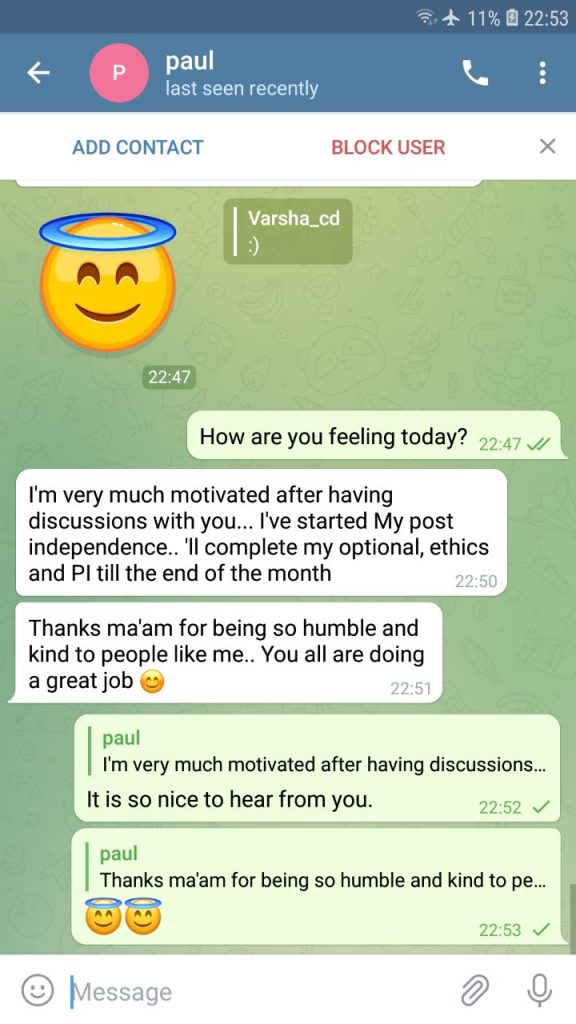
    This image has an empty alt attribute; its file name is 50f70a4d-c239-44a5-b49b-9b93617a378f-461x1024.jpg

    All of them dedicate their time weekly to give 1-on-1 mentorship to every student where they discuss last week’s performance and next week’s approach.

    Be it Telegram, Whatsapp or Habitiat channels, they are always available and clear student’s doubts in a turnaround time of 24 Hours.

    Why Civilsdaily Mentors are the GPS for Your UPSC-CSE Preparation

    Remember there is always light at the end of the tunnel and if you want to get out of the tunnel you have to follow the direction of the light! Our mentors’ give you direction which is divided into daily modules. All you have to do is study and complete them on time.

    See the source image

    As every year passes by, we don’t get confident by the previous years’ performance and become laidback. Instead, we become more hungry to convert all our students into toppers.

    How are Current Civilsdaily Students Gearing up for UPSC-CSE 2022?

    Initially, our Civilsdaily student Smriti wasn’t confident about Prelims when she began her preparation. Though she had joined Civilsdaily in 2020, she started studying for UPSC-CSE back in 2019. At that time, Smriti had enrolled in multiple institutes. Though, most of these institutes had promised a personal mentor, she was unable to get in touch with them on a daily basis. Also those mentors never scheduled test-series on a weekly basis. Hence, despite preparing for a year, Smriti had scored only 35 marks out of 200 in her first test series by Civilsdaily.

    She then started writing 20-25 test series over the course of UAP 2021 and in her last test, her scores have drastically improved. She now scores in the range of 130-135 marks in prelims’ and 110+ in mains’ papers.

    In Smriti’s own words she describes her Samanvaya Mentorship Experience to be —

    Our parents provide us financial and emotional support, friends provide us moral support and the right mentor gives you logistic and logical support for UPSC. There are days when I felt I won’t be able to compete against lakhs of aspirants. That’s when my mentor, Ravi sir reminded me of my improvement and encouraged me that I can crack it with the same consistency. We need someone, who tells us we are performing well especially when we cannot see that ourselves. The mentorship at Civilsdaily helped me become mentally stronger as a person. In other institutes, mentors are allotted only for doubt resolution. But at Civilsdaily, I am getting end-to-end mentorship via value added notes, classes, test series and detailed evaluation.”

    Similarly our another Civilsdaily student, Ashish sums up his Samanvaya experience with Civilsdaily mentor, Pravin Sir, “Because of Pravin sir’s support, I am able to understand a topic in lesser time.”

    This image has an empty alt attribute; its file name is ashish.jpg

    This is how Pravin sir evaluates Ashish’s Mains Test Series every week. After every test series evaluation, Pravin sir schedules a 1 hour call to discuss how Ashish can improve his marks and the sources he can refer for key topics.

    It’s Your Turn Get the Free 40 Min Counselling Session By a CD Mentor

    Civilsdaily mentors are so dedicated, consistent and focused for your UPSC goal, that you will eventually become focused into turning your dreams to reality.

    This image has an empty alt attribute; its file name is a2d57403-4c49-462b-8459-b15e690ea928-1-461x1024.jpg

    At the core of Civilsdaily UPSC mentorship, lies the fact that each one of you will have a unique journey while preparing for the exam. Some will get through on the first attempt without much effort while others will take both more time and more effort.

    We want to understand you better to help you optimize your journey so you can focus on the right things and not waste time on the wrong ones. We are asking you to tap into the valuable experiences of mentors who underwent the same grind and realize the pitfalls and understand the shortcuts to make it.

    In the first counselling session, we will understand your weaknesses. We then help you to stick to one plan or strategy throughout your preparation. We will then follow up with you on a daily basis to check if you are right on track. To get an idea of how your 1st 1-on-1 mentorship will look like, watch this sample video —

    This image has an empty alt attribute; its file name is photo1627364370-1024x1024.jpeg
    This image has an empty alt attribute; its file name is AAJ-.jpeg

  • India-Japan friendship can help global peace, prosperity

    Context

    The year 2022 marks the 70th anniversary of the establishment of diplomatic relations between Japan and India.

    Historical background of India-Japan relationship

    • We have a long history of people-to-people exchanges that can be traced back to the sixth century.
    • Buddhism was brought to Japan and, in 752.
    • During Meiji Restoration in the late 19th Century — Japan needed natural resources to modernise its industry.
    • Many Japanese travelled to India to purchase cotton, iron ore, etc.
    • Formal relations between Japan and India began in 1952.
    • After the Second World War, instead of signing the multilateral San Francisco Peace Treaty, India opted for concluding a bilateral peace treaty with Japan, considering that honour and equality should be ensured for Japan to rejoin the international community.
    • But even before the establishment of diplomatic relations, the goodwill between the people of the two countries was deeply rooted through business, academic and cultural exchanges.
    • After 70 years of multi-layered exchanges, the relationship between our two countries grew into a “Special Strategic and Global Partnership”. 

    Future possibilities

    [1] As democratic countries, contribute to global peace and prosperity

    • As democratic countries in Asia, India and Japan can cooperate to contribute to global peace and prosperity.
    • We share political, economic and strategic interests based on the firm foundations of common values and traditions.
    • We are continuing our efforts to build a rules-based free and open international order.

    [2] Cooperation in security

    • There are a plethora of fields that we can cooperate in security issues including cyber security, outer space and economic security.

    [3] Augmenting economic relations

    •  For long, Japan has been the largest ODA (Official Development Assistance) donor to India.
    • One of the most recent and ongoing examples of our collaboration is the Mumbai-Ahmedabad High-Speed Rail project.
    • Japan is also one of the largest investors in India.
    • Both countries have also promoted economic cooperation in other countries to enhance social infrastructure and connectivity.
    • Our economic partnership can further strengthen the economy of the Indo-Pacific, as well as the world economy.

    [4] Cultural exchange

    • Cultural exchanges including literature, movies, music, sports and academics are essential for our relations, enabling a better understanding.

    Consider the question “The year 2022 marks the 70th anniversary of the establishment of diplomatic relations between Japan and India. The future offers enormous possibilities for the partnership. In context of this, examine the future possibilities the two countries can explore.” 

    Conclusion

    India-Japan ties will continue to flourish. Our long history substantiates that.

    UPSC 2022 countdown has begun! Get your personal guidance plan now! (Click here)


    Meiji Restoration in Japan

    • In Japanese history, the political revolution in 1868 that brought about the final demise of the Tokugawa shogunate (military government)—thus ending the Edo (Tokugawa) period (1603–1867)—and, at least nominally, returned control of the country to direct imperial rule under Mutsuhito (the emperor Meiji).
    • In a wider context, however, the Meiji Restoration of 1868 came to be identified with the subsequent era of major political, economic, and social change—the Meiji period (1868–1912)—that brought about the modernization and Westernization of the country.
  • [Burning Issue] Women and the military

    UPSC 2022 countdown has begun! Get your personal guidance plan now! (Click here)

    The position of women in the armed forces, which is described as a male-dominated establishment generally, offers a limited window for any kind of change in the role of women in occupational and bureaucratic structures. However, breaking the glass ceiling, two women officers have been selected to train as helicopter pilots at Combat Army Training School, Nashik. Till now, women officers were only limited to performing ground duties in the Army Aviation Corps.

    The Supreme Court last year ruled that women could serve as army commanders further granting permanent commission and promotions equal to their male counterparts. 

    India’s women in uniform: A timeline

    • The role of women in the Indian Army began in 1888 when the ‘Indian Military Nursing Service’ was formed during the British Raj.
    • During 1914-45, British Indian Army nurses fought in World War I (1914–18) and World War II (1939-45), where 350 nurses either died or were taken prisoner of war or declared missing in action.
    • But it was only in 1992 that the organisation opened doors and started inducting women in non-medical roles. In 2015, India also opened new combat air force roles for women as fighter pilots.
    • During 1914-45, British Indian Army nurses fought in World War I (1914–18) and World War II (1939-45), where 350 nurses either died or were taken prisoner of war or declared missing in action.
    • However, despite all these developments, the women in the Indian armed forces that constitute 3% of the Indian army are still not allowed to be a part of the active combat.
    • Since 2008, women were inducted as permanent commissioned officers in the legal and education corps and as permanent commissioned officers in eight more non-combative corps in 2020.

    A timeline of women’s inductions into the military –

    YearServiceBranches that opened up for women
    1991NavyEducation, Logistics and Law Cadre of Executive Branch
    1992ArmyArmy Service Corps, Army Ordnance Corps, Army Education Corps, Judge Advocate General Branch
    1993NavyAir Traffic Controller
    1994Air ForceTransport and helicopter pilots
    1996ArmyEngineers, Signals, Intelligence, Electrical and Mechanical Engineering branches opened up for women.
    2001NavyNaval Constructor Cadre of Engineering Branch
    2008ArmyWomen became eligible for Permanent Commission in Army Education Corps and Judge Advocate General Department
    2008NavyObservers
    2015Air ForceFighter pilots

    Present context

    • The Supreme Court on Tuesday asked the Union government to explain the admission of merely 19 women in the prestigious National Defence Academy (NDA) for 2022.
    • The court also asked the Centre to place the figures on record the total number of candidates, including women, who appeared in the NDA, Rashtriya Indian Military College (RIMC) and Rashtriya Military School (RMS) entrance tests.
    • The NDA exam was held and 8,009 candidates qualified for the Service Selection Board test as also medical tests, out of which 1,002 candidates were women and 7,007 men.

    Supreme Court’s ruling to grant Permanent Commission (PC) to women officers

    • In 2020, the Supreme Court upheld the right of serving Short Service Commission (SSC) women officers of the Navy to be granted Permanent Commission (PC) on a par with their male counterparts.
    • The Court has directed that SSC women officers found suitable for the grant of PC shall be entitled to all consequential benefits, including arrears of pay, promotions and retirement benefits as and when due.
    • All serving women SSC officers in at least seven wings, including the executive, engineering, electrical, education, law and logistics, will be eligible to apply.
    • The grant of PCs will be subject to: (i) availability of vacancies in the stabilized cadre; (ii) Suitability of the candidate; and (iii) recommendation by the chief of Naval Staff.

    Women in Uniform: A global scan

    India has limited experience as regards the induction of women in the armed forces. The first batch had joined in 1992. Therefore, our knowledge of the complexities and long-term effects of the issues involved is highly limited.

    On the other hand, women have been serving in the militaries of developed countries for a long time. These countries have acquired a deep understanding of all the issues involved.

    Let’s have a look:

    United States

    • The United States is considered a pioneer and a trend-setter as regards induction of women in the services.
    • There are approximately 200,000 American women on active duty in the US armed forces. They constitute nearly 20 percent of its strength.
    • Women are also participating in Iraq operations in large numbers, albeit in support functions as they are forbidden to be placed in direct ground combat with enemy. They, however, are assigned ‘combat support’ duties on voluntary basis.
    • Prior to November 1975, if women became pregnant, they were given the option to terminate pregnancy or seek discharge.
    • A number of important steps were initiated during President Clinton’s time. Women were permitted to join as combat aircraft pilots and could also be assigned for prolonged duty on combat naval ships. The scope of combat-risk assignments for women was redefined to open additional appointments to them.

    Israel

    • Though Israel has conscription for women (as well as men), a large number of them are exempted for various reasons.
    • Women are generally not allotted active battle field duties. They serve in many technical and administrative posts to release men for active duty.
    • Although they make excellent instructors as well, most women occupy lower and middle level appointments. Only a handful reaches senior ranks.

    Other Countries

    • In the Australian Army, women are still not allowed in the field/battle. In Russia, women generally serve in nursing, communications and logistic support functions.
    • Like all Islamic states, Pakistan does not permit women in the armed forces. It is feared that women would create distraction and cause disruption of internal order.
    • There is also a great deal of concern for the safety of women from the organisational environment itself.

    Why males have ever dominated the armed forces?

    • Militaries across the world help entrench hegemonic masculine notions of aggressiveness, strength and heterosexual prowess in and outside their barracks.
    • The military training focuses on creating new bonds of brotherhood and camaraderie between them based on militarised masculinity.
    • This temperament is considered in order to enable conscripts to survive the tough conditions of military life and to be able to kill without guilt.
    • To create these new bonds, militaries construct a racial, sexual, gendered “other”, attributes of whom the soldier must routinely and emphatically reject.

    Dimensions of the Issue

    Indeed, the court’s strong statements against the gender stereotypes employed by the government come as a welcome relief. Equally, ensuring that women can hold permanent commissions in the army recognizes the equal effort and service that they put in.

    • Gender is not a hindrance: As long as an applicant is qualified for a position, one’s gender is arbitrary. It is easy to recruit and deploy women who are in better shape than many men sent into combat.
    • Military Readiness: Allowing a mixed-gender force keeps the military strong. The armed forces are severely troubled by falling retention and recruitment rates. This can be addressed by allowing women in the combat role.
    • Effectiveness: The blanket restriction for women limits the ability of commanders in theatre to pick the most capable person for the job.
    • Tradition: Training will be required to facilitate the integration of women into combat units. Cultures change over time and the masculine subculture can evolve too.
    • Cultural Differences & Demographics: Women are more effective in some circumstances than men. Allowing women to serve doubles the talent pool for delicate and sensitive jobs that require interpersonal skills, not every soldier has.

    The road is not so simple

    Capabilities of women

    • The Centre states that although women are equally capable, if not more capable than men, there might be situations that could affect the capabilities of women such as absence during pregnancy and catering to the responsibilities of motherhood, etc. 
    • The arguments are presented on the basis that a role in combat would require tough training, whereas the current training for women is different and at a much lower level than that of their male counterparts.
    • However, Lieutenant Colonel Mitali Madhumita and IAF squad leader Minty Agarwal are examples of women who stand as a testament to the capabilities of women in commanding positions.

    Adjusting with the masculine setup

    • To then simply add women to this existing patriarchal setup, without challenging the notions of masculinity, can hardly be seen as “gender advancement”.
    • In fact, in order to succeed within the army, women are forced to deride their femininity and work harder than men to establish parity in the eyes of their counterparts.
    • They are forced to blend in while standing out for their exceptional work in order to be taken seriously.

    Fear of sexual misconduct

    • This superficial approach to gender equality defines parity solely based on the opportunity to participate hence fails to address several fallouts most notable of which is sexual harassment and abuse.
    • Sexual harassment faced by women military officers is a global phenomenon which remains largely unaddressed, and women often face retaliation when they do complain.
    • Extensive and rigorous data on the pervasiveness of sexual harassment in the Indian armed forces is not available.
    • However, a relatively small 2015 study, which questioned 450 members of the armed forces on sexual discrimination in their workplace, found that sexual harassment is rampant in the military.

    Gender progressiveness could be an illusion

    • In reality, there are several factors behind the decision to include women in the forces, including using the illusion of gender progressiveness within the army to shame populations for their gender inequities, brand them as backwards and use this to justify military control.
    • Women’s inclusion is criticized as just another manoeuvre to camouflage women’s subjugation and service as women’s liberation.

    Battle of ‘Acceptance’

    • The only way to command is to show the lower ranks that the orders are fair and just, both in spirit and action.
    • Acceptance of women in the military has not been smooth in any country. Every country has to contend with sceptics who consider it to be a counterproductive programme.
    • They tend to view it as a political gimmick to flaunt sexual equality, or, at best, a necessary liability.
    • Additionally, every country has to mould the attitude of its society at large and male soldiers in particular to enhance acceptability of women in the military.
    • For trained soldiers “acceptance” is not an option; they have undergone rigorous regimentation to accept orders from the command.

    Job Satisfaction

    • Most women feel that their competence is not given due recognition. Seniors tend to be over-indulgent without valuing their views.
    • They are generally marginalised and not involved in any major decision-making. They have to work twice as hard as men to prove their worth. Additionally, a woman is always under scrutiny for even minor slip-ups.
    • Many women complain that despite their technical qualifications, they are generally detailed for perceived women-like jobs. Either they get routine desk work or are asked to perform duties related to social minutiae.

    Doubts about Role Definition

    • The profession of arms is all about violence and brutality. To kill another human is not moral but soldiers are trained to kill.
    • They tend to acquire a streak of raw ruthlessness and coarseness. This makes the environment highly non-conducive and rough for women.
    • Women, in general, are confused about the way they should conduct themselves. If they behave lady-like, their acceptance amongst male colleagues is low.
    • On the other hand, their active participation in casual repartee carries the danger of their losing colleagues’ respect.

    Societal Impact

    • The government has argued that if a woman is taken captive by insurgents/terrorists or as a Prisoner of War (PoW) by an enemy state, then it would become an international and deeply emotive issue which could have an impact on the society.
    • However, times have changed and this cannot be a valid reason for denying command roles and permanent commission to women.

    Physical and Physiological Issues

    • The natural physical differences in stature, strength, and body composition between the sexes make women more vulnerable to certain types of injuries and medical problems.
    • The vigorous training might also have an effect on the health of women officers.
    • The natural processes of menstruation and pregnancy make women particularly vulnerable in combat situations.
    • Such positions usually leave the commanding officer with no privacy and during adverse situations, the lack of sanitation can have an impact on their health.

    Comfort Level

    • Most women accepted the fact that their presence amongst males tends to make the environment ‘formal and stiff’.
    • The mutual comfort level between men and women colleagues is often very low.
    • Men miss their light-hearted banter which is considered essential to release work tensions and promote group cohesion. They consider women to be intruding on their privacy.

    Whose concern is National Security…

    Many defense analysts are disgusted with the ongoing emulsive debate incorporating issues of national security with gender justice. Few of their opinion are discussed as under:

    • The recent debate about the entry of women officers in the armed forces has been highly ill- informed and subjective in nature.
    • People have taken stands and expressed opinion without analysing the matter in its entirety. It is imprudent to consider it as an issue of equality of sexes or gender bias or even women’s liberation.
    • It is also not a question of conquering the so-called ‘last male bastion’.
    • That would amount to trifling a matter that concerns the well-being and the war-potential of a nation’s armed forces.
    • Armed forces have been constituted with the sole purpose of ensuring defence of the country and all policy decisions should be guided by this overriding factor.
    • All matters concerning defence of the country have to be considered in a dispassionate manner.
    • No decision should be taken which even remotely affects the cohesiveness and efficiency of the military. Concern for equality of sexes or political expediency should not influence defence policies.

    Way Forward

     Defense readiness is one major aspect which is required to be borne in mind throughout while considering their employability options. The career aspects and opportunities for women need to be viewed holistically keeping the final aim in focus.

    • Misleading information such as using the patriarchal nature of the society as an excuse to deny women their deserving opportunities should be stopped. India has come a long way, and society should be supportive of women being inducted in to combat roles. 
    • So far combatant roles are concerned, an all-women combat squadron should be designed and studied extensively before any further development or decisions are made.
    • The training provided to men and women should be similar to eliminate differentiation on the basis of physical standards.
    • It is the responsibility of the Government to create both administrative and social infrastructure for the easy induction of women into the Armed Forces. Administrative issues should not be cited as a barrier to women’s entry in the Armed Forces.
    • The framework for the induction of women should be incorporated into a policy. As for the concern of preserving the female officers’ modesty and dignity, there should be elaborate codes of conduct to ensure no adverse incident occurs.

    Finally, no decision should be taken which even remotely affects the cohesiveness and efficiency of the military. Concern for equality of sexes or political expediency should not influence defense policies.

    UPSC 2022 countdown has begun! Get your personal guidance plan now! (Click here)

  • How to Prepare for UPSC 2023 with the Right Mindset, Laser Sharp Focus, Foolproof Strategy, Simple yet Effective Schedule & Limited Study Sources? || How to Revise atleast 5 times before UPSC-2023 Exams?|| Fill Samanvaya Free 1-on-1 Mentorship To Get a Headstart

    UPSC-CSE 2021 results have shaken the long held belief that the examination can only be cleared after multiple attempts. Most of the UPSC-CSE toppers like Satyam Gandhi (AIR 10), Ria Dabi (AIR 15), Yash Jaluka (AIR 4), Mamta Yadav (AIR 5) and Shashwat Tripurari (AIR 19) cleared the exam as fresh graduates in their very first attempt. How were they able to do it?

    If you watch their strategy videos, you can find a common pattern — they started 12-24 months in advance before the exam.

    Let’s Start 2023 UPSC Preparation Right Now in the Right Direction

    One of the benefits of starting your preparation early is the time you would get to revise and practice test series upon completing the syllabus. Also, you would get ample time to pay attention to every subject. There are totally 9 papers in UPSC-CSE Mains and 2 papers in Prelims exams. Not to forget, the daily current affairs. Many aspirants need time to figure out how they can prepare in an understandable manner. That’s why starting your preparation eight months before the exam is not advisable.

    However, what’s the best way to prepare, if you aren’t a fan of making mistakes and figuring it out along the way? We understand how annoying it might be for you if you were to study in a certain way for months together and then realize that it doesn’t align with the UPSC-CSE way of doing things.

    Do you know an ideal preparation would be divided into five phases and spread across 18 months? This means each phase will be about three to four months long.

    Want to know how you can make each phase count? Want to know how you can revise 5-6 times before UPSC-2023? Then, fill the form below and a veteran Civilsdaily mentor will get in touch with you for a free 1-on-1 counselling session in the next 24 hours.

    What will be Addressed in Your Free 1-on-1 Counselling Session?

    1. The first phase – Studying the Core Subjects. How to read every topic in the syllabus from 2-3 sources in the first reading and prepare a 1-2 page notes? And in your second reading, stick to only one source while using your notes as reference.

    2. The second phase – Studying Mains Specific Subjects & Optional. How to follow the ritual of reading, writing summaries and answering topic-wise previous year questions?

    3. Discussing 2-3 Revision Strategies which you can follow. Why should you not go more than 20 days without revision?

    4. Live demonstration of making the perfect notes. How to not copy line-by-line of everything you read & only note down the 5 dimensions of a topic?

    5. Why is the third phase of preparation the shortest of all? What should you ideally do after completing the Prelims and Mains subjects?

    6. About the fourth phase. How to improve your accuracy 3 months before the Prelims exams?

    5. The last phase. What must be done 3 months before the Mains exams?

    6. Including statistics and relevant data. What are the subject-wise important committee reports you should read?

    7. Three readings per subject. How do you study during each revision phase?

    How does Samanvaya, Free 1-on-1 Mentorship help you clear UPSC 2023 in one shot?

    Our philosophy behind MENTORSHIP is to get you out of this Snooze cycle. This ensures that you are the BEST VERSION of yourself in this journey. If you are under the impression that mentorship is weekly calls you attend, then you are mistaken, my friend. Trust us, your mentor will be your ‘FRIEND, PHILOSOPHER AND GUIDE’.

    TO EACH THEIR OWN – Every aspirant is different. Their strengths and weaknesses are different. Their time availability is also different. Identifying this is important so you don’t end up making unrealistic targets and lose momentum. Your mentor will make sure you start slow but remain consistent to build your confidence. Making your schedule structured based on our experience of working with 2500+ students is our first priority. 

    TRACK YOUR PROGRESS – When you see yourself grow, it becomes easier to motivate yourself to push boundaries. Tracking your progress can happen in many ways like mentorship calls or chat sessions or by regular tests. The idea is to ensure that you don’t go off track in your preparation, and even if you do, we have your back.

    EVOLUTION – A constant guidance is important to bring consistency to your UPSC preparation. Guidance is not about clearing your doubts or asking you to study when you don’t. It is also about the evolution of your preparation. This is where you and your mentor work as a team. A constant effort to PLAN AND BUILD UP YOUR ABILITY to learn in a faster and more efficient way.RECEIVE PERSONAL GUIDANCE FOR UPSC (REGISTER HERE)

    TALK IT OUT – The biggest hurdle in achieving your highest level of consistency is the emotional part. Every now and then, you. surround yourself with negative thoughts, you feel scared and depressed. Instead of resolving these emotional issues, you avoid them as it seems like a waste of your precious time. You have to understand that ignoring emotional troubles does not solve them. What your doing is building an emotional time bomb that may burst a week before your mains or prelims! This is where your MENTOR AS A FRIEND comes in. All our mentors have been through this journey. We understand your fears and anxieties. So, TALK IT OUT.

    Don’t let inconsistency keep you away from your dreams.

    Fill up the SAMANVAYA form given below. Let us know your problems and we will find a solution to it, just like our students say ” TOGETHER WE CAN AND WE WILL”.

    How has Civilsdaily Mentorship, helped Aspirants become Toppers?

    The most difficult challenge faced by EVERY candidate is inconsistency. Be it inconsistency in studies, answer-writing practice, covering the syllabus, or revision, every candidate finds it difficult to cope with. But how do successful candidates manage to FIGHT Inconsistency so consistently?

    In UPSC 2020, Civilsdaily helped 80+ students secure ranks in their exams. In the top 100, every 3rd ranker was a Civilsdaily student.

     A very recent success story would be Vishwa Shah, student of Civilsdaily Mentor, Sukanya Ma’am. Vishwa has cleared the GPSC exam to become the Deputy Superintendent of Police in Gujarat. He has penned a thank-you note yesterday. Heartiest Congratulations to Vishwa!

    One of our other Civilsdaily Student, Shubham Nagargoje cleared the exams in 2020 to become an IPS Officer. Shubham was gracious enough to let us know how he felt about Civilsdaily Samanvaya Guidance under Parth sir.

    To know how all of them cleared the exam with our mentorship, visit the Unherd Podcast.

    Now that results are announced for UPSC 2021 Prelims, out of 15 out of 25 students of Santhosh Gupta sir have been recommended to Mains. One such student, Rahul expresses his gratitude and extends his appreciation.

    Most of our Mentors like Sudhanshu sir, Sajal sir, Santhosh sir, Pravin sir, Parth Verma sir and Sukanya Ma’am were UPSC aspirants themselves and have attended UPSC Mains more than five times and UPSC Interview more than twice. Hence their mentorship is always a blend of the best test series, comprehensive notes and current affairs knowledge.

    This image has an empty alt attribute; its file name is 50f70a4d-c239-44a5-b49b-9b93617a378f-461x1024.jpg

    All of them dedicate their time weekly to give 1-on-1 mentorship to every student where they discuss last week’s performance and next week’s approach.

    Be it Telegram, Whatsapp or Habitiat channels, they are always available and clear student’s doubts in a turnaround time of 24 Hours.

    Why Civilsdaily Mentors are the GPS for Your UPSC-CSE Preparation

    Remember there is always light at the end of the tunnel and if you want to get out of the tunnel you have to follow the direction of the light! Our mentors’ give you direction which is divided into daily modules. All you have to do is study and complete them on time.

    See the source image

    As every year passes by, we don’t get confident by the previous years’ performance and become laidback. Instead, we become more hungry to convert all our students into toppers.

    How are Current Civilsdaily Students Gearing up for UPSC-CSE 2022?

    Initially, our Civilsdaily student Smriti wasn’t confident about Prelims when she began her preparation. Though she had joined Civilsdaily in 2020, she started studying for UPSC-CSE back in 2019. At that time, Smriti had enrolled in multiple institutes. Though, most of these institutes had promised a personal mentor, she was unable to get in touch with them on a daily basis. Also those mentors never scheduled test-series on a weekly basis. Hence, despite preparing for a year, Smriti had scored only 35 marks out of 200 in her first test series by Civilsdaily.

    She then started writing 20-25 test series over the course of UAP 2021 and in her last test, her scores have drastically improved. She now scores in the range of 130-135 marks in prelims’ and 110+ in mains’ papers.

    In Smriti’s own words she describes her Samanvaya Mentorship Experience to be —

    Our parents provide us financial and emotional support, friends provide us moral support and the right mentor gives you logistic and logical support for UPSC. There are days when I felt I won’t be able to compete against lakhs of aspirants. That’s when my mentor, Ravi sir reminded me of my improvement and encouraged me that I can crack it with the same consistency. We need someone, who tells us we are performing well especially when we cannot see that ourselves. The mentorship at Civilsdaily helped me become mentally stronger as a person. In other institutes, mentors are allotted only for doubt resolution. But at Civilsdaily, I am getting end-to-end mentorship via value added notes, classes, test series and detailed evaluation.”

    Similarly our another Civilsdaily student, Ashish sums up his Samanvaya experience with Civilsdaily mentor, Pravin Sir, “Because of Pravin sir’s support, I am able to understand a topic in lesser time.”

    This image has an empty alt attribute; its file name is ashish.jpg

    This is how Pravin sir evaluates Ashish’s Mains Test Series every week. After every test series evaluation, Pravin sir schedules a 1 hour call to discuss how Ashish can improve his marks and the sources he can refer for key topics.

    It’s Your Turn Get the Free 40 Min Counselling Session By a CD Mentor

    Civilsdaily mentors are so dedicated, consistent and focused for your UPSC goal, that you will eventually become focused into turning your dreams to reality.

    This image has an empty alt attribute; its file name is a2d57403-4c49-462b-8459-b15e690ea928-1-461x1024.jpg

    At the core of Civilsdaily UPSC mentorship, lies the fact that each one of you will have a unique journey while preparing for the exam. Some will get through on the first attempt without much effort while others will take both more time and more effort.

    We want to understand you better to help you optimize your journey so you can focus on the right things and not waste time on the wrong ones. We are asking you to tap into the valuable experiences of mentors who underwent the same grind and realize the pitfalls and understand the shortcuts to make it.

    In the first counselling session, we will understand your weaknesses. We then help you to stick to one plan or strategy throughout your preparation. We will then follow up with you on a daily basis to check if you are right on track. To get an idea of how your 1st 1-on-1 mentorship will look like, watch this sample video —

    This image has an empty alt attribute; its file name is photo1627364370-1024x1024.jpeg
    This image has an empty alt attribute; its file name is AAJ-.jpeg

  • How to Prepare for UPSC 2023 with the Right Mindset, Laser Sharp Focus, Foolproof Strategy, Simple yet Effective Schedule & Limited Study Sources? || How to Revise atleast 5 times before UPSC-2023 Exams?|| Fill Samanvaya Free 1-on-1 Mentorship To Get a Headstart

    UPSC-CSE 2021 results have shaken the long held belief that the examination can only be cleared after multiple attempts. Most of the UPSC-CSE toppers like Satyam Gandhi (AIR 10), Ria Dabi (AIR 15), Yash Jaluka (AIR 4), Mamta Yadav (AIR 5) and Shashwat Tripurari (AIR 19) cleared the exam as fresh graduates in their very first attempt. How were they able to do it?

    If you watch their strategy videos, you can find a common pattern — they started 12-24 months in advance before the exam.

    Let’s Start 2023 UPSC Preparation Right Now in the Right Direction

    One of the benefits of starting your preparation early is the time you would get to revise and practice test series upon completing the syllabus. Also, you would get ample time to pay attention to every subject. There are totally 9 papers in UPSC-CSE Mains and 2 papers in Prelims exams. Not to forget, the daily current affairs. Many aspirants need time to figure out how they can prepare in an understandable manner. That’s why starting your preparation eight months before the exam is not advisable.

    However, what’s the best way to prepare, if you aren’t a fan of making mistakes and figuring it out along the way? We understand how annoying it might be for you if you were to study in a certain way for months together and then realize that it doesn’t align with the UPSC-CSE way of doing things.

    Do you know an ideal preparation would be divided into five phases and spread across 18 months? This means each phase will be about three to four months long.

    Want to know how you can make each phase count? Want to know how you can revise 5-6 times before UPSC-2023? Then, fill the form below and a veteran Civilsdaily mentor will get in touch with you for a free 1-on-1 counselling session in the next 24 hours.

    What will be Addressed in Your Free 1-on-1 Counselling Session?

    1. The first phase – Studying the Core Subjects. How to read every topic in the syllabus from 2-3 sources in the first reading and prepare a 1-2 page notes? And in your second reading, stick to only one source while using your notes as reference.

    2. The second phase – Studying Mains Specific Subjects & Optional. How to follow the ritual of reading, writing summaries and answering topic-wise previous year questions?

    3. Discussing 2-3 Revision Strategies which you can follow. Why should you not go more than 20 days without revision?

    4. Live demonstration of making the perfect notes. How to not copy line-by-line of everything you read & only note down the 5 dimensions of a topic?

    5. Why is the third phase of preparation the shortest of all? What should you ideally do after completing the Prelims and Mains subjects?

    6. About the fourth phase. How to improve your accuracy 3 months before the Prelims exams?

    5. The last phase. What must be done 3 months before the Mains exams?

    6. Including statistics and relevant data. What are the subject-wise important committee reports you should read?

    7. Three readings per subject. How do you study during each revision phase?

    How does Samanvaya, Free 1-on-1 Mentorship help you clear UPSC 2023 in one shot?

    Our philosophy behind MENTORSHIP is to get you out of this Snooze cycle. This ensures that you are the BEST VERSION of yourself in this journey. If you are under the impression that mentorship is weekly calls you attend, then you are mistaken, my friend. Trust us, your mentor will be your ‘FRIEND, PHILOSOPHER AND GUIDE’.

    TO EACH THEIR OWN – Every aspirant is different. Their strengths and weaknesses are different. Their time availability is also different. Identifying this is important so you don’t end up making unrealistic targets and lose momentum. Your mentor will make sure you start slow but remain consistent to build your confidence. Making your schedule structured based on our experience of working with 2500+ students is our first priority. 

    TRACK YOUR PROGRESS – When you see yourself grow, it becomes easier to motivate yourself to push boundaries. Tracking your progress can happen in many ways like mentorship calls or chat sessions or by regular tests. The idea is to ensure that you don’t go off track in your preparation, and even if you do, we have your back.

    EVOLUTION – A constant guidance is important to bring consistency to your UPSC preparation. Guidance is not about clearing your doubts or asking you to study when you don’t. It is also about the evolution of your preparation. This is where you and your mentor work as a team. A constant effort to PLAN AND BUILD UP YOUR ABILITY to learn in a faster and more efficient way.RECEIVE PERSONAL GUIDANCE FOR UPSC (REGISTER HERE)

    TALK IT OUT – The biggest hurdle in achieving your highest level of consistency is the emotional part. Every now and then, you. surround yourself with negative thoughts, you feel scared and depressed. Instead of resolving these emotional issues, you avoid them as it seems like a waste of your precious time. You have to understand that ignoring emotional troubles does not solve them. What your doing is building an emotional time bomb that may burst a week before your mains or prelims! This is where your MENTOR AS A FRIEND comes in. All our mentors have been through this journey. We understand your fears and anxieties. So, TALK IT OUT.

    Don’t let inconsistency keep you away from your dreams.

    Fill up the SAMANVAYA form given below. Let us know your problems and we will find a solution to it, just like our students say ” TOGETHER WE CAN AND WE WILL”.

    How has Civilsdaily Mentorship, helped Aspirants become Toppers?

    The most difficult challenge faced by EVERY candidate is inconsistency. Be it inconsistency in studies, answer-writing practice, covering the syllabus, or revision, every candidate finds it difficult to cope with. But how do successful candidates manage to FIGHT Inconsistency so consistently?

    In UPSC 2020, Civilsdaily helped 80+ students secure ranks in their exams. In the top 100, every 3rd ranker was a Civilsdaily student.

     A very recent success story would be Vishwa Shah, student of Civilsdaily Mentor, Sukanya Ma’am. Vishwa has cleared the GPSC exam to become the Deputy Superintendent of Police in Gujarat. He has penned a thank-you note yesterday. Heartiest Congratulations to Vishwa!

    One of our other Civilsdaily Student, Shubham Nagargoje cleared the exams in 2020 to become an IPS Officer. Shubham was gracious enough to let us know how he felt about Civilsdaily Samanvaya Guidance under Parth sir.

    To know how all of them cleared the exam with our mentorship, visit the Unherd Podcast.

    Now that results are announced for UPSC 2021 Prelims, out of 15 out of 25 students of Santhosh Gupta sir have been recommended to Mains. One such student, Rahul expresses his gratitude and extends his appreciation.

    Most of our Mentors like Sudhanshu sir, Sajal sir, Santhosh sir, Pravin sir, Parth Verma sir and Sukanya Ma’am were UPSC aspirants themselves and have attended UPSC Mains more than five times and UPSC Interview more than twice. Hence their mentorship is always a blend of the best test series, comprehensive notes and current affairs knowledge.

    This image has an empty alt attribute; its file name is 50f70a4d-c239-44a5-b49b-9b93617a378f-461x1024.jpg

    All of them dedicate their time weekly to give 1-on-1 mentorship to every student where they discuss last week’s performance and next week’s approach.

    Be it Telegram, Whatsapp or Habitiat channels, they are always available and clear student’s doubts in a turnaround time of 24 Hours.

    Why Civilsdaily Mentors are the GPS for Your UPSC-CSE Preparation

    Remember there is always light at the end of the tunnel and if you want to get out of the tunnel you have to follow the direction of the light! Our mentors’ give you direction which is divided into daily modules. All you have to do is study and complete them on time.

    See the source image

    As every year passes by, we don’t get confident by the previous years’ performance and become laidback. Instead, we become more hungry to convert all our students into toppers.

    How are Current Civilsdaily Students Gearing up for UPSC-CSE 2022?

    Initially, our Civilsdaily student Smriti wasn’t confident about Prelims when she began her preparation. Though she had joined Civilsdaily in 2020, she started studying for UPSC-CSE back in 2019. At that time, Smriti had enrolled in multiple institutes. Though, most of these institutes had promised a personal mentor, she was unable to get in touch with them on a daily basis. Also those mentors never scheduled test-series on a weekly basis. Hence, despite preparing for a year, Smriti had scored only 35 marks out of 200 in her first test series by Civilsdaily.

    She then started writing 20-25 test series over the course of UAP 2021 and in her last test, her scores have drastically improved. She now scores in the range of 130-135 marks in prelims’ and 110+ in mains’ papers.

    In Smriti’s own words she describes her Samanvaya Mentorship Experience to be —

    Our parents provide us financial and emotional support, friends provide us moral support and the right mentor gives you logistic and logical support for UPSC. There are days when I felt I won’t be able to compete against lakhs of aspirants. That’s when my mentor, Ravi sir reminded me of my improvement and encouraged me that I can crack it with the same consistency. We need someone, who tells us we are performing well especially when we cannot see that ourselves. The mentorship at Civilsdaily helped me become mentally stronger as a person. In other institutes, mentors are allotted only for doubt resolution. But at Civilsdaily, I am getting end-to-end mentorship via value added notes, classes, test series and detailed evaluation.”

    Similarly our another Civilsdaily student, Ashish sums up his Samanvaya experience with Civilsdaily mentor, Pravin Sir, “Because of Pravin sir’s support, I am able to understand a topic in lesser time.”

    This image has an empty alt attribute; its file name is ashish.jpg

    This is how Pravin sir evaluates Ashish’s Mains Test Series every week. After every test series evaluation, Pravin sir schedules a 1 hour call to discuss how Ashish can improve his marks and the sources he can refer for key topics.

    It’s Your Turn Get the Free 40 Min Counselling Session By a CD Mentor

    Civilsdaily mentors are so dedicated, consistent and focused for your UPSC goal, that you will eventually become focused into turning your dreams to reality.

    This image has an empty alt attribute; its file name is a2d57403-4c49-462b-8459-b15e690ea928-1-461x1024.jpg

    At the core of Civilsdaily UPSC mentorship, lies the fact that each one of you will have a unique journey while preparing for the exam. Some will get through on the first attempt without much effort while others will take both more time and more effort.

    We want to understand you better to help you optimize your journey so you can focus on the right things and not waste time on the wrong ones. We are asking you to tap into the valuable experiences of mentors who underwent the same grind and realize the pitfalls and understand the shortcuts to make it.

    In the first counselling session, we will understand your weaknesses. We then help you to stick to one plan or strategy throughout your preparation. We will then follow up with you on a daily basis to check if you are right on track. To get an idea of how your 1st 1-on-1 mentorship will look like, watch this sample video —

    This image has an empty alt attribute; its file name is photo1627364370-1024x1024.jpeg
    This image has an empty alt attribute; its file name is AAJ-.jpeg

  • 17th January 2022| Daily Answer Writing Enhancement(AWE)

    Topics for Today’s questions:

    GS-1    Social empowerment, communalism, regionalism and secularism

    GS-2    Bilateral, regional and global groupings and agreements involving India and/or affecting  India’s interests.

    GS-3   Science and Technology- developments and their applications and effects in everyday life; Money-laundering and its prevention

    GS-4   Probity in Governance: Information sharing and_ transparency in government, Right to Information, Codes of Ethics, Codes of Conduct, Citizen’s Charters, Work culture, Quality of service delivery, Utilization of public funds, challenges of corruption

    Question 1)


    Q.1 Examine the uniqueness of tribal knowledge system when compared with mainstream knowledge and cultural systems.(10 Marks)


    Question 2)

    Q.2 Indo-Pacific will present India strategic and economic opportunities that India must not miss. However, the region will have to chart a course through inter-state tensions and crises. Comment. (10 Marks)

    Question 3)

    Q.3 What are the challenges in taxing cryptocurrency transactions? Suggest the way forward. (10 Marks)

    Question 4)  

    Q.4 An independent and empowered social audit mechanism is an absolute must in every sphere of public service, including judiciary, to ensure performance, accountability and ethical conduct. Elaborate. (10 Marks)


    HOW TO ATTEMPT ANSWERS IN DAILY ANSWER WRITING ENHANCEMENT(AWE)?

    1. Daily 4 questions from General studies 1, 2, 3, and 4 will be provided to you.

    2. A Mentor’s Comment will be available for all answers. This can be used as a guidance tool but we encourage you to write original answers.

    3. You can write your answer on an A4 sheet and scan/click pictures of the same.

    4.  Upload the scanned answer in the comment section of the same question.

    5. Along with the scanned answer, please share your Razor payment ID, so that paid members are given priority.

    6. If you upload the answer on the same day like the answer of 11th  October is uploaded on 11th October then your answer will be checked within 72 hours. Also, reviews will be in the order of submission- First come first serve basis

    7. If you are writing answers late, for example, 11th October is uploaded on 13th October, then these answers will be evaluated as per the mentor’s schedule.

    8. We encourage you to write answers on the same day. However, if you are uploading an answer late then tag the mentor like @Staff so that the mentor is notified about your answer.

    *In case your answer is not reviewed, reply to your answer saying *NOT CHECKED*. 

    For the philosophy of AWE and payment: 

  • How predatory pricing is affecting distributors and traders

    Context

    Consumer goods distributors in Maharashtra has been protesting against Colgate’s alleged unfair treatment of traditional distributors vis-à-vis B2B (Business-to-Business) technology companies such as Reliance’s JioMart, Udaan and others.

    The disruption caused by B2B companies

    • Nearly half-a-million of India’s distributors pick up goods from consumer companies such as Colgate and deliver them to 13 million small local stores located in 7,00,000 villages and towns across the country through a web of millions of traders and other intermediaries.
    • Enter the new age technology B2B companies.
    • They have developed technologies to connect directly to the kirana store through a mobile phone app, bypassing the intermediaries.
    • They supply goods to the local store for lower prices than the charged by the distributor.
    • Unable to match such prices and facing the peril of losing business, India’s distributors claim these are unfair practices and want manufacturers such as to stop supplying goods to the technology companies.

    Issue of disruption caused by the pricing power and predatory pricing

    • Creative destruction: New innovations disrupting an existing process and rendering incumbents futile is generally a healthy process of ‘creative destruction’, as the Austrian economist, Joseph Schumpeter, postulated.
    • But this disruption in India is driven not entirely by technology innovation but also through pricing power.
    • These technology companies bear the loss on the products they sell to the local store.
    • Further, they offer extensive credit terms and working capital to the local stores.
    • In other words, these technology companies rely not just on their mobile phone app innovation but also steep price discounting and cheaper financing to win customers.
    • Evidently, these companies use the money to not only build new technologies but also to undercut competitors and steal market share. 
    • This practice, called predatory pricing, is illegal in most countries including India.
    • These companies are supplied with funds from foreign venture capital firms, which in turn are largely funded by American pension funds and university endowments.
    • The flip side is that India’s millions of distributors and intermediaries have no access to such finance.
    • These small companies are cut off from the endless stream of free foreign money that gushes into new age ‘startups’ and established large corporates.

    Problems created by predatory pricing

    • While consumers may benefit from lower prices, the livelihoods of millions of distributors, traders and their families suffer.
    • To be sure, this is not just an India problem but a global one.
    •  Social media companies such as Facebook give away their products for free and e-commerce companies such as Amazon sell at lower prices, benefiting consumers enormously, but also causing immense social strife and disharmony.
    • But in India’s case, there is an added complexity of foreign capital flows.
    • Access to this capital is only available to a tiny proportion of Indian businesses but threatens the livelihoods of millions of Indian families, as in the case of distributors, causing massive income and social disparities.
    • This unequal access to capital creates leads to anti-competitive behaviour.

    Consider the question “What is predatory pricing? What are the issues created by predatory pricing?”

    Conclusion

    To be clear, this is not a Luddite argument against e-commerce or technological innovations. The issue is about illegal predatory pricing and abuse of pricing power by startups and big corporates through preferential access to easy foreign money.

    UPSC 2022 countdown has begun! Get your personal guidance plan now! (Click here)

  • How to Prepare for UPSC 2023 with the Right Mindset, Laser Sharp Focus, Foolproof Strategy, Simple yet Effective Schedule & Limited Study Sources? || How to Revise atleast 5 times before UPSC-2023 Exams?|| Fill Samanvaya Free 1-on-1 Mentorship To Get a Headstart

    UPSC-CSE 2021 results have shaken the long held belief that the examination can only be cleared after multiple attempts. Most of the UPSC-CSE toppers like Satyam Gandhi (AIR 10), Ria Dabi (AIR 15), Yash Jaluka (AIR 4), Mamta Yadav (AIR 5) and Shashwat Tripurari (AIR 19) cleared the exam as fresh graduates in their very first attempt. How were they able to do it?

    If you watch their strategy videos, you can find a common pattern — they started 12-24 months in advance before the exam.

    Let’s Start 2023 UPSC Preparation Right Now in the Right Direction

    One of the benefits of starting your preparation early is the time you would get to revise and practice test series upon completing the syllabus. Also, you would get ample time to pay attention to every subject. There are totally 9 papers in UPSC-CSE Mains and 2 papers in Prelims exams. Not to forget, the daily current affairs. Many aspirants need time to figure out how they can prepare in an understandable manner. That’s why starting your preparation eight months before the exam is not advisable.

    However, what’s the best way to prepare, if you aren’t a fan of making mistakes and figuring it out along the way? We understand how annoying it might be for you if you were to study in a certain way for months together and then realize that it doesn’t align with the UPSC-CSE way of doing things.

    Do you know an ideal preparation would be divided into five phases and spread across 18 months? This means each phase will be about three to four months long.

    Want to know how you can make each phase count? Want to know how you can revise 5-6 times before UPSC-2023? Then, fill the form below and a veteran Civilsdaily mentor will get in touch with you for a free 1-on-1 counselling session in the next 24 hours.

    What will be Addressed in Your Free 1-on-1 Counselling Session?

    1. The first phase – Studying the Core Subjects. How to read every topic in the syllabus from 2-3 sources in the first reading and prepare a 1-2 page notes? And in your second reading, stick to only one source while using your notes as reference.

    2. The second phase – Studying Mains Specific Subjects & Optional. How to follow the ritual of reading, writing summaries and answering topic-wise previous year questions?

    3. Discussing 2-3 Revision Strategies which you can follow. Why should you not go more than 20 days without revision?

    4. Live demonstration of making the perfect notes. How to not copy line-by-line of everything you read & only note down the 5 dimensions of a topic?

    5. Why is the third phase of preparation the shortest of all? What should you ideally do after completing the Prelims and Mains subjects?

    6. About the fourth phase. How to improve your accuracy 3 months before the Prelims exams?

    5. The last phase. What must be done 3 months before the Mains exams?

    6. Including statistics and relevant data. What are the subject-wise important committee reports you should read?

    7. Three readings per subject. How do you study during each revision phase?

    How does Samanvaya, Free 1-on-1 Mentorship help you clear UPSC 2023 in one shot?

    Our philosophy behind MENTORSHIP is to get you out of this Snooze cycle. This ensures that you are the BEST VERSION of yourself in this journey. If you are under the impression that mentorship is weekly calls you attend, then you are mistaken, my friend. Trust us, your mentor will be your ‘FRIEND, PHILOSOPHER AND GUIDE’.

    TO EACH THEIR OWN – Every aspirant is different. Their strengths and weaknesses are different. Their time availability is also different. Identifying this is important so you don’t end up making unrealistic targets and lose momentum. Your mentor will make sure you start slow but remain consistent to build your confidence. Making your schedule structured based on our experience of working with 2500+ students is our first priority. 

    TRACK YOUR PROGRESS – When you see yourself grow, it becomes easier to motivate yourself to push boundaries. Tracking your progress can happen in many ways like mentorship calls or chat sessions or by regular tests. The idea is to ensure that you don’t go off track in your preparation, and even if you do, we have your back.

    EVOLUTION – A constant guidance is important to bring consistency to your UPSC preparation. Guidance is not about clearing your doubts or asking you to study when you don’t. It is also about the evolution of your preparation. This is where you and your mentor work as a team. A constant effort to PLAN AND BUILD UP YOUR ABILITY to learn in a faster and more efficient way.RECEIVE PERSONAL GUIDANCE FOR UPSC (REGISTER HERE)

    TALK IT OUT – The biggest hurdle in achieving your highest level of consistency is the emotional part. Every now and then, you. surround yourself with negative thoughts, you feel scared and depressed. Instead of resolving these emotional issues, you avoid them as it seems like a waste of your precious time. You have to understand that ignoring emotional troubles does not solve them. What your doing is building an emotional time bomb that may burst a week before your mains or prelims! This is where your MENTOR AS A FRIEND comes in. All our mentors have been through this journey. We understand your fears and anxieties. So, TALK IT OUT.

    Don’t let inconsistency keep you away from your dreams.

    Fill up the SAMANVAYA form given below. Let us know your problems and we will find a solution to it, just like our students say ” TOGETHER WE CAN AND WE WILL”.

    How has Civilsdaily Mentorship, helped Aspirants become Toppers?

    The most difficult challenge faced by EVERY candidate is inconsistency. Be it inconsistency in studies, answer-writing practice, covering the syllabus, or revision, every candidate finds it difficult to cope with. But how do successful candidates manage to FIGHT Inconsistency so consistently?

    In UPSC 2020, Civilsdaily helped 80+ students secure ranks in their exams. In the top 100, every 3rd ranker was a Civilsdaily student.

     A very recent success story would be Vishwa Shah, student of Civilsdaily Mentor, Sukanya Ma’am. Vishwa has cleared the GPSC exam to become the Deputy Superintendent of Police in Gujarat. He has penned a thank-you note yesterday. Heartiest Congratulations to Vishwa!

    One of our other Civilsdaily Student, Shubham Nagargoje cleared the exams in 2020 to become an IPS Officer. Shubham was gracious enough to let us know how he felt about Civilsdaily Samanvaya Guidance under Parth sir.

    To know how all of them cleared the exam with our mentorship, visit the Unherd Podcast.

    Now that results are announced for UPSC 2021 Prelims, out of 15 out of 25 students of Santhosh Gupta sir have been recommended to Mains. One such student, Rahul expresses his gratitude and extends his appreciation.

    Most of our Mentors like Sudhanshu sir, Sajal sir, Santhosh sir, Pravin sir, Parth Verma sir and Sukanya Ma’am were UPSC aspirants themselves and have attended UPSC Mains more than five times and UPSC Interview more than twice. Hence their mentorship is always a blend of the best test series, comprehensive notes and current affairs knowledge.

    This image has an empty alt attribute; its file name is 50f70a4d-c239-44a5-b49b-9b93617a378f-461x1024.jpg

    All of them dedicate their time weekly to give 1-on-1 mentorship to every student where they discuss last week’s performance and next week’s approach.

    Be it Telegram, Whatsapp or Habitiat channels, they are always available and clear student’s doubts in a turnaround time of 24 Hours.

    Why Civilsdaily Mentors are the GPS for Your UPSC-CSE Preparation

    Remember there is always light at the end of the tunnel and if you want to get out of the tunnel you have to follow the direction of the light! Our mentors’ give you direction which is divided into daily modules. All you have to do is study and complete them on time.

    See the source image

    As every year passes by, we don’t get confident by the previous years’ performance and become laidback. Instead, we become more hungry to convert all our students into toppers.

    How are Current Civilsdaily Students Gearing up for UPSC-CSE 2022?

    Initially, our Civilsdaily student Smriti wasn’t confident about Prelims when she began her preparation. Though she had joined Civilsdaily in 2020, she started studying for UPSC-CSE back in 2019. At that time, Smriti had enrolled in multiple institutes. Though, most of these institutes had promised a personal mentor, she was unable to get in touch with them on a daily basis. Also those mentors never scheduled test-series on a weekly basis. Hence, despite preparing for a year, Smriti had scored only 35 marks out of 200 in her first test series by Civilsdaily.

    She then started writing 20-25 test series over the course of UAP 2021 and in her last test, her scores have drastically improved. She now scores in the range of 130-135 marks in prelims’ and 110+ in mains’ papers.

    In Smriti’s own words she describes her Samanvaya Mentorship Experience to be —

    Our parents provide us financial and emotional support, friends provide us moral support and the right mentor gives you logistic and logical support for UPSC. There are days when I felt I won’t be able to compete against lakhs of aspirants. That’s when my mentor, Ravi sir reminded me of my improvement and encouraged me that I can crack it with the same consistency. We need someone, who tells us we are performing well especially when we cannot see that ourselves. The mentorship at Civilsdaily helped me become mentally stronger as a person. In other institutes, mentors are allotted only for doubt resolution. But at Civilsdaily, I am getting end-to-end mentorship via value added notes, classes, test series and detailed evaluation.”

    Similarly our another Civilsdaily student, Ashish sums up his Samanvaya experience with Civilsdaily mentor, Pravin Sir, “Because of Pravin sir’s support, I am able to understand a topic in lesser time.”

    This image has an empty alt attribute; its file name is ashish.jpg

    This is how Pravin sir evaluates Ashish’s Mains Test Series every week. After every test series evaluation, Pravin sir schedules a 1 hour call to discuss how Ashish can improve his marks and the sources he can refer for key topics.

    It’s Your Turn Get the Free 40 Min Counselling Session By a CD Mentor

    Civilsdaily mentors are so dedicated, consistent and focused for your UPSC goal, that you will eventually become focused into turning your dreams to reality.

    This image has an empty alt attribute; its file name is a2d57403-4c49-462b-8459-b15e690ea928-1-461x1024.jpg

    At the core of Civilsdaily UPSC mentorship, lies the fact that each one of you will have a unique journey while preparing for the exam. Some will get through on the first attempt without much effort while others will take both more time and more effort.

    We want to understand you better to help you optimize your journey so you can focus on the right things and not waste time on the wrong ones. We are asking you to tap into the valuable experiences of mentors who underwent the same grind and realize the pitfalls and understand the shortcuts to make it.

    In the first counselling session, we will understand your weaknesses. We then help you to stick to one plan or strategy throughout your preparation. We will then follow up with you on a daily basis to check if you are right on track. To get an idea of how your 1st 1-on-1 mentorship will look like, watch this sample video —

    This image has an empty alt attribute; its file name is photo1627364370-1024x1024.jpeg
    This image has an empty alt attribute; its file name is AAJ-.jpeg

  • Opportunity for agri-reforms in Punjab

    Context

    It is no secret that Punjab, once the frontrunner of Indian agriculture, is struggling to retain its dynamism.

    Need to diversify

    • While Punjab ranked at the top of major Indian states in terms of per capita income during 1967-68 to 2002-03, it has slipped below the 13th position.
    • Punjab’s agricultural growth rate, at 5.7 per cent, was more than double the country’s average of 2.3 per cent during 1971-72 to 1985-86.
    • This has reversed between 2005 and 2019 with Punjab at 1.9 per cent and India at 3.7 per cent.
    • Agriculture least diversified state: With almost 85 per cent of the gross cropped area under wheat and rice, agriculture is least diversified in the state. 
    • Mandi transactions cost about 8.5 per cent of the MSP, the highest in the country, making Punjab wheat and rice less competitive.

    What explains low diversification in agriculture?

    • Policies: Guaranteed MSP for wheat and paddy, backed by assured procurement, free power and highly subsidised fertilisers, has disincentivised diversification.
    • Political economy: The political economy around wheat and rice is so intense that any effort to address its distortionary impact is met with fierce opposition by vested interest groups.

    How to recalibrate Punjab agriculture towards higher, sustainable growth?

    • Augment livestock and milk processing: While fruits and vegetables account for 7.4 per cent of the value of the output of agriculture and allied sectors, livestock accounts for 31.5 per cent and fisheries less than 1 per cent.
    • The state has the highest per capita availability of milk but it can process less than 20 per cent of it.
    •  Promoting mega parks for value addition in fruits and vegetables, milk, and other livestock products through medium and small enterprises will strengthen its competitiveness.
    • Strengthen market for seed potato: It is also a significant player in seed potato and with the right package of practices, traceability systems, and infrastructure, the market for Punjab seed potato can be strengthened.
    • Scaling up alternative marketing channel: Alternative marketing channels for fruits and vegetables such as direct marketing, contract farming, and exports have been in place but these models need to be scaled up with the right ecosystem.
    • Shift to demand-driven agriculture: Punjab needs to switch from supply-driven agriculture to demand-driven agriculture.
    • The demand for fisheries, poultry, dairy, and fruits and vegetables is increasing way faster than the demand for wheat and rice.
    • Rationalise mandi charges:  Rationalising mandi charges to not more than 3 per cent will attract private sector investments in building efficient value chains.
    • Rationalise subsidies: Time-bound incentives in the form of freight subsidies for exporters of high-value agri-produce, tax exemptions for the processing of perishable commodities for value chain players would be more rational than the overloaded subsidies of urea and free power.
    • Use technology and start-up revolution: Punjab should leverage the start-up revolution that is unfolding in India, and use technology to ensure optimal utilisation of resources, expand markets, and augment farmers’ income.
    • Geo-tagging of farms can address concerns related to long-term leasing of land that is critical for large-scale investments and enable vibrant agricultural land markets.
    • Innovations in supply chain management, be it automated grain silos or state-of-art herd management will not only optimise the use of resources but also bring in traceability of farms and animals, early monitoring and prevention of disease outbreaks, and contain value chain losses.

    How to manage financial resources?

    • Rationalise urea subsidy: It should rationalise its fertiliser subsidy regime by moving towards cash transfers on a per hectare basis and free up fertiliser prices.
    • Include urea in nutrient-based subsidy scheme: If that’s not possible, then urea should be included in the nutrient-based subsidy scheme.
    • Bring soluble fertiliser under subsidy: Bring soluble fertilisers under subsidy, which will enhance fertiliser use efficiency through fertigation.
    • This will also help reap environmental gains.
    • Rationalise food subsidy: Food subsidy can also be rationalised through direct cash transfers replacing PDS, as Punjab is a grain surplus state.

    Conclusion

    Both environmental and financial sustainability concerns related to business-as-usual farming in Punjab call for a rebooting strategy.

    UPSC 2022 countdown has begun! Get your personal guidance plan now! (Click here)

  • India to seal a Free Trade Agreement (FTA) with UK

    India and the United Kingdom have launched formal Free Trade Agreement (FTA) negotiations with the aim of concluding an early harvest trade agreement over the next few months.

    What is a Free Trade Agreement (FTA)?

    • A FTA is a pact between two or more nations to reduce barriers to imports and exports among them.
    • Under a free trade policy, goods and services can be bought and sold across international borders with little or no government tariffs, quotas, subsidies, or prohibitions to inhibit their exchange.
    • The concept of free trade is the opposite of trade protectionism or economic isolationism.

    Key benefits offered by FTA

    • Reduction or elimination of tariffs on qualified: For example, a country that normally charges a tariff of 12% of the value of the incoming product will rationalize or eliminate that tariff.
    • Intellectual Property Protection: Protection and enforcement of intellectual property rights in the FTA partner country is upheld.
    • Product Standards: FTA enhances the ability for domestic exporters to participate in the development of product standards in the FTA partner country.
    • Fair treatment for investors: FTA provides treatment as favourably as the FTA partner country gives equal treatment for investments from the partner country.
    • Elimination of monopolies: With FTAs, global monopolies are eliminated due to increased competition.

    How many FTAs does India have?

    • India has signed it’s first Free Trade Agreement (FTA) with Sri Lanka in 1998.
    • Likewise, India had FTAs with: Nepal, Bhutan, Thailand, Singapore, ASEAN, Japan and Malaysia.
    • The discussion is going for an FTA with Australia.
    • India has signed Preferential Trade Agreements such as:
    1. Asia Pacific Trade Agreement (APTA) with Bangladesh, China, India, Lao PDR, Republic of Korea, and Sri Lanka
    2. Global System of Trade Preferences (GSTP)
    3. India – MERCOSUR PTA etc. with South American countries

    Back2Basics: Types of Trade Agreements

    (1) Free Trade Agreement – discussed above

    (2) Preferential Trade Agreement

    • In this type of agreement, two or more partners give preferential right of entry to certain products.
    • This is done by reducing duties on an agreed number of tariff lines.
    • Here a positive list is maintained i.e. the list of the products on which the two partners have agreed to provide preferential access.
    • Tariff may even be reduced to zero for some products even in a PTA.
    • India signed a PTA with Afghanistan.

    (3) Comprehensive Economic Partnership Agreement

    • Partnership agreement or cooperation agreement are more comprehensive than an FTA.
    • CECA/CEPA also looks into the regulatory aspect of trade and encompasses and agreement covering the regulatory issues.
    • CECA has the widest coverage. CEPA covers negotiation on the trade in services and investment, and other areas of economic partnership.
    • It may even consider negotiation on areas such as trade facilitation and customs cooperation, competition, and IPR.
    • India has signed CEPAs with South Korea and Japan.

    (4) Comprehensive Economic Cooperation Agreement

    • CECA generally cover negotiation on trade tariff and Tariff rate quotas (TRQs) rates only.
    • It is not as comprehensive as CEPA.
    • India has signed CECA with Malaysia.

    (5) Framework Agreement

    • Framework agreement primarily defines the scope and provisions of orientation of the potential agreement between the trading partners.
    • It provides for some new area of discussions and set the period for future liberalisation.
    • India has previously signed framework agreements with the ASEAN, Japan etc.

    (6) Early Harvest Scheme

    • An Early Harvest Scheme (EHS) is a precursor to an FTA/CECA/CEPA between two trading partners. For example, early harvest scheme of RCEP has been rolled out.
    • At this stage, the negotiating countries identify certain products for tariff liberalization pending the conclusion of actual FTA negotiations.
    • An Early Harvest Scheme is thus a step towards enhanced engagement and confidence building.


    UPSC 2022 countdown has begun! Get your personal guidance plan now! (Click here)

More posts