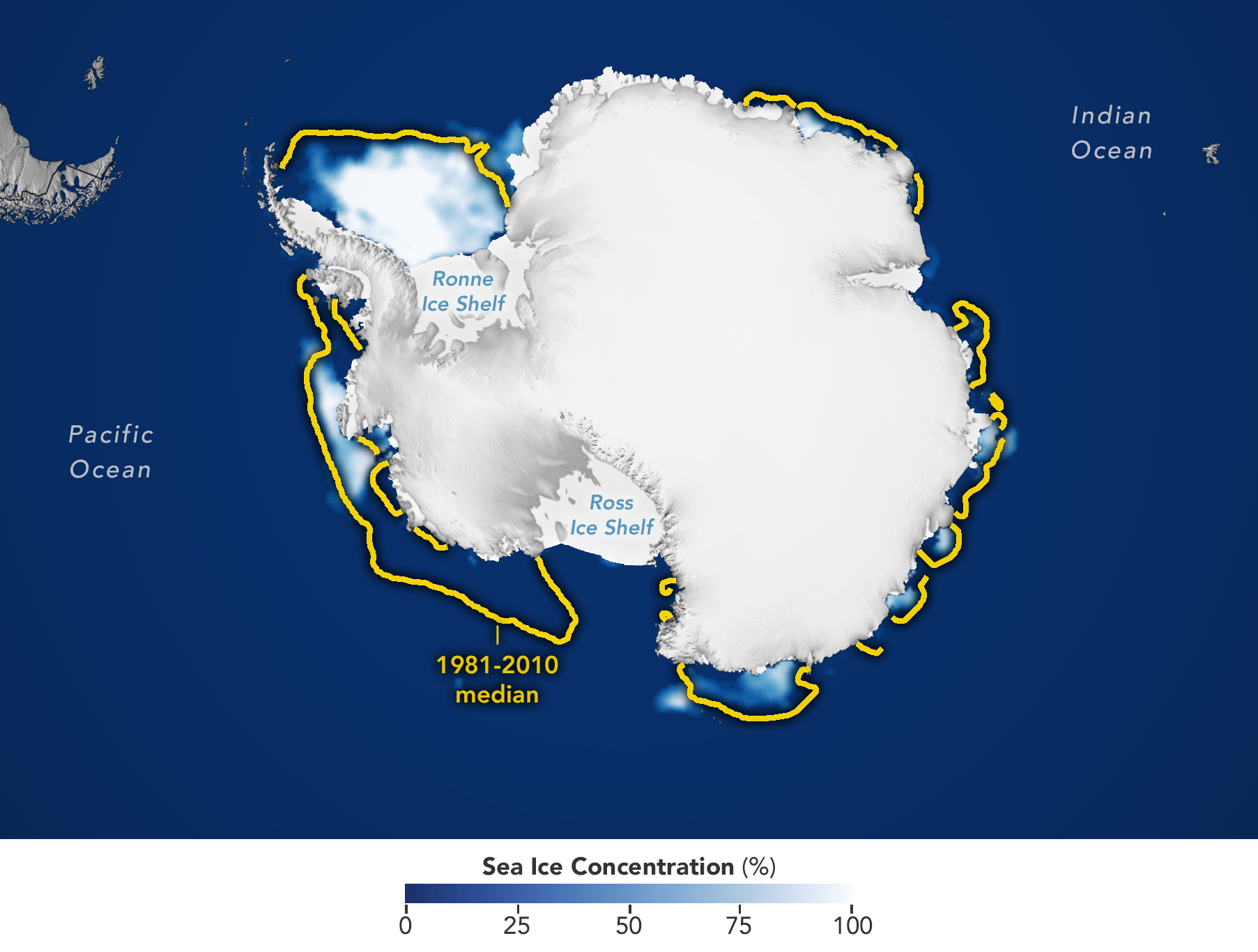
Sea ice in Antarctica reached its smallest area on record in February for the second consecutive year, continuing a decade-long decline.
Ice cover decline: Key data
(1) Square km decline
The European Union’s Copernicus Climate Change Service (C3S) provided the figures, highlighting the significant decrease in Antarctic sea ice.
On February 16, the ocean surface covered by ice around Antarctica shrank to 2.09 million square kilometers (800,000 square miles), the lowest level since satellite records began.
(2) Warming trends
Both the North and South poles have experienced significant warming, with temperatures rising by approximately 3 degrees Celsius compared to late 19th-century levels, three times the global average.
Arctic sea ice has been diminishing by about 3 percent per year since the late 1970s, while sea ice in Antarctica has remained relatively constant with large annual variations.
(3) Regional variances and vulnerabilities
Recent ice cover reduction during the southern hemisphere summer has been most pronounced in West Antarctica, which is more vulnerable to the impacts of global warming compared to East Antarctica.
Antarctica witnessed its first recorded heatwave in 2020, with temperatures 9.2 degrees Celsius above the mean maximum. Unusual temperature spikes have been observed in various parts of Antarctica.
The Arctic has also experienced significant declines in sea ice, with the record minimum sea ice extent occurring in 2012.
Impact of declining Ice Cover
Global sea level rise: Melting ice in Antarctica contributes to rising sea levels worldwide.
Disruption of ecosystems: Declining ice cover disrupts habitats and food sources for ice-dependent species.
Increased warming: Less ice reflects sunlight, leading to more heat absorption and further ice melting.
Changes in ocean circulation: Declining ice cover can disrupt currents and impact global climate patterns.
Release of stored carbon: Melting ice releases trapped carbon, potentially affecting marine ecosystems and contributing to climate change.
Amplification of global warming: Reduced ice cover creates a positive feedback loop, exacerbating climate change.
Disruption of biodiversity and food chains: Changing ice conditions impact species relying on ice algae and affect the overall Southern Ocean ecosystem.
Future projections
The Intergovernmental Panel on Climate Change (IPCC) predicted with high confidence that the Arctic Ocean would become practically ice-free in September at least once by mid-century.
The decreasing trends in both Arctic and Antarctic sea ice highlight the urgent need to address climate change and its impact on the Polar Regions.
The Ministry of Education has organized a workshop in New Delhi to discuss the unification of 60 school examination boards operating across different states and union territories.
The key component of this plan is PARAKH, the National Assessment Centre established under the National Council of Educational Research and Training.
What is PARAKH?
PARAKH stands for Performance Assessment, Review, and Analysis of Knowledge for Holistic Development.
It is an organization created to bring school boards from various states and union territories onto a unified platform.
It has been launched as part of the implementation of the National Education Policy (NEP)-2020.
It acts as a constituent unit of the NCERT.
It is tasked with holding periodic learning outcome tests like the National Achievement Survey (NAS) and State Achievement Surveys.
It will work on three major assessment areas: large-scale assessments, school-based assessment, and examination reforms.
Key objectives of PARAKH
Uniform Norms & Guidelines: Setting comprehensive norms, standards, and guidelines for student assessment and evaluation in all recognized school boards.
Enhance Assessment Pattern: Encouraging school boards to adopt assessment patterns aligned with the skill requirements of the 21st century.
Reduce Disparity in Evaluation: Establishing uniformity across state and central boards, which currently employ different evaluation standards, resulting in significant score disparities.
Benchmark Assessment: Developing a benchmark assessment framework to move away from rote learning and align with the objectives of the NEP 2020.
Outcomes of the recent workshop
(1) Establishing Equivalence of Boards
The Centre is planning for the equivalence of boards to facilitate seamless transitions for students across different boards or regions.
The objective is to align curriculum standards, grading systems, and evaluation methodologies to enhance the credibility and recognition of certificates and grades obtained across boards.
(2) Moving away from Rote Examination Culture
The workshop highlighted the need to reassess the prevailing rote examination culture in the education system.
There is a growing realization that holistic assessments, considering various dimensions of a student’s abilities and potential, are equally important.
(3) Standardization and Fairness in Assessments
The discussion emphasized the importance of well-designed and standardized question papers to ensure fairness and consistency across schools and boards.
Striking a balance between formative and summative assessments was identified as a means to reduce the burden of high-stakes examinations while effectively measuring student progress.
Conclusion
PARAKH’s significance lies in its potential to bring about transformative change, facilitating collaboration, and benchmarking assessments.
It is an important step towards creating a standardized and equitable assessment system, providing students with a fair platform to demonstrate their abilities and skills.
Block Your Sunday (28th May) 2023 for 1-1 Live Masterclass by AIR-49, IAS, Divyansh Sir on a 12-month Phase wise blueprint for UPSC 2024 | We’ll share a personalized PDF study plan and timetable designed with Divyansh sir’s inputs. (click here for more details)
Aspirants, just 12 months are left for UPSC Prelims 2024. And if you haven’t started yet, even if it is going to be from scratch, today is the best time to start.
IAS, Divyansh Singh, CD’s mentorship student who secured AIR 49 in 2021, will share with you what his phase-wise prep blueprintand how he strategized his final 12 months before 2021 attempt.
According to him starting your preparation before 12 months has several advantages, like giving you more time to revise, take practice tests, develop, polish your knowledge and responses, and move four steps ahead of the competition.
An ideal prep is divided into five phases and spread across 11-12 months. Divyansh sir, an IAS officer who secured AIR 49 in UPSC 2021, is conducting a special LIVE Masterclass (FREE) on the Only 12 months are left for 2024! Why should you start ASAP?
Masterclass Details:
Topic: Only 12 months are left for UPSC 2024! Why should you start ASAP?
Date: 28th May 2023 (Sunday)
Time: 7:30 pm Onwards
Zoom Meeting Link will be sent via your registered email address.
What you should expect in 1-1 LIVE with Divyansh sir?
The workshop will cover a 12-month Phase-wise blueprint for UPSC 2024.
1. First phase – Studying the Core Subjects. How to read every topic in the syllabus from 2-3 sources in the first reading and prepare a 1-2 page note? And in your second reading, stick to only one source while using your notes as reference.
2. Second phase – Studying Mains Specific Subjects & Optional. How to follow the ritual of reading, writing summaries, and answering topic-wise previous year questions?
3. Discuss 2-3 Revision Strategies which you can follow. Why should you not go more than 20 days without revision?
4. Live demonstration of making the perfect notes. How to not copy line-by-line of everything you read & only note down the 5 dimensions of a topic?
5. Why is the Third phase of preparation the shortest of all? What should you ideally do after completing the Prelims and Mains subjects?
6. Fourth phase.How to improve your accuracy 3 months before the Prelims exams?
7. The 5th and Last phase. What must be done 3 months before the Mains exams?
Post-webinar you will get important PDFs, timetable framework, and mentorship session.
Based on your UPSC prep situation (working aspirant, full-time aspirant), your learning style, previous attempts, and other such factors, we will be preparing and sharing a personalized PDF study plan for you.
We will be incorporating Divyansh’s (AIR 49, UPSC 2021) inputs in preparing the timetable for you.
What The Hindu opined about Civilsdaily Mentorship
Register FREE for 1-1 LIVE UPSC Masterclass by Divyansh (AIR 49), IAS, Super Mentor of Civilsdaily
The civil society process of G-20, known as C-20, which is meant to provide a platform for independent voices and hold governments accountable, has been co-opted by the ruling party in India. Critiques argue that under the guise of civil society representation, C-20 has become a tool to further a politico-religious vision and legitimize neoliberal economic policies. This distortion of C-20 raises concerns about its credibility and ability to serve as a counter-balance to undue business influence.
What is C-20?
C-20 refers to the civil society process of the Group of Twenty (G-20) summit.
The C-20 process provides a platform for civil society organizations to engage with G-20 member governments, discuss relevant issues, and advocate for policy changes.
It aims to ensure that the voices and concerns of civil society are taken into account in the decision-making processes of G-20.
C-20 focuses on economic, social, and cultural issues, and its participants include non-governmental organizations, grassroots movements, and other civil society actors.
Facts for prelims
What is U20?
A city diplomacy initiative called the “Urban 20” (U20) was launched in December 2017 within G20 ecosystem.
It was meant to collectively raise critical urban issues of G20 cities during the G20 negotiations.
U20 specifically focuses on climate change, sustainable development, and socio-economic issues in connection with the Sustainable Development Goals.
What is SAI20?
SAI20 stands for Supreme Audit Institutions (SAIs) of G20 countries.
It is a forum where SAIs from G20 countries can engage with each other to share their experiences and expertise in auditing public policies and governance practices.
The group meets annually to discuss important issues related to public auditing and to develop joint initiatives to promote good governance and accountability in their respective countries.
What are the concerns about C-20 ‘s credibility?
Politicization: The C-20 process in India has been co-opted by the party in power, using it as a platform to further its own politico-religious vision. This raises questions about the independence and neutrality of the civil society process.
Lack of diversity: The composition of C-20 has raised concerns about the overwhelming presence of members from a single religion, which goes against the principle of inclusiveness. The dominance of a particular religious group undermines the diversity and representation of civil society voices.
Censorship and suppression: There have been instances of censorship and attempts to control the narrative within C-20. Participants have been asked to refrain from making political statements about G-20 and C-20, limiting their ability to critically address policies and actions that may be detrimental to biodiversity and community interests.
Limited influence: The C-20 process, along with other engagement forums of G-20, has not been allowed to play an independent role in holding governments accountable or countering undue business influence. The influence of civil society in shaping G-20 decisions and policies remains limited.
Lack of transparency: The selection and decision-making processes within C-20 have been criticized for lacking transparency. The way the C-20 architecture is set up, with its Secretariat housed in a civil society organization linked to a particular political ideology, raises concerns about the independence and fairness of the process.
Impact of using international engagement forums for political gains?
Undermining credibility: When international engagement forums, such as the G-20 and its civil society process, are used for political and electoral gains, it undermines their credibility and purpose. These platforms are meant for meaningful dialogue, collaboration, and decision-making on global issues, and politicizing them for short-term domestic interests erodes their legitimacy.
Diminishing trust and cooperation: Political exploitation of international engagement forums can lead to a breakdown of trust and cooperation among participating countries and civil society organizations. It creates an atmosphere of suspicion and undermines the spirit of mutual respect and collaboration that these forums are intended to foster.
Weakening global governance: The instrumentalization of international engagement forums for political gains can weaken global governance mechanisms. It hampers the ability of these forums to address pressing global challenges effectively and make informed decisions based on the common good, as decisions may be driven by narrow political considerations rather than sound policy-making.
Impact on international reputation: The misuse of international engagement forums can have a negative impact on a country’s international reputation. It may be seen as a breach of trust and an attempt to manipulate global platforms for domestic political purposes, damaging the country’s standing in the international community.
Impeding progress on global issues: When international engagement forums are exploited for political and electoral gains, the focus shifts from addressing global issues to advancing narrow domestic agendas. This can hinder progress on crucial matters such as climate change, sustainable development, poverty alleviation, and human rights, which require international collaboration and concerted efforts.
Alienating civil society: The politicization of international engagement forums can alienate civil society organizations and undermine their trust in the process. When civil society voices are co-opted or marginalized for political gains, it weakens their role as independent actors, reduces their influence, and stifles their ability to contribute meaningfully to global policy discussions.
Loss of long-term benefits: Prioritizing short-term political and electoral gains over the long-term benefits of meaningful international engagement can lead to missed opportunities for economic, social, and diplomatic advancements. It undermines the potential for constructive dialogue, knowledge sharing, and collaboration that can yield positive outcomes for the country and the global community.
Way ahead: Addressing the concerns over C-20
Enhance transparency and inclusiveness: There should be greater transparency in the selection processes of C-20 members and the decision-making mechanisms. Efforts should be made to ensure diverse representation from different religions, ideologies, and sectors, fostering inclusivity and avoiding the dominance of any particular group.
Safeguard independence: Measures should be taken to ensure the independence of C-20 from government influence. The Secretariat and coordination should be entrusted to neutral and independent organizations or institutions that have a proven track record of upholding the principles of civil society engagement.
Strengthen civil society networks: Civil society organizations should strengthen their networks, collaborations, and solidarity to amplify their voices and advocate for meaningful engagement in the C-20 process. This can involve building alliances with other organizations, sharing information and resources, and collectively advocating for the principles of inclusiveness and accountability.
Promote critical dialogue: Open and constructive dialogue should be encouraged within C-20, allowing for diverse perspectives and critical analysis of G-20 policies and actions. Participants should have the freedom to raise concerns, offer alternative viewpoints, and contribute to the discourse without fear of censorship or reprisal.
Advocate for policy coherence: Civil society organizations should actively engage in advocacy and policy dialogue with both the government and international bodies like the G-20. They should highlight the need for policy coherence that integrates social, environmental, and economic dimensions, ensuring that biodiversity conservation, sustainability, and the rights of marginalized communities are prioritized.
Strengthen public awareness: Efforts should be made to increase public awareness about the G-20 and its civil society process, including C-20. This can involve disseminating information, organizing awareness campaigns, and facilitating public participation in discussions and decision-making processes.
International solidarity: Civil society organizations in India should foster collaborations and exchanges with international civil society networks and organizations working on similar issues. Sharing experiences, strategies, and best practices can strengthen the collective voice of civil society globally and exert pressure for more accountable and inclusive processes.
Conclusion
The co-optation of C-20 by the ruling party in India has undermined its credibility as an independent civil society platform. Civil society organizations participating in C-20 must reflect on whether they will legitimize this distortion or challenge it, as their decisions will shape the future of this crucial platform for global dialogue and accountability.
Prime Minister Narendra Modi’s upcoming visit to Australia highlights the significance India attaches to its bilateral relationship with Australia, despite the cancellation of the Quad Summit meeting in Sydney. The transformation of this relationship over the past decade, coupled with its broad bipartisan support in Australia, demonstrates the establishment of a new chapter in India-Australia ties.
India-Australia Relations: A Backgrounder
The India-Australia bilateral relationship has undergone evolution in recent years, developing along a positive track, into a friendly partnership.
The two nations have much in common, underpinned by shared values of a pluralistic, Westminster-style democracies, Commonwealth traditions, expanding economic engagement etc.
Several commonalities include strong, vibrant, secular and multicultural democracies, free press, independent judicial system and English language.
Historical Perspective
The historical ties between India and Australia started immediately following European settlement in Australia from 1788.
All trade, to and fro from the penal colony of New South Wales was controlled by the British East India Company through Kolkata.
India and Australia established diplomatic relations in the pre-Independence period, with the establishment of India Trade Office in Sydney in 1941.
The end of the Cold War and simultaneously, India’s decision to launch major economic reforms in 1991 provided the first positive move towards development of bilateral ties.
What is the Significance of this upcoming visit?
Strengthening Bilateral Relations: The visit reaffirms the commitment of both India and Australia to further strengthen their bilateral relationship. It provides an opportunity for high-level engagements, discussions, and collaborations on various issues of mutual interest.
Enhancing Economic Cooperation: The visit can pave the way for boosting economic cooperation between India and Australia. It provides a platform to explore new avenues for trade, investment, and technological collaboration, benefiting both economies and creating business opportunities.
Showcasing Commitment to the Indo-Pacific Region: Prime Minister’s visit to Australia will demonstrates the commitment of both countries to the Indo-Pacific region’s peace, stability, and development. It reinforces the role of India and Australia as significant stakeholders in the region.
Collaboration on Strategic and Security Issues: The visit presents an opportunity to discuss and collaborate on strategic and security issues, including maritime security, counterterrorism, cybersecurity, and defense cooperation. This will contribute to regional stability and address common security challenges.
Promoting People-to-People Connections: People-to-people interactions and cultural exchanges are crucial for fostering closer ties between nations. Prime Minister Modi’s visit will promote people-to-people connections, strengthen the Indian diaspora’s engagement, and enhance cultural understanding between India and Australia.
The growing partnership between India and Australia
Enhanced Bilateral Engagements: The frequency of high-level visits and interactions between the leaders of India and Australia has increased, showcasing the importance both countries place on their bilateral relationship.
Multilateral Collaboration: India and Australia collaborate closely in various multilateral forums such as the Quad, G7, East Asia Summit, G20, and the Indian Ocean Rim Association. They address important regional issues, including maritime domain awareness, supply chain resilience, climate change, and food and energy security.
Strategic Cooperation: Both nations recognize the need to build secure and resilient supply chains. They focus on strategic areas such as clean energy, electric vehicles, semiconductors, aerospace, and defense, fostering collaboration and joint initiatives.
Space Collaboration: Space cooperation has gained prominence in the India-Australia partnership. Australia participates in India’s Gaganyaan Space Programme, and the International Space Investment grants program encourages collaboration in the space sector.
Educational Ties: Australia is a preferred destination for Indian students, with a large number of Indian students studying there. Efforts are being made to address challenges related to student mobility, visa backlogs, and research collaboration, strengthening educational ties between the two countries.
People-to-People Linkages: Cultural exchanges, diaspora connectivity, and people-to-people contacts play a crucial role in strengthening the partnership. Initiatives like the opening of a new consulate in Bengaluru and the establishment of a center for Australia-India relations in Sydney contribute to fostering cultural linkages.
Economic Cooperation: The focus is on expanding economic ties and trade relations. Efforts are being made to increase the current trading partnership, setting clear targets to elevate it by 2030. Comprehensive Economic Cooperation Trade Agreement discussions are underway to deepen economic cooperation.
Regional Stability: India and Australia, along with other Quad members, work together to ensure peace, stability, and prosperity in the Indo-Pacific region. They address regional challenges and maintain a rules-based order.
Counterbalance to China: The India-Australia partnership is seen as a counterweight to China’s non-rules-based approach in the region. It provides a strategic balance and promotes a free and open Indo-Pacific.
The India-Australia partnership: Opportunities for further collaboration and growth
Trade and Investment: There is immense potential to expand bilateral trade and investment between India and Australia. Both countries can explore new sectors and avenues for collaboration, including technology, renewable energy, infrastructure, agriculture, healthcare, and manufacturing. Initiatives like the Comprehensive Economic Cooperation Agreement (CECA) can further facilitate trade and investment flows.
Innovation and Technology: India’s thriving tech ecosystem and Australia’s advanced research and development capabilities present opportunities for collaboration in innovation and technology-driven sectors. Joint research projects, technology transfer, and startup collaborations can foster mutual growth and innovation.
Defense and Security: The defense and security collaboration between India and Australia can be further strengthened. Opportunities exist for joint military exercises, defense equipment co-production, technology-sharing, and intelligence cooperation. Collaborative efforts can contribute to maritime security, counterterrorism, and regional stability.
Education and Research: The education sector offers opportunities for deeper collaboration, including student exchanges, joint research programs, and faculty exchanges. Strengthening academic ties can enhance cultural understanding and promote knowledge sharing between institutions in both countries.
Sustainable Development and Climate Change: Both India and Australia face significant challenges related to sustainable development and climate change. Collaborative efforts in renewable energy, climate adaptation, and environmental conservation can address common concerns and promote sustainable development practices.
Regional Engagement: India and Australia can leverage their partnership to enhance regional engagement and cooperation in the Indo-Pacific. By working together in multilateral forums such as the Quad, ASEAN, and the Indian Ocean Rim Association, they can promote a rules-based order, regional stability, and prosperity.
Health and Biotechnology: The COVID-19 pandemic has highlighted the importance of collaboration in health and biotechnology. Joint research on vaccines, healthcare innovations, and disease prevention can strengthen public health systems and contribute to global health security.
Conclusion
India and Australia have transcended past misperceptions and established a promising partnership that holds tremendous potential in the 21st century. As Prime Minister Menzies’ decision in 1955 remains a relic of the past, India and Australia are committed to nurturing a vibrant and enduring partnership, solidifying their place as key actors in the global arena.
The presence of single-teacher schools in India, particularly in Jharkhand, continues to persist despite the Right to Education Act mandating a minimum of two teachers in every school. The prevalence of such schools poses significant challenges, hampering the quality of education and depriving children of their right to a proper education. The alarming situation of single-teacher schools, calls attention to recent findings, and emphasizes the need for urgent action to address this issue.
Plight of Single-Teacher Schools in India
Even after 14 years since the implementation of the Right to Education Act, the proportion of single-teacher schools in India remains high at 14.7%.
In Jharkhand alone, nearly one-third of primary schools fall under the single-teacher category, significantly impacting the quality of education.
While Jharkhand is a poor performer, a few States had a similar or even higher proportion of single-teacher schools such as Andhra Pradesh (34%), Telangana (30%) and Karnataka (29%).
In nine of India’s 21 major States, the share of children studying in single-teacher schools was well above 10%, rising to 25% in Jharkhand.
A recent report titled Gloom in the Classroom sheds light on the severity of the situation in Jharkhand.
Did you know?
· The Right to Education Act states that every school must have at least two teachers.
Reasons attributed to the presence of Single-Teacher Schools in certain states
Low Population Density and Scattered Settlements: In states with low population density and scattered settlements, such as Himachal Pradesh, it becomes challenging to establish multiple schools in close proximity. Limited resources and logistical difficulties make it economically unviable to have multiple teachers in such areas. As a result, single-teacher schools are often the only feasible option to provide education to children in remote locations.
Low Fertility Rates: States with low fertility rates, such as Himachal Pradesh and Kerala, may have a smaller number of students in schools. In these cases, single-teacher schools serve as a more efficient and cost-effective arrangement to cater to the relatively smaller student population. With fewer students, consolidating them into larger schools may not be practical or necessary.
Viability of Mini-Schools: In some states, single-teacher schools are a result of the viability and historical existence of mini-schools. Mini-schools were established in sparsely populated areas before the Right to Education Act came into force. Some states, like Kerala, have successfully managed to merge mini-schools, while others continue to have single-teacher schools as separate entities.
Staffing Challenges and Budget Constraints: State governments facing staffing challenges and budget constraints may opt for under-staffing schools in underprivileged areas, leading to the prevalence of single-teacher schools. Limited resources and difficulties in recruiting and retaining teachers, especially in remote or economically disadvantaged regions, contribute to the staffing issues.
Resistance to Remote Postings: Remote areas often lack basic amenities and facilities, making it challenging for teachers to adjust to such environments. Reluctance to accept postings in remote locations can lead to a shortage of teachers, resulting in single-teacher schools as a temporary solution.
Measures to tackle the challenges associated with single-teacher schools
Infrastructure and Resources: Adequate investment in infrastructure, including the establishment of additional classrooms, is crucial to accommodate more teachers and reduce the burden on existing staff. Providing schools with sufficient teaching resources, such as textbooks, learning materials, and technological tools, can enhance the teaching-learning process.
Recruitment and Retention: State governments must prioritize the recruitment of qualified teachers, ensuring a sufficient number of professionals in underprivileged areas. Encouraging and incentivizing teachers to accept postings in remote areas can help overcome the resistance to such assignments.
Policy Reforms: The Right to Education Act needs to be rigorously implemented, emphasizing the requirement for a minimum of two teachers in each school. State governments should allocate adequate funds to address staffing needs and enforce compliance with the act. Policy reforms should focus on promoting equity and inclusivity, targeting marginalized communities and ensuring access to quality education for all children.
Community Engagement: Building awareness among parents and communities about the importance of education and the impact of single-teacher schools is crucial. Encouraging community participation in school management committees and fostering collaboration between schools, parents, and local organizations can drive collective efforts to improve the educational environment.
Way forward: Revitalizing the Education Movement
It is imperative to revive the momentum for the right to education that once echoed across the nation.
A renewed movement is necessary to advocate for quality education, raise awareness about the persisting challenges, and hold authorities accountable for ensuring children’s right to education.
The recent protests in Jharkhand, which highlighted the unmet demand for quality education, serve as a reminder of the urgent need to address the plight of single-teacher schools.
Conclusion
The prevalence of single-teacher schools in Jharkhand and several other states indicates a systemic failure in fulfilling the right to education. Immediate action is required to improve infrastructure, recruit qualified teachers, implement policy reforms, and foster community engagement. By prioritizing education and addressing the challenges associated with single-teacher schools, we can ensure that every child has access to quality education and the opportunity to thrive.
The unavailability of Census and Household Consumer Expenditure (HCE) survey data is causing difficulties in policymaking in India.
The census enumeration, originally scheduled for 2021, has been postponed to 2024-25.
Furthermore, the results of the National Statistical Office’s HCE survey for 2022-23, expected to be released by December this year, might be delayed until after the general elections in 2024.
What is Evidence-Based Policymaking (EBP)?
Evidence-based policymaking, also known as data-based policymaking, involves using factual information and credible evidence to make policy decisions rather than relying on political opinions or theories.
This approach relies on relevant data and evidence to develop policies, such as using reliable healthcare data to inform healthcare policy decisions.
Evidence-based policymaking is widely considered as a fundamental aspect of good governance.
Why rely on EBP?
There are several reasons why evidence-based policymaking (EBP) is essential and beneficial:
Facts and Credible Evidence: Making decisions based on reliable data ensure that policymaking is grounded in objective information and not influenced by personal beliefs or opinions.
Supplementing Political Opinion or Theory: Evidence-based approaches prioritize empirical evidence and research findings over subjective political opinions or unproven theories.
Informed Decision-Making: Utilizing accurate and reliable information enables policymakers to make well-informed decisions with a comprehensive understanding of issues.
Better Policy Outcomes: Evidence helps identify effective strategies and interventions, leading to policies that are more likely to achieve their intended goals and produce positive outcomes.
Targeted Resource Allocation: By considering evidence of effectiveness, policymakers can allocate limited resources strategically. They have focus on interventions that have a proven track record of success.
Accountability and Transparency: EBP fosters transparency and accountability by providing a clear rationale for policy decisions based on objective information. This earns public trust and allowing for scrutiny and evaluation.
Continuous Learning: Evaluating policies based on evidence promotes a culture of learning. It allows for the identification of what works well and areas that require improvement. This leads to iterative policy development.
Public Health and Safety: EBP in public health and safety ensure that decisions are informed by scientific evidence, helping to protect and improve the well-being of the public by preventing harm and mitigating risks.
Impact on Electoral Politics
Prevention of decisions based on vested interests: Evidence-based policymaking holds policymakers accountable and prevents decisions driven by ideology, opinions, or political interests.
Enhanced public trust: Evidence-based policymaking increases trust by using rigorous analysis and data, enhancing the legitimacy of government actions and policies.
Evidence-Based Campaigning: Candidates use evidence-based research for effective campaign strategies, addressing voter concerns and tailoring policies for electoral success.
Voter Engagement and Education: EBP informs voters with evidence-based information, empowering them to make informed choices based on data and research.
Policy Evaluation and Improvement: EBP promotes regular evaluation of policies based on evidence, appealing to voters prioritizing evidence-driven decision-making and policy effectiveness.
Challenges and Concerns
There are several challenges and concerns related to evidence-based policymaking in India:
Delay in the release of data: Despite adopting advanced data processing technologies, there has been a growing delay, sometimes spanning years, in releasing collected data. This renders the data less useful for timely policy intervention and reduces public scrutiny, undermining accountability. For example, the government refrained from releasing data collected through the Socio-Economic and Caste Census in an extreme case.
Issue of comparability: Changes in the estimation of GDP over recent years have made it impossible to compare data over time. While adjustments to computation and survey methods aimed at improving accuracy are welcome, in this case, the revisions were seen as driven more by political considerations than the need for accuracy.
Reliance on multiple surveys and datasets: In the absence of surveys like the HCE survey, policymakers rely on other datasets that often provide contradictory signals. This lack of consensus hampers understanding of poverty and inequality trends over the past decade. Different studies present conflicting findings, such as varying estimates of rural poverty during the strict lockdown of April-June 2020.
Where can India utilize EBP?
Sector
Government Schemes
How EBP can be used
Healthcare
Ayushman Bharat, National Health Mission, Swachh Bharat Mission
Utilize evidence-based interventions, allocate resources effectively, and monitor health outcomes
Education and HRD
Sarva Shiksha Abhiyan, Mid-Day Meal Scheme, Digital India for Education
Inform curriculum development, teacher training, and interventions for improved learning outcomes
Agriculture upliftment
PM Kisan Samman Nidhi, Soil Health Card Scheme, PM Fasal Bima Yojana
Enhance productivity, promote sustainable farming practices, and address farmer challenges
Social Welfare
PM Jan Dhan Yojana, PM Awas Yojana, National Rural Employment Guarantee Act (NREGA)
Ensure effective targeting, equitable distribution, and improved outcomes for marginalized communities
Expand access to financial services, promote inclusive growth, and reduce financial vulnerability
Employment Generation
Make in India, Stand-Up India, Mudra Yojana
Identify growth sectors, target job creation, and support entrepreneurship based on market demand and skill gaps
Way forward
Establish a National Evidence-Based Policy Institute: Create an institute to promote research, evaluation, and capacity-building in EBP, collaborating with universities and organizations to generate and disseminate rigorous evidence for policymaking.
Develop a National Evidence Bank: Create a centralized platform to store and share research findings, evaluations, and data, ensuring policymakers have easy access to credible evidence for informed decision-making.
Encourage Collaborative Research Partnerships: Foster collaborations between researchers, policymakers, and practitioners to conduct joint studies, facilitating the integration of research findings into policy processes and enhancing relevance.
Implement Mandatory Evidence Assessments: Require major policy proposals to undergo systematic evidence assessments, evaluating existing evidence, identifying gaps, and enhancing proposed initiatives’ quality and effectiveness.
Invest in Research and Evaluation Capacity: Allocate resources to strengthen research and evaluation capabilities within government agencies, providing training programs to build evidence use skills among policymakers and civil servants.
Foster Collaboration with International EBP Networks: Engage with global networks like J-PAL and the Campbell Collaboration, leveraging their expertise and best practices to enhance EBP in India.
Promote Open Data and Transparency: Encourage transparency through open data initiatives and mandatory publication of evaluation reports, enabling scrutiny, replication, and accountability in decision-making.
Embed EBP in Policy Education: Integrate evidence-based approaches into policy school curricula and training programs, equipping policymakers with skills to critically evaluate evidence and apply it in policy formulation.
Encourage Public Engagement: Facilitate public participation in policy-making through consultations and forums, incorporating diverse perspectives and local knowledge in evidence synthesis and policy development.
Continuous Monitoring and Evaluation: Establish robust monitoring and evaluation frameworks for policies and programs, enabling regular reviews to assess effectiveness, make evidence-informed adjustments, and learn from successes and failures.
Conclusion
Evidence-based policymaking holds significant potential for bringing about high-impact changes in people’s lives.
To eradicate poverty and improve economic performance, education, healthcare, and social assistance, systemic institutionalization of evidence-based policymaking is imperative.
Timely and accurate data form the foundation of effective policymaking, enabling policymakers to make well-informed choices.
Measures must be taken to strengthen the statistical system, ensuring its independence and safeguarding against external influence.
The Central Board of Directors of the RBI approved the transfer of ₹87,416 crore as surplus to the Union government for the accounting year 2022-23.
This amount is almost three times the ₹30,307 crore transferred in the previous fiscal year.
Reserve funds of RBI
The RBI has two types of reserves: Currency & Gold Revaluation Account (CGRA) and Contingency Fund (CF).
CGRA: It represents the value of gold and foreign currency held by the RBI on behalf of India and fluctuates based on market movements.
Contingency Fund: It is a provision to meet unexpected contingencies arising from the RBI’s monetary policy and exchange rate operations.
Calculation of Surplus
RBI’s surplus is the amount transferred to the government after meeting its needs and provisions.
The surplus is determined by deducting expenses, including provisions made to the CF, from the RBI’s income, mainly generated through interest on securities.
How does RBI earn its INCOME?
The RBI earns profits through various functions and operations it carries out, including:
Managing the borrowings of the Government of India and State governments.
Supervising and regulating banks and non-banking finance companies.
Managing the currency and payment systems.
RBI generates income through the following sources:
Returns on its foreign currency assets, such as bonds and treasury bills of other central banks or top-rated securities.
Interest earned on holdings of local rupee-denominated government bonds or securities.
Interest earned from lending to banks for short tenures, such as overnight loans.
Management commission received for handling government and state government borrowings.
Expenditure by RBI
The RBI’s expenditures include-
Costs related to printing currency notes
Staff salaries
Commissions paid to banks for government transactions and
Payments to primary dealers for underwriting borrowings
How the transfer of surplus takes place?
The RBI, as a central bank, is not a commercial organization owned or controlled by the government.
The RBI was initially a private shareholders’ bank but was nationalized by the government in January 1949.
According to Section 47 (Allocation of Surplus Profits) of the Reserve Bank of India Act, 1934, the RBI transfers the excess of income over expenditure to the government.
This provision mandates the transfer of profits to the Central Government after accounting for necessary provisions and obligations.
Does the RBI pay tax on these earnings or profits?
No, the RBI is exempted from paying income tax or any other tax as per Section 48 (Exemption of Bank from income-tax and super-tax) of the RBI Act, 1934.
This exemption ensures that the RBI is not liable to pay income tax or super-tax on its income, profits, or gains.
Policy inputs
(1) Y H Malegam Committee
It reviewed the adequacy of reserves and surplus distribution policy in 2013, recommended a higher transfer to the government.
Prior to this recommendation, the RBI transferred a portion of the surplus to the Contingency Fund and the Asset Development Fund.
Following the Malegam committee’s recommendation, the percentage of surplus transferred to the government significantly increased from 53.40% in 2012-13 to 99.99% in 2013-14.
(2) Bimal Jalan Committee
The RBI in November 2018 had constituted a 6-member committee, chaired by former governor Dr Bimal Jalan.
It was tasked to review the current economic capital framework (ECF), after the Ministry of Finance asked the central bank to follow global practices.
Key recommendations
Differentiate between realised equity and revaluation balances for RBI’s economic capital.
Adopt Expected Shortfall (ES) for measuring market risk with a target of ES 99.5% confidence level.
Maintain Contingent Risk Buffer (CRB) between 6.5% and 5.5% of RBI’s balance sheet.
Implement surplus distribution policy based on realised equity.
Review RBI’s Economic Capital Framework every five years.
Russia and his Iran has signed a deal to finance and build the 162 km Rasht-Astara Iranian railway, the main connection in the emerging North-South Transport Corridor.
Rasht-Astara Railway Link
The Rash Astra Railway is a 162-kilometer railway connecting Rasht (Iran) and Astara (Azerbaijan) on the border.
It is part of the International North-South Transport Corridor (INSTC) and will significantly diversify global traffic flows.
The railway will facilitate connections between Russian ports on the Baltic Sea and Iranian ports in the Indian Ocean and the Gulf.
About INSTC
The INSTC is a 7,200-kilometer Multi-Mode Transit System connecting India, Iran, Azerbaijan, Russia, Central Asia, and Europe.
It promotes transportation cooperation among member states and includes ship, rail, and road routes.
Membership has expanded to include additional countries, and observer states and Baltic countries have expressed interest in joining.
Significance of INSTC for India
Central Asia trade: India has invested in the Chabahar Port in Iran, which serves as a doorway for trade with Central Asian countries.
Extended connection: INSTC offers potential connections to the Baltic, Nordic, and Arctic regions.
Bypassing Pakistan: INSTC provides an alternate route for India to connect with Central Asia, bypassing obstacles in Pakistan.
Fastest freight: It reduces transit time by 40% and freight costs by 30% compared to the Suez Canal route.
Alternative to Suez: Russia claims the project could ultimately rival the Suez Canal in terms of trade flows.
Challenges of INSTC
Challenges include limited financial support from major international institutions due to US sanctions on Iran.
Harmonization of tariffs and customs, increased private sector involvement, and improved informational connectivity are necessary for success.
Conclusion
More financing, cooperation, political will, and strategic planning are required to realize the full benefits of INSTC.
Addressing demand deficits and enhancing informational connectivity are crucial.
Collaboration and the establishment of industrial parks and special economic zones can contribute to the corridor’s development and commercial value.
Key terminologies
Multi-Mode Transit System: A system that integrates multiple modes of transportation, such as ship, rail, and road, for efficient movement of goods.
Joint Comprehensive Plan of Action (JCPOA): An agreement reached in 2015 between Iran and world powers regarding Iran’s nuclear program.
Suez Canal: A major global trade route connecting the Mediterranean Sea to the Red Sea.
Chabahar Port: A port in Iran’s Sistan-Balochistan province, providing India with access to Central Asian countries.
Baltic Countries: Countries located in the Baltic region of Northern Europe, including Latvia and Estonia.






![[ORF] Evidence-Based Policymaking (EBP)](https://d18x2uyjeekruj.cloudfront.net/wp-content/uploads/2023/05/orfc.jpg)


