A farmer in Punjab has committed suicide outside the office of the Muktsar DC against kurki orders for his land based on a court case filed against him by the local moneylender for defaulting on loan payment.
What is Kurki?
Kurki means attachment of a farmer’s land, already pledged to the money lending institution or individual, in case of a loan default.
Apart from banks, private moneylenders, commission agents also get these decrees against farmers from time to time.
How is kurki executed?
Kurki orders are executed under Section 60 of Civil Procedure Code, 1908.
The land which is pledged by the farmer to the bank or money lender gets registered in their name. In some cases, the land is auctioned as well.
The process begins after the money lender moves court to get kurki orders in case the farmer is unable to pay back his loan.
In kurki, attachment of farmer’s land as well as his tractor can be done as per the Section 60.
Was kurki not banned in Punjab?
Both Akali Dal and Congress governments of the past have claimed to have banned kurki.
Congress fought the 2017 Assembly polls on the slogan ‘karza kurki khatam, fasal di poori rakam’.
Soon after winning polls in 2017, the then government abolished Section 67-A of Punjab Cooperative Societies Act that enabled cooperatives to recover unpaid loans through auctioning of land mortgaged by farmers.
However, Section 63-B, 63-C of the Act were not dropped to prevent attachment of land.
Former Punjab CM has also claimed that kurki was abolished by his government. Activists accuses governments of issuing vague orders on the matter.
Why has a total ban on the century-old kurki law not been achieved?
A plea filed in the Punjab and Haryana High Court in 2018 sought complete ban on kurki.
However, the Punjab government in its affidavit stated that there was no need to ban kurki as relief was being given to farmers in terms of loan waiver, compensation etc.
Moreover, it stated that Section 60 of Civil Procedure Code, 1908 – under which kurki takes place — was over 110 years old and needed complete revision.
What is the ground reality?
Farmers point out that they are made to give post-dated cheques for loan, which are then used to get arrest orders issued in cheque bounce cases.
They have also accused money lenders of using pronotes signed by them to get kurki orders.
“Pro-notes” (promissory notes) are written documents taken from farmers, and signed by them at the time of giving the loan.
In April 2022, over 2,000 arrest warrants were issued against farmers for non-payment of loans to cooperative societies and Punjab agriculture development banks.
Russia is holding Vostok exercises. However, India has only sent its army contingent of the 7/8 Gorkha Rifles, and will not take part in the maritime section of the two-part event.
Vostok-2022
It is an annual, multilateral, strategic and command exercise hosted by Russia.
This year it will see the participation of more than 50,000 troops from 13 countries such as India, China, Algeria, India, Laos, Mongolia, Nicaragua, Syria and many more.
While the exercises in Vostok-2022 are routine, they are the first such multilateral exercises to be held since the Russian war in Ukraine began.
Why in news now?
India has only sent its army contingent and will not take part in the maritime section of the two-part event.
This is because the maritime part of the exercises would be held in the Sea of Okhotsk and the Sea of Japan.
India’s decision not to take part in the naval exercises is believed to be in deference to Tokyo’s sensitivities.
What does India’s participation mean?
By sending an army contingent to join Russian and Chinese troops in the exercises at this time, New Delhi is aiming to send a four-pronged message:
Continuing relationship with Russia despite the Ukraine war: The Modi government has decided not to join the Western sanctions regime, or to curb oil imports and other economic engagement with Moscow.
Signal balance and non-alignment in the current crisis: India has mostly abstained from votes at the United Nations seeking to criticise Russia.
India also takes part in routine Indo-Pacific exercises: This is with its Western partners including the Quad, as well as in bilateral exercises, like the India-US Ex. Yudh Abhyas.
Willingness to conditional engagement with China: The message the government continues to give is that it is willing to engage with China on a number of fronts, even as military talks at LAC (Line of Actual Control) remain stuck.
Conclusion
There might be some discomfort for Indian soldiers in dealing with their counterparts at a time when they are facing each other off along the LAC.
But that’s a small price to pay if it means keeping India-Russia ties on an even keel.
India needs to start communicating its intent better.
Strategic communication is an art. It’s time to master it.
GS-1 Important Geophysical phenomena such as earthquakes, Tsunami, Volcanic activity, cyclone. etc., geographical features and their location-changes in critical geographical features (including water-bodies and ice-caps) and in flora and fauna and the effects of such changes.
GS-2 India and its neighbourhood- relations.
GS-3 Infrastructure: Energy, Ports, Roads, Airports, Railways etc.
GS-4 Strengthening of ethical and moral values in governance; ethical issues in international relations and funding; corporate governance.
HOW TO ATTEMPT ANSWERS IN DAILY ANSWER WRITING ENHANCEMENT(AWE)?
Daily 4 questions from General studies 1, 2, 3, and 4 will be provided to you.
A Mentor’s Comment will be available for all answers. This can be used as a guidance tool but we encourage you to write original answers.
You can write your answer on an A4 sheet and scan/click pictures of the same.
Upload the scanned answer in the comment section of the same question.
Along with the scanned answer, please share your Razor payment ID, so that paid members are given priority.
If you upload the answer on the same day like the answer of 11th February is uploaded on 11th February then your answer will be checked within 72 hours. Also, reviews will be in the order of submission- First come first serve basis
If you are writing answers late, for example, 11th February is uploaded on 13th February , then these answers will be evaluated as per the mentor’s schedule.
We encourage you to write answers on the same day. However, if you are uploading an answer late then tag the mentor like @Staff so that the mentor is notified about your answer.
*In case your answer is not reviewed, reply to your answer saying *NOT CHECKED*.
MASTERCLASS on how do Toppers write ‘Impactful Intro’ in UPSC Essay & score 150+ concluded |Register and get FREE mentorship and Samachar Manthan current week’s module
Whether it’s Philosophical or topical or any other UPSC essay topic, ideally, the introduction should not only introduce mere the topic/issue/concept to the examiner but also (very) briefly describe the central premise of the answer. Zeeshan sir says that a good essay doesn’t require very advanced English.
But the introduction should be such that the examiner knows in advance that you know the answer and you’re not going to beat around the bush or weave a boring net of ornamental words looking for the right answer.
Feedback on Zeeshan sir’s mentorship by AIR 65, Pranav (from Quora: https://qr.ae/pvH4yA)
Acknowledging the need to ensure removing difficulties, the students face, we are conducting an on-demand MASTERCLASS on How to write an impactful introduction in UPSC Essay to make a great first impression on the examiner.
You don’t want to miss out on this great chance to learn the subtleties of the Essay introduction and discuss your queries in a 1-1 session with a senior IAS expert.
An advanced technique for writing successfully is to create an impactful introduction for different types of UPSC essays that you can recall at short notice.
UPSC Essay favorite topics
Philosophical Essay: You shouldn’t ignore them as UPSC is focused on them. In 2021, most of the questions were philosophical. So, how to write that intro? Should you start with a quote/story/anecdote/or self-written poem? Will be thoroughly discussed.
Topical essay: You should not ignore them completely and prepare a few important topics which are repeated often like IR, Women, Health and Education, Environment, Agriculture, etc. A fitting mark-leaving intro will be different from that of a ‘Philosophical essay’. All these super important points are going to be discussed in this masterclass.
Whichever essay topic you choose – It should be based on the topic you like or you are comfortable with. You have to write impactful introductions that leave a great first impression on the examiner.
Though you can prepare for UPSC and give your attempts anytime till 32 years, the optimal time to begin your preparation is during your college days. A graduation degree is for 3 years and almost all toppers have prepared for the same amount of time to get the success they now enjoy.
One of the biggest advantages for a college student is that they can easily switch to study mode as there are no other additional family responsibilities or expectations. Plus, an IAS officer who clears the exam within 23 years is more likely to hold the highest position of cabinet secretary than someone who cleared it in their late twenties. Youthful enthusiasm is the biggest internal motivation that college students possess which can help them in clearing this exhausting exam.
So, now that you have broken the news to your parents about wanting to write the UPSC-CSE exam, you might be now wondering — what is UPSC-CSE? How to prepare for it? Should I attend a coaching institute? What is the syllabus? How many hours to study… the list is endlessand daunting.
However, you would have missed the obvious question— What kind of questions come in the paper and what kind of answers UPSC expects from an aspirant?
Is UPSC CSE really about reading Unlimited Sources?
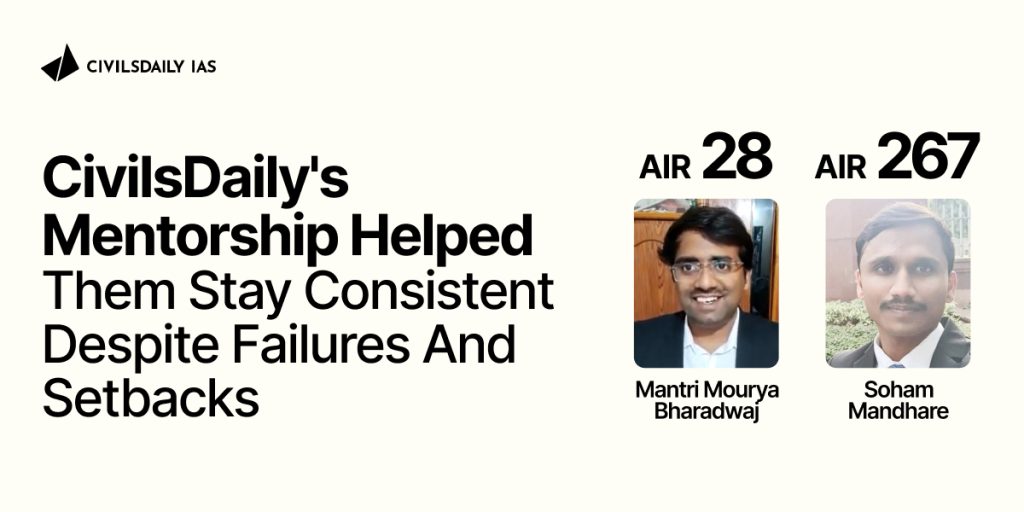
Some of us will ask advices from all our friends and family on how to prepare for the exam, resulting in confusion in following through the UPSC syllabus. Don’t let these questions play the devil and make you postpone your UPSC preparation by a few more years. Having the right direction and guidance can help you save 2-3 critical attempts in UPSC. Listen to our Civilsdaily student and AIR 32 2021 UPSC topper Anay on how he improved his performance after 2 attempts with the guidance of Civilsdaily mentor, Sajal sir.
Without much ado, register yourself for our free 1-on-1 counselling session at Civilsdaily known as Samanvaya. Your counsellors are trained mentors who have given the Mains exam six times and have attended UPSC interview multiple times. Experienced mentors like Sajal sir and his team have nearly mentored 500+ students.
How Sajal sir and CivilsDaily helped these toppers?
List goes on and on.
What are the other mistakes in UPSC preparation first-time aspirants are likely to make?
About 60% of the UPSC toppers have mostly prepared the wrong way in their first attempt. This could range from books, notes to time and consistency. If you want to start in the right direction, then it’s about time you booked a slot with your Samanvaya mentor.
First-time aspirants often make the mistake of reading many sources for a single subject. If there is a new book in the market, they will not hesitate to buy it. UPSC preparation is not about reading multiple books, but one book multiple times.
Few others, answer the essay paper in a very academic and technical manner.
Most of the first-time aspirants skip studying for the language and CSAT paper.
In the first few months of preparation, all of us read the entire 24 pages of the newspaper and waste 3-4 hrs of time. Some of us are over-confident of clearing the exam with our own preparation or by our institute’s coaching. We might be making notes but we will not be updating them or revising them.
First-time aspirants struggle to understand what to skip in a book or what to cover. They take atleast 2-3 months to finish books like Laxmikanth and yet don’t have conceptual clarity.
You can go through this video over here to get a basic understanding of the UPSC preparation.
Toppers were once Beginners. And they began with Samanvaya.
We, at Civilsdaily, are extremely proud to announce the incredible success of our students who have made their dreams come true. Today, we celebrate the hard work, commitment, and dedication with which they prepared for this exam, and succeeded! They are the heroes of today and leaders of tomorrow, and we are extremely glad to have been a part of their journey.
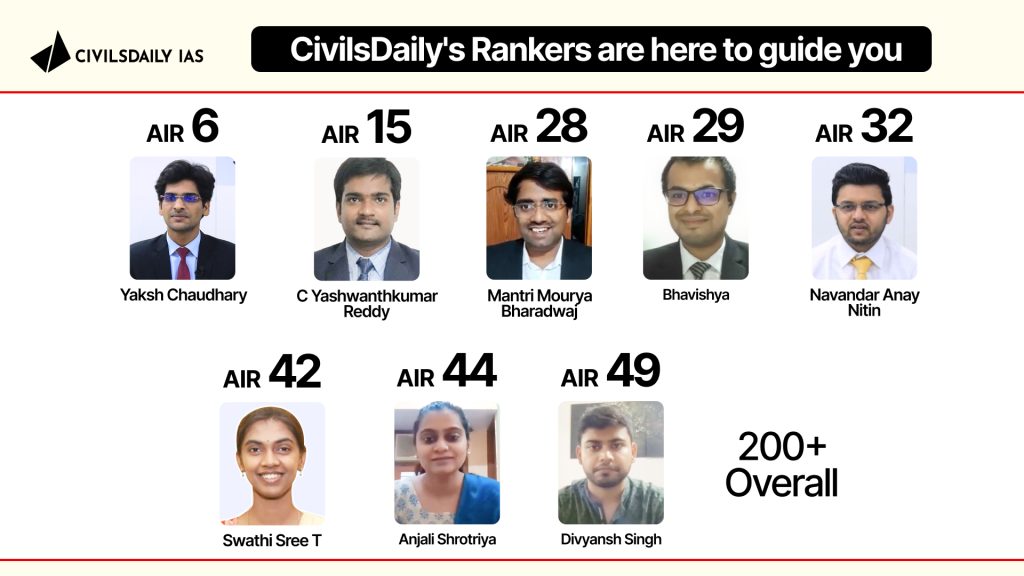
We are also happy to announce that 78 Civilsdaily students (and counting) are now rank holders in UPSC. Our success rate has increased by 77% from last year in terms of rank holders. Civilsdaily is proud to say that 20 of our students are in the top 100 ranks. And this is a phenomenal 25% increase in our success rate for the top 100 positions since last year.
And finally, we are extremely proud of our mentors whose tireless efforts helped our students become officers today. Their daily guidance, skilled mentorship, round-the-clock support, and dedication to work with the students day-in and day-out has led to this wonderful occasion where we celebrate the success of our students together!
How is Samanvaya, UPSC Counselling Session Planned?
At Civilsdaily, your assigned mentors interact with you on a daily basis. They are not just teachers, but coaches, philosophers, and guides. And this is how they will help you succeed:
Motivating you for one whole year and pushing you to complete the modules on time.
Helping you restart preparation despite low scores in test series.
Helping you study for 6 hours every day if you are working.
Guiding you on how to revise the whole syllabus 3 months before prelims and mains.
Providing you topic-wise notes.
Teaching you elimination techniques, tikdams and helpful strategies like 4-2-4 model of preparation.
Keeping you updated on what to study and from where to study.
Three stages of Samanvaya FREE mentorship
1.30-minute counseling session:Once you fill the form, our senior mentors get on a 30-40 minute call with you to understand your preparation level, study constraints, your strategy for the last 6 months, and create measurable targets for next week, next month and so on. You will hear back from us within 24 hours. The first counseling session is absolutely free for all, however, there are limited slots available. So please register now.
2.Access to our invite-only chat platform, Habitat: This is where you can post your daily doubts, discuss your test questions and have real-time, live discussions on news and op-eds, and connect with other aspirants in your optional groups.
3. 1 on 1 mentor allotment: The mentor will be available on scheduled calls with you throughout all the stages of your UPSC preparation and will daily assess, evaluate, and plan the next module according to the available time. We will help you pick the right books, make you practice answers daily, evaluate them and design practical & personalstrategies that you can follow everyday
India’s links with Bangladesh are civilization, cultural, social and economic.
There is much that unites the two countries – a shared history and common heritage, linguistic and cultural ties, passion for music, literature and the arts.
India was one of the first countries, along with Bhutan, to recognise Bangladesh as a sovereign state on 6 December 1971.
It is also worth recalling that India shares its longest border of 4,096.7 kilometres with Bangladesh, which is also the fifth-longest border in the contemporary world.
Trade between two
CEPA: Trade will be a focal point during Ms. Hasina’s visit as the two countries gear up to sign a Comprehensive Economic Partnership Agreement.
Bangladesh dependency: Bangladesh imports critical industrial raw material from India on which its exports are reliant.
Leveraging Indian support: Bangladesh also could improve several manufacturing industries by leveraging Indian expertise in service sectors.
Connectivity
IMT highway: Bangladesh has expressed its interest in joining the India-Myanmar-Thailand highway project.
Waterway: India-Bangladesh bilateral waterway trade will get boosted as India can now use the Mongla and Chittagong ports.
Logistics: India’s Northeast and Bangladesh is important for bilateral cooperation. Currently, three express trains and international bus services operate between Indian and Bangladesh.
Key data to remember
Bangladesh is India’s sixth largest trade partner with bilateral trade rising from $2.4 billion in 2009 to $10.8 billion in 2020-21.
Regional geopolitics
Chinese influence: Chinese inroads into the neighbourhood have been a cause of worry for India. China has been actively pursuing bilateral ties with Bangladesh. Bangladesh had successfully approached China for a mega project to enhance Teesta river water flow.
Strategic location: From the perspective of India’s Northeast, Bangladesh is India’s most strategic neighbour, whom New Delhi cannot ever afford to ignore.
Cooperation needed: India’s dream of ‘Act East Policy’ can only be materialized with the helping hands of Dhaka.
Gateway to northeast: The bridge ‘Maitri Setu’ has been built over the Feni River which flows between the Indian boundary in Tripura State and Bangladesh. It is set to become the ‘Gateway of North East’ with access to Chittagong Port of Bangladesh, which is just 80 kms from Sabroom.
Way forward
The future will present itself with an abundance of opportunities to help the two countries to reach a new plane of bilateral relations higher than ever before.
Both nations should play their diplomatic cards with more maturity and pragmatism, keeping the regional aspirations and nuances of both countries in mind.
A judicious aggregation of regional expectations on both sides of the border will help in achieving their mutual national objectives.
To make the recent gains irreversible, both countries need to continue working on the three Cs — cooperation, collaboration, and consolidation.
Conclusion
For India it will take more than cosy relations with one particular government to have long-term stable relations with its most trusted friend in the neighbourhood.
Mains question
Q. Do you think Bangladesh is most trusted friend in the neighbourhood? Discuss bilateral relations between two in terms of trade, connectivity and geopolitics.
5 September is teacher’s day. Teachers’ Day or Shikshak Divas marks the birthday of the country’s first Vice President (1952–1962) who went on to become the second President of India (1962-1967), a scholar, philosopher, Bharat Ratna awardee, a highly-respected teacher and prolific statesman – Dr Sarvapalli Radhakrishnan.
Less attractive career: It seems that teaching the young is no longer an attractive profession because systemic conditions are so discouraging. It points towards the reforms that education now requires.
Diversion from teaching: Teaching children is not regarded as a serious profession. Non-teaching duties are routinely assigned, and now the digital regime has washed away the few traces of professional autonomy even in the best of private schools.
Bureaucratic over vigilance: So deep is official suspicion of their integrity that many states have installed CCTV cameras in classrooms. That is not the only form of insult teacher’s face. They have little power to assert their professional dignity in the face of bureaucratic or managerial authority.
Marginalisation by coaching institutes: The Indian school teacher now faces new social and economic forces. Coaching institutions have marginalised the secondary-level science teacher. All over the country, children are allowed to bunk school to attend NEET and JEE coaching classes. Science and math teachers were, in any case, aware that their pedagogic effectiveness would be measured by an unreformed examination system.
Reliability issue due to internet overuse: Social Science teachers are coping with a different kind of challenge to justify their knowledge and interpretation. Children’s access to the internet exposes them to a wilderness of socio-political ideas and information. It is not easy for social science teachers to convince children that they are more reliable than a YouTube video or a WhatsApp message.
Catchy line in this context for value addition
Jinke jiwan me guru nahi, unka jiwan abhi shuru nahi.
How to address these challenges
Supporting teacher control over curriculum and instruction: Classical top-down school leadership needs to be re-examined, and teachers must be recognized as professionals who have expertise to make good learning decisions for their students.
Establish adequate pay scales and financial incentives: Compensation systems signal what skills and attributes are valued and what kinds of contributions are rewarded.
Establish and conduct personnel evaluation systems: Teachers need regular feedback and accurate information on job expectations.
Provide adequate planning time for teachers: While all teachers work under tremendous time constraints, experienced teachers generally are able to complete their planning more quickly. For new teachers, adequate planning time can allay feelings of being overwhelmed.
Provide a structure for team planning and teaching: Teachers often report feeling isolated in their classrooms. Team planning and teaching can be an important step in retaining a high quality teaching force.
Conclusion
Since the teacher is the pivot of the entire educational system and is the main catalytic agent for introducing desirable changes in the teaching learning process, all attempts need be made for motivating teachers to become innovative and creative. It goes without saying that a self-motivated and really industrious teacher can utilise his own resources to keep themselves abreast of new knowledge and skills.
Mains question
Q. It seems that teaching the young is no longer an attractive profession because systemic conditions are so discouraging. Critically analyse.
The Prime Minister has called for “Energy Atmanirbharta” by 2040.
What is Atmanirbharta?
Atmanirbharta translates literally to self-reliance.
What is the main purpose of Atmanirbhar Bharat?
The aim is to make the country and its citizens independent and self-reliant in all senses. Five pillars of Aatma Nirbhar Bharat are – Economy, Infrastructure, System, Vibrant Demography and Demand.
How to achieve energy self-reliance?
Definitional clarity: Atmanirbharta translates literally to self-reliance. Many interpret it to mean self-sufficiency. That should not be our goal. Energy self-sufficiency is infeasible and uneconomic. A better statement of intent would be “strategic autonomy”.
Affordable access to fuel: Our policy must continue to emphasise affordable and secure access to oil and gas. Part of this objective could be met by intensifying domestic exploration.
Prioritise access to the building blocks of green energy: The sine qua non for realising this forecast will be cost-competitive access to minerals/components (copper, cobalt, lithium, semiconductor chips etc) required to build EVs, solar panels, wind turbines and batteries.
Infrastructure development: We must expand our strategic petroleum reserves to cover at least 30 days of consumption and upgrade the transmission grid and battery storage systems to scale up renewables and smoothen its supplies. We will need to develop innovative financing mechanisms to fund green infrastructure. It should be emphasised that all such investments will get impaired if state discoms are financially insolvent.
Green incentives: The government’s production-linked incentive scheme (PLI) offers benefits for investment in green energy.
Demand conservation and efficiency: Energy usage norms must be standardised and tightened. Legislation should be contemplated to ensure compliance.
Energy diplomacy: Our diplomats should add the arrows of energy diplomacy to their quiver. This is because of our dependence on the international energy supply chains. Success in navigating the cross-currents of economic and geopolitical uncertainties will rest greatly on skilful diplomacy.
Holistic governance: The current siloed structures of energy governance are suboptimal. A root and branch administrative overall is required. Institutions should be created to facilitate integrated energy planning and implementation.
Case study for value addition
Costa Rica lasted 300 consecutive days on renewable energy alone. Costa Rica set the record in 2017 for most consecutive days with renewable energy. The previous record for this feat was in 2015 when Costa Rica lasted 299 consecutive days on pure, clean energy.
Challenges ahead
Anti-nuclear public sentiment: The Fukushima-Daiichi accident resulted in growing concern over the safety of nuclear plants in India .The construction of a nuclear plant in Kudankulam, Tamil Nadu, brought the issue directly into the public domain in 2012.
Management autonomy: Power sector is dominated by public sector companies or PSUs (owned by the central and state government). Some parts of the energy sector have made very little progress in attracting private investment since 2007.
Pricing: is the key to ensure the commercial viability of business entities and to attract investment into each fuel sector.
Rigid tariff setting mechanism: Theoretically, prices should be supervised and adjusted in a timely manner and adequately by independent regulators to reflect changing costs. However, in India, regulators including CERC and SERCs operate in a very rigid way due to political considerations. This jeopardises the operational profitability of companies.
Conclusion
We need leadership that can reconcile temporal differences and balance the short-term pressures of elections with the longer-term imperatives of sustainability in energy security which calls for bold and pragmatic decision making by the leadership.
Mains question
Q. How India can achieve “Energy Atmanirbharta” by 2040 an ambitious target stated by prime minister? What are the challenges in achieving this goal?.

![[MASTERCLASS] How do UPSC toppers write ‘Impactful Intoductions’ in UPSC Essay and score 150+ marks? | Register for the recorded *VIDEO* & Get Best Introduction PDF and Essay Test (FREE)](https://d18x2uyjeekruj.cloudfront.net/wp-content/uploads/2022/07/Zeeshan.jpg)




 Context
  Trade between two
 Connectivity
  Context
 Conclusion
  Context
 Case study for value addition
  Conclusion