Linking Sri Lanka’s past on human rights record to its current economic crisis, the UN Human Rights Chief on said “impunity” for human rights abuses, economic crimes, and corruption was the underlying reason for the country’s collapse.
UNHRC report on Sri Lanka
The UNHRC report warned that Sri Lanka’s failure to address human rights violations and war crimes committed in the past had put the country on a “dangerous path”.
It rose that this could lead to a “recurrence” of policies and practices that gave rise to the earlier situation.
It flagged the accelerating militarization of civilian governmental functions, a reversal of important constitutional safeguards, political obstruction of accountability, intimidation of civil society, and the use of anti-terrorism laws.
The shrinking space for independent media and civil society and human rights organizations are also themes in the report.
The Resolution 30/1
The resolution 30/1 launched in 2015 deals with promoting reconciliation, accountability and human rights in Sri Lanka.
It extended an opportunity to make good on its promises for justice and offered extensive support to accomplish that objective.
Sri Lanka’s intention
It is more than Sri Lanka has failed to – and doesn’t intend to — take the necessary, decisive, and sustainable steps necessary to achieve domestic justice and reconciliation.
Sri Lanka has officially sought India’s help to muster support against the resolution, which it has described as “unwanted interference by powerful countries”.
Where India comes in
The UNHRC is scheduled to hold an “interactive” session on Sri Lanka where the report was to be discussed, and member countries were to make statements.
Country-specific resolutions against Sri Lanka have regularly come up at the UNHRC in the last decade.
New Delhi voted against Sri Lanka in 2012 and abstained in 2014. It was spared the dilemma in 2015 when Sri Lanka joined resolution 30/1.
With elections coming up in Tamil Nadu, and PM declaring on a recent visit that he was the first Indian leader to visit Jaffna, Sri Lanka has begun reading the tea leaves.
Whichever way it goes, the resolution is likely to resonate in India-Sri Lanka Relations and for India internally, in the run-up to the Assembly elections in Tamil Nadu.
How to deal with mental wellness challenges in the uniformed forces
What is stress?
Stress is a feeling of emotional or physical tension. It can come from any event or thought that makes you feel frustrated, angry, or nervous. Stress is your body’s reaction to a challenge or demand.
What is mental wellness?
Mental wellness encompasses emotional, psychological, and social well-being. It influences cognition, perception, and behaviour. It also determines how an individual handles stress, interpersonal relationships, and decision-making.
Why is Mental Health Important?
Mental health is more important now than ever before; it impacts every area of our lives. The importance of good mental health ripples into everything we do, think, or say.
Stigma to seek help: The staggering figures are void of millions of others directly, or indirectly impacted by the challenge and those who face deep-rooted stigma, many times rendering them unable to seek help.
Lack of awareness: This growing challenge in dealing with mental health issues is further compounded by a lack of information and awareness, self-diagnosis, and stigma.
Psycho-social factors: Institutions like gender, race and ethnicity, are also responsible for mental health conditions.
Post-Treatment gap: There is a need for proper rehabilitation of the mentally ill persons post/her treatment which is currently not present.
Rise in Severity: Mental health problems tend to increase during economic downturns, therefore special attention is needed during times of economic distress.
Ongoing challenges in mental wellness regime
There is a need to expand understanding of the full scope of what uniformed Services and other mental health experts can achieve.
Stigma regarding mental health both domestically and around the world remains strong.
There is a lack of trained personnel and healthcare and public health systems in many areas of the world.
Training needs are broad and reach beyond direct patient care, especially regarding cultural competence, crisis communication, and consultation.
There is a need for expanded support for the value of multi-professional and multi-organizational integration and collaboration.
Government Policy initiatives
National Mental Health Program (NMHP): To address the huge burden of mental disorders and shortage of qualified professionals in the field of mental health, the government has been implementing the NMHP since 1982.
Mental HealthCare Act 2017: It guarantees every affected person access to mental healthcare and treatment from services run or funded by the government.
Rights of Persons with Disabilities Act, 2017: The Act acknowledges mental illness as a disability and seeks to enhance the Rights and Entitlements of the Disabled and provide an effective mechanism for ensuring their empowerment and inclusion in the society
Manodarpan Initiative: An initiative under Atmanirbhar Bharat Abhiyan aims to provide psycho-social support to students for their mental health and well-being.
What needs to be done?
Open dialogue: The practice of open dialogue, a therapeutic practice that originated in Finland, runs through many programmes in the Guidance. This approach trains the therapist in de-escalation of distress and breaks power differentials that allow for free expression.
Increase investment: With emphasis on social care components such as work force participation, pensions and housing, increased investments in health and social care seem imperative.
Network of services: For those homeless and who opt not to enter mental health establishments, we can provide a network of services ranging from soup kitchens at vantage points to mobile mental health and social care clinics.
Conclusion
Persons with mental health conditions need a responsive care system that inspires hope and participation without which their lives are empty. We should endeavour to provide them with such a responsive care system.
Mains question
Q. Mental disorders are now among the top leading causes of health burden worldwide, with no evidence of global reduction since 1990. Examine.
From flora and fauna to human residents, no one has been left untouched due to the wanton extraction of sand mining from Yamuna River.
What is sand?
Sand is a granular material made up of finely divided rock and mineral fragments. According to The Mines and Minerals (Development and Regulations) Act of 1957, sand is classified as a “minor mineral”.
What is Sand mining?
Sand mining is the extraction of sand, mainly through an open pit but sometimes mined from beaches and inland dunes or dredged from ocean and river beds. Sand is often used in manufacturing, for example as an abrasive or in concrete.
Sand Mining overview
Least regulated: Sand and gravel are the second largest natural resources extracted and traded by volume after water, but among the least regulated.
Uneven distribution: Sand is created by slow geological processes, and its distribution is not even.
Desert sand: Available in plenty, is not suited for construction use because it is wind-smoothed, and therefore non-adherent.
Environmental impact: While 85% to 90% of global sand demand is met from quarries, and sand and gravel pits, the 10% to 15% extracted from rivers and sea shores is a severe concern due the environmental and social impacts.
Concerns of excessive mining
Deteriorating river banks: Their extraction often results in river and coastal erosion and threats to freshwater and marine fisheries and aquatic ecosystems, instability of river banks leading to increased flooding, and lowering of ground water levels.
Critical hotspot: The report notes that China and India head the list of critical hotspots for sand extraction impacts in rivers, lakes and on coastlines.
Broken replenishment: system exacerbates pressures on beaches already threatened by sea level rise and intensity of storm-waves induced by climate change, as well as coastal developments.
Aesthetic sense is reduced: There are also indirect consequences, like loss of local livelihoods an ironic example is that construction in tourist destinations can lead to depletion of natural sand in the area, thereby making those very places unattractive and safety risks for workers where the industry is not regulated.
No comprehensive assessment: Despite this, there is no comprehensive assessment available to evaluate the scale of sand mining in India.
Damage to the environment: Regional studies such as those by the Centre for Science and Environment of the Yamuna riverbed in Uttar Pradesh have observed that increasing demand for soil has severely affected soil formation and the soil holding ability of the land, leading to a loss in marine life, an increase in flood frequency, droughts, and also degradation of water quality.
Loss to exchequer: It is not just damage to the environment. Illegal mining causes copious losses to the state exchequer.
Innovative use of technology
State governments such as Gujarat have employed satellite imagery to monitor the volume of sand extraction and transportation from the riverbeds.
Where to mine and where to prohibit mining: District Survey Report for each district in the country, focusing on the river as a single ecological system. ISRO, remote sensing data, and ground truthing are all used.
Sustainable mining: It involves extracting only the amount of material that is deposited each year.
District authorities’ participation in the process: The District Collector chairs the District Environment Impact Assessment Authority (DEIAA). The District Collector will be assisted by the District Level Expert Appraisal Committee (DEAC), which is led by the Executive Engineer (Irrigation Department) and is tasked with granting environmental clearance for up to 5 hectares of mine lease area for minor minerals, primarily sand.
Conclusion
Protecting sand mineral requires investment in production and consumption measurement and also monitoring and planning tools. To this end, technology has to be used to provide a sustainable solution.
Mains question
Q. A growing global population increasingly living in cities has led to a spiralling rise in the extraction of sand and aggregates, with serious environmental, political and social consequences. Examine.
India can become an upper-middle-income country by 2047 if it manages to achieve a sustained growth rate of 7 to 7.5 percent for the next 25 years.
And at this growth rate, India can become a 20 trillion dollar economy by 2047.
This was asserted by the Chairman of the Economic Advisory Council to the PM, Bibek Debroy, while releasing ‘The Competitiveness Roadmap for India@100’.
What is the news?
With a GDP of 2.7 trillion dollars, India is currently the world’s sixth largest economy and is classified as a developing nation.
PM has set an ambitious target of making India a developed nation by 2047.
So what will it take India to achieve the status of a developed nation? What should be the roadmap for the country for the next 25 years?
What one means by a Developed Country?
A developed country is typically characterized by:
A relatively high level of economic growth,
General standard of living, and
Higher per capita income as well as
Performing well on the Human Development Index (HDI), which includes education, literacy and health
Highlights of the Report: Competitiveness Roadmap for India@100
Ref: Competitiveness Roadmap for India@ 100
The roadmap, which is a component of the India Competitiveness Initiative, will assist in the development of roadmaps for certain Indian states and industries.
The competitiveness framework created by Professor Michael E. Porter serves as the foundation for the Competitiveness roadmap for India@100.
The India@100 roadmap, which is based on a competitiveness strategy, lays the path for India to achieve high-income status by 2047 by implementing sector- and region-specific policies based on the “4 S” principles. The competitiveness strategy emphasizes productivity as a source of sustained prosperity.
What are the “4 S” guiding principles?
It emphasizes the need for prosperity growth thus redefining the approach to achieving prosperity:
to be matched by Social progress
to be shared across all regions of India
to be environmentally Sustainable and
to be Solid in the face of external Shocks
Key Points
The roadmap forecasts that India’s economy will reach USD 20 trillion by 2047, assuming average annual growth between 7 – 7.5% over the next 25 years.
The competitiveness framework that underpins the roadmap provides a strategic viewpoint on how to transform the diagnostics on a country’s competitiveness principles into valuable insights.
It will be the bedrock of India’s economic and social policies in order to sustain long-term economic growth.
It provides a complete diagnostic assessment of India’s current competitiveness level, the key issues faced, and growth potential.
Major maladies to the Indian Economy
Low per capita income
Huge dependence of population on agriculture
Heavy population pressure
Existence of chronic unemployment and under-employment
Slow rate of Capital Formation
Inequality in wealth distribution
Poor Quality of Human Capital
Digital divide
Under-utilisation of resources
Major highlighted challenges
The competitiveness diagnostics have revealed three particular challenges that India will have to address:
(1) Shared prosperity challenge
India’s headline GDP growth has been strong and even accelerating.
But weak social progress, rising inequality, and a lack of convergence across regions suggest that this growth has failed to translate into the expected improvements in quality of life for many Indians.
(2) Jobs challenge
India has a vast demographic opportunity with a young and growing working-age population.
But it has increasingly struggled to create jobs for a large part of its labour force, especially women and the less skilled.
(3) Policy implementation challenge
India’s government has pursued an ambitious agenda of economic reforms, largely focused on the relevant issues and based on mostly sound conceptual principles.
But the impact on job creation terms of job creation and the growth of firms has fallen short of ambitions.
(4) Others
India is facing a shifting external environment with rising geopolitical tensions and changing patterns of globalization, climate change and policies to achieve the transition to net zero, digital transformation and other technological changes all embedded in a complex macroeconomic context.
Way forward
India’s growing labour force, low debt levels and low household leverage have helped the economy escape major scarring from an exigency like coronavirus.
The push for Self-Reliance will also propel India’s growth trajectory in the future.
The undercurrents of change in the geopolitical arena have also put India in an advantageous position.
The coronavirus pandemic has made most of the developed countries see China as an adversary and the Indo-Pacific region is increasingly becoming a place what Middle East and Europe were at different points in time.
India now has become pivotal to Western economies in terms of strategic thinking.
GS-1 Important Geophysical phenomena such as earthquakes, Tsunami, Volcanic activity, cyclone. etc., geographical features and their location-changes in critical geographical features (including water-bodies and ice-caps) and in flora and fauna and the effects of such changes.
GS-2 Salient features of the Representation of People’s Act.
GS-3 Conservation, environmental pollution and degradation, environmental impact assessment; Agriculture and related issues
GS-4 Probity in Governance: Concept of public service; Philosophical basis of governance and probity
HOW TO ATTEMPT ANSWERS IN DAILY ANSWER WRITING ENHANCEMENT(AWE)?
Daily 4 questions from General studies 1, 2, 3, and 4 will be provided to you.
A Mentor’s Comment will be available for all answers. This can be used as a guidance tool but we encourage you to write original answers.
You can write your answer on an A4 sheet and scan/click pictures of the same.
Upload the scanned answer in the comment section of the same question.
Along with the scanned answer, please share your Razor payment ID, so that paid members are given priority.
If you upload the answer on the same day like the answer of 11th February is uploaded on 11th February then your answer will be checked within 72 hours. Also, reviews will be in the order of submission- First come first serve basis
If you are writing answers late, for example, 11th February is uploaded on 13th February , then these answers will be evaluated as per the mentor’s schedule.
We encourage you to write answers on the same day. However, if you are uploading an answer late then tag the mentor like @Staff so that the mentor is notified about your answer.
*In case your answer is not reviewed, reply to your answer saying *NOT CHECKED*.
Preventive detentions in 2021 saw a rise by over 23.7% compared with the year before, with over 1.1 lakh people being placed under preventive detention, according to statistics released by the National Crime Records Bureau (NCRB).
What does NCRB report say on Preventive Detention?
Over 24,500 people placed under preventive detention were either in custody or still detained as of 2021-end — the highest since 2017 when the NCRB started recording this data.
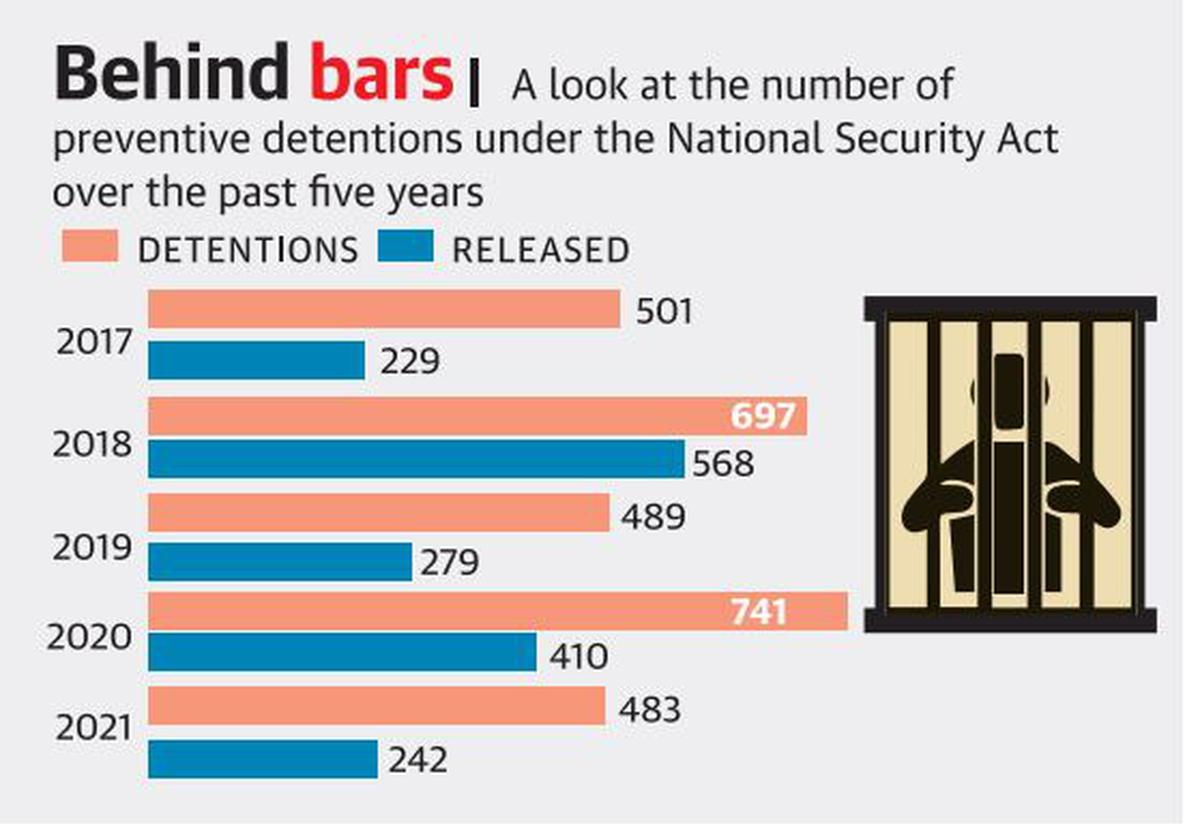
Over 483 were detentions under the National Security Act, of which almost half (241) were either in custody or still detained as of 2021-end.
In 2017, the NCRB’s Crime in India report found that 67,084 persons had been detained as a preventive measure that year.
Of these, 48,815 were released between one and six months of their detention and 18,269 were either in custody or still in preventive detention as of the end of the year.
Various provisions invoked for Preventive Detention
Among other laws under which the NCRB has recorded data on preventive detentions are the:
Goonda Act (State and Central) (29,306),
Prevention of Illicit Traffic in Narcotic Drugs and Psychotropic Substances Act, 1988 (1,331), and
A category classified as “Other Detention Acts”, under which most of the detentions were registered (79,514).
Since 2017, the highest number of persons to be placed under preventive detention has consistently been under the “Other Detention Acts” category.
Concerns over the report
The number of persons placed under detention has been increasing since 2017 — to over 98,700 in 2018 and over 1.06 lakh in 2019 — before dipping to 89,405 in 2020 (due to lockdowns).
The number of persons placed under preventive detention has seen an increase in 2021.
What is Preventive Detention?
Preventive detention means detaining a person so that to prevent that person from commenting on any possible crime.
In other words, preventive detention is an action taken by the administration on the grounds of the suspicion that some wrong actions may be done by the person concerned which will be prejudicial to the state.
Preventive Detention in India
A police officer can arrest an individual without orders from a Magistrate and without any warrant if he gets any information that such an individual can commit any offense.
Preventive Detention Law, 1950: According to this law any person could be arrested and detained if his freedom would endanger the security of the country, foreign relations, public interests, or otherwise necessary for the country.
Unlawful Activities Prevention Act (UAPA) 1968: Within the ambit of UAPA law the Indian State could declare any organization illegal and could imprison anyone for interrogation if the said organization or person critiqued/questioned Indian sovereignty territorially.
What is the difference between Preventive Detention and an Arrest?
An ‘arrest’ is done when a person is charged with a crime.
In the case of preventive detention, a person is detained as he/she is simply restricted from doing something that might deteriorate the law-and-order situation.
Article 22 of the Indian Constitution provides protection against arrest and detention in certain cases.
Rights of an Arrested Person in India
A/c to Article 22(1) and 22(2) of the Indian constitution:
A person cannot be arrested and detained without being informed why he is being arrested.
A person who is arrested cannot be denied to be defended by a legal practitioner of his choice. This means that the arrested person has right to hire a legal practitioner to defend himself/ herself.
Every person who has been arrested would be produced before the nearest magistrate within 24 hours.
The custody of the detained person cannot be beyond the said period by the authority of magistrate.
Exceptions for Preventive Detention
Article 22(3) says that the above safeguards are not available to the following:
If the person is at the time being an enemy alien
If the person is arrested under certain law made for the purpose of “Preventive Detention”
Constitutional provision
It is extraordinary that the framers of the Indian Constitution, who suffered most because of the Preventive Detention Laws, did not hesitate to give Constitutional sanctity.
B.R. Ambedkar was of the opinion that the freedom of the individual should not supersede the interests of the state.
He had also stated that the independence of the country was in a state of inflancy and in order to save it, preventive detention was essential.
Issues with preventive detention
Arbitrariness: The police determinations of whether a person poses a threat are not tested at a trial by leading evidence or examined by legally trained persons.
Rights violation: Quiet often, there is no trial (upto 3 months), no periodic review, and no legal assistance for the detained person.
Abuse: It does not provide any procedural protections such as to reduce detainees’ vulnerability to torture and discriminatory treatment, and to prevent officials’ misusing preventive detention for subversive activities.
Tool for suppression: In the absence of proper safeguards, preventive detention has been misused, particularly against the Dalits and the minorities.
What has the apex court recently rule?
Preventive detention is a necessary evil only to prevent public disorder, ruled the Supreme Court in 2021.
The State should not arbitrarily resort to “preventive detention” to deal with all sundry “law and order” problems, which could be dealt with by the ordinary laws of the country.
Whenever an order under a preventive detention law is challenged, one of the questions the court must ask in deciding its legality is: was the ordinary law of the land sufficient to deal with the situation?
If the answer is in the affirmative, the detention order will be illegal.
Upholding the Article 21
Preventive detention must fall within the four corners of Article 21 (due process of law) read with Article 22 (safeguards against arbitrary arrest and detention) and the statute in question, Justice Nariman ruled.
The Liberty of a citizen is a most important right won by our forefathers after long, historical, and arduous struggles.
Way forward
Having such kind of acts has a restraining influence on the anti-social and subversive elements.
India is a large country and many separatist tendencies against the national security and integrity existed and existing and a strict law is required to counter the subversive activities.
The number of persons detained in these acts is not a very large and due attention is made before preventive detention.
The state should have very effective powers to deal with the acts in which the citizens involve in hostile activities, espionage, coercion, terrorism, etc.
The National Medical Commission (NMC), the apex regulatory body of medical professionals in India, has written to all State Medical Councils, banning sexual conversion therapy and calling it a “professional misconduct”.
What is the news?
The NMC has empowered the State bodies to take disciplinary action against medical professionals who breach the guideline.
The NMC was following a Madras High Court directive to issue an official notification listing conversion therapy as a wrong, under the Indian Medical Council (Professional Conduct, Etiquettes and Ethics) Regulations, 2002.
What is Sexual Conversion Therapy?
Conversion or reparative therapy is an intervention aimed at changing the sexual orientation or gender identity of an individual.
It uses either psychiatric treatment, drugs, exorcism and even violence, with the aim being to make the individual a heterosexual.
The conversion therapy umbrella also includes efforts to change the core identity of youth whose gender identity is incongruent with their sex anatomy.
Often, the therapy is offered by quacks with little expertise in dealing with the issue.
As late as 2018, medical books listed homosexuality and lesbianism as a “perversion”.
What are the risks?
The interventions under conversion therapy are provided under the false premise that homosexuality and diverse gender identities are pathological.
They are not; the absence of pathology means there is no need for conversion or any other like intervention.
Conversion therapy poses the risk of causing or exacerbating mental health conditions, like anxiety, stress and drug use which sometimes even lead to suicide.
What is the role of the Madras High Court in the ban?
On June 7, 2021, Justice N. Anand Venkatesh of the Madras High Court gave a landmark ruling on a case he was hearing about the ordeal of a same-sex couple who sought police protection from their parents.
Pending adequate legislation more protective of the community, Justice Venkatesh issued a slew of interim guidelines.
It aimed for the police, activists, Union and State Social Welfare Ministries, and the National Medical Commission to ensure their safety and security to lead a life chosen by them.
The ruling prohibited any attempt to medically “cure” or change the sexual orientation of LGBTQIA+ (lesbian, gay, bisexual, transgender, queer, intersex, asexual or of any other orientation) people.
It urged the authorities to take action against professionals involving themselves in any form or method of conversion therapy,” which could include the withdrawal of licence to practice medicine.
On July 8, 2022, the court gave an order to the NMC directing it to issue necessary official notification by enlisting ‘Conversion Therapy’ as a professional misconduct.
What were some of the other guidelines issued by the court?
The court asked the Ministry of Social Justice & Empowerment to draw up a list of NGOs and other groups which could handle the issues faced by the community, and gave it a time of 8 weeks from the date of the order.
The court said the community should be provided with legal assistance by the District Legal Services Authority in coordination with law enforcement agencies.
It asked agencies to follow the Transgender Persons (Protection of Rights) Rules, 2020, and the Transgender Persons (Protection of Rights) Act, 2019, in letter and spirit.
The court said it was imperative to hold sensitisation programmes for an all-out effort to understand the community and its needs.
Way forward
Schools and colleges must effect changes in curricula for a better understanding of the community.
People of a different sexual orientation or gender identity often narrate harrowing tales of bullying, discrimination, stigma and ostracization.
Gender-neutral restrooms should be compulsory in educational institutes and other places.
Parents too need to be sensitised, because the first point of misunderstanding and abuse often begins at home, with teenagers being forced to opt for “conversion” therapies.
Health professionals point out that even adults opting for sex reassignment surgeries need to get proper guidance liketherapy pre and post operation.
Back2Basics: Transgender Persons (Protection of Rights) Act, 2019: Key Features
Defining Transperson
The act defines a transgender person as one whose gender does not match the gender assigned at birth.
It includes trans-men and trans-women, persons with intersex variations, gender-queers, and persons with socio-cultural identities, such as kinnar and hijra.
Prohibition against discrimination
It prohibits the discrimination against a transgender person, including denial of service or unfair treatment in relation to education, employment, healthcare, access to, or enjoyment of goods, facilities, opportunities available to the public.
Every transgender person shall have a right to reside and be included in his household.
No government or private entity can discriminate against a transgender person in employment matters, including recruitment, and promotion.
HRD measures
A transgender person may make an application to the District Magistrate for a certificate of identity, indicating the gender as ‘transgender’.
Educational institutions funded or recognised by the relevant government shall provide inclusive facilities for transgender persons, without discrimination.
The government must provide health facilities to transgender persons including separate HIV surveillance centres, and sex reassignment surgeries.
Grievances redressal
The National Council for Transgender persons (NCT) chaired by Union Minister for Social Justice, will advise the central government as well as monitor the impact of policies with respect to transgender persons.
It will also redress the grievances of transgender persons.
Legal Protection
The Bill imposes penalties for the offences against transgender persons like bonded labour, denial of use of public places, removal from household & village and physical, sexual, verbal, emotional or economic abuse.
The Indian Railways’ experiment to introduce AC III tier economy class coaches has started to pay off. Since its introduction, in the last one year, these coaches have earned the Railways more than Rs.230 crore in revenue.
What is AC III tier economy class coach?
The AC 3 tier economy class in Indian Railways is a milestone concerning pocket-friendly traveling experience for common man.
With fare slightly more than sleeper class and lower than conventional AC class.
The objective of the railway is to move sleeper class passengers to a comfortable AC class with luxurious facilities. AC-3 tier comprises air-conditioned coaches with 64 sleeping berths.
When it is introduced?
The Indian Railway has introduced the first AC III tier Economy Class for North Central Railway Zone in 2021 to provide a convenient traveling experience to the passengers.
As of now 7 trains are equipped with AC III tier economy class coaches are running on the tracks
Features of the AC III tier economy coach:
Pocket friendly: According to the Indian Railways, the fair in these coaches are cheaper than the normal AC three-tier coach. Fares in AC III tier economy are 6%-7% cheaper than the AC III tier class. The economy class has a capacity of 83 berths compared to 72 in the regular coach.
Divyang friendly and modern designs: The coaches were specially designed for the convenience of the divyangs. Providing Improved and modular design of berths and ergonomically designed ladder for accessing the middle and upper berths etc.
Modern features: In these, modern arrangements have been made for mobile phones and magazine holders, fire safety, personalised reading lights, AC vents, USB points, mobile charging points.
Optimum Speed: These air-conditioned three-tier economy class coaches are capable of running at an optimum speed of 160 kilometers per hour.
More Capacity: The economy class has a capacity of 83 berths compared to 72 in the regular coach.
What is the current status of AC III tier class?
AC- III tier, the favorite mode of train travel of people falling in the bottom rung of the middle class, is the only class that earns the Railways profit among all its passenger services.
The AC III tier is the only class of service which has generated consistent profits for the Railways. Between FY16 and FY20,
AC III tier coaches carried only 1% of the total passengers, but were responsible for 21% of the earnings from travelers. Such a low-passenger, high-revenue dichotomy was not seen in any other class.
It is not as expensive as the other AC classes and at the same time, its share in revenue has not been impacted by the relatively low pricing
The overall revenue of Indian Railways at the end of August 2022 was Rs 95,486.58 crore, showing an increase 38 per cent over the corresponding period of last year.
Goods revenue climbed by Rs 10,780.03 crore (or 20 per cent) to Rs 65,505.02 crore till August-end this year
The revenue from passenger traffic was Rs 25,276.54 crore, an increase of Rs 13,574.44 crore (116 per cent) year-on-year.
Passenger traffic also increased compared to last year in both the segments — reserved and unreserved
Railways’ total revenue during the entire last fiscal (2021-22) stood at Rs.1,91,278.29 crore.
What are the issues faced by Indian railways to increase its revenue?
Cross Subsidized: The cross-subsidiszation in respect of second class, ordinary class and suburban services has increased continuously in the past five years with subsidy on ordinary class being the maximum,
Concessional fare: The revenue forgone in passenger earnings due to concessions to various categories of passengers (physically challenged persons, patients, senior citizens, Izzat monthly season tickets, press correspondents, sport persons and war widows among others) increased from Rs 1,994.83 crore in 2018-19 to Rs 2,058.61 crore in 2019-20.
Low -Revenue dichotomy in Expensive class: A high-passenger, low-revenue dichotomy was seen in the inexpensive classes. For instance, over 90% passengers travelled by second class which accounted for only 37% of the earnings.
Operational Loss: Operational losses (in crore) incurred while operating various classes of service. For instance, in operating AC first class service, the Railways incurred a loss of 403 crore in FY20
Conclusion
Adding more AC III tier economy class coaches is a step in the right direction as it has shown positive result in revenue generation for railways and it provides a travel with dignity to a common man. But If Indian railway has to benefit it have to work extensively on operational loss incurred out of low Revenue dichotomy in Expensive classes.
Mains Question
Q. Indian Railways is often referred to as the lifeline of the country but runs at a loss when it comes to running class-divided coaches. In this context discuss the utility of class divided coaches.

 Context
  Reasons for Persistence of
  Ongoing challenges in mental wellness regime
  Context
  Concerns of excessive mining


 Context
 What is AC III tier economy class coach?
 Features of the AC III tier economy coach:
 Revenue of