It is a heavy-duty power bank that is portable and weighs 14 kilograms.
It is of great utility to the digitally connected modern military and Special Forces personnel who have to operate in high-risk zones while using gadgets that require constant power back-up.
These batteries are designed, engineered and made in India.
The field pack can be used to charge a MacBook 60 times.
Significance of Pravaig
This supply marks a major shift in the defense landscape of India — a tipping point in the reversal of India’s high technology defense industry, from users to developers, from importers to exporters.
The field pack can be used to energize a military person’s field duties and it can be used to deploy remote sensors.
A powerful tactical battery can be used even to operate larger military equipment such as drones and it can even help coordinate tactical operations which involve multiple weapons systems.
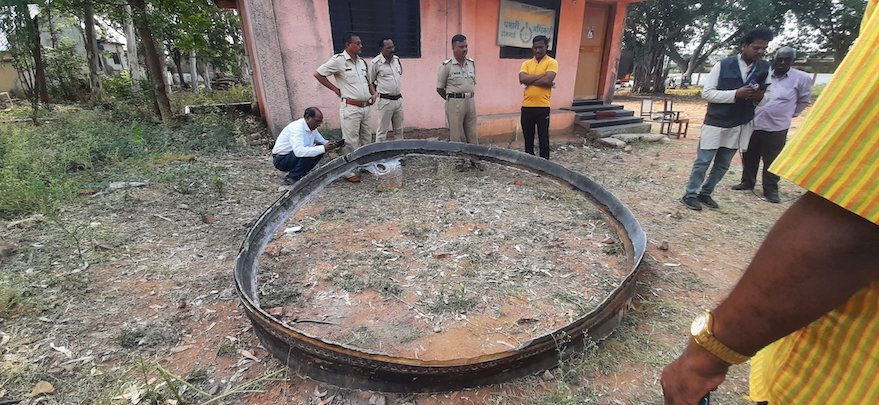
Four spherical metal balls fell from the sky in some villages of Gujarat over the past few days.
Some experts say they are most likely the debris of a Chinese rocket Chang Zheng 3B or fuel storage tanks of space launch vehicles.
With more & more space launches and events like space tourism kicking off, the space above Earth is overcrowded – calling for urgent attention from countries to declutter it.
What is Space Junk?
Space junk, or space debris, is any piece of machinery or debris left by humans in space.
It can refer to big objects such as dead satellites that have failed or been left in orbit at the end of their mission.
It can also refer to smaller things, like bits of debris or paint flecks that have fallen off a rocket.
Space debris encompasses both natural meteoroid and artificial (human-made) orbital debris.
Meteoroids are in orbit about the sun, while most artificial debris is in orbit about the Earth (hence the term “orbital” debris).
How are they generated?
All space junk is the result of us launching objects from Earth, and it remains in orbit until it re-enters the atmosphere.
Some objects in lower orbits of a few hundred kilometres can return quickly.
They often re-enter the atmosphere after a few years and, for the most part, they’ll burn up – so they don’t reach the ground.
But debris or satellites left at higher altitudes of 36,000 kilometres – where communications and weather satellites are often placed in geostationary orbits – can continue to circle Earth for hundreds or even thousands of years.
Some space junk results from collisions or anti-satellite tests in orbit.
How much space junk is there?
While there are about 2,000 active satellites orbiting Earth at the moment, there are also 3,000 dead ones littering space.
What’s more, there are around 34,000 pieces of space junk bigger than 10 centimetres in size and millions of smaller pieces that could nonetheless prove disastrous if they hit something else.
What risks does space junk pose to space exploration?
Fortunately, at the moment, space junk doesn’t pose a huge risk to our exploration efforts.
Collisions: Collisions could cause significant damage to the space properties of the countries. Upon collision, the debris disables the satellites’ onboard electronics and may disrupt the services provided by the space assets.
Collateral damage: The biggest danger it poses is to other satellites in orbit. These satellites have to move out of the way of all this incoming space junk to make sure they don’t get hit and potentially damaged or destroyed.
High momentum strikes: As these debris travel at high speeds in the low earth orbit, they risk colliding with functional satellites or even the space station. Given that these particles travel at speeds of 8 metres per second, even a 100g object could create an impact comparable to a 30-kg stone travelling at 100kmph.
Usability of space: This debris orbit the earth several times a day. As the mass of space junk continues to grow, parts of the space may become unusable.
Kessler Syndrome: It refers to a theoretical scenario in which the amount of space debris becomes so high that a single collision or destruction event could lead to a snowballing cascade of space debris- like a domino effect.
India and Space Debris
India had 103 spacecraft, including active and defunct satellites, and 114 space debris objects, including spent rocket bodies orbiting the earth.
So, the country has a total of 217 space objects orbiting the earth.
Presently, the ISRO has taken up research activities to study the feasibility and technologies required to undertake active debris removal (ADR).
ADR was one of the active methods suggested by the Space Debris Research Community to contain the growth of space debris objects.
Mechanism against damage
Space is beyond national jurisdiction and falls under the ambit of international law:
Under the Convention on International Liability for Damage Caused by Space Objects, countries can claim compensation from other countries for damages incurred from space debris.
The Outer Space Treaty, 1967 and the like outline the guidelines for the countries’ activities in space.
All space objects, including the defunct space debris, are under the jurisdiction of the ‘State of Registry’.
If something goes wrong during such manoeuvres, a liability regime under the applicable international law applies to not only the launching country but also other countries involved in the launch.
The UN Committee on the Peaceful Use of Outer Space (COPUOS) is tasked with space governance and there are already accepted guidelines for space debris mitigation and sustainability of space activities.
Efforts for space debris removal
There are four techniques that can move debris from heavily trafficked orbits:
Deorbiting (the deliberate, forced re-entry of a space object into the Earth’s atmosphere by application of a retarding force, usually via a propulsion system)
Orbital lifetime reduction (accelerating the natural decay of spacecraft and other space objects to reduce the time that they remain in orbit)
Disposal orbits– Moving objects into less populated “disposal” orbits at the end of their functional lifetime
Active removal of debris from orbit
Global efforts
NASA undertakes DAMs or Debris Avoidance Manoeuvres, which are navigation manoeuvres that take the space station away from its normal trajectory to avoid collisions, are undertaken based on the probability of collision.
NORAD, or the North American Aerospace DefenceCommand, is an initiative of the U.S. and Canada that shares selective debris data with many countries.
Clearspace-1(of European Space Agency), which is scheduled to launch in 2025, will be the first space mission to eliminate debris from orbit.
India’s efforts: Project NETRA
NETRA stands for Network for Space Objects Tracking and Analysis (NETRA) project.
Project NETRA is an early warning system in space to detect debris and other hazards to Indian satellites.
In this pursuit, space debris tracking radar with a range of 1,500 km and an optical telescope will be inducted as part of establishing an effective surveillance and tracking network under NETRA.
Way forward
Space junk is no one country’s responsibility, but the responsibility of every spacefaring country.
Spacefaring nations must minimize the risks to people and property on Earth of re-entries of space objects and maximize transparency regarding those operations.
High-accuracy assessment and prediction tools are essential for reducing risk to current systems and future launches.
Space traffic management is a crucial area that requires attention since the satellites in orbit can come in the way of each other.
India is negotiating and signing several free trade agreements (FTAs) with countries like Australia, the UK, Israel, and the EU. While the economic benefits of these FTAs have been studied, there is very little discussion on the lack of parliamentary scrutiny of these treaties.
Provisions in the Constitution
In the Constitution, entry 14 of the Union list contains the following item — “entering into treaties and agreements with foreign countries and implementing of treaties, agreements and conventions with foreign countries”.
According to Article 246, Parliament has the legislative competence on all matters given in the Union list.
Thus, Parliament has the power to legislate on treaties.
This power includes deciding how India will ratify treaties and thus assume international law obligations.
Article 253 elucidates that the power of Parliament to implement treaties by enacting domestic laws also extends to topics that are part of the state list.
Lack of parliamentary oversight and its implications
No law laying down the process: While Parliament in the last seven decades has passed many laws to implement international legal obligations imposed by different treaties, it is yet to enact a law laying down the processes that India needs to follow before assuming international treaty obligations.
Given this legislative void, and under Article 73(the powers of the Union executive are co-terminus with Parliament), the Centre has been not just negotiating and signing but also ratifying international treaties and assuming international law obligations without much parliamentary oversight.
Arguably, Parliament exercises control over the executive’s treaty-making power at the stage of transforming a treaty into the domestic legal regime.
However, this is a scenario of ex-post parliamentary control over the executive.
In such a situation, Parliament does not debate whether India should or should not accept the international obligations; it only deliberates how the international law obligations, already accepted by the executive, should be implemented domestically.
Against the practice in other liberal democracies: This practice is at variance with that of several other liberal democracies.
In the US, important treaties signed by the President have to be approved by the Senate.
In Australia, the executive is required to table a “national interest analysis” of the treaty it wishes to sign in parliament, and then this is examined by a joint standing committee on treaties – a body composed of Australian parliamentarians.
Way forward
Indian democracy needs to inculcate these healthy practices of other liberal democracies.
Conclusion
Effective parliamentary supervision will increase the domestic acceptance and legitimacy of international treaties, especially economic agreements, which are often critiqued for imposing undue restraints on India’s economic sovereignty.
India, after half a century of keeping its higher education doors closed to foreigners, is on the cusp of opening itself to the world.
Higher education reforms
Currently, India does not allow the entry and the operation of foreign university branch campuses.
The NEP 2020 was a turning point for the entry of foreign universities as it recommended allowing foreign universities ranked in the “top 100” category to operate in India — under somewhat unrealistic conditions.
Internationalism: The wide-ranging National Education Policy (NEP) 2020 promises higher education reforms in many areas, and internationalisation is prominent among them.
Strengthening India’s soft power: Among the underlying ideas is to strengthen India’s “soft power” through higher education collaboration, bringing new ideas and institutions from abroad to stimulate reform and show “best practice”, and in general to ensure that Indian higher education, for the first time, is a global player.
In February 2022, Finance Minister Nirmala Sitharaman, in her Budget speech, announced that “world-class foreign universities and institutions would be allowed in the planned business district in Gujarat’s GIFT City”
It was reported that in April 2022, the University Grants Commission (UGC) formed a committee to draft regulations to allow foreign institutions in the “top 500” category to establish campuses in India — realising that more flexibility was needed
Bringing global experience to India: Establishing branch campuses of top foreign universities is a good idea as this will bring much-needed global experience to India.
Challenges
Globally, branch campuses, of which there are around 300 now, provide a mixed picture.
Many are aimed at making money for the sponsoring university — and this is not what India wants.
It will not be easy to attract foreign universities to India and even more difficult to create the conditions for them to flourish.
Many of those top universities are already fully engaged overseas and would likely require incentives to set up in India.
Further, there are smaller but highly regarded universities outside the ‘top 500’ category that might be more interested.
Universities around the world that have academic specialisations focusing on India, that already have research or faculty ties in the country, or that have Non-Resident Indians (NRI) in senior management positions may be easier to attract.
What is most important is to prevent profit-seekers from entering the Indian market and to encourage foreign institutions with innovative educational ideas and a long-term commitment.
Many host countries have provided significant incentives, including building facilities and providing necessary infrastructure.
Foreign universities are highly unlikely to invest significant funds up front.
A big challenge will be India’s “well-known” bureaucracy, especially the multiple regulators.
Opportunities
India is seen around the world as an important country and an emerging higher education power.
It is the world’s second largest “exporter” of students, with 4,61,792 students studying abroad (according to the UNESCO Institute for Statistics).
And India has the world’s second largest higher education system.
Foreign countries and universities will be eager to establish a “beachhead” in India and interested in providing opportunities for home campus students to learn about Indian business, society, and culture to participate in growing trade and other relations.
Benefits of branch campuses: International branch campuses, if allowed, could function as a structurally different variant of India’s private university sector.
Branch campuses, if effectively managed, could bring much needed new ideas about curriculum, pedagogy, and governance to Indian higher education — they could be a kind of educational laboratory.
Current initiatives
There has been modest growth of various forms of partnerships between Indian and foreign institutions.
The joint PhD programmes offered by the Indian Institute of Technology Bombay-Monash Research Academy and the University of Queensland-Indian Institute of Technology Delhi Academy of Research (UQIDAR), both with Australian partners, are some examples.
Another example is the Melbourne-India Postgraduate Academy (MIPA). It is a joint initiative of the Indian Institute of Science Bangalore, the Indian Institute of Technology Madras, the Indian Institute of Technology Kanpur and the Indian Institute of Technology Kharagpur with the University of Melbourne.
MIPA provides students with an opportunity to earn a joint degree accredited both in India and Australia: from the University of Melbourne and one of the partnering Indian institutions.
These partnerships suggest that India could offer opportunities for international branch campuses as well.
Challenges
Globally, branch campuses, of which there are around 300 now, provide a mixed picture.
Many are aimed at making money for the sponsoring university — and this is not what India wants.
It will not be easy to attract foreign universities to India and even more difficult to create the conditions for them to flourish.
Many of those top universities are already fully engaged overseas and would likely require incentives to set up in India.
Further, there are smaller but highly regarded universities outside the ‘top 500’ category that might be more interested.
Universities around the world that have academic specialisations focusing on India, that already have research or faculty ties in the country, or that have Non-Resident Indians (NRI) in senior management positions may be easier to attract.
What is most important is to prevent profit-seekers from entering the Indian market and to encourage foreign institutions with innovative educational ideas and a long-term commitment.
Many host countries have provided significant incentives, including building facilities and providing necessary infrastructure.
Foreign universities are highly unlikely to invest significant funds up front.
A big challenge will be India’s “well-known” bureaucracy, especially the multiple regulators.
Conclusion
After examining national experiences elsewhere, clear policies can be implemented that may be attractive to foreign universities. Once policies are in place, the key to success will be relationships among universities.
The country’s frontline health workers or ASHAs (accredited social health activists) were one of the six recipients of the WHO’s Global Health Leaders Award 2022 which recognises leadership, contribution to the advance of global health and commitment to regional health issues.
Who are ASHA workers?
ASHA workers are volunteers from within the community who are trained to provide information and aid people in accessing benefits of various healthcare schemes of the government.
The role of these community health volunteers under the National Rural Health Mission (NRHM) was first established in 2005.
They act as a bridge connecting marginalised communities with facilities such as primary health centres, sub-centres and district hospitals.
Genesis & evolution
The ASHA programme was based onChhattisgarh’s successful Mitanin programme, in which a Community Worker looks after 50 households.
The ASHA was to be a local resident, looking after 200 households.
The programme had a very robust thrust on the stage-wise development of capacity in selected areas of public health.
Many states tried to incrementally develop the ASHA from a Community Worker to a Community Health Worker, and even to an Auxiliary Nurse Midwife (ANM)/ General Nurse and Midwife (GNM), or a Public Health Nurse.
Qualifications for ASHA Workers
ASHAs are primarily married, widowed, or divorced women between the ages of 25 and 45 years from within the community.
They must have good communication and leadership skills; should be literate with formal education up to Class 8, as per the programme guidelines.
How many ASHAs are there across the country?
The aim is to have one ASHA for every 1,000 persons or per habitation in hilly, tribal or other sparsely populated areas.
There are around 10.4 lakh ASHA workers across the country, with the largest workforces in states with high populations – Uttar Pradesh (1.63 lakh), Bihar (89,437), and Madhya Pradesh (77,531).
Goa is the only state with no such workers, as per the latest National Health Mission data available from September 2019.
What do ASHA workers do?
They go door-to-door in their designated areas creating awareness about basic nutrition, hygiene practices, and the health services available.
They focus primarily on ensuring that pregnant women undergo ante-natal check-up, maintain nutrition during pregnancy, deliver at a healthcare facility, and provide post-birth training on breast-feeding and complementary nutrition of children.
They also counsel women about contraceptives and sexually transmitted infections.
ASHA workers are also tasked with ensuring and motivating children to get immunised.
Other than mother and child care, ASHA workers also provide medicines daily to TB patients under directly observed treatment of the national programme.
They are also tasked with screening for infections like malaria during the season.
They also provide basic medicines and therapies to people under their jurisdiction such as oral rehydration solution, chloroquine for malaria, iron folic acid tablets to prevent anaemia etc.
Now, they also get people tested and get their reports for non-communicable diseases.
The health volunteers are also tasked with informing their respective primary health centreabout any births or deaths in their designated areas.
How much are ASHA workers paid?
Since they are considered “volunteers/activists”, governments are not obligated to pay them a salary. And, most states don’t.
Their income depends on incentives under various schemes that are provided when they, for example, ensure an institutional delivery or when they get a child immunised.
All this adds up to only between Rs 6,000 to Rs 8,000 a month.
Her work is so tailored that it does not interfere with her normal livelihood.
Success of the ASHAs
It is a programme that has done well across the country.
In a way, it became a programme that allowed a local woman to develop into a skilled health worker.
Overall, it created a new cadre of incrementally skilled local health workers who were paid based on performance.
The ASHAs are widely respected as they brought basic health services to the doorstep of households.
Since then ASHA continues to enjoy the confidence of the community.
Challenges to ASHAs
The ASHAs faced a range of challenges: Where to stay in a hospital? How to manage mobility? How to tackle safety issues?
There have been challenges with regard to the performance-based compensation. In many states, the payout is low, and often delayed.
It has a problem of responsibility and accountability without fair compensation.
There is a strong argument to grant permanence to some of these positions with a reasonable compensation as sustaining motivation.
Ideally, an ASHA should be able to make more than the salary of a government employee, with opportunities for moving up the skill ladder in the formal primary health care system as an ANM/ GNM or a Public Health Nurse.
Way forward
The incremental development of a local resident woman is an important factor in human resource engagement in community-linked sectors.
It is equally important to ensure that compensation for performance is timely and adequate.
Upgrading skill sets and providing easy access to credit and finance will ensure a sustainable opportunity to earn a respectable living while serving the community.
Strengthening access to health insurance, credit for consumption and livelihood needs at reasonable rates, and coverage under pro-poor public welfare programmes will contribute to ASHAs emerging as even stronger agents of change.
The Inter-State Council, which works to promote and support cooperative federalism in the country, has been reconstituted with PM Modi as Chairman and CMs of all States and six Union Ministers as members.
What is Inter-State Council (ISC)?
Genesis of ISC
The Constitution of India in Article 263, provides for the establishment of Inter-State Council (ISC).
The objective of the ISC is to discuss or investigate policies, subjects of common interest, and disputes among states.
Temporary or permanent?
The articles says that ISC may be established “if at any time it appears to the President that the public interests would be served by the establishment of a Council”.
Therefore, the constitution itself did not establish the ISC, because it was not considered necessary at the time the constitution was being framed, but kept the option for its establishment open.
Establishment as permanent body
This option was exercised in 1990.
The ISC was established as a permanent body on 28 May 1990 by a presidential order on the recommendation of the Sarkaria Commission.
It had recommended that a permanent Inter-State Council called the Inter-Governmental Council (IGC) should be set up under Article 263.
It cannot be dissolved and re-established.
Therefore, the current status of ISC is that of a permanent constitutional body.
Aims of the ISC
Decentralisation of powers to the states as much as possible
More transfer of financial resources to the states
Arrangements for devolution in such a way that the states can fulfil their obligations
Advancement of loans to states should be related to as ‘the productive principle’
Deployment of Central Armed Police Forces in the states either on their request or otherwise
Composition
The Inter-State Council composes of the following members:
Prime Minister, Chairman.
Chief Ministers of all states.
Chief Ministers of the union territories having legislative assemblies.
Administrators of the union territories not having legislative assemblies.
6 Union Cabinet Ministers, including Home Minister, to be nominated by the Prime Minister.
Governors of the states being administered under President’s rule.
India has signalled its readiness to be part of a new economic initiative led Indo-Pacific Economic Framework for Prosperity (IPEF) by the US for the region.
What is IPEF?
The grouping, which includes seven out of 10 members of the Association of South East Asian Nations (ASEAN), all four Quad countries, and New Zealand, represents about 40% of global GDP.
The negotiations for the IPEF are expected to centre around four main pillars, including trade, supply chain resiliency, clean energy and decarbonisation, and taxes and anti-corruption measures.
Countries would have to sign up to all of the components within a module, but do not have to participate in all modules.
The “fair and resilient trade” module will be led by the US Trade Representative and include digital, labor, and environment issues, with some binding commitments.
The IPEF seeks to strengthen economic partnership amongst participating countries with the objective of enhancing resilience, sustainability, inclusiveness, economic growth, fairness, and competitiveness in the Indo-Pacific region.
Features of IPEF
US officials made it clear that the IPEF would not be a “free trade agreement”, nor are countries expected to discuss reducing tariffs or increasing market access.
The IPEF will not include market access commitments such as lowering tariff barriers,
In that sense, the IPEF would not seek to replace the 11-nation CPTPP (Trans-Pacific Partnership) that the US quit in 2017, or the RCEP, which China, and all of the other IPEF countries (minus the US) are a part of.
Three ASEAN countries considered closer to China — Myanmar, Cambodia and Laos — are not members of the IPEF.
Four pillars of IPEF
Tradethat will include digital economy and emerging technology, labour commitments, the environment, trade facilitation, transparency and good regulatory practices, and corporate accountability, standards on cross-border data flows and data localisations;
Supply chain resiliency to develop “a first-of-its-kind supply chain agreement” that would anticipate and prevent disruptions;
Clean energy and decarbonisationthat will include agreements on “high-ambition commitments” such as renewable energy targets, carbon removal purchasing commitments, energy efficiency standards, and new measures to combat methane emissions; and
Tax and anti-corruption, with commitments to enact and enforce “effective tax, anti-money laundering, anti-bribery schemes in line with [American] values”.
Reasons for creation of IPEF
The IPEF is also seen as a means by which the US is trying to regain credibility in the region after former President Donald Trump pulled out of the Trans Pacific Partnership TPP).
Since then, there has been concern over the absence of a credible US economic and trade strategy to counter China’s economic influence in the region.
China is an influential member of the TPP, and has sought membership of its successor agreement Comprehensive and Progressive Agreement on Trans Pacific Partnership.
It is also in the 14-member Regional Comprehensive Economic Partnership, of which the US is not a member (India withdrew from RCEP).
The Biden Administration is projecting IPEF as the new US vehicle for re-engagement with East Asia and South East Asia.
Disaster struck Dima Hasao, central Assam’s hill district, in mid-May after incessant heavy rainfall.
Impacts of the disaster
The 170 km railway line connecting Lumding in the Brahmaputra Valley’s Hojai district and Badarpur in the Barak Valley’s Karimganj district was severely affected.
The Assam government and Railway Ministry’s assessments said the district suffered a loss of more than ₹1,000 crore, but ecologists say the damage could be irreversibly higher.
How severe has the rain been in Assam?
Assam is used to floods, sometimes even four times a year, resultant landslides and erosion.
But the pre-monsoon showers this year have been particularly severe on Dima Hasao, one of three hill districts in the State.
Landslips have claimed four lives and damaged roads.
The impact has been most severe on the arterial railway, which was breached at 58 locations leaving the track hanging in several places.
The disruption of train services, unlikely to be restored soon, has cut off the flood-hit Barak Valley, parts of Manipur, Mizoram and Tripura.
Why is the railway in focus post-disaster?
Dima Hasao straddles the Barail, a tertiary mountain range between the Brahmaputra and Barak River basins.
The district is on the Dauki fault (the prone-to-earthquakes geological fractures between two blocks of rocks) straddling Bangladesh and parts of the northeast.
British engineers were said to have factored in the fragility of the hills to build the railway line over 16 years by 1899.
The end result was an engineering marvel 221 km long over several bridges and through 37 tunnels, laid along the safer sections of the hills.
A faulty experiment
A project to convert the metre gauge track to broad gauge was undertaken in 1996 but the work was completed only by March 2015 because of geotechnical constraints and extremist groups.
The broad-gauge track was realigned to be straighter, but a 2009-10 audit report revealed that the project had been undertaken without proper planning and visualisation of the soil strata behaviour.
The report gave the example of the disaster-prone Tunnel 10 on the realigned track that was pegged 8 meters below the bed of a nearby stream.
Is only the railway at fault?
There is a general consensus that other factors have contributed to the situation Dima Hasao is in today.
Roads in the district, specifically the four-lane Saurashtra-Silchar (largest Barak Valley town) East-West Corridor, have been realigned or deviated from the old ones that were planned around rivers and largely weathered the conditions.
The arterial roads build over the past 20 years often cave in and get washed away by floods or blocked by landslides.
Shortened cycles of jhum or shifting cultivation on the hill slopes and unregulated mining have accentuated the “man-made disaster”.
Massive extraction of river stone, illegal mining of coal and smuggling of forest timbe has led to the disaster.
These activities have increased water current besides weakening either side of riverbanks.
How vital are the rail and highway through Dima Hasao?
Meghalaya aside, Dima Hasao is the geographical link to a vast region comprising southern Assam’s Barak Valley, parts of Manipur, Mizoram and Tripura.
Moreover, this track is vital for India’s Look East policy that envisages shipping goods to and from Bangladesh’s Chittagong port via Tripura’s border points at Akhaura and Sabroom.
These are the last railway station near the Feni River that serves as the India-Bangladesh border.