💥Mains Ready By December. Smash Mains & Smash PYQ Admissions Open

Search results for: “”

  • India slips to 150 in Press Freedom Index

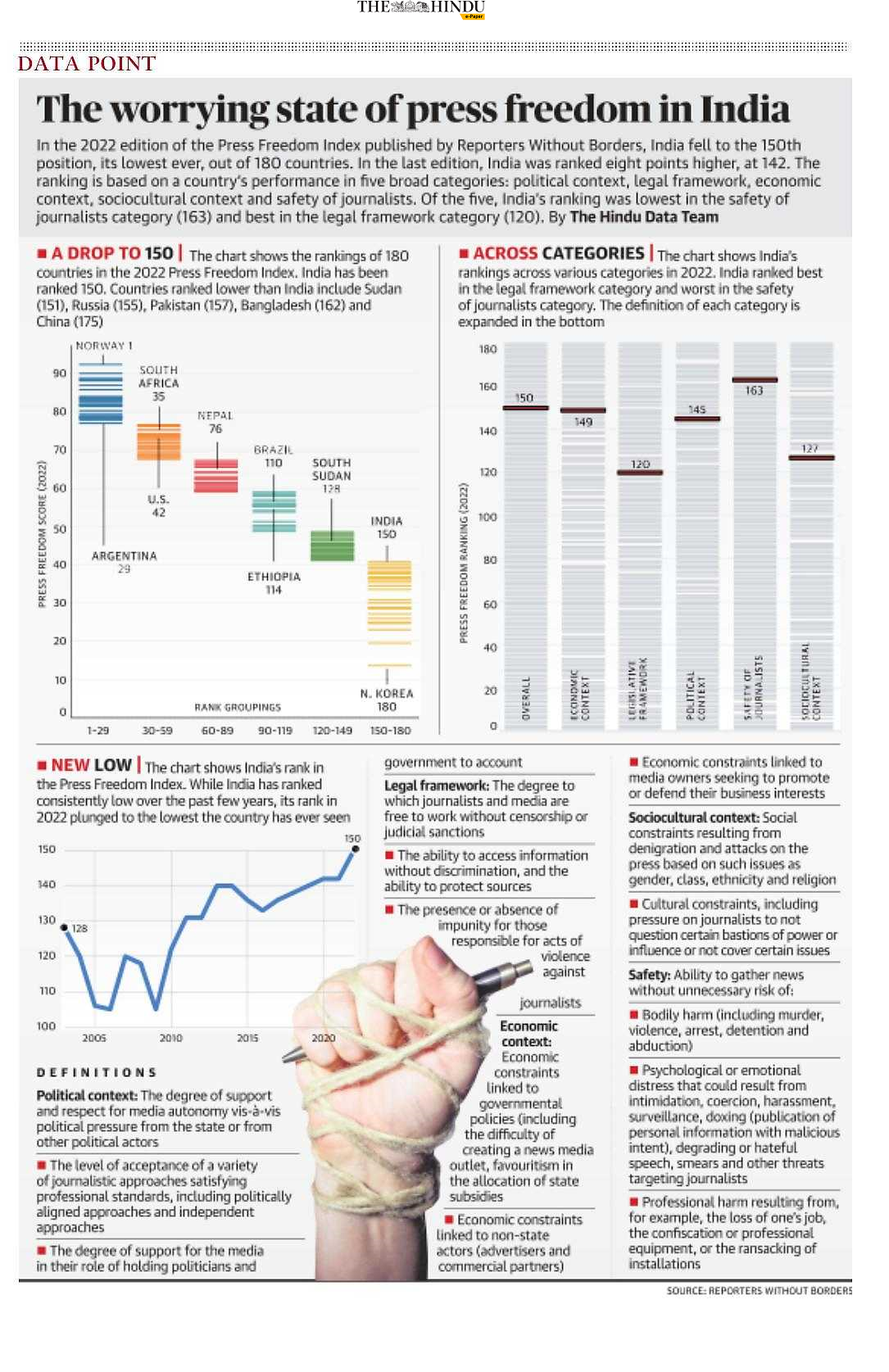
    India has reached 150th position in the World Press Freedom Index, dropping further from its last year’s 142nd rank out of 180 countries.

    What is Press Freedom Index?

    • The PFI is an annual ranking of countries compiled and published by Reporters Without Borders since 2002.
    • It is based upon the organisation’s own assessment of the countries’ press freedom records in the previous year.
    • It intends to reflect the degree of freedom that journalists, news organisations, and netizens have in each country, and the efforts made by authorities to respect this freedom.
    • It does not measure the quality of journalism in the countries it assesses, nor does it look at human rights violations in general.

    Highlights of the 2022 report

    (a) Best performing countries

    • Norway– 1st
    • Denmark– 2nd
    • Sweden– 3rd
    • Estonia– 4th
    • Finland– 5th

    (b) Worst performers

    • North Korea remained at the bottom of the list, while Russia was placed at 155th position, slipping from 150th last year.
    • As per the global media watchdog, China climbed up by two positions ranking at 175th position, as compared to 177th position last year.

     (c) Performance in our neighbourhood

    • Besides India, its neighbours except Nepal have also slid down.
    • While Pakistan is at 157th position, Sri Lanka ranks at 146th, Bangladesh at 162nd and Maynmar at 176th position.

    Back2Basics: Freedom of Press and Constitutional Provisions

    • The Supreme Court in Romesh Thappar v. the State of Madras, 1950 observed that freedom of the press lay at the foundation of all democratic organisations.
    • It is guaranteed under the freedom of speech and expression under Article 19, which deals with ‘Protection of certain rights regarding freedom of speech, etc.
    • Freedom of the press is not expressly protected by the Indian legal system but it is impliedly protected under article 19(1) (a) of the constitution.
    • The freedom of the press is also not absolute.

    Reasonable restrictions

    • A law could impose only those restrictions on the exercise of this right, it faces certain restrictions under article 19(2), which is as follows:
    1. Sovereignty and integrity of India
    2. Security of the State,
    3. Friendly relations with foreign States
    4. Public order, decency or morality
    5. Contempt of court
    6. Defamation
    7. Incitement to an offence


    UPSC 2023 countdown has begun! Get your personal guidance plan now! (Click here)

  • France pulls out of P-75I Project

    Ahead of PM Modi’s scheduled visit, France has denounced its participation in the P-75 India (P-75I) project under which six conventional submarines are to be built in India for the Indian Navy.

    Why did France pull out?

    • The reason was that the Request for Proposal (RFP) requires that the fuel cell AIP be sea proven, which not the case is for us yet since the French Navy does not use such a propulsion system.
    • AIP refers to Air-Independent Propulsion, a technology for conventional — that is, non-nuclear — submarines.

    Backgrounder: Project 75

    • Project 75 India is a part of India’s thirty-year-old submarine building plan by which all the six submarines which are under the project should already be sailing and it should have been followed by the submarines now for which the RFP has been issued.
    • It is a long-awaited and long-overdue project.
    • This should have happened way back but it got delayed because it was difficult to find a strategic partnership model.

    What is P-75I?

    • The Project 75I-class submarine is a follow-on of the Project 75 Kalvari-class submarine for the Indian Navy.
    • In the late 1990s, around the time of Kargil war, a three-decade plan took shape for indigenous construction of submarines.
    • It was known to have two separate series of submarine building lines – codenamed Project 75 and Project 75I — in collaboration with foreign entities.
    • Under this project, the Indian Navy intends to acquire six diesel-electric submarines, which will also feature advanced air-independent propulsion systems.
    • This is for enabling them to stay submerged for longer duration and substantially increase their operational range.

    What is the status of the project?

    • The navy is slightly behind the curve on P-75I.
    • The project faces choppy waters; the Naval Group has already announced it is pulling out, and sources said the Russian and Spanish companies might also not proceed with their bids.
    • Among the concerns, is the requirement to demonstrate a sea-proven fuel cell AIP.
    • While some manufacturers may have the technology, it may not have been proven at sea yet.
    • Another problem for the OEMs is the transfer of technology, which is built into the process.

    Why does the Navy want AIP subs?

    • Simply put, AIP technology allows a conventional submarine to remain submerged for much longer than ordinary diesel-electric submarines.
    • All conventional submarines have to surface to run their generators that recharge the batteries that allow the boat to function under water.
    • However, the more frequently a submarine surfaces, the higher the chances of it being detected.
    • AIP allows a submarine to remain submerged for more than a fortnight, compared to two to three days for diesel-electric boats.
    • IP has a force multiplier effect on lethality of a diesel electric submarine as it enhances the submerged endurance of the boat several folds.

    What submarines does India have now?

    • India has 16 conventional diesel-electric submarines, which are classified as SSKs.
    • After the last two Kalvari Class subs are commissioned under P-75, this number will go up to 18.
    • India also has two nuclear ballistic submarines, classified SSBN.

    Strategic importance of submarines development

    • Ageing arsenal: Currently, India has less number of submarines than what is required with some more of those from both types being at various stages of construction.
    • Combat roles in near future: The nuclear powered and diesel-electric submarines have their designated roles in the Carrier Battle Groups, which are formations of ships and submarines with Aircraft Carriers at the lead role.
    • Strategic deterrence: As per the basic principles of submarine deployment and the minimum requirement for India to create a strategic deterrence, there is a specific number of submarines of both types that India needs to have in active service.

    Significance of P-75 I

    • ‘Make in India’ Projects: It will serve to facilitate faster and more significant absorption of technology and create a tiered industrial ecosystem for submarine construction in India.
    • Self-Reliance: From a strategic perspective, this will help reduce current dependence on imports and gradually ensure greater self-reliance and dependability of supplies from indigenous sources.
    • Securing Indo-Pacific: China is increasing its presence in the Indian Ocean Region (IOR) and this is creating pressure on the Indian Navy in sprucing up the submarine arm.


    UPSC 2023 countdown has begun! Get your personal guidance plan now! (Click here)

  • Russia officially quits the International Space Station (ISS)

    Russia is responding to the Western sanctions. It has decided to walk out of the International Space Station.

    International Space Station

    • The ISS was launched in 1998 as part of joint efforts by the U.S., Russia, Japan, Canada and Europe.
    • The idea of a space station originated in the 1984 State of the Union address by former U.S. President Ronald Reagan.
    • The space station was assembled over many years, and it operates in low-earth orbit.
    • Since its inception, it has served as a laboratory suspended in space and has aided multiple scientific and technological developments.
    • The ISS was originally built to operate for 15 years.

    Why was ISS launched?

    • A space station permits quantum leaps in research in science, communications, and in metals and lifesaving medicines which could be manufactured only in space.
    • ISS has consistently maintained human presence for the past 21 years, providing astronauts with sophisticated technologies for scientific research.

    What is Russia’s role in maintaining the ISS?

    • The ISS is built with the co-operation of scientists from five international space agencies — NASA of the U.S., Roscosmos of Russia, JAXA of Japan, Canadian Space Agency and the European Space Agency.
    • Each agency has a role to play and a share in the upkeep of the ISS.
    • Both in terms of expense and effort, it is not a feat that a single country can support.
    • Russia’s part in the collaboration is the module responsible for making course corrections to the orbit of the ISS.
    • They also ferry astronauts to the ISS from the Earth and back.
    • Until SpaceX’s dragon spacecraft came into the picture the Russian spacecrafts were the only way of reaching the ISS and returning.


    UPSC 2023 countdown has begun! Get your personal guidance plan now! (Click here)

  • Advanced Towed Artillery Gun System (ATAGS) passes validation trials

    The indigenous Advanced Towed Artillery Gun System (ATAGS) developed by the Defence Research and Development Organisation (DRDO) successfully completed the validation trials.

    Why in news?

    • The ATAGS has demonstrated a range of over 45 km, making it the “most consistent and accurate gun in the world”.

    ATAG System

    • The ATAGS is a 155-mm, 52-calibre artillery gun jointly developed by the DRDO in partnership with Bharat Forge of the Kalyani Group and the Tata Power SED.
    • ATAGS has greater than 95% of indigenous content. It set a world record for the longest unassisted projectile range of 48 kilometres.

    Its features

    • The gun consists of a barrel, breech mechanism, muzzle brake and recoil mechanism to fire 155 mm calibre ammunition with a firing range of 48 km.
    • It has an all-electric drive to ensure reliability and minimum maintenance over a long period of time.
    • It has advanced features like high mobility, quick deployability, auxiliary power mode, advanced communication system, automatic command and control system with night capability in direct fire mode.


    UPSC 2023 countdown has begun! Get your personal guidance plan now! (Click here)


  • Prelims Spotlight: Schemes, Project, and Policies Regarding Science and Technology

    Register for PRELIMS MAHASANGRAM to get TIKDAM videos. Register here

    04th May 2022

    1. SATHI

    The Department of Science & Technology has launched a unique scheme called “Sophisticated Analytical & Technical Help Institutes(SATHI)”.

    Objectives of the Scheme

    • SATHI will address the problems of accessibility, maintenance, redundancy and duplication of expensive equipment in the institutions.
    • This will also foster a strong culture of collaboration between institutions and across disciplines to take advantage of developments, innovations and expertise in diverse areas.

    2. National Blockchain Strategy

    The ‘National Strategy on Blockchain’ as brought out by the Ministry of Electronics and Information Technology (MeitY), Government of India, is the move in the direction towards enabling trusted digital platforms creating blockchain framework for the development of applications based on this technology.

    About NBS

    • Aim: To provide trusted digital platform for providing e – governance services using blockchain technology.

      Objectives
    • Creation of trusted digital platforms through blockchain.
    • To make India a global leader in Blockchain Technology.
    • Provide trusted, secure and transparent service delivery to citizens and businesses.

    3. Project MANAV: Human Atlas Initiative

    • For the first time, Indian scientists will be mapping every single tissue of the human body to have a deeper understanding of the roles of tissues and cells linked to various diseases.
    • Department of Biotechnology (DBT) launched MANAV: Human Atlas Initiative towards improving knowledge on human physiology.
    • It is a project funded by DBT, which aims at creating a database network of all tissues in the human body from the available scientific literature.
    • It is a project that involves scientific skill development for annotation, science outreach along with handling big data.
    • It will involve gaining better biological insights through physiological and molecular mapping, develop disease models through predictive computing and have a holistic analysis and finally drug discovery.
    • The student community, who will be the backbone on assimilating the information, will be trained and imparted with skills to perform annotation and curation of information that will ultimately form the online network.
    • DBT has invested funds shared between two institutions in Pune – National Centre for Cell Science (NCCS) and Indian Institute of Science, Education and Research (IISER), Pune.
    • Besides, Persistent Systems Limited has co-funded the project and is developing the platform.

    4. Project Cosmic Microwave Background-Bharat

    • CMB stands for Cosmic Microwave Background, and the scientific space project CMB-Bharat has been presented as a proposal to ISRO and is under consideration.
    • In the workshop, project CMB-Bharat, which could help us listen to the faintest murmurs of the early universe, was discussed.
    • CMB-Bharat is a proposal for comprehensive next-generation Cosmic Microwave Background (CMB) mission in international collaboration with major Indian contribution.
    • This referred to quantum gravitational waves, which are different from what LIGO detectors had observed that were classical in nature.

    5. Phyto-Pharma Plant Mission

    Objectives

    • Rs 50 crore Mission aimed at conservation and cultivation of endangered and threatened endemic medicinal plants, and discovery of new botanical drugs for unmet medical needs using the rich traditional ethnobotanical knowledge and biodiversity of these states and at the same time also improve the availability of authentic and quality botanical raw material on a sustainable basis for a boom in the phyto-pharmaceutical industry
    • Nodal Ministry –Ministry of Science & Technology

    6. Biotech-PRIDE Guidelines

    The Union Ministry for Science & Technology has released “Biotech-PRIDE (Promotion of Research and Innovation through Data Exchange) Guidelines” developed by the Department of Biotechnology (DBT)

    Biotech-PRIDE

    • These guidelines aim at providing a well-defined framework and guiding principle to facilitate and enable sharing and exchange of biological knowledge, information and data.
    • They will facilitate this and enable the exchange of information to promote research and innovation in different research groups across the country.
    • They will be implemented through the Indian Biological Data Centre (IBDC) at Regional Centre for Biotechnology supported by the Department of Biotechnology.

    7. Drone Rules, 2021

    Some of the key features are as under:

    Number of forms: The rules propose to reduce the number of forms required for manufacturing, importing, testing, certifying and operating drones in India from 25 to six.

    Abolishing authorization number: The draft seeks to abolish the unique authorisation number, unique prototype identification number, and certificate of conformance that were previously required for approval of drone flights.

    Digital Sky Platform: Digital Sky, a platform launched by the government in December 2018, will become a single-window system for all approvals under the newly proposed rules.

    Airspace map: An airspace map segregating the entire landmass of India into Green, Yellow and Red zones will be published on the platform within 30 days of notification of the new rules, the government said. The map will also be machine-readable through an Application Programming Interface (API) for easier plotting of drone flight paths.

    Airport Perimeter: The draft rules reduced the airport perimeter from 45 km to 12 km. The rules state that no flight permissions would be required to fly up to 400 feet in green zones and up to 200 feet in the area between 8 and 12 km from the airport perimeter.

    Drone corridors: The government will also publish a policy framework for Unmanned Aircraft System Traffic Management (UTM) within 60 days of notifying the rules. This will also include frameworks for developing “drone corridors” for the safe transfer of goods by drones.

    Drone Promotion Council: The Rules also propose the setting up of a Drone Promotion Council, with the aim of facilitating a business-friendly regulatory regime for drones in India, the establishment of incubators for developing drone technologies and organizing competitive events to showcase drones and counter-drone solutions.

    Others: To implement safety features such as “no permission, no take-off”, real-time tracking and geofencing, drone manufacturers, importers and operators will get six months’ time to comply from the date of notification of the rules.

    8. CYBER Attacks in India

    Common types of cyber-attacks are:

    (1) Backdoor Trojan

    • A backdoor Trojan creates a backdoor vulnerability in the victim’s system, allowing the attacker to gain remote, and almost total, control.
    • Frequently used to link up a group of victims’ computers into a botnet or zombie network, attackers can use the Trojan for other cybercrimes.

    (2) Cross-site scripting (XSS) attack

    • XSS attacks insert malicious code into a legitimate website or application script to get a user’s information, often using third-party web resources.

    Denial-of-service (DoS)

    • DoS and Distributed denial-of-service (DDoS) attacks flood a system’s resources, overwhelming them and preventing responses to service requests, which reduces the system’s ability to perform.
    • Often, this attack is a setup for another attack.

    (3) DNS tunnelling

    • Cybercriminals use DNS tunnelling, a transactional protocol, to exchange application data, like extract data silently or establish a communication channel with an unknown server, such as a command and control (C&C) exchange.

    (4) Malware

    • Malware is malicious software that can render infected systems inoperable. Most malware variants destroy data by deleting or wiping files critical to the operating system’s ability to run.

    (5) Phishing

    • Phishing scams attempt to steal users’ credentials or sensitive data like credit card numbers.
    • In this case, scammers send users emails or text messages designed to look as though they’re coming from a legitimate source, using fake hyperlinks.

    (6) Ransomware

    • Ransomware is sophisticated malware that takes advantage of system weaknesses, using strong encryption to hold data or system functionality hostage.
    • Cybercriminals use ransomware to demand payment in exchange for releasing the system. A recent development with ransomware is the add-on of extortion tactics.

    (7) Zero-day exploit

    • Zero-day exploit attacks take advantage of unknown hardware and software weaknesses. These vulnerabilities can exist for days, months or years before developers learn about the flaws.

    9. VAJRA

    Objectives –

    • The Government of India recently launched VAJRA (Visiting Advanced Joint Research) Faculty scheme by the Department of Science and Technology which enables NRIs and overseas scientific community to participate and contribute to research and development in India. The Science and Engineering Research Board (SERB), a statutory body of the Department will implement the Scheme.
    • International Faculty / scientists/technologists including Non-resident Indians (NRI) and Persons of Indian Origin (PIO) / Overseas Citizen of India (OCI) are offered adjunct / visiting faculty positions in Indian Institutions / Universities for a period of 1-3 months under this scheme. The faculty can also undertake the role of teaching /mentoring apart from R&D.
    • Public funded institutions and national laboratories are allowed to host the VAJRA faculty.
    • Nodal Ministry –Ministry of Science & Technology

    10. National Initiative for Developing & Harnessing Innovation (NIDHI)

    Objectives

    A programme to address the complete chain of innovation ecosystem right from scouting to mentoring to scaling up innovations. launched by DST. Establishment of a research park at IIT Gandhinagar has been supported at a cost of Rs.90 cr.

    11.Surya Jyoti

    Objectives

    • In order to capture daylight and concentrate the same inside a dark room, particularly in the urban slum or rural areas which lack electricity supply, a low cost and energy-efficient Micro Solar Dome (Surya Jyoti) has been tested and developed. -Potential users of this device are10 million households.
    • According to preliminary estimates, if this technology is adopted in 10 million households only, it has the potential of saving 1750 million units of energy.
    • It would also lead to an emission reduction of about 12.5 million ton of CO2 equivalent, hence giving a fillip to the mission of ‘Clean India, Green India’.
    • The manufacturing process, being labour-intensive, would also generate huge job opportunities in the economy.
    • Nodal Ministry – Department of Science & Technology.

    12. Rashtriya Avishkar Abhiyan

    • Rashtriya Avishkar Abhiyan is running successfully to motivate children to learn Science, Maths and Technology through observation and experimentation.
    • It was launched on 9th July 2015 by Late Dr A.P.J. Abdul Kalam, Former President of India.
    • Nodal Ministry-HRD Ministry.

  • [Sansad TV] Perspective: 70 Years of India-Japan Relations

    UPSC 2023 countdown has begun! Get your personal guidance plan now! (Click here)

    Context

    • India and Japan are celebrating 70th anniversary of the establishment of diplomatic relations between the two nations.
    • This seven decade long journey has witnessed significant milestones and shared visions for the future.

    The recent visit to India by Japanese PM Fumio Kishida for the annual summit laid out a roadmap for deepening the Special Strategic and Global Partnership between the two countries in a post-COVID world.

    Background of India-Japan Ties

    [I] Ancient times

    • The friendship between India and Japan has a long history rooted in spiritual affinity and strong cultural and civilization ties dating back to the visit of Indian monk Bodhisena in 752 AD.
    • The people of India and Japan have engaged in cultural exchanges, primarily as a result of Buddhism, which spread indirectly from India to Japan, via China and Korea.

    [II] India’s freedom movement

    • Independence movement: The leader of the Indian Independence Movement, Rash Behari Bose was instrumental in forging India–Japan relations during India’s independence movement.
    • During World War II, The British occupiers of India and Japan were enemies during World War II.  Subhas Chandra Bose used Japanese sponsorship to form the Azad Hind Fauj or Indian National Army (INA).

    [III] Present times

    • Pokhran nuclear test: In 1998, Japan imposed sanctions on India following the Pokhran-II, an Indian nuclear weapons test, which included the suspension of all political exchanges and the cutting off of economic assistance. These sanctions were lifted three years later.
    • Both nations share core values of democracy, peace, the rule of law, tolerance, and respect for the environment in realising pluralistic and inclusive growth of the region

    Post-cold war relations

    • The end of cold war and the collapse of the Soviet Union, and the inauguration of economic reforms in India seemed to mark the beginning of a new era in Indo-Japanese relationship.
    • India’s “Look East Policy” posited Japan as a key partner.
    • Japan being the only victim of nuclear holocaust, Pokhran –II tests of India in May 1998 brought bitterness in the bilateral relations where Japan asked India to sign NNPT.
    • Tokyo’s relation with India showed signs of an upswing when Prime Minister Yoshiro Mori came on an official 5 day visit to India in August 2000.

    Recent developments in India-Japan Relationship

     (1) 2+2 Ministerial Dialogue

    • The 2+2 ministerial dialogue is seen as an upgrade of the meeting between foreign and defense secretaries of the two countries, the first round of which took place in 2010.
    • The ministerial level meeting was held after a decision to institute a Foreign and Defense Ministerial Dialogue was taken during the 13th India-Japan Annual Summit held in Japan in 2018.
    • 2+2 meeting aimed to give further momentum to their special strategic partnership, particularly in the maritime domain.

    (2) Supply Chain Resilience Initiative

    • Recently India, Australia and Japan formally launched the Supply Chain Resilience Initiative. The initiative was launched to counter the dominance of China in the Global Supply Chain.
    • It aims to prevent disruptions in the supply chain as seen during COVID-19 pandemic.
    • The initiative will mainly focus on diversification of investment and digital technology adoption.

    (3) Other MEA led-bilateral dialogues

    • The Act East Forum, established in 2017, aims to provide a platform for India-Japan collaboration under the rubric of India’s “Act East Policy” and Japan’s “Free and Open Indo-Pacific Vision”.
    • At the Second meeting of the Act East forum, both sides agreed to focus on expanding of Japanese language in North East, training of caregivers under Technical Intern Training Program (TITP), capacity building in area of bamboo value chain development and Disaster Management.
    • The inaugural India-Japan Space Dialogue was held in Delhi for enhancing bilateral cooperation in outer space and information exchange on the respective space policies.

    (4) Currency Swap Agreement

    • Japan and India have entered into a $75-billion currency swap arrangement that will bolster the country’s firepower as it battles a steep drop in the rupee’s value.
    • A currency swap is an agreement between two parties to exchange a series of cash flows denominated in one currency for those denominated in another for a predetermined period of time.
    • The deal will help the two countries to swap their currencies for U.S. dollars to stabilise the rupee which has witnessed the steepest fall in recent years.

    Areas of Cooperation

    (1) Economic and Commercial relations

    • India’s bilateral trade with Japan stood at US$ 16.95 billion in FY 2019-20. India’s imports during this period were US$ 12.43 billion and exports were US$ 4.52 billion.
    • From 2000 until September 2020, the Japanese investments in India cumulatively stands at around US$ 34.152 billion (Japan ranks fifth among the largest source of investment).
    • The Mumbai-Ahmedabad High Speed Rail, Western Dedicated Freight Corridor (DFC), Delhi-Mumbai Industrial Corridor (DMIC) with twelve industrial townships, Chennai-Bengaluru Industrial Corridor (CBIC) are some mega project with Japanese cooperation on the anvil.

    (2) Security and Defence

    • QUAD: Formed in 2007 and revived in 2017 The Quadrilateral Security Dialogue (QSD, also known as the Quad) is an informal strategic dialogue between the United States, Japan, Australia and India.
    • Exercise Malabar: The dialogue was paralleled by joint military exercises of an unprecedented scale, titled Exercise Malabar.
    • In spite of the pandemic, complex exercises in all domains were conducted including Japan India maritime exercise (JIMEX 2020) and PASSEX, showcasing the trust and interoperability between the navies.

    (3) Strategic

    • 2+2 dialogue: It is taking place between the foreign and defence ministers of the two countries to deepen the global partnership.
    • Collaboration with the US: It is also agreed to establish the India–Japan–United States trilateral dialogue on regional and global issues of shared interest.
    • Global institutional reforms: Both countries also reiterated their determination to work together under the UNFCCC, WTO, etc. They are working together to realize the reform of UNSC Security Council at the earliest.
    • Indo-Pacific: There is a beginning of India-Japan-Australia trilateral dialogue to evolve an open, inclusive, stable and transparent economic, political and security architecture in the indo-pacific region.

    (4) Others

    • Disaster management: An Agreement on joint research in the field of Earthquake Disaster Prevention was signed between Fujita Corporation and Indian Institute of Technology, Roorkee (IIT-R).
    • Skilling and HRD: India-Japan MoC signed in 2016 to train 30,000 shop floor leaders over 10 years thereby also contributing to India’s flagship initiatives such as “Skill India” and “Make in India”.
    • Health-care: In view of the similarities and synergies between the goals and objectives of India’s AYUSHMAN Bharat Programme and Japan’s AHWIN, both sides consulted with each other to identify projects to build the narrative of AHWIN for AYUSHMAN Bharat.
    • Nuclear Energy: In 2015, India and Japan reached on substantive Agreement on Cooperation in the Peaceful Uses of Nuclear Energy. India becomes the first non NPT signed country to do so.

    What lies at the fulcrum of ties?

    • Japan is the most mature economy: In terms of maturity, sophistication, and experience in international economic engagements, Japan excels every other country of the Indo-Pacific region, excluding the US.
    • Technological development: Its technological marvels, business strategies, and management skills are second to none.
    • Political neutrality: Japan rarely hits the international headlines and it is actually Japan’s feebleness in the world of political advertisements.
    • Key player in Indo-Pacific: Japan sooner than later will be a leading player in the political economy as well as security fields of the Indo-Pacific region.

    Why Japan needs India?

    • Worrisome ageing population: Its aging population is a major concern and Japan very well acknowledges this fact. While increasing the domestic birth rate will always be important, it is a position to devise a new immigration policy that would largely benefit Indians.
    • Japan has never been an adversary of India: The current global as well as regional distribution of power and strategic scenario necessitate a deeper and expansive Indo-Japan strategic teamwork.
    • India as a net security provider: The US and Japan need India as a stabilising force. India has the potential as a security provider in Southeast Asia for geo-strategic reasons.
    • India’s naval assets: India possesses enough naval capability to be projected as a strong naval power in the future.  
    • Filling strategic vacuum: India can only fill the power vacuum created due to the declining US power. Japan and ASEAN alone do not have enough power to fill the power vacuum.

    Why India needs Japan?

    For India, developing a strategic relationship with other Asia-Pacific powers such as Japan might appear to be a no-brainer.

    • US needs Japan – India cooperation: The US needs an “ally” to maintain military balance in Asia because their naval power is declining and China’s naval power is rising.
    • Countering China: China has been expanding and intensifying its activities in its surrounding waters. This has caused a worry in Japan.
    • Uniting the Indo–Pacific: The Indo-pacific is not an integrated region. Most countries have been expanding while others are falling prey to China.
    • Infrastructure development: Japan has the distinction of being the only foreign power that has been allowed to undertake infrastructure and other projects in India’s sensitive northeast.

    Limitations to bilateral ties

    • Geographical limitations: The two countries are too far apart to be meaningful partners in any confrontation between one of them and China.
    • China is too big to defeat: No partnership have the military muscle or diplomatic heft to achieve its objectives in countering China.
    • Lesser say at UNSC: At the diplomatic level, neither pulls the kind of power that can counter Beijing and this is not just because they are not UNSC members, unlike China.
    • Japan lacks military technology: Japan obviously has a very advanced high-technology industrial sector, its military industry is insignificant. It’s better not to invoke the DRDO.

    Way forward

    • People to people contact: Although the Covid-19 situation remains challenging, people-to-people exchanges between two countries are also being advanced.
    • Cooperation in security: Cooperation has also taken great strides in the area of security, including joint exercises between the Japan Self-Defence Forces and the Indian Armed Forces.
    • Reaping the benefits of natural alliance: Taking advantage of its considerable assets — the world’s third-largest economy, substantial high-tech skills, Japan is largely perceived as a natural ally to India.
    • Looking East: If Japan and India continue to add concrete security content to their relationship, their strategic partnership could potentially be a game-changer in Asia.
  • [Yojana Archive] Fintech Beyond Boundaries

    UPSC 2023 countdown has begun! Get your personal guidance plan now! (Click here)

    April 2022

    Context

    FinTech is rapidly changing the face of the banking industry, as several banks are now switching to digitization as well as paperless and cashless processes.

    Fintech in India: A backgrounder

    • With the establishment of two institutions in 2009, India’s fintech journey began.
    • The National Payments Corporation of India was the first to take over ATM networks in India in order to modernize retail payments and settlements.
    • The second step was the establishment of India’s Unique Identification Authority.

    What are fintechs?

    • Fintech, the word, is a combination of “financial technology”. 
    • Financial technology (Fintech) is used to describe new tech that seeks to improve and automate the delivery and use of financial services. ​​​
    • At its core, fintech is utilized to help companies, business owners and consumers better manage their financial operations, processes, and lives by utilizing specialized software and algorithms.

    Key fintech products

    • Digital Public Infrastructure (DPI): DPI refers to digital solutions that enable basic functions such as collaboration, commerce, and governance, which are critical for public and private service delivery.
    • Digital Public Goods (DPGs): DPGs refer to open source software, open data, open AI models, open standards, and open content that adhere to privacy and other applicable best practices.  They’re an important tool for constructing infrastructure in ways that avoid some of the drawbacks of proprietary software-based solutions.

    Why in news?

    • India is one of the largest and fastest-growing markets in the world with more than 2100 fintechs.
    • It has the third largest fintech ecosystem in line after the US and China.
    • As of December 2021, India has over 17 fintech companies which have gained Unicorn status with a valuation of over USD 1 billion.

    FinTech industry in India: A closer look

    • Banks have conventionally served as the gateway to payment services in India.
    • However, with the rapid advancement of technology, this no longer appears to be the case, as the monopoly of banks in this area is gradually weakening.
    • In recent years, India’s payments infrastructure has seen substantial improvements, particularly with the introduction of new payment mechanisms and interfaces such as Immediate Payments Service (IMPS), Unified Payments Interface (UPI), Bharat Interface for Money (BHIM), and others.
    • The government’s “Make in India” and “Digital India” projects also played a significant role in accelerating the adoption of Fintech.
    • It is commendable that the Reserve Bank of India (RBI) has also pushed the growing use of electronic payments to establish a truly cashless society in recent years.

    Key initiatives: India Stack

    • The India Stack is a set of APIs that allow the government and private sector to deploy cashless and paperless technology.
    • Although the owners of these APIs are responsible for their upkeep, the India Stack encourages developers to use them by hosting events.

    Components of the India Stack

    • Unique Identification Number: The UIDAI makes up the India Stack, also known as the Aadhaar Stack. This is the individual’s unique identification number, which is linked to their biometric readings.
    • E-KYC: The e-KYC project allows businesses to obtain instant customer verification.
    • AEPS: AEPS expands financial inclusion by allowing government entitlements and bank-to-bank transfers to be disbursed at retail outlets that can go cashless.
    • UPI: A payment request and a customer can use the Unified Payment Interface to send funds to a beneficiary and collect payment requests from customers.
    • E-Sign: eSign is enabled through an API that facilitates an Aadhaar cardholder to electronically sign documents. This is authenticated through biometric readings and through an OTP.
    • DigiLocker: DigiLocker is used as a Government of India repository for documents.
    • Digital Signature: Digital Signature provides the capability that allows individuals to electronically sign contracts with any entity without a pen or paper.

    FSCA – The Governing Body

    • The IFSCA was established under the International Financial Services Centres Authority Act of 2019.
    • In India, the IFSCA is the single body in charge of the creation and regulation of financial goods, financial services, and financial institutions.
    • India’s first international financial services centre is the GIFT IFSC.
    • IFSC serves as a unified authority for the development and regulation of financial products, financial services, and financial institutions.

    Data and standards

    • People and small businesses can now retrieve and use their data thanks to digitised infrastructure.
    • To make this open-banking system work, a standard language will be needed, similar to how UPI created a payment protocol.
    • The National Payments Corporation of India (NPCI) is launching an Open Credit Enablement Network (OCEN) to connect lenders and marketplaces.

    Challenges to FinTech in India

    • Despite being a vastly diversified and populated country, a huge portion of India remains underbanked, underserved and subject to a constantly changing regulatory environment.
    • And for these very reasons, the nation’s financial landscape and unsolved challenges are no easy hurdles to overcome.
    • This is where Fintech enters the equation, with its ability and power to fundamentally alter and transform India’s financial and banking services sector.

    Conclusion

    • FinTech companies’ growing partnerships with traditional banking, insurance, and retail sectors, where they are actively catering to evolving customer needs, will further accelerate FinTech’s expansion in India.
    • All these factors indicate a positive shift towards FinTech and present a huge growth potential for the industry, with the country gearing towards massive adoption.
  • India-Denmark relations

    Context

    As Russia, isolated by unprecedented Western sanctions, deepens its alliance with China, Europe has begun to loom larger than ever before in India’s strategic calculus. Prime Minister Narendra Modi’s visit to Berlin, Copenhagen, and Paris this week could give us a glimpse of India’s post-Russian strategic future in Europe.

    Engagement with collective Europe

    • In her visit to Delhi, the president of the European Commission, Ursula von Der Leyn, unveiled the new contours of the EU’s strategic partnership with India by launching the India-Europe Trade and Technology Council. 
    • This week, the focus is on India’s key bilateral partnerships with European majors — Germany and France — as well as a critical northern corner of Europe, the so-called Norden.
    • Having built up a significant engagement with Moscow over the decades, India and Germany are under pressure to disentangle from the Russian connection.
    • Modi and Scholz could also exchange notes on how their long-standing illusions about China came crashing down.
    • Macron’s return to power in France offers a good moment for Modi to imagine the next phase in bilateral relations.
    • For some time now it has been said that France is India’s “new Russia” — Delhi’s most important strategic partner.
    • In recent years, France has emerged as a strong defender of India’s interests in the United Nations Security Council and a regional ally in the vast Indo-Pacific theatre.
    • France has also been a major supplier of advanced arms to India.
    • But Delhi and Paris have been some distance away from demonstrating full possibilities of their defence partnership.
    • There is no doubt that Western Europe has moved from the margins to the centre of India’s foreign and security policies.
    • The crisis in Ukraine, which has shattered the regional order that emerged in 1991, intensifies the imperatives for deeper strategic cooperation between India and its European partners.

    India’s engagement with smaller European countries

    • In Copenhagen, the bilateral talks with Danish leadership are about Delhi finally finding time for the smaller European countries.
    • The Nordic summit hosted by Denmark underlines India’s discovery of the various sub-regions of Europe — from the Baltics to the Balkans and from Iberia to Mittleuropa.
    • The Nordic Five — Denmark, Finland, Iceland, Norway, and Sweden — have a population of barely 25 million but their GDP at $1.8 trillion is greater than that of Russia.
    • Two members of the Nordic five — Sweden and Finland — are now rushing to end their long-standing neutral status and join NATO.
    • The other three — Denmark, Iceland, and Norway — have been founding members of NATO, set up in 1949.
    • Listening to the Nordic leaders might help Delhi appreciate the deeply-held fears about Russia among Moscow’s smaller neighbours.
    • In Copenhagen, Modi would want to build on the unique bilateral green strategic partnership with Denmark.

    Germany and India’s engagement with Russia

    • Berlin is tied far more deeply to Russia than India.
    • Germany’s annual trade with Russia is about $60 billion while India’s is at $10 bn.
    • Germany relies heavily on Russian natural gas, while Russian arms dominate India’s weaponry.
    • Irrespective of their Russian preferences, Germany and India have no option but to live with circumstances over which they have no control.
    • Opportunity for India: Making India an attractive new destination for German capital, now under pressure to reduce its exposure to Russian and Chinese markets, should be the highest priority for PM Modi.
    • Germany is one of India’s oldest economic partners, but the full potential of the commercial relationship has never been realised.
    • If there ever was a moment to think big about the future of German trade and investment in India, it is now.

    Conclusion

    A new paradigm is beckoning India — strong commercial and security partnerships with Europe that stand on their own merit and bring the many synergies between them into active play.

    UPSC 2023 countdown has begun! Get your personal guidance plan now! (Click here)

  • The supply bottlenecks causing power shortages

    Context

    The power sector in India is going through a crisis. Peak shortages in some states have reached double digits.

    Chronology of the crisis

    • First, with summer approaching before time, power demand has shot up to record levels.
    • The second reason for the rise in power demand is that the economy is recovering, and demand from the industrial sector is going up.
    • All things put together, power demand crossed 207 GW on April 29, which is about 14 per cent higher than what it was a year ago.
    • Experts feel that the peak demand may even touch 215 GW in the coming months.

    Coal shortage crisis

    • On average, coal stocks available are only good enough for about eight days’ generation against a norm of 24 days.
    • In some plants, the stocks available are just about enough to run the plant for a day or two more.
    • Part of the problem of poor coal stock is also rumoured to be on account of the non-payment of dues of coal companies.
    • But this is not the major cause of the shortage.

    Reasons for coal shortage and fall in generation

    • The fall in coal stock in power stations is because of two main reasons.
    • 1] Rise in international price of coal: The first is that due to a rise in the international price of coal on account of the Ukraine crisis, all plants that were importing coal have either stopped generating completely or are generating at much lower levels.
    • We have a sizeable generating capacity based on imported coal, estimated at about 16 GW to 17 GW.
    • All these plants after stopping imports are now looking for domestic coal, creating pressure on domestic coal.
    • 2] Non-availability of rakes with Indian railways for transporting coal: Though about 22 MT of coal may be available in power stations, if one includes the stocks available with mining companies, the figure is well over 70 MT.
    • So, it is all a question of transporting the coal to the power stations.
    • 3] Fall in generation from gas-based plants: To make matters worse, generation from gas-based plants has also fallen due to high gas prices in the world market.
    • 4] Impact on hydro generation: Reservoirs, too, are drying up due to intense heat which will adversely affect hydro generation.

    Transportation problem faced by Indian railways

    • The railways have about 2,500 rakes which can be used for coal transportation.
    • With a turn-around time of about four-and-a-half days which goes up to nine days for coastal regions, the railways can provide only about 525 rakes on any single day. 
    • Of this, about 100 rakes are used for transporting imported coal and therefore, only about 425 rakes are available on a daily basis for transporting domestic coal.
    • But only 380 rakes were being provided in the first half of April this year, though efforts are on to increase this to about 415 rakes.
    • The railways prefer to transport coal over short distances in order to save on the turn-around time.
    • There is also the issue of availability of tracks since they are being used on a back-to-back basis.
    • Thus production has to be enhanced so that the replenishment rate is higher than consumption.
    • Unless we do that, the total stock of coal in the country will deplete further and it will no longer be a mere transportation problem as it is now, but a general lack of supply of coal.

    Conclusion

    This is the right time to enhance coal production and build adequate stocks because once the monsoon sets in, production will fall.

    UPSC 2023 countdown has begun! Get your personal guidance plan now! (Click here)