India is likely to receive a normal monsoon for the fourth consecutive year, the India Meteorological Department (IMD) said in its first Long Range Forecast (LRF) for this year.
What is Long Period Average (LPA)?
The IMD predicts a “normal”, “below normal”, or “above normal” monsoon in relation to a benchmark “long period average” (LPA).
The LPA of rainfall is the rainfall recorded over a particular region for a given interval (like month or season) average over a long period like 30 years, 50 years, etc.
LPA refers to the average rainfall recorded from June to September for the entire country, the amount of rain that falls every year varies from region to region and from month to month.
The IMD’s prediction of a normal monsoon is based on the LPA of the 1971-2020 period, during which India received 87 cm of rain for the entire country on average.
It has in the past calculated the LPA at 88 cm for the 1961-2010 period, and at 89 cm for the period 1951-2000.
Why LPA is needed?
The IMD records rainfall data at more than 2,400 locations and 3,500 rain-gauge stations.
Because annual rainfall can vary greatly not just from region to region and from month to month, but also from year to year within a particular region or month.
An LPA is needed to smooth out trends so that a reasonably accurate prediction can be made.
A 50-year LPA covers for large variations in either direction caused by freak years of unusually high or low rainfall, as well as for the periodic drought years.
It also takes into account the increasingly common extreme weather events caused by climate change.
Range of normal rainfall
The IMD maintains five rainfall distribution categories on an all-India scale. These are:
Normal or near normal, when the percentage departure of actual rainfall is +/-10% of LPA, that is, between 96-104% of LPA;
Below normal, when departure of actual rainfall is less than 10% of LPA, that is 90-96% of LPA;
Above normal, when actual rainfall is 104-110% of LPA;
Deficient, when departure of actual rainfall is less than 90% of LPA; and
Excess, when the departure of actual rainfall is more than 110% of LPA.
The Ministry of Housing and Urban Affairs (MoHUA) has launched ‘SVANidhi se Samriddhi’ program in additional 126 cities across 14 States/ UTs.
About PM SVANidhi Scheme
The Pradhan Mantri Street Vendor’s Atmanirbhar Nidhi Scheme is aimed at benefiting over 50 lakh vendors who had their businesses operational on or before March 24 2020.
It is a Central Sector Scheme.
The scheme was announced by Finance Minister as a part of the economic package for those affected by the COVID-19 pandemic and lockdown.
The loans are meant to help kick-start activity for vendors who have been left without any income since the lockdown was implemented on March 25.
The scheme was valid until March 2022.
What is SVANidhi se Samriddhi Program?
SVANidhi se Samriddhi program was started to provide social security benefits to street vendors for their holistic development and socio-economic upliftment.
Quality Council of India (QCI) is the implementing partner for the programme.
Under the program, socio-economic profiling of PMSVANidhi beneficiaries and their families is conducted to assess their eligibility for 8 Government of India’s welfare schemes and facilitate sanctions of eligible schemes.
These schemes include:
Pradhan Mantri Jeevan Jyoti Bima Yojana,
PM Suraksha Bima Yojana,
Pradhan Mantri Jan Dhan Yojana,
Registration under Building and other Constructions Workers (Regulation of Employment and Conditions of Service) Act (BOCW),
Pradhan Mantri Shram Yogi Maandhan Yojana,
National Food Security Act (NFSA) portability benefit – One Nation One Ration Card (ONORC),
With Less than 60 days remaining for UPSC 2022 Prelims, your preparation must revolve around revision and attempting tests. At this stage, aspirants become more stressed and anxious than when they first started their preparation. Having a foolproof strategy for the last few days can work wonders — especially for those falling on the borderline, scoring between 80-90 marks in the mock test series. Now is the time to focus on improving your performance and boosting your scores.
While many of you, would have felt easier following a timetable for an entire year, you might not be sure how to revise every topic in the syllabus along with test series and current affairs of 1.5 years in last few days.
Open to all, Free Live Webinar by IPoS Officer Vikas Palwe (CSE 2020)
Vikas Palwe has a special command over UPSC Prelims. In all his 5 attempts, He scored 120+ marks consistently. Now, with prelims coming up in few days, he would be happy to share his mantras and techniques to scoring high in prelims with future aspirants.
If you are attempting this year’s prelims then do not miss this opportunity. Attend the webinar to gain topper’s insights on prelims and clear your personal queries with him.
Webinar Details
This Ask me Anything session is free for all aspirants to attend but is perfect for anyone looking for a refreshing break from their grueling studies. Only limited slots are available, so register ASAP.
Evening 09:00 PM – TIKDAM: Art of Elimination Session.
Download Habitat app from the Playstore Join our Official Civilsdaily Space for GS and CSATHere
15th Apr 2022
Trans-Pacific Partnership
The Trans-Pacific Partnership (TPP), or the Comprehensive and Progressive Agreement for Trans-Pacific Partnership (CPTPP), is a trade agreement between Australia, Brunei Darussalam, Canada, Chile, Japan, Malaysia, Mexico, New Zealand, Peru, Singapore, the United States (until 23 January 2017) and Vietnam
The TPP began as an expansion of the Trans-Pacific Strategic Economic Partnership Agreement (TPSEP or P4) signed by Brunei Darussalam, Chile, New Zealand, and Singapore in 2005
The TPP contains measures to lower both non-tariff and tariff barriers to trade and establish an investor-state dispute settlement (ISDS) mechanism
The agreement will enter into force after ratification by all signatories if this occurs within two years
APEC members may accede to the TPP, as may any other jurisdiction to which existing TPP members agree. After an application for membership is received, a commission of parties to the treaty negotiates conditions for accession.
BRICS
BRICS is the acronym coined for an association of five major emerging national economies: Brazil, Russia, India, China and South Africa.
Originally the first four were grouped as “BRIC” (or “the BRICs”), before the induction of South Africa in 2010.
The BRICS members are known for their significant influence on regional affairs; all are members of G20.
Since 2009, the BRICS nations have met annually at formal summits. China hosted the 9th BRICS summit in Xiamen on September 2017, while Brazil hosted the most recent 11th BRICS summit on 13-14 November 2019.
New Development Bank and the Fortaleza Declaration
During the sixth BRICS Summit in Fortaleza (2014), the leaders signed the Agreement establishing the New Development Bank (NDB).
In the Fortaleza Declaration, the leaders stressed that the NDB will strengthen cooperation among BRICS and will supplement the efforts of multilateral and regional financial institutions for global development, thus contributing to collective commitments for achieving the goal of strong, sustainable and balanced growth.
The bank was established in July 2015 by the BRICS countries (Brazil, Russia, India, China and South Africa).
The aim of the bank is to mobilize funding for infrastructure and sustainable development.
Its ownership structure is unique, as the BRICS countries each have an equal share and no country has any veto power.
In this sense, the bank is a physical expression of the desire of emerging markets to play a bigger role in global governance.
NDB was created to help fill the funding gap in the BRICS economies and was intended to grow its global scope over time.
The bank, with its subscribed capital base of US$50bn, is now poised to become a meaningful additional source of long-term finance for infrastructure in its member countries.
The Regional Comprehensive Economic Partnership (RCEP) is a trade deal that was being negotiated between 16 countries.
They include the 10 ASEAN members and the six countries with which the bloc has free trade agreements (FTAs) — India, Australia, China, Korea, Japan, and New Zealand.
The purpose of the deal is to create an “integrated market” spanning all 16 countries.
This means that it would be easier for the products and services of each of these countries to be available across the entire region.
RCEP – India
It comprises half of the world population and accounts for nearly 40% of the global commerce and 35% of the GDP. RCEP would have become the world’s largest FTA after finalisation, with India being the third-biggest economy in it.
Without India, the RCEP does not look as attractive as it had seemed during negotiations.
Divided ASEAN – ASEAN has been keen on a diversified portfolio so that member states can deal with major powers and maintain their strategic autonomy. ASEAN member states have tried to keep the U.S. engaged in the region.
Act East policy has been well received. With China’s rise in the region, ASEAN member states have been keen on Indian involvement in the region.
Indo-Pacific – India’s entire Indo-Pacific strategy might be open to question if steps are not taken to restore India’s profile in the region.
Rejected China’s dominance – India signalled that, despite the costs, China’s rise has to be tackled both politically and economically.
Shanghai Cooperation Organisation (SCO)
After the collapse of the Soviet Union in 1991, the then security and economic architecture in the Eurasian region dissolved and new structures had to come up.
The original Shanghai Five were China, Kazakhstan, Kyrgyzstan, Russia and Tajikistan.
The SCO was formed in 2001, with Uzbekistan included. It expanded in 2017 to include India and Pakistan.
Since its formation, the SCO has focused on regional non-traditional security, with counter-terrorism as a priority:
The fight against the “three evils” of terrorism, separatism and extremism has become its mantra.
Today, areas of cooperation include themes such as economics and culture.
India’s entry to the SCO
India and Pakistan both were observer countries.
While Central Asian countries and China were not in favour of expansion initially, the main supporter — of India’s entry in particular — was Russia.
A widely held view is that Russia’s growing unease about an increasingly powerful China prompted it to push for its expansion.
From 2009 onwards, Russia officially supported India’s ambition to join the SCO. China then asked for its all-weather friend Pakistan’s entry.
The Bay of Bengal Initiative for Multi-Sectoral Technical and Economic Cooperation (BIMSTEC)
The Bay of Bengal Initiative for Multi-Sectoral Technical and Economic Cooperation (BIMSTEC) is a regional organization comprising seven Member States lying in the littoral and adjacent areas of the Bay of Bengal constituting a contiguous regional unity. This sub-regional organization came into being on 6 June 1997 through the Bangkok Declaration.
The regional group constitutes a bridge between South and South-East Asia and represents a reinforcement of relations among these countries.
BIMSTEC has also established a platform for intra-regional cooperation between SAARC and ASEAN members. The BIMSTEC region is home to around 1.5 billion people which constitute around 22% of the global population with a combined gross domestic product (GDP) of 2.7 trillion economies. In the last five years, BIMSTEC Member States have been able to sustain an average 6.5% economic growth trajectory despite a global financial meltdown.
SAARC & SAARC Countries
The South Asian Association for Regional Cooperation (SAARC) is a regional intergovernmental organization and geopolitical union in South Asia. Its member states include Afghanistan, Bangladesh, Bhutan, India, Nepal, the Maldives, Pakistan and Sri Lanka. SAARC was founded in Dhaka in 1985.
Its secretariat is based in Kathmandu.
The organization promotes the development of economic and regional integration.
It launched the South Asian Free Trade Area in 2006.
SAARC maintains permanent diplomatic relations at the United Nation as an observer and has developed links with multilateral entities.
Observers Of SAARC: – States with observer status include Australia, China, the European Union, Iran, Japan, Mauritius Myanmar, South Korea and the United States.
Association of Southeast Asian Nations (ASEAN)
The Association of Southeast Asian Nations is a regional intergovernmental organization comprising ten Southeast Asian countries
It promotes Pan-Asianism and intergovernmental cooperation and facilitates economic, political, security, military, educational and socio-cultural integration amongst its members and other Asian countries
It members are Indonesia, Malaysia, the Philippines, Singapore, Thailand, Brunei, Cambodia, Laos, Myanmar, and Vietnam
ASEAN shares land and maritime borders with India, China
ASEAN is an official United Nations Observer.
The Nuclear Suppliers Group (NSG)
The Nuclear Suppliers Group (NSG) is a group of nuclear supplier countries that seeks to contribute to the non-proliferation of nuclear weapons through the implementation of two sets of Guidelines for nuclear exports and nuclear-related exports.
One of the critical elements for inclusion into the NSG is that the member countries need to signatories of the NPT, a proposal which India has categorically disagreed.
However considering India’s history of nuclear non-proliferation, the US and subsequently the NSG have shown some recognition and granted India with the waiver of dealing with other countries for nuclear technology.
Organisation for the Prohibition of Chemical Weapons (OPCW)
OPCW is an intergovernmental organization and the implementing body for the Chemical Weapons Convention, which entered into force on 29 April 1997
The OPCW, with its 193 member states, has its seat in The Hague, Netherlands, and oversees the global endeavour for the permanent and verifiable elimination of chemical weapons
The organization promotes and verifies the adherence to the Chemical Weapons Convention, which prohibits the use of chemical weapons and requires their destruction
Verification consists both of evaluation of declarations by member states and onsite inspections
The OPCW has the power to say whether chemical weapons were used in an attack it has investigated
The organization was awarded the 2013 Nobel Peace Prize “for its extensive efforts to eliminate chemical weapons”
The Australian Group
The Australia Group is a multilateral export control regime (MECR) and an informal group of countries (now joined by the European Commission) established in 1985 (after the use of chemical weapons by Iraq in 1984) to help member countries to identify those exports which need to be controlled so as not to contribute to the spread of chemical and biological weapons
The group, initially consisting of 15 members, held its first meeting in Brussels, Belgium, in September 1989. With the incorporation of India on January 19, 2018, it now has 43 members, including Australia, the European Commission, all 28 member states of the European Union, Ukraine, and Argentina
The name comes from Australia’s initiative to create the group. Australia manages the secretariat
The initial members of the group had different assessments of which chemical precursors should be subject to export control
Later adherents initially had no such controls
Today, members of the group maintain export controls on a uniform list of 54 compounds, including several that are not prohibited for export under the Chemical Weapons Convention but can be used in the manufacture of chemical weapons
In 2002, the group took two important steps to strengthen export control
The first was the “no-undercut” requirement, which stated that any member of the group considering making an export to another state that had already been denied an export by any other member of the group must first consult with that member state before approving the export
The second was the “catch-all” provision, which requires member states to halt all exports that could be used by importers in chemical or biological weapons programs, regardless of whether the export is on the group’s control lists.
Delegations representing the members meet every year in Paris, France
WTO
US, UK and a few other countries set up, an interim organisation about trade named GATT (General Agreement on Tariff and Trade) in 1947
GATT was biased in favourof the developed countries and was called informally as the Rich men’s club.
So, the developing countries insisted on setting up the International Trade Organisation (ITO)
That’s the reason, the United Nations Conference on Trade and Development (UNCTAD) was set up in 1964 as an alternative, on the recommendation of the UN committee
Next development comes in Uruguay Round of GATT, it sought to expand the scope of the organisation by including, services, investment and intellectual property rights (IPR)
Agreements were ratified by the legislatures of 85 member-countries by year-end 1994.
On such rectification, the WTO started functioning from Jan 1, 1995, < Marrakesh Agreement>
Functions of WTO
The WTO deals with regulation of trade in goods, services and intellectual property between participating countries.
It provides a framework for negotiating trade agreements and a dispute resolution process aimed at enforcing participants’ adherence to WTO agreements, which are signed by representatives of member governments and ratified by their parliaments.
G20
Formed in 1999, the G20 is an international forum of the governments and central bank governors from 20 major economies.
Collectively, the G20 economies account for around 85 percent of the Gross World Product (GWP), 80 percent of world trade.
To tackle the problems or the address issues that plague the world, the heads of governments of the G20 nations periodically participate in summits.
In addition to it, the group also hosts separate meetings of the finance ministers and foreign ministers.
The G20 has no permanent staff of its own and its chairmanship rotates annually between nations divided into regional groupings.
Aims and objectives
The Group was formed with the aim of studying, reviewing, and promoting high-level discussion of policy issues pertaining to the promotion of international financial stability.
The forum aims to pre-empt the balance of payments problems and turmoil on financial markets by improved coordination of monetary, fiscal, and financial policies.
It seeks to address issues that go beyond the responsibilities of any one organisation.
Member Countries
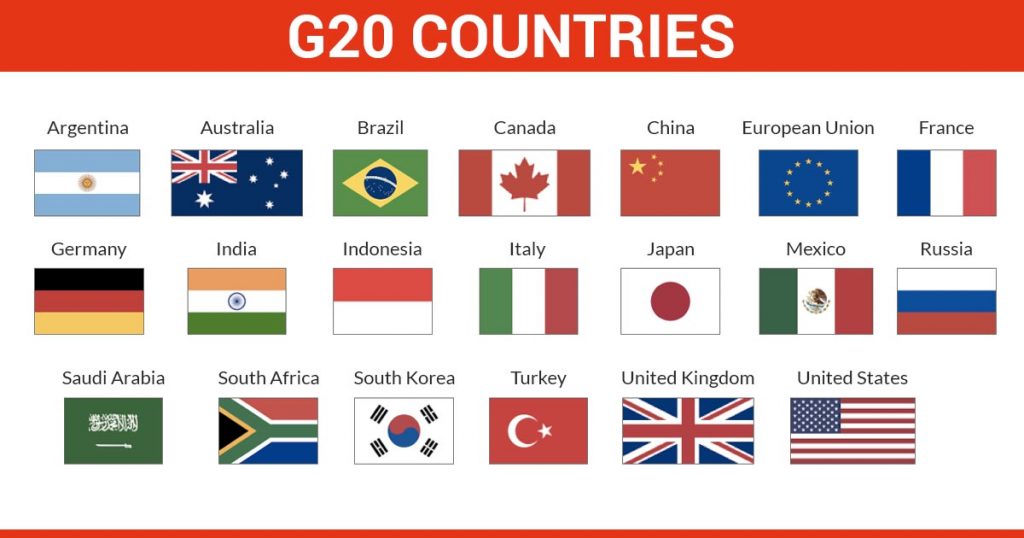
The members of the G20 consist of 19 individual countries plus the European Union (EU).
The 19 member countries of the forum are Argentina, Australia, Brazil, Canada, China, France, Germany, India, Indonesia, Italy, Japan, Mexico, Russia, Saudi Arabia, South Africa, South Korea, Turkey, United Kingdom and the United States.
The European Union is represented by the European Commission and by the European Central Bank.
Who are the G20 Sherpas?
A Sherpa is the personal representative of a head of state or government who prepares an international summit, particularly the annual G7 and G20 summits.
Between the summits, there are multiple Sherpa conferences where possible agreements are laid out.
This reduces the amount of time and resources required at the negotiations of the heads of state at the final summit.
The Sherpa is generally quite influential, although they do not have the authority to make a final decision about any given agreement.
The name is derived from the Sherpa people, a Nepalese ethnic group, who serve as guides and porters in the Himalayas, a reference to the fact that the Sherpa clears the way for a head of state at a major summit.
G7
The G7 or the Group of Seven is a group of the seven most advanced economies as per the International Monetary Fund (IMF).
The seven countries are Canada, USA, UK, France, Germany, Japan and Italy. The EU is also represented in the G7.
These countries, with the seven largest IMF-described advanced economies in the world, represent 58% of the global net wealth ($317 trillion).
The G7 countries also represent more than 46% of the global gross domestic product (GDP) based on nominal values, and more than 32% of the global GDP based on purchasing power parity.
The requirements to be a member of the G7 are a high net national wealth and a high HDI (Human Development Index).
Clueless about 2023 Preparation? Talk to your Friend, Philosopher and Guide.
Fill up this form to schedule a free on-call discussion with senior mentor from Civilsdaily. Once submitted we will call you within 24 hours.
After weeks of economic turmoil, Sri Lanka announced that it would be defaulting on all of its external debt worth $51 billion.
After running out of foreign exchange for imports, Colombo called the move a last resort.
The island nation is grappling with its worst economic downturn since independence, with regular blackouts and acute shortages of food and fuel.
Sri Lankan Crisis: A backgrounder
(1) Fragility of Sri Lankan Economy
Post-independence from the British in 1948, Sri Lanka’s agriculture was dominated by export-oriented crops such as tea, coffee, rubber and spices.
A large share of its gross domestic product came from the foreign exchange earned from exporting these crops. That money was used to import essential food items.
Over the years, the country also began exporting garments, and earning foreign exchange from tourism and remittances (money sent into Sri Lanka from abroad, perhaps by family members).
Any decline in exports would come as an economic shock, and put foreign exchange reserves under strain.
(2) Series of BoP Crises
For this reason, Sri Lanka frequently encountered balance of payments crises.
From 1965 onwards, it obtained 16 loans from the International Monetary Fund (IMF).
Each of these loans came with conditions including that once Sri Lanka received the loan they had to reduce their budget deficit, maintain a tight monetary policy, cut government subsidies for food for the people of Sri Lanka, and depreciate the currency.
But usually in periods of economic downturns, good fiscal policy dictates governments should spend more to inject stimulus into the economy. This becomes impossible with the IMF conditions.
Despite this situation, the IMF loans kept coming, and a led the economy soaked up more and more debt.
The last IMF loan to Sri Lanka was in 2016. The country received US$1.5 billion for three years from 2016 to 2019.
The conditions were familiar, and the economy’s health nosedived over this period. Growth, investments, savings and revenues fell, while the debt burden rose.
(3) Terror attack changed the course
A bad situation turned worse with two economic shocks in 2019.
There was a series of bomb blasts in churches and luxury hotels in Colombo in April 2019.
The blasts led to a steep decline in tourist arrivals – with some reports stating up to an 80% drop – and drained foreign exchange reserves.
Second, the new government under President Gotabaya Rajapaksa irrationally cut taxes.
Growth demands stability and stability lies on effective leadership which is totally blurred in Sri lanka which is suffering from ongoing financial crisis.
(4) Pandemic
In March 2020, the COVID-19 pandemic struck.
In April 2021, the Rajapaksa government made another fatal mistake. To prevent the drain of foreign exchange reserves, all fertiliser imports were completely banned.
Sri Lanka was declared a 100% organic farming nation.
This policy, which was withdrawn in November 2021, led to a drastic fall in agricultural production and more imports became necessary.
A fall in the productivity of tea and rubber due to the ban on fertiliser also led to lower export incomes.
(5) Immediate triggers of the crisis
Leadership issues: Another instance that proved detrimental for Sri Lankan leadership is government where few members of the cabinets were immediate relatives of the Prime Minister (Rajapaksas).
Ukraine War: The invasion of Ukraine has further exacerbated the economic calamity of the country as Russia is the second biggest market to Sri Lanka in tea exports and its tourism sector is heavily reliant upon these two nations as most of the tourist arrivals are from Russia and Ukraine.
All these factors led to the implosion of Sri Lankan economy.
Is China the real culprit behind?
Many believe Sri Lanka’s economic relations with China are a main driver behind the crisis. The United States has called this phenomenon “debt-trap diplomacy”.
This is where a creditor country or institution extends debt to a borrowing nation to increase the lender’s political leverage – if the borrower extends itself and cannot pay the money back, they are at the creditor’s mercy.
A reality check
Sri Lanka’s economy, in recent months, started experiencing, what economists refer to as a ‘twin crisis’: in form of a combined balance of payment and sovereign debt crisis.
(1) Debts
The most “burdensome debt” in terms of maturity and rates is typically owed to international sovereign bonds.
Loans from China accounted for only about 10% of Sri Lanka’s total foreign debt in 2020.
The largest portion – about 30% – can be attributed to international sovereign bonds.
Japan actually accounts for a higher proportion of their foreign debt, at 11%.
(2) Losses from Ports
Defaults over China’s infrastructure-related loans to Sri Lanka, especially the financing of the Hambantota port, are being cited as factors contributing to the crisis.
But these facts don’t add up. The construction of the Hambantota port was financed by the Chinese Exim Bank.
The port was running losses, so Sri Lanka leased out the port for 99 years to the Chinese Merchant’s Group, which paid Sri Lanka US$1.12 billion.
Repercussions of the crisis
Sustenance crisis: For Sri Lankans, the crisis has turned their daily lives into an endless cycle of waiting in lines for basic goods, many of which are being rationed.
Energy sources exhausted: Soldiers are stationed at gas stations to calm customers, who line up for hours in the searing heat to fill their tanks. Some people have even died waiting.
Sacking of the public savings: Even members of the middle class with savings are frustrated, fearing they could run out of essentials like medicine or gas.
Public outrage: Meanwhile, Sri Lanka has imposed several curbs on social media and news flow, its stock market and currency is sharply down. Unrest is brewing, so police action, possibly brutal, looks inevitable.
What’s next for Sri Lanka?
In all probability, Sri Lanka will now obtain a 17th IMF loan to tide over the present crisis, which will come with fresh conditions.
Sri Lanka is now seeking financial support from the IMF and turning to regional powers that may be able to help.
Earlier, President Rajapaksa had weighed the pros and cons of working with the IMF and had decided to pursue a bailout from the US.
Sri Lanka has also requested help from China and India, with New Delhi already issuing a credit line of $1 billion in March.
Lessons to be learnt
(1) For India
While the Sri Lankan economic crisis may not directly impact India for now, the crisis itself offers useful political economy lessons for the Indian government.
Populist freebies has a dear cost: A majoritarian government announcing populist measures amidst a low-growth performance cycle creates macroeconomic crisis scenarios over time.
SL had fared better than India: Unlike Sri Lanka, India’s per capita income and performance in social sectors like healthcare, education and social security is worse.
Long term inflation is risky: India’s unemployment and joblessness crisis is far worse – in aggregate. Inflation too has remained high with the RBI struggling to keep consumer prices low.
The idea here is not to compare Sri Lanka with India as like-with-like. They are two different and geographically distinct nation-states with different social, political and economic features.
(2) Other SAARC members
Nations are collapsing: From Afghanistan and Pakistan, and now, Sri Lanka (with Nepal in queue), each nation’s political economy landscape appears to be in a depressing situation.
SAARC has become dysfunctional: Besides India, no other South Asian countries have offered any form of support or assistance to Sri Lanka, which raises alarm over the absence of regional cooperation in South Asia.
Way forward
Fiscal consolidation and discipline: What the Lankan economy would need is a robust path towards revenue based fiscal consolidation.
Near-term monetary policy tightening: It is needed to ensure that the recent breach of the inflation target band is only temporary.
Institution building reforms: such as revamping the fiscal rule, would also help ensure the credibility of the strategy, as the IMF report suggests.
Flexible exchange rate policy: Other (longer-term) reforms would need to include the creation of a flexible exchange rate policy and a medium-to-long-term debt reduction strategy, while ensuring most government spending in targeted social areas continues for developmental objectives.
Conclusion
It is no doubt that the over-dependence on China for economic development could be a miserable option for any country, and the latest examples of it, are Pakistan and Sri Lanka.
Also, Sri Lanka is a prime example of a third world country led by a post-colonial elite on the brisk of collapsing as a nation.
With Less than 60 days remaining for UPSC 2022 Prelims, your preparation must revolve around revision and attempting tests. At this stage, aspirants become more stressed and anxious than when they first started their preparation. Having a foolproof strategy for the last few days can work wonders — especially for those falling on the borderline, scoring between 80-90 marks in the mock test series. Now is the time to focus on improving your performance and boosting your scores.
While many of you, would have felt easier following a timetable for an entire year, you might not be sure how to revise every topic in the syllabus along with test series and current affairs of 1.5 years in last few days.
Open to all, Free Live Webinar by IPoS Officer Vikas Palwe (CSE 2020)
Vikas Palwe has a special command over UPSC Prelims. In all his 5 attempts, He scored 120+ marks consistently. Now, with prelims coming up in few days, he would be happy to share his mantras and techniques to scoring high in prelims with future aspirants.
If you are attempting this year’s prelims then do not miss this opportunity. Attend the webinar to gain topper’s insights on prelims and clear your personal queries with him.
Webinar Details
This Ask me Anything session is free for all aspirants to attend but is perfect for anyone looking for a refreshing break from their grueling studies. Only limited slots are available, so register ASAP.
Book your slot for UPSC Mock interviews (paneled by ex UPSC members) and get a dedicated mentor, on-call DAF analysis, DAF-based personalized questionnaire, and Situational questionnaire (FREE)
A typical UPSC interview generally clocks for about 30 minutes, and this half an hour can make or break the dream to become an IAS.
Giving mocks is just one part of the interview preparation strategy. You need to be prepared from multiple fronts.
Civilsdaily is always at the forefront when it comes to ensuring that your prep is rapid, focused, and effective. We help make you understand how the panel at UPSC thinks, what they would expect from you (as per your DAF), and how to gear your preparation towards the 200+ marks target.
Do You Know That Civilsdaily Has a 75% Success Rate In UPSC Interview?
Transcend Interview Guidance 2021: Program inclusion
2 Mock interviews, detailed analysis + feedback
Most important issues coverage – current and structural
Personalized mentorship
DAF analysis and one-on-one sessions with in-service officers and panelists
DAF based personalized questionnaire
Situational and Roleplay questionnaire
To give you a real feel of the panel that you will be facing in your real UPSC interview 2021, CD has brought together a mix of the most experienced and valued panelists for your mock interview.
Vaibhav cracked Mains in the first attempt but only barely! With very few marks in GS, he joined Civilsdaily’s Mentorship Program for 2020 for his second attempt and the results were clear – he secured 25th rank in UPSC 2020. Vaibhav is an IT BHU graduate, school cricket captain, 7th ranker in All India Science Olympiad, a former employee at Samsung R&D and current Rank Holder for UPSC 2020.
We, at Civilsdaily IAS family, are equally thrilled and overjoyed. We wish Vaibhav Rawat, all the very best. This turn around which he has experienced in his life, may he reflect upon the society.
Guys, you can connect with our mentors to get advice on the mentorship experience and how it can help to improve your results in UPSC preparation.
Building an inventory of antiquities should be the first step in dealing with the problem.
Measures taken by the worldwide organisations
CAG in its 2013 Report stated that “131 antiquities were stolen from monuments/sites and 37 antiquities from Site Museums from 1981 to 2012″
It added that in similar situations, worldwide, organisations took many more effective steps:
1] Checking of catalogues of international auction house(s),
2] Posting news of such theft on websites.
3] Posting information about theft in the International Art Loss Registry.
4] Sending photographs of stolen objects electronically to dealers and auction houses and intimate scholars in the field.
Lack of legal provisions: The report also stated that the ASI had never participated or collected information on Indian antiquities put on sale at well-known international auction houses viz. Sotheby’s, Christie’s, etc. as there was no explicit provision in the AAT (Antiquities and Art Treasures) Act, 1972 for doing so.
International conventions and treaties
India is a signatory to the 1970 UNESCO Convention on the Means of Prohibiting and Preventing the Illicit Import, Export and Transfer of Ownership of Cultural Property. (We ratified it in 1977).
Perhaps we should also sign the 1995 UNIDROIT (International Institute for the Unification of Private Law) Convention on Stolen or Illegally Exported Cultural Objects.
Lessons from Italy
Italy also suffers and several stolen antiquities have been returned by the US to Italy.
That being the case, it shouldn’t be surprising that many best practices originate in Italy.
The following list is illustrative.
(1) A specific law on protecting cultural heritage, with enhanced penalties;
(2) Centralised management before granting authorisation for archaeological research;
(3) Specialisation in cultural heritage for public prosecutors;
(4) An inter-ministerial committee for recovery and return of cultural objects;
(5) MOUs and bilateral agreements with other countries and international organisations to prevent illegal trafficking;
(6) Involvement of private organisations and individuals in protection;
(7) A complete inventory of moveable and immoveable cultural heritage, with detailed catalogues;
(8) Monitoring and inspection of cultural sites; and
(9) Centralised granting of export requests.
Way forward
One could say the 2013 CAG Report did a bit of (8), but that was a one-off and isn’t a permanent solution.
This isn’t a binary, nor is it possible to accomplish everything overnight. However, incrementally, one can move towards (1), (3), (4), (5), (6), (8) and, especially, (7).
We should start with that inventory.
Conclusion
While fingers can rightly be pointed at Western museums and auction-houses (this isn’t only about the colonial era), there is internal connivance.
Language sensitivity has been a feature of selfhood in the case of every Indian language.
Sensitivity to language
From ancient times, a sensitivity to language difference has almost been the core of Dravidic self-hood.
A similar sensitivity existed among the speakers of Prakrits in ancient times.
It was in one of the Prakrits that Mahavir had presented his teachings in the sixth century BCE.
Eighteen centuries later, Acharya Hemachandra, a major Jain scholar, poet, mathematician and philosopher, produced his Desinamamala, a treatise on the importance of Prakrit words used in Gujarat of his times as against those from Sanskrit.
Mahatma Gandhi, who defined the idea of selfhood for India in Hind Swaraj (1909), chose to write this iconic book in Gujarati.
Constitutional provision
The official language used for communication between the States shall be the language that has been in use at the time of adoption of the Constitution.
The move from English to Hindi can take place only if, ‘two or more states agree’ for the shift.
Article 344 (4) provides for a ‘Committee consisting of thirty members’, ‘twenty’ from the Parliament and ‘ten’ from State assemblies, for safeguarding language-related provisions.
The distribution between two ministries
The functions and the scope of the committee, as laid down by the Constitution, are further clarified by the practice of distribution of language as a subject between two Ministries, the Human Resource Development (HRD) Ministry and the Home Ministry.
The scope of the HRD Ministry extends to education and the promotion of cultural expression.
The Home Ministry’s scope extends to safeguarding relations of the States with the ‘union’, protecting the linguistic rights of language minorities and the promotion of Hindi.
The last of these, the Constitution states, has to be ‘without interference with other languages.
Data on language decline
In 2011, Hindi speakers accounted for 43.63% of the total population, with a total of 52.83 crore speakers.
In 1971, the number was 20.27 crore, accounting for 36.99% of the total population.
Between 2001 and 2011, the growth in proportion of the population was 2.6%.
The next most spoken language, Bangla, had negative growth.
It was spoken by 8.30% of Indians in 1991, 8.11% in 2001 and by 8.03% in 2011.
Telugu, which slid from 7.87% in 1991, to 7.19% in 2001 and 6.70% in 2011, has a similar story to tell.
Tamil recorded 6.32% of the total population in 1991, 5.91% in 2001 and 5.70% in 2011.
The only major language to show decadal growth (though small) was Gujarati.
And the only small yet scheduled language to show good growth was Sanskrit.
Reasons for Hindi’s growth
The 52.83 crore speakers of Hindi (as recorded in 2011) included not just the speaker of ‘Hindi’ but also those of more than 50 other languages.
Bhojpuri and most languages of Himachal Pradesh, Uttarakhand, Chhattisgarh, Rajasthan and Jharkhand have also been pushed into the Hindi package.
Had the Census not included these other languages under Hindi, the strength of Hindi speakers would have gone down to about 39 crore, — just a little under 32% of the total population in 2011 — and would have looked not too different from those of other scheduled languages.
The data for English speakers is far more truthful. Census 2011 reports a total of 3,88,793 Indians as English speakers (2,59,678 men and 1,29,115 women).
Hindi in comparison to other languages in the Eighth schedule
Among the languages included in the Eighth Schedule, Hindi falls within the younger lot of languages.
On the other hand, Tamil, Kannada, Kashmiri, Marathi, Oriya, Sindhi, Nepali and Assamiya have a much longer/older history.
As a language of knowledge too, Tamil, Kannada, Bangla and Marathi (with their abundance of encyclopaedias and historical literature), quite easily outshine Hindi.
Conclusion
A language evolves slowly and cannot be forced to grow by issuing ordinances.