Every aspirant who decides to be a civil servant has no idea in the beginning how to prepare for the examination. They find the books too lengthy, the test series very advanced and the syllabus vague. Some of us, are fully acquanited with the syllabus only three months into preparation.
It’s important to create a workable strategy on every aspect of UPSC — from current affairs, prelims, mains, optionals to revision and test series. Missing even one of this will put you many marks behind the UPSC race.
Open to All, Free Live Q&A Webinar by IPS Officer Rajiv Kumar (West Bengal Cadre)
You might have consulted umpteen websites on the internet on how to go about your UPSC preparation, but still you are confused as they address only the surface level Do’s and Don’ts.
For example, every site says read the newspaper. Here comes the question – what to read in the newspaper? What if I miss an important news? Should I make notes of the news everyday? Won’t that be a lot? Then how will I be able to revise?
Every website says read Laxmikanth for polity. But after reading 2-3 pages of Laxmikanth you realise that you are unable to remember anything! Even as you are reading, the concepts don’t register clearly. What to do now? Go slow and not leave the page till you have memorized all the concepts, or read fast and complete the book in time? Remember you have nine papers in UPSC Mains.
Similarly, in test series for Prelims is better to only solve previous year question papers? Are previous year questions actually important for prelims exam where the paper pattern and type of questions changes every year?
Attend the free live webinar conducted by IPS officer Rajiv Kumar sir to understand how he simplified his preparation, eliminated confusions and remained consistent and discplined for one whole year. Rajiv Kumar sir was a student of Civilsdaily MentorSajal Sir.
A busy IPS Officer like Rajiv Kumar is free only on a Sunday. But he loves to dedicate his Sundays to mentor upcoming civil servants. So join him and give your UPSC preparation a fresh start and direction!
Every aspirant who decides to be a civil servant has no idea in the beginning how to prepare for the examination. They find the books too lengthy, the test series very advanced and the syllabus vague. Some of us, are fully acquanited with the syllabus only three months into preparation.
It’s important to create a workable strategy on every aspect of UPSC — from current affairs, prelims, mains, optionals to revision and test series. Missing even one of this will put you many marks behind the UPSC race.
Open to All, Free Live Q&A Webinar by IPS Officer Rajiv Kumar (West Bengal Cadre)
You might have consulted umpteen websites on the internet on how to go about your UPSC preparation, but still you are confused as they address only the surface level Do’s and Don’ts.
For example, every site says read the newspaper. Here comes the question – what to read in the newspaper? What if I miss an important news? Should I make notes of the news everyday? Won’t that be a lot? Then how will I be able to revise?
Every website says read Laxmikanth for polity. But after reading 2-3 pages of Laxmikanth you realise that you are unable to remember anything! Even as you are reading, the concepts don’t register clearly. What to do now? Go slow and not leave the page till you have memorized all the concepts, or read fast and complete the book in time? Remember you have nine papers in UPSC Mains.
Similarly, in test series for Prelims is better to only solve previous year question papers? Are previous year questions actually important for prelims exam where the paper pattern and type of questions changes every year?
Attend the free live webinar conducted by IPS officer Rajiv Kumar sir to understand how he simplified his preparation, eliminated confusions and remained consistent and discplined for one whole year. Rajiv Kumar sir was a student of Civilsdaily MentorSajal Sir.
A busy IPS Officer like Rajiv Kumar is free only on a Sunday. But he loves to dedicate his Sundays to mentor upcoming civil servants. So join him and give your UPSC preparation a fresh start and direction!
Preparing for UPSC in a stress-free manner is something all of us dream of. Studying in an anxious state of mind reduces concentration, focus and retention of topics learnt.
One of the reasons why you might get stressed is because despite studying for longer hours, you are unable to translate it to higher scores. This is where it becomes important to understand the difference between ‘studying smart’ and ‘studying hard’.
How will Samanavaya Free 1-on-1 Counselling Session Help you study like a UPSC Topper?
UPSC-CSE is an information loaded exam and at times, we have to come up with certain hacks to remember facts in books, newspapers, committee reports etc. Recalling information on time is crucial to success in Prelims exam.
However, since this is UPSC and not any other normal exam what does studying smart actually mean according to UPSC? It means to master the art of learning. There are several tricks available out there to learn better. You could use mind maps, flow charts, flash cards, mnemonic devices, etc to break down complex topics into simpler parts.
Another memory technique to remember facts is to pretend you are a teacher and then teach the concept out loud. You can record important facts as voice notes and replay them again and again as well. It is also important to stay relaxed and calm because a tired and distracted mind needs to work harder and longer to absorb new information. So do try getting meditatation and pranayama techniques to learn better.
Do you want to take it a notch higher and have an expert Civilsdaily mentor tell you what kind of studying techniques or brain hacks you can use to understand and remember the concepts?
Then, fill the Samanvaya free 1-on-1 counselling session form. You will get a personalised 30-40 minutes free mentorship-driven strategy call to ace your UPSC preparation!
Key-Takeaways of this Week’s Samanvaya Free 1-on-1 Mentoring Session
Our philosophy behind MENTORSHIP is to get you out of this Snooze cycle. This ensures that you are the BEST VERSION of yourself in this journey. If you are under the impression that mentorship is weekly calls you attend, then you are mistaken, my friend. Trust us, your mentor will be your ‘FRIEND, PHILOSOPHER AND GUIDE’.
TO EACH THEIR OWN – Every aspirant is different. Their strengths and weaknesses are different. Their time availability is also different. Identifying this is important so you don’t end up making unrealistic targets and lose momentum. Your mentor will make sure you start slow but remain consistent to build your confidence. Making your schedule structured based on our experience of working with 2500+ students is our first priority.
TRACK YOUR PROGRESS – When you see yourself grow, it becomes easier to motivate yourself to push boundaries. Tracking your progress can happen in many ways like mentorship calls or chat sessions or by regular tests. The idea is to ensure that you don’t go off track in your preparation, and even if you do, we have your back.
EVOLUTION – A constant guidance is important to bring consistency to your UPSC preparation. Guidance is not about clearing your doubts or asking you to study when you don’t. It is also about the evolution of your preparation. This is where you and your mentor work as a team. A constant effort to PLAN AND BUILD UP YOUR ABILITY to learn in a faster and more efficient way.
TALK IT OUT – The biggest hurdle in achieving your highest level of consistency is the emotional part. Every now and then, you. surround yourself with negative thoughts, you feel scared and depressed. Instead of resolving these emotional issues, you avoid them as it seems like a waste of your precious time. You have to understand that ignoring emotional troubles does not solve them. What your doing is building an emotional time bomb that may burst a week before your mains or prelims! This is where your MENTOR AS A FRIEND comes in. All our mentors have been through this journey. We understand your fears and anxieties. So, TALK IT OUT.
Don’t let inconsistency keep you away from your dreams.
Fill up the SAMANVAYA form given below. Let us know your problems and we will find a solution to it, just like our students say ” TOGETHER WE CAN AND WE WILL”.
How has Civilsdaily Mentorship, helped Aspirants become Toppers?
The most difficult challenge faced by EVERY candidate is inconsistency. Be it inconsistency in studies, answer-writing practice, covering the syllabus, or revision, every candidate finds it difficult to cope with. Buthow do successful candidates manage to FIGHT Inconsistency so consistently?
In UPSC 2020, Civilsdaily helped 80+ students secure ranks in their exams. In the top 100, every 3rd ranker was a Civilsdaily student.
A very recent success story would be Vishwa Shah, student of Civilsdaily Mentor, Sukanya Ma’am. Vishwa has cleared the GPSC exam to become the Deputy Superintendent of Police in Gujarat. He has penned a thank-you note yesterday. Heartiest Congratulations to Vishwa!
One of our other Civilsdaily Student, Shubham Nagargojecleared the exams in 2020 to become an IPS Officer. Shubham was gracious enough to let us know how he felt about Civilsdaily Samanvaya Guidance under Parth sir.
To know how all of them cleared the exam with our mentorship, visit the UnherdPodcast.
Now that results are announced for UPSC 2021 Prelims, out of 15 out of 25 students of Santhosh Gupta sir have been recommended to Mains. One such student, Rahul expresses his gratitude and extends his appreciation.
Most of our Mentors like Sudhanshu sir, Sajal sir, Santhosh sir, Pravin sir, Parth Verma sir and Sukanya Ma’am were UPSC aspirants themselves and have attended UPSC Mains more than five times and UPSC Interview more than twice. Hence their mentorship is always a blend of the best test series, comprehensive notes and current affairs knowledge.
All of them dedicate their time weekly to give 1-on-1 mentorship to every student where they discuss last week’s performance and next week’s approach.
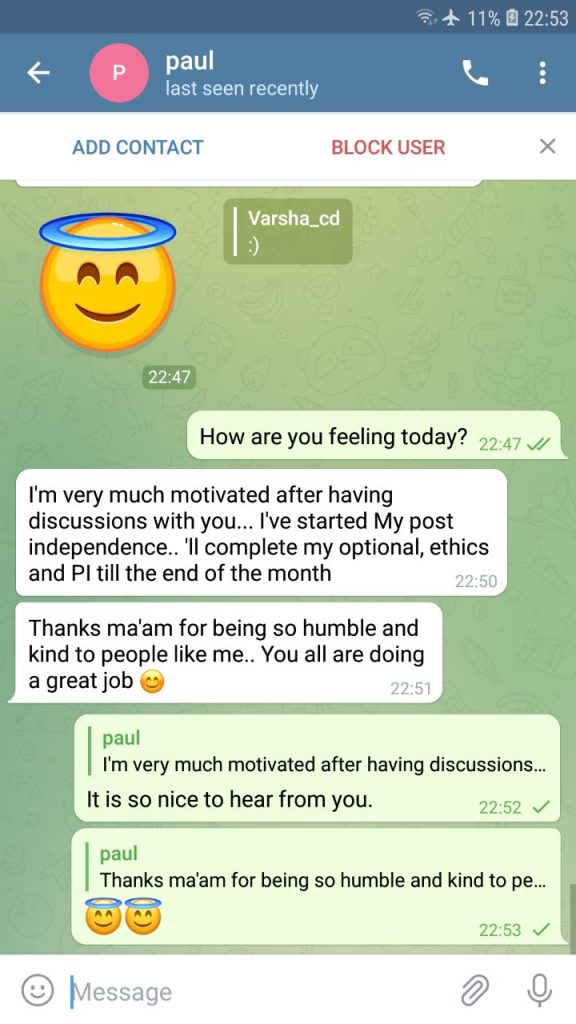
Be it Telegram, Whatsapp or Habitiat channels, they are always available and clear student’s doubts in a turnaround time of 24 Hours.
Why Civilsdaily Mentors are the GPS for Your UPSC-CSE Preparation
Remember there is always light at the end of the tunnel and if you want to get out of the tunnel you have to follow the direction of the light! Our mentors’ give you direction which is divided into daily modules. All you have to do is study and complete them on time.
As every year passes by, we don’t get confident by the previous years’ performance and become laidback. Instead, we become more hungry to convert all our students into toppers.
How are Current Civilsdaily Students Gearing up for UPSC-CSE 2022?
Initially, our Civilsdaily student Smriti wasn’t confident about Prelims when she began her preparation. Though she had joined Civilsdaily in 2020, she started studying for UPSC-CSE back in 2019. At that time, Smriti had enrolled in multiple institutes. Though, most of these institutes had promised a personal mentor, she was unable to get in touch with them on a daily basis. Also those mentors never scheduled test-series on a weekly basis. Hence, despite preparing for a year, Smriti had scored only 35 marks out of 200 in her first test series by Civilsdaily.
She then started writing 20-25 test series over the course of UAP 2021 and in her last test, her scores have drastically improved. She now scores in the range of 130-135 marks in prelims’ and 110+ in mains’ papers.
In Smriti’s own words she describes her Samanvaya Mentorship Experience to be —
“Our parents provide us financial and emotional support, friends provide us moral support and the right mentor gives you logistic and logical support for UPSC. There are days when I felt I won’t be able to compete against lakhs of aspirants. That’s when my mentor, Ravi sir reminded me of my improvement and encouraged me that I can crack it with the same consistency. We need someone, who tells us we are performing well especially when we cannot see that ourselves. The mentorship at Civilsdaily helped me become mentally stronger as a person. In other institutes, mentors are allotted only for doubt resolution. But at Civilsdaily, I am getting end-to-end mentorship via value added notes, classes, test series and detailed evaluation.”
Similarly our another Civilsdaily student, Ashishsums up his Samanvaya experience with Civilsdaily mentor,Pravin Sir, “Because of Pravin sir’s support, I am able to understand a topic in lesser time.”
This is how Pravin sir evaluates Ashish’s Mains Test Series every week. After every test series evaluation, Pravin sir schedules a 1 hour call to discuss how Ashish can improve his marks and the sources he can refer for key topics.
It’s Your Turn Get the Free 40 Min Counselling Session By a CD Mentor
Civilsdaily mentors are so dedicated, consistent and focused for your UPSC goal, that you will eventually become focused into turning your dreams to reality.
At the core of Civilsdaily UPSC mentorship, lies the fact that each one of you will have a unique journey while preparing for the exam. Some will get through on the first attempt without much effort while others will take both more time and more effort.
We want to understand you better to help you optimize your journey so you can focus on the right things and not waste time on the wrong ones. We are asking you to tap into the valuable experiences of mentors who underwent the same grind and realize the pitfalls and understand the shortcuts to make it.
In the first counselling session, we will understand your weaknesses. We then help you to stick to one plan or strategy throughout your preparation. We will then follow up with you on a daily basis to check if you are right on track.
Every aspirant who decides to be a civil servant has no idea in the beginning how to prepare for the examination. They find the books too lengthy, the test series very advanced and the syllabus vague. Some of us, are fully acquanited with the syllabus only three months into preparation.
It’s important to create a workable strategy on every aspect of UPSC — from current affairs, prelims, mains, optionals to revision and test series. Missing even one of this will put you many marks behind the UPSC race.
Open to All, Free Live Q&A Webinar by IPS Officer Rajiv Kumar (West Bengal Cadre)
You might have consulted umpteen websites on the internet on how to go about your UPSC preparation, but still you are confused as they address only the surface level Do’s and Don’ts.
For example, every site says read the newspaper. Here comes the question – what to read in the newspaper? What if I miss an important news? Should I make notes of the news everyday? Won’t that be a lot? Then how will I be able to revise?
Every website says read Laxmikanth for polity. But after reading 2-3 pages of Laxmikanth you realise that you are unable to remember anything! Even as you are reading, the concepts don’t register clearly. What to do now? Go slow and not leave the page till you have memorized all the concepts, or read fast and complete the book in time? Remember you have nine papers in UPSC Mains.
Similarly, in test series for Prelims is better to only solve previous year question papers? Are previous year questions actually important for prelims exam where the paper pattern and type of questions changes every year?
Attend the free live webinar conducted by IPS officer Rajiv Kumar sir to understand how he simplified his preparation, eliminated confusions and remained consistent and discplined for one whole year. Rajiv Kumar sir was a student of Civilsdaily MentorSajal Sir.
A busy IPS Officer like Rajiv Kumar is free only on a Sunday. But he loves to dedicate his Sundays to mentor upcoming civil servants. So join him and give your UPSC preparation a fresh start and direction!
Every aspirant who decides to be a civil servant has no idea in the beginning how to prepare for the examination. They find the books too lengthy, the test series very advanced and the syllabus vague. Some of us, are fully acquanited with the syllabus only three months into preparation.
It’s important to create a workable strategy on every aspect of UPSC — from current affairs, prelims, mains, optionals to revision and test series. Missing even one of this will put you many marks behind the UPSC race.
Open to All, Free Live Q&A Webinar by IPS Officer Rajiv Kumar (West Bengal Cadre)
You might have consulted umpteen websites on the internet on how to go about your UPSC preparation, but still you are confused as they address only the surface level Do’s and Don’ts.
For example, every site says read the newspaper. Here comes the question – what to read in the newspaper? What if I miss an important news? Should I make notes of the news everyday? Won’t that be a lot? Then how will I be able to revise?
Every website says read Laxmikanth for polity. But after reading 2-3 pages of Laxmikanth you realise that you are unable to remember anything! Even as you are reading, the concepts don’t register clearly. What to do now? Go slow and not leave the page till you have memorized all the concepts, or read fast and complete the book in time? Remember you have nine papers in UPSC Mains.
Similarly, in test series for Prelims is better to only solve previous year question papers? Are previous year questions actually important for prelims exam where the paper pattern and type of questions changes every year?
Attend the free live webinar conducted by IPS officer Rajiv Kumar sir to understand how he simplified his preparation, eliminated confusions and remained consistent and discplined for one whole year. Rajiv Kumar sir was a student of Civilsdaily MentorSajal Sir.
A busy IPS Officer like Rajiv Kumar is free only on a Sunday. But he loves to dedicate his Sundays to mentor upcoming civil servants. So join him and give your UPSC preparation a fresh start and direction!
First introduced in 2019, it is a private member bill proposed by Rakesh Sinha.
The purpose of the bill was to control the population growth of India.
The proposed bill then was signed by 125 Members of Parliament (MP) and is yet to become an act of law.
It seeks to amend Article 47 by inserting article 47A to the Constitution of India. It proposes that-
The State shall promote small family norms by offering incentives in taxes, employment, education etc. to its people who keep their family limited to two children
The state shall withdraw every concession from and deprive such incentives to those not adhering to small family norm, to keep the growing population under control.
Key provisions
Penalties: The 2019 bill talked about introducing penalties for couples not adhering to the two-child policy such as debarment from contesting in elections and ineligibility for government jobs.
Two-child policy: The 2020 bill proposes to introduce a two-child policy per couple.
Incentivizing adoption: It shall incentivize adoption through various measures such as educational benefits, taxation cuts, home loans, free healthcare, and better employment opportunities.
Birth spacings: It also proposes to ensure healthy birth spacing through measures related to augmenting the availability, accessibility and affordability of quality reproductive health services.
Issues with penal provisions
Alienation: If a family was penalized for more than two children, then the third child would develop a feeling of alienation that he is an unwanted child.
Bar on Women: The biggest victim of such would be women, irrespective of religion. They would be debarred in political participation.
Selective abortions: In India, the preference for male children may lead to a greater anti-female child sex selection because parents will only have “two attempts” to have babies.
Violation of reproductive autonomy: To control and regulate the number of children a family can have is a gross violation of human rights, the right to self-determination and an individual’s reproductive autonomy.
Violation of Individual Privacy: A right to procreation is not explicitly mentioned in the Constitution but it comes under the ambit of Article 21, as discussed in Jasvir Singh vs State of Punjab.
Remarriage issues: A divorced person who has two children with a prior partner cannot bear a child with their next spouse.
Why need such policy?
India had a land availability of only 1.2 hectare per person, while the resources that get regenerated automatically was 0.43 only.
We are an ecological debtor. The ecological footprint which we use and the gap between their regeneration is 187%.
If this continued for 30 years, then resources would be exhausted and people would not be able to lead a dignified life.
Some people see demographic dividend in the growing population but it was being used as cheap labour globally.
Way forward
The population of India is seen as the biggest obstacle to its economic development.
It is the fall guy for governments seeking to justify their incompetence.
No legislation must be enacted unless its future impact and social effect are first completely realized.
A row over whether educational institutions can impose a strict dress code that could interfere with the rights of students has spilled in the Udupi district of Karnataka.
Don’t you think that such instances incite fear among the politically destitute minorities?
Religious Freedom in India
Article 25(1) of the Constitution guarantees the “freedom of conscience and the right freely to profess, practise and propagate religion”.
It is a right that guarantees a negative liberty — which means that the state shall ensure that there is no interference or obstacle to exercise this freedom.
Restrictions on religious freedom
Like all fundamental rights, the state can restrict the right for grounds of public order, decency, morality, health and other state interests.
Over the years, the Supreme Court has evolved a practical test of sorts to determine what religious practices can be constitutionally protected and what can be ignored.
In 1954, the Supreme Court held in the Shirur Mutt case that the term “religion” will cover all rituals and practices “integral” to a religion.
The test to determine what is integral is termed the “Essential Religious Practices” test.
What is the essential religious practices test?
While these issues are largely understood to be community-based, there are instances in which the court has applied the test to individual freedoms as well.
In a 2004 ruling, the Supreme Court held that the Ananda Marga sect had no fundamental right to perform the Tandava dance in public streets since it did not constitute an essential religious practice of the sect.
For example, in 2016, the Supreme Court upheld the discharge of an airman from the Indian Air Force for keeping a beard.
It distinguished the case of a Muslim airman from that of Sikhs who are allowed to keep a beard.
In 2015, the Supreme Court restored the Jain religious practice of Santhara/Sallekhana (a ritualistic fast unto death) by staying an order of the Rajasthan HC.
Issues with this Test
In the first place, what constitutes the essential part of a religion is primarily to be ascertained with reference to the doctrines of that religion itself, the SC had held in the Shirur Mutt case.
So the test, a judicial determination of religious practices, has often been criticized by legal experts as it pushes the court to delve into theological spaces.
In criticism of the test, scholars agree that it is better for the court to prohibit religious practices for public order rather than determine what is so essential to a religion that it needs to be protected.
In several instances, the court has applied the test to keep certain practices out.
Precursors related to Hijab
Two set of rulings of the Kerala High Court, particularly on the right of Muslim women hold dressing according to the tenets of Islam.
In 2015, Kerala HC ruled the prescription of dress code for AIPMT exam which prescribed wearing light clothes with half sleeves not having big buttons, brooch/badge, flower, etc. with Salwar/Trouser and slippers and not shoes.
In 2016, it examined the issue more closely. It held that the practice of wearing a hijab constitutes an essential religious practice but did not quash the CBSE rule.
The court once again allowed for the “additional measures” and safeguards put in place the previous year.
Presenting the Union Budget for 2022-23, Finance Minister said 400 new energy-efficient Vande Bharat trains will be introduced in three years.
What is Vande Bharat Express?
The Vande Bharat Express is a semi-high speed train designed, developed, and built by the Integral Coach Factory (ICF).
Presently there are only two Vande Bharat trains that are running — Delhi to Varanasi and Delhi to Katra.
Key Features
The current Vande Bharat trains have seating only in two classes — chair car and executive chair car. But Railways is planning to upgrade it.
The trains have fully sealed gangways for a dust-free environment, modular bio-vacuum toilets, rotating seats in Executive Class, personalized reading lights, automatic entry/exit doors with sliding footsteps, diffused LED lighting, mini pantry, and sensor-based interconnecting doors in each coach.
They are self-propelled trains that do not require an engine. This feature is called a distributed traction power system, which is increasingly becoming the norm the world over for passenger operations(Distributed power gives the train higher acceleration and deceleration compared to loco-hauled trains, which take a much longer time to reach top speed or to gradually come to a halt).
400 trains announced by the Finance Minister carry a potential investment of Rs 50,000 crore over the next three years, because of different specifications and also, inflation.
The current Vande Bharat’s are being made at Rs 106 crore per trainset of 16 cars, at 2018 pricing.
Benefits of Vande Bharat Trains
1) Cuts Travel Time Drastically
2) Energy Efficient
3) Reduce Turnaround Time
4) Faster Acceleration and Deceleration among others.
Why High-speed rail projects are important for India?
Improve India’s GDP: According to a study conducted by the London School of Economics and Political Science and the University of Hamburg in 2008, cities that are connected to HSR systems tend to witness a rise in their gross domestic product (GDP) by at least 2.7 percentage points compared to their neighbors that do not have an HSR station. The reason for the differential was improved market access.
Role of the trains in India’s development: Being the third-largest network in the world under single management and
with over 68,102 route km IR strives to provide a safe, efficient, competitive, and world-class transport system.
During FY21, IR carried 1.23 billion tonnes of freight and 1.25 billion passengers. In addition, despite COVID -19 pandemic revenue earning freight loading (excluding loading by Konkan Railway Corporation Ltd. (KRCL) was 1230.9 million tonnes in 2020-21 as compared to 1208.4 million tonnes during2019-20. Passengers originating were 1250 million in 2020-21 as compared to 8086 million in 2019-20- Economic Survey 2021-22.
Spin-off effect:It is about Rs 40,000 crore business opportunity that would also create 15,000 jobs and several spin-off benefits and act as a stimulus for the development of satellite towns.
Boost to ‘Make in India’– it involves only about 15 percent import content which will further go down if production volumes increase.
Environmental Benefits: More rail traffic translates to less automobile traffic, and by extension, less highway and city street traffic congestion, reduced air pollution. In addition, less congestion means less wear and tear on the roadways, which means that they require fewer repairs. According to the International Association of Railways (UIC), high-speed rail is eight times more energy-efficient than airplanes and four times more efficient than automobile use.
Social Benefits: High-speed rail can promote a sense of social cohesion among residents, by bringing distant populated areas closer together.
Global Experience: The High-Speed Railway has an economic multiplier effect. Since the introduction of the first Shinkansen (literally meaning ‘new main line’) in Japan in 1964, high-speed trains have proven to be an undeniable technological, commercial and popular success. Many countries like the UK, France, Germany, Spain, China, and most recently, the US have adopted the technology.
Challenges faced by the High-Speed Rail Projects
Infrastructure Bottlenecks: India’s railway system is saddled with a two-pronged infrastructure deficit – aging infrastructure and the pace of new project execution struck by unforeseen circumstances related to socio-economic issues on land acquisition for new projects and escalating projects costs.
New Technologies: For instance, Hyperloop Transportation Technologies which proposes to make travel as fast as 760 miles per hour, investing a humongous capital on bullet trains seems like an outdated investment.
Political Will: The politics of Rail Bhavan and an unwillingness to accept the need for change have derailed the project execution.
Short of Investments: For instance, the estimated cost of Mumbai-Ahmedabad HSR is ₹1.1 lakh crore (US$17 billion) which is massively expensive. Though India receives funding from Japan (81%), the power demand and up-gradation of existing infrastructure will be more costly.
Social Conflict: Development along the corridor will lead to an increase in urbanization, the fight for resources, and social conflicts due to the labor influx of the workforce.
Legal Trouble: While farmers in Maharashtra are protesting on the ground, the farmers in Gujarat led by Gujarat Khedut Samaj (GKS)- fighting a case in the Gujarat High Court against the land acquisition for the bullet train project.
Way ahead
Stakeholders approach: Politics and Policy have to be in sync for the railway modernization. In order to achieve the target, Railways will have to pool in all resources and multiple stakeholders, including private players to deliver the propulsion system and also carry out the assembling. The Policymakers and administration should give priority to systematic sustainable development work- the convergence of jal, jungle, jameen(water-forest-land is an asset for the Adivasi community).
Regular Monitoring: To ensure the induction of these trains in the shortest time possible, as envisaged by Indian Railways.
Technology Transfer: The government has to push for the technology transfer of HSR. This is because there is no mention of the transfer of technology anywhere in the agreement.
Conclusion
India aspires to become the third-largest economy in the next 25 years. It has already proven its prowess in the field of space and now is the time for furthering its international stature by joining the exclusive club of nations having a high-speed rail network, however, we should be careful not to confuse leapfrogging technology development with elitism, whether it is mobile phones, satellite launches, regional air connectivity, or high-speed rail. This high-speed rail project will therefore help the Indian Railways to become a global leader in scale, technology, and skill.
A noted Parliamentarian from Hyderabad has rejected the ‘Z’ category security by the Central Armed Police Forces (CAPF) accorded to him.
Security Provisions in India
In India, security is provided to high-risk individuals by the police and local government.
The level of security needed by any individual is decided by the Ministry of Home Affairs, based on inputs received from intelligence agencies which include the IB and R&AW.
Individuals such as PM, home minister, and other officials such as the National Security Advisor generally get security cover because of the positions they occupy.
In addition to this, persons who are believed to be under threat also receive security cover.
What is ‘Z’ Category Security?
In India, the category covers are X, Y, Y-plus, Z, Z-plus, and SPG (Special Protection Group).
X Category: The protectee gets one gunman. Protectees in the Y category have one gunman for mobile security and one (plus four on rotation) for static security.
Y Plus category: It receives the cover of two gunmen (plus four on rotation) for mobile security, and one (plus four on rotation) for residence security,
Z Category: It has six gunmen for mobile security and two (plus 8) for residence security. They get 10 security personnel for mobile security, and two (plus 8) for residence security.
Z Plus Category: It is provided by National Security Guard commandos whereas the other category of security is provided by the Delhi police or the ITBP or CRPF personnel.
What about Special Protection Group (SPG) Cover?
The SPG cover is meant only for the PM and his immediate family.
After Indira Gandhi was assassinated by her own security guards in 1984, the Rajiv Gandhi government decided to create a special cadre of security personnel for the PM.
In March 1985, following the recommendations of a committee set up by the Home Ministry, a special unit was created for this purpose under the Cabinet Secretariat.
This unit, initially called the Special Protection Unit, was renamed as Special Protection Group in April 1985.
Neighbours of a golden langur habitat in western Assam’s Bongaigaon district have opposed a move by the State government to upgrade it to a wildlife sanctuary.
Kajoijana Bamuni Hill Wildlife Sanctuary
The Assam Forest Department has issued a preliminary notification for converting the 19.85 sq. km. patch of forest into the Kajoijana Bamuni Hill Wildlife Sanctuary.
It is one of the better-known homes of the golden langur (Trachypithecus geei) found only in Assam and Bhutan.
About Golden Langur
Gee’s golden langur (Trachypithecus geei), also known as simply the golden langur, is an Old World monkey.
It is found in a small region of Western Assam and in the neighboring foothills of the Black Mountains of Bhutan.
Long considered sacred by many Himalayan people, the golden langur was first brought to the attention of the western world by the naturalist Edward Pritchard Gee in the 1950s.
Adult males have a cream to golden coat with darker flanks while the females and juveniles are lighter.
It has a black face and a long tail up to 50 cm in length.
Its habitat
It lives in high trees and has a herbivorous diet of ripe and unripe fruits, mature and young leaves, seeds, buds and flowers.
The average group size is eight individuals, with a ratio of several females to each adult male.
It is one of the most endangered primate species of India and Bhutan.
Distribution
Its habitat is bounded on the south by the Brahmaputra River, on the east by the Manas River, on the west by the Sankosh River, in Assam and on the north by the Black Mountains of Bhutan.
Conservation status
IUCN Red List: Endangered
CITES: Appendix I
Wildlife Protection Act, 1972: Schedule I
Try this question from CSP 2014:
Q. Which one of the following groups of animals belongs to the category of endangered species?
(a) Great Indian Bustard, Musk Deer, Red Panda, Asiatic Wild Ass
(b) Kashmir Stag, Cheetah, Blue Bull, Great Indian Bustard