HOW TO ATTEMPT ANSWERS IN DAILY ANSWER WRITING ENHANCEMENT(AWE)?
Daily 4 questions from General studies 1, 2, 3, and 4 will be provided to you.
A Mentor’s Comment will be available for all answers. This can be used as a guidance tool but we encourage you to write original answers.
You can write your answer on an A4 sheet and scan/click pictures of the same.
Upload the scanned answer in the comment section of the same question.
Along with the scanned answer, please share your Razor payment ID, so that paid members are given priority.
If you upload the answer on the same day like the answer of 11th February is uploaded on 11th February then your answer will be checked within 72 hours. Also, reviews will be in the order of submission- First come first serve basis
If you are writing answers late, for example, 11th February is uploaded on 13th February , then these answers will be evaluated as per the mentor’s schedule.
We encourage you to write answers on the same day. However, if you are uploading an answer late then tag the mentor like @Staff so that the mentor is notified about your answer.
*In case your answer is not reviewed, reply to your answer saying *NOT CHECKED*.
Preparing for UPSC in a stress-free manner is something all of us dream of. Studying in an anxious state of mind reduces concentration, focus and retention of topics learnt.
One of the reasons why you might get stressed is because despite studying for longer hours, you are unable to translate it to higher scores. This is where it becomes important to understand the difference between ‘studying smart’ and ‘studying hard’.
How will Samanavaya Free 1-on-1 Counselling Session Help you study like a UPSC Topper?
UPSC-CSE is an information loaded exam and at times, we have to come up with certain hacks to remember facts in books, newspapers, committee reports etc. Recalling information on time is crucial to success in Prelims exam.
However, since this is UPSC and not any other normal exam what does studying smart actually mean according to UPSC? It means to master the art of learning. There are several tricks available out there to learn better. You could use mind maps, flow charts, flash cards, mnemonic devices, etc to break down complex topics into simpler parts.
Another memory technique to remember facts is to pretend you are a teacher and then teach the concept out loud. You can record important facts as voice notes and replay them again and again as well. It is also important to stay relaxed and calm because a tired and distracted mind needs to work harder and longer to absorb new information. So do try getting meditatation and pranayama techniques to learn better.
Do you want to take it a notch higher and have an expert Civilsdaily mentor tell you what kind of studying techniques or brain hacks you can use to understand and remember the concepts?
Then, fill the Samanvaya free 1-on-1 counselling session form. You will get a personalised 30-40 minutes free mentorship-driven strategy call to ace your UPSC preparation!
Key-Takeaways of this Week’s Samanvaya Free 1-on-1 Mentoring Session
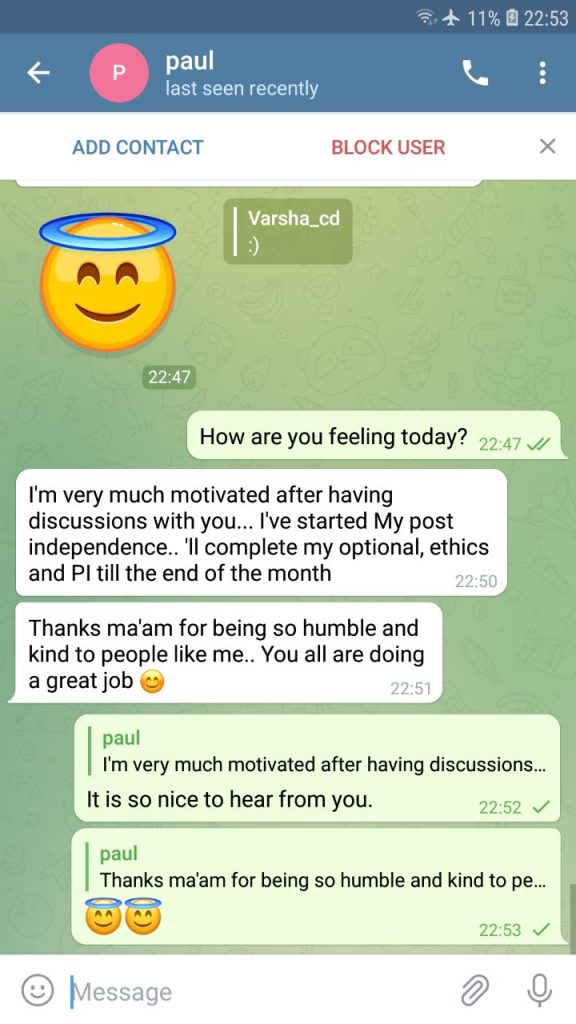
Our philosophy behind MENTORSHIP is to get you out of this Snooze cycle. This ensures that you are the BEST VERSION of yourself in this journey. If you are under the impression that mentorship is weekly calls you attend, then you are mistaken, my friend. Trust us, your mentor will be your ‘FRIEND, PHILOSOPHER AND GUIDE’.
TO EACH THEIR OWN – Every aspirant is different. Their strengths and weaknesses are different. Their time availability is also different. Identifying this is important so you don’t end up making unrealistic targets and lose momentum. Your mentor will make sure you start slow but remain consistent to build your confidence. Making your schedule structured based on our experience of working with 2500+ students is our first priority.
TRACK YOUR PROGRESS – When you see yourself grow, it becomes easier to motivate yourself to push boundaries. Tracking your progress can happen in many ways like mentorship calls or chat sessions or by regular tests. The idea is to ensure that you don’t go off track in your preparation, and even if you do, we have your back.
EVOLUTION – A constant guidance is important to bring consistency to your UPSC preparation. Guidance is not about clearing your doubts or asking you to study when you don’t. It is also about the evolution of your preparation. This is where you and your mentor work as a team. A constant effort to PLAN AND BUILD UP YOUR ABILITY to learn in a faster and more efficient way.
TALK IT OUT – The biggest hurdle in achieving your highest level of consistency is the emotional part. Every now and then, you. surround yourself with negative thoughts, you feel scared and depressed. Instead of resolving these emotional issues, you avoid them as it seems like a waste of your precious time. You have to understand that ignoring emotional troubles does not solve them. What your doing is building an emotional time bomb that may burst a week before your mains or prelims! This is where your MENTOR AS A FRIEND comes in. All our mentors have been through this journey. We understand your fears and anxieties. So, TALK IT OUT.
Don’t let inconsistency keep you away from your dreams.
Fill up the SAMANVAYA form given below. Let us know your problems and we will find a solution to it, just like our students say ” TOGETHER WE CAN AND WE WILL”.
How has Civilsdaily Mentorship, helped Aspirants become Toppers?
The most difficult challenge faced by EVERY candidate is inconsistency. Be it inconsistency in studies, answer-writing practice, covering the syllabus, or revision, every candidate finds it difficult to cope with. Buthow do successful candidates manage to FIGHT Inconsistency so consistently?
In UPSC 2020, Civilsdaily helped 80+ students secure ranks in their exams. In the top 100, every 3rd ranker was a Civilsdaily student.
A very recent success story would be Vishwa Shah, student of Civilsdaily Mentor, Sukanya Ma’am. Vishwa has cleared the GPSC exam to become the Deputy Superintendent of Police in Gujarat. He has penned a thank-you note yesterday. Heartiest Congratulations to Vishwa!
One of our other Civilsdaily Student, Shubham Nagargojecleared the exams in 2020 to become an IPS Officer. Shubham was gracious enough to let us know how he felt about Civilsdaily Samanvaya Guidance under Parth sir.
To know how all of them cleared the exam with our mentorship, visit the UnherdPodcast.
Now that results are announced for UPSC 2021 Prelims, out of 15 out of 25 students of Santhosh Gupta sir have been recommended to Mains. One such student, Rahul expresses his gratitude and extends his appreciation.
Most of our Mentors like Sudhanshu sir, Sajal sir, Santhosh sir, Pravin sir, Parth Verma sir and Sukanya Ma’am were UPSC aspirants themselves and have attended UPSC Mains more than five times and UPSC Interview more than twice. Hence their mentorship is always a blend of the best test series, comprehensive notes and current affairs knowledge.
All of them dedicate their time weekly to give 1-on-1 mentorship to every student where they discuss last week’s performance and next week’s approach.
Be it Telegram, Whatsapp or Habitiat channels, they are always available and clear student’s doubts in a turnaround time of 24 Hours.
Why Civilsdaily Mentors are the GPS for Your UPSC-CSE Preparation
Remember there is always light at the end of the tunnel and if you want to get out of the tunnel you have to follow the direction of the light! Our mentors’ give you direction which is divided into daily modules. All you have to do is study and complete them on time.
As every year passes by, we don’t get confident by the previous years’ performance and become laidback. Instead, we become more hungry to convert all our students into toppers.
How are Current Civilsdaily Students Gearing up for UPSC-CSE 2022?
Initially, our Civilsdaily student Smriti wasn’t confident about Prelims when she began her preparation. Though she had joined Civilsdaily in 2020, she started studying for UPSC-CSE back in 2019. At that time, Smriti had enrolled in multiple institutes. Though, most of these institutes had promised a personal mentor, she was unable to get in touch with them on a daily basis. Also those mentors never scheduled test-series on a weekly basis. Hence, despite preparing for a year, Smriti had scored only 35 marks out of 200 in her first test series by Civilsdaily.
She then started writing 20-25 test series over the course of UAP 2021 and in her last test, her scores have drastically improved. She now scores in the range of 130-135 marks in prelims’ and 110+ in mains’ papers.
In Smriti’s own words she describes her Samanvaya Mentorship Experience to be —
“Our parents provide us financial and emotional support, friends provide us moral support and the right mentor gives you logistic and logical support for UPSC. There are days when I felt I won’t be able to compete against lakhs of aspirants. That’s when my mentor, Ravi sir reminded me of my improvement and encouraged me that I can crack it with the same consistency. We need someone, who tells us we are performing well especially when we cannot see that ourselves. The mentorship at Civilsdaily helped me become mentally stronger as a person. In other institutes, mentors are allotted only for doubt resolution. But at Civilsdaily, I am getting end-to-end mentorship via value added notes, classes, test series and detailed evaluation.”
Similarly our another Civilsdaily student, Ashishsums up his Samanvaya experience with Civilsdaily mentor,Pravin Sir, “Because of Pravin sir’s support, I am able to understand a topic in lesser time.”
This is how Pravin sir evaluates Ashish’s Mains Test Series every week. After every test series evaluation, Pravin sir schedules a 1 hour call to discuss how Ashish can improve his marks and the sources he can refer for key topics.
It’s Your Turn Get the Free 40 Min Counselling Session By a CD Mentor
Civilsdaily mentors are so dedicated, consistent and focused for your UPSC goal, that you will eventually become focused into turning your dreams to reality.
At the core of Civilsdaily UPSC mentorship, lies the fact that each one of you will have a unique journey while preparing for the exam. Some will get through on the first attempt without much effort while others will take both more time and more effort.
We want to understand you better to help you optimize your journey so you can focus on the right things and not waste time on the wrong ones. We are asking you to tap into the valuable experiences of mentors who underwent the same grind and realize the pitfalls and understand the shortcuts to make it.
In the first counselling session, we will understand your weaknesses. We then help you to stick to one plan or strategy throughout your preparation. We will then follow up with you on a daily basis to check if you are right on track.
Preparing for UPSC in a stress-free manner is something all of us dream of. Studying in an anxious state of mind reduces concentration, focus and retention of topics learnt.
One of the reasons why you might get stressed is because despite studying for longer hours, you are unable to translate it to higher scores. This is where it becomes important to understand the difference between ‘studying smart’ and ‘studying hard’.
How will Samanavaya Free 1-on-1 Counselling Session Help you study like a UPSC Topper?
UPSC-CSE is an information loaded exam and at times, we have to come up with certain hacks to remember facts in books, newspapers, committee reports etc. Recalling information on time is crucial to success in Prelims exam.
However, since this is UPSC and not any other normal exam what does studying smart actually mean according to UPSC? It means to master the art of learning. There are several tricks available out there to learn better. You could use mind maps, flow charts, flash cards, mnemonic devices, etc to break down complex topics into simpler parts.
Another memory technique to remember facts is to pretend you are a teacher and then teach the concept out loud. You can record important facts as voice notes and replay them again and again as well. It is also important to stay relaxed and calm because a tired and distracted mind needs to work harder and longer to absorb new information. So do try getting meditatation and pranayama techniques to learn better.
Do you want to take it a notch higher and have an expert Civilsdaily mentor tell you what kind of studying techniques or brain hacks you can use to understand and remember the concepts?
Then, fill the Samanvaya free 1-on-1 counselling session form. You will get a personalised 30-40 minutes free mentorship-driven strategy call to ace your UPSC preparation!
Key-Takeaways of this Week’s Samanvaya Free 1-on-1 Mentoring Session
Our philosophy behind MENTORSHIP is to get you out of this Snooze cycle. This ensures that you are the BEST VERSION of yourself in this journey. If you are under the impression that mentorship is weekly calls you attend, then you are mistaken, my friend. Trust us, your mentor will be your ‘FRIEND, PHILOSOPHER AND GUIDE’.
TO EACH THEIR OWN – Every aspirant is different. Their strengths and weaknesses are different. Their time availability is also different. Identifying this is important so you don’t end up making unrealistic targets and lose momentum. Your mentor will make sure you start slow but remain consistent to build your confidence. Making your schedule structured based on our experience of working with 2500+ students is our first priority.
TRACK YOUR PROGRESS – When you see yourself grow, it becomes easier to motivate yourself to push boundaries. Tracking your progress can happen in many ways like mentorship calls or chat sessions or by regular tests. The idea is to ensure that you don’t go off track in your preparation, and even if you do, we have your back.
EVOLUTION – A constant guidance is important to bring consistency to your UPSC preparation. Guidance is not about clearing your doubts or asking you to study when you don’t. It is also about the evolution of your preparation. This is where you and your mentor work as a team. A constant effort to PLAN AND BUILD UP YOUR ABILITY to learn in a faster and more efficient way.
TALK IT OUT – The biggest hurdle in achieving your highest level of consistency is the emotional part. Every now and then, you. surround yourself with negative thoughts, you feel scared and depressed. Instead of resolving these emotional issues, you avoid them as it seems like a waste of your precious time. You have to understand that ignoring emotional troubles does not solve them. What your doing is building an emotional time bomb that may burst a week before your mains or prelims! This is where your MENTOR AS A FRIEND comes in. All our mentors have been through this journey. We understand your fears and anxieties. So, TALK IT OUT.
Don’t let inconsistency keep you away from your dreams.
Fill up the SAMANVAYA form given below. Let us know your problems and we will find a solution to it, just like our students say ” TOGETHER WE CAN AND WE WILL”.
How has Civilsdaily Mentorship, helped Aspirants become Toppers?
The most difficult challenge faced by EVERY candidate is inconsistency. Be it inconsistency in studies, answer-writing practice, covering the syllabus, or revision, every candidate finds it difficult to cope with. Buthow do successful candidates manage to FIGHT Inconsistency so consistently?
In UPSC 2020, Civilsdaily helped 80+ students secure ranks in their exams. In the top 100, every 3rd ranker was a Civilsdaily student.
A very recent success story would be Vishwa Shah, student of Civilsdaily Mentor, Sukanya Ma’am. Vishwa has cleared the GPSC exam to become the Deputy Superintendent of Police in Gujarat. He has penned a thank-you note yesterday. Heartiest Congratulations to Vishwa!
One of our other Civilsdaily Student, Shubham Nagargojecleared the exams in 2020 to become an IPS Officer. Shubham was gracious enough to let us know how he felt about Civilsdaily Samanvaya Guidance under Parth sir.
To know how all of them cleared the exam with our mentorship, visit the UnherdPodcast.
Now that results are announced for UPSC 2021 Prelims, out of 15 out of 25 students of Santhosh Gupta sir have been recommended to Mains. One such student, Rahul expresses his gratitude and extends his appreciation.
Most of our Mentors like Sudhanshu sir, Sajal sir, Santhosh sir, Pravin sir, Parth Verma sir and Sukanya Ma’am were UPSC aspirants themselves and have attended UPSC Mains more than five times and UPSC Interview more than twice. Hence their mentorship is always a blend of the best test series, comprehensive notes and current affairs knowledge.
All of them dedicate their time weekly to give 1-on-1 mentorship to every student where they discuss last week’s performance and next week’s approach.
Be it Telegram, Whatsapp or Habitiat channels, they are always available and clear student’s doubts in a turnaround time of 24 Hours.
Why Civilsdaily Mentors are the GPS for Your UPSC-CSE Preparation
Remember there is always light at the end of the tunnel and if you want to get out of the tunnel you have to follow the direction of the light! Our mentors’ give you direction which is divided into daily modules. All you have to do is study and complete them on time.
As every year passes by, we don’t get confident by the previous years’ performance and become laidback. Instead, we become more hungry to convert all our students into toppers.
How are Current Civilsdaily Students Gearing up for UPSC-CSE 2022?
Initially, our Civilsdaily student Smriti wasn’t confident about Prelims when she began her preparation. Though she had joined Civilsdaily in 2020, she started studying for UPSC-CSE back in 2019. At that time, Smriti had enrolled in multiple institutes. Though, most of these institutes had promised a personal mentor, she was unable to get in touch with them on a daily basis. Also those mentors never scheduled test-series on a weekly basis. Hence, despite preparing for a year, Smriti had scored only 35 marks out of 200 in her first test series by Civilsdaily.
She then started writing 20-25 test series over the course of UAP 2021 and in her last test, her scores have drastically improved. She now scores in the range of 130-135 marks in prelims’ and 110+ in mains’ papers.
In Smriti’s own words she describes her Samanvaya Mentorship Experience to be —
“Our parents provide us financial and emotional support, friends provide us moral support and the right mentor gives you logistic and logical support for UPSC. There are days when I felt I won’t be able to compete against lakhs of aspirants. That’s when my mentor, Ravi sir reminded me of my improvement and encouraged me that I can crack it with the same consistency. We need someone, who tells us we are performing well especially when we cannot see that ourselves. The mentorship at Civilsdaily helped me become mentally stronger as a person. In other institutes, mentors are allotted only for doubt resolution. But at Civilsdaily, I am getting end-to-end mentorship via value added notes, classes, test series and detailed evaluation.”
Similarly our another Civilsdaily student, Ashishsums up his Samanvaya experience with Civilsdaily mentor,Pravin Sir, “Because of Pravin sir’s support, I am able to understand a topic in lesser time.”
This is how Pravin sir evaluates Ashish’s Mains Test Series every week. After every test series evaluation, Pravin sir schedules a 1 hour call to discuss how Ashish can improve his marks and the sources he can refer for key topics.
It’s Your Turn Get the Free 40 Min Counselling Session By a CD Mentor
Civilsdaily mentors are so dedicated, consistent and focused for your UPSC goal, that you will eventually become focused into turning your dreams to reality.
At the core of Civilsdaily UPSC mentorship, lies the fact that each one of you will have a unique journey while preparing for the exam. Some will get through on the first attempt without much effort while others will take both more time and more effort.
We want to understand you better to help you optimize your journey so you can focus on the right things and not waste time on the wrong ones. We are asking you to tap into the valuable experiences of mentors who underwent the same grind and realize the pitfalls and understand the shortcuts to make it.
In the first counselling session, we will understand your weaknesses. We then help you to stick to one plan or strategy throughout your preparation. We will then follow up with you on a daily basis to check if you are right on track.
Preparing for UPSC in a stress-free manner is something all of us dream of. Studying in an anxious state of mind reduces concentration, focus and retention of topics learnt.
One of the reasons why you might get stressed is because despite studying for longer hours, you are unable to translate it to higher scores. This is where it becomes important to understand the difference between ‘studying smart’ and ‘studying hard’.
How will Samanavaya Free 1-on-1 Counselling Session Help you study like a UPSC Topper?
UPSC-CSE is an information loaded exam and at times, we have to come up with certain hacks to remember facts in books, newspapers, committee reports etc. Recalling information on time is crucial to success in Prelims exam.
However, since this is UPSC and not any other normal exam what does studying smart actually mean according to UPSC? It means to master the art of learning. There are several tricks available out there to learn better. You could use mind maps, flow charts, flash cards, mnemonic devices, etc to break down complex topics into simpler parts.
Another memory technique to remember facts is to pretend you are a teacher and then teach the concept out loud. You can record important facts as voice notes and replay them again and again as well. It is also important to stay relaxed and calm because a tired and distracted mind needs to work harder and longer to absorb new information. So do try getting meditatation and pranayama techniques to learn better.
Do you want to take it a notch higher and have an expert Civilsdaily mentor tell you what kind of studying techniques or brain hacks you can use to understand and remember the concepts?
Then, fill the Samanvaya free 1-on-1 counselling session form. You will get a personalised 30-40 minutes free mentorship-driven strategy call to ace your UPSC preparation!
Key-Takeaways of this Week’s Samanvaya Free 1-on-1 Mentoring Session
Our philosophy behind MENTORSHIP is to get you out of this Snooze cycle. This ensures that you are the BEST VERSION of yourself in this journey. If you are under the impression that mentorship is weekly calls you attend, then you are mistaken, my friend. Trust us, your mentor will be your ‘FRIEND, PHILOSOPHER AND GUIDE’.
TO EACH THEIR OWN – Every aspirant is different. Their strengths and weaknesses are different. Their time availability is also different. Identifying this is important so you don’t end up making unrealistic targets and lose momentum. Your mentor will make sure you start slow but remain consistent to build your confidence. Making your schedule structured based on our experience of working with 2500+ students is our first priority.
TRACK YOUR PROGRESS – When you see yourself grow, it becomes easier to motivate yourself to push boundaries. Tracking your progress can happen in many ways like mentorship calls or chat sessions or by regular tests. The idea is to ensure that you don’t go off track in your preparation, and even if you do, we have your back.
EVOLUTION – A constant guidance is important to bring consistency to your UPSC preparation. Guidance is not about clearing your doubts or asking you to study when you don’t. It is also about the evolution of your preparation. This is where you and your mentor work as a team. A constant effort to PLAN AND BUILD UP YOUR ABILITY to learn in a faster and more efficient way.
TALK IT OUT – The biggest hurdle in achieving your highest level of consistency is the emotional part. Every now and then, you. surround yourself with negative thoughts, you feel scared and depressed. Instead of resolving these emotional issues, you avoid them as it seems like a waste of your precious time. You have to understand that ignoring emotional troubles does not solve them. What your doing is building an emotional time bomb that may burst a week before your mains or prelims! This is where your MENTOR AS A FRIEND comes in. All our mentors have been through this journey. We understand your fears and anxieties. So, TALK IT OUT.
Don’t let inconsistency keep you away from your dreams.
Fill up the SAMANVAYA form given below. Let us know your problems and we will find a solution to it, just like our students say ” TOGETHER WE CAN AND WE WILL”.
How has Civilsdaily Mentorship, helped Aspirants become Toppers?
The most difficult challenge faced by EVERY candidate is inconsistency. Be it inconsistency in studies, answer-writing practice, covering the syllabus, or revision, every candidate finds it difficult to cope with. Buthow do successful candidates manage to FIGHT Inconsistency so consistently?
In UPSC 2020, Civilsdaily helped 80+ students secure ranks in their exams. In the top 100, every 3rd ranker was a Civilsdaily student.
A very recent success story would be Vishwa Shah, student of Civilsdaily Mentor, Sukanya Ma’am. Vishwa has cleared the GPSC exam to become the Deputy Superintendent of Police in Gujarat. He has penned a thank-you note yesterday. Heartiest Congratulations to Vishwa!
One of our other Civilsdaily Student, Shubham Nagargojecleared the exams in 2020 to become an IPS Officer. Shubham was gracious enough to let us know how he felt about Civilsdaily Samanvaya Guidance under Parth sir.
To know how all of them cleared the exam with our mentorship, visit the UnherdPodcast.
Now that results are announced for UPSC 2021 Prelims, out of 15 out of 25 students of Santhosh Gupta sir have been recommended to Mains. One such student, Rahul expresses his gratitude and extends his appreciation.
Most of our Mentors like Sudhanshu sir, Sajal sir, Santhosh sir, Pravin sir, Parth Verma sir and Sukanya Ma’am were UPSC aspirants themselves and have attended UPSC Mains more than five times and UPSC Interview more than twice. Hence their mentorship is always a blend of the best test series, comprehensive notes and current affairs knowledge.
All of them dedicate their time weekly to give 1-on-1 mentorship to every student where they discuss last week’s performance and next week’s approach.
Be it Telegram, Whatsapp or Habitiat channels, they are always available and clear student’s doubts in a turnaround time of 24 Hours.
Why Civilsdaily Mentors are the GPS for Your UPSC-CSE Preparation
Remember there is always light at the end of the tunnel and if you want to get out of the tunnel you have to follow the direction of the light! Our mentors’ give you direction which is divided into daily modules. All you have to do is study and complete them on time.
As every year passes by, we don’t get confident by the previous years’ performance and become laidback. Instead, we become more hungry to convert all our students into toppers.
How are Current Civilsdaily Students Gearing up for UPSC-CSE 2022?
Initially, our Civilsdaily student Smriti wasn’t confident about Prelims when she began her preparation. Though she had joined Civilsdaily in 2020, she started studying for UPSC-CSE back in 2019. At that time, Smriti had enrolled in multiple institutes. Though, most of these institutes had promised a personal mentor, she was unable to get in touch with them on a daily basis. Also those mentors never scheduled test-series on a weekly basis. Hence, despite preparing for a year, Smriti had scored only 35 marks out of 200 in her first test series by Civilsdaily.
She then started writing 20-25 test series over the course of UAP 2021 and in her last test, her scores have drastically improved. She now scores in the range of 130-135 marks in prelims’ and 110+ in mains’ papers.
In Smriti’s own words she describes her Samanvaya Mentorship Experience to be —
“Our parents provide us financial and emotional support, friends provide us moral support and the right mentor gives you logistic and logical support for UPSC. There are days when I felt I won’t be able to compete against lakhs of aspirants. That’s when my mentor, Ravi sir reminded me of my improvement and encouraged me that I can crack it with the same consistency. We need someone, who tells us we are performing well especially when we cannot see that ourselves. The mentorship at Civilsdaily helped me become mentally stronger as a person. In other institutes, mentors are allotted only for doubt resolution. But at Civilsdaily, I am getting end-to-end mentorship via value added notes, classes, test series and detailed evaluation.”
Similarly our another Civilsdaily student, Ashishsums up his Samanvaya experience with Civilsdaily mentor,Pravin Sir, “Because of Pravin sir’s support, I am able to understand a topic in lesser time.”
This is how Pravin sir evaluates Ashish’s Mains Test Series every week. After every test series evaluation, Pravin sir schedules a 1 hour call to discuss how Ashish can improve his marks and the sources he can refer for key topics.
It’s Your Turn Get the Free 40 Min Counselling Session By a CD Mentor
Civilsdaily mentors are so dedicated, consistent and focused for your UPSC goal, that you will eventually become focused into turning your dreams to reality.
At the core of Civilsdaily UPSC mentorship, lies the fact that each one of you will have a unique journey while preparing for the exam. Some will get through on the first attempt without much effort while others will take both more time and more effort.
We want to understand you better to help you optimize your journey so you can focus on the right things and not waste time on the wrong ones. We are asking you to tap into the valuable experiences of mentors who underwent the same grind and realize the pitfalls and understand the shortcuts to make it.
In the first counselling session, we will understand your weaknesses. We then help you to stick to one plan or strategy throughout your preparation. We will then follow up with you on a daily basis to check if you are right on track.
While there is an allure to national dreams of economic prosperity and global competitiveness, underwritten by AI, there is an environmental cost.
Issues with AI
Unfair race for dominance in AI: A few developed economies possess certain material advantages right from the start, they also set the rules.
They have an advantage in research and development, and possess a skilled workforce as well as wealth to invest in AI.
Inequality in terms of governance: We can also look at the state of inequity in AI in terms of governance: How “tech fluent” are policymakers in developing and underdeveloped countries?
What barriers do they face in crafting regulations and industrial policy?
At the same time, there is an emerging challenge at the nexus of AI and climate change that could deepen this inequity.
Climate impact of AI
The climate impact of AI comes in a few forms: The energy use of training and operating large AI models is one.
In 2020, digital technologies accounted for between 1.8 per cent and 6.3 per cent of global emissions.
In November 2021, UNESCO adopted the In November 2021, UNESCO adopted the Recommendation on the Ethics of Artificial Intelligence, calling on actors to “reduce the environmental impact of AI systems, including but not limited to its carbon footprint.” , calling on actors to “reduce the environmental impact of AI systems, including but not limited to its carbon footprint.”
Inequitable access to resources
Both global AI governance and climate change policy (historically) are contentious, being rooted in inequitable access to resources.
Developing and underdeveloped countries face a challenge on two fronts:
1] AI’s social and economic benefits are accruing to a few countries.
2] Most of the current efforts and narratives on the relationship between AI and climate impact are being driven by the developed West.
Way forward
Assess technology-led priorities: Governments of developing countries, India included, should also assess their technology-led growth priorities in the context of AI’s climate costs.
It is argued that as developing nations are not plagued by legacy infrastructure it would be easier for them to “build up better”.
Consider the question “How Artificial Intelligence technologies could transform the world as we know it? What are the concerns with it?
Conclusion
It may be worth thinking through what “solutions” would truly work for the unique social and economic contexts of the communities in our global village.
As an aspirant if you have taken many test series, but are unable to score above 100 marks and want to improve your scores before Mains 2022, then this program is for you!
If coaches of sportspersons have themselves been players, then shouldn’t mentors of UPSC aspirants have cleared UPSC Mains themselves?
It’s about time you find a Rahul Dravid or a Pullela Gopichand to mentor your Upsc preparation. Just practising test series without knowing the ways to present an answer is not the way to clear Mains. An ideal test series program should have 1-on-1 mentorship and guidance by veterans who have themselves topped the exams!
Instead of getting demotivated and comparing yourself to other students, get mentorship support like Kunal Aggrawal IRS did when he could only score 75/250 marks in Mains mock tests.
Why UPSC toppers are convinced that Smash Mains helped them succeed?
A serving IPS officer, who had written the Mains exam again in 2021 to aim for IAS posting, gave us his feedback of our Smash Mains Test Series
How has Smash Mains helped 2021-2022 Aspirants in Preparing for UPSC?
What do aspirants need in their UPSC preparation journey? They need a senior who will give them moral support and the required logistics to prepare for the tough exam in a simplified manner.
You can clear the exam only with confidence and consistency. And to achieve both, you require a personalised mentor. Many aspirants feel just attending classes or tests is not beneficial for them. So we tweaked our program to include mentorship both in our tests series and classes. Aspirants feel they can reach out to us anytime with their concerns and we are available to sort them out.
Message from Sajal Sir
Dear Students,
For some of you prelims has never been a challenge for you. You have been missing the mains cut-off with a small margin (repeatedly). This means that there are some fundamental issueswith your approach. You might be aware or not about this. But just realization is not enough, you have to work on its execution as well. And bringing that to fruition will be possible through a guided process under a meticulously designed plan.
Smash mains is a highly personalized and intensive handholding program for the crème-de-la-crème (veterans) amongst UPSC aspirants (the intake is 50 students).
Note: The Entry is Restricted to those who have appeared in UPSC interview in the past 2 years or have missed the mains cut off by a whisker.
The focus is on identifying and highlighting the issues with your preparation (information / analysis / utilization). According to your strength and weaknesses, a tailor-made strategy is developed. Under Sajal sir’s strict monitoring, incremental improvements are aimed every day, after every session.
My marks in UPSC 2017 GS Mains paper were:
GS Paper 1 – 132
GS Paper 2 – 125
GS Paper 3 – 130
Key Takeways About Smash Mains 2022
Every 3rd Ranker in the Top 100 of UPSC 2020 is a Civilsdaily Student.
Your mentor, Sajal Sir is himself the 2017 topper of GS Mains. He has appeared for interview many times.
Over 400 students have emerged as toppers under Sajal Sir’s mentorship in the last 7 years.
Sajal Sir will daily motivate you on our chat-based platform, Habitat and have weekly 1-on-1 discussions with you after every test.
You don’t have to waste any more time finding the strategy (value added notes, test series or timetable ) for the next 3 months. You will get the guidance for it.
You will gain access to Civildaily’s Samachar Manthan – For holistic and comprehensive coverage of Current Affairs.
You will have exclusive membership to Smash Mains club in Habitat.
One of our other Civilsdaily Student cleared the exams in 2020 to become an IPS Officer. He wrote the 2021 exam again as he aims for an IAS posting. This is what he said about our program
If you are still not convinced then go through this video by UPSC 2020 AIR 425 topper Divyansh Singh who tells us how Sajal sir helped him develop 1-2 pages notes for every topic.
After completing the Mains Test series, you will have a one-to-one detailed and in-depth interaction with Sajal sir. Final refinements are done to every answer. Value addition material, as well as pointers, will be provided here. We will work with you to ensure you have enough material for value addition. Our focus will be on providing tips that add the missing X factor to your answers.
Why is Smash 2022 the best way to prepare for mains?
Individual attention and approachability are the USPs of this program. Listen to what our Smash Mains 2020 student and topper Pooja Gupta (AIR 42) says about the program.
Not putting Penguins among the Fowls – You already know how to write an average answer (you’re missing it by a few marks actually). You want to know how to increase your score from 90 to 110-115. The approach followed by other institutes in their Test series is the same for a veteran and a complete newbie and here lies the problem. Without personalizedone-to-one interaction with someone like Sajal sir (who has scored these awesome marks), it will be difficult for you to rectify these minute yet very important shortcomings.
Evaluation is a strength of this program and we put it on a high priority. Sajal sir himself is involved in the process, unlike other institutes where evaluation is outsourced to those who themselves might not have appeared for mains (It’s bizarre). It shouldn’t be based on ‘model answers’ as there are 3-4 ways of approaching an answer. Only a seasoned player will be able to go beyond these model answers and be able to appreciate your approach (If it’s innovative) even if it differs from the model answers provided.
Test copies get checked in a time-bound manner. The questions, answers and material provided are of the highest quality.
Emphasis on execution and utilization of knowledge – Mains is not only about knowledge but the way you express the relevant knowledge in the most optimum manner.
Sajal sir’s interventions are highly specific and not generalized. Sitting right in front of you he walks you through each and every question. Always there, he will not let you lose your focus.
AIR 148 UPSC 2020 topper and our Civilsdaily student, Ponmani explains why answer writing with mentorship is necessary for Mains.
Preparing for UPSC in a stress-free manner is something all of us dream of. Studying in an anxious state of mind reduces concentration, focus and retention of topics learnt.
One of the reasons why you might get stressed is because despite studying for longer hours, you are unable to translate it to higher scores. This is where it becomes important to understand the difference between ‘studying smart’ and ‘studying hard’.
How will Samanavaya Free 1-on-1 Counselling Session Help you study like a UPSC Topper?
UPSC-CSE is an information loaded exam and at times, we have to come up with certain hacks to remember facts in books, newspapers, committee reports etc. Recalling information on time is crucial to success in Prelims exam.
However, since this is UPSC and not any other normal exam what does studying smart actually mean according to UPSC? It means to master the art of learning. There are several tricks available out there to learn better. You could use mind maps, flow charts, flash cards, mnemonic devices, etc to break down complex topics into simpler parts.
Another memory technique to remember facts is to pretend you are a teacher and then teach the concept out loud. You can record important facts as voice notes and replay them again and again as well. It is also important to stay relaxed and calm because a tired and distracted mind needs to work harder and longer to absorb new information. So do try getting meditatation and pranayama techniques to learn better.
Do you want to take it a notch higher and have an expert Civilsdaily mentor tell you what kind of studying techniques or brain hacks you can use to understand and remember the concepts?
Then, fill the Samanvaya free 1-on-1 counselling session form. You will get a personalised 30-40 minutes free mentorship-driven strategy call to ace your UPSC preparation!
Key-Takeaways of this Week’s Samanvaya Free 1-on-1 Mentoring Session
Our philosophy behind MENTORSHIP is to get you out of this Snooze cycle. This ensures that you are the BEST VERSION of yourself in this journey. If you are under the impression that mentorship is weekly calls you attend, then you are mistaken, my friend. Trust us, your mentor will be your ‘FRIEND, PHILOSOPHER AND GUIDE’.
TO EACH THEIR OWN – Every aspirant is different. Their strengths and weaknesses are different. Their time availability is also different. Identifying this is important so you don’t end up making unrealistic targets and lose momentum. Your mentor will make sure you start slow but remain consistent to build your confidence. Making your schedule structured based on our experience of working with 2500+ students is our first priority.
TRACK YOUR PROGRESS – When you see yourself grow, it becomes easier to motivate yourself to push boundaries. Tracking your progress can happen in many ways like mentorship calls or chat sessions or by regular tests. The idea is to ensure that you don’t go off track in your preparation, and even if you do, we have your back.
EVOLUTION – A constant guidance is important to bring consistency to your UPSC preparation. Guidance is not about clearing your doubts or asking you to study when you don’t. It is also about the evolution of your preparation. This is where you and your mentor work as a team. A constant effort to PLAN AND BUILD UP YOUR ABILITY to learn in a faster and more efficient way.
TALK IT OUT – The biggest hurdle in achieving your highest level of consistency is the emotional part. Every now and then, you. surround yourself with negative thoughts, you feel scared and depressed. Instead of resolving these emotional issues, you avoid them as it seems like a waste of your precious time. You have to understand that ignoring emotional troubles does not solve them. What your doing is building an emotional time bomb that may burst a week before your mains or prelims! This is where your MENTOR AS A FRIEND comes in. All our mentors have been through this journey. We understand your fears and anxieties. So, TALK IT OUT.
Don’t let inconsistency keep you away from your dreams.
Fill up the SAMANVAYA form given below. Let us know your problems and we will find a solution to it, just like our students say ” TOGETHER WE CAN AND WE WILL”.
How has Civilsdaily Mentorship, helped Aspirants become Toppers?
The most difficult challenge faced by EVERY candidate is inconsistency. Be it inconsistency in studies, answer-writing practice, covering the syllabus, or revision, every candidate finds it difficult to cope with. Buthow do successful candidates manage to FIGHT Inconsistency so consistently?
In UPSC 2020, Civilsdaily helped 80+ students secure ranks in their exams. In the top 100, every 3rd ranker was a Civilsdaily student.
A very recent success story would be Vishwa Shah, student of Civilsdaily Mentor, Sukanya Ma’am. Vishwa has cleared the GPSC exam to become the Deputy Superintendent of Police in Gujarat. He has penned a thank-you note yesterday. Heartiest Congratulations to Vishwa!
One of our other Civilsdaily Student, Shubham Nagargojecleared the exams in 2020 to become an IPS Officer. Shubham was gracious enough to let us know how he felt about Civilsdaily Samanvaya Guidance under Parth sir.
To know how all of them cleared the exam with our mentorship, visit the UnherdPodcast.
Now that results are announced for UPSC 2021 Prelims, out of 15 out of 25 students of Santhosh Gupta sir have been recommended to Mains. One such student, Rahul expresses his gratitude and extends his appreciation.
Most of our Mentors like Sudhanshu sir, Sajal sir, Santhosh sir, Pravin sir, Parth Verma sir and Sukanya Ma’am were UPSC aspirants themselves and have attended UPSC Mains more than five times and UPSC Interview more than twice. Hence their mentorship is always a blend of the best test series, comprehensive notes and current affairs knowledge.
All of them dedicate their time weekly to give 1-on-1 mentorship to every student where they discuss last week’s performance and next week’s approach.
Be it Telegram, Whatsapp or Habitiat channels, they are always available and clear student’s doubts in a turnaround time of 24 Hours.
Why Civilsdaily Mentors are the GPS for Your UPSC-CSE Preparation
Remember there is always light at the end of the tunnel and if you want to get out of the tunnel you have to follow the direction of the light! Our mentors’ give you direction which is divided into daily modules. All you have to do is study and complete them on time.
As every year passes by, we don’t get confident by the previous years’ performance and become laidback. Instead, we become more hungry to convert all our students into toppers.
How are Current Civilsdaily Students Gearing up for UPSC-CSE 2022?
Initially, our Civilsdaily student Smriti wasn’t confident about Prelims when she began her preparation. Though she had joined Civilsdaily in 2020, she started studying for UPSC-CSE back in 2019. At that time, Smriti had enrolled in multiple institutes. Though, most of these institutes had promised a personal mentor, she was unable to get in touch with them on a daily basis. Also those mentors never scheduled test-series on a weekly basis. Hence, despite preparing for a year, Smriti had scored only 35 marks out of 200 in her first test series by Civilsdaily.
She then started writing 20-25 test series over the course of UAP 2021 and in her last test, her scores have drastically improved. She now scores in the range of 130-135 marks in prelims’ and 110+ in mains’ papers.
In Smriti’s own words she describes her Samanvaya Mentorship Experience to be —
“Our parents provide us financial and emotional support, friends provide us moral support and the right mentor gives you logistic and logical support for UPSC. There are days when I felt I won’t be able to compete against lakhs of aspirants. That’s when my mentor, Ravi sir reminded me of my improvement and encouraged me that I can crack it with the same consistency. We need someone, who tells us we are performing well especially when we cannot see that ourselves. The mentorship at Civilsdaily helped me become mentally stronger as a person. In other institutes, mentors are allotted only for doubt resolution. But at Civilsdaily, I am getting end-to-end mentorship via value added notes, classes, test series and detailed evaluation.”
Similarly our another Civilsdaily student, Ashishsums up his Samanvaya experience with Civilsdaily mentor,Pravin Sir, “Because of Pravin sir’s support, I am able to understand a topic in lesser time.”
This is how Pravin sir evaluates Ashish’s Mains Test Series every week. After every test series evaluation, Pravin sir schedules a 1 hour call to discuss how Ashish can improve his marks and the sources he can refer for key topics.
It’s Your Turn Get the Free 40 Min Counselling Session By a CD Mentor
Civilsdaily mentors are so dedicated, consistent and focused for your UPSC goal, that you will eventually become focused into turning your dreams to reality.
At the core of Civilsdaily UPSC mentorship, lies the fact that each one of you will have a unique journey while preparing for the exam. Some will get through on the first attempt without much effort while others will take both more time and more effort.
We want to understand you better to help you optimize your journey so you can focus on the right things and not waste time on the wrong ones. We are asking you to tap into the valuable experiences of mentors who underwent the same grind and realize the pitfalls and understand the shortcuts to make it.
In the first counselling session, we will understand your weaknesses. We then help you to stick to one plan or strategy throughout your preparation. We will then follow up with you on a daily basis to check if you are right on track.
The Supreme Court Collegium headed by Chief Justice N.V. Ramana has recommended to the Centre the names of six judicial officers for appointment as judges of the Delhi High Court.
What is Collegium System?
The Collegium of judges is the Indian Supreme Court’s invention.
It does not figure in the Constitution, which says judges of the Supreme Court and High Courts are appointed by the President and speaks of a process of consultation.
In effect, it is a system under which judges are appointed by an institution comprising judges.
After some judges were superseded in the appointment of the CJI in the 1970s, and attempts made subsequently to effect a mass transfer of High Court judges across the country.
Hence there was a perception that the independence of the judiciary was under threat. This resulted in a series of cases over the years.
Evolution: The Judges Cases
First Judges Case (1981) ruled that the “consultation” with the CJI in the matter of appointments must be full and effective.
However, it rejected the idea that the CJI’s opinion, albeit carrying great weight, should have primacy.
Second Judges Case (1993) introduced the Collegium system, holding that “consultation” really meant “concurrence”.
It added that it was not the CJI’s individual opinion, but an institutional opinion formed in consultation with the two senior-most judges in the Supreme Court.
Third Judges Case (1998): On a Presidential Reference for its opinion, the Supreme Court, in the Third Judges Case (1998) expanded the Collegium to a five-member body, comprising the CJI and four of his senior-most colleagues.
The procedure followed by the Collegium
Appointment of CJI
The President of India appoints the CJI and the other SC judges.
As far as the CJI is concerned, the outgoing CJI recommends his successor.
In practice, it has been strictly by seniority ever since the supersession controversy of the 1970s.
The Union Law Minister forwards the recommendation to the PM who, in turn, advises the President.
Other SC Judges
For other judges of the top court, the proposal is initiated by the CJI.
The CJI consults the rest of the Collegium members, as well as the senior-most judge of the court hailing from the High Court to which the recommended person belongs.
The consultees must record their opinions in writing and it should form part of the file.
The Collegium sends the recommendation to the Law Minister, who forwards it to the Prime Minister to advise the President.
For High Courts
The CJs of High Courts are appointed as per the policy of having Chief Justices from outside the respective States. The Collegium takes the call on the elevation.
High Court judges are recommended by a Collegium comprising the CJI and two senior-most judges.
The proposal, however, is initiated by the Chief Justice of the High Court concerned in consultation with two senior-most colleagues.
The recommendation is sent to the Chief Minister, who advises the Governor to send the proposal to the Union Law Minister.
Does the Collegium recommend transfers too?
Yes, the Collegium also recommends the transfer of Chief Justices and other judges.
Article 222 of the Constitution provides for the transfer of a judge from one High Court to another.
When a CJ is transferred, a replacement must also be simultaneously found for the High Court concerned. There can be an acting CJ in a High Court for not more than a month.
In matters of transfers, the opinion of the CJI “is determinative”, and the consent of the judge concerned is not required.
However, the CJI should take into account the views of the CJ of the High Court concerned and the views of one or more SC judges who are in a position to do so.
All transfers must be made in the public interest, that is, “for the betterment of the administration of justice”.
Loopholes in the Collegium system
Lack of Transparency: Opaqueness and a lack of transparency, and the scope for nepotism are cited often.
Judges appointing Judge: The attempt made to replace it with a ‘National Judicial Appointments Commission’ was struck down by the court in 2015 on the ground that it posed a threat to the independence of the judiciary.
Criteria: Some do not believe in full disclosure of reasons for transfers, as it may make lawyers in the destination court chary of the transferred judge.
Way ahead
In respect of appointments, there has been an acknowledgment that the “zone of consideration” must be expanded to avoid criticism that many appointees hail from families of retired judges.
The status of a proposed new memorandum of procedure, to infuse greater accountability, is also unclear.
Even the majority opinions admitted the need for transparency, now Collegiums’ resolutions are now posted online, but reasons are not given.
The J&K Delimitation Commission is likely to get a second extension of its term this month.
What is Delimitation and why is it needed?
Delimitation is the act of redrawing boundaries of an assembly or Lok Sabha seat to represent changes in population over time.
This exercise is carried out by a Delimitation Commission, whose orders have the force of law and cannot be questioned before any court.
The objective is to redraw boundaries (based on the data of the last Census) in a way so that the population of all seats, as far as practicable, be the same throughout the State.
Aside from changing the limits of a constituency, the process may result in a change in the number of seats in a state.
Delimitation in J&K
Assembly seats in J&K were delimited in 1963, 1973 and 1995.
Prior to August 5, 2019, carving out of J&K’s Assembly seats was carried out under the J&K Constitution and Jammu and Kashmir Representation of the People Act, 1957.
Until then, the delimitation of Lok Sabha seats in J&K was governed by the Constitution of India.
However, the delimitation of the state’s Assembly was governed by the J&K Constitution and J&K Representation of the People Act, 1957.
There was no census in the state in 1991 and hence no Delimitation Commission was set up by the state until 2001 census.
Why is it in the news again?
After the abrogation of J&K’s special status in 2019, the delimitation of Lok Sabha and Assembly seats in the newly-created UT would be as per the provisions of the Indian Constitution.
On March 6, 2020, the government set up the Delimitation Commission, headed by retired Supreme Court judge Ranjana Prakash Desai, which was tasked with winding up delimitation in J&K in a year.
As per the J&K Reorganization Bill, the number of Assembly seats in J&K would increase from 107 to 114, which is expected to benefit the Jammu region.
Factors considered during Delimitation
The number of districts had increased from 12 to 20 and tehsils from 52 to 207 since the last delimitation.
The population density ranged from 29 persons a square km in Kishtwar to 3,436 persons a square km in Srinagar.
The remoteness of the place, inaccessibility etc are also considered during the exercise.
Concerns raised over Delimitation
Jammu vs. Kashmir: Concerns had been expressed over how the delimitation process may end up favoring the Jammu region over Kashmir in terms of the seats.
Under-representation of Ladakh: Arguments have been made on how Ladakh has been underrepresented, with demands for statehood/sixth schedule.
Non-proportionate reservations: It is argued that seats for STs should’ve been divided in both Jammu province & Kashmir province, as the ST population is almost equal.
Do not forget to answer this PYQ in the comment box:
Q.With reference to the Delimitation Commission, consider the following statements:
The orders of the Delimitation Commission cannot be challenged in a Court of Law.
When the orders of the Delimitation Commission are laid before the Lok Sabha or State Legislative Assembly, they cannot affect any modifications in the orders.
Which of the statements given above is/are correct?
(a) 1 only
(b) 2 only
(c) Both 1 and 2
(d) Neither 1 nor 2
[wpdiscuz-feedback id=”alffxgur6b” question=”Please leave a feedback on this” opened=”1″]Post your answers here:[/wpdiscuz-feedback]




![80% Success Rate for Smash Mains 2020 Students & 85% of UPSC 2021 Mains Questions Are From Smash Mains 2021 !!|| [50 seats left] 1-on-1 Mentorship provided by Sajal sir (GS Topper 2017) to get 100 marks above cut off in Mains|| Smash Mains 2022 : New Batch || Invite only program || Register here](https://d18x2uyjeekruj.cloudfront.net/wp-content/uploads/2021/11/590b5905-1e30-4a69-aed5-45a265bdcb41-1200x600.png)


