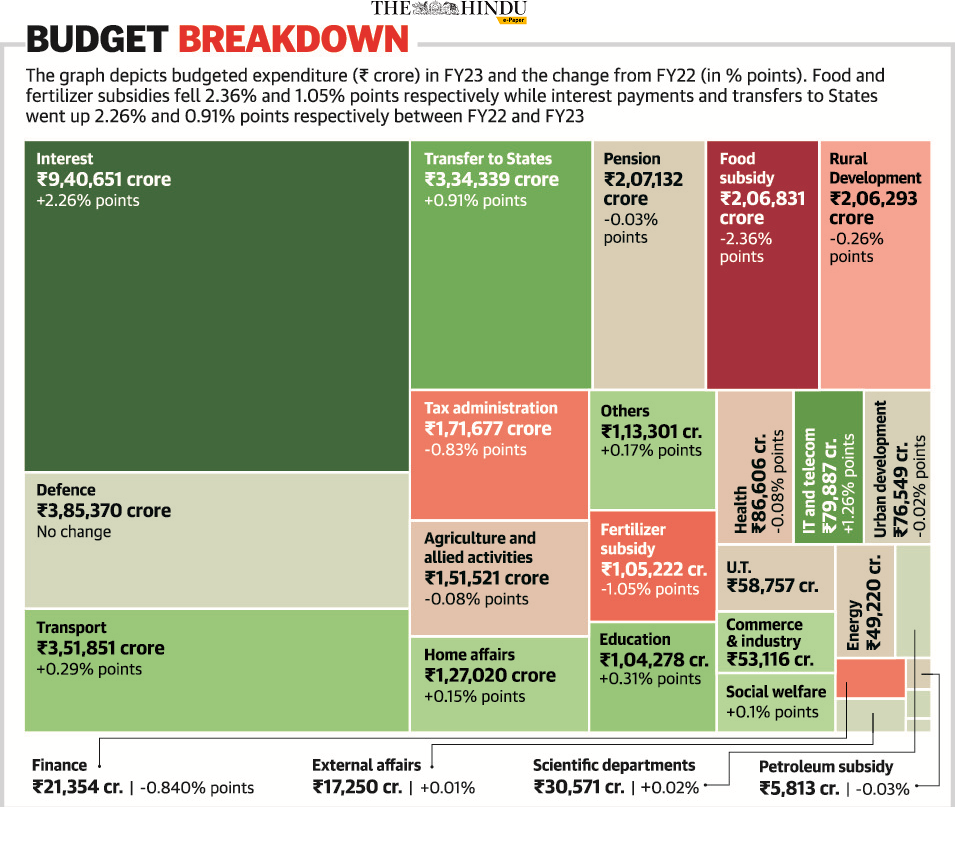
India continues to rank poorly in various global indices that reflect the quality of life, human capital or human development in the country. In this context, it was expected that the current Budget would see an expansion in government spending on the social sector.
Need for greater spending on social sector
In Human Development Index, India ranks 131 out of 189 countries and on the Global Hunger Index, it ranks 101 out of 116 countries.
The pandemic over the last two years has had a severe impact on the health, education and food security of the poor and informal sector workers.
The country has been experiencing increasing inequality over the last couple of decades.
Marginal increase in allocation for school education
In the budget, the government announced that it will expand its ‘one class, oneTVchannel’ scheme instead of announcing enhanced allocations for schools the government announced that it will expand its ‘one class, oneTVchannel’ scheme instead of announcing enhanced allocations for schools so that they can reopen with vigour.
The budget for school education at ₹63,449 crore is a slight improvement over last year’s ₹54,873 crore (2021-22 budget estimates, BE) and a mere increase of 6% in nominal terms compared to 2020-21 BE of ₹59,845 crore.
After rechristening the school mid-day meal scheme as Pradhan Mantri Poshan Shakti Nirman, simply called PM Poshan, the allocation for the scheme has reduced from ₹11,500 crore last year to ₹10,233 crore this year.
Low allocation for health
Despite repeated statements about strengthening the public health system, the overall budget for the Department of Health and Family Welfare at ₹83,000 crore has gone up by only 16% over the BE for 2021-22 and by less than ₹1,000 crore compared to the RE for 2021-22, which is ₹82,921 crore.
However, by including water and sanitation in the budget for health, there is an increase being shown in health spending as a proportion of GDP.
Also, even though the budget for the Jal Jeevan Mission has increased from ₹50,000 crore to ₹60,000 crore, only 44% of the allocated funds to the Department of Water and Sanitation for 2021-22 has been spent as on end December 2021.
No indication of plan to extend the PMGKAY
60% of the population are covered by ration cards currently under the National Food Security Act.
Those who were eligible benefited from the additional free foodgrains that they have been given under the Pradhan Mantri Garib Kalyan Anna Yojana (PMGKAY).
However, the food subsidy (BE) for 2022-23 at ₹2.06 lakh crore is only enough to cover the regular NFSA entitlements.
The indication is that there is no plan to extend the PMGKAY.
The food subsidy RE for 2021-22 is ₹2.86 lakh crore.
Other schemes
Budgets for important schemes such as Saksham Anganwadi, maternity entitlements and social security pensions are around the same as the allocations for last year.
The allocation for MGNREGA at ₹73,000 crore also does not reflect the increased demand for work or thethe pending wages of ₹21,000 crore.
Continued negligence
The resources allocated for crucial government schemes in the fields of health, education, nutrition, and social protection have remained stagnant or show negligent increase.
In fact, the budgets for these schemes have been declining in real terms since 2015.
The World Social Protection Report 2020-22, brought out by the International Labour Organization, shows that the spending on social protection (excluding health) in India is 1.4% of the GDP, while the average for low-middle income countries is 2.5%.
Conclusion
This continued negligence does not bode well for inclusive development in India.
Smash Prelims Program is back after a thumping success in Prelims 2021. Out of 25 students Santosh sir has mentored, 15 have cleared prelims this time.Our students were kind enough to take time out of their hectic Mains preparation and let us know how Santosh sir’s mentorship benefitted them in the exams. We wish them all the very best for the upcoming Mains exam from 7th January onwards!
https://youtu.be/oTRUMSOQEY4
Why Your Focus for Next 5 Months Must be About Scoring Above Cut-Off Marks in UPSC-CSE Prelims? Isn’t the last 1 Month Enough for This?
Every year, the competition for UPSC-CSE is increasing while vacancies are decreasing drastically. This year there are only 712 vacancies as against 2019 which had 927 vacancies. However, atleast 10 lakh students will attempt the prelims exam. This is why right now, it’s important to start having an Olympic Athlete mindset. You need to daily focus on scoring above the cut-off marks in your test series.
Civilsdaily Student and 2019 UPSC-CSE AIR 8 Topper Abhishek Saraf had practiced nearly 6000+ MCQs under us to clear prelims!
What makes prelims tough? It’s because the paper is unpredictable. If this year, science questions are a breeze then the next year you will have to answer advanced concept-based questions. Unlike Mains, Prelims has negative markings.
Toppers like Pranav Vijayvergiya (AIR 65) andSwati Sharma(AIR 17) have found Prelims to be tougher than Mains. In fact, Pranav failed to clear Prelims thrice. But, in his fourth attempt he took Civilsdaily mentorship and cleared Prelims, Mains and Interview in one shot!
Are you feeling low that you are unable to get the required cut-off marks in your test series. Worry not, for about 65% of the UPSC toppers have said that they scored below cut-off marks till December. But by June, they were able to boost their marks to get through the prelims hurdle. It’s time to be like them now.
One has to be good at elimination methods to choose the right option amongst two similar ones. Our Smash Prelims Program started as a pilot project last year with an aim to introduce step-wise improvement in our chosen 25 aspirants. Over a period of 2 months, Santhosh sir inculcated confidence in aspirants who were either newbies or gave too many attempts. This year, we achieved a remarkable 60% success ratio. Next year, we have set our eyes on 100%. Yes, we are ambitious and aspirational just like any other UPSC aspirant.
Why is Mentorship Required for UPSC-CSE Prelims in Every Step – From Test Series, to Study Materials, Classes to Doubt Resolution?
If you are appearing for UPSC-CSE 2022 exams, you might have completed your entire prelims and mains syllabus right now. So what are your main priorities right now? To succeed in UPSC-CSE Prelims 2022, you have to check all these boxes in terms of preparation—
You need clear strategy for next 150 days.
You need to revise effectively to remember whole syllabus at the eve of exam.
You need to practice lots of tests to score accurately, to understand elimination techniques and reduce exam anxiety.
You need to revise current affair of 1.5 years that you have been studying daily.
You need a mentor to fill the critical gaps that have been ignoring till now as you had no one to address them for you.
Santhosh Sir’s Weekly Zoom Session
Do you want to have a mentor who conducts and evaluates medium to advanced test series regularly? A mentor explains to you the different kinds of elimination techniques after you have taken a test series. Before attending a test do you want the mentor to discuss with you the study materials required for the test and provide the right notes with integrated current affairs? While studying a subject, you might have umpteen number of questions. Having someone who responds quickly and explains the topics in simple terms saves your time. And, after a test do you want an experienced mentor to discuss the right answers and motivate you? Do you want the mentor to provide you classes on static+dynamic prelims topics? If yes, then this is the right program for you! The registrations are open for all UPSC 2022 aspirants
Self Preparation with Mentorship: What do Civilsdaily Students think of Santosh Sir’s Mentorship for UPSC-CSE Prelims?
Santhosh Sir, Core Civilsdaily Mentor. He has attended Interview Thrice & Cleared Prelims 6/6 times with above 145 marks.
We asked Santosh sir’s students about their opinion on mentorship — if it was something that saved their time or wasted their time in studies and this is what they had to say:
Kamini: “If I can say in one word, then Santosh sir’s mentorship is unique. Before I joined his program, I used to score 90 marks in Full Length Test Series. Santhosh sir had done in depth analysis of my test papers and suggested ways to reduce the negatives. Right now I am able to score 100+ in advanced test series of not only Civilsdaily but other institutes. He is always available to clear my doubts and solve my issues on call or phone. No issue is too big enough for Santosh sir. He has always told me after you finish a test series, read the same topics again and take another test series the same day to see if your marks improve. From Santosh sir’s polity and economic survey notes, we got questions in 2021 Prelims. I always feel its better to do self studies with mentorship than join coaching institutes and get spoon fed with information.”
Sweetie Raj: “I am a banking professional, living with a joint family. Attending coaching classes is out of question because I won’t have time to read the books myself. Santosh sir helps me self-study by providing me mentorship daily. I study daily from 9PM to 3AM. Santosh sir has been available for 1 hour strategy calls even during this time. No other teacher would have wanted me to succeed as much as he wants me to. I can understand concepts by myself and don’t need help in that. I want someone who pushes me to complete the target modules, checks if I did my mains answer writing for the day and analyses the previous year question papers with me. Because of Santosh sir, I understood that its just not enough reading one book but at the same time I dont have to waste time reading many books. He tells me the topic-wise sources to refer. Also he has designed a study plan for me that I can follow every week. Once, I told Santhosh sir I was missing test series discussion classes as it was conducted at 7PM. Immediately, he provided me recorded videos and kept the session at 8.30PM.”
Specific Features of Smash Prelims 2022 by Santosh Sir
Sincere aspirants who are scoring in the range of 80-90 marks must not attend last minute crash courses right now. They should instead focus on self revision, test series practice and guided mentorship to qualify for UPSC Prelims 2022. Here are the features of Prelims Focused Program by Civilsdaily —
Pillar-1
PRELIMS TESTS:
40 Full Length Tests(12 Basic + 6 Advanced + 10 CA tests + 8 Full tests + 4 CSAT).
In addition to this, in the month of January, we will have 60 sectional tests for practice. This will have 50 questions each. Hence, totally 100 Test Papers (40 FLTs + 60 Sectional Test Papers)
CHECK OUT THE TEST SERIES PROGRAM ON FEBRUARY 15TH & REGISTER ASAP.
VALUE ADDITIONS NOTES AND CLASSES BY VETERAN CIVILSDAILY MENTORS like SUDHANSHU SIR, SAJAL SIR & SUKANYA MA’AM
Polity: Sudhanshu sirwill conduct two sessions covering all the Polity Fundamentals, a session analyzing past year papers, another session on important current affairs related to polity this year and will discuss your test solutions.
History: Santosh Gupta sir will conduct a session on Sectoral Developments in Modern History, a session analyzing past year papers, and test discussion.
Economy: Sajal sir will conduct sessions on economic survey, trend analysis, discussion of most important economic current affairs, past year paper analysis, and economy final test discussion.
Geography: Santosh sir will conduct sessions on the most difficult aspects like Geography Mapping, Economic Geography, and Indian Agriculture.
Environment:Sukanya Ma’amwill cover sessions on Environment innovatively. Key concepts like vegetation and biome, Indian wildlife, conventions and protocols, national parks and sanctuaries, agriculture and sustainable development, and environment current affairs will be covered.
Science & Technology: This year’s prelims paper questioned on the basic concepts of science. Keeping this in mind, Santosh Gupta sir will conduct 2 sessions on One basic concept and current affairs of science and technology.
2. Civilsdaily Current Affairs Magazines for 1 year
3. Civilsdaily compilations of Yojna, Kurukshetra, PRS and RS TV.
4. Civilsdaily Budget And Economic Survey Summary.
5. Handouts on key subject-wise static topics to remember the terms and definitions for Prelims 2022.
Pillar-3
Santosh Gupta sir’s mentorship program
1. Introductory mentor call to every aspirant immediately upon commencement of program.
2. Weekly zoom strategy session by Santosh sir for doubt clearance and continuous improvement.
3. 1-1 mentor calls after 3-4 tests by mentor. After every test series, zoom sessions will be conducted by Birendra sir with all members of the batch for test discussion.
4. Support from mentors on the Habitat Group.
5. Frequent sessions with toppers for support and guidance. will have these special features for aspirants.
6. Mentor will guide on the FCE Approach i.e the Factual and Conceptual Methods of Elimination.
7. Mentor call as per request and mandatory check up call by mentor once a month.
Toppers’ Speak: How Civilsdaily Mentorship Helped Me Clear UPSC?
https://www.youtube.com/watch?v=DSwO38weHAA
About Santosh Gupta Sir
Santosh sir has scored above 140 twice in UPSC prelims and 120 plus in all 6 attempts. He has written all 6 mains and has appeared for Interviews 3 times. He has qualified UPSC EPFO and BPSC 56-59th also. As the Prelims coordinator at Civilsdaily, he has helped 15 out of 25 students clear the prelims examination this year.
Preparing for UPSC in a stress-free manner is something all of us dream of. Studying in an anxious state of mind reduces concentration, focus and retention of topics learnt.
One of the reasons why you might get stressed is because despite studying for longer hours, you are unable to translate it to higher scores. This is where it becomes important to understand the difference between ‘studying smart’ and ‘studying hard’.
How will Samanavaya Free 1-on-1 Counselling Session Help you study like a UPSC Topper?
UPSC-CSE is an information loaded exam and at times, we have to come up with certain hacks to remember facts in books, newspapers, committee reports etc. Recalling information on time is crucial to success in Prelims exam.
However, since this is UPSC and not any other normal exam what does studying smart actually mean according to UPSC? It means to master the art of learning. There are several tricks available out there to learn better. You could use mind maps, flow charts, flash cards, mnemonic devices, etc to break down complex topics into simpler parts.
Another memory technique to remember facts is to pretend you are a teacher and then teach the concept out loud. You can record important facts as voice notes and replay them again and again as well. It is also important to stay relaxed and calm because a tired and distracted mind needs to work harder and longer to absorb new information. So do try getting meditatation and pranayama techniques to learn better.
Do you want to take it a notch higher and have an expert Civilsdaily mentor tell you what kind of studying techniques or brain hacks you can use to understand and remember the concepts?
Then, fill the Samanvaya free 1-on-1 counselling session form. You will get a personalised 30-40 minutes free mentorship-driven strategy call to ace your UPSC preparation!
Key-Takeaways of this Week’s Samanvaya Free 1-on-1 Mentoring Session
Our philosophy behind MENTORSHIP is to get you out of this Snooze cycle. This ensures that you are the BEST VERSION of yourself in this journey. If you are under the impression that mentorship is weekly calls you attend, then you are mistaken, my friend. Trust us, your mentor will be your ‘FRIEND, PHILOSOPHER AND GUIDE’.
TO EACH THEIR OWN – Every aspirant is different. Their strengths and weaknesses are different. Their time availability is also different. Identifying this is important so you don’t end up making unrealistic targets and lose momentum. Your mentor will make sure you start slow but remain consistent to build your confidence. Making your schedule structured based on our experience of working with 2500+ students is our first priority.
TRACK YOUR PROGRESS – When you see yourself grow, it becomes easier to motivate yourself to push boundaries. Tracking your progress can happen in many ways like mentorship calls or chat sessions or by regular tests. The idea is to ensure that you don’t go off track in your preparation, and even if you do, we have your back.
EVOLUTION – A constant guidance is important to bring consistency to your UPSC preparation. Guidance is not about clearing your doubts or asking you to study when you don’t. It is also about the evolution of your preparation. This is where you and your mentor work as a team. A constant effort to PLAN AND BUILD UP YOUR ABILITY to learn in a faster and more efficient way.
TALK IT OUT – The biggest hurdle in achieving your highest level of consistency is the emotional part. Every now and then, you. surround yourself with negative thoughts, you feel scared and depressed. Instead of resolving these emotional issues, you avoid them as it seems like a waste of your precious time. You have to understand that ignoring emotional troubles does not solve them. What your doing is building an emotional time bomb that may burst a week before your mains or prelims! This is where your MENTOR AS A FRIEND comes in. All our mentors have been through this journey. We understand your fears and anxieties. So, TALK IT OUT.
Don’t let inconsistency keep you away from your dreams.
Fill up the SAMANVAYA form given below. Let us know your problems and we will find a solution to it, just like our students say ” TOGETHER WE CAN AND WE WILL”.
How has Civilsdaily Mentorship, helped Aspirants become Toppers?
The most difficult challenge faced by EVERY candidate is inconsistency. Be it inconsistency in studies, answer-writing practice, covering the syllabus, or revision, every candidate finds it difficult to cope with. Buthow do successful candidates manage to FIGHT Inconsistency so consistently?
In UPSC 2020, Civilsdaily helped 80+ students secure ranks in their exams. In the top 100, every 3rd ranker was a Civilsdaily student.
A very recent success story would be Vishwa Shah, student of Civilsdaily Mentor, Sukanya Ma’am. Vishwa has cleared the GPSC exam to become the Deputy Superintendent of Police in Gujarat. He has penned a thank-you note yesterday. Heartiest Congratulations to Vishwa!
One of our other Civilsdaily Student, Shubham Nagargojecleared the exams in 2020 to become an IPS Officer. Shubham was gracious enough to let us know how he felt about Civilsdaily Samanvaya Guidance under Parth sir.
To know how all of them cleared the exam with our mentorship, visit the UnherdPodcast.
Now that results are announced for UPSC 2021 Prelims, out of 15 out of 25 students of Santhosh Gupta sir have been recommended to Mains. One such student, Rahul expresses his gratitude and extends his appreciation.
Most of our Mentors like Sudhanshu sir, Sajal sir, Santhosh sir, Pravin sir, Parth Verma sir and Sukanya Ma’am were UPSC aspirants themselves and have attended UPSC Mains more than five times and UPSC Interview more than twice. Hence their mentorship is always a blend of the best test series, comprehensive notes and current affairs knowledge.
All of them dedicate their time weekly to give 1-on-1 mentorship to every student where they discuss last week’s performance and next week’s approach.
Be it Telegram, Whatsapp or Habitiat channels, they are always available and clear student’s doubts in a turnaround time of 24 Hours.
Why Civilsdaily Mentors are the GPS for Your UPSC-CSE Preparation
Remember there is always light at the end of the tunnel and if you want to get out of the tunnel you have to follow the direction of the light! Our mentors’ give you direction which is divided into daily modules. All you have to do is study and complete them on time.
As every year passes by, we don’t get confident by the previous years’ performance and become laidback. Instead, we become more hungry to convert all our students into toppers.
How are Current Civilsdaily Students Gearing up for UPSC-CSE 2022?
Initially, our Civilsdaily student Smriti wasn’t confident about Prelims when she began her preparation. Though she had joined Civilsdaily in 2020, she started studying for UPSC-CSE back in 2019. At that time, Smriti had enrolled in multiple institutes. Though, most of these institutes had promised a personal mentor, she was unable to get in touch with them on a daily basis. Also those mentors never scheduled test-series on a weekly basis. Hence, despite preparing for a year, Smriti had scored only 35 marks out of 200 in her first test series by Civilsdaily.
She then started writing 20-25 test series over the course of UAP 2021 and in her last test, her scores have drastically improved. She now scores in the range of 130-135 marks in prelims’ and 110+ in mains’ papers.
In Smriti’s own words she describes her Samanvaya Mentorship Experience to be —
“Our parents provide us financial and emotional support, friends provide us moral support and the right mentor gives you logistic and logical support for UPSC. There are days when I felt I won’t be able to compete against lakhs of aspirants. That’s when my mentor, Ravi sir reminded me of my improvement and encouraged me that I can crack it with the same consistency. We need someone, who tells us we are performing well especially when we cannot see that ourselves. The mentorship at Civilsdaily helped me become mentally stronger as a person. In other institutes, mentors are allotted only for doubt resolution. But at Civilsdaily, I am getting end-to-end mentorship via value added notes, classes, test series and detailed evaluation.”
Similarly our another Civilsdaily student, Ashishsums up his Samanvaya experience with Civilsdaily mentor,Pravin Sir, “Because of Pravin sir’s support, I am able to understand a topic in lesser time.”
This is how Pravin sir evaluates Ashish’s Mains Test Series every week. After every test series evaluation, Pravin sir schedules a 1 hour call to discuss how Ashish can improve his marks and the sources he can refer for key topics.
It’s Your Turn Get the Free 40 Min Counselling Session By a CD Mentor
Civilsdaily mentors are so dedicated, consistent and focused for your UPSC goal, that you will eventually become focused into turning your dreams to reality.
At the core of Civilsdaily UPSC mentorship, lies the fact that each one of you will have a unique journey while preparing for the exam. Some will get through on the first attempt without much effort while others will take both more time and more effort.
We want to understand you better to help you optimize your journey so you can focus on the right things and not waste time on the wrong ones. We are asking you to tap into the valuable experiences of mentors who underwent the same grind and realize the pitfalls and understand the shortcuts to make it.
In the first counselling session, we will understand your weaknesses. We then help you to stick to one plan or strategy throughout your preparation. We will then follow up with you on a daily basis to check if you are right on track.
The Union Finance Minister has announced the launch of the Digital Rupee — a central bank digital currency (CBDC) — 2022-23 onwards.
Who will launch the CBDC?
The Reserve Bank of India will launch the CBDC in the upcoming financial year.
This follows the government’s plans to launch the CBDC that will be backed by blockchain technology.
What is a CBDC?
CBDC is a legal tender issued by a central bank in a digital form.
It is similar to a fiat currency issued in paper and is interchangeable with any other fiat currency.
One chief difference will be that a Digital Rupee transaction will be instantaneous as opposed to the current digital payment experience.
Features of CBDC
High-security instrument: CBDC is a high-security digital instrument; like paper banknotes, it is a means of payment, a unit of account, and a store of value.
Uniquely identifiable: And like paper currency, each unit is uniquely identifiable to prevent counterfeit.
Liability of central bank: It is a liability of the central bank just as physical currency is.
Transferability: It’s a digital bearer instrument that can be stored, transferred, and transmitted by all kinds of digital payment systems and services.
What is the need for CBDC?
Online transactions: India is a leader in digital payments, but cash remains dominant for small-value transactions.
High currency in circulation: India has a fairly high currency-to-GDP ratio.
Cost of currency management: An official digital currency would reduce the cost of currency management while enabling real-time payments without any inter-bank settlement.
The growth of cryptocurrencies such as Bitcoin, Ethereum, etc has raised challenges to fiat currencies.
Key benefits offered
Faster system: CBDC can definitely increase the transmission of money from central banks to commercial banks and end customers much faster than the present system.
Financial inclusion: Specific use cases, like financial inclusion, can also be covered by CBDC that can benefit millions of citizens who need money and are currently unbanked or banked with limited banking services
Monetary policy facilitation: The move to bring out a CBDC could significantly improve monetary policy development in India.
Making of a regional currency: In the cross-border payments domain, India can take a lead by leveraging digital Rupee especially in countries such as Bhutan, Saudia Arabia, and Singapore where NPCI has existing arrangements.
Why is CBDC preferred over Cryptocurrency?
Sovereign guarantee: Cryptocurrencies pose risks to consumers. They do not have any sovereign guarantee and hence are not legal tender.
Market volatility: Their speculative nature also makes them highly volatile. For instance, the value of Bitcoin fell from USD 20,000 in December 2017 to USD 3,800 in November 2018.
Risk in security: A user loses access to their cryptocurrency if they lose their private key (unlike traditional digital banking accounts, this password cannot be reset).
Malware threats: In some cases, these private keys are stored by technical service providers (cryptocurrency exchanges or wallets), which are prone to malware or hacking.
Money laundering: Cryptocurrencies are more vulnerable to criminal activity and money laundering. They provide greater anonymity than other payment methods since the public keys engaging in a transaction cannot be directly linked to an individual.
Regulatory bypass: A central bank cannot regulate the supply of cryptocurrencies in the economy. This could pose a risk to the financial stability of the country if their use becomes widespread.
Power consumption: Since validating transactions is energy-intensive, it may have adverse consequences for the country’s energy security (the total electricity use of bitcoin mining, in 2018, was equivalent to that of mid-sized economies such as Switzerland).
Way forward
The launch of CBDCs may not be a smooth affair and still requires more clarity in India. There are still a lot of misconceptions about the concept of digital currency in the country.
The effectiveness of CBDCs will depend on aspects such as privacy design and programmability.
There is a huge opportunity for India to take a lead globally via a large-scale rollout and adoption of digital currencies.
The government has proposed to replace the existing law governing Special Economic Zones (SEZs) with new legislation to enable States to become partners in ‘Development of Enterprise and Service Hubs’.
Why amend SEZ Act, 2005?
Units in SEZs used to enjoy 100% income tax exemption on export income for the first five years, 50% for the next five years, and 50% of the ploughed back export profit for another five years.
SEZs now have started losing their sheen after the imposition of minimum alternate tax and the introduction of a sunset clause for the removal of tax incentives.
The new act will cover all large existing and new industrial enclaves to optimally utilize the available infrastructure and enhance the competitiveness of exports.
The government will also undertake reforms in customs administration of SEZs with a view to promote ease of doing business.
What are SEZs?
A Special Economic Zone (SEZ) is an area in which the business and trade laws are different from the rest of the country.
SEZs are located within a country’s national borders, and their aims include increasing trade balance, employment, increased investment, job creation, and effective administration.
To encourage businesses to set up in the zone, financial policies are introduced.
These policies typically encompass investing, taxation, trading, quotas, customs, and labor regulations.
Additionally, companies may be offered tax holidays, where upon establishing themselves in a zone, they are granted a period of lower taxation.
SEZs in India
The SEZ policy in India first came into inception on April 1, 2000.
The prime objective was to enhance foreign investment and provide an internationally competitive and hassle-free environment for exports.
The idea was to promote exports from the country and realize the need for a level playing field must be made available to the domestic enterprises and manufacturers to be competitive globally.
Subsequently, the SEZ Act 2005, was enacted to provide the umbrella legal framework, covering all important legal and regulatory aspects of SEZ development as well as for units operating in SEZs.
Who can set up SEZs? Can foreign companies set up SEZs?
Any private/public/joint sector or state government or its agencies can set up an SEZ.
Yes, a foreign agency can set up SEZs in India.
What is the role of state governments in establishing SEZs?
A representative of the state government, who is a member of the inter-ministerial committee on private SEZ, is consulted while considering the proposal.
Before recommending any proposals to the ministry of commerce and industry (department of commerce), the states must satisfy themselves that they are in a position to supply basic inputs like water, electricity, etc.
Are SEZs controlled by the government?
In all SEZs, the statutory functions are controlled by the government.
The government also controls the operation and maintenance function in the central government-controlled SEZs. The rest of the operations and maintenance are privatized.
Are SEZs exempt from labor laws?
Normal labor laws are applicable to SEZs, which are enforced by the respective state governments.
The state governments have been requested to simplify the procedures/returns and for the introduction of a single-window clearance mechanism by delegating appropriate powers to development commissioners of SEZs.
Who monitors the functioning of the units in SEZ?
The performance of the SEZ units is monitored by a unit approval committee consisting of a development commissioner, custom, and representative of the state government on an annual basis.
What are the special features for business units that come to the zone?
Business units that set up establishments in an SEZ would be entitled to a package of incentives and a simplified operating environment.
Besides, no license is required for imports, including second-hand machinery.
How do SEZs help a country’s economy?
SEZs play a key role in the rapid economic development of a country.
In the early 1990s, it helped China and there were hopes that the establishment in India of similar export-processing zones could offer similar benefits – provided, however, that the zones offered attractive enough concessions.
Traditionally the biggest deterrents to foreign investment in India have been high tariffs and taxes, red-tapism, and strict labor laws.
To date, these restrictions have ensured that India has been unable to compete with China’s massively successful light-industrial export machine.
Union Budget 2022-23 provided for a new scheme, Prime Minister’s Development Initiative for North East (PM-DevINE) will be implemented through the North-Eastern Council.
PM-DevINE
It will fund infrastructure, in the spirit of PM GatiShakti, and social development projects based on felt needs of the northeast.
This will enable livelihood activities for youth and women, filling the gaps in various sectors.
While the Central Ministries may also pose their candidate projects, priority will be given to those posed by the States.
Some of the projects to be implemented are:
Dedicated Services for the Management of Paediatric and Adult Haemotolymphoid Cancers in North East India, Guwahati
Construction of Aizawl bypass on western side, gap funding for passenger ropeway system for Pelling to Sanga-Choeling in West Sikkim
Gap funding for eco-friendly Ropeway (Cable Car) from Dhapper to Bhaleydhunga in South Sikkim
Pilot project for the construction of Bamboo Link Road at different locations in various districts in Mizoram
Major cities such as New York and Boston in US are witnessing a “Bomb Cyclone” characterized by the explosive power of rapid drops in atmospheric pressure.
What is Bomb Cyclone?
A bomb cyclone is a large, intense mid-latitude storm that has low pressure at its center, weather fronts and an array of associated weather, from blizzards to severe thunderstorms to heavy precipitation.
It becomes a bomb when its central pressure decreases very quickly—by at least 24 millibars in 24 hours.
When a cyclone “bombs,” or undergoes bombogenesis, this tells us that it has access to the optimal ingredients for strengthening, such as high amounts of heat, moisture and rising air.
Why is it called a bomb?
Most cyclones don’t intensify rapidly in this way.
Bomb cyclones put forecasters on high alert, because they can produce significant harmful impacts.
Its etymology
The word “bombogenesis” is a combination of cyclogenesis, which describes the formation of a cyclone or storm, and bomb, which is, well, pretty self-explanatory.
This can happen when a cold air mass collides with a warm air mass, such as air over warm ocean waters.
The formation of this rapidly strengthening weather system is a process called bombogenesis, which creates what is known as a bomb cyclone.
How does it occur?
Over the warmer ocean, heat and moisture are abundant.
But as cool continental air moves overhead and creates a large difference in temperature, the lower atmosphere becomes unstable and buoyant.
Air rises, cools and condenses, forming clouds and precipitation.
Where does it occur the most?
The US coast is one of the regions where bombogenesis is most common.
That’s because storms in the mid-latitudes – a temperate zone north of the tropics that includes the entire continental US – draw their energy from large temperature contrasts.
Along the US East Coast during winter, there’s a naturally potent thermal contrast between the cool land and the warm Gulf Stream current.
The Union Finance Minister has tabled the Union Budget 2022-23 in Parliament today.
What is Union Budget in India?
The Union Budget also referred to as the Annual Financial Statement in Article 112 of the Constitution of India is the annual budget of India.
The Government presents it on the first day of February so that it could be materialized before the beginning of new financial year in April.
Until 2016 it was presented on the last working day of February by the Finance Minister in Parliament.
The budget, which is presented by means of the Finance bill and the Appropriation Bill, has to be passed by Lok Sabha before it can come into effect on 1 April, the start of India’s financial year.
Components of the Budget
There are three major components — expenditure, receipts and deficit indicators.
The budget is generally classified into Revenue Budget and Capital Budget.
[A] Revenue Budget
It includes the government’s revenue receipts and expenditure.
There are two kinds of revenue receipts – tax and non-tax revenue.
Revenue expenditure is the expenditure incurred on day to day functioning of the government and on various services offered to citizens.
If revenue expenditure exceeds revenue receipts, the government incurs a revenue deficit.
[B] Capital Budget
It includes capital receipts and payments of the government.
Loans from public, foreign governments and RBI form a major part of the government’s capital receipts.
Capital expenditure is the expenditure on development of machinery, equipment, building, health facilities, education etc.
Fiscal deficit is incurred when the government’s total expenditure exceeds its total revenue.
What are fiscal rules and how do they affect policy?
Fiscal rules provide specific policy targets on the basis of which fiscal policy is formed.
In India’s case, its present fiscal rule is guided by the recommendations of the N.K. Singh Committee Report.
Allowing for some deviations under exceptional times, it has three policy targets — maintaining a specific level of debt-GDP ratio (stock target), fiscal deficit-GDP ratio (flow target) and revenue deficit-GDP ratio (composition target).
Highlights of the Union Budget 2022-23
PART A
Entering Amrit Kaal, the 25 year long lead up to India @100, the budget provides impetus for growth along four priorities:
PM Gati-Shakti
Inclusive Development
Productivity Enhancement & Investment, Sunrise opportunities, Energy Transition, and Climate Action
Financing of investments
(1) PM GatiShakti
The seven engines that drive PM Gati-Shakti are Roads, Railways, Airports, Ports, Mass Transport, Waterways and Logistics Infrastructure:
National Highways Network to be expanded by 25000 Km in 2022-23
One Station One Product concept to help local businesses & supply chains
2000 Km of railway network to be brought under Kavach, the indigenous world class technology and capacity augmentation in 2022-23
400 new generation Vande Bharat Trains to be manufactured during the next three years
National Ropeways Development Program, Parvatmala to be taken up on PPP mode
(2) Inclusive Development
Agriculture
Grains Procurement
NABARD Loans: To facilitate fund with blended capital to finance startups for agriculture & rural enterprise.
Kisan Drones: for crop assessment, digitization of land records, spraying of insecticides and nutrients.
Ken Betwa project: 1400 crore outlay for implementation of the Ken – Betwa link project.
MSME Sector
MSME: ECLGS to be extended up to March 2023; Udyam, e-shram, NCS and ASEEM portals to be interlinked
Raising and Accelerating MSME performance (RAMP) Program: with outlay of Rs 6000 Crore to be rolled out.
Skill Development
Digital Ecosystem for Skilling and Livelihood (DESH-Stack e-portal): It will be launched to empower citizens to skill, reskill or upskill through on-line training.
Drone-As-A-Service (DrAAS): Startups will be promoted to facilitate ‘Drone Shakti’.
Education
‘One class-One TV channel’ programme of PM eVIDYA: To be expanded to 200 TV channels.
Virtual labs: skilling e-labs to be set up to promote critical thinking skills and simulated learning environment.
High-quality e-content: It will be developed for delivery through Digital Teachers.
Digital University: for world-class quality universal education with personalized learning experience to be established.
Health
National Digital Health Ecosystem: An open platform to be rolled out.
National Tele Mental Health Programme: for quality mental health counseling and care services to be launched
Saksham Anganwadi: Integrated benefits to women and children through Mission Shakti, Mission Vatsalya, Saksham Anganwadi and Poshan 2.0
Housing for All
Housing for All: Rs. 48,000 crore allocated for completion of 80 lakh houses in 2022-23 under PM Awas Yojana
Har Ghar, Nal Se Jal: Rs. 60,000 crore allocated to cover 3.8 crore households in 2022-23 under this
Prime Minister’s Development Initiative for North-East Region (PM-DevINE)
New scheme PM-DevINE launched to fund infrastructure and social development projects in the North-East.
An initial allocation of Rs. 1,500 crore made to enable livelihood activities for youth and women under the scheme.
Vibrant Villages Programme
Vibrant Villages Programme for development of Border villages with sparse population, limited connectivity and infrastructure on the northern border.
Urban Planning
Modernization of building byelaws, Town Planning Schemes (TPS), and Transit Oriented Development (TOD) will be implemented.
Battery swapping policy to be brought out for setting up charging stations at scale in urban areas.
(3) Industrial Sector
Telecom Sector
Scheme for design-led manufacturing to be launched to build a strong ecosystem for 5G as part of the Production Linked Incentive Scheme.
Export Promotion
Special Economic Zones Act to be replaced with a new legislation to enable States to become partners in ‘Development of Enterprise and Service Hubs’.
Atmanirbharta in Defence
68% of capital procurement budget earmarked for domestic industry in 2022-23, up from 58% in 2021-22
GIFT-IFSC
World-class foreign universities and institutions to be allowed in the GIFT City.
An International Arbitration Centre to be set up for timely settlement of disputes under international jurisprudence
(4)Energy Transition and Climate Action
Five to seven per cent biomass pellets to be co-fired in thermal power plants
CO2 savings of 38 MMT annually
Extra income to farmers and job opportunities to locals
Help avoid stubble burning in agriculture fields
Pilot projects to be set up for coal gasification and conversion of coal into chemicals for the industry
Financial support to farmers belonging to Scheduled Castes and Scheduled Tribes, who want to take up agro-forestry
(5) Mobilizing Resources
Data Centres and Energy Storage Systems to be given infrastructure status.
Venture Capital and Private Equity invested more than Rs. 5.5 lakh crore last year facilitating one of the largest start-up and growth ecosystems
Blended funds to be promoted for sunrise sectors
Sovereign Green Bonds to be issued for mobilizing resources for green infrastructure.
Digital Rupee
Introduction of Digital Rupee by the Reserve Bank of India starting 2022-23.
Providing Greater Fiscal Space to States
Enhanced outlay for ‘Scheme for Financial Assistance to States for Capital Investment’:
(6) Fiscal Management
Budget Estimates: Rs. 34.83 lakh crore
Revised Estimates: Rs. 37.70 lakh crore
Total expenditure estimated at Rs. 39.45 lakh crore
Total receipts other than borrowings estimated at Rs. 22.84 lakh crore
Fiscal deficit in current year: 6.9% of GDP (against 6.8% in Budget Estimates)
The competition in the UPSC examination is fierce. One day and even writing one answer a day can make a huge difference. Many of you might want to take a break. And honestly, you deserve it!
But writing just 4 answers a day can be a perfect balance to take a break and not lose momentum.
Answer writing practices through Civilsdaily’s Daily AWE program can reduce test anxiety and help you ace the GS Mains answer writing. And what is a better way to practice for UPSC Mains Examinations than attempting Questions which are the closest to the demands of the UPSC Civil Services Mains Examination? The more you are accustomed to sitting for a period of time, answering questions, and pacing yourself, the more comfortable you will feel when you actually sit down to take the real UPSC Mains examinations yourself.
We are working hard to make the program more featureful, highlight the best answers, show the competency levels of students.
What the Program Includes:
Daily 4 questions from General studies 1, 2, 3, and 4 will be provided to you. A sample 2 week schedule is available below.
A Mentor’s Comment will be available for all answers. This can be used as a guidance tool, but we encourage you to write original answers.
You can write your answer on the same day and attached a scanned copy. Within 4 days, a review of your answer will be provided.
Also, write the Razor payment ID, when you attached your answer.
If you are writing answers late, then please tag the mentor, to let him know about your submission. These answers will be evaluated as per the mentor’s schedule.
Schedule:
Here is the schedule for the first week of FEBRUARY to give you an idea about how we will follow your Syllabus: