Recently, The Central Board of Direct Taxes (CBDT) issued detailed guidelines on the Tax Deducted at Source (TDS) rule for Virtual Digital Assets (VDAs) such as cryptocurrencies .
What are Virtual Digital Assets?
To define the term “virtual digital asset”, a new clause (47A) is proposed to be inserted into section 2 of the Act.
A virtual digital asset is proposed to mean any information or code or number or token (not being Indian currency or any foreign currency):
Generated through cryptographic means or otherwise
Providing a digital representation of value that is exchanged with or without consideration with the promise or representation of having inherent value
Functions as a store of value or a unit of account and includes its use in any financial transaction or investment, but not limited to, investment schemes
Can be transferred, stored, or traded electronically.
Non-fungible token (NFT) and; any other token of similar nature are included in the definition.
Why tax them?
Popularity: Virtual digital assets have gained tremendous popularity in recent times and the volumes of trading in such digital assets have increased substantially.
Growing market: Further, a market is emerging where payment for the transfer of a virtual digital asset can be made through another such asset.
Increased transactions: There has been a phenomenal rise in such transactions and the magnitude and frequency of these transactions have made it imperative to provide for a specific tax regime.
Prevalence of gifting: The gifting of virtual digital assets is also a popular mode of exchange.
Key takeaways from the FM’s speech
The bill provides for the definition of virtual digital assets which is wide enough to cover emerging digital assets including NFT, assets in metaverse, cryptocurrencies, etc.
This recognition of digital assets under income tax is NOT akin to granting legal status.
Mahatma Gandhi National Rural Employment Guarantee Act (MGNREGA) workers are still waiting for almost ₹3,360 crore in pending wage payments, with the largest pending payments in West Bengal, Uttar Pradesh and Rajasthan.
What is MGNREGA?
The MGNREGA stands for Mahatma Gandhi National Rural Employment Guarantee Act of 2005.
This is labour law and social security measure that aims to guarantee the ‘Right to Work’.
The act was first proposed in 1991 by P.V. Narasimha Rao.
Features of the scheme
MGNREGA is unique in not only ensuring atleast 100 days of employment to the willing unskilled workers, but also in ensuring an enforceable commitment on the implementing machinery i.e., the State Governments, and providing a bargaining power to the labourers.
The failure of provision for employment within 15 days of the receipt of job application from a prospective household will result in the payment of unemployment allowance to the job seekers.
Employment is to be provided within 5 km of an applicant’s residence, and minimum wages are to be paid.
Thus, employment under MGNREGA is a legal entitlement.
The India Press Freedom Report, 2021was recently released by the Rights and Risks Analysis Group (RRAG).
India Press Freedom Report, 2021: Key Highlights
Jammu and Kashmir, Uttar Pradesh, Madhya Pradesh and Tripura topped the list of States and Union Territories where journalists and media houses were targeted in 2021.
It is followed by Delhi (8), Bihar (6), Assam (5), Haryana and Maharashtra (4 each), Goa and Manipur (3 each), Karnataka, Tamil Nadu and West Bengal (2 each), and Andhra Pradesh, Chhattisgarh and Kerala (1each).
While J&K recorded the maximum attacks by State actors, Tripura had the most cases of attacks by non-State actors, the analysis of data showed.
Significance of the report
The widespread attacks on the press freedom are an indicator of the continuing deterioration of civic space in the country.
It represents the status of free speech exercised in our country.
Homestays would soon be allowed in the villages around Sultanpur National Park in Gurugram to promote tourism and provide an opportunity for the visitors to catch a glimpse of rural life in Haryana.
Sultanpur National Park
Sultanpur NP is located at Sultanpur village on Gurugram-Jhajjar highway, 15 km from Gurugram, Haryana and 50 km from Delhi.
It was a bird sanctuary, ideal for birding and bird lookers. Its area covers approximately 142.52 hectares.
Migratory birds start arriving in the park in September. Birds use the park as a resting place till the following March-April.
During summer and monsoon months the park is inhabited by many local bird species.
In April 1971, the Sultanpur Jheel inside the park (an area of 1.21 sq. km.) was accorded Sanctuary status under section 8 of the Punjab Wildlife Preservation Act of 1959.
The status of the park was upgraded to National Park under the Wildlife (Protection) Act, 1972 in July 1991.
Why must we remember it?
It is one of the few NPs in the small state of Haryana.
Another NP in Haryana is Kalesar National Park.
Important Fauna at the Park
Mammals:Blackbuck, Nilgai, Hog deer, Sambar, Leopard etc.
Birds: Siberian Cranes, Greater Flamingo, Demoiselle Crane etc.
Recently, a report stated that the tension on the Russia-Ukraine border represents a major security crisis for the region. The massive mobilization of Russian troops on the Ukraine border and occasional outbreak of violence in the contested Donbass region has pushed both countries to the brink of an open conflict.
History of the conflict between Ukraine and Russia
Annexation of Crimea
Ukraine was one of the republics within the USSR during the cold war days, and has remained a strong ally of Russia till 2013.
While it was planning to sign an association agreement with the European Union in 2013, Russia sternly objected to it leading to tensions.
Russia subsequently annexed “Crimea” (Russian speaking province in Ukraine) by force and declared its sovereignty over it with people’s support.
The resultant conflict has so far claimed about 10,000 lives and displaced millions with no lasting resolution in sight.
The naval skirmish over the Sea of Azov
After Crimea’s annexation in 2014, Russia gained control over both sides of the Kerch strait.
In May 2018, Russian opened a 12-mile-long bridge over the Kerch Strait, which has also become the physical gateway to the Sea of Azov.
To prevent the Ukrainian boats from passing under the bridge, Russia placed a cargo ship below it.
Later, the Ukrainian vessels’ attempt to travel from the Black Sea to the Sea of Azov was denied by the Russian coast guard.
However, Ukraine insists that the patrol of the Kerch Strait was authorized under a bilateral agreement with Moscow.
Thus the naval skirmish over the Sea of Azov proves again the Russia’s irreversibility of its annexation of Crimea.
Russian backed rebels
Russia has been criticized for its involvement in the Donetsk and Luhansk regions in eastern Ukraine.
There, Russian-backed separatists have been fighting with Ukrainian troops.
In May 2021, Moscow has allegedly deployed thousands of troops as well as tanks and artillery near Ukraine’s eastern border and has mobilized troops in the annexed Black Sea region of Crimea.
Current conflict – Belarus, a Russian ally was blamed for the migration crisis in the EU’s Polish border.
Russia flew bombers near Poland’s borders earlier this month.
In the Black Sea, Russian President Vladimir Putin dispatched vessels to shadow U.S. warships.
Cause of Conflict
(1) Shared history
Ukraine and Russia share hundreds of years of cultural, linguistic and familial links.
As part of the Soviet Union, Ukraine was the second-most powerful Soviet republic after Russia, and was crucial strategically, economically and culturally.
(2) Emotional Exploitation of People
For many in Russia and in the ethically Russian parts of Ukraine, the shared heritage of the countries is an emotional issue that has been exploited for electoral and military purposes.
(3) Balance of Power
Ever since Ukraine split from the Soviet Union, both Russia and the West have vied for greater influence in the country in order to keep the balance of power in the region in their favour.
(4) Acts as a buffer
For the United States and the European Union, Ukraine is a crucial buffer between Russia and the West.
As tensions with Russia rise, the US and the EU are increasingly determined to keep Ukraine away from Russian control.
What is Euromaidan Movement?
Origin of the movement
November 2013 saw the start of mass protests across Ukraine, but particularly in Kiev’s Maidan, or central square.
Protest
Protesters were angry at Ukraine’s then pro-Russia President Viktor Yanukovych’s decision to join the Russia-led Eurasian Economic Union instead of the EU.
The protests, known as the Euromaidan movement, saw massive clashes between the protesters and security forces that reached their peak in February 2014 and led to the ouster of Yanukovych.
Annexing Crimea
Amid fears of growing Western influence in Ukraine, Russia decided to take action by invading Crimea, which was a part of Ukraine.
It also began fomenting a separatist movement in eastern Ukraine, which is home to many who are ethnically Russian.
Result of this annexation
The invasion and subsequent annexation of Crimea have given Russia a maritime upper hand in the region.
It also gave Russia’s President a significant boost in popularity ratings inside Russia.
Criticism received globally
It was widely condemned by world powers and resulted in the US and EU imposing sanctions on Moscow.
It also resulted in a strengthened commitment by both the US and the EU to protect the integrity of Ukraine’s borders.
Separatist Movement
The Donbass region (the Donetsk and Luhansk regions) of eastern Ukraine has been facing a pro-Russian separatist movement since 2014.
According to the Ukrainian government, the movement is actively supported by the Russian government and Russian paramilitaries make up between 15% to 80% of the separatists fighting against the Ukraine government.
How big is the risk of invasion?
Russia says it has no plans to attack Ukraine.
But tensions are high and President Vladimir Putin has threatened “appropriate retaliatory military-technical measures” if what he calls the West’s aggressive approach continues.
Russia has offered no explanation for the troops posted close to Ukraine – and Russian troops and tanks have
What are Russia’s and the West’s interests in Ukraine?
Ukraine and Russia share hundreds of years of cultural, linguistic and familial links.
As part of the Soviet Union, Ukraine was the second-most powerful Soviet republic after Russia, and was crucial strategically, economically and culturally.
Ever since Ukraine split from the Soviet Union, both Russia and the West have vied for greater influence in the country in order to keep the balance of power in the region in their favour.
For many in Russia and in the ethically Russian parts of Ukraine, the shared heritage of the countries is an emotional issue that has been exploited for electoral and military purposes.
For the US and the EU, Ukraine is a crucial buffer between Russia and the West. As tensions with Russia rise, the US and the EU are increasingly determined to keep Ukraine away from Russian control.
Efforts to induct Ukraine into NATO have been ongoing for many years and seems to have picked up pace recently.
What does Russia want from NATO?
Russia do not want Ukraine to become a member of NATO.
Moscow accuses NATO countries of “pumping” Ukraine with weapons and the US of stoking tensions.
It demands no more eastward expansion and an end to NATO military activity in Eastern Europe.
That would mean combat units being pulled out of Poland and the Baltic republics of Estonia, Latvia and Lithuania, and no missiles deployed in countries such as Poland and Romania.
Russia has also proposed a treaty with the US barring nuclear weapons from being deployed beyond their national territories.
Russia seized Crimea in 2014 arguing it had a historic claim to it.
Ukraine was part of the Soviet Union, which collapsed in December 1991 and Russia said it was the “disintegration of historical Russia”.
Russia has also become frustrated that a 2015 Minsk peace deal for eastern Ukraine is far from being fulfilled.
Minsk Agreements
Minsk I
Ukraine and the Russian-backed separatists agreed a 12-point ceasefire deal in the capital of Belarus in September 2014.
Its provisions included prisoner exchanges, deliveries of humanitarian aid and the withdrawal of heavy weapons.
The agreement quickly broke down, with violations by both sides.
Minsk II
In 2015, an open conflict was averted after the ‘Minsk II’ peace agreement was signed, under the mediation of France and Germany.
It was designed to end the fighting in the rebel regions and hand over the border to Ukraine’s national troops.
It was signed by Representatives of Russia, Ukraine, the Organisation for Security and Cooperation in Europe (OSCE) and the leaders of two pro-Russian separatist regions.
OSCE is the world’s largest security-oriented intergovernmental organisation. Its mandate includes issues such as arms control, promotion of human rights, freedom of the press, and fair elections.
Concerns for ‘Nord Stream 2’gas pipeline’s future
The US threatened to halt the opening of a key pipeline that would send Russian gas to Western Europe, if Russia invades Ukraine.
Nord Stream 2 would run from Russia to Germany.
What is Nord Stream 2?
The 1,225km (760-mile) pipeline took five years to build and cost $11bn (£8bn). The energy project, which would run under the Baltic Sea, is designed to double Russia’s gas exports to Germany.
If it comes to fruition, the pipeline will be able to pump 55 billion cubic metres of gas to Germany each year.
So why is it so controversial?
The pipeline is a tool of Russian foreign policy – and there has been strong opposition from the US, Ukraine and Poland.
The US fears the pipeline makes Europe much more dependent on Russian energy, handing significant power over Berlin and the EU to Russian President Vladimir Putin.
Russia sends much of its gas to Europe through Ukraine. But Nord Stream 1 and 2 bypass the country.
That means that with the new pipeline Kyiv could lose out on €1.8bn in “transit” fees it earns on gas passing through its territory. Ukraine says it is being punished for its warm relations with the West.
Poland is unhappy about being overlooked as a transit country for Russian gas supplies into Europe.
So what happens if it doesn’t open?
Europe is already grappling with soaring energy prices and lower-than-usual supplies of Russian gas.
Germany badly needs the pipeline’s gas. It could warm 26 million German homes and ease the nation’s transition to renewable energy.
But the bigger danger would come from Russia halting gas supplies from existing pipelines through Ukraine.
India’s Stand
During a UNSC meeting in May 2021, India signaled its backing for traditional partner Russia on the Ukraine issue.
India has advocated political and diplomatic solutions that protect the legitimate interests of all countries in the region and ensure long term peace and stability in Europe and beyond.
The path forward can only be through peaceful dialogue for a lasting solution acceptable to all concerned.
Last November India voted against a Ukraine-sponsored resolution in the UN that condemned alleged human rights violations in Crimea thereby backing old ally Russia on the issue.
Way Forward
Ukraine’s reluctance to implement the agreement and its growing military, economic and political ties with the West seem to have prompted Russia to put Ukraine under direct military pressure.
Ukraine lacks the military resources to deter its giant neighbor and there is no guarantee that the West would come to its help in the event of a Russian invasion.
Russia might make tactical gains from an invasion but such a move could further deteriorate its already ruptured ties with the West.
The practical solution is to revive the Minsk peace process.
The West should push both sides to resume talks and live up to their commitments as per the Minsk agreement to restore relative peace on the border.
International cooperation is needed to solve the ever-increasing conflict between Russia and Ukraine. Both the countries should restrain from any move leading to escalation of the tension.
The UPSC Exam Dates are released by the Union Public Service Commission in the annual Calendar that mentions the exams schedule for the respective years.
The Notification for 2022 has been released, yesterday on 2nd February 2022.
UPSC Exam Dates 2022:
As per the latest UPSC release, the UPSC Prelims 2022 will be held on 5th June 2022.
2. The UPSC Mains exam will be held from 16th September 2022 onwards.
We have also devised a perfect plan for Economy by sketching the roadmap for preparation + revision till the month of June. This is for those who are preparing for UPSC-CSE from zero level. If you need similiar study plans for other subjects, then please fill the Free 1-on-1 mentorship below. Get your first counselling session absolutely free and within 24 hours.
GS-1 Salient features of Indian Society, Diversity of India.
GS-2 Issues relating to development and management of Social Sector/Services relating to Health, Education, Human Resources.
GS-3 Government Budgeting.
GS-4 Aptitude and foundational values for Civil Service, integrity, impartiality and non-partisanship, objectivity, dedication to public service, empathy, tolerance and compassion towards the weaker sections.
HOW TO ATTEMPT ANSWERS IN DAILY ANSWER WRITING ENHANCEMENT(AWE)?
Daily 4 questions from General studies 1, 2, 3, and 4 will be provided to you.
A Mentor’s Comment will be available for all answers. This can be used as a guidance tool but we encourage you to write original answers.
You can write your answer on an A4 sheet and scan/click pictures of the same.
Upload the scanned answer in the comment section of the same question.
Along with the scanned answer, please share your Razor payment ID, so that paid members are given priority.
If you upload the answer on the same day like the answer of 11th February is uploaded on 11th February then your answer will be checked within 72 hours. Also, reviews will be in the order of submission- First come first serve basis
If you are writing answers late, for example, 11th February is uploaded on 13th February , then these answers will be evaluated as per the mentor’s schedule.
We encourage you to write answers on the same day. However, if you are uploading an answer late then tag the mentor like @Staff so that the mentor is notified about your answer.
*In case your answer is not reviewed, reply to your answer saying *NOT CHECKED*.
A concern that resurfaced following the events of the past week that witnessed a high-profile legal fight in Australia over star tennis player Novak Djokovic’s vaccination status.
He was deported after he lost the visa battle on grounds that he was unvaccinated and did not fulfil the criteria to participate in the Australian Open tournament.
What is Vaccine Hesitancy?
The reluctance of people to receive safe and recommended available vaccines is known as ‘vaccine hesitancy’.
This was already a growing concern before the COVID-19 pandemic.
A framework developed from research done in high-income countries, called ‘the 5C model of the drivers of vaccine hesitancy’, provides five main individual person–level determinants for vaccine hesitancy:
Confidence
Complacency
Convenience (or constraints)
Risk calculation
Collective responsibility
A matter of debate
Freedom of Choice: Djokovic’s incident has brought forth different viewpoints – one which argues against vaccine mandate – saying getting vaccinated is a freedom of choice.
Common cause of public good: While the other point of view is that vaccination is the only and the best way to end the pandemic and the global misery it has caused.
Questions raised by vaccine hesitancy
To end the pandemic, wherein no one is safe until everyone is safe, how relevant and strong are the arguments on freedom of choice?
How is the fight against this global crisis impacted when prominent personalities assert on making a choice contrary to global good?
Amid the raging pandemic and the persistent threat of future waves, how can vaccine scepticism and hesitancy be addressed worldwide?
Why is it a cause of concern?
Re-surging of covid cases: Amid the ongoing Omicron surge, there have been reports pointing to the unvaccinated population driving the current surge in COVID-19 cases in Europe and US.
Risk of future waves and danger mutations: Large scale vaccine hesitancy could drag the pandemic longer by ensuring sustained continuance of the COVID-19 diseases and emergence of newer and deadlier variants.
Various causes for vaccine hesitancy
Scepticism: There are many reasons for vaccine scepticism. Vaccine hesitancy is complex and context specific varying across time, place and vaccines.
Fake news: The conspiracy theories on social media have brought negative publicity for vaccination. These seem to have created propaganda against the vaccines.
Malfunctions: The sensational highlighting of vaccine fatalities event by the media is driving vaccine hesitancy to some extent.
Myths and beliefs: In some places radical religious factors have driven vaccine hesitancy resulting in myth against vaccines. This is also a leading factor of prevalence of Polio in Pakistan and Afghanistan.
Policy fluctuations: The frequent flip-flops by governments on the vaccination issue have resulted in a low trust among the general populace regarding vaccination.
Public trust: Vaccine hesitancy is also influenced by factors such as complacency, convenience and confidence.
Why nations have mandated compulsory vaccination?
Public threat: Reluctance for vaccination goes against another person’s right to good health given the fact that no one is safe until everyone is safe.
Community safeguard: Given that all humans share a common space, the decision to not get vaccinated by a section of the population would undermine the interests of others sharing the common spaces.
Immunization: Vaccination coverage will help boost immunity against the disease and will thus help save precious lives. It will also help reduce load on the stretched healthcare sector.
Controlling of future mutations: Universal vaccination will help reduce the chances of evolution of new variants and could help end the pandemic.
Way forward
With no “one-size-fits-all” solution to vaccine hesitancy, contextualised and curated approaches are crucial.
Dispelling misinformation: There is the need to dispel all misinformation – unscientific, incorrect and unsubstantiated.
Community engagement: The diversity of India necessitates community engagement at the local level to counter this narrative of misinformation.
Counselling: WHO has put forth the BeSD (behavioural and social drivers) vaccination model, which emphasises “motivation” as the vanguard of human psychology during a vaccination drive.
Standard safeguards: The fact that vaccines meet the necessary safety standards set by the various organizations needs to be highlighted.
Responsible journalism: The media should indulge in responsive reporting especially in cases involving reports of adverse events of vaccination.
Vaccine equality: Apart from addressing the vaccine hesitancy issue, it is also equally important to address the issue of vaccine inequity. There is the need to ensure access of affordable, quality and timely vaccines to all.
Highlighting success: Countries must highlight the success observed due to the vaccination programmes, wherein despite rapid rise in cases the hospitalization and death rates remain within controllable limits.
Conclusion
Vaccines mitigate the chances of contracting Covid-19.
There is no caveat to this singular truth.
Thinking local and utilising established networks to create culturally resonant messages is the need of the hour to reduce vaccine hesitancy, bridge the digital divide and achieve vaccine saturation.
Preparing for UPSC in a stress-free manner is something all of us dream of. Studying in an anxious state of mind reduces concentration, focus and retention of topics learnt.
One of the reasons why you might get stressed is because despite studying for longer hours, you are unable to translate it to higher scores. This is where it becomes important to understand the difference between ‘studying smart’ and ‘studying hard’.
How will Samanavaya Free 1-on-1 Counselling Session Help you study like a UPSC Topper?
UPSC-CSE is an information loaded exam and at times, we have to come up with certain hacks to remember facts in books, newspapers, committee reports etc. Recalling information on time is crucial to success in Prelims exam.
However, since this is UPSC and not any other normal exam what does studying smart actually mean according to UPSC? It means to master the art of learning. There are several tricks available out there to learn better. You could use mind maps, flow charts, flash cards, mnemonic devices, etc to break down complex topics into simpler parts.
Another memory technique to remember facts is to pretend you are a teacher and then teach the concept out loud. You can record important facts as voice notes and replay them again and again as well. It is also important to stay relaxed and calm because a tired and distracted mind needs to work harder and longer to absorb new information. So do try getting meditatation and pranayama techniques to learn better.
Do you want to take it a notch higher and have an expert Civilsdaily mentor tell you what kind of studying techniques or brain hacks you can use to understand and remember the concepts?
Then, fill the Samanvaya free 1-on-1 counselling session form. You will get a personalised 30-40 minutes free mentorship-driven strategy call to ace your UPSC preparation!
Key-Takeaways of this Week’s Samanvaya Free 1-on-1 Mentoring Session
Our philosophy behind MENTORSHIP is to get you out of this Snooze cycle. This ensures that you are the BEST VERSION of yourself in this journey. If you are under the impression that mentorship is weekly calls you attend, then you are mistaken, my friend. Trust us, your mentor will be your ‘FRIEND, PHILOSOPHER AND GUIDE’.
TO EACH THEIR OWN – Every aspirant is different. Their strengths and weaknesses are different. Their time availability is also different. Identifying this is important so you don’t end up making unrealistic targets and lose momentum. Your mentor will make sure you start slow but remain consistent to build your confidence. Making your schedule structured based on our experience of working with 2500+ students is our first priority.
TRACK YOUR PROGRESS – When you see yourself grow, it becomes easier to motivate yourself to push boundaries. Tracking your progress can happen in many ways like mentorship calls or chat sessions or by regular tests. The idea is to ensure that you don’t go off track in your preparation, and even if you do, we have your back.
EVOLUTION – A constant guidance is important to bring consistency to your UPSC preparation. Guidance is not about clearing your doubts or asking you to study when you don’t. It is also about the evolution of your preparation. This is where you and your mentor work as a team. A constant effort to PLAN AND BUILD UP YOUR ABILITY to learn in a faster and more efficient way.
TALK IT OUT – The biggest hurdle in achieving your highest level of consistency is the emotional part. Every now and then, you. surround yourself with negative thoughts, you feel scared and depressed. Instead of resolving these emotional issues, you avoid them as it seems like a waste of your precious time. You have to understand that ignoring emotional troubles does not solve them. What your doing is building an emotional time bomb that may burst a week before your mains or prelims! This is where your MENTOR AS A FRIEND comes in. All our mentors have been through this journey. We understand your fears and anxieties. So, TALK IT OUT.
Don’t let inconsistency keep you away from your dreams.
Fill up the SAMANVAYA form given below. Let us know your problems and we will find a solution to it, just like our students say ” TOGETHER WE CAN AND WE WILL”.
How has Civilsdaily Mentorship, helped Aspirants become Toppers?
The most difficult challenge faced by EVERY candidate is inconsistency. Be it inconsistency in studies, answer-writing practice, covering the syllabus, or revision, every candidate finds it difficult to cope with. Buthow do successful candidates manage to FIGHT Inconsistency so consistently?
In UPSC 2020, Civilsdaily helped 80+ students secure ranks in their exams. In the top 100, every 3rd ranker was a Civilsdaily student.
A very recent success story would be Vishwa Shah, student of Civilsdaily Mentor, Sukanya Ma’am. Vishwa has cleared the GPSC exam to become the Deputy Superintendent of Police in Gujarat. He has penned a thank-you note yesterday. Heartiest Congratulations to Vishwa!
One of our other Civilsdaily Student, Shubham Nagargojecleared the exams in 2020 to become an IPS Officer. Shubham was gracious enough to let us know how he felt about Civilsdaily Samanvaya Guidance under Parth sir.
To know how all of them cleared the exam with our mentorship, visit the UnherdPodcast.
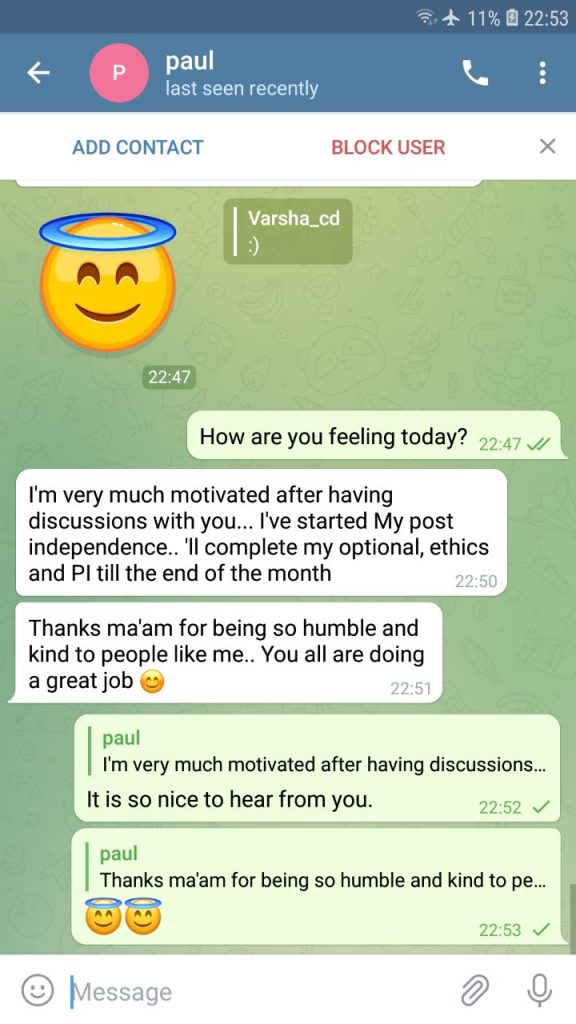
Now that results are announced for UPSC 2021 Prelims, out of 15 out of 25 students of Santhosh Gupta sir have been recommended to Mains. One such student, Rahul expresses his gratitude and extends his appreciation.
Most of our Mentors like Sudhanshu sir, Sajal sir, Santhosh sir, Pravin sir, Parth Verma sir and Sukanya Ma’am were UPSC aspirants themselves and have attended UPSC Mains more than five times and UPSC Interview more than twice. Hence their mentorship is always a blend of the best test series, comprehensive notes and current affairs knowledge.
All of them dedicate their time weekly to give 1-on-1 mentorship to every student where they discuss last week’s performance and next week’s approach.
Be it Telegram, Whatsapp or Habitiat channels, they are always available and clear student’s doubts in a turnaround time of 24 Hours.
Why Civilsdaily Mentors are the GPS for Your UPSC-CSE Preparation
Remember there is always light at the end of the tunnel and if you want to get out of the tunnel you have to follow the direction of the light! Our mentors’ give you direction which is divided into daily modules. All you have to do is study and complete them on time.
As every year passes by, we don’t get confident by the previous years’ performance and become laidback. Instead, we become more hungry to convert all our students into toppers.
How are Current Civilsdaily Students Gearing up for UPSC-CSE 2022?
Initially, our Civilsdaily student Smriti wasn’t confident about Prelims when she began her preparation. Though she had joined Civilsdaily in 2020, she started studying for UPSC-CSE back in 2019. At that time, Smriti had enrolled in multiple institutes. Though, most of these institutes had promised a personal mentor, she was unable to get in touch with them on a daily basis. Also those mentors never scheduled test-series on a weekly basis. Hence, despite preparing for a year, Smriti had scored only 35 marks out of 200 in her first test series by Civilsdaily.
She then started writing 20-25 test series over the course of UAP 2021 and in her last test, her scores have drastically improved. She now scores in the range of 130-135 marks in prelims’ and 110+ in mains’ papers.
In Smriti’s own words she describes her Samanvaya Mentorship Experience to be —
“Our parents provide us financial and emotional support, friends provide us moral support and the right mentor gives you logistic and logical support for UPSC. There are days when I felt I won’t be able to compete against lakhs of aspirants. That’s when my mentor, Ravi sir reminded me of my improvement and encouraged me that I can crack it with the same consistency. We need someone, who tells us we are performing well especially when we cannot see that ourselves. The mentorship at Civilsdaily helped me become mentally stronger as a person. In other institutes, mentors are allotted only for doubt resolution. But at Civilsdaily, I am getting end-to-end mentorship via value added notes, classes, test series and detailed evaluation.”
Similarly our another Civilsdaily student, Ashishsums up his Samanvaya experience with Civilsdaily mentor,Pravin Sir, “Because of Pravin sir’s support, I am able to understand a topic in lesser time.”
This is how Pravin sir evaluates Ashish’s Mains Test Series every week. After every test series evaluation, Pravin sir schedules a 1 hour call to discuss how Ashish can improve his marks and the sources he can refer for key topics.
It’s Your Turn Get the Free 40 Min Counselling Session By a CD Mentor
Civilsdaily mentors are so dedicated, consistent and focused for your UPSC goal, that you will eventually become focused into turning your dreams to reality.
At the core of Civilsdaily UPSC mentorship, lies the fact that each one of you will have a unique journey while preparing for the exam. Some will get through on the first attempt without much effort while others will take both more time and more effort.
We want to understand you better to help you optimize your journey so you can focus on the right things and not waste time on the wrong ones. We are asking you to tap into the valuable experiences of mentors who underwent the same grind and realize the pitfalls and understand the shortcuts to make it.
In the first counselling session, we will understand your weaknesses. We then help you to stick to one plan or strategy throughout your preparation. We will then follow up with you on a daily basis to check if you are right on track.
Preparing for UPSC in a stress-free manner is something all of us dream of. Studying in an anxious state of mind reduces concentration, focus and retention of topics learnt.
One of the reasons why you might get stressed is because despite studying for longer hours, you are unable to translate it to higher scores. This is where it becomes important to understand the difference between ‘studying smart’ and ‘studying hard’.
How will Samanavaya Free 1-on-1 Counselling Session Help you study like a UPSC Topper?
UPSC-CSE is an information loaded exam and at times, we have to come up with certain hacks to remember facts in books, newspapers, committee reports etc. Recalling information on time is crucial to success in Prelims exam.
However, since this is UPSC and not any other normal exam what does studying smart actually mean according to UPSC? It means to master the art of learning. There are several tricks available out there to learn better. You could use mind maps, flow charts, flash cards, mnemonic devices, etc to break down complex topics into simpler parts.
Another memory technique to remember facts is to pretend you are a teacher and then teach the concept out loud. You can record important facts as voice notes and replay them again and again as well. It is also important to stay relaxed and calm because a tired and distracted mind needs to work harder and longer to absorb new information. So do try getting meditatation and pranayama techniques to learn better.
Do you want to take it a notch higher and have an expert Civilsdaily mentor tell you what kind of studying techniques or brain hacks you can use to understand and remember the concepts?
Then, fill the Samanvaya free 1-on-1 counselling session form. You will get a personalised 30-40 minutes free mentorship-driven strategy call to ace your UPSC preparation!
Key-Takeaways of this Week’s Samanvaya Free 1-on-1 Mentoring Session
Our philosophy behind MENTORSHIP is to get you out of this Snooze cycle. This ensures that you are the BEST VERSION of yourself in this journey. If you are under the impression that mentorship is weekly calls you attend, then you are mistaken, my friend. Trust us, your mentor will be your ‘FRIEND, PHILOSOPHER AND GUIDE’.
TO EACH THEIR OWN – Every aspirant is different. Their strengths and weaknesses are different. Their time availability is also different. Identifying this is important so you don’t end up making unrealistic targets and lose momentum. Your mentor will make sure you start slow but remain consistent to build your confidence. Making your schedule structured based on our experience of working with 2500+ students is our first priority.
TRACK YOUR PROGRESS – When you see yourself grow, it becomes easier to motivate yourself to push boundaries. Tracking your progress can happen in many ways like mentorship calls or chat sessions or by regular tests. The idea is to ensure that you don’t go off track in your preparation, and even if you do, we have your back.
EVOLUTION – A constant guidance is important to bring consistency to your UPSC preparation. Guidance is not about clearing your doubts or asking you to study when you don’t. It is also about the evolution of your preparation. This is where you and your mentor work as a team. A constant effort to PLAN AND BUILD UP YOUR ABILITY to learn in a faster and more efficient way.
TALK IT OUT – The biggest hurdle in achieving your highest level of consistency is the emotional part. Every now and then, you. surround yourself with negative thoughts, you feel scared and depressed. Instead of resolving these emotional issues, you avoid them as it seems like a waste of your precious time. You have to understand that ignoring emotional troubles does not solve them. What your doing is building an emotional time bomb that may burst a week before your mains or prelims! This is where your MENTOR AS A FRIEND comes in. All our mentors have been through this journey. We understand your fears and anxieties. So, TALK IT OUT.
Don’t let inconsistency keep you away from your dreams.
Fill up the SAMANVAYA form given below. Let us know your problems and we will find a solution to it, just like our students say ” TOGETHER WE CAN AND WE WILL”.
How has Civilsdaily Mentorship, helped Aspirants become Toppers?
The most difficult challenge faced by EVERY candidate is inconsistency. Be it inconsistency in studies, answer-writing practice, covering the syllabus, or revision, every candidate finds it difficult to cope with. Buthow do successful candidates manage to FIGHT Inconsistency so consistently?
In UPSC 2020, Civilsdaily helped 80+ students secure ranks in their exams. In the top 100, every 3rd ranker was a Civilsdaily student.
A very recent success story would be Vishwa Shah, student of Civilsdaily Mentor, Sukanya Ma’am. Vishwa has cleared the GPSC exam to become the Deputy Superintendent of Police in Gujarat. He has penned a thank-you note yesterday. Heartiest Congratulations to Vishwa!
One of our other Civilsdaily Student, Shubham Nagargojecleared the exams in 2020 to become an IPS Officer. Shubham was gracious enough to let us know how he felt about Civilsdaily Samanvaya Guidance under Parth sir.
To know how all of them cleared the exam with our mentorship, visit the UnherdPodcast.
Now that results are announced for UPSC 2021 Prelims, out of 15 out of 25 students of Santhosh Gupta sir have been recommended to Mains. One such student, Rahul expresses his gratitude and extends his appreciation.
Most of our Mentors like Sudhanshu sir, Sajal sir, Santhosh sir, Pravin sir, Parth Verma sir and Sukanya Ma’am were UPSC aspirants themselves and have attended UPSC Mains more than five times and UPSC Interview more than twice. Hence their mentorship is always a blend of the best test series, comprehensive notes and current affairs knowledge.
All of them dedicate their time weekly to give 1-on-1 mentorship to every student where they discuss last week’s performance and next week’s approach.
Be it Telegram, Whatsapp or Habitiat channels, they are always available and clear student’s doubts in a turnaround time of 24 Hours.
Why Civilsdaily Mentors are the GPS for Your UPSC-CSE Preparation
Remember there is always light at the end of the tunnel and if you want to get out of the tunnel you have to follow the direction of the light! Our mentors’ give you direction which is divided into daily modules. All you have to do is study and complete them on time.
As every year passes by, we don’t get confident by the previous years’ performance and become laidback. Instead, we become more hungry to convert all our students into toppers.
How are Current Civilsdaily Students Gearing up for UPSC-CSE 2022?
Initially, our Civilsdaily student Smriti wasn’t confident about Prelims when she began her preparation. Though she had joined Civilsdaily in 2020, she started studying for UPSC-CSE back in 2019. At that time, Smriti had enrolled in multiple institutes. Though, most of these institutes had promised a personal mentor, she was unable to get in touch with them on a daily basis. Also those mentors never scheduled test-series on a weekly basis. Hence, despite preparing for a year, Smriti had scored only 35 marks out of 200 in her first test series by Civilsdaily.
She then started writing 20-25 test series over the course of UAP 2021 and in her last test, her scores have drastically improved. She now scores in the range of 130-135 marks in prelims’ and 110+ in mains’ papers.
In Smriti’s own words she describes her Samanvaya Mentorship Experience to be —
“Our parents provide us financial and emotional support, friends provide us moral support and the right mentor gives you logistic and logical support for UPSC. There are days when I felt I won’t be able to compete against lakhs of aspirants. That’s when my mentor, Ravi sir reminded me of my improvement and encouraged me that I can crack it with the same consistency. We need someone, who tells us we are performing well especially when we cannot see that ourselves. The mentorship at Civilsdaily helped me become mentally stronger as a person. In other institutes, mentors are allotted only for doubt resolution. But at Civilsdaily, I am getting end-to-end mentorship via value added notes, classes, test series and detailed evaluation.”
Similarly our another Civilsdaily student, Ashishsums up his Samanvaya experience with Civilsdaily mentor,Pravin Sir, “Because of Pravin sir’s support, I am able to understand a topic in lesser time.”
This is how Pravin sir evaluates Ashish’s Mains Test Series every week. After every test series evaluation, Pravin sir schedules a 1 hour call to discuss how Ashish can improve his marks and the sources he can refer for key topics.
It’s Your Turn Get the Free 40 Min Counselling Session By a CD Mentor
Civilsdaily mentors are so dedicated, consistent and focused for your UPSC goal, that you will eventually become focused into turning your dreams to reality.
At the core of Civilsdaily UPSC mentorship, lies the fact that each one of you will have a unique journey while preparing for the exam. Some will get through on the first attempt without much effort while others will take both more time and more effort.
We want to understand you better to help you optimize your journey so you can focus on the right things and not waste time on the wrong ones. We are asking you to tap into the valuable experiences of mentors who underwent the same grind and realize the pitfalls and understand the shortcuts to make it.
In the first counselling session, we will understand your weaknesses. We then help you to stick to one plan or strategy throughout your preparation. We will then follow up with you on a daily basis to check if you are right on track.


![[Burning Issue] Russia-Ukraine Crisis](https://d18x2uyjeekruj.cloudfront.net/wp-content/uploads/2022/02/WhatsApp-Image-2022-02-03-at-12.33.43-PM-1200x675.jpeg)