This newscard is an excerpt from the original article published in the TH e-paper edition.
Regression Theorem
The regression theorem refers to a theory of the origin of money.
It states that money must have originated as a commodity with intrinsic value in the marketplace.
The idea was first proposed by Austrian economist Carl Menger in his 1892 work “On the Origins of Money.”
This theory is offered as an alternative to the state theory of money which states that money (fiat money) can come into existence only when it is backed by the government.
Evolution of Money
The regression theory argues that money comes into existence through a gradual process of evolution in the marketplace, without the need for any government sanction.
Economists who try to explain the regression theory generally start with the question of why money, particularly fiat money which is simply just a piece of paper, has any value at all in the marketplace.
The most common answer to this question is that fiat money can be used to buy other useful goods such as houses, cars etc.
But this answer is insufficient —it tries to tackle the question of why fiat money can buy other useful goods by simply saying that it can buy other useful goods.
Why is fiat money, which has little intrinsic value, considered valuable?
In real life, people accept money in exchange for goods in the present because they are aware that money was accepted as a medium in exchange for other goods in the past.
For example, people accept wages in the US dollar today because they are aware that the dollar was used to buy cars, groceries and other goods in the market yesterday.
This gives them confidence in the value of their money.
What made people accept money in exchange for other useful goods in the past?
Ans.Intrinsic Value
Economists who advocate the regression theory of money argue that money must have originated as a useful commodity like gold or silver or the barter system.
This is the only way, they argue, it could have possibly been accepted by people in exchange for other useful goods at some point in the past.
If a thing did not possess any intrinsic value, it is unlikely that people in the marketplace would have accepted it in exchange for other goods and services.
So, commodities like gold and silver must have been traded in exchange for other goods and services at some point in history purely because they offered some kind of personal utility to people.
For example, these precious metals could have been used to make ornaments, to fill teeth, etc., which gives them intrinsic value.
They maintain value over time because their supply cannot be easily ramped up as mining gold involves significant production costs.
The 2022 calendar of the IIT, Kharagpur on the theme of “evidence” for “rebutting the Aryan invasion myth” has caused controversy.
What is the Aryan Invasion Theory?
It has always been understood that the Aryans migration from the Steppe happened after 2000 BCE.
In 1953 Mortimer Wheeler proposed that the invasion of an Indo-European tribe from Central Asia, the “Aryans”, caused the decline of the Indus Civilization.
As evidence, he cited a group of 37 skeletons found in various parts of Mohenjo-daro, and passages in the Vedas referring to battles and forts.
However, scholars soon started to reject Wheeler’s theory, since the skeletons belonged to a period after the city’s abandonment and none were found near the citadel.
Basis of this theory
This was first propounded when linguistic similarities between Sanskrit and the major European languages were discovered by European scholars during the colonial era.
This tool was used by the colonizers to legitimize their rule in India.
The theory hypothesizes that during 2000BC Aryans from Europe invaded or migrated into the Asian subcontinent.
It states these ‘invaders’ killed the original Dravidians and set up the Aryan race in the South-Asian subcontinent.
The Aryan Invasion Theory claimed that these ‘invaders’ were the root of modern Indian civilization, not the Harappan civilization.
Its rebuttal
Recent studies have debunked the theory after DNA samples from 5000-year old Harappan remains were proven to be similar to modern Indians’ DNA as part of the Rakhigarhi Project.
Who were the Harappans then?
The Harappans who created the agricultural revolution in northwestern India and then built the Harappan civilization were a mix of First Indians and Iranians who spoke a pre-Arya language.
The Arya were central Asian Steppe pastoralists who arrived in India between roughly 2000 BCE and 1500 BCE, and brought Indo-European languages to the subcontinent.
The new study says the Iranians arrived in India before agriculture or even herding had begun anywhere in the world.
In other words, these migrants were likely to have been hunter-gatherers, which means they did not bring a knowledge of agriculture.
Try this PYQ:
Q With reference to the difference between the culture of Rigvedic Aryans and Indus Valley people, which of the following statements correct?
Rigvedic Aryans used the coat of mail and helmet in warfare whereas the people of Indus Valley Civilization did not leave any evidence of using them.
Rigvedic Aryans knew gold, silver and copper whereas Indus Valley people knew only copper and iron.
Rigvedic Aryans had domesticated the horse whereas there is no evidence of Indus Valley people having been aware of this animal.
Select the correct answer using the code given below:
(a) Only 1
(c) 1 and 3 only
(b) 2 and 3 only
(d) 1, 2 and 3
[wpdiscuz-feedback id=”piz6vf17w7″ question=”Please leave a feedback on this” opened=”1″]Post your answers here.[/wpdiscuz-feedback]
Atal Ranking of Institutions on Innovation Achievements (ARIIA) 2021 has been recently released.
About ARIIA
ARIIA is an initiative of erstwhile Ministry of HRD, implemented by AICTE and Ministry’s Innovation Cell.
It systematically ranks all major higher educational institutions and universities in India on indicators related to “Innovation and Entrepreneurship Development” amongst students and faculties.
ARIIA 2020 will have six categories which also includes special category for women only higher educational institutions to encourage women and bringing gender parity in the areas of innovation and entrepreneurship.
The other five categories are 1) Centrally Funded Institutions 2) State-funded universities 3) State-funded autonomous institutions 4) Private/Deemed Universities and 5) Private Institutions.
Major Indicators for consideration
Budget & Funding Support.
Infrastructure & Facilities.
Awareness, Promotions & support for Idea Generation & Innovation.
Promotion & Support for Entrepreneurship Development.
Innovative Learning Methods & Courses.
Intellectual Property Generation, Technology Transfer & Commercialization.
Innovation in Governance of the Institution.
Key highlights of 2021 report
Seven IITs and the IISc, Bengaluru, are among the top 10 central institutions in promotion and support of innovation and entrepreneurship development.
The top rank has been bagged by the IIT, Madras followed by the IITs in Bombay, Delhi, Kanpur and Roorkee.
The IISc has bagged the sixth position in the ranking followed by the IITs in Hyderabad and Kharagpur, the NIT, Calicut.
Thousands of Tribals fear displacement following the implementation of the project to mine coals and basalts from the Deucha-Pachami coal block in West Bengal’s Birbhoom district.
Deucha-Pachami Mines
Deucha-Pachami-Dewanganj-Harinsinga coal block is the second-largest coal block in the world; it is the largest in India.
It is located in Deucha and Panchamati area under Mohamad bazar community Development Block of Birbhum district, West Bengal.
The block has a thick coal seam trapped between equally thick layers of rocks, mostly basalt. It has a great economic value.
The existence of these thick basalt layers, however, makes mining of coal difficult; foreign investment and technology will be hence needed for mining.
Are you finding Current Affairs for UPSC-CSE to be a time-consuming affair? Do you either spend the entire day reading only current affairs or skip reading it for many days? Is there a lack of clarity while answering current affairs questions? Do you want to know the right approach to prepare for UPSC-CSE Current affairs without wasting time on trial and error? Then it’s time you filled the Samanvaya form for free 1-on-1 counselling session with an experienced faculty from Civilsdaily!
Current Affairs for UPSC-CSE doesn’t only test an aspirant’s basic understanding, but their ability to critically analyze and remember certain very important details. It requires you to do match the following — you need to match the topic in your UPSC syllabus with the current affairs as you read. For example, India has placed an anti-dumping duty recently on China to protect it’s local manufacturers from cheap imports. This news is related to GS 3 Economics and comes under Foreign Trade topic.
But that’s not all. Current Affairs is the key component that you cannot do without in all the 3 stages of your UPSC-CSE preparation — Prelims, Mains and Interview. And the way you are supposed to prepare for current affairs under each stage varies. You have to remember facts for Prelims, understand the background, challenges and the solutions of current events for Mains and for Interview you should be able to drive meaningful discussions with your current affairs knowledge. Hence, simply reading a newspaper cannot help you ace current affairs for UPSC-CSE.
Unlike popular notion, importance of current affairs isn’t decreasing in UPSC-CSE papers. Rather, it’s become a part and parcel of every topic in the Core Subjects like Economy, Polity, Science and Environment. Let’s understand this with a question asked in UPSC-CSE Mains 2020 —
Which steps are required for constitutionalization of a commission? Do you think imparting constitutionality to the National Commission for Women would ensure greater gender justice and empowerment in India? Give reasons.
This question needs you to have current knowledge on government policies/interventions, constitutional and non-constitutional bodies, constitutional provisions and issues related to developmental and management of social sectors. That’s totally 4 topics for one answer!
Remembering current affairs indices for Prelims MCQs & using them to substantiate answers in Mains is crucial to get marks above cut-off.
Why Samanvaya for UPSC-CSE Current Affairs Preparation?
In UPSC 2020, Civilsdaily helped 80+ students secure ranks in their exams. In the top 100, every 3rd ranker was a Civilsdaily student.
A very recent success story would be Vishwa Shah, student of Civilsdaily Mentor, Sukanya Ma’am. Vishwa has cleared the GPSC exam to become the Deputy Superintendent of Police in Gujarat. He has penned a thank-you note yesterday. Heartiest Congratulations to Vishwa!
One of our other Civilsdaily Student, Shubham Nagargojecleared the exams in 2020 to become an IPS Officer. Shubham was gracious enough to let us know how he felt about Civilsdaily Samanvaya Guidance under Parth sir.
To know how all of them cleared the exam with our mentorship, visit the UnherdPodcast.
Now that results are announced for UPSC 2021 Prelims, out of 15 out of 25 students of Santhosh Gupta sir have been recommended to Mains. One such student, Rahul expresses his gratitude and extends his appreciation.
Most of our Mentors like Sudhanshu sir, Sajal sir, Santhosh sir, Pravin sir, Parth Verma sir and Sukanya Ma’am were UPSC aspirants themselves and have attended UPSC Mains more than five times and UPSC Interview more than twice. Hence their mentorship is always a blend of the best test series, comprehensive notes and current affairs knowledge.
All of them dedicate their time weekly to give 1-on-1 mentorship to every student where they discuss last week’s performance and next week’s approach.
Be it Telegram, Whatsapp or Habitiat channels, they are always available and clear student’s doubts in a turnaround time of 24 Hours.
Why Civilsdaily Mentors are the GPS for Your UPSC-CSE Preparation
Remember there is always light at the end of the tunnel and if you want to get out of the tunnel you have to follow the direction of the light! Our mentors’ give you direction which is divided into daily modules. All you have to do is study and complete them on time.
As every year passes by, we don’t get confident by the previous years’ performance and become laidback. Instead, we become more hungry to convert all our students into toppers.
How are Current Civilsdaily Students Gearing up for UPSC-CSE 2022?
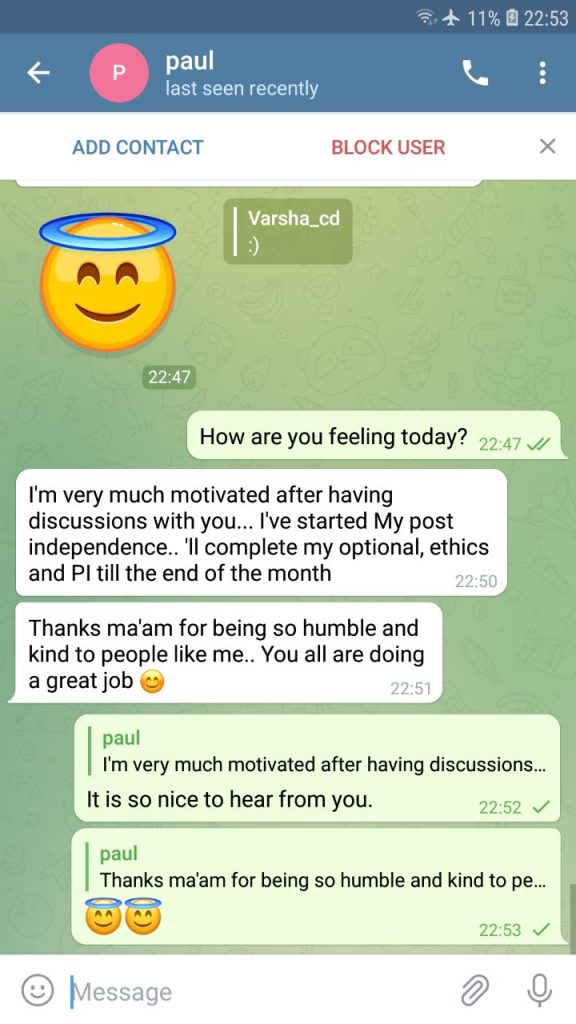
Initially, our Civilsdaily student Smriti wasn’t confident about Prelims when she began her preparation. Though she had joined Civilsdaily in 2020, she started studying for UPSC-CSE back in 2019. At that time, Smriti had enrolled in multiple institutes. Though, most of these institutes had promised a personal mentor, she was unable to get in touch with them on a daily basis. Also those mentors never scheduled test-series on a weekly basis. Hence, despite preparing for a year, Smriti had scored only 35 marks out of 200 in her first test series by Civilsdaily.
She then started writing 20-25 test series over the course of UAP 2021 and in her last test, her scores have drastically improved. She now scores in the range of 130-135 marks in prelims’ and 110+ in mains’ papers.
In Smriti’s own words she describes her Samanvaya Mentorship Experience to be —
“Our parents provide us financial and emotional support, friends provide us moral support and the right mentor gives you logistic and logical support for UPSC. There are days when I felt I won’t be able to compete against lakhs of aspirants. That’s when my mentor, Ravi sir reminded me of my improvement and encouraged me that I can crack it with the same consistency. We need someone, who tells us we are performing well especially when we cannot see that ourselves. The mentorship at Civilsdaily helped me become mentally stronger as a person. In other institutes, mentors are allotted only for doubt resolution. But at Civilsdaily, I am getting end-to-end mentorship via value added notes, classes, test series and detailed evaluation.”
Similarly our another Civilsdaily student, Ashishsums up his Samanvaya experience with Civilsdaily mentor,Pravin Sir, “Because of Pravin sir’s support, I am able to understand a topic in lesser time.”
This is how Pravin sir evaluates Ashish’s Mains Test Series every week. After every test series evaluation, Pravin sir schedules a 1 hour call to discuss how Ashish can improve his marks and the sources he can refer for key topics.
It’s Your Turn Get the Free 40 Min Counselling Session By a CD Mentor
At the core of Samanvaya lies the fact that each one of you will have a unique journey while preparing for the exam. Some will get through on the first attempt without much effort while others will take both more time and more effort.
We want to understand you better to help you optimize your journey so you can focus on the right things and not waste time on the wrong ones. We are asking you to tap into the valuable experiences of mentors who underwent the same grind and realize the pitfalls and understand the shortcuts to make it.
In the first counselling session, we will understand your weaknesses. Over 80% of students who claimed to have revised NCERTs twice were unable to answer basic questions. Many were not comfortable with at least 1 GS subject and Optional. Many struggled with ‘What went wrong’ after 2-3 years of hard work. Our mentors will provide free preliminary assignments so that we can assess your preparedness and suggest accurate strategies. We then help you to stick to one plan or strategy throughout your preparation.
All Mains Recommended Aspirants, here is the good news! Civilsdaily is providing a free compilation of the topic-wise data and statistics that will help you write better answers for Mains 2022 examination. If you have difficulty remembering facts, you can use this handbook as a revision material.
We all know how an aspirant can create a good impression and get the extra 2-4 marks in their papers when they write an introduction and conclusion with solid data. The statistics, reports & indices complied by Civilsdaily is based on the past 1-2 year survey and committee reports.
The topics range from Education, Employment, Labour & MSME’s , Infrastructure, Population and Security.
The Parliamentary Standing Committee on ICT has observed that Internet today is an indispensable part of everyday lives of citizens.
Hence, the government should explore the possibility of banning particular internet services, such as messengers like WhatsApp and social media websites, instead of putting in place blanket internet bans.
Internet shutdowns in India
Nowadays, India is widely considered to be a world leader in cutting off access to the Net.
Yet, there are no detailed official data on Internet shutdowns in India.
Taking a serious note of the situation, the Supreme Court has for the first time set the stage for challenging such suspension orders before courts.
It has directed the government to mandatorily publish all orders permitting Internet shutdowns. It has opened such decisions amenable to judicial review.
Recent statistics
India leads the global tally in suspension of internet services.
An internet tracker internetshudowns.in points out there have been 550 internet shutdowns in India since 2012, more than 50 per cent of which were imposed since 2019.
The longest shutdown, lasting for 552 days, was imposed in J&K from August 4, 2019 to February 6, 2020.
Mechanisms allowing Internet Shut-downs
[1] Temporary Suspension of Telecom Services Rule, 2017
Home Departments in the states are mostly the authorities that enforce shutdowns, drawing powers from The Temporary Suspension of Telecom Services (Public Emergency or Public Safety) Rules, 2017.
The decisions are reviewed by a state government review committee. The central government also has powers under this law, but has not used it.
[2] CrPC
Section 144 of the Code of Criminal Procedure has enabled many of the shutdowns in the recent past, especially until the time the telecom suspension Rules came into force in 2017.
[3] Telegraph Act, 1885
Less frequently used is The Indian Telegraph Act, 1885, whose Section 5(2) allows central and state governments to prevent the transmission of messaging during a public emergency or in the interest of public safety or in the interests of the sovereignty and integrity of India etc.
This act stipulates that only the Home Secretary of the Union or a state can pass an order, and that the order must include the reasons for the decision.
Under this the government has the power to block the transmission of messages during a public emergency or for public safety.
Need for Internet Shutdowns
Civil unrest: Internet serves as a medium for the transmission of information through pictures, videos and text that have the potential to cause civil unrest and exacerbate the law and order.
Fake news: Shutdowns in order to block the flow of information about government actions or to end communication among activists and prevent the spread of rumors and fake news.
Rumors: Shutdown helps prevent the “spreading of rumors and misinformation using social media platforms which can hinder peace and law and order”.
Preventive Response: Cutting off the Internet is both an early and preventive response to block restive groups to organize riots against the Government.
National Interest: The Internet cannot be independent of national sovereignty. Therefore, the necessary regulation of the internet is a reasonable choice of sovereign countries based on national interests.
Issues with the Kashmir Shutdown
Arbitrary: The Internet shutdown in Kashmir was is often alleged to be non-compliant with the Rules.
Unnecessary: The Rules require the suspension to be temporary; also, the orders did not provide reasons for the restrictions.
Discriminatory: Shutdowns in Kashmir often led to obstruction for essential services such as e-banking and hospitals.
Supreme Court Judgment on Internet Shutdowns
The court ordered the government to review its order, ruling that the freedom of speech and trade on the Internet is a fundamental right under Article 19.
Non-recognition of technology within the sphere of law is only a disservice to the inevitable.
The court said that because the Rules require the order to be in accordance with Section 5(2) of The Telegraph Act, the order must be during a “public emergency” or in the “interest of public safety”.
Also, the suspension must be “necessary” and “unavoidable”.
In furtherance of the same, the State must assess the existence of an alternate less intrusive remedy,” the court said.
Legal basis for Right to Internet
The access to the Internet is a right very similar to what the Supreme Court held with respect to the right to privacy in Justice K.S. Puttaswamy.
The Human Rights Council of the United Nations Resolution dated July 2, 2018, on the promotion, protection and enjoyment of human rights on the Internet, made important declarations.
It noted with concern the various forms of undue restriction on freedom of opinion and expression online, including where countries have manipulated or suppressed online expression in violation of international law.
Why is the Internet a necessity?
Information: While the Internet is certainly the main source of information and communication and access to social media, it is so much more than that.
Education: It is a mode of access to education for students who do courses and take exams online. Access to the Internet is important to facilitate the promotion and enjoyment of the right to education.
Livelihood: People working in the technology-based gig economy — like the thousands of delivery workers for depend on the Internet for their livelihoods.
Healthcare: It is also a mode to access to health care for those who avail of health services online.
Dysfunctions created by shutdowns
[1]Economic impact
While there is no proven benefit of closing down the internet, there are serious economic repercussions.
A report by the Brookings Institute adjudged India to have topped the list by incurring losses to the tune of $968 million in 2016 itself.
Over the past five years, some 16,000 hours of Internet shutdowns cost the economy a little over $3 billion, according to estimates in a report by the Indian Council for Research on International Economic Relations (ICRIER).
[2] Governance hurdles
In Sept. 2018, the Dept. of Telecommunication had acknowledged the adverse impact of a rising number of internet shutdowns that State governments are ordering.
The Govt. has embarked upon a programme to deliver services through mobile and internet apart from promoting a cashless economy.
Neither banking transactions using credit and debit cards nor internet banking can be done, which leads to hardships to common citizens.
Way Forward
Internet shutdowns should be used as the option of the last resort.
There exists no qualitative or quantitative evidence to show that internet shutdowns are effective tools to restore normalcy.
In fact, the internet itself can be used to resolve the problem.
For example, the Government can have verified sources to spread legitimate information across various mediums stating areas that are safe/affected the updated status of the situation, etc.
State interests like security are important because they are the prerequisites for us to exercise our freedoms. However, in pursuing this, the freedoms themselves cannot be suspended.
Therefore, the government needs to clearly lay down a comprehensive framework, stating the conditions behind such Internet shutdowns.
Conclusion
It is time that we recognize that the right to access to the Internet is indeed a fundamental right within our constitutional guarantees.
The Internet is pretty much a basic human right, even if not legally defined as such, for most parts of the world — without access to the virtual world, a very large number of vital human activities simply stops.
On December 19, Pakistan hosted a special session of the Organisation of Islamic Cooperation (OIC) to address the crisis in Afghanistan.
The humanitarian crisis in Afghanistan and how regional countries are responding to it
The humanitarian crisis in Afghanistan is peaking with no basic amenities available for its population and a harsh winter ahead.
While Pakistan hosted the OIC, India played host to foreign ministers of Central Asian states where Afghanistan topped the agenda as well.
All the attending countries — Kazakhstan, Uzbekistan, Tajikistan, Turkmenistan, and Kyrgyzstan — also OIC members, chose to prioritise deliberations with New Delhi.
Qatar’s growing influence in Afghanistan and implications for the region
Saudi Arabia, the UAE, and Pakistan were the only three countries that had officially recognised the previous Taliban government in 1996, until its fall in 2001.
Fast forward to the 2010s, and it was the small but rich state of Qatar that became the mediating force on Afghanistan.
Doha hosted the official Taliban political office from 2013 to allow negotiations with the U.S.
Qatar’s new role on Afghanistan gave it significant diplomatic and political visibility the world over.
In West Asia, Qatar’s growing influence was causing unease in the traditional power centres in Abu Dhabi and Riyadh, specifically on issues such as the Qatari leadership’s support for political Islam and organisations such as the Muslim Brotherhood.
Fundamental changes
Economic blockade: In 2017 the UAE and Saudi Arabia initiated an economic blockade against Doha in the hope of reigning the Kingdom in and disallowing it from pursuing its geopolitical designs that were challenging the long-held power status quos.
This four-year long impasse ended in 2021.
These four years created fundamental changes within the larger Arab Gulf construct.
Qatar mitigated risk and moved closer towards Turkey and Iran.
Today, both Qatar and Turkey are bidding to operate a landlocked Afghanistan’s airports under the Taliban regime.
For the Gulf specifically, Qatar’s punching-above-its-weight approach in geopolitics was also making it more powerful and influential with Washington D.C.
To mitigate this, the Saudis played a central role during the recent OIC special session.
They repaired their broken relationship with Pakistan.
Way forward for India
Over the past decade, India has recognised the importance of middle powers in the Arab Gulf to a fast-evolving global order, from fighting against terrorism to newer diplomacy challenges such as Afghanistan.
Conclusion
The Arab Gulf is poised to become an important player once again in Afghanistan under the shadow of the Taliban.
2021 surely sped by quickly for UPSC aspirants and now there’s only three more days left to welcome the new year. Every new year brings us new hopes, and every UPSC aspirant wishes that that they clear the exam that very year.
If you are appearing for UPSC-CSE 2022 exams, you might have completed your entire prelims and mains syllabus right now. So what are you going to be doing January onwards? How are you going to switch to a prelims focused approach till June?
Are you feeling low that you are unable to get the required cut-off marks in your test series. Worry not, for about 65% of the UPSC toppers have said that they scored below cut-off marks till December. But by June, they were able to boost their marks to get through the prelims hurdle. How did they do this?
Free Open to All Webinar by Civilsdaily Mentor Ranadheer Ravula
Our Civilsdaily mentor, Ranadheer sir will be providing a fool proof time-table on how to devote your time for the upcoming prelims exams from January onwards. This will include a month-by-month outlook as well.
Preparing ahead will help you stay focused, determined and consistent in your UPSC preparation as opposed to deciding impulsively. It takes a lot of efforts to plan the right schedule for the upcoming prelims exams. Sometimes, you will be second guessing and wondering what others are upto. Ranadheer sir will use his expertise to break down your preparation into phases.
Additionally he will speak about the 6 ways to find the right optional for you. The right optional is always subjective, however the process of finding out an optional that’s easy to understand (for you) and is a scoring subject (by UPSC standards) is objective.
Want to know how is the January month timetable? Then fill the form & register below
Key Takeaways of Free Live Webinar with Ranadheer Sir
1. How to revise 2 years of Prelims Current Affairs in the last 6 months?
2. How to go a day without studying yet take frequent breaks in a day?
3. Is it advisable to increase the number of study hours as the exam nears?
4. How to speed read all the books once again?
5. How many test series should one take before exams?
6. What are the 6 things to keep in mind before choosing an Optional that can change your fortunes?
7. What are the additional sources and books that can help you score above cut-off marks?
Webinar Details
Don’t miss the chance to get value addition inputs to score better in the examination! This webinar is absolutely free. All aspirants are welcome to attend.
Date – 31 December 2021 (Friday)
Time – 6:00 P.M.
Limited slots are available. Please register immediately.