💥Join UPSC 2027,2028 Mentorship (June Batch) + XFactor Notes & Microthemes PDF

Search results for: “”

  • [Burning Issue] Five Years of Startup India Scheme

    As the world’s economy transitions into one where economic value is created by bringing about disruption, and consequently behavioural change, governments know they have to create ample runway space for startups to take off.

    With that in mind, five years ago, the central government took this into consideration and launched the Startup India Scheme on January 16, 2016, to give new firms, particularly in the Micro, Small and Medium Enterprises (MSME) sector a boost.

    What are Startups?

    • A startup or start-up is a company or project undertaken by an entrepreneur to seek, develop, and validate a scalable economic model.
    • While entrepreneurship refers to all new businesses, including self-employment and businesses that never intend to become registered, startups refer to new businesses that intend to grow large beyond the solo founder.
    • At the beginning, startups face high uncertainty and have high rates of failure, but a minority of them does go on to be successful and influential.  Some startups become unicorns.

    Why do we need start-ups?

    Start-ups make an indispensable contribution in the economic growth of a nation.

    (1) Employment Generation

    Entrepreneurship creates more avenues for new job in the economy. This would help harness the readily available employment in our country. This mission will reduce the burden from service and agricultural sector and enables condition of balance in economy.

    (2) Creation of Wealth

    Since entrepreneurs are attracting investors by investing their own resources, the people of the nation would get benefit when startups grow. Since the money is sharing with the society, wealth is creating within the nation.

    (3) Better standard of living

    Startups can implement innovations and technologies to improve the living of people. There are many startups who are working for rural areas to develop the community.

    (4) Economic growth

    GDP plays a vital role in enhancing the economic growth of a country. By supporting and encouraging more startups, it is possible to generate more revenue domestically and consumer’s capital will also flow around the Indian economy.

    (5) Source for FDI

    It has been noted that in recent years, the volume of foreign investments made in the Indian startup is quite huge. The foreign investments in the startups act as an easy capital raise and technological investment for the startups which makes them readily accept the investments coming towards them.

    (6) Culture of Entrepreneurship

    Startups encourage a culture of entrepreneurship and innovation which leads to create new job opportunities and provide support to the economy. Success stories motivate talented youth to start their own ventures and help them to become a job provider instead of a job seeker.

    (7) Advancement in technology

    Startups are more focused on new technologies and cutting-edge innovation. Free from a multilayered corporate bureaucracy, startups are more agile and able to build an idea into a product and improve it upon consumer demand with faster decision-making communications.

    Startup India Scheme

    • Startup India is an initiative of the Government of India.
    • The campaign was first announced by PM Modi during his speech on 15 August 2015 address from the Red Fort.
    • The action plan for this initiative is focusing on three areas:
    • Simplification and Handholding.
    • Funding Support and Incentives.
    • Industry-Academia Partnership and Incubation.
    • An additional area relating to this initiative is to discard restrictive States Government policies within this domain, such as License Raj, Land Permissions, Foreign Investment Proposals, and Environmental Clearances.
    • It was organized by the Department for promotion of industry and internal trade (DPI&IT).

    An evaluation of the Scheme

    (A) Successes

    • Investment: $63 Bn has been invested in Indian startups in the last five years. The Indian tech startups rose about $13.5 Bn in funding across 885 deals in 2017, which is the peak year in terms of funding in the past five years.
    • Growth: From 29K startups in 2014, the numbers grew exponentially from 2015-2018 to touch 55K in 2020. Between 2016 and August 2020, Startup India programme says it has recognised over 34.8K startups. 
    • IPRs: Among these, 8.3K startups received intellectual property rights (IPR) fee benefits, while over 2.6 lakh people enrolled in the entrepreneurship-focused learning courses.
    • Gender inclusion: In terms of gender diversity across workspaces in India, just 9% of the board members of the top 20 unicorn startups in India are women.

    (B) Failures

    • Clearances: The Startup India scheme had received around 1368 applications by mid-December last year out of which DPIIT has only accepted 502 application forms and recognized them as ‘startups’.
    • Delay: The delay and lack of efficiency is a cause for the startup plan to fail in some cases.
    • Funding: The concerns of domestic angel and VCs on capital gains tax remain largely unaddressed.
    • EODB issues: Venture capital firms and angel investors are more cautious while investing in Indian startups. It is because the conditions, the ease of capital flow and doing business are not stable enough.

    Some lacunae of the scheme

    • Definitional issues: The scheme is criticized by professionals because of the definition of Start-up provided in the scheme. The definition states that a mere act of developing products or services that do not have the potential for commercialization or have no or limited incremental value for customers would not be a start-up.
    • Test of ‘Innovation’: Each startup is scrutinized by an Inter-Ministerial Board (IMB) to see if the startup is ‘innovative’ – i.e. if it is unique or a world first. Most of the start-ups would lie outside the purview of this definition.
    • Red tapism: Further eligibility of start-up, lies under definition or not, shall be approved or certified by an inter-ministerial board which is a retrograde step and against the government policy of ‘Min Government Max Governance’.
    • Taxation mirage: A tax break of three years has been given in the scheme. Anyone who has business sense knows that only a few of start-ups will be profitable in the first three years and so this handful can avail them of the tax break.
    • Patenting terms: The other option for startups to get tax benefits is to get a patent. And we all know that it takes several years to register a patent in India, and if royalty profits accrue before then, the tax benefits will be denied.

    Inherent challenges to Start-ups in India

    • Financial scarcity: Availability of finance is critical for the startups and is always a problem to get sufficient amounts.
    • Lack of Infrastructure: There is a lack of support mechanisms that play a significant role in the lifecycle of startups which include incubators, science and technology parks, business development centers etc.
    • Regulatory bottlenecks: Starting and exiting a business requires a number of permissions from government agencies. Although there is a perceptible change, it is still a challenge to register a company and exiting it.
    • Compliance hurdles: For example earlier Angel tax, which stands removed no, falls under corruption and bureaucratic inefficiencies as it takes the focus of entrepreneurs away from building a product or service to responding to tax notices and filing appeals.
    • Low success rate: Several startups fail due to poor revenue generation as the business grows. As the operations increase, expenses grow with reduced revenues forcing startups to concentrate on the funding aspect, thus, diluting the focus on the fundamentals of business.
    • Lack of an Innovative Business Model: To be successful a startup must be innovative. Unfortunately, Indian startups are less innovative than startups elsewhere. Many Indian startups don’t have an original business idea that is disruptive and by which consumers will be provided with better service.
    • Non-competitive Indian Markets: Too many startups serving too few consumers are saturating the Indian market.  Most startups serve the fraction of Indians who live in urban India. The majority of Indians who live in rural areas and small towns remain untouched by most startups.

    Various initiatives by the Govt.

    There are numerous government initiatives to assist start-ups,

    • MUDRA Scheme: Through this scheme, start-ups get loans from the banks to set up, grow and stabilize their businesses.
    • SETU (Self-Employment and Talent Utilization) Fund: Government has allotted Rs 1,000 Cr in order to create opportunities for self-employment and new jobs mainly in technology-driven domains.
    • E-Biz Portal: Government launched e-biz portal, India’s first government to business portal that integrates 14 regulatory permissions and licenses at one source to enable faster clearances and improve the ease of doing business in India.
    • Credit Guarantee Fund: launched by the GoI to make available collateral-free credit to the micro and small enterprise sector. Both the existing and the new enterprises are eligible to be covered under the scheme.
    • Fund of Funds for Start-ups (FFS): 10,000 Rs corpus fund established in line with the Start-up India action plan under Small Industries Development Bank of India (SIDBI) for extending support to Start-ups.
    • Tax Sops: Tax exemption on Capital gain tax, Removal of Angel tax, Tax exemption for 3 years and Tax exemption in investment above Fair Market Value.

    Entrepreneurship today is ‘survival driven’ self-employment, formed out of necessity, as well as opportunity motivated, largely because poverty and lack of formal employment opportunities rear its ugly head in striving economies.

    Way Forward

    The best of the Indian startup ecosystem still lies ahead.

    • There is a need for policies and progressive strategies from governments to encourage startups and provide access and assistance in key areas including tax clarity, incubation, affordability and licensing.
    • In any case, governments should be well prepared and dedicated to creating a culture of startups to impact the entrepreneurial ecosystem in their cities, countries and citizens.
    • Innovation and economic growth depend on being able to produce excellent individuals with the right skills and attitudes to be entrepreneurial in their professional lives.
    • It is critical, therefore, that nations set out to develop entrepreneurial skills, attitudes and behaviour in the school systems at all levels as a part of the lifelong learning process.
    • To produce effective entrepreneurs who can initiate change, governments need to cut ‘red tape’ and streamline regulations.
    • Funding, another daunting and difficult challenge, has to be resolved at earliest with liberal funding mechanisms.
    • Apart from all these concerns, Start-up India has potential to solve India’s problems and create jobs. Nonetheless, the challenges and changes are not to be dreaded but defeated.

    Conclusion

    • The current economic scenario in India is in expansion mode.  Indian Startups are now spread across the length and breadth of the entire country.
    • The Indian government’s policies like Make in India, Digital India, Atmanirbhar etc. shows the enthusiasm of centre to imbibe reforms.
    • With the government going full hog on Startups, it could arrest the brain drain.
    • Efforts are being made by diverse stakeholders in the Indian startup ecosystem to elevate domestic policies in concurrence with global trends.

    References

    RSTV

    https://www.desientrepreneurs.com/importance-of-startups/

    https://inc42.com/features/startupindia-at-5-the-defining-moments-from-indias-startup-ecosystem-in-the-last-5-years/

    https://www.financialexpress.com/industry/sme/cafe-sme/startup-india-how-entrepreneurs-can-realise-full-potential-of-govts-scheme-remain-competitive/1907610/

    https://www.theweek.in/news/biz-tech/2019/01/03/Corruption-securing-funds-key-challenges-for-startups-in-2019-Report.html

    https://timesofindia.indiatimes.com/blogs/yankeedoodle/why-startup-india-has-failed-how-to-fix-it/

  • Mercy petition

    The article highlights the issue of delay in carrying out the dealth penalty and issues associated with it.

    Review of India’s position on the death penalty

    • The delay in carrying out the death penalty is one of the reasons to review India’s position on capital punishment.
    • The debate on the efficacy of the death penalty in reducing crime has been going on for several decades.
    • A few years ago, the issue of abolishing capital punishment was raised in the Rajya Sabha but was rejected by a voice vote.
    • The then Minister of State for Home Affairs stated that the government was not contemplating abolition of the death penalty.
    • In 2015, the Law Commission of India proposed abolishing the death penalty and sought the comments of States and Union Territories on the subject.
    • India figures among the 56 nations in the world that have retained the death penalty.

    Issue of delay in carrying out the punishment

    • The prolonged detention of death row convicts in prison is not just inhuman but also against the canons of justice.
    • The delay coupled with long years of solitary confinement leads to immense psychological trauma.
    • It is small wonder that the courts tend to take a lenient view and reduce the sentence when such cases of prolonged years of detention come before them.
    • A time frame needs to be fixed for the President to dispose of mercy petitions.
    •  Delays in investigations, court hearings, and administrative steps to be taken after the final verdict need to be inquired into, and responsibility fixed.

    Consider the question “Against the backdrop of delay in carrying out the dealth penalty in India, take the review of India’s position on the abolition of death penalty.”

    Conclusion

    With the changing time, we must change and so do the way we punish people. Capital punishment should be abolished in the country and until then, the inordinate delays in carrying out punishment should be avoided.

  • Defending liberty against selective prosecution

    The article examines the issue of selective prosecution and Indian judiciary’s approach toward it. It also highlights the importance of recent Goswami case.

    Selective prosecution: Form of abuse of state power

    • Recently the case involving bail application of a T.V. anchor brought to the fore issue of selective prosecution.
    • The illegal selection of accused based on grounds prohibited by the Constitution is called “selective prosecution”.
    • In case of selective prosecution, the police and enforcement agencies selectively target political and ideological opponents of the ruling dispensation to interrogate, humiliate, harass, arrest, torture and imprison.
    • It is one of the oldest, most pernicious and widespread forms of abuse of state power.

    How it is illegal: Two independent legal issues

    1) Exercise of prosecutorial discretion

    • The applicable legal standard is that while the police and prosecutors in common law jurisdictions enjoy vast discretion in deciding who they may pursue and who they may spare.
    • However, the choice of accused must not be based on grounds that violate Constitutional rights, including the Article 14 right to equal protection of the law.
    • The accused should not be selected, either explicitly or covertly, on constitutionally prohibited grounds.

    2) Merit of the case filed

    • When the choice of accused runs contrary to the Constitution, the entire criminal proceeding is vitiated, irrespective of the determination of the second issue, viz., whether the accused are convicted or acquitted on the charges brought against them.
    • Once the proceedings fail under the first issue, there is no legal basis to proceed to the second issue., i.e., trial on the merits of the case.
    • The theory is that the Constitution cannot be violated to uphold the law — such an approach would spell doom for the Constitution.
    • The selective prosecution claim must be adjudicated as a threshold issue, with the prosecution being quashed at the outset of the criminal case if the claim is justified.
    • In the context of this discussion, the constitutionally prohibited ground we are confronting in India is the political or ideological affiliation of the accused.
    • It is an arbitrary ground that violates the Article 14 guarantee of equal protection of the law.

    Approach of judiciary

    • Our courts have not recognised selective prosecution as an independent claim.
    • This is because courts assume that lawfulness of prosecution can only be taken up after the trial, if the accused is acquitted.
    • The 2018 Report of the Law Commission on ‘Wrongful Prosecution (Miscarriage of Justice): Legal Remedies’ discusses remedies for wrongful prosecution available only if and after the accused is acquitted.
    • Remedy after acquittal comes far too late, well after a brutal and long drawn out criminal justice process that upends the lives of the victims.
    • Also, the right against selective prosecution cannot be extinguished by conviction.
    • Separate from post-acquittal actions for wrongful prosecution (which will still be available), the claim of selective prosecution is a threshold issue that is required to be adjudicated at the outset of criminal proceedings even during the investigation stage irrespective of the merit of the charges.

    Importance of Goswami case

    • The case provides a much needed and long awaited legal opening to strengthen the recognition and use of the selective prosecution claim in India to counter politically coloured prosecution.
    • The judgment says, “Courts should be alive to the needof ensuring that the law does not become a ruse for targeted harassment ”.
    • The Goswami judgment also quotes the 2018 Supreme Court holding in Romila Thapar v. Union of India that, “[T]he basic entitlement of every citizen who is faced with allegations of criminal wrongdoing is that the investigative process should be fair. This is an integral component of the guarantee against arbitrariness under Article 14 and of the right to life and personal liberty under Article 21.”

    Consider the question “How selective prosecution could threten the liberty of person? How Indian judiciary approaches the issue of selective prosecution and what are the issue with the approach adopted by the judiciary?”

    Conclusion

    To strengthen the protection of civil liberty, equality and democracy, it is time our courts — at all levels — recognise selective prosecution as a threshold constitutional defence against the abuse of police and prosecutorial power.

  • Economics for IAS pre 2021: Strategy and Trend Analysis | Free Decimate Prelims Open Test (Link inside)

    Economics for UPSC IAS prelims is a tricky affair for many aspirants. The breadth and complexity of topics keeps them doubtful and confused about the approach to be followed to cover the syllabus.

    Watch Sajal sir provide his insights on the Economics syllabus and trend analysis of Economics PYQs in IAS Prelims exam. He has also discussed the approach you should be following for IAS prelims 2021 exam.

    Sajal sir will be taking up the module of Economics in Decimate Prelims 2021 program (crash course for IAS pre 2021). You can discuss and connect with him on Habitat as well.


    Reminder- 2nd IAS prelims Free test

    2nd Free Decimate Prelims Open Test will be held on 24th Jan 2021. Register for free below.

    Click here to enroll for Decimate Prelims 2021

    What is Decimate Prelims 2021?

    Decimate Prelims 2021 @ Habitat is a three-phased program that ensures full coverage of current affairs syllabus, related static parts, tests, intensive discussions, and revision.

    We’re going more intensive and comprehensive to make sure that you comfortably go beyond 130+ marks and literally decimate prelims.

    UPSC is evolving, are you? Bury the old ways of IAS Prelims preparation

    Decimate Prelims 2021 progression – 3 Phases

    Decimate Prelims 2021 IAS PRelims 2021

    Click here to enroll for Decimate Prelims 2021

  • (Live session) Essay writing for UPSC IAS exam: Unravel the mystery with Ajay Verma| Join us at 8 pm today (link inside)

    Essay writing is an art as well as a skill that must be learned and practiced. But for most of the aspirants, it is a bane of their lives.

    Since it’s the right time to start focussing on Essay writing (and not postpone it after prelims) Ajay Verma sir will be live with you for an interactive session on Essay writing where he will be unraveling the mystery of UPSC IAS Essays.

    Time and Date: 8 pm, 22 Jan. Click on the video and set a reminder. Join free Essay Writing group on Habitat (click)

    https://youtu.be/ieXWF4yKico

    Another reminder, the 2nd Free Decimate Prelims Open Test will be held on 24th Jan 2021. Click below to register for free.

  • Getting it wrong on India’s level of agricultural support

    As per the OECD methodology, Indian farmers received negative support of Rs. 1.62-lakh crore in 2019, which implies that the government is taxing the farmers. But there are pitfalls in the methodology. The article explaines them.

    The issue of support given to the farmers

    • Many media reports, based on data by the Organisation for Economic Co-operation and Development (OECD), have stated that the support provided to Indian agriculture is extremely low or negative, and, therefore, net taxed.
    • The OECD has estimated that Indian farmers received negative support to the extent of minus ₹2.36-lakh crore and minus ₹1.62-lakh crore in 2010 and 2019, respectively.
    • Surprisingly, the negative support of minus ₹1.62-lakh crore as estimated by the OECD was higher than the total budgetary allocation of the Ministry of Agriculture at ₹1.09-lakh crore in 2019.

    Issues with the OECD estimates

    • Expenditure on the PM-KISAN, the National Food Security Mission, crop insurance, input subsidies such as fertilizer and electricity, are some of the measures covered under the 2019 OECD estimates.
    • However, the expenditure related to the operation of minimum support price and general services is not covered by it.
    • Despite the overall negative support, the expenditure of the Central and State governments on agriculture has increased substantially since 2000.
    • This support increased from ₹1.61-lakh crore to ₹3-lakh crore, between 2015 to 2019, registering 85% growth.
    • The massive negative market price support to the producers of different products has resulted in the total negative producer support, overshadowing the increase in the budgetary support over the years.

    Market Price Support as per OECD methodology

    • The market price support of a commodity is calculated by multiplying its total production with the gap between the domestic price and international prices in a relevant year.
    • This methodology assumes that in case there is no government intervention in the agriculture market, then the domestic and international price of a product will converge, resulting in no gap in prices.

    Why there is a focus on the price gap in OECD methodology

    • The OECD assumes government interventions lead to a gap between the international and domestic prices.
    • However, even if the government does not implement any program, the gap can still arise due to domestic and international factors.
    • Changes in supply and demand conditions in the domestic and international market due to shocks, depressed international prices due to subsidies given by other countries, among other factors, can generate a gap.

    3 Consequence of OECD’s Market Price Support methodology

    • 1) If the domestic price for a product is less than its international price, then support for that product would be negative.
    • 2) A negative market price support for a product in one year can turn into huge positive support in another year on account of the relative movement of domestic and international prices.
    • 3) Even if in a particular year, the government does not provide any additional support compared to a previous year, the level of support calculated by the OECD can change.
    • This will arise if there is a change in either the gap between the domestic price and international price for a commodity, or its production, in the two years.
    • Given the unpredictability in the inherent data, the total support can move from huge negative to huge positive.

    Concerns for India

    • For India, the negative support as a percentage of the total value of agriculture production has substantially reduced in recent years.
    • It is possible that support to Indian farmers in the near future becomes one of the highest in the world due to pitfalls in the OECD methodology.
    • This might set alarm bells ringing, particularly in the developed countries, which may aggressively question India’s support measures.

    Consider the question “As per the OECD methodology, net support provided by Indian government to its farmers is negative for the year 2019. However, India’s expenditure on agriculture is consistently rising. What explains this conundrum? What are the concerns for India in the price support method of OECD?”

    Conclusion

    Rather than being swayed by the OECD numbers suggesting negative support, farmers, policymakers, and other stakeholders need to understand the pitfalls and limitations in the underlying methodology. This will help in providing a more correct perception of the level of support to agriculture in India.

  • 22nd January 2021| Daily Answer Writing Enhancement

    Important Announcement:  Topics to be covered on 25th January

    GS-1  Modern Indian history from about the middle of the eighteenth century until the present- significant events, personalities, issues. 

    GS-4 Case Studies.

    Question 1)

    Discuss the key features and significance of folk dance of North Eastern India. 10 marks

    Question 2)

    With a view to the contentious issue of delay in the carrying out the death penalty, do you think that India should abolish the death penalty? Give reasons in support of your argument. 10 marks

    Question 3)

    Digital corporations can operate in a market without a physical presence. The current basis for taxing in a particular jurisdiction is a notion of a fixed place of business. In light of this, examine the challenges in taxing the digital companies and how India is dealing with such a challenge? 10 marks

    Question 4)  

    Explain tolerance and compassion in Indian context. How effectively can tolerance and compassion be used by the respective authority in the process of decision making in public administration? 10 marks

    Reviews will be provided in a week. (In the order of submission- First come first serve basis). In case the answer is submitted late the review period may get extended to two weeks.

    *In case your answer is not reviewed in a week, reply to your answer saying *NOT CHECKED*. If Parth Sir’s tag is available then tag him.

    For the philosophy of AWE and payment, check  here: Click2Join

  • TN Governor to decide on Ex-PM assassin Pardon

    Tamil Nadu Governor would take a decision as per the Constitution in the next three or four days on the plea for release filed by A.G. Perarivalan, who is undergoing life imprisonment for the assassination of former PM Rajiv Gandhi in 1991.

    Give your personal views in favour and against Capital Punishment in the comment box.

    What is the news?

    • The court noted in its short order that the Solicitor General submitted that the application filed by the petitioner Perarivalan under Article 161 of the Constitution.
    • The TN State Cabinet had earlier made the recommendation to remit the life sentences of seven convicts, including Perarivalan in September 2018.
    • The new turn of events when the Additional Solicitor General for the Centre, had argued recently that the pleas for pardon and release should go to the President instead of the Governor.

    What does Pardon mean?

    • A pardon is a government/executive decision to allow a person to be absolved of guilt for an alleged crime or other legal offense as if the act never occurred.

    Why need a Pardon?

    • Pardons can be granted when individuals are deemed to have demonstrated that they have “paid their debt to society”, or are otherwise considered to be deserving of them.
    • Pardons are sometimes offered to persons who were either wrongfully convicted or who claim that they were wrongfully convicted.
    • Pardons are sometimes seen as a mechanism for combating corruption, allowing a particular authority to circumvent a flawed judicial process to free someone that is seen as wrongly convicted.

    What does Article 161 say?

    • Article 161 of the Constitution provides the Governor with the power to remit or commute the sentence of any prisoner.
    • The Governor’s decision will be subject to judicial review by the constitutional courts.

    Supreme court’s observations

    • The Constitution Bench in 2015, in a majority decision, had held that the States cannot unilaterally remit the sentences of life convicts in cases investigated by a Central agency under a Central law.
    • The assassination case was probed by the CBI.
    • In compliance with the 2015 verdict, the Tamil Nadu government wrote to the Centre in 2016, proposing the grant of remission to the convicts. The State wanted the Centre to concur.
    • After a wait of over two years, the Centre rejected the State’s proposal, saying this was an unparalleled act in the annals of crimes committed in this country.

    Arguments in Perarivalan’s petition seeking pardon

    • Perarivalan had been pleading for release citing that he was 19 when he was arrested.
    • He was the only male child of his parents, there were no records of criminal antecedents, and that he had excellent conduct in his entire prison life.
    • His petition also cited UG and PG degrees, and that he was the university topper, Gold medalist in diploma in DTP, and that he completed more than eight diploma and certificate courses during his prison term.
    • His probation officer gave a report about lapses in recording his confession statement that handed out maximum punishment in his case.

    Basis of his innocence

    • Perarivalan cannot be called innocent before the law as he continues to be a convicted prisoner serving imprisonment.
    • He was accused of having bought two battery cells for Sivarasan, the LTTE man who masterminded the conspiracy.
    • He was sentenced to death based on this crucial confession statement.

    Significance of the convicts’ release

    • The release of seven convicts is a demand raised by not only the ruling party of TN but the main opposition too.
    • All TN politicians voiced that the judiciary should be able to reform and let them live as good citizens to uphold the high values of reformatory justice and restitution.

  • China builds a new village in Arunachal Pradesh

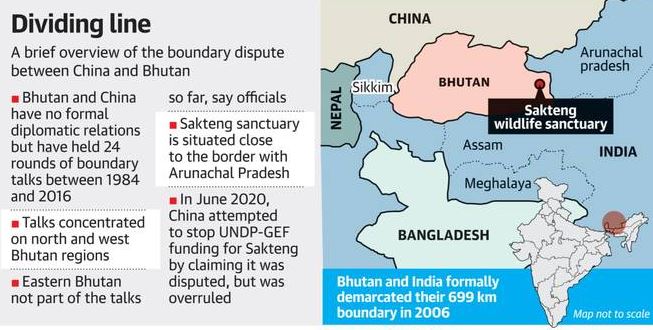
    Satellite images show that China has constructed a new village in Arunachal Pradesh, around 4.5 kilometres inside of the de facto border on the Indian side.

    Indian and Chinese soldiers have confronted each other in their deadliest clash in decades in Ladakh last year and the earlier one in Doklam. Now another front has been opened up by China in Arunachal.

    This year could face another ugliest standoffs and skirmishes.

    Location of the village

    • The village, located on the banks of the River Tsari Chu, lies in the Upper Subansiri district.
    • It is an area that has been long disputed by India and China and has been marked by armed conflict.
    • Sources in the defense ministry have said that Beijing has, for years, maintained an army post on this territory, and the various constructions by the Chinese have not happened suddenly.

    Background of the story

    • China’s June 1959 operation known as the Longju incident reportedly accused Indian troops of occupying some places in Tibet and colluding with Tibetan rebels.
    • In August same year, the PLA clashed with the Indian personnel of the 9 Assam Rifles.
    • Two Indian soldiers were killed in action and the issue was finally resolved through diplomatic channels. Both sides withdrew from the area on August 20, 1960.
    • And the Assam Rifles then did not re-occupy the post.
    • In the late 1990s however, China established a company level post 3 kilometers inside the Indian Territory. Since then, the area remains contested to this day.

    India and Arunachal

    • Arunachal Pradesh (called South Tibet in China) is a full-fledged state of India.
    • India’s sovereignty over the area is internationally recognized and its residents have not shown any inclination to leave India.
    • The majority of the international maps acknowledge the area to be an Indian Territory.
    • China has some (pre-) historical claims through its ownership of Tibet, but the people and geography primarily favor India.

    Back2Basics: Chinese claim over Arunachal Pradesh

    • When the new Peoples Republic of China was formed in February 1912 after the abdication of the Qing emperor, the Tibetans asserted their independence.
    • They forced the Chinese troops based in Lhasa to return to the mainland-via India. A year later, Tibet declared independence from China.
    • In order to ensure that the unrest did not spread to India and assert their boundaries, the ruling British convened a tripartite meeting at Shimla with Tibetan and Chinese delegates to define the border.
    • The meeting gave China suzerainty over most of Tibet, and the boundary defined in this treaty was later known as the McMohan line.

    Chinese reluctance

    • The essential dispute is over China’s refusal to acknowledge the McMohan Line as the border between the two nations, and staking claim to large tracts of land as a contiguous part of Tibet.
    • However, it laid claim to the entire state of Arunachal Pradesh.
    • In the 16th century, the most important heritage of the state – Tawang Monastery was built. This is one of the most important sites for Tibetan Buddhists.
    • China never recognized Tibet’s independence nor the 1914 Simla convention.
    • In 1950 China completely took over Tibet. Thus, according to their version, the Tawang region belongs to them.
    • It especially wants to hold on to the monastery as that is a leading center of Tibetan Buddhism in India.
  • What is Nitrogen-Use Efficiency (NUE)?

    A group of Indian scientists have found a way to improve crops by reducing wastage of nitrogen fertilizers applied to them.

    Try this PYQ:

    Q.Which of the following adds/add nitrogen to the soil?

    1. Excretion of Urea by animals
    2. Burning of coal by man
    3. Death of vegetation

    Select the correct answer using the code given below:

    (a) 1 only

    (b) 2 and 3 only

    (c) 1 and 3 only

    (d) 1, 2, and 3

    Nitrogen-Use Efficiency

    • NUE is calculated as a ratio between nitrogen used and harvest: A higher number denotes low wastage.
    • With the efficiency on the decline, farmers use more fertiliser in the hope of raising yield. This in turn worsens NUE.
    • Crops generally use up 30 per cent of nitrogen fertilizer applied; the rest seeps into the environment, harming health and adding to climate change.
    • Researchers were able to identify phenotypes or visibly identifiable features that determine the efficiency with which cultivated rice varieties (cultivars) use nitrogen.
    • This efficiency is known as nitrogen-use efficiency (NUE).
    • Cereals consume over 69 per cent of nitrogen fertilizers in India; rice tops the list with 37 per cent, followed by wheat (24 per cent).

    Nitrogen Pollution: the reason behind

    • Agriculture leads to 70 per cent of nitrous oxide emissions in India.
    • Of this, 77 per cent is contributed by fertilizers, mostly urea, according to the Indian Nitrogen Assessment published in 2017.
    • This greenhouse gas (GHG) is 300 times more potent than carbon dioxide.
    • It has replaced methane as the second-largest component of GHG emissions from Indian agriculture in the past 15 years.

    Must read:

    [Burning Issue] Nitrogen Pollution in India