Search results for: “”
-
[Prelims Spotlight] World Gold Council, Linke Hoffman Busche (LHB) coaches, Impeachment of a Supreme Court Judge, Rajsuya
Here are 3 Back2Basics collections from today’s news items
B2B #1: From news- India gold demand seen rising
World Gold Council
- The World Gold Council is the market development organisation for the gold industry. It works across all parts of the industry, from gold mining to investment, and their aim is to stimulate and sustain demand for gold
- They frequently publish research that demonstrates gold’s strength as a preserver of wealth – both for investors and countries
- They also provide analysis of the industry, offering insights into the drivers of gold demand. They have also launched various products such as SPDR GLD and gold accumulation plans in India and China
- The World Gold Council is an association whose members comprise the world’s leading gold mining companies
- It helps to support its members to mine in a responsible way and developed the Conflict Free Gold Standard
- Headquartered in London United Kingdom, they have offices in India, China, Singapore, Japan and the United States
B2B #2: From news- What Railways hope to learn from German Rail
Linke Hoffman Busche (LHB) coaches
- LHB coaches are the passenger coaches of Indian Railways that have been developed by Linke-Hofmann-Busch of Germany
- These coaches are produced by Rail Coach Factory in Kapurthala, Punjab
- The coaches are designed for an operating speed up to 160 km/h and could go up to 200 km/h
- During derailment or collision, these coaches do not climb over each and crash because of a special type of CBC (center buffer coupler)
B2B #3: From news- [op-ed snap] Acting against a judge
Impeachment of a Supreme Court Judge
- Article 124(4) of the Constitution of India states: “A Judge of the Supreme Court shall not be removed from his office except by an order of the President passed after an address by each House of Parliament supported by a majority of the total membership of that House and by a majority of not less than two-thirds of the members of that House present and voting has been presented to the President in the same session for such removal on the ground of proved misbehaviour or incapacity”
- 100 Lok Sabha MPs or 50 Rajya Sabha MPs is the minimum number of signatories required to issue the notice
- The notice has to be handed over either to the Speaker if it is from Lok Sabha MPs or to the Chairman if it is Rajya Sabha MPs
- If and when the motion is admitted, the Speaker or the Chairman will have to constitute a three-member committee to investigate the charges leveled against the Supreme Court judge
- This committee will consist of a senior Supreme Court judge, a High Court judge, and a ‘distinguished jurist’ — who is a highly qualified law professor who has been appointed as a Supreme Court judge by the President of India
As a part of revision for Prelims 2018, Here’s a Factoid to brush up your concepts
Key words related to History : Rajsuya
Dynasty/era : Vedic period
Meaning : – basically a ceremony for the consecration of a kind. It lasted for a day of prayers and sacrifices and extracting soma, but preceded by a long period, extending to maybe a year, during which time various preliminary rites were observed. During this ritual, the king received a bow and an arrow (or other weapons as the priest was advised) and declares himself the king. He performed various acts symbolising his conquests and was finally anointed by a priest, a kshatriya and a vaishya.
-
[open SIP] Test 28- CA March+ April’18 Link + Discussion
Link for the test: Click2Attempt (Let us know your score in comments)
We have started our Open SIP program in conjunction with our PAID program (Click2Know all details of the program)
We will be running this special FREE initiative on daily basis providing students with revision questions for static subjects as well as current affairs starting from June 2017
Test 28 as per schedule (Click2View) is CA March+ April’18
Liked the test? You can join our FLT program containing more such high-level questions. The module contains 11 FLTs (8 paper 1 TS + 3 CSAT)
Know all details about the program and join here: Click2Join
Want to do quick revision for Prelims? Join our SIP Comprehensive or SIP Mini modules giving you Static & Dynamic subjects coverage through video lectures
SIP Comprehensive- Samanvaya + Lectures + Notes + FLTs + CA Tests: Click2Join
SIP Mini- Samanvaya + Lectures + Notes: Click2Join
-
[Prelims Spotlight] Bacillus Thuringiensis (Bt), Pradhan Mantri Vaya Vandana Yojana (PMVVY), Cartosat-2 series
Here are 2 Back2Basics collections from today’s news items
B2B #1: From news- [op-ed snap] Protect patents: on revoking Monsanto’s Bollgard-2 patent
Bacillus Thuringiensis (Bt)
- It is a soil-dwelling bacterium, commonly used as a biological pesticide
- It occurs naturally in the gut of caterpillars of various types of moths and butterflies plant leaves etc.
- Bt produces insecticidal action when used in the genetic modification of crops
- Bt cotton was the first genetically modified crop to be approved for cultivation in India in 2002, with the introduction of Monsanto’s GM cotton seeds
- Other Bt crops used in India: Bt Brinjal, Bt/GM Mustard
- Issues with Bt modified crops: Costly seeds, Gene pool contamination, Increasing incidence of pest resistance, the toxicity of food crops etc
B2B #2: From news- Govt. doubles PMVVY pension investment limit to ₹ 15 lakh; extends scheme by two years
Pradhan Mantri Vaya Vandana Yojana (PMVVY)
- The government has launched the PMVVY to provide social security during old age and to protect elderly persons aged 60 and above against a future fall in their interest income due to uncertain market conditions
- The PMVVY is being implemented through Life Insurance Corporation of India (LIC)
- The scheme provides an assured pension based on a guaranteed rate of return of 8 percent per annum for ten years, with an option to opt for the pension on a monthly, quarterly, half-yearly or annual basis
- The difference between the return generated by LIC and the assured return of 8 percent annually will be borne by the government of as a yearly subsidy
As a part of revision for Prelims 2018, Here’s a Factoid to brush up your concepts
Name : Cartosat-2 series
Details : The launch marks the roll out of the 100th satellite by ISRO. 30 other satellites – 28 foreign and 2 Indian. 2nd time that ISRO has been able to place satellites in 2 different orbits This was done through the “multiple burn technology” under which the rocket’s engine is switched off and then switched on to control its height.
Launch Vehicle : PSLV C40
-
[Static Revision] Chapter 8 | Post-Gupta Period I (600AD – 750AD)
Area of interest : North India, Deccan India & South India


Political situation became complex with the passing away of the Guptas and the demise of the Vakataka rulers. Vassals of the Guptas became independent in the North.
In the Deccan and far South too multiplicity of powers was witnessed.
NORTH INDIA
I. Political Background
Harshavardhana (590 AD to 648 AD) –
The fall of the Gupta rulers paved the way for domination of the Later Guptas, Maukharis and Pushyabhutis in the North. Harsha, though a Pushyabhuti ruler of Thaneswar ruled from Kanauj, which was originally the seat of Maukharis, with whom he contracted a marriage alliance. Harsha is celebrated as last ‘Hindu’ ruler in the North post the Gupta era.
II. Literature and Language
Work Author Type Theme Patronage Kadambari Banabhatta Romantic Sanskrit Novel Romantic attachment between Chandrapeeda and Kadambari Harshacharita Banabhatta Harsha’s biography in Sanskrit An account of Harsha’s ancestry and his early life Harsha Priyadarshika Harsha Sanskrit play Harsha Nagananda Harsha Sanskrit play Harsha Ratnavali Harsha Sanskrit play About a princess Ratnavali and a great King Udayan. One of the first reference of Holi found in the text Harsha Mahaviracharita Bhavabhuti Sanskrit play Based on the early life of Rama Yashovarman of Kannauj Malatimadhava Bhavabhuti Sanskrit play Love story between Malati and Madhava Yashovarman of Kannauj III. Religion
All religions were patronized under Harshavardhana’s reign. He was a Shaivite, but later Hiuen Tsang converted him to Mahayana Buddhism.
Hiuen Tsang who visited Harshavardhana’s empire noted Buddhism was declining in India while Brahmanism was on rise.
IV. Art and Architecture
The art and architectural contributions of Harsha’s period are very few and mostly followed the Guptas. Harshavardhana’s realm is associated with construction of numerous stupas and monasteries. Harsha patronised the Nalanda University by his liberal endowments.
The brick temple of Lakshmana at Sirpur with its rich architecture is assigned to the period of Harsha.
Lakshamana temple, Sirpur
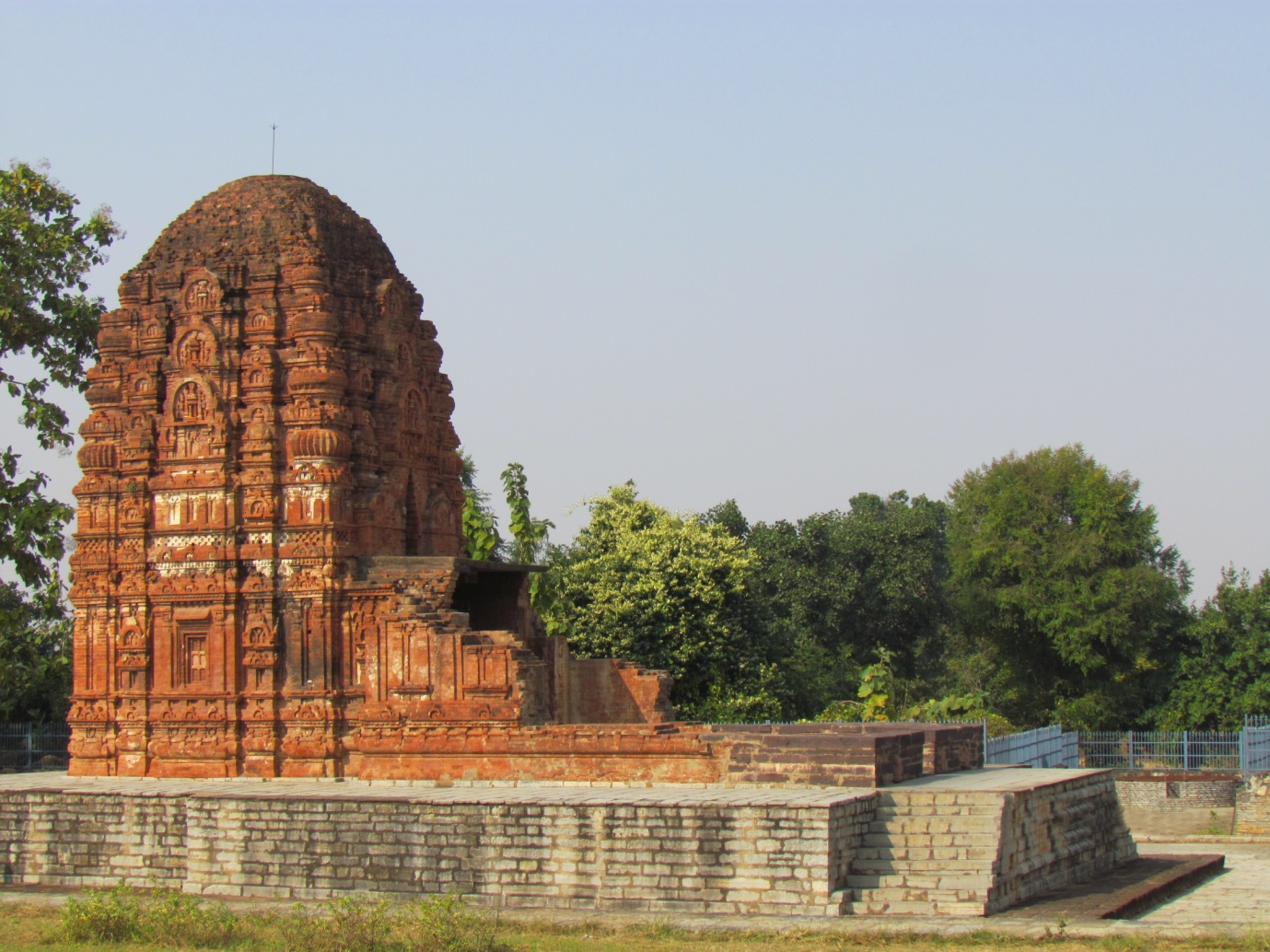
- The Lakshamana temple is located in the village Sirpur of Chattisgarh.
- It is dedicated to Lord Vishnu
DECCAN INDIA
I. Political Background
The late sixth century is marked by rise of Badami Chalukyas around the North Eastern part of Karnataka. The empire was founded by Pulakesin I. Pulakesin II (610 – 642 AD ) is considered the greatest ruler of the house.
II. Literature and Language
Work Author Type Theme Patronage Aihole Prasasti Ravi Kirti Pulakesin II’s eulogy Mentions defeat of Harshavardhana by Pulekesin II when Harsha tried expanding towards the Deccan Pulakesin II Vikramankadevacharitam Bilhana An epic in honor of Vikramaditya VI Western Chalukyan ruler, Vikramaditya VI III. Religion
Chalukyans were both Vaishanavas and Shaivites but had a greater inclination towards Vaishnavism and Jainism. Nonetheless, they patronized all religions.
IV. Architecture
A. Caves
Cave temple architecture was also famous under the Chalukyas. Their cave temples are found in Ajanta, Ellora and Nasik.
B. Temples
Chalukyan temples are found in 3 places – Badami, Aihole and Pattadakal.
Badami – Badami cave temples are a complex of 6 temples – 4 Hindu, 1 Jain & 1 possibly Buddhist.
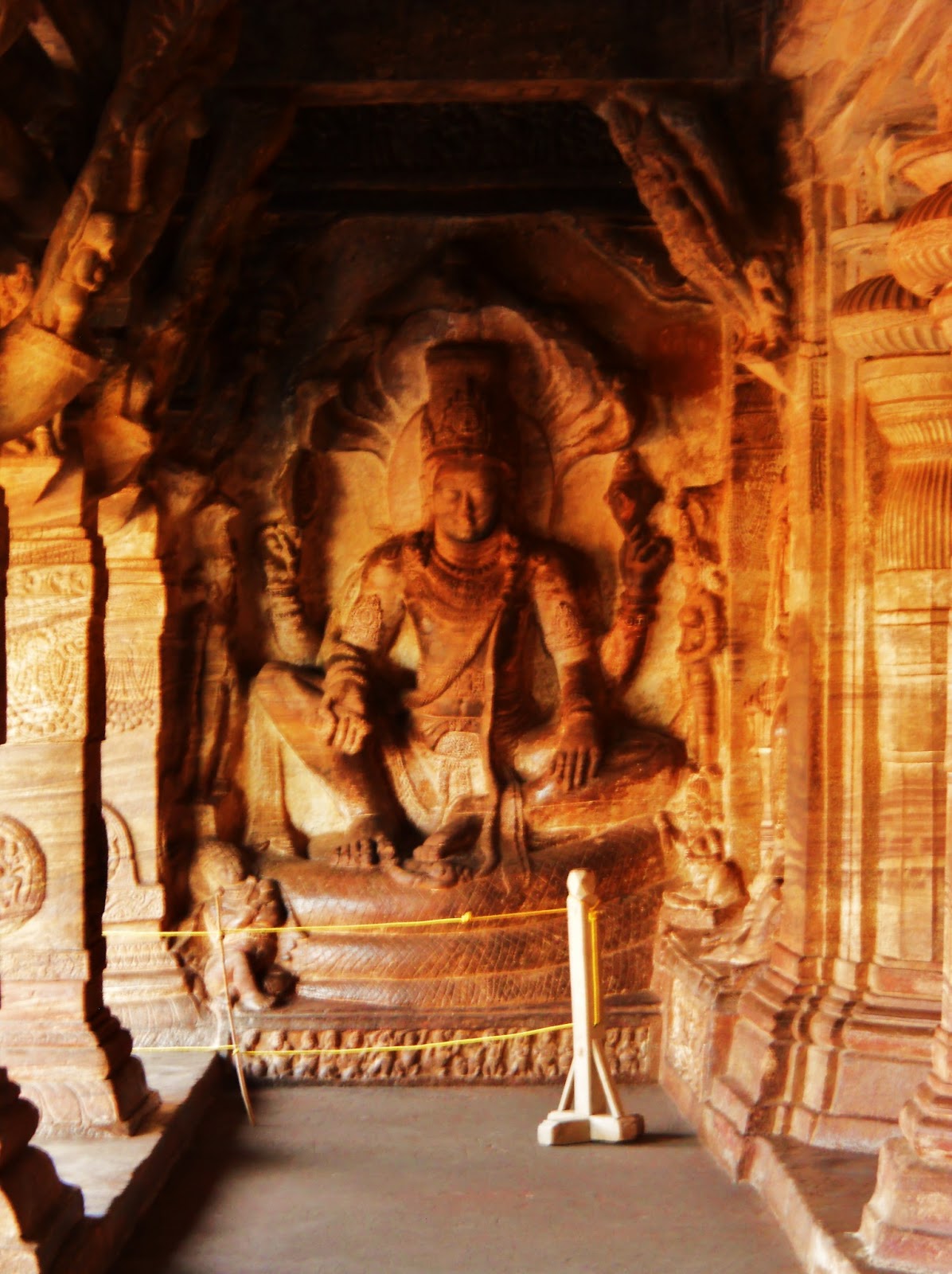
Cave 3 – Vishnu image
Aihole – Ladkhan temple, Durga temple and Ravana Phadi Temple
Durga temple
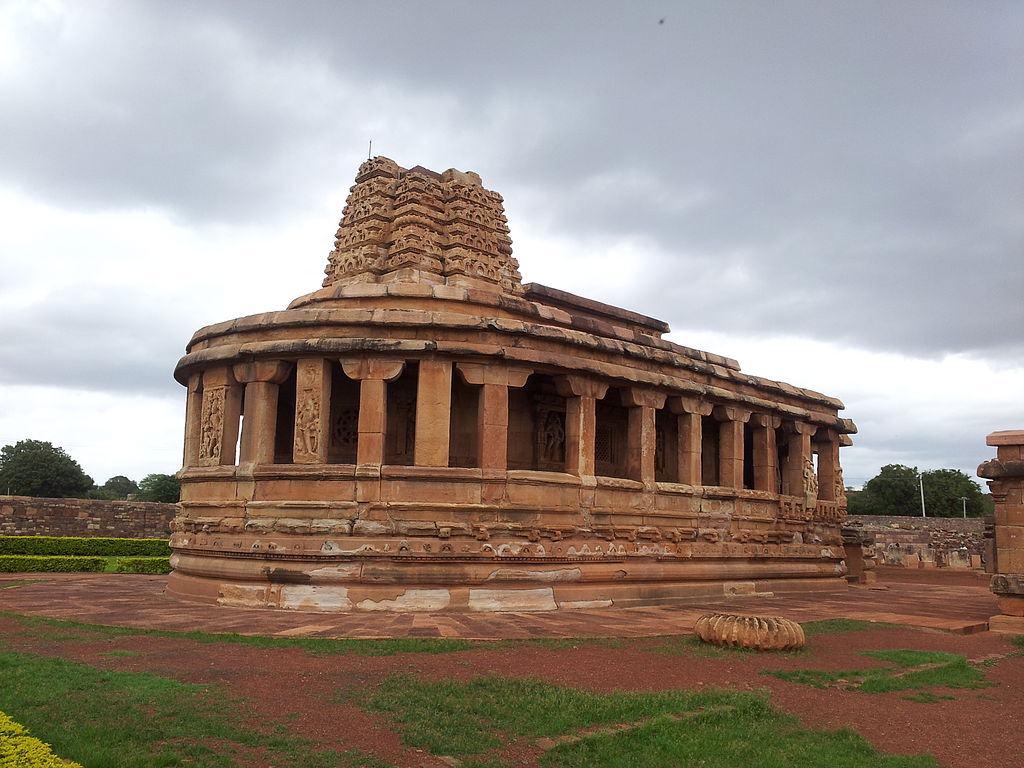
- It is an apsidal temple of 550 AD. The apsidal shape is similar to the shape of a Buddhist chaitya.
- Temple has an open pillared verandah serving as pradakshinapatha instead of a dark ambulatory path.
- Temple shows improvements in shikhara development as compared to the Gupta period.
Ravana Phadi Temple
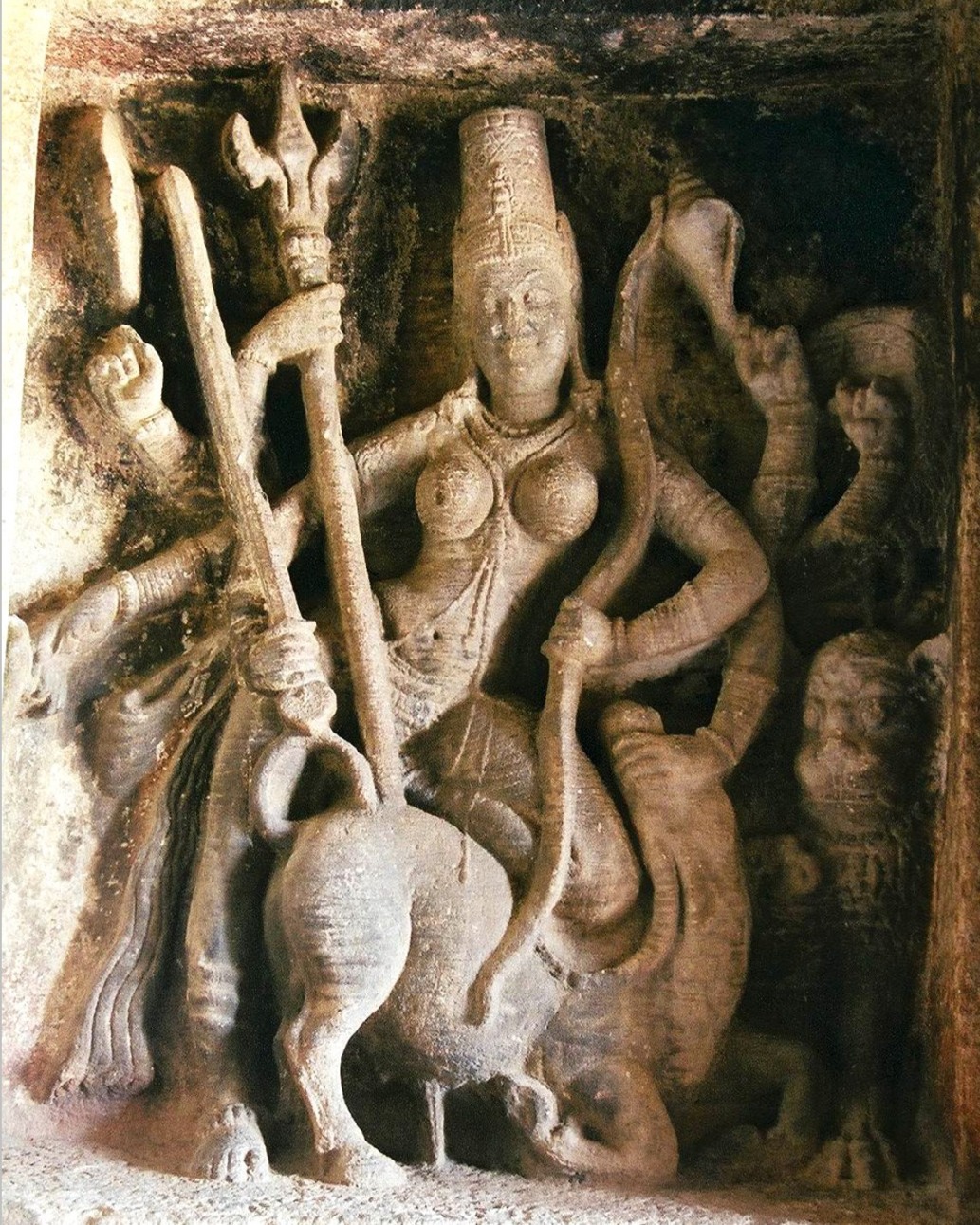
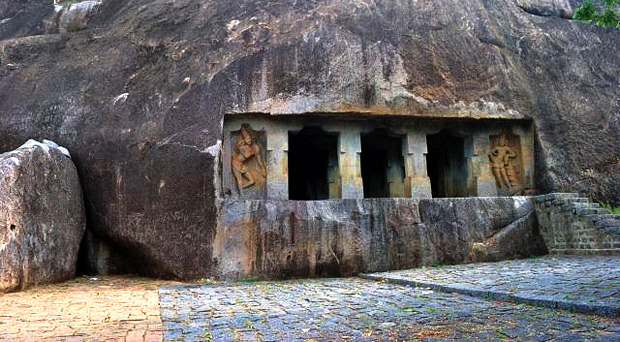
- Ravana Phadi is a rock cut cave with distinct sculptures made during the Chalukyan era.
- Among numerous sculptures is the Goddess Durga is portrayed in the carving. She appears to be slaying Mahishasura (panel above).
Pattadakal – This temple complex has 10 temples – 4 Dravida style, 4 in Nagara style, 1 Vesara style & 1 Jain Sanctuary. The Papanath temple is the Nagara style temple.
Virupaksha Temple
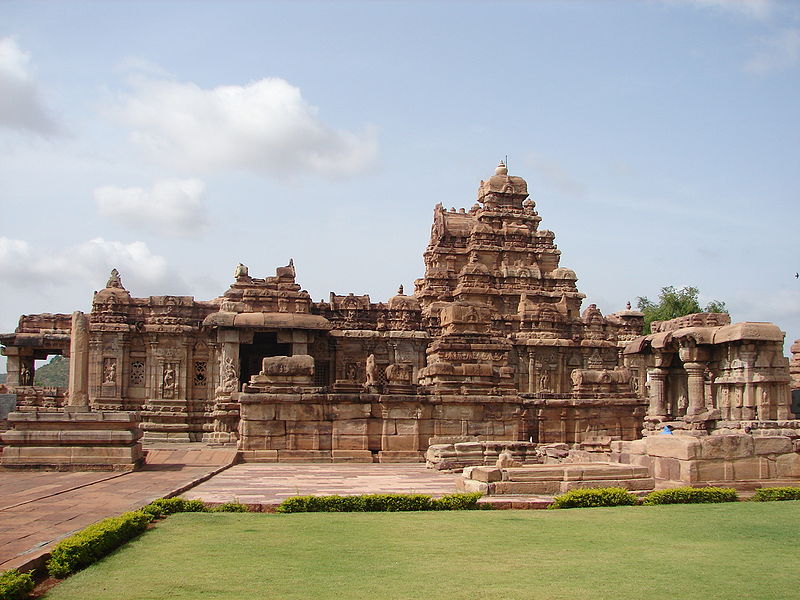
- Largest and grandest temple in Pattadakal
- Built in 8th Century by Queen Lokamahadevi to commemorate her husband’s (Vikramaditya II’s ) victory over Pallava ruler.
SOUTH INDIA
I. Political Background
The Pallavas were feudatories of the Satavahanas. After the fall of the Satavahanas in third century AD, they became independent. They ruled in the Tondaimandalam area with Kachipuram as their capital. The 7th Century marked the rise of great rulers like Mahendravarman, Narasimhavarman I and Rajasimha. The Pallava rule reached its zenith under these rulers.
II. Literature and Language
Work Author Type Theme Mattavilasa Prahasana Mahendravarman I Sanskrit Means the ‘delight of the drunkards’. Sanskrit farse on Buddhist and Kapalika ascetics Kiratarjuniya Bharavi Sanskrit Simhavishnu Devaram Nayanars Tamil Saiva literature Nalayradivyaprabandam Alvars Tamil Vaishnava literature III. Religion
The Tamil society witnessed a great change during the Pallava period.
A. Hinduism
The Brahmins occupied a high place in the society. Brahmanism and Brahmins were patronized by the rulers. The Pallava period witnessed the rise of Saivism and Vaishnavism.
Bhakti Cult
The Saiva Nayanmars and the Vaishnava Alwars contributed to the growth of Saivism and Vaishnavism. Apar and Sambandar were Shaivite bhakti saints who contributed immensely to the growth of Shaivism.
B. Buddhism and Jainism
Increased patronage to Hinduism and revival by Bhakti movement led to decline of Buddhism and Jainism.
IV. Architecture
A. Temples
This era is significant for temple building activities as the Dravidian style of temple architecture began. The Pallavas introduced the art of excavating temples out of rocks. We see a gradual evolution starting from the cave temples to monolithic rathas which culminated in structural temples. The development of temple architecture under the Pallavas can be seen in 4 stages.
Stage I – Mahendra phase
This stage sees the development of Pallava rock-cut temples under Mahendravarman I. They were built in many places. The most important among them are Pallavaram, Mamandur, Mahendravadi, Vallam and Thalavanur.
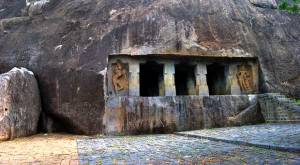
Pallavaram Caves
Stage II – Mamallapuram phase
The second stage of Pallava architecture is represented by the monolithic rathas and mandapas found at Mamallapuram (Mahabalipuram). The name ‘Mammalapuram’ is derived from Narshimahavarman’s name ‘Mamalla’ which means the ‘great wrestler’.
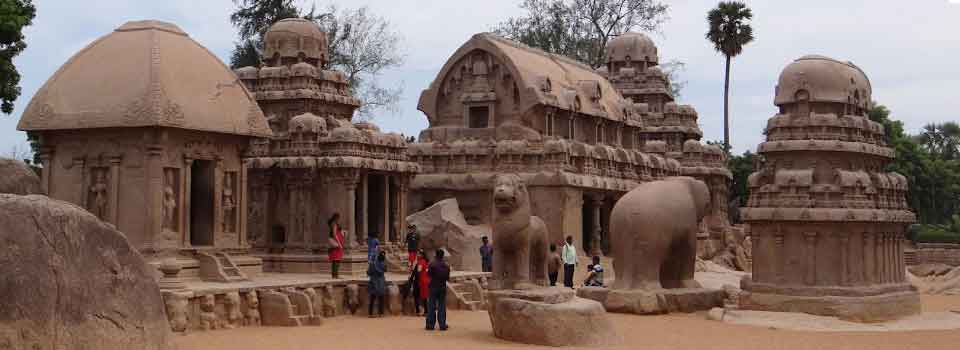
There are 5 Rathas – Dharmaraj Ratha, Bhim Ratha, Arjuna Ratha, Draupadi Ratha, Nakul Sahdev. These rathas, popularly called as the Panchapanadava rathas, signify 5 different styles of temple architecture. Dharmaraja Rath is the largest and it’s considered a precursor for the Dravidian style.
Rathas of Mahabalipuram
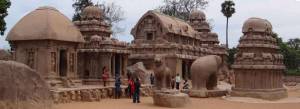
- The South saw the emergence of Dravida style of architecture. Earliest Dravida style is visible at Mahabalipuram where during the Pallava period were constructed different rock cut structures called rathas.
- Main shrine has a square ground plan
- The superstructure above the shrine instead of having a shikhara, has horizontal platforms each placed one above the other with the size receding upwards. This is called a vimana.
- Constructed under the patronage of Mahendravarman I and Narsimhavarman I.
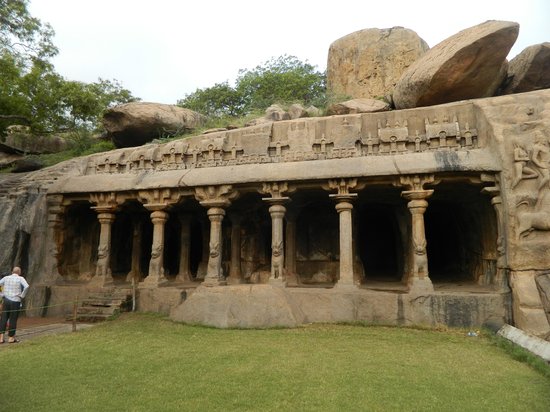
The mandapas contain beautiful sculptures on its walls. The most popular of these mandapas are Varaha Madapam, Mahishasuramardhini Mandapa, Tirumurthi Mandapam and the Panchpandava Caves.
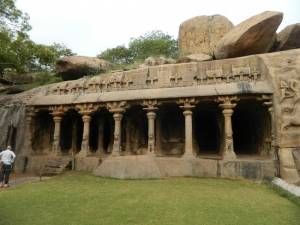
Panchpandava Caves
Stage III – Rajasimha phase
This stage witnesses the evolution of structural temples in South India. These temples were built by using the soft sand rocks. The Kailasanatha temple at Kanchi and the Shore temple at Mamallapuram remain the finest examples of the early structural temples of the Pallavas.
Shore Temple
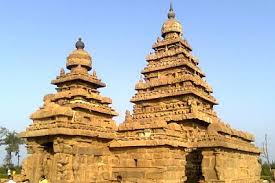
- The Shore temple is located in Mamallapuram.
- Its name is credited to its presence at the shore of Bay of Bengal.
- Built by Rajasimha.
- Made up of granite
- A Shaiva temple but also has a Vaishnava shrine
Kailasanatha Temple
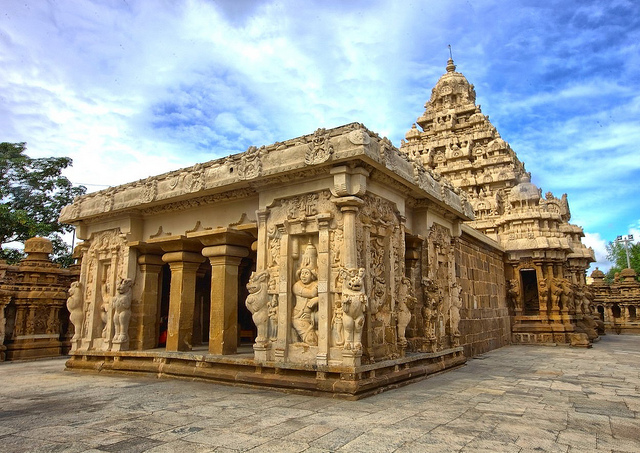
- This temple is the oldest structure in Kanchipuram.
- Located in Tamil Nadu, it is a Hindu temple dedicated to Lord Shiva.
- Dravidian style temple.
- Built by Rajasimha.
Stage IV – Nandivarman phase
The last stage of the Pallava art is also represented by structural temples built by the later Pallavas. The Vaikundaperumal temple and Muktheeswara temple at Kanchipuram belong to this stage of architecture.
Vaikunda Perumal Temple
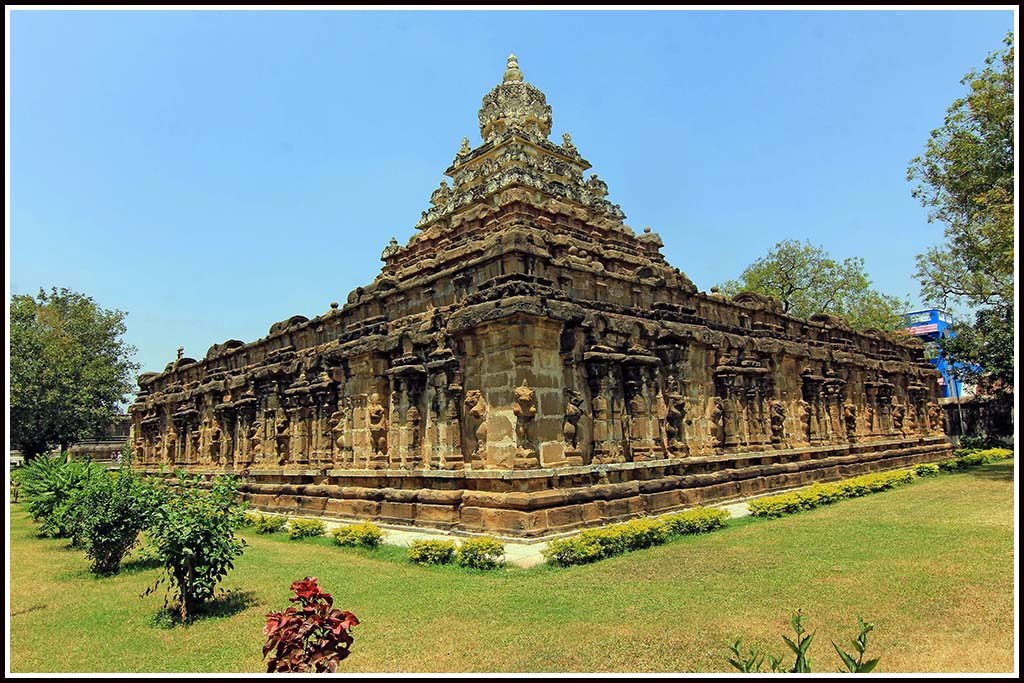
- Dedicated to Lord Vishnu
- Dravidian style
V. Art
The Pallavas had also contributed to the development of sculpture. Apart from the sculptures found in temples, an ‘Open Art Gallery’ at Mamallpuram remains an important monument.
The Descent of the Ganga or Arjun’s penance remains the most important sculpture.
Descent of Ganga/ Arjun’s penance
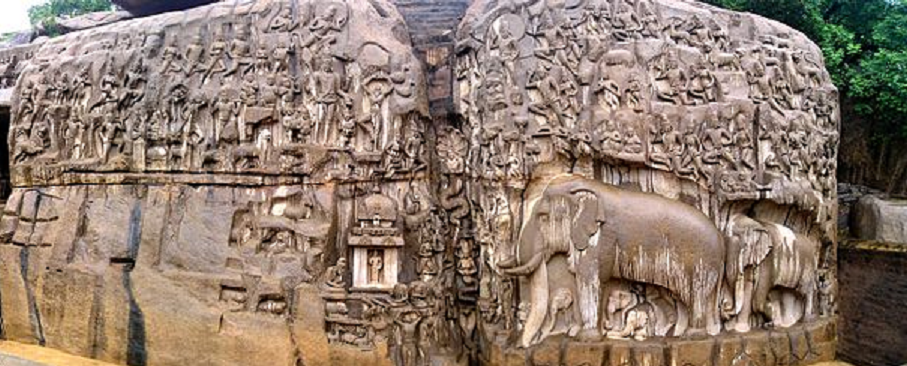
- Made of a monolithic rock
- Found in Mahabalipuram, Tamil Nadu
- Identified as Bhagiratha’s bringing Ganga down from the matted locks of Shiva
- It is also identified as Arjun’s penance
- Declared a UNESCO World Heritage Site.
The Sittannavasal jain paintings belonged to the period of Pallavas.
References and image credits:
- http://www.globalsecurity.org/military/world/india/history-vardhana-society.htm
- http://www.indianetzone.com/35/features_pala_sculpture_indian_sculpture.htm
- https://en.wikipedia.org/wiki/Chalukya_dynasty#Architecture
- http://www.cpreecenvis.nic.in/Database/AiholeCaveorRavanaPhadiCave_2838.aspx
- NCERTs
- NIOS
- CCRT site
-
[open SIP] Test 27- Misc. Test 4 ( Full Syllabus)
Link for the test: Click2Attempt (Let us know your score in comments)
We have started our Open SIP program in conjunction with our PAID program (Click2Know all details of the program)
We will be running this special FREE initiative on daily basis providing students with revision questions for static subjects as well as current affairs starting from June 2017
Test 27 as per schedule (Click2View) is MISC (Full syllabus)
Liked the test? You can join our FLT program containing more such high-level questions. The module contains 11 FLTs (8 paper 1 TS + 3 CSAT)
Know all details about the program and join here: Click2Join
Want to do quick revision for Prelims? Join our SIP Comprehensive or SIP Mini modules giving you Static & Dynamic subjects coverage through video lectures
SIP Comprehensive- Samanvaya + Lectures + Notes + FLTs + CA Tests: Click2Join
SIP Mini- Samanvaya + Lectures + Notes: Click2Join
-
[Prelims Spotlight] National Pharmaceutical Pricing Authority, Universal Service Obligation Fund,
Here are 2 Back2Basics collections from today’s news items
B2B #1: From news- DoT releases draft National Telecom Policy
National Pharmaceutical Pricing Authority
- NPPA is a regulatory agency under Ministry of Chemicals and Fertilizers of India which was established to fix/ revise the prices of controlled bulk drugs and enforce prices and availability of the medicines in the country, under the Drugs (Prices Control) Order, 1995
- It renders advice to the Central Government on changes/ revisions in the drug pricing policy
- It regularly publishes lists of medicines and their maximum ceiling prices
- It is also entrusted with the task of recovering amounts overcharged by manufacturers for the
controlled drugs from the consumers - It also monitors the prices of decontrolled drugs in order to keep them at reasonable levels.
B2B #2: From news- India rejects U.S. request on medical device price caps
Universal Service Obligation Fund
- USOF was formed by the Central Government in 1999 to help fund projects to provide widespread and non-discriminatory access to quality ICT services at affordable prices to people in rural and remote areas
- The money for this fund comes through a Universal Access Levy (UAL) charged from the telecom
operators as a percentage of various licenses fees being paid by them - The amount from UAL is deposited into the Consolidated Fund of India and require prior parliamentary approval to be dispatched
- It is headed by the USOF Administrator who reports to the Secretary, Department of Telecommunications (DoT)
As a part of revision for Prelims 2018, Here’s a Factoid to brush up your concepts
Name : Barak
Defence Forces : Army
Module Type : Missiles
Brief Intro : 1.Barak 8 (the Hebrew word for Lightning) also known as LR-SAM or as MR-SAM is an Indian-Israeli surface-to-air missile (SAM), designed to defend against any type of airborne threat including aircraft, helicopters, anti-ship missiles, and UAVs as well as cruise missiles and combat jets. Both maritime and land-based versions of the system exist. 2.Barak 8 was jointly developed by Israel Aerospace Industries (IAI), India’s Defence Research & Development Organisation (DRDO), Israel’s Administration for the Development of Weapons and Technological Infrastructure, Elta Systems, Rafael and other companies. Bharat Dynamics Limited (BDL) produce the missiles.
Note4students (wherever applicable) : Also used by navy
-
National Income Accounting
National Income Accounting
National Income Accounting refers to the practice of calculating the output of an economy. It helps in assessing how the economy is doing. Some of the most standard identities used are GDP, GNP, National Income, etc. We will be studying those in detail once we cover the basics.
Since GDP is the most important identity and all other identities are derived from it, we will cover it first.
Gross Domestic Product (GDP)
Gross Domestic Product (GDP) is the monetary value of all the finished goods and services produced within a ‘domestic territory’ in a specific time period. As evident, it is tied to a specific territory – a country’s border irrespective of the person producing it. That person could be a citizen or a foreign national.
Let’s take a hypothetical economy that produces 10 cars. The manufacturer purchases all components like tyres, glass, etc for Rs. 40, pays rent for Rs. 30 and pays labor for Rs. 10. Finally, sells the car for Rs. 100.
The GDP for this economy will be 10X100 = 1000. We didn’t include the cost of components like tyres, glass, etc because they were not final goods in themselves. They were consumed in the manufacturing of cars.
The domestic (economic) territory includes 4:
(i) Territory lying within the political frontiers, including territorial waters of the country.
(ii) Ships and aircrafts operated by the residents of the country between two or more countries.
(iii) Fishing vessels, oil and natural gas rigs and floating platforms operated by the residents of a country in the international waters or engaged in extraction in areas where the country has exclusive rights of operation. For example, fishing boats operated by Indian fishermen in the international waters of the Indian Ocean.
(iv) Embassies, consulates and military establishments of the country located abroad.
Value Added Method: The sum of the value of all final goods and services produced.
Let’s suppose there are only kind of production process taking place in the economy. they are the farmers growing grapes and wine producer. The farmer need only human labour to grow grapes. The farmers sell a part of the produced grapes to the wine manufacturers. The manufacturer uses grapes as inputs to produce wine.
Let’s further assume that in a given year farmer grows grape worth of Rs 1000. Out of this, he sells Rs 500 worth of grapes to the wine manufacturer. The wine manufacturer using grapes as input produces wine worth of Rs 1500.
What will be the total value added in this entire process?
The farmer grows grapes of Rs 1000 which will be added to total value added since that’s the final output produced by the farmers.
The baker used grapes worth Rs 500 as an input to produce wine worth of Rs 1500. The input used by the baker must be subtracted from the final output of wine produced by him (1500-500=1000). The reason for the deduction is that, we have already included the value of grapes produced by the farmer in the value added. If we now again include this in calculating value added we commit the mistake of Double counting- counting a product twice while calculating final output.
Hence the net value added for the economy will be contribution of the farmer (1000) + net contribution of the wine manufacturer (1000) = Rs 2000.
The raw materials that a firm buys from another firm which are completely used up in the process of production are called ‘intermediate goods’. Therefore,
The value added of a firm = Value of production of the firm – Value of intermediate goods used by the firm.
The value added of a firm is distributed among its four factors of production, namely, labour, capital, entrepreneurship and land. Therefore wages, interest, profits and rents paid out by the firm must add up to the value added of the firm.
Income Method: The sum of all incomes accruing to factors of production, i.e., Rent, Interest, Profit and Wages.
The sum of final expenditures in the economy must be equal to the incomes received by all the factors of production taken together (final expenditure is the spending on final goods, it does not include spending on intermediate goods). This follows from the simple idea that the revenues earned by all the firms put together must be distributed among the factors of production as salaries, wages, profits, interest earnings and rents.
Expenditure Method: The sum of consumer’s expenditure, net investment, and government expenditure on goods and services.
The expenditure method looks at the demand side of the GDP. In this method we add the final expenditures incurred by all the firms in the economy. in the farmer wine grower example, the value of output in the economy by expenditure method will be calculated in the following way.
Final expenditure is that part of the expenditure which does not count intermediate inputs. In our example, the Rs 500 worth of grapes that the wine manufacturer buys from the farmer will not be included in final expenditure. The aggregate value of output of the economy is Rs 1500 (final expenditure received by the wine manufacturer) + Rs 500 (final expenditure received by the farmer) = Rs 2000.
Firms make final expenditure on the following accounts:
C, consumption expenditure incurred by the firms
I, Investment expenditure incurred by firms on capital goods
G, expenditure incurred by government on the purchase of final goods and services produced by the firms
X, Exports revenues earned by firms by selling its goods and services abroad
Sum total of final consumption, investment, government and exports expenditures received by the firms ≡ C + I + G + X
Circular Flow of Money and Methods of Calculating National Income
We will discuss a simple economic model depicting how money flows through the economy.

Money changes hand from one sector to another.
Companies/Firms use 4 kinds of inputs that are used in the production of goods and services in order to make an economic profit. These 4 inputs are land, labor, capital, and entrepreneurship and are known as factors of productions.
In the first stage, the Household sector provides the factors of production to the Business firms.
In the second stage, the Business firms pay back in monetary terms to the Household sector in the form of Wages, Rent, Interest and Profits.
In the third stage, the money received by household is spent on the goods and services produced by the firms in the form of consumption expenditure (C).Thus, we see, that money flows from business firms to households and then it flows from Household to firms. This money flow is called circular flow of income.
Saving and Investment in the Circular Flow
Along with consumption, the households also save(S) part of their money.
When Households save, their expenditure on purchase of goods and services decline. The decline in the purchase will result in a decline in money received by firms. This will result in less money flow to the household as the firms will reduce hiring and production operations. Thus, saving act as a leakage from the economic system.
But the important question to ask is, where will savings go in the economy?
The savings in the economy does not lead to any reduction in aggregate spending and income as the savings flows back into the economic system through Financial Markets (Banks, Stock markets, insurance etc.)
From Financial Markets, the savings flows back to the Business firms who borrow them and invest it into new forms of investments.
Thus, the saving which is a leakage in the system also flows back into the system through investment by a firm which acts as injections.Government Sector in the Circular Flow
Government affects the economy in a number of ways. The main components of government intervention are in the form of taxes(T), spending and borrowings(G).
The money flow from Households and firms to the government is in the form of taxes.
The other form of money flow from Households and firms to government is in the form of Borrowings through financial markets.
The Government pays back to households and firms in the form of provision of public goods like health, education, Policing, National Defence etc.Because the money circulates, it leads to the following methods of GDP calculations.
- Expenditure Method
Households/firms can make the expenditure on final goods and services. We shall denote this by C. Final investment expenditure, I , incurred by firms on the capital goods produced. The expenditure that the government makes on the final goods and services produced by firms is G. We may point out that the final expenditure incurred by the government includes both the consumption and investment expenditure. The export revenues that firm earns by selling its goods and services abroad is denoted by X
GDP ≡ X+Ι+G+(X–M)
2. Income Method
The sum of income received by all the factors of production taken together is same as the value of final goods produced.
Either they consume it, or they save it, or pay taxes with it. This leads to the formulae.
GDP ≡ C + S + T
The Product or Value Added Method
Going back to the car example, we see the inputs were Rs. 40 and the value added was Rs. 60(finally the car was sold at 100). One way to calculte GDP would be to sum up all the value added at each step. In the first step it was Rs. 40 and in the 2nd step it was Rs. 60. That gives the total of Rs.100. Thus GDP can also be defined as
GDP ≡ Summation of GVA
When we consider an actual economy, the Value Added Method is used but things get more complicated.
First, the concept of factor cost, basic prices, and market prices is introduced.
Factor cost refers to the sum of the factor costs incurred during the process of production of final goods and services by the producer.
Basic prices refer to the price after accounting for production taxes and subsidies. When we add Net Production Taxes(Production taxes – Production subsidies), we get basic prices.
Market prices refer to the amount receivable by the producer from the purchaser for a unit of a good or service produced as output minus any tax payable. We get this price by adding Net Product Taxes(Product taxes – Product subsidies)
This is how it translates –
Gross Value Added (GVA) at basic prices = GVA at factor cost + Production taxes – Production subsidies
Gross Domestic Product (GDP) at market = GVA at market prices = GVA at basic prices + Product taxes – Product subsidiesSecond, we come to the concept of constant prices and current prices.
We need to measure GDP by discounting the effect of inflation in the economy to arrive at real numbers of how the growth has been. When our reference year is a base year, we call it GPD at constant prices while this year’s GDP is referred to as GDP at current prices. Recently, the base year was updated to 2011-12.
Change in methodology of calculating GDP
India’s Central Statistical Office (CSO) introduced the new series of National Accounts Statistics (NAS) with the base year 2011-12, replacing the earlier series with 2004-05 as the base year. This is a routine matter for the CSO – as with statistical offices of most countries – to change the base year of the NAS periodically to account for structural changes in the economy, relative prices, and to replace older survey data with newer ones to better capture the economic activities. This time around the revision also had another objective, that is, to update the underlying methodology of NAS to the most recent international guidelines, namely, the UN System of National Accounts, 2008 (SNA 2008).
The following changes were made by the CSO while calculating GDP:
Replacing GDP at factor cost and GDP at market price with gross value added at basic prices and GDP respectively.
Estimating GDP of private corporate sector directly from the audited balance sheets, following an enterprise approach replacing the earlier used establishment approach.
Using private corporate sector for estimating the manufacturing sector GVA, by discarding the earlier usage of Index of Industrial Production (IIP) and Annual Survey of Industries (ASI).
Further, the GDP structure is also different now. While the public sector share in GDP remains unchanged, the share of private sector corporates is higher in new series by some 11 percent and the share of unorganised sector declined from 56 to 44 percent.

The Controversy
Historically, the private corporate sector was small. However, since the last three decades there is a phenomenon growth in the number of registered companies ranging from services to financial sector. But their contribution to the Indian economy is mostly unknown as they mostly don not files their returns and audited balance sheets with Registrar of Companies. Similarly, unorganised sector is vastly underestimated in the new series.
The new series, in a first, has estimated PCS’s GDP directly using company balance sheets obtained from Ministry of Corporate Affair’s (MCA) new database of about 500,000 companies for just two years (2011-12 and 2012-13).
MCA database has two sets of problem.
- Aggregate revenue estimates from company balance sheets are significantly different from those obtained from disaggregated revenue data, affecting the level as well as the growth rates of GVA in PCS.
- Since the number of companies in the MCA database plummeted to 300,000 – or, by 40 per cent – in 2013-14 and beyond, applying the blowing-up factor prepared with the smaller number of companies and blowing it up to the universe of over 900,000 companies, could have, one suspects, potentially over-estimated the GVA in the subsequent years, affecting the growth rates. Therefore, critics wonder if the remedy of using the huge MCA database has unwittingly proved to be worse than the disease.
The new methodology seems to have particularly affected the manufacturing sector estimates. The sector’s share in GDP has risen to 17-18 per cent, from 14-15 per cent earlier; its growth rate is systematically diverging from that based on both IIP and ASI
References in Government Reports
The Central Statistics Office brings a document on QUARTERLY ESTIMATES OF
GROSS DOMESTIC PRODUCT. Though such level of detail is not required from an exam perspective, its good for conceptual clarity.A sample can be seen here.
http://mospi.nic.in/sites/default/files/press_release/nad_pr_2eni_28feb18_0.pdf
Advanced Estimates are predictions based on past trend. Revised Estimates are a review of Advanced Estimates taking into account the actual trend of expenditure, not past trend.
Statement 1 is as follows –

Notice the terms, PFCE, GFCE, GFCF.
These correspond to Private Final Consumption Expenditure, Government Final Consumption Expenditure and Gross Fixed Capital Formation respectively.
In the following chart, you can see sectors growth.

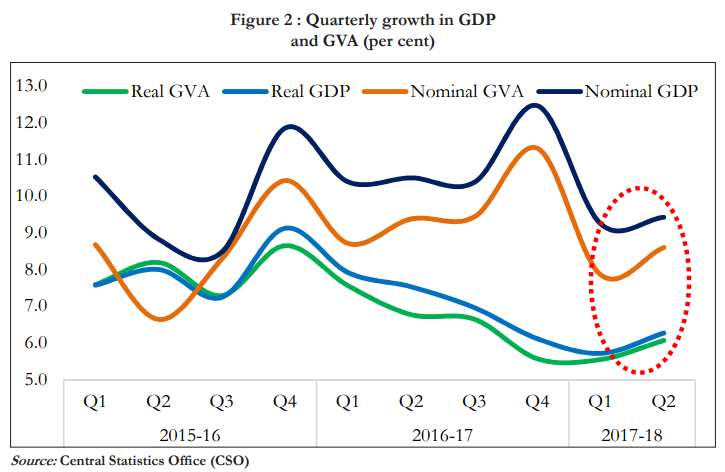
CSO also releases various graphs for trend analysis.

The Economic Survey also comes out with interesting trends on GDP.