💥UPSC 2026, 2027, 2028 UAP Mentorship (March Batch) + Access XFactor Notes & Microthemes PDF

Search results for: “”

  • Development Finance Institutions: IFCI, ICICI, SIDBI, IDBI, UTI, LIC, GIC

    Development Finance Institutions

    The Need of DFIs

    Classification of DFIs

    All India DFIs Special DFIs Investment Institutions Refinance Institutions State Level DFIs
    IFCI

    IDBI

    SIDBI

    ICICI

    ICICI ceased to be a DFI and converted into a Bank on 30 March 2002.

    IDBI was converted into a Bank on 11 October 2004.

    EXIM Bank

    IFCI Venture Capitalist Fund

    Tourism Finance Corporation of India.

    IDFC.

    LIC

    Union Trust of India.

    General Insurance Corporation.

    National Housing Board.

    NABARD.

    State Financial Corporation.

    State Industrial Development Corporations.


    All India Development Finance Institutions

    IFCI ICICI IDBI SIDBI
    IFCI was the first DFI to be setup in 1948. It was setup in January 1995. The IDBI was initially set up as a Subsidiary of the RBI. In February 1976, IDBI was made fully autonomous. SIDBI was setup as a subsidiary of IDBI in 1989.
    With Effect from 1 July 1993, IFCI has been converted into Public Limited Company. With effect from April 2002, ICICI has been converted into a Bank. The IDBI was designated as apex organisation in the field of Development Financing. However, it was converted in a bank wef Oct 2004. The SIDBI was designated as apex organisation in the field of Small Scale Finance.

    The Union Budget of 1998-99 proposed the delinking of SIDBI from IDBI.

    The key function of IFCI was; granting long-term loans(25 years and above); Guaranteeing rupee loans floated in open markets by industries; Underwriting of shares and debentures; Providing guarantees for industries. The key functions of ICICI were; to provide long term or medium term loans or equity participation; Guaranteeing loans from other private sources; providing consultancy services to industry. The key functions of IDBI were; it provides refinance against loans granted to industries; it subscribed to the share capital and bond issues of other DFIs; it also acted as the coordinator of DFIs at all India level. The key function of SIDBI was; to provide assistance to small scale units; initiating steps for technological up gradation and modernization of SSIs; expanding the marketing channel for the Small Scale Industries product; promotion of employment creating SSIs.
    IFCI was a public sector DFI. The ICICI differed from IFCI and IDBI with respect to ownership, management and lending operation. ICICI was a Private sector DFI. It was a Public sector DFI.


    Investment Institutions

    UTI LIC GIC
    The UTI was setup on Nov 1963 after Parliament passed the UTI Act. LIC was setup in 1956 after the insurance business was nationalised. The GIC was formed by the central government in 1971.
    The objective of UTI was to channel the savings of people into equities and corporate debts. The flagship scheme of the UTI was called Unit Scheme 64. The objective of LIC is to provide assistance in the form of term loans; subscription of shares and debentures;resource support to financial institutions and Life insurance coverages. The GIC had four subsidiaries; National Insurance Co; New India Assurance; Oriental Insurance; and United India Insurance.
    In 2002, the Union Cabinet had decided to split UTI into UTI 1 and UTI 2 as a result of the prolonged crisis in UTI. The General Insurance Nationalisation Amendment Act, 2002, has delinked the GIC from its four subsidiaries.


    By
    Himanshu Arora
    Doctoral Scholar in Economics & Senior Research Fellow, CDS, Jawaharlal Nehru University

  • Banking in India: Definition, Functions and Types of Banks

    CLICK:-REGISTER & DISCUSS ECONOMICS CONCEPTS & YOUR UPSC PREPARATION WITH CD MENTORS FOR FREE

    Definition of a Bank

    A bank is a financial institution which performs the deposit and lending function. A bank allows a person with excess money (Saver) to deposit his money in the bank and earns an interest rate. Similarly, the bank lends to a person who needs money (investor/borrower) at an interest rate. Thus, the banks act as an intermediary between the saver and the borrower.

    The bank usually takes a deposit from the public at a much lower rate called deposit rate and lends the money to the borrower at a higher interest rate called lending rate.

    The difference between the deposit and lending rate is called ‘net interest spread’, and the interest spread constitutes the banks income.

    Essential Features/functions of the Bank

    Financial Intermediation

    The process of taking funds from the depositor and then lending them out to a borrower is known as Financial Intermediation. Through the process of Financial Intermediation, banks transform assets into liabilities. Thus, promoting economic growth by channelling funds from those who have surplus money to those who do not have desired money to carry out productive investment.

    The bank also acts as a risk mitigator by allowing savers to deposit their money safely (reducing the risk of theft, robbery) and also earns interest on the same deposit. Bank provides services like saving account deposits and demand deposits which allow savers to withdraw money on an immediate basis thus, providing liquidity (which is as good as holding cash) with security.

    How Banks promote economic growth?

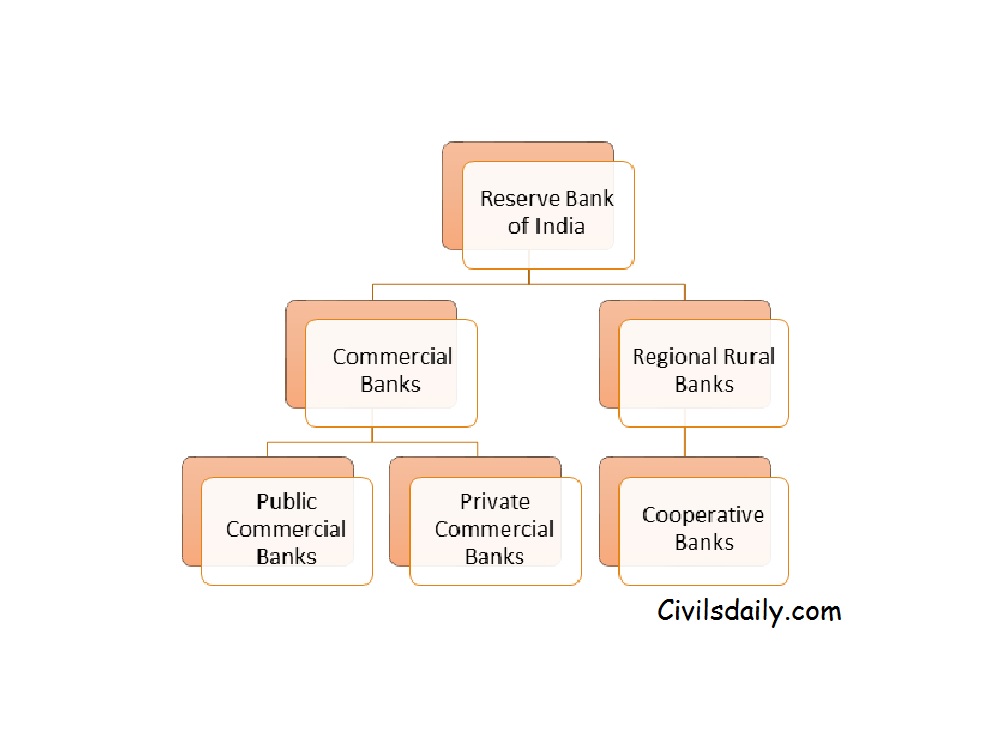
    Types/Structure of Banks in India

    Scheduled Commercial Banks

    • All the commercial banks in India- Scheduled and Non-Scheduled is regulated under Banking Regulation Act 1949.
    • By definition, any bank which is listed in the 2nd schedule of the Reserve Bank of India Act, 1934 is considered a scheduled bank. The list includes the State Bank of India and its subsidiaries (like State Bank of Travancore), all nationalised banks (Bank of Baroda, Bank of India etc), Private sector banks, Foreign banks, regional rural banks (RRBs), foreign banks (HSBC Holdings Plc, Citibank NA) and some co-operative banks.
    • Till 2017, Scheduled commercial banks in India comprised 26 Public sector banks including SBI and its associates, and 19 Nationalised Bank and IDBI. The creation of Bhartiya Mahaila Bank has increased the total no of Public sector SCB’s to 27, but the recent merger of the Mahaila Bank with SBI had reduced the list back to 26.
    • The scheduled private sector bank includes old private sector banks and new private sector banks. There are 13 old private sector banks and 9 new private sector banks including the newly formed IDFC and Bandhan Bank.
    • There are also 43 Foreign National Banks operating in India.
    • The Regional Rural Banks were started in India back in the 1970s due to the inability of the commercial banks to lend to farmers/rural sectors/agriculture. The governance structure/shareholding of RRBs is as follows:
    • Central Government: 50%, State Government: 15% and Sponsor Bank: 35%.
    • RBI has kept CRR (Cash Reserve Requirements) of RRBs at 3% and SLR (Statutory Liquidity Requirement) at 25% of their total net liabilities.

    Important Facts Relating to Scheduled Commercial Banks

    • In terms of Business, Public sector banks dominate the Indian Banking.
    • PSB accounts for close to 50% of total assets, 70% of deposits and close to 70% of the advances.
    • Amongst the Public-Sector Banks, SBI and its Associates has the highest number of Branches.
    • The committee on Regional Rural Bank headed by M Narasimhan recommended the setting up of RRBs for the purpose of providing rural credit.
    • An RRB is sponsored by a Public-Sector Bank which also provides a part of its share capital. Example: Maharashtra Gramin Bank (sponsored by the Bank of Maharashtra) and the Himachal Gramin Bank (Sponsored by Punjab National Bank). RRBs were set up to eliminate other unorganized financial institutions like money lenders and supplement the efforts of co-operative banks.
    • The Private Commercial banks account for close to 1/4th of the assets of the total banking assets.

    Why RRBs Failed to Achieve ITs Objective

    The RRB Amendment Bill, 2014

    • The Regional Rural Banks (Amendment) Bill, 2014 was introduced by the Minister of Finance, Mr Arun Jaitley, in Lok Sabha on December 18, 2014.  The Bill seeks to amend the Regional Rural Banks Act, 1976. It was passed by parliament in April 2015.
    • The Regional Rural Banks Act, 1976 mainly provides for the incorporation, regulation and winding up of Regional Rural Banks (RRBs).
    • Sponsor banks:  The Act provides for RRBs to be sponsored by banks.  These sponsor banks are required to (i) subscribe to the share capital of RRBs, (ii) train their personnel, and (iii) provide managerial and financial assistance for the first five years.  The Bill removes the five-year limit, thus allowing such assistance to continue beyond this duration.
    • Authorized capital:  The Act provides for the authorized capital of each RRB to be Rs five crore.  It does not permit the authorized capital to be reduced below Rs 25 lakh.  The Bill seeks to raise the amount of authorized capital to Rs 2,000 crore and states that it cannot be reduced below Rs one crore.
    • Issued capital:  The Act allows the central government to specify the capital issued by an RRB, between Rs 25 lakh and Rs one crore.  The Bill requires that the capital issued should be at least Rs one crore.
    • Shareholding:  The Act mandates that of the capital issued by an RRB, 50% shall be held by the central government, 15% by the concerned state government and 35% by the sponsor bank.  The Bill allows RRBs to raise their capital from sources other than the central and state governments, and sponsor banks.  In such a case, the combined shareholding of the central government and the sponsor bank cannot be less than 51%.  Additionally, if the shareholding of the state government in the RRB is reduced below 15%, the central government would have to consult the concerned state government.
    • The Bill states that the central government may by notification raise or reduce the limit of the shareholding of the central government, state government or the sponsor bank in the RRB. In doing so, the central government may consult the state government and the sponsor bank.  The central government is required to consult the concerned state government when reducing the limit of the shareholding of the state government in the RRB.
    • Board of directors:  The Act specifies the composition of the Board of Directors of the RRB to include a Chairman and directors to be appointed by the central government, NABARD, sponsor bank, Reserve Bank of India, etc.  The Bill states that any person who is a director of an RRB is not eligible to be on the Board of Directors of another RRB.
    • The Bill also adds a provision for directors to be elected by shareholders based on the total amount of equity share capital issued to such shareholders.  If the equity share capital issued to shareholders is 10% or less, one director shall be elected by such shareholders.  Two directors shall be elected by shareholders where the equity share capital issued to them is from 10% to 25%.  Three directors shall be elected in case of equity share capital issued being 25% or above.  If required, the central government can also appoint an officer to the board of directors to ensure the effective functioning of the RRB.
    • The Act specifies the term of office of a director (excluding the Chairman) to be not more than two years.  The Bill raises this tenure to three years.  The Bill also states that no director can hold office for a total period exceeding six years.
    • Closure and balancing of books:  As per the Act, the books of an RRB should be closed and balanced as on December 31 every year.  The Bill changes this date to March 31 to bring the Act in uniformity with the financial year.

    Non-scheduled Banks

    • Non-scheduled banks by definition are those which are not listed in the 2nd schedule of the RBI Act, 1934.
    • Banks with a reserve capital of less than 5 lakh rupees qualify as non-scheduled banks.
    • Unlike scheduled banks, they are not entitled to borrow from the RBI for normal banking purposes, except, in emergency or “abnormal circumstances.”
    • Jammu & Kashmir Bank is an example of a non-scheduled commercial bank.

    Cooperative Banks

    • Co-operative banks operate in both urban and non-urban areas. All banks registered under the Cooperative Societies Act, 1912 are considered co-operative banks.
    • In the urban centres, they mainly finance entrepreneurs, small businesses, industries, self-employment and cater to home buying and educational loans.
    • Likewise, co-operative banks in the rural areas primarily cater to agricultural-based activities, which include farming, livestock’s, diaries and hatcheries etc.
    • They also extend loans to small scale units, cottage industries, and self-employment activities like artisanship.
    • Unlike commercial banks, who are driven by profit, cooperative banks work on a “no profit, no loss” basis.
    • Co-operative Banks are regulated by the Reserve Bank of India under the Banking Regulation Act, 1949 and Banking Laws (Application to Co-operative Societies) Act, 1965.

    By
    Himanshu Arora
    Doctoral Scholar in Economics & Senior Research Fellow, CDS, Jawaharlal Nehru University

    CLICK:-REGISTER & DISCUSS ECONOMICS CONCEPTS & YOUR UPSC PREPARATION WITH CD MENTORS FOR FREE
  • 21 September 2017 | Prelims Daily with Previous Year Questions & Tikdams

    Q.1) Which of the following Dry Cells are Primary Dry Cells?
    1. Alkaline cell
    2. Lithium cell
    3. Mercury cell
    4. silver oxide cell
    Select the correct option using the codes given below.
    a) 1, 2 and 3 only
    b) 2, 3 and 4 only
    c) 1 and 2 only
    d) 1, 2, 3 and 4 only

    Q.2) Consider the following statements regarding the ‘TRIPS-Plus’, which is often seen in news:
    1. It is related to the WTO.
    2. It is enacted under the Patent laws by some countries.
    Which of the statements given above is/are correct?
    a) 1 only
    b) 2 only
    c) Both are correct
    d) Neither 1 nor 2

    Q.3) Consider the following statements regarding the ‘VoLTE Technology’, which is often seen in the news:
    1. It is related to Telecom Regulatory.
    2. ‘T’ in VoLTE stands for ‘Term’
    Which of the statements given above is/are correct?
    a) 1 only
    b) 2 only
    c) Neither 1 nor 2
    d) Both are correct

    Q.4) What are the main objectives of the Fiscal Responsibility and Budget Management Act, 2003?
    1. to introduce transparent fiscal management systems in the country
    2. to introduce a more equitable and manageable distribution of the country’s debts over the years
    3. to aim for fiscal stability for India in the long run
    Select the correct option using the codes given below.
    a) 1 and 2 only
    b) 2 and 3 only
    c) 1 and 3 only
    d) 1, 2 and 3

    Q.5) Build, use, maintain and treat (BUMT), which was recently seen in the news, is related to which of the following?
    a) Swachh Bharat Mission
    b) Pradhan Mantri Gram Sadak Yojana
    c) Pradhan Mantri Shehri Sadak Yojana
    d) Pradhan Mantri Krishi Sinchayee Yojana

    Q.6) What was the main reason for the split in the Indian National Congress at Surat in 1907? (CSE: 2016)
    a) Introduction of communalism into Indian politics by Lord Minto
    b) Extremists’ lack of faith in the capacity of the moderates to negotiate with the British Government
    c) Foundation of Muslim League
    d) Aurobindo Ghosh’s inability to be elected as the president of the Indian National Congress

    Q.7) The plan of Sir Stafford Cripps envisaged that after the Second World War (CSE: 2016)
    a) India should be granted complete independence
    b) India should be partitioned into two before granting independence
    c) India should be made a republic with the condition that she will join the Commonwealth
    d) India should be given Dominion status

    Q.8) Consider the following pairs:(CSE: 2016)
    Famous place – Region
    1.Bodhgaya – Baghelkhand
    2.Khajuraho – Bundelkhand
    3.Shirdi – Vidarbha
    4.Nasik(Nashik) – Malwa
    5.Tirupati – Rayalascema
    Which of the pairs given above are correctly matched?
    a) 1, 2 and 4
    b) 2, 3, 4 and 5
    c) 2 and 5 only
    d) 1, 3, 4 and 5


    IMPORTANT STUFF: 

    1. Daily newscards have been enriched with back2basics and note2students – Make notes daily

    2. Join Full Year Prelims TS – prelims.civilsdaily.com

    3. Solutions will be uploaded at 11.30 p.m. Click here for Solutions

    4. For attempting previous Prelims Daily Questions – Click here

  • Budgetary procedure in India

    The budgetary procedure in India involves four different operations that are

    • Preparation of the budget
    • Enactment of the budget
    • Execution of the budget
    • Parliamentary control over finance

    Preparation of the budget

    The exercise of the preparation of the budget by the ministry of finance starts sometimes around in the month of September every year. There is a budget Division of the Department of Economic affair of the ministry of finance for this purpose.

    The ministry of finance compiles and coordinates the estimates of the expenditure of different ministers and departments and prepare an estimate or a plan outlay.

    Estimates of plan outlay are scrutinized by the Planning Commission. The budget proposals of finance ministers are examined by the finance ministry who has the power of making changes in them with the consultation of the prime minister.

    Enactment of the budget

    Once the budget is prepared, it goes to the parliament for enactment and legislation. The budget has to pass through the following stages:

    • The finance minister presents the budget in the Lok Sabha. He makes his budget in the Lok Sabha. Simultaneously, the copy of the budget is laid on the table of the Rajya Sabha. Printed copies of the budget are distributed among the members of the parliament to go through the details of the budgetary provisions.
    • The finance bill is presented to the parliament immediately after the presentation of the budget. Finance Bill relates to the proposals regarding the imposition of new taxes, modification on the existing taxes or the abolition of the old taxes.
    • The proposals on revenue and expenditure are discussed in the Parliament. Members of the Parliament actively take part in the discussion.
    • Demands for grants are presented to the Parliament along with the budget These demands for grants show that the estimates of the expenditure for various departments and they need to be voted by the Parliament.
    • After the demands for grants are voted by the parliament, the Appropriation Bill is introduced, considered and passed by the appropriation of the Parliament. It provides the legal authority for withdrawal of funds of what is known as the Consolidated Fund of India.
    • After the passing of the appropriation bill, finance bill is discussed and passed. At this stage, the members of the parliament can suggest and make some amendments which the finance minister can approve or reject.
    • Appropriation bill and Finance bill are sent to Rajya Sabha. The Rajya Sabha is required to send back these bills to the Lok Sabha within fourteen days with or without amendments. However, Lok Sabha may or may not accept the bill.
    • Finance Bill is sent to the President for his assent. The bill becomes the statue after presidents’ sign. The president does not have the power to reject the bill.

    Execution of the budget

    • Once the finance and appropriation bill is passed, execution of the budget starts. The executive department gets a green signal to collect the revenue and start spending money on approved schemes.
    • Revenue Department of the ministry of finance is entrusted with the responsibility of collection of revenue. Various ministries are authorized to draw the necessary amounts and spend them.
    • For this purpose, the Secretary of minister’s acts as the chief accounting authority.
    • The accounts of the various ministers are prepared as per the laid down procedures in this regard. These accounts are audited by the Comptroller and Auditor General of India.

    Parliament Control over Finance

    • There is a prescribed procedure by which the Finance Bill and the Appropriation Bill are presented, debated and passed.
    • The Parliament being sovereign gives grants to the executive, which makes demands. These demands can be of varieties like the demands for grants, supplementary grants, additional grants, etc.
    • The estimates of expenditure, other than those specified for the Consolidated Fund of India, are presented to the Lok Sabha in the form of demands for grants.
    • The Lok Sabha has the power to assent to or to reject, any demand, or to assent to any demand, subject to a reduction of the amount specified. After the conclusion of the general debate on the budget, the demands for grants of various ministries are presented to the Lok Sabha.
    • Formerly, all demands were introduced by the finance minister; but, now, they are formally introduced by the ministers of the concerned departments. These demands are not presented to the Rajya Sabha, though a general debate on the budget takes place there too.
    • The Constitution provides that the Parliament may make a grant for meeting an unexpected demand upon the nation’s resources, when, on account of the magnitude or the indefinite character of the service, the demand cannot be stated with the details ordinarily given in the annual financial statement.
    • An Appropriation Act is again essential for passing such a grant. It is intended to meet specific purposes, such as for meeting war needs.

    Merging Railway budget into Union budget – Pros and Cons

    After 92 years of seeing them separately, the year 2017 witnessed the Railway budget being merged into Union budget. This move is being lauded for it will be beneficial for the economy at large and there will be positive influence in the development in railways.

    During the British reign, having a separate Railway budget made sense because a larger part of the country’s GDP depended on railway revenue. The tradition of having the budgets separately continued when India gained freedom even though the revenue from railway continued to go lower than most of the organizations in the public and private sector.

    Pros
    1. The scores: During the British rule Railways took up to 85 percent of the yearly budget while now it has gone down to about 15 percent only. Having separate railway budget stopped making sense long ago but the old tradition was not done away with. Scrapping the old for the renewed and better is always a positive change to look upon.

    2. Better policies: Now that the Railway budget will be introduced along with the union budget, there will be less wastage of time when a new policy is to be initiated and implemented. Keeping them separate resulted in a lot of drawbacks and hindrances that had to be faced by the railway ministry before it could decide upon a solution.

    3. Party politics: Minority parties fighting to meet their intentions and ministers of certain states arguing new railways and trains for their region has always been known to result in an everlasting brawl. There will be less of political pressure on the Railway budget and the centre will have the ultimate hold of the decision making.

    4. Goodbye to annual dividend: When Rail budget had to be introduced separately, the railways needed to pay an annual dividend to render its budgetary support to the government. The railways will be free of this now and the same fund could now be used in better ways for development the conditions of Indian railways.

    5. The huge loss: Our railways are running on loss. There are lesser funds for development plans and most of them are wasted in wrongful manner when there emerges a demand from the regional MLA who promised new trains and stoppages for their location during the time of election. When it goes into the hands of finance ministry, it would mean and absolute end to this and a more commercialized distribution of resources.

    Cons

    1. The rise and fall: Henceforth, the distribution and allocation of funds to various departments will all go under the finance ministry, which will take decisions according to rise and fall of budget. A fall in the annual budget will mean a similar cut in the railway and other budgets. This will be something unusual for the railways and they might not react supportively to that.

    2. Conditions of government departments: The depleting conditions of the various departments under the government have always been prominent. There is lesser attention paid to the responsibilities and everyone is busy sorting out their own means. Railways might see drastic disadvantage if the merging doesn’t reap the desired result.

    3. Goodbye to privatization: There have previously been talks of privatization of Indian railways in order to improve and develop them with world class facilities and cleanliness. It was not well received earlier and after the merging, there will a complete end to any future chances of privatization. At the efficient hands of government employees, nothing big could be expected.

    4. Loss for the railways: We know how much our parties love making promises and then reducing price to earn the favor of the voters. Not in their wildest dreams would they want to hike the railway prices and lose the vote bank that flows from commuters. Lesser hikes in price might pose loss for the railways department.

    There have been mismanagement of the highest order in Indian railways and if there are chances of seeing it improve, merging it with the Union budget is just the solution that could help. The falling revenue and more projects for new trains and stoppages have been a difficult project for the railway ministry which took the right step by merging the two budgets.

    Budget advancement:

    The objective behind this move is to have the Budget constitutionally approved by Parliament and assented to by the President, and all allocations at different tiers disseminated to budget-holders, before the financial year begins on April 1.

    • The proposal for a change in the budget presentation date was first mooted by some of the government’s senior most bureaucrats as part of a ‘Transforming India’ initiative in January 2016.

    Presenting the budget earlier comes with both advantages and disadvantages.

    Advantages:

    • In the existing system, the Lok Sabha passes a vote on account for the April-June quarter, under which departments are provided a sixth of their total allocation for the year. This is done by March. The Finance Bill is not passed before late April or early May. If the Budget is read in January and passed by February-March, it would enable the government to do away with a vote on account for the first three months of a financial year.
    • Retired and serving officials say the biggest plus would be that the Finance Bill, incorporating the Budget proposals, could be passed by February or March. So, government departments, agencies and state-owned companies would know their allocations right from April 1, when the financial year begins.
    • It would also help the private sector to anticipate government procurement trends and evolve their business plans. And, civil society could deliberate on and give feedback in time for the parliamentary discussions. 

    Disadvantages:

    • One big disadvantage of advancing the Budget preparations is lack of comprehensive revenue and expenditure data. Currently, work on the Budget begins in earnest by December. By the time it is finalised in mid-February, data on revenue collections and expenditure trends is available for the first nine months of the financial year, i.e April-December. Based on which, projections for the full year can be made.
    • To read the Budget in January, the centre will have to start preparing it by early October. To go by less than six months of data and making projections for the full year and the next year, based on such an incomplete picture, will be an impossible task.
    • Advancing the Budget dates would be fraught with practical difficulties. Effective Budget planning also depends on the monsoon forecasts for the coming year, making the advancing the whole exercise even more difficult.
    • Besides, whether the chambers of Parliament and its standing committees will get adequate time to deliberate on the budget is a moot point. The standing committees of Parliament, whose charter is to examine the justification of the ministry-wise allocations and funding needs of concomitant programmes included in the Budget, undertake their scrutiny during a two to three-week gap within the budget session period, when the houses are adjourned. This scrutiny is an essential element in the parliamentary budget approval system.

    Way ahead:

    Advancing the presentation of the Budget, so as to allow Parliament to vote on tax and spending proposals before the beginning of the new financial year on April 1, is a good idea. It would do away with the need for a vote on account and allow new direct tax measures to have a full year’s play. Members of Parliament now will have to work hard over two months to vet Budget proposals, for this to work. 

    Conclusion:

    These reforms make sense, but Budget reform has to go further, to incorporate a multi-year time horizon and shift to outcome-linked expenditure management, as had been recommended by a committee headed by C Rangarajan in 2011.

    By
    Himanshu Arora
    Doctoral Scholar in Economics & Senior Research Fellow, CDS, Jawaharlal Nehru University

  • The Role of the Government in the Economy

    • India embraced an economic model which has the features of both free market capitalism and socialism. The policy makers called this a model of ‘Mixed Economy’.
    • The reason for adopting such a hybrid model was to raise people’s standard of living and reduce income inequality.
    • India embraced an economic model that uniquely combined free market capitalism with that of State intervention in essential sectors of the economy.
    • The record of India’s successive governments in providing social welfare is at best mediocre.
    • The Government must build a comprehensive welfare state with a strong emphasis on redistribution of resources to poor along with provisions of social services (Public Health, Education, Equitable Institutions, Un-Employment Benefits, Old Age Pensions etc.) financed through taxation.
    • In today’s changing World of high technology, the Government must do a lot of public spending on investment in human capital and research and development.
    • On Jobs creation front, the government must adopt a judicious mix of labour market institution that includes a fairly flexible labour market allowing easy hiring and firing of employees along with strong labour associations to safeguard the interest of employees.
    • On the External front, the government must embrace globalisation, openness to trade and investment but with risk sharing approach. The government should share the risk arising out of globalisation, by training and skilling those who have suffered from the negative impact of globalisation. The process of risk sharing will make globalisation acceptable to all.
    • Adopting the above features will allow India to achieve high growth along with high social ambitions/indicators.
    • Therefore, in a nutshell, the future of India’s rapid and sustainable development lies in the following:


    Functions of Government

    Allocation Function

    • The government provides certain public goods and services which the private sector fails to provide because there exists no market for them.
    • Example: National Defence, Public Parks and National Highways etc.
    • The reason of government providing such goods is the nature of public goods. The public goods are by nature non-rival and non-excludable.
    • Non-Rivalry means, the consumption of the good by one individual does not stop another individual from consuming the same good. The goods remain available to all the citizens.
    • Non-Excludability means the government cannot exclude any person from enjoying the benefit of the good whether they pay or not. The goods are non-excludable in nature.
    Private Goods Public Goods
    They are Rival in nature. Rivalry means if one person consumes a good, then it will not be available for the consumption of another individual. Example- Any private good like a car, a pen, a mobile handset etc. if I own a car, then that particular car is not available to any other person. They are non-rival in nature. Consumption by one individual does not affect consumption of another individual. Example: National Defence or Public Highway- if I am driving a car on the highway that does not stop any other individual from driving his/her car on the same highway.
    They are excludable in nature. Excludability means that exclusion is possible. If someone does not buy a metro ticket, then he/she can be excluded from riding on the metro train. They are non-excludable in nature. It means exclusion is not possible. If a public park is constructed, then no person can be excluded from using it, whether he pay tax/price or not.
    The market for private goods exist. The existence of market helps in their price discovery, and hence prices for private goods exist which makes exclusion possible. The market for public goods does not exist. Hence price discovery is not possible. With no price available private sector will never supply such goods. Thus, Government must provide such goods.
    Property Rights of private goods are well determined. If I own a house, then I have exclusive property rights over its usage. The house is in my name; it belongs to me. Property Rights are not determined. No person owns the Highway or a public park. They are common goods to be shared by all. No single person can claim that it belongs to them.
    Free Ridership is not possible. Free ridership is a situation when someone who has not paid for it started using it. Free ridership is possible. Example- Government comes up with a provision that all houses must contribute Re 100 towards spreading of medicine for Dengue prevention. Despite this, some houses refuse to pay. The government simply does not let its prevention program fail because some houses are not paying. Since the issue involves public health threat, the government decides to provide it anyway. Thus, the houses that had not paid Re 100 will also enjoy the benefit of dengue prevention program.

    Distribution Function

    • The government through its tax and expenditure policies attempts to bring out income redistribution in the society that is fair to all.
    • The government transfer payments from one citizen to other through taxation policy.
    • Example: Old age pensions, Social sector initiatives for the poor. Through these programs, the government provides income support to those individuals who do not have any source of earnings. The funds for running these programs comes from progressive taxation. Those with higher income paying higher taxes.
    • The idea of distribution is not to rob the rich by forcing them to pay high taxes or to discourage people from earning more but to make just redistribution which will be equitable for all.
    • Think like this, the per capita consumption of common resources will be higher for rich individuals as compared to the poorer individual (who survives on bare necessities). Thus they must pay a higher price for its provision. Space taken by an SUV or Sedan on the road is much higher than the space taken by Bicycle. Thus, the SUV owner must pay a higher price/ tax for the construction of the road as compared to bicycle owner. The above example explained the concept Progressive taxation.
    • Similarly, the old age pensions are not grants by the government but are right of those individuals who have worked endlessly during their productive years. Thus, the government must take care of them by providing them old age benefits.

    Stabilisation Function

    • The economy tends to undergo periods of instability and fluctuations. The periods of fluctuations require the government to play an active role in removing it.
    • The year of 2008-09 witnessed the Global Financial Crisis. The GFC led to a decline in GDP growth rate along with employment. To help recover economy from the GFC, the government provided Fiscal Stimulus package for the industry.
    • Let’s understand the channel

    • Similarly, the economy may at times overshoot when expenditure becomes greater than output. In such a situation when consumers are spending more than what producer are willing to supply. Inflation happens. To remove inflationary pressure from the economy, the government intervenes through tight fiscal policy.

    By
    Himanshu Arora
    Doctoral Scholar in Economics & Senior Research Fellow, CDS, Jawaharlal Nehru University
  • Types of Budgets in India

    Balance Budget versus Unbalanced Budget

    Balanced Budget Unbalanced Budget
    A balanced budget is a situation, in which estimated revenue of the government during the year is equal to its anticipated expenditure.


    The budget in which income & expenditure are not equal to each other is known as Unbalanced Budget.


    The government’s estimated

    Revenue = Government’s proposed Expenditure.


    Unbalanced budget is of two types:

    Surplus Budget

    Deficit Budget


    Surplus Budget

    The budget is a surplus budget when the estimated revenues of the year are greater than anticipated expenditures.

    The government expected revenue > Government proposed Expenditure.


    The surplus budget shows the financial soundness of the government. When there is too much inflation, the government can adopt the policy of surplus budget as it will reduce aggregate demand.


    Deficit Budget

    Deficit budget is one where the estimated government expenditure is more than expected revenue. Government’s estimated Revenue is less than Government’s proposed Expenditure.


    If over a period of time expenditure exceeds revenue, the budget is said to be unbalanced

    Such deficit amount is generally covered through public borrowings or withdrawing resources from the accumulated reserve surplus. A way a deficit budget is a liability of the government as it creates a burden of debt or it reduces the stock of reserves of the government.

    In developing countries like India, where huge resources are needed for the purpose of economic growth & development it is not possible to raise such resources through taxation, deficit budgeting is the only option.

    In Underdeveloped countries, deficit budget is used for financing planned development & in advanced countries, it is used as stability tool to control business & economic fluctuations.


    Zero Based Budgeting versus Traditional Budgeting

    Zero Based Budgeting Traditional Budgeting
     Zero based budgeting is a method of budgeting in which all expenses are evaluated each time a budget is made and expenses must be justified for each new period. Traditional budgeting calls for incremental increases over previous budgets, such as 2% increase in spending.
    Zero budgeting starts from the zero base and every function of the government is analysed for its needs and cost. Budget are then made based on the needs. Traditional budgeting analyses only new expenditures, while zero based budgeting starts from zero and calls for justification of old recurring expenses in addition to new expenditures.

     Outcome Budget

    If was first introduced in the year 2005. Outcome budget analyses the progress of each ministry and department and what the respected ministry has done with its budget outlay.

    The Outcome Budget will comprise scheme or project wise outlays for all central ministries, departments and organizations during an annual year listed against corresponding outcomes (measurable physical targets) to be achieved during the year.

    It measures the development outcomes of all government programs. Which means that if you want to find out whether some money allocated for, say, the building of a school or a health center has actually been given, you might be able to. It will also tell you if the money has been spent for the purpose it was sanctioned and the outcome of the fund-usage.

    Gender Budgeting

    • Gender Budgeting is a powerful tool for achieving gender mainstreaming so as to ensure that benefits of development reach women as much as men.
    • It is not an accounting exercise but an ongoing process of keeping a gender perspective in policy/ programme formulation, its implementation and review.
    • Gender Budgeting entails dissection of the Government budgets to establish its gender differential impacts and to ensure that gender commitments are translated in to budgetary commitments.
    • Experts defines Gender Budgeting as “Gender budget initiatives. To analyse how governments raise and spend public money, with the aim of securing gender equality in decision-making about public resource allocation; and gender equality in the distribution of the impact of government budgets, both in their benefits and in their burdens.
    • The impact of government budgets on the most disadvantaged groups of women is a focus of special attention.
    • The rationale for gender budgeting arises from recognition of the fact that national budgets impact men and women differently through the pattern of resource allocation.
    • Women, constitute 48% of India’s population, but they lag behind men on many social indicators like health, education, economic opportunities, etc. Hence, they warrant special attention due to their vulnerability and lack of access to resources.
    • The way Government budgets allocate resources, has the potential to transform these gender inequalities. In view of this, Gender Budgeting, as a tool for achieving gender mainstreaming, has been propagated.


    By
    Himanshu Arora
    Doctoral Scholar in Economics & Senior Research Fellow, CDS, Jawaharlal Nehru University

  • The Government Budget: Revenue Budget, Capital Budget, Government Deficits

    Revenue Account

    • The revenue account shows the current receipts of the government and the expenditure that can be met from these receipts.
    • Revenue Receipts: RR are receipts of the government incomes which cannot be reclaimed back by the citizens from the government.


    Revenue Expenditure

    • The expenditure incurred by thegovernment that neither creates any physical/financial asset nor reduces the liability of the government. The Revenue expenditure relates to thedaytoday functioning of the government.
    • Revenue expenditure is expenditure for normal running of the government department and various services, interest charges on debt incurred by government, subsidies and so on.
    • Example: Salaries of employees, Interest payments on past debts, grants given to state governments etc.

    The Expenditure under Budget is divided into two subheads.

    • With the demise of Planning Commission, the Central Government has decided to do away with the classification of plan and non-plan expenditure. The 2018-19 Budget will not contain any such classification.

    The Capital Account

    • The capital budget is an account of assets as well as liabilities of the central government.
    • Capital Receipts: All those receipts of the government which either creates liability or reduces financial asset are capital receipts.
    • Examples: Market borrowings by thegovernmentfrom the public, Borrowings from the RBI, Borrowings from commercial banks or financial institutions through thesale of T-BILLS, loans received from foreign governments or international financial institutions, post office savings, post office saving certificates and PSU’s Disinvestment.
    • Capital Expenditure: All those expenditures of the government which either result in thecreation of physical/financial assets or reduction in financial liabilities.
    • Examples: Purchase of land, machinery, building and equipment’s; investment in shares; loans and advances by the central government to state governments and UTs.
    • Capital Expenditure is also classified as plan and non-plan capital expenditure. Plan expenditure relates to central Five-yearPlan and Non-Plan relates to expenditure not covered under theFive-year

    The Distinction in a Nutshell

    Revenue Expenditure Capital Expenditure Capital Receipts
    Neither Creates Any Assets nor reduces any liability for the government Either Creates Assets or Reduces Liabilities Either creates liabilities or reduces assets.
    The revenue deficit happens when revenue receipts falls short of revenue expenditure.

    RD = Revenue Expenditure – Revenue Receipts


    The fiscal deficit is the difference between the government’s total expenditure (both revenue and capital) and its total receipts excluding borrowings.

    FD= Total Expenditure- (Revenue Receipts+ Non-Debt Creating Capital Receipts)


    Measuring Government Deficits

    When a government spends more than it collects by way of revenues, it incurs deficits. There are various kinds of deficits incurred by thegovernment, and each has its own implications.

    Let’s understand the concepts of deficits through a simple hypothetical household example of Robinson Crusoe.

    The Revenue Side of Robinson Crusoe HHs:

    Robinson Crusoe HHs has 5 members with a monthly family income of $1000. The family pays a rent 0f $2000, buys grocery worth of $3000, pays interest of student education loan $2000 and other expenses of $4000. Now examine the expenditure and receipts side of HHs of Robinson Crusoe. The monthly salary of the HH is $10000 (Revenue Receipts). The monthly expenditure of the HH is $11000. The expenditure of the HH is recurring expenditure and the salary also come every month. This means the HH is neither creating any assets or reducing its liabilities. But since the HH expenditure is more that its receipts; its running a deficit of $1000. Which is known as revenue deficit.

    1. Deficits on Revenue Account or Revenue Deficit
    • The revenue deficit happens when revenue receipts fall short of revenue expenditure.
    • RD = Revenue Expenditure – Revenue Receipts
    • Implications: When a government incurs revenue deficit, it implies that the government is not able to cover its day today expenses from its current receipts.
    • It also implies that the government is using its past saving to finance its current consumption expenditure.
    • The implication is the government will have to borrow in future to finance its current consumption expenditure. This will lead to building up of government debt and rising interest payments in future.
    • Increase in interest payment obligations will again lead to increase in revenue expenditure and hence revenue deficits.
    • The vicious circle of RD will continue until government start cutting on its wasteful expenditures.

    The Capital Side of Robinson Crusoe HH.

    Let’s assume now, the Crusoe family, owns an ancestral land worth $5000. The ancestral land is an asset. The family decides to sold this land, the proceeds from the selling of land is a capital receipt. Also, the selling of the land is a onetime process, thus it’s a onetime receipt. Since, the selling of the land has nor created any debt, it is also called Non-Debt Creating Capital Receipt(NDCR).

    The family has also taken an education loan worth $2000. The loan is a liability since they have to return it. It’s a debt on the family. Since the loan is creating debt it is known as debt creating capital receipt. Together they both constitute Capital Receipts of the Robinson HH.

    The Robinson family decides to buy a small shop ($5000) to supplement its family income. The buying of shop is leading to creation of an asset (the family can sale it latter or derive monthly income out of it by renting it out). This constitute the capital expenditure side of the HH.

    The Fiscal deficit of the Robinson family will be:

    {$11000(Revenue Exp) + $5000 (capital exp)} minus {$10000 (revenue rec) +$5000(NDCR)}

    = $1000

    1. Fiscal Deficit

    The fiscal deficit is the difference between the government’s total expenditure (both revenue and capital) and its total receipts excluding borrowings.

    • FD= Total Expenditure- (Revenue Receipts+ Non-Debt Creating Capital Receipts)
    • Non-Debt Creating Receipts are those receipts which are not classified as borrowings and do not give rise to debt.
    • Examples Disinvestment proceeds from Public Sector Undertakings and recovery of loans by the central government.
    • Implications: Fiscal deficits has to be financed through borrowings, thus indicating total borrowing requirements of the government.
    • Alternatively, FD can be seen as FD= Net borrowing at home+ Net borrowing from RBI+ Net borrowing from Abroad.
    • Fiscal Deficit reflects the health of the economy; A large FD indicates the economy is under stress.
    • A large FD can create inflation in the economy.
    • A large FD makes the country unattractive to foreigners.
    • A large FD can lead to outflow of capital from the country.
    • A large FD crowd out/reduces private investment from the economy.

    If a large part of FD is due to revenue deficit, it implies the government is borrowing to finance its consumption requirement. This is a dangerous situation, and soon thegovernment will go bankrupt.

    2.   Primary Deficit

    • The borrowing requirement of the government includes interest obligations on accumulated debt.
    • The goal of measuring primary deficit is to focus on present fiscal imbalances.
    • To obtain an estimate of borrowing on account of current expenditures exceeding revenues, we need to calculate what has been called the primary deficit.
    • It is simply the fiscal deficit minus the interest payments
    • Gross primary deficit = Gross fiscal deficit – Net interest liabilities

    The Capital Account

    • The capital budget is an account of assets as well as liabilities of the central government.
    • Capital Receipts: All those receipts of the government which either creates liability or reduces financial asset are capital receipts.
    • Examples: Market borrowings by the government from the public, Borrowings from the RBI, Borrowings from commercial banks or financial institutions through the sale of T-BILLS, loans received from foreign governments or international financial institutions, post office savings, post office saving certificates and PSU’s Disinvestment.
    • Capital Expenditure: All those expenditures of the government which either result in the creation of physical/financial assets or reduction in financial liabilities.
    • Examples: Purchase of land, machinery, building and equipment’s; investment in shares; loans and advances by the central government to state governments and UTs.
    • Capital Expenditure is also classified as plan and non-plan capital expenditure. Plan expenditure relates to central Five-year Plan and Non-Plan relates to expenditure not covered under the Five-year

    The Distinction in a Nutshell

    Revenue Expenditure Capital Expenditure Capital Receipts
    Neither Creates Any Assets nor reduces any liability for the government Either Creates Assets or Reduces Liabilities Either creates liabilities or reduces assets.
    The revenue deficit happens when revenue receipts falls short of revenue expenditure.

    RD = Revenue Expenditure – Revenue Receipts


    The fiscal deficit is the difference between the government’s total expenditure (both revenue and capital) and its total receipts excluding borrowings.

    FD= Total Expenditure- (Revenue Receipts+ Non-Debt Creating Capital Receipts)


    Measuring Government Deficits

    When a government spends more than it collects by way of revenues, it incurs deficits. There are various kinds of deficits incurred by the government, and each has its own implications.

    Deficits on Revenue Account or Revenue Deficit

    • The revenue deficit happens when revenue receipts fall short of revenue expenditure.
    • RD = Revenue Expenditure – Revenue Receipts
    • Implications: When a government incurs revenue deficit, it implies that the government is not able to cover its day to day expenses from its current receipts.
    • It also implies that the government is using its past saving to finance its current consumption expenditure.
    • The implication is the government will have to borrow in future to finance its current consumption expenditure. This will lead to building up of government debt and rising interest payments in future.
    • Increase in interest payment obligations will again lead to increase in revenue expenditure and hence revenue deficits.
    • The vicious circle of RD will continue until government start cutting on its wasteful expenditures.


    By
    Himanshu Arora
    Doctoral Scholar in Economics & Senior Research Fellow, CDS, Jawaharlal Nehru University

  • Taxation in India: Classification, Types, Direct tax, Indirect tax

    CLICK:-REGISTER & DISCUSS ECONOMICS CONCEPTS & YOUR UPSC PREPARATION WITH CD MENTORS FOR FREE

    Taxation in India

    The India Constitution is quasi-federal in nature, and the country has three tier government structure.

    To avoid any disputes between the centre and state the Constitution envisage following provisions regarding taxation:

    • Division of powers to levy taxes between centre and state is clearly defined.
    • There are certain taxes which are levied by the centre, but their proceeds are distributed between both centre and the state. Example- Union Excise Duty.
    • There are certain taxes which are levied by the centre, but their proceeds are transferred to the states. Example-Estate duty on property other than agriculture income.
    • There are certain taxes which are levied by the central government, but the responsibility to collect them is vested with the states. Example- Stamp Duty other than included in the Union List.
    • There are certain taxes which are levied by the states, and their proceeds are also kept by states. Example: Erstwhile VAT

    Classification of Taxes in India

    What is a Tax?

    Taxes are generally an involuntary fee levied on individuals and corporations by the government in order to finance government activities. Taxes are essentially of quid pro quo in nature. It means a favour or advantage granted in return for something.

    Key Differences between Direct Tax and Indirect Tax

    Basis Direct Tax Indirect Tax
    Meaning The tax that is levied by the government directly on the individuals or corporations are called Direct Taxes. The tax that is levied by the government on one entity (Manufacturer of goods), but is passed on to the final consumer by the manufacturer.
    Incidence The incidence and impact of the direct tax fall on the same person. The incidence and impact of the tax fall on different persons.
    Examples Income Tax, Corporation Tax and Wealth Tax. VAT, Service tax, GST, Excise duty, entertainment tax and Customs Duty.
    Nature They are progressive in nature. They are regressive in nature.
    Objective Both Social and Economical. Social objective of direct tax is the distribution of income. A person earning more should contribute more in the provision of public service by paying more tax. This provision is also known as progressive taxation. Only Economical. When an indirect tax is levied on a product, both rich and poor must pay at the same rate. A person earning 10 lakh a month pays the same tax on the Wheat purchase as the person earning 3000 Re a month. This principle is called regressive taxation.
    Impact Not at all Inflationary. Is inflationary.

    Understanding Regressive Nature of Indirect Taxes.

    Government Levies a tax of 5 percent on a pack of 5KG Rice worth Re1000.

    Tax Burden on the Pack: 5/100*1000= 50 Re

    • Rich Individual Case (Monthly Earning 1 Lakh)

    He buys the rice pack and pays a tax of 50 Re.

    The proportion of his income that went on paying tax on Rice is 0.05 Percent (50/100000) of his total earning.

    • Poor Individual Case (Monthly income 1000 Re)

    He buys Rice pack and pays a tax of Re 50.

    The proportion of his income that went on paying tax on rice is 5 percent (50/1000) of his total earning.

    As you can clearly see, a poor individual is paying a higher proportion of his income as indirect tax as compared to the richer individual.

    Key Differences between Ad valorem and Specific Tax

    Ad Valorem Tax Specific Tax
    Ad valorem tax is based on the assessed value of the product. In Fact, ‘Ad Valorem’ is a Latin word meaning ‘According to Value’. Specific tax is a fixed amount tax based on the quantity of unit sold.
    Most Ad valorem taxes are levied based on the value of the item purchased. Specific tax is levied based on the volume of the item purchased.
    The tax is usually expressed in percentage. Example GST in India has 5 tax rate slabs- 0, 5. 12, 18 and 28 percent. The tax is usually expressed in specific sums. Example: Excise Duty on Petrol.
    Example: GST, Property tax, sales tax. Example: Excise duty on petrol and liquor products.
    They are progressive in nature. They are regressive in nature.

    Types of Taxes in India

    In India, Taxes are levied on income and wealth. Taxes are broadly classified into two main categories: Direct Tax and Indirect tax. Direct taxes are levied directly on individuals and entities, with income tax and corporate tax being prime examples. These taxes are based on the taxpayer’s ability to pay. Indirect taxes, on the other hand, are imposed on goods and services, such as Goods and Services Tax (GST) and excise duty. Each type of tax plays a crucial role in government revenue and economic regulation, contributing to national development.

    Direct Taxes in India

    Direct taxes in India are levied directly on individuals and corporations based on their income or profit. Key types include Income Tax, imposed on individual earnings; Corporate Tax, charged on company profits; and Wealth Tax (though currently abolished), which taxed an individual’s wealth. These taxes ensure equitable distribution of wealth and provide significant revenue for the government.

    Income Tax

    • Income tax is levied on the income of individuals, Hindu undivided families, unregistered firms and other association of people.
    • In India, the nature of income tax is progressive.
    • For taxation purpose income from all sources is added and taxed as per the income tax slabs of the individual.
    • The budget of 2017-18 proposed the following slab structure:
    Income Slab (less than 60 years) Tax Rate
    Up to 2,50,000 No Tax
    Up to 2,50,000 to 5,00,000 5%
    Up to 5,00,000 to 10,00,000 20%
    Excess of 10,00,000 30%
       

    Surcharge of 10% of income tax where the total income exceeds Rs 50 lakh up to Rs 1 Crore.

    Surcharge of 15% of income tax, where the total income exceeds Rs 1 Crore.

    Corporation Tax

    • Corporation tax levied on the income of corporate firms and corporations.
    • For taxation purpose, a company is treated as a separate entity and thus must pay a separate tax different from personal income tax of its owner.
    • Companies both public and private which are registered in India under the companies act 1956 are liable to pay corporate tax.
    • The Budget 2017-18 proposed following tax structure for domestic corporate firms:
    • For the Assessment Year 2017-18 and 2018-19, a domestic company is taxable at 30%.
    • For Assessment Year 2017-18, the tax rate would be 29% where turnover or gross receipt of the company does not exceed Rs. 5 crores in the previous year 2014-15.
    • However, for Assessment year 2018-19, the tax rate would be 25% where turnover or gross receipt of the company does not exceed Rs. 50 crores in the previous year 2015-16.

    Wealth Tax or Capital Tax

    Estate Duty: First introduced in 1953. It was levied on the total property passing on the death of a person. The whole property of the deceased person constituted his wealth and is liable for the tax. The tax now stands abolish w.e.f 1985.

    Wealth Tax: First introduced in 1957. It was levied on the excess of net wealth (over 30,00,00,0 @ 1 percent) of individuals, joint Hindu families and companies. Wealth tax has been a minor source of revenue. The tax now stands abolish wef 2015.

    Gift Tax: First introduced in 1958. The gift tax was levied on all donations except the one given by the charitable institution’s government companies and private companies. The tax now stands abolished wef 1998.

    Capital Gain Tax: Ay profit or gain that arises from the sale of the capital asset is a capital gain. The profit from the sale of capital is taxed. Capital Asset includes land, building, house, jewellery, patents, copyrights etc.

    • Short-term capital asset – An asset which is held for not more than 36 months or less is a short-term capital asset.
    • Long-term capital asset – An asset that is held for more than 36 months is a long-term capital asset.
      From FY 2017-18 onwards – The criteria of 36 months has been reduced to 24 months in the case of immovable property being land, building, and house property.
    • For instance, if you sell house property after holding it for a period of 24 months, any income arising will be treated as long-term capital gain provided that property is sold after 31st March 2017.

    But this change is not applicable to movable property such as jewellery, debt oriented mutual funds etc. They will be classified as a long-term capital asset if held for more than 36 months as earlier.

    • Tax on long-term capital gain: the Long-term capital gain is taxable at 20% + surcharge and education cess.
    • Tax on the short-term capital gain when securities transaction tax is not applicable: If securities transaction tax is not applicable, the short-term capital gain is added to your income tax return, and the taxpayer is taxed according to his income tax slab.
    • Tax on the short-term capital gain if securities transaction tax is applicable: If securities transaction tax is applicable, the short-term capital gain is taxable at the rate of 15% +surcharge and education cess.

    Indirect Taxes in India

    Indirect taxes in India are levied on goods and services rather than on income or profits. Key examples include the Goods and Services Tax (GST), excise duty, and customs duty, which impact consumer prices and government revenue.

    Custom Duty

    • It is a duty levied on exports and imports of goods.
    • Import duty is not only a source of revenue from the government but also have also been employed to regulate trade.
    • Import duties in India is levied on ad valorem basis.
    • Example: if an Indian plan to buy a Mercedes from abroad. He must pay the customs duty levied on it.
    • The purpose of the customs duty is to ensure that all the goods entering the country are taxed and paid for.
    • Just as customs duty ensures that goods for other countries are taxed, octroi is meant to ensure that goods crossing state borders within India are taxed appropriately.
    • It is levied by the state government and functions in much the same way as customs duty does.

    Excise Duty

    • An excise duty is in the true sense is a commodity tax because it is levied on production of goods in India and not on the sale of the product.
    • Excise duty is explicitly levied by the central government except for alcoholic liquor and narcotics.
    • It is different from customs duty because it is applicable only to things produced in India and is also known as the Central Value Added Tax or CENVAT.

    Service Tax

    • Service tax is levied on the services provided in India.
    • Service tax was first introduced in 1994-95 on three services telephone services, general insurance and share broking.
    • Since then, every year the service net has been widened by including more and more services. We now have an exclusion criterion based on ‘negative list’, where some services are excluded out of tax net.
    • The current rate of service tax in India was 15% before being replaced by Goods and Service tax.

    Value Added Tax

    • The India’s indirect tax structure is weak and produces cascading effects.
    • The structure was by, and large uncertain and complex and its administration was difficult.
    • As a result, various committees on taxation recommended ‘Value Added Tax’. The Indirect Taxation enquiry committee argued for VAT.
    • The VAT has a self-monitoring mechanism which makes tax administration easier.
    • The VAT is properly structured removes distortions.
    • Accordingly, VAT has been introduced in India by all states and UTs (except UTs of Andaman Nicobar and Lakshadweep).
    • The State VAT being implemented till 1 July 2017, had replaced erstwhile Sales Tax of States.
    • The tax is levied on various goods sold in the state, and the amount of the tax is decided by the state itself.

    Goods and Services Tax(GST)

    GST is a comprehensive indirect tax introduced in India on July 1, 2017. It aims to simplify the taxation process by unifying multiple indirect taxes into a single tax structure. GST is applied to the supply of goods and services, with rates varying based on the category of the product or service. The main features of GST include a dual tax structure (Central GST and State GST), seamless input tax credit, and a focus on transparency and efficiency in tax administration. GST has streamlined the tax system, promoting ease of doing business and boosting economic growth in India.

    Indirect Taxes in a nutshell

    Tax Who Levies Revenue goes to Nature Incidence Levied on
    Custom Duty Central Government Centre Govt Progressive Shifts to Final Consumer Export and Import
    Excise Duty/CENVAT Central Government Both Centre and State progressive Shifts to Final Consumer Domestically Manufactured Goods
    Service Tax Central Government Centre Govt Regressive Shifts to Final Consumer All Services
    VAT State Government State Govt Regressive Shifts to Final Consumer Sale of Goods in the States

    Conclusion

    For UPSC aspirants, understanding the intricacies of taxation in India, including its classifications, impacts on the economy, and recent reforms, is essential for comprehensive preparation. This knowledge not only aids in tackling examination questions but also provides insights into India’s fiscal policies and their implications on development.

    FAQs

    Why is understanding direct and indirect taxes important for UPSC?

    Understanding direct and indirect taxes is essential for UPSC aspirants as it provides insights into India’s tax system, economic policies, and fiscal responsibilities. This knowledge is vital for answering questions related to taxation in the UPSC exams.

    Why is understanding taxation in India crucial for UPSC aspirants?

    Understanding taxation in India is crucial for UPSC aspirants because it directly influences the economy and public governance. Knowledge of direct and indirect taxes helps candidates analyze fiscal policies, which are often included in the exam syllabus. This understanding is essential for effective exam preparation and for informed decision-making as future civil servants.


    By
    Himanshu Arora
    Doctoral Scholar in Economics & Senior Research Fellow, CDS, Jawaharlal Nehru University

    CLICK:-REGISTER & DISCUSS ECONOMICS CONCEPTS & YOUR UPSC PREPARATION WITH CD MENTORS FOR FREE
  • Goods and Services Tax

    Goods and Services Tax

    The Goods and Services Tax (GST), the biggest reform in India’s indirect tax structure since the economy began to be opened up 25 years ago, at last, becomes a reality.

    The Working of GST

    The Manufacturing Stage:

    Step 1) Imagine a Producer of Shoe. He buys raw materials like leather, cloth, thread etc., worth Re 1000. The Re 1000 includes a tax of Re 100. He manufactures a pair shoe using these raw materials.

    Step 2) The manufacturer by converting raw material into a finished good (Shoe) has added value to the product. The raw leather is being converted into the wearable shoe.

    Step 3) Let us assume that the value added by the manufacturer is Re 300 (After conversion the shoe is sold in the market at Re 1300). The gross value added of the shoe will be now Re 1300 (1000+300).

    Step 4) Prior to GST, assuming an excise duty of 10%, the tax that the manufacturer has paid would be Re 130 (10/100*1300).

    But under GST, the manufacturer could set off Re 130 as input credit as the tax already paid by him on inputs Re 100(SEE Step 1)

    The effective tax paid by the manufacturer under GST regime is thus, Re 30 (130-100) only.

    The Wholesale Stage:

    Step 1) The Wholesaler purchases the shoe from the manufacturer at Re 1300. The Wholesaler adds value to the shoe (his profit margin) of Re 200. The gross value of the shoe has now become Re 1500 (1300+200).

    Step 2) Assuming a tax of 10% on purchase of shoe, the tax that the wholesaler has paid prior to GST regime would be Re 150 (10/100*1500).

    But under GST, the wholesaler also could set off Re 150 as input credit as the tax already paid on the purchase of shoe from the manufacturer Re 130.

    Thus, the effective GST paid by the Wholesaler under GST regime is Re 20(150-130) only.

    The Retail Stage

    Step 1) The Retailer buys the shoe from the wholesaler at Re 1500. The Retailer adds value to the shoe (his profit margin) of Re 500. The gross value of the shoe has now become Re 2000 (1500+500).

    Step 2) Assuming a tax of 10% on the sale of the shoe, the tax that the retailer has paid prior to GST regime would be Re 200 (10/100*2000).

    But under GST, the retailer also could set off Re 200 as input credit as the tax already paid by him on the previous stage Re 150.

    Thus, the effective GST paid by the retailer under GST regime is Re 50 (200-150) only.

    Step 3) Thus, the total GST on the entire value chain from the raw material/input suppliers (who can claim no tax credit since they haven’t purchased anything themselves) through the manufacturer, wholesaler and retailer is, Rs 100+30+20+50= 200 only.

    Pre and Post GST a comparison

    Pre-GST Scenario Post GST Scenario
    Input Stage Rs 1000 (Initial Price) including 10% tax Rs 1000 (Initial Price) including 10% tax
    Manufacturing Stage Rs 1300 (value added) at tax 0f 10%, tax=130, Final price including tax (1300+130) =1430 Rs 1300 (value added) at tax 0f 10%, tax=130, Final price including tax under GST (1300+30) =1330
    Wholesale Stage Rs 1630 (1430+200) after value added.

    Tax at 10%, tax=163.

    Final price including tax 1630+163= 1793

    Rs 1500 after value added.

    Tax at 10%, tax=150.

    Final price including GST 1500+20= 1520.

    Retail Stage Rs 1793+500) =2293, after value added.

    Tax at 10%, tax= 229.3

    Final Price including tax

    2293+229.3= 2522.3

    Rs 2000 after value added.

    Tax at 10%, tax=200.

    Final price including GST

    2000+50=2050.

    The Difference Total Tax= 100+130+163+229.3= 622.3 Total Tax

    100+30+20+50= 200

    Final Price Rs 2522.3 Rs 2050

    Taxes to be subsumed under GST

    Central Taxes State Taxes
    Central Excise duty State VAT
    Service Tax Central Sales Tax
    Duties of Excise (Medicinal and Toilet Preparations) Purchase Tax
    Additional Duties of Excise (Goods of Special Importance) Luxury Tax
    Additional Duties of Excise (Textile) Octroy Tax
    Counter Vailing Duties Entertainment Tax
    Additional duty on Customs Taxes on advertisement, Lottery, Betting, Gambling

    The Three Tier Structure of GST

    The Parliament and the state legislatures will have the power to levy GST. There will be complete separation of power between Centre and State.

    The centre will have the power to levy GST when it comes to interstate trade and exports, imports. The sharing of IGST between centre and state will be based on the views of GST Council.

    Suppose a trader in Maharashtra sells goods to another trader in Maharashtra itself. In this case, the trade is of intrastate in nature. If the applicable GST rate is 18%, then 9% will go to the centre as CGST, and 9% will go to the Maharashtra as SGST.

    Now, suppose the same trader in Maharashtra sells goods to a trader in Tamil Nadu. In this case, the trade is off interstate nature. If the applicable GST rate is 18%, then the entire 18% GST will be charged as IGST.

    The GST Council

    The Council will have the representation of both Centre and State.

    • The council will be headed by Union Finance Minister.
    • The Minister of State for Revenue (Central Government) will be a member.
    • The Minister of Finance from each State or Minister nominated by the States will be its member.
    • The decision will be made by the majority of 3/4th members.
    • The Centre government will have a 1/3rd voting share in the council.
    • The State government will have a 2/3rd voting share in the council.

    Advantages of GST

    Limitation of GST


    By
    Himanshu Arora
    Doctoral Scholar in Economics & Senior Research Fellow, CDS, Jawaharlal Nehru University


More posts