The Peninsular drainage system is older than the Himalayan one. This is evident from the broad, largely-graded shallow valleys, and the maturity of the rivers.
Evolution:
Three major geological events in the distant past have shaped the present drainage systems of Peninsular India:
Subsidence of the western flank of the Peninsula leading to its submergence below the sea during the early tertiary period. Generally, it has disturbed the symmetrical plan of the river on either side of the original watershed and left just the upper parts of west flowing rivers above the sea level.
Upheaval of the Himalayas when the northern flank of the Peninsular block was subjected to subsidence and the consequent trough faulting. The Narmada and The Tapi flow in trough faults and fill the original cracks with their detritus materials. Hence, there is a lack of alluvial and deltaic deposits in these rivers.
Slight tilting of the Peninsular block from north-west to the southeastern direction gave orientation to the entire drainage system towards the Bay of Bengal during the same period.
River-Systems:
The peninsular river system can be categorised into the following sections:
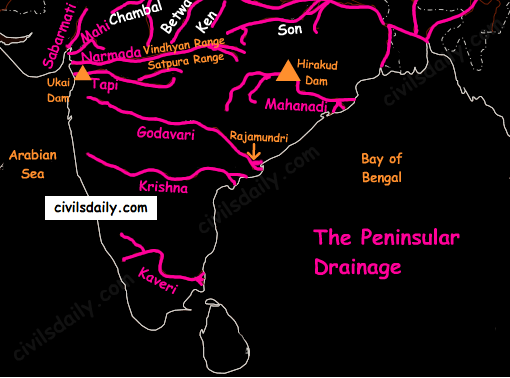
The East flowing rivers – the Mahanadi, the Godavari, the Krishna and the Cauvery flow eastwards and drain into the Bay of Bengal. These rivers make deltas at their mouths.
The West flowingrivers:
Narmada and Tapi along with other small rivers originating from the Western Ghats and falling in the Arabian Sea form estuaries in place of deltas. This is due to the fact that these rivers, especially Narmada and Tapi, flow through hard rocks and are not able to form distributaries before they enter the sea.
Although these west flowing rivers of Sahyadri form only about 3% of the areal extent of basins of India, they contain about 18% of the country’s water resources.
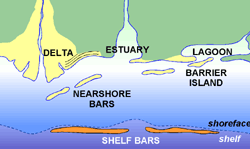
Wondering what is the difference between a delta and an estuary? Let’s see:
The Western Ghats running close to the western coast act as a water divide between the major Peninsular Rivers discharging their water in the Bay of Bengal and the small rivulets joining the Arabian Sea.
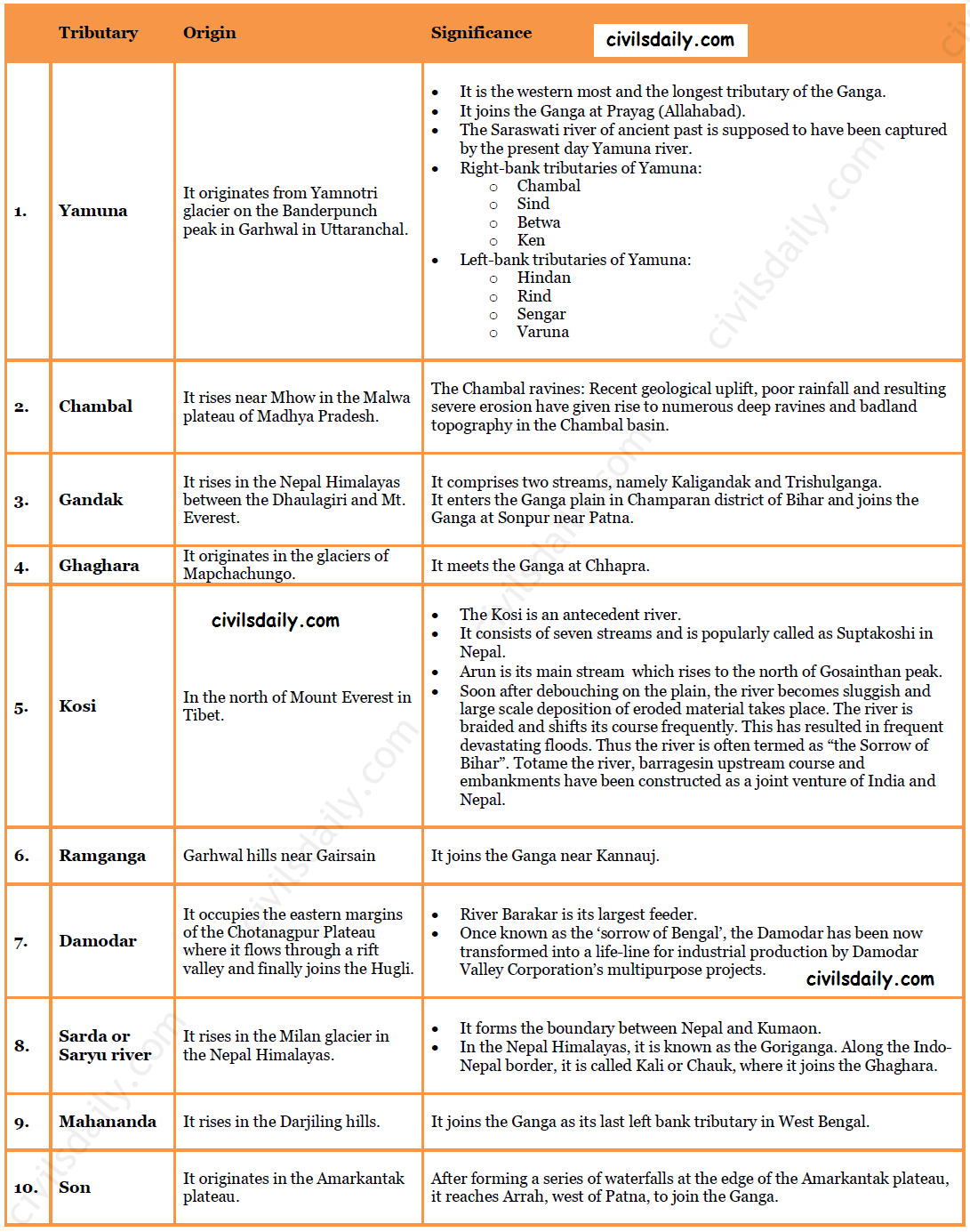
The Chambal, the Sind, the Betwa, the Ken, the Son, originating in the northern part of the Peninsula belong to the Ganga river system.
The Peninsular rivers are characterized by fixed courses, absence of meanders and non-perennial flow of water. The Narmada and the Tapi which flow through the rift valley are, however, exceptions.
The Peninsular Drainage
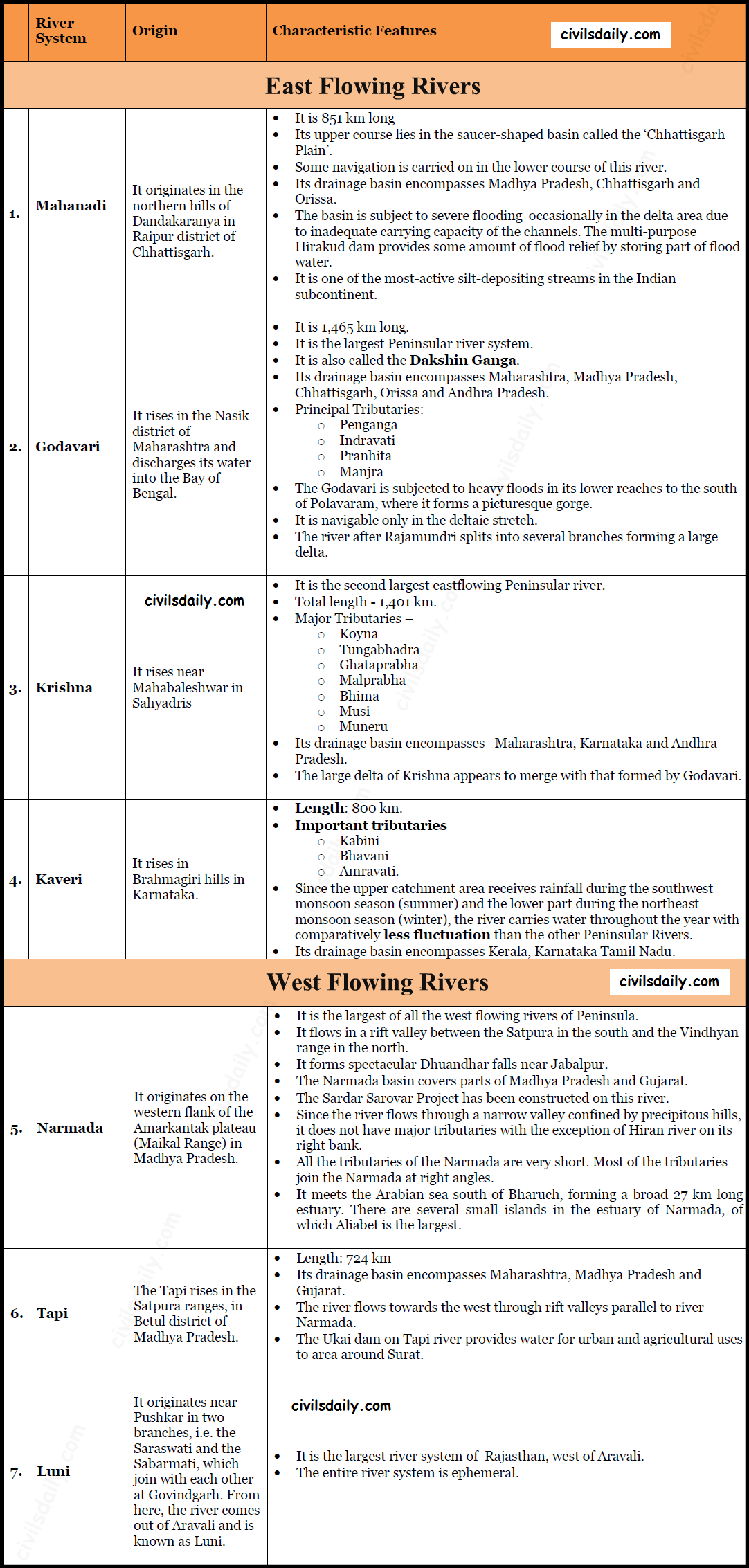
A brief account of the major Peninsular river systems is given below:
Major Peninsular River Systems
Smaller rivers flowing Towards the West:
The rivers flowing towards the Arabian Sea have short courses ( Because their origins lie closer to the sea, and the Western Ghats act as a water divide). Several of these small rivers are important for the production of hydroelectricity because of steep slopes and waterfalls.
Gujarat:
The Shetruniji – It rises near Dalkahwa in Amreli district.
The Bhadra – It originates near Aniali village in Rajkot district.
The Dhadhar rises near Ghantar village in Panchmahal district.
Sabarmati
Mahi
Maharashtra:
The Vaitarna rises from the Trimbak hills in Nasik district
The Kalinadi rises from Belgaum district and falls in the Karwar Bay.
The source of Bedti river lies in Hubli Dharwar and traverses a course of 161 km.
The Sharavati is another important river in Karnataka flowing towards the west. The Sharavati originates in Shimoga district of Karnataka and drains a catchment area of 2,209 sq. km. The famous Jog or Gersoppa Falls (289m) made by Sharavati river are the highest untiered waterfalls in India.
Goa:
Mandovi
Juari
Kerala:
Bharathapuzha – It is the largest river of Kerala. It is also known as Ponnani. It originates from Annamalai hills and flows into the Arabian Sea at a place called Ponnani.
The Periyar – It is the longest and the second largest river of Kerala. [Largeness of a river is related to its basin size and the volume of water flowing in the river. At the same time when we say that a river is the longest, it means that we are referring to its geographical length]
The Pamba river – It falls in the Vembanad lake.
Small Rivers Flowing towards the East:
There are small rivers which join the Bay of Bengal, though small, these are important in their own right.
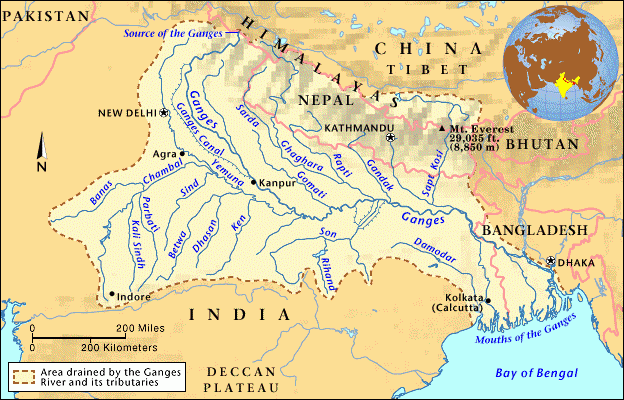
The Ganga river system is the largest in India having a number of perennial and non-perennial rivers originating in the Himalayas in the north and the Peninsula in the south, respectively. It accounts for 26.3% of the geographical area of the country and is shared by ten states.
Ambala is located on the water divide between Indus and Ganga.
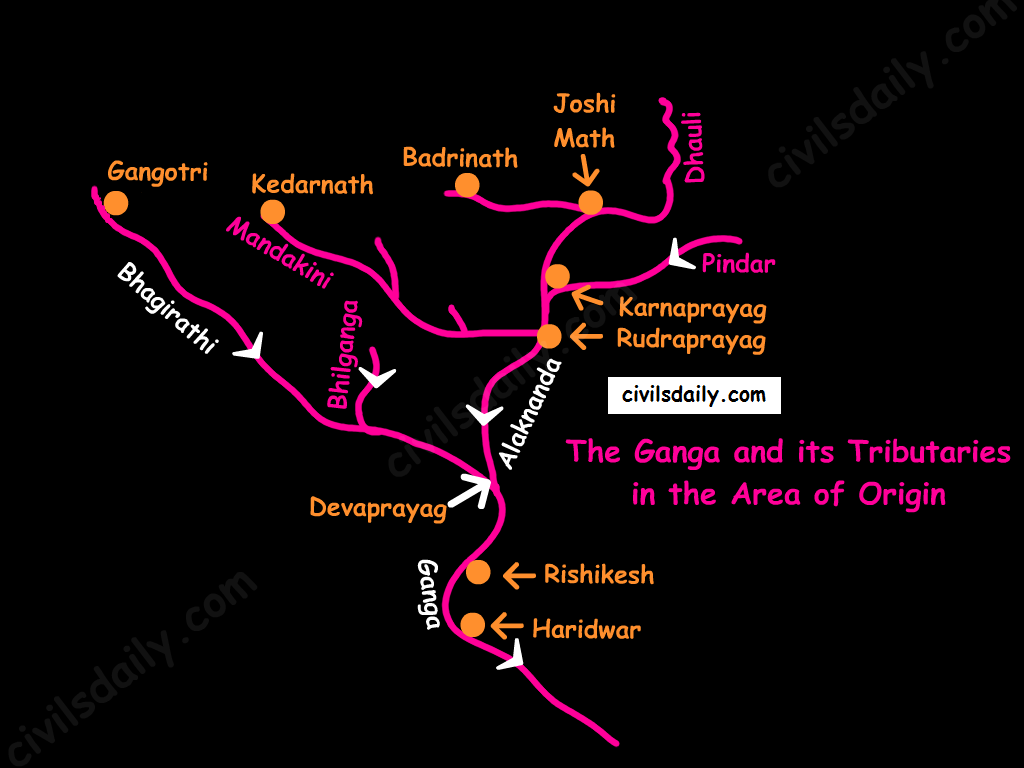
Origin: It rises in the Gangotri glacier near Gaumukh in the Uttarkashi district of Uttaranchal. Here, it is known as the Bhagirathi. At Devprayag, the Bhagirathi meets the Alaknanda; hereafter, it is known as the Ganga.
The Ganga and its Tributaries in the Area of Origin
The river-course:
The Ganga enters the plains at Haridwar.
From here, it flows first to the south, then to the south-east direction to reach Allahabad. Here it is joined by the Yamuna.
Further, near Rajmahal hills, Ganga turns south-east and bifurcates at Farakka into Bhagirathi – Hugli in West Bengal and as the Padma in Bangladesh.
The river finally discharges itself into the Bay of Bengal near the Sagar Island.
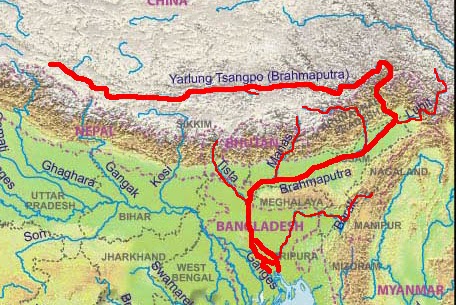
Origin: The Brahmaputra has its origin in the Chemayungdung glacier of the Kailash range near the Mansarovar lake. Mariam La separates the source of the Brahmaputra from the Manasarovar Lake.
The river-course:
Most of the course of the Brahmaputra lies in Tibet, popularly known as Tsangpo. It flows eastwards parallel to the Himalayas. It receives a large number of tributaries in Tibet. The first major tributary is the Raga Tsangpo meeting the Tsangpo near Lhatse Dzong.
After reaching Namcha Barwa, it takes a “U” turn (also known as Hair Pin turn) and enters India west of Sadiya town in Arunachal Pradesh through the deep Dihang or Siang gorge of Himalayas. Here initially it is called as Siang and then as Dihang.
It is joined by Dibang, Lohit, Kenula and many other tributaries and finally forms the Brahmaputra in Assam.
It then enters into Bangladesh near Dhubri and flows southward. In Bangladesh, the Tista joins it on its right bank from where the river is known as the Jamuna. [Note: The Tista was a tributary of the Ganga prior to the floods of 1787 after which it diverted its course eastwards to join the Brahmaputra.]
The Jamuna and Ganga confluence at Goalundo and afterwards are called as the Padma. Further south, Padma is joined by Meghna (Barak river in India) and thence onward it is known as Meghna to finally merge in the Bay of Bengal.
It is called:
The Tsangpo in Tibet ( Tsangpo = ‘the purifier.’)
The Brahmaputra in India
The Jamuna in Bangladesh
Major left bank tributaries:
Burhi Dihing,
Dhansari (South)
Kalang
Major right bank tributaries:
Subansiri ( It has its origin in Tibet and is an antecedent river.)
Kameng
Manas
Sankosh
Characteristic Features:
River Brahmaputra is a little longer than the river Indus.
It forms a spectacular Grand Canyon – like canyon in Tibet.
The river is nearly 16 km wide at Dibrugarh and forms many islands, the most important of which is Majuli. Majuli is the world’s largest riverine island and India’s first island district.
The Brahmaputra has a braided channel. It carries a lot of silt and there is excessive meandering.
The Brahmaputra is well-known for floods, channel shifting and bank erosion. This is due to the fact that most of its tributaries are large, and bring large quantity of sediments owing to heavy rainfall in its catchment area.
1. On the basis of discharge of water – the Arabian Sea drainage and the Bay of Bengal drainage:
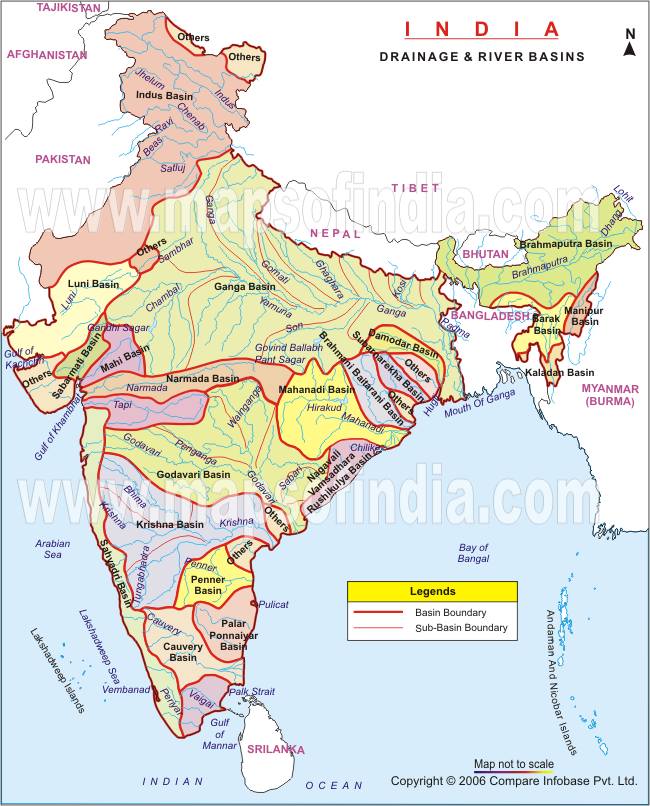
On the basis of discharge of water (orientations to the sea), the drainage system of India may be grouped into:
the Arabian Sea drainage
the Bay of Bengal drainage
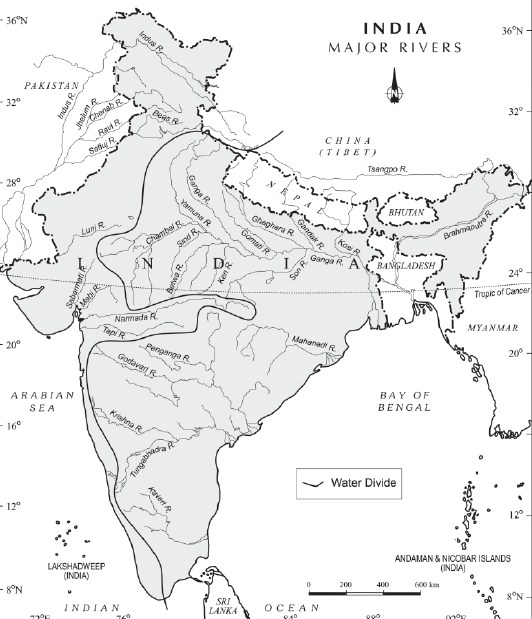
They are separated from each other by the Delhi ridge, the Aravalis and the Sahyadris (water divide is shown by a line in the following map).
Source: NCERT
Nearly 77 percent of the drainage area consisting of the Ganga, the Brahmaputra, the Mahanadi, the Krishna, etc. is oriented towards the Bay of Bengal while 23 percent comprising the Indus, the Narmada, the Tapi, the Mahi and the Periyar systems discharge their waters in the Arabian Sea.
1. Rivers of the inland drainage basin (endorheic basin): When a river does not reach the sea but disappears into the sand, such a region is called an area of inland drainage. Inland drainage streams are ephemeral streams (short-lived). E.g.:
The Ghaggar river in Haryana, which is supposed to be remnant of the proverbial ancient Saraswati river, gets lost in dry sands near Hanumangarh in Rajasthan.
The Luni river in Rajasthan originates near Ajmer and after flowing through Thar desert gets lost in the Rann of Kutch.
The Aksai Chin region in Ladakh too has some inland drainage.
2. On the basis of the size of the watershed:
Major river basins – with more than 20,000 sq. km of catchment area. It includes 14 drainage basins such as the Ganga, the Brahmaputra, the Krishna, the Tapi, the Narmada, the Mahi, the Pennar, the Sabarmati, the Barak, etc.
Medium river basins – with catchment area between 2,000-20,000 sq. km incorporating 44 river basins such as the Kalindi, the Periyar, the Meghna, etc.
Minor river basins – with catchment area of less than 2,000 sq. Km, these include 55 river basins.
3. On the basis of the mode of origin, nature and characteristics:
The Himalayan drainage, and
The Peninsular drainage.
There is no clear-cut line of demarcation between these two drainage systems, as many of the peninsular rivers like the Chambal, Betwa, Sind, Ken and Son are much older in age and origin than the Himalayan rivers.
Let’s follow this line of classification and look at the drainage system of India in detail. We begin with the Himalayan drainage.
The Himalayan Drainage system:
It consists of the rivers originating in the Himalayan and trans-Himalayan region. It further consists of three river systems namely:
the Ganga,
the Indus, and
the Brahmaputra river systems.
Since these are fed both by the melting of snow and precipitation, rivers of this system are perennial.
The various geographical features made by the Himalayan rivers are:
In upper reaches (Youthful stage): Gorges, V-shaped valleys, rapids, waterfalls, truncated spurs etc.
In plain areas or middle part (Mature stage): While entering the plains, they form depositional features like flat valleys, ox-bow lakes, flood plains, braided channels, and deltas near the river mouth. Over the plains, they display a strong meandering tendency and shift their courses frequently.
Evolution of the Himalayan Drainage System:
There is a difference of opinion about the evolution of the Himalayan Rivers. However, geologists believe that:
A mighty river called Shiwalik or Indo-Brahma traversed the entire longitudinal extent of the Himalaya from Assam to Punjab and onwards to Sind, and finally discharged into the Gulf of Sind near lower Punjab during the Miocene period some 5-24 million years ago.
Evidences: The remarkable continuity of the Shiwalik and its lacustrine origin and alluvial deposits consisting of sands, silt, clay, boulders and conglomerates support this viewpoint.
It is opined that in due course of time Indo–Brahma river was dismembered into three main drainage systems:
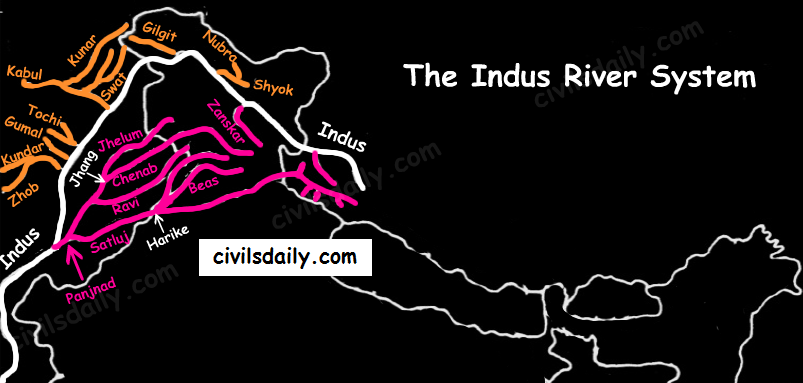
the Indus and its five tributaries in the western part;
the Ganga and its Himalayan tributaries in the central part; and
the stretch of the Brahmaputra in Assam and its Himalayan tributaries in the eastern part.
The dismemberment was probably due to the Pleistocene upheaval in the western Himalayas, including the uplift of the Potwar Plateau (Delhi Ridge), which acted as the water divide between the Indus and Ganga drainage systems.
Likewise, the downthrusting of the Malda gap area between the Rajmahal hills and the Meghalaya plateau during the mid-pleistocene period, diverted the Ganga and the Brahmaputra systems to flow towards the Bay of Bengal.
Let’s take up the three major river systems of the Himalayan drainage individually:
1. The Indus River System
It is one of the largest river basins of the world. A little over one-third of the Indus basin is located in India; in the states of Jammu & Kashmir, Himachal Pradesh and Punjab. The rest of the portion is in Pakistan.
The Indus also known as the Sindhu, is the westernmost of the Himalayan rivers in India.
Origin: It originates from a glacier near Bokhar Chu in the Kailash Mountain range (Tibetan region). In Tibet, it is known as ‘Singi Khamban; or Lion’s mouth.
The river-course:
The Indus cuts through Himalayas and enters India near Damchok.
flows in India only through the Leh district in Jammu and Kashmir.
It enters into Pakistan near Chillar in the Dardistan region through a deep gorge near the hair-pin bend of Nanga Parbat.
It finally discharges into the Arabian Sea, east of Karachi.
The right-bank tributaries of Indus:
Shyok
Gilgit
Hunza
Nubra
Kabul
Khurram
Tochi
Gomal
Sangar
Kunar
The left-bank tributaries of Indus:
Zaskar
‘Panjnad’ joins Indus a little above Mithankot). The Panjnad is the name given to the five rivers of Punjab, namely:
Satluj
Beas
Ravi
Chenab
Jhelum
Chief Characteristics:
The Indus drains the largest number of glaciers of Himalayas, Ladakh, Zaskar, and Kailash.
The Indus plain has a very gentle slope.
Indus and its Tributaries
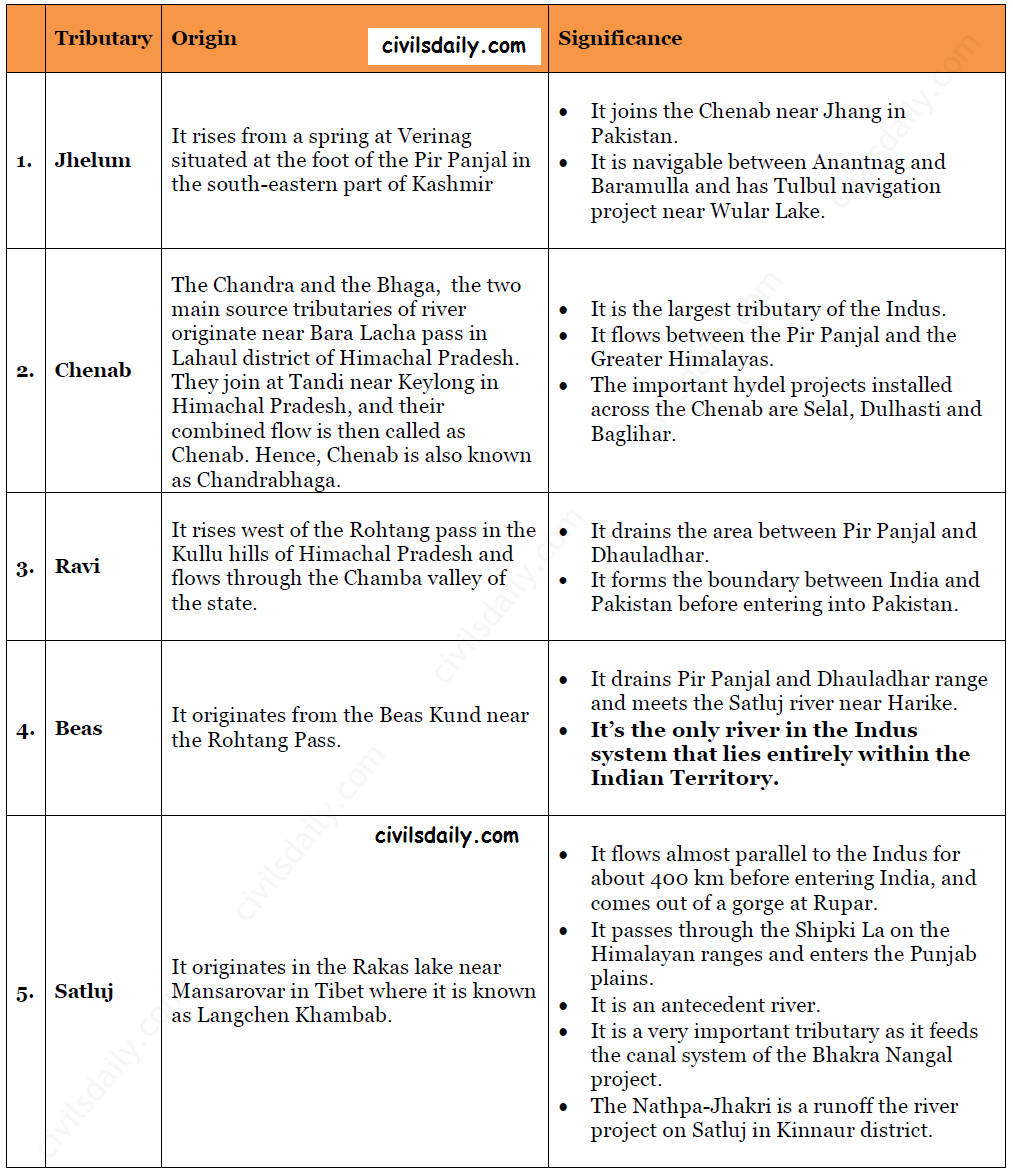
Let’s look at some important tributaries of Indus:
Important Tributaries of Indus and their Characteristic Features
The Indus water treaty:
The waters of the Indus river system are shared by India and Pakistan according to the Indus Water Treaty signed between the two countries on 19th September 1960. According to this treaty, India can utilise only 20 percent of its total discharge of water. The Indus water treaty was recently in news. Remember why? Read here!
Area of interest: North India, Central India, and South India.
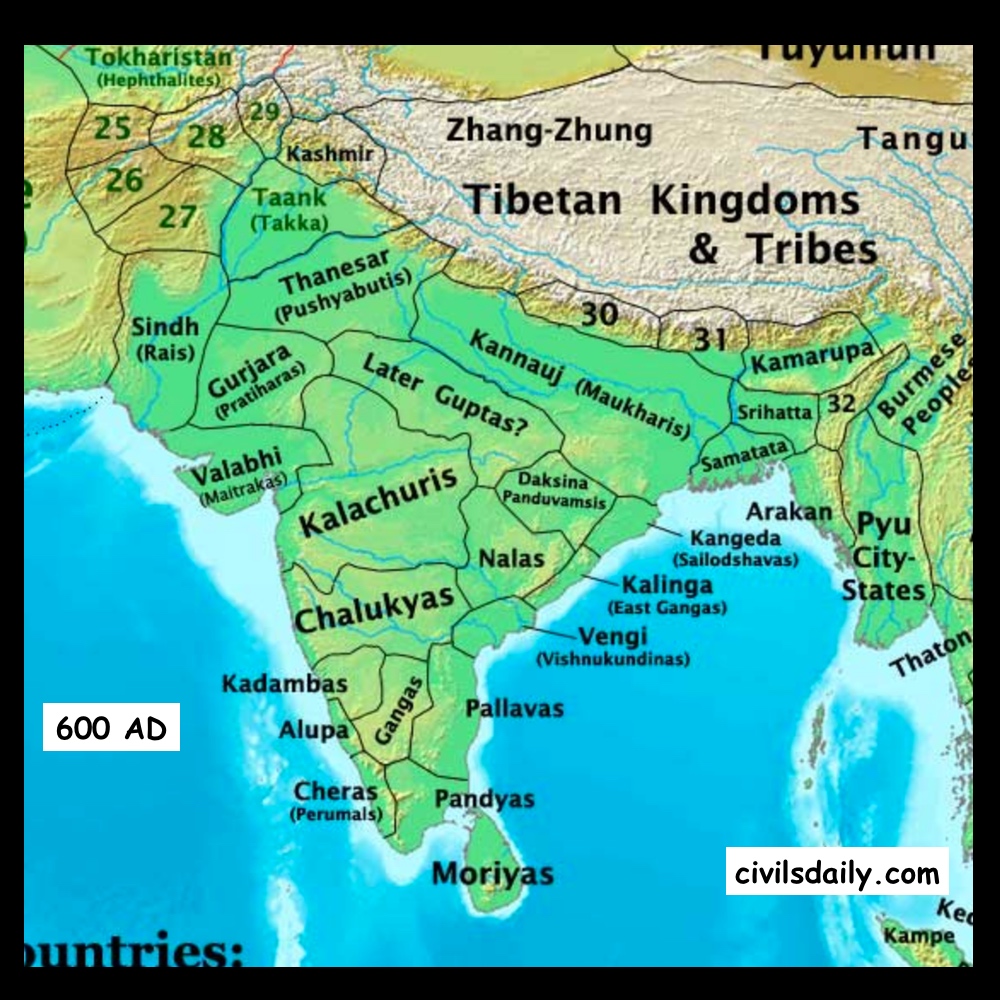
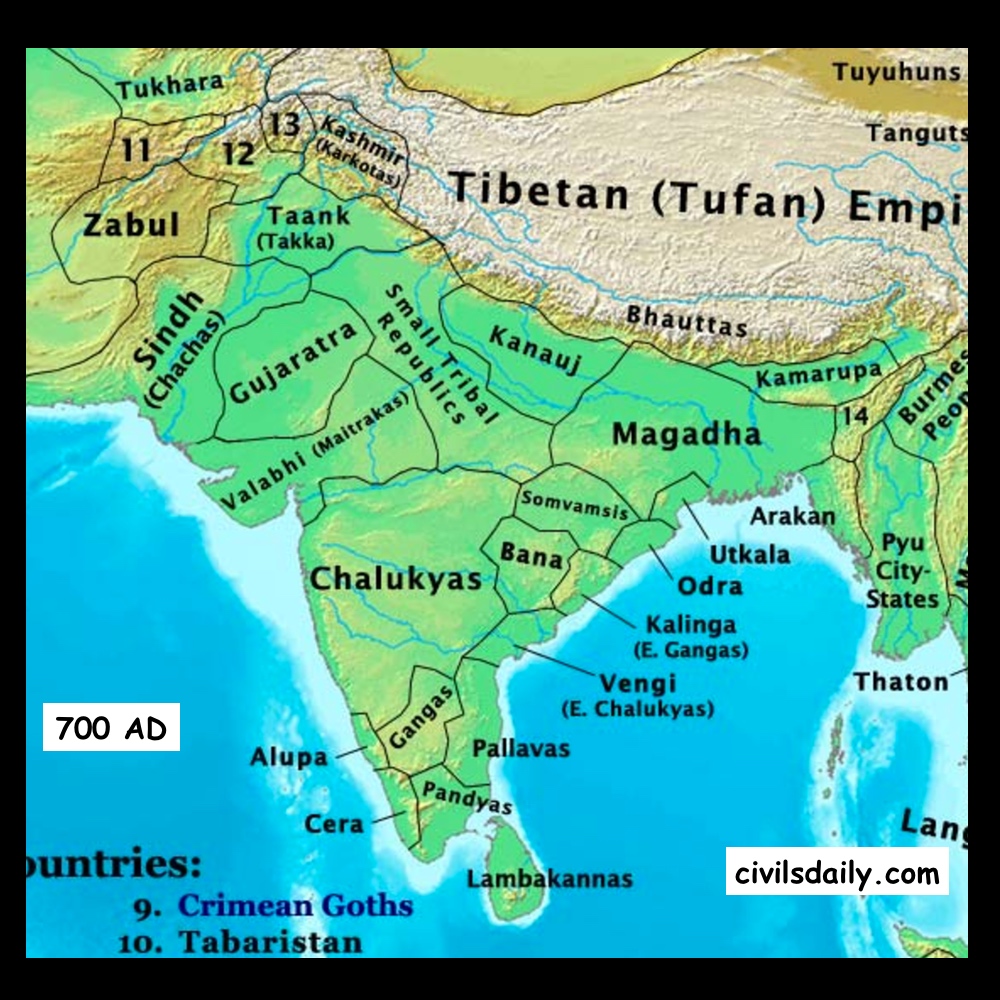
After the decline of Harsha’s empire, a number of large states rose in North India, Deccan, and South India. 3 of the most prominent among these were – the Palas, the Pratiharas, and the Rashtrakutas.
NORTH INDIA
The political confusion created by the fall of Harshavardhana was resolved with the rise of Gurjara-Pratiharas in Central India and Palas in the East.
I. Political Background
-The Pala empire founded by Gopala around 750 AD. They were majorly a power in Bihar but also ruled over Bengal.
-The Pratiharas ruled from Kanauj and often clashed with the Palas and the Rashtrakutas giving rise to what is known as the ‘tripartite struggle’.
II. Literature and Language
Work
Author
Type
Theme
Patronage
Ramacharitam
Sandhyakaranandin
Sanskrit Epic poem
Complex composition as each verse offers two meanings. One related to Ramachandra of Ayodhya and the other about Pala ruler Ramapala
Pala Empire
III. Religion
The changes introduced in the preceding era (300 AD – 600 AD) continued.
A. Hinduism
The popularity of Brahmanical bhakti cult increased. Vaishnavism and Saivism rose to popularity due to sustained patronage from dynasties.
B. Buddhism
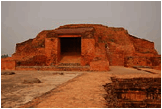
Hiuen Tsang and Ijing’s accounts testify the decline of Buddhism. However, Buddhism flourished in Eastern India under the Pala and Sena dynasties. Nalanda University and few other universities continued to prosper under their patronage.
Other Famous Buddhist Universities
Location
Vikramasila
Bihar
Odantapuri
Near Nalanda, Bihar
Somapuri
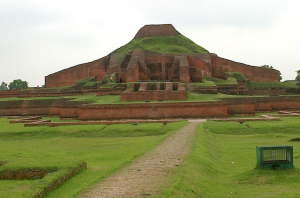
Paharpur, Bangladesh
The above sites were centers of Mahayana Buddhism. With the turn of millennium, new elements to existing Mahayana practices were introduced, namely complex and esoteric Tantric ideas and practices. One major outcome was growing visibility of female deities, particularly Tara in diverse forms. This introduced complex rituals often oriented to sexual practices.
C. Jainism
Not much support was found in the North and Jainism was fading in the North.
IV. Architecture
A. Mahavira in Paharpur, Bengal(now Bangladesh)
Know for its crucifix (cross shaped) basement plan.
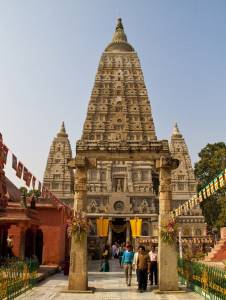
B. Mahabodhi Temple, Bodhgaya
The temple itself as it stands now is largely a Colonial Period reconstruction of the old 17th century design but many sculptures in the niches in the temple are dated to the 8th century Pala Period.
The first shrine, located at the base of the Bodhi tree, is said to have been constructed by King Ashoka; the vedika around it is said to be post-Mauryan, of about 100 BCE;
Known for its unusual design. It is, strictly speaking, neither Dravida nor Nagara – it is narrow like a Nagara temple, but it rises without curving, like a Dravida one.
C. Monasteries
Vikramasila university was established by king Dharampal. Nalanda University was renovated. Most of these buildings have vanished.
The monasteries were imposing rectangular buildings, each with an open courtyard, enclosed by a covered verandah which leads into cells, arranged on the four sides.
Nalanda University
Vikramsila University
V. Art
A. Sculptures – Pala School of sculpture
Derives its features from, both, the Sarnath and the Mathura schools
Detailed sculptures but delicate ornamentation.
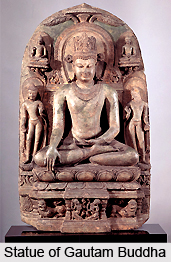
Back-slabs are a unique feature of the sculptures.
Has many sub-schools. 2 most important are Nalanda school and Bodhgaya School.
Nalanda School of sculpture
Art from stucco, stone and metal(most specifically bronze).
Synthesis between the Sarnath school from the Gupta period and the local bihar tradition.
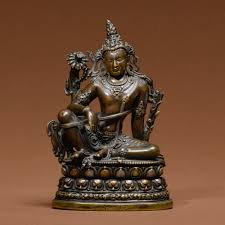
Nalanda bronzes
Remarkable bronze is a 4-armed avalokiteshwara which is a good eg. of male form in tribhanga
Images of Tara became very popular. Growing curvilinear lotus stalk and her right hand in Abhaymudra.
Bodhgaya School of sculpture
Has elements from the Matura school.
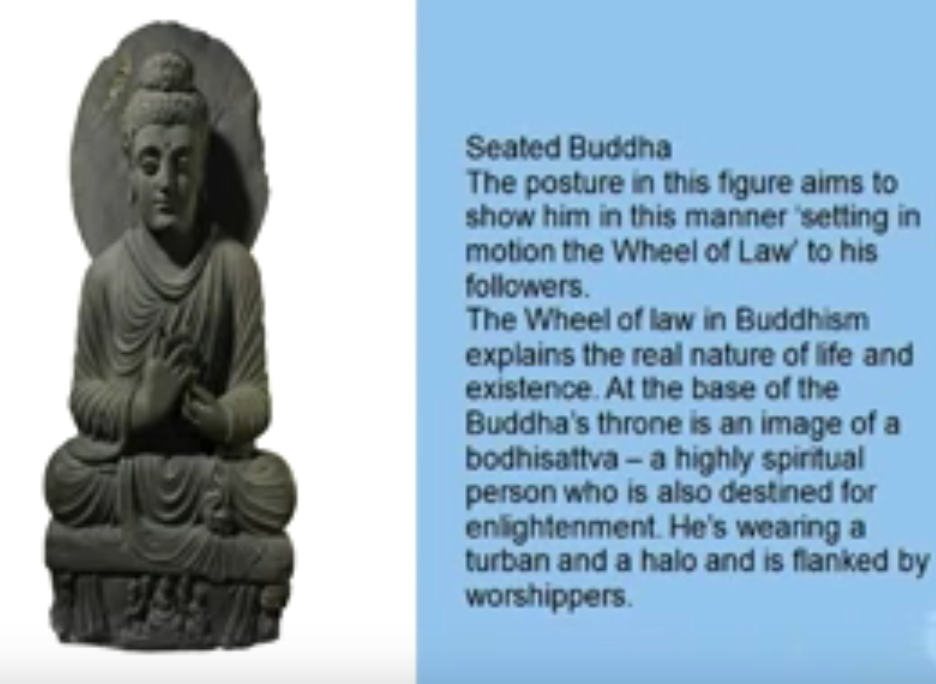
Seated Buddha
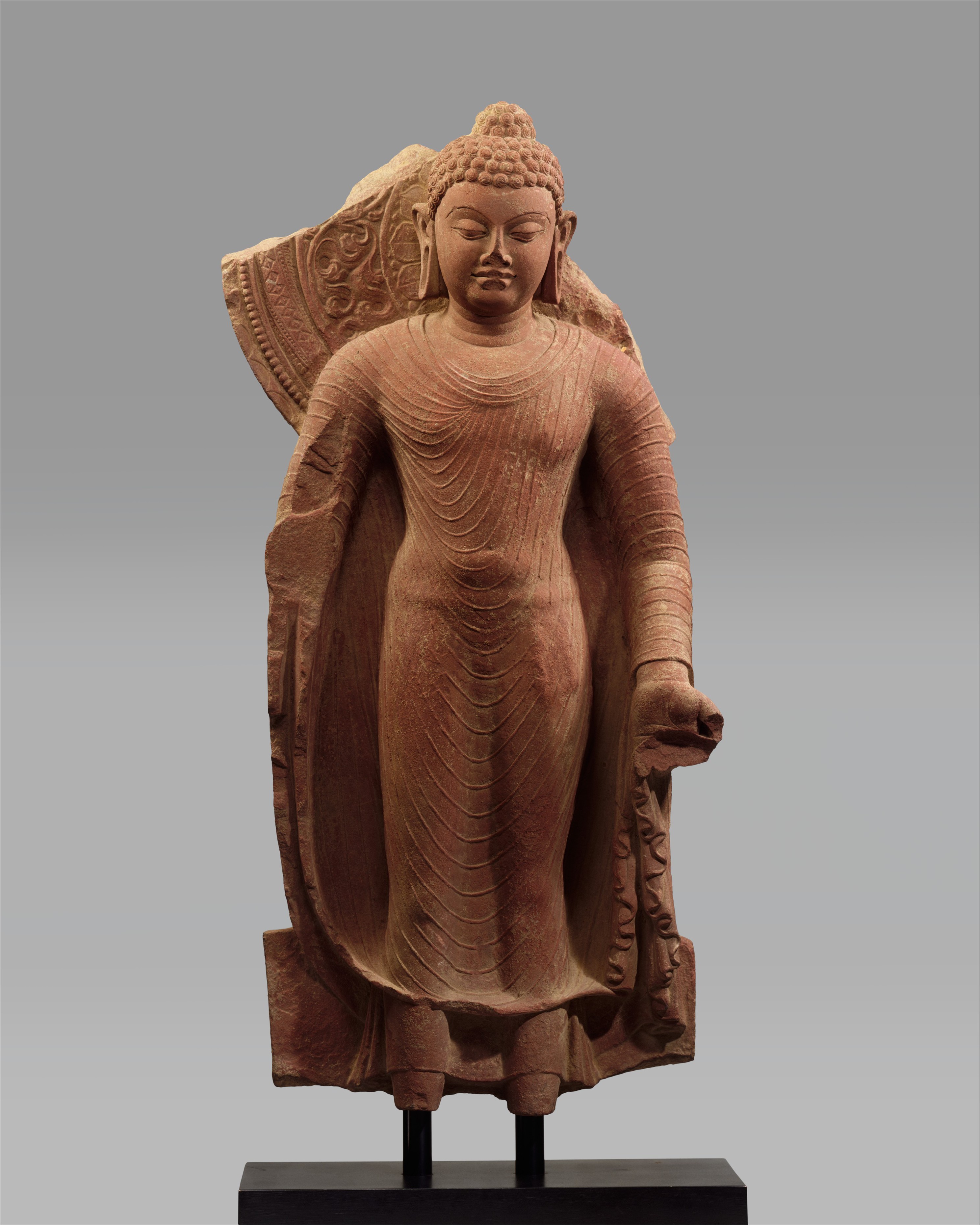
Standing image of Buddha broken off at mid thighs
Elongated halo with the flame like motif around its perimeter.
B. Paintings – Pala School of painting
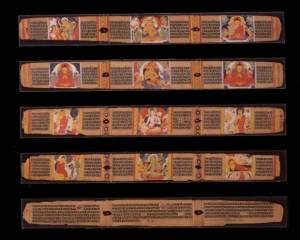
The earliest examples of miniature painting in India were executed under the Palas.
These paintings are found in Bengal and Bihar region, mostly produced in the buddhist centers of learning like Nalanda, Vikramsila, etc.
Were initially done on palm leaves while later we see a shift towards painting on
Buddhism remained the chief subject. Besides Buddhism, few paintings were dedicated to Hinduism.
Scenic paintings like that of banana and coconut trees are also seen prominently.
The Pala painting is characterized by sinuous lines and subdued tones of color.
It is a naturalistic style that resembles the ideal forms of contemporary bronze and stone sculpture and reflects some feeling of the classical art of Ajanta.
The Pala art came to a sudden end after the destruction of the Buddhist monasteries at the hands of Muslim invaders in the first half of the 13th century.
Ashtasahasrika-Prajnaparamita is a very popular manuscript. 5 leaves from the manuscript are shown below.
CENTRAL INDIA
I. Political Background
The Rashtrakutas dynasty was founded by Dantidurga in 754 AD with its capital in Malkhed, Maharastra. Their rule continued till the end of the 10th Century.
II. Literature and Language
This period saw the development of Kannada and Sanskrit. The trinity poets of this time – Pampa, Ranna, and Ponna made immense contributions to Kannada.
Literary contributions were few under the Rashtrakutas.
Work
Author
Type
Theme
Patronage
Kavirajamarga
Amoghavarsha I
Poetic Works
Earliest work in Kannada
Rashtrakutas
III. Religion
The Rashtrakutas were tolerant in religious views and patronized Saivism, Vaishnavism and Jainism. The revival of Hinduism that began during the Guptas got a boost.
Though Jainism did not spread outside India like Buddhism, but continued to exist in Western India and Karnataka.
Even Muslim traders were allowed to settle and Islam was preached. Unfortunately, Buddhism saw a decline.
IV. Architecture
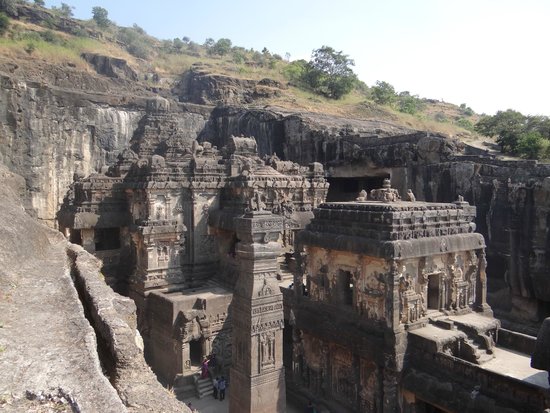
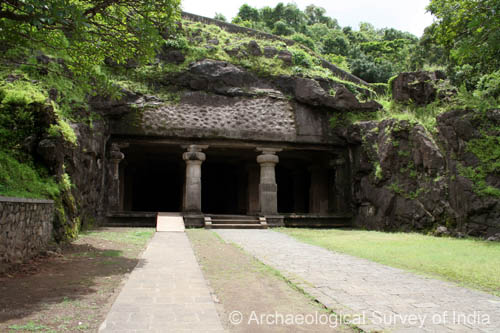
The Rashtrakutas temples are majorly rock cut. Art and architecture at Ellora and Elephanta cave temples are remarkable contributions of the Rashtrakutas.
A. Cave Temples
The vesara style reached its culmination under the Rashtrakutas. Deccan architecture shows the hybridization of Nagara and Dravidian style ie. Vesara style. These
1. Ellora – Kailashnath temple
Is located in Ellora, Maharashtra
This temple is considered the greatest achievement in Rashtrakutan architecture built under the patronage of Krishna I.
It is a rock-cut temple built in Dravidian style with a Nandi shrine.
It is carved out of a monolithic rock.
Some of these caves are dedicated to Buddhism.
2. Elephanta Caves
are a network of sculpted caves located on Elephanta Islands in Mumbai Harbour.
It has Hindu and Buddhist caves
The Hindu caves are dedicated to Lord Shiva.
The rock cut architecture of the caves has been dated to between the 5th and 8th centuries.
Designated as a UNESCO World Heritage Site.
V. Art
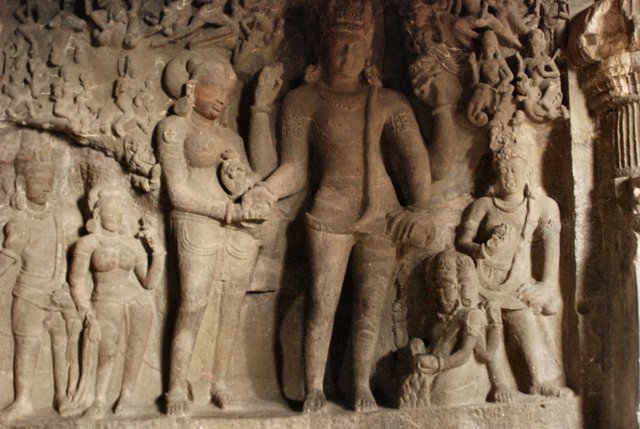
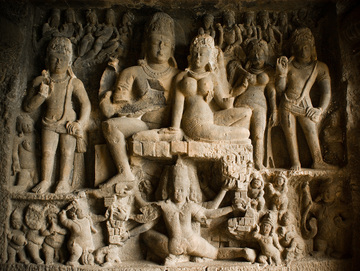
A. Ellora Caves
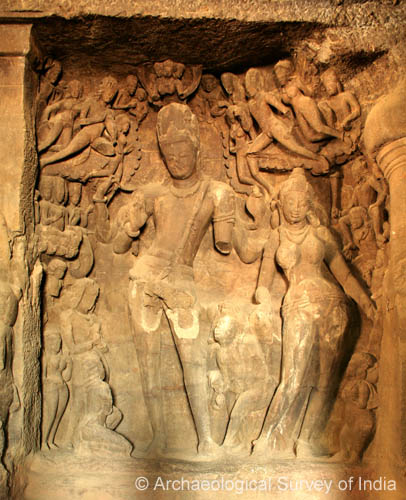
1. Shiva and Parvati’s Wedding
2. Ravana shaking the Kailash mountain
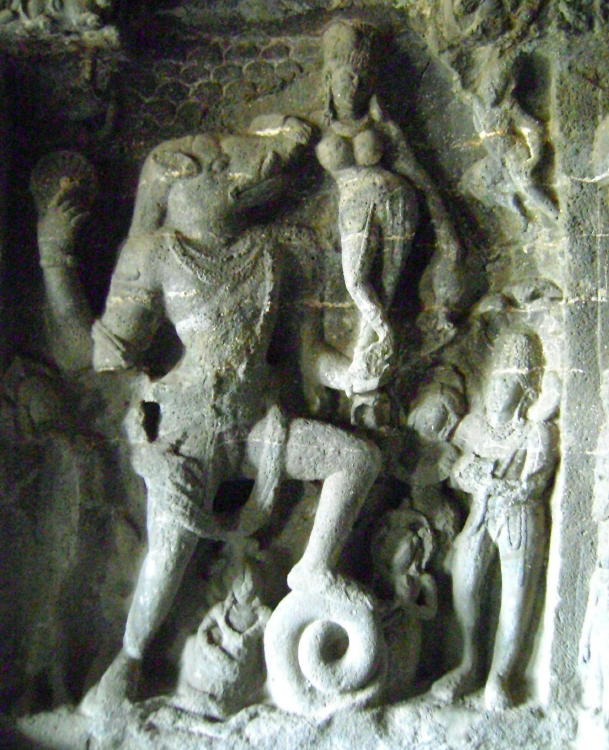
3. The Dashavatara Cave – illustrate ten incarnations of Vishnu. One being Vishnu rescuing Bhoodevi.
Other than these, Ramayana theme is well depicted in this temple.
B. Elephanta Cave Scultpures
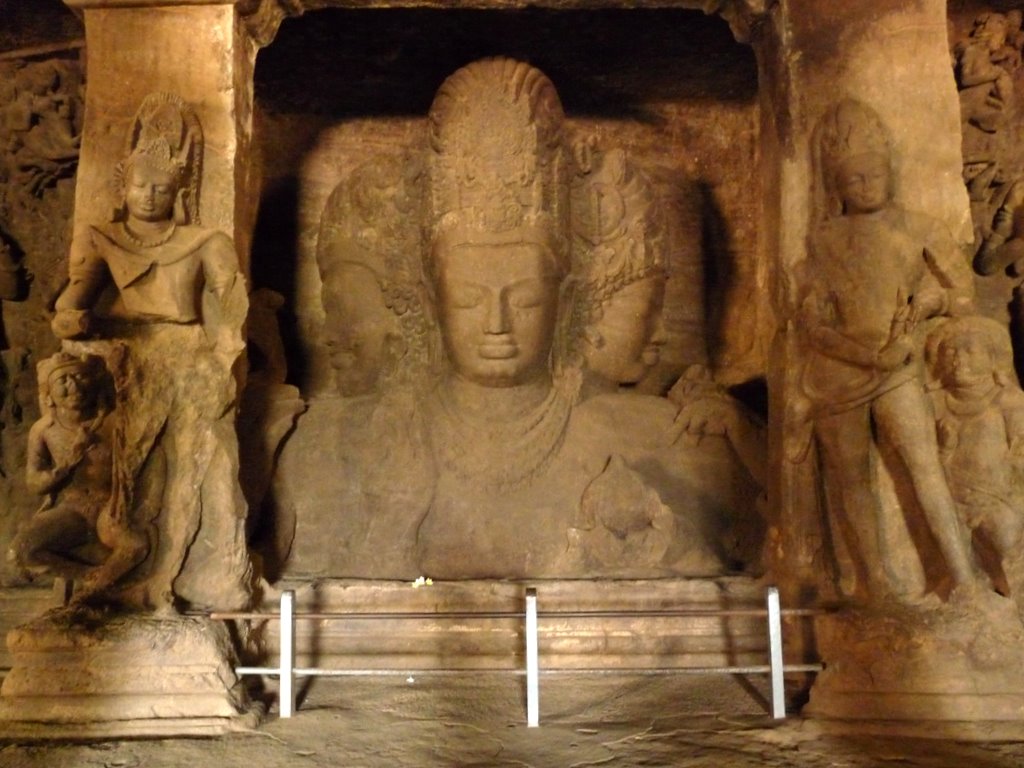
1. Trimurti
The three heads are said to represent three essential aspects of Shiva: creation, protection, and destruction
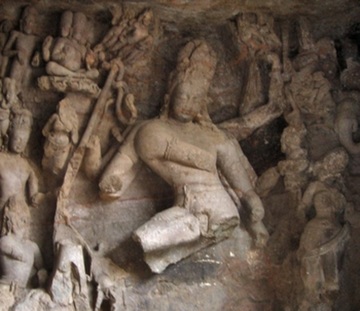
2. Gangadhara panel
Shiva as Nataraj performing the Tandava (cosmic dance).
3. Gangadhara Panel
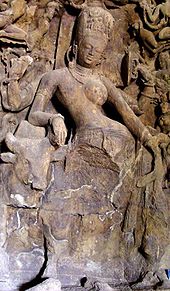
4. Ardhanarishvara Panel
Other than the above, Wedding of Shiva, Shiva slaying Andhaka and Yogisvara are other important scultures.
SOUTH INDIA
South India witnessed the weakening of the mighty Pallavas giving way to the imperial Chola Empire. Few significant works of art and architecture are as follows
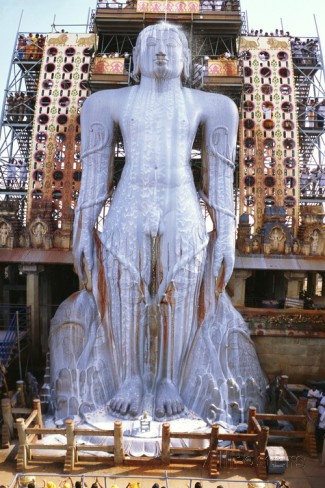
Bahubali
Bahubali , a much revered figure among Jains was the son of Rishabanath, first Jain tirthankara.
He is said to have meditated motionless for one year in a standing posture (Kayotsarga) and that during this time, climbing plants grew around his legs.
After his year of meditation, Bahubali attained omniscience (Kevala Jnana).
According to Jain texts, Bahubali’s soul was liberated from the cycle of births and deaths (moksha) at Mount Kailsh.
Bahubali is also called Gommatesha because of the Gommateshwara monolithic statue dedicated to him.
The statue was built under Ganga dynasty in Sravanabeligola in Karnataka around 981 AD.
It is one of the largest free-standing statues in the world
Area of interest: North India, Deccan India & South India
The political situation became complex with the passing away of the Guptas and the demise of the Vakataka rulers. Vassals of the Guptas became independent in the North. In the Deccan and far South too, a multiplicity of powers were witnessed.
NORTH INDIA
Political Background
Harshavardhana (590 AD to 648 AD)
The fall of the Gupta rulers paved the way for domination of the Later Guptas, Maukharis and Pushyabhutis in the North. Harsha, though a Pushyabhuti ruler of Thaneswar ruled from Kanauj, which was originally the seat of Maukharis, with whom he contracted a marriage alliance. Harsha is celebrated as last ‘Hindu’ ruler in the North post the Gupta era.
Literature and Language
Work
Author
Type
Theme
Patronage
Kadambari
Banabhatta
Romantic Sanskrit Novel
Romantic attachment between Chandrapeeda and Kadambari
Harshacharita
Banabhatta
Harsha’s biography in Sanskrit
An account of Harsha’s ancestry and his early life
Harsha
Priyadarshika
Harsha
Sanskrit play
Harsha
Nagananda
Harsha
Sanskrit play
Harsha
Ratnavali
Harsha
Sanskrit play
About a princess Ratnavali and a great King Udayan. One of the first references of Holi found in the text
Harsha
Mahaviracharita
Bhavabhuti
Sanskrit play
Based on the early life of Rama
Yashovarman of Kannauj
Malatimadhava
Bhavabhuti
Sanskrit play
The love story between Malati and Madhava
Yashovarman of Kannauj
Religion
All religions were patronized under Harshavardhana’s reign. He was a Shaivite, but later Hiuen Tsang converted him to Mahayana Buddhism.
Hiuen Tsang who visited Harshavardhana’s empire noted Buddhism was declining in India while Brahmanism was on rise.
Art and Architecture
The art and architectural contributions of Harsha’s period are very few and mostly followed the Guptas. Harshavardhana’s realm is associated with the construction of numerous stupas and monasteries. Harsha patronized Nalanda University with his liberal endowments.
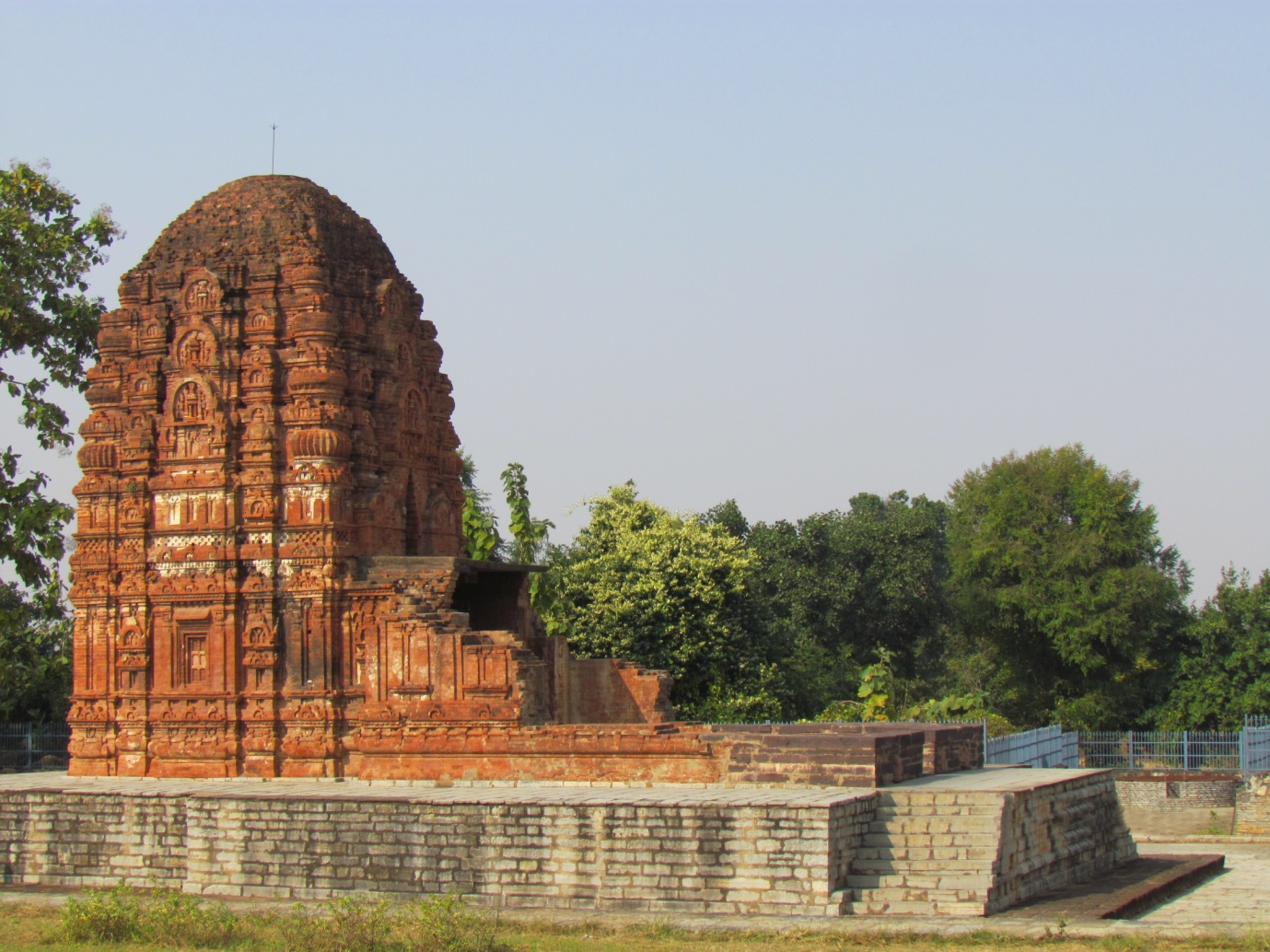
The brick temple of Lakshmana at Sirpur with its rich architecture is assigned to the period of Harsha.
Lakshamana temple, Sirpur
The Lakshamana temple is located in the village Sirpur of Chattisgarh.
It is dedicated to Lord Vishnu
DECCAN INDIA
Political Background
The late sixth century is marked by rise of Badami Chalukyas around the North Eastern part of Karnataka. The empire was founded by Pulakesin I. Pulakesin II (610 – 642 AD ) is considered the greatest ruler of the house.
Literature and Language
Work
Author
Type
Theme
Patronage
Aihole Prasasti
Ravi Kirti
Pulakesin II’s eulogy
Mentions defeat of Harshavardhana by Pulekesin II when Harsha tried expanding towards the Deccan
Pulakesin II
Vikramankadevacharitam
Bilhana
An epic in honor of Vikramaditya VI
Western Chalukyan ruler, Vikramaditya VI
Religion
Chalukyans were both Vaishanavas and Shaivites but had a greater inclination towards Vaishnavism and Jainism. Nonetheless, they patronized all religions.
Architecture
A. Caves
Cave temple architecture was also famous under the Chalukyas. Their cave temples are found in Ajanta, Ellora and Nasik.
B. Temples
Chalukyan temples are found in 3 places – Badami, Aihole and Pattadakal.
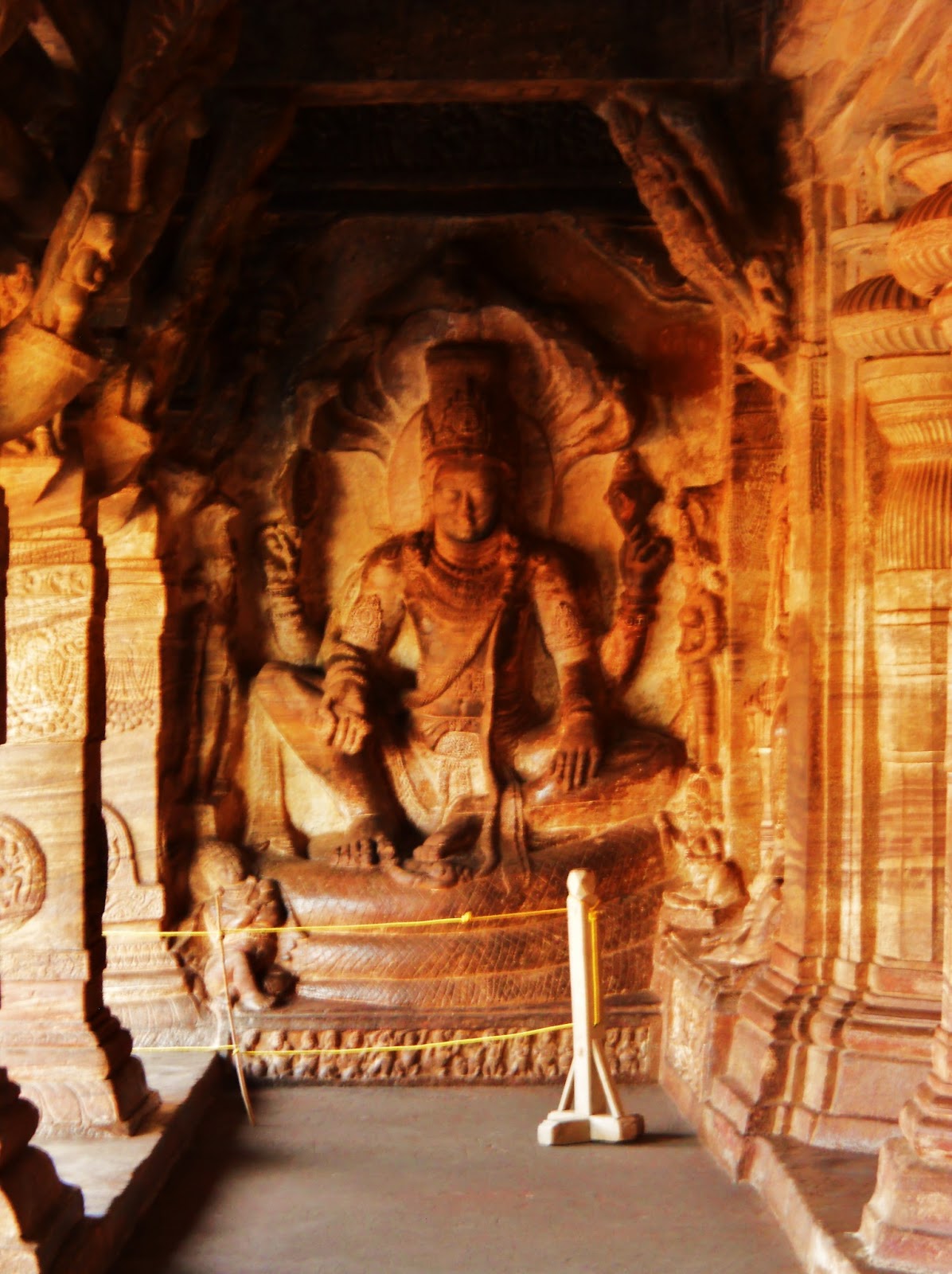
Badami – Badami cave temples are a complex of 6 temples – 4 Hindu, 1 Jain & 1 possibly Buddhist.
Cave 3 – Vishnu image
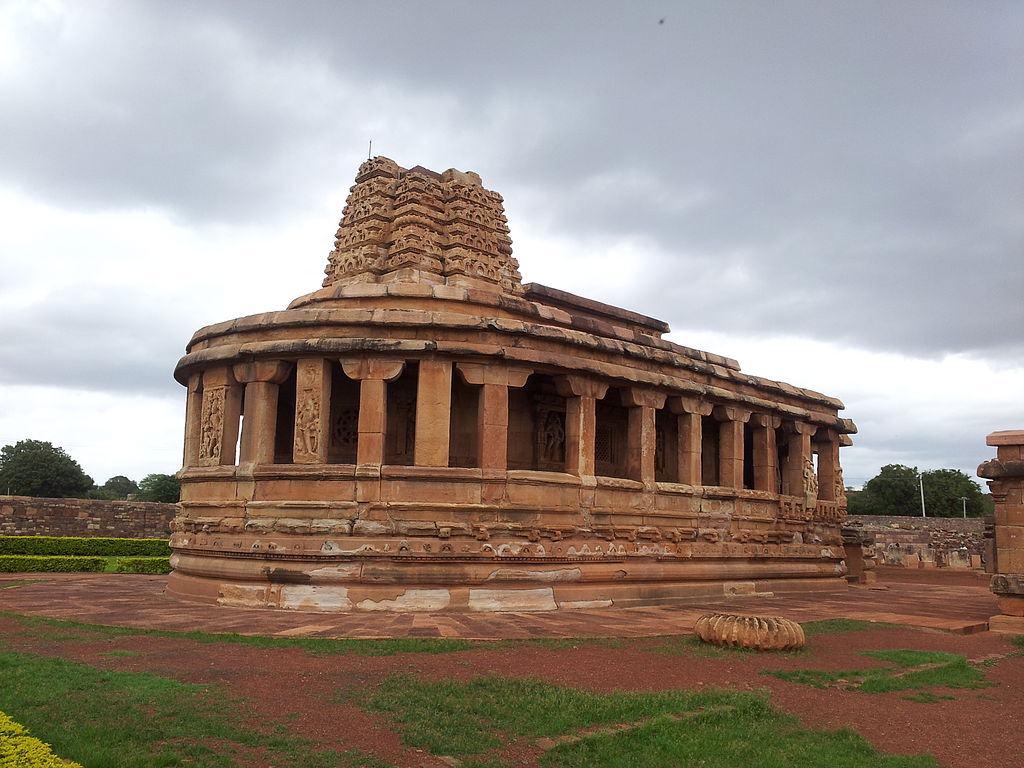
Aihole – Ladkhan temple, Durga temple and Ravana Phadi Temple
Durga temple
It is an apsidal temple of 550 AD. The apsidal shape is similar to the shape of a Buddhist chaitya.
Temple has an open pillared verandah serving as pradakshinapatha instead of a dark ambulatory path.
Temple shows improvements in shikhara development as compared to the Gupta period.
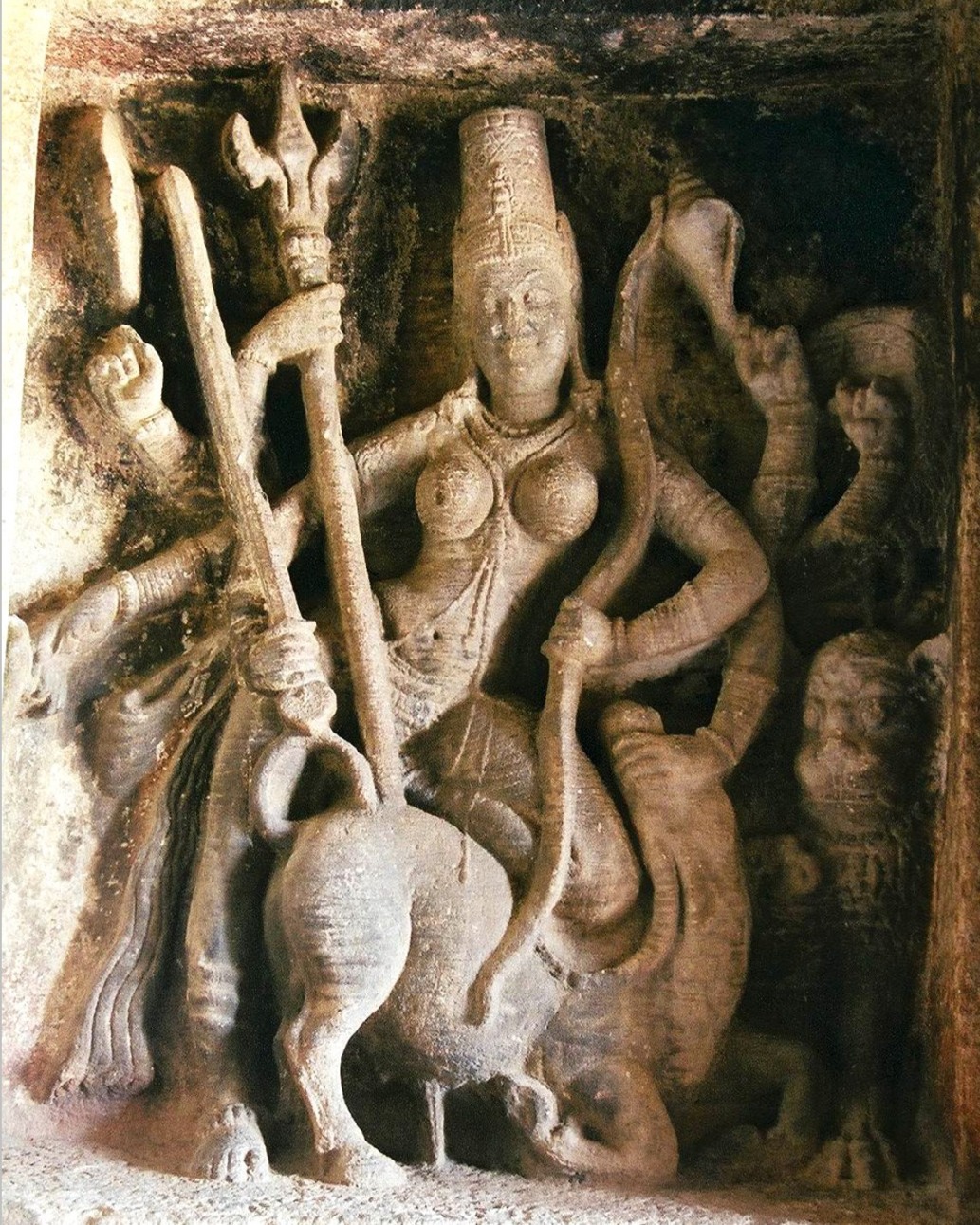
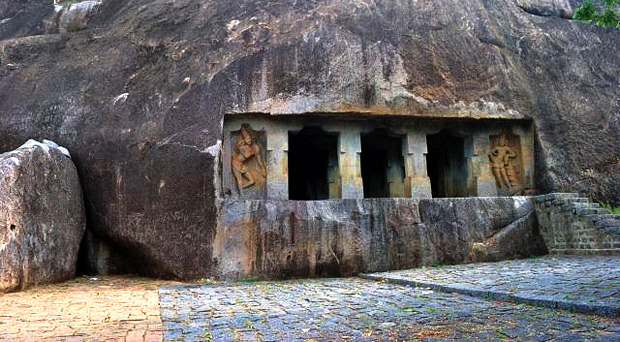
Ravana Phadi Temple
Ravana Phadi is a rock-cut cave with distinct sculptures made during the Chalukyan era.
Among numerous sculptures is the Goddess Durga is portrayed in the carving. She appears to be slaying Mahishasura (panel above).
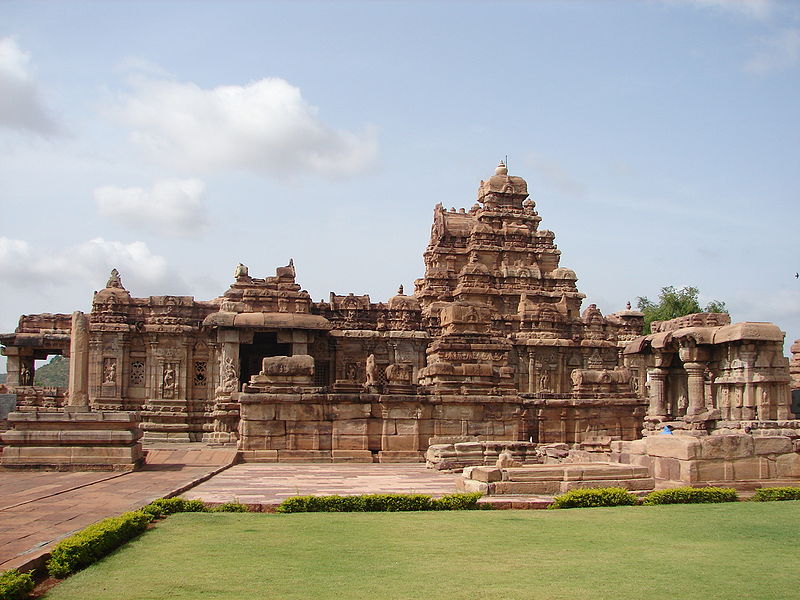
Pattadakal – This temple complex has 10 temples – 4 Dravida style, 4 in Nagara style, 1 Vesara style & 1 Jain Sanctuary. The Papanath temple is the Nagara style temple.
Virupaksha Temple
Largest and grandest temple in Pattadakal
Built in 8th Century by Queen Lokamahadevi to commemorate her husband’s (Vikramaditya II’s ) victory over Pallava ruler.
SOUTH INDIA
Political Background
The Pallavas were feudatories of the Satavahanas. After the fall of the Satavahanas in the 3rd century AD, they became independent. They ruled in the Tondaimandalam area with Kachipuram as their capital. The 7th Century marked the rise of great rulers like Mahendravarman, Narasimhavarman I and Rajasimha. The Pallava rule reached its zenith under these rulers.
Literature and Language
Work
Author
Type
Theme
Mattavilasa Prahasana
Mahendravarman I
Sanskrit
Means the ‘delight of the drunkards’. Sanskrit farse on Buddhist and Kapalika ascetics
Kiratarjuniya
Bharavi
Sanskrit
Simhavishnu
Devaram
Nayanars
Tamil
Saiva literature
Nalayradivyaprabandam
Alvars
Tamil
Vaishnava literature
Religion
The Tamil society witnessed a great change during the Pallava period.
A. Hinduism
The Brahmins occupied a high place in society. Brahmanism and Brahmins were patronized by the rulers. The Pallava period witnessed the rise of Saivism and Vaishnavism.
Bhakti Cult
The Saiva Nayanmars and the Vaishnava Alwars contributed to the growth of Saivism and Vaishnavism. Apar and Sambandar were Shaivite bhakti saints who contributed immensely to the growth of Shaivism.
B. Buddhism and Jainism
Increased patronage of Hinduism and revival by the Bhakti movement led to the decline of Buddhism and Jainism.
Architecture
A. Temples
This era is significant for temple building activities as the Dravidian style of temple architecture began. The Pallavas introduced the art of excavating temples out of rocks. We see a gradual evolution starting from the cave temples to monolithic rathas which culminated in structural temples. The development of temple architecture under the Pallavas can be seen in 4 stages.
Stage I – Mahendra phase
This stage sees the development of Pallava rock-cut temples under Mahendravarman I. They were built in many places. The most important among them are Pallavaram, Mamandur, Mahendravadi, Vallam and Thalavanur.
Pallavaram Caves
Stage II – Mamallapuram phase
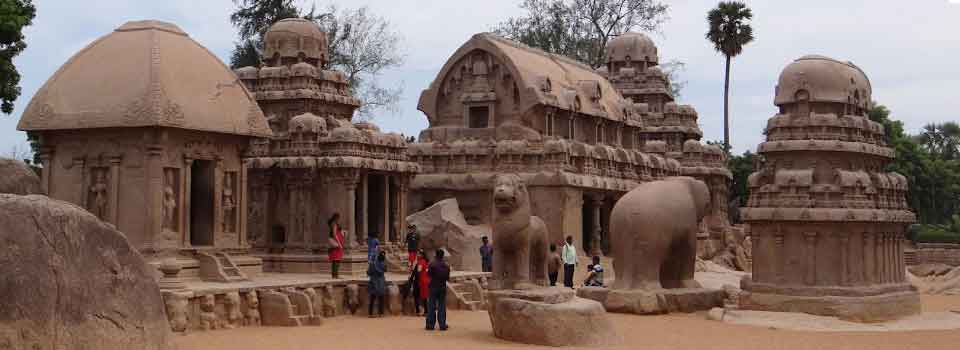
The second stage of Pallava architecture is represented by the monolithic rathas and mandapas found at Mamallapuram (Mahabalipuram). The name ‘Mammalapuram’ is derived from Narshimahavarman’s name ‘Mamalla’ which means the ‘great wrestler’.
There are 5 Rathas – Dharmaraj Ratha, Bhim Ratha, Arjuna Ratha, Draupadi Ratha, Nakul Sahdev. These rathas, popularly called as the Panchapanadava rathas, signify 5 different styles of temple architecture. Dharmaraja Rath is the largest and it’s considered a precursor for the Dravidian style.
Rathas of Mahabalipuram
The South saw the emergence of Dravida style of architecture. Earliest Dravida style is visible at Mahabalipuram where during the Pallava period were constructed different rock cut structures called rathas.
Main shrine has a square ground plan
The superstructure above the shrine instead of having a shikhara, has horizontal platforms each placed one above the other with the size receding upwards. This is called a vimana.
Constructed under the patronage of Mahendravarman I and Narsimhavarman I.
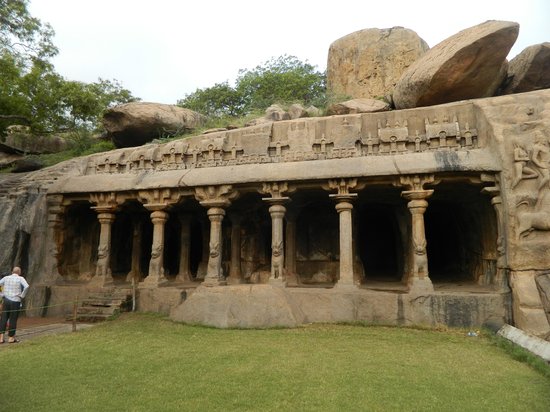
The mandapas contain beautiful sculptures on its walls. The most popular of these mandapas are Varaha Madapam, Mahishasuramardhini Mandapa, Tirumurthi Mandapam and the Panchpandava Caves.
Panchpandava Caves
Stage III – Rajasimha phase
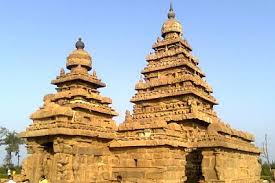
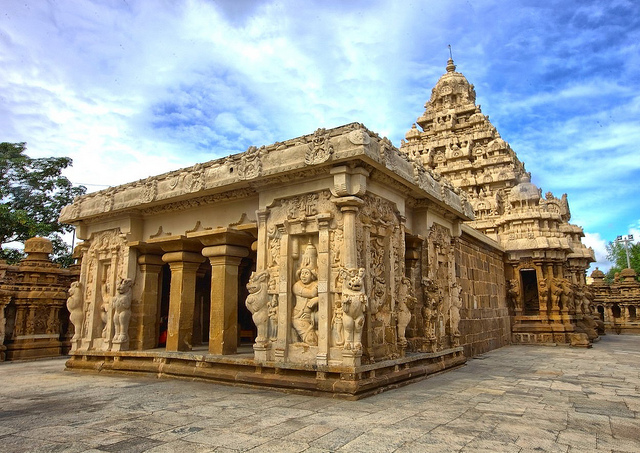
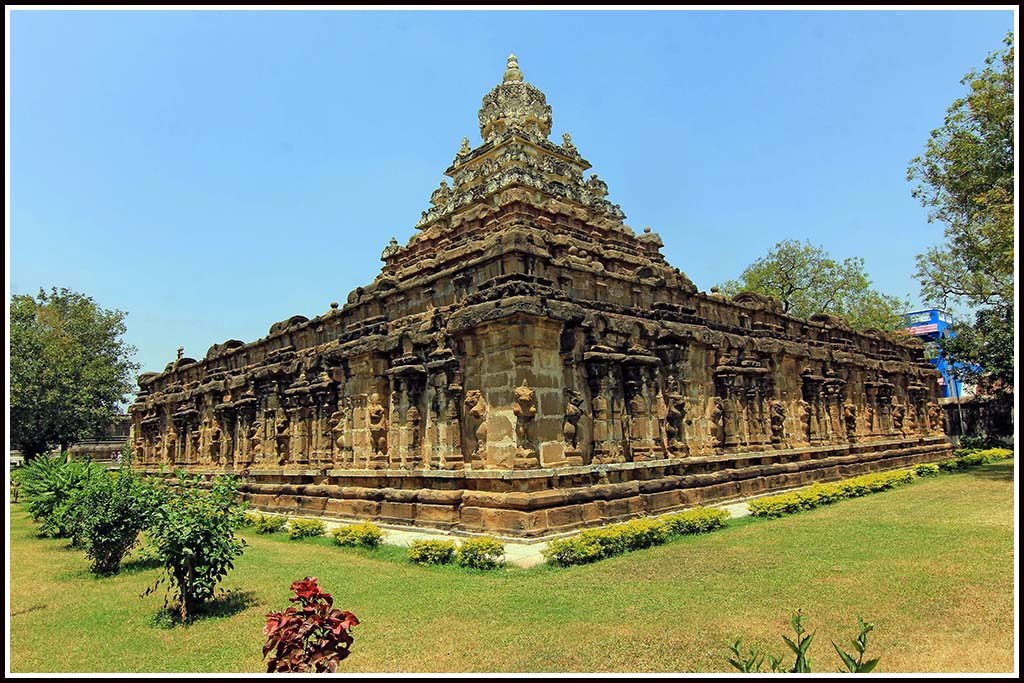
This stage witnesses the evolution of structural temples in South India. These temples were built by using the soft sand rocks. The Kailasanatha temple at Kanchi and the Shore temple at Mamallapuram remain the finest examples of the early structural temples of the Pallavas.
Shore Temple
The Shore temple is located in Mamallapuram.
Its name is credited to its presence at the shore of Bay of Bengal.
Built by Rajasimha.
Made up of granite
A Shaiva temple but also has a Vaishnava shrine
Kailasanatha Temple
This temple is the oldest structure in Kanchipuram.
Located in Tamil Nadu, it is a Hindu temple dedicated to Lord Shiva.
Dravidian style temple.
Built by Rajasimha.
Stage IV – Nandivarman phase
The last stage of the Pallava art is also represented by structural temples built by the later Pallavas. The Vaikundaperumal temple and Muktheeswara temple at Kanchipuram belong to this stage of architecture.
Vaikunda Perumal Temple
Dedicated to Lord Vishnu
Dravidian style
Art
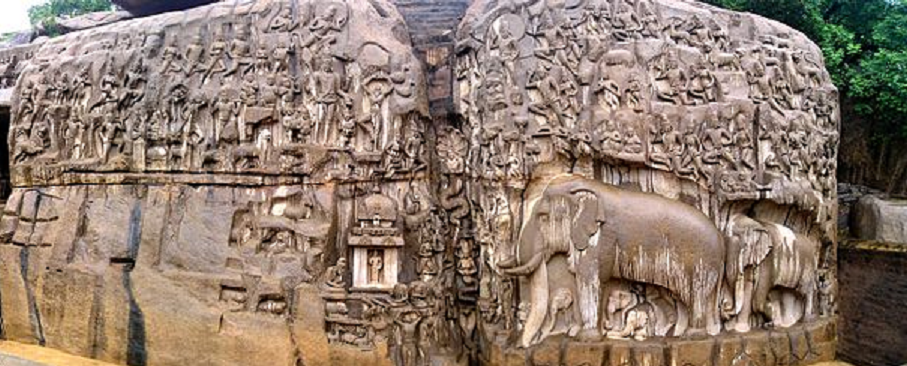
The Pallavas also contributed to the development of sculpture. Apart from the sculptures found in temples, an ‘Open Art Gallery’ at Mamallpuram remains an important monument.
The Descent of the Ganga or Arjun’s penance remains the most important sculpture.
Descent of Ganga/ Arjun’s penance
Made of a monolithic rock
Found in Mahabalipuram, Tamil Nadu
Identified as Bhagiratha’s bringing Ganga down from the matted locks of Shiva
It is also identified as Arjun’s penance
Declared a UNESCO World Heritage Site.
The Sittannavasal Jain paintings belonged to the period of Pallavas.
The study of coins is known as Numismatics. The importance of coins as a source of reconstructing history cannot be denied, particularly in case of ancient history where very few chronicles were produced.
1. Indus Valley Civilization – BC
The Harappan Seal is the most distinctive artefact of the Indus Valley Civilization. It was made of a stone called steatite. However, it’s believed that it was *NOT* used as a coin. It served various other purposes like – sealing a package of trade, as amulets, etc.
2. Janapadas / Mahajanapadas –
The earliest account of issuing of coins dates back to the 7th-6th Century BC. These coins were ‘punched-mark’ coins made in silver. They were initially issued by merchant guilds and later, by the state.
3. Post-Mauryan Period
For the first time, we see regular Dynastic coins being issued.
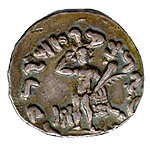
The Greeks bring along their old age tradition of issuing coins. They are the first ones to issue gold coins(besides the use of Silver).
Greek Coins
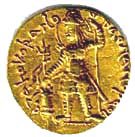
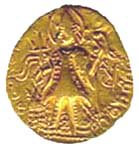
It is then followed by the Kushan Empire who become the first Indian Empire to issue gold coins.
Kushan Coins
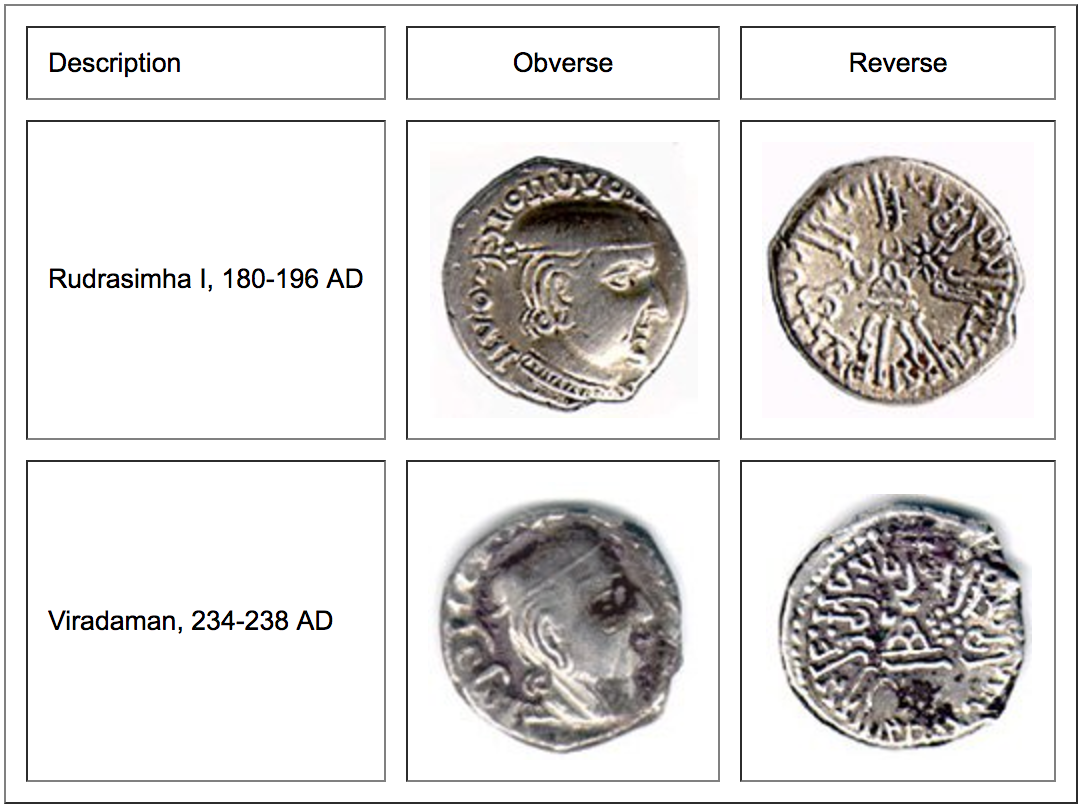
The Western Kshatrap coins are reckoned to be the earliest coins bearing dates.
3. Gupta Period
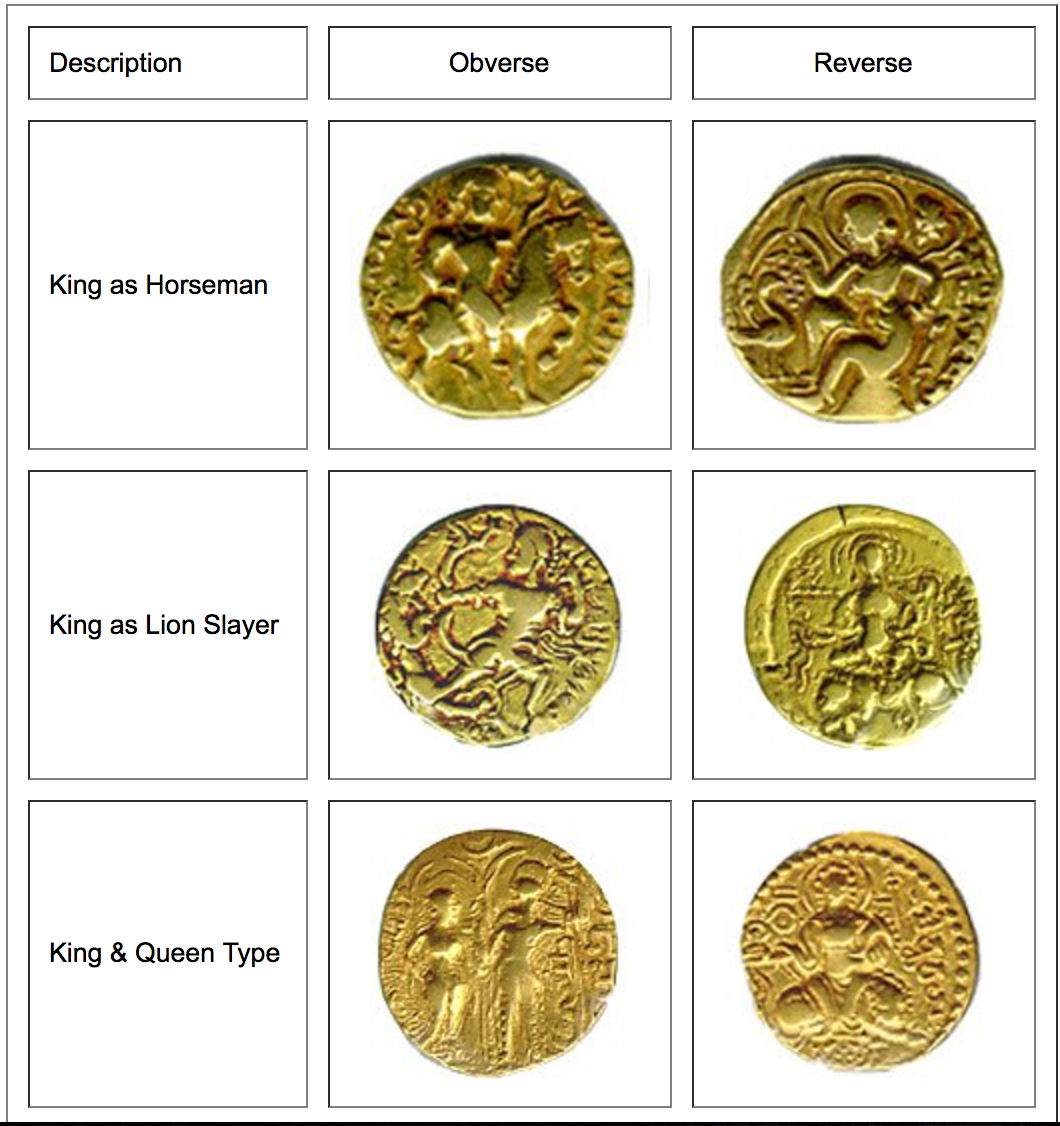
The Kushan gold coins subsequently influence Gupta dynasty. They become more rich and elaborate in design depicting a wide variety of events – commemorate dynastic succession, significant socio-political events – like marriage alliances, the horse sacrifice, etc. and for that matter artistic and personal accomplishments of royal members (Lyrist, Archer, Lion-slayer etc.)
We see the decline in the number of coins produced in this phase suggestive of a decline in trade and commerce.
Areas of Interest: North India, Central India, and South India
Unlike the previous period, this period saw was marked by political stability that ensured and encouraged cultural florescence. The Guptas and Vakatakas were the major powers in north and central India respectively.
South however witnessed a transitionary period called the Kalabhra Interregnum. This transitionary period was known as the ‘Dark Ages’ and lasted for 300 years. Not much is known about this time.
More can be read here – http://www.gloriousindia.com/history/kalabhra_interregnum.html
NORTH INDIA
1. Political Background
Gupta Empire extended for close to 300 years – almost twice the duration of the Mauryan Empire and 1.5 times the British Empire.
The maps above illustrate how they unified the whole of Northern India by around 480 AD. The Gupta Empire saw many great rulers who patronized art, architecture, and science. No wonder it has been referred to as the Golden Age. (this remains contested. While art and culture flourished, society showed signs of degeneration).
Finally, the Guptas lost out to the Hunas.
II. Literature and Language
A. Sanskrit
Sanskrit was the court language of the Guptas. Needless to say, Classic Sanskrit literature saw tremendous development under their patronage.
Two great epics(Mahakayva), the Ramayana and the Mahabharata were compiled around 4AD. Their importance is as follows
They served as a precursor to various other Sanskrit literature
They are the origins of many of the stories and anecdotes of the social, religious, and cultural history of India.
They were translated into various languages that gave them renewed relevance and meaningful reincarnation.
These epics in turn shaped new languages providing them with substance and style.
Puranas follow the lines of epics. Some of the earlier Puranas were compiled in this era. There are 18 Mahapuranas and 19 Upa-puranas.
The Puranas were associated with the revival of Hinduism. They were in the form of stories which made them more palatable to the masses than the earlier bramanical text – the Vedas.
Besides the epics, this period also saw the development of kavya (poetry), nataka (drama) and other literature.
Two things can be noted about plays
They do not come across tragedies.
Characters of high social status speak Sanskrit: whereas those of lower status and women speak Prakrit. This particular feature throws light on the status of Sanskrit and Prakrit in society.
The table below summarizes the important works of this time.
Work
Author
Type
Theme
Patronage
Allahabad Prasasti
Harisena
An inscription. The Allahabad Pillar also has inscriptions by Ashoka and Mughal Emperor Jahangir
Eulogy on the conquests of Samudragupta. Inscribed on the Allahabad Pillar
Samudragupta
Kumarasambhava
Kalidas
Mahakavya(epic poem)
Genealogy of Lord Rama. The Ikshvakus are also known as Raghuvanshis hence the name.
Raghuvamsa
Geneology of Lord Rama. The Ikshvakus are also known as Raghuvanshis hence the name.
Malavikagnimitra
Play
Story of love between Agnimitra, the Sunga Prince and the hand-maiden of his chief queen, Mālavikā. Also gives an account of his father Pushyamitra Sunga’s Rajasuya Yagna.
Vikramorvasiya
It’s a Sanskrit drama depicting the love story of Puruvas, a Vedic King and Urvashi. Puruvas is chosen to reflect the qualities of Chandragupt Vikramaditya.
Abhigyana Shakuntala
A sanskrit play which depicts the story of Dushyanta, king of Hastinapur, and Shakuntala, daughter of the sage Vishwamitra and the apsara Menaka.
Ritusamhara
Lyrical Poetry
A mini epic poem on six seasons (Ritu). Considered to be the earliest work of Kalidasa.
Chandragupta II
Meghaduta
Lyrical Poetry
Cloud is a messenger. An exiled yaksha who is pining for his beloved on a lonely mountain peak. When, at the beginning of a monsoon, a cloud perches on the peak, he asks it to deliver a message to his love in the Himalayan city of Alaka.
Chandragupta II
Mricchakatika
Sudraka
Plays
Mrichhakatika means a “little clay cart’. Traces the love story of Charudatta with Vasantsena. There is a hindi movie on the same work starring Rekha and Shekhar Suman.
Vinavasavadatta
Padmaprabhritaka
Bhana (short one-act monologue)
Mudrārākṣasa
Vishakhadatta
Mudrarakshasha means “Ring of the Demon”. It narrates the ascent of Chandragupta Maurya to throne.
Also mentions Suryasiddhanta. Aryabhatta is credited with the discovery of algebra. He formulated the area of triangle which led to the origin of Trigonometry. He *did not* invent zero.
Panchasiddhanta
Varahamihira
Astrology
Gives a summary of 5 schools of astrology – Surya Siddhanta, Romaka Siddhanta, Paulisa Siddhanta, Vasishtha Siddhanta and Paitamaha Siddhanta. Also discusses concepts of Trigonometry.
Brihatsamhita
Varahamihira
Astrology
III. Religion
A. Hinduism
Vaishnavism – Bhagavatism on the rise.
Emergence of Pauranic Hinduism
The brahmanical tradition witnessed a decisive change from what was traditionally practised as “Vedic tradition”. Vedic Brahmanism gave way to Pauranic Hinduism. Sacrifices/ Rituals were not entirely abandoned but they lost their steam.
Where Vedic Brahmanism was intimately linked with lavish sacrifices and upper varna-jatis, Pauranic Hinduism became widely popular as it was open to all varna-jatis including Shudras, women, etc and encouraged the worship of a personal deity.
Its accessibility lay in performing acts that required little investments – the giving of gifts, keeping of fasts and vows, traveling collectively to places of pilgrimages, and subscribing to local mythologies.
B. Buddhism
Buddhism no longer received royal patronage, unlike the earlier times. Samudragupta’s permission to the King of Ceylon to erect a magnificent monastery in Bodh-Gaya indicates that Buddhism was given good patronage.
Nalanda prospered under their patronage.
Post 500AD it saw a new phase in Buddhism marked by the following developments
1. Homogenization with Hinduism: Hindus practiced devotion to Buddha as a reincarnation of Lord Vishnu. In a way, Hinduism went on to assimilate Buddhism as a part/ branch of its own.
2. Humble beginnings of what later comes to be known as tantric Buddhism. The new form of text associated with this tradition, the tantras, appeared during the Gupta period, and there are indications that distinctively Tantric rituals began to be employed at this time as well. Tara is a female Bodhisattva in Mahayana Buddhism who appears as a female Buddha in Vajrayana Buddhism. She is known as the “mother of liberation”, and represents the virtues of success in work and achievements.
This will later develop into a full-fledged Vajrayana cult and reach its peak during the Pala Empire.
C. Jainism
Jainism spread into Gujarat. At Valabhi, took place the compilation of two Jain canonical texts in two councils in the 4th and 5th centuries.
D. Shaktism and Tantrism
Shaktism and Tantrism are closely associated with cults. They started as different streams. Shaktism revolves around placing women at the center. Later this cult starts to be associated with Shaivism, where Shakti is seen as Shivas consort.
The name Tantrism is derived from sacred texts called tantras. The earliest works were written in the Gupta period. In the course of time, tantrism manages to penetrate all religions.
IV. Architecture
A. Stupas
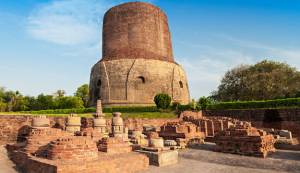
1. Dhamekh Stupa
Originally built in 249 BCE during the reign of King Ashoka of the Maurya Dynasty, this massive and prominent structure has over time gone through several expansions and additions. This solid cylindrical shaped Stupa is made of red bricks and stone. The stone facing is chiseled and displays delicate floral carvings of Gupta origin.
B. Caves
The earliest examples of religious architecture were cave-temples which typically had exteriors decorated with relief sculpture and a single carved doorway.
Inside the shrine, ritual sculptures were placed such as a Shiva linga, and the walls were richly decorated with more carvings showing scenes from mythology.
1. Udayagiri Caves
Note4Students – There are a number of places in India with the same name, the most notable being the mountain called Udayagiri at Rajgir in Bihar and the Udayagiri and Khandagiri caves in Orissa. The caves in Orissa correspond to Jainism.
The Udayagiri caves belonging to the Gupta period are located in Vidisha, Madhya Pradesh.
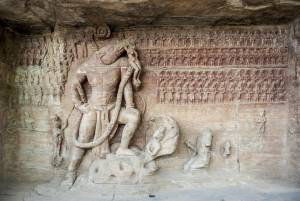
There are about 14 caves but you need to focus on only 1 of them: Cave #5 – Dedicated to the Varaha avatar of Vishnu.
This shrine is one of the finest examples of Gupta art, the celebrated relief showing Vishnu in his incarnation as the boar-headed Varaha. Varaha’s avatar rescued the Earth from the chaos of the cosmic sea.
The scholars say that when Chandragupta II (Vikramaditya) renovated the cave in this manner, he wanted to portray the rescue of Northern India from the political instability and fragmentation that it had experienced prior to the rise of the Gupta Empire.
2. Junagarh Caves
The so-called “Buddhist Caves” are not actually caves, but three separate sites of rooms carved out of stone to be used as monks’ quarters.
Unique feature = Presence of a 30-50 ft high citadel-like feature – Upar Kot in front of the prayer hall
3. Bagh Caves:
Located on the bank of the Baghani River in the Dhar district of Madhya Pradesh. These rock-cut caves possess the most amazing paintings known to be made by ancient man. According to legend, these caves were established by Buddhist monk Dataka. Out of the initial 9 caves only 5 have been extant.
Bagh Caves are known for Mural Paintings – thick mud plaster in brownish orange color. The most famous features of Bagh Caves are these murals made in the tempera technique.
Over this plaster, there was done lime-priming and then paintings were laid. This is also known as the tempera technique, which refers to the use of a permanent fast-drying painting medium consisting of colored pigment mixed with a water-soluble binder media.
These caves belong to Hinayana Buddhism (have no images of Buddhas)
Contrary to what their name suggests they have nothing to do with the characters of Mahabharata (the Pandavas).
C. Temples
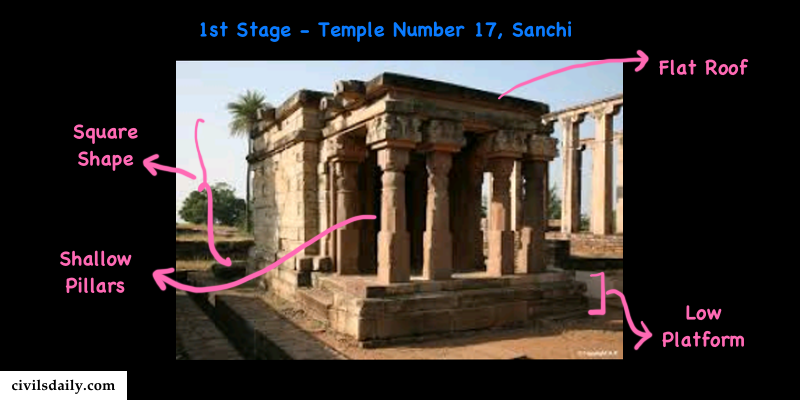
Not satisfied with caves, the Guptas were the first dynasty to build permanent free-standing Hindu temples. This lay the foundation of the Nagara School of Art. Temple architecture with the development of a square sanctum and pillared portico emerged during the Gupta period.
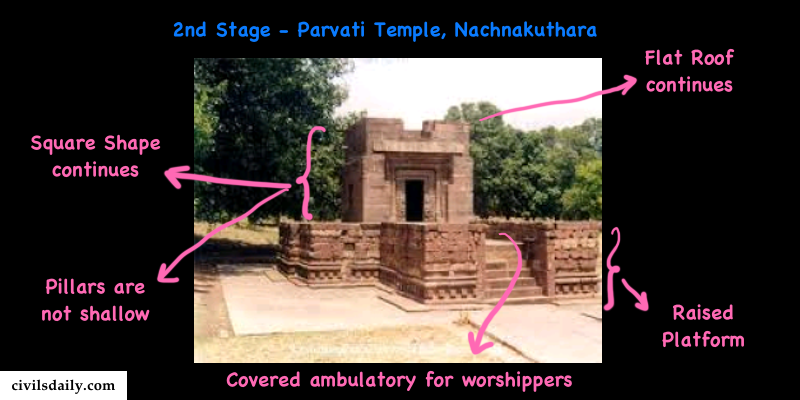
Among the 5 stages of temple development, you will find a gradual progression from flat-roofed, monolithic temples in the initial stage to the sculptured ‘shikhara’ in the later years.
Most of the features of 2nd stage are carried forward
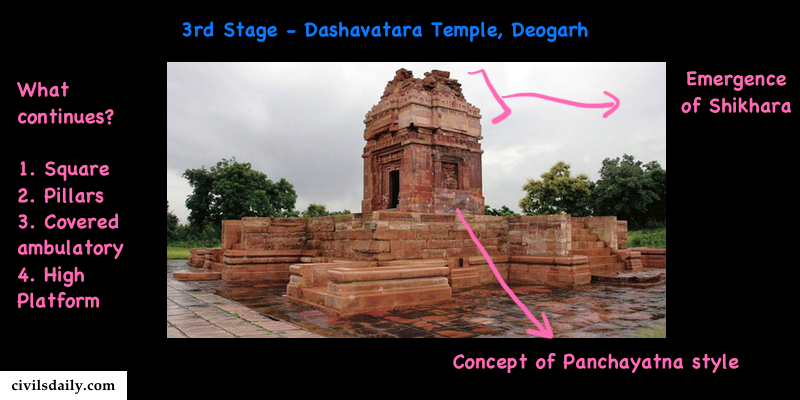
Flat roof evolved into a curvilinear roof (shikhara)
Introduction of Panchayatan style of temple making
A Hindu temple is a Panchayatana one when the main shrine is built on a rectangular plinth with 4 subsidiary shrines at 4 corners making it a total of 5 shrines. The origin of the name is the Sanskrit words Pancha (5) et ayatana (containing).
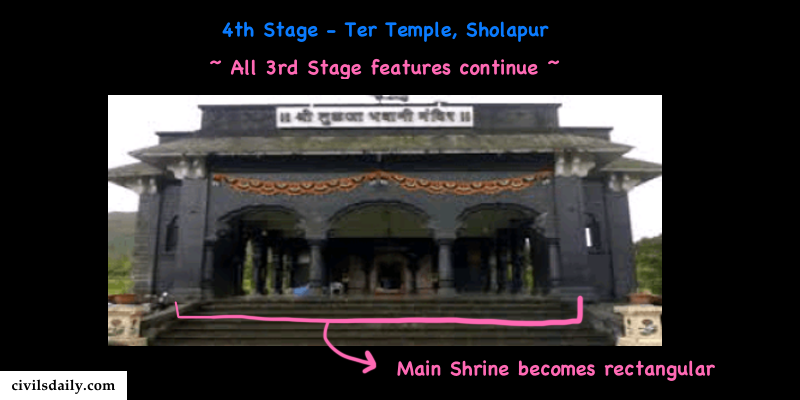
Stage #4 – Ter Temple, Sholapur
Most of the features of 3rd stage are carried forward
Noticable change from square to rectangular shape of the main shrine
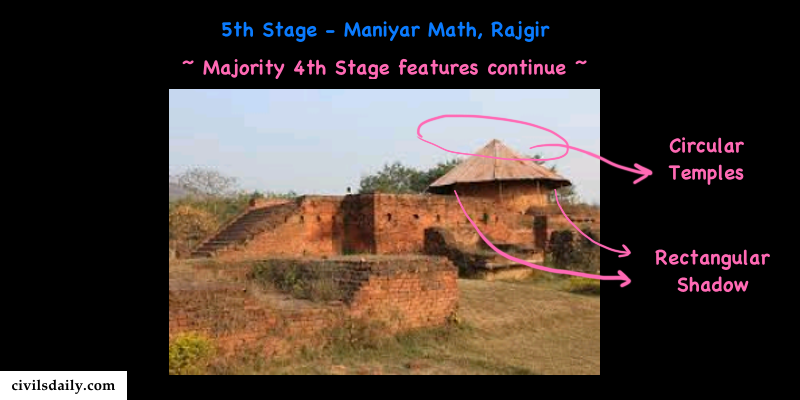
Stage #5
Most of the features of 3rd stage are carried forward
Introduction of circular temples with shallow rectangular projections
Stage 3 Temples in detail
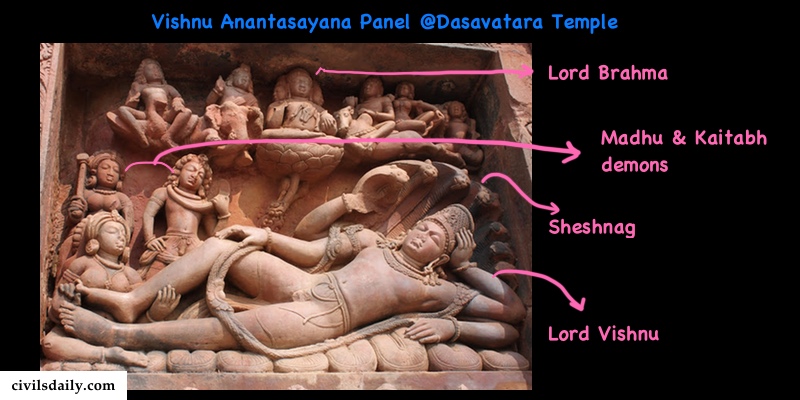
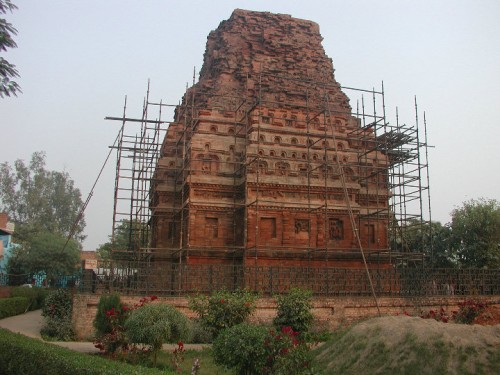
1. Dasavatara temple, Deogarh, Uttar Pradesh
Dasavatara = Das (10) + Avatara (Incarnation). The temple depicts the 10 avataras of Vishnu.
First North Indian temple with a shikhara.
Earliest known Panchayatana temple in North India.
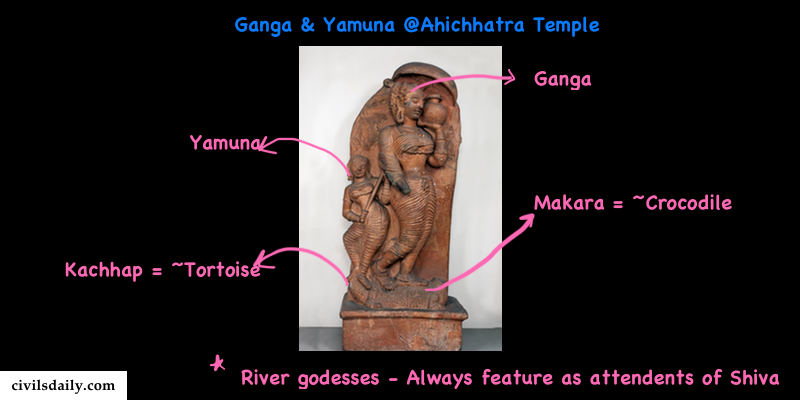
Two river goddesses, the Ganga and Yamuna, are mentioned as attendants of Shiva and this occurs as a regular feature of temple architecture from the doorways of the Dasavatara temple.
There are 3 main reliefs of Vishnu on the temple walls:
1. On the west – Gajendramoksha is the story of achieving moksha, symbolically communicated by Vishnu’s suppression of an asura Who had taken the form of an elephant.
2. On the east – Nara-Narayan shows the discussion between the human soul and the eternal divine.
3. On the south – The Sheshashayana Vishnu panel is a superb piece of art
Sheshashayana is the form of Vishnu where he is shown reclining on the sheshanaga called Ananta whose seven hoods form a canopy over his crowned head
His consort Lakshmi is massaging his right leg and two attendant figures stand behind her
Various gods and celestials are hovering above. Lord Brahma can be seen.
In the lower panel, the two demons Madhu and Kaitabha, in an attacking attitude, are challenged by the four personified weapons of Vishnu
It is the oldest remaining Hindu temple made entirely of bricks/terracotta.
The temple is built on a square plan with double-recessed corners and faces east. There tall pyramidal spire over the garbhagriha.
Terracotta sculpture depicts both secular and religious theme such as deities like ganesha adi virah mahisasaur-mardani and river goddess. Myths and stories representing abduction of Sita and the penance of nara-narayan.
3. Ahichhatra Temple (Shiva Temple)
The Shiva temple at Ahichhatra belongs to the Gupta period 4th century A.D. It is famous for its two life-sized terracotta images of Ganga and Yamuna.
Ganga and Yamuna are installed in niches flanking the main steps leading to the upper terrace of the temple.
Ganga stands on her vehicle, the makara. and Yamuna on the kacchap.
V. Art
A. Sculpture
Mathura School
Mathura school also witnessed some development during the Gupta period. A prominent sculpture is the Standing Buddha at Matura
Red sandstone image of the Buddha dated to 500AD
Right hand in abhayamudra, assuring protection, and the left holding the hem of the garment.
Smiling countenance with down-cast eyes is robed in spiritual ecstasy
Robe covering both shoulders is skillfully represented with delicately covered schematic folds and clings to the body
Head is covered with schematic spiral curls with a central protuberance and the elaborate halo decorated with concentric bands of graceful ornamentation.
2. The Sarnath School of Sculpture
The art of Bharhut, Amravati, Sanchi and Mathura came closer and closer; melting into one – The Sarnath School.
Its plasticity is derived from that of Mathura and its elegance from that of Amravati. Plasticity is a term used to describe a rich, three-dimensional or sculptural presence of a building.
The human figure takes center stage and nature becomes the background.
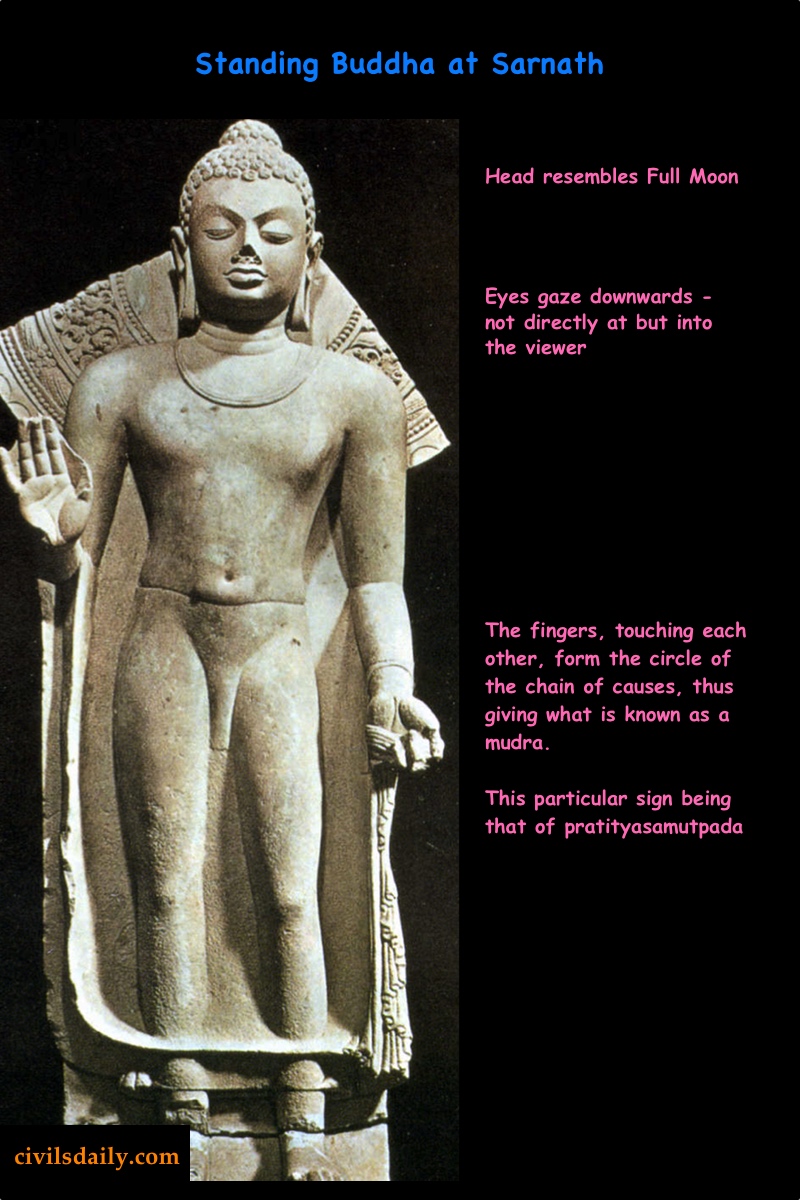
A prominent sculpture is Standing Buddha at Sarnath
his right hand in abhayamudra.
Unlike the delicately carved drapery folds of the Mathura Buddha, only the fringe of the diaphanous robe is here indicated.
The eyes gaze downward, not directly at, but into the viewer
The very fine high-grade surface seems to have a soft bloom -a specially distinctive Sarnath quality
Difference between Sarnath and Mathura School Buddha
Sarnath School
Mathura School
Relaxed attitude in the body of the sculpture. Visible bends
Mathura School had a columnar rigidity in similar works
Very fine draping – almost invisible on the body but left hanging out on the sides
In the Mathura School, the drapes were elaborate and folds were very much visible
The body in its smooth and shining plasticity constitutes the principal theme of the Sarnath artists
Mathura sculpture was more rigid
At Sarnath, the material used was cream colored sandstone
Mathura sculpture was made of moderately fine red sandstone.
Follow the link for more remarkable examples or Sarnath School Sculptures
Areas of Interest – North, South & East India (specifically Kalinga)
The five centuries that passed between the fall of the Mauryas and the rise of the Guptas witnessed a lot of political instability and upheaval in the North of India. The South however remained fairly stable.
NORTH INDIA
I. Political Background
As the maps suggest, many kingdoms came up in North India. Despite being foreign rulers, they were assimilated in our culture and influenced it in many ways. The 3 most important among them were
1. Sunga Empire (185BCE–73 BCE) – East India
They succeeded the Mauryan Empire in Magadha. Pushyamitra Sunga was the first king of this dynasty.
2. Indo-Greek Kingdom (180BCE – 010AD) – North West India
The Greeks were the first foreign power in the sub-continent. After Alexander left, his generals stayed back. Hence the term Indo-Greek. They brought the Greek culture. Menander(165-145 BC) was the most important king in this time. In Pali Literature he is known as Milinda.
3. Indo-Scythian or Sakas (200 BC–400 AD) – West India
Sakas or Scythians were nomadic Central Asian tribes who destroyed the Indo-Greek rule in north-western India. They were pushed out of Central Asia and came to India. The Sakas were divided into five branches. Around 100AD, they give rise to Kushana Empire and Western Kshatrapas.
SL No.
Early
Later (100AD)
1
Afghanistan
Kushanas
(60AD–240 AD)
2
Punjab (Taxila)
3
Mathura
4
Maharashtra + Saurashtra
Western Kshatrapa (27 independent)
(35AD–405AD)
5
Central India (Ujjain)
Kanishka is the most celebrated king of the Kushana empire. At its peak, his empire extended from Khotan in the northwest to Benaras in the east and Kashmir in the north to Saurashtra and Malwa in the south. The capital of his empire was Purushapur i.e. modern Peshawar.
II. Literature
Many important works of literature happened in this era.
Work
Author
Theme
Patronage
Junagarh Rock inscription
Rudradaman I
from the Western Kshatrapa
He’s credited to have issued the 1st long inscription in chaste Sanskrit.
It mentions the repairs he undertook to improve the Sudershana Lake.
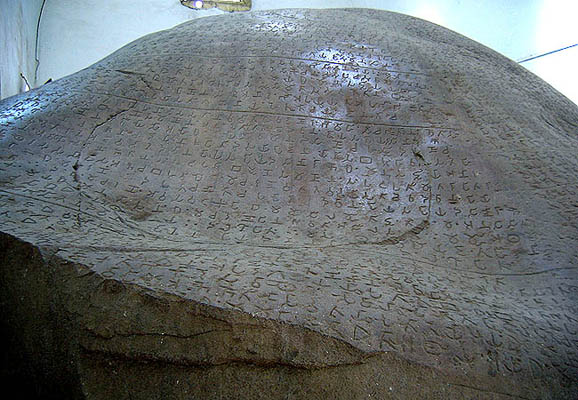
Junagarh Rock also contains inscriptions from Ashoka and Skandgupta (from the Gupta Period almost 800 years later).
Rudradaman I
Milindapanho
Nagasena
Menander asked Nagasena many questions related to philosophy and Buddhism, which together with Nagasena’s answers are recorded in Milindapanho or the Questions of Milinda.
Milinda
Saundarananda, Buddhacharita,
Vajrasuchi
Ashvaghosh
Buddhacharita is a complete lifecof Buddha written in the form of Mahakavya. It is the first Buddist book written in Sanskrit.
Kanishka
Charaka-Samhita
Charaka
Extends Ayurveda and lays down the concept of balance of 3 doshas called Vata, Pitta and Kapha.
Sushruta-Samhita
Sushruta(Father of Surgery)
He mentions more than 120 instruments
Junagarh Rock inscription.
III. Religion
1. Hinduism
Vaishnavism – There were 3 streams centered around worship of Vishnu or Bhagawat
Vishnu as a minor god in Vedic times. Was worshipped as the Sun and fertility cult.
Narayana was a non-vedic tribal god. He was also called Bhagavat.
Vishnu came to be identified as the hero of the vrishni tribe known as Krishna-Vasudeva.
By 200 BC all these 3 streams merged into one and led to the creation of Bhagvatism. By the end of Late Gupta Period, it was assimilated into Vaishnavism.
2. Buddhism
Buddhism continued to receive royal patronage. Many kings of this era were Buddhists. Kanishka’s court was adorned by the presence of such scholars as Parsva, Vasumitra, Ashvaghosha, Charaka, and Nagarjuna.
A major development in Buddhism was it’s splitting up in to two sects –The Hinayana and the Mahayana. Kanishka organized the 4th Buddhist council where this split happened.
Hinayana
Mahayana
Also known as Lesser Vehicle
Greater Vehicle
Treat Buddha has a guide (Since Buddha never said he was God)
Treat Buddha as a God
Worshipped only in form of symbols that represent various stages in the life of Buddha
Worshipped in human form, Bodhisattvas.
Literature only in Pali
Sanskrit
This phase also witnessed the spreading of Mahayana Buddhism to south and south east Asia.
IV. Architecture
1. Stupas
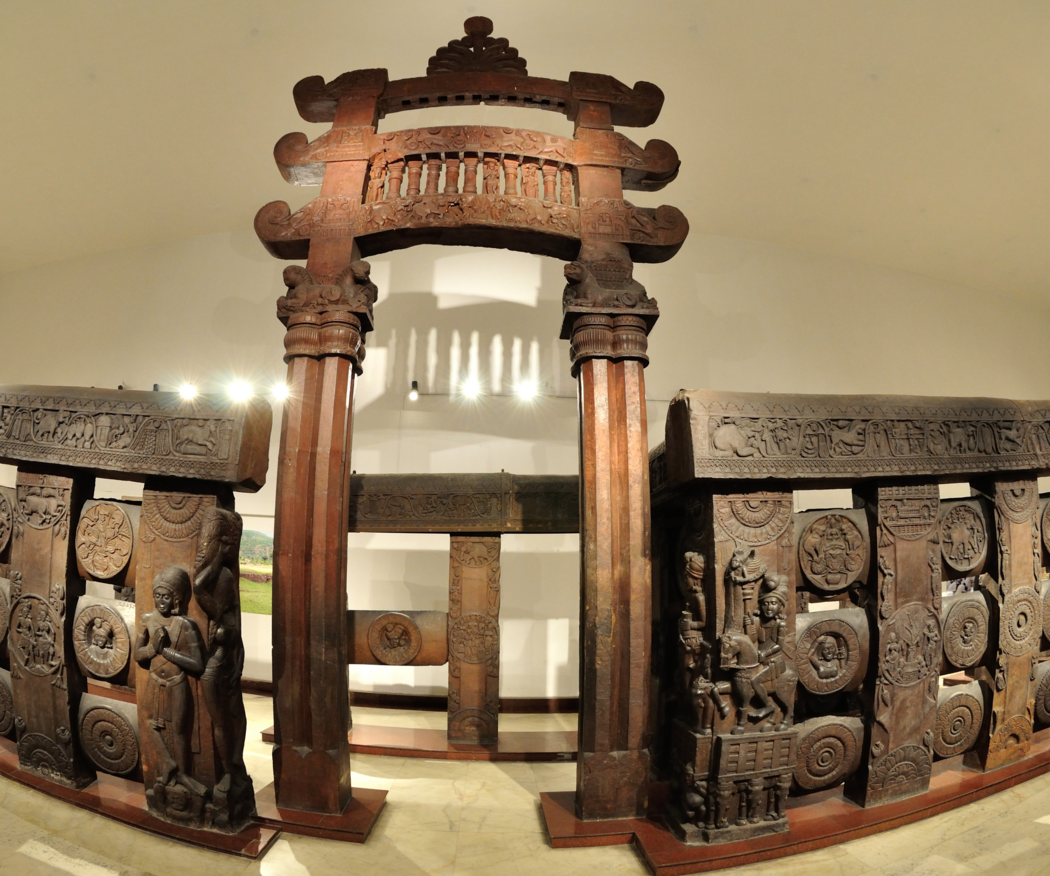
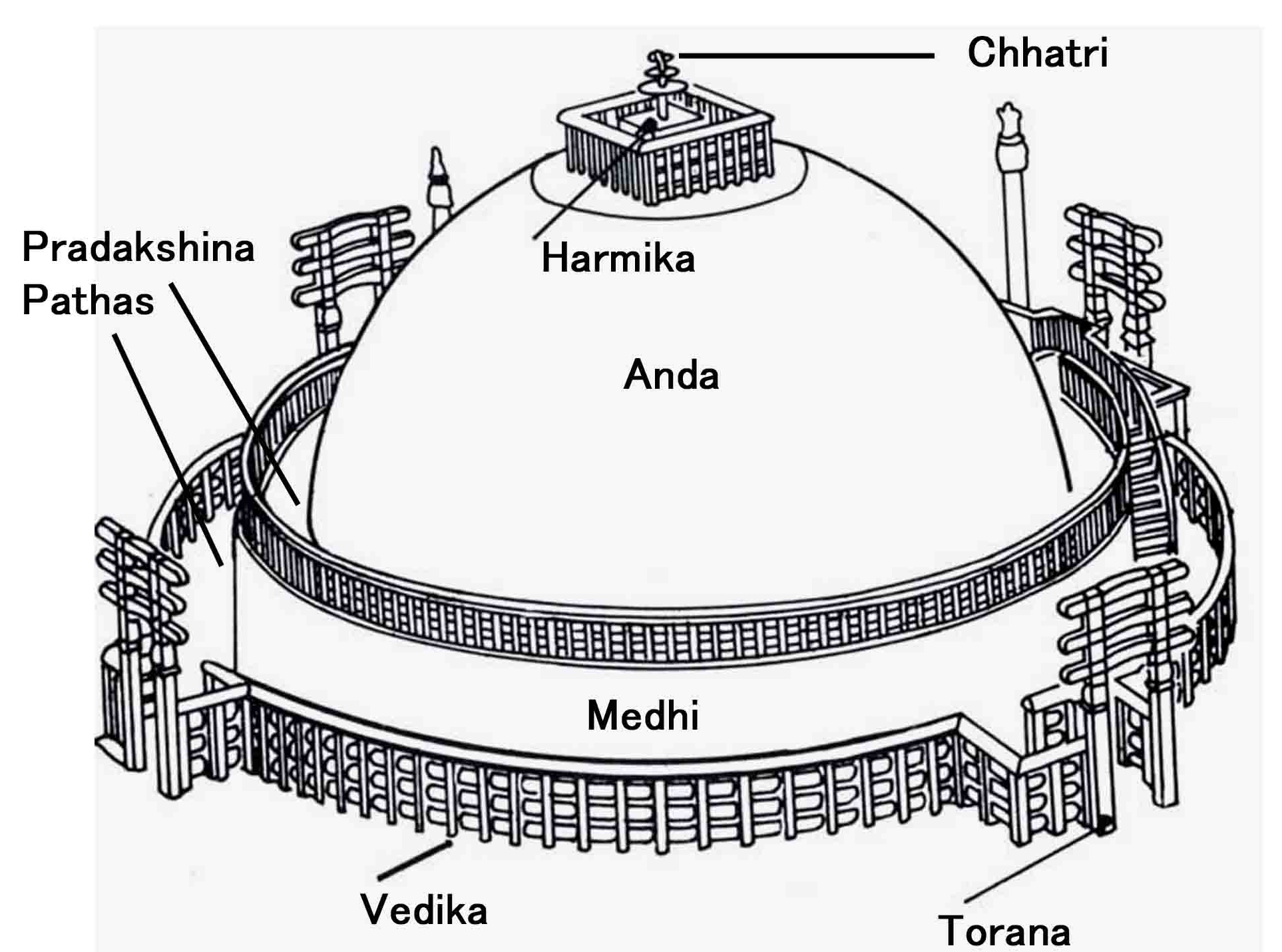
The Sungas were great patrons of art and architecture. They contributed to the expansion of Bharut and Sanchi Stupas.
Bharhut and Sanchi
Bharut
Sanchi
Time Period
100 BC is the accepted date for Bharut. Slightly earlier than Sanchi and Ajanta.
Said to have been started by Ashoka but much of its work has been done in the time of the Sungas.
100 BC.
Said to have been started by Ashoka but much of its work has been done in the time of the Sungas. The decorated gateways with lavish carvings were done by Satavahanas.
Location
Satna District of MP. Was on a major trade route from western coastal regions to Pataliputra.
A very large complex 13-14km from Vidisha, the capital of Mauryan Empire. Vidisha was a very important trading town. It was on the Dakshinapath – an offshoot of the Uttarapath, which connected Taxila to Pataliputra and further east.
Stupa
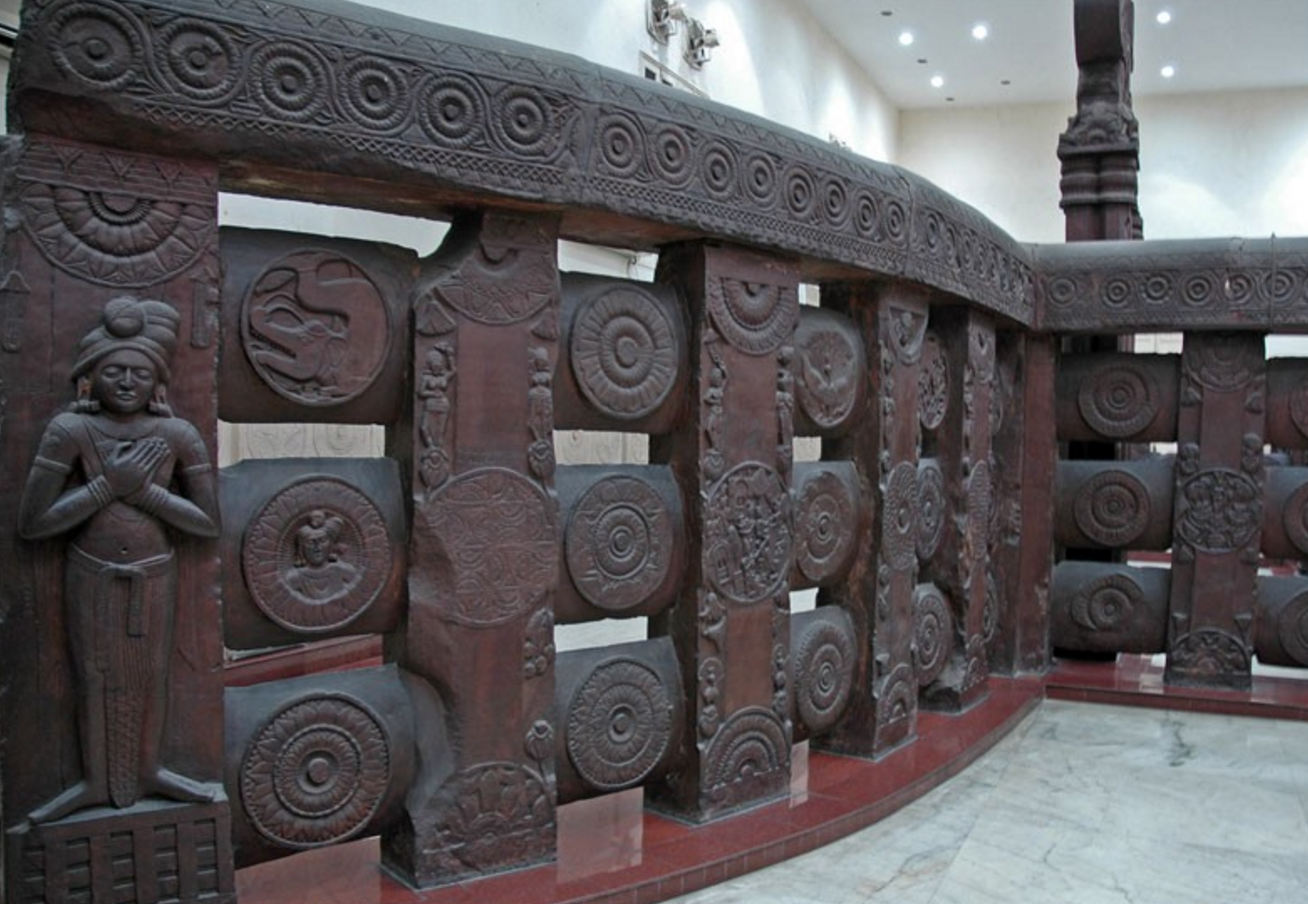
Has been reconstructed in Indian Museum Calcutta
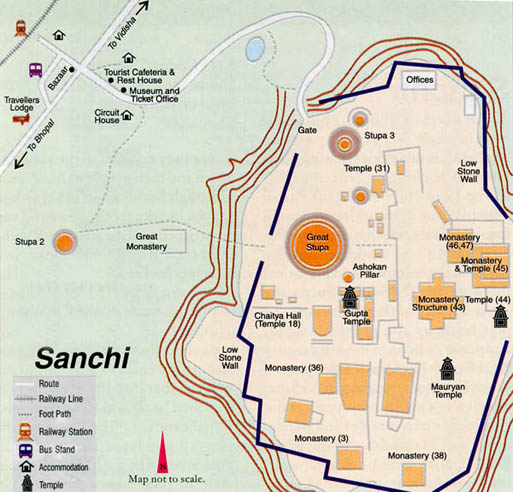
There are 3 stupas
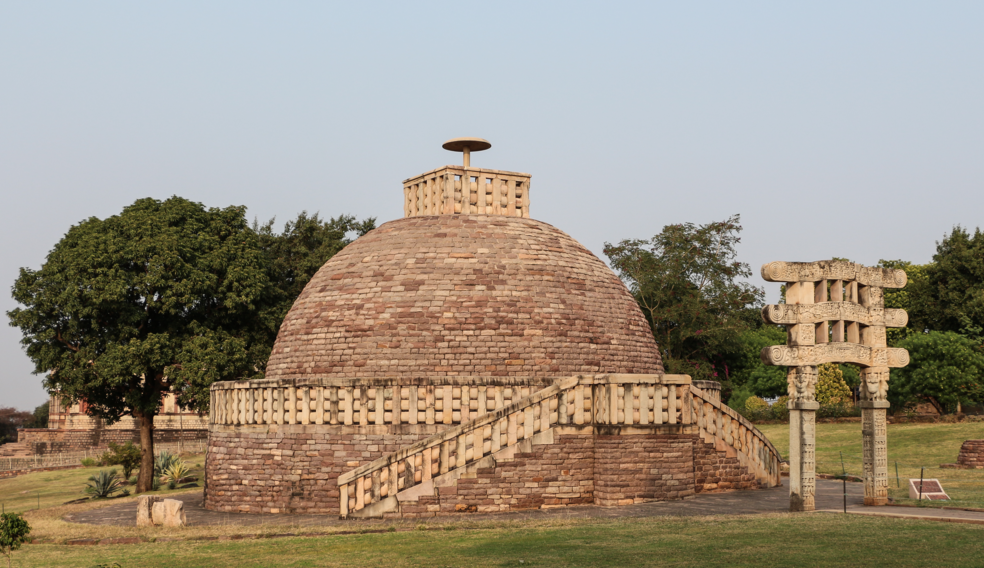
Stupa 1- The Great Stupa. Largest of them. It has 4 gates with Toranas.
Stupa 2 – This is the earliest stupa. Same time as Bharut but simpler.
Stupa 3 –Has only 1 Torana.
Bharut : Themes Represented
Discovered by Cunninghum. Has been reconstructed in Indian Museum Calcutta. Stone Architecture. Surrounded by Vedika roughly 3 feet.
Only 1 Torana has been found but it is suspected that there would’ve been 4.
As evident, the Vedika and Torana have beautiful carvings. They are 5 elements –
1. Visual narratives about the life of Buddha
Buddha is represented in his iconic form – feet, bodhi tree, dharmachakra, empty seat, and not the human form (symbolizing the Theravadin/ Hinayana Buddhism).
2. Jataka Kathas – Jatakas Stories like the Kaka Jataka(Monoscenic), Ruru Jataka
3. Yakshas and Yakshis – These gods of local cults start assimilating into Buddhism. It is believed that Yakshis were made through the contributions of women.
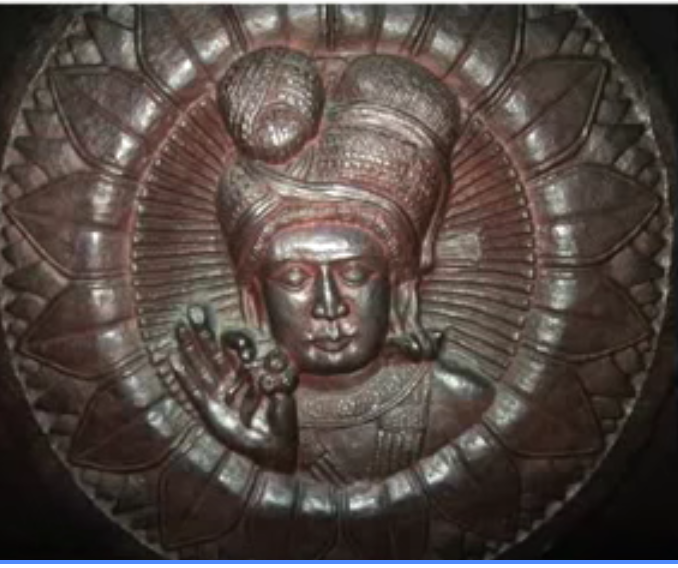
4. Medallions – There are also medallions like the one shown below. They represent the sun god, various bodhisattvas, etc.
Sanchi: Themes Represented
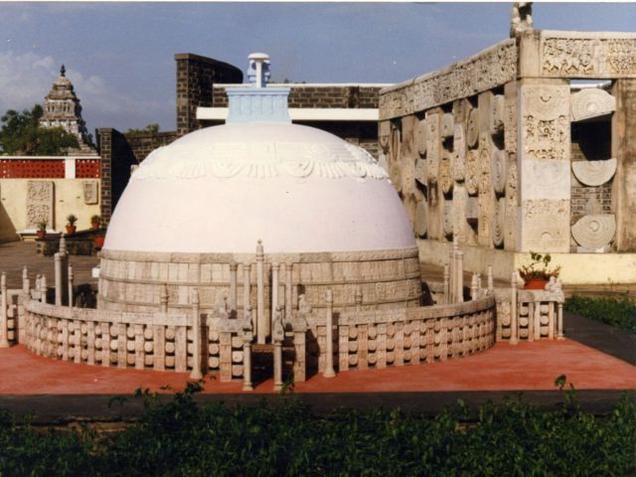
Sanchi Complex has 3 stupas. Follow the Map below.
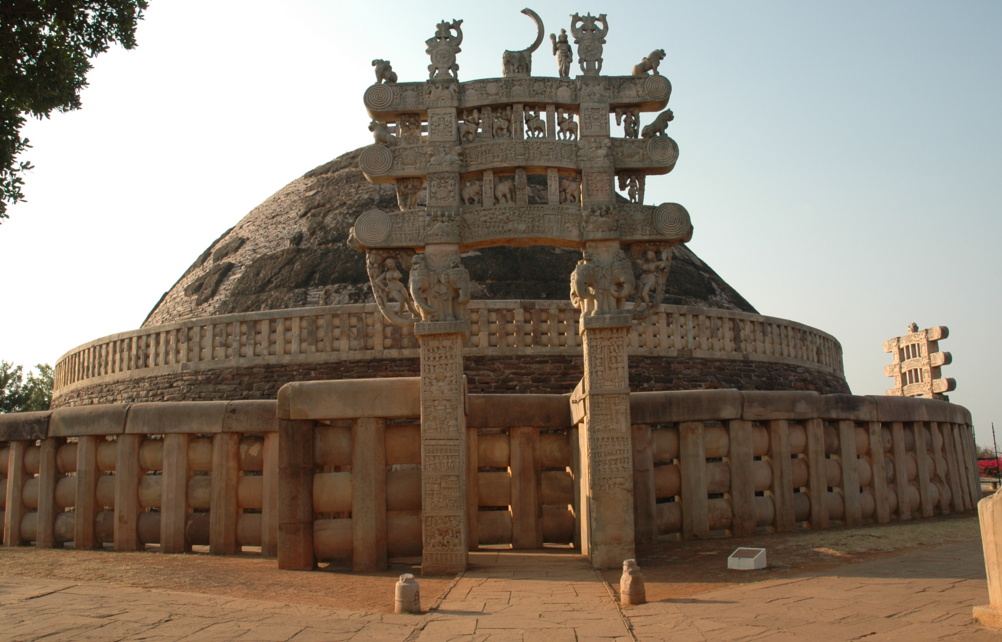
Stupa No. 1 is the largest and is called the Great Stupa. It has 4 gates with Toranas. In the pic, you see the Northern Gate.
There are extensive carvings on the Torana. The themes are similar to those of Bharut.
Stupa 2 – This is the earliest stupa. Same time as Bharut but simpler.
Stupa 3 –Has only 1 Torana.
2. Pillars
1. Heliodorus Pillar
Stone column erected by Heliodorus, Greek ambassador to the court of the Shunga king Bhagabhadra, around 150BC
In honor of Vasudeva.
V. Independent Art
A. Sunga Art
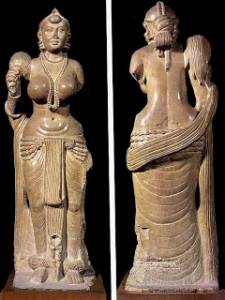
-Standing sculptures of Yakshas and Yakshis, discovered from Gwalior and Mathura
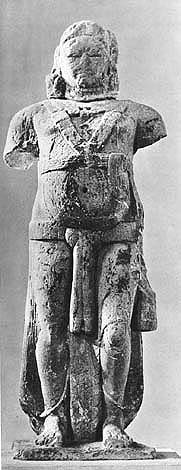
-Dwarfish Yaksha from the Pithalkhora caves in Central India
B. The Gandhara School and the Mathura School of Art
This period saw the emergence to two very important schools of art – one in Gandhara, North West Frontier Province and the other in Mathura.
The Gandhara Art received patronage from various dynasties – Indo-Greek, Indo Scythian and Kushan Kings. It was during Kanishka’s reign that both these centers flourished.
Gandhara
Mathura
Strong Greek influence and was based on Greco-Roman norms encapsulating foreign techniques and an alien spirit. It is also known as Graeco-Buddhist School of art. Assimilating various traits of Achaemenian, Parthian and Bactrian traditions into the local tradition is a hallmark of the Gandhara style.
No foreign Influence, however, later it cross fertilized with the Gandhara School. Its development took place indigenously.Initially inspired by Yaksha Images
Blue-grey Mica / Grey Sandstone.
Spotted Red Sandstone
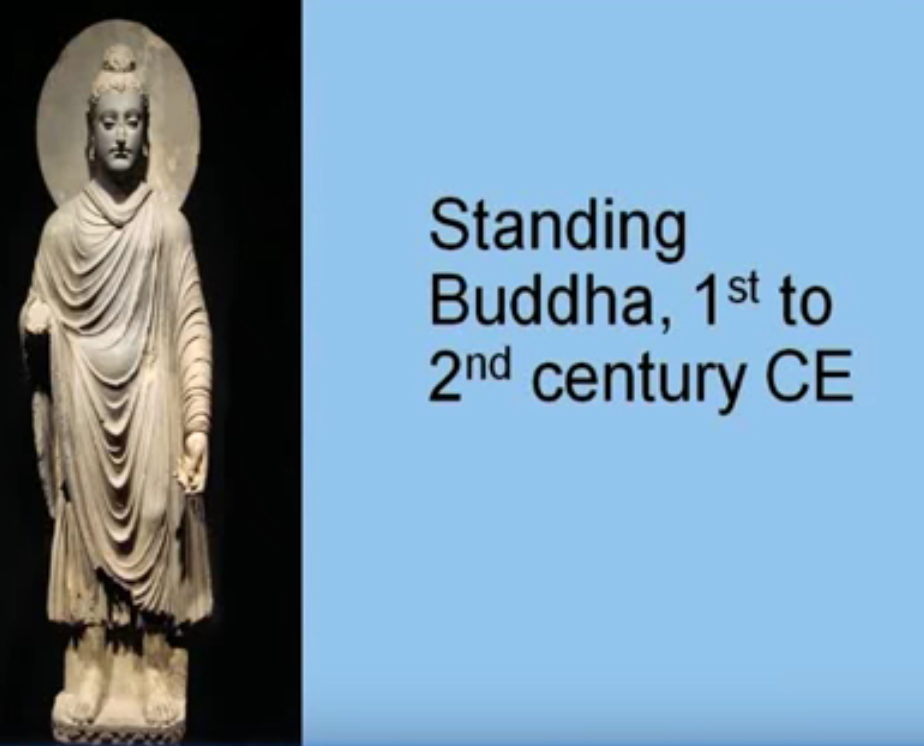
Rendering of drapery with sharp flowing folds similar to those shown in Roman togas.
Finer details and realistic images. Buddha carved out in various Mudras.
Wavy curled hair.
Early period: Light volume having fleshy body.
Later Period: Flashiness reduced. Not much attention to detailed sculpting.
Halo not decorated. Images are very expressive.
The halo around the head of Buddha was profusely decorated. Images less expressive.
Mainly Buddhism
All religions – Hinduism, Buddhism, Jainism
Gandhara School: Themes represented
Buddha is depicted standing frontally with one leg bent.
Greek Deities
Zeus Apollo, Athena indicating the Greeks wanted to preserve their culture.
Portraits of Kings
Other Sites
Mathura School – Themes represented
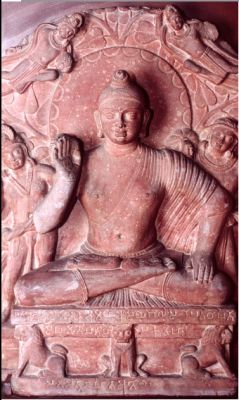
The Buddhist religion greatly flourished under the patronage of Kushan emperors, and several images of the Buddha and Bodhisattavas were produced after the earlier Yaksha types.
The first purely Indian Style art and sculptures were produced here. Mathura Art is famous for its iconographic traits – identification of particular deities based on their postures, attributes, vehicles.
Common Facial Features – Oval/ Roundish faces, open eyes, thick lips and sharp nose.
Fleshy full-body figures in a number of postures. Female figures are voluptuous, heavy round breasts, narrow waist. Male figures are shown with a slight V shape.
i. Buddhism
Buddha seen in Abhaymudra with one hand raised.
ii. Jainism
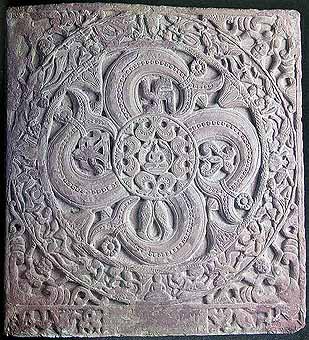
Mathura also becomes an important center of Jainism. A new kind of worshipping develops in this era – that of the Ayagapattas. The Jains produced votive tablets called ayagapattas that contain auspicious marks of worship such as fish couple or matsya yugala, the swatiska, etc.
Jain Ayagapattas with a Tirthankara in the middle.
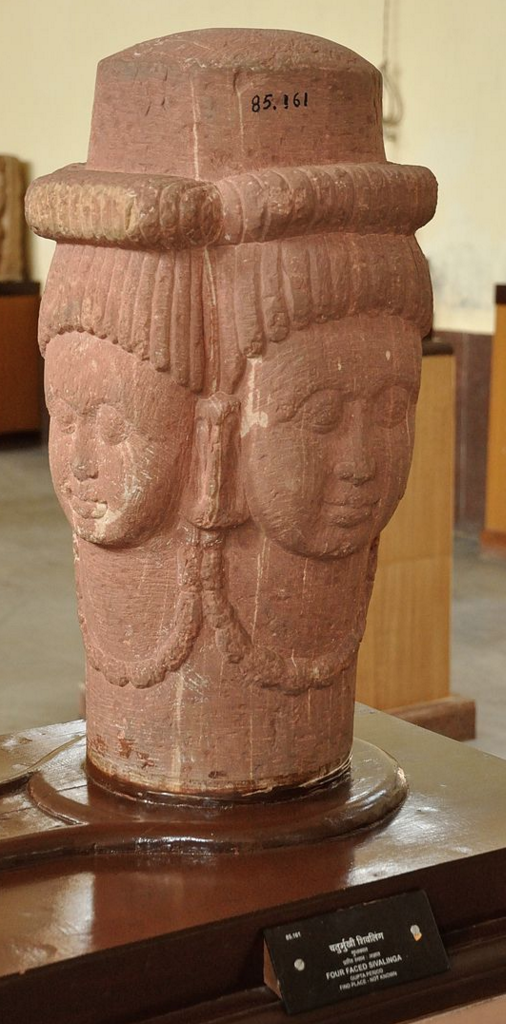
iii. Shaivism
Various Shaiva images have been found from the region though their numbers are limited.
Chaturmukhalinga.
Karttikeya-Skanda
iv. Vaishnavism
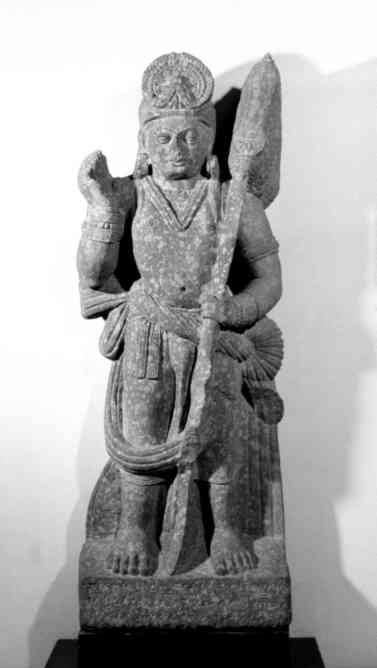
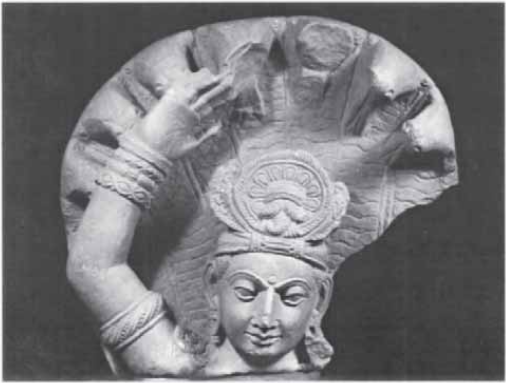
Balarama is shown with a snake canopy . Sometimes he carries a lion-staff plough.
v. Local Cults
Naga Cult is very prominent. A lot of Naga Temples have been found in/around this area.
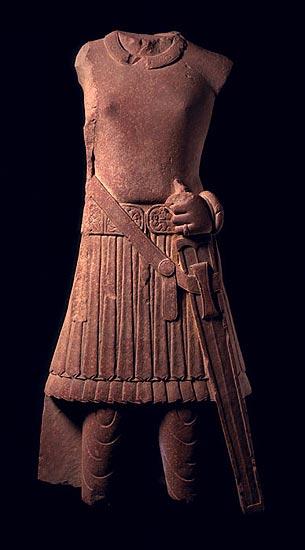
vi. Statue of Kanishka
Last but not the least, we have the statue of Kanishka.
SOUTH INDIA
I. Political Background
In the south, the Sangam Period starts (circa 300BC – 300AD). We see the emergence for 3 main kingdoms
1. Cholas – Kaveri Delta
2. Cheras – Kaveri Karoor
3. Pandya – Vagai, Madhurai
In the Deccan, the Satvahanas declare themselves as independent after the fall of the Mauryan Empire and emerge as a powerful force. Their kingdom is centered around Aurangabad.
Their 3rd king, Satakarni I seems to have performed two Ashvamedhayajna. His achievements are described in detail in the Nanaghat Inscription. Referred to as the lord of Dakshinapatha.
The strongest Satvahana ruler – Gautamiputra Satakarni carried out expeditions against the Saka rulers and drove them out of Maharashtra. His achievements are recorded in the Nasik inscription. By 225 AD, the Satvahanas are replaced by Ikshwaku (refer map).
II. Literature
A. Sangam Literature
South sees the emergence of Tamil Language. For the first time, we come to know of life in South India using literature. Sangam means assembly of scholars. Each Sangam consisted of a number of distinguished poets and erudite scholars who selected the best ones from amongst the works submitted to them. Many female authors seem to have contributed.
The Sangam classics, consisting of 18 works (8 anthologies of lyrics and 10 long poems), are well known for their directness of expression. The eight anthologies called the Ettuttogai are considered to be the earliest work belonging to the BC 300. The 10 poems are called Pattupattu. They are divided into
1) Aham deals purely with the subjective emotions of the lover.
2) Puram deals with objective emotions, mainly the valor and glory of kings, good and evil.
Some important works Sangam works are as follows –
Serves as a manual of precepts to guide one to noble living
Agattiyam
Agathiyar
The first known book on Tamil grammar. Believed to be lost beyond redemption.
Tolkāppiyam
Tolkappiyar
Work on the grammar of the Tamil language and the earliest extant work of Tamil Literature and Linguistics. It talks of Thinai(explained below)
Thinai : Another fascinating aspect of Sangam literature is its reference to 5 landscapes(eco-zones) and the people associated with them known as Thinai.
Ecozone as mentioned in Sangam Literature
Refers to
Associated human settlement
Marudam
Agricultural lands, Plains
Peasants, farmers
Mullai
Forest
Pastoral people
Palai
Desert Lands
Bandits, Travellers
Kurunji
Mountains/Hilly Areas
Hill tribes
Neydhal
Coastal Areas
Fishermen
B. Tamil Epics outside the Sangam Literature
We have 5 great epics.
No
Name
Author
Notes
1
Silappatikāram
Ilango Adigal
Love story between Kovalan who prefers the courtesan Madhavi of Kaveripattinam over his wife Kannagi.
2
Manimekalai
Cattan
Story of the daughter, Manimekalai, born out of love of Kovalan and Madhavi. There is also an elaborate exposition of the doctrines of Buddhism.
3
Cīvaka Cintāmaṇi
Adopted from Sanskrit Mahapurana, is predominantly sensuous, though Jain philosophy is brought to practical aspects of life
4
Valayapathi
5
Kundalakēci
III. Religion
We see no specific adherence to religion. The Sangam texts were secular in nature(one main reason how they differed from the Vedas)
IV. Architecture
A. Stupas
1. The Amaravati Stupa
Covered with locally available white limestone.
5 pillars at each gateway. These 5 pillars represent the 5 milestones of the life of Buddha (discussed earlier)
Use this tool to explore further – http://www.ancientindia.co.uk/buddha/explore/intro.html
2. Nagarjunakonda Stupa
Built by the successor of Satvahanas, the Ikshwakus. They continued the great art traditions of Satvahanas.
B. Rock-cut caves
1. Karle caves & Bhaja caves
Both caves belong to Hinayana Buddhism.
Karla Cave is the largest Hinayana Buddhist Chaitya in India built during Satavahana’s rule. Karla is the best example of rock-cut architecture, which is believed to carve out from a living rock. Some of its 2000-year-old wooden beams are still alive.
Bhaja caves are also mainly Viharas and Chaityas.
Noteworthy are the Dampati and the Mithuna figures as also the pairs riding the magnificent elephant crowning the pillars forming imposing colonnades.
The figures are more than life-size and are represented with a powerful and muscular physique.
2. Ajanta caves
The earliest group of caves consists of caves 9, 10, 12, 13 and 15A. They were made during the period 100 BCE to 100 CE, probably under the patronage of the Satavahanas who ruled the region.
Check out our Case Study on Ajanta and Ellora to explore more.
V. Independent Art
A. The Amaravati School of Art
Sculptural form in this area is characterised by intense emotions.
Figures are slender, have a lot of movement, bodies are shown with three bents (i.e. tribhanga), and the sculptural composition is more complex than at Sanchi.
White Marble was used in this art and the themes were Buddha’s life and Jatakas tales. The curly hair of Buddha is a feature that is influenced by the Greeks.
In this school, the Kings, Princes, Palaces, etc. have got prominence.
A relief medallion from Amravati belonging to the 2 century A.D. is a masterly representation of a scene showing the subjugation or taming of Nalagiri, a mad elephant let loose on the Buddha.
Carving on the outer wall of Amaravati Stupa
A famous carving depicts the adoration of the feet of the Buddha by four women and belongs to the 2nd century A.D. from Amravati.
Three-dimensional space in the relief sculpture is devised by using pronounced volume, angular bodies, and complex overlapping.
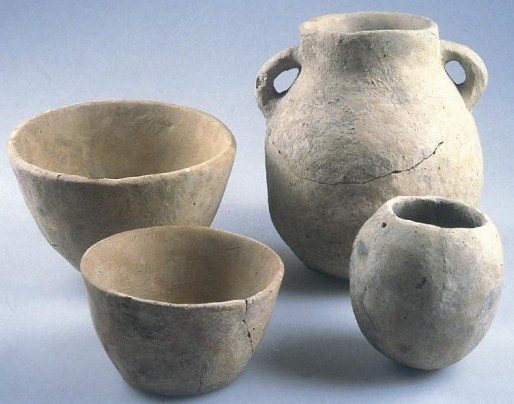
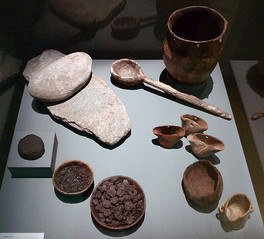
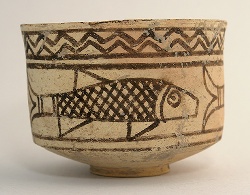
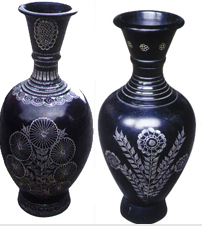
Pottery or ceramics or ceramic art refers to the creation of objects that are made up of hard brittle material produced from non-metallic minerals by moulding them while the material is wet and then firing them at high temperatures. They are often made up of clay, porcelain, steatite, etc.
Pottery plays an important role in studying culture and reconstructing the past. Historically with distinct culture, the style of pottery changed. It reflects the social, economic and environmental conditions a culture thrived in, which helps the archaeologists and historians in understanding our past. It holds significant value in understanding cultures where script was either absent or remains undeciphered. Understanding of presence of fire, cooking, storage, sedentary or migratory populace, social stratification can all be developed via studying pottery.
For people, pottery provided opportunity to store, cook, transport, trade and essentially became an expression of artistic creativity.
Pottery is majorly of two types
Handmade
Wheel thrown
Handmade pottery is rather a primitive style pottery developed in early ages which with time transforms to wheel thrown. The different motifs drawn on the surface plays an important role in understanding a culture and its beliefs.
Evolution of Pottery
I. Neolithic Age
We find the first reference of pottery in this age. Naturally it is hand-made pottery but during the later period footwheel is also used.
Features
Unglazed/unburnished that is having rough surface
Handmade coarse grey pottery
Material – clay mixed with mica and sand
Pottery is devoid of any painting
In many cases twisted rice husk cords were impressed into wet clay for decoration
Found throughout India including the South. Burzahom – coarse grey pottery
Included black-burnished ware, greyware and mat-pressed ware
II. Chalcolithic Age
Chalcolithic Era, the first metal age, is marked by the occurrence of distinct cultures in various parts of our country namely – Ahar culture in South Eastern Rajasthan, Malwa culture in Western MP, Jorwe culture in Western Maharashtra, etc.
People of this age used different kinds of pottery.
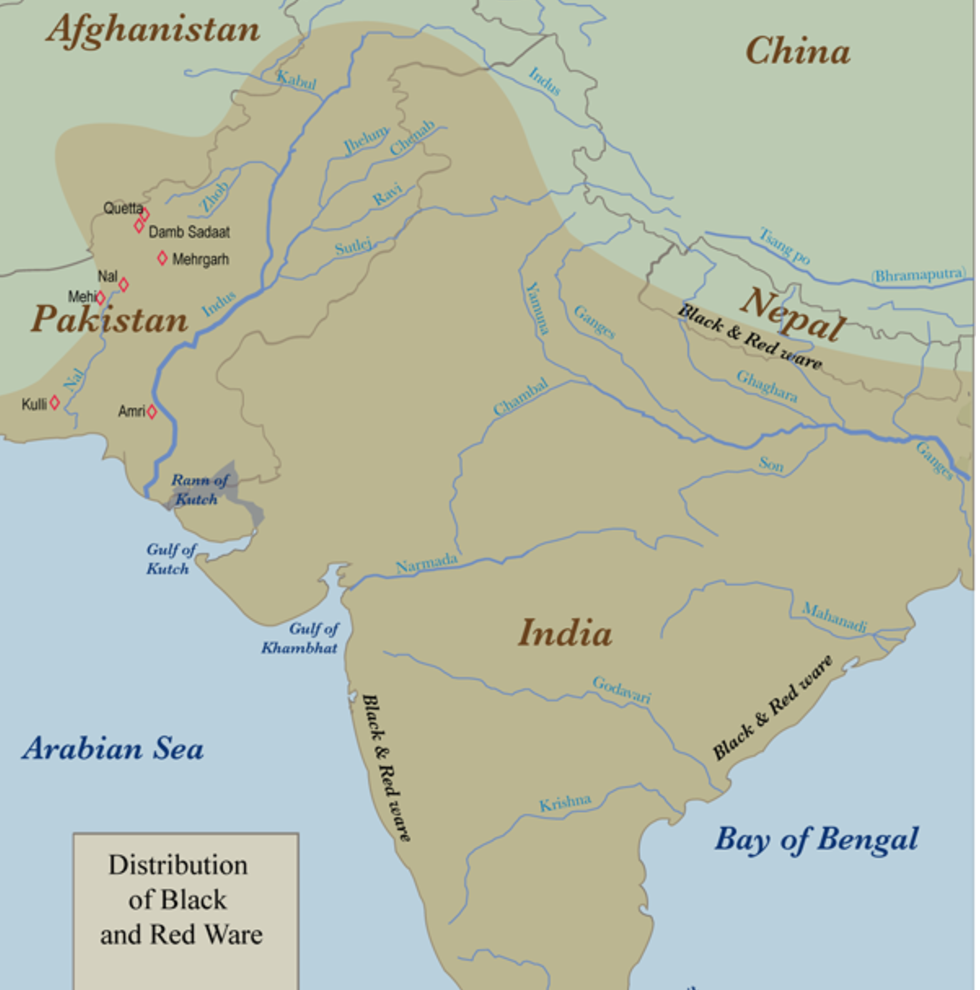
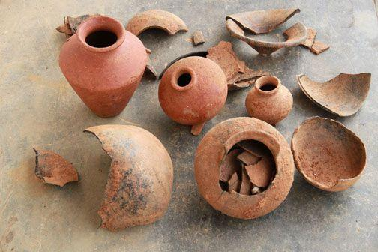
1. Black-and-red-ware Pottery
Black and red ware seems to have been widely used. Cultures like Ahar-Banas showed the presence of Black and Red ware pottery with white linear designs.
2. Black-on-red ware
Jorwe ware is painted black-on-red and has a matt surface treated with a wash.
3. Ochre Coloured Pottery (OCP)
OCP people are regarded as the junior contemporaries of Harappa.
This pottery is identified with the Copper Hoard Culture that was found in upper Ganga Valley and Ganga Yamuna doab area.
The colour of the pottery ranges from orange to red.
The period covered by the OCP culture is roughly placed between 2000 BC and 1500 BC.
Major sites are – Jodhpura (Rajasthan), Attranjikhera (UP)
Ganeshwar, located near Khetri copper mines, was initially believed to have OCP but researches have confuted this.
III. Harappan Civilization
Polished Ware Pottery with rough surface
Both polished and unpolished type of pottery existed
Pottery generally has a red surface and is wheel thrown although handmade ones too exist
Polished wares were well fired.
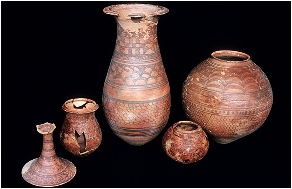
Most of the pottery is polychrome meaning more than two colours are used to colour the pottery.
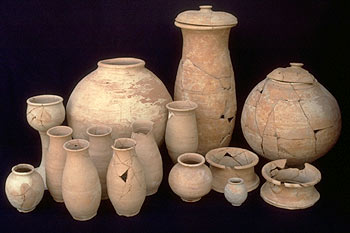
Most of the pottery is utilitarian. Such potteries usually have flat bases
Geometrical design along with paintings depicting flora and fauna are observed
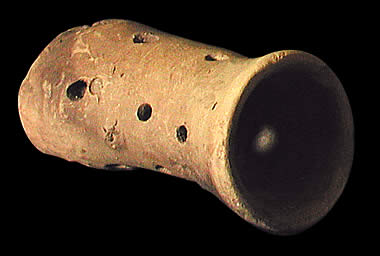
Perforated pottery was also found may be used for straining liquor.
Pottery throughout the civilization was uniform (mass thrown) revealing some form of control and leaving less space of individual creativity
Presence of luxurious pottery obtained from certain sites reveals economic stratification in the society
1. Mature Harappa
Burial Pottery of Harappa
Burnished and painted pottery
Burial pottery was specially and distinctly made
Reveals the Harappan belief in life after death
Presence or absence of this pottery in the grave goods reflected social stratification
2. Late Harappa
Ochre Colored Pottery (OCP) – As we know the late Harappan cultures(1900BC – 1200BC) were primarily chalcolithic. Some specific chalcolithic sites show the elements of late Harappan(like use of burnt bricks, etc). These sites have OCP.
Black-grey burnished ware produced on slow wheel – Found in Swat Valley. This resembles the pottery from north Iranian plateau.
Black-on-red painted and wheel turned pottery – Also found in Swat Valley. This shows a connection that Swat Valley was associated with Harappa.
Grey-ware and Painted Grey Ware, generally associated with Vedic people have been found in conjunction with some late Harappan pottery. It has less intricate designs as compared to the early and mature periods suggesting a dilution of the rich culture.
IV. Vedic Era – PGW
The Vedic Era saw the emergence of Painted Grey Ware(PGW) Culture.
The Rig Vedic sites have PGW but iron objects and cereals are absent. Hence it is considered a pre-iron phase of PGW. On the other hand, the Later Vedic sites are considered iron-phase of PGW.
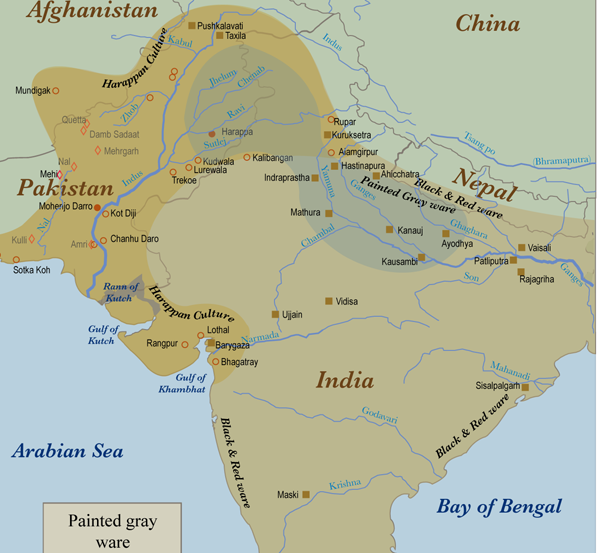
This pottery is an Iron Age pottery found in Gangetic plain and Ghaggar – Hakra valley, lasting from roughly 1200 BC – 600 BC. Mathura was the largest PGW site.
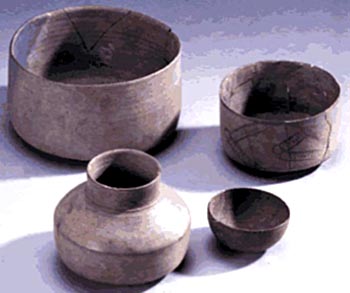
Characterized by a style of fine, grey pottery painted with geometric patterns in black.
Are confined to few geographical locations, namely – Punjab, Haryana and upperGanga Valley. This culture is associated with village and town settlements (but without large cities)
V. Later Vedic Era – NBPW
The later Vedic people were acquainted with 4 types of pottery – Black-and-red ware, black-slipped ware, painted grey ware and red ware.
VI. End of Later Vedic Era – NBPW
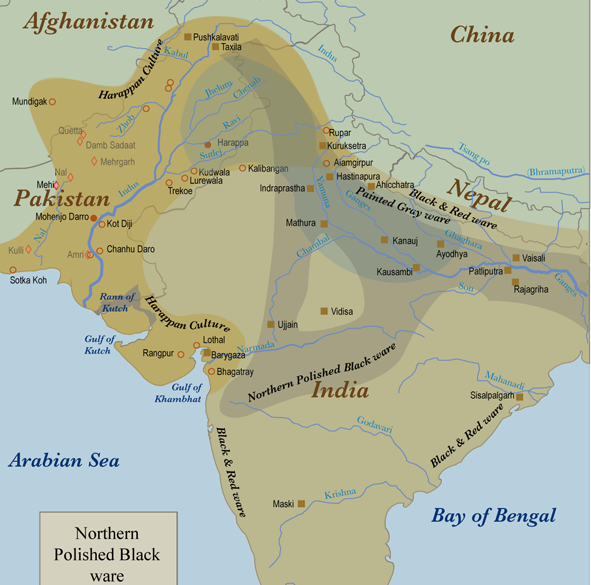
Towards the very end of Later Vedic Age around 6th century BC, we see the emergence of 2nd phase of urbanization(1st being Indus Valley Civilization). This era marked the beginning of the Northern Black Polished Ware (NBPW).
Map showing areas where NBPW pottery was found
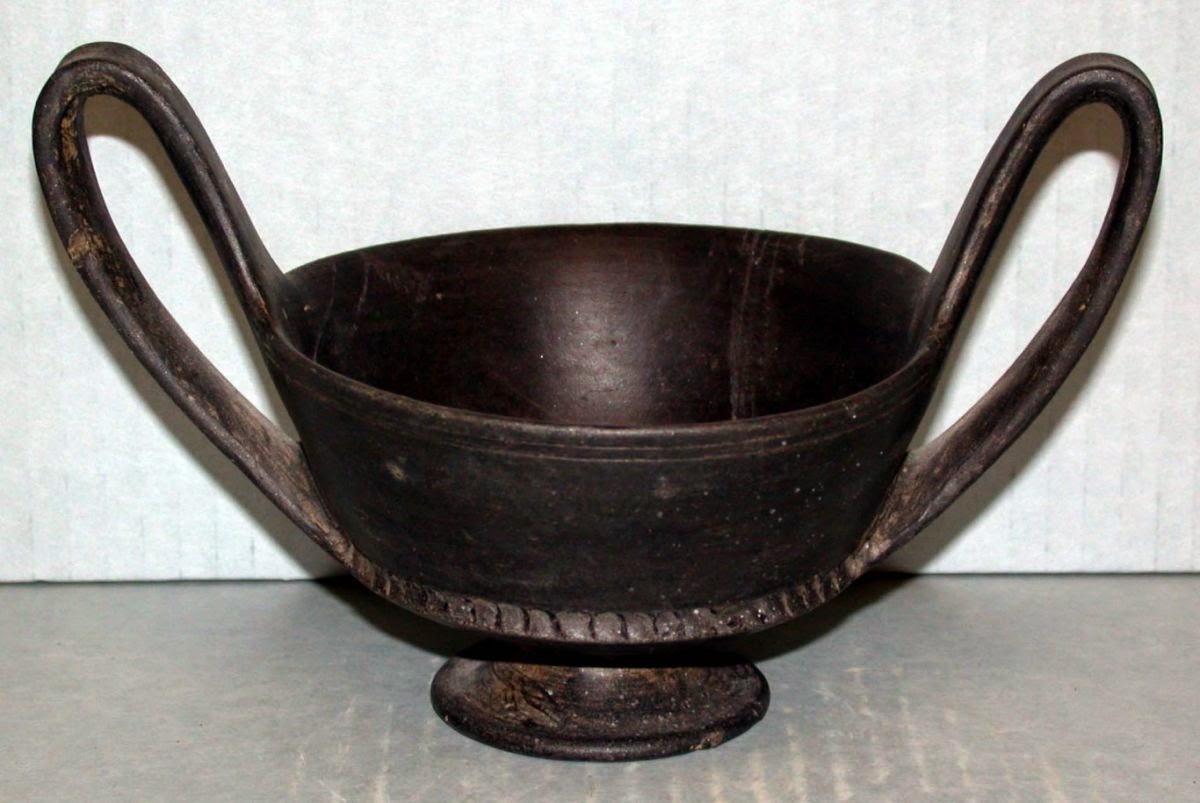
Glossy, shining type pottery.
Made of fine fabric and served as tableware for richer class. Considered deluxe pottery only found with the elites revealing societal stratification which was a result of Brahmanical hegemony.
This pottery continued to exist during the Mahajanapada era.
Found in Ahichatra, Hastinapur (both in UP), Navdatoli (Madhya Pradesh)
Classified into two groups – bichrome and monochrome
Monochrome pottery has a fine and thin fabric. Potted on fast wheel and have a strikingly lustrous surface. 90% of this type is jet black, brownish black and bluish black and 10% have colours like pink, golden, brown among others.
Bichrome pottery is found less. It shows all the features of monochrome except that it shows combination of two colours.
A Bichrome pottery with two colours
VI. Megalithic Era
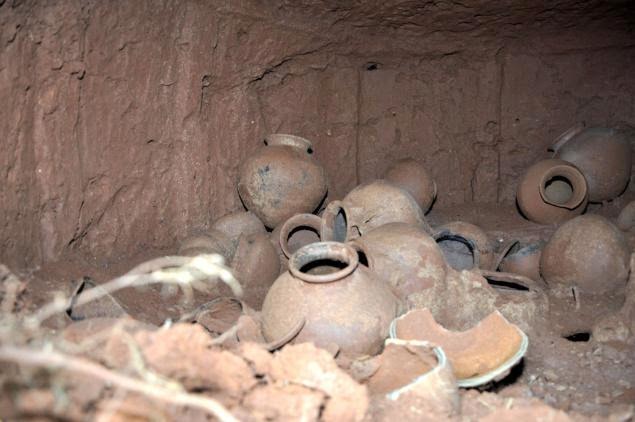
This culture is placed between- 3rd Century BC to 1st Century AD. Megaliths refers to monuments constructed of big (mega) stones (lith). This culture is particularly known for its large stone graves. In the South this age is characterized by the use of iron.
Megalithic Pottery found in Kerala
Well baked and durable
Wheel thrown
Bulk of these are plain however, a sherd from Koldihawa reveals black painting on the surface.
It has been excavated throughout India but majorly from the South. Mostly in Vindhyas.
They were used as grave goods revealing belief in life after death.
The period from the sixth to the late fourth century BC witnessed the rise of territorial polities-mahajanapadas in North India. This culminated in the establishment of the Mauryan Empire in about 325 BC. The Mauryan Empire was a pan-Indian empire founded by Chandragupta Maurya.
Ashoka is considered the most significant ruler of the empire.
II. Literature and Language
The Mauryan era witnessed very few literary contributions. These contributions were either in Prakrit or Pali or Sanskrit.
1. Sanskrit
Work
Author
Type
Theme
Patronage
Arthashastra
Chanakya
Political text written in Sanskrit
Deals with statecraft, Economic policy, military strategy and overall administration of the Mauryan realm.
Chandragupta Maurya
2. Pali and Prakrit
The religious books of Buddhism and Jainism were written in Pali and Prakrit (the language of the masses) respectively. This ensured even common men read and understood religion.
The earliest Buddhist works were written in Pali. The Buddhist works can be divided into the canonical and the non-canonical.
The canonical literature is best represented by the “Tripitakas”, that is, three baskets – Vinaya Pitaka, Sutta Pitaka and Abhidhamma Pitaka.
Work
Author
Type
Theme
Vinaya Pitaka
Upali
Buddhist scripture written in Pali. Name means basket of discipline.
Deals with monastic rules for monks and nuns.
Abhidhamma Pitaka
Buddhist scripture written in Pali
Deals with philosophy and metaphysics.
Sutta Pitaka
Ananda
Pali collection of Buddhist writings of Thervada Buddhism
Deals with dialogues and discourses on morality and deals with Dharma.
The non-canonical literature is best represented by the Jatakas. Jatakas are interesting stories of the previous births of Buddha. Each birth story is called a Jataka.
The Jain texts were written in Prakrit.
Work
Author
Type
Theme
Kalpasutra
Bhadrabahu
Jain scripture. written in Prakrit.
Jain scripture. written in Prakrit.
Besides these texts, Megasthenes’ Indica which was written in Greek also sheds light on the Mauryan administration.
III. Religion
Mauryan rulers were tolerant towards all religions.
1. Hinduism
Despite the increased popularity of Buddhism and Jainism, Hinduism remained popular too. Hinduism underwent changes during this era. Though Yajanas were performed animal sacrifices were stopped.
2. Buddhism
Buddhism flourished during Ashoka’s realm. He sent his son Mahinda and daughter Sangamitra to Sri Lanka to propagate Buddhism. Ashoka is also credited for the construction of 84000 stupas. Ashoka also convened the Third Buddhist Council.
History of Buddhist Council – These councils were Buddhist meetings held periodically which included Buddhist monks, nuns, and religious leaders.
Buddhist Council
Timeline
Location
Outcome
Spiritual Leader (Monk)
Patronage
First Buddhist Council
Around 400 BC after Lord Buddha’s death.
Sattapanni caves, Rajgriha
Led to formulation of Sutta and Vinaya Pitaka.
Mahakasyapa
Ajatashatru
Second Buddhist Council
Around 383 BC
Vaishali
The aim was to settle the dispute on practices of Vinaya Pitaka which led to the first schism of Buddhism– Mahasamghikas and Sthaviravadins sects were formed.
Sthaviravadins followed orthodox norms while Mahasamghikas followed less rigid norms.
Yasa
Kalasoka
Third Buddhist Council
Around 251 BC
Pātaliputra
Led to formulation of Abhidhamma Pitaka.
Moggaliputta Tissa
Ashoka
Fourth Buddhist Council
Around 72 AD
Kashmir
Buddhists further divided into 2 sects- Mahayana and Hinayana.
Vasumitra
Kanishka
3. Jainism
The growing merchant community made religious grants to Jainism which ensured the religion prospered. Chandragupta Maurya became a Jain follower and sent missions to the South to propagate the religion further. The decline in animal sacrifices was a result of the increasing influence of Jainism and Buddhism.
IV. Architecture
For the first time, we see state-sponsored art and architecture. Architectures prior to this period seem to have been made of wood and hence were not able to survive. A case in point is the 80-pillared hall at Kumrahar which is often considered to be a Mauryan palace.
For the first time, we see the construction of Stupas. These are hemispherical dome structures originally built over the relics of Buddha after his death. There were 8 of them distributed in places where Buddha seemed to have lived – Rajagraha, Vaishali, Kapilvastu, Allakapa, Ramagrama, Vethadipa, Pava, Kushinagar. Ashoka is credited to have commissioned construction of 84000 stupas.
The components of a Stupa are shown in the diagram –
Another remarkable sculpture is Sarnath’s lion capital
Characterized by four Asiatic lions standing back to back
It was adopted as India’s national emblem in 1950.
Figures of horse, lion, bull and elephant are sculpted on the abacus.
This pillar capital symbolized Dharmachakraparivartana that is the first sermon of Buddha.
The abacus has four wheels with 24 spokes each. This wheel with 24 spokes is adopted in the National Flag.
1. Basarah – Bakhira, Bihar
Single crowning lion sitting on a square abacus.
Compared to other capitals, this sculpture is relatively less ornamented.
2. Lauriya – Nandangarh Lion Capital
In Champaran district of Bihar.
The pillar is inscribed with edicts of Ashoka
Characterized by round abacus and lion as the crowning animal.
3. Sankisa Elephant Capital
Located in Uttar Pradesh
After Buddha’s death Ashoka installed series of columns in Sankissa among them only the Elephant capital survives.
4. Rampurva, Bihar
Is a hybridization of Persian and Indian elements.
The abacus shows Greek influence and has beautiful floral designs.
Zebu bull is depicted as the crowning animal.
C. Temples
Evidence of the earliest known structural temples has been recovered through excavations at the Bairat District of Jaipur, Rajasthan.
This shrine is dated to the 3rd century B.C
A circular brick and timber shrine of the Mauryan period
Was made of lime-plastered brick work
Points to construction of wooden pillars.
Surrounded by a seven feet wide ambulatory.
Temple 40′ at Sanchi, has a similar plan, it was a stone temple on an apsidal plan enclosed by an ambulatory, and raised on a high, rectangular scale, approached by two flights of steps from diagonally opposite sides. The super-structure was possibly built of wood, and has disappeared.
D. Caves
Many caves were built during the time of Ashoka. They were mostly Chaityas and Viharas (click to read more)
1. BARABARA CAVES
Oldest surviving rock-cut cave in India.
These caves are situated in the twin hills of Barabar (four caves) and Nagarjuni (three caves) located in Bihar.
These caves were granted to Ajivika sect by Ashoka. Ashokan inscriptions have been found in this cave.
Caves are carved out of granite and have a polished surface.
Barabar Hill contains four caves, namely, Karan Chaupar, Lomas Rishi, Sudama and Visva Zopri.
Among these most important are Sudama and Lomas Rishi Caves as they are the earliest examples of rock-cut architecture in India
2. LOMAS RISHI CAVE
The arch-like shape facade of Lomas Rishi Caves, imitates the contemporary timber architecture
3. SUDAMA CAVE
This cave has better finishing in comparison to Lomas Rishi cave. The inner walls are highly polished.
V. Independent Art
Human figures are conspicuously absent. Exceptions to this pattern are the yaksha and yakshi sculptures.
A. Sculpture
Yaksha and Yakshi figures – Life-size figures have been found in Vidisha, Patna and Mathura.
DIDARGANJ YAKSHI
Found from a Didarganj, Patna.
A wonderfully modeled life-size standing image of a Yakshini holding a chauri (flywhisk)
Characterized by elaborate ornamentations and sensuous appeal depicting Indian sculptural tradition.
Highly polished surface made up of sandstone.
PAKHAM, YAKSHA
Located in Mathura
Made up of sandstone
Elephant in Dhauli, Orissa
Dhauli Hills are located on the banks of river Daya south of Bhubaneshwar
The oldest Buddhist sculpture in Orissa is the rock-cut elephant above which Ashokan Edicts are spotted.
Male Torso, Lohanipur
– Highly polished. The nude torso of a Jain Tirthankara or a savior of the Digambara sect found at Lohanipur
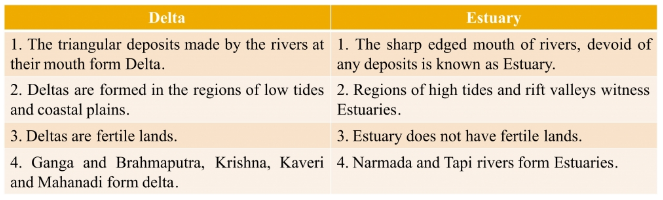 Source