💥UPSC 2026, 2027, 2028 UAP Mentorship (March Batch) + Access XFactor Notes & Microthemes PDF

Search results for: “”

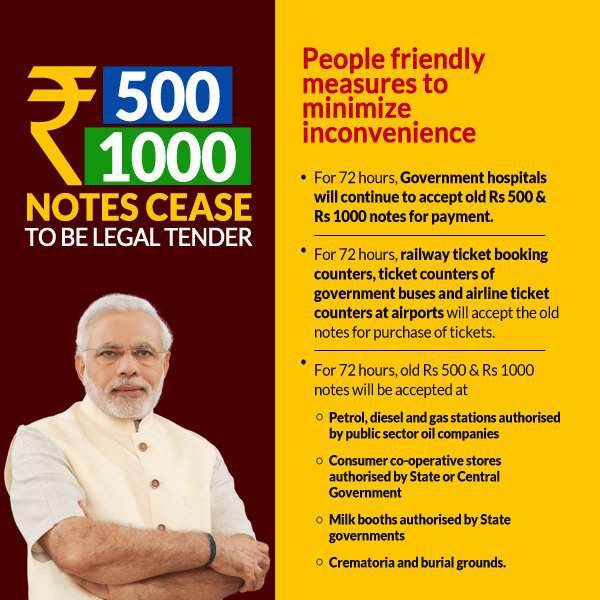
  • Rs 500-1,000 notes ban: Understand Demonetization & link JAM Trinity with this announcement on curbing Black Money

    source

    Understanding Demonetization

    Demonetization is the act of stripping a currency unit of its status as legal tender. Demonetization is necessary (this happened when Euro was introduced) whenever there is a change of national currency. The old unit of currency must be retired and replaced with a new currency unit.

    What is legal tender?

    The coins issued under the authority of Section 6 of The Coinage Act, 2011, shall be legal tender in payment or on account i.e. provided that a coin has not been defaced and has not lost weight so as to be less than such weight as may be prescribed in its case: –

    (a) coin of any denomination not lower than one rupee shall be legal tender for any sum,

    (b) half rupee coin shall be legal tender for any sum not exceeding ten rupees,

    Every banknote issued by Reserve Bank of India ( ₹ 2, ₹ 5, ₹ 10, ₹ 20, ₹ 50, ₹ 100, ₹ 500 and ₹ 1000) shall be legal tender at any place in India.

    What India witnessed on 8th november 2016 was the not the first time we plugged and play the demonetization game.

    1946: Rs1,000, Rs5,000, and Rs10,000 notes were taken out of circulation in January 1946. The Rs10,000 notes were the largest currency denomination ever printed by the Reserve Bank of India, introduced for the first time in 1938. All three notes were reintroduced in 1954

    1977: The Wanchoo committee (set up in 1970s), a direct tax inquiry committee, suggested demonetization as a measure to unearth and counter the spread of black money. However, the public nature of the recommendation sparked black money hoarders to act fast and rid themselves of high denominations before the government was able to clamp down on them!

    The High Denomination Bank Notes (Demonetisation) Act deemed the Rs 1,000, Rs 5,000 and Rs 10,000 notes illegal for the second time. At the time, then-RBI governor I.G. Patel disagreed with the measure.

    2016: Recommendations of SIT on Black Money as Contained in the Fifth SIT Report 

    Cash transactions : The SIT has felt that large amount of unaccounted wealth is stored and used in form of cash. Having considered the provisions which exist in this regard in various countries and also having considered various reports and observations of courts regarding cash transactions the SIT felt that there is a need to put an upper limit to cash transactions. Thus, the SIT has recommended that there should be a total ban on cash transactions above Rs. 3, 00,000 and an Act be framed to declare such transactions as illegal and punishable under law.

    Cash holding : The SIT has further felt that, given the fact of unaccounted wealth being held in cash which are further confirmed by huge cash recoveries in numerous enforcement actions by law enforcement agencies from time to time, the above limit of cash transaction can only succeed if there is a limitation on cash holding, as suggested in its previous reports. SIT has suggested an upper limit of Rs. 15 lakhs on cash holding. Further, stating that in case any person or industry requires holding more cash, it may obtain necessary permission from the Commissioner of Income tax of the area.

    With full backing, for the third time, India participated in the process of demonetization. RBI governor, Urjit Patel applauded Modi’s “very bold step” which addresses concerns about the “growing menace of fake Indian currency notes.”

    How big is the impact of this announcement?

    A better sense of this can be gauged from this graph below. As you can see, the monetary value of Rs500 and Rs1,000 notes in circulation far outstrips any other denomination.

    Putting it simply, at the stroke of midnight, a little over 80% of the cash in India (by value) will be worthless pieces of paper.

    With these notes now going out of circulation overnight, the government has created a solid opportunity to clean up the system. Currently India’s black money economy is about 20% of its GDP, according to estimates from Ambit Research. Apart from cash, Indians also hoard wealth worth over billions of dollars in the form of gold. To understand the issue of Black money in depth, read this blog
    What was the need for such a move?
    – The incidence of fake Indian currency notes in higher denomination has increased
    – Unaccounted money, often used in any form of corruption or illicit deals, usually takes the form of high-value notes, which in this case are the Rs 500 and Rs 1,000 bills
    – The Financial Action Task Force, a global body that looks at the criminal use of the international financial system, notes that high-value bills are used in money laundering schemes, racketeering, and drug and people trafficking
    Comparison of high value bills across the world
    – In the United States, the highest denomination bank note is $100. When it comes to the United Kingdom, the highest denomination bank note issued by the Bank of England is £50
    – As you can see, the highest denomination note is essentially 50-100 times the smallest denomination note of one dollar or one pound
    – In India, up until now the highest denomination note was Rs 1,000 and this was 1,000 times the smallest denomination note of Re 1 (Note: Re 1 notes are issued by the ministry of finance)
    When a currency has notes of higher denomination, it is easier to launder money i.e. store black money, as it takes less space and weighs less as well.
    The positives that come out of this announcement
    – Remember your economics basics? What happens when people go back and deposit their money. Deposits increase for the banks and that means eventually interest rates might come down
    – Curb on black money – corruption, terrorism etc. (as discussed above) [Backgrounder on Black money]
    – Boost to cashless economy with people adopting habits of wallets etc. [Read about Payment Banks here]
    – Boost to Jan Dhan Account’s relevance for poor people – Would be interesting to factor the surge in new account creation and activity in dormant accounts [Read more on JAM Trinity]
    – Politics and various elections are known to run on cash. Same is the case with sectors such as real estate. Expect a gradual reform in this area
    The potential negatives out of this announcement
    – Everything else being equal, withdrawal of currency in circulation, in the (very) short-run, might actually drive up interest rates
    – (Very) Short-term liquidity squeeze could be severe and hence economic activity could suffer
    – Sovereign credit rating – possibly no impact. But if there are short-term impact on economic activity which dampens government revenues and widens deficit, you can expect a short term decline in ratings
    – Cost of printing the new currency (if high) would create another political furore
    – Immediate chaos and public mayhem (which will bring out potential issues of execution)

    3 Important Steps taken before this announcement was made

    1. Jan Dhan scheme, under which 22-crore new bank accounts were opened in one-and-a-half years (May 2016), was the first truly game-changing move. Most of these accounts brought those people into the network who were outside the ambit.

    According to the Economic Survey for 2015-16 released in February this year, leakages in LPG subsidy transfers fell 24 percent and the exclusion of beneficiaries had been greatly reduced, thanks to the infrastructure created by Jan Dhan accounts, Aadhaar and mobile networks, or the JAM trinity.

    2. The next step was to bring back black money stashed away in tax havens or foreign banks abroad and here.

    3. Then came the Income Declaration Scheme. By 30 September, all illegal asset holders had the chance to declare their holdings and pay 45 % tax and a penalty in exchange for anonymity and immunity from criminal proceedings.

    The tax department has reported Rs 65,250 crore worth of black money from 64,275 declarations. This means about Rs 30,000 crore will flow into the government’s tax kitty.

    Challenges ahead

    #1. The government should come up with additional economic stimulus to offset the dampening effect:
    (a) Accelerated reduction in corporate income tax along with withdrawal of exemptions;
    (b) Ending uncertainty on GAAR and retrospective taxation or any other blockbuster measure that they might be working on, that would offset the initial adverse economic impact.
    #2. Assess Black Money better: There’s no good estimate for how much of India’s black money is in forms other than currency/physical notes such as gold, jewellery, land or any other form of wealth. Therefore, while banning Rs 500 and Rs 1,000 notes will tackle the black money that is in the form of hard cold cash, it won’t affect other forms of black money.

    #3. Prepare for the challenges of cashless economy: The UPI (unified payment interface) system is likely to be fully operationalised only by January 2017.  India was recently hit by one of its biggest financial security breaches compromising hundreds of thousands of debit cards. Read more about Cyber Security challenges from here

    Reference:

    http://thewire.in/78694/paper-money-ban-rs-500-rs-1000-notes-explained/

    http://www.firstpost.com/politics/rs-500-1000-notes-ban-jam-trinity-overseas-haul-how-pm-modi-is-winning-the-war-against-graft-3097176.html

    http://indianexpress.com/article/business/economy/ambit-capital-black-economy-shrinking-pegged-at-20-per-cent-of-gdp-2835783/


     

  • 9 Nov 2016 | GS4 | Trupti and Pallavi are two college-friends working in the same project in a reputed Information Technology company. Both are hardworking employees and their friendship is quite strong. One late evening, while leaving office, Pallavi saw Trupti taking printouts of the software code being developed by the team.

    GS4 (Case Study)

    Trupti and Pallavi are two college-friends working in the same project in a reputed Information Technology company. Both are hardworking employees and their friendship is quite strong. One late evening, while leaving office, Pallavi saw Trupti taking printouts of the software code being developed by the team.
    The company has strict rules regarding the use of company property and it doesn’t allow employees to take work home or to take printouts of codes. Early this year, the company had fired two employees who were found to have violated these rules.
    Pallavi knows that Trupti comes from a humble background and this job is very important for the financial security of her family.

    (a) The following are some suggested options. Please evaluate the merits and demerits of each of the options:
    1. Report to the higher management about the incident.
    2. Talk to Trupti about the issue and try to convince her to stop doing this act.
    3. Ignore the act as it does not directly concern you.

    (b) Also indicate (without necessarily restricting to the above options) what you would like to advise, giving proper reasons.


    GS4 question powered by mitrasias.com

  • 9 Nov 2016 | GS3 | The future of India’s food security lies in genetically modified crops. Critically comment on the statement in the light of the recent GM Mustard issue.

    GS3 (Agriculture)

    The future of India’s food security lies in genetically modified crops. Critically comment on the statement in the light of the recent GM Mustard issue.

  • 9 Nov 2016 | GS2 | What is the difference between competitive and cooperative federalism? Are both mutually exclusive concepts or can they go together? Discuss.

    GS2 (Polity and Governance)

    What is the difference between competitive and cooperative federalism? Are both mutually exclusive concepts or can they go together? Discuss.

  • 9 Nov 2016 | GS1 | What factors accounted for the rather sudden rise of Europe to world dominance? How was this small region was able to transform immensely larger portions of the world and to maintain its commanding position for so long?

    GS1 (World History)

    What factors accounted for the rather sudden rise of Europe to world dominance? How was this small region was able to transform immensely larger portions of the world and to maintain its commanding position for so long?


    For a background/discussion of this question, read this blog by K Siddhartha

  • 9 Nov 2016 | Prelims Daily: CA Questions with Tikdams & Tidbits

    Dear students,

    When you submit your answer, if possible, give some reasoning & more info. along with the ABACAA format. Elaborate on what you know. This helps the whole community to know more and learn more!


    Q.1) Recently, Magnetospheric Multiscale Mission (MMS) was in the news for Guinness World Record for highest altitude fix of a GPS signal. Which of the following space agency is related to MMS.

    a) European Space Agency (ESA)

    b) NASA

    c) ISRO

    d) Russia’s Roscosmos


    Q.2) Consider the following statements about ‘International Regulatory Cooperation for Herbal Medicines’ (IRCH)

    1.IRCH is a global network of regulatory authorities created by Ministry of AYUSH.

    2.Its mission is to protect and promote public health and safety through improved regulation for herbal medicines.

    Which of the statements given above is/are correct?  

    a) 1 only

    b) 2 only

    c) Both 1 and 2

    d) Neither 1 nor 2


    Q.3) Consider the following statements about ‘WHO Framework Convention on Tobacco Control’ (WHO FCTC).

    1.It is the first global evidence-based public health treaty that recognises the right of all people to the highest standard of health.

    2.The Treaty was developed by countries in response to the globalization of the tobacco epidemic.

    Which of the statements given above is/are correct?  

    a) 1 only

    b) 2 only

    c) Both 1 and 2

    d) Neither 1 nor 2


    Q.4) Consider the following statements about Internet Assigned Numbers Authority (IANA).

    1.IANA body is responsible for delegating and managing domain names and Internet protocol addresses globally.

    2.It is headquartered in the Geneva, Switzerland.

    Which of the statements given above is/are correct?  

    a) 1 only

    b) 2 only

    c) Both 1 and 2

    d) Neither 1 nor 2


    Q.5) Which of the following is the first state in the country to join new GST (Goods and Service Tax) System.

    a) Tamil Nadu

    b) Delhi

    c) Puducherry

    d) Maharashtra


    IMPORTANT STUFF: 

    1. These questions are mostly derived from our daily newscards. Reading daily news from Civilsdaily’s App (click here) or website + solving these questions will help you reinforce the basics.

    2. For a comprehensive preparation of IAS Prelims 2017 – consider joining one of the three Prelims Modules by CD – prelims.civilsdaily.com

    3. Solutions will be uploaded at 8 p.m. Click here for solutions.

    4. For attempting previous Prelims Daily Questions – Click here

    5. How to apply Tikdams? Read this, this and this

  • Government scrapping the notes carrying value of Rs. 500 & Rs. 1000

    Flawless decision by the government. Pondered over the pros & cons of the decision of scrapping the old series of notes of denomination of Rs. 500 & Rs. 1000.
    Arrived to a conclusion (my personal opinion, experts may disagree):
    Pros:
    1. The value of the Hard EARNED money of corrupt officials across the country stands NIL as the notes of biggest denominations they had in their houses or GODOWNS are scrapped. They are as good as any colorful piece of paper available in the market. On a lighter note, no difference between the notes of Rs. 500 & Rs. 1000 issued of RBI & Bhartiya Manoranjan Bank. ?
    2. The same is applicable to all the corporate houses, businessmen, Sports betters etc who had amashed black money as they will not find any taker of this black money be it Capital Market, Money Market, Real Estate, Hawala etc. Since they themselves are under pressure due to increased regulation made by several authorities viz SEBI, RBI, INCOME TAX, ED, Economic Offence Wing of CBI & State Police among others.
    3. The influence that the black money market had on our economy is massive. Because of the black money which is present in the economy but not accountable for the purposes of monitoring the Health of the economy shall be neutralised. Say for an example, the data for foreign remittances will be correctly matched with what sent officially unlike in past. There shall be a huge blow on the Black Money which is considered by many as a Parrallel Economy.

    Cons:
    1. With the reintroduction of the bigger denomination, it is likely that the game of Black Money may resume. To ensure that this does not happen, greater enforcement should be made. Efforts to reduce the cash economy and encourage the cashless transactions.
    2. The present govt or any succeeding govt may change the decison taken and resume the circulation of old notes. This may create a grater panic situation than what we have now as all the black money holders shall be injecting the money kept till such time into the market. To avoid this, there needs to have a political will which can very well be seen in this govt. Need of the hour is to epower the law enforcement wings viz. Income tax, ED among others to another scale and digitalise the country to keep an eye on the suspicious transactions.
    3. The law brought with an intention to curb Black Money & Corruption shall be having an adverse effect on the poor. A major portion of our population who happen to reside in villages and still have very limited access to banks and that too at some places through banking correspondents (BC) may find it difficult to get the money in time as they are not well equipped with ATMs offering money instantly. Efforts would be that the rural areas should also be in focus while circulating the money. The duty of the Rural Branches and the respective BCs increases here as they have to carry out the work of assisting the needy ones immediately.
    4. The panic observed among the general public is obvious and well understood. The need of the hour is to sensitise them about the law and the steps are to be taken for avoiding any kind of confusion grown out of this law by making ads, radio, TV, social media etc.
    The cons of the law are not influensive in nature and can be easily done away with if worked upon properly.

  • Debate: Scrapping the 500, 1000 rupee notes – Good or bad?

    When I read the news, I didnt believe it at 1st. How could they simply de-recognise bills overnight? What about the money I have?
    Okay, then I read further and saw options:
    – ATMs closed tomorrow (Where do I get the 100s from?)
    – You can get them exchanged in banks starting in a few days with daily and weekly caps (Q: How is this different from me getting notes exchanged when they phased out, eg 2005 series of 100 notes for new notes)
    – you can still use them in Petrol pumps and govt hospitals

    on top of it all, “HOW DOES IT END BLACK MONEY?!”

    And then it hit me. I SMILED, then thought of putting an FB status update.
    This was sheer brilliance!!

    Now lets analyse
    Black money is mostly carried as cash in 500 and 1000 bills. If you have 1 crore as black money, you’d need (7 zeroes divided by 3 zeroes = 4 zeroes) 10,000 Rs 1000 notes. Double that for Rs 500 notes and keep extrapolating because 1 crore is such a paltry sum. People have stashed far more than that!!
    Converting all of that into 100s makes a humongous storage problem and then there’s the problem of exchange too as that entails going to the bank with your PAN in hand..

    Lets analyse other options
    – Get the tanks filled of all your ill gotten Audi’s, BMWs, Mercs and the like. Still “Bhai kitna tel dalwa loge?”
    – Get yourself the best and costliest treatment in a govt hospital. (Fir bhi, bhai kya kya karva loge?”)
    – Go to the bank and get Rs 4000, 10,000… exchanged everyday into 100s (storage problem) or get it deposited in your account by showing a PAN card.

    Let’s say you keep doing that everyday till March 2017 (with project INSIGHT a couple of weeks should be enough to realize a pattern) and suddenly you’ve exchanged either too much money or deposited too big an amount and guess who shall know – “The IT DEPT <without Kejriwal>!!!!”

    Where do you run now? All that stash ain’t gonna help you mate!!

    Isnt this awesome??

    Tonight at the stroke of Midnight hour, a new India awakes!!! and rises!!! And whatever happens in the US, this is a TRiUMPh!!! <no absolutely not supporting him>

    <Let’s discuss>
    Have I got this wrong? Is there something else at play?
    Isn’t printing new money (with the 2000 bill and all) going to make this exercise moot?
    Is a chance missed to bring Black money into the system?

  • Know Your Service | Indian P&T Accounts and Finance Service

    source

    Indian P&T Accounts and Finance Service is a group A service, wherein, the senior most person of the service is the Deputy Director General who heads this organisation.

    The Service was started in 1972 for prudent and professional management of the finances of the Department of Posts and Department of Telecommunications which were the sole provider of the communications needs of the country at that time.

    Training:

    Training is split into three parts:

    1. After selection through the civil services exam, the IP&TAFS officers get trained in the Foundation Course at the Lal Bahadur Shastri National Academy of Administration in Mussoorie
    2. This is followed by training in the financial management at the National Institute of Financial Management, Faridabad, for 48 weeks along with officers of other organised accounts and finance services.
    3. The final phase of training is at the advanced level telecom training centre at Ghaziabad with emphasis on postal and telecom functioning and rules. Here the training schedule has an intensive course in advanced accountancy.

    After these training programmes, the officers handle posts in the Departments of Telecom and Posts, TRAI and a number of PSUs under the Communications Ministry.

    All the finance posts in the largest PSUs in the country – BSNL and MTNL – are also manned by the officers of this service – Indian P&T Accounts and Finance Service.

    Career Progression:

    Assistant Chief Controllers of Imports and Exports > Deputy Chief Controller of Imports and Exports > Joint Chief Controller Imports and Exports or Chairman of a Public Sector unit.

    Why IP&TAFS:

    This is a service of prestige and power. It involves postings at some of the prominent posts of the country. In Department of Telecommunications, the officers are posted at DOT Headquarters as Adviser, Sr DDG, DDG, Directors & ADG.

    In field units the officers are posted as Controller or Joint Controller of Communication Accounts (CCA/JCCA) which is involved in the collection of License fees and Spectrum Usage Charges from Airtel, Vodafone, Idea, BSNL, MTNL and other service providers.

    The CCA units also assist in the administration of Universal Service Obligation Fund under the Ministry of Communications & IT for providing telecom service in rural or remote areas of the country.

    This involves: (a) planning & forecasting, (b) tendering, (c) costing, (d) disbursement of support to service providers, and (e) monitoring.

    In the Department of Post, the officers from this service are manning the offices of Postal Accounts located at DOP Headquarters and in all states. The work in these offices mainly comprises maintaining General Provident Fund accounts of the staff employed in a particular postal circle, settlement of pension cases, checking of money order deliveries and NSCs, budgeting and financial control, Internal Audit of Postal Units and rendering financial advice to the concerned Head of the Circle.

    With such important departments to serve in, respectable job, easy timings and good pay packages, the service becomes another of the coveted posts of India.

  • 8 Nov 2016 | GS4 | Are women at a disadvantage in the workplace in terms of moving up the hierarchy, pay etc? Explain the reasons and also discuss why we should aim for gender parity.

    GS4 (Ethics)

    Are women at a disadvantage in the workplace in terms of moving up the hierarchy, pay etc? Explain the reasons and also discuss why we should aim for gender parity.

More posts