The Supreme Court affirmed a candidate’s right to privacy from voters, stating that candidates need not divulge every aspect of their personal lives and possessions to the electorate.
It held that Voters Right to Know about the electors is NOT ABSOLUTE.
Right to Privacy in India:
The Right to Privacy under Article 21 of the Indian Constitution is interpreted as an intrinsic part of the fundamental right to life and personal liberty.
Article 21 states that “No person shall be deprived of his life or personal liberty except according to procedure established by law.”
In the landmark judgment of Justice K.S. Puttaswamy (Retd.) v. Union of India (2017), the Supreme Court explicitly recognized the Right to Privacy as a fundamental right under Article 21.
The court held that privacy is an essential aspect of personal liberty and dignity, encompassing informational privacy, decisional autonomy, bodily integrity, and spatial privacy.
This right protects individuals against unwarranted intrusions into their private lives by the state or any other entity.
It includes the right to keep personal information confidential, to make decisions about one’s life and body without interference, and to maintain physical and spatial autonomy.
A candidate doesn’t need to declare every item of movable property, such as clothing, shoes, crockery, stationery, and furniture, unless these items are of such value as to constitute a sizeable asset in itself or reflect upon the candidate’s candidature in terms of their lifestyle – Supreme Court.
What are Corrupt Practices under the RPA?
Section 123 of the Representation of People Act, 1951 defines “corrupt practices” to include bribery, undue influence, false information, and promotion of enmity among citizens based on religion, race, caste, etc.
Section 123(2) deals with “undue influence,” involving interference with electoral rights through threats or promises.
Undue influence can manifest in various forms, including threats of physical harm, coercion, intimidation, promises of reward or benefit, or exploitation of vulnerabilities.
Supreme Court’s Verdict
Emphasis on Candidate’s Right to Privacy:
Upholding the appeal, the Supreme Court emphasized the candidate’s right to privacy, stating that not every non-disclosure automatically constitutes a defect.
The court highlighted that a candidate is not required to disclose every item of movable property unless it reflects upon their candidature or lifestyle.
Case-specific Evaluation:
The court emphasized that each case must be judged on its own merits, without applying a blanket rule.
The Court emphasized that non-disclosure of certain personal possessions does not amount to a “defect of a substantial nature” under Section 36(4) of the 1951 Act.
Example of “High-value” Assets:
Suppression of high-priced assets, indicating a lavish lifestyle, would constitute undue influence.
However, ownership of simple, low-value items may not be considered a defect.
PYQ:
[2017] For election to the Lok Sabha, a nomination paper can be filed by-
(a) Anyone residing in India.
(b) A resident of the constituency from which the election is to be contested.
(c) Any citizen of India whose name appears in the electoral roll of a constituency.
The White House directed NASA to establish a time standard for the Moon, named Coordinated Lunar Time (LTC) by the end of 2026.
This move aims to facilitate coordination among international bodies and private companies operating on the lunar surface.
Timekeeping on the Moon
The Moon has its own day and night cycle, which lasts about 29.5 Earth days.
Currently, the time on the Moon is measured using Coordinated Universal Time (UTC), which is the same timekeeping system used on the Earth.
However, because the Moon’s day is much longer than Earth’s day, it would be difficult to use UTC for day-to-day activities on the Moon.
Coordinated Universal Time (UTC)
UTC is a time standard introduced on January 1, 1960.
It is based on International Atomic Time (TAI), which is maintained by atomic clocks around the world.
It is the primary time standard used by many countries, international organizations, and scientific research institutions.
It is expressed as a 24-hour clock and is used to indicate the time offset from Coordinated Universal Time (UTC+0).
Time zones are defined as an offset from UTC, with some time zones being ahead of UTC (UTC+1, UTC+2, etc.) and others being behind UTC (UTC-1, UTC-2, etc.).
It is adjusted periodically to account for changes in the Earth’s rotation, which can cause variations in the length of a day.
These adjustments are made through the addition of leap seconds to UTC, which help to keep the time standard synchronized with the Earth’s rotation.
Need for a Lunar Time Standard
Earth’s Time Standard:
Earth’s time standard is primarily based on Coordinated Universal Time (UTC), set by the International Bureau of Weights and Measures in Paris, France.
UTC is determined by a weighted average of over 400 atomic clocks worldwide, providing a universally agreed-upon standard for time measurement.
Challenges with Earth’s Time Standard on the Moon:
Time on the Moon differs from Earth due to factors like gravity and the Moon’s rotation.
Time on the Moon ticks slightly faster due to lower gravity (about 56 microseconds every day) as per Einstein’s Theory of General Relativity.
Establishing a Lunar Time Standard:
Technical Considerations:
LTC cannot be based on UTC due to the time differences between Earth and the Moon.
Current lunar missions operate on independent timescales linked to UTC, but this approach becomes challenging with multiple space crafts on the Moon.
Deployment of Atomic Clocks:
Like on Earth, atomic clocks can be deployed on the lunar surface to establish a time standard.
A 2023 report suggests placing at least three atomic clocks on the Moon’s surface, accounting for variations in lunar rotation and local gravity.
Synthesizing Time Measurements:
Atomic clocks placed at different lunar locations will tick at the Moon’s natural pace.
Output from these clocks will be combined using algorithms to generate a unified time standard for the Moon, tied back to UTC for Earth operations.
Earth’s Latitudinal Variations on Time
On Earth, atomic clocks placed at different latitudes experience variations in time due to differences in rotational speed of Earth.
Earth rotatesfaster at the Equator compared to the poles, resulting in different time measurements.
Benefits offered by Lunar Time
Having a lunar time zone would also make it easier for scientists and researchers to conduct experiments and collect data on the Moon.
It would also help to prevent confusion and errors that could arise from using different timekeeping systems on Earth and the Moon.
PYQ:
[2015] Tides occur in the oceans and seas due to which among the following?
1. The gravitational force of the Sun
2. The gravitational force of the Moon
3. The centrifugal force of the Earth
Select the correct option using the code given below:
The Andaman and Nicobar Islands administration sought assistance from the Wildlife Institute of India to manage the increasing population of chital (spotted deer) in Ross Island, officially known as the Netaji Subhash Chandra Bose Island.
Chital in Andaman Islands
The Chital, originally native to mainland India, were introduced to Ross Island (0.3 sq km) by the British in the early 20th century.
Lacking natural predators or competitors and possessing strong swimming abilities, the Chital rapidly proliferated across the Andamans.
About Chital(spotted deer)
The Spotted Deer, scientifically known as Axis axis, is a species of deer native to the Indian subcontinent.
It is characterized by its reddish-brown coat adorned with white spots, particularly prominent in juveniles.
Spotted Deer inhabit various types of forest habitats, including dry and moist deciduous forests, grasslands, and open woodlands.
The Spotted Deer is classified as a species of Least Concern (LC) on the IUCN Red List and Schedule II animal under Wildlife Protection Act, 1972.
Definition of Invasive Alien Species (IAS):
The Convention on Biological Diversity (CBD) defines invasive alien species (IAS) as species whose introduction and/orspread outside their natural past or present distribution poses a threat to biological diversity.
These species encompass animals, plants, fungi, and even microorganisms, and can affect various types of ecosystems.
According to the CBD, characteristics of IAS include their ability to “arrive, survive, and thrive” in new environments.
The Invasive Species Specialist Group (ISSG) is a global network of scientific and policy experts on invasive species, organized under the auspices of the Species Survival Commission (SSC) of the International Union for Conservation of Nature (IUCN)
It refers to species of animal or plant not native to India whose introduction or spread may threaten or adversely impact wildlife or its habitat.
Notably, this definition EXCLUDES species within India that may be invasive to specific regions, such as the chital in the Andamans.
Examples of Invasive Wildlife in India:
Fish Species:
Examples include the African catfish, Nile tilapia, red-bellied piranha, and alligator gar.
These species were introduced to fulfill the demand for maintaining aquariums.
Reports indicate their presence in various inland systems and lakes in India.
Turtle Species:
Notably, the red-eared slider, a favored exotic pet in India, is often abandoned in local water bodies.
Originating from North America, this species is known for outcompeting local freshwater species due to its rapid reproduction.
Impact of IAS on Native Flora and Fauna
Disruption of Ecosystem Balance:
Invasive species act as disruptors in the food chain, disturbing the balance of ecosystems.
In habitats lacking competition, invasive species can dominate the entire ecosystem.
Specific Examples:
In Keoladeo Park, Bharatpur, Rajasthan, a UNESCO World Heritage site, the African catfish has been observed preying on waterfowl and migratory birds.
Studies have shown that the proliferation of chital in the Andamans has negatively impacted the regeneration of native vegetation, as these deer are known to consume seeds and seedlings.
IAS’ Economic Impact:
Global Perspective:
A report by the UN-founded Intergovernmental Platform on Biodiversity and Ecosystem Services (IPBES) in September 2023 revealed that approximately 37,000 established alien species were introduced worldwide, with roughly 200 new alien species introduced annually.
The economic cost of IAS globally surpassed $423 billion annually in 2019, primarily due to the damage inflicted on natural ecosystems.
Local Implications:
In India, the National Biodiversity Action Plan of 2019, published by the National Biodiversity Authority, highlighted the economic impact of invasive species such as the cotton mealybug (Phenacoccus solenopsis).
This invasive species, native to North America, has significantly affected cotton crops in the Deccan region, leading to substantial yield losses.
PYQ:
[2023] Invasive Species Specialist Group’ (that develops Global Invasive Species Database) belongs to which one of the following organizations?
(a) The International Union for Conservation of Nature
(b) The United Nations Environment Programme
(c) The United Nations World Commission for Environment and Development
(d) The World Wide Fund for Nature
The government has introduced a new platform called CDP-SURAKSHA for disbursing subsidies to horticulture farmers under the Cluster Development Programme (CDP).
India’s Horticulture Sector:
India’s horticulture sector contributes nearly 1/3rd to the agriculture GVA, making a substantial economic contribution.
The total production of horticulture crops has increased, from 240.53 million tonnes in 2010-11 to 334.60 million tonnes in 2020-21.
What is CDP-SURAKSHA?
CDP-SURAKSHA is a digital platform acronym for “System for Unified Resource Allocation, Knowledge, and Secure Horticulture Assistance.”
It facilitates instant subsidy disbursal to farmers’ bank accounts using the e-RUPI voucher from the National Payments Corporation of India (NPCI).
It providesupfront subsidiesduring material purchase, and vendors receive payment only after farmers verify delivery.
Key Features include database integration with PM-KISAN, cloud-based server space from NIC, UIDAI validation, eRUPI integration, LGD, content management system, geotagging, and geo-fencing.
Operational Mechanism of CDP-SURAKSHA
Farmer Interaction:
Farmers, vendors, implementing agencies (IA), cluster development agencies (CDAs), and National Horticulture Board (NHB) officials can access the platform.
Farmers can log in using their mobile number, place orders for planting material, and contribute their share of the cost.
Subsidy Disbursement:
After raising the demand, farmers receive the subsidy amount automatically on the screen.
Upon paying their contribution, an e-RUPI voucher is generated and received by the vendor, who supplies the planting material.
Farmers verify the delivery through geo-tagged media, following which the IA releases payment to the vendor.
Significance of e-RUPI
e-RUPI is a one-time payment mechanism redeemable without cards or digital payment apps, used for specific purposes.
It is shared with beneficiaries via SMS or QR code and accepted at merchants supporting e-RUPI.
Old System vs. CDP-SURAKSHA:
Previously, farmers purchased planting materials independently and then approached officials for subsidy release.
Cluster Development Program (CDP)
CDP, under National Horticulture Board (NHB), aims to leverage horticulture clusters’ geographical specialization for integrated development.
It is a Central Sector Scheme aimed at growing and developing identified horticulture clusters to make them globally competitive.
55 clusters have been identified, with 12 selected for the pilot phase, covering 9 lakh hectares and 10 lakh farmers.
It provides government assistance based on cluster size—up to Rs 25 crore for mini clusters, Rs 50 crore for medium, and Rs 100 crore for mega clusters.
PYQ:
[2019]Among the agricultural commodities imported by India, which one of the following accounts for the highest imports in terms of value in the last five years?
This newscard is an excerpt from an articles which delves into the historical and social context of the Jenu Kuruba community, including their displacement from their traditional lands in the Western Ghats due to conservation efforts.
About Jenu Kuruba
The Jenu Kuruba tribe, numbering around 37,000, resides primarily in the Nilgiris region, bordering Kerala and Karnataka.
Their traditional occupation involves collecting honey in the forest, reflected in their name where ‘Jenu’ means ‘honey’ in Kannada.
In the early 20th century, they lived in forest huts and engaged in cultivation.
Social organization of Jenu Kurubas’
They speak the Jenu Kurumba language, which is related to Kodava or considered a rural dialect of Kannada.
Historically, they engaged in activities like food gathering, collecting minor forest produce, and handling elephants.
They typically reside in small settlements known as Hadi and practice shifting cultivation.
Social organization within the community is semi-nomadic, with decentralized authority led by a head-man (yajamana) and a ritual head or shaman (gudda).
Their rehabilitation
The tribe has fought for their rights to live in reserved forests, most recently in 2020 under the Forest Rights Act.
In 2021, protests continued against the forest department for promoting eco-tourism and safaris, which are deemed illegal under Indian and international laws.
From the 1970s onwards, many Jenu Kurubas have been evicted from their homes due to conservation efforts in tiger reserves like Nagarhole and Bandipur.
Those relocated outside the forest often work as daily wagers, agricultural laborers, or on coffee estates in Kodagu.
PYQ:
[2013] Consider the following pairs :
Tribe: State
1. Limboo Limbu : Sikkim
2. Karbi : Himachal
3. Dongaria Kondh : Odisha
4. Bonda : Tamil Nadu
Which of the above pairs are correctly matched?
(a) 1 and 3 only
(b) 2 and 4 only
(c) 1, 3 and 4 only
(d) 1, 2, 3 and 4
[2014] With reference to ‘Changpa’ community of India, consider the following statement :
1. They live mainly in the State of Uttarakhand.
2. They rear the Pashmina goats that yield a fine wool.
3. They are kept in the category of Scheduled Tribes.
Which of the statements given above is/are correct?
Researchers at the University of Kerala have devised an eco-friendly fuel cell that primarily utilizes air and seawater to generate power.
Magnesium – Copper -Cupric Oxide Fuel Cell
A semiconducting layer of Cupric Oxide grown over Copper substrate was used in a Magnesium- Sodium Chloride based fuel cell.
It breathes air; produces only electricity and heat during its operation and emits pure water.
The prototype, measuring 3 cm × 1.5 cm × 1 cm, delivered a voltage of 0.7 V and a current of 0.35 A for a duration of 10 minutes, showcasing the potential for practical application.
What is a Fuel Cell?
A fuel cell is an electrochemical cell that converts the chemical energy into electricity of a fuel and an oxidizing agent.
It generates electrical energy from fuel through an electrochemical reaction, offering high efficiency and zero emissions.
They are an innovative technology poised to revolutionize electricity generation, often referred to as the “battery of the future“.
Fuel cells provide high efficiency, low emissions, and can be used in various applications.
Note: Any electrochemical cell generates DC (Direct Current) output.
Significance of the Device
This innovative fuel cell technology is anticipated to disrupt the market dominance of Lithium-ion batteries, offering a higher power output.
Unlike conventional batteries, the Magnesium-based fuel cells utilized in this research operate by utilizing saline water as fuel and extracting oxygen from the surrounding air.
PYQ:
2015:
With reference to ‘fuel cells’ in which hydrogen-rich fuel and oxygen are used to generate electricity, consider the following statements :
1. If pure hydrogen is used as a fuel, the fuel cell emits heat and water as by-products.
2. Fuel cells can be used for powering buildings and not for small devices like laptop computers.
3. Fuel cells produce electricity in the form of Alternating Current (AC).
Which of the statements given above is / are correct?
Mrs. Jagjit Pavadia (IRS) India’s nominee has been re-elected for a third term to the INCB for the period of 2025-2030.
About International Narcotics Control Board (INCB)
Description
Establishment
Established in 1968 by the Single Convention on Narcotic Drugs of 1961.
Headquarters
Based in Vienna, Austria, with a Secretariat supporting its activities.
Membership
Consists of 13 members elected by ECOSOC, experts in drug control and related fields.
Role and Mandate
Independent body monitoring compliance with UN drug control conventions.
Functions
Assess global drug situation, evaluate licit drug production, and publish annual reports.
Collaboration
Works with governments and international organizations on drug control issues.
Control Measures
Monitors and evaluates national drug control measures for treaty compliance.
Advocacy and Awareness
Promotes adherence to drug treaties and raises awareness on global drug issues.
Cooperation
Collaborates with UN agencies like WHO and UNODC to address drug-related challenges.
India’s Election to Key UN Bodies
India’s proactive engagement at the United Nations resulted in its election to several pivotal bodies:
1. Commission on the Status of Women (2025-2029)
2. Executive Board of UNICEF (2025-2027)
3. Executive Board of UNDP and UNFPA (2025-2027)
4. UN Office for Project Services (2025-2027)
5. Executive Board of UN Women (2025-2027)
6. Executive Board of the World Food Programme (2025-2027)
PYQ:
[2019] Consider the following statements:
1. The United Nations Convention against Corruption (UNCAC) has a ‘Protocol against the Smuggling of Migrants by Land, Sea and Air’.
2. The UNCAC is the ever-first legally binding global anti-corruption instrument.
3. A highlight of the United Nations Convention against Transnational Organized Crime (UNTOC) is the inclusion of a specific chapter aimed at returning assets to their rightful owners from whom they had been taken illicitly.
4. The United Nations Office on Drugs and Crime (UNODC) is mandated by its member States to assist in the implementation of both UNCAC and UNTOC.
Q) ‘Climate change’ is a global problem. How India will be affected by climate change? How Himalayan and coastal states of India will be affected by climate change? (UPSC CSE 2017)
Q)Describe the major outcomes of the 26th session of the Conference of the Parties (COP) to the United Nations Framework Convention on Climate Change (UNFCCC). What are the commitments made by India in this conference? (UPSC CSE 2021)
Note4Students:
Prelims: NA;
Mains: Social Issues; Women Issues;
Mentor comments: Women are very effective at mobilizing communities during disasters. They are at the frontline in moving forward with recovery. Women further hold key knowledge of most of the Natural Resources and their management. Hence, they can be the key actors in Climate Adaptation and Mitigation.
However, women and girls have less access to climate information, early warnings, agricultural advisory services, mobile phone technology, and financial credit. For example, more women than men died in the Indian Ocean Tsunami in 2004 because they were less likely to know how to swim, and long clothing hampered their movement. Now, we have no time to lose as we are standing at the intersection of inequality and climate change, and our strategies must reflect the urgency of the times.
Let’s learn.
—
Why in the News?
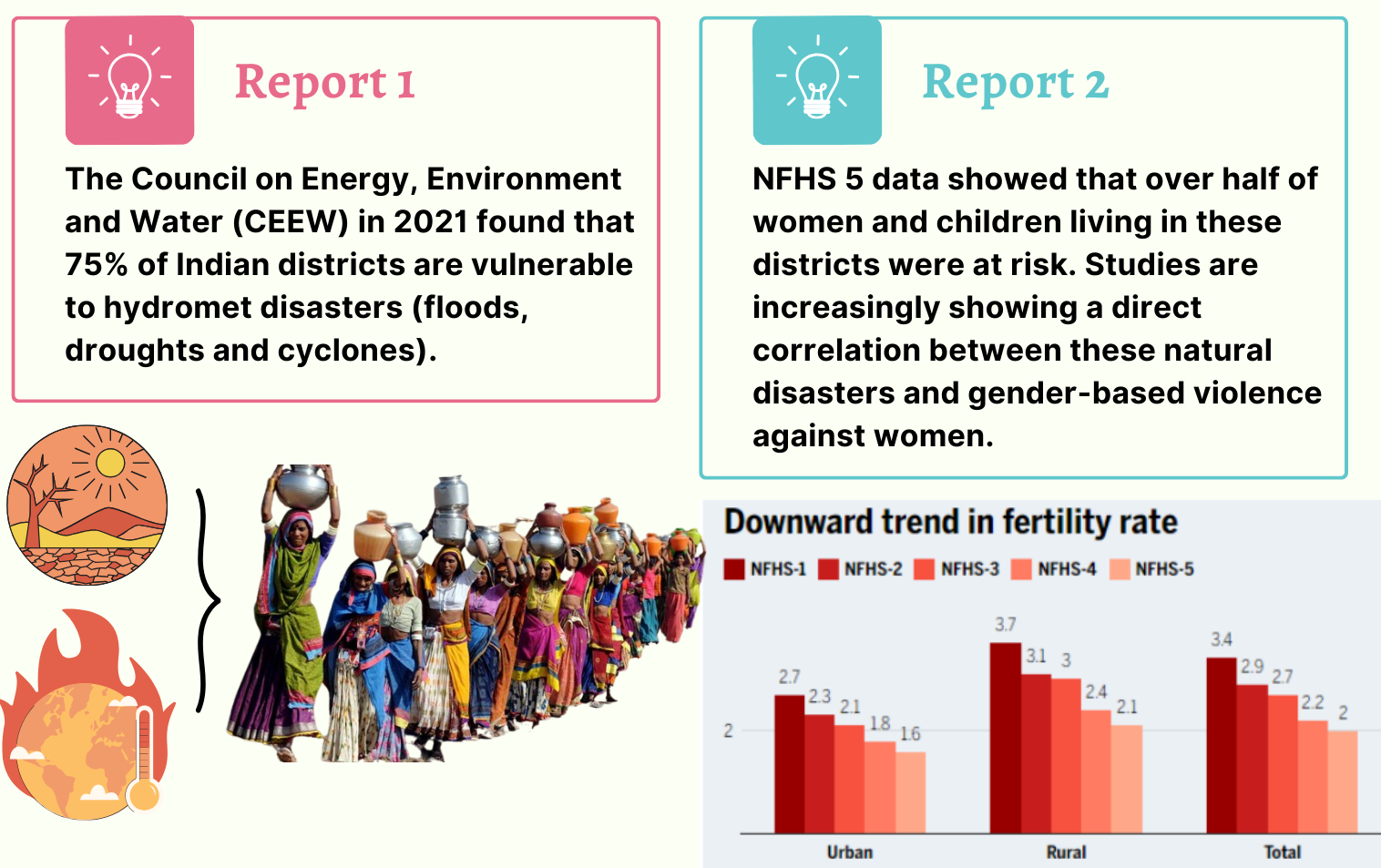
According to the United Nations Development Programme (UNDP), women and children are 14 times more likely than men to die in a disaster.
Tropical countries in the past decade are likely to face unprecedented heatwaves.
The SC has just recently ruled that people have a right to be free from the adverse effects of climate change, and the right to a clean environment is already recognized as a Fundamental Right within the ambit of the ‘Right to Life’.
Why Women are more vulnerable due to Climate Change Impacts?
High Sector-Specific Dependency: Agriculture is the most important livelihood source for women in India, particularly in rural India. Climate-driven crop yield reductions increase poverty.
Men Vs. Women Scenario: Within small and marginal landholding households, while men face social stigma due to unpaid loans (leading to migration, emotional distress, and sometimes even suicide), women experience higher domestic work burdens, worse health, and greater intimate partner violence.
The Scenario in Drought-prone Areas:National Family Health Survey 4 and 5 data showed that women living in drought-prone districts were more underweight, experienced more intimate partner violence, and had a higher prevalence of girl marriages.
Poverty and Insecurity: The increasing food and nutritional insecurity, work burdens and income uncertainties lead not only to poor physical health but also impact their mental health and emotional well-being.
How do the Extreme Climatic Events result in gender-based violence?
Reduced Self-Care: Subsequent changes in water cycle patterns severely impact access to safe drinking water, which increases the drudgery and reduces the time for productive work and self-health care of women and girls.
Maternal Issues: Prolonged heat is particularly dangerous for pregnant women (Chances of Preterm Birth/ Eclampsia), young children, and the elderly.
Cardiovascular disease: Air Pollution affects women’s health, causing respiratory and cardiovascular disease, and also the unborn child, impairing its physical and cognitive growth. One of the most worrying aspects is its impact on the growing brain.
Emerging data from cohort studies in India show that the risk of lung cancer increases by 9% due to PM2.5
Why does Climate Action need Women?
Improve Agri-Productivity: Women increased their agricultural yields by 20% to 30% when provided with the same access to resources as men.
Enhanced Conservation: Tribal and rural women have been at the forefront of environmental conservation.
Empowerment: Giving women and women collectives (Self-help Groups and Farmer Producer Organisations) the knowledge, tools, and access to resources would encourage local solutions to emerge.
Reducing CO2 emissions is crucial:
Creating Cooler Environments: Immediate action is needed to protect vulnerable groups from heatwaves, such as providing cooling spaces and adjusting work schedules.
Planting trees and vegetation can create a cooler and more sustainable environment.
Upgrading Infrastructure: Urban planning can help mitigate heatwave and drought impacts, such as increasing green spaces and using heat-resistant materials.
Improving early warning systems for heatwaves, creating more cooling shelters and green spaces, and promoting awareness campaigns about heatwave risks and safety measures are crucial for preparedness and mitigation.
Water Conservation: Traditional rainwater harvesting and storage systems in India can be revived using geographic information systems and local planning.
Improving water use efficiencies, and reusing treated wastewater can help reduce the strain on freshwater resources.
Technological Interventions: The M.S. Swaminathan Research Foundation in a few districts of Tamil Nadu showed that by using Geographic Information Systems (GIS), Panchayats could improve the groundwater crisis.
It identified vulnerabilities and climate hazards and developed a local plan to improve water access by directing government schemes and resources.
China’s burgeoning production of electric cars and other green technologies has become a flashpoint in a new US-China trade fight, highlighted by US Treasury Secretary Janet Yellen during her five-day visit to China.
Context:
According to the Paris-based International Energy Agency, China has built a substantial car industry that accounts for 60% of global electric vehicle sales. Similar dynamics exist in other industries, such as solar panels, batteries, and steel.
China is now the world’s largest producer of solar cells.
Now the main concern is that the Chinese are building up a lot of capacity in many industries across the board, including these new technology sectors, and if domestic demand does not pick up, they are going to be looking for markets outside the country.
US-China Trade Dispute:
The US and China have been slugging it out since Trump slapped heavy tariffs on imported steel and aluminum items from China in March last year, and China responded by imposing tit-for-tat tariffs on billions of dollars worth of American imports.
The IMF noted that the US-China trade tension was one factor that contributed to a “significantly weakened global expansion” late last year, as it cut its global growth forecast for 2019.
US-China Trade and Investment Facts:
US GOODS & SERVICES trade with China totalled an estimated $737.1 billion in 2018. Exports: $179.3 billion; imports: $557.9 billion; deficit: $378.6 billion
CHINA IS CURRENTLY the US’s largest goods trading partner with $659.8 billion in total (two-way) goods trade in 2018. Exports: $120.3 billion; imports: $539.5 billion; US goods trade deficit: $419.2 billion
US FDI IN CHINA (stock) was $107.6 billion in 2017, a 10.6% increase from 2016. US direct investment in China is led by manufacturing, wholesale trade, finance and insurance
CHINA FDI IN THE US (stock) was $39.5 billion in 2017, down 2.3% from 2016. China’s direct investment in the US is led by manufacturing, real estate, depository institutions
How does China’s Auto Industry pose an external threat to Indian Market?
Market Dominance: China is dominating the local market and threatening to dominate India’s traditional export markets, which could cause concern for the ‘Make in India‘ program.
Quality Concerns: The quality of auto parts coming from China is a major concern for the safety of vehicles in India. With increasing stakes by Chinese vendors, the situation is expected to become more challenging.
Cost Advantage: Chinese automakers have a cost advantage over North American and European brands, allowing them to undercut rivals. This cost advantage is due to Chinese manufacturers’ ability to produce EVs more efficiently and profitably than their Western counterparts.
Security concerns: Chinese automakers flooding foreign markets with their autos and the potential for these vehicles to be used for espionage, data collection, or sabotage.
How India can benefit from the ongoing US-China trade war?
Export Opportunities: India can tap export opportunities in both the US and China, particularly in areas such as garments, agriculture, automobile, machinery, apparel, and readymade garments
Export Growth: India’s exports to the US increased by 11.2% in 2018, and to China by 31.4% in the same year, indicating the potential for further growth
Product Opportunities: India can boost exports of around 350 products to the US and China, including items like copper ores, rubber, paper/paperboard, industrial valves, vulcanised rubber, carbon or graphite electrodes, and natural honey
Trade Deficit Reduction: Increasing exports would help India narrow the widening trade deficit with China, which stood at USD 50.12 billion during April-February 2018-19
Conclusion: The US-China trade fight intensifies over China’s dominance in green technology sectors like electric vehicles. India stands to benefit from increased exports to both nations, potentially narrowing its trade deficit with China while tapping into new markets.
Recently, the SC called on the Centre and state governments to refrain from a “contest”, and noted that various state governments were approaching the court to seek relief against the Centre in matters related to the disbursal of funds.
The bench was hearing the Karnataka government’s plea seeking a direction to the Centre to release financial assistance from the National Disaster Response Fund (NDRF) for drought management.
Background:
The Karnataka state submitted to the Central government, that 223 of the 236 talukas or sub-districts were declared drought-hit. (48 lakh hectares of land under cultivation)
An Inter-Ministerial Central Team (IMCT) also visited the state to inspect the damage in October 2023. During the monsoon season last year, the rainfall deficit was 56% in June (the third highest in 122 years) and 73% in August (the highest in 122 years).
Supreme Court’s role in this case:
Ensuring Accountability and Setting Legal Precedence: The plea before the SC involves significant questions concerning the interpretation of the Constitution, particularly regarding Article 293. It questions whether this article grants states a legally enforceable right to borrow from the Union government or other sources.
Additionally, the court is considering the extent to which the Union government can regulate such borrowing rights if they exist.
Interpreting the Constitution: There should be at least five judges to hear cases that involve ” a substantial question of law as to the interpretation” of the Constitution. (Article 145(3))
Promoting Fair resource allocation in federal structure: It also raises “various questions of significant importance impacting the federal structure of governance as embedded in our Constitution.
About the National Disaster Response Fund (NDRF):
It is a fund administered by the Central Government to cover costs associated with emergency response, relief, and rehabilitation in the face of potential disaster situations or actual disasters.
The NDRF is formed to bolster the finances of the State Disaster Response Funds (SDRF) during significant disasters, ensuring support if sufficient funds are lacking in the SDRF.
Under the Disaster Management Act 2005, there is no definition of disasters. It can include any event arising from natural or man-made causes that can severely disrupt life for people, going beyond their coping capacity.
NDRF is mentioned in Section 46 of the Disaster Management Act, 2005.
Provisions:
NDRF guidelines state that natural calamities of cyclones, drought, earthquake, fire, flood, tsunami, hailstorms, landslides, avalanches, cloud bursts, pest attacks, and cold waves and frost are considered to be severe by the Government of India (GoI) and requiring expenditures by a state government over the balances available in its own SDRF will qualify for immediate relief assistance from NDRF.
The NDRF also covers man-made disasters such as terrorist attacks, chemical or biological disasters, or nuclear disasters as notified by the Central Government.
States have the State Disaster Relief Funds, where the Centre contributes 75% of the funds (and 90% for Himalayan and northeastern states) and states contribute the remainder.
Conclusion:
The Supreme Court, addressing Karnataka’s drought relief plea, emphasizes cooperation over conflict between the Centre and states, while also examining constitutional and federal structure implications, amid discussion on National Disaster Response Fund (NDRF) utilization.
Recently a study by researchers at the L.V. Prasad Eye Institute (LVPEI), Hyderabad, has found that around 70-80% of people who visit an Eye Hospital can benefit from teleconsultations because their problems aren’t serious enough to require attention at a hospital.
Key points as report:
Telemedicine in High-Income Countries: Studies in high-income countries have shown that telemedicine is both patient- and environment-friendly for delivering healthcare services.
Carbon Emissions from the Healthcare Sector: According to the International Comparison of Healthcare Carbon Footprints analysis, India’s healthcare sector emitted 74 million tonnes of carbon dioxide in 2014, around 3% of India’s total emissions of the gas that year.
Carbon Neutrality in Healthcare: The healthcare sector should aim for carbon neutrality to mitigate its environmental impact. Teleophthalmology is cited as an efficient and effective tool to help achieve this goal, as demonstrated by the lead author’s remarks.
The teleophthalmology process:
What are Telemedicine’s Green Gains?
Reduced Carbon Footprint: Teleophthalmology significantly reduces the need for patients, especially those from rural areas, to travel long distances to access healthcare services. This leads to a substantial reduction in carbon dioxide emissions, contributing to environmental sustainability.
Economic Gains: Teleophthalmology results in significant cost savings for both patients and healthcare systems. Patients save money on travel expenses
Easy Accessibility: Teleophthalmology improves access to eye care services, especially for individuals living in remote or rural areas where access to healthcare facilities is limited. It allows patients to receive timely consultations without the need for extensive travel.
Targeted Care Gains: Teleophthalmology is particularly beneficial for patients with minor eye problems like mild refractive errors or regular preventive eye check-ups. It enables healthcare providers to target specific demographics and deliver personalized care more effectively.
Conclusion: The recent study highlights teleophthalmology’s potential in reducing carbon emissions and improving accessibility to eye care, emphasizing its role in achieving carbon neutrality and delivering cost-effective, targeted healthcare services, particularly for minor eye issues.
The Finance Minister proposed the ₹19,500 crore PLI scheme in the Union Budget of 2022-23.
This was to scale domestic manufacturing of the entire solar supply chain — from polysilicon to solar modules.
The government also introduced a steep 40% customs duty on PV modules and 25% on PV cells.
BACK2BASICS
What is the ALMM list?
The Approved List of Models and Manufacturers (ALMM) is a list of models and manufacturers of solar photovoltaic (PV) modules approved by the Ministry of New and Renewable Energy (MNRE) in India.
Objective: The ALMM is used to ensure the quality of solar panels and the manufacturer’s reliability for government projects, government-assisted projects, projects under government schemes and programs, and open access and net-metering projects.
It is being re-implemented to boost domestic solar manufacturing against China’s dominance in the supply value chain of solar PV.
Does India rely on Solar PV imports?
China’s Dominance in Imports: China is the leading supplier of solar cells and modules to India, accounting for a significant portion of India’s imports. As of January 2023-24, China accounted for 53% of India’s solar cell imports and 63% of solar PV module imports.
Manufacturing Capacity Disparity: China holds a dominant position in the manufacturing capacity for various components of solar panels, including polysilicon, wafers, cells, and modules. Rating agency ICRA estimates that China commands over 80% of the manufacturing capacity in these areas.
Government Initiatives:
Notification of ALMM Order: The government initiated efforts to address import dependency in the solar sector by notifying the Approved List of Models and Manufacturers (ALMM) order in January 2019.
Introduction of PLI Scheme: The Finance Ministry proposed the Production Linked Incentive (PLI) scheme worth ₹19,500 crore in the Union Budget of 2022-23. This scheme was designed to incentivize domestic manufacturing across the entire solar supply chain, ranging from polysilicon to solar modules.
Imposition of Customs Duties on PV Modules and Cells: To further incentivize domestic manufacturing and curb imports, the government introduced steep customs duties on photovoltaic (PV) modules and cells. Initially, a 40% customs duty was imposed on PV modules, and a 25% duty was imposed on PV cells.
Why is China a leading exporter?
Cost-Competitive Manufacturing: China is recognized as the most cost-competitive location for manufacturing all components of the solar PV supply chain.
Low Cost of Power: The lower cost of power supplied to the solar PV industry significantly contributes to China’s competitiveness.
Growing Domestic Demand: The significant and rapidly growing domestic demand for solar PV products in China has played a crucial role in driving economies of scale.
Economies of Scale: China’s large-scale production capacity allows manufacturers to benefit from economies of scale.
Continuous Innovation: Chinese government support and the competitive market environment have fostered continuous innovation throughout the solar PV supply chain.
Future scope for Solar Energy in India:
Ambitious Targets: The target of achieving 500 GW of installed capacity from non-fossil fuels by 2030 underscores the significant role solar energy will play in India’s energy mix.
Fastest Growth Rate in Electricity Demand: India accounts for the fastest rate of growth in electricity demand among major economies, according to the International Energy Agency (IEA).
Abundant Solar Potential: India possesses abundant solar resources, with an estimated solar power potential of 748.99 GW.
Conclusion: The ALMM list, PLI scheme, and customs duties aim to boost domestic solar manufacturing in India to counter China’s dominance. With ambitious targets, fast-growing electricity demand, and abundant solar potential, solar energy holds significant promise for India’s energy transition.
Mains question for practice
Q Discuss the initiatives undertaken by the Indian government to promote domestic manufacturing in the solar sector, particularly in light of China’s dominance.
The Indo-Pacific Economic Framework for Prosperity (IPEF) Clean Economy Investor Forum is set to be held in Singapore.
About IPEF Clean Economy Investor Forum
The IPEF Clean Economy Investor Forum brings together the region’s top investors, philanthropies, financial institutions, innovative companies, start-ups and entrepreneurs.
The Forum aims to mobilize investments into sustainable infrastructure, climate technology and renewable energy projects.
It is managed by Invest India (www.investindia.gov.in), India’s National Investment Promotion Agency.
The Department of Commerce is the nodal agency for the IPEF engagements.
The Forum will have opportunity for the Indian industry in the two following tracks:
Climate Tech Track: Under this track, IPEF Clean Economy Investor Forum is holding an open call that aims to recognise the top climate tech companies and start-ups among the member countries and present them to global investors.
Infrastructure Track: Under this track, India will showcase selected investible sustainable infrastructure projects at the 2024 Forum. The sectors of focus are-energy transition (e.g electric gird; renewable energy, including solar, and onshore wind; sustainable aviation fuel; battery storage; hydrogen; green data centers), transport and logistics (e.g. Electric Vehicle, EV charging points), waste management/waste to energy.
About Indo-Pacific Economic Framework for Prosperity (IPEF)
It is a US-led initiative that aims to strengthen economic partnerships among participating countries to enhance resilience, sustainability, inclusiveness, economic growth, fairness, and competitiveness in the Indo-Pacific region.
The IPEF was launched in 2021with 12 initial partners who together represent 40% of the world GDP.
The IPEF is NOT a Free Trade Agreement (FTA) but allows members to negotiate the parts they want to.
Four main “Pillars” of IPEF:
Trade that will include digital economy and emerging technology, labor commitments, the environment, trade facilitation, transparency and good regulatory practices, and corporate accountability, standards on cross-border data flow and data localisations;
Supply chain resilience to develop “a first-of-its-kind supply chain agreement” that would anticipate and prevent disruptions;
Clean energy and decarbonization that will include agreements on “high-ambition commitments” such as renewable energy targets, carbon removal purchasing commitments, energy efficiency standards, and new measures to combat methane emissions; and
Fair Economy Agreement, with commitments to enact and enforce “effective tax, anti-money laundering, anti-bribery schemes in line with [American] values”.
Members Countries include:
Currently, India and 13 countries other located in the Pacific Ocean are its members: Australia, Brunei, Fiji, India, Indonesia, Japan, South Korea, Malaysia, New Zealand, Philippines, Singapore, Thailand, United States, and Vietnam.
How is IPEF different from other trade deals?
No market access or tariff reductions have been outlined in the IPEF, although experts say it can pave the way to trade deals.
It’s not a take-it-or-leave-it arrangement, like most multilateral trade deals are.
Since the IPEF is not a regular trade pact, the members so far are not obligated by all four pillars despite being signatories.
The Indian Space Research Organisation (ISRO) has said its PSLV-C58/XPoSat mission has practically left zero debris in earth’s orbit.
About PSLV Orbital Experimental Module-3 (POEM-3)
Launched on January 1, 2024, POEM-3 utilized the spent PS4 stage of the PSLV-C58 vehicle, which initially launched XPoSat.
It is a three-axis-altitude controlled platform with power generation and tele-command & telemetry capabilities, for supporting Payloads.
The XPoSat mission aimed to leave no debris in space, demonstrating ISRO’s commitment to responsible space practices.
Upon deployment into its orbit at 650 km, POEM-3 was maneuvered to a 350 km circular orbit to minimize orbit decay time after the experiment’s completion.
After completing 400 orbits, POEM-3 re-entered Earth’s atmosphere after 73 days in space.
Significance of this achievement
With the rise in the number of satellites in orbit around the earth, space debris has become a pressing issue.
Space debris in the low earth orbit (LEO) mainly comprises pieces of spacecraft, rockets, and defunct satellites, and the fragments of objects that have deteriorated explosively as a result of anti-satellite missile tests.
This debris often flies around at high speeds of up to 27,000 kilometres per hour.
Due to their sheer volume and momentum, they pose a risk to several space assets.
Threats posed by Space Debris
Space debris also leads to two major risks:
It creates unusable regions of the orbit due to excessive debris, and
Leads to the ‘Kessler syndrome’ – creation of more debris due to cascading collisions resulting from one collision.
Various Initiatives to mitigate the Space Debris Issue
Description
Project NETRA
ISRO initiative for early warning system in space to detect debris and hazards to the Indian satellites.
It can spot, track and catalogue objects as small as 10 cm, up to a range of 3,400 km and equal to a space orbit of around 2,000 km.
Space Debris Mitigation Guidelines
Established in 2002 by the Inter-Agency Space Debris Coordination Committee (IADC) and endorsed by the United Nations in 2007.
Zero Debris Charter by ESA
Adopted by the European Space Agency (ESA) with the goal of achieving zero space debris by 2030.
NASA’s Orbital Debris Program
NASA’s initiative since 1979, focusing on reducing orbital debris creation, tracking existing debris, and exploring debris removal technologies.
Space Force Tracking System
Implemented by the U.S. Space Force to monitor space debris and assess collision risks in low Earth orbit (LEO).
Chinese Debris Removal Initiatives
China’s efforts include deploying spacecraft for debris removal with innovative technologies like solar sails.
Japanese CRD2 Demonstration
Partnership between Japan’s Aerospace Exploration Agency (JAXA) and Astroscale to develop debris removal technologies.
Practice MCQ:
ISRO’s PSLV Orbital Experimental Module-3 (POEM-3) recently re-entered Earth’s Orbit. What is so significant about this re-entry?
(a) It practically left zero debris in earth’s orbit.
(b) It facilitated groundbreaking research on the effects of microgravity on biological organisms.
(c) It paved the way for the development of reusable spacecraft technology, reducing the cost of future space missions.
The Centre has reportedly initiated measures to reduce the land jurisdiction of 10 major cantonment boards across five states.
In May 2023, the Centre had kicked off a plan to abolish all 62 colonial-era Cantonments across the country.
What are Cantonments?
Cantonments are Permanent military stations where a group of military personnel are stationed for administrative purposes.
They are governed by the Cantonments Act, 2006, which provides for municipal administration and control of these areas.
India currently has 62 cantonments spread across various states, with some areas known for their better infrastructure and facilities compared to other parts of the country.
Cantonments are managed by Cantonment Boards, which are democratic bodies comprising elected and nominated members.
The Station Commander of the Cantonment serves as the ex-officio President of the Board.
Historical Background
The Cantonments Act, 1924, was enacted by the British to regulate the municipal administration of cantonments.
After India’s independence, the Cantonments Act was modified to suit the democratic setup of the country.
The current Cantonments Act, 2006, replaced the previous version, aiming to provide greater autonomy and accountability to the Cantonment Boards.
Categories of the erstwhile Cantonments
Cantonments are categorized based on the population size residing within them:
Category I: Cantonments with a population of over 50,000.
Category II: Cantonments with a population of 10,000 to 50,000.
Category III: Cantonments with a population of less than 10,000.
Category IV: Industrial or training Cantonments, irrespective of their population size.
Centre’s plan to re-regulate Cantonments
Conversion to Exclusive Military Stations: Under the plan, military areas within all cantonments will be carved out and designated as “exclusive military stations.” The Army will exercise “absolute control” over these areas, streamlining their administration and operations.
Merger with Local Municipalities: The civilian areas of cantonments will be integrated with the respective local municipalities. These municipalities will take up the responsibility of maintaining these areas, along with providing essential services and infrastructure.
Move Away from Traditional Cantonment Concept: Post-independence, the Indian Army moved away from the traditional cantonment concept, primarily due to friction between military and civilian authorities. However, certain major cantonments continued to exist, such as Pune Cantonment and Agra Cantonment.
The Ministry of New & Renewable Energy has unveiled Guidelines for the implementation of an R&D Scheme under the National Green Hydrogen Mission.
The scheme aims to catalyze advancements in the production, storage, transportation, and utilization of green hydrogen, with a focus on affordability, efficiency, safety, and reliability.
Hydrogen Energy: A Backgrounder
Hydrogen is an important source of energy since it has zero carbon content and is a non-polluting source of energy in contrast to hydrocarbons that have net carbon content in the range of 75–85 per cent.
Hydrogen energy is expected to reduce carbon emissions that are set to jump by 1.5 billion tons in 2021.
It has the highest energy content by weight and lowest energy content by volume.
As per International Renewable Energy Agency (IRENA), Hydrogen shall make up 6 per cent of total energy consumption by 2050.
Hydrogen energy is currently at a nascent stage of development, but has considerable potential for aiding the process of energy transition from hydrocarbons to renewable.
About National Green Hydrogen Mission (NGHM)
The National Green Hydrogen Mission was launched in January 2023 to make India a ‘global hub’ for using, producing and exporting green hydrogen.
Earlier, the National Hydrogen Mission was launched on August 15, 2021,with a view to cutting down carbon emissions and increasing the use of renewable sources of energy.
The Ministry of New and Renewable Energy (MNRE) formulates the scheme guidelines for implementation of these missions.
Key features of the NGHM
Power capacity: The mission seeks to promote the development of green hydrogen production capacity of at least 5 MMT per annum with an associated renewable energy capacity addition of about 125 GW in the country by 2030.
Job creation: It envisages an investment of over ₹8 lakh crore and creation of over 6 lakh jobs by 2030.
Reducing energy import bill: It will also result in a cumulative reduction in fossil fuel imports of over ₹1 lakh crore and abatement of nearly 50 MMT of annual greenhouse gas emissions by 2030.
Export promotion: The mission will facilitate demand creation, production, utilisation and export of green hydrogen.
Incentivization: Under the Strategic Interventions for Green Hydrogen Transition Programme (SIGHT), two distinct financial incentive mechanisms targeting domestic manufacturing of electrolysers and production of green hydrogen will be provided under the mission.
Green Hydrogen Hubs: Regions capable of supporting large-scale production and/or utilisation of hydrogen will be identified and developed as Green Hydrogen Hubs.
Types of Hydrogen
Hydrogen extraction methods are classified into three types based on their processes: Grey, Blue, and Green.
Green Hydrogen: Green hydrogen is produced through water electrolysis, utilizing electricity generated from renewable energy sources.
Grey Hydrogen: This type of hydrogen is obtained through coal or lignite gasification (black or brown), or by steam methane reformation (SMR) of natural gas or methane (grey). These processes are typically carbon-intensive.
Blue Hydrogen: Blue hydrogen is derived from natural gas or coal gasification, coupled with carbon capture storage (CCS) or carbon capture use (CCU) technologies to mitigate carbon emissions.
PYQ:
[2010]Hydrogen fuel cell vehicles produce one of the following as “exhaust”:
(a) NH3
(b) CH4
(c) H2O
(d) H2O2
[2023]With reference to green hydrogen, consider the following statements:
1. It can be used directly as a fuel for internal combustion.
2. It can be blended with natural gas and used as fuel for heat or power generation.
3. It can be used in the hydrogen fuel cell to run vehicles.
Titled “Geospatial modelling and mapping of soil erosion in India,” the report marks the first attempt to classify soil erosion on a pan-India basis.
The study categorizes soil erosion into six classifications, ranging from “minor” to “catastrophic,” based on the amount of soil eroded per hectare over a year.
Soil Erosion in India
Soil erosion is the process by which soil is removed or displaced from its original location, often due to the action of wind, water, or human activities.
It is a natural geological process accelerated by various factors such as deforestation, overgrazing, improper agricultural practices, urbanization, and climate change.
Key trends in India
Nearly 30% of the country’s landmass is experiencing “minor” soil erosion.
Critical 3% (approx. 1500 sq km) faces “catastrophic” topsoil loss.
The Brahmaputra Valley in Assam emerged as the most significant hotspot for soil erosion, with close to 300 square kilometers or 31% of its surface soil lost to “catastrophic” erosion.
The lower Himalayan region, extending from Kashmir to Uttarakhand and beyond, and Odisha also face severe erosion challenges, posing threats to biodiversity and environmental stability.
Causes of Soil Erosion
Anthropogenic Causes: Soil erosion in India is primarily caused by human activities including deforestation, overgrazing, improper land use practices, and construction activities.
Natural Causes: The monsoon season, characterized by heavy rainfall, exacerbates soil erosion, especially in regions with steep slopes and poor vegetation cover.
Impact of Soil Erosion
Topsoil, essential for agriculture due to its nutrient-rich composition, is crucial for sustaining crop growth.
Erosion diminishes soil fertility, leading to reduced crop yields and agricultural productivity.
Revised Universal Soil Loss Equation (RUSLE) Methodology
The Revised Universal Soil Loss Equation (RUSLE) is a widely used empirical model for estimating soil erosion rates.
It is used to predict the average annual soil loss caused by sheet and rill erosion from specific field areas.
The RUSLE methodology considers various factors that contribute to soil erosion, including rainfall, soil erodibility, slope length and steepness, vegetation cover, and conservation practices.
The equation for RUSLE is:
A = R * K * LS * C * P
Where:
A is the estimated average annual soil loss (in tons per acre per year).
R is the rainfall factor, representing the erosive power of rainfall.
K is the soil erodibility factor, representing the susceptibility of soil to erosion.
LS is the slope length and steepness factor, accounting for the effect of slope on erosion.
C is the cover management factor, indicating the impact of vegetation cover and land use practices on erosion.
P is the conservation practice factor, reflecting the effectiveness of erosion control practices implemented.
PYQ:
[2014] In India, the problem of soil erosion is associated with which of the following?
1. Terrace cultivation
2. Deforestation
3. Tropical climate’
Select the correct answer using the code given below:
Sangeet Natak Akademi is set to host ‘Shakti, a festival of music and dance’ as part of its Kala Pravah series at 7 Shaktipeeths.
Shakti – Festival of Music and Dance
Events will be held at:
Kamakhya Temple, Guwahati
Mahalakshmi Temple, Kolhapur, Maharashtra
Jwalamukhi Temple, Kangada, Himachal Pradesh
Tripura Sundari Temple, Udaipur, Tripura
Ambaji Temple, Banaskantha, Gujarat
Jai Durga Shaktipeeth, Deoghar, Jharkhand
Shaktipeeth Maa Harsidhi Temple, Jaisinghpur, Ujjain, Madhya Pradesh
What are Shaktipeeths?
Shaktipeeths are sacred sites in Hinduism associated with the Goddess Shakti or Devi, the divine feminine energy.
According to Hindu mythology, these sites are believed to be where various body parts of the goddess Sati/ Shakti fell to the earth when her body was dismembered by Lord Vishnu’s.
There are numerous Shaktipeeths spread across the Indian subcontinent and beyond, each considered highly sacred by devotees of the Goddess.
Here are some major Shaktipeeths often seen in news:
Temple
Place (State/Country)
Shankari Devi Temple
Trincomalee (Sri Lanka)
Kamakshi Amman Temple
Kanchipuram (Tamil Nadu)
Shrinkala Temple
Pradmunyee (Pandua, West Bengal)
Chamundeshwari Temple
Mysuru (Karnataka)
Jogulamba Devi
Alampuram (Telangana)
Bhramaramba Mallikarjuna Temple
Srisailam (Andhra Pradesh)
Mahalakshmi Temple
Kolhapur (Maharashtra)
Ekveera Temple
Mahur (Maharashtra)
Mahakaleswar Temple
Ujjain (Madhya Pradesh)
Kukkuteswara Swamy Temple
Pithapuram (Andhra Pradesh)
Biraja Temple
Jajpur (Odisha)
Bhimeswara Temple
Draksharamam (Andhra Pradesh)
Kamakhya Temple
Guwahati (Assam)
Alopi Devi Mandir
Prayagraj (Uttar Pradesh)
Jwalamukhi Temple
Jwalamukhi (Himachal Pradesh)
Mangla Gauri Temple
Gaya (Bihar)
Vishalakshi Temple
Varanasi (Uttar Pradesh)
Sharada Peeth
Sharda, Kashmir (Pakistan Occupied Kashmir)
About Sangeet Natak Akademi
It is the national level academy for performing arts set up by the Government of India.
It was set up by the Indian education ministry on 31 May 1952 and became functional the following year, with the appointment of its first chairman, Dr. P. V. Rajamannar.
Dr Rajendra Prasad, the first President of India, inaugurated it on 28 January 1953 in a special function held in the Parliament House.
Functions:
The academy functions as the apex body of the performing arts in the country to preserve and promote the vast cultural heritage of India expressed in music, dance and drama.
It also works with governments and art academies in states and union territories of the country.
Aiming for UPSC Prelims 2024? Picture this: answering 7-8 extra questions and soaring to the top! It’s not just a dream—it’s possible with Micro-Thematic Analysis.
Join Zeeshan Sir’s Webinar to learn – Micro-Thematic Analysis
Get an Edge: Learn how to master Micro-Thematic Analysis.
Tailored for Success in Prelims 2024: This webinar is designed for aspirants like you gearing up for the UPSC Prelims. It will help you gain those 20+ extra marks.
Simplified Strategies: Zeeshan Sir will break down note-making based on Micro-Themes into simple steps.
Known to work tactics: Join the league of successful rankers who swear by Micro-Thematic Analysis.
Interactive Session: Ask questions and learn directly from Zeeshan Sir.
These masterclasses are packed with value. They are conducted in private with a closed community. We rarely open these webinars for everyone for free. This time we are keeping it for 300 seats only.


![[10 April 2024] The Hindu Op-ed: The climate crisis is not gender neutral](https://d18x2uyjeekruj.cloudfront.net/wp-content/uploads/2024/04/10-april-1568x882.jpg)


![[Prelims’24 Webinar]Make Micro-Thematic Notes to Attempt 7-8 Extra Qs in IAS Prelims 2024 | Webinar by Zeeshan Sir](https://d18x2uyjeekruj.cloudfront.net/wp-content/uploads/2024/04/Zee-Thumbnail-1568x882.jpg)