💥UPSC 2026, 2027, 2028 UAP Mentorship (March Batch) + Access XFactor Notes & Microthemes PDF

Search results for: “”

  • Everything that you should know about the World Trade Organization (WTO)

    World Trade Organization (WTO) as the name suggests, is the organization dealing with the global rules of trade between nations. Its main function is to ensure that trade flows as smoothly, predictably and freely as possible.

    But why do nations trade? Whatever happened to Swadeshi and self sufficiency? 

    • Different factor endowments – simplest and obvious logic is every country does not possess everything. As we do not have sufficient oil reserves, we can’t do anything but import oil. But we also import things we can produce from simplest of things such as toys to complex things such as mobile phones.
    • Choice -from consumers perspective, it gives them more choices <you can buy iphones or Samsung galaxy, micromax or freedom 251>.
    • Market– Similarly it gives bigger market to industries (economies of scale, a concept that cost decreases as the size of an industry increases) <from sale in India to sale to the whole world>
    • Specialization – If countries didn’t trade, or traded only those things which they did not have (essentially raw materiel), they will have to produce everything. It will hamper specialization. Every country will become jack of all trade, master of none. Trade allows countries to specialize in things they do the best based on their comparative and competitive advantage.<If India is good at producing apples and China at oranges, India should only produce apples and exchange them for oranges>
    • Competition and efficiency – Also domestic industries will not face any competition from outside world, less competition, less incentive to become efficient or to innovate , consumers suffer. Thus trade forces industries to become more efficient.
    • Reduction in hostility – Apart from these economic reasons, as countries trade, they become interdependent on each other and thus chances of hostilities or major wars decrease. New ideas also flow along with trade.

    Discussion so far suggests that in an ideal world we should all promote free trade as it increases efficiency and benefits consumers. But the world is not ideal. There are some problems with free trade and hence need for protecionism


    • In developing economies, industries may not even get a chance to grow because they face competition from more established foreign firms <thus the argument for protecting nascent industries by higher tariffs>
    • Trade can lead to over-specialisation <workers at risk of losing their jobs should world demand fall> <suppose India produced only apples and suddenly some virus infest the crop, there wouldn’t be anything else to sell to the world or someone produces better variety of apple somewhere else, Indian apples would lose market> <recall situation of Cuba when sugar prices fell>
    • What if other country started cheating, subsidizing exports to capture the market abroad and when all domestic industries are killed, increasing the prices <every country must play by the same rules>

    It’s clear that trade can not be totally free in a not so ideal world. Countries need some policy levers to allow domestic industries to grow and diversify their economies. Also there’s need for a watchdog/referee who can adjudicate when other countries start cheating.

    Let’s now discuss barriers to trade


    In spite of all the benefits of trade, we all know countries regularly resort to measures which discourage trade (especially imports) to protect domestic industries <hence called protectionist measure> even though they might hurt consumers <problem of silent majority v/s vociferous minority discussed in chapter 2 of economic survey>

    Tariff barriers- custom duties which make imported goods costlier than domestically manufactured goods <it’s imposed to earn revenues for the govt, protect interest of domestic industry>

    Non tariff barrier– Here countries do not impose custom duties but retard flow of trade in other ways.

    Quantitative restrictions- Crude way of doing it is imposing quantitative restrictions on goods imported <quotas, say only up to 100 m tonne of sugar can be imported> or making licenses compulsory to export goods to home country or that only certain licenses can import goods or embargo <banning trade of certain goods with certain countries>

    Standards setting and administrative delays– But countries now employ sophisticated ways to retard flow of trade. Customs official can simply delay clearance of cargo <hence trade facilitation agreement> or can set standards <product using child labor/ environmentally degrading techniques will not be allowed, the problem with TPP> or simply cheat by providing export subsidies or domestic subsidies.

    Two kinds of trade barriers that are allowed for protection of health, safety, environmental protection but are often misused

    1. Technical barriers to trade-technical regulations, standards, and conformity assessment procedures can be set for the protection of human health and safety, or protection of the environment.
    2. Sanitary and Phyto Sanitary Measures – It allows countries to set their own standards for food safety and animals and plant health standards.

    But both the measures specify that standards must not be arbitrary i.e they must be scientific. Also they should not be discriminatory.

    WTO’s role is to reduce these barriers to trade, set rules of the game and adjudicate when one member country accuses other of cheating.

    Let’s learn about WTO in detail


    When? 1995

    Headquarter: Geneva, Switzerland <where are the HQs of IMF and World Bank? Answer in comments> 

    Members: 164 <Afghanistan the most recent member> < latest member of IMF?>

    Origin:

    • US, UK and a few other countries set up, an interim organisation about trade named GATT (General Agreement on Tariff and Trade) in 1947
    • GATT was biased in favour of the developed countries and was called informally as the Rich men’s club.
    • So, the developing countries insisted on setting up of the International Trade Organisation (ITO)
    • That’s the reason, United Nations Conference on Trade and Development (UNCTAD) was set up in 1964 as an alternative, on recommendation of UN committee
    • Next development comes in Uruguay Round of GATT, it sought to expand the scope of the organisation by including, services, investment and intellectual property rights (IPR)
    • Agreements were ratified by the legislatures of 85 member-countries by year-end 1994.
    • On such rectification, the WTO started functioning from Jan 1, 1995 Marrakesh Agreement>

    Why GATT failed to perform? Any Limitations?

    • Institutional structure – Only the set of rules and multilateral agreements, it lacked institutional structure
    • Limited scope – It didn’t cover trade in services, Intellectual Property Rights(IPR) etc.
    • Dispute Resolution Mechanism and Non-tariff barriers – No
    • Representation for developing and new states – No (Western monopoly)

    Objectives of the WTO

    • Raising standards of living and incomes, ensuring full employment, expanding production and trade, optimal use of world’s resources, at the same time extending the objectives to services and making them more precise
    • Introduces the idea of sustainable development in relation to the optimal use of world’s resources, and the need to protect and preserve the environment in a manner consistent with the various levels of national economic development
    • Recognises the need for positive efforts designed to ensure that developing countries, especially the least developed ones, secure a better share of growth in international trade
    • WTO continues the decision-making practice followed under the GATT Decisions will be taken by a majority of votes cast on the basis of one country, one vote . In fact rarely is voting undertaken. Decisions are mostly based on consensus. <What is the basis of voting in IMF? Answer in comments>

    Principles of the trading system

    A) Non-discrimination –

    1) Most favoured nation (MFN) rule

    • The MFN rule requires that a WTO member must apply the same conditions on all trade with other WTO members
    • i.e. a WTO member has to grant the most favorable conditions under which it allows trade in a certain product type to all other WTO members.
    • Grant someone a special favour and you have to do the same for all other WTO members
    • Then how do Free Trdae Agreements (FTAs) work? Well as eveywhere, devil is always in detail, FTAs are exempt from this rule.
    • Did you know that Pakistan has not yet granted India MFN status though we have grated them that status <for long time, there’s talk of Pakistan granting us non discriminating market access (NDMA) as Pakistanis feel, if they grant us MFN status, they would be favouring us the most, hahaha>

    2) The National Treatment Policy

    National treatment means that imported goods should be treated no less favorably than domestically produced goods  <after the foreign goods have entered the market> and was introduced to tackle non-tariff barriers to trade (e.g. technical standards, security standards, discriminating against imported goods)

    B) Reciprocity

    • Granting of mutual concessions in tariff rates, quotas, or other commercial restrictions
    • It implies that these concessions are neither intended nor expected to be generalized to other countries <contrast MFN and reciprocity.>

    C) Binding and enforceable commitments –

    • The tariff commitments made by WTO members in a multilateral trade negotiation and on accession are enumerated in a schedule (list) of concessions
    • These schedules establish “Ceiling bindings”: a country can change its bindings, but only after negotiating with its trading partners, which could mean compensating them for loss of trade <i.e can’t increase tariff beyond these levels>
    • If satisfaction is not obtained, the complaining country may invoke the WTO dispute settlement procedures

    D) Transparency –

    • The WTO members are required to publish their trade regulations, to maintain institutions allowing for the review of administrative decisions affecting trade, to respond to requests for information by other members, and to notify changes in trade policies to the WTO
    • These internal transparency requirements are supplemented and facilitated by periodic country-specific reports (trade policy reviews) through the Trade Policy Review Mechanism (TPRM)
    • WTO system tries also to improve predictability and stability, discouraging the use of quotas and other measures used to set limits on quantities of imports

    E) Safety valves –

    • In specific circumstances, govts are able to restrict trade
    • WTO’s agreements permit members to take measures to protect not only the environment but also public health, animal health and plant health <sanitary and phytosanitary measure, TBT>

    Let’s come to main part of WTO -AGREEMENTS

    <There were many agreements agreed and ratified, but we found only some which are important for us, so let’s analyse them in brief>


    1) Agreement on subsidies and countervailing measures (SCM)

    It deals with the provision of subsidies, and the use of countervailing measures to offset injury caused by subsidized imports

    Definition of subsidy has 3 basic elements:

    1. Financial contribution
    2. By a Government or any public body within the territory of a Member
    3. Which confers a benefit.

    All three of these elements must be satisfied in order for a subsidy to exist SCM applies to non-agricultural products.

    It follows the traffic lights approach and classifies subsidies in 3 categories: <scroll up and look at barriers to trade infograph gain>

    Red:

    Subsidies with high trade-distorting effects, such as export subsidies, and those that favour the use of domestic over imported goods are prohibited. [If suppose, Brazil gives subsidy to its product Exported to India, Then India can ban such items from country]

    Green:

    Subsidies that are not specific to an enterprise or industry or a group of enterprises or industries are non-actionable.
    [No action at all – actionless]

    Amber:

    • Subsidies that are neither red nor green belong to the amber category.
    • They are actionable by the trading partners if their interests are adversely hit.
    • The affected country can seek remedy through the dispute-settlement procedures or go for countervailing duties.
      [Here, India can go either for countervailing duties or dispute-settlement procedure]

    2) General Agreement on Trade in Services – GATS

    The creation of the GATS was one of the landmark achievements of the Uruguay Round, whose results entered into force in January 1995.

    Objectives: same as broad objectives of WTO

    What services are covered under GATS?

    • GATS applies in principle to all service sectors, with 2 exceptions.
    • GATS excludes services supplied in the exercise of governmental authority i.e. services that are supplied neither on a commercial basis nor in competition with other suppliers. Eg.- social security schemes and any other public service, such as health or education, that is provided at non-market conditions.
    • Air traffic rights and services directly related to the exercise of such rights are also exempt

    Four modes under GATS <refer to the infograph above>

    Mode 1: Cross-border supply – There’s no movement of natural persons, no legal presence Eg-  an architect can send his architectural plan through electronic means

    Mode 2: Consumption abroad – movement of natural perosns to avail services elsewhere, eg.- a tourist using hotel or restaurant services abroad

    Mode 3: Commercial presence – legal presence in another country, eg.FDI, joint ventures

    Mode 4: Presence or movement of natural persons – here movement of natural person to provide services , eg. India techies going to USA

    It’s clear India wants liberalization in mode 1 and mode 4 <our BPO industry plus software industry, techies going to US> while developed world want liberalization in mode 3 <100% automatic FDI>

    Let’s understand all 4 modes with an example

    • Suppose Apple <USA company> establishes a subsidiary in India. This is supply of services through Mode 3 i.e. Commercial Presence
    • An architect of the Apple sends blueprints over the Internet to another firm in India- this is Mode 1 i.e. Cross Border Supply
    • An Engineer from the said Apple is deputed to work in the subsidiary in India for a limited period for managerial operations – this is Mode 4 i.e. Movement of Natural Persons
    • Certain trainees from the subsidiary in India visit USA and consume both education and tourism services  – this is Mode 2 i.e. Consumption Abroad for USA

    3) TRIPS

    The Agreement on Trade-Related Aspects of Intellectual Property Rights, sets down minimum standards for many forms of intellectual property (IP) regulation as applied to nationals of other WTO Members.

    Areas of intellectual property that it covers are –

    • Copyright and related rights, Trademarks including service marks
    • Geographical indications (GI) including appellations of origin <Did you remember, Pakistan also claim GI for their Basmati Rice, but recently India got GI tag for Indo-Gangetic plains basmati rice for 6 states>
    • Industrial designs, patents including the protection of new varieties of plants
    • Layout-designs of integrated circuits; and undisclosed information including trade secrets and test data

    3 Main features of Agreement includes –

    Standards –

    • Agreement sets out the minimum standards of protection to be provided by each Member
    • Each of the main elements of protection is defined, namely the subject-matter to be protected, the rights to be conferred and permissible exceptions to those rights, and the minimum duration of protection

    Enforcement – 

    Set of provisions deals with domestic procedures and remedies for the enforcement of intellectual property rights

    Dispute settlement – 

    The Agreement makes disputes between WTO Members about the respect of the TRIPS obligations subject to the WTO’s dispute settlement procedures

    Read story with Explainer on IPRs here, story on WTO and TRIPS here 

    4) Agreement on Agriculture (AoA)

    Objective:

    • To reform trade in the sector and to make policies more market-oriented.
    • This would improve predictability and security for importing and exporting countries alike

    The new rules and commitments apply to:

    1)Market access : various trade restrictions confronting imports

    2)Domestic support:  subsidies and other programmes, including those that raise or guarantee farmgate prices and farmers’ incomes

    Under this, Subsidies are categorized into 3 boxes –

    Green Box –

    • In order to qualify for the Green Box, a subsidy must not distort trade, or at most cause minimal distortion
    • These subsidies have to be govt-funded (not by charging consumers higher prices) and must not involve price support
    • They tend to be programmes that are not directed at particular products, and include direct income supports for farmers that are not related to <decoupled> current production levels or prices.

    <Like in India farmer is supported for specific products and separate support prices are there for rice, wheat etc. An example of Amber box subisdy. On the other hand income support is uniformly available to farmers and crop doesn’t matter, Green box>

    • Green box subsidies are therefore allowed without limits, provided they comply with relevant criteria
    • They also include environmental protection and regional development programmes, research and development subsidies etc
    • Developed countries have shifted most of their subsidies to green box, hence even though they provide more subsidies than us, they still get away with it

    Blue Box

    • Only Production limiting Subsidies under this are allowed. They cover payments based on acreage, yield, or number of livestock in a base year <such as subisdies for leaving the land fallow>
    • Targets price are allowed to be fixed by govt and if market prices are lower, so farmer will be compensated with difference between target prices and market prices in cash. This cash shall not be invested by farmer in expansion of production
    • Loophole here is that there no limit on target prices that can be set and those are often set far above market prices deliberately.
    • USA currently isn’t using this method, instead here EU is active.

    Amber Box –

    • All domestic support measures for agriculture, considered to distort production and trade (with some exceptions) fall into the Amber Box and this is Aggregate measure of support (AMS) i.e AMS is trade distorting subsidy in monetary terms
    • It required member countries to report their total AMS for the period between 1986 and 1988, bind it, and reduce it according to an agreed upon schedule <de minimis level>

    What is De-Minimis provision?

    • Under this provision developed countries are allowed to maintain trade distorting subsidies or ‘Amber box’ subsidies to level of 5% of total value of agricultural output. For developing countries this figure was 10%
    • So far India’s subsidies are below this limit, but it is growing consistently
    • This is because MSP are always revised upward whereas Market Prices have fluctuating trends
    • In recent times when crash in international market prices of many crops is seen, government doesn’t have much option to reduce MSP drastically
    • By this analogy India’s amber box subsidies are likely to cross 10% level allowed by de Minimis provision and hence the Bali deal for public stock holding and MSP <India is seeking permanent solution to this problem>


    3) Export subsidies:

    • These can be in form of subsidy on inputs of agriculture, making export cheaper or can be other incentives for exports such as import duty remission etc.
    • These can result in dumping of highly subsidized (and cheap) products in other country. This can damage domestic agriculture sector of other country
    • These subsidies are also aligned to 1986-1990 levels, when export subsidies by developed countries was substantially higher and Developing countries almost had no export subsidies that time

    Special safeguard mechanism (SSM)

    • A tool that will allow developing countries to raise tariffs temporarily to deal with import surges or price fall
    • is meant to protect the interests of resource-poor and subsistence farmers in the developing nations
    • Critics claim that SSM could be repeatedly and excessively invoked, distorting trade
    • In turn, the G33, a major SSM proponent, has argued that breaches of bound tariffs should not be ruled out if the SSM is to be an effective remedy
    • SSM is quite important in a scenario in which west has significant powers to subsidize their production and in turn, exports

    Special Products

    • At the 2005 WTO Ministerial Conference in Hong Kong, members agreed to allow developing countries to designate an appropriate number of tariff lines as Special Products (SPs) based on food security, livelihood security and rural development
    • They would be given extra flexibility in market access for these products
    • For instance if wheat is important for food security and livelihoods, India many not fully open up this sector but obviously USA wouldn’t agree on that

    Special and Differential Treatment (S&D)

    Special treatment under WTO to Developing and least developed countries. Special safeguard mechanism (SSM) is a demand under this.

    • longer time periods for implementing Agreements and commitments
    • measures to increase trading opportunities for developing countries
    • provisions requiring all WTO members to safeguard the trade interests of developing countries
    • support to help developing countries build the capacity to carry out WTO work, handle disputes, and implement technical standards, and
    • provisions related to least-developed country (LDC) Members

    A few more points before concluding the topic

    Plurilateral agreements – For the most part, all WTO members subscribe to all WTO agreements. After the Uruguay Round, however, there remained four agreements, originally negotiated in the Tokyo Round, which had a narrower group of signatories and are known as plurilateral agreements <contrast with multilateral agreements>

    1. Trade in civilian aircraft
    2. Govt Procurement
    3. Dairy products <terminated in 1997>
    4. Bovine Meat <terminated in 1997>

    Single Undertaking Principle – Nothing is agreed until everything is agreed. Negotiations proceed simultaneously, not sequentially, and all Members must accept all the results

    Dispute Settlement Process

    1. You don’t like what other country is doing, raise a complaint with WTO
    2. 1st step is mediation, talk with the other country, see if problem can be resolved
    3. No resolution, a dispute settlement panel is formed, hears both parties, gives it’s verdicts
    4. Not satisfied with it’s orders, appeal with the appellate body, decision is final
    5. What if country doesn’t comply with the orders? well there’s very little that WTO can do. Other country is free to take retaliatory measures


    WTO timeline


    Further Readings –

  • IAS Prelims tit-bits- Current Affairs part 3

    1. Sugamya Bharat Abhiyan

    1. Accessible India Campaign
    2. focus on making public buildings accessible to Persons with Disabilities
    3. Enhancing the accessibility and usability of Public Transport, and information & communication
    4. It was launched on international day pf persons with disabilities (3rd dec) not on 2nd October
    5. Sugamya Bharat Mobile app

    Discuss – Nodal department and ministry

    2. International Solar Alliance

    1. Countries located b/w tropic of cancer and tropic of Capricorn <sunshine countries>
    2. Was launched in Paris at COP21
    3. HQ will be in India, interim secretariat at Nation Institute of Solar Energy, Gurgaon

    Discuss- States in India through which tropic of cancer passes

    3. Ujjwala and UJALA scheme 

    1. Ujjawala– To extend availability of cooking gas (LPG) to BPL women of 18+ age i.e free LPG connection
    2. Funds from people who opted to omit their LPG subsidy through GIVE UP scheme
    3. UJALA–  Unnat Jyoti by Affordable LEDs for All
    4. Overall target of number of incandescent bulbs to be replaced – 200 million
    5. Every grid-connected consumer <NO BPL/APL> having a metered connection can get the LED bulbs at about 40% of the market price under the UJALA Scheme
    6. Consumers also have the option of paying for the LEDs in equated monthly instalment
    7. Electricity Distribution Company and Energy Efficiency Services Limited (EESL) is the implementing agency
    • Discuss – Domestic Efficient lighting programme (DELP) and Bachat Lamp Yojana
    • Discuss– Compare Incandescent bulb v/s CFL v/s LED

    4. New Horizon

    1. New Horizons is an interplanetary space probe that was launched as a part of NASA’s New Frontiers program
    2. launched in 2006 not last year with the primary mission to perform a flyby study of the Pluto system, and a secondary mission to fly by and study one or more other Kuiper Belt objects (KBOs) <primary mission accomplished>
    3. Pluto is a dwarf planet not planet and has 5 moon <Charon, Hydra, Nix, Styx, Kerberos>
    • Discuss – What is Kuiper belt
    • Discuss – Asteroid, comet, meteor, meteorite

    5. SERVIR-Mekong Project

    1. Combined Project of National Aeronautics and Space Administration (NASA) and the US Agency for International Development (USAID) and 5 SEA Countries – Burma, Cambodia, Laos, Thailand and Vietnam
    2. aims to tap into the latest technologies to help the Mekong River region protect its vital ecosystem
    3. In 2010, SERVIR-Himalaya, was established at the International Centre for Integrated Mountain Development (ICIMOD) in Kathmandu, Nepal
    • Discuss – NISAR mission
    • Discuss – members of Mekpng- Ganga Cooperation


  • [Spiritual Tourism #1] PRASAD Cities- Ajmer and Amaravati

    Although the definition and purposes of Tourism is no longer restricted to Heritage and Pilgrimage cities- its definitely India’s USP due to its Civilizational legacy, and being the birthplace of many religions.

    In this series on Themes in Tourism Industry, we’ll start by taking a trip through History and Culture of Cities of Spiritual / Religious Importance. For its promotion Government of India has launched two schemes PRASAD and Swadesh Darshan for Development of Theme-Based Tourist Circuits. 

    About the PRASAD Scheme

    • PRASAD means Pilgrimage Rejuvenation and Spirituality Augmentation Drive
    • A 100% Centrally Sponsored Scheme under Tourism Ministry
      • Note that funds for any CSS is given to states in installments (20% at approval stage, 60% when 20% work done and rest 20% when 60% work is finished)
    • Provisions under the scheme include
      • Tourism Promotion and Tourist Ecosystem
      • Vocational Training for Tourists and Hospitality Business
        • Hunar se Rozgar tak (HSRT) and earn while you learn programs
      • Improving Tourist Infrastructure

    Provisions regarding Tourist Infrastructure in PRASAD

    • ATM, foreign currency exchange counters
    • Rail, road water transport
    • Green energy streetlights
    • Water adventure sports
    • First-aid centres, Wi-Fi hotspots, Parking facilities
    • Green landscaping, water fountains, walkways, furniture etc.
    • Removing encroachments

    PRASAD versus HRIDAY?

    • HRIDAY means Heritage City Development and Augmentation Yojana
    • While PRASAD is under Tourism ministry <note that Culture ministry is separate from Tourism ministry> while HRIDAY is under Urban Development Ministry
    • PRASAD cities are handpicked because their tourism is centered around faith, spirituality and religion. On the other hand, a HRIDAY city is chosen for its heritage status that goes beyond faith to include aspects of culture such as Architecture (Eg- Cave temples of Badami, Kakatiya Temples of Warangal)
    • HRIDAY is exclusively focused on Infrastructure that preserve the Heritage Character (Museums, Fairs, Festivals etc) , while PRASAD goes beyond that to include Vocational Training programmes and other things that make up Tourism Ecosystem
    • Common outcomes of both are:
      • Increase in Employment, Tourist Footfalls, Cleanliness of Heritage/Pilgrimage cities
      • Decrease in Pollution, Crime rates etc
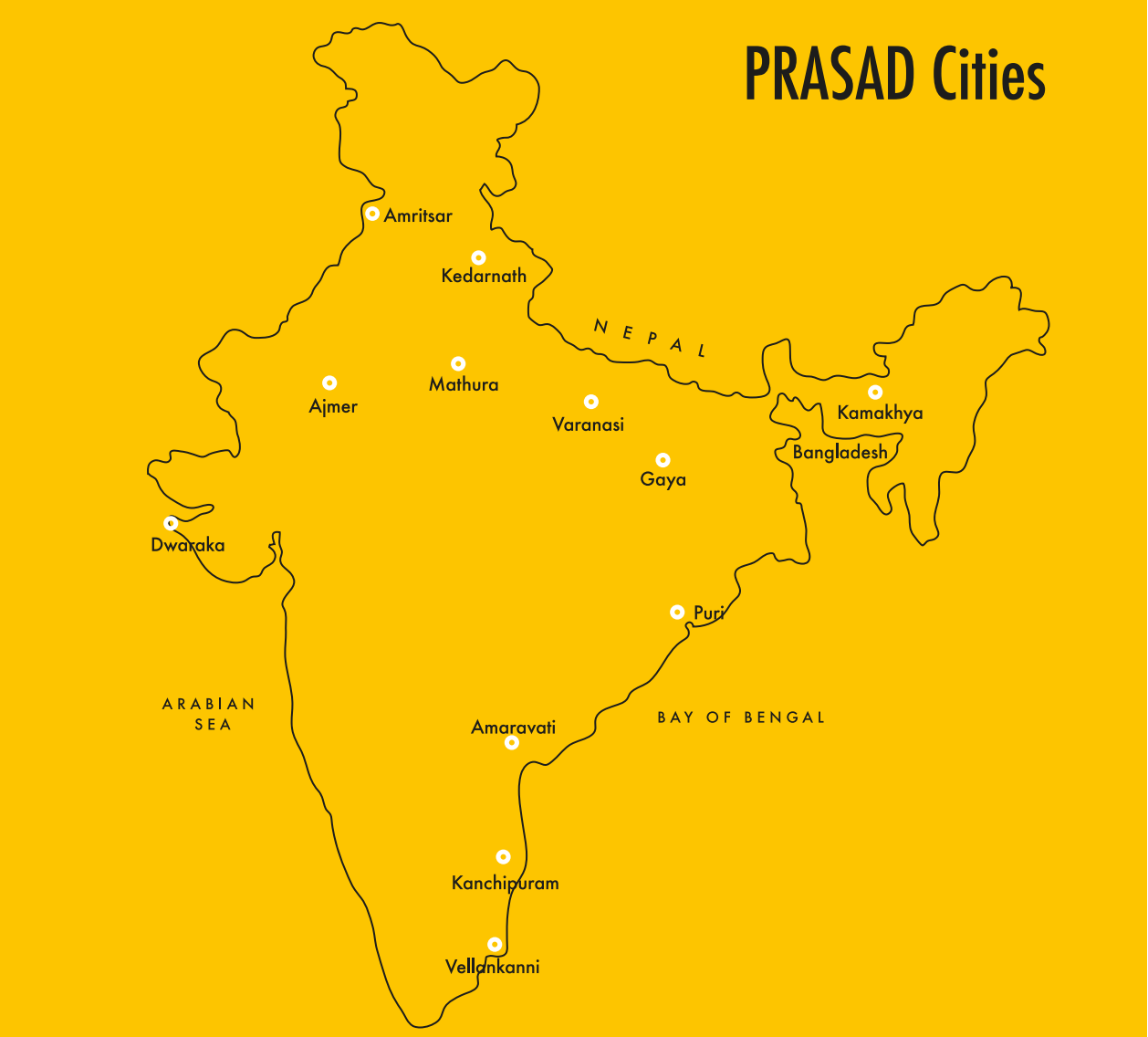
    • There are 12 cities selected for both schemes, but there’s a considerable overlap in the sense that 10 cities are common to both. Only cities separate are:
      • Kamakhya in Assam and Kedarnath in Uttarakhand (PRASAD)
      • Badami in Karnataka and Warangal in Telangana
    • Lets take a tour of those common 10 cities and the other 2 specific to PRASAD.

    Map of PRASAD Cities

    source

    #1: Ajmer

    source
    • Surrounded by the Aravalli Mountains (meaning the “Invincible Hill”)
    • Founded by Ajaipal Chauhan (who established The Chauhan Dynasty – 7th century.
    • Ruled by the legendary Prithviraj Chauhan, the last Hindu king of Delhi.
    • Dargah of the Great Sufi Saint Khwaja Moinuddin Chishti (aka Madina of India)
      • Devotees of all sects and faiths congregate
      • Annual festival of Urs (Death anniversary of a Sufi saint in South Asia, usually held at the saint’s dargah such as Chisti’s; it is celebrated rather than mourned)
      • Picture of harmony and universal brotherhood.
    • Variety of styles of Architecture including lndo-Islamic, Royal Rajasthani, lndo-Saracenic and Jain styles of architecture.
      • Soniji Ki Nasiyan is a famous Digambara Jain temple from Ajmer
    • Ajmer is also the base for visiting Pushkar (11 km), the abode of Lord Brahma and a sacred town of Hindus <Pushkar is far from Mahadeo Hills of MP, remember 2015 prelims question?>
    • Artists of this area
      • Carving on wood and ivory,
      • Blue pottery

    #2: Amaravati

    • What’s in a name?
      • Translates to “The town lives forever”
      • Also referred as Amareswaram
      • Formerly known as Andhra nagari
      • Name derived from famous “Amareswara temple” dedicated to Lord Shiva
    • Ancient Rulers of Amaravati
      • Capital of Satavahanas who ruled from 2nd century BCE to 3rd century CE <most important period for Amaravati>
      • Andhra Ikshvakus
      • Pallava kings
      • Eastern Chalukyas
      • Telugu Cholas
      • Kakatiyas in 11th century CE
    • Medieval Rulers of Amaravati
      • Delhi Sultanate
      • Bahmani Sultanate
      • Vijayanagara Empire,
      • Munsuri Nayaks
      • Sultanate of Golconda
    • Mentions of Amaravati found in:
      • Skanda Purana gives a picture of the place
      • Puranic literature such as Aitreya Brahamana mentions about “Andhra-jati” ruling area we now know as Amaravati
    • The Amaravati Stupa
      • Buddhist stupa (Dhyana) was built during the Reign of Ashoka in 200 BCE
        • Carved with panels that tells the story of Buddha
      • During the period of the Decline of Buddhism, this stupa was also neglected and it was buried
      • Stupa is related to the “Vajrayana” (Tibetan) teachings of Kalchakra (a festival held in 2006, Dalai Lama inaugurated)
      • NOTE: Hiuen Tsang (Xuanzang) also visited Amaravati Stupa in 640 CE

    source
    • Ancient Art (Sculpture) from Amaravati
      • Amaravati art as one of the three major styles or schools of ancient Indian Sculpture
        • Other two being the Gandhara style and the Mathura style.
      • Use of White marble (to Potrays a Greco-Roman influence)
      • Physical beauty with elegance
      • Narrative rather than individualistic (not deities but Humans)
      • Depiction of Kings and Princes
      • Direct result of the close trade and diplomatic contacts between south india and the ancient roma
      • Amaravati has itself yielded a few Roman coins
      • World’s finest examples of Narrative sculpture.

    source

    Published with inputs from Amar 
  • IAS Prelims tit-bits- History part 2

    1. Morley Minto Reform, 1909

    1. 1st name i.e Morley, Secretary of state, 2nd i.e Minto, Viceroy
    2. Prelude – Shimla Deputation led by Agha Khan demanded separate electorate in 1906
    3. Muslim League was founded in 1906 and it intended to preach loyalty to the empire <when was all India Hindu Mahasabha formed and it’s founders?>
    4. Reforms– separate electorate for muslims
    5. Elected members increased in legislative councils but elected non official still in minority
    6. Indirect election <elections for the 1st time>
    7. One Indian to the viceroy’s executive council
    • Discuss- 1st Indian to the viceroy’s executive council
    • Discuss – Progress of separate electorate in subsequent reforms  upto Poona Pact

    2. Montagu Chelmsford Reform

    1. Two lists, central and provincial , in provincial, reserved and transferred
    2. Dyarchy at Provinces i.e. reserve list by the governor, Transferred list by ministers
    3. Elected majority in provincial legislature <contrast this with reform of 1909>
    4. Bicameral legislature at Centre
    5. Secretary of state would now be paid out of British Exchequer <home charges reduced>
    • Discuss – Home charges and economic critique by nationalists
    • Discuss – Dual system/ government or Dyarchy of Clive and it’s end
    • Discuss– Transferred and reserve list


    3. Nehru Report <Motilal>

    Prelude – Challenge by Lord Birkenhead to Indians to produce an agreed constitution accepted by all in the wake of Anti Simon Agitation <No Indian In 7 member Simon commission>

    Recommendations

    1. Dominion Status <when did British 1st concede demand of dominion status>
    2. Joint electorate with reserved seat for minorities at centre and in provinces in which they were in minority
    3. Linguistic Provinces
    4. 19 Fundamental rights <congress resolution on fundamental rights, which session?>

    Jinnah Made 14 demands

    1. Provincial autonomy and residuary power to provinces
    2. Separate electorate
    3. ⅓ Muslim representation in central legislature and all cabinets

    Unhappy with Nehru Report J.L.Nehru Subhash Bose set up Independence for India League

    Discuss – 1st linguistic state in post independence India

    4. Three Round Table Conferences

    Proposed by Lord Irwin to discuss Simon Commission Report

    1st RTC <nov 1930 to jan 1931>

    1. Civil Disobedience Movement had already been started as Gandhi’s 11 demands not accepted by Viceroy
    2. Congress boycotted
    3. Muslim League, Hindu Mahasabha, Liberals, Princes participated <when was liberal party formed and why did it secede from Congress?>
    4. Failure as constitutional advance could not be discussed without congress participation

    2nd RTC <Dec 1931>

    1. After Gandhi Irwin pact (Delhi Pact) led to suspension of CDM
    2. Congress (Gandhi) participated
    3. Failure as session got deadlocked on the question of minorities < separate electorate for Muslims, depressed classes (SC), christians, anglo Indians>

    Result- Two Muslim majority provinces – Sindh and NWFP<No. Of provinces now?> , CDM resumed

    3rd RTC < Nov. 1932>

    1. Congress wasn’t even invited
    2. Labour Party <Britain> refused to attend it
    3. In this conference Chaudhary Rahmat Ali, a student, 1st proposed the name Pakistan

    Outcome – White Paper on the basis of this paper, the Government of India Act 1935 was to be passed.

    • Discuss – Significance of round table in RTC
    • Discuss – two demands of Gandhi which were rejected by Irwin in Gandhi- Irwin Pact
    • Discuss – What was agreed with regard to political prisoners, fines and land confiscated in Gandhi- Irwin Pact

    5. Govt of India Act, 1935

    1. All India Federation  and Bicameral legislature at center <what was there in 1919 act?>
    2. Odd that election to the council of states <upper house> was direct while indirect to the federal assembly
    3. Three lists, federal, provincial and concurrent <v/s 2 list in 1919> <who had residuary powers?>
    4. federal lists into reserved and transferred <in 1919 provincial list was into reserved and transferred>
    5. Provincial autonomy <dyarchy in 1919>
    6. All members of provincial legislature directly elected <contrast this with 1909 and 1919>
    7. Abolished the council of India created by the act of 1858

    Discuss – Following institutions were set up under which acts-

    RBI, central Public service commission, Federal Public Service Commission , office of secretary of state, office of high commissioner for India, Federal court, Supreme Court, Board of Control

  • Prelims 2016 Test Series

    —————————————————–

    To write the tests, click on this link – Prelims Mocks

    —————————————————–

    Hello Everyone,

    We had promised you that it shall be our endeavour to provide you with quality MCQs in the form of a test series. Beginning Monday, we shall set down to fulfil our promise. And as we get down to the task, here are some ground rules/instructions, by whatever name you may call them:

    #1. There shall be 25 questions each in sectional tests from Test 1 to Test 10.

    #2. Liberty has been taking in framing few questions from sources which were not explicitly mentioned in the schedule but nonetheless constitute the standard text we read.

    #3. We fill fix a time for releasing the test series and the same shall be followed throughout (save the exigencies) so you can set yourself a time to attempt the test in exam-like conditions.

    #4. The main purpose of these tests is not to judge you in anyway but to let you identify your weaknesses and strengths. So be active and place your answers in the comment sections because that is the way it shall trigger discussions from others who might have different answers. Such lively discussions are among the best ways to remember things.

    #5. There might be instances where we may differ in our answer choices owing to the reference we may take or the different interpretations we may have. In such cases we shall point our reference and settle down on the answers and interpretations.

    #6. On Sundays, solutions shall be appended at the end of the tests with references.

    #7. The master blaster Dr. V has already enumerated the various ‘saam daam dand bhed’ ways in which you can zero in on the right answers in MCQs. Read the blog several times over and make sure you have mastered the ‘art of answering MCQs’.

    Best Wishes!

  • IAS Prelims tit-bits- Current Affairs part 2

    1. Nobel prize 2015

    1. Physics -Takaaki Kajita and Arthur B. McDonald for the discovery of neutrino oscillations, which shows that neutrinos have mass
    2. Chemistry– Tomas Lindahl, Paul Modrich and Aziz Sancar for mechanistic studies of DNA repair
    3. Physiology or Medicine– William C. Campbell and Satoshi Omura for a novel therapy against infections caused by roundworm parasites and to Tu Youyou for a novel therapy against Malaria
    4. Literature-Svetlana Alexievich for her polyphonic writings, a monument to suffering and courage in our time.
    5. Peace Prize– National Dialogue Quartet for its decisive contribution to the building of a pluralistic democracy in Tunisia in the wake of the Jasmine Revolution of 2011
    6. Economics– Angus Deaton for his work on consumption, poverty and welfare that helped governments improve their policies through household surveys and tax changes.
    • Discuss – Properties of Neutrino which make them useful for humankind
    • Discuss– Indian Neutrino Observatory (INO)
    • Discuss – Particular drugs discovered by Medicine Nobel laureates

    2. Swadesh Darshan, PRASAD and HRIDAY

    1. Swadesh Darshan for Integrated Development of Tourist Circuits around Specific Themes
    2. PRASAD- National Mission on Pilgrimage Rejuvenation and Spiritual Augmentation Drive (PRASAD) to beautify and improve the amenities and infrastructure at pilgrimage centres of all faiths
    3. Under PRASAD twelve cities have been identified – Ajmer, Amritsar, Amravati, Dwarka, Gaya, Kedarnath, Kamakhaya, Kanchipuram, Mathura, Puri, Varanasi and Velankanni <please try to recognize their names>
    4. HRIDAY– National Heritage Development and Augmentation Yojana (HRIDAY) seeks to preserve and rejuvenate the rich cultural heritage of the country
    • Discuss – Circuits of Sawdesh Darshan
    • Discuss– Cities common to both HRIDAY and PRASAD
    • Discuss – Nodal Ministries for all three schemes

    3. Important Military Exercises 

    1. Naval – Malabar with USA, Varuna with France, Indra with Russia, Slinex with SL, Konkan with Britain, Naseem al Bahar with Oman
    2. Coast Guard – Sahyog-Kaijin with Japan
    3. Air force – Indra Dhanush with UK, Garuda with France
    4. Army – Hand in Hand with China, Mithra Shati with SL, Youdh Abhyas with USA, Shakti with Frnace
    • Discuss – Indian Ocean Naval Symposium
    • Discuss- Malabar Exercise and japan
    • Discuss– International Fleet Review 2016

    4. Random Govt. Initiatives

    1. e – Sahayog Launched by ministry of finance to facilitate taxpayers
    2. Mahila E Haat is an online platform for women for Showcasing products made/manufactured/sold by women entrepreneur
    3. Vikalp It aims to provide confirmed accommodation to waitlisted passengers in alternate trains

    Discuss – Other such inititives

    5. Mission Indradahnush

    1. Against 7 vaccine preventable diseases
    2. For reform of Public Sector Banks
    3. Four new vaccines added to national immunization programme – Injectable Polio, Rubella, Rotavirus, Adult vaccine aganist Japanese Encephalitis
    • Discuss – Seven diseases which Indradhnush seek to protect against
    • Discuss– switch over day (polio)
    • Discuss – Difference b/w Oral polio and Injectable Polio Vaccine
    • Discuss – theme of world Health Day
  • Repatriation of Artifacts & Antiquities under Colonial Possession

    In previous blog of this series we learnt that our heritage under Colonial possession qualifies as an “illegal acquisition” as per international conventions. 

    So technically, countries like UK are indeed liable to return antiquities and heritage properties under their private or public possession. But politics aside, there are some other reasons due to which there has been little progress on restitution of Peacock Throne, or everyone’s favourite- the Koh-i-Noor diamond.

    International Conventions on returning colonial possessions

    1. UNESCO’s Convention on the Means of prohibiting and preventing the illicit import, export and transfer of ownership of cultural property (1970)
      • Newly independent states after World wars, were trying to recover important cultural objects that are mostly found in the museums of their former colonizing state.
      • Three main pillars: Protection against theft (Preventive Measure), Restitution Measures through Diplomatic channels, and International cooperation.
      • But the issue with this convention is that its mandate is not retroactive and most of the illegal acquisitions were made before 1970 before the fall of Colonialism.
      • Contemporary relevance: Monuments are being destroyed locally (IS in Syria or the Taliban in Afghanistan) can be taken out and protected for the sake of the whole world by a capable country under this convention. It can later be returned to the “source” countries when the conflict ends.
    2. UN General Assembly resolutions
      • UNGA has made successive resolutions on this matter
      • Deplored “the wholesale removal of Cultural Heritage, virtually without payment” as a result of colonial or Foreign Occupation
      • Unlike UNESCO’s convention- their mandates has been retroactive
      • Covered cultural property lost either as a consequence of
        1. Foreign or colonial occupation, or
        2. Through illicit traffic “prior” to the adoption of the 1970 Convention
      • Then why no success?
        • Covers cultural properties that are currently in safe places and open to the public, like museums, archives and libraries. Thus, it does not cover the equally important Private Sphere
        • CAG’s findings that Indian artifacts have reached foreign auction houses like Sotheby’s and Christie’s
        • Eg- Bonhams, the london private auctioneer, recently auctioned Tipu Sultan’s property against all efforts by India to claim its ownership over it.
        • Most of the personal wealth and possessions of the 18th century Mysore ruler including that of Tipu Sultan, is in the illegal private possession of families, descendants of British and Scottish soldiers <which particular soldier/general could we be referring to?>
      • Why no repatriation from Public Museums?
        • Cultural institutions like Public Museums have yet to acknowledge the full negative legacy of the colonial rulers.
        • While many of these museums are autonomous, when such demands are made on an International level, local governments do intervene and matter turns diplomatic and political.

    Why Repatriation of possessions is a just demand?

    1. Repatriation is already happening: Restitution of Jewish Artifacts by Nazis
      • Association of Art Museum Directors (AAMD) adopted a series of protocols to ensure that any work of art proven to be taken forcibly from a Jewish family during the Nazi regime should be returned to the rightful heirs
      • Between 1998 and 2006, 26 works in American museums were identified as being looted by the Nazis and were, in each case, restituted to the heirs
    2. Non-governmental actors succeeding on many levels— students resident in the U.K. — getting into the discussion around national cultural patrimony
      • Nigerian students demanding the return of the Benin bronzes looted from Nigeria at the time of the British imperial siege of the country in the late 19th century
      • Pressure generated so far has led for Cambridge University to remove the articles from Public display. It goes a long way into acknowledging the mistakes, if not outrightly returning the possessions.
      • Furthermore, few descendants of British Soldiers have shown the way by returning Nigerian Artifacts to their rightful owners, that was otherwise looted by their grandfathers in 19th century.

    Why are ex-Colonialists against repatriation?      

    1. They say that Encyclopedic museums of Europe and the U.S. are repositories of world art under one roof.
      • That they take care (by acting as protectors) of our global heritage, as art knows no boundaries
      • In this way they claim to be promoting international understanding of art.
      • Counter: This argument reeks of old European big-brother attitude that claims to be a superior civilization taking upon itself the task of correcting other civilizations.
    2. Objects were taken from countries such as Egypt, China, or India because none of these countries had the resources or the inclination to protect their own treasures
      • It was British officials who discovered, excavated or restored great sites such as Sanchi or Ajanta while there was no indigenous interest in preserving them at the time.
      • Counter: By this logic, they should return these artifacts to us, because now capable and resourceful enough to preserve the

    What are the “real” consequences of Repatriation on ex-Colonial countries?

    • Former colonizers would have to acknowledge various wrongs perpetrated by them on the colonies they ruled. This would result in a domino effect and not just restricted to repatriation of heritage objects, and could cause an International debacle and domestic shame.
    • Many of the biggest museums, especially the Louvre, the British Museum, and even some major American museums would get hollowed out of their collections

    So how do we resolve this issue?

    1. Museums of the Euro-American world could create a Long-term Loan programme
      • National Museum in New Delhi were to receive a long-term loan of Egyptian objects or 19th century American landscape paintings so that the National Museum too could begin to resemble an encyclopaedic museum of the West
    2. Seriously think about returning the ownership of objects back to the source countries
      • This could only happen if Western museums actually acknowledged the colonial past.
      • And simply recognising their role as “protectors” of, and not “owners” of global heritage.

    Published with inputs from Amar 
  • “IGNOU:MPA-018 Disaster Management”

    whether i read whole
    “IGNOU:MPA-018 Disaster Management” or Selected Chapter’s ??
    or any better option then “IGNOU:MPA-018 Disaster Management” ??

More posts