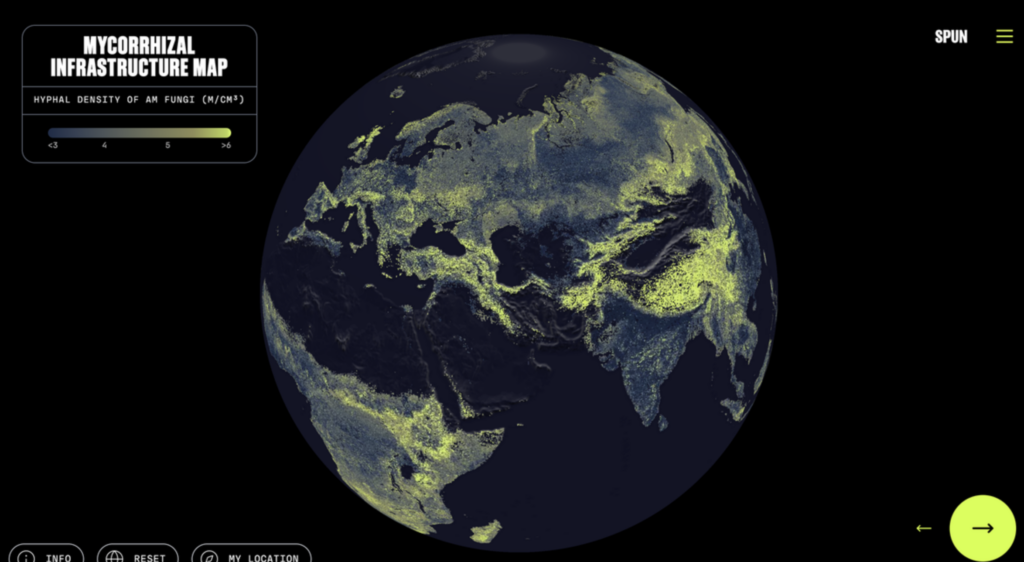
A study published in the journal Science produced the first global map of arbuscular mycorrhizal (AM) fungi, revealing the enormous extent of underground fungal networks and their importance for climate regulation.
Key Findings
Topsoils worldwide contain about 110 quadrillion km of fungal hyphae.
This distance is equivalent to nearly one billion trips between the Earth and the Sun.
AM fungal networks store around 300 million tonnes of carbon.
This is 4 to 6 times the weight of the entire human population.
The study analysed data from more than 16,000 soil cores using machine-learning techniques.
Role in Climate Regulation
AM fungi form symbiotic associations with nearly 70% of all plant species.
They exchange Nutrients and water with plants, in return for carbon compounds produced through photosynthesis.
These networks sequester approximately 4 billion tonnes of CO₂-equivalent annually.
This equals roughly 11% of global human-related carbon emissions.
Arbuscular Mycorrhizal (AM) Fungi
A group of fungi belonging to the phylum Glomeromycota.
They colonise plant roots and form mycorrhizae (fungus-root associations).
The fungal filaments, called hyphae, extend into the soil and improve nutrient uptake.
Benefits
Enhance absorption of: Phosphorus, Nitrogen, Micronutrients, and Water.
Improve plant growth and drought tolerance.
Increase soil aggregation and fertility.
Contribute to long-term carbon storage.
Biodiversity Hotspots Identified
The study found that around 40% of global AM fungal networks occur in grassland ecosystems, including South Sudan, The Tibetan Plateau, and Banni Grasslands.
Major Threats
Croplands contain about 50% lower fungal density compared to natural ecosystems.
Grasslands are being converted into agricultural land four times faster than forests.
This threatens underground fungal biodiversity and its ecosystem services.
Why is the Study Important?
Highlights fungi as a form of “living infrastructure” supporting ecosystems.
Emphasises the need to include soil biodiversity and fungi in climate policy.
Strengthens the case for grassland conservation alongside forest protection.
[2021] Which of the following have species that can establish symbiotic relationship with other organisms? 1. Cnidarians 2. Fungi 3. Protozoa Select the correct answer using the code given below.
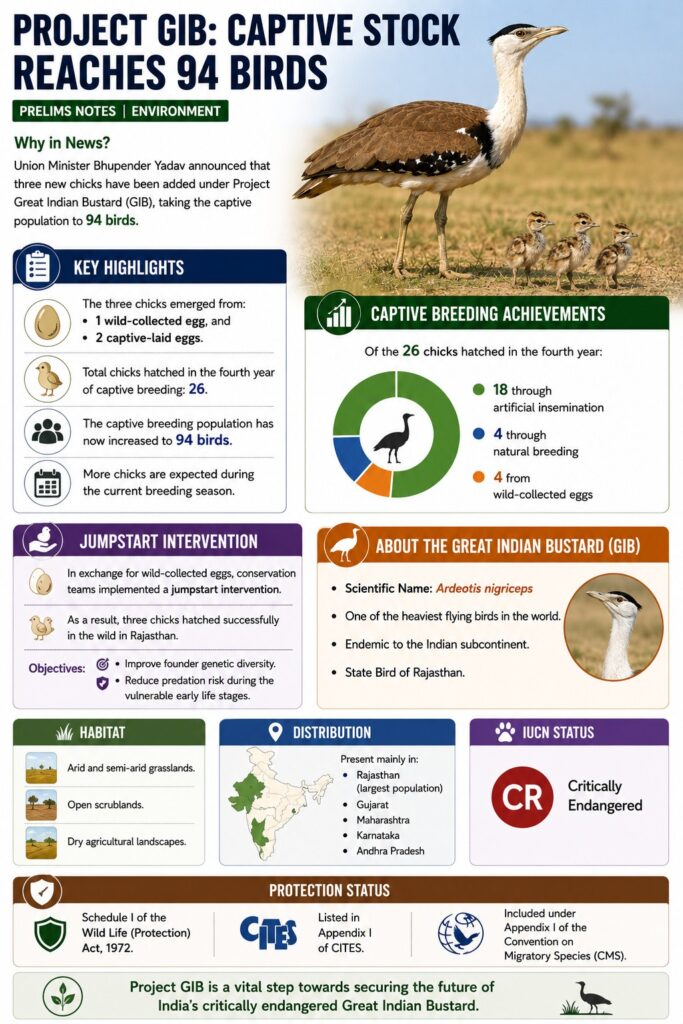
Union Minister Bhupender Yadav announced that three new chicks have been added under Project Great Indian Bustard (GIB), taking the captive population to 94 birds.
Key Highlights
The three chicks emerged from: 1 wild-collected egg, and 2 captive-laid eggs.
Total chicks hatched in the fourth year of captive breeding:26.
The captive breeding population has now increased to 94 birds.
More chicks are expected during the current breeding season.
About the Great Indian Bustard (GIB)
Scientific Name: Ardeotis nigriceps
One of the heaviest flying birds in the world.
Endemic to the Indian subcontinent.
State Bird of Rajasthan.
Habitat
Arid and semi-arid grasslands.
Open scrublands.
Dry agricultural landscapes.
Distribution: Rajasthan (largest population), Gujarat, Maharashtra, Karnataka, and Andhra Pradesh.
IUCN Status: Critically Endangered.
Protection Status:Schedule I of the Wild Life (Protection) Act, 1972.
Listed in Appendix I of CITES.
Included under Appendix I of the Convention on Migratory Species (CMS).
[2020] With reference to India’s Desert National Park, which of the following statements are correct?
1. It is spread over two districts. 2. There is no human habitation inside the Park. 3. It is one of the natural habitats of the Great Indian Bustard. Select the correct answer using the code given below: a) 1 and 2 only b) 2 and 3 only c) 1 and 3 only d) 1, 2 and 3
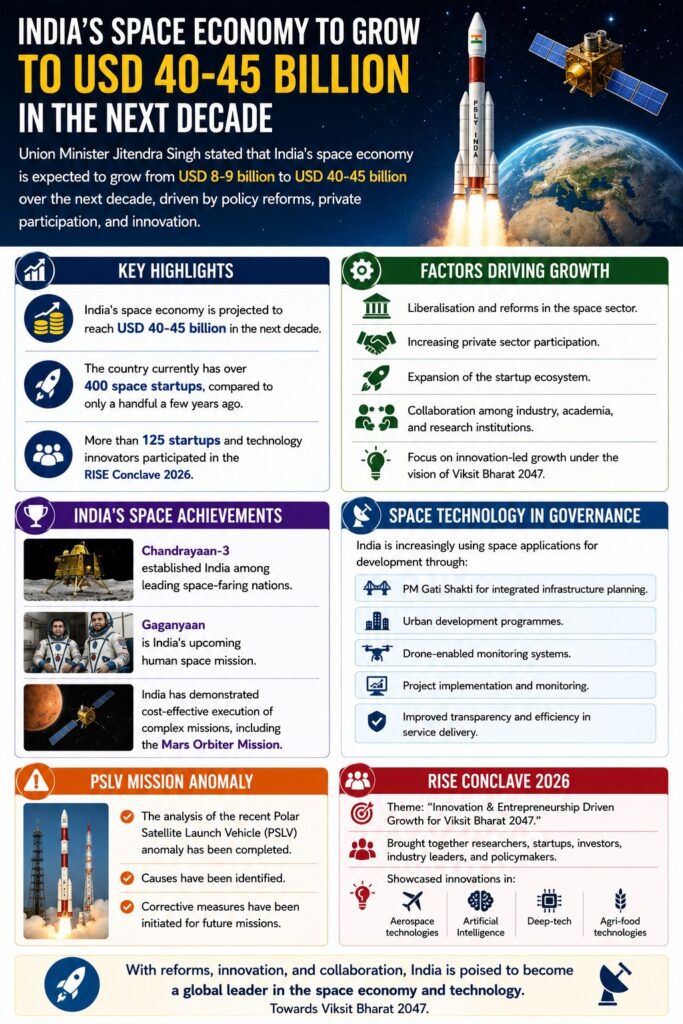
Union Minister Jitendra Singh stated that India’s space economy is expected to grow from USD 8-9 billion to USD 40-45 billion over the next decade, driven by policy reforms, private participation, and innovation.
Key Highlights
India’s space economy is projected to reach USD 40-45 billion in the next decade.
The country currently has over 400 space startups, compared to only a handful a few years ago.
More than 125 startups and technology innovators participated in the RISE Conclave 2026.
Factors Driving Growth
Liberalisation and reforms in the space sector.
Increasing private sector participation.
Expansion of the startup ecosystem.
Collaboration among industry, academia, and research institutions.
Focus on innovation-led growth under the vision of Viksit Bharat 2047.
India’s Space Achievements
Chandrayaan-3 established India among leading space-faring nations.
Gaganyaan is India’s upcoming human space mission.
India has demonstrated cost-effective execution of complex missions, including the Mars Orbiter Mission.
Space Technology in Governance
India is increasingly using space applications for development through:
PM Gati Shakti for integrated infrastructure planning.
Urban development programmes.
Drone-enabled monitoring systems.
Project implementation and monitoring.
Improved transparency and efficiency in service delivery.
PSLV Mission Anomaly
The analysis of the recent Polar Satellite Launch Vehicle (PSLV) anomaly has been completed.
Causes have been identified.
Corrective measures have been initiated for future missions.
RISE Conclave 2026
Theme: “Innovation & Entrepreneurship Driven Growth for Viksit Bharat 2047.”
Brought together researchers, startups, investors, industry leaders, and policymakers.
Showcased innovations in Aerospace technologies, Artificial Intelligence, Deep-tech, and Agri-food technologies.
[2025] GPS-Aided Geo Augmented Navigation (GAGAN) uses a system of ground stations to provide necessary augmentation. Which of the following statements is/are correct in respect of GAGAN? I. It is designed to provide additional accuracy and integrity. II. It will allow more uniform and high quality air traffic management. III. It will provide benefits only in aviation but not in other modes of transportation. Select the correct answer using the code given below.
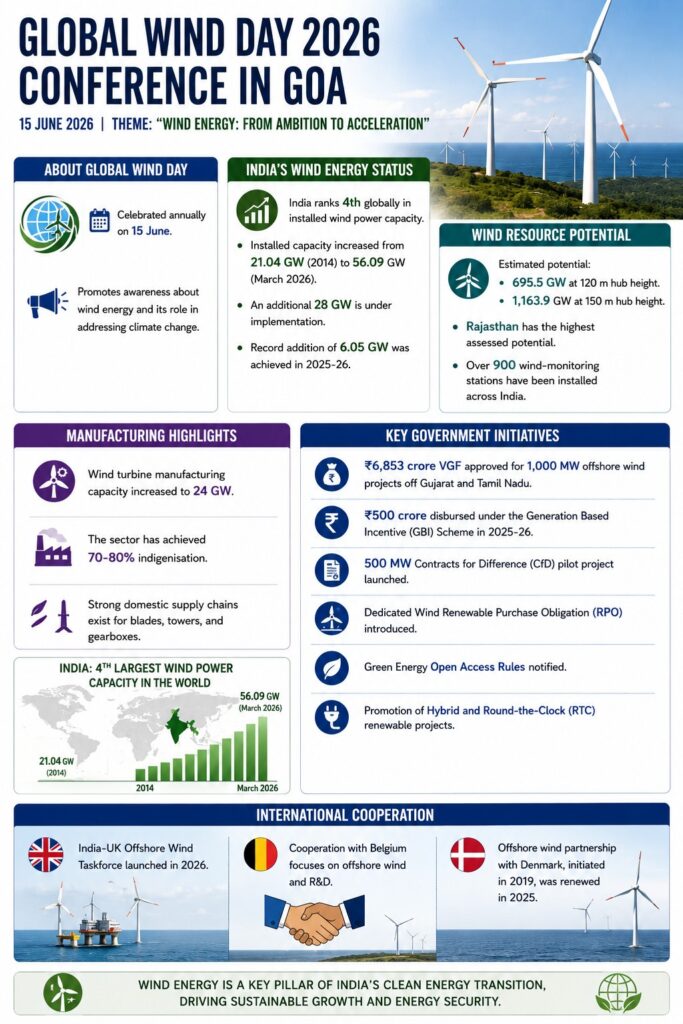
Promotion of Hybrid and Round-the-Clock (RTC) renewable projects.
International Cooperation
India-UK Offshore Wind Taskforce launched in 2026.
Cooperation with Belgium focuses on offshore wind and R&D.
Offshore wind partnership with Denmark, initiated in 2019, was renewed in 2025.
[2025] Consider the following statements about ‘PM Surya Ghar Muft Bijli Yojana’: I. It targets installation of one crore solar rooftop panels in the residential sector. II. The Ministry of New and Renewable Energy aims to impart training on installation, operation, maintenance and repairs of solar rooftop systems at grassroot levels. III. It aims to create more than three lakhs skilled manpower through fresh skilling, and upskilling, under scheme component of capacity building. Which of the statements given above are correct?
PYQ Relevance[UPSC 2022] The Rights of Persons with Disabilities Act, 2016 remains only a legal document without intense sensitisation of government functionaries and citizens regarding disability. Comment.Linkage: The PYQ examines the gap between statutory rights and actual social, administrative and economic inclusion of Persons with Disabilities. The proposed Minimum Universal Disability Pension Floor Rate (MUDPFR) represents the next step in translating legal rights into meaningful social protection and economic security for PwDs.
Mentor’s Comment
India’s welfare architecture has achieved remarkable success in digital inclusion and benefit delivery, yet disability pensions remain fragmented and dependent on State-level discretion. A Minimum Universal Disability Pension Floor Rate (MUDPFR) would establish a nationally guaranteed minimum social security entitlement for Persons with Disabilities, ensuring equality, dignity and portability of benefits while strengthening India’s transition towards a rights-based welfare state.
Why does India’s disability pension system remain inadequate despite a rights-based legal framework?
Large Beneficiary Base: Census 2011 recorded 2.68 crore PwDs; current estimates place the number at around 4.5-6 crore due to population growth and changing disease profiles.
Constitutional Recognition: Supreme Court has recognized the right to live with dignity as a fundamental right.
Legal Protection: Rights of Persons with Disabilities Act, 2016 provides statutory protection and mandates social security support.
Fragmented Pension System: Disability benefits vary significantly across States.
Low Pension Amounts: Most States provide pensions ranging between ₹300 and ₹500 per month.
Limited Coverage: Indira Gandhi National Disability Pension Scheme covers only a small fraction of eligible beneficiaries.
Domicile-Based Inequality: Pension support often depends on place of residence rather than disability status.
How does India’s spending on disability welfare compare internationally?
Low Public Spending: India spends only about 0.02% of GDP on disability welfare, including pensions.
South Africa Comparison: Allocates approximately 0.12-0.15% of GDP.
Brazil Comparison: Allocates around 0.45-0.50% of GDP.
OECD Countries: Average spending around 2.2% of GDP.
Australia Comparison: Allocates approximately 0.35-0.40% of GDP.
Resource Gap: India’s spending remains multiple times lower than comparable welfare systems.
What are the economic and social costs of inadequate disability support?
GDP Loss: World Bank and UNDP estimates indicate low- and middle-income countries lose 3-7% of GDP from exclusion of PwDs.
Educational Exclusion: Limited support reduces access to education.
Employment Barriers: Inadequate social security weakens labour force participation.
Household Vulnerability: Disability income support improves household stability.
Consumption Multiplier: Studies indicate multipliers ranging between 1.4 and 1.6.
Disability pensions have a consumption multiplier of 1.4-1.6, meaning every ₹100 transferred to beneficiaries can generate approximately ₹140-₹160 in economic activity through increased spending on food, healthcare, transport and local services.
Economic Returns: Pro Bono Economics (2025) found socio-economic returns from disability pensions exceed costs by nearly 48%.
Investment Perspective: Disability pensions function as economic investments rather than welfare expenditures alone.
Why is a Minimum Universal Disability Pension Floor Rate (MUDPFR) being proposed?
Constitutional Obligation: Supports Article 41 directing public assistance in cases of disability.
Implementation of RPwD Act: Operationalises Section 24 guaranteeing social security measures.
Universal Minimum Guarantee: Ensures a baseline pension irrespective of State of residence.
Rights-Based Welfare: Shifts support from charity-based approaches to citizenship-based entitlements.
Portability: Ensures continuity of benefits across States.
Equity: Reduces interstate disparities in pension access and quantum.
Proposed Design
National Floor Rate: Central government guarantees a minimum pension.
State Top-Ups: States remain free to provide higher benefits.
Uniform Eligibility: Common eligibility standards across India.
Portability: Benefits remain accessible across State boundaries.
Is a universal disability pension financially feasible?
₹8,000 Monthly Pension Scenario: Cost estimated at approximately ₹38,400 crore annually.
GDP Share: Around 0.08% of GDP.
10 Lakh Beneficiaries Scenario: Cost around ₹65 lakh crore? (Article indicates cost projections for larger coverage; emphasis remains below 0.2% GDP even under expanded coverage assumptions.)
₹15,000 Monthly Pension Scenario: Public expenditure would still remain below 0.2% of GDP.
Comparative Fiscal Context:
Food Subsidy: ₹2.05 lakh crore.
Rural Development: ₹1.80 lakh crore.
Tax Concessions and Revenue Foregone: ₹1.72 lakh crore.
Infrastructure: ₹11.11 lakh crore.
How can India move from fragmented welfare to integrated disability support?
Institutional Fragmentation: Pension administration is divided between the Ministry of Rural Development and the Department of Empowerment of Persons with Disabilities.
Administrative Delays: Multiple authorities create duplication and accountability gaps.
International Practice: Several countries operate through unified disability-support institutions.
Proposed Institutional Reforms
National Disability Pension Authority: Oversees eligibility, portability and grievance redress.
National Registry: Creates integrated beneficiary database.
Digital Integration: Links welfare databases through interoperable platforms.
Performance Monitoring: Enables State-wise accountability and benchmarking.
Single Governance Framework: One standard, one system, one nation.
What lessons can India learn from international experience?
South Africa
National Disability Grant: Uniform eligibility and nationwide coverage.
Centralized Standards: Ensures portability and consistency.
Brazil
BPC Programme: Guarantees a national minimum income for persons with disabilities.
Australia
Nationwide Disability Pension: Central administration with State coordination.
Employment Incentives: Combines social security with labour participation.
New Zealand
Universal Framework: Nationwide disability support system.
Other Developing Countries
Kenya, Rwanda, Thailand and Indonesia: National disability income support mechanisms demonstrate feasibility even in developing economies.
Why should disability pensions be linked with employment and economic participation?
Inclusive Growth: Moves beneficiaries from survival support to productive participation.
MUDPFR Advantage: Creates financial security necessary for skill development and employment.
Employer Incentives: Encourages hiring of persons with disabilities.
Singapore: Integrates disability support with skills training and workforce participation programmes.
South Korea: Combines income support with vocational rehabilitation and employment assistance.
South Africa: Provides a nationwide Disability Grant ensuring minimum income security for PwDs.
Brazil: Guarantees income support through the Benefício de Prestação Continuada (BPC) programme.
Nigeria: Offers tax incentives to employers hiring persons with disabilities, encouraging workplace inclusion.
United Kingdom (Access to Work): Provides financial assistance for workplace accommodations and support services.
Australia (Wage Subsidies): Offers wage subsidies to employers to improve employment opportunities for persons with disabilities.
Existing Indian Base: PM-DAKSH, NAPS and State-level incentives provide foundations for expansion.
How does a universal disability pension strengthen constitutional morality?
Equality: Reduces domicile-based discrimination.
Dignity: Recognises persons with disabilities as rights-bearing citizens.
Citizenship: Moves welfare from discretionary charity to guaranteed entitlement.
Article 14: Advances equality before law.
Article 21: Supports dignified living.
Social Justice: Aligns welfare architecture with constitutional commitments.
Federal Balance: Preserves State flexibility while guaranteeing minimum national standards.
Conclusion
A Minimum Universal Disability Pension Floor Rate (MUDPFR) would mark a shift from fragmented welfare to rights-based social protection by ensuring that disability support is determined by citizenship and need rather than geography. As India aspires to become a developed nation, guaranteeing a minimum income floor for Persons with Disabilities is not merely a welfare measure but a constitutional imperative that advances equality, dignity, inclusion and human capital development.
India has unveiled the Coal Exchange Rules, 2026, marking a major structural reform in the coal sector. For the first time, coal will be traded through regulated exchange platforms similar to power exchanges
What are the Coal Exchange Rules, 2026?
The Coal Exchange Rules, 2026, notified by the Ministry of Coal, establish a legally binding framework for transparent, electronic “many-to-many” spot mineral trading. Regulated by the Coal Controller Organisation, the rules aim to improve price discovery and market access for consumers.
Key Features of the Rules
Electronic Trading: The system transitions coal marketing from the traditional “one-to-many” bilateral model to an efficient, competitive digital trading platform where multiple buyers and sellers can transact.
Mandatory Physical Delivery: All transactions must culminate in physical delivery of the coal. These are supported by independent quality verification to ensure contractual compliance.
Regulatory Oversight: The Coal Controller Organisation acts as the central market regulator, handling the registration, supervision, and auditing of exchanges, as well as enforcing safeguards against market manipulation.
Registration Validity: Eligible entities (incorporated as companies under the Companies Act, 2013) are granted authorizations to establish and operate exchanges for 25 years.
Financial Obligations: Operators pay a ₹50 Lakh one-time registration fee, a ₹3 Lakh application fee, and an annual fee calculated as either ₹30 Lakh or 0.02% of the total trading volume, capped at ₹5 Crore.
How can coal exchanges transform India’s coal market structure?
Market-Based Trading: Establishes regulated platforms for buying and selling coal through transparent mechanisms.
Price Discovery: Creates market-driven price signals instead of relying primarily on bilateral negotiations.
Transparency: Reduces opacity associated with traditional contractual arrangements.
Competition: Enables broader participation by producers and consumers.
Secondary Markets: Facilitates development of coal trading beyond primary allocation channels.
Why is the existing coal allocation mechanism considered inadequate?
Long-Term Contracts: Most coal transactions currently occur through long-duration agreements, particularly for the power sector.
Auction Dependence: Significant volumes are allocated through auctions where prices may rise substantially.
Coal India Dominance: Non-regulated consumers often depend on Coal India auctions.
Premium Pricing: Coal is frequently sold at premiums to the highest bidder.
Limited Market Signals: Existing mechanisms provide inadequate real-time information regarding shortages and surpluses.
What lessons can be drawn from India’s power exchange experience?
Market Signalling: Power exchanges evolved into indicators of scarcity and surplus conditions.
What institutional safeguards are required for successful implementation?
Volatility Management: Ensures protection against excessive price fluctuations.
Dispute Resolution: Provides mechanisms for conflict settlement.
Logistics Integration: Strengthens transportation and delivery systems.
Regulatory Oversight: Ensures compliance and market integrity.
Settlement Systems: Facilitates efficient trading and delivery.
Conclusion
The Coal Exchange Rules, 2026 represent a shift from administrative allocation towards market-based coal governance. Their success will depend on quality standardisation, liquidity creation, Coal India’s participation, efficient logistics, and strong regulatory oversight. If implemented effectively, coal exchanges can become an important mechanism for balancing regional shortages, improving transparency, and strengthening India’s energy security.
Value Addition
Coal Sector at a Glance
Coal accounts for around 70% of India’s electricity generation.
India is the second-largest coal producer globally.
Coal India Limited produces roughly 80% of India’s domestic coal output.
Major coal-producing states: Odisha, Chhattisgarh, Jharkhand, Madhya Pradesh and Telangana.
About the Coal Controller Organisation (CCO)
The Coal Controller Organisation (CCO) is a subordinate office under the Ministry of Coal. Established in 1916 during World War I, it is one of the oldest regulatory bodies in India’s energy sector.
Headquartered in Kolkata, the CCO operates field offices across major mining hubs including Delhi, Dhanbad, Ranchi, Bilaspur, Nagpur, Sambalpur, and Kothagudem.
Core Regulatory Functions: The CCO derives its executive powers from various statutes, including the Colliery Control Rules, 2004, the Collection of Statistics Act, 2008, and the Coal Bearing Areas Act, 1957. Its primary responsibilities include:
Production and Grade Surveillance: The CCO inspects collieries to verify the correctness of declared coal classes, grades, and sizes. It establishes and enforces strict coal grading and quality standards.
Dispute Resolution: It serves as the official appellate authority to resolve quality and grade conflicts between coal producers and consumers.
Mine Approvals: No coal mine, seam, or section can be opened, reopened, or sub-divided without formal opening/reopening permissions from the CCO. It also approves Mining and Mine Closure Plans.
Captive Mine Monitoring: The organization tracks and monitors the development and progress of captive coal and lignite blocks allocated to various companies.
Statistical Authority: The CCO acts as the primary source for national coal statistics. It collects monthly production data and publishes the Provisional Coal Statistics and Coal Directory of India.
Land Acquisition Hearing Authority: Under the Coal Bearing Areas (Acquisition & Development) Act, the Coal Controller hears legal objections regarding the government’s acquisition of coal-bearing land.
New Role Under the Coal Exchange Rules, 2026: Following the notification of the Coal Exchange Rules, 2026, the CCO’s regulatory footprint has significantly expanded:
Central Market Regulator: The government designated the CCO as the apex statutory body to register, regulate, and audit electronic Coal Exchanges in India.
Platform Authorization: The CCO processes registrations for eligible entities, granting them 25-year operational licenses to run digital spot trading platforms.
Market Surveillance: It monitors exchange activities to prevent market manipulation, ensure fair price discovery, and resolve stakeholder grievances.
Coal India Limited (CIL)
Coal India Limited (CIL) is a Maharatna Public Sector Undertaking (PSU) that serves as the backbone of India’s energy security infrastructure.
Production Volume: World’s largest coal-producing company, accounting for roughly 80% of India’s total domestic coal output.
Operates under the Ministry of Coal.
Plays a central role in India’s energy security architecture.
Prime Minister Narendra Modi visited France in June 2026 for a bilateral visit and participation in the G7 Summit, marking his seventh visit to France since 2014. The relationship has evolved from a traditional diplomatic partnership into a Special Global Strategic Partnership, spanning defence, nuclear energy, space cooperation, emerging technologies, and Indo-Pacific security.
Timeline of India-France Relations
Year
Development
1947
Establishment of diplomatic relations
1998
Strategic Partnership launched
1998
France refrains from sanctions after Pokhran-II
2018
International Solar Alliance deepened cooperation
2023
Special Global Strategic Partnership announced
2024
Macron attends Republic Day as Chief Guest
2026
PM Modi’s seventh visit to France
Why Is India-France Partnership Considered Unique in Contemporary Diplomacy?
Strategic Trust
Consistency: Maintains stable engagement irrespective of changes in domestic political leadership.
Reliability: Supports long-term cooperation without transactional conditions.
Strategic Autonomy: Respects each other’s independent foreign policy choices.
Political Continuity
Leadership Engagement: PM Modi’s June 2026 visit marks his seventh visit to France since 2014.
Reciprocity: French President Emmanuel Macron attended India’s Republic Day celebrations in January 2024.
How Are Innovation and Emerging Technologies Deepening Bilateral Ties?
India-France Year of Innovation: The India-France Year of Innovation is designated for 2026.
Core Goal: To accelerate cooperation across deep tech, artificial intelligence, cyberspace, sustainable development, and advanced research networks.
Flagship Event: The landmark event “Bharat Innovates 2026” is hosted in Nice, France, connecting prominent Indian deep tech startups with global investors.
Strategic Roadmap: The program aligns with the Horizon 2047 Roadmap, which outlines the future of the India-France strategic partnership.
AI Cooperation: The global AI Action Summit hosted in Paris took place in 2025
Co-Chairs: The high-level summit was jointly co-chaired by Indian Prime Minister Narendra Modi and French President Emmanuel Macron.
India-France Declaration on AI: The two nations signed a comprehensive India-France Declaration on Artificial Intelligence to advance sovereign computing capacity, open-source language models, and digital public infrastructure.
Responsible Governance: Ahead of the summit, India and France co-led an international working group on AI governance consisting of 29 states to establish frameworks for trustworthy and ethical AI deployment.
Official AI Country Partner: India serves as the official AI Country Partner under the theme “Tech for Humanity,” establishing one of the largest national pavilions in the event’s history to showcase over 80 Indian deep tech startups.
Entrepreneurship Networks: Facilitates startup investments and technology transfer. Active entrepreneurship pipelines include the ongoing Station F-HEC Paris International Launchpad programme, which regularly scales cohorts of Indian startups into the European market.
Bilateral Incubation hubs: The launch of dedicated platforms like the Indo-French Centre for AI in Health and the Indo-French Centre for Digital Science and Technology continues to facilitate technology transfers and research networks.
Digital Collaboration: Joint research partnerships include, Indo-French Centre for Digital Science and Technology, Indo-French Centre for AI in Health and Joint Ph.D. & Exchange Frameworks
Emerging Technologies: Cooperation in AI, quantum technologies, digital infrastructure and cybersecurity.
Research Partnerships: Encourages joint innovation projects.
How Do India and France Cooperate in the Indo-Pacific?
Maritime Security
Indian Ocean Presence: France’s territories give it a direct stake in the region, allowing India and France to act as mutual logistical hubs to monitor crucial sea lanes.
Naval Coordination: The two navies conduct highly complex joint maneuvers like the annual Varuna naval exercise to improve interoperability.
Logistics Sharing: A reciprocal logistics support agreement allows Indian warships to access French naval bases in Djibouti, Réunion, and the UAE, and vice versa.
Regional Stability
Rules-Based Order: Supports freedom of navigation and international law.
Strategic Balancing: Contributes to regional stability amid rising geopolitical competition.
Information Fusion: India’s Information Fusion Centre for the Indian Ocean Region (IFC-IOR) hosts a permanent French liaison officer to coordinate maritime domain awareness and counter piracy, smuggling, and illegal fishing.
Connectivity and Blue Economy
Infrastructure Cooperation: They partner through initiatives like the Indo-Pacific Triangular Development Cooperation Fund to bankroll sustainable, green infrastructure projects in Pacific and Indian Ocean island nations.
Blue Economy: The two countries work together under the Indo-French Roadmap on the Blue Economy and Ocean Governance to scientifically map marine biodiversity, manage fisheries, and prevent ocean pollution.
Resilient Networks: They cooperate under the International Solar Alliance (ISA) and the Coalition for Disaster Resilient Infrastructure (CDRI) to help vulnerable coastal states adapt to climate change and rising sea levels.
What Opportunities Exist for Future Expansion?
Defence Manufacturing
Co-Production: Supports Make in India objectives.
Supply Chains: Integrates Indian MSMEs and aerospace vendors into the global supply chains of French giants like Safran, Dassault, and Thales, strengthening domestic defence industrial ecosystems.
Green Transition
Renewable Energy: Expands the scope of the co-founded International Solar Alliance (ISA) to roll out large-scale grid storage solutions and cross-border solar networks.
Climate Technology: Facilitates clean technology deployment through joint ventures in carbon capture, smart grid management, and climate-resilient urban infrastructure.
Multilateral Coordination: Aligns positions on major international issues.
Strategic Dialogue: Deepens coordination in G20, UN and Indo-Pacific forums.
Energy Security Concerns: India seeks international cooperation to ensure stability of critical sea lanes such as the Strait of Hormuz.
Maritime Trade Protection: Disruptions affect India’s energy imports and trade flows.
Conclusion
India-France relations demonstrate how strategic partnerships endure when built on trust, strategic autonomy, and long-term convergence rather than short-term geopolitical calculations. From France’s support during the 1998 nuclear tests to cooperation in defence, space, nuclear energy, innovation, and the Indo-Pacific, the partnership has steadily expanded into a comprehensive and future-oriented relationship. As global uncertainties deepen, the India-France partnership is increasingly emerging as a model of reliable diplomacy, capable of advancing not only bilateral interests but also a stable, multipolar, and rules-based international order.
PYQ Relevance
[UPSC 2019] “The time has come for India and Japan to build a strong contemporary relationship, one involving global and strategic partnership that will have a great significance for Asia and the world as a whole.” Comment.
Linkage: The question examines the significance of strategic partnerships in advancing India’s geopolitical, economic, and security interests in an evolving global order. Similar to India-Japan relations, the India-France partnership has evolved into a comprehensive strategic partnership based on trust, strategic autonomy, defence cooperation, technology collaboration, and Indo-Pacific convergence.
The emergence of Super El Niño conditions in the equatorial Pacific Ocean has become a major concern because it coincides with India’s crucial southwest monsoon season. The India Meteorological Department (IMD) has officially confirmed the development of El Niño and warned that it is expected to strengthen further during the monsoon months. This
How Has El Niño Developed During the Current Monsoon Season?
IMD Confirmation: El Niño conditions have officially emerged in the equatorial Pacific Ocean.
Strengthening Trend: IMD expects the phenomenon to intensify further during the ongoing southwest monsoon season.
NOAA Assessment: The US National Oceanic and Atmospheric Administration (NOAA) earlier confirmed El Niño emergence.
Peak Projection: NOAA projects the event to peak during November-January.
Intensity Forecast: The event may approach the “very strong” category.
ENSO Threshold
Niño 3.4 Region: El Niño is declared when sea surface temperature anomalies exceed +0.5°C in the Niño 3.4 region.
The Niño 3.4 region (5°N-5°S, 170°W-120°W) is the primary equatorial Pacific area used by scientists to monitor, define, and predict the El Niño-Southern Oscillation (ENSO).
Current Reading: Weekly Niño 3.4 Index reached +0.7°C.
Eastern Pacific Warming: Temperature anomalies reached +2.1°C in the easternmost Pacific region.
What Makes the Current El Niño Different from Previous Events?
Emerging “Super El Niño” Concerns
NOAA Forecast: El Niño has officially formed in the tropical Pacific Ocean and is likely to strengthen significantly in the coming months.
Historical Significance: Scientists have projected that the current event could rank among the strongest El Niño episodes recorded since 1950.
Probability Estimate: NOAA estimates a 63% probability that the event will intensify into one of the largest El Niño events in the historical record.
Transition Phase: The current event follows the end of La Niña conditions earlier in 2026.
Global Warning: The UN Secretary-General António Guterres has described the phenomenon as an “urgent climate warning.”
What Lessons Can Be Drawn from the 2015-16 Super El Niño?
India’s Experience
Rainfall Deficit: India received only 86% of Long Period Average (LPA) rainfall.
Agricultural Stress: Several states experienced drought-like conditions.
Water Scarcity: Reservoir levels and groundwater recharge declined.
Key Lesson
ENSO Alone is Not Deterministic: Strong El Niño events do not always produce identical outcomes.
Role of Other Drivers: Indian Ocean Dipole (IOD), Madden-Julian Oscillation (MJO), Eurasian snow cover and regional ocean temperatures also influence monsoon performance.
Conclusion
The emerging El Niño highlights the growing interaction between natural climate variability and global warming. With risks of weaker monsoons, heatwaves, food insecurity and extreme weather events, India must strengthen climate-resilient agriculture, early warning systems, water management and disaster preparedness to reduce vulnerability and build long-term resilience.
Value Addition
Year
Characteristics
Global Impact
1982-83
One of strongest recorded
Droughts, floods, crop losses
1997-98
Extreme warming
Major global weather disruptions
2015-16
Strongest of recent decades
Global temperature records broken
2026-27*
Potential Super El Niño
Risk of hottest year in recorded history
Positive vs Negative IOD
Positive IOD
Negative IOD
Warmer western Indian Ocean
Warmer eastern Indian Ocean
Supports Indian monsoon
Weakens monsoon
Can offset El Niño impact
Can worsen El Niño impact
PYQ Relevance
[UPSC 2015] How far do you agree that the behavior of the Indian monsoon has been changing due to humanizing landscapes? Discuss.
Linkage: The PYQ examines changing monsoon patterns and the factors affecting rainfall variability in India. The article discusses how the emerging Super El Niño could weaken the southwest monsoon, alter rainfall distribution, intensify heatwaves and interact with climate change to reshape India’s monsoon behaviour.
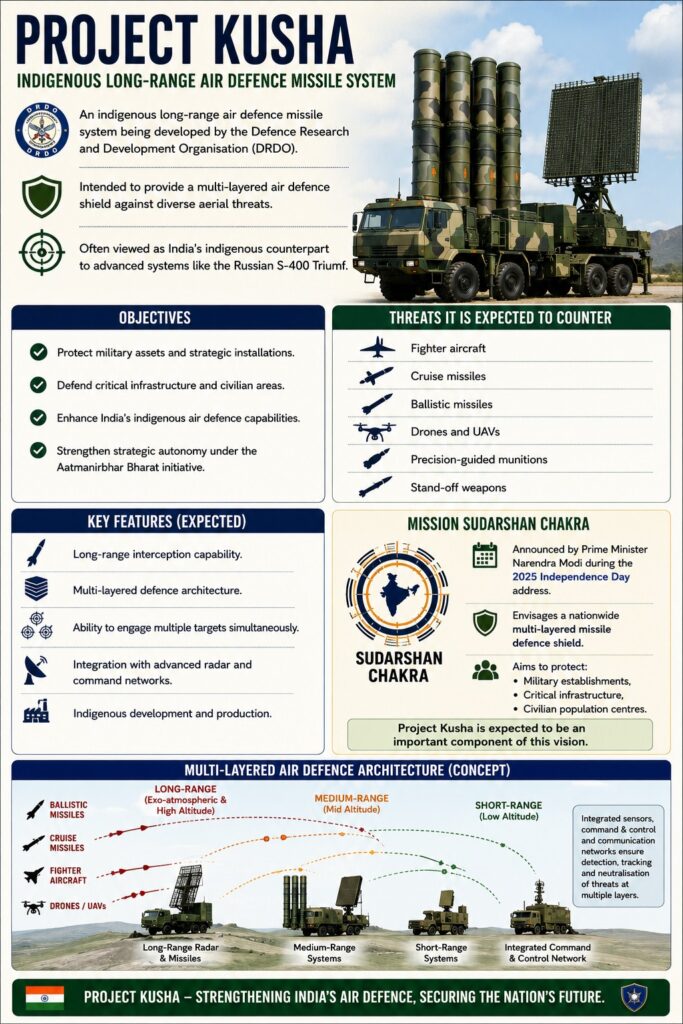
Defence Minister Rajnath Singh described Project Kusha as a “game changer” for India’s security architecture and stated that its significance had been demonstrated during Operation Sindoor.
What is Project Kusha?
An indigenous long-range air defence missile system being developed by the Defence Research and Development Organisation (DRDO).
Intended to provide a multi-layered air defence shield against diverse aerial threats.
Often viewed as India’s indigenous counterpart to advanced systems like the Russian S-400 Triumf.
Objectives
Protect military assets and strategic installations.
Defend critical infrastructure and civilian areas.
Enhance India’s indigenous air defence capabilities.
Strengthen strategic autonomy under the Aatmanirbhar Bharat initiative.
Threats It Is Expected to Counter
Fighter aircraft, Cruise missiles, Ballistic missiles, Drones and UAVs, Precision-guided munitions, and Stand-off weapons
Mission Sudarshan Chakra
Announced by Prime Minister Narendra Modi during the 2025 Independence Day address.
Envisages a nationwide multi-layered missile defence shield.
Aims to protect: Military establishments, Critical infrastructure, and Civilian population centres.
Project Kusha is expected to be an important component of this vision.
[2018] What is “Terminal High Altitude Area Defense (THAAD)”, sometimes seen in the news?
[A] An Israeli radar system
[B] India’s indigenous anti-missile programme
[C] An American anti-missile system
[D] A defence collaboration between Japan and South Korea.
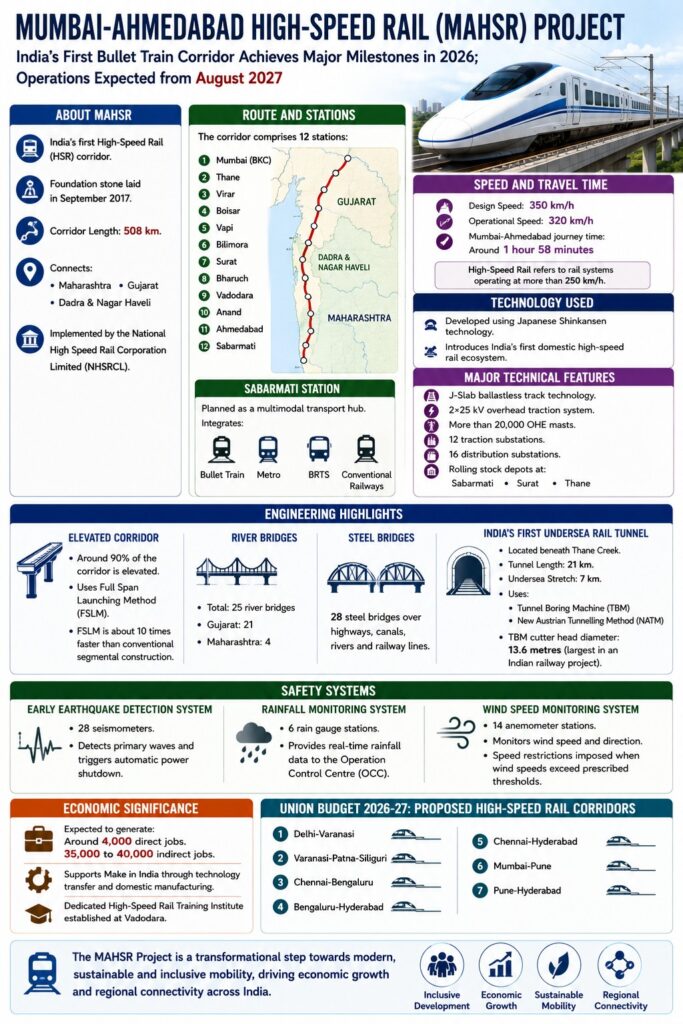
The Mumbai-Ahmedabad High-Speed Rail (MAHSR) Project, India’s first bullet train corridor, has achieved major construction milestones in 2026 and is expected to commence operations from August 2027.
About MAHSR
India’s first High-Speed Rail (HSR) corridor.
Foundation stone laid in September 2017.
Corridor Length: 508 km.
Connects: Maharashtra, Gujarat, and Dadra & Nagar Haveli
Implemented by the National High Speed Rail Corporation Limited (NHSRCL).
The corridor comprises 12 stations
Sabarmati Station: Planned as a multimodal transport hub.
Integrates: Bullet Train, Metro, BRTS, and Conventional Railways.
Speed and Travel Time
Design Speed: 350 km/h
Operational Speed: 320 km/h
Mumbai-Ahmedabad journey time: Around 1 hour 58 minutes
High-Speed Rail refers to rail systems operating at more than 250 km/h.
Technology Used
Developed using Japanese Shinkansen technology.
Introduces India’s first domestic high-speed rail ecosystem.
Major Technical Features
J-Slab ballastless track technology.
2×25 kV overhead traction system.
More than 20,000 OHE masts (Overhead Equipment Mast) is a vital vertical steel support used in railway electrification
12 traction substations (electrical substation that converts power from the public electricity grid into the specific voltage, current, and frequency required to power railways, trams, or trolleybuses)
16 distribution substations(electrical facility that receives high-voltage power from transmission or sub-transmission systems and “steps down” the voltage to medium levels).
Rolling stock depots at: Sabarmati, Surat, and Thane.
Engineering Highlights
Elevated Corridor
Around 90% of the corridor is elevated.
Uses Full Span Launching Method (FSLM).
FSLM is about 10 times faster than conventional segmental construction.
River Bridges: Total: 25 river bridges: Gujarat: 21. Maharashtra: 4.
Steel Bridges: 28 steel bridges over highways, canals, rivers and railway lines.
India’s First Undersea Rail Tunnel
Located beneath Thane Creek.
Tunnel Length: 21 km.
Undersea Stretch: 7 km.
Uses: Tunnel Boring Machine (TBM) and New Austrian Tunnelling Method (NATM).
TBM cutter head diameter: 13.6 metres (largest in an Indian railway project).
Safety Systems
Early Earthquake Detection System:28 seismometers. Detects primary waves and triggers automatic power shutdown.
Rainfall Monitoring System: 6 rain gauge stations. Provides real-time rainfall data to the Operation Control Centre (OCC).
Wind Speed Monitoring System:14 anemometer stations. Monitors wind speed and direction. Speed restrictions imposed when wind speeds exceed prescribed thresholds.
Economic Significance
Expected to generate: Around 4,000 direct jobs. 35,000 to 40,000 indirect jobs.
Supports Make in India through technology transfer and domestic manufacturing.
Dedicated High-Speed Rail Training Institute established at Vadodara.
Union Budget 2026-27: Proposed High-Speed Rail Corridors
Delhi-Varanasi, Varanasi-Patna-Siliguri, Chennai-Bengaluru, Bengaluru-Hyderabad, Chennai-Hyderabad, Mumbai-Pune, and Pune-Hyderabad
[2023] Consider the following statements : 1. In a seismograph, P waves are recorded earlier than S waves. 2. In P waves, the individual particles vibrate to and fro in the direction of wave propagation, whereas in S waves, the particles vibrate up and down at right angles to the direction of wave propagation. Which of the statements given above is/are correct?