GOVERNMENT OF INDIA
PRESS INFORMATION BUREAU
PRESS NOTE
CIVIL SERVICES (MAIN) EXAMINATION, 2014
The results of the Civil Services (Main) Examination, 2014 were declared vide
Press Note dated 04.07.2015 recommending 1236 candidates in order of merit for
appointment to IAS, IFS, IPS and Central Services Group ‘A’ and Group ‘B’ against
1364 vacancies.
2. The Commission, in accordance with the Rule 16 (4) & (5) of the Civil Services
Examination Rules, was also maintaining a Consolidated Reserve List in order of merit
below the last recommended candidate under the respective category.
3. As sought by the Department of Personnel & Training, the Commission has
now recommended 126 candidates which include 109 General, 15 OBC and 02 SC
candidates, to fill up the remaining posts based on the Civil Services Examination,
2014. Particulars of these candidates are indicated below. The candidates so
recommended will be communicated directly by the DOP&T.
4. The candidature of following candidates bearing Roll 124690 and 390542 is
provisional.
5. The list of these 126 candidates is also available on the UPSC website i.e.
http//www.upsc.gov.in.
Contd….. 2/‐
CIVIL SERVICES (MAIN) EXAMINATION,2014
AS A PART OF RESERVE LIST
S.NO. ROLL NO NAME
_________________________________________________________________________
2
1 231901 ARATHI A NAIR
2 372649 KUMAR ABHISHEK
3 006116 ADARSH PACHERA
4 542133 ASHWIN D GOWDA
5 001291 PRAGYA ANAND
6 002144 SHRIHARSHA N
7 597566 GOVIND MOHAN
8 135355 ISHAN BHARDWAJ
9 804568 DEVANSH SHUKLA
10 066397 PATEL AROHIBEN MUKESHBHAI
11 423796 EISHVARYESH BHARDWAJ
12 000447 ROHIT TRIPATHI
13 704635 SURBENDU THAKUR
14 074839 RACHIT RAWAT
15 837083 AMIT KUMAR JHA
16 651329 RAJASEKHARA REDDY K
17 083880 HASEEN ZAHERA RIZVI
18 003429 PALAK GOEL
19 750573 VAGISH KUMAR SINGH
20 296362 ANUBHAV JAIN
21 557070 GURSEWAK SINGH
22 059047 ABRAHAM KOSHY
23 105390 AVINASH SHANDILYA
24 423637 CHINCHAWADE SHREYANS BALASAHEB
25 010604 ASHUTOSH DWIVEDI
26 294597 JATIN LAL
27 023364 DINESH SINGH TOMAR
28 591780 HARSHIT SHRIVASTAVA
29 012786 CHITRESH JOSHI
30 538144 SAM PRASHANTH JR
31 045588 AKRITI
32 452333 VINIT TRIPATHI
33 717621 DEEPAK KUMAR BHARDWAJ
34 004817 DEVRANJAN MISHRA
35 868425 CH SINDHU SARMA
36 628364 M VENKAT NARASIMHA REDDY
37 564327 NITISH SHARMA
38 646460 SAMUEL NITIN STEPHEN
39 323083 HARISH PAPOLA
40 003579 ANUBHAV BHARADWAJ
41 718745 AYUSH GOEL
42 753747 MOHIT KUMAR
43 394917 SUMANTH V
44 053958 AMAN SHARMA
45 561135 RAHUL RAJ
46 177738 BHANU JAIN
47 413233 RAHUL SINGLA
48 019570 ASHISH UJLAYAN
49 151738 M VYSHAKH NAG
50 651760 SUSHMA B
51 407682 ANSHUL JAIN
52 378578 AMIT CHANDRA SUNAL
53 316864 GADIYARAM VIVEKANANDA
54 355823 PREETI SHARMA
55 572444 ANSHU SHARAWAT
56 190658 NIKHIL SEWAK
57 002625 RAJA BANTHIA
58 495681 VIKASH N
59 430426 ISHAAN SHARMA
60 194458 ACHIN GARG
CIVIL SERVICES (MAIN) EXAMINATION,2014
AS A PART OF RESERVE LIST
S.NO. ROLL NO NAME
_________________________________________________________________________
3
61 595106 BHUPESH SATIJA
62 417039 PALLAVI SINHA
63 062980 MANWESH PRIYADARSHI
64 099604 RAHUL PANWAR
65 029939 SUSHANT RANJAN
66 457200 ARCHNA YADAV
67 188795 KARTIK KUMAR SINGH
68 085517 VISHWA M
69 170949 KUMAR RAHUL
70 566947 SALONI RAI
71 686125 RAHUL SINGH
72 261104 EKTA KAPTA
73 046182 HEMANT KOTIYAL
74 262499 CHANCHAL CHITWAN
75 032857 SAHIL GARG
76 236546 DEEPAK
77 069854 SAHIL ARORA
78 031853 TAWAREJ KSHITIJ KISHOR
79 523259 NIDHI DWIVEDI
80 001146 NARENDRA PANT
81 499770 ADITYA SINGH
82 127494 AJAY BARTWAL
83 457789 KEERTHISHRI S
84 005995 SHREY DALELA
85 098328 SAGAR GUPTA
86 085205 KAPIL GADE
87 036508 DEVENDRA UPADHYAY
88 318075 PAVAN KUMAR REDDY G
89 312676 ABHILASH BARANWAL
90 000186 VIJAY BISHNOI
91 002268 TANU JAIN
92 009949 AJEY SINGH
93 047623 RAKSHIT SHIVAM PRAKASH
94 005052 ISHAAN SHARMA
95 409662 PRITI
96 219067 PANDEY SHRADDHA NARENDRA
97 242452 Y RISHANTH REDDY
98 005296 HARSH KUMAR
99 429928 LOKESH MISHRA
100 037705 RUCHA KULKARNI
101 617179 ASHVINI SATISH JADHAV
102 146672 JONNALAGADDA SNEHAJA
103 021714 WALI SHITAL MAHADEV
104 119969 N MOHAMMED ALI
105 087598 VAATSALYA KUMAR
106 156686 KINTHADA PRAVALIKA
107 061696 ASHUTOSH
108 153859 HIRANI ADITYAVIKRAM MOHANKUMAR
109 007247 APRAJITA CHANDEL
110 633423 SHANMUGA VADIVEL S
111 193852 SHRIVAS NUPUR AJAY
112 600750 K SRUJANA
113 031225 GURAV KSHITIJ SURESH
114 383679 PRASHANT YADAV
115 022742 SANTHOSH NAHTHA K
116 155388 DEEPAK VERMA
117 549930 ALOK KUMAR
118 026501 HARSHIT TODI
119 260797 P UDAY
120 390542 MD SHAHID KAMAL ANSARI
CIVIL SERVICES (MAIN) EXAMINATION,2014
AS A PART OF RESERVE LIST
S.NO. ROLL NO NAME
_________________________________________________________________________
4
121 804634 DILIP SINGH
122 124690 SHIPRA GIRI
123 434446 PARASURAMAN A
124 860015 ADHARSH M
125 407020 MAYANK PRAKASH
126 483862 KUMAR PRIYATAM ASHOK
CONCLUDED
UNION PUBLIC SERVICE COMMISSION
_______________________________________________
NEW DELHI – 110 069 – 19th January,2016/Paush 29, 1937 Saka
Search results for: “”
-
2014 CSE Reserve list out: Was anyone expecting a result?
-
Ethical Dilemma
Narrate an incident from the life of your model that shall help you to tide over ethical dilemma you may face in your career as a civil servant.
-
GS 4 Analysis not given on CD
I could see GS paper analysis but that didn’t talk about GS 4..Whats ur take on GS4..Was it tougher than last year or easier.
-
MCQs : Few Random Ones
1. Which of the following are the pollutant that enter the atmosphere due to large scale burning of the biomass?
1. Formaldehyde
2. Potassium
3. Benzene
4. Carbon Monoxide
Choose the correct alternative using the codes given below:
(a) 3 and 4 only
(b) 1, 3 and 4 only
(c) 1, 2 and 3 only
(d) 1, 2, 3 and 42. Consider the following statements:
1. Lord Curzon was the Viceroy when the first session of the Indian National Congress was held.
2. Formation of Indian National Congress was preceded by a number of political organizations including Poona Sarvajanik Sabha.
Which of the above statements is/are correct?
(a) 1 only
(b) 2 only
(c) Both 1 and 2
(d) Neither 1 nor 23. Which of the following factors influence the spatial distribution of the salinity of the oceans?
1. Ocean currents
2. Atmospheric Pressure
3. Evaporation
4. Wind Direction
Choose the correct alternative using the codes given below:
(a) 3 and 4 only
(b) 1, 2 and 4 only
(c) 1, 2 and 3 only
(d) 1, 2, 3 and 44.The Western Indian Ocean has witnessed a sharp decline in phytoplankton population due to increased sea surface temperatures largely because increased sea surface temperatures
(a) suppress the mixing of surface and sub-surface waters
(b) make the oceanic water acidic
(c) constrict reproduction among the phytoplankton
(d) limit the process of photosynthesis5.Nairobi Package’, in news recently, is related to the affairs of
(a) FAO
(b) UNFCCC
(c) WTO
(d) IMF6. Which of the following enshrine the goal of promotion of sense of brotherhood among the citizens?
(a) Preamble only
(b) Preamble and Fundamental Duties
(c) Fundamental Duties and Directive Principles of State Policy
(d) Preamble, Fundamental Duties and Directive Principles of State Policy7. Consider the following statements:
1. In Indian Parliamentary system , the office of the ‘Leader of the House’ is not mentioned in the Constitution.
2. In Indian Parliamentary system , the office of the ‘Leader of the Opposition’ is not mentioned in the Constitution.
Which of the above statements is/are correct?
(a) 1 only
(b) 2 only
(c) Both 1 and 2
(d) Neither 1 nor 28.Consider the following statements with reference to the Indian Parliamentary System:
1. The power to adjourn a session of any House lies with the Presiding officer of that House.
2. The power to adjourn a session of any House sine die lies with the President.
Which of the above statements is/are correct?
(a) 1 only
(b) 2 only
(c) Both 1 and 2
(d) Neither 1 nor 29. Consider the following statements:
1. No ground has been mentioned in the Indian Constitution for the removal of the Vice- President.
2. The resolution to remove the Vice-President cannot be introduce in the Lok Sabha.
Which of the above statements is/are correct?
(a) 1 only
(b) 2 only
(c) Both 1 and 2
(d) Neither 1 nor 210. India is planning to notify Euro V and Euro VI norms soon. The norms are related to
(a) international banking standards
(b) vehicular emission standards
(c) mergers and acquisition standards
(d) effluents from industrial units -
MCQs from previous B2Bs
1. Which of the following states were formerly Union Territories?
1. Himachal Pradesh
2. Goa
3. Arunachal Pradesh
Choose the correct alternative using the codes given below:
(a) 1 and 3 only
(b) 3 only
(c) 1 and 2 only
(d) 1, 2 and 32. Consider the following statements:
At the time of independence
1. Indian Union was classified into three distinct constituent units.
2. Part A states were administered by the President through a Chief Commissioner.
Which of the above statements is/are correct?
(a) 1 only
(b) 2 only
(c) Both 1 and 2
(d) Neither 1 nor 23. Which of the following was the only Union Territory at the time of independence and continues to enjoy the same status to date?
(a) Daman and Diu
(b) Dadar and Nagar Haveli
(c) Puducherry
(d) Andaman & Nicobal Islands4. Through which of the following acts, the Governor General of Bengal was made the Governor Bengal of India?
(a) Charter Act of 1833
(b) Charter Act of 1853
(c) Indian Councils Act, 1861
(d) Regulating Act of 17735. What is the correct order of the following satyagrahas undertaken by Gandhiji?
(a) Kheda – Champaran – Ahmedabad
(b) Kheda – Ahmedabad – Champaran
(c) Champaran – Ahmedabad – Kheda
(d) Champaran – Kheda – Ahmedabad -
Officers IAS Academy | IAS Prelims Test Series | Part 2
Officier’s IAS Academy under the aegis of R.A.Israel Jebasingh, IAS has launched a Prelims Test Series targeted at IAS 2016.
To know more about the test series, check the link – Prelims 2016 Online Test Batch Schedule. Use Promo Code CD500 to get 500 off on the test package.
Wonder what the questions are going to be like? Here are 6 under Indian Economics
#1. Which of the following statements are true?
i) Exchange rates are determined by open market economies which is open to a wide range of buyers and sellers where currency trading is continuous
ii) Forward exchange rate refers to an exchange rate that is quoted and traded today but for delivery and payment on a future datea) i only b) ii only c) both i and ii d) neither i nor ii
Explanation- Exchange rates are determined by foreign exchange markets
Reason- The economic condition of the country , where our money was devalued many a times .Indian rupee plunges to 2-year low of 65.10.
#2. Consider the statements about Bharatiya Mahila Bank (BMB)
- The banks accepts deposits only from women
- It lends predominantly to women
Which of the following are correct?
a. Only I | b. Only II | c. Both I and II | d. Neither I nor II
Explanation: The banks’ accept deposits from everyone but lends predominantly to women.
Reason: Government mulls merger of Bharatiya Mahila Bank into State Bank of India.
#3. Which of the following statements is/are correct?
i. The Central Statistical office publishes consumer price index for all series.
ii. The wholesale price index is published by ministry of Finance.
a.i only | b.ii only | c.both I and ii | d.neither i nor ii
Explanation: CSO publishes CPI for Industrial workers, Agricultural Labourers, Rural Labours. CPI for Urban Non-manual employees published by Ministry of Labour and Employment. The Wholesale price Index is Published by the office of economic Advisor.
Reason: Last year Economy survey had spoken about CPI.
#4. The chairman of 7th central pay commission is
a. Shri Ashok Kumar Mathur
b. Shri Vivek Rae
c. Dr. Ratha Roy
d. Smt. Meena AgarvwalReason: Recently the most awaited 7th pay commission was announced.
#5. Match the following,
Problems faced by farming sector possible measures
1) Unirrigated land A) Setting up agro-based mills
2) Low price for crops B) Banks to provide low interest credit
3) Debt burden C) Procurement of food grains by govt
4) No job in the off season D) Construction of canals by the govt
Select the correct code from below :
a) 1-D;2-C;3-B;4-A
b)1-D;2-A;3-B;4-C
c)1-C;2-B;3-A;4-D
d)1-C;2-D;3-A;4-B
Reason: Across India farmers are facing drought crisis.
This was a sample. If you wish to attend the full test series, click on Application form, here.
Apply promo code = CD500 to get a rebate of 500 INR on the course fee. -
MCQs on B2B : Water in the Air
1. What is the correct order of the following types of clouds in the order of increasing height?
(a) Stratocumulus- Altocumulus- Cirrocumulus
(b) Altocumulus- Stratocumulus- Cirrocumulus
(c) Stratocumulus- Cirrocumulus- Altocumulus
(d) Altocumulus- Cirrocumulus- Stratocumulus2. The rainfall on Western Ghats is mostly
(a) Convectional
(b) Orographic
(c) Frontal
(d) Convectional or Orographic3. Consider the following statements:
1. Absolute Humidity is a measure of percentage of water vapour in the atmosphere compared to its full capacity.
2. Relative Humidity is a measure of actual weight of the water vapour present per unit of the atmosphere.
Which of the above statements is/are correct?
(a) 1 only
(b) 2 only
(c) Both 1 and 2
(d) Neither 1 nor 24. Which of the following coasts is more likely to experience advection fog?
1. Peruvian Coast
2. Namibian Coast
3. Brazilian Coast
Choose the correct alternative using the codes given below:
(a) 1 only
(b) 2 and 3 only
(c) 1 and 2 only
(d) 1, 2 and 35. Which of the following can act as hygroscopic particles leading to cloud formation?
1. Salt Particles
2. Dust Particles
3. Silver iodide particles
Choose the correct alternative using the codes given below:
(a) 2 only
(b) 2 and 3 only
(c) 1 and 2 only
(d) 1, 2 and 3 -
Lo and behold! The Night mode arrives on the Civilsdaily App
Hello reader,
It’s with great pleasure (& an even greater level of excitement!) that we announce the inclusion of two more awesome features on your Civilsdaily Android App.
- Night mode
- Notifications

Toggle between the reading modes from the left drawer
Thanks for helping us build such an amazing product by staying with us all this while. It is an absolute pleasure to keep listening to your suggestions and write for you guys!
Our mission has always been to create a news app where factual, unbiased, and succinct information could be found. And with your support & love, we will continue to do so for a long, long time to come.
Over the last couple of weeks or so, we have pushed forward a few amazing things –
#1. Launch of the new app!
The latest update is faster, lighter and simply epic! We reimagined the app grounds up and gave it a more classier finish.
- A super cool user interface inspired from international design standards
- Introduced Blogs on the app
- Introduced nightmode & notifications to keep you coming back to us everyday!

We would request all of you to take a moment and revise your ratings on the playstore and help us grow faster! If you haven’t rated us yet, now would be a great time to do so 🙂
#2. Launch of the Civilsdaily offline & online magazine
We are so excited to have finally been able to put our words to print. A well known publisher agreed to partner with us to help remove the tyranny of lacklustre magazines which have plagued the market for IAS aspirants for long.
We will be releasing monthly magazines in both hard copy and soft copy (to be released after a few days) and the first edition is out there in the stands.
- For those who wish to order the hard copies online, we will let you know the web address soon. Very soon.
- For those who are cool with reading from pdfs, we will have the link up on our website soon enough!
#3. An amazing response to support Civilsdaily
Producing high-quality content can be a costly endeavor. While we were still exploring sustainable revenue options, we thought why not turn to our users and look out for patrons among them to support us in our journey!
Very hesitantly we launched a crowdfunding appeal – Support Civilsdaily & Help us grow on the eve of new year and we have been blown away by the amazing amazing response! No website should expect such generosity from its readers and we are at our wits end to express our gratitude for you all!
You are our heroes and your contributions are keeping everyone motivated here to innovate more and more! We will be surprising you with exclusive compilations every quarter or so!
For those of you who wish to come forward and pitch in financially to help us do more – here is a quick instamojo link to donate for Civilsdaily.
So enjoy the new app, rate us high and donate to help us grow!
-
Organic Farming – Paramparagat Krishi Vikas Yojna (PKVY), NPOF etc.
The market for organic food in this country is likely to treble in the next four years, according to a report from business chamber Assocham and TechSci Research, a non-government body.
source
- What is organic farming?
- Need for organic farming in India
- Key characteristics of organic farming
- Steps taken by the Government to promote organic farming in India
- Key features of PKVY
- Status of Organic farming in India
- Why demand for organic products are increasing in recent years?
- Challenges and constraints faced by Organic farming in India
What is organic farming?
Organic farming system in India is not new and is being followed from ancient time.
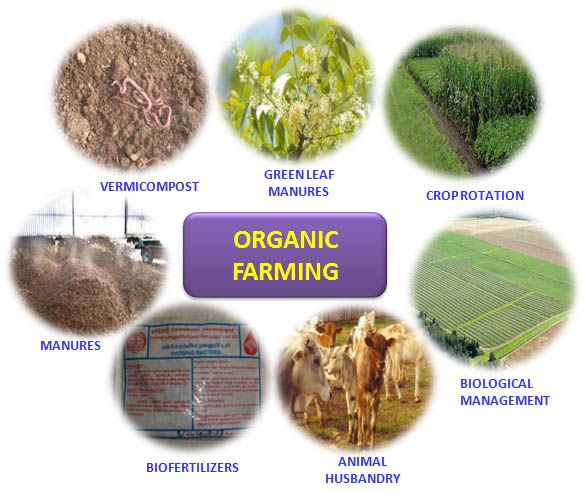
It is a method of farming system which primarily aimed at cultivating the land and raising crops in such a way, as to keep the soil alive and in good health by use of organic wastes (crop, animal and farm wastes, aquatic wastes) and other biological materials along with beneficial microbes (biofertilizers) to release nutrients to crops for increased sustainable production in an eco friendly pollution free environment.
Need for organic farming in India
With the increase in population our compulsion would be not only to stabilize agricultural production but to increase it further in sustainable manner.
The scientists have realized that the ‘Green Revolution’ with high input use has reached a plateau and is now sustained with diminishing return of falling dividends.
Thus, a natural balance needs to be maintained at all cost for existence of life and property. The obvious choice for that would be more relevant in the present era, when these agrochemicals which are produced from fossil fuel and are not renewable and are diminishing in availability. It may also cost heavily on our foreign exchange in future.
The key characteristics of organic farming include
- Protecting the long term fertility of soils by maintaining organic matter levels, encouraging soil biological activity, and careful mechanical intervention
- Providing crop nutrients indirectly using relatively insoluble nutrient sources which are made available to the plant by the action of soil micro-organisms
- Nitrogen self-sufficiency through the use of legumes and biological nitrogen fixation, as well as effective recycling of organic materials including crop residues and livestock manures
- Weed, disease and pest control relying primarily on crop rotations, natural predators, diversity, organic manuring, resistant varieties and limited (preferably minimal) thermal, biological and chemical intervention
- The extensive management of livestock, paying full regard to their evolutionary adaptations, behavioral needs and animal welfare issues with respect to nutrition, housing, health, breeding and rearing
- Careful attention to the impact of the farming system on the wider environment and the conservation of wildlife and natural habitats
Steps taken by the Government to promote organic farming in India
Government is promoting Organic farming through various schèmes
- National Project on Organic Farming (NPOF)
- National Horticulture Mission (NHM)
- Horticulture Mission for North East and Himalyan States (HMNEH)
- Rashtriya Krishi Vikas Yojana (RKVY)
- Network Project on Organic Farming of Indian Council Agricultural Research (ICAR).
- In addition to this, Government is implementing a Cluster based programme to encourage the farmer for promoting organic farming called Paramparagat Krishi Vikas Yojana (PKVY)
Key features of PKVY
- Groups of farmers would be motivated to take up organic farming under Paramparagat Krishi Vikas Yojana (PKVY). Fifty or more farmers will form a cluster having 50 acre land to take up the organic farming under the scheme.
- In this way during three years 10,000 clusters will be formed covering 5.0 lakh acre area under organic farming. There will be no liability on the farmers for expenditure on certification.
- Every farmer will be provided Rs. 20,000 per acre in three years for seed to harvesting of crops and to transport produce to the market.
- Organic farming will be promoted by using traditional resources and the organic products will be linked with the market.
- It will increase domestic production and certification of organic produce by involving farmers
Status of Organic farming in India

source
- The current market (pulses and foodgrain the bulk) of organic food is at $500 million (about Rs 3,350 crore). It was $360 million (Rs 2,400 crore) in 2014.
- Although nascent, the Indian organic food market has begun growing rapidly in last few years. A report by Yes Bank in 2014 said that the organic food sector is growing at about 20% in India, with more than 100 retail organic outlets in Mumbai and about 60 in Bangalore.
- Total area under organic certification in India in 2013-14 is estimated to be 4.72 million ha with 15 per cent are certified and the rest under forest area. India has the highest number of organic producers in the world (5,97,873), mainly due to small holdings.
- During 2013-14, India exported 135 products, realisation from which was to the tune of $403, million including $183 million contributed by exports of organic textile. Major destinations for organic products from India are the US, EU, Canada, Switzerland, Australia, New Zealand, South-East Asian countries, West Asia, South Africa, etc.
- Soyabean (70 per cent) lead among the products exported followed by cereals and millets other than basmati (six per cent), processed food products (five per cent), basmati rice (four per cent), sugar (three per cent), tea (two per cent), pulses and lentils (one per cent), dry fruits (one per cent), spices (one per cent).
Why is the demand for organic products increasing in recent years

source
Challenges and constraints faced by Organic farming in India
- The most important issue facing organic farming is its failure to raise the productivity to keep pace with the growing population. Studies, according to a latest report in The Wall Street Journal, have shown that organic yields are far less than yields of conventional farming. As per the 2011 survey data of National Agricultural Statistics Service, a branch of the US organic farming would require 14.5 million acres more to equal conventional farming’s production of 14 staple (human-focused food crops).
- There is a wide gap in scientific validation and research compared to the progress in the same for general agriculture. Also, there is a need to aid farmers with advisory services (technical and managerial support to form cluster and adopt best management practices).
- Due to lack of government support, the courage needed to convert inorganic land into organic land is missing also there is absence of globally recognized consultancy for timely guidance to farmers. Thus, huge support from states and the Centre is required.
- Key problems faced by organic farmers during the transition phase are non-realisation of premium.
References:
