💥UPSC 2026, 2027, 2028 UAP Mentorship (March Batch) + Access XFactor Notes & Microthemes PDF

Search results for: “”

  • Geography | Water in the Atmosphere

    Its important to analyze the role of water in the atmosphere. Water is present in 3 forms – namely gaseous, liquid and solid.

    Lets go through some simple but important definitions

    1. Humidity : A generic term to refer to the amount of water vapour present in the atmosphere.
    2. Absolute Humidity : Its the actual weight of the water vapour(grams) present per unit volume(cubic meter m^3) of the atmosphere. This gives us an estimate of the actual amount of water present in a given atmosphere.
    3. Relative Humidity : The % of water vapour present in the atmosphere compared to its full capacity at a given temperature is called Relative Humidity.
    4. Condensation : Transformation of water vapour into water is called condensation. It releases heat.
    5. Sublimation : When the water vapour directly condenses into solid form, it is called sublimation.

    Now, you would’ve guessed, water vapour in the atmosphere is a function of temperature. As you increase the temperature of the air, you increase its water holding capacity. This relationship is best described by the graph below. You can make out, its not linear.

    02d

    We come to the most important concept of this topic – SATURATION. We will be required to understand what it means, what it can do and most importantly what are the different ways it can happen.

    Water in the atmosphere is mostly lying idle. However all the magic happens when saturation point is reached. By Saturation we mean air, at that temperature is incapable of holding any additional moisture. The temperature at which saturation occurs in a given sample of air is known as dew point.

    How can we bring about saturation? Well, the most logical thing to say here would be by increasing the amount of water vapour. Thats correct. Another important method would be to bring down the maximum holding capacity of the air by bringing down the temperature of the atmosphere to dew point. The next section will explain why the second method is the most preferred one.


    CONDENSATION

    After Saturation, Condensation takes place. And when it happens, one of the following will be formed – dew, frost, fog and clouds. Lets see how –

    1. Add Moisture – Pretty obvious. You add more moisture, the relative humidity increases till the saturation point reaches.
    1. Cooling by removing heat – If I remove heat from the atmosphere, I’ll most certainly bring down the temperature to dew point and saturate the air. When condensation takes place within itself on dust particles, its called fog.
      • Radiation Fog : Occurs on clear nights on land. As we’ve studied earlier, during the night we have relatively cool earth because its not being heated by the sun and much of its infrared radiation can escape to space. Thus fog if formed near the earth’s surface.RadiationFog
      • Advection Fog : Occurs over cold ocean currents. When we have an already cold surface and moisture laden winds pass through it, they condense. The only difference between Advection and Radiation is the method of cooling. In the first case, we had the surface that was getting cooled while in the second we already had a cool surface to begin with.  All cold currents of the world with warm air blowing over them will experience this.  Also remember, sea-smoke is almost the opposite of this – when we have cold air and warm water. AdvectionFog
      • Dew : Mostly observed in early morning. When the saturated air comes in contact with cold surfaces like that of leaves, trees, grass, etc.
      • Frost : Same as above, but in this case the Due Point is below 0^C. This leads to the formation of ice-crystals instead of droplets.
    1. Cooling by adiabatic expansion – If we make the air just rise, it will expand, lose heat and saturate.
      • Leads to the formation of clouds
      • Vortices
      • Supersonic flight

    Lets come to one of the most interesting topics – Clouds. Repeating what we’ve already established – adiabatic cooling is responsible for the formation of clouds. Clouds will always have water. If they don’t then its just air, its not a cloud. Its interesting to note that though all clouds have water, they might not rain(precipitate would be a more correct term to use). However for every rainfall there has to be a corresponding cloud.

    CLASSIFICATION OF CLOUDS

    The general classification of clouds was proposed by Luke Howard in 1803. It was descriptive based on shape and height.

    A. On the basis of Shape

    Cumulus – A heap or a pile of cotton mass. They look like cotton wool. They are formed at a height of 4K-7K m. They exist is patches and have a flat base.

    There’s an timelapse video where you can observe the process happening. The air doesn’t rise much higher than the ground, forms clouds and descends. And these clouds appear and disappear.

    Stratus – As the name implies they are layered clouds covering large portions of the sky. Formed due to loss of heat of mixing of air masses.  They are spread out and mostly found in the lower heights (as shown in the video).

    Cirrus – Cirrus clouds are formed at high altitudes (8K-12K m). They are thin and detached clouds having a feathery appearance.


    B. On the basis of Height

    As low clouds, middle clouds and high clouds.

    In this classification, Luke Howard very intelligently re-uses the terms defined in A. How ?? He notices that all low clouds are generally Stratus and all high clouds are generally Cirrus. Meaning he didn’t have to look for separate words for low and high clouds. Eg. A high Cumulus cloud becomes – cirrocumulus. Similarly a low cumulus cloud becomes stratocumulus.

    He, however had to coin a term for middle – ‘Alto’. Eg. Altostratus, Altocumulus implies clouds of middle height.


    Nimbus : It is used as an adjective to the above clouds to indicate that these clouds are black or grey suggesting they are rain-bearing. Eg. cumulonimbus clouds are those huge clouds that lead to thunderstorm and lightening.


    PRECIPITATION

    As we had earlier pointed out, clouds alone cannot give precipitation. While the theory behind cloud formation is understood in science, what happens after cloud formation to result in precipitation is not so clearly understood.

    We know one thing for sure, for precipitation to take place, the cloud droplets (10 microns) need to grow in size. A raindrop has 100 times the radius of a cloud droplet. So the cloud droplets have to grow that large in order to overpower the force of gravity and upward turbulence and finally come down.

    There are 2 theories proposed in this regard :

    I. Collision Coalescence : It assumes that you have differently sized droplets where the large ones collide with the small ones and form bigger particles. Why? the larger ones will be moving at a different pace, hence they are bound to collide with the smaller ones coming in their way. It’s not a very efficient process most of the time, because more often that not, you will have similar cloud droplets, not varying too much in size. There’s not enough of a range of large to small particles to get this going. But on occasion, especially over tropical oceans, this mechanism is thought to dominate.

    II. Ice Crystal Formation Theory : Before we discuss this in detail, lets see the different forms in which water exists.

    T>0 : Water

    -40<T<0 : Supercooled water (This is water thats not frozen but will freeze as soon as it comes in contact with a nuclei)

    T<-40 : Ice

    This theory assumes that you have supercooled water droplets in the cloud. This could happen because lets say the whole of the cloud or a part of it is below the freezing point. Now some of this supercooled water freezes and becomes ice crystals. Now these ice crystals have the tendency to attract water droplets.

    Supercooled water condenses on these ice crystals. This forms the snowflakes. Once this starts falling, it may collide with other water droplets or ice crystals forming Hail. Similarly as they fall and experience a warmer atmosphere, they may melt and convert to rain.

    winter-graphic


    FORMS OF PRECIPITATION

    As we noted above, after condensation, the release of moisture is known as precipitation. It can occur in the following forms.

    1. Rain : Precipitation in form of water is called rain.
    2. Drizzle : Is spray like rainfall which is very slow with water droplets having .mm diameter. They mostly happen via stratus clouds.
    3. Snow : As discussed above, when ice crystals come down.
    4. Sleet : When the falling water experiences a cool atmosphere just before touching the earth and freezes forming a sheet.Screen-Shot-2014-11-13-at-10.03.53-PM
    5. Hail : Is the most complex of all precipitation. It mostly originates from the cumulonimbus clouds as a result of active turbulence and vertical air currents.


    RAINFALL

    We will study in detail, the most common form of precipitation – Rainfall.

    Rainfall can be classified on the basis of its origin.

    1. Convectional : When air is being heated, it rises up and cools adiabatically. When such cooling appears, it saturates. This leads to cloud formation which may in turn lead to shedding of excess moisture in form of Rain. Such rain doesn’t last long. As you saw, the precondition for such rainfall was the air being heated. Hence this type of rainfall is mainly a feature of equatorial regions particularly in the Northern Hemisphere.
    1. Orographic : It is due to a topographic barrier. When the moist air hits the windward side of a mountain, it is forced to rise which cause it to adiabatically cool and saturate. Hence the windward side receives rain. The cool air descends towards the leeward side making that area dry.
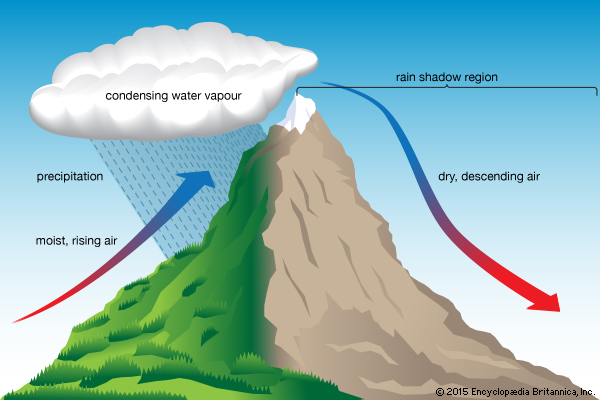
    images

    1. Frontal : Frontal rainfall is a feature of middle latitudes. It will be more clear when we’ve gone through what fronts are in the topic Atmospheric circulations. Just for some conceptual clarity, we say fronts are boundary of two different air masses say warm air mass and cold air mass. When these two airs masses meet, rain might occur. This type of rainfall is called frontal rains.
  • Primary and Secondary sanction's imposed by U.S on Iran?

    What are the primary and secondary sanction’s imposed by U.S on Iran? Even though U.S lifted secondary sanction’s but not primary. So, folks please enlighten me on what are the primary sanction’s?

  • answer please

    dec 22 for smallest day of year
    Every cycle is of 92 days
    21 March -21 june
    21 june -21 September
    21 September -22 December
    Then why it is 90 or 89 days for 22 dec-21 March

  • Selection of best talks/ lectures given by Civil Servants (India)

    I loved this one by Srivatsa Krishna, IAS. Gives a good perspective on what the job entails and what some of the biggies have done before!

    Lifts up my mood whenever I am low.

  • Failed UPSC candidates can get to know their full scores

    I read the news in offline HT paper.. Kiss ke pass online link hai… or the UPSC link for that?

  • UP village which has produced 47 IAS officers.

    Ye pado bhai logon…

    http://www.thebetterindia.com/43310/madhopatti-jaunpur-uttar-pradesh-75-households-47-ias-officers/

    This village, in Jaunpur district of Uttar Pradesh, also holds the record for four siblings who have all cleared the exam. These four brothers are, in descending order of age, Vinay Kumar Singh, Chatrapal Singh, Ajay Kumar Singh, and Shashikant Singh. Vinay Kumar, the oldest, cleared the exam in 1955. He retired as chief secretary of Bihar. Chatrapal was chief secretary of Tamil Nadu.

  • [Fresh Release] Civilsdaily magazine is now available OFFLINE

    When the student is ready, the magazine arrives.

    You already know about the new magazine initiative, right? If you do not then go ahead and click this link to download the first complimentary copy.

    The offline editions will be released in partnership with UNIQUE PUBLISHERS.
    Name? Unique Civils | Availability? (Stores listed below) | Price? 100 INR


    Magazine's first look


    When are we releasing the pdf version? That should be available on our website by 20th January. It would be priced at 50 INR.

    Here’s a list of the shops which are going to stock the magazine copies. As we understand, they already have their stocks with them. Go have a look!


    null

    null

    null

    null

    null

    Let us know once you get your hands on them. Truth be told, we haven’t seen the copies yet. Just very much excited to let know you first. Spread the word 🙂

  • Rule of Law v/s Rule by Law

    This article focuses on bringing clarity to the two very different concepts which look similar at face value.  Sir Ivor Jennings, the famous constitutional historian, characterized the Rule of Law as ‘an unruly horse’.

    First, let’s be clear about what the Rule of Law is not.

    Rule of Law should not be equated with law and order. The breakdown of law and order is a temporary phenomenon.

    Breakdown of the Rule of Law means the collapse of good governance and the breakdown of constitutional machinery in a State.

    Now, let’s see what the Rule of Law is.

    It may be difficult to define the concept with precision but in essence, it signifies a commitment to certain principles and values. Generally, the rule of law is the principle that no one is above the law and treated equally among citizens.

    The Rule of Law symbolizes the quest of civilized democratic societies to combine that degree of liberty without which law is tyranny with that degree of law without which liberty becomes license.

    However high you may be, the law is above you.

    For instance, One may be the Prime Minister or the Speaker or the Imam or the Archbishop or a judge or the Sankaracharya or whoever, all are equally subject to the law. That imparts the element of non-discrimination in the concept of the Rule of Law.

    What are the principles of the Rule of Law?

    It was A.V. Dicey, the English Professor and Constitutional expert, who developed this concept. He defined 3 principles that govern the rule of law.

    1. Supremacy of Law
      No man shall be punished or made to suffer in body or goods except for the violation of the law. Such a violation must be established in an ordinary court of the land and in an ordinary legal manner.
    2. Equality before Law
      No man is above the law and everyone, whatever his condition or rank is, is subject to the ordinary laws of the land. <It means a person can sue or be sued in a court of law>
    3. Predominance of Legal Spirit
      The result of the ordinary law of the land is Constitution. It indicates that the general principles of the constitution are the result of judicial decisions of the courts in England. <However, this principle does not apply in the case of a written constitution. It stands modified in India, where it reads that the constitution is the supreme law of the land & all other laws in order to be legally valid shall conform to the constitution>

    What is the importance of Rule of Law?

    Rule of Law is essential for the protection of human rights.

    This concept changed the mode of administration from “King was Law” to “Law is King”. It is quite essential for the healthy functioning of democracy.

    In its path-breaking judgment in Keshavanand Bharti’s case, our Supreme Court ruled that the Rule of Law is part of the Basic Structure of the Constitution.

    The Constitution in order to preserve the rule of law, has conferred the writ jurisdiction under Art. 32 and Art. 226 on Supreme Court and High Court respectively.

    How Rule of Law is different from Rule of Law?

    It is important not to confuse Rule of Law with rule by law.

    The existence of a law is necessary but that is not sufficient. The law must have a certain core component that guarantees the basic human rights and the human dignity of every person.

    Rule by law can become an instrument of oppression and it can give legitimacy to the enactment of laws that may grossly violate basic human rights.

    Let’s see with examples, how rule by law can be misused

    Nazi Germany put Jews in concentration camps and thereafter sent them to the gas chambers. The justification offered was that there was a law that empowered such acts to be done. But that was rule by law, not the Rule of Law.

    During the apartheid regime in South Africa, repressive and racially discriminatory laws against the black majority were sought to be justified on the basis of enacted laws.

    Let’s see the relevance of the Rule of Law in India

    In India, this concept is implicitly mentioned in the fundamental rights of our constitution. The equality before law (Article 14) includes Rule of Law in itself.

    Indian Constitution grants some exceptions to the Rule of Law.

    What are the exceptions to the Rule of Law in India?

    1. The President/Governor is not answerable to court of law in discharge of his executive functions.
    2. No criminal proceedings whatsoever can be instituted against the President or Governor of the state, while he is in office.
    3. No civil proceedings in which relief is claimed can be filed against President or Governor except after the expiration of a 2-month notice that is served on him.

    Under International laws, the visiting heads of state, heads of govt, ministers, officials, and foreign diplomats who are posted in the country are not subjected to the jurisdiction of local courts in the discharge of their official functions.

    What are the concerns regarding the Rule of Law in India?

    Legal experts have raised their concerns regarding the implementation of the Rule of Law in India. A free democratic society like India cannot have recourse to measures that violate the very essence of the rule of law.

    For instance, a law that permits the killing of suspected terrorists or enables indefinite detention without prior hearing at the absolute discretion of the executive is destructive of the rule of law. Fake encounters have no place in a govt professedly based on the rule of law.

    Therefore, we should strive to instill the rule of law temperament and culture at home and in educational institutions. The aim should be that rule of law becomes the secular religion of all nations based on tolerance and mutual respect.

  • Help needed… from sincere readers…

    I forget a lot of the information that I read in books and this truly discourages me to read any new information, is there any way to solve this issue?

  • Progress in Dedicated Freight Corridor: Ministry of Railway Updates 

    Freight operations on the Indian Railways are set to witness a paradigm shift with the stage-wise completion of its 2 dedicated freight corridors, the Western Dedicated Freight Corridor (WDFC) and the Eastern Dedicated Freight Corridor (EDFC), over the next 4 years, beginning 2017-18. Let’s have some updates from Ministry of Railway!

    What are the objectives of Dedicated Freight Corridors (DFCs)?

    • To create world-class rail infrastructure with advanced technology and knowledge to carry higher throughput per train.
    • To improve overall transport efficiency.
    • To offer customer guaranteed, faster transit, energy efficient, environment-friendly transport.
    • To encourage total supply chain management.
    • Increase Rail share in the freight market.

    What’s the mandate for DFCs?

    • Effective independence in decision-making and functions with a market focus and business orientation.
    • DFCs will provide non-discriminatory access to freight trains belonging to Indian Railways and other qualified operators.
    • A Complementing Indian Railways for increasing the Rail share.

    So, that’s why Dedicated Freight Corridor Corporation of India Limited (DFCCIL) come into picture?

    • Dedicated Freight Corridor Corporation of India (DFCCIL) is a Special Purpose Vehicle set up under the administrative control of Ministry of Railways.
    • To undertake planning & development, mobilization of financial resources and construction, maintenance and operation of the DFCs.
    • DFCCIL has been set up with 100% equity by Ministry of Railways and registered as a company under the Companies Act 1956 on 30th October, 2006.

    Did you know about Golden Quadrilateral ?

    • The genesis of the Dedicated Freight Corridor is due to saturation in rail transportation capacity of Indian Railways on the Golden Quadrilateral.
    • The Indian Railways’ network linking the 4 metropolitan cities of Delhi, Mumbai, Chennai and Howrah, along with its 2 diagonals (Delhi-Chennai and Mumbai-Howrah) commonly known as the Golden Quadrilateral.
    • Adding up to a total route length of 10,122 km, carries more than 58% of its revenue earning freight traffic.

    What are the reasons that led to demand for additional capacity for rail freight transportation?

    • Growing international trade along existing Eastern and Western Routes.
    • In the first phase, the Government of India has approved construction of two corridors-the Western DFC (1504 route km) and Eastern DFC (Estimated 1856 route km)- spanning a total length of about 3360 route km.
    • The Eastern Corridor, starting from Dankuni in West Bengal will pass through the states of Jharkhand, Bihar, Uttar Pradesh and Haryana to terminate at Ludhiana in Punjab.
    • The Western Corridor connecting Dadri in Uttar Pradesh to Mumbai – Jawaharlal Nehru Port (JNPT), will traverse through NCR and the states of Haryana, Rajasthan, Gujarat and Maharashtra.

    How will these corridors helps in Industrial Growth?

    Multi Modal Logistic Hubs

    • The DFC network would attract setting up of Multimodal Logistics Parks along the corridor to facilitate value addition including packaging, retailing, labeling, pelletizing, transportation etc.
    • The last mile connectivity in terms of door to door services will be provided to the customers by 3PL service providers.

    Delhi-Mumbai Industrial Corridor (DMIC) & Amritsar-Delhi-Kolkata Industrial Corridor (ADKIC)

    • Impact of DFCCIL is visible as a driver of Industrial Growth with planning and development of DMIC & ADKIC along the DFC.
    • Industrial Corridors have been planned using the backbone of the DFC.
    •  Industrial Corridor will get benefits from the World-Class Rail Infrastructure of the DFC.
    • The traffic originating from the Industrialized Corridor will contribute significantly to traffic on the DFC.

    Let’s see progress of these 2 significant corridors –

    Western Corridor

    • Western Corridor comprising of estimated 1504 km of a double line track from Jawaharlal Nehru Port Trust to Dadri via Vadodara-Sanand-Palanpur Phulera-Rewari.
    • The Corridor will provide a boost to EXIM Trade.

    Eastern Corridor

    • The Eastern Corridor with a route length of estimated 1856 km and consisting of the some distinct segments.
    • Traffic on EDFC comprises of coal for the power plants in the northern region of India from Coalfields located in state of Bihar, Jharkhand and Bengal , finished steel, food grains, cement, fertilizer, limestone from Rajasthan to steel plants in the east and general goods.

    How will DFC aim at reducing Carbon Footprints?

    • DFC aims at to follow a low carbon path adopting various technological options which can help DFC to operate in a more energy-efficient fashion.
    • As per detailed study on a Green House Gas (GHS) emission forecasting for a 30-year period Cumulative GHG emissions over the 30-year period in the case of no-DFC scenario would have been 582 million ton CO2 while in the DFC scenario it would be 124.5 million ton CO2.
    • This demonstrates that in absence of DFC implementation approximately 4.5 times more GHG would be emitted in 30-year period for freight transportation envisaged on the Eastern and Western Corridor.

    Are there any future corridors in the list?

    Ministry of Railways has assigned DFCCIL to undertake Preliminary Engineering & Traffic Survey (PETS) for 4 additional corridors, which is in progress.

    • East-West Corridor (Kolkata-Mumbai) Approx 2330 Kms.
    • North-South Corridor (Delhi-Chennai) Approx 2343 Kms.
    • East Coast Corridor (Kharagpur-Vijayawada) 1100 Kms.
    • Southern Corridor (Chennai-Goa) Approx 899 Kms.

    Source - PIB features

More posts
