💥UPSC 2026, 2027, 2028 UAP Mentorship (March Batch) + Access XFactor Notes & Microthemes PDF

Search results for: “”

  • All that you need to know about Civilsdaily’s Monthly Newsletter

    Hello readers,

    First of all wishing you a very happy new year. The Edition #0 of the CivilsDigest is out and we chose to put the .pdf file up for a complimentary download for the benefit of all the aspirant community.

    This was made possible because a lot of our readers (old & new) came forward to support us with voluntary contributions. We are honored by the generosity shown by our student community. Would request you all to take a second and help us do more!

     Click this to Support Civilsdaily + Get your Edition #0

    Pledging any amount to support us puts you in hero territory. We seriously appreciate you trusting us to build more high quality content & we will come out to surprise you with exclusive compilations & freebies as we grow!


    Done? Great! Back to the magazine now

    1. The magazine is an exquisitely designed and neatly laid out compilation of most of what we put on the website + android app.
    2. We believe that while there is no dearth of content (or magazines for that matter), content approachability leaves a lot to be desired. CD’s focus is on making the content approachable so that it sticks with the student for long, really long!

    But, I want the magazine offline! How can I get one?

    1. Edition #0 was an ONLINE only release. Hope you all have clicked the link in red (on top) to get your copy.
    2. We have tied up with a well known publisher to make the magazine available in hard copy and the Edition #1 will be available by the end of this week.

    The details on pricing, distribution channels & availability are with them. We will keep you posted as soon as we have the information on all of these 3 heads. Understandably, we had to part with the name but it is designed and curated by our awesome writers and trust us, the color print looks heavenly to hold & read from.

    I am cool with the online edition. Will the Edition #1 be available soon?

    1. The Edition #1 will be released by the second week of every month.
    2. Pricing details would be revealed shortly & be assured you won’t have to part with your ancestral wealth to be a monthly subscriber!
    3. What’s more? To make sure that it doesn’t becomes a yet another .pdf file in your hard disk, we have added 2 cool utility features –


    Try out all this stuff in your copy of the CivilsDigest Edition #0!

    What’s more, this facility works across your digital devices – mobile, desktop & tablets! We sincerely hope to be on your side as you prepare to ace UPSC this year.

    Do great stuff!

    PS: Help us reach out the next aspirant. Share this link to all the social communities & discussion forums that you are a part of.

  • IAS Mains Writing Essentials – Reading and answering a question | Part 2

    Read the first part, here.

    After ‘Critical Evaluation’, let us look at some of the other directives that are used by the UPSC examiners with their most commonly accepted definitions.


    #1. Analyse

    Break an issue into its constituent parts. Look in depth at each part using supporting arguments and evidence for and against as well as how these interrelate to one another.

    “Instances of President’s delay in commuting death sentences has come under public debate as denial of justice. Should there be a time limit specified for the President to accept/reject such petitions. Analyse.” (2014)

    #2. Comment

    Pick out the main points on a subject and give your opinion, reinforcing your point of view using logic and reference to relevant evidence, including any wider reading you have done.

    “Sufis and Medieval mystic saints failed to modify either the religious ideas and practices or the outward structure of Hindu/Muslim societies to any appreciable extent. Comment.” (2014)

    #3. Critically Comment

    Pick out main points in the statement, present your views on it which rests on sound logic, reasoning and evidence. Do not forget to arrive at your conclusion.

    “Scientific research in India universities is declining, because a career in science is not as attractive as are business professions, engineering or administration and the universities are becoming consumer-oriented. Critically comment.” (2014)

    #4. Discuss

    Seemingly innocuous, frequently used and probably the most tricky/sticky term whose meaning depends upon the question in which it has been used and how it has been used.

    “Discuss” basically entails a debate where we use our reasoning backed up with evidence to make a case for and against an argument arriving at a conclusion.

    “How difficult would have been the achievement of Indian independence without Mahatma Gandhi? Discuss.”(2015)

    When the examiner has chosen the words “How difficult?”, then you are the one who have to arrive at a conclusion of “Very difficult”,

    “A little difficult” or “Not at all difficult”, or any other shade you believe in, depending upon the reasoning and evidence you chose.

    “The quality of higher education in India requires major improvement to make it internationally competitive. Do you think that the entry of foreign educational institutions would help improve the quality of technical and higher education in the country? Discuss.”(2015)

    In the above question again, you have to arrive at a conclusion.

    In the question that follows, they did not just put a full stop after “Discuss” but went on to add what it means i.e. give logical arguments.
    “Success of make in India program depends on the success of Skill India programme and radical labour reforms. Discuss with logical arguments.”

    However, many a items, examiners ask you to discuss one particular facet of an issue and in such cases they specifically mention what they want you to discuss.

    #5. Elucidate

    Elucidate means “to make clear”. In several of the questions, where the examiners use this directive, they present us with a cause-effect linkage asking us to “elucidate”. In such cases, we have to basically bring out the linkage more clearly citing evidence and examples.

    “The Self Help Group (SHG) Bank Linkage Program (SBLP), which is India’s own innovation, has proved to be one of the most effective poverty alleviation and women empowerment programme. Elucidate.”

    #6. Evaluate

    Similar to critical evaluation. Even otherwise when we are asked to evaluate something, we arrive at a decision on how good or bad it is depending upon evidence and logic. That is exactly what you do in the questions where we are directed to evaluate a statement. We give our verdict as to what extent a statement or finding is true, or to what extent we agree with them. We give evidence which both agrees with and contradict it and then we arrive at a final conclusion, basing our decision on what we judge to be the most important factors.

    “The New Economic Policy – 1921 of Lenin had influenced the policies adopted by India soon after independence. Evaluate.” (2014)

    #7. Examine

    Look in close detail and establish the key facts and important issues surrounding a topic. This should be a critical examination and you should try and offer reasons as to why the facts and issues you have identified are the most important, as well as explain the different ways they could be construed.

    “The penetration of Self Help Groups (SHGs) in rural areas in promoting participation in development programmes is facing socio-cultural hurdles. Examine.” (2014)

    #8. Explain

    Quite an easy directive per se.

    It is basically a clarification. We have to clarify why and how something happens or why is something the way it is.

    “Explain the factors responsible for the origin of ocean currents. How do they influence regional climates, fishing and navigation?” (2015)

    “Explain the formation of thousands of islands in Indonesian and Philippines archipelagos.” (2014)

    Here we not only have to give the factors that cause ocean currents but also clarify how they cause ocean currents.

  • Direct Benefits Transfers

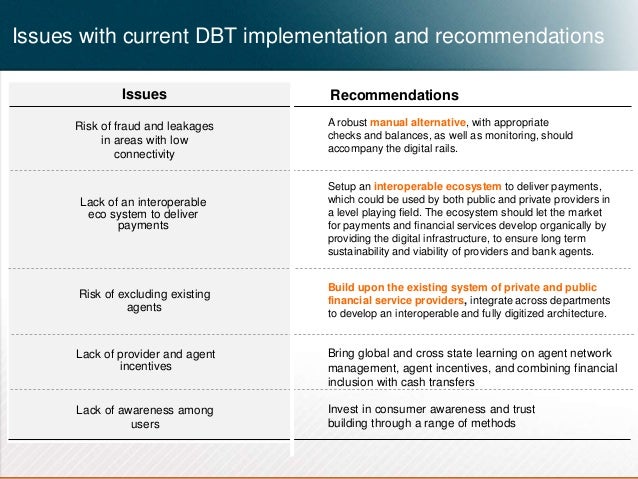
    The government’s DBT plan involves transferring the subsidy amount directly to the beneficiaries’ bank accounts.

    • Here, the government does not have to fiddle around with differential pricing for the underprivileged.
    • This method can effectively address the issue of leakages and go a long way in solving the mis-targeting problem.

    The government has also linked DBT to Aadhaar. Efficient targeting, using Aadhaar-linked data, ensures that the intended beneficiary receives the money in his account, thus helping him as well as reducing the government’s subsidy burden. This has resulted in effectively solving the leakage and mis-targeting problems in some schemes.


    • DBT in India
    • Pre requisite of successful DBT
    • Merits of DBT
    • Demerits of DBT
    • DBT in fertilizers
    • Is India ready to implement DBT in all programmes?
    • Suggestions for improvement
    • Conclusion

    DBT in India

    Direct Benefit Transfer is a mechanism to transfer the subsidy amount directly to the bank account of beneficiaries. Main agendas for DBT is to prevent and address following

    1. Leakages
    2. Delays
    3. Reducing structural expenses in distributing the subsidies in hand
    4. Encouraging everyone to have bank account and achieve financial inclusion.

    Right now it is applied to only 4 areas that too in selected districts:

    1. LPG subsidies
    2. Jnani Suraksha Yojana
    3. Old age pension
    4. Scholarships

    Pre requisite of successful DBT

    source

    Merits of DBT (Direct Benefit Transfer)

    • Leakage and delays are prevented.
    • Reduces Corruptions and black money issue.
    • Reduces economical inequalities in rural areas as everyone gets theire share rightfully.
    • Reducing the government expense on PDS, Cooperative society, bureaucracy to distribute scholarships etc.
    • Reduces time, energy and money of people to get their money/commodity.
    • Encourage free and fair market structure. Earlier subsidised grains entering market through backdoor used to distort the price in market.
    • More circulation of money in economy which will lead to at least 0.5% growth in GDP.
    • Government can better focus on other issues and not engaging in distribution.
    • Transportation charge for FCI and NABARD subsidies for warehouses will be reduced.
    • Slowly importance of MSP will reduce while price a farmer would fetch will increase which is win-win situation for farmers, also non-food crops will get importance which is issue right now in India.
    • Financial institutions will pay attention in rural area once people have cash in their hand.
    • Health facility will get better with private hospital giving facilities once people will have money to get treatment.

    Demerits of DBT

    • Money in the hand of poor may get spent in something other than what is needed, a scholarship needed to be spent in education only, but how government can ensure that, once she has sent it to account
    • Most accounts holder are males who have accessibility to banks, hence it will lead to usage by them only. Females may not get their share if they are the intended beneficiaries
    • With lesser banks in rural parts of India, it will be another overhead for people to get their withdrawal
    • Delay in transfer may create more turbulence as many will flock to banks to check on their balances

    DBT in fertilisers

    Government is embarked on rationalizing subsidies as has been seen in LPG subsidy which saved thousands of crores of government exchequer. Now it has proposed for rolling out DBT for fertilizers as has been mentioned in recent economic survey.

    Pros of DBT in fertilizer –

    • It would be beneficial for minimizing the use of fertilizer which would check degradation of soil nutrients and would prevent water contamination.
    • Farmers would be free from moneylender’s debt trap as now they would have secure money in their bank accounts. It would be helpful for inculcating saving habits also in farmers.
    • Released government control on the fertilization market would drive competition and would enhance productivity.
    • Enhanced financial inclusion and financial literacy will give boost to digital India and skill India.
    • No middlemen > no leakage > benefits to the needy > correct use of tax payer’s money (redistribution of wealth).
    • Less burden on government exchequer > fiscal consolidation target >money transferred in job creation and infrastructure development

    However there are some cons which need to be factored – 

    • More money in hand may lead to misuse like in drug, alcohol, unnecessary shopping or gambling etc.
    • May further widen the gap between big farmers and small farmers.
    • Bio-identification can be detrimental for the personal information of farmers if not properly handled.

    Operational challenges –

    • Management of data whether it may be of land, of status of farmer (landholder, tiller or tenant etc) or pertaining to agriculture practice is not up to the level in our country.
    • Though crores of accounts are opened but still there is a good number of people who are unbanked.
    • Some farmers have little knowledge about banking system so they can fall prey of undue interference.

    Is India ready to implement DBT across all programmes?

    The debate of implementing DBT in all subsidy programmes is discussed below. A proper implementation would helpful in following ways –

    • Filling leakages: DBT will help in reducing malpractices like leakages, ultimately giving the beneficiary what he is entitled. Example: LPG subsidy.
    • Increasing incomes: with large number of schemes which are implemented with an intention to increase incomes of the poor, but due to delay and other factors most of the time poor gets subsidy after a long time (like in wages of MNREGA). DBT can reduce these cases.
    • Financial inclusion: with the provision of DBT, poor will get themselves included in financial system of the country, which will help them to get other benefits and will boost their saving.

    Some of the downsides of the implementation – 

    • People may use money for other purposes rather than using it for what it is meant for like in case of PDS.
    • Due to lack of education and financial literacy, poor will keep themselves outside the purview of banks.
    • Inadequate development of the banking channel in rural areas is also a challenge.
    • Lack of adequate documents also leads to exclusion of many poor from banking sector.

    source

    Conclusion

    DBT revolutionized the banking sector by connecting low income segments of society with banks. There is no doubt that DBT has created a firm base for financial inclusion, which will include poor sections to the growth and development processes.

    National Payment Corporation of India (NPCI) has successfully opened 150 million DBT accounts with Adhaar numbers and around 125 million accounts under Jan Dhan Yojana.

    The government is fully relying on this scheme to plug leakages and save costs. It is estimated that over the time it could save up to 1.2% of GDP, which is currently lost in transit.


    References:

  • 7 Memoirs Every Serious IAS Aspirant Must Read

    Every once in awhile, it might serve you good to set the customary Lakshmikanths and the BipinChandras aside and slip into reading something less overwhelming (and more encouraging).

    Catch up on these memoirs (of sorts) written by civil servants (IAS/IFS/IPS), both old and new and get a sneak peak on “life on the other side of the fence”. Click on the titles to buy them from Amazon.

    #1. And What Remains in the End


    In an interview to The Hindu, Robin Gupta reminisces

    “Bhaskar Ghosh once divided the civil servants into 3 types: nuns, loyal wives and prostitutes, and I agree with him. Nuns are those who keep on doing what is right irrespective of who is in power; loyal wives are ones who pick one party and keep serving it and are ready to suffer for it as well. The prostitutes have no qualms about changing sides.”


    #2. The Insider’s View: Memoirs of a Public Servant


    Javid Chowdhury tries to give an earnest and evolved picture of his 40 years as a public servant and though he has a neat turn of phrase and some juicy stories, specially the one on three Parsi police officers controlling a riot, it is his integrity and values that come across strongly. Boy! If this was what civil servants were like once, the country was in good hands.

    Ref: The Hindu


    #3. An Outsider Everywhere: Revelations by An Insider


    The book is a compilation of a bureaucrat’s candid revelations about his various tasks, his close brush with politicians, thereby revealing their insecurities and egos and his zest for not toeing the line blindly despite all odds.

    Kaw is a 1964-batch Himachal cadre IAS officer, who acquired a wide array of experience in several prestigious departments and retired in November 2001 after putting in 42 years of service.


    #4. Walking with Lions


    K. Natwar Singh is a well-known author, diplomat and politician. He has been ambassador to Pakistan. He was attached to the office of Prime Minister Indira Gandhi from 1966 to 1971.

    Shashi Tharoor reviews this book here,

    Walking with Lions is his account of his encounters with those remarkable men and women. It is not a conventional memoir but rather a series of vignettes, each of which has previously appeared as a newspaper column. This makes for easily digestible reading.


    #5. Not Just an Accountant


    Not just an accountant is an incisive, no-holds-barred account of India’s eleventh comptroller and auditor general and a symbol of the anti-corruption movement, Vinod Rai.


    #6. Driven: Memoirs of a Civil Servant Turned Entrepreneur


    Jagdish Khattar has had an astonishingly diverse career, a trained lawyer who became an IAS officer. He was an agent of change in Uttar Pradesh through his roles as district magistrate, and head of the cement and transport corporations. He also helmed India’s Tea Board in London and played a key role in the steel ministry. Finally, at the age of sixty-five, Khattar turned entrepreneur with Carnation, India’s first multi-brand car sales and servicing network.


    #7. Poor But Spirited in Karimnagar


    This is an unusual entry to our list but it’s worth a good read because of the theme it explores. In this book, Sumita Dawra recounts her experiences as collector in the district of Karimnagar in Andhra Pradesh.

    The field notes recount a period between 2001 and 2004 when the author, a 1991-batch IAS officer, was collector in Andhra Pradesh’s Karimnagar district. But analytically, in terms of statistics and argument, the book is up to date.

    Ref: India Today

  • Outcome of Paris Climate Summit

    Paris Agreement was recently adopted by 195 countries of UNFCCC, which agreed to take measures to control climate change.

    We had written 4 explainers for a comprehensive coverage and they can be read here – 

    As we move ahead, let’s take a look at this agreement with respect to various dimensions and debates, which are going on in the international sphere.

    When this agreement will enter into force?

    The agreement in Paris will come into effect only after 2020 when the Kyoto Protocol, an existing international mechanism to deal with climate change, comes to an end.

    What is the temperature goal?

    The agreement says that its objective is to keep the global temperature rise below 2 degree Celsius, but pursue efforts to keep it below 1.5 degree Celsius from pre-industrial times.

    It also says that IPCC will come with a special report in 2018 on the impacts of global warming of 1.5 degree Celsius and above pre-industrial levels. <IPCC reports form the scientific basis on which the world is taking climate action>

    Let’s analyse the implications

    • Least Developed Countries (LDCs) and Small Island Developing Countries (SIDCs) were demanding that the rising temperature be kept under 1.5 degree Celsius from pre-industrial times.
    • LDCs fear that cost of adaptation will be high, if the temperature is allowed to risee upto 2 degree Celsius.

    What about Finance and Technology Transfer ?

    Finance

    Developed nations have been asked to provide financial resources, but $ 100 bn mark does not figure in the agreement. $ 100 bn has been shifted to the decision text, which is a list of all decisions taken at the conference.

    Developing countries are also asked to raise financial resources, even as voluntary effort.< This was one of the demands of the developed countries to widen the base of countries who will provide financial resources>

    There has to be a balance between the mitigation and adaptation needs of the developing countries, while allocating financial resources.

    Technology

    The developed countries to abide by their promises to provide technology development and transfer, and capacity building to developing countries.

    Why is it a matter of concern?

    • Paris Agreement is a permanent document, while the decisions of the conference can be modified.
    • This gives a message that developed nations will provide $ 100 bn every year from 2020, but they will not increase it annually, as demanded by developing countries.

    Carbon Neutral, by when?

    The agreement says that, world should peak emissions as soon as possible and achieve a balance between sources and sinks of greenhouse gases (GHGs) in the second half of this century.

    This means that to limit the amount of GHG emitted by human activity to the same levels which can be absorbed naturally such as trees, soil, ocean, etc beginning 2050.

    What happens to INDCs?

    In the run-up to the Paris conference, 186 countries submitted their INDCs, giving information about the climate actions they planned to take until 2025 or 2030. INDCs would henceforth be called only Nationally Determined Contributions.

    Every country needs to communicate NDCs every 5 years. Each NDC has to be progressively more ambitious than the previous one.

    However, NDCs are not legally binding, i.e. the targets set by nations will not be binding under the Paris Climate Agreement. <India, China and South Africa were unwilling to sign up for this condition because they felt that it could hamper economic growth and development>

    What is Global Stocktake?

    • It refers to a proposed a 5-yearly review of the impact of countries climate change actions.
    • It will assess whether the net result of the climate actions being taken was consistent with the goal of keeping the increase in global average temperature from pre-industrial times to within 2 degree Celsius.
    • It is mandatory for every country to participate in the global stocktake, the exercise will not assess whether actions of any individual country are adequate or not.

    The best part of global stocktake is that it will also assess whether developed countries are adequate help to developing countries by providing money and technology.

    Is Differentiation principle at Stake?

    Experts are divided on whether developed countries succeeded in their effort to do away with concept of Common But Differentiated Responsibilities.

    The Paris agreement firmly anchors ‘differentiation’ for developing countries. At many places, differentiation is achieved by having different kind of commitments for developed and developing countries.

    Developed countries are expected to take the lead on mitigation and support, while developing countries are expected to take actions within the context of their sustainable development and poverty eradication imperatives.

    Let’s see what is the other point of view.

    • All parties have to report NDCs every 5 years.
    • There is no differentiation in reporting, inventory of GHGs and progress made in implementation of NDCs.< Inventory is basically a list of all units which release GHGs>
    • The stocktake is universal for aggregate actions and it will happen in 2023 and every 5 years henceforth.
    • Developed countries are asked to take absolute economy-wide emission reduction targets, while developing countries will enhance mitigation efforts, but are encouraged to move towards economy-wide reduction in the light of national circumstances.

    Published with inputs from Pushpendra 
  • Bharat Emission Standards

    Bharat Emission Standards – Everything that you want to know


    Recently, govt. has decided to implement Bharat Standards VI norms on April 1, 2020. This comes in the wake of pressure from the Supreme Court to implement clean vehicular fuel norms soon amid concerns about rising air pollution, especially in Delhi.

    This policy is in line with our commitments at the Paris Climate Change Conference as well as public sentiments against rising air pollution in the cities, especially metros.

    These are norms instituted by the Govt of India to regulate the output of air pollutants from internal combustion engine equipment, including motor vehicles.

    • The standards and the timeline for implementation are set by the Central Pollution Control Board under the Ministry of Environment & Forests and Climate Change.
    • The standards are based on European regulations and were first introduced in 2000.

    What is the current status of emission norms?

    Currently, BS IV norms are applicable in 33 cities in which the required grade of fuel is available.

    In rest of India, we are still following BS III standards.


    Let’s see a little background of its implementation

    1991– India introduced the emission norms for the first time.

    1996– The norms saw some tightening as govt. asked most vehicle manufacturers to incorporate catalytic converters to cut exhaust emissions.
    Govt. also notified fuel specifications based on environmental considerations, which were to be implemented by 2000.

    2000– Govt. notified BS-I and BS-II standards, which were equivalent to Euro I and Euro II respectively. <BS-II was for the NCR and BS-I for the rest of India>

    2005BS-III and BS-II fuel quality norms came to be implemented. <BS-III for 13 major cities and BS-II for the rest of India>

    2010 BS-IV and BS-III fuel quality norms were introduced. <BS-IV for 13 major cities and BS-III for the rest of India>

    It works on a two-pronged strategy to control the air pollutant output.

    1. Reducing the Sulphur content in the fuel.
    2. At engine level, it augments some equipment which reduces emissions.

    What does Auto Fuel Policy have to say?

    Auto Fuel Policy 2003

    • It aims at addressing issues of vehicular emissions and vehicular technologies by applying fuel quality standards.
    • It encouraged the use of CNG/LPG fuel in cities affected by higher pollution levels.
    • It gives the timeline for adopting the Bharat Standards across the country:
      BS IV- 2017
      BS V- 2020
      BS VI- 2024

    Recently, govt had constituted an Expert Committee under the Chairmanship of Shri Soumitra Choudhuri, to draft Auto Fuel Vision and Policy 2025.

    Recommendations of Soumitra Choudhuri committee:

    It presents the road map for auto fuel quality till 2025 for the country,taking into account the achievement under the last Auto Fuel Policy, emission reduction of in use vehicles, growth of vehicles and the supply and availability of fuels.

    • It recommended nationwide fuel standards to be BS-IV. It has proposed to move to BS V from 2020 and BS VI from 2024.
    • To upgrade refineries to produce BS-V petrol and diesel will need Rs.80,000 crore.
    • It recommended Special Fuel Upgradation Cess of 75 paise/litre on fuel to meet the cost.

    Let’s analyse Bharat Standards vis-a-vis Euro Standards

    BS-VI is equivalent to Euro VI. However, many western countries have already graduated to Euro VI.

    But, India is following European emission norms with a time lag of  5 years.

    What are the challenges in implementing BS VI norms?

    Engine

    Engine development firms have cited a technological challenge in implementing the changes.

    They have cited that jumping directly to BS-VI norms would give them little time to design changes in their vehicles.

    Why is it challenging for auto firms to implement it?

    There are two critical components which needs a fitment in the engine. They would have to be adapted to India’s peculiar conditions, where running speeds are much lower than EU or US. Industry estimates of required investment to upgrade from BS-IV to BS-V are to the tune of Rs. 50000 crore.

    1. Diesel Particulate Filter– Its function is to remove particulate matter from diesel exhaust.
      ChallengeProblem is small cars with limited bonnet space would need major redesign to accommodate DPF. Temperature of 600 degrees Celsius is required to burn the soot in DPF, which is difficult to achieve in India due to low driving speeds.
    2. Selective Catalytic Reduction Module– It reduces oxides of Nitrogen.
      Challenge: It needs injection of Aqueous solution into the system, for which separate infrastructure is needed for countrywide supply.

    Fuel

    There are questions about the ability of the oil marketing companies to quickly upgrade fuel quality from BS-III and BS-IV standards to BS-VI.

    The objective of upgradation to higher emission norms is defeated, if the uniform fuel is not available across the country.<This has been seen in reduced efficacy of engines of BS-IV vehicles, while taking inter-state travel>


    Published with inputs from Pushpendra 
  • History | Gandhiji’s 4 Satyagraha

    After his successful stint in South Africa, it was time for Gandhiji to try his tactics in his homeland, India. He tries to experiment with Satyagraha at a smaller scale before he goes for a mass movement. All his experiments were a huge success and thus lay the foundation of the Non-Cooperation movement which shook the British Raj.

    CLICK:-REGISTER & DISCUSS ETHICS CASE STUDIES & YOUR UPSC PREPARATION WITH CD MENTORS FOR FREE
    1. Champaran Satyagraha – 1917

    Gandhiji was persuaded by Raj Kumar Shukla to study the conditions of the Indigo Plantation workers in Champaran, a district in Bihar.

    The system prevalent in the Indigo Plantations was the Tinkathia System*. In this system, the peasants were required to mandatorily cultivate indigo in 3/20th of their land holdings.

    Gandhiji did his research. At the same time, the Govt. appointed a Commission of Inquiry to go into the whole issue and nominated Gandhiji as one of its members. Needless to say, it found the Planters guilty of exploitation. A compromise was reached and Planters were ordered to refund 25% of the amount they had illegally taken.

    1. Ahmedabad Satyagraha – 1918

    This time Gandhiji was dealing with the workers. Due to plague, the mill owners had increased the pay to 75% to attract workers. However, once the plague conditions subsided, the mill owners wanted to bring down the pay to 20%. The workers didn’t agree with this reduction and wanted 50% of the pay to remain. The logic they sited was that WW1 had increased the prices. Gandhiji didn’t want the interest of the industrialist class to be hurt. He tried hard to persuade Ambalal Sarabhai who was his friend but failed. Left with no option, he asked workers to go on a strike. When Gandhiji saw the strike subsiding, he went on a fast. This put pressure on the mill owners who agreed for the 35% increment.

    1. Kheda Satyagraha – 1918

    This is where Gandhiji teams up with Sardar Vallabhbhai Patel to help the cause of peasants. The peasants were in extreme distress as their crop produce had been 1/4th of the original. As per the revenue code, they were entitled for a full concession. However, the Govt. wasn’t willing to let go of their revenues and kept pressurizing the peasants.

    Gandhiji urged all farmers to fight unto death against this injustice of the British. He appealed the rich farmers to support to the poor farmers by not paying revenues despite having the capability. Later the British came out with a policy asking the rich farmers to pay their due voluntarily. (which backfired as no rich farmer willingly wanted to pay revenue)

    1. Rowlatt Satyagraha – 1919

    British, in the name of curbing terrorist violence, had introduced a Bill that severely curtailed the liberties of the Indians. It had provisions for arrest without warrant and detention for 2 years. Gandhiji called for a nation-wide hartal accompanied by fasting and praying. The Movement went in a different direction than what was expected. There were events of violent outbreaks which feared the Govt.

    The Rowlatt Satyagraha was withdrawn on 18th April, 1919 because of the Jaliawala Bagh Massacre that happened on 13th April 1919.

    Gandhiji called it a ‘Himalayan Blunder’. It should be noted that NCM was not the first Nationwide Movement, it was the Rowlatt Satyagraha.

    CLICK:-REGISTER & DISCUSS ETHICS CASE STUDIES & YOUR UPSC PREPARATION WITH CD MENTORS FOR FREE

    *There were two main systems of indigo cultivation – nij and ryoti. A detailed explanation of the same is given in NCERT.

    Ref : http://www.ncert.nic.in/ncerts/l/hess103.pdf

More posts
