💥Mains Ready By December. Smash Mains & Smash PYQ Admissions Open

Search results for: “”

  • 5 September 2018 | High Relevance vs Low Relevance News

    Reading News for UPSC is utmost important and rising number of questions year on year in UPSC Prelims is a testimony of this

    We are starting a daily series where we will analyze news covered in The Hindu, Indian Express and other newspapers which are important from exam perspective and which are not

    Important news would have been covered in our daily news coverage in form of newscards.

    Unimportant ones will be mentioned here and a short description regarding why it is not relevant for the exam

    Click on news headlines to read the full news

    High relevance news

    [op-ed snap] Where interests meet

    https://www.civilsdaily.com/news/op-ed-snap-where-interests-meet/

    A good editorial summing up India-US relationship and giving way forward for India. Important for Mains as 2+2 dialogue is finally happening.

    India wins key concession on services at RCEP Singapore Ministerial

    https://www.civilsdaily.com/news/india-wins-key-concession-on-services-at-rcep-singapore-ministerial/

    RCEP deal is under the final negotiation stage and might be completed by year-end. Note all details related to it. Important for Pre as well as Mains.

    Google to help EC track online political ads

    https://www.civilsdaily.com/news/google-to-help-ec-track-online-political-ads/

    Measures are being taken to make the election process more transparent especially the election funding. Make notes of all such initiatives as these can be quoted in answers related to conduct of elections.

    Reserve Bank tightens Ombudsman Scheme

    https://www.civilsdaily.com/news/reserve-bank-tightens-ombudsman-scheme/

    Make notes about the Ombudsman scheme. Can be asked in Prelims.

    Low Relevance Scheme

    Congress gives Lokpal panel meeting a miss

    The Congress has boycotted the Lokpal Selection Committee meeting for the fifth time this year, asserting that it would continue to do so until the leader of the single largest Opposition party in the Lok Sabha is given the status of a full-fledged member of the panel

    The committee will set up a search panel for recommending names for the appointment of the anti-graft ombudsman, the Lokpal, and its members

    No important points from the exam point of view in the news.

  • 4 September 2018 | Prelims Daily with Previous Year Questions

    Q.1) Which of the following states is/are member of ASEANS’s East Asia Summit?

    1. Australia
    2. India
    3. Japan
    4. New Zealand
    5. Republic of Korea
    6. Russian Federation

    Select the correct code from the following options:

    a) 2, 3, 5

    b) 2, 3, 4, 5, 6

    c) 1, 2, 3, 4

    d) All of the above

    Inspired by: [pib] 6th East Asia Summit and 15th India-ASEAN Economic Ministers Meeting, Singapore

    https://www.civilsdaily.com/news/pib-6th-east-asia-summit-and-15th-india-asean-economic-ministers-meeting-singapore/


    Q.2) Exercise IOWave18 was recently held to increase tsunami preparedness, evaluate response capabilities and improve coordination throughout the country. Consider the following statements about IOWave18:

    1. It is organised by the World Meteorological Organisation.
    2. It has been held in India, Sri Lanka, Indonesia and Japan only.
    3. The exercise would involve the evacuation of more than 1, 25,000 people from the Tsunami Prone areas of India.

    Which of the given statements is/are incorrect?

    a) All of the above

    b) 1 and 2

    c) 2 and 3

    d) 3 only

    Inspired by: India to take part in tsunami mock drill

    https://www.civilsdaily.com/news/india-to-take-part-in-tsunami-mock-drill/


    Q.3) Shimla Crisis was recently seen in news is related to which of the following issues?

    a) Excessive floods and Cloud bursting

    b) Drinking Water Crisis

    c) Bacterial Contamination of Ground-Water

    d) Lowering of Ground-water table

    Inspired by: Panel urges plan to save Himalayan springs

    https://www.civilsdaily.com/news/panel-urges-plan-to-save-himalayan-springs/


    Q.4) With context to the Online sale of Drugs in India as per the draft rules on sale of drugs on e-pharmacy, consider the following statements:

    1. Firms/Persons/Portals have to be mandatorily registered with the central authority.
    2. The Central Drugs Standard Control Organization (CDSCO) is the nodal agency for Licensing.
    3. Sale of tranquillizers, psychotropic drugs, narcotics and habit forming drugs has been prohibited through these portals.

    Which of the given statements is/are correct?

    a) All are correct.

    b) 1 and 2

    c) 2 and 3

    d) 3 only

    Inspired by: Health Ministry comes out with draft rules on sale of drugs by e-pharmacy

    https://www.civilsdaily.com/news/health-ministry-comes-out-with-draft-rules-on-sale-of-drugs-by-e-pharmacy/

    Q.5) Military Exercise Rapid Trident was recently held with NATO by which of the following Countries?

    1. Ukraine
    2. Turkey
    3. Italy
    4. Mongolia

    Inspired by:  The Hindu


    For Solutions – Click Here

    Prelims Daily Archive – Click here


  • [Burning Issue] NPA Crisis: Major Surgery Needed


    http://i.investopedia.com/dimages/graphics/nonperforming_asset.png?width=680&height=680

    Context

    According to RBI’s recent data The pile of bad loans, or stressed assets, is close to Rs10 lakh crore($154 billion) now, which is more than the GDP of at least 137 countries. And what’s more, it is only growing.

    Stressed assets, which include non-performing assets (NPAs) and restructured loans, form some 12% of the total loans in Indian banking now.

    What is NPA?

    1. The assets of the banks which don’t perform (that is – don’t bring any return) are called Non Performing Assets (NPA) or bad loans. Bank’s assets are the loans and advances given to customers. If customers don’t pay either interest or part of principal or both, the loan turns into a bad loan.
    2. According to RBI, terms loans on which interest or instalment of principal remain overdue for a period of more than 90 days from the end of a particular quarter is called a Non-performing Asset.
    3. However, in terms of Agriculture / Farm Loans; the NPA is defined as under- For short duration crop agriculture loans such as paddy, Jowar, Bajra etc. if the loan (instalment/interest) is not paid for 2 crop seasons, it would be termed as an NPA. For Long Duration Crops, the above would be 1 Crop season from the due date

    http://image.slidesharecdn.com/nonperformingassetmanagement-150324234247-conversion-gate01/95/non-performing-asset-management-2-638.jpg?cb=1437494895

    Impact of NPA on Economy

    1. Depositors do not get rightful returns and many times may lose uninsured deposits. Banks may begin charging higher interest rates on some products to compensate for Non-performing loan losses
    2. Bank shareholders are adversely affected
    3. Bad loans imply redirecting of funds from good projects to bad ones. Hence, the economy suffers due to loss of good projects and failure of bad investments
    4. When bank do not get loan repayment or interest payments, liquidity problems may ensue.

    Reasons for the rise in NPA in recent years

    1. GDP slowdown: Between early 2000’s and 2008 Indian economy were in the boom phase. During this period Banks especially Public sector banks lent extensively to corporates. However, the profits of most of the corporate dwindled due to slowdown in the global and domestic economy, bans in mining projects, delays in environmental related permits ,Land acquisition hurdles and volatility in prices of raw material. This has adversely affected their ability to pay back loans and is the most important reason behind increase in NPA of public sector banks.
    2. Relaxed lending Norms: One of the main reasons of rising NPA was the relaxed lending norms especially for corporate honchos when their financial status and credit rating was not analyzed properly. Also, to face competition banks were hugely selling unsecured loans .
    3. Priority Sector Lending: There is a myth that main reason for rise in NPA in Public sector banks was Priority sector lending as according to the findings of Standing Committee on Finance , NPAs in the corporate sector are far higher than those in the priority or agriculture sector. However, even if PSL is not the main cause but it is still a cause for rising NPA which can be seen from the fact that As per the latest estimates by the SBI, education loans constitute 20% of its NPAs.
    4. The Lack of Bankruptcy code in India and the sluggish legal system makes it difficult for banks to recover these loans from both corporate and noncorporate.

    Other factors

    1. Banks did not conduct adequate contingency planning, especially for mitigating project risk. They did not factor eventualities like failure of gas projects to ensure supply of gas or failure of land acquisition process for highways.
    2. Restructuring of loan facility was extended to companies that were facing larger problems of over-leverage & inadequate profitability. This problem was more in the Public sector banks.
    3. Companies with dwindling debt repayment capacity were raising more & more debt from the system.

    Why most NPA in the Public sector?

    1. Five sectors Textile, aviation, mining, Infrastructure contributes to most of the NPA since most of the loan given in these sectors are by PSB, they account for most of the NPA.
    2. Public Sector banks provide around 80% of the credit to industries and it is this part of the credit distribution that forms a great chunk of NPA. Last year, when Kingfisher was marred in a financial crisis, SBI provided it a huge amount of loan which it is not able to recover from it.
    3. Less Professional management
    4. Political Pressure and interference forces PSB to lend to not so commercially sounds project.

    Steps taken by RBI and Government in last few years to curb NPA

    1. The government has launched Mission Indradhanush to make the working of public sector bank more transparent and professional in order to curb the menace of NPA in future.
    2. The government has also proposed to introduce Bankruptcy code which will make it easier for banks to Recover the loans from the debtors.
    3. RBI introduced a number of measures in the last few years which include:
    • Tightening the Corporate Debt Restructuring (CDR) mechanism,
    • Setting up a Joint Lenders’ Forum, prodding banks to disclose the real picture of bad loans, asking them to increase provisioning for stressed assets,
    • Introducing a 5:25 scheme where loans are to be amortized over 25 years with a refinancing option after every five years, and
    • Empowering them to take majority control in defaulting companies under the Strategic Debt Restructuring (SDR) scheme.
    • Amendment in banking law to give RBI more powers: The Banking Regulation Act may be amended to give RBI more powers to monitor bank accounts of big defaulters. The amendment in the banking law will enable setting up of a committee to oversee companies that have been the biggest defaulters of loans.
    • Stringent NPA recovery rules: The government has over the years enacted and tweaked stringent rules to recover assets of defaulters. The Securitisation and Reconstruction of Financial Assets and Enforcement of Security Interest Act or Sarfaesi Act of 2002 was amended in 2016 as it took banks years to recover the assets.

    How to curb the menace of NPA?

    #1. Short-Term measures

    1. Review of NPA’S/Restructured advances- We need to assess the viability case by case. Viable accounts need to be given more finance for turnaround and unviable accounts should either be given to Asset Reconstruction Company or Management/ownership restructuring or permitting banks to take over the units.
    2. Bankruptcy code should be passed as soon as possible. Bankruptcy code will make it easier for banks to recover loans from unviable enterprises.
    3. The government should establish an ARC with the equity contribution from the government and the Reserve Bank of India (RBI). The established ARC should take the tumour (of non-performing assets or NPAs) out” of the banking system. An ARC acquires bad loans from banks and financial institutions, usually at a discount, and works to recover them through a variety of measures, including sale of assets or a turnaround steered by professional management. Relieved of their NPA burden, the banks can focus on their core activity of lending.

    #2. Long-term Measures

    1. Improving credit risk management– This includes credit appraisal, credit monitoring, and efficient system of fixing accountability and analyzing trends in group leverage to which the borrowing firm belongs to
    2. Sources/structure of equity capital– Banks need to see that promoter’s contribution is funded through equity and not debt.
    3. Banks should conduct necessary sensitivity analysis and contingency planning while appraising the projects and it should built adequate safeguards against such external factors.
    4. Strengthen credit monitoring– Develop an early warning mechanism and comprehensive MIS(Management information system) can play an important role in it.MIS must enable timely detection of problem accounts, flag early signs of delinquencies and facilitate timely information to management on these aspects.
    5. Enforce accountability- Till now lower ring officials considered accountable even though loaning decisions are taken at higher level. Thus sanction official should also share the burden of responsibility.
    6. Restructured accounts should treated as non performing and technical write-offs where Banks remove NPA’S from their balance sheets Permanently should be dispensed with.
    7. Address corporate governance issues in PSB- This includes explicit fit and proper criteria for appointment of top executives and instituting system of an open market wide search for Chairman

    Questions

    1. Non-performing assets, restructured loans and written-off assets — collectively called ‘stressed assets’ — have become a major challenge to the country’s banking system. To combat these, what has the government done? Will these measures be effective? Examine.
    2. The problem of non-performing assets (NPAs) in the Indian banking system is said to be big and might affect economic growth of the country. What are the approaches that RBI and government are adopting to clean the banking system of NPAs? Examine.
  • 4 September 2018 | High Relevance vs Low Relevance News

    Reading News for UPSC is utmost important and rising number of questions year on year in UPSC Prelims is a testimony of this

    We are starting a daily series where we will analyze news covered in The Hindu, Indian Express and other newspapers which are important from exam perspective and which are not

    Important news would have been covered in our daily news coverage in form of newscards.

    Unimportant ones will be mentioned here and a short description regarding why it is not relevant for the exam

    Click on news headlines to read the full news

    High relevance news

    [op-ed snap] Why ethanol blending in petrol might not work for India

    https://www.civilsdaily.com/news/op-ed-snap-why-ethanol-blending-in-petrol-might-not-work-for-india/

    Amidst government plans to increase ethanol blending, there are few areas of concern that need to be dealt with. Editorial discusses the same. Important for Mains.

    Health Ministry comes out with draft rules on sale of drugs by e-pharmacy

    https://www.civilsdaily.com/news/health-ministry-comes-out-with-draft-rules-on-sale-of-drugs-by-e-pharmacy/

    With growing e-commerce, online sales of drugs remains a grey area without any specific rules. Now initiative has been taken to fix this patch. Note important points of draft rules.

    Draft charter of Patients’ Rights released

    https://www.civilsdaily.com/news/draft-charter-of-patients-rights-released/

    There’s a lack of rights manual for patients which leads to their exploitation. A step forward to ensure that patients get good treatment without any compromise of their rights.

    Panel urges plan to save Himalayan springs

    https://www.civilsdaily.com/news/panel-urges-plan-to-save-himalayan-springs/

    Note about Shimla crisis and the need to conserve groundwater resources. Important for mains.

    Low Relevance News

    Ateli enters history on a freight train

    The small town in Haryana marked the inauguration of the first stretch of the 3,360-km-long Dedicated Freight Corridor, touted as one of the biggest infrastructure projects in the country. The first 190-km stretch of the Dedicated Freight Corridor from Ateli to Phulera in Rajasthan was opened on August 15.

    No important points in news from the exam point of view

  • 3 September 2018 | Prelims Daily with Previous Year Questions

    Q.1) Consider the following statements with respect to the “Pravah” Mobile App for E-learning:

    1. It is developed by Ministry of HRD.
    2. With the help of this app anybody can learn Hindi through his mother tongue.

     Which of the given statements is/are correct?

    a) Only 1

    b) Only 2

    c) Both 1 and 2

    d) None of the above.

    Inspired by: [pib] First review meeting of Department of Official Language

    https://www.civilsdaily.com/news/pib-first-review-meeting-of-department-of-official-language/


    Q.2) With reference to the UN Convention on the Law of the Sea, consider the following statements:

    1. All States enjoy the traditional freedoms of navigation, overflight, scientific research and fishing on the high seas.
    2. The international zone of marine waters belongs to no country.
    3. US is a signatory to the convention.

    Which of the given statements is/are correct?

    a) Only 3

    b) 1 and 3

    c) 1 and 2

    d) All are incorrect

    Inspired by: UN begins talks on treaty to protect imperilled High Seas

    https://www.civilsdaily.com/news/un-begins-talks-on-treaty-to-protect-imperilled-high-seas/


    Q.3) A public credit registry is an information repository that collects all loan information of individuals and corporate borrowers. In context to the Public Credit Registry of India, consider the following statements:

    1. It will be set up by the Insolvency and Bankruptcy Board of India.
    2. It will take into account only natural persons and not legal person.

    Which of the given statements is/are incorrect?

    a) None of the above

    b) Only 1

    c) Only 2

    d) Both 1 and 2

    Inspired by: Why is a Public Credit Registry important?

    https://www.civilsdaily.com/news/why-is-a-public-credit-registry-important/


    Q.4) Biosimilars are-

    1. Biosimilars are the generic versions of medicines made from animal or plant proteins as opposed to chemicals.
    2. They are useful in treating certain types of cancer, rheumatoid arthritis, and multiple sclerosis
    3. Biologics are notable for targeting the underlying causes of diseases as opposed to just the symptoms, with fewer side effects

    Select the correct alternatives:

    a) All are correct.

    b) Only 1

    c) 1 and 2

    d) 2 and 3

    Inspired by: [op-ed snap] The need for growth in Indian Biosimilars

    https://www.civilsdaily.com/news/op-ed-snap-the-need-for-growth-in-indian-biosimilars/


    Q.5) Recently Sinamale Bridge was inaugurated by China in which of the following Asian Countries?

    a) Myanmar

    b) Laos

    c) Maldives

    d) Sri Lanka

    Inspired by: India boycotts inauguration of China-funded Bridge

    Times of India


    For Solutions – Click Here

    Prelims Daily Archive – Click here

  • [Burning Issue] India-Maldives Relations

    Recent developments

    1. Maldives immigration authority has not been issuing work visas to Indians since March this year.
    2. This is retaliation from the Maldives for India’s condemnation of Maldivian President Abdulla Yameen’s declaration of emergency in February after the country’s Supreme Court reversed the conviction of opposition leader, Mohammed Nasheed, and others.
    3. The Maldives has also asked India to take back its gift of two Dhruv Advanced Light Helicopters, one manned by the Indian Coast Guard and another by the Indian Navy, by the end of June. Though the Maldivian government has said that these were not the helicopters it wanted, the real worry seems to be the presence of Indian defence personnel who are maintaining and operating the aircraft.
    4. In retaliation, it is learnt that Delhi voted against Malé and in favour of Indonesia for a non-permanent seat at the UN Security Council last week.

    Weakening ties between India and the Maldives

    1. There has been a series of setbacks in India-Maldives ties, starting from March 2015 when Prime Minister Narendra Modi cancelled a visit
    2. Recent moves by Abdulla Yameen, President of the Maldives, have put Malé on a collision course with New Delhi
    3. India criticised the government for its incarceration of former President Maumoon Abdul Gayoom and Chief Justice Abdulla Saeed, sentenced to 19 months in prison for an alleged plot to unseat Mr. Yameen
    4. The Maldives in December 2017 also signed a free trade agreement with China
    5. The Maldives, under Yameen, is also wooing Pakistan, China’s closest friend and ally. Soon after Pakistani army chief General Qamar Javed Bajwa paid a visit to Malé, Islamabad offered a $10 million loan to finance the purchase of two Super Mushak aircraft from Pakistan’s Aeronautical Complex.
    6. The strain is now evident in two areas where India-Maldives ties had been the strongest: strategic relations and people-to-people engagement

    Internal developments in the Maldives which concerned India in recent past

    Islamist radicalisation

    1. In the past decade or so, the number of Maldivians drawn towards terrorist groups like the Islamic State (IS) and Pakistan-based madrassas and jihadist groups has been increasing.
    2. In terms of proportion to population, this number of Maldivian nationals(200) joining IS, is quite high compared to other South Asian countries, irrespective of whether they are Muslim-majority countries.
    3. Political instability and socio-economic uncertainty are the main drivers fuelling the rise of Islamist radicalism in the island nation.
    4. India has two worries in this regard:
    • the exfiltration of members of Indian terror groups like the Students Islamic Movement of India (SIMI) and the Indian Mujahideen (IM) to the Maldives after their crackdown in India
    • the possibility of LeT using remote Maldivian islands as a launch pad for terror attacks against India and Indian interests.

    Overall, India’s concern is regarding how radical Islamist forces have been gaining political influence in the neighbourhood.

    Role of China

    https://s3.amazonaws.com/examsprint-api-prod/production/articles/0150975a6584bcbb4a0308ca029068b4.png

    1. China’s strategic footprint in India’s neighbourhood has increased.
    2. The Maldives has emerged as an important ‘pearl’ in China’s “String of Pearls” for ensuring the security of its sea lanes, especially the unhindered flow of critically-needed energy supplies from Africa and West Asia through the Indian Ocean.
    3. Chinese have remained among the top visitors to the Maldives. Beijing has evinced a keen interest in developing infrastructure in the Ihavandhoo, Marao and Maarandhoo Islands.
    4. During Chinese President Xi Jinping’s visit in 2014, the Maldives agreed to become a partner in China’s Maritime Silk Route.
    5. China has provided grant and loan assistance to the Maldives to build a bridge between the capital and the airport (called the China-Maldives friendship bridge).
    6. Amendments to the Maldivian Constitution in July 2015 allowed foreigners to own land, including investments of over US$ 1 billion for projects where 70 per cent of the land has been reclaimed. Looking at the parameters, China will be the obvious beneficiary.
    7. Chinese nationals now account for the largest tourist arrivals in the islands.
    8. India views the growing Chinese footprint in the Maldives with concern. India’s concern stems from the increasing Chinese strategic presence in the Indian Ocean region.
    9. Though the Maldivian government under Yameen has reassured India that the Chinese presence is purely economic, the concern of ‘places turning into bases’ is genuine
    10. In December 2017, China signed the Free Trade Agreement with the Maldives.
    11. It paves the way for a tighter embrace between Beijing and Maldives and it will also open the Maldives to Chinese goods and tourists in unprecedented numbers.
    12. Delhi saw this as a betrayal of the Maldives’ publicly stated “India First” policy

    Way forward

    1. The Yameen government must reconsider these policies.
    2. India too must pause to consider why relations have soured so badly.
    3. India cannot take its predominant power in South Asia for granted.
    4. Whether it is Nepal, where the people recently elected the pro-Chinese and moderate Communist, K.P. Oli, to power, or the Maldives, Delhi must abandon their perceived arrogance towards its smaller neighbours.
    5. India needs to separate ground reality from its desires — whatever its discomfort with Yameen, it has to learn to deal with him.
    6. Elections are due in the Maldives later this year and Delhi must realistically assess the pros and cons, including its policy towards exiled former president Mohamed Nasheed, before taking sides.
    7. China is here to stay in the Maldives, as well as across the rest of South Asia. Delhi needs to learn to deal with issues realistically.

    Question

    1. There is unmistakable evidence of souring of ties between India and Maldives. Why has the relationship deteriorated? How can it be improved?
  • 1 September 2018 | Prelims Daily with Previous Year Questions

    Q.1) Krishna Kutir, a special home for 1000 widows was recently set up at Vrindavan, Mathura under Swadhar Greh scheme. Which of the following statements about Krishna Kutir is/are correct?

    1. It is an initiative of Ministry of Social Justice and Empowerment.
    2. It is constructed by National Building Construction Corporation (NBCC).

    Select the correct codes from the following options:

    a) Only 1

    b) Only 2

    c) Both 1 and 2

    d) None of the above.

    Inspired by: [pib] Krishna Kutir, a home for 1000 widows inaugurated

    https://www.civilsdaily.com/news/pib-krishna-kutir-a-home-for-1000-widows-inaugurated/

    Q.2) Babloo Chauhan vs. State Govt. of NCT of Delhi case is related to which of the following Issue?

    a) Wrongful Prosecution

    b) State Specific nature of Reservation

    c) Adultery Prohibition

    d) Pregnancy Termination

    Inspired by: [pib] Law commission submits report on “Wrongful Prosecution (Miscarriage of Justice): Legal Remedies”

    https://www.civilsdaily.com/news/pib-law-commission-submits-report-on-wrongful-prosecution-miscarriage-of-justice-legal-remedies/

    Q.3) With reference to the Census of India consider the following statements:

    1. The Office of the Registrar General & Census Commissioner is designated under Ministry of Statistics and Program Implementation.
    2. 2021 census will be conducted by trained enumerators.
    3. The census will start with “house listing” in 2020 and the headcount will begin from February 2021.

    Which of the given statements is/are correct?

    a) Only 1

    b) 1 and 2

    c) 2 and 3

    d) All are correct

    Inspired by: Census 2021 to collect OBC data, use maps

    https://www.civilsdaily.com/news/census-2021-to-collect-obc-data-use-maps/

    Q.4) Kathmandu Declaration is related to which of the following International agency?

    a) ASEAN

    b) SAARC

    c) BIMSTEC

    d) Asia Cooperation Dialogue

    Inspired by: Kathmandu Declaration to Root out Terror

    https://www.civilsdaily.com/news/kathmandu-declaration-to-root-out-terror/


    Q.5) Recently the Singphan Elephant Reserve was declared as India’s 30th Elephant reserve.

    This reserve is located in which of the following states?

    a) Nagaland

    b) West Bengal

    c) Jharkhand

    d) Tripura

    Inspired by: Singphan wildlife sanctuary declared 30th elephant reserve of the country

    Business Standard

    For Solutions – Click Here

    Prelims Daily Archive – Click here

  • 3 September 2018 | High Relevance vs Low Relevance News

    Reading News for UPSC is utmost important and rising number of questions year on year in UPSC Prelims is a testimony of this

    We are starting a daily series where we will analyze news covered in The Hindu, Indian Express and other newspapers which are important from exam perspective and which are not

    Important news would have been covered in our daily news coverage in form of newscards.

    Unimportant ones will be mentioned here and a short description regarding why it is not relevant for the exam

    Click on news headlines to read the full news

    High relevance news

    Why is a Public Credit Registry important?

    https://www.civilsdaily.com/news/why-is-a-public-credit-registry-important/

    Make notes about credit registry. Important for Pre as well Mains.

    UN begins talks on treaty to protect imperilled High Seas

    https://www.civilsdaily.com/news/un-begins-talks-on-treaty-to-protect-imperilled-high-seas/

    Read about UNCLOS and areas covered as well as left out by it. A tricky statement can be made in Prelims from that.

    Green Tribunal steps in to conserve Western Ghats

    https://www.civilsdaily.com/news/green-tribunal-steps-in-to-conserve-western-ghats/

    Note about ESZ provisions and various reports related to western ghats ecology conservation. Important for Pre as well as Mains.

    [op-ed snap] From Plate to Plough: Maharashtra vs Market

    https://www.civilsdaily.com/news/op-ed-snap-from-plate-to-plough-maharashtra-vs-market/

    A good editorial providing steps to make farming more profitable instead of relying on makeshift measures like MSP & other subsidies. Points can be quoted in mains answers as is.

    Low Relevance News

    U.S., India may not sign security pact at 2+2 meet

    At the 2+2 dialogue between India and the U.S. here on September 6, an announcement could be made about an in-principle agreement between the two sides on the Communications Compatibility and Security Agreement (COMCASA), but its signing is doubtful

    No important points from exam perspective as the summit is yet to happen and this is not an official statement from the government.

  • [Burning Issue] Income support model (Telengana)


    How Telangana supports farmers with Rs 4,000 for every acre they own


    https://i1.wp.com/images.indianexpress.com/2018/06/farmers2.jpg?resize=525%2C293&ssl=1

    Why in News

    1. An income support scheme for farmers in Telangana has earned the appreciation of outgoing Chief Economic Advisor Arvind Subramanian.
    2. It formally gives scope for the feasible framework at pan-India level.

    What Rythu Bandhu provides?

    1. Under Rythu Bandhu, the Telangana government gives every beneficiary farmer Rs 4,000 per acre as investment support before every crop season.
    2. The objective is to help the farmer meet a major part of his expenses on seed, fertiliser, pesticide, and field preparation.
    3. The scheme covers 1.42 crore acres in the 31 districts of the state, and every farmer owning land is eligible.
    4. Officials said 92% of the beneficiaries own less than 5 acres, 5% own 5-10 acres and the remaining 3% own more than 10 acres.

    Payment

    1. The government plans to extend the flat Rs 4,000-per-acre subsidy to the rabi season as well, with the distribution of cheques from November 18.
    2. The government has allocated Rs 12,000 crore for Rythu Bandhu in 2018-19; the 24×7 free power supply to farmers is estimated to cost another Rs 1,000 crore.
    3. The government will issue cheques rather than make direct benefit transfer (DBT) because banks might use the DBT money to adjust against farmers’ previous dues.
    4. The cheques have been distributed along with free Pattadar Dharani passbooks with updated information including ownership and land purchase and sale.

    Beneficiaries

    1. The government had initially drawn up a list of 72 lakh beneficiaries based on a revenue department survey last year.
    2. Lack of proper land records resulted in the total being shortlisted at 57.33 lakh.
    3. But the records are still under rectification and more farmers will be added to the list later.

    Relief from Indebtedness – the major impact

    1. Rythu Bandhu money provides that cushion to the farmer because with that money the farmer can purchase seeds and fertiliser and start sowing.
    2. If a bank approves his loan later then it is of additional help to hire farm labour etc but at least he is not going to moneylenders.

    Criticisms of the scheme

    1. The foremost issue is that it does not exclude rich farmers and wealthy landlords. The scheme does, however, have a provision under which cheques can be returned to the local authorities.
    2. The scheme leaves out tenant cultivators — an estimated 40% of Telangana’s farming population and mostly coming from the poorest and most disadvantaged backgrounds. Tenant farmers cannot be included in the scheme as they cannot submit any proof of cultivation of land, which is done mostly based on informal and oral lease arrangements. Their frequent movement makes it very difficult to identify them. If they are included in the scheme, it will lead to unnecessary litigation.

    Way forward

    1. Acute agri distress is a grim reality that needs to be tackled on a war footing. Schemes like Rythu Bandhu show promise.
    2. Filter out the rich farmers (on the basis of factors like income, land and asset ownership etc) so as to make the model more cost-effective and impactful.
    3. The model will have to be customised to suit the agro-climatic and socio-economic variations across India. A blanket approach will not work.
  • How to write Essay in UPSC Mains

    Related image

    The first paper in the Civil Services Examination (Mains) is the Essay writing paper. This paper doesn’t have any well-defined syllabus, so it is one of the most neglected paper during preparation. The vast syllabi of optional papers and general studies papers coupled with the lethargy of aspirants to practice answer writing often leads to unpreparedness for this paper. If prepared well, this paper can be a game changer.

    The most commonly asked question by the aspirant is, “How to prepare for essay paper?”

    Let us start by understanding what is expected from a candidate in this paper. The notification of UPSC mentions that “Candidates may be required to write essays on multiple topics. They will be expected to keep closely to the subject of the essay to arrange their ideas in orderly fashion and to write concisely. Credit will be given for effective and exact expression.” Thus, it is very clear that UPSC is looking for

    1. Discussion to be close to the subject ie; minimum digression from the topic.
    2. The arrangement of ideas in an orderly fashion ie; the structure of essay should be well organized.
    3. To write concisely ie; the assertions should be terse and succinct. One should avoid lengthy discussions on the same point in the essay.
    4. Credit will be given for effective and exact expression.

    The evaluation of the essays written considers comprehension, originality of thought, clarity of expression and integrated thinking with the assimilation of ideas. Thus, the notification makes it very clear that UPSC is expecting short, precise, accurate and exact discussion on the topic. Describing your thoughts in fewer words requires practice.

    We will now discuss in detail various aspects related to essay paper.

    1. Choosing Essay Topic

    Choosing the topic is the most decisive part of essay paper. One should deliberate seriously over the options given before starting to write. Below mentioned are some tips one can follow for choosing a topic.

    • One should deliberate about all the topics given by reading them carefully. One should not choose the topic haphazardly.
    • Rule out the topics that seem interesting, but you do not know much about them. One cannot make effective arguments without much knowledge.
    • There is no empirical evidence that one receives more marks in unconventional topics. You should choose the topics in which you can easily write 5-7 points in favour and at least 3-4 points counter to the topic.
    • Some topics are too specific and not much can be written about them. If you cannot think of at least 3-5 arguments for and against, you should avoid choosing such a topic.
    • You may have a lot of information on the topic, but merely reproducing information does not make for a good essay; you should have few good ideas around that topic.
    • After finalizing the topic, you can write down all the ideas you have around it before starting to plan the essay structure. This step will give you an idea about the kind of topic you have chosen and the arguments you are going to make. If you spot any problem, you can change the topic at this stage before it is late.
    • One of the better practices is to make a mind map related to the topic in a rough space. It helps in organising ideas. Also, it can be seen by the examiner and gives a good impression.

    2. How to Write an Essay Introduction

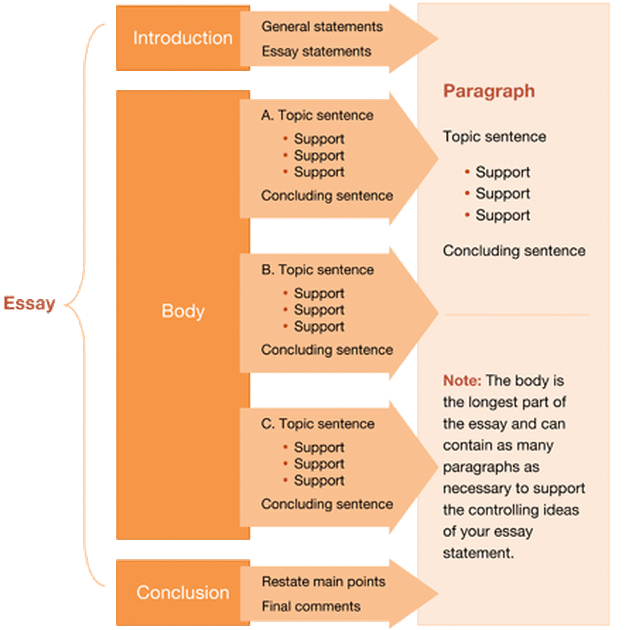
    The introduction is the first impression upon the examiner. Given the subjectivity in this paper, the introduction is the key to good marks. The introduction should be crisp and precise laying down the thesis statement in an effective manner.

    • The introduction should not be vague and general like “since the beginning of time…” It should be targeted to the topic. Given the paucity of time, if nothing comes to mind, try to incorporate the topic given in the introduction. It gives direction to the discussion.
    • The introduction can be in more than one paragraph. One should lay down the thesis statement and the relevance of the topic. One should also mention his plan of discussion in the introduction. This is a good method of transition from introduction to the main body of the essay.
    • Some techniques of evoking interest of the reader are:
      • Starting with a story.
      • Writing a statement/assertion at the beginning that evokes the interest of the reader.
      • Asking poignant or rhetorical questions related to the topic and your thesis statement.
      • Writing a quote. Although quotes should not be too commonly used and if you are using quotation marks, they should be exactly in a way written by the author. You can also paraphrase the quote and attribute it to the author.
      • Using relevant statistic. However, numbers can be boring. So, it should be used tactfully. Further, statistics should not be common or too obvious.
    • Following points should be kept in mind about thesis statements:
      • The thesis statement is essentially what you want to discuss in the essay. It will guide the tone of your essay and arguments that follow.
      • The thesis statement should not be too general.
    • The introduction should also mention the approach you are going to take for further discussion.
    • How can you transition from the introduction to the body of the essay?
      • The best way to transition is to talk about how the essay is structured; like tracing what arguments will be followed.
      • For instance, after the thesis statement one can write “this essay surveys major issues surrounding reproductive rights and then discusses arguments for and against for giving say over such issues to only women…”

    3. How to Write Body of the Essay

    The main body of the essay should exhibit your capability of coherent analysis. One should desist from discussing only one-sided view of the topic even if you are trying to take a one-sided stand in conclusion. Discussing both sides of the topics leads to an impression that you are open to discussion. Below mentioned are some points which can help in writing the main body.

    • Dividing the essay into different sections and giving subtitles helps the reader get an overall idea of the essay at the end without having to search for your line of thought. However, one should not write over simplistic subheadings like pros, cons etc.
    • A transition from introduction to body of the essay should be clear and one of the better ways to do it is through a subtitle suggesting next part of the essay.
    • Let each paragraph represent one argument. The best way to structure a paragraph is to write the argument in first sentence of the paragraph and then explain it or give examples in following sentences. Consider each paragraph to be a mini-essay, which will present an argument, explain it, provide example/s, and write a very short concluding remark or transitory sentence for the next paragraph. Paragraphs should not be too long as they make the essay monotonous.
    • As the time and space in essay paper is limited, one should refrain from giving too many examples to corroborate an argument.
    • Avoid using technical terms of your field or your optional subjects.
    • Do not use shorthand expressions and symbols such as “&,” “can’t” and “don’t” in formal essays even if the time is limited.
    • Do not spend time in making your language flowery and your sentences long and difficult. Write in simple, short sentences and words. The examiner is not checking your prowess over the language, but your ability to think critically, present arguments in a logical manner and produce a crisp yet convincing essay in a short period of time. At the same time, maintain a certain formality and avoid writing as if you are texting or e-mailing a friend.
    • Underline the quotations and important words, but do not overdo it.
    • If you are quoting, make sure that you write the exact quote in quotation marks. If you do not remember the quote, you can paraphrase it without using quotation marks and attribute it to the writer, but the essence of original quote should not be lost.
    • Your arguments should be balanced and logical. Do not write controversial statements or give controversial examples especially on polemic topics. Consider all the sides of arguments and always think of counter-arguments, which can be used to strengthen your arguments in following ways:
      • Show that the counter-argument is weak.
      • Demonstrate that the counter argument is irrelevant to your example.
      • Prove that the counter argument does not apply universally.

    4. How to Write Essay Conclusion

    The conclusion is the difficult part because of the short amount of time available for writing a conclusion. One should not write it in a haphazard manner.

    • There should be a clear transition from body to the conclusion. One of the common ways to do so is to use phrases such as “To conclude the discussion..,” “In conclusion…,” “Consequently…” etc. Do not merely say “As discussed above…” or “As shown in the essay…” instead of stringing the arguments together.
    • Conclusions that state main argument of the essay for the first time do not make an effective impression.
    • Given the word limit for this exam, at least two paragraphs should be written to conclude the essay.
    • The conclusion should not be too short and very generalist either.
    • Do not introduce new arguments/philosophers/examples in the conclusion.
    • The conclusion should contain a brief summary of the discussion done in the main body of the essay.
    • Generally, one should avoid concluding on a negative or pessimistic note. Conclusions should be optimistic, positive and forward-looking. Some practical suggestions given in the conclusion make the whole essay very effective.
    • The conclusion can be said to be reverse-introduction. In the introduction, we start with a general discussion to lay down a specific topic for discussion. In conclusion, we summarize the discussion on a specific topic and end with a general tone

    -Vipul Shrivastav (IPS -2011 Batch)