💥Mains Ready By December. Smash Mains & Smash PYQ Admissions Open

Search results for: “”

  • Roundup of the week (March 27 – April 2) – Polity & Governance

    #5. Defence Procurement Procedure 2016

    India is world’s largest arms importer and even after 68 years of independence, India imports more than 65% of it’s defence needs. To promote indegenisation and give fillip to domestic industry DPP 2016 was launched at defence EXpo.

    Whats new <Copy paste from newscard>

    #1. Included a new category to acquire weapons–IDDM (Indigenously Designed, Developed and Manufactured)

    #2. IDDM will be the first preferred category of preference

    #3. Defence Acquisition Council (DAC) to take a “fast-track” route to acquire weapons, something which was limited to only armed forces till now <who chairs DAC meetings? Who are it’s members? Answer in comments>

    #4. Defence export clearances will now be granted online

    Let’s look into details

    To qualify for IDDM the equipment procured from an Indian vendor would have to be indigenously designed and account for a minimum of 40% of indigenous content (IC) on cost basis.

    So far, technology was imported and the products manufactured at home, at cut-rate prices. Now, the emphasis is on ensuring that Indian players tap the best domestic technical intellect, generously invest in R&D, and thereby , retain ownership of the all-important technology applied.

    – If the equipment is not indigenously designed, but constitutes 60% IC on cost basis of total contract value, it would be treated as Buy (Indian-IDDM).

    – Stressing on the need for domestic sourcing, the policy also increases the minimum IC threshold for other categories.

    – For example, under Buy (Indian), an equipment from Indian vendors could be procured, only if it comprises of a minimum of 40% IC on cost basis of the total contract value.

    – Make category has been sub classified into 2 parts which would promote SMEs

    Good news for foreign investors – threshold for discharging offset obligations has been marked up, from the existing R300 crore to R2,000 crore. Apart from this govt has also decided to fast track the procedures.

    All of this will give fillip to make in India and job creation. It will also bring down dependence on imports.

    But the all important chapter on strategic partners is yet to be notified.

    What more needs to be done-

    #1. The FDI ceiling in defence should be revised upward from current 49%. Original equipment makers are not willing to part with their technology when they don’t have control.

    #2. Employ multipliers (assigning higher value) where foreign companies manufacture defence wares identified to be of critical need for the services in offset clauses

    Read these two very interesting articles


    #6. High court allows entry of women in Sani temple

    Observations of high court

    #1. There is no law that prevents women from entering a place of worship

    #2. If men are allowed entry, women should be allowed too

    #3. It is the State government’s duty to protect the rights of women

    #4. Under the Maharashtra Hindu Place of Worship (Entry Authorisation) Act, 1956, if any temple or person prohibits any person from entering a temple, then he or she faces a six-month imprisonment

    We discussed this issue in detail in article landmark judgement: Supreme Court of Hinduism here

  • Roundup of the week (March 27 – April 2) – IR


    #2. Nuclear Security Summit 2016 (last summit)

    Imp facts for prelims

    – The first Nuclear Security Summit was held in Washington, DC in 2010, and was followed by Seoul in 2012 and The Hague in 2014 and again in Washington in 2016

    – There is no new organisation being set up, three existing institutions are expected to adopt specific action plan <UN, IAEA and Interpol>

    – NSS covers nuclear material only for non-military purposes, 83% of the nuclear material falls outside its ambit

    – Russia did not attend the summit

    Threat of nuclear terrorism and need for enhanced nuclear security assumes importance as one of the Brussels suicide bomber was found to have tracked the movement of a senior official of a Belgian nuclear power plant. Also the ISIS has shown it’s interest in acquiring nuclear weapons.

    Threats of nuclear terrorism

    #1. Acquiring a nuclear weapon from the arsenal of a nuclear state <very unlikely and even if they do acquire, if would be difficult for them to mount them on missiles and launch. Also a code has to be broken before nuclear bombs can be launched>.

    #2. Acquiring enough fissile material to construct an improvised nuclear device <again unlikely as first getting enough material is difficult, techology f bomb making even more challenging>

    #3. Acquiring radioactive material from civilian sources such as hospitals or university laboratories, mixing them up with conventional explosives to make a radioactive dispersal device or ‘dirty bomb <most likely scenario as security and tracking is not foolproof in such places. Though damage would be limited but mass panic and hysteria plus cost of clean up>

    #4. Sabotage a nuclear facility leading to large-scale loss of lives and destruction <have already tried to do that in Pak>

    In this context, Pakistan becomes a dangerous state as it is installing short range tactical nuclear weapons and they are mounted on battlefield and thus more susceptible to being acquired by terrorists<What’s the difference b/w tactical and strategic weapons. Answer in comments.>

    What has Summit achieved so far?

    – About 15 MT of highly enriched uranium (HEU) have been down- blended to low-enriched uranium <can you tell us the difference b/s HEU and LEU>

    – A number of reactors using HEU have either been shut down or switched their fuel

    – 12 countries have given up all HEU, and fuel repatriation to source countries has been accelerated

    However the major drawback of this process is that there is no legally binding outcome at the end of six years

    What is the outcome of this summit

    Amendment to nuclear security treaty that would tighten protections against nuclear theft and smuggling

    What has PM Modi announced?

    – Accord a high national priority to nuclear security through strong institutional framework, independent regulatory agency and trained and specialized manpower.

    – Development and deployment of technology to deter and defend against nuclear terrorism including physical and cyber barriers, technological approaches, setting up a facility for medical grade ‘Moly-99’ using low enriched Uranium and using vitrified forms of vulnerable radioisotopes such as Ceasium-137,

    – Counter nuclear smuggling and strengthen the national detection architecture for nuclear and radioactive material< dedicated counter-nuclear smuggling team has been set up>

    – 1m$ contribution to the nuclear security fund  of IAEA. A workshop with IAEA experts on International Physical Protection Assessment Service (IPPAS) will also be held in India

    – Sharing of best practices through Centres of Excellence such as our own

    – Host a meeting of Global Initiative to Combat Nuclear Terrorism in 2017.

    – International conference on countering nuclear smuggling is also being planned with Interpol

    These are very very important points for pelims as well as mains <Moly 99, vitrified cesium, IPPAS etc> <Btw what’s the difference b/w nuclear safety and security? Answer in comments.>


    #3. India-EU summit

    EU-28 is India’s largest trading partner and biggest source of FDI <which country is our largest trading partner? Which country is our no.1 export market and which country export us the most? answers in comments>.

    The EU-India strategic partnership was launched in 2004. The last summit i.e. 12th edition was held in 2012 in New Delhi

    Outcomes of the summit

    ‘EU-India Agenda for Action 2020‘ as a common road map for the strategic partnershipin the next five years

    Terrorism: Joint Declaration on Counter-terrorism to step up cooperation to counter radicalisation and violent extremism

    Climate Change -Joint Declaration on a Clean Energy and Climate Partnership

    Loan assistance to Lucknow Metro by European Investment Bank (EIB)

    Water Partnership: enhance cooperation on environment issues, including on the ‘Clean Ganga’ and ‘Clean India’ flagship programmes.

    Science and Technology Cooperation Agreement: extend this agreement until 2020 to boost innovation and research in India and Europe.

    Common Agenda on Migration and Mobility: aimed at organising regular migration and prevention of irregular migration and human trafficking.

    Broad Based Trade and Investment Agreement (BTIA)

    It has been pending since 2007 and was suspended last year when EU imposed ban against more than 700 generic drugs . Both sides have agreed to resume negotiations

    What’s holding back the signing of BTIA

    India’s interests

    #1. Greater market accesses to its professionals (MODE 4 of GATS)

    #2. Data Secure status to allow SMEs to compete in BPO, KPO space (Mode 1 of GATS)- he high cost of compliance with existing EU’s data protection laws and procedures renders Indian small and medium enterprises (SMEs) un-competitive <what is data secure status? Answer in comments>

    #3. EU To reduce its agriculture subsidies

    EU’s demands

    #1. Lowering of tariffs on automobiles and wine spirits and dairy products

    #2. But tariff cuts in the agricultural sector would mean Europe’s heavily subsidised agro industry will dump its surplus here, hitting Indian farmers <INdia’s concern>

    #3. Further liberalization of FDI in multi-brand retail and insurance, and presently closed sectors like accountancy and legal services <Mode 3 of WTO)

    #4. TRIPS + IPR regime- data exclusivity protection measures (which allow pharmaceutical companies to exclusively retain rights to their test results for a certain period) would delay the supply of Indian generic medicines <strict no no for India) <what is data exclusivity? Answer in comments>

    We shall explain GATS and TRIPS plus in detail in separate article on WTO.


    #4. PM’s visit to Saudi Arabia

    #1. Saudi Arabia is our largest supplier of oil (20%) and the fourth largest trading partner s><who is the largest trading partner? Answer in comment>

    #2. The population of Indian expats in the Kingdom is estimated to be around 2.96m ( of our 7m diaspora in West Asia ).

    #3. The Saudi king is the custodian of the two holy mosques and this matters a great deal to India’s 170 million Muslims, the country’s largest religious minority.

    In 2010 on PM Singh’s visit to Riyadh, ties were elevated to the status of strategic partnership. Since then intelligence and security cooperation has expanded manifold and Saudi extradited Abu Jindal to India.

    Focus areas

    – Counter terrorism <deradicalization, counter radicalization and intelligence cooperation>

    – Military cooperation-Training and Joint execrcises

    – Trade and investment <attracting Saudi investment into infrastructure. Investment so far has been below par>

    Tight rope walk

    – Balancing relations with Saudi , Iran and Israel at the same time

    – India’s stand on war in Syria and Yemen

    Aim

    To dehyphenate India from Pak where relationship with Saudi is concerned as Stronger relationships with Pakistan’s allies can help India get a more sympathetic hearing on global and regional forums and put pressure on Islamabad to rein in militants.

  • Roundup of the week (March 27 – April 2) – Economics

    Part 1 discusses FDI in e-commerce

    #1. FDI in e-commerce

    Before coming to the actual policy announcement and nitty gritty of that, it’s important to understand some basics without going into technical details (various comments on our e commerce story).

    What is e commerce?

    Simple, electronic commerce i.e buying and selling of goods and services using electronic or digital means

    It can be done many ways

    #1. Inventory led model – It’s simply like your kirana store or Walmart if you will i.e. you own what you sell. Suppose, I want to open my e commerce firm. I will start mt website (drvbaniyastore.com) buy and stock all the goods I want to sell and deliver them to consumers. It’s actual retailing.

    #2. Marketplace model– It’s like your mall, say select city walk Saket . Different vendors, Lewis, Svmsung, apple, individual service providers (mobile repair shop) etc can open their shops in the mall. Consumer comes to mall, shops from different vendors, Mall only connect buyers to consumers. So, if I want to start my own e commerce firm, I will start my website, different vendors will be listed on my website, consumers will choose products they like from vendor they like. My task would only be to connect consumers to vendors and producers.

    #3. Hybrid model- mix of both

    Then there is B2B and B2C.

    B2B or business to business– It’s like wholesaler or producer shipping goods to retailers i.e. they do not supply goods directly to consumers. For instance, consider apple factory which would supply iphones only to retailers like mobile store.

    B2C or business to consumer-  It’s like your kirana store, actual retailing.

    So, what was the policy until now?

    # Until now, 100% FDI in B2B commerce was allowed.

    # FDI in multi brand retail though allowed at 51% (announced by UPA govt in 2012) comes with many riders and present govt does not support the policy. Effectively FDI in multibrand retail is not allowed.

    # There was complete lack of clarity with regard to FDI in e commerce (market place model)

    e commerce firms took advantage of this vacuum and confusion to bring FDI through complex structures and this policy attempts to bring some clarity and sanity in this sector.

    What’s new in the policy that is making headlines?

    Policy allows 100% FDI by automatic route in e commerce market place model <makes eminent sense, they are just connecting buyers and sellers>. Flipkarts and Amazons and Snapdeals were already opearting under this model and policy merely makes de jure what has hitherto been de facto. <Tell us the meaning of de jure and de facto in comments>

    It restrict sells from a single vendor to maximum of 25% <makes sense, in a well functioning market, one vendor should not be allowed to concentrate all the sales>. But problem is for both Amazon and Flipkart their biggest vendor account for >40% of sales.

    the responsibility for both delivery and quality of the product and related warranties will lie with the seller <again makes sense, if you buy some product from a store in mall, you don’t go to mall manager to claim your warranty but manager of that particular shop. But think what happens to that Flipkart advertisement about return of goods. Does not appear a consumer friendly initiative>

    But e-commerce firms can provide support services to sellers, including warehousing, logistics, call centres and payment collection <makes sense to me. Even a mall provides some support services to it’s vendors>

    prohibits ventures from “directly or indirectly” influencing the sale price of goods <makes sense, whatever discounts etc are given, are given by vendors not malls so how can Amazon give you discount> i.e vendors can still offer discounts but marketplace i.e amazons and Flipkarts of this world can’t influence prices.

    This indirectly provision is very interesting.

    Let’s see at present how discounts work <indirectly influencing the prices> step by step

    #1. Amazon recommends the amount of discounts to its sellers on products, but doesn’t force them to adopt these suggested prices.

    #2. Sellers, however, end up keeping these suggested prices because Amazon finances the discounts

    #3. At the end of a certain period, sellers send a debit note to Amazon. This note contains the amount of discount that the seller gave on apparel, electronics, toys and other products sold on the site.

    #4. Amazon then pays the seller by cheque.

    All of it is shown as promotional funding/ marketing expense. Of course, we can all see how Amazon is trying to bypass regulations.

    #1. It disallows any FDI in inventory led model <again makes sense. Inventory led model is actual retailing. If you don’t allow FDI in multi brand retail how can you allow FDI in retailing through backdoor using digital means>

    #2. By the same logic, hybrid products are also disallowed <they include component of inventory>

    One major effect of disallowing FDI in inventory led model is that e tailers who were selling goods with their brands will no longer be able to do so. <You are the owner of your own brand i.e you own inventory and FDI there is not allowed. This might create problem for Myntras of this world who sell their own fashion brands but also other brands>

    But 100% FDI was already allowed in single brand retail i.e Nike can sell it’s own product but products of no other brand. This policy allows Nike to sell their branded product online also.

    Announcements related to e commerce in the past

    #1. Budget allowed 100% FDI in marketing of food products produced and manufactured in India.

    #2. In November last year, the government allowed a manufacturer to sell its products manufactured in India through retail e-commerce.

    Now let’s come to the larger issue of merits and demerits of the policy

    – Policy clarifies the provisions wrt marketplace model. There were concerns that even this was not allowed <there are cases in high courts, ED is investigating claims of FEMA violation. Btw can you tell us someyhing about FEMA and FERA? Answer in comments>

    – Unambiguous stance on inventory led model

    But why does govt not permit FDI in multi brand retail?

    simple- Employment/Jobs- Largest employer outside agriculture. Concern that Walmarts and Tescos of this world will wipe out your kirana stores. <both sides cite their own studies>

    What’s the problem with discount? They were helping consumers, no?

    Opponents say that those discounts are example of predatory pricing. These companies are incurring massive losses due to discounts but are acquiring customers. Venture capital and private equity backing them have deep pockets. They will discount till they drive competitors <your kirana store> out of market and then enjoy an oligopoly.And in any case how can a marketplace offer discounts. They should be offered by vendors <can you differentiate venture capital, angel investor and private equity>

    Concerns of JNU Jhola Chaap Professors and Jholachaaps sitting in RSTV studios

    #1. It’s clear they were violating the law earlier. Instead of punishing them, govt is actually rewarding them by legitimizing their business.

    #2. They will keep on violating the law i.e employ inventory led model, deep discounts etc with impunity<they know govt will legitimize that too>

    #3. Even if govt wanted to take action, govt does not have the capacity to monitor their businesses and take action

    #4. Influencing prices directly or indirectly is too vaguely worded and their hotshot lawyers will take care of this provision

    #5. It will hurt interests of small kirna stores and ultimately consumers

    My take (obviously shamelessly borrowed  from multiple sources)-

    #1. It seems like a good policy which bring clarity to the sector.

    #2. Supply chain efficiency and multi brand retail will ultimately be required to build warehouses and store agri and other products.

    #3. We need not fear the foreign competition but empower our kirana stores to become more efficient and cost competitive. They will be forced to innovate and that’s good thing.

    #4. Govt’s role is to provide social safety nets not to prevent technological disruption.

    #5. Of course all anti competitive practices, price rigging etc should be strictly dealt with and for this we need to empower competition commission of India both by a better statute and better financial and human resources.

    Please follow this story -E coomerce the new boom – to read live running commentary in newscards on e commerce

    If you want to read more, these four Livemint articles will provide you the best understanding

    1. Half-Hearted attempt to liberalize
    2. Govt allows 100% FDI in eCommerce
    3. Will it stop online discounts
    4. Govt warns on discounts

    Update on Solar Dispute in WTO (covered in last round up)

    #1. By focusing its arguments (or future measures) on the goal of developing a manufacturing capacity that serves a domestic demand not adequately served by international markets, India might have greater success

    #2. Given the breadth of local content requirements within the United States, India could also eventually bring a claim against the United States based on these programmes.

  • SDG GOAL NO. 12

    KINDLY TELL THE VARIOUS INITIATIVES BY THE GOI TO ENSURE FOLLOWING GOAL IS MET.

  • लीगो, आईपीसी, अवतरण: विस्तृत आलेख श्रृंखला(भाग-1)

    साथियों,
    अंग्रेजी ख़बरों के बाद हम आपके लिए अंग्रेजी एक्स्प्लेनर्स का हिंदी अनुवाद लाने का प्रयास कर रहे हैं. हमारे साथी इस काम में जुटे हैं. जल्द ही आप सभी एक्स्प्लेनर्स हिंदी में भी विस्तारपूर्वक पढ़ सकेंगे. इस कड़ी में आज हम आपके लिए तीन विस्तृत आलेख(लीगो, आईपीसी और अवतरण) लेकर आए हैं जिनके लिंक नीचे दिए जा रहे हैं, इन लिंक पर जाने के बाद आप सीडी एक्प्लेन(CD Explain) पर क्लिक कर इन आलेखों को पढ़ सकते हैं-

    1. लीगो ने गुरुत्वाकर्षी तरंगों का पता लगाया: सम्पूर्ण विवरण

    लिंक- https://www.civilsdaily.com/story/gravitational-waves-detected-by-ligo-complete-coverage/

    (उपरोक्त लिंक पर आपको गुरुत्वीय तरंग, उसके प्रकार, उसे खोजने की ज़रूरत और भारत का इसमें क्या भविष्य है, इन सब बातों की विस्तार से जानकारी मिलेगी)

    2. अवतरण – सात मिशन मोड गतिविधियों के ज़रिये रेलवे का होगा कायाकल्प

    लिंक- https://www.civilsdaily.com/story/railway-reforms/

    ( उरोक्त लिंक पर क्लिक कर आप जानेंगे कि रेल बजट में रेलवे को मजबूत करने और कामकाज के तरीके में सुधार के लिए घोषित सात मिशन मोड गतिविधियां – अवतरण, आखिर क्या हैं?)

    3. भारतीय दंड संहिता और आधुनिकीकरण की ज़रूरत

    लिंक- https://www.civilsdaily.com/story/lgbt-rights-call-on-section-377/

    (उपरोक्त लिंक पर क्लिक कर आप भारतीय दंड संहिता का इतिहास, उस पर गठित विधि आयोग, आईपीसी में संशोधन की ज़रूरत और उससे जुड़े विशिष्ट मामलों की विस्तृत जानकारी हासिल कर सकेंगे)

    हमें उम्मीद है कि ये तीनों एक्स्प्लेनर्स न केवल आप पढेंगे बल्कि अपने साथियों संग भी साझा करेंगे. हम प्रत्येक दो-तीन दिनों के अंतराल पर इस श्रृंखला को आगे बढ़ाते रहेंगे.

  • Bharat Darshan: IAS Winter Study tour’s experience

    “Not all who wander are lost”, so it is said. But as one sits down to put pen to paper in order to recount all that one has seen over two months, one feels distinctly at a loss. Not for want of words to describe the unparalleled experience, but to undertake the herculean task of squeezing in the two months into a thousand words. What lies below is a microcosm of the phenomenal experience we had during the perceptibly best part of our training- the Winter Study Tour.

    Being born to parents living a constantly peripatetic existence, one has looked upon travel as an indispensable part of life.

    Having lived in London for almost four years before I decided to return to Indian shores and write the UPSC exam, I had been planning to undertake a tour across the country to familiarize and reconnect with the land and its people. Much akin to Mahatma Gandhi, who upon his return to India in 1915, was advised by his political guru Gokhale, to travel across India to know the great country, its people, its past and its practices, to appreciate its present. Shakespeare, in Hamlet echoes this sentiment: ‘There are more things in heaven and earth Horatio, than are dreamt of in your philosophy’.

    While travelling, one often questioned the very raison d’être of the Winter Study Tour (WST), colloquially called Bharat Darshan. The WST manual graciously reads that, “the Course Team believes that you will find the WST to be an enriching experience”. Travelling, unpacking and then re-packing every alternate day does not give the idea of an ‘enriching experience’, however, it is only when one reflects upon the amazing journey in hindsight, that one is compelled to agree with the Course Team.

    Major Akash Tapadiya: Ordinary men, extraordinary deeds

    Perhaps the most amazing aspect of Bharat Darshan was the inspirational array of people we met, from all walks of life. One such was Major Akash Tapadiya, of the Chinar Corps of the Indian Army, posted in Tangdhar- India’s westernmost post in LoC, which juts inside Pakistan! A month before we landed in Tangdhar he had been involved in a counter-infiltration operation, where he and his men lay a fourteen-hour ambush to apprehend terrorists crossing the border. Caught in the crossfire, he lost two men, got shot at, yet with tenacity managed to capture three terrorists, and also walked 10 kms in snow all the way back to base-camp with a wounded leg! For his act of bravery and sheer grit he was awarded the Sena Medal this Republic Day, which he dedicated to the Nation and his Regiment.

    Valiant soldiers are not the only ones in service of the nation. We met a group of doctors from AIIMS in Delhi, who had given up their successful and lucrative professions to relocate to a remote district in Chhattisgarh, to serve the local tribal population and run a not-for-profit health centre called the Jan Swasthya Sahyog (JSS). Health indicators of this tribal area were abysmal: high infant and maternal mortality rates, extreme prevalence of fatality due to preventable diseases and absolutely minimal access to healthcare. JSS had brought low-cost world-class healthcare to the most backward region of the country. The doctors were selflessly devoting their lives for the most neglected section of the society and were espousing a truly replicable model of low-cost, accessible healthcare.

    Going the extra mile at Mandla district

    A collector and CEO-ZP duo of Mandla district showed us how just going that extra mile can bring transformation in the lives of many. They had been instrumental in envisioning and running a unique model of schools called the Excellence Schools that focused on technological interventions in teaching.

    They ran an award-winning ‘100 Kalam’ project that provided special training to tribal children of Mandla for competitive exams, with some of them even cracking exams like IIT!

    If common traits were to be picked, these inspiring men and women showed absolute devotion to their job, selfless service to their fellowmen, and a sense of commitment to their vision. As Eleanor Roosevelt aptly articulated, ‘the future belongs to those who believe in the beauty of their dreams’.

    The dazzling diversity of our Indian subcontinent

    Starting our journey from the summit of Jammu and Kashmir, we meandered through the length of India to end our magnificent excursion down south in Lakshadweep. We passed such diversity of landscapes that it looked like a kaleidoscope of colours.

    While on one hand we trudged the snow-peaked ridges of Greater Himalayas, on the other we were speechless onlookers to the vibrancy of colours of corals and fishes in the shallow waters of Arabian Sea. From the lapping waters of Vizag beaches to the reclusive tigers of Kanha forest, from monumental temples of South to arched shrines of North, we traversed the extent of the country, witnessing a smorgasbord of variety, not just in language, culture, creeds, customs and colours, but truly in spirit. It is this diversity that quintessentially unites us.

    The plethora of gourmet delights we experienced left our palettes rekindled. From Malabar fish curry to Jigar-thanda (a sweet from Madurai), from Kashmiri wazwan to kebabs of Bhopal, from pedhas of Agra to fondues of Kerala, the senses were truly revived!

    There was no paucity of adventurism in the group and each of us wanted to experience it all. From trekking in Kashmir Himalayas to snorkeling and scuba diving in Lakshadweep, from laying night ambush with the jawans in the Army to tracking the tiger-trail in Kanha, we all seemed to have a common agenda- to make the most of this lifetime experience.

    From the cities to the margins: The challenges of governing India

    As diverse the spread of this country, as variegated are the challenges to governance. One of the major objectives of Bharat Darshan is to acquaint the new officers with the difficulties of delivery of public service.

    We saw similar impediments to governance across the country. In rural areas, the same problems afflicted the governments of the day- implementation of govt. schemes, provision of basic services- education and health care, income support to the poor and underprivileged, provision of productive assets to the impoverished and securing the future of teeming millions of the population dependent on land.

    Even our cities face analogous challenges- an acute lack of basic services like sanitation, housing, water supply; abysmal state of urban infrastructure; loss of community life and urban culture and unsustainable urban sprawl. While our urban centres face extreme depredation from rising populations and unplanned growth, we have made our cities unlivable even though they account for almost two-thirds of our GDP.

    As much in physical infrastructure, more so in human facilities that administration’s real challenge lies. A visit to one of India’s oldest private sector enterprises demonstrated that governments had failed to develop private productive capacity, infuse competition and encourage entrepreneurship. Mere lip service to ideals, with elusive goals of becoming a manufacturing giant, would not make programs like ‘Make in India’ successful.

    Our battle is not with resource constraint anymore, but with resource allocation. Be it land, finance or skilled labour, resource re-distribution and transfer of ownership of productive capital, have affected whole gamut of industries- from coal-mining which we saw at Southern Coalfields to heavy metals evidenced in poor performance of BHEL.

    A plethora of formidable challenges face present-day administrators. Preservation of our resources- ecology, traditional customs and practices or art and culture, is a pressing one. Many artifacts of national heritage lie uncared for, like the 200-year old “Company-style paintings” we found abandoned in a forgotten corner of Bangalore’s library; or the defacing palace of the Raja of Madurai. There is also an urgent need to invest in scientific and technological advancements and move people away from superstitious beliefs. We evidenced a tribal community in Chhattisgarh refusing healthcare interventions and preferring occult practices, even such as beating neonates and keeping lactating mothers hungry for days. These diabolical practices fly in the face of reason. We must instill scientific temper and a spirit of enquiry in the people of this nation, so that we may embrace scientific developments and not be suspicious of technological interventions that can bridge the last mile.

    The magnitude of our challenges has not yet been met with the measure of our actions. Administrators face a tall order, and almost consistently across the country confront similar challenges.

    Method to the madness – Learning from best practices

    One of the key objectives of the Bharat Darshan is to provide Officer Trainees with nuggets of insights that would hold us in good stead, once we assume our roles in the field. An abundance of best practices were observed on our travels that one would want to replicate in one’s own career. Be they in urban development like the city administration model of Greater Vizag Municipal Corporation with planned progress towards making Vizag a “smart and resilient city”; or in slum redevelopment by the Bangalore Slum Development Board and the innovative “sheer wall” house design they had devised; or in the implementation of Govt. schemes like the well-acknowledged Lado Abhiyan of M.P Govt, there were lesson galore!

    One hopes to inculcate many practices observed during the WST that would not only help us in becoming more efficient public servants but also make us more effective in our professional and personal lives. We learnt from observing scientists at ISRO’s Sriharikota Space Centre that excellence can be imbibed as a way of life. From the city planners of Vizag we learnt that participative approach to development can be instilled in every facet of governance. From self-help groups of women in Andhra Pradesh, we learnt that for the marginalized, strength lies in numbers. From the selfless service of doctors of JSS in Chhattisgarh we observed that we must endeavour towards higher and nobler ideals in all that we do.

    We covered a great length in a short time, and were still left wanting for more. What we take back is not merely a collage of memories, but a glimpse into the life-force which is the essence of this country. We carry with us images of this land and its people, and insights into administration and what that entails for a nation like India. As one reflects over the two months of travel, one cannot but feel that the Winter Study Tour has truly been an “enriching experience”, as predicted by the Course Team. This Bharat Darshan would carry lessons for us well into our future and most gratifyingly if we can imbibe some of the learnings in our professional lives as public servants. As eloquently expressed by T.S. Eliot, on the rewards of travelling:

    “We shall not cease from exploration.
    And the end of all our exploring,
    Would be to arrive where we started,
    And know the place for the first time”

    Source: Aditi Garg’s blog (IAS 2015 – Rank 54)

  • In-depth understanding of the Directive Principles of State Policy

    Directive Principles of State Policy:

    The Constitution of India aims to establish not only political democracy but also socio-economic justice to the people to establish a welfare state. With this purpose in mind, our Constitution lays down desirable principle and guidelines in Part IV known as the Directive Principle of State Policy.

    Directive Principles of State Policy (DPSP) are in the form of instructions/guidelines to the governments at the centre as well as states. Though these principles are non-justiciable, they are fundamental in the governance of the country. The idea of Directive Principles of State Policy has been taken from the Irish Republic. They were incorporated in our Constitution in order to provide economic justice and to avoid concentration of wealth in the hands of a few people. Therefore, no government can afford to ignore them. They are in fact, the directives to the future governments to incorporate them in the decisions and policies to be formulated by them.

    #Features

    1. Resemble the ‘Instrument of Instructions’ enumerated in the Government of India Act,   1935.
    2. Aim at realising the high ideals of justice, liberty, equality and fraternity as outlined in Preamble to the Constitution.
    3. Embody the concept of a ‘welfare state’.
    4. Seek to establish economic and social democracy.
    5. Are non-justiciable.
    6. Fundamental in the governance of the country.
    7. Help the courts in examining and determining the constitutional validity of a law.

    #Classification

    The Constitution does not contain any classification of the Directive Principles. However, on the basis of their content and direction, they can be classified broadly into socialist, Gandhian and liberal-intellectual.

    #Socialistic Principles:

    1. to promote the welfare of the people by securing a social order permeated by social, economic and political justice and to minimise inequalities in income, status, facilities and opportunities. (Art 38)
    2. to secure (a) the right to adequate means of livelihood for all citizens; (b) the equitable distribution of material resources of the community for common good; (c) prevention of concentration of wealth and means of production; (d) equal pay for equal work for men and women; (e) preservation of the health and strength of workers and children against forcible abuse; and (f) opportunities for healthy development of children. (Art 39)
    3. to promote equal justice and to provide free legal aid to the poor. (Art 39A)
    4. to secure the right to work, to education and to public assistance in cases of unemployment, old age, sickness and disablement. (Art 41)
    5. to make provision for just and humane conditions for work and maternity relief. (Art 42)
    6. to secure a living wage, a decent standard of life and social and cultural opportunities for all workers (Art 43)
    7. to take steps to secure the participation of workers in the management of industries (Art 43A)
    8. to raise the level of nutrition and the standard of living of people and to improve public health. (Art 47)

    #The Gandhian Principles:

    Based on Gandhian ideology, these include

    1. to organize village Panchayats and endow them with necessary powers and authority to enable them to function as units of self government. (Art 40)
    2. to promote cottage industries on an individual or co-operation basis in rural areas. (Art 43)
    3. to promote voluntary formation, autonomous functioning, democratic control, and professional management of co-operative societies. (Art 43B)
    4. to promote the educational and economic interests of SCs, STs and other weaker sections of the society and to protect them from social injustice and exploitation. (Art 46)
    5. to prohibit the consumption of intoxicating drinks and drugs which are injurious to health. (Art 47)
    1. to prohibit slaughter of cows, calves and other milch and drought cattle and to improve their breeds. (Art 48)

    # Liberal-Intellectual Principles:

    These principles represent the ideology of liberalism and direct the state to

    1. to secure for all citizens a uniform civil code. (Art 44)
    2. to provide early childhood care and education for all children until they complete the age of 6 years. (Art 45)
    3. to organise agricultural and animal husbandry on modern and scientific lines. (Art 48)
    4. to protect and improve the environment and to safeguard forests and wildlife. (Art 48A)
    5. to protect monuments, places and objects of artistic or historic interest which are declared to be of national importance. (Art 49)
    6. to separate the judiciary from the executive in the public services of the state. (Art 50)
    7. to promote international peace and security and maintain just and honourable relations between nations; to foster respect for international law and treaty obligations, and to encourage settlement of international disputes by arbitration. (Art 51)

    # Added by 42nd Amendment Act, 1976:

    1. to secure opportunities for healthy development of children. (Art 39)
    2. to promote equal justice and to provide free legal aid to the poor. (Art 39A)
    3. to take steps to secure the participation of workers in the management of industries (Art 43A)
    4. to protect and improve the environment and to safeguard forests and wildlife. (Art 48A)

    # Added by 44th Amendment Act, 1978:

    1. to minimise inequalities in income, status, facilities and opportunities. (Art 38)

    # Added by 97th Amendment Act, 2011:

    1. to promote voluntary formation, autonomous functioning, democratic control, and professional management of co-operative societies. (Art 43B)

    86th Amendment Act, 2002 changed the subject matter of Art 45 and made elementary education a fundamental right under Art 21A. The amended directive requires the state to provide early childhood care and education for all children until they complete the age of 6 years.


    #Previous Year MCQs:

    #1. The ideal of ‘Welfare State’ in the Indian Constitution is enshrined in its (2015)

    (a) Preamble

    (b) Directive Principles of State Policy

    (c) Fundamental Rights

    (d) Seventh Schedule

    #2. Consider the following statements regarding the Directive Principles of State Policy : (2015)

    1. The Principles spell out the socio-economic dmocracy in the country.
    2. The provisions contained in these Principles are not enforceable by any court.

    Which of the statements given above is/are correct ?

    (a) 1 only

    (b) 2 only

    (c) Both 1 and 2

    (d) Neither 1 nor 2

    #3. In the Constitution of India, promotion of international peace and security is included in the  (2014)

    (a) Preamble to the Constitution

    (b) Directive Principles of State Policy

    (c) Fundamental Duties

    (d) Ninth Schedule


    #4. According to the Constitution of India, which of the following are fundamental for the governance of the country? (2013)

    (a) Fundamental Rights

    (b) Fundamental Duties

    (c) Directive Principles of State Policy

    (d) Fundamental Rights and Fundamental Duties

    #5. ‘Economic Justice’ as one of the objectives of the Indian Constitution has been provided in (2013)

    (a) the Preamble and the Fundamental Rights

    (b) the Preamble and the Directive Principles of State Policy

    (c) the Fundamental Rights and the Directive Principles of State Policy

    (d) None of the above

    #6. Consider the following provisions under the Directive Principles of State Policy as enshrined in the Constitution of India : (2012)

    1. Securing for citizens of India a uniform civil code
    2. Organizin village Panchayats
    3. Promoting cottage industries in rural areas
    4. Securing for all the workers reasonable leisure and cultural opportunities

    #7. Which of the above are Gandhian Principles that are reflected in the Directive Principles of  State Policy ? (2012)

    (a) 1, 2 and 4 only

    (b) 2 and 3 only

    (c) 1, 3 and 4 only

    (d) 1, 2, 3 and 4

  • Pension Reforms

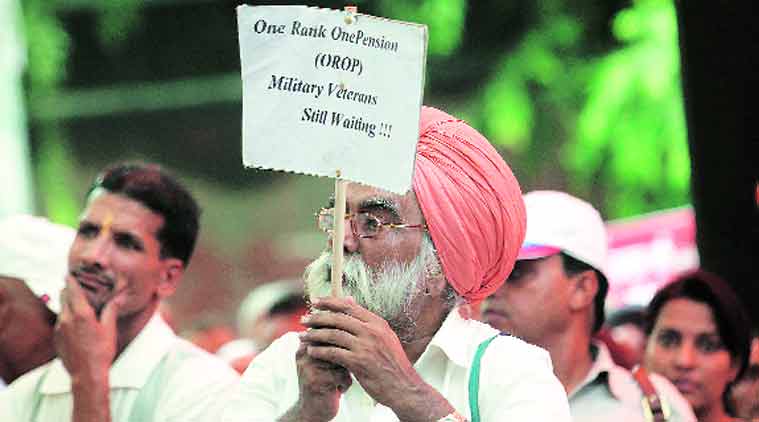
    Everything That You Need to Know on OROP


    • It is a pension scheme for the armed forces personnel which was in existence till 1973.
    • This scheme provided same pension for same rank and for the same length of service irrespective of the date of retirement which was the basis for determining the pension and benefits of the Indian Armed Forces till 1973.
    • OROP was terminated by the government in 1973.

    Which government was in power at that time and who was the PM of India?

    Then came the Koshiyari committee – 

    Bhagat Singh Koshiyari headed a committee which comprised 10 members (an all party parliamentary panel). It was formed in 2011.

    What were the recommendations of the committee?

    1. OROP should be implemented in the defence forces at the earliest and a separate commission should be formed to take decisions on pay allowances, pension, family pension etc. in respect of the defence personnel should be taken into the account by that committee.
    2. The committee recommended to absorb the Armed Forces personnel after their military engagement into other services of government which is a custom in countries like U.S. and China.

    What would be the financial Implications?

    1. Early estimates were around 3000crores for OROP.( by Ministry of Defence)
    2. Revised estimates vary between 8000 to 9000 crores.
    3. According to the Koshiyari committee the estimates for implementation of OROP were around 12000 crores.

    Is OROP expensive for the government?

    1. OROP is affordable by the government as it is a small fraction of the military pension budget.
    2. It includes about 4,00,000 defence civilians.
    3. Defence civilians, which includes the entire civilian bureaucracy in the ministry of defence ,retire at  the age of 60 are mostly based permanently in Delhi and they are not covered by OROP.
    4. It is alleged that they oppose the OROP due to their exclusion from the scheme.

    Government of India on OROP

    1. The government does not subscribe to the definition of Koshiyari committee, but states that there is a need for a new definition of OROP which should be acceptable to all the other ‘stakeholders’.
    2. The stakeholders were neither defined nor identified by the government.
    3. The government stand on the OROP prompted widespread dismay, disappointment and outrage amongst Armed Forces pensioners.
    4. The ministry of defence recommended the proposal for implementation after the approval of the Defence minister.
    5. Now it is with the of the Finance ministry which should make a call on the scheme.
  • Trans Pacific Partnership: Latest updates and developments


    What is the TPP?

    Trans-Pacific Partnership (TPP) is a trade agreement between several Pacific Rim countries concerning a variety of matters of economic policy.

    The aims of the TPP include the lowering of barriers to trade in goods and services, reducing tariffs to zero by 2015. In addition, the TPP hopes to promote investment and job creation in member states.


    How does it come into reality?

    TPP initially called the Trans-Pacific Strategic Economic Partnership Agreement, the pact began as a 2005 trade agreement between Brunei, Chile, New Zealand and Singapore in an effort to integrate their economies, drive growth and create unified regulations.

    In 2008, during the Bush administration, the U.S. joined talks to expand the agreement, along with Australia, Peru and Vietnam. The U.S. trade representative under Obama, Ron Kirk, declared the American interest in forging a broad-based regional pact.

    Then, in 2010, under the new name the Trans-Pacific Partnership, Malaysia entered the discussions, followed by Canada and Mexico in 2012.

    By 2013, Japan began participating in the talks. South Korea and Taiwan have subsequently announced their interest but not formal participation.

    Though all of the negotiating parties belong to the Asia-Pacific Economic Cooperation forum (APEC), the TPP is a separate initiative but with similar goals as APEC’s proposed Free Trade Area of the Asia Pacific.


    Why the Trans-Pacific Partnership Matters?

    The Pacific accord would phase out thousands of import tariffs as well as other barriers to international trade, like Japanese regulations that keep out some American-made autos and trucks.

    It also would establish uniform rules on corporations’ intellectual property, and open the Internet even in communist Vietnam.

    It eventually would end more than 18,000 tariffs that the participating countries have placed on American exports, including autos, machinery, information technology and consumer goods, chemicals and agricultural products as varied as avocados in California and wheat, pork and beef from the Plains states.

    The trade ministers who negotiated it predicted the overall economic and political heft of the 12-nation group would turn the accord into a model for future trade agreements.

    It would overhaul the system for settling disputes between nations and foreign companies, while barring tobacco companies from using that process to block countries’ antismoking initiatives.

    It also would enforce higher standards for labor conditions and environmental protection, including wildlife-trafficking.

    How will it benefits to USA ?

    Expanding the orbit of U.S. free trade is a major foreign policy goal of the Obama administration, and as a part of its desired international “pivot” toward Asia, it hopes to increase its economic presence in the region.

    Supporters of the partnership say by lowering barriers to trade and increasing avenues for economic globalization, the enlarged $2 trillion zone of diminished tariffs would stimulate employment in U.S. and provide an incentive to invest abroad.

    Agreement hopes to show China that the U.S. will remain a committed economic partner for the nations of the Pacific Rim, without excessively provoking Beijing.

    Who opposes the TPP?

    Opposition to the proposed agreement and to the perceived influence of multinational corporations in the process has been led by public health advocates, labor groups and environmentalists and politicians.

    Some U.S. legislators have voiced concerns that the TPP requirements would prevent access to medicine in developing countries, due to excessive patent protection. Doctors Without Borders argues against “dangerous provisions that would dismantle public health safeguards enshrined in international law.”

    Many activists also focused criticisms on the intellectual property section of the proposed partnership, which, according to WikiLeaks, could have “wide-ranging effects on medicines, publishers, internet services, civil liberties and biological patents.”

    As a trade agreement, the TPP would require House and Senate majorities and then the president’s signature. Domestic American opposition has concentrated their skepticism not just on how “free” the agreement would be but also on problems with the “fast track” congressional voting procedure.

    Japanese producers in the anime and manga industry say the TPP could damage their business by allowing companies to halt imports of intellectual property, in order to protect local distributors of licensed merchandise.

    Rice farmers, as well as beef, poultry and pork producers, have mounted firm resistance to the pact, which would dramatically decrease import tariffs.

    Geopolitically, China is concerned that the partnership is designed to exclude its economic activities, while some American officials have expressed doubts whether the market-oriented pact would ever be compatible with Beijing’s command economy.

    In Europe, analysts view the TPP as a trade regime that could set a precedent for the nascent Transatlantic Trade and Investment Partnership (TTIP).


    Published with inputs from Arun
  • Nobel and other Prizes

    Cells’ Toolbox for DNA repair honoured with Nobel Prize in Chemistry


    The Nobel Prize in Chemistry 2015 is awarded to Tomas Lindahl (UK), Paul Modrich (USA) and Aziz Sancar (USA) for having mapped, at a molecular level, how cells repair damaged DNA and safeguard the genetic information.

    Their work has provided fundamental knowledge of how a living cell functions and is, for instance, used for the development of new cancer treatments.

    What’s the DNA repair toolbox ?

    Each day our DNA is damaged by UV radiation, free radicals and other carcinogenic substances, but even without such external attacks, a DNA molecule is inherently unstable.

    Thousands of spontaneous changes to a cell’s genome occur on a daily basis. Furthermore, defects can also arise when DNA is copied during cell division, a process that occurs several million times every day in the human body.

    The reason our genetic material does not disintegrate into complete chemical chaos is that a host of molecular systems continuously monitor and repair DNA.

    The Nobel laureate scientists, who have mapped how several of repair systems function at a detailed molecular level.


    Tomas Lindahl – Puts together the pieces of base excision repair

    In the early 1970s, scientists believed that DNA was an extremely stable molecule, but Tomas Lindahl demonstrated that DNA decays at a rate that ought to have made the development of life on Earth impossible. This insight led him to discover a molecular machinery, base excision repair, which constantly counteracts the collapse of our DNA.

    This was the start of 35 years of successful work, during which Tomas Lindahl has found and examined many of the proteins in the cell’s toolbox for DNA repair.

    Bit by bit, Lindahl pieced together a molecular image of how base excision repair functions, a process in which glycosylases, enzymes similar to the one he had found in 1974, are the first step in the DNA repair process.

    Base excision repair also occurs in human beings and, in 1996, Tomas Lindahl managed to recreate the human repair process in vitro.

    The decisive factor for Tomas Lindahl was the realisation that DNA inevitably undergoes change, even when the molecule is located in the cell’s protective environment. However, it had long been known that DNA can be damaged by environmental assaults such as UV radiation.

    The mechanism used by the majority of cells to repair UV damage, nucleotide excision repair, was mapped by Aziz Sancar, born in Savur, Turkey, and professionally active in the USA.
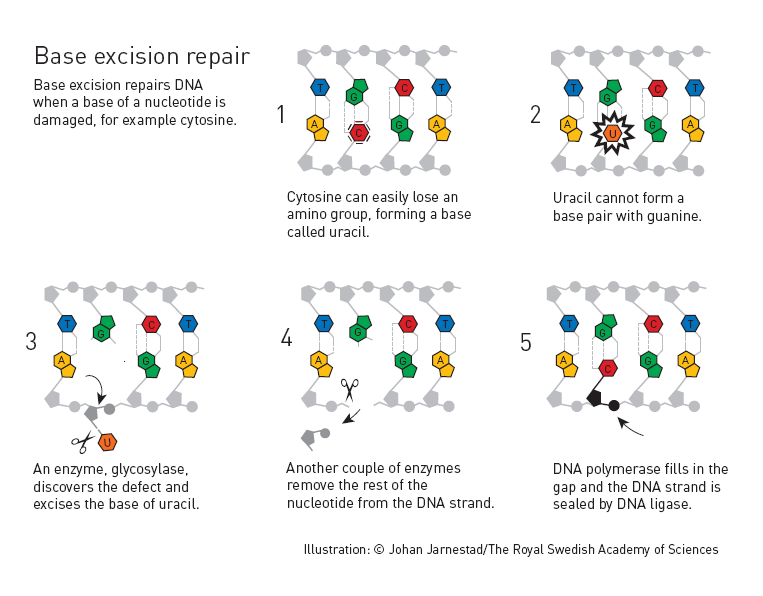
    Base Excision repair

    Aziz Sancar’s Nucleotide excision repair

    Aziz Sancar has mapped nucleotide excision repair, the mechanism that cells use to repair UV damage to DNA. People born with defects in this repair system will develop skin cancer if they are exposed to sunlight. The cell also utilises nucleotide excision repair to correct defects caused by mutagenic substances, among other things.

    Aziz Sancar’s ability to generate knowledge about the molecular details of the process changed the entire research field. He published his findings in 1983.

    He mapped the next stages of nucleotide excision repair. In parallel with other researchers, including Tomas Lindahl, Sancar investigated nucleotide excision repair in humans.

    The molecular machinery that excises UV damage from human DNA is more complex than its bacterial counterpart but, in chemical terms, nucleotide excision repair functions similarly in all organisms.
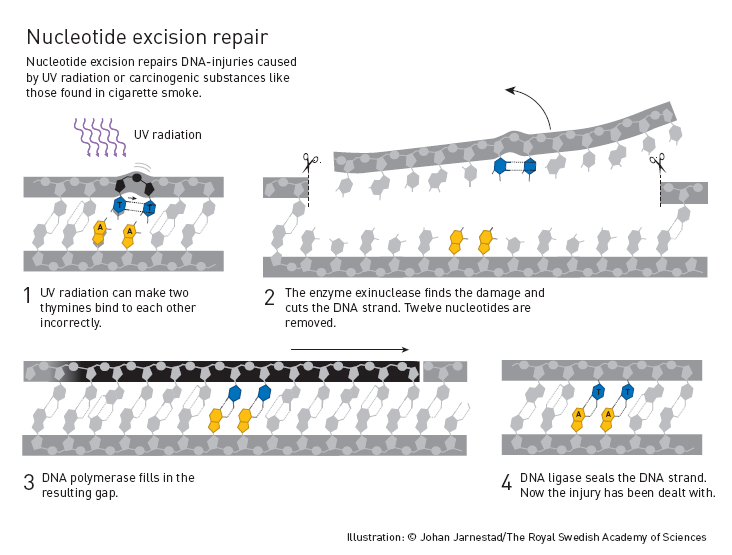
    nucleotide_excision_repair


    Paul Modrich – illustrating DNA mismatch repair

    Once his father, a biology teacher, said: “You should learn about this DNA stuff.” This was in 1963, the year after James Watson and Francis Crick had been awarded the Nobel Prize for discovering the structure of DNA.

    A few years later, that “DNA stuff” really became central to Paul Modrich’s life.

    Paul Modrich has demonstrated how the cell corrects errors that occur when DNA is replicated during cell division. This mechanism, mismatch repair, reduces the error frequency during DNA replication by about a thousandfold. Congenital defects in mismatch repair are known, for example, to cause a hereditary variant of colon cancer.

    In conclusion, the basic research carried out by the 2015 Nobel Laureates in Chemistry has not only deepened our knowledge of how we function, but could also lead to the development of lifesaving treatments.

    In the words of Paul Modrich: “That is why curiosity-based research is so important. You never know where it is going to lead… A little luck helps, too.”


    Irish-born William Campbell and Japan’s Satoshi Omura won half of the prize for discovering avermectin, a derivative of which has been used to treat hundreds of millions of people with river blindness and lymphatic filariasis, or elephantiasis.

    China’s Tu Youyou was awarded the other half of the prize for discovering artemisinin, a drug that has slashed malaria deaths and has become the mainstay of fighting the mosquito-borne disease. She is China’s first Nobel laureate in medicine.

    Lets’s talk about Satoshi Omura’s invention

    Satoshi Ōmura

    So, how did the journey start for Satoshi Omura?

    Satoshi Omura, a Japanese microbiologist and expert in isolating natural products, focused on a group of bacteria, Streptomyces, which lives in the soil and was known to produce a plethora of agents with antibacterial activities (including Streptomycin discovered by Selman Waksman, Nobel Prize 1952).

    Equipped with extraordinary skills in developing unique methods for large-scale culturing and characterization of these bacteria, Omura isolated new strains of Streptomyces from soil samples and successfully cultured them in the laboratory.

    From many thousand different cultures, he selected about 50 of the most promising, one of these cultures later turned out to be Streptomyces avermitilis, the source of Avermectin, a medicine that has nearly eradicated river blindness and radically reduced the incidence of filariasis, which can cause the disfiguring swelling of the lymph system in the legs and lower body known as elephantiasis.


    Bacteria.


    Puzzle about River Blindness?

    Also known as onchocerciasis or Robles’ Disease, is caused by transmission of the parasitic worm Onchocerca volvulus by black flies of the genus Simulium. Vector lives near rivers, thus the name.Inside the host, the worms create larvae that travel to the skin, and infect other flies that bite the victim.

    Symptoms include severe itching, eruptions under the skin, and blindness. About 17-25 million are infected; some 0.8 million have some degree of vision loss. Most infections in sub-Saharan Africa.

    Then, what about Lymphatic Filariasis or Commonly known as elephantiasis ?

    It is tropical disease caused by transmission of parasites classified as nematodes (roundworms) of the family Filariodideato, to humans by mosquitoes.

    Adult worms lodge in lymphatic system and disrupt immune system. Causes abnormal enlargement of body parts, pain, severe disability and social stigma.

    Over 120 million people are infected, about 40 million disfigured or incapacitated. About 1.23 billion in 58 countries are threatened, 80% of whom live in 10 countries, including India, Bangladesh and Nepal.


    Our next Pioneer William C. Campbell

    William C. Campbell

    An expert in parasite biology working in the USA, acquired Omura’s Streptomyces cultures and explored their efficacy.

    Campbell showed that a component from one of the cultures was remarkably efficient against parasites in domestic and farm animals.

    The bioactive agent was purified and named Avermectin, which was subsequently chemically modified to a more effective compound called Ivermectin. 

    Ivermectin was later tested in humans with parasitic infections and effectively killed parasite larvae (microfilaria) .

    Collectively, Omura and Campbell’s contributions led to the discovery of a new class of drugs with extraordinary efficacy against parasitic diseases.


    Scheme.


    What a breakthrough, China’s first Nobel laureate in medicine, Let’s talk about it?


    Youyou Tu

    Ms. Youyou Tu, won Nobel in Medicine for a therapy against malaria.

    Malaria was traditionally treated by chloroquine or quinine, but with declining success. By the late 1960s, efforts to eradicate Malaria had failed and the disease was on the rise.

    At that time, Youyou Tu in China turned to traditional herbal medicine to tackle the challenge of developing novel Malaria therapies.

    Tu revisited the ancient literature and discovered clues that guided her in her quest to successfully extract the active component from Artemisia annua. 

    Tu was the first to show that this component, later called Artemisinin, was highly effective against the Malaria parasite, both in infected animals and in humans.

    Artemisinin represents a new class of antimalarial agents that rapidly kill the Malaria parasites at an early stage of their development, which explains its unprecedented potency in the treatment of severe Malaria.


    Herbal medicine


    How do you think these inventions will change the world?

    The discoveries of Avermectin and Artemisinin have fundamentally changed the treatment of parasitic diseases.

    Ivermectin is highly effective against a range of parasites, has limited side effects and is freely available across the globe.

    The importance of Ivermectin for improving the health and wellbeing of millions of individuals with River Blindness and Lymphatic Filariasis, primarily in the poorest regions of the world, is immeasurable.

    Treatment is so successful that these diseases are on the verge of eradication, which would be a major feat in the medical history of humankind. Malaria infects close to 200 million individuals yearly.

    Artemisinin is used in all Malaria-ridden parts of the world. When used in combination therapy, it is estimated to reduce mortality from Malaria by more than 20% overall and by more than 30% in children. For Africa alone, this means that more than 100 000 lives are saved each year.

    The discoveries of Avermectin and Artemisinin have revolutionized therapy for patients suffering from devastating parasitic diseases.

    Campbell, Ōmura and Tu have transformed the treatment of parasitic diseases. The global impact of their discoveries and the resulting benefit to mankind are immeasurable.

    Published with inputs from Arun