💥UPSC 2026, 2027, 2028 UAP Mentorship (March Batch) + Access XFactor Notes & Microthemes PDF

Search results for: “”

  • Nikaalo Prelims Spotlight || Bilateral Relations


    Dear Aspirants,

    This Spotlight is a part of our Mission Nikaalo Prelims-2023.

    You can check the broad timetable of Nikaalo Prelims here

    Session Details

    YouTube LIVE with Parth sir – 7 PM  – Prelims Spotlight Session

    Evening 04 PM  – Daily Mini Tests

    Join our Official telegram channel for Study material and Daily Sessions Here


    18th Apr 2023

    Bilateral Relations

    1. Technology Innovation Hubs (TIH)
      Joint India-US research projects will be implemented through TIH.
      About TIH
      • It comes under National Mission on Interdisciplinary Cyber- Physical Systems (NM-ICPS) and is aimed at providing requisite infrastructure (testbeds and data sets), enabling collaboration (e.g. on AI and wireless) and encouraging exchange
      programmes.
      NM-ICPS was launched in 2018 for 5 year period to enable academia-industrygovernment collaboration and provide technical support for CPS implementations.
      Activities under NM-ICPS are: Technology Development; Human Resources and Skill development; Entrepreneurship; Innovations and International Collaborations.
    2. Non-nuclear aggression agreement
      • The Non-nuclear aggression agreement is a bilateral and nuclear weapons control treaty between the two South Asian states, India and Pakistan, on the reduction (or limitation) of
      nuclear arms and pledged not to attack or assist foreign powers to attack on each’s nuclear installations and facilities.
      • The treaty barred its signatories to carry out a surprise attack (or to assist foreign power to attack) on each other’s nuclear installations and facilities.
      • The treaty provides a confidence-building security measure environment and refrained each party from “undertaking, encouraging, or participating in directly or indirectly, any action
      aimed at causing destruction or damage to any nuclear installation or facility in each country”.
      • Starting in January 1992, India and Pakistan have annually exchanged lists of their respective military and civilian nuclear-related facilities.
    3. Foundational agreements between India and US
      The United States signs “foundational agreements” with its defence partners. These are “routine” agreements and include:
      General Security of Military Information Agreement (GSOMIA):
      ● (a military information agreement) was the first of the foundational agreements to be signed in 2002
      ● It essentially guaranteed that the two countries would protect any classified information or technology that they shared
      ● It was aimed at promoting interoperability and laid the foundation for future US arms sales to the country.
      LEMOA (logistics exchange agreement):
      ● It was signed in 2016
      ● It provides the framework for sharing military
      logistics, for example for refueling and replenishment of
      stores for ships or aircraft transiting through an Indian/US facility
      COMCASA (communications security agreement):
      ● It was signed in 2018
      ● This enables the US to supply India with its
      proprietary encrypted communications equipment and
      systems, allowing secure peacetime and wartime
      communications between high-level military leaders on both sides.
      Basic Exchange Cooperation Agreement (BECA) signed in 2020:
      ● BECA will help India get real-time access to American geospatial intelligence that will enhance the accuracy of automated systems and weapons like missiles and armed drones.
      ● Through the sharing of information on maps and satellite images, it will help India access topographical and aeronautical data, and advanced products that will aid in navigation and targeting.
    4. Supporting Entrepreneurs in Transformation and Upskilling (SETU)
      Supporting Entrepreneurs in Transformation and Upskilling (SETU) will connect start-ups in India with USbased investors, mentors and leaders.
      • SETU is designed to break the geographical barriers between mentors based in US that are willing to invest in entrepreneurship and sunrise startups in India.
      • The interaction will be supported through the mentorship portal under the Startup India initiative MAARG, or the Mentorship, Advisory, Assistance, Resilience, and Growth program, which is a single-stop solution finder for startups in India.
      • The core functions of MAARG are to improve ease of access, use Artificial Intelligence for Matchmaking, schedule meetings virtually, host masterclasses, provide a custom dashboard
      for relevant information, analytics, features, etc., host cohort-based programs that will allow startup ecosystem enablers to be become a part of the program and enable outcome driven
      activities.
    5. International North-South Transport Corridor (INSTC)
      INSTC is a 7,200-km multi-modal transport corridor that combines road, rail and maritime routes connecting Russia and India via Central Asia and Iran. The corridor is expected to consolidate the emerging Eurasian Free Trade Area.
      • Legal Framework: The legal framework for the INSTC is provided by a trilateral agreement signed by India, Iran and Russia at the Euro-Asian Conference on Transport in 2000.
      Significance of INSTC:
      • Reduce freight costs by 30% and the journey time by 40% in comparison with the conventional deep-sea route via the Suez Canal
      • Complement East-West axis: INSTC can shape a north-south transport corridor that can complement the east-west axis of the China-led Belt and Road Initiative (BRI).
      • Bypass Pakistan to access Afghanistan, Central Asia and beyond
      • Departure from non-alignment to multi-alignment: E.g., India’s working under QUAD, SCO and INSTC.
      • ‘Chabahar Day’ is observed to promote Chabahar – Ministry of Port, Shipping and Waterways (MoPSW) in association with India Ports Global observed ‘Chabahar Day’ to mark the Chabahar – Link to INSTC – Connecting Central Asian Markets.
    6. Mahakali Treaty
      Mahakali Treaty is an agreement between the Government of Nepal and the Government of India regarding the development of watershed of Mahakali River. The treaty recognizes the Mahakali River as a boundary river between the two countries.
    7. Kushiyara river treaty between India and Bangladesh
      ● A memorandum of understanding (MoU) was signed on sharing of the waters of the Kushiyara river(distributary of the Barak river)which flows through Assam, and then on to
      Bangladesh.
      What is the Kushiyara agreement?
      ● Under the agreement, Bangladesh will be able to withdraw 153 cusecs (cubic feet per second) of water from the Kushiyara which will solve the water crisis for farmers of Sylhet.
      ● The water of Kushiyara will be channelled through the Rahimpur Canal project in Sylhet.
      ● Rahimpur canal is the only supplier of water from the Kushiyara to the region.
    8. Indus Water Treaty
      India and Pakistan signed the treaty in 1960 after nine years of negotiations, with the Washington-based World Bank being a signatory.
      The treaty sets out a mechanism for cooperation and information exchange between the two countries regarding their use of the rivers.
      Under the Indus Water Treaty (IWT), all the waters of the eastern rivers—Sutlej, Beas, and Ravi—is allocated to India for
      unrestricted use.
      The waters of western rivers—Indus, Jhelum, and Chenab have been assigned largely to Pakistan.

      Permanent Indus Commission:
      ● The Permanent Indus Commission is a bilateral commission of officials from India and
      Pakistan, created to implement and manage goals of the Indus Waters Treaty, 1960.
      ● The Commission according to the treaty must meet regularly at least once a year, alternately
      in India and Pakistan.
      The functions of the Commission are:
      ● to study and report to the two Governments on any problem relating to the development on
      the waters of the rivers.
      ● to solve disputes arising over water sharing.
      ● to arrange technical visits to projects’ sites and critical river head works.
      ● to undertake, once in every five years, a general tour of inspection of the Rivers for
      ascertaining the facts.
      ● to take necessary steps for the implementation of the provisions of the treaty.

  • [Burning issue] Extra judicial killings in India

    kill

    Context

    • The Uttar Pradesh Special Task Force has recently encountered two persons who were wanted in connection with a murder case.
    • The incident has again highlighted the issue of extra-judicial killings or encounters by security forces.
    • In this context, this edition of the Burning Issue will deal with the issue of extra-judicial killings.

    What Are Extra-Judicial Killings?

    • Extra-judicial killing occurs when a person is killed by governmental authorities without a judicial decision or hearing on the case. In India, it is also known as extra-legal killing or encounter killing.

    History of Extra-Judicial Killings in India

    • In the past, the Indian subcontinent has seen a lot of things that led to the current situation of encountering killing.
    • Ancient: Manusmriti and other ancient Hindu texts provide insight into the Indian criminal law system of the past. The Manu-Smriti says that torture is necessary to stop crimes and keep society peaceful. The Indian kings used torture to uncover the truth and solve crimes, adhering to the previous system.
    • Medieval: The rule of “eye for an eye” was upheld when Mughal rulers were present. The British rulers in India accepted torture as a method of questioning the accused after the Mughals.
    • Present: Despite the fact that the Indian judiciary is founded on the principle of “innocent until proven guilty,” the Indian police still employ torture and humiliation as methods of interrogation today.

    Encounter Law in India

    • No specific law: There is no specific encounter law in India. But there are certain situations described by the Indian Penal Code in which a civilian or a government entity can take another person’s life.
    • Only in self-defence: The law allows the state authorities to kill another person during an investigation only when it’s a matter of self-defence. There are provisions in the Indian Penal Code citing the same.
    • IPC Section 100: states that a person can take another person’s life only in the following situations:
    • If the assault leads to another death otherwise or a very serious injury as a consequence.
    • If the assault is carried out with the intent of rape, satisfying unnatural lust, or kidnapping.
    • If the assault is carried out with the intent of wrongfully trapping a person, where he cannot seek the help of public authorities for his liberation.

    What is the legislative status in India?

    • No Legislation – No law in India exclusively defines encounter killings.
    • Indian Penal Code – Sections 96-106 of the Indian Penal Code, 1860 deal with the Right to Private Defence. Under these sections, death in an encounter will not amount to a criminal offence, when it is done in self-defence.
    • CrPC – Section 46 of the Criminal Procedure Code (CrPC), 1973 allows police officers to use any degree of force which is required to arrest the accused or prevent the accused from escaping.
    • Supreme Court judgment: The Supreme Court in Om Prakash Vs the State of Jharkhand (2012) stated that extra-judicial killings are not recognized as legal by our criminal justice administration system and amount to State-sponsored terrorism.

    Constitutionality of Extra-Judicial Killings

    • Extra-judicial killings also serve as an attack on the fundamental rights of the citizens. The fundamental rights which are violated because of these unlawful killings are:
    • Article 21– the right to life and personal liberty except according to procedure established by law.
    • Article 22– the right to be protected against arrest and detention.

    The Reason for Extra-judicial Killings

    • Support from politicians: Indian political leaders occasionally tout the accomplishments of their state police in keeping the region’s peace, such as the number of encounters they have recorded.
    • Support from the masses: People in general once in a while upholds these experience killings since they feel that the legal executive cannot make an opportune judgment.
    • Work stress: When wrongdoing is perpetrated, the police need to pursue settling it. Because there are approximately 150 police officers for every one million people in India, the police are frequently understaffed.
    • Weak human rights organizations: When it comes to criticizing the killings, the State Human Rights Commission (SHRC) and the National Human Rights Commission (NHRC) are not as effective as they should be.
    • Rewards for encounters: The experience encounter executioners are compensated with monetary rewards, grants and motivators to lead the kills.
    • Glorification of extra-judicial killings: The encounter killers are sometimes viewed by the general public as heroes who are punishing criminals. In Bollywood films, extrajudicial killings are glorified by having the hero engage in a confrontation and claim it to be justice.

    What is the status of extra-judicial killings in India?

    • 5-fold increase: A report states that the number of encounter killings has nearly multiplied by five over the past six years.
    • In the six years between 2016-17 and 2021-22, India’s registration of encounter-killing cases decreased by 15%.
    • From 2016 to 2021, India recorded 813 encounter killings. Between 2021 and 2022, the number of cases increased by 69.5 per cent.
    • While there was a critical drop in these cases during the pinnacle of the Coronavirus pandemic – from 112 of 2019-’20 to 82 in 2020-’21 – there was a 69.5% spike the following year with 139 cases.

    State-wise analysis:

    • In their unofficial “Operation Langda” mission, the Uttar Pradesh Police shot and wounded more than 3,300 criminals in 8,472 encounters.
    • Chhattisgarh had the most extrajudicial killings with 259 in the six years since April 2016, followed by Uttar Pradesh with 110 and Assam with 79.
    • In the past six years, the number of extrajudicial killings in Uttar Pradesh has more than doubled.

    Why do encounter killings receive the support of the masses?

    • The common man in India is very unsatisfied with the long and tiring police investigations and judicial procedures. Sometimes, the accused are not punished because of the absence of proof or are given less severe than they deserve.
    • In such a situation, many believe that encountering killings are a way to speedy justice.

    A negative outcome of these killings

    • Loss of life: The most obvious negative outcome of a fake encounter is the loss of life of an innocent person. If the police use excessive force or fake evidence, they can end up killing an innocent person.
    • Violation of human rights: A fake encounter by the police is a violation of the fundamental human right to life. It is also a violation of the right to a fair trial and due process of law.
    • Damage to public trust: When the police are found to have been involved in a fake encounter, it can damage public trust in law enforcement. This can lead to increased mistrust and hostility towards the police.
    • Increase in crime: If the public loses trust in the police, they may be less likely to cooperate with law enforcement in investigations. This can lead to an increase in crime and a decrease in public safety.
    • Rise of a retributive society: such incidents lead to the rise of revenge feelings against society, government and police leading to rise of new criminals.

    How to control extra-judicial killings?

    NHRC Guidelines

    • In March 1997, Justice M. N. Venkatachaliah (the then chairperson of the NHRC), asked all states and UTs to ensure that police follow the following set of guidelines in cases of encounter killings:
    • Launching an FIR: At the point when the responsible for a Police headquarters gets data about the passings in an experience, he will keep that data in the proper register.
    • Proper Investigation: The information that is received shall be deemed sufficient to constitute a suspicion, and immediate action must be taken to investigate the relevant facts and circumstances that led to the death in order to determine, if any, the nature and perpetrator of the offense.
    • Compensation if found innocent: It tends to be allowed to the wards of the departed when the cops are indicted based on the after-effects of the examination.
    • Independent Organization: It is appropriate to refer the cases for investigation to some other independent investigation agency, such as State CID, whenever the encounter party consists of police officers from the same police station. These guidelines were extended in 2010 by the NHRC to include:
    • Authoritative Test: An authoritative inquiry should be held in all instances of death which happen throughout police activity, as quickly as could be expected (ideally in three months or less).
    • Making a Commission Report: Within 48 hours of death, the Senior Superintendent of Police/Superintendent of Police of the District is required to report any police-related deaths to the Commission.
    • Within three months, a second report containing information such as a post-mortem report and findings must be submitted to the Commission in all instances.

    Supreme Court 16-point guidelines

    • In 2014, the Supreme Court in the PUCL Vs State of Maharashtra case formulated 16-point guidelines on extra-judicial killings. Some of the guidelines include prompt action, FIR registration, independent investigation etc. The National Human Rights Commission (NHRC) has also laid down strict guidelines that government officials must follow in the case of extra-judicial killing.

    Way Forward

    • For the credibility of the rule of law to be maintained, encounter killings must be thoroughly investigated.
    • The state government is responsible for upholding the rule of law and instructing police officers on how to handle unforeseen circumstances and safeguard those in custody.
    • In addition, the criminal justice system must be completely overhauled and necessary police reforms must be implemented.
    • Respect for human rights must be instilled in officers involved in the increasing number of encounter killings.
    • UN Convention against Torture – India should take immediate measures to ratify UN Convention against Torture and the enactment of the Prevention of Torture Bill, 2017.
    • Strict Implementation – Ensure the strict implementation and monitoring of the Supreme Court and the NHRC guidelines on fake encounter deaths.

    Conclusion

    • ‘The rule by gun’ should not be preferred to ‘the rule of law’. The fundamental premise of the rule of law is that every human being, including the worst criminal, is entitled to basic human rights and due process.
    • Unless it is for self-defense, all extra-judicial killings are otherwise unacceptable in a society of law.
    • The need of the hour is to rebuild the lost trust in the justice delivery mechanism in the country and fast-track the process.
    • We must recall what the Supreme Court said in the Salwa Judum case (2011):

    The primordial value is that it is the responsibility of every organ of the State to function within the four corners of constitutional responsibility. That is the ultimate rule of law.

  • What is Ninth Schedule of the Constitution?

    Central idea: Chhattisgarh CM has written to the Prime Minister seeking the inclusion of two amendment Bills allowing for higher quotas in jobs and educational institutions in the Ninth Schedule of the Constitution.

    What is Ninth Schedule?

    • The Ninth Schedule is a legal provision in the Constitution of India that provides immunity to certain laws from judicial review.
    • It is a list of Central and State laws that are immune from judicial review.
    • These laws are not subject to judicial scrutiny or challenge in any court of law, including the Supreme Court of India.
    Details
    Definition A list of Central and State laws that are immune from judicial review.
    History Added to the Constitution by the First Amendment in 1951.
    Purpose back then To protect land reforms and other progressive laws from being challenged in courts.
    Significance Used to protect laws related to land reforms, reservation in education and employment, anti-defection laws, and other progressive measures aimed at social justice and equality.
    Criticisms Criticised for shielding unconstitutional laws and violating fundamental rights.

    Supreme Court of India has struck down several laws in the Ninth Schedule on the grounds that they violate the basic structure of the Constitution.

    Amendment Constitution (Ninety-Sixth Amendment) Act, 2001 added a provision stating that any law added to the Ninth Schedule after April 24, 1973, can be challenged in courts on the ground that it violates the fundamental rights guaranteed by the Constitution.


    What is the request made by CG CM?

    • In Chhattisgarh’s case, the two amendment Bills were passed unanimously by the State Assembly paving the way for 76% quota for Scheduled Caste, Scheduled Tribes and Other Backward Classes.
    • However, the Bills are yet to receive the Governor’s nod.
    • The Chhattisgarh High Court had struck down a 2013 State government order to allow 58% quota, holding that reservation above the 50% ceiling was “unconstitutional.”

    Request for Inclusion in Ninth Schedule

    • The CM presented the demographics of the State and wrote that the socio-economic and educational condition of the OBC people of the State is as weak as that of the SC/ST people.
    • He argued that the inclusion of the amended provision in the Ninth Schedule of the Constitution is necessary for the people of the deprived and backward classes to get justice.


  • WTO panel rules against India in IT tariffs dispute


    A World Trade Organization (WTO) panel has ruled that India has violated global trading rules in a dispute with the European Union (EU), Japan, and Taiwan over import duties on IT products.

    About World Trade Organization (WTO)

    Details
    Purpose Regulate and facilitate international trade between nations
    Establishment 1995
    Headquarters Geneva, Switzerland
    Membership 164 member countries as of 2023, representing over 98% of global trade
    Goal Promote free and fair trade by negotiating and enforcing rules and agreements governing international trade
    Agreements Administers a number of agreements, including GATT, SPS Agreement, and TRIPS Agreement
    Dispute Resolution Operates a dispute settlement system to resolve conflicts between member countries
    Technical Assistance Provides technical assistance and training to help developing countries participate more effectively in international trade
    Decision-Making Body Ministerial Conference, which meets every two years
    Director-General Chief executive responsible for overseeing the organization’s operations and activities
    Criticisms Some criticize the WTO for being undemocratic, favoring developed countries, and not doing enough to promote labor and environmental standards in international trade


    What was the case?

    • The case involved a dispute over India’s introduction of import duties ranging from 7.5% to 20% on a wide range of IT products, including mobile phones, components, and integrated circuits.
    • The EU, Japan, and Taiwan challenged these import duties in 2019, arguing that they exceeded the maximum rate allowed under global trading rules.
    • The recent ruling by the WTO panel found that India had violated these rules and recommended that India bring its measures into conformity with its obligations.

    WTO Panel’s Ruling

    • The WTO panel has ruled that India violated global trading rules by imposing these import duties.
    • The panel recommended that India bring these measures into conformity with its obligations.
    • While the panel broadly backed the complaints against India, it rejected one of Japan’s claims that India’s customs notification lacked “predictability”.

    Implications of the ruling

    • The EU is India’s third-largest trading partner, accounting for 10.8% of total Indian trade in 2021, according to the European Commission.
    • The ruling could have implications for trade relations between India and the EU, as well as Japan and Taiwan.
    • India may be required to lower or eliminate the challenged import duties.
    • It remains to be seen whether India will appeal against the ruling.
    • If it does, the case will sit in legal purgatory since the WTO’s top appeals bench is no longer functioning due to US opposition to judge appointments.

    Conclusion

    • The panel recommended that India bring such measures into conformity with its obligations, and it remains to be seen whether India will appeal against the ruling.
    • The case highlights the importance of complying with global trading rules and the role of the WTO in resolving trade disputes between countries.


  • What is Great Pacific Garbage Patch?

    pacific

    Central idea: The article reports on a recent study which found evidence that coastal life forms have colonized plastic items in the Great Pacific Garbage Patch, a vast area in the North Pacific Ocean where plastic waste has accumulated due to ocean currents.

    What is the Great Pacific Garbage Patch (GPGP)?

    Features
    Location North Pacific Subtropical Gyre (NPSG), north of the equator in the Pacific Ocean
    Currents Kuroshio, North Pacific, California, and North Equatorial currents, moving in a clockwise direction
    Sources Any trash that enters one of these currents from any of the 51 Pacific Rim countries
    Size Estimated to be 1.6 million sq. km
    Age More than 50 years old
    Plastic Content Estimated to contain 45,000-129,000 metric tonnes of plastic, predominantly in the form of microplastics
    Visible Objects Heavier, more visible objects that haven’t yet broken down into smaller particles accounted for 92% in 2018


    Findings of the new study

    • Researchers from Canada, the Netherlands, and the U.S. have reported that coastal life forms have colonized plastic items in the Great Pacific Garbage Patch.
    • From November 2018 to January 2019, they collected 105 pieces of plastic debris, the most heavily plastic-polluted ocean gyre on the globe.
    • Based on studying them, they reported that 98% of the debris items had invertebrate organisms.

    Plastic inflicting into a coastal organism

    • Organisms found on coasts were getting by on small floating islands of garbage out in the Pacific Ocean, which the researchers named the neopelagic community.
    • They found organisms belonging to 46 taxa, and 37 of them were coastal; the rest were pelagic. Among both coastal and pelagic organisms, crustaceans were the most common.
    • Nearly all taxa were of Northwest Pacific origin, including Japan.
    • Eight of the remainder were from East Asia and five specifically from Japan. Four items were from North America.
    • They found that 68% of the coastal taxa and 33% of the pelagic taxa reproduced asexually and that there was evidence of sexual reproduction among the hydroids and the crustaceans, among others.

    Implications of the findings

    • Marine plastic pollution has given rise to a new kind of standing coastal community in the open ocean.
    • The neopelagic community is not misplaced but lives on plastic items in the garbage patch, including reproducing there.
    • The finding recalls other studies that show the chemical bonding of plastic with rocks, sedimentary rocks embedded with plastic earrings in Brazil, and the formation of plastiglomerates in Hawaii.


    What is neopelagic community?

    • The neopelagic community refers to the group of organisms that inhabit the open ocean or the pelagic zone beyond the continental shelf.
    • It is characterized by deep waters with very few physical structures or substrate for organisms to attach to.
    • This community includes a wide variety of organisms, including zooplankton, fish, squid, and marine mammals, among others.
    • These organisms have adapted to survive in the open ocean environment, which can be quite challenging due to factors such as temperature fluctuations, limited food availability, and the absence of physical structures for shelter.
    • The neopelagic community is an important part of the global marine ecosystem, playing a key role in nutrient cycling and energy transfer between different levels of the food chain.


    GPGP and its impact on marine life

    • The GPGP has significant impacts on marine life due to the ingestion of plastic by marine animals, which can cause harm and even death.
    • Plastic can also entangle and suffocate marine animals, leading to the disruption of ecosystems.
    • The new study sheds light on the neopelagic community, which has adapted to living on plastic in the garbage patch.

    Plastic pollution and its environmental impact

    • Plastic pollution is a major environmental issue that affects land and water ecosystems worldwide.
    • Plastic waste can take hundreds of years to decompose, and even then, it breaks down into microplastics that can persist in the environment indefinitely.
    • The presence of plastic in the environment has negative impacts on biodiversity, ecosystem function, and human health.

    Conclusion

    • There are various solutions to plastic pollution, including reducing the use of single-use plastics, recycling, and promoting alternative materials.
    • Governments and industries can also take steps to reduce plastic waste, such as implementing policies and regulations that reduce plastic use and increase recycling.
    • Individual actions, such as reducing personal plastic consumption and properly disposing of plastic waste, can also make a difference.


  • What is Polar Crown Prominence (PCP)?

    crown

    Central idea: The article talks about an astrophotographer named Andrew McCarthy capturing an image of a plasma waterfall on the sun. The phenomenon is called Polar Crown Prominence (PCP).

    Polar Crown Prominence (PCP)

    • PCP is a solar phenomenon that occurs on the sun’s Polar Regions.
    • It is a type of solar prominence, which is a large, bright, gaseous feature that extends out from the sun’s surface.
    • A solar prominence is a large, bright, gaseous feature that extends out from the sun’s surface.
    • It is made up of ionized gas (plasma) that is held in place by magnetic fields.
    • Prominences are visible during total solar eclipses and can also be observed using specialized telescopes.
    • PCPs are often associated with sunspots, which are dark regions on the sun’s surface that are caused by magnetic activity.

    How are PCPs Formed?

    • PCPs are formed by the interaction of magnetic fields on the sun’s surface.
    • Magnetic fields are created by the movement of charged particles (plasma) in the sun’s interior.
    • When these magnetic fields interact, they can create regions of intense magnetic activity, such as sunspots.
    • PCPs are often associated with these regions of magnetic activity.

    Why are PCPs Important?

    • PCPs are important because they provide clues about the sun’s magnetic activity and how it affects the Earth’s environment.
    • Solar activity, including PCPs, can cause disturbances in the Earth’s magnetic field, which can lead to auroras and disruptions in communication systems.


  • India’s first Mangrove Pitta Birds Census conducted in Odisha

    pitta

    Central idea: The article talks about the first-ever census of mangrove pitta birds conducted in two coastal districts of Odisha, India.

    About Mangrove Pitta

    • The mangrove pitta (Pitta megarhyncha) belongs to the family of pittas, the Pittidae.
    • The mangrove pitta species is distributed in India, Bangladesh, Myanmar, Thailand, Malaysia, Singapore and Indonesia.
    • These pitta species have fragmented distribution and considered ‘Near Threatened’ by IUCN. These pittas are monotypic species.

    Focus of the Census

    • In this census, a total of 179 individual mangrove pitta birds were counted.
    • The census mainly focused on the mangrove patches along the coasts of Kendrapara and Jagatsingpur districts.
    • Information was collected on the distribution, habitat, and breeding of mangrove pittas along the coastal mangroves.
    • The census was carried out by point count method, either by walking in the forest or using country boats in the creeks.


  • 5 hr/day prep strategy for IAS 2024 aspirant with a serious time crunch | 1-1 LIVE Masterclass + QnA session by IRPS Prabhat sir | Get FREE Strategic package on registration

    5 hr/day prep strategy for IAS 2024 aspirant with a serious time crunch | 1-1 LIVE Masterclass + QnA session by IRPS Prabhat sir | Get FREE Strategic package on registration

    (Concluded Successfully) UPSC 2024: 5-hour prep strategy for College aspirants and working professionals | 1-1 LIVE Masterclass + Q&A session by IRPS Prabhat Sir.

    🚨What you should expect in 1-1 LIVE with Prabhat Sir

    Can college aspirants & working Professionals Clear UPSC with a serious time crunch?

    This is the most familiar & much-debated question that candidates have. The answer is yes, and why not? If you simply sidestep irregular reading habits & comes under prominent mentos, you’re eligible to crack UPSC-CSE with a single-digit rank.

    Our ‘Hall Of Fame working ProfessionalsVaibhav Rawat (AIR 25), Ravi Kumar (AIR 84), and College going student-Tina Dabi (AIR-1) and Kamya Mishra (AIR-172) have already busted the myth that only full-time aspirants can become an IAS.

    Preparing with a full-time job was the best decision…and CivilsDaily made it easy for me.

    Mantri Mourya, AIR 28, UPSC 2021

    Cracking UPSC is an art of excellence & can be achieved even by improving by 1% Per day. All it wants are willpower, effort, and systematic practice. And you can bring this 1% improvement if you’re ready to dedicate only 5 hrs every day to your IAS dream. 

    Prabhat sir’s step-by-step 5-hour learning strategy enables you to manage to work hard in your respective jobs and studies and taste success aftermath.

    upsc 2024
    IRPS, Prabhat Singh will be taking up a UPSC 2024 masterclass

    UPSC 2024 Workshop on 17th April 2023, Monday

    Strategies & Approaches, in This Free Live Workshop by Prabhat Sir!

    • How to manage time for UPSC Preparation if you’re a working Professional or a college student? How to utilize the time, left in your hand, in the best possible way?
    • UPSC preparation timetable and schedule with just 5 hrs of daily study time?
    • How to identify those people or things that deplete your energy and waste your time?
    • How to break down the syllabus into small chunks, and develop an effective & workable study strategy for UPSC preparation.
    • How to complete the syllabus, in a short time! 
    • How to prioritize conventional topics/subjects?
    • How to divide your time and keep a balance between Prelims and mains preparation?
    • Selective reading or studying: How to deal with the ocean of current affairs and a mountain of GS?
    • How to tackle Optional subject preparation, Making Notes, and improving answer writing habits in a short time
    • Many more untold tips and techniques that only a topper can elaborate

    A lot more crucial points will be discussed to smoothen your IAS journey.

    Details of UPSC Workshop Day-1: 2 Foolproof Frameworks for Mains answer writing by Sukanya Ma’am


    CivilsDaily’s FREE Webinar package

    Post-webinar we will share important PDFs, timetable framework, and notes.

    Other than this a strategy package will be emailed to you.


    What The Hindu opined about Civilsdaily Mentorship

    best coaching for upsc in delhi

  • Election Commission Revised It’s List of National and State Parties

    Central Idea

    • The Election Commission of India (EC) recently revised its list of recognised national and state parties.

    The EC’s decision

    • The EC recognised AAP as a national party and revoked the national party status of TMC, NCP and CPI.
    • It also revoked the state party status granted to Rashtriya Lok Dal in Uttar Pradesh, Bharat Rashtra Samithi in Andhra Pradesh, People’s Democratic Alliance (Manipur), Pattali Makkal Katchi (Puducherry), Revolutionary Socialist Party (West Bengal) and Mizoram People’s Conference (Mizoram).
    • The EC laid down strict technical criteria for a party to be recognised as a national party, based entirely on its electoral performance. A party may gain or lose national/state party status from time to time, depending on the fulfilment of these conditions.

    Process of recognition and derecognition

    • Election Symbols Order, 1968: The process of recognition and derecognition is stipulated under the Election Symbols (Reservation and Allotment) Order, 1968, which lays down the criteria for recognition as a national or state party.
    • Specific stipulations: The order has specific stipulations which also find concurrence in the EC’s Political Parties and Election Symbols, 2019 Handbook.
    • Based on poll performance: The EC’s decision was based on a review of the parties’ poll performances since 2014.

    What is a National Party?

    • The name suggests that a national party would be one that has a presence ‘nationally’, as opposed to a regional party whose presence is restricted to only a particular state or region.
    • National parties are usually India’s bigger parties.
    • However, some smaller parties, like the communist parties, are also recognised as national parties.
    • A certain stature is sometimes associated with being a national party, but this does not necessarily translate into having a lot of national political clout.

    Criteria for recognition of political parties

    Criteria National Party State Party
    At least 6% of valid votes in 4+ states OR 4 Lok Sabha seats from at least 3 states OR recognition as a state party in at least 4 states
    2% of all Lok Sabha seats in the last such election, with MPs elected from at least three states.
    Two seats plus a 6% vote share in the last Assembly election in that state
    One seat plus a 6% vote share in the last Lok Sabha election from that state
    3% of the total Assembly seats or 3 seats, whichever is more.
    One of every 25 Lok Sabha seats (or an equivalent fraction) from a state.
    An 8% state-wide vote share in either the last Lok Sabha or the last Assembly polls.

    Benefits of recognition as a national party

    Benefit Description
    Election symbol The election symbol of the party will remain unchanged across India, making it easier for voters to identify and vote for the party.
    Free broadcast/telecast time National parties get free broadcast/telecast time on Akashvani and Doordarshan during the general election, giving them greater visibility and reach.
    Star campaigners National parties can have a maximum of 40 star campaigners whose travel expenses will not be counted in the accounts of the candidates.
    Consultation with the Election Commission National parties will have the privilege of consultation with the EC in the setting of election dates, and giving inputs in setting electoral rules and regulations.
    Top slots on the EVM/ballot paper Top slots on the EVM/ballot paper are reserved for national parties, giving them greater visibility and prominence on the ballot.

     Perception and legal challenges

    • The greater impact, however, will be concerning the public perception of the party, which is why many who have lost national party status are planning to go to courts.
    • Some parties are questioning the power of the EC though it stands legitimised by the Supreme Court.
    • The EC has no discretion in the matter as the rules are very specific and repeatedly emphasise that a party is eligible if, and only if it fulfils all criteria.

    Conclusion

    • The EC’s decision to revise the list of recognized national and state parties has faced legal challenges from some parties questioning the power of the EC. However, the EC’s decision is based on strict technical criteria laid down by the EC and the process of recognition and derecognition is stipulated under the Election Symbols (Reservation and Allotment) Order, 1968.

    Mains Question

    Q. The Election Commission of India (EC) recently revised its list of recognised national and state parties. In this light highlight the criteria for recognition of political parties and discuss the benefits of recognition as a national party

  • [Sansad TV] Perspective: Global Debt Distress 

    [Sansad TV] Perspective: Global Debt Distress 

    Central idea: Surging global debt

    • Reiterating that addressing the growing sovereign debt distress globally was a priority for India’s G20 presidency.
    • Globally, at least 21 countries are in default or seeking restructuring.

    G20 discussion on Sovereign Debt

    At the 2023 Spring Meetings of the IMF and the WB Group, the Global Sovereign Debt Roundtable (GSDR) has agreed on urgently improving information sharing on macroeconomic projections, at an early stage of debt restructuring processes.

    About GSDR

    • A platform established in Feb 2023, co-chaired by IMF, World Bank, and India (G20 Presidency).
    • Comprises official bilateral creditors, private creditors, and borrowing countries.
    • Aims to build common understanding among stakeholders involved in debt restructuring and address shortcomings in the process.
    • Focuses on process and standards, not meant to discuss country cases or replace existing restructuring mechanisms.
    Global Debt Distress: Key Stats

    Last week, IMF said that 15% of low-income countries are already in debt distress; another 45% are vulnerable; and a quarter of emerging economies are at high-risk.A report by UN conference on trade and development says that high interest rates combined with soaring debt levels will add to the crushing effect on developing countries.This crisis is up to the tune of at least $800 billion.According to World Bank data, in 2022, the world’s poorest countries owed $35 billion as debt-service payments to official and private-sector creditors, with China alone accounting for over 40% of the total dues.The Russia-Ukraine war has only aggravated their debt sustainability problem by setting off an energy-and-food crisis.
    debt

    General factors responsible for Debt Distress

    • High Public Spending: When governments spend beyond their means, they must borrow to finance their spending. This can lead to the accumulation of debt over time, especially if the government’s spending is not matched by a corresponding increase in revenue.
    • Decline in Exports: When a country’s exports decrease, it can lead to a decline in foreign currency earnings, making it more difficult for the country to service its foreign currency-denominated debts. This situation can be especially challenging for countries that rely heavily on exports for their economic growth.
    • Weak Institutions: When institutions are weak, it can be difficult to implement effective policies and reforms that can address debt issues. This can make it challenging for countries to improve their debt situation, leading to a cycle of economic decline and further debt accumulation.
    • Dependence on Commodities: Commodity prices can be volatile, and when they decline, it can lead to a decline in government revenue, making it more challenging to service debt obligations. This situation can be exacerbated when countries borrow heavily to invest in their commodity sectors, leading to a further accumulation of debt.
    • Demographic Changes: Aging populations and declining birth rates, can also contribute to debt distress. These changes can lead to declining economic growth, increased public spending on pensions and healthcare, and declining tax revenues. This situation can be challenging for countries that have high levels of debt and limited resources to address these demographic challenges.

    Immediate triggers

    • Slow recovery from COVID-19: Pandemic has had a severe impact on the global economy, leading to a significant decline in economic activity, and causing many countries to accumulate high levels of debt as they try to support their economies and people.
    • High food and energy prices: Another factor contributing to debt distress is high food and energy prices. These prices have been rising in recent years, putting a strain on the budgets of many countries, particularly those that are heavily dependent on food and energy imports.
    • Russia’s war in Ukraine: This has also contributed to debt distress in some countries. The geopolitical instability and economic sanctions that have resulted from the conflict have had a severe impact on the economies of many neighboring countries, leading to a build-up of debt.
    • Escalating Climate impacts: The increasing frequency and severity of natural disasters such as floods, hurricanes, and droughts have led to significant economic and social costs for many countries. These costs have contributed to the accumulation of debt as countries try to rebuild and recover from these events.
    • Depreciating domestic Currencies: As the US dollar strengthens, it becomes more expensive for EMDEs to service their dollar-denominated debts, leading to higher debt burdens. This makes it more expensive for them to import goods, leading to higher inflation and increasing debt burdens.

    Implications of the looming Debt Crisis

    • Developmental damage: With so many countries reeling under food scarcity, energy shortages, and high inflation, among other problems, a looming debt spiral presents a complex developmental challenge.
    • Misery of masses: Debt distress has real socio-economic consequences. When countries accumulate high levels of debt, it can lead to heightened inequality, increased levels of poverty, and inadequate economic growth.
    • Humanitarian damage: As the government tries to deal with the debt burden, it may have to cut back on essential social programs and infrastructure projects, leading to a decline in the standard of living for the population.
    • Food insecurity: Due to the swelling import bills for wheat, rice, and maize, these countries (ex. Pakistan) may not have sufficient foreign currency to purchase enough food to feed their populations.

    Possible solutions

    • The G20 report calls for a reform of the Common Framework, which is a debt restructuring mechanism that was established by the G20 in 2020 to help countries address their debt burdens.
    • The report proposes three pillars to address the issue:
    1. Credible public creditors: The first pillar involves public creditors granting significant cuts in debts to bring a distressed country back to debt sustainability and help it achieve its development and climate goals. This means that public creditors, such as multilateral development banks, should provide debt relief to the most debt-distressed countries.
    2. Private and commercial creditors: It implies that private creditors, such as bondholders and banks, should also provide debt relief to the most debt-distressed countries. For the remaining debt, the government should issue new bonds for private creditors, backed by a guaranteed fund.
    3. International financial institutions: It can provide credit enhancement. This means that countries that are not at risk of debt distress can receive support from international financial institutions to improve their credit ratings and access financing at more favorable rates.

    Roadmap for India

    • Utilizing G20 residency: India has assumed the G20 presidency at a time when the global economy is facing uncertainty, making it a challenging task to address debt distress, initiate action, and devise a coordinated relief framework.
    • Role as a global rescuer: As a major creditor of Sri Lanka and some heavily-indebted countries in Africa, India has provided $4 billion in assistance to Sri Lanka.
    • Negotiate debt relief: Under the G20’s leadership, India should provide guidance and help negotiate commitments to debt relief before the crisis worsens global economic conditions.
    • Promoting inclusive trade: To achieve this, India can facilitate debt suspension and debt relief and by granting unhindered market access to these countries for inclusive trade and shared prosperity.
    • Emphasis on tradable sectors: To promote shared prosperity, an emphasis should be laid on the development of tradable sectors, with priority given to the informal sector, lower-income groups, and conflict-affected regions.

    Conclusion

    • Overall, India’s leadership in the G20 is crucial for addressing debt distress, negotiating commitments to debt relief, and promoting inclusive and sustainable development in heavily-indebted countries.
    • By facilitating debt relief and promoting tradable sectors, India can help these countries achieve their development goals and reduce the impact of the debt crisis on their populations.


  • Babasaheb Ambedkar’s Contribution Towards Women’s Rights

    Ambedkar

    Central Idea

    • Babasaheb Ambedkar’s contribution towards women’s rights is often overlooked, and he needs to be recognized as a champion of social justice, a visionary, and a philosopher. He advocated for women’s equal participation in both personal and professional spheres, was instrumental in drafting legislation to protect women’s rights, and played a key role in reducing working hours and improving working conditions.

    Ambedkar’s Advocacy for Women’s Rights

    • Equal participation of women: Ambedkar advocated for equal participation of women in both personal and professional spheres. He was the first man to raise his voice against the unequal treatment of women in factories and other workplaces.
    • No of legislations: Ambedkar drafted legislation such as the Mines Maternity Benefit Act, which demanded equal pay and equal rights for coal mine workers, ensuring that the question of maternity leave for women was brought up and they were protected under labor laws.
    • Improving working conditions: He was instrumental in reducing working hours and improving working conditions.
    • Reproductive rights of women: Ambedkar was a strong believer in the reproductive rights of women and urged them to make their own choices about conception.

    Ambedkar’s Contribution to Women’s Rights

    • Hindu Code Bill: Ambedkar’s most important contribution to the cause of women’s rights was the Hindu Code Bill, which revolutionized property and marriage practices and established laws of maintenance for women.
    • Four acts, resulting from the Bill, were passed:
    1. The Hindu Marriage Act, 1955, which gave women the right to divorce and maintenance;
    2. The Hindu Succession Act, 1956, which gave them the legal right to inherit property;
    3. The Hindu Adoption and Maintenance Act, 1956, which allowed women to legally adopt a child; and
    4. The Hindu Minority and Guardianship Act, 1956, which allowed women to be the natural guardian of their children.
    • Pro-women Acts: The influence of these reforms led to other pro-women Acts such as the Equal Remuneration Act of 1976 and the Dowry Prohibition Act of 1961, which brightened the dark roads of women’s struggles.

    Ambedkar’s Vision for Women’s Rights

    • Women’s right to education: Ambedkar believed that education was crucial for the country’s progress and regularly spoke up for women’s right to education, defying the Manusmriti and the Dharmashastra.
    • Targeted hierarchical social order: He targeted the hierarchical social order and condemned it for degrading women, and believed that endogamy was the root cause of caste consolidation.
    • Caste system and atrocities on women: His 1917 paper, titled ‘Castes in India: Their Mechanism, Genesis and Development’ outlines how atrocities on women are rooted in the caste system.
    • For instance: He denounced sati, child marriage, and the condemnation of widow remarriage, which were all meant to control women.
    • Vision of equality: Ambedkar’s vision of equality despite caste, gender, race, and ethnicity differences is a pioneering thought of social justice.

    Conclusion

    • Ambedkar’s contribution towards women’s rights is often overlooked, and he needs to be recognized as a champion of social justice, a visionary, and a philosopher. His work to empower all sections of marginalized communities needs to be acknowledged, and his vision of equality despite caste, gender, race, and ethnicity differences is a pioneering thought of social justice. Women’s rights and their liberation are crucial for building a progressive society, and Ambedkar’s values and vision continue to guide feminist principles in India.

    Mains Question

    Q. Ambedkar’s contribution towards women’s rights is often overlooked. In this backdrop discuss his advocacy, contribution to Women’s Rights.

  • China’s Mediation Brings Saudi Arabia and Iran to the Table: An Analysis

    China

    Central Idea

    • China’s mediation efforts have resulted in the resumption of diplomatic relations between Saudi Arabia and Iran, which is significant in terms of regional stability and the changing dynamics of international diplomacy.

    What is Mediation?

    • Mediation is a deliberate attempt to reconcile differences between two parties, and it plays a significant role in international relations. In this op-ed, we will discuss China’s recent mediation efforts that led to the resumption of diplomatic relations between Saudi Arabia and Iran.

    Background

    • Conflicts in GCC: The Gulf Cooperation Council (GCC) has been facing several tensions and conflicts since 2016, mainly related to Yemen and Syria. However, bilateral efforts have been underway since early 2016 to ease these tensions.
    • Bilateral efforts: Talks were held in Baghdad and during Iranian President Ebrahim Raisi’s visit to China in February 2023. The Emir of Kuwait and the Sultan of Oman initiated steps that were responded to by Iran. All concerned were worried about the attacks on shipping and energy facilities in the Kingdom of Saudi Arabia (KSA) and the United Arab Emirates.

    China’s Mediation Efforts

    • Resumption of diplomatic relations: In a joint statement on March 10, 2023, Iran, Saudi Arabia, and China announced that an agreement has been reached between the Kingdom of Saudi Arabia and the Islamic Republic of Iran covering a resumption of diplomatic relations between them and a re-opening of their embassies and missions within a period not exceeding two months.
    • Terms of the agreement: The agreement affirmed their respect for the sovereignty of states, non-interference in the internal affairs of states, and said the Ministers of Foreign Affairs of both countries shall meet to implement this, arrange for the return of their Ambassadors, and discuss means of enhancing bilateral relations.
    • For instance; One agreement and seven achievements: Iranian National Security Adviser Ali Shamkhani lent credibility to the accord. A commentary in an Iranian newspaper on March 11 depicted the event as ‘One agreement and seven achievements’; it listed the latter as
    1. Tehran’s willingness to engage in dialogue;
    2. Failure of the U.S.’s effort to isolate Iran;
    3. Strengthening of the alliance of Islamic Countries;
    4. Failure of Israeli efforts against this agreement;
    5. Failure of U.S. effort to show the Iranian public that it has no choice but to agree to the Joint Comprehensive Plan of Action (JCPOA) with America;
    6. Beijing’s successful entry in West Asian relations, and
    7. Failure of dreams of regime change.

    American and Israeli Reactions

    • US; Change in terms of reference in international diplomacy For US:S. reactions, apart from unconcealed surprise, reflected the change in terms of reference in international diplomacy.
    • Israel; a fatal blow to a regional coalition against Iran: Equally surprised was Israel, the other major player in the region, which saw it as a fatal blow to the effort to build a regional coalition against Iran.

    The Indian stand

    • India’s reaction to this development has been restrained: Apart from historical linkages, the region is in India’s proximate neighbourhood and within its security parameters.
    • Trade a priority: It is the principal source of hydrocarbon imports, and increasingly of investments. It is also an important destination for manpower exports apart from being a major trading partner including projects.
    • Policy of avoiding interference in bilateral and regional disputes: The official policy has focused on bilateral relations and avoidance of involvement in bilateral and regional disputes.
    • Refrained from speculative ventures: Given these priorities, India has consciously refrained from speculative ventures in alternate security architectures apart from supporting cooperative security and freedom of waterways and of navigation.

    Conclusion

    • China’s mediation efforts have played a significant role in bringing Saudi Arabia and Iran to the negotiating table. This development is significant in terms of regional stability and the changing dynamics of international diplomacy. India’s response to this development has been restrained, focusing on bilateral relations and avoiding involvement in regional disputes. The region should not be viewed in competition with China, and India should not consider itself a surrogate for those who have been outplayed in power games.

    Mains Question

    Q. Analyze the significance of China’s mediation efforts in bringing Saudi Arabia and Iran to the negotiating table and its impact on international diplomacy. Evaluate India’s response to this development.

  • Nikaalo Prelims Spotlight || Important Conventions, Important Regional Groupings


    Dear Aspirants,

    This Spotlight is a part of our Mission Nikaalo Prelims-2023.

    You can check the broad timetable of Nikaalo Prelims here

    Session Details

    YouTube LIVE with Parth sir – 7 PM  – Prelims Spotlight Session

    Evening 04 PM  – Daily Mini Tests

    Join our Official telegram channel for Study material and Daily Sessions Here


    17th Apr 2023

    Trans-Pacific Partnership

    • The Trans-Pacific Partnership (TPP), or the Comprehensive and Progressive Agreement for Trans-Pacific Partnership (CPTPP), is a trade agreement between Australia, Brunei Darussalam, Canada, Chile, Japan, Malaysia, Mexico, New Zealand, Peru, Singapore, the United States (until 23 January 2017) and Vietnam
    • The TPP began as an expansion of the Trans-Pacific Strategic Economic Partnership Agreement (TPSEP or P4) signed by Brunei Darussalam, Chile, New Zealand, and Singapore in 2005
    • The TPP contains measures to lower both non-tariff and tariff barriers to trade and establish an investor-state dispute settlement (ISDS) mechanism
    • The agreement will enter into force after ratification by all signatories if this occurs within two years
    • APEC members may accede to the TPP, as may any other jurisdiction to which existing TPP members agree. After an application for membership is received, a commission of parties to the treaty negotiates conditions for accession.

    BRICS

    • BRICS is the acronym coined for an association of five major emerging national economies: Brazil, Russia, India, China and South Africa.
    • Originally the first four were grouped as “BRIC” (or “the BRICs”), before the induction of South Africa in 2010.
    • The BRICS members are known for their significant influence on regional affairs; all are members of G20.
    • Since 2009, the BRICS nations have met annually at formal summits. China hosted the 9th BRICS summit in Xiamen on September 2017, while Brazil hosted the most recent 11th BRICS summit on 13-14 November 2019.

    New Development Bank and the Fortaleza Declaration

    • During the sixth BRICS Summit in Fortaleza (2014), the leaders signed the Agreement establishing the New Development Bank (NDB).
    • In the Fortaleza Declaration, the leaders stressed that the NDB will strengthen cooperation among BRICS and will supplement the efforts of multilateral and regional financial institutions for global development, thus contributing to collective commitments for achieving the goal of strong, sustainable and balanced growth.
    • The bank was established in July 2015 by the BRICS countries (Brazil, Russia, India, China and South Africa).
    • The aim of the bank is to mobilize funding for infrastructure and sustainable development.
    • Its ownership structure is unique, as the BRICS countries each have an equal share and no country has any veto power.
    • In this sense, the bank is a physical expression of the desire of emerging markets to play a bigger role in global governance.
    • NDB was created to help fill the funding gap in the BRICS economies and was intended to grow its global scope over time.
    • The bank, with its subscribed capital base of US$50bn, is now poised to become a meaningful additional source of long-term finance for infrastructure in its member countries.

    Regional Comprehensive Economic Partnership (RCEP)

    • The Regional Comprehensive Economic Partnership (RCEP) is a trade deal that was being negotiated between 16 countries.
    • They include the 10 ASEAN members and the six countries with which the bloc has free trade agreements (FTAs) — India, Australia, China, Korea, Japan, and New Zealand.
    • The purpose of the deal is to create an “integrated market” spanning all 16 countries.
    • This means that it would be easier for the products and services of each of these countries to be available across the entire region.

    RCEP – India

    • It comprises half of the world population and accounts for nearly 40% of the global commerce and 35% of the GDP. RCEP would have become the world’s largest FTA after finalisation, with India being the third-biggest economy in it.
    • Without India, the RCEP does not look as attractive as it had seemed during negotiations.
    • Divided ASEAN – ASEAN has been keen on a diversified portfolio so that member states can deal with major powers and maintain their strategic autonomy. ASEAN member states have tried to keep the U.S. engaged in the region.
    • Act East policy has been well received. With China’s rise in the region, ASEAN member states have been keen on Indian involvement in the region.
    • Indo-Pacific – India’s entire Indo-Pacific strategy might be open to question if steps are not taken to restore India’s profile in the region.
    • Rejected China’s dominance – India signalled that, despite the costs, China’s rise has to be tackled both politically and economically.

    Shanghai Cooperation Organisation (SCO)

    • After the collapse of the Soviet Union in 1991, the then security and economic architecture in the Eurasian region dissolved and new structures had to come up.
    • The original Shanghai Five were China, Kazakhstan, Kyrgyzstan, Russia and Tajikistan.
    • The SCO was formed in 2001, with Uzbekistan included. It expanded in 2017 to include India and Pakistan.
    • Since its formation, the SCO has focused on regional non-traditional security, with counter-terrorism as a priority:
    • The fight against the “three evils” of terrorism, separatism and extremism has become its mantra.
    • Today, areas of cooperation include themes such as economics and culture.

    India’s entry to the SCO

    • India and Pakistan both were observer countries.
    • While Central Asian countries and China were not in favour of expansion initially, the main supporter — of India’s entry in particular — was Russia.
    • A widely held view is that Russia’s growing unease about an increasingly powerful China prompted it to push for its expansion.
    • From 2009 onwards, Russia officially supported India’s ambition to join the SCO. China then asked for its all-weather friend Pakistan’s entry.

    The Bay of Bengal Initiative for Multi-Sectoral Technical and Economic Cooperation (BIMSTEC)

    • The Bay of Bengal Initiative for Multi-Sectoral Technical and Economic Cooperation (BIMSTEC) is a regional organization comprising seven Member States lying in the littoral and adjacent areas of the Bay of Bengal constituting a contiguous regional unity. This sub-regional organization came into being on 6 June 1997 through the Bangkok Declaration.
    • The regional group constitutes a bridge between South and South-East Asia and represents a reinforcement of relations among these countries.
    • BIMSTEC has also established a platform for intra-regional cooperation between SAARC and ASEAN members.  The BIMSTEC region is home to around 1.5 billion people which constitute around 22% of the global population with a combined gross domestic product (GDP) of 2.7 trillion economies. In the last five years, BIMSTEC Member States have been able to sustain an average 6.5% economic growth trajectory despite a global financial meltdown.

    SAARC & SAARC Countries

    • The South Asian Association for Regional Cooperation (SAARC) is a regional intergovernmental organization and geopolitical union in South Asia.  Its member states include Afghanistan, Bangladesh, Bhutan, India, Nepal, the Maldives, Pakistan and Sri Lanka.  SAARC was founded in Dhaka in 1985.
    • Its secretariat is based in Kathmandu.
    • The organization promotes the development of economic and regional integration.
    • It launched the South Asian Free Trade Area in 2006.
    • SAARC maintains permanent diplomatic relations at the United Nation as an observer and has developed links with multilateral entities.
    • Observers Of SAARC: – States with observer status include Australia, China, the European Union, Iran, Japan, Mauritius Myanmar, South Korea and the United States.

    Association of Southeast Asian Nations (ASEAN)

    • The Association of Southeast Asian Nations is a regional intergovernmental organization comprising ten Southeast Asian countries
    • It promotes Pan-Asianism and intergovernmental cooperation and facilitates economic, political, security, military, educational and socio-cultural integration amongst its members and other Asian countries
    • It members are Indonesia, Malaysia, the Philippines, Singapore, Thailand, Brunei, Cambodia, Laos, Myanmar, and Vietnam
    • ASEAN shares land and maritime borders with India, China
    • ASEAN is an official United Nations Observer.

    The Nuclear Suppliers Group (NSG)

    • The Nuclear Suppliers Group (NSG) is a group of nuclear supplier countries that seeks to contribute to the non-proliferation of nuclear weapons through the implementation of two sets of Guidelines for nuclear exports and nuclear-related exports.
    • One of the critical elements for inclusion into the NSG is that the member countries need to signatories of the NPT, a proposal which India has categorically disagreed.
    • However considering India’s history of nuclear non-proliferation, the US and subsequently the NSG have shown some recognition and granted India with the waiver of dealing with other countries for nuclear technology.

    Organisation for the Prohibition of Chemical Weapons (OPCW)

    • OPCW is an intergovernmental organization and the implementing body for the Chemical Weapons Convention, which entered into force on 29 April 1997
    • The OPCW, with its 193 member states, has its seat in The Hague, Netherlands, and oversees the global endeavour for the permanent and verifiable elimination of chemical weapons
    • The organization promotes and verifies the adherence to the Chemical Weapons Convention, which prohibits the use of chemical weapons and requires their destruction
    • Verification consists both of evaluation of declarations by member states and onsite inspections
    • The OPCW has the power to say whether chemical weapons were used in an attack it has investigated
    • The organization was awarded the 2013 Nobel Peace Prize “for its extensive efforts to eliminate chemical weapons”

    The Australian Group

    • The Australia Group is a multilateral export control regime (MECR) and an informal group of countries (now joined by the European Commission) established in 1985 (after the use of chemical weapons by Iraq in 1984) to help member countries to identify those exports which need to be controlled so as not to contribute to the spread of chemical and biological weapons
    • The group, initially consisting of 15 members, held its first meeting in Brussels, Belgium, in September 1989. With the incorporation of India on January 19, 2018, it now has 43 members, including Australia, the European Commission, all 28 member states of the European Union, Ukraine, and Argentina
    • The name comes from Australia’s initiative to create the group. Australia manages the secretariat
    • The initial members of the group had different assessments of which chemical precursors should be subject to export control
    • Later adherents initially had no such controls
    • Today, members of the group maintain export controls on a uniform list of 54 compounds, including several that are not prohibited for export under the Chemical Weapons Convention but can be used in the manufacture of chemical weapons
    • In 2002, the group took two important steps to strengthen export control
    • The first was the “no-undercut” requirement, which stated that any member of the group considering making an export to another state that had already been denied an export by any other member of the group must first consult with that member state before approving the export
    • The second was the “catch-all” provision, which requires member states to halt all exports that could be used by importers in chemical or biological weapons programs, regardless of whether the export is on the group’s control lists.
    • Delegations representing the members meet every year in Paris, France

    WTO

    • US, UK and a few other countries set up, an interim organisation about trade named GATT (General Agreement on Tariff and Trade) in 1947
    • GATT was biased in favour of the developed countries and was called informally as the Rich men’s club.
    • So, the developing countries insisted on setting up the International Trade Organisation (ITO)
    • That’s the reason, the United Nations Conference on Trade and Development (UNCTAD) was set up in 1964 as an alternative, on the recommendation of the UN committee
    • Next development comes in Uruguay Round of GATT, it sought to expand the scope of the organisation by including, services, investment and intellectual property rights (IPR)
    • Agreements were ratified by the legislatures of 85 member-countries by year-end 1994.
    • On such rectification, the WTO started functioning from Jan 1, 1995, Marrakesh Agreement>

    Functions of WTO

    • The WTO deals with regulation of trade in goods, services and intellectual property between participating countries.
    • It provides a framework for negotiating trade agreements and a dispute resolution process aimed at enforcing participants’ adherence to WTO agreements, which are signed by representatives of member governments and ratified by their parliaments.

    G20

    • Formed in 1999, the G20 is an international forum of the governments and central bank governors from 20 major economies.
    • Collectively, the G20 economies account for around 85 percent of the Gross World Product (GWP), 80 percent of world trade.
    • To tackle the problems or the address issues that plague the world, the heads of governments of the G20 nations periodically participate in summits.
    • In addition to it, the group also hosts separate meetings of the finance ministers and foreign ministers.
    • The G20 has no permanent staff of its own and its chairmanship rotates annually between nations divided into regional groupings.

    Aims and objectives

    • The Group was formed with the aim of studying, reviewing, and promoting high-level discussion of policy issues pertaining to the promotion of international financial stability.
    • The forum aims to pre-empt the balance of payments problems and turmoil on financial markets by improved coordination of monetary, fiscal, and financial policies.
    • It seeks to address issues that go beyond the responsibilities of any one organisation.

    Member Countries

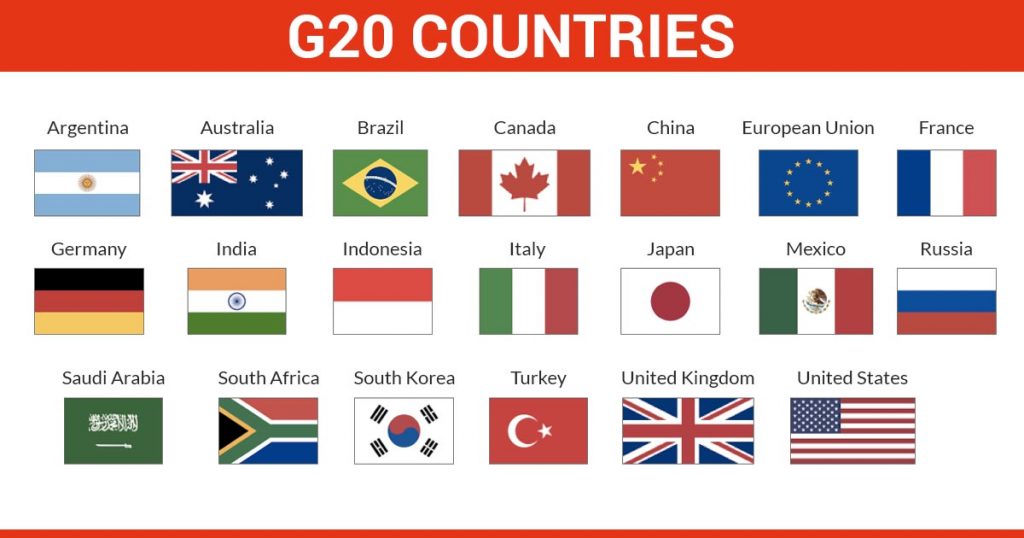
    The members of the G20 consist of 19 individual countries plus the European Union (EU).

    • The 19 member countries of the forum are Argentina, Australia, Brazil, Canada, China, France, Germany, India, Indonesia, Italy, Japan, Mexico, Russia, Saudi Arabia, South Africa, South Korea, Turkey, United Kingdom and the United States.
    • The European Union is represented by the European Commission and by the European Central Bank.

     Who are the G20 Sherpas?

    • A Sherpa is the personal representative of a head of state or government who prepares an international summit, particularly the annual G7 and G20 summits.
    • Between the summits, there are multiple Sherpa conferences where possible agreements are laid out.
    • This reduces the amount of time and resources required at the negotiations of the heads of state at the final summit.
    • The Sherpa is generally quite influential, although they do not have the authority to make a final decision about any given agreement.
    • The name is derived from the Sherpa people, a Nepalese ethnic group, who serve as guides and porters in the Himalayas, a reference to the fact that the Sherpa clears the way for a head of state at a major summit.

    G7

    • The G7 or the Group of Seven is a group of the seven most advanced economies as per the International Monetary Fund (IMF).
    • The seven countries are Canada, USA, UK, France, Germany, Japan and Italy. The EU is also represented in the G7.
    • These countries, with the seven largest IMF-described advanced economies in the world, represent 58% of the global net wealth ($317 trillion).
    • The G7 countries also represent more than 46% of the global gross domestic product (GDP) based on nominal values, and more than 32% of the global GDP based on purchasing power parity.
    • The requirements to be a member of the G7 are a high net national wealth and a high HDI (Human Development Index).

  • Constitution Bench formed in Same-Sex Marriage Case

    bench

    The Supreme Court has announced the formation of a new Constitution Bench headed by Chief Justice of India DY Chandrachud to hear a series of petitions seeking legal recognition of same sex marriages.

    What is a Constitution Bench?

    • The constitution bench is the name given to the benches of the Supreme Court of India.
    • The Chief Justice of India has the power to constitute a Constitution Bench and refer cases to it.

    Constitution benches are set up when the following circumstances exist:

    1. Interpretation of the Constitution: Article 145(3) provides for the constitution of at least five judges of the court which sit to decide any case “involving a substantial question of law as to the interpretation” of the Constitution of India.
    2. President of India seeking SC’s opinion: When the President has sought the Supreme Court’s opinion on a question of fact or law under Article 143 of the Constitution. Article 143 of the Constitution provides for Advisory jurisdiction to the SC. As per the provision, the President has the power to address questions to the apex Court, which he deems important for public welfare.
    3. Conflicting Judgments: When two or more three-judge benches of the Supreme Court have delivered conflicting judgments on the same point of law, necessitating a definite understanding and interpretation of the law by a larger bench.
    • The Constitution benches are set up on ad hoc basis as and when the above-mentioned conditions exist.
    • Constitution benches have decided many of India’s best-known and most important Supreme Court cases, such as:
    1. K. Gopalan v. State of Madras (Preventive detention)
    2. Kesavananda Bharati v. State of Kerala (Basic structure doctrine) and
    3. Ashoka Kumar Thakur v. Union of India (OBC reservations) etc.

    Why in news now?

    • The Centre had expressed its concern about the “psychological impact” that same-sex unions could have on children, but refused to link its worries to stigma about same-sex relationships.
    • The government’s recent affidavit sought to explain how same-sex marriage was antithetical to the view held by many in India that marriage was a “holy union, a sacrament and a sanskar” between a biological man and a woman.


  • Top-notch Aspirational Toilets to usher in change

    toilet

    The Ministry of Housing and Urban Affairs has issued a directive to all state governments to ensure that 25% of public toilet seats added in any city or urban unit are “aspirational toilets.”

    What are Aspirational Toilets?

    • The aspirational toilets scheme was launched in September 2022 as part of the Swachh Bharat Mission (SBM) 2.0, with an aim to help make cities open defecation free.
    • A quarter of all new public restrooms in Indian cities will soon have high-end features such as luxurious bath cubicles, touchless flushing, breast-feeding rooms, and automatic sanitary napkin incinerators.
    • These will be indicated as “aspirational toilets” on Google Maps.

    Focus areas for constructing aspirational toilets

    • The focus areas for constructing these luxury toilets will be tourist and religious destinations, as well as iconic cities.
    • High-footfall locations such as markets, railway stations, inter-state bus depots, and national highways will be given priority.
    • Guidelines have been issued to the states for constructing these toilets. It also includes low-height toilets and basins for children.
    • Hand-dryers, paper napkins, and vending machines for sanitary napkins are proposed to be made available.

    Maintenance and funding patterns

    • One of the business models being explored for the maintenance of these toilets is attaching them with other public services such as restaurants, shopping malls, libraries, cinema halls, or even medicine shops, to make them self-sustaining.
    • Experts have cautioned that a proper study must be done on the location and the way these toilets will be maintained before beginning any such project.

    Back2Basics: Swachh Bharat Mission (Urban) 2.0

    Description

    Objective Make all cities in India “garbage-free”
    Period 5 years (1st Oct 2021 – 1st Oct 2026)
    Focus Sustainable solid waste management, sustainable sanitation and treatment of used water, and promoting behavior change through citizen outreach
    Segregation of waste All households and premises required to segregate their waste into “wet waste” and “dry waste”
    Collection of waste Aims to achieve 100% door-to-door collection of segregated waste from each household/premise
    Waste management Aims to achieve 100% scientific management of all fractions of waste, including safe disposal in scientific landfills, remediation of all legacy dumpsites, and the conversion of these sites into green zones
    Sanitation Aims to promote holistic sanitation, with end-to-end solutions, treatment of used water before discharge into water bodies, and maximum reuse of treated used water
    Citizen outreach Aims to create awareness and institutionalize “Swachh” behavior through large-scale citizen outreach
    Institutional capacity Aims to create institutional capacity to effectively implement programmatic interventions to achieve mission objectives


  • SpaceX Starship: World’s biggest rocket set for first test flight

    starship

    SpaceX is preparing for the first test flight of Starship, which is the most powerful rocket ever built.

    About SpaceX Starship

    • Starship is a fully reusable spacecraft designed and built by SpaceX with the primary goal of sending humans to the Moon, Mars, and beyond.

    Key objectives

    • SpaceX aims to use Starship to establish a self-sustaining human settlement on Mars.
    • The ultimate goal is to enable humans to become a multi-planetary species.
    • It also aims to make Starship reusable, reducing the cost of spaceflight and bringing down the price to a few million dollars per flight.
    • In the long run, the company aims to achieve full and rapid reusability of the spacecraft.


    Features

    Details

    Design and configuration
    • Made up of two parts: a 50-meter tall spacecraft and a 70-meter tall Super Heavy rocket booster.
    • Spacecraft has six Raptor engines; Super Heavy Booster has 28 Raptor engines.
    • Payload capacity of up to 100 metric tons and features a large heat shield.
    • Interior can be configured for up to 100 passengers or cargo.
    Manoeuvrability
    • Designed to be fully reusable, with vertical take-off and landing on Earth, Moon, and Mars.
    • Can be refuelled in orbit for deeper space travel and for establishing a human settlement on Mars.
    Construction and materials
    • Built using durable and cost-effective stainless steel material.
    • Stainless steel also provides heat protection during re-entry into the Earth’s atmosphere.
    Power and thrust
    • Powered by methane and liquid oxygen fueled Raptor engines.
    • Generates 17 million pounds of thrust more than twice that of the Saturn V rockets used for the Apollo missions.


  • Omicron evolved strategies to evade T Cell Immunity

    t cell

    Central idea: The SARS-CoV-2 virus has the ability to evade CD8 T cells, which are important in reducing the viral load and clearing the infection by detecting and killing infected cells.

    What is the news?

    • A recent study has revealed that the SARS-CoV-2 virus has the ability to modulate MHC I expression in host cells.
    • MHC I is crucial in alerting the immune system to virally infected cells.
    • The virus has evolved multiple strategies to inhibit MHC I expression, which is not seen in the case of the influenza virus.

    What is T Cell Immunity?

    • Like B cells, which produce antibodies, T cells are central players in the immune response to viral infection.
    • For your immune system to fight off any kind of invader, such as a virus, you need a kind of white blood cell called a B cell, which makes antibodies, and a similar-looking white blood cell called a T cell.
    • T cells can play different roles altogether.
    • They can act as “killer cells”, attacking cells which have been infected with a virus or another kind of pathogen, or they can act as “helper cells” by supporting B cells to produce antibodies.

    How do they function?

    • Alongside antibodies, the immune system produces a battalion of T cells that can target viruses.
    • Some of these, known as killer T cells (or CD8+T cells), seek out and destroy cells that are infected with the virus.
    • Others, called helper T cells (or CD4+T cells) are important for various immune functions, including stimulating the production of antibodies and killer T cells.
    • T cells do not prevent infection, because they kick into action only after a virus has infiltrated the body. But they are important for clearing an infection that has already started.
    • In the case of COVID-19, killer T cells could mean the difference between a mild infection and a severe one that requires hospital treatment.


More posts