The Ministry of New and Renewable Energy has introduced the Energy Conservation (Amendment) Bill in Rajya Sabha.
Highlights of the Bill
The Bill amends the Energy Conservation Act, 2001 to empower the central government to specify a carbon credit trading scheme.
Designated consumers may be required to meet a proportion of their energy needs from non-fossil sources.
Why was this Bill introduced?
During the COP-26 summit in 2021, India made commitments relevant for energy efficiency efforts.
Against this backdrop, the Energy Conservation (Amendment) Bill, 2022 was introduced in Lok Sabha in August 2022.
Key features of the bill
Carbon credit trading:The Bill empowers the central government to specify a carbon credit trading scheme. Carbon credit implies a tradable permit to produce a specified amount of carbon dioxide or other greenhouse emissions.
Obligation to use non-fossil sources of energy:The Act empowers the central government to specify energy consumption standards for designated consumers to meet a minimum share of energy consumption from non-fossil sources. Designated consumers include: (i) industries such as mining, steel, cement, textile, chemicals, and petrochemicals, (ii) transport sector including Railways, and (iii) commercial buildings, as specified in the schedule.
Energy conservation code for buildings: The bill empowers the central government to specify norms for energy efficiency and conservation, use of renewable energy, and other requirements for green buildings. Under the Act, the energy conservation code applies to commercial buildings: (i) erected after the notification of the Code, and (ii) having a minimum connected load of 100 kilowatt (kW) or contract load of 120 kilo volt ampere (kVA).
Standards for vehicles and vessels: Under the bill, the energy consumption standards may be specified for equipment and appliances which consume, generate, transmit, or supply energy. The Bill expands the scope to include vehicles (as defined under the Motor Vehicles Act, 1988), and vessels (includes ships and boats).
Composition of the governing council of BEE: The Act provides for the setting up of the Bureau of Energy Efficiency (BEE). The Bureau has a governing council with members between 20 and 26 in number.
Concerns raised
Carbon credit trading aims to reduce carbon emissions, and hence, address climate change. The question is whether the Ministry of Power is the appropriate Ministry to regulate this scheme.
A further question is whether the market regulator for carbon credit trading should be specified in the Act.
Same activity may be eligible for renewable energy, energy savings, and carbon credit certificates.
The Bill does not specify whether these certificates will be interchangeable.
Designated consumers must meet certain non-fossil energy use obligation. Given the limited competition among discoms in any area, consumers may not have a choice in the energy mix.
A political party based in New Delhi lost its election deposit for most of its candidates in the assembly elections in Gujarat and Himachal Pradesh.
Do you know?
In the first Lok Sabha elections in 1951-52, almost 40 per cent of the total candidates lost their deposits. Nearly 86 per cent of the candidates contesting Lok Sabha elections in 2019 lost deposits, according to a report released by the Election Commission of India.
What is an Election Security Deposit?
An election security deposit is an amount that is to be deposited with the Returning Officer when a candidate files their nomination.
This is to be submitted either in cash, or a receipt must be enclosed with the nomination paper.
It mentions that the said sum has been deposited on the candidate’s behalf in the Reserve Bank of India or in a Government Treasury.
The main purpose of this practice is to ensure that only genuinely intending candidates end up filing the nomination to be a part of the electoral process.
Is the amount same for all elections?
No, it depends on the particular election being conducted, and the Representation of the People Act of 1951 mentions different amounts depending on the level of election:
In the case of an election from a Parliamentary constituency, meaning a Lok Sabha and Rajya Sabha seat, the amount is Rs 25,000 and Rs 12,500 for a Scheduled Caste (SC) or Scheduled Tribe (ST) candidate.
In the case of an election from an Assembly or Council constituency, meaning at the level of legislative bodies in the states, it is Rs 10,000 and Rs 5,000 for an SC/ST candidate.
Even in the case of Presidential and Vice-Presidential elections, a deposit of Rs 15,000 is to be made.
Losing the deposits
As per the same Act, the deposit has to be forfeited at an election if the number of valid votes polled by the candidate is less than 1/6th of the total number of valid votes polled.
Or, in the case of the election of more than one member, it would be 1/6th of the total number of valid votes so polled divided by the number of members to be elected.
This refers to elections by proportional representation method, as is the case in Rajya Sabha.
If the candidate does meet the threshold, “the deposit shall be returned as soon as practicable after the result of the election is declared.”
If a candidate withdraws their nomination or passes away before the polls, the amount is returned.
A political party (revived from the anti-corruption movement) is on track to be recognized as a 9th national party by the Election Commission of India (ECI).
What is a national party?
The name suggests that a national party would be one that has a presence ‘nationally’, as opposed to a regional party whose presence is restricted to only a particular state or region.
National parties are usually India’s bigger parties.
However, some smaller parties, like the communist parties, are also recognised as national parties.
A certain stature is sometimes associated with being a national party, but this does not necessarily translate into having a lot of national political clout.
So how is a political party defined?
The ECI’s Political Parties and Election Symbols, 2019 handbook species following criteria:
For recognition as a NATIONAL PARTY, the conditions specified are:
a 6% vote share in the last Assembly polls in each of any four states, as well as four seats in the last Lok Sabha polls; or
2% of all Lok Sabha seats in the last such election, with MPs elected from at least three states; or
recognition as a state party in at least four states.
For recognition as a STATE PARTY, any one of five conditions needs to be satisfied:
two seats plus a 6% vote share in the last Assembly election in that state; or
one seat plus a 6% vote share in the last Lok Sabha election from that state; or
3% of the total Assembly seats or 3 seats, whichever is more; or
one of every 25 Lok Sabha seats (or an equivalent fraction) from a state; or
an 8% state-wide vote share in either the last Lok Sabha or the last Assembly polls.
Benefits for recognized parties
This is subject to the fulfillment of the conditions prescribed by the Commission in the Election Symbols (Reservation and Allotment) Order, 1968.
(a) Reserved Sybol
If a party is recognised as a ‘state party’, it is entitled for exclusive allotment of its reserved symbol to the candidates set up by it in the state in which it is so recognised.
If a party is recognised as a ‘national party’ it is entitled for exclusive allotment of its reserved symbol to the candidates set up by it throughout India.
(b) Proposer for nomination
Recognised ‘state’ and ‘national’ parties need only one proposer for filing the nomination.
(c) Campaigning benefits
They are also entitled for two sets of electoral rolls free of cost and broadcast/telecast facilities over state-owned Akashvani/Doordarshan during the general elections.
The Delhi High Court has sought a response from the central government on a petition against the cancellation of a person’s Overseas Citizenship of India (OCI) card.
Who is an Overseas Citizen?
An OCI is a category introduced by the government in 2005.
Persons of Indian Origin (PIOs) of certain categories as specified in the Citizenship Act, 1955 are eligible for being OCI cardholders.
Some of the benefits for PIO and OCI cardholders were different until 2015 when the government merged these two categories.
The MHA defines an OCI as a person who was a citizen of India on or after January 26, 1950; or was eligible to become a citizen of India on that date; or who is a child or grandchild of such a person, among other eligibility criteria.
According to Section 7A of the OCI card rules, an applicant is not eligible for the OCI card if he, his parents or grandparents have ever been a citizen of Pakistan or Bangladesh.
Privileges to an OCI
OCI cardholders can enter India multiple times, get a multipurpose lifelong visa to visit India, and are exempt from registering with Foreigners Regional Registration Office (FRRO) no matter how long their stay.
If an individual is registered as an OCI for a period of five years, he/she are eligible to apply for Indian citizenship.
At all Indian international airports, OCI cardholders are provided with special immigration counters.
OCI cardholders can open special bank accounts in India, they can buy the non-farm property and exercise ownership rights and can also apply for a driver’s license and PAN card.
However, OCI cardholders do not get voting rights, cannot hold a government job and purchase agricultural or farmland.
They cannot run for public office either, nor can they travel to restricted areas without government permission.
UPSC Mains 2022 results were announced a couple of days back. Many cleared the exam but today I am not going to talk about them. This is for those who couldn’t.
Almost 90% of the UPSC Toppers I have trained to LBSNAA have failed in one or the other stages of UPSC. The real difference between a UPSC topper and one who will never clear UPSC IAS is how they see failure and how they respond to it.
https://youtu.be/PAv_C3UO41w
Failing the UPSC mains exam can be a difficult and disappointing experience. However, it is important to remember that failure is not the end. You need to accept that there are going to be failures in the journey, we’ll screw up royally sometimes, but understanding that failure is not the opposite of success, but a part of success, is essential.
The greatest glory in living lies not in never falling, but in rising every time we fall.
Ralph Waldo Emerson
What to do now?
Keeping it simple there are 6 things that you must do.
Acknowledge and accept failure as a natural part of the learning process.
Introspection and Retrospection: Either on your own or through your mentor’s help reflect on the reasons for the failure.
Stay positive and focused: This is important to stay motivated and avoid getting overwhelmed by failure.
Execute: Get back to the grind asap. UPSC Prelims 2023 is just 24 weeks away and you know you won’t be getting much time for Mains preparation.
How I will help you personally on a 1-to-1 basis?
A few years back I started personally guiding a small group of students who were very close to UPSC success but they were unable to do so. The first batch produced many rankers and so developed our Smash Mains program out of that.
Smash Mains 2023 with me (Click and fill the form for a detailed call)
Smash Mains is a highly personalized and intensive handholding program for the crème-de-la-crème (veterans) amongst UPSC aspirants (the intake is 50 students – my bandwidth allows this much only).
Even The Hindu acknowledged the success and efficacy of Smash Mains program
The result of Smash Mains 2021 was both shocking and humbling. More than 85% of the students I mentored cleared UPSC 2021, many with a double-digit rank like Mantri Mourya, AIR 28; Anay, AIR 32; Divyansh, AIR 49; and many more.
My student Mantri Mourya, AIR 28 UPSC 2021 was a Smash Mains student
Even in UPSC Mains 2022, almost 85% of students are appearing for UPSC Interviews 2022.
Some of whatsapp messages after UPSC Mains 2022 result
Note: The Entry is Restricted to those who have given mains in the past 2 years and have failed to score high marks.
It’s a three-phased program under my personalized guidance. The focus is on identifying and highlighting the issues with your preparation (information/analysis / utilization). According to your strength and weaknesses, a tailor-made strategy will be developed. And I will strict monitor your progress, aiming for incremental improvements every day.
1. One-to-One mentorship by Sajal sir. 2. Mains Test Series – 4 sectional and 12 FLTs 3. Samachar Manthan – For holistic and comprehensive coverage of Current Affairs (without answer writing) 4. Smash Prelims Crash Course 5. Prelims Full-Length Tests – To prepare you for prelims (8 FLTs and 10 Current affairs) 6. Exclusive membership to Smash Mains group in Civilsdaily’s Habitat.
The fact that you have been missing the cut-off with a small margin (repeatedly) tells that there are some fundamental issueswith your approach. The answers to which you might or might not have. For bringing the change you have to work on its execution as well. (Realization is not enough). And bringing that to fruition is not possible in isolation. Now onwards, it should be a guided process under a meticulously designed plan.
It is all about redesigning the machinery which is unable to convert your knowledge and analysis into marks in Mains. And you know it – Fewer marks in mains, very low chances of seeing your name in the final list.
What makes Smash Mains unique?
Individual attention and approachability are the USPs of this program.
Not putting Penguins among the Fowls – You already know how to write an average answer (you’re missing it by a few marks actually). You want to know how to increase your score from 90 to 110-115. The approach followed by other institutes in their Test series is the same for a veteran and a complete newbie and here lies the problem. Without personalizedone-to-one interaction with someone like Sajal sir (who has scored these awesome marks), it will be difficult for you to rectify these minute yet very important shortcomings.
Evaluation is a strength of this program and we put it on a high priority. I am myself involved in the process, unlike other institutes where evaluation is outsourced to those who themselves might not have appeared for mains (It’s bizarre). It shouldn’t be based on ‘model answers’ as there are 3-4 ways of approaching an answer. Only a seasoned player will be able to go beyond these model answers and be able to appreciate your approach (If it’s innovative) even if it differs from the model answers provided.
Test copies get checked in a time-bound manner. The questions, answers and material provided are of the highest quality.
Emphasis on execution and utilization of knowledge – Mains is not only about knowledge but the way you express the relevant knowledge in the most optimum manner.
My interventions are highly specific and not generalized. Sitting right in front of you I will walk you through each and every question. I will not let you lose your focus.
Several agencies, including the IMF and the World Bank have projected lower growth rates for the Indian economy in FY23, than the 7.2 per cent estimated by the RBI in April. The Central bank has now lowered its forecast to 6.8 per cent. Given the current situation, with the Q2 FY 2023.
Economy is likely to grow at 6.5-7.0 per cent: Given the current situation, with the Q2 FY 2023 GDP growth clocking in at 6.3 per cent, the economy is likely to grow at 6.5-7.0 per cent in this fiscal year.
Considering economic uncertainties it is difficult to arrive at precise estimate: It is difficult to arrive at a precise estimate for growth this year with unprecedented economic uncertainty worldwide, including high global inflation, synchronized monetary tightening, and the impact of the Ukraine war.
Positive medium-term growth prospects: Company and bank balance sheets are healthier, credit growth is rising, and capacity utilisation has increased, all of which augur well for investment activity.
Positive impact on tourism: The waning of Covid-19 should hopefully have a positive impact on travel, transport and tourism. Construction activity should pick up further with the reduction in housing inventory and almost stable prices over the last decade.
On inflation India is doing better: On the inflation front, India is doing better than many advanced economies and emerging markets.
What is Indian economy’s pressing problems specifically in terms of Labour-intensive growth?
Employment a biggest concern: Employment, an issue that has persisted over the last two decades. In brief, we have not generated enough good jobs to match the scale at which the economy has grown, especially in the organised sector. As a result, we have very high under-employment and poor-quality employment, which have hampered a much-needed move away from agriculture.
Lack of precise data on people living in poverty: We do not have a precise estimate of the current levels of poverty, as there has been no household consumption survey since 2011-12, and the 2017-18 survey was abandoned due to technical issues. But there is reasonable consensus that poverty could be around 10 per cent of the country’s population, A low number compared to the past, but as many as 140 million people could still be living in poverty.
Lack of non-agricultural jobs: The rising demand for the MGNREGA, and the importance of food distribution schemes and other welfare programmes for the poor are indicators of the lack of non-agriculture jobs being generated.
Lowest rate of women participation in labour force: An alarming aspect of the employment problem in India is the low participation rate of women in the labour force, which is among the lowest in the world. This loops back to the importance of labour-intensive manufacturing. For example, much of Bangladesh’s success, and that of Southeast Asian countries, in exports and manufacturing stems from the large number of women working in their factories.
Women literacy is rising but increasing number of educated women are not working: A positive trend in India has been the growing trend in girls attending schools and college in the last 20 years, but this also means that an increasing number of educated women are not working.
Despite of 1991 reforms still remains an untapped opportunity: With the LPG reforms, the expectation was that, as the economy opened up to global competition, India’s low wage levels would attract private investment into labour-intensive manufacturing, thus generating jobs. This was the path followed by the East Asian economies that experienced high growth and rapid development. But for India this remains an untapped opportunity.
Manufacturing is shifting to countries other than India: Even with rising wage levels in China, manufacturing is shifting to countries other than India. The PLI (production-linked incentives) scheme has been rolled out to encourage manufacturing. It may need some tweaking to be biased towards labour-intensive manufacturing as China vacates space in this area. This may seem at odds with the more popular view that it is small and medium enterprises which promote employment.
Country’s real exchange rate is not healthy: An overvalued rupee has discouraged the export of labour-intensive manufacturing goods, which are very price-sensitive in global markets. It has also had a dampening effect on domestic production as our currency has depreciated at a lower rate than other emerging economies like China and Indonesia.
Depreciated rupee impacting domestic producers by inflow of cheaper imports: Domestic producers of goods that compete with imports into our markets have been impacted by the inflow of cheaper imports. This has disincentivised them from expanding production and generating employment.
Micro, small and medium enterprises (MSMEs) are severally hit: Problems that have come to the fore post-pandemic include the health of micro, small and medium enterprises (MSMEs). Accurate information on this is somewhat scarce but anecdotal evidence suggests that they have been more severely hit than the formal sector.
Way ahead
The rupee has been overvalued for long and needs to be allowed to depreciate, though in a calibrated way, ensuring external and financial stability.
Job growth is crucial if we are to reduce the still high levels of poverty in the country
Incentivizing the domestic producers so that they can compete with the cheaper inflow of imports and expands their manufacturing thereby generating employment in the economy
The continued recovery of the formal sector, as indicated by various metrics, in terms of the improved health of corporates and banks should effectively pull up the MSMEs through supply chains linkages, among others.
We still have a negative real interest rate (that is, the difference between the RBI’s policy rate and inflation). Hence, the policy rate needs to rise further, providing a push to financial savings, which are needed to generate higher investment for growth.
Inflation need to be contained through supply-side measures as well, such as an improvement in the supply of food products.
Conclusion
High under-employment and poor-quality employment have hampered a much-needed move away from agriculture. A focus on labour-intensive formal manufacturing is the need of the hour.
Mains Question
Q. India is showing positive signs of economic recovery however the economy still has a hangover from the past and some are exacerbated by Covid. Discuss.
Crimes against tourists and other foreign nationals appear to be on the rise in India. Consider several recent cases, and the lessons they suggest.
Some of the recent cases of crime against tourists
A case of rape and murder in Kerala: A few days ago, a Kerala session court sentenced two men to life imprisonment for the rape and murder of a Latvian tourist in 2018.
A case of a rape of a girl child in Goa: A 12-year-old Russian girl was raped in a hotel in Goa on April 6 this year. The rapist was an employee of the hotel in which the girl was staying with her mother.
A case extortion in Gurugram: An Iraqi couple staying at a hotel in Gurugram for the treatment of the husband in the Medanta hospital was accosted by two miscreants posing as policemen on October 23. They accused the couple of carrying drugs and on the pretext of checking their wallets, fled with $15,000 the couple had saved for the treatment.
A case of sexual misconduct in Delhi: On September 2, a British woman lawyer lodged a complaint of sexual misconduct against a cab driver who was ferrying her from the airport to her hotel in South Delhi. The incident traumatized her to the extent that she left for the U.K. within two days of her arrival.
Drastic decline in cases of crimes against foreigners in Delhi: According to data of the National Crime Records Bureau (NCRB), Delhi recorded 27 cases of crime against foreigners last year, a drastic decline from 62 cases reported in 2020 and 123 in 2019.
Sharp reduction Rajasthan: Rajasthan has shown a sharp reduction in registration of crimes from 16 in 2019 to just 4 in 2020 and two cases last year, which could be attributed to the sharp decline in tourist arrivals due to COVID-19.
Though there is a decline in cases but the data is still shameful and to be studied: As many as 29 foreigners were murdered in the last three years. While 14 foreigners fell victim to rape last year, 16 were raped in 2020 and 12 in 2019. As many as 15 cases of assault to outraging modesty of foreign women were registered last year across the country, apart from 14 complaints of cheating. While 142 cases of theft were lodged by foreigners in 2019, it declined to 52 in 2020 and further dipped to 23 in 2021.
Women are more prone and most cases go unreported: Women are more prone to sexual attacks by criminals on the prowl in tourist destinations. For every crime committed against foreigners, there would be several others that go unreported for multifarious reasons, with one of them being the fear instilled in them by the threats of these criminals. In the South Delhi incident, the British national was reluctant to lodge a formal complaint out of fear
How do such cases of crimes against tourists tarnish our image?
Not only dents our image but also impacts on tourism: Crime against foreigners not only dents our image globally but could also adversely affect the inflow of foreign tourists, which is a vital source of income for our country.
It impacts Tourism sector which is one of the significant sources of FOREX: Tourism happens to be one of the biggest foreign exchange earners for India. Such cases may leave tourists moral down and they may lose sense of security.
What is Tourist police scheme and what steps can be taken to ensure security of the Tourists?
Booklet on the tourist police scheme and tourist police stations: The Bureau of Police Research and Development (BPRD) has brought out a booklet on the tourist police scheme detailing the mode of setting up of tourist police stations and control rooms, outposts, uniforms, recruitment, qualifications, training and logistics requirements for tourist police stations.
Identified tourist spots: As many as 25 popular tourist spots have been identified in the country where the tourist police necessarily need to be deployed to help foreigners. As an incentive, 30% deputation allowance has been recommended for the police personnel who joins the tourist police on deputation.
Identified Criminals in and around tourists’ spots need to be kept on constant surveillance: While the setting up of tourist police stations is a commendable step to provide safety to foreigners, much needs to be done to instil a sense of security in them even before they leave their countries for India. With theft being the most common crime committed against foreigners, all criminals in and around tourist spots need to be identified and kept under constant surveillance.
Fast track courts should be set immediately to try cases of crimes against tourists: Since foreigners come for short durations, the cases cannot be allowed to linger on in courts for long. Fast track courts should be set up immediately to try cases of crime against foreigners and the culprits punished speedily. It may be recalled that a rape convict, Bitihotra Mohanty, was tried for raping a German national in Alwar (Rajasthan) on March 21, 2006 and he was sentenced to seven years imprisonment on April 12, that is, within 22 days.
For the effective implementation of Tourism police scheme: In order to provide a safe environment for tourists, the Ministry of Tourism, in collaboration with the Bureau of Police Research and Development (BPRD), organised a conference in New Delhi on October 19, 2022. It was organised with a view to “sensitise the specific requirements of the tourists for effective implementation of Uniform Tourist Police Scheme at pan-India level”.
States that have tourist police: Though the concept of ‘tourist police’ has been in vogue for the past few years, it has not been given the kind of attention it deserves. The States that have tourist police are Uttar Pradesh, Madhya Pradesh, Delhi, Goa, Rajasthan and Kerala.
Delhi a neglected state is gearing up for tourist police wing: In view of the forthcoming G20 Summit, the Delhi police is gearing up its tourist police wing, which was hitherto in a neglected state and so are other States which will see a huge influx of foreigners.
Conclusion
With optimistic predictions of about 13.34 million foreign tourists arriving by 2024, there is a pressing need to upgrade our security systems specially to provide a flawless security blanket cover to foreign tourists. Safety assumes utmost importance to draw tourists in hordes.
Mains question
Q. What is tourist police scheme? Why it is necessary to have such a tourist security wing in India? What more steps can be taken to ensure the security of tourist in India?
GS-3 Challenges to internal security through communication networks, role of media and social networking sites in internal security challenges, basics of cyber security
December 8 is commemorated as SAARC Charter Day. It was on this day, 37 years ago, that the South Asian Association for Regional Cooperation (SAARC), an intergovernmental organization, was established.
Establishment: The South Asian Association for Regional Cooperation (SAARC) was established with the signing of the SAARC Charter in Dhaka on 8 December 1985.
Members: It is an intergovernmental organization, was established by Bangladesh, Bhutan, India, the Maldives, Nepal, Pakistan and Sri Lanka Afghanistan acceded to SAARC later.
Secretariat: The Secretariat of the Association was set up in Kathmandu on 17 January 1987.
Objectives: The objectives as outlined in the SAARC Charter are, to promote the welfare of the peoples of South Asia and to improve their quality of life; to accelerate economic growth, social progress and cultural development in the region and to provide all individuals the opportunity to live in dignity and to realize their full potentials; to promote and strengthen collective self-reliance among the countries of south Asia.
What SAARC has achieved?
SAARC has failed abjectly in accomplishing most of its objectives.
South Asia continues to be an extremely poor and least integrated region in the world.
The intraregional trade and investment in South Asia are very low when compared to other regions such as the Association of South East Asian Nations (ASEAN) and Sub-Saharan Africa.
Pakistan has adopted an obstructionist attitude within SAARC by repeatedly blocking several vital initiatives such as the motor vehicles agreement, aimed at bolstering regional connectivity.
Deepening hostility between India and Pakistan has made matters worse. Since 2014, no SAARC summit has taken place leaving the organisation rudderless, and practically dead.
But why to bother about SAARC?
South Asia is important for India’s national interest: Because South Asia, that is India’s neighbourhood, is important for India’s national interests. This is best captured in the current government’s ‘neighbourhood first’ policy.
SAARC, a pan south Asia reach: SAARC is the only intergovernmental organisation with a pan-South Asia reach. India can judiciously employ it to serve its interests in the entire region.
Weakened SAARC means heightened instability: A weakened SAARC also means heightened instability in other promising regional institutions such as the South Asian University (SAU), which is critical to buttressing India’s soft power in the region.
Bilateralism can complement, not substitute regional efforts: A new narrative is that in South Asia, India can successfully use the instrument of bilateralism over regionalism to pursue its interests. While bilateralism is undoubtedly important, it can at best complement, not substitute, regional or multilateral efforts.
Regionalism in East Asia and Africa: Regionalism has brought immense success in other parts such as East Asia and Africa. Regionalism can deliver prosperity in the South Asian region too, especially because multilateralism is weakening.
concept of new regional economic order: Looking at ASEAN’s spectacular success in regional integration, international lawyers Julien Chaisse and Pasha L. Hsieh have developed the concept of a new regional economic order, a process through which developing countries search for a trade-development model, based on incrementalism and flexibility; this is different from the neoliberal model laid down by the Washington Consensus.
What is BIMSTEC?
Regional organization of seven members lying in or adjacent to BOB: The Bay of Bengal Initiative for Multi-Sectoral Technical and Economic Cooperation (BIMSTEC) is a regional organization comprising seven Member States lying in the littoral and adjacent areas of the Bay of Bengal constituting a contiguous regional unity.
Establishment: This sub-regional organization came into being on 6 June 1997 through the Bangkok Declaration.
Act as a bridge between South and South East Asia: The regional group constitutes a bridge between South and South East Asia and represents a reinforcement of relations among these countries.
Provides Inter regional cooperation platforms: BIMSTEC has also established a platform for intra-regional cooperation between SAARC and ASEAN members.
Did you Know?
BIMSTEC comprises five South Asian nations (Bangladesh, Bhutan, Nepal, India and Sri Lanka) and two ASEAN countries (Myanmar and Thailand).
Pakistan is NOT a BIMSTEC member.
Importance of BIMSTEC for India
India shifted its diplomatic energy from SAARC to BIMSTEC: In recent years, India seems to have moved its diplomatic energy away from SAARC to BIMSTEC. This resulted in BIMSTEC, after 25 years, finally adopting its Charter earlier this year.
BIMSTEC is better than SAAC charter: The BIMSTEC Charter is significantly better than the SAARC Charter. For instance, unlike the SAARC Charter, Article 6 of the BIMSTEC Charter talks about the ‘Admission of new members’ to the group. This paves the way for the admission of countries such as the Maldives.
However no flexible formula like ‘ASEAN Minus X’: Notwithstanding the improvements, the BIMSTEC Charter, to boost economic integration, does not contain the flexible participation scheme of the kind present in the ASEAN Charter. This flexible scheme, also known as the ‘ASEAN Minus X’ formula, allows two or more ASEAN members to initiate negotiations for economic commitments. Thus, no country enjoys veto power to thwart economic integration between willing countries.
Obstructionist attitude of Pakistan within SAARC: Given the experience of SAARC, where Pakistan routinely vetoes several regional integration initiatives, it is surprising that BIMSTEC does not contain such a flexible participation scheme. A flexible ‘BIMSTEC Minus X’ formula might have allowed India and Bangladesh or India and Thailand to conduct their ongoing bilateral free trade agreement (FTA) negotiations under the broader BIMSTEC umbrella. This would have eventually strengthened BIMSTEC by enabling the gradual and incremental expansion of these binding commitments to other members. India should press for this amendment in the BIMSTEC Charter.
Some steps to take
BIMSTEC should not end up as another SAARC: For this, its member countries should raise the stakes. A high-quality FTA offering deep economic integration, something that Prime Minister Narendra Modi also advocated at the last BIMSTEC ministerial meeting would be an ideal step.
India should try make the organizations flexible to ensure peace and prosperity in the region: Likewise, India should explore legal ways to move successful SAARC institutions such as SAU to BIMSTEC. These steps will give stronger roots to BIMSTEC and enable erecting a new South Asian regional order based on incrementalism and flexibility, ushering in prosperity and peace in the region.
Conclusion
Since South Asia cannot repudiate regionalism, reviving SAARC by infusing political energy into it and updating its dated Charter will be an ideal way forward. However, in the current scenario, this is too idealistic. So, the next best scenario is to look at other regional instruments such as the Bay of Bengal Initiative for Multi-Sectoral, Technical and Economic Cooperation (BIMSTEC).
Mains Question
Q. India seems to have shifted its diplomatic energies away from SAARC to BIMSTEC in recent years. What are the reasons for doing so?
India has a vast coastline stretched over 7000 kilometres having over 1000 offshore islands that bring enormous resources and opportunities.
The long stretch of shores has been a habitat of varied coastal communities as well as vegetation.
Safeguarding these waters from external threats and protecting India’s maritime interests is of great importance, particularly in the existing geopolitical and security situation.
Trade potential of India’s Coast
Around 95% of India’s trade by volume and 68% by value is conducted through these waters, with priority being accorded to port-led development plans in recent years.
The safety and unhindered continuity of maritime trade, through a wide network of ships, is also a primary national concern as it directly impacts our economy.
India’s Coastline Vulnerability
Critical assets: The coastal areas host major commercial cities, and significant strategic and vital installations of Defence, Atomic Energy, Petroleum, and private ventures besides 12 major ports.
Ports: It has more than 239 non-major ports which increases the coastline’s vulnerability.
Major challenges
Geostrategic location of the Indian peninsula poses typical oceanic challenges owing to-
Transnational maritime crimes like narcotics and weapon trafficking, human trafficking, etc., and
Dense fishing traffic
Increased likelihood of maritime incidents
The use of sea routes by terrorists during the attacks of 26/11 highlighted the vulnerabilities of India’s coastline and its security.
Stakeholders in oceanic governance
Several agencies including the Indian Coast Guard, Indian Navy, Coastal Security Police, Customs, Fisheries, Port Authorities, Intelligence Agencies, and other Central and State Departments look after maritime security and governance.
The multi-agency concept mandates cooperation, coordination, and institutionalised domain control of the respective agency to achieve foolproof security by optimum utilisation of limited resources.
As per the concept of a tiered mechanism for surveillance in-depth, the Indian Coast Guard is additionally responsible for coastal security in territorial waters.
The Director General of the Indian Coast Guard is designated as Commander, Coastal Command with responsibility for overall coordination between state and central agencies in matters of coastal security.
Various security enhancement moves
Coastal Security Exercise namely ‘Sagar Kavach’ is conducted by the Indian Navy along with the Indian Coast Guard and all stakeholders involved in Coastal Security.
The exercise involves synergised application of maritime surveillance assets, coordinated air and maritime strikes, air defence, and submarine and landing operations.
Joint Coastal Patrol (JCP) by the Indian Coast Guard and Coastal Police has been instituted across all coastal States and Union Territories.
The apex level monitoring and review of the implementation of measures for enhancing the effectiveness of the Coastal Security Framework are done by the National Committee on Strengthening of Maritime and Coastal Security.
Conclusion
The coastal security construct of the present day has successfully built synergy and coordination, which are very much required in the current security environment.
The Indian Coast Guard has grown into a force to be reckoned with and is rightfully called “Sentinels of Sea,” executing the roles of maritime law enforcement, ocean peacekeeping, and many other tasks.
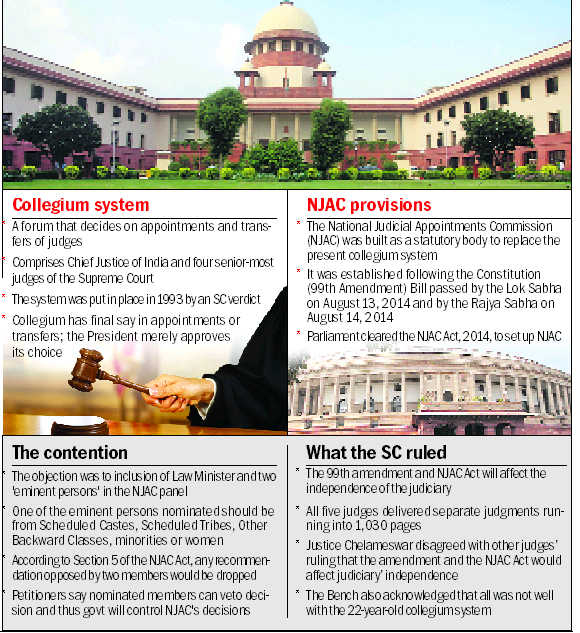
VP asked the two Houses for not taking cognizance, over the last seven years, of the 2015 Supreme Court judgment setting aside the Constitutional amendment to constitute the National Judicial Appointment Commission (NJAC).
VP pointed out that the amendment had been passed with unprecedented support by both Houses and approval from 16 State Assemblies.
However, on October 16, 2015, the Supreme Court ruled that it was not in consonance with the basic structure of the Constitution, and scrapped the legislation.
What was NJAC?
The NJAC was a body which was proposed to make appointments of Chief Justices, Supreme Court judges, and High Court judges in a more transparent manner as compared to the existing collegium system.
It sought to replace the Collegium System.
It was proposed via the National Judicial Appointments Commission Bill, 2014.
The bill was passed by both the houses; Lok Sabha and Rajya Sabha, and also received the President’s assent.
The commission was established by the 99th Constitutional Amendment Act, 2014.
The Act proposed that the members of NJAC would be composed of members from the legislative, judicial, and civil society.
Composition of NJAC
Chief Justice of India would be the Chairman of the NJAC
Two senior-most judges of the Supreme Court
The Law and Justice Minister
Two eminent persons would be selected by a committee which would be composed of the Prime Minister, the Chief Justice of India and the Leader of Opposition
Why was the NJAC Act struck down?
The five-judge SC bench struck down the NJAC Act along with the 99th Constitutional Amendment Act in a 4:1 ratio.
It was repealed by a five-judge bench, famously known as the Fourth Judges Case, 2015.
It was termed ‘unconstitutional’and was struck down, citing it as having affected the independence of the judiciary.
Benefits of the NJAC Act
Justice Chelameshwar praised the NJAC Act because-
Transparent process: It involved a smooth and transparent process for the appointment of judges.
Brings checks and balances: the exclusion of checks and balances principle leads to the destruction of the basic structure of the Constitution.
Seeks balance of power: In a democratic setup, the executive cannot be completely excluded.
Global examples: In the dissent order, an example of the United States of America was given, where the head of the Executive is conferred with the power to appoint the judges.
Issues with collegium system
Alleged favouritism: The collegium system does not provide any guidelines or criteria for the appointment of the Supreme Court judges and it increases the ambit of favouritism.
Ambiguous process: The absence of an administrative body is also a reason for worry because it means that the members of the collegium system are not answerable for the selection of any of the judges.
Isolating the executive: The check and balance principle is necessary because it ensures that no organ of democracy is exercising its power in an excessive manner.
Extra-constitutional nature: The collegium system tells us that even though the collegium system is not mentioned anywhere in the Constitution, rather it has evolved over a period of time from different landmark cases.
Lack of transparency: Nepotism has been often witnessed in the judiciary due to a lack of criteria for the appointment of judges.
What can we, as aspirants, observe here?
After analyzing both NJAC and the collegium system, it can be inferred that neither of the methods is complete and both lack certain aspects.
Many former judges and legal experts are supporting the NJAC.
However, legal jurists are divided on NJAC, with some supporting it while others calling for amendments to the Act.
It is quite evident that neither the collegium system nor the NJAC is accurate; both have some shortcomings.
Way forward
NJAC needs to be amended to keep the judiciary independent.
According to Justice Deepak Gupta, retired senior civil servants need to be inducted into the body appointing judges.
The Supreme Court needs to lay down certain guidelines for appointing judges and those guidelines should be strictly followed and codified.
Apart from that, all the notifications should be issued in the public domain to make the process more transparent.
The Multi-State Cooperative Societies (Amendment) Bill, 2022, aimed at bringing in transparency in the sector, was introduced in the Lok Sabha.
What is MSCS Act, 2002?
Cooperatives are a state subject, but there are many societies such as those for sugar and milk, banks, milk unions etc. whose members and areas of operation are spread across more than one state.
The MSCS Act was passed to govern such cooperatives.
For example, most sugar mills along the districts on the Karnataka-Maharashtra border procure cane from both states.
What are Multi-State Cooperatives?
They draw their membership from two or more states, and they are thus registered under the MSCS Act.
Their board of directors has representation from all states they operate in.
Administrative and financial control of these societies is with the central registrar, with the law making it clear that no state government official can wield any control on them.
Why does the government plan to amend the Act?
(1) Issues with Central Registrar
The exclusive control of the central registrar, who is also the Central Cooperative Commissioner, was meant to allow smooth functioning of these societies.
The central Act cushions them from the interference of state authorities so that these societies are able to function in multiple states.
What was supposed to facilitate smooth functioning, however, has created obstacles.
For state-registered societies, financial and administrative control rests with state registrars who exercise it through district- and tehsil-level officers.
(2) Multiple checks and balances
Thus if a sugar mill wishes to buy new machinery or go for expansion, they would first have to take permission from the sugar commissioner for both.
Post this, the proposal would go to the state-level committee that would float tenders and carry out the process.
While the system for state-registered societies includes checks and balances at multiple layers to ensure transparency in the process, these layers do not exist in the case of multistate societies.
Instead, the board of directors has control of all finances and administration.
(3) Lack of govt control
There is an apparent lack of day-to-day government control on such societies.
Unlike state cooperatives, which have to submit multiple reports to the state registrar, multistate cooperatives need not.
The central registrar can only allow inspection of the societies under special conditions — a written request by one-third of the members of the board.
Inspections can happen only after prior intimation to societies.
(4) Lack of infrastructure
The on-ground infrastructure for central registrar is thin — there are no officers or offices at state level, with most work being carried out either online or through correspondence.
For members of the societies, the only office where they can seek justice is in Delhi, with state authorities expressing their inability to do anything.
(5) Ponzi schemes functioning as MCS
There have been instances across the country when credit societies have launched ponzi schemes taking advantage of these loopholes.
Such schemes mostly target small and medium holders with the lure of high returns.
Fly-by-night operators get people to invest and, after a few instalments, wind up their operations.
Need for Amendment
At present, India has more than 1,500 multi-State cooperative societies.
The Bill seeks to strengthen governance, reform the electoral process, improve the monitoring mechanism, and ensure ease of doing business in multi-State cooperative societies.
It also aims to improve the composition of boards and ensure financial discipline, besides enabling the raising of funds in multi-State cooperative societies.
Key establishments under the Amendment Bill
In order to make the governance of multi-State cooperative societies more democratic, transparent and accountable, the Bill has provisions for setting up of –
Cooperative Election Authority,
Cooperative Information Officer and
Cooperative Ombudsman.
Other features
Constitution of interim board: The Bill allows the central registrar to declare any multi-state cooperative society as sick. The Central government may, on the recommendation of the registrar, appoint an interim board for a maximum of five years. The central registrar can also declare a cooperative to be viable within the five years. The board of directors before the cooperative was declared sick shall be reinstated.
Elections: The Act states that elections shall be conducted by the existing board. The Bill amends this to state that the Central government may appoint a Cooperative Election Authority to conduct elections in cooperative societies to be prescribed.
Constitution of Fund: The Bill states that the central government shall set up the Cooperative Rehabilitation and Reconstruction Fund. A cooperative society shall credit 0.005% to 0.1% of its turnover to the fund, provided it does not exceed Rs 3crores per year.
For a country like India where each individual constituency can have lakhs of voters, counting votes is a complex process that requires both pace and precision.
Where are the Votes counted?
Ideally, all votes should be counted in one location in the constituency.
However, during General Elections, when seats are larger with multiple Assembly constituencies, many counting centres can be appointed, depending on the number of votes that need to be counted.
The location(s) for counting votes is decided by the Returning Officer (RO), with multiple centres in assembly segments being under the supervision of the Assistant Returning Officers (ARO).
In counting centres, ideally all votes are counted in one big hall having multiple tables.
However, if the RO feels there is a risk of overcrowding, more rooms may be opened up after permission from the Election Commission (EC).
Role of Returning Officer
The RO is appointed for each constituency by the Election Commission.
During the duration of the election, the RO is the highest authority in the constituency having a wide range of powers in order to peacefully and impartially conduct elections.
With respect to counting of votes, the RO has the following duties:
To designate the counting centres and get them approved by the Commission well in advance;
To send notice to the candidates about the place, date and time of counting of votes;
To appoint and train counting staff;
To count the votes and declare the result.
ROs themselves do not count all votes but verify the counting at multiple stages and announce the results.
They are the final authority in the matter of vote counting in an election.
Supervision of the process
A counting room will have multiple counting tables with each counting a set number of postal ballots/EVMs on a round-to-round basis.
On each table, there is a counting supervisor and up to two assistants who do the actual counting.
They should be gazetted officers and are appointed by the RO.
They receive specific training pertaining to the tasks they are expected to undertake.
For instance, for those counting postal ballots, the training is different from that received for counting EVM votes.
Observers in the counting process
The EC appoints observers at each counting room, who are supposed to record the proceedings and file a report.
They are generally employees of the GoI, and are tasked with the duty to oversee overall functioning of the election apparatus.
Candidates who were on the ballot are also allowed in the counting room along with their representatives.
All parties and candidates send counting agents in order to ensure that votes are counted fairly and according to procedure, and lodge complaints, if any.
The Indian Space Research Organisation (ISRO) has signed a MoU with Social Alpha, a multistage innovation curation and venture development platform, to launch SpaceTech Innovation Network (SpIN).
SpaceTech Innovation Network (SpIN)
SpIN is India’s first dedicated platform for innovation, curation, and venture development for the burgeoning space entrepreneurial ecosystem.
SpIN will primarily focus on facilitating space tech entrepreneurs in three distinct innovation categories:
Geospatial Technologies and Downstream Applications;
Enabling Technologies for Space & Mobility; and
Aerospace Materials, Sensors, and Avionics.
Key initiative
SpIN has launched its first innovation challenge for developing solutions in areas of maritime and land transportation, urbanization, mapping, and surveying.
The selected start-ups and innovators will be able to access both Social Alpha’s and ISRO’s infrastructure and resources as per the prevailing guidelines.
They will be provided active hand-holding in critical areas, including access to product design, testing and validation infrastructure, and intellectual property management.
On November 20-21, Indian Foreign Secretary Vinay Kwatra made a two-day visit to Myanmar. The Indian Ministry of External Affairs (MEA) in a press release stated that he met with members of the military junta that is currently ruling the country and discussed security and stability in the border areas, human trafficking issues (several Indian nationals have been victims), and infrastructure development.
What are the interpretations over the foreign Secretary’s visit?
Myanmar’s national portal says discussion on friendly relations: According to Myanmar National portal, the two sides held discussions on Myanmar-India friendly relations, exchanged views on the promotion of bilateral cooperation and the implementation of Myanmar’s peace process.
India’s no mention of Myanmar’s return to democracy: The MEA statement made no mention of any Indian interest in seeing Myanmar return to the path of democracy or the release of political prisoners and other tricky issues.
Emphasis on completing the ongoing projects: On the contrary, the foreign secretary spoke about continued Indian support for “people-centric socio-economic developmental projects” and early completion of connectivity projects including the Kaladan Multimodal Transit Transport Project and the Trilateral Highway between India, Myanmar, and Thailand.
Assured development Programs: It appears that infrastructure and developmental projects were a big emphasis during the visit because Kwatra also assured the Myanmar junta about projects under Rakhine State Development Program and Border Area Development Program.
Contradictory omissions: Despite the MEA press release not mentioning it, the MEA spokesperson Arindam Bagchi tweeted that the foreign secretary had discussions on several important issues including “India’s support to democratic transition in Myanmar.”
Background of the different interpretations
MEA’s 2021 statement that India’s interest in Myanmar’s return to democracy: Contrast this with the December 2021 statement that the MEA issued following then-Foreign Secretary Harsh Vardhan Shringla’s visit where he emphasized India’s interest in seeing Myanmar’s return to democracy at the earliest; release of detainees and prisoners; resolution of issues through dialogue; and complete cessation of all violence.”
India’s strong and consistent support to ASEAN: He had also reiterated that India’s strong and consistent support to the ASEAN initiative and expressed hope that progress would be made in a pragmatic and constructive manner, based on the five point consensus.
What are the India’s concerns?
Human trafficking emerged as the major issue: Human trafficking has emerged as a major issue in Myanmar, with several criminal syndicates running a racket luring Indian citizens with fake job prospects. The MEA spokesperson, according to media reports, cautioned Indian nationals of being wary of trafficking. IT companies recruiting Indian workers in the pretext of jobs in Thailand, who were then taken to Myanmar. There have been reportedly close to 200 Indian nationals who have been duped into this job racket.
China’s support to Military Junta: Since the military coup, China has improved on its good relations with the military junta, providing much-needed support for the Myanmar leadership in the face of international opprobrium.
Chinas’ high investment in Myanmar: China reportedly has been a key source of foreign investment in Myanmar. China’s multiple projects include several high-speed railway lines and dams as well as a $2.5 billion investment in a gas-fired power plant. The China-Myanmar Economic Corridor, which consists of oil and gas pipelines and infrastructure development projects run into billions of dollars.
China’s aim to get better access to Indian ocean: Of particular interest to China is the deep sea port that China plans to develop at Kyaukphyu, on Myanmar’s west coast, this will possibly give China better access to the Indian Ocean, which China has been eyeing for a while.
Budding relationship between Myanmar and Pakistan a cause of concern: According to media reports, Myanmar took the delivery of six JF-17 light-weight multi-role fighter jets from Pakistan in 2018 after signing a contract two years earlier in 2016. Myanmar was to get another batch of 10 aircraft although the date of delivery is unknown.
Pragmatism on account of the growing presence and inroads of China in Myanmar has possibly pushed India to give up on its moralizing about democracy and increase its outreach to Naypyidaw.
While the pro-democracy elements within Myanmar as well as India’s strategic partners in ASEAN may not be particularly pleased with this outreach, especially India dropping ASEAN’s Five-Point Consensus on Myanmar, it appears that New Delhi sees itself as having not too many choices
Conclusion
Strategic factors appear to be driving India’s greater engagement with the military junta, especially fear of China and Pakistan making inroads into the country. India has to maintain delicate balance while dealing with the ruling military junta.
Mains question
Q. In the backdrop of much speculations about the recent visit of India’s foreign secretary to Myanmar. Discuss India’s evolving position, which shows a soft approach towards the ruling military junta.
As India assumed the presidency of the G20 group of countries for 2022 to 2023, EAM S Jaishankar said on December 1 that India would be the voice of the Global South that is otherwise under-represented in such forums.
What is ‘Global South’?
The term has since been used multiple times, such as when Jaishankar said of ongoing global conflicts, “polarisation may occur elsewhere, the people who suffer most are the Global South”.
‘Global North’ refers loosely to countries like the US, Canada, Europe, Russia, Australia and New Zealand, while ‘Global South’ includes countries in Asia, Africa and South America.
Behind the binary difference: ‘Global North’ and the ‘Global South’
For a long time in the study of international political systems, the method of categorising countries into broad categories for easier analysis has existed.
The concepts of ‘East’ and ‘West’ is one example of this, with the Western countries generally signifying greater levels of economic development and prosperity among their people.
Eastern countries were considered as being in the process of that transition.
What are other such categorizations?
Another similar categorisation is of First World, Second World and Third World countries.
It referred to countries associated with the Cold war-era alliances of the US, the USSR, and non-aligned countries, respectively.
The idea of the “third” world underlined that it was not only different from the “first” — the capitalist West — but also and the second — the socialist “East”.
Concept behind: World Systems Approach
At the centre of these concepts is the World Systems approach introduced by sociologist Immanuel Wallerstein in 1974, emphasising an interconnected perspective of looking at world politics.
He said there are three major zones of production: core, peripheral and semi-peripheral.
The core zones reap profits, being the owners of cutting-edge technologies – countries like the US or Japan.
Peripheral zones, on the other hand, engage in less sophisticated production that is more labour-intensive.
In the middle are countries like India and Brazil.
Need for new terms
(1) Global shift of powers
In the post-Cold War world, the First World/Third World classification was no longer feasible.
This is because when the Communist USSR disintegrated in 1991, most countries had no choice but to ally at some level with the capitalist US – the only remaining global superpower.
(2) Monolithic classification
The East/West binary was seen as often perpetuating stereotypical thinking about African and Asian countries.
Categorising incredibly diverse countries into a monolith was felt to be too simplistic.
Also, the idea that some countries were ‘developed’ while others were not was thought to be too wide a classification, inadequate for accurately discussing concerns.
(3) Issues with Developed vs. Developing
Writing in 2014 from the perspective of his organisation’s philanthropic activities, Bill Gates said of the ‘developing’ tag.
It found an irony that- any category that lumps China and the Democratic Republic of Congo together confuses more than it clarifies.
Some so-called developing countries have come so far that it’s fair to say they have developed.
A handful of failed states are hardly developing at all. Most countries are somewhere in the middle.
Emergence of Global South
Colonial past: A big commonality between the South countries is that most have a history of colonization, largely at the hands of European powers.
No say since de-colonization: Region’s historical exclusion from prominent international organizations – such as from the permanent membership of the UN is intriguing.
Consciousness for decision-making: As bodies like the UN and the IMF are involved in major decision-making that affect the world in terms of politics, economy and society, the exclusion is seen by these countries as contributing to their slower growth.
Economic emergence: China and India have emerged economically sound in the past two decades.
Declining US hegemony: Many consider the world to now be multipolar rather than one where the US alone dominates international affairs.
Climate reparations: In the ongoing debate adds Northern countries paying for funding green energy, having historically contributed to higher carbon emissions.
Criticism of the classification
Only few players: South simply aims to replace the North and the positions it occupies, again continuing a cycle in which a few countries accumulate crucial resources.
More of a India vs. China competition: Much controversy currently surrounds the question of whether elites of the global South and ‘rising powers’ genuinely have the intention to challenge the dominant structures of global capitalist development”.
Anti-china motive: China’s tentative “going out” strategy at the turn of the century eventually morphed into the expansive Belt and Road Initiative.
Where does India stand?
No further diplomatic groupism: EAM S Jaishankar India’s objective is not to rebuild a global trade union against the North.
Bridging the divide: India is eager to become a bridge between the North and the South by focusing on practical outcomes rather than returning to old ideological battles.
Challenges
Political consistency: In the past, India’s ideological enthusiasm for the Global South was not matched by material power and political will.
Bridging the neighbours: India must also come to terms with the fact that the Global South is not a coherent group and does not have a single shared agenda.
Despaired south: There is much differentiation within the South today in terms of wealth and power, needs and capabilities.
Defiance from NAM: India’s Third World strategy (and Non-Aligned Movement) in the Cold War era was undermined by multiple internal and regional conflicts within the Global South.
Way ahead
More engagement in neighborhood: Championing the Global South today would demand more active Indian engagement with the messy regional politics within the developing world.
Political coherence: If India can translate this ambition into effective policy, there will be no contradiction between the simultaneous pursuit of universal and particular goals.