💥UPSC 2026, 2027, 2028 UAP Mentorship (March Batch) + Access XFactor Notes & Microthemes PDF

Search results for: “”

  • Current Account Deficit (CAD) likely to be lower at 3% this fiscal

    deficit

    The SBI has estimated a lower current account deficit at 3% for this fiscal as against the minimum consensus of 3.5%, citing rising software exports, remittances and a likely $5-billion jump in forex reserves via swap deals.

    What is Current Account Deficit (CAD)?

    deficit

    • A current account is a key component of balance of payments, which is the account of transactions or exchanges made between entities in a country and the rest of the world.
    • This includes a nation’s net trade in products and services, its net earnings on cross border investments including interest and dividends, and its net transfer payments such as remittances and foreign aid.
    • A CAD arises when the value of goods and services imported exceeds the value of exports, while the trade balance refers to the net balance of export and import of goods or merchandise trade.

    Components of Current Account

    Current Account Deficit (CAD) =  Trade Deficit + Net Income + Net Transfers

    (1) Trade Deficit

    • Trade Deficit = Imports – Exports
    • A Country is said to have a trade deficit when it imports more goods and services than it exports.
    • Trade deficit is an economic measure of a negative balance of trade in which a country’s imports exceeds its exports.
    • A trade deficit represents an outflow of domestic currency to foreign markets.

    (2) Net Income

    • Net Income = Income Earned by MNCs from their investments in India.
    • When foreign investment income exceeds the savings of the country’s residents, then the country has net income deficit.
    • This foreign investment can help a country’s economy grow. But if foreign investors worry they won’t get a return in a reasonable amount of time, they will cut off funding.
    • Net income is measured by the following things:
    1. Payments made to foreigners in the form of dividends of domestic stocks.
    2. Interest payments on bonds.
    3. Wages paid to foreigners working in the country.

    (3) Net Transfers

    • In Net Transfers, foreign residents send back money to their home countries. It also includes government grants to foreigners.
    • It Includes Remittances, Gifts, Donation etc

    How Current Account Transaction does takes place?

    • While understanding the Current Account Deficit in detail, it is important to understand what the current account transactions are.
    • Current account transactions are transactions that require foreign currency.
    • Following transactions with from which component these transactions belong to :
    1. Component 1 : Payments connection with Foreign trade – Import & Export
    2. Component 2 : Interest on loans to other countries and Net income from investments in other countries
    3. Component 3 : Remittances for living expenses of parents, spouse and children residing abroad, and Expenses in connection with Foreign travel, Education and Medical care of parents, spouse and children

    What has the SBI said?

    • The biggest impact on CAD is oil imports, which form as much as 30% of the country’s import bills.
    • Every $10 increase in crude prices impacts the CAD to the tune of 40 basis points while the same on fuel inflation is 50 bps and also results in 23 bps decline in growth.
    • Strong remittances and software exports had lowered CAD by 60 basis points (bps) in the June quarter.
    • Forex reserves, which have declined from $642 billion in September 2021 to about $531 billion last week, are expected to rise by $5 billion as swap transactions reverse.

     

    Click and get your FREE Copy of CURRENT AFFAIRS Micro Notes

  • Russia’s withdrawal from Kherson

    kherson

    Ukraine’s defence and intelligence unit has reported on the withdrawal of Russian troops from Kherson but predicts it to be a delusion for a retreat.

    Where is Kherson?

    • Geographically, Kherson is a strategic location for Russia and Ukraine.
    • Situated in the northwest of the Dnipro River, the province shares borders with Donetsk, Crimea and the Black Sea.

    Why is it important for Russia?

    • With Moscow capturing Crimea in 2014, the occupation of Kherson in March 2022 has benefited Russia in transferring its military from Crimea to counter Ukraine.
    • It provides access to Odesa and Black Sea ports in the west and serves as the main route to secure southern Ukraine.

    Implications of regaining for Ukraine

    • For Ukraine, regaining Kherson is significant to protect its population in Kalanchak and Chaplynka districts and also to recapture Crimea.
    • Kherson is also an important agricultural region, with irrigation channels.

    How did Kherson come under Russia’s control?

    • In early March 2022, Kherson was captured by Russia through intense fighting.
    • The battle of Kherson proved to be the starting point to capturing and occupying the southern part of Ukraine while the battles for Kharkiv and Kyiv in the north progressed.
    • Russia’s hold over Kherson since March 2022 enabled Moscow to capture the key port cities — Mariupol in the Sea Azov, and Odesa, thus expanding control.
    • Kherson’s irrigation canals were used as defence positions, creating a strong line preventing Ukraine’s counter-attacks.
    • Russia also had positioned its soldiers in Kherson and stockpiled the ammunition.

    Why has Moscow announced its withdrawal from Kherson?

    • Mobilisation failure: When Russia was advancing rapidly in capturing the southern and northern cities of Ukraine, its military personnel and weapon systems started to run thin.
    • Unexperienced troops: The failure of new recruits added an additional challenge to Russia to keep its hold against the Ukraine counter-offensive in Kherson.
    • Inability of Russia to govern Kherson: Despite imposing martial law, Russia could not effectively rule Kherson; the three-level security in the occupied areas could not enforce Russia’s control on the ground.
    • Ukraine’s expanding counter-offensive: Until August, Ukraine was supplied only with short-range and low-grade weapons by the West. On the other hand, Russia has been facing challenges in augmenting its military hardware on the battleground.

    Is the withdrawal final, or a tactical move by Russia?

    • Ukraine is advancing: Russia’s new mobilisation has failed to stop the advancing of Ukraine forces.
    • Russia is weakening: The challenges to remobilise its defence systems and the shortage of weapons must have played a role in Russia’s withdrawal.
    • Inevitable western intervention: With Ukraine strengthening its military capacity through support from the west, upgrading from land-based to air-based to heavy battle tanks, Russia is facing a challenge to hold its occupied territories in Ukraine.

    Conclusion

    • Withdrawal from Kherson exposes a serious gap in Russia’s strategy to hold southern Ukraine.
    • However, it also underlines its strategy — to withdraw under serious attack or resistance by the Ukrainian forces — as it happened in Kyiv and Kharkiv.


    Click and get your FREE Copy of CURRENT AFFAIRS Micro Notes

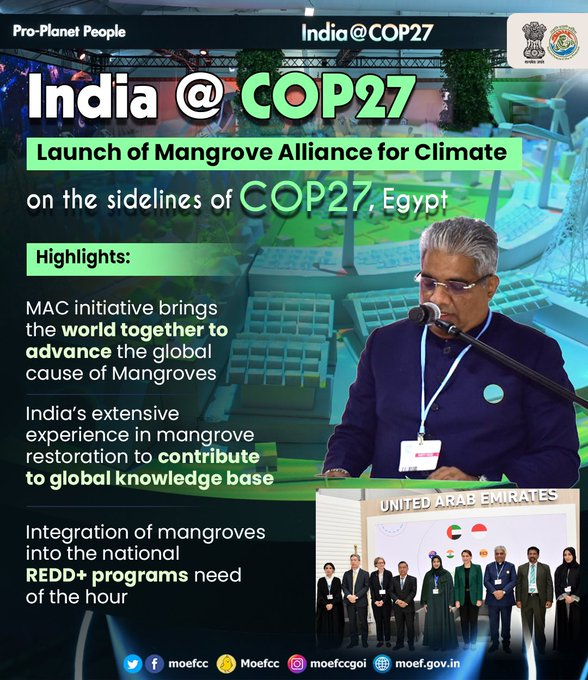
  • Mangrove Alliance for Climate (MAC) launched at COP27

    mangroves

    At the 27th Session of the Conference of Parties (COP27), this year’s UN climate summit, the Mangrove Alliance for Climate (MAC) was launched with India as a partner.

    Mangrove Alliance for Climate (MAC)

    • An initiative led by the UAE and Indonesia, the MAC includes India, Sri Lanka, Australia, Japan, and Spain.
    • It seeks to educate and spread awareness worldwide on the role of mangroves in curbing global warming and its potential as a solution for climate change.
    • Under MAC, UAE intends to plant 3 million mangroves in the next two months, in keeping with UAE’s COP26 pledge of planting 100 million mangroves by 2030.

    Working of MAC

    • MAC would work on a voluntary basis. It means that there are no real checks and balances to hold members accountable.
    • Instead, the parties will decide their own commitments and deadlines regarding planting and restoring mangroves.
    • The members will also share expertise and support each other in researching, managing and protecting coastal areas.

    Why protect mangroves?

    • Infrastructure projects — industrial expansion, shifting coastlines, coastal erosion and storms, have resulted in a significant decrease in mangrove habitats.
    • Between 2010 and 2020, around 600 sq km of mangroves were lost of which more than 62% was due to direct human impacts, the Global Mangrove Alliance said in its 2022 report.

    Importance of mangroves

    mangrove

    • Biodiversity: Mangrove forests — consisting of trees and shrub that live in intertidal water in coastal areas — host diverse marine life.
    • Fishing grounds: They also support a rich food web, with molluscs and algae-filled substrate acting as a breeding ground for small fish, mud crabs and shrimps, thus providing a livelihood to local artisanal fishers.
    • Carbon sinks: Equally importantly, they act as effective carbon stores, holding up to four times the amount of carbon as other forested ecosystems.
    • Cyclone buffers: When Cyclone Amphan struck West Bengal in May, its effects were largely mitigated by the Sundarbans flanking its coasts along the Bay of Bengal.

    Threats to Mangroves

    • Anthropogenic activities: They are a major threat to the mangroves. Urbanization, industrialization and the accompanying discharge of industrial effluents, domestic sewage and pesticide residues from agricultural lands threaten these fragile ecosystems.
    • Saltpan and aquaculture: This causes huge damage to the mangroves. Shrimp farming alone destroyed 35,000 hectares of mangroves worldwide.
    • Destruction for farming: 40% of mangroves on the west coast has been converted into farmlands and other settlements in just 3 decades.
    • Sea-level rise: This is another challenge to these mangroves- especially on the Bay of Bengal coast.

    Mangroves in India

    • India holds around 3 percent of South Asia’s mangrove population.
    • Besides the Sundarbans in West Bengal, the Andaman region, the Kutch and Jamnagar areas in Gujarat too have substantial mangrove cover.

    How can India benefit from MAC?

    • India is home to one of the largest remaining areas of mangroves in the world — the Sundarbans.
    • It has years of expertise in restoration of mangrove cover that can be used to aid global measures in this direction.
    • The move is in line with India’s goal to increase its carbon sink.


    Try this PYQ:

    Q.Which one of the following is the correct sequence of ecosystems in the order of decreasing productivity?

    (a) Oceans, lakes, grasslands, mangroves

    (b) Mangroves, oceans, grasslands, lakes

    (c) Mangroves, grasslands, lakes, oceans

    (d) Oceans, mangroves, lakes, grasslands


    Post your answers here.


    Click and get your FREE Copy of CURRENT AFFAIRS Micro Notes

  • Energy Transition Accelerator (ETA): A new carbon offset scheme by the US

    eta

    The US has unveiled a new carbon offset scheme called Energy Transition Accelerator (ETA) for climate finance.

    Energy Transition Accelerator (ETA)

    • ETA is carbon offset plan that will allow companies to fund clean energy projects in developing countries and gain carbon credits that they can then use to meet their own climate goals.
    • The plan will be developed by the US along with the Bezos Earth Fund and the Rockefeller Foundation.
    • It would receive inputs from public and private
    • The concept is to put the carbon market to work, deploy capital otherwise undeployable, and speed up the transition from dirty to clean power.

    Benefits of ETA

    • It may be good for renewable energy projects for sure and for those coal plants that are very old and unviable and which India wishes to shut down.
    • The scheme comes at a time when there is growing mistrust among developing countries about developed nations failing to deliver on climate finance commitments.

    Limitations of ETA

    • The proposed initiative would be insufficient to make up for the lack of funding from rich countries.
    • What developing countries need is predictable finance – not offset markets.
    • The proposed initiative cannot make up for the US’s failure to provide its fair share of climate finance – an estimated $40 billion of the unmet goal of $100 billion a year.

    Conclusion

    • ETA appears to be a substitute for deep decarbonization needed within the US and other industrialized countries.
    • For developing countries like India, the first priority would be to meet their own targets and not provide offsets for reductions in developed nations.


    Click and get your FREE Copy of CURRENT AFFAIRS Micro Notes

  • 10th Nov| Daily Answer Writing Enhancement

    Topics for Today’s questions:

    GS-1            Effects of globalization on Indian society.

    GS-2           Executive and Judiciary

    GS-3          Conservation, environmental pollution and degradation, environmental impact assessment; Indian Economy

    GS-4          Dedication to public service, empathy, tolerance and compassion towards the weaker sections.

    Question 1)


    Q.1 A new globalization is taking shape, and it’s both good and bad news for India. Critically analyse. (10 Marks)


    Question 2)

    Q.2 Briefly outlining the evolution of collegium system for appointment of judges in India, highlight the issues with the process. (15 Marks)

    Question 3)

    Q.3 What are green bonds? Illustrate using examples. What are the objectives of India’s Sovereign Green Bonds Framework? (10 Marks)

    Question 4)  

    Q.4 What are the principles of effective public service delivery? Explain its importance in ensuring good governance with the help of relevant examples. (10 Marks)


    HOW TO ATTEMPT ANSWERS IN DAILY ANSWER WRITING ENHANCEMENT(AWE)?

    1. Daily 4 questions from General studies 1, 2, 3, and 4 will be provided to you.

    2. A Mentor’s Comment will be available for all answers. This can be used as a guidance tool but we encourage you to write original answers.

    3. You can write your answer on an A4 sheet and scan/click pictures of the same.

    4.  Upload the scanned answer in the comment section of the same question.

    5. Along with the scanned answer, please share your Razor payment ID, so that paid members are given priority.

    6. If you upload the answer on the same day like the answer of 11th  February is uploaded on 11th February then your answer will be checked within 72 hours. Also, reviews will be in the order of submission- First come first serve basis

    7. If you are writing answers late, for example, 11th February is uploaded on 13th February , then these answers will be evaluated as per the mentor’s schedule.

    8. We encourage you to write answers on the same day. However, if you are uploading an answer late then tag the mentor like @Staff so that the mentor is notified about your answer.

    *In case your answer is not reviewed, reply to your answer saying *NOT CHECKED*. 

    1. For the philosophy of AWE and payment: 

  • Q.4 What are the principles of effective public service delivery? Explain its importance in ensuring good governance with the help of relevant examples. (10 Marks)

    Mentor’s Comments-

    • Introduce briefly by giving the principles of public service delivery.
    • Describe its importance in ensuring good governance
    • Conclude briefly.
  • Q.3 What are green bonds? Illustrate using examples. What are the objectives of India’s Sovereign Green Bonds Framework? (10 Marks)

    Mentor’s Comments-

  • Q.2 Briefly outlining the evolution of collegium system for appointment of judges in India, highlight the issues with the process. (15 Marks)

    Mentor’s Comments-

  • Q.1 A new globalization is taking shape, and it’s both good and bad news for India. Critically analyse. (10 Marks)

    Mentor’s Comments-

    • In the introduction, define globalization and briefly describe how is it evolving.
    • In the body, write down few points explaining both the positive and negative aspects of the ‘new’ globalization.
    • Next, mention what should be the way forward for India.
    • Conclude on a balanced note.
  • Watch LIVE(inside) | UPSC Workshop: Master the art of Intelligent Elimination for UPSC Prelims MCQs | Session by Dinesh sir at 4pm | Register now.

    Watch LIVE(inside) | UPSC Workshop: Master the art of Intelligent Elimination for UPSC Prelims MCQs | Session by Dinesh sir at 4pm | Register now.

    13th Nov @ 4 PM- Intelligent Elimination of options for UPSC Prelims MCQs by Dinesh Sir.

    WATCH LIVE BELOW:

    https://youtu.be/9qOWbha-LXU

    Day 4: 13th Nov, 4 pm (Sunday)

    Dinesh sir, the senior IAS Faculty from Civilsdaily will discuss the most important aspects of the UPSC exam – How to attempt UPSC Prelims MCQs? and in that he will share tips and hacks to attempt successfully questions that pull you into negative marking by confusing you.

    • Intelligent Elimination Techniques for UPSC Prelims 2023-24
    • 10 smart hacks for MCQ option elimination 

    You will be able to solve many questions with almost no or relatively less information by using these techniques.

    Given the voluminous nature of the UPSC exam syllabus, it is almost impossible for a candidate preparing for UPSC to expect a complete revision of all textbooks and the entire syllabus right before the examination; however, revision is critical to scoring well and passing the examination. As a result, most aspirants rely on self-made notes for quick revision during exam days to overcome this challenge.

    Making notes is not only an important part of UPSC preparation but also it is the main part of active learning. One cannot expect to clear even the Prelims unless he prepares his notes and regularly revises them. Take any UPSC topper from any year, and you will find that almost all of them used note-taking as part of their UPSC preparation strategy.

    Day 3: 13th Nov, 12 noon (Sunday)

    Dimple Chouhan ma’am, CD’s Senior IAS Mentor will discuss how to make UPSC notes for  GS-Current Affairs for Pre+Mains. She will also share value-added 2-3 paged crisp and comprehensive notes so that students get proper guidance… 

    Apart from the above, an IAS aspirant must know how to deal with offbeat questions.


    Day 1: UPSC FREE Workshop by AIR 109, UPSC 2021, Areeba Nomaan was concluded successfully. In case you missed it, Register for the Recorded session, PDF & Notes

    UPSC is nothing but a difficult battle. Every year Lakhs of aspirants face only fail because they accept self-defeat. Sajal sir said, “UPSC is the most UNPREDICTABLE PUBLIC SERVICE COMMISSION’.

    ‘The Journey of UPSC something different.

    Civilsdaily

    During the preparation journey, an aspirant should be doubly sure of his/her strategy and all those IMP themes that only can work in the exam hall. It’s not good to go ahead without knowing the most possible loopholes. 

    You have to be Prelims, Mains ready even before 2 months of Prelims itself. And only then you can catch your IAS/IPS dream on the very 1st attempt.

    True success involves the full use of your power and strategy. Most of the time it happens that an aspirant works very hard but he/she does not achieve success because they lack clarity. 

    REGISTER FOR RECORDED SESSION | Day 1: 11th Nov, 5:30 pm (Friday) | The most important Masterclass by AIR 109, UPSC 2021, Areeba Nomaan | Post-session important PDFs, videos, and notes will be shared for FREE.

    Acknowledging the need to ensure sure success in UPSC in the very 1st attempt, AIR 109, UPSC 2021, Areeba Nomaan, CD’s Super Mentor will take the IMP masterclass on cracking UPSC 2023-24 in just one attempt + Important themes and strategy…She will be giving a 6 months strategy for UPSC 2023 Prelims aspirants as well.


    Key Takeaways of Masterclass with AIR 109, UPSC 2021, Areeba Nomaan, Super Mentor of Civilsdaily. Other than those mentioned above we will be discussing the following points:

    1. Analysing the trend of UPSC and devising an evolving adaptive strategy.

    2. How to cover the syllabus? The syllabus, not the books, must be completed. Focussing on the essentials first.

    3. What are the best books to refer to? Based on the last 10-year UPSC-CSE paper analysis.

    4. Recognize the UPSC requirement. What kinds of test series are useful? Which mock test series should be avoided?

    5. Complete UPSC-CSE Preparation Timeline for a Working Professional

    6. The skill of taking notes. What topics necessitate notes and which do not?

    7. Working hard in the right direction vs. working hard in the wrong direction Is it possible to be successful solely by studying hard?

    8. There are only two consolidated sources for current events. What exactly are they?

    9. Revision techniques that are common, standard, and used frequently. What exactly are they?

    10. And many more IMP points of UPSC Prep that only a Topper can disclose


    Details of the workshop

    Date: 11th November 2022

    Time: 5pm onwards

    Venue: This Workshop will be held in both offline and online mode. You can attend in CivilsDaily’s Delhi center offline, and for Online mode, we will share a Zoom link in your email. Please register.

    Address: CivilsDaily IAS, 1 LGF, Apsara Arcade, Pusa Rd Next to Gate No 7, Karol Bagh, Delhi

    What The Hindu mentioned about Civilsdaily Mentorship

    The Hindu has acknowledged the success rate of CD’s Smash mains Mentorship

    Quora Digests:

    Don’t miss out on this super important workshop.

  • Impact of Pandemic on Vulnerable Section: SC, ST and OBC

    Impact of Pandemic

    Context

    • SC/ST and OBC have been impacted disproportionately by the pandemic as various social indicators shows vulnerabilities of this communities.

    Impact of pandemic on education

    • On the one hand, with policies mandating the promotion of students, promotion rates at the secondary school level rose significantly and repetition rates nosedived during the pandemic years (2020-21 and 2021-22).
    • On the other, the inability to attend physical school and the lack of access to digital education caused a massive drop in learning levels after the COVID-19 outbreak.

    Impact of Pandemic

    Impact on education of SC, ST and OBC

    • Increasing promotion rate: Notably, the promotion rate among Scheduled Caste (SC) and Scheduled Tribe (ST) students increased sharply after the outbreak. The promotion rate among Other Backward Classes (OBC) students continued to rise unabated.
    • Repetition rate declining: The repetition rates too drastically came down in the pandemic years with some 1% students repeating their class across all communities. Notably, the gap in the repetition rate between SC/ST students and general category students declined greatly after the outbreak.
    • Declining learning outcomes: While the promotion rate surged and the repetition rate declined, the marks scored by school students in National Achievement Survey (NAS) exams dropped significantly across classes and in most subjects.
    • Disproportionate impact: There is a disproportionately greater impact on SC and ST students as their learning outcomes reduced the most while their promotion rates saw the highest degree of rise among all the communities.

    Impact on livelihood of vulnerable sections of the society

    • High job loss probability: The researchers found that compared to workers from upper castes, the probability of job loss was three times higher for those who are SC and two times higher for OBC workers.
    • Comparatively higher unemployment: In December 2019, 39% of upper caste workers were employed and by April 2020, the percentage had dropped to 32%. The fall was more pronounced for SC workers, 44% of whom were employed in December 2019, but only 24% were employed in April 2020. For OBCs and STs the fall was from 40% to 26% and 48% to 33%, respectively.
    • Poor education poor Opportunities: According to researchers, the upper castes are endowed with higher human capital, i.e. educational achievement, and are in jobs less vulnerable to pandemic disruption. What is surprising is that the impact on scheduled caste is three times worse. Not only has the pandemic exposed the pre-existing inequities but has amplified them.

    Impact of Pandemic

    How women are affected due to the pandemic?

    • Effect on mental health: Women in low-caste women may be at a greater risk for worse mental health outcomes and higher perceived loneliness relative to high-caste women.
    • Social exclusion and job losses: Prior research has found that low-caste women have been found to experience greater social exclusion greater job loss and greater barriers to healthcare and thus may experience both worse mental health and higher loneliness.
    • Rising loneliness: Women in SC/ST and OBC groups will experience worse mental health, and higher perceived loneliness relative to women in the general caste group. We expect that this difference will be robust even when accounting for sociodemographic factors.
    • Victims of systemic disadvantage: Women in general and women of weaker sections in particular, are victims of multiple systemic disadvantages, which exacerbated during the pandemic. Rural women, especially the female wage workers, endured greater socio-economic difficulties as their livelihood opportunities were abruptly halted by the lockdown.
    • Visible gendered impact of pandemic: There is nothing natural in the gendered impact of pandemic, but the social norms and behaviour put them at greater risks due to unequal gender preference that is inbuilt in the social structure and culture.

    Conclusion

    • Pandemic have disproportionately affected the Indian society. Whether it is access to healthcare or vaccination SC, ST and OBC had a disadvantage. Lot of studies and research have assessed the caste specific impact of coronavirus and projected the dismal state of vulnerable groups. Government must look all these data while drafting the future policies for vulnerable communities.

    Mains Question

    Q. Analyze the learning outcome of SC/ST students after the pandemic. Assess the impact of pandemic on women belonging to SC, ST and OBC community.

    Click and Get your FREE copy of Current Affairs Micro notes

  • Urban Pollution

    Urban Pollution

    Context

    • More than 1,10,000 infants are likely to have been killed by air pollution in India in 2019, almost immediately after being born while long-term exposure to outdoor and household air pollution was estimated to be responsible for about 1.67 million annual deaths amongst the adult population in the country.

    What is pollution?

    • Pollution is the introduction of harmful materials into the environment. These harmful materials are called pollutants. Pollutants can be natural, such as volcanic ash. They can also be created by human activity, such as trash or runoff produced by factories. Pollutants damage the quality of air, water, and land.

    Urban Pollution

    Menace of air pollution in urban areas

    • Demands for air purifiers: Demand for air purifiers has boomed. Recently, in Delhi, pollution-related curbs were lifted and schools opened, despite air quality continuing to be in the “very poor” category.
    • Health related problems: For the majority of urban north Indians who can’t afford air purifiers, life continues amidst dust, cough and breathlessness.
    • Children are most affected: Our children in urban localities are growing up with stunted lungs, amidst poverty.
    • High percentage of respiratory problems: Eighty per cent of all families in Delhi are noted to be suffering respiratory ailments due to severe pollution.

    How we can reduce the air pollution?

    • Expand green cover across urban areas to reduce dust pollution: Ahmedabad’s municipal corporation, for instance, has experimented with urban forests, with the city’s 43rd urban forest inaugurated in June 2021 over 20,000 trees have been in 7,625 sq. metres. Chandigarh has about 1,800 parks. Close to 46 per cent of the city was classified as a green area in 2019.
    • Use of Miyawaki technique: Civil society could also help in Chennai, the NGO Thuvakkam, with a volunteer force of 1,800, has been able to grow 25 Miyawaki forests, raising over 65,000 trees. Such plantations are now being replicated in other cities including Tuticorin, Vellore and Kanchipuram.
    • Push for airshed management: With a focus on understanding meteorological, seasonal and geographic patterns for air quality across a large region. In the US, the passage of the Air Quality Act (1967) saw the state of California being divided into 35 districts which had similar geographic and meteorological conditions and pollution was regulated at the state level. This approach was successful in reducing emissions by 98 per cent from 2010 to 2019.
    • Heavy penalty on polluting cars: Inspiration can also be taken from London’s air pollution revolution an Ultra-Low Emission zone has been established in Central London, with hefty daily fees on cars that emit more than 75g/km of pollution.

    Urban Pollution

    Water pollution in Indian cities

    • Untreated water into freshwater bodies: 72 per cent of urban sewage is untreated in India’s urban freshwater bodies. The Central Pollution Control Board reckons that more than 50 per cent of 351 river stretches (on 323 rivers) are polluted. Over 4,000 septic trucks (with each truck having 5,000 litres of human waste) dispose of their waste in the Ganga every day. In Delhi, about 941 MLPD of raw sewage finds its way to the river, killing off fish and preventing rituals on the banks.
    • Riverine Pollution: Riverine pollution causes due to raw sewage overflowing from sewage treatment plants, untreated waste from unauthorized colonies, industrial effluents, sewer water from authorized colonies and inter-state pollution.
    • Water scarcity: More than 40 per cent of Indians are expected to face water scarcity by 2050 and close to 35 million will face annual coastal flooding with sea level rise.
    • Lack of planning: Apathy prevails as of May 2021, only 16 Indian cities had disclosed their plans to tackle climate change to international institutions, with only eight having actual sustainability-related targets in their urban master plans. Only 43 per cent of all Indian cities surveyed actually sought to address climate change adaption as a topic in their master plans, while only five had a GHG emission reduction target.

    Urban Pollution

    Do you know this harsh reality?

    • In India, nearly 7 lakh premature deaths are attributed to water pollution
    • Globally, 1.5 million children under five years die each year as a result of water-related diseases.

    How to fight water pollution?

    • Improving sewage treatment plant capacity: ensuring linkages with the drainage network. Mangalore’s City Corporation (MCC) has wastewater treatment plants with end-user linkages. The MCC offered to supply treated water to such industrial end-users in the city’s special economic zone if the latter agreed to fund about 70 per cent of the operations and maintenance cost of the pumps and the sewage treatment plant.
    • Developing a sanitation network: The problem of untreated waste and sewer water from unauthorized colonies can be solved by investing in a sewerage network. Consider the example of Alandur, a small suburb of Chennai in 2000, it had no underground sewage lines, with most houses dependent on septic tanks. In the late 1990s, the local municipality in partnership with local resident welfare associations conducted collection drives to gain deposits (ranging from Rs 1,000 to Rs 1,500) for developing a sanitation network.
    • Pump house: The project was launched with a push for creating a pump house, setting up over 5,650 manholes and providing sewerage connections to 23,700 households, a sewage treatment plant with a 12 MLD capacity was also set up. Going forward, many other municipalities in Tamil Nadu have sought to adopt this model.
    • A systems-based approach should be adopted: along with a push for protecting “blue infra” areas places that act as natural sponges for absorbing surface runoff, allowing groundwater to be recharged. At the household level, we can encourage citizens to take up rainwater harvesting, urban roof terrace greening, urban roof water retention tanks and having a green corridor around residential buildings.
    • Water permeable roads: Municipalities could be encouraged to make existing roads permeable with a push for green landscaping and rain gardens. At the city level and beyond, policymakers should push for “sponge cities” and incorporate disaster planning. A mindset shift, in citizenry and policymakers, is urgently needed.

    Conclusion

    • Urban planning and urban pollution are largely neglected in our governance model. Unplanned cities are facing the various problems. We must embrace the technology to fight the pollution in urban India.

    Mains Question

    How severe is the problem of Urban pollution? What steps can be taken to fight the urban pollution in India?

    Click and Get your FREE copy of Current Affairs Micro notes

  • [Sansad TV] Mudda AapKa: POCSO Act

    Click and get your FREE Copy of CURRENT AFFAIRS Micro Notes

    Context

    • Non-reporting of sexual assault against a minor child despite knowledge is a serious crime, held the Supreme Court under the POCSO Act.
    • It further added that such non-reporting is more often than not done in an attempt to shield the offenders of the crime.
    pocso

    What is POCSO Act?

    • The Ministry of Women and Child Development championed the introduction of the Protection of Children from Sexual Offences (POCSO) Act, 2012.
    • The Act has been enacted to protect children from offences of sexual assault, sexual harassment and pornography and provide for establishment of Special Courts for trial of such offences.
    • The Act was amended in 2019, to make provisions for enhancement of punishments for various offences so as to deter the perpetrators and ensure safety, security and dignified childhood for a child.

    Features of the Act   

    • Gender neutrality: The Act is gender neutral and regards the best interests and welfare of the child. The Act calls for mandatory reporting of sexual offences. A false complaint with intent to defame a person is punishable under the Act.
    • Definition of Child: The Act defines a child as any person below eighteen years of age.
    • Definitions of sexual abuses: It defines different forms of sexual abuse, including penetrative and non-penetrative assault, as well as sexual harassment and pornography.
    • Prevents child trafficking: People who traffic children for sexual purposes are also punishable under the provisions relating to abetment in the Act.  
    • Preventing re-victimization of child: Adequate provisions are made to avoid re-victimization of the Child at the hands of the judicial system.
    • Sensitization of Police: The Act assigns a policeman in the role of child protector during the investigation process.
    • Child friendly investigation: The Act stipulates that such steps must be taken which makes the investigation process as child-friendly as possible.
    • Speedy disposal: The Act provides for the establishment of Special Courts for the trial of such offences and stipulates that the case is disposed of within one year from the date of reporting of the offence.

    What is the rationale behind the legislation?

    • Multiple facets of crime: New forms of child abuse like online bullying, harassment and Child Pornography have emerged to a greater extent.
    • Exception handling: As per the last available data from the National Crime Records Bureau of child rape cases came up before the courts under the POCSO Act read with Indian Penal Code Section 376.
    • Larger conviction: Less than three per cent cases ended in convictions, pointing to the need for better access to justice for all, and not just more stringent conviction in a small percentage of cases.
    • Deterrence against crime: There is the belief that harsher punishments will deter people from committing child rape.
    • Zero-tolerance: Lastly, the disgust for the crime makes the perpetrator ‘deserving’ of death penalty.

    Issues with the Law

    • Recurrence of such crime: In the context of child rape, many preventive measures and policies do have a definitive impact on preventing child rape.
    • Lower conviction: The conviction rates are low under the Protection of Children from Sexual Offences Act, 2012.
    • Investigation bottlenecks: There is lack of specialised investigators, prosecutors, judges, mental health professionals, doctors, forensic experts and social workers.
    • Protection bottlenecks: Inadequate child protection and rehabilitation services, lack of compliance with child-friendly legal procedures are some other concerns.
    • Under-reporting: A large proportion of perpetrators are family members or those close to or known to the family. This results in massive underreporting of such crimes.
    • Protection of convicts: This concern will only intensify with death penalty, as the child’s family often settles a case of known person preventing him to the gallows.
    • Vulnerability: The arbitrariness of the death penalty in India also arises from the discriminatory impact of the choice of what constitutes ‘rarest of rare’.
    • Delay of trials: The Kathua Rape case took 16 months for the main accused to be convicted whereas the POCSO Act clearly mentions that the entire trial and conviction process has to be done in one year.
    • Communal Politicization:  Considering rapes on communal angles is another challenge. The Unnao rape case and Kathua rape case are some of the examples.

    Way forward

    • The social menace of child rape requires sustained planning, engagement, and investment of resources by the government.
    • The need of the hour is to prioritise prevention activities against abuse, creating safe (physical and online) environments for children.
    • Developing a comprehensive outreach system to engage parents, schools, communities, NGOs partners and local governments as well as police and lawyers is needed.
    • This will ensure better implementation of the legal framework, policies, national strategies and standards.

    Click and get your FREE Copy of CURRENT AFFAIRS Micro Notes

  • Groundwater Extraction Lowest in 18 years

    groundwater

    Groundwater extraction in India saw an 18-year decline, according to an assessment by the Central Ground Water Board (CGWB).

    What is Groundwater?

    groundwater

    • Groundwater is the water found underground in the cracks and spaces in soil, sand and rock.
    • It is stored in and moves slowly through geologic formations of soil, sand and rocks called aquifers.
    • Aquifers are typically made up of gravel, sand, sandstone, or fractured rock, like limestone.
    • Water can move through these materials because they have large connected spaces that make them permeable.
    • Aquifers, hand-dug wells, and artesian wells are different types of sources of groundwater.

    Declining trend of groundwater extraction

    • The total annual groundwater recharge for the entire country is 437.6 billion cubic metres (bcm) in 2022.
    • However the extraction for entire country is only 239.16 bcm, according to the 2022 CGWB report.
    • By comparison, an assessment in 2020 found that the annual groundwater recharge was 436 bcm and extraction 245 bcm.
    • The 2022 assessment suggests that groundwater extraction is the lowest since 2004, when it was 231 bcm.

    Implications of the CGWB report

    • A detailed analysis of the assessment indicates increase in ground water recharge.
    • This is mainly attributed to:
    1. Increase in recharge from canal seepage,
    2. Return flow of irrigation water and
    3. Recharges from water bodies/tanks & water conservation structures.

    Significance of groundwater

    • Groundwater supplies drinking water to a sizeable population in India and almost 99% of the rural population.
    • It helps grow our food. 64% of groundwater is used for irrigation to grow crops.
    • It is an important component in many industrial processes.
    • It is a source of recharge for lakes, rivers, and wetlands.

    Why discuss this?

    • Depletion: People face serious water shortages because groundwater is used faster than it is naturally replenished.
    • Contamination: In other areas groundwater is polluted by human activities.

    Reasons for Depletion

    • Increased demand for water for domestic, industrial and agricultural needs and limited surface water resources lead to the over-exploitation of groundwater resources.
    • Limited storage facilities owing to the hard rock terrain, along with the added disadvantage of lack of rainfall, especially in central Indian states.
    • Green Revolution enabled water-intensive crops to be grown in drought-prone/ water deficit regions, leading to over-extraction of groundwater.
    • Frequent pumping of water from the ground without waiting for its replenishment leads to quick depletion.
    • Subsidies on electricity and high MSP for water-intensive crops is also leading reasons for depletion.
    • Inadequate regulation of groundwater laws encourages the exhaustion of groundwater resources without any penalty.
    • Deforestation, unscientific methods of agriculture, chemical effluents from industries, and lack of sanitation also lead to pollution of groundwater, making it unusable.
    • Natural causes include uneven rainfall and climate change that are hindering the process of groundwater recharge.

    Impact of groundwater depletion

    • Lowering of the water table: Groundwater depletion may lower the water table leading to difficulty in extracting groundwater for usage.
    • Reduction of water in streams and lakes: A substantial amount of the water flowing in rivers comes from seepage of groundwater into the streambed. Depletion of groundwater levels may reduce water flow in such streams.
    • Subsidence of land: Groundwater often provides support to the soil. When this balance is altered by taking out the water, the soil collapses, compacts, and drops leading to subsidence of land.
    • Increased cost for water extraction: As the depleting groundwater levels lower the water table, the user has to delve deep to extract water. This will increase the cost of water extraction.

    Regulation of Groundwater in India

    (1) Central Ground Water Authority (CGWA)

    • It has the mandate of regulating ground water development and management in the country.
    • It is constituted under the Environment (Protection) Act of 1986.
    • CGWA issues advisories, public notices and grant No Objection Certificates (NOC) for ground water withdrawal.

    (2) National Aquifer Mapping and Management Programme (NAQUIM)

    • The NAQUIM is an initiative of the Ministry of Jal Shakti for mapping and managing the entire aquifer systems in the country.
    • It maintains the Hydrological Map of India.

    (3) Atal Bhujal Yojana 

    • It is a Central Sector Scheme, for sustainable management of groundwater resources with community participation in water-stressed blocks.

    Way Forward

    • Routine survey: There should be regular assessment of groundwater levels to ensure that adequate data is available for formulating policies and devising new techniques.
    • Assessment of land use pattern: Studies should be carried out to assess land use and the proportion of agricultural land falling under overt-exploited units.
    • Changes in farming methods: To improve the water table in those areas where it is being overused, on-farm water management techniques and improved irrigation methods should be adopted.
    • Reforms in power supply subsidies: The agricultural power-pricing structure needs to be revamped as the flat rate of electricity adversely affects the use of groundwater.
    • Monitoring extraction: There should be a policy in place to monitor the excessive exploitation of groundwater resources to ensure long-term sustainability.


    Click and get your FREE Copy of CURRENT AFFAIRS Micro Notes

  • Genesis of the Delhi Air Pollution and its mitigation

    delhi

    As the situation becomes an annually recurring one in New Delhi and NCR, here’s a look at how far back it goes and what policies have been adopted by the Centre and Delhi’s elected governments to curb air pollution over the years.

    Do you know?

    In November 2016, in an event known as the Great Smog of Delhi, the air pollution spiked far beyond acceptable levels. This tagged New Delhi to be world’s most polluted city ever.

    Causes of Poor Air Quality

    • Motor vehicle emissions are one of the causes of poor air quality.
    • Badarpur Thermal Power Station, a coal-fired power plant was another major source of air pollution in Delhi.
    • The drift/mist emissions from the wet cooling towers are also a source of particulate matter as they are widely used in industry and other sectors for dissipating heat in cooling systems.
    • Although Delhi is kerosene free and 90% of the households use LPG for cooking, the remaining 10% uses wood, crop residue, cow dung, and coal for cooking. (Census-India, 2011)
    • Fires in Bhalswa landfill is a major reason for airborne particles in Delhi.
    • Burning of effigies during Vijayadashami and bursting of firecrackers burning during Diwali is often accused by the left-wing activists to cause of Delhi’s poor air quality.
    • Agricultural stubble burning in Haryana and Punjab, coupled with north-westerly winds also affects Delhi’s air quality since the 1980s when crops are being harvested.

    Evolution of policies

    (1) Recognition of the broader issue (1995)

    • In March 1995, the Supreme Court, while hearing a plea by environmentalist and lawyer M.C. Mehta about Delhi’s polluting industries
    • It noted that Delhi was the world’s fourth most polluted city in terms of concentration of suspended particulate matter (SPM) in the ambient atmosphere as per the WHO’s 1989 report.

    (2) Identifying major pollutants (1996)

    • The Court took note of two polluting factors — vehicles and industries.
    • In 1996, the court ordered the closure and relocation of over 1,300 highly-polluting industries from Delhi’s residential areas beyond the National Capital Region (NCR) in a phased manner.
    • In 1996, Mr. Mehta filed another public interest litigation (PIL) alleging that vehicular emissions were leading to air pollution and that it posed a public health hazard.

    (3) Action plan by Delhi Govt. (1996)

    • The Delhi government submitted an action plan to the apex court.
    • The court recognised the need for technical assistance and advice in decision-making and implementation of its orders.

    (4) Establishment of EPCA (1998)

    • The Supreme Court asked the Environment Ministry to establish an authority for Delhi, leading to the creation of the Environmental Pollution Control Authority of Delhi NCR (EPCA) in 1998.
    • The EPCA submitted its report containing a two-year action.
    • The Court subsequently ordered the Delhi Transport Corporation (DTC) bus fleet, taxis, and autos to switch to Compressed Natural Gas (CNG), and the phasing out of all pre-1990 autos.
    • Coal-based power plants within Delhi were also converted to gas-based ones.

    (5) National Air Quality Programme (NAMP)

    • Around the same time, the Centre decided to establish a network of monitoring stations under the National Air Quality Programme (NAMP) to measure key pollutants.
    • The NAMP monitors the four major pollutants as part of the AQI – sulphur dioxide, oxides of nitrogen, respirable particulate matter and fine particulate matter.
    • It also checks wind speed and direction along with relative humidity and temperature.

    How were air quality standards revised?

    • The National Ambient Air Quality Standards (NAAQS) were specified by the Central Pollution Control Board (CPCB).
    • It identified pollutants like PM10 (particulate matter with a diameter exceeding 10 microns), sulphur dioxide and nitrogen oxides were measured.
    • The NAAQS were revised in 2009 to include 12 categories of pollutants including PM2.5 (particulate matter with a diameter under 2.5 microns
    • Particulate Matter (PM) is primarily generated by fuel combustion from different sectors, including transport, energy, households, industry and agriculture.

    Arriving finally at: Graded Response Action Plan (GRAP)

    • According to the revised NAAQS, the acceptable annual limit for PM2.5 is 40 micrograms per cubic metre (ug/m3) and 60 ug/m3 for PM10.
    • In the winter of 2016, Delhi witnessed one of its worst incidents of pollution-induced smog, with PM2.5 and PM10 levels reaching a whopping 999 ug/m3 in parts of Delhi on November 1.
    • Subsequently, the Supreme Court in November 2016 told Delhi and NCR authorities to form a plan to deal with the air pollution.
    • The MoEFCC in early 2017 came out with the Graded Response Action Plan (GRAP).


    Try this question from CS Mains 2015:

    Q.Mumbai, Delhi and Kolkata are the three megacities of the country but the air pollution is a much more serious problem in Delhi as compared to the other two. Why is this so?


    Click and get your FREE Copy of CURRENT AFFAIRS Micro Notes

  • Kerala govt. moves to divest Governor of Chancellor Role

    chancellor

    In the latest escalation of its running battle with Governor, the Kerala government has decided to remove him as Chancellor of State universities, seeking to replace him with “renowned academic experts”.

    Who is a Chancellor of a University?

    • In India, almost all universities have a chancellor as their titular head whose function is largely ceremonial.
    • The governor of the state, appointed as the union’s representative of state by the president, is the honorary chancellor of all State owned universities.
    • The de facto head of any government university is the vice-chancellor.
    • In private non-profit universities, normally the head of the foundation who has established the university is the chancellor of the university and is the head of the university.

    Role of Governors in State Universities

    • In most cases, the Governor of the state is the ex-officio chancellor of the universities in that state.
    • Its powers and functions as the Chancellor are laid out in the statutes that govern the universities under a particular state government.
    • Their role in appointing the Vice-Chancellors has often triggered disputes with the political executive.

    What about Central Universities?

    • Under the Central Universities Act, 2009, and other statutes, the President of India shall be the Visitor of a central university.
    • With their role limited to presiding over convocations, Chancellors in central universities are titular heads, who are appointed by the President in his capacity as Visitor.
    • The VCs too are appointed by the Visitor from panels of names picked by search and selection committees formed by the Union government.
    • The Act adds that the President, as Visitor, shall have the right to authorize inspections of academic and non-academic aspects of the universities and also to institute inquiries.

    What is Kerala attempting to do?

    • Education comes under the Concurrent List.
    • In an official statement, the Kerala Cabinet noted the M.M. Punchhi Commission had vouched against granting Governors the power of Chancellors.
    • In many states, the elected governments have repeatedly accused the Governors of acting at the behest of the Centre on various subjects, including education.


    Click and get your FREE Copy of CURRENT AFFAIRS Micro Notes

  • In news: Pashmina Wool

    pashmina

    Traders of Pashmina shawls are complaining that “obsolete testing methods” have resulted in many of their export consignments being flagged for the presence of ‘Shahtoosh’ guard hair, which is obtained from endangered Tibetan antelopes.

    Shahtoosh, on the other hand, is the fine undercoat fibre obtained from the Tibetan Antelope, known locally as ‘Chiru’, a species living mainly in the northern parts of the Changthang Plateau in Tibet.  

    What is Pashmina?

    • Pashmina is a fine type of cashmere wool. The textiles made from it were first woven in Kashmir.
    • The wool comes from a number of different breeds of the cashmere goat; such as the changthangi or Kashmir pashmina goat from the Changthang Plateau in Tibet and part of the Ladakh region and few parts of Himachal Pradesh.
    • Often shawls called shahmina are made from this material in Kashmir and Nepal; these shawls are hand spun and woven from the very fine cashmere fibre.
    • Traditional producers of pashmina wool are people known as the Changpa.
    • Bureau of Indian Standards (BIS) has published an Indian Standard for identification, marking and labelling of the already GI tagged Pashmina products to certify its purity.

    About Pashmina goat

    • The Changthangi or Pashmina goat is a special breed of goat indigenous to the high altitude regions of Ladakh in Jammu and Kashmir.
    • They are raised for ultra-fine cashmere wool, known as Pashmina once woven. The Textiles are handspun and were first woven in Kashmir.
    • The Changthangi goat grows a thick warn undercoat which is the source of Kashmir Pashmina wool – the world’s finest cashmere measuring between 12-15 microns in fiber thickness.
    • These goats are generally domesticated and reared by nomadic communities called the Changpa in the Changthang region of Greater Ladakh.
    • The Changthangi goats have revitalized the economy of Changthang, Leh and Ladakh region.


    Try this PYQ:

    Q.With reference to ‘Changpa’ community of India, consider the following statement:

    1. They live mainly in the State of Uttarakhand.
    2. They rear the Pashmina goats that yield fine wool.
    3. They are kept in the category of Scheduled Tribes.

    Which of the statements given above is/are correct?

    (a) 1 only

    (b) 2 and 3 only

    (c) 3 only

    (d) 1, 2 and 3


    Post your answers here.


    Click and get your FREE Copy of CURRENT AFFAIRS micro notes

  • 9th Nov| Daily Answer Writing Enhancement

    Topics for Today’s questions:

    GS-1          Urbanization, their problems and their remedies

    GS-2           Constitution of India- historical underpinnings, evolution, features, amendments, significant provisions and basic structure.

    GS-3          Conservation, environmental pollution and degradation, environmental impact assessment.

    GS-4          Dedication to public service, empathy, tolerance and compassion towards the weaker sections.

    Question 1)


    Q.1 Examine what role tier 2 and tier 3 cities in India can play in solving urban problems that plague Indian cities. (15 Marks)


    Question 2)

    Q.2 Endorsement of reservations based on economic criteria by the Supreme Court offers an expansive view of the affirmative action vision offered by the constitution. Discuss. (10 Marks)

    Question 3)

    Q.3 Solar energy can become the cornerstone of India’s net-zero emissions target. Highlighting the challenges in development of solar energy, suggest a way forward in this direction. (15 Marks)

    Question 4)  

    Q.4 Differentiate between sympathy, empathy and compassion. Highlight the role of empathy in shaping leadership. (10 Marks)


    HOW TO ATTEMPT ANSWERS IN DAILY ANSWER WRITING ENHANCEMENT(AWE)?

    1. Daily 4 questions from General studies 1, 2, 3, and 4 will be provided to you.

    2. A Mentor’s Comment will be available for all answers. This can be used as a guidance tool but we encourage you to write original answers.

    3. You can write your answer on an A4 sheet and scan/click pictures of the same.

    4.  Upload the scanned answer in the comment section of the same question.

    5. Along with the scanned answer, please share your Razor payment ID, so that paid members are given priority.

    6. If you upload the answer on the same day like the answer of 11th  February is uploaded on 11th February then your answer will be checked within 72 hours. Also, reviews will be in the order of submission- First come first serve basis

    7. If you are writing answers late, for example, 11th February is uploaded on 13th February , then these answers will be evaluated as per the mentor’s schedule.

    8. We encourage you to write answers on the same day. However, if you are uploading an answer late then tag the mentor like @Staff so that the mentor is notified about your answer.

    *In case your answer is not reviewed, reply to your answer saying *NOT CHECKED*. 

    1. For the philosophy of AWE and payment: 

  • Q.4 Differentiate between sympathy, empathy and compassion. Highlight the role of empathy in shaping leadership. (10 Marks)

    Mentor’s Comments-

    • Explain what is sympathy, empathy, and compassion.
    • Bring out the difference between the three with suitable examples.
    • Discuss the importance of empathy in leadership.
  • Q.3 Solar energy can become the cornerstone of India’s net-zero emissions target. Highlighting the challenges in development of solar energy, suggest a way forward in this direction. (15 Marks)

    Mentor’s Comments-

More posts