💥UPSC 2026, 2027, 2028 UAP Mentorship (March Batch) + Access XFactor Notes & Microthemes PDF

Search results for: “”

  • 9th August 2022| Daily Answer Writing Enhancement(AWE)

    Topics for Today’s questions:

    GS-1        History of the world will include events from 18th century such as industrial revolution, world wars, redrawal of national boundaries, colonization, decolonization, political philosophies like communism, capitalism, socialism etc.— their forms and effect on the society.

    GS-2       India and its neighbourhood- relations.

    GS-3       Indian Economy

    GS-4        Ethics and Human Interface: Essence, determinants and consequences of Ethics in-human actions; dimensions of ethics; ethics – in private and public relationships.

    Question 1)


    Q.1 Bring out the factors, which led to decolonisation after the Second World War. Also, discuss the role played by India in this regard. (15 Marks)


    Question 2)

    Q.2 There is no question that the bilateral relationship dominated by endless contentions at the turn of the millennium has transformed into a very productive partnership. For both Delhi and Dhaka, the reinvention of the bilateral relationship has been one of the most significant successes of their recent foreign policies. Comment. (10 Marks)

    Question 3)

    Q.3 What are the implications of increased share of indirect taxes in gross tax revenue in India? (10 Marks)

    Question 4)  

    Q.4 The opportunities and threats created by emerging technologies like Artificial Intelligence (AI) require leaders across business, government and civil society to understand the importance of values and ethics in technological development. Elucidate. (10 Marks)


    HOW TO ATTEMPT ANSWERS IN DAILY ANSWER WRITING ENHANCEMENT(AWE)?

    1. Daily 4 questions from General studies 1, 2, 3, and 4 will be provided to you.

    2. A Mentor’s Comment will be available for all answers. This can be used as a guidance tool but we encourage you to write original answers.

    3. You can write your answer on an A4 sheet and scan/click pictures of the same.

    4.  Upload the scanned answer in the comment section of the same question.

    5. Along with the scanned answer, please share your Razor payment ID, so that paid members are given priority.

    6. If you upload the answer on the same day like the answer of 11th  February is uploaded on 11th February then your answer will be checked within 72 hours. Also, reviews will be in the order of submission- First come first serve basis

    7. If you are writing answers late, for example, 11th February is uploaded on 13th February , then these answers will be evaluated as per the mentor’s schedule.

    8. We encourage you to write answers on the same day. However, if you are uploading an answer late then tag the mentor like @Staff so that the mentor is notified about your answer.

    *In case your answer is not reviewed, reply to your answer saying *NOT CHECKED*. 

    1. For the philosophy of AWE and payment: 

  • Q.4 The opportunities and threats created by emerging technologies like Artificial Intelligence (AI) require leaders across business, government and civil society to understand the importance of values and ethics in technological development. Elucidate. (10 Marks)

    Mentor’s Comments-

    • Introduce the answer by briefly writing about opportunities presented by emerging technologies like Artificial Intelligence (AI).
    • Mention the threats created by AI.
    • Highlight the significance of understanding the role of values and ethics in technological development for government, business leaders and civil society.
    • Conclude accordingly.
  • Q.3 What are the implications of increased share of indirect taxes in gross tax revenue in India? (10 Marks)

    Mentor’s comment-
  • Q.2 There is no question that the bilateral relationship dominated by endless contentions at the turn of the millennium has transformed into a very productive partnership. For both Delhi and Dhaka, the reinvention of the bilateral relationship has been one of the most significant successes of their recent foreign policies. Comment. (10 Marks)

    Mentor’s comment-
    • https://indianexpress.com/article/opinion/columns/india-bangladesh-pakistan-what-east-can-teach-west-8078070/
    • In the intro, mention rapid transformation of India’s ties with Bangladesh which stands in contrast with India’s ties with Pakistan.
    • In the body, mention efforts to address bilateral problems after 2010 such as border settlement, river water sharing, cross-border terrorism, market access to Bangladeshi goods, and connectivity. In the next part, mention how both countries succeeded in finding solutions to most of these issues resulting in adding substantially to the peace and prosperity in the region.
    • Conclude by mentioning that the 75th anniversary of independence offers Delhi and Dhaka a special opportunity to elevate the ambition for their bilateral partnership.
  • Q.1 Bring out the factors, which led to decolonisation after the Second World War. Also, discuss the role played by India in this regard. (15 Marks)

    Mentor’s Comments-

    • Discuss the end of the Second World War and the creation of a new global order.
    • Highlight the major factors that led to the decolonization of the world.
    • Discuss the role played by India in this context.
    • Conclude accordingly.
  • 80 years of Quit India Movement

    On this day 80 years ago — on August 9, 1942 — the people of India launched the decisive final phase of the struggle for independence through the Quit India Movement.

    Quit India Movement

    • It was a mass upsurge against colonial rule on a scale not seen earlier, and it sent out the unmistakable message that the sun was about to set on the British Empire in India.
    • Mahatma Gandhi, who had told the Raj to “Quit India” on the previous day (August 8) was already in jail along with the entire Congress leadership.
    • So when August 9 dawned, the people were on their own — out on the street, driven by the Mahatma’s call of “Do or Die”.
    • This truly people-led movement was eventually crushed violently by the British, but by then it was clear that nothing short of their final departure was acceptable to India’s masses.

    The slogan ‘Quit India’

    • While Gandhi gave the clarion call of Quit India, the slogan was coined by Yusuf Meherally, a socialist and trade unionist who also served as Mayor of Bombay.
    • A few years ago, in 1928, it was Meherally who had coined the slogan “Simon Go Back”.

    Build-up to August 1942

    • Failure of Cripps Mission: While factors leading to such a movement had been building up, matters came to a head with the failure of the Cripps Mission. With WW2 raging, the beleaguered British government needed the cooperation of its colonial subjects. With this in mind, in March 1942, a mission led by Sir Stafford Cripps arrived in India to meet leaders of the Congress and the Muslim League.
    • Betrayal on WW2 Promises: The idea was to secure India’s whole-hearted support in the war, and the return offer to Indians was the promise of self-governance. But things did not go that way.
    • No complete freedom: Despite the promise of “the earliest possible realisation of self-government in India”, Cripps only offered dominion status, not freedom.
    • Unviable partition plan: Also, there was a provision for the partition of India, which was not acceptable to the Congress.

    Gandhiji’s departure from non-violent struggle

    • The failure of the Cripps Mission made Gandhi realise that freedom would come only if Indians fought tooth and nail for it.
    • The Congress was initially reluctant to launch a movement that could hamper Britain’s efforts to defeat the fascist forces. But it eventually decided on mass civil disobedience.
    • At the Working Committee meeting in Wardha in July 1942, it was decided the time had come for the movement to move into an active phase.

    Gandhi’s address: Do or Die

    • On August 8, 1942, Gandhi addressed the people in the Gowalia Tank maidan in Bombay (Mumbai). “Here is a mantra, a short one that I give you.
    • Imprint it on your hearts, so that in every breath you give expression to it,” he said.
    • “The mantra is: ‘Do or Die’. We shall either free India or die trying; we shall not live to see the perpetuation of our slavery,” Gandhi said.
    • Aruna Asaf Ali hoisted the Tricolour on the ground. The Quit India movement had been officially announced.
    • The government cracked down immediately, and by August 9, Gandhi and all other senior Congress leaders had been jailed.
    • Gandhi was taken to the Aga Khan Palace in Poona (Pune), and later to Yerwada jail. It was during this time that Kasturba Gandhi died at the Aga Khan Palace.

    Course of events

    (1) People vs. the Raj

    • The arrest of their leaders failed to deter the masses.
    • With no one to give directions, people took the movement into their own hands.
    • In Bombay, Poona, and Ahmedabad, hundreds of thousands of ordinary Indians clashed with the police.
    • The following day (August 10), protests erupted in Delhi, UP, and Bihar.
    • There were strikes, demonstrations and people’s marches in defiance of prohibitory orders in Kanpur, Patna, Varanasi, and Allahabad.
    • The protests spread rapidly into smaller towns and villages.
    • Till mid-September, police stations, courts, post offices, and other symbols of government authority came under repeated attack.

    (2) Working class involvement

    • Railway tracks were blocked, students went on strike in schools and colleges across India, and distributed illegal nationalist literature.
    • Mill and factory workers in Bombay, Ahmedabad, Poona, Ahmednagar, and Jamshedpur stayed away for weeks.

    (3) Violent phase

    • Bridges were blown up, telegraph wires were cut, and railway lines were taken apart.

    Outcome: Brutal suppression

    • The Quit India movement was violently suppressed by the British — people were shot and lathi-charged, villages were burnt, and backbreaking fines were imposed.
    • In the five months up to December 1942, an estimated 60,000 people had been thrown into jail.
    • However, though the movement was quelled, it changed the character of the Indian freedom struggle, with the masses rising up to demand with a passion and intensity like never before.


    Try this PYQ:

    Q. Quit India Movement was launched in response to:

    (a) Cabinet Mission Plan

    (b) Cripps Proposals

    (c) Simon Commission Report

    (d) Wavell Plan


    Post your answers here.


    UPSC 2023 countdown has begun! Get your personal guidance plan now! (Click here)

  • Panel bats for Equality in Child’s Guardianship

    A mother and father should have equal rights as guardians of their children and the Hindu Minority and Guardianship Act (HMGA), 1956 should be amended as it discriminates against women, a parliamentary panel has recommended in its report.

    Why in news now?

    • The said Act does NOT provide for joint guardianship.
    • NOR does it recognise the mother as the guardian of the minor legitimate child unless the father is deceased or is found unfit.
    • The Act gives preference to father over mother.
    • Thus it goes against the right to equality and right against discrimination envisaged under Articles 14 and 15 of the Constitution.

    What is Guardianship?

    • A guardian is a person appointed to look after another person or his property in India, as per the personal laws of the religion into which the minor was born.
    • He or she takes on the responsibility of caring for and protecting the person for whom he or she has been appointed guardian.
    • On behalf of the ward’s person and property, the guardian makes all legal decisions.

    Guardianship under the Hindu law

    • The Hindu Minority and Guardianship Act, 1956, regulates guardianship of minor children in Hindu law (covers Hindus, Sikhs, Jains and Buddhists in India).
    • A minor is described as anyone under the age of eighteen, according to Section 4(a) of the Act.
    • A guardian, according to Section 4(b) of the Act, is an individual who is responsible for the child’s care, property, or both.
    • The various forms of guardianship in India include:
    1. Natural guardian: Only three people are considered natural guardians, according to Section 6 of the 1956 Act: the mother, father, and husband.
    2. Testamentary guardian: A testamentary guardian is a guardian appointed in a will by the natural guardian. A father has the testamentary right to appoint a guardian for his legitimate children or property or both. If the mother is alive after the father’s death, she will be the guardian of the children, and the fathers will be restored only if the mother dies without appointing a guardian.
    3. Guardian appointed by the court: The court can appoint a guardian to a child under the Guardians and Wards Act, 1890 who would be called a certified guardian. The powers of the certified guardian are also stated in the Act. The Act confers power to district courts.
    4. De facto guardian: A de facto guardian is someone who has consistently shown an interest in caring for, handling, or managing the infant, his or her property, or both. A de facto guardian is not a legal guardian, and therefore, has no legal authority over the child or the child’s property, but he has assumed responsibility for the child and the property.
    5. Guardians by affinity: The guardianship of a minor widow by a relative within the degree of sapinda (generation of ancestors) is known as affinity guardianship.

    Guardianship under Muslim law

    The law of guardianship in Muslims came from certain verses in the religious texts.

    1. Natural guardian: The only father is considered the natural guardian of a child under Muslim law, and the mother is not considered a natural or other guardian even after the father’s death.
    2. Testamentary guardian: The term wali, guardian, amin, or kaim-mukam refers to a testamentary guardian.
    3. Guardian appointed by the court: When natural and testamentary guardians fail, the court has the right to appoint a guardian for the child. The Guardians and Wards Act of 1890 governs the appointment of a guardian for a child from any group.


    UPSC 2023 countdown has begun! Get your personal guidance plan now! (Click here)

  • What is PESA Act?

    A Political Party has declared a six-point “guarantee” for tribals in Gujarat’s Chhota Udepur district, including the “strict implementation” of The Panchayats (Extension to the Scheduled Areas) Act (PESA Act).

    What is PESA Act?

    • The PESA Act was enacted in 1996 to provide for the extension of the provisions of Part IX of the Constitution relating to the Panchayats to the Scheduled Areas.
    • Other than Panchayats, Part IX, comprising Articles 243-243ZT of the Constitution, contains provisions relating to Municipalities and Cooperative Societies.
    • Under the PESA Act, Scheduled Areas are those referred to in Article 244(1), which says that the provisions of the Fifth Schedule shall apply to the Scheduled Areas and Scheduled Tribes in states other than Assam, Meghalaya, Tripura, and Mizoram.
    • The Fifth Schedule provides for a range of special provisions for these areas.

    How is the PESA Act, 1996 supposed to work?

    • The PESA Act was enacted to ensure self-governance through Gram Sabhas (village assemblies) for people living in the Scheduled Areas.
    • It recognises the right of tribal communities to govern themselves through their own systems of self-government, and also acknowledges their traditional rights over natural resources.
    • In pursuance of this objective, the Act empowers Gram Sabhas to play a key role in approving development plans and controlling all social sectors.

    Special powers accorded by PESA Act includes the:

    1. Processes and personnel who implement policies
    2. Exercising control over minor (non-timber) forest resources
    3. Minor water bodies and minor minerals
    4. Managing local markets
    5. Preventing land alienation and
    6. Regulating intoxicants among other things

    States and PESA Act

    • State governments are expected to amend their respective Panchayati Raj Acts without making any law that would be inconsistent with the mandate of PESA.
    • Ten states — Andhra Pradesh, Chhattisgarh, Gujarat, Himachal Pradesh, Jharkhand, Madhya Pradesh, Maharashtra, Odisha, Rajasthan, and Telangana — have notified Fifth Schedule areas that cover partially or fully several districts in each of these states.
    • After the PESA Act was enacted, the central Ministry of Panchayati Raj circulated model PESA Rules.
    • So far, six states have notified these Rules, including Gujarat.

    What is the issue in Gujarat?

    • Gujarat notified the State PESA Rules in January 2017, and made them applicable in 4,503 gram sabhas under 2,584 village panchayats in 50 tribal talukas in eight districts of the state.
    • The provisions of the law deem the Gram Sabhas as “most competent”.
    • However, the Act has not been enforced in letter and spirit.
    • The Act lays down that the state must conduct elections in such a way that the tribal representation is to be dominant in the Gram Sabha Committees.
    • Yet again, there has been no attempt to proportionally increase the representation.

    Try this PYQ:

    Q.The Government enacted the Panchayat Extension to Scheduled Areas (PESA) Act in 1996. Which one of the following is not identified as its objective?

    (a) To provide self-governance

    (b) To recognize traditional rights

    (c) To create autonomous regions in tribal areas

    (d) To free tribal people from exploitation


    Post your answers here.


    UPSC 2023 countdown has begun! Get your personal guidance plan now! (Click here)

  • [Burning issue] China-Taiwan Tension: A flash point in Indo-Pacific

    UPSC 2023 countdown has begun! Get your personal guidance plan now! (Click here)

    Context

    • The brief visit by the United States House Speaker, Nancy Pelosi, to Taiwan, against stern warnings issued by China, has the potential to increase the already deteriorating relationship between the U.S. and China.
    • The move severely undermined China’s perception of sovereignty and territorial integrity.
    • For the US, the visit was aimed at expressing that “America’s determination to preserve democracy in Taiwan and in the world remain iron-clad”
    • This makes the topic important for the coming Mains Examination for GS-2 paper under international relations and also for Political science and international relations optional.

    How did China respond to the visit?

    • Increased military exercises around Taiwan: Military exercises around Taiwan have been expanded, with Chinese aircraft intruding more frequently across the informal median line which defines the zone of operations on each side.
    • Increased naval presence: Chinese naval ships are cruising within the Taiwan Straits and around the island itself.
    • Economic sanctions: have been announced, prohibiting imports of a whole range of foodstuffs from Taiwan.

    What is the issue between China and Taiwan?

    • Taiwan is an island about 160 km off the coast of south-eastern China, opposite the Chinese cities of Fuzhou, Quanzhou, and Xiamen.
    • It was administered by the imperial Qing dynasty, but its control was passed to the Japanese in 1895.
    • After the defeat of Japan in World War II, the island passed back into Chinese hands.
    • After the communists led by Mao Zedong won the civil war in mainland China, Chiang Kai-shek, the leader of the nationalist Kuomintang party, fled to Taiwan in 1949.
    • Chiang Kai-shek set up the government of the Republic of China on the island and remained President until 1975.
    • Beijing has never recognized the existence of Taiwan as an independent political entity, arguing that it was always a Chinese province under its ‘One China Policy’
    • The PRC considers the island as a renegade province awaiting reunification by peaceful means, if possible.
    • This has generated strong opposition from the Taiwanese government and people. To protect its sovereignty, Taiwan remains closer to the US, buying weapons from it and thus irking China.
    • This has become a major bone of contention between the two.

    What is the ‘One China policy?

    • It is the diplomatic acknowledgment of China’s position that there is only one Chinese government.
    • Under the policy, a country should recognize and have formal ties with China rather than the island of Taiwan, which China sees as a breakaway province to be reunified with the mainland one day.
    • The policy is also a fundamental bedrock of Chinese policy-making and diplomacy.
    • However, it is distinct from the One China principle, whereby China insists Taiwan is an inalienable part of one China to be reunified one day.

    How did it come about?

    • The origin-The policy can be traced back to 1949 and the end of the Chinese civil war.
    • The defeated Nationalists, also known as the Kuomintang, retreated to Taiwan and made it their seat of government while the victorious Communists began ruling the mainland as the People’s Republic of China.
    • Both sides said they represented all of China.
    • Since then China’s ruling Communist Party has threatened to use force if Taiwan ever formally declares independence, but it has also pursued a softer diplomatic track with the island in recent years.
    • Taiwan’s government was set up by the Kuomintang, whose party logo is reflected in Taiwan’s flag
    • Initially, many governments including the US recognised Taiwan as they shied away from Communist China.
    • But the diplomatic winds shifted as China and the United States saw a mutual need to develop relations beginning in the 1970s, with the US and other countries cutting ties with Taipei in favour of Beijing.

    US and One-China Principle

    • PREVIOUS SITUATION– Officially, the US has subscribed to PRC’s “One China Policy” which means there is only one legitimate Chinese government.
    • With the shifting geopolitics of the Cold War, the PRC and the U.S. were forced to come together in the 1970s to counter the growing influence of the USSR.
    • This led to the US-China rapprochement demonstrated by the historic visit of then US President Richard Nixon to PRC in 1972.
    • The same year, the PRC displaced ROC as the official representative of the Chinese nation at the UN.
    • Diplomatic relations with the PRC became possible only if countries abided by its “One China Principle” — recognizing PRC and not the ROC as China.
    • CURRENT SITUATION– But now, the US backs Taiwan’s independence, maintains ties with Taipei, and sells weapons to it. The policy saw a shift from Donald Trump’s presidentship.
    • Taiwan is entirely dependent on the US for its defence against possible Chinese aggression.
    • This is why every spike in military tensions between China and Taiwan injects more hostility into the already strained relationship between Washington and Beijing.

    Importance of Taiwan for China

    • TSMC (Taiwan Semiconductor Manufacturing Company) is the largest foundry in the world and holds around 65 percent of the global production of chips.
    • Any potential conflict with China would completely disrupt the entire supply chain of TSMC and labor availability and could cause a major shortage of electronic chips.
    • Additionally, China controls five percent of the global production of chips, which could also be affected.
    • This could further impact the already existing supply-demand gap for electronic components.

    Importance of Taiwan for the US

    • Strategic importance– After Japan, Taiwan is the geographically closest friendly territory around China for US in the Indo-Pacific region.
    • Economic importance– US-Taiwan have a bilateral trade of $105 billion with US high dependence on Taiwanese semiconductor chips.
    • Gaining lost credibility– the current crisis is about re-establishing steadily diminishing American credibility in the eyes of friend and foes through Taiwan.

    Importance of Taiwan for the world

    • Leading semiconductor manufacturer- Taiwan is the world’s leading producer of semiconductors and other electronic components. The Taiwan Semiconductor Manufacturing Company (TSMC) has more than 55 per cent of the global market share.
    • It might be more accurate to say that “semiconductors are the new oil” and their production is increasingly dominated by Taiwan and the TMSC.

    Impact of the crisis on US-China relations

    • Cancellation of 3 key military dialogues- the theatre command meet, defence policy coordination talks and the talks under the military maritime consultative agreement.
    • Further degradation of ties– the crisis would lead to further degradation of bilateral ties two super powers of the world which will also lead to spilling of consequences to other regions, countries and sectors.

    India Taiwan relations

    • 25th year– India and Taiwan are celebrating 25 years of their partnership.
    • Mutual efforts– efforts between Delhi and Taipei have enabled a range of bilateral agreements covering agriculture, investment, customs cooperation, civil aviation, industrial cooperation and other areas.
    • Creating political framework– Both partners have increasingly deepened mutual respect underpinned by openness, with democracy and diversity as the key principles for collective growth.
    • Deepening economic ties– India’s huge market provides Taiwan with investment opportunities. The signing of a bilateral trade agreement in 2018 was an important milestone.

    What should be India’s approach?

    • Advantageous for India- In one sense, China’s preoccupation with its eastern ocean flank of the Yellow Sea, the Taiwan Strait and the South China Sea is good for India.
    • Diminishes Chinese attention- toward the Indian Ocean, India’s primary security theatre.
    • Adhere to One China Policy- Prudence demands that India hew closely to its consistent one China policy even while maintaining and even expanding non-official relations with Taiwan.
    • QUAD factor– For the US, Japan and Australia, members of the Quad, Taiwan is a key component of the Indo-Pacific strategy.

    What are the lessons for India in the crisis?

    • Articulate red lines– The most important lesson from the Taiwan standoff for policymakers in New Delhi is the importance of articulating red lines and sovereign positions in an unambiguous manner.
    • Avoid appeasement- Appeasement of China, Taiwan knows, is not the answer to Beijing’s aggression. India’s policy of meeting/hosting Chinese leaders while the Chinese People’s Liberation Army (PLA) continue(d) to violate established territorial norms on the LAC is a deeply flawed one.
    • Economic relationship is a two-way process- India for sure should do business with China, but not on China’s own terms.

    Way forward

    • Avoiding any escalation- both sides should maintain a restraint from further escalation of tensions keeping diplomatic channels open and actively pursuing back channel diplomacy.
    • Respecting each-others sensitivities– on important unclear matters like Taiwan and taking up the trust building process.
    • More Realistic approach by India– also, New Delhi must begin to deal with Taiwan as a weighty entity in its own right that offers so much to advance India’s prosperity.
    • Wide view– Delhi does not have to discard its “One-China policy” to recognise that Taiwan is once again becoming the lightning rod in US-China tensions.

    Conclusion

    • After implanting “democracy with Chinese characteristics” in Hong Kong, thus, strengthening ‘One China Policy’, Taiwan is the next target.
    • As Taiwan becomes the world’s most dangerous flashpoint, the geopolitical consequences for Asia and the world are real. A restraint from all sides is thus a sine qua non.
    • Although New Delhi has embraced the Indo-Pacific maritime construct, it is yet to come to terms with Taiwan’s critical role in shaping the strategic future of Asia’s waters.

    UPSC 2023 countdown has begun! Get your personal guidance plan now! (Click here)

  • How to stop illegal mining of minor minerals

    Context

    While laws and monitoring have been made stringent for the mining of major minerals consequent to the unearthing of several related scams across the country, the fact is that rampant and illegal mining of minor minerals continues unabated.

    What are minor minerals?

    •  “Minor minerals” means building stones, gravel, ordinary clay, ordinary sand other than sand used for prescribed purposes, and any other mineral which the Central Government may, by notification in the Official Gazette, declare to be a minor mineral;
    • Regulation exclusively by States: Unlike major minerals, the regulatory and administrative powers to frame rules, prescribe rates of royalty, mineral concessions, enforcement, etc. are entrusted exclusively to the State governments.
    • The Environment Impact Assessment (EIA) Notifications of 1994 and 2006 made environmental clearance compulsory for mining in areas more than or equal to five hectares.
    • The EIA was amended in 2016 which made environmental clearance mandatory for mining in areas less than five hectares, including minor minerals.
    • The amendment also provided for the setting up of a District Environment Impact Assessment Authority (EIAA) and a District Expert Appraisal Committee (EAC).

    The problem of illegal mining of minor minerals

    • The United Nations Environment Programme, in 2019, ranked India and China as the top two countries where illegal sand mining has led to sweeping environmental degradation.
    • No comprehensive assessment: Despite this, there is no comprehensive assessment available to evaluate the scale of sand mining in India.
    • Damage to the environment: Regional studies such as those by the Centre for Science and Environment of the Yamuna riverbed in Uttar Pradesh have observed that increasing demand for soil has severely affected soil formation and the soil holding ability of the land, leading to a loss in marine life, an increase in flood frequency, droughts, and also degradation of water quality.
    • Loss to exchequer: It is not just damage to the environment. Illegal mining causes copious losses to the state exchequer.
    • A State-wide review of the reasons behind non-compliance suggests a malfunction of governance due to weak institutions, a scarcity of state resources to ensure enforcement, poorly drafted regulatory provisions, inadequate monitoring and evaluation mechanisms, and excessive litigation that dampens state administrative capacity.

    Way forward: Use of technology

    • Use of satellite imagery: Satellite imagery can be used to monitor the volume of extraction and also check the mining process.
    • Recently, the NGT directed some States to use satellite imagery to monitor the volume of sand extraction and transportation from the riverbeds.
    • Drones, IoT and blockchain: Additionally, drones, the internet of things (IoT) and blockchain technology can be leveraged to monitor mechanisms by using Global Positioning System, radar and Radio Frequency (RF) Locator.
    • State governments such as Gujarat and judicial directions such as the High Court of Madras have employed some of these technologies to check illegal sand mining.

    Conclusion

    Protecting minor minerals requires investment in production and consumption measurement and also monitoring and planning tools. To this end, technology has to be used to provide a sustainable solution.

    UPSC 2023 countdown has begun! Get your personal guidance plan now! (Click here)

  • 8th August 2022| Daily Answer Writing Enhancement(AWE)

    Topics for Today’s questions:

    GS-1       Post-independence consolidation and reorganization within the country.

    GS-2       India and its neighbourhood- relations.

    GS-3      Conservation, environmental pollution and degradation, environmental impact assessment.

    GS-4        Probity in Governance: Concept of public service; Philosophical basis of governance and probity; Information sharing and transparency in government, Right to Information, Codes of Ethics, Codes of Conduct

    Question 1)


    Q.1 Why was there a need to include separate provisions for tribals in the North-East in the Indian Constitution? Discuss with reference to the differences between the tribals of Central and North-East India. (15 Marks)


    Question 2)

    Q.2 What lessons India can learn from the recent Taiwan-China standoff? (10 Marks)

    Question 3)

    Q.3 What is the Lifestyle for the Environment (LiFE) initiative? How does it seek to utilise the positive impact that individual and community behaviours can have on climate action? (10 Marks)

    Question 4)  

    Q.4 Explain the importance of probity in governance. What measures have been undertaken for ensuring probity in governance in India? (10 Marks)


    HOW TO ATTEMPT ANSWERS IN DAILY ANSWER WRITING ENHANCEMENT(AWE)?

    1. Daily 4 questions from General studies 1, 2, 3, and 4 will be provided to you.

    2. A Mentor’s Comment will be available for all answers. This can be used as a guidance tool but we encourage you to write original answers.

    3. You can write your answer on an A4 sheet and scan/click pictures of the same.

    4.  Upload the scanned answer in the comment section of the same question.

    5. Along with the scanned answer, please share your Razor payment ID, so that paid members are given priority.

    6. If you upload the answer on the same day like the answer of 11th  February is uploaded on 11th February then your answer will be checked within 72 hours. Also, reviews will be in the order of submission- First come first serve basis

    7. If you are writing answers late, for example, 11th February is uploaded on 13th February , then these answers will be evaluated as per the mentor’s schedule.

    8. We encourage you to write answers on the same day. However, if you are uploading an answer late then tag the mentor like @Staff so that the mentor is notified about your answer.

    *In case your answer is not reviewed, reply to your answer saying *NOT CHECKED*. 

    1. For the philosophy of AWE and payment: 

  • Q.4 Explain the importance of probity in governance. What measures have been undertaken for ensuring probity in governance in India? (10 Marks)

    Mentor’s Comments-

    • Briefly explain the term probity.
    • Discuss the importance of probity in governance.
    • Mention the measures taken by government to ensure probity in governance.
  • Q.3 What is the Lifestyle for the Environment (LiFE) initiative? How does it seek to utilise the positive impact that individual and community behaviours can have on climate action? (10 Marks)

    Mentor’s comment-
  • Q.2 What lessons India can learn from the recent Taiwan-China standoff? (10 Marks)

    Mentor’s Comments-

  • Q.1 Why was there a need to include separate provisions for tribals in the North-East in the Indian Constitution? Discuss with reference to the differences between the tribals of Central and North-East India. (15 Marks)

    Mentor’s Comments-

    • Giving a brief introduction, mention the separate provisions for tribes of the Central and North-Eastern India.
    • Specify the reasons for providing such separate provisions for tribes of North East India.
    • Conclude accordingly on above lines.
  • Small Satellite Launch Vehicle (SSLV) launched into wrong Orbit

    The Indian Space Research Organisation (ISRO) has said that the satellite onboard its’ maiden Small Satellite Launch Vehicle “are no longer usable” after the SSLV-D1 placed them in an elliptical orbit instead of a circular one.

    What is SSLV?

    • The SSLV is a small-lift launch vehicle being developed by the ISRO with payload capacity to deliver:
    1. 600 kg to Low Earth Orbit (500 km) or
    2. 300 kg to Sun-synchronous Orbit (500 km)
    • It would help launching small satellites, with the capability to support multiple orbital drop-offs.
    • In future a dedicated launch pad in Sriharikota called Small Satellite Launch Complex (SSLC) will be set up.
    • A new spaceport, under development, near Kulasekharapatnam in Tamil Nadu will handle SSLV launches when complete.
    • After entering the operational phase, the vehicle’s production and launch operations will be done by a consortium of Indian firms along with NewSpace India Limited (NSIL).

    Vehicle details

    (A) Dimensions

    • Height: 34 meters
    • Diameter: 2 meters
    • Mass: 120 tonnes

    (B) Propulsion

    • It will be a four stage launching vehicle.
    • The first three stages will use Hydroxyl-terminated polybutadiene (HTPB) based solid propellant, with a fourth terminal stage being a Velocity-Trimming Module (VTM).

    SSLV vs. PSLV: A comparison

    • The SSLV was developed with the aim of launching small satellites commercially at drastically reduced price and higher launch rate as compared to Polar SLV (PSLV).
    • The projected high launch rate relies on largely autonomous launch operation and on overall simple logistics.
    • To compare, a PSLV launch involves 600 officials while SSLV launch operations would be managed by a small team of about six people.
    • The launch readiness period of the SSLV is expected to be less than a week instead of months.
    • The SSLV can carry satellites weighing up to 500 kg to a low earth orbit while the tried and tested PSLV can launch satellites weighing in the range of 1000 kg.
    • The entire job will be done in a very short time and the cost will be only around Rs 30 crore for SSLV.

    Significance of SSLV

    • SSLV is perfectly suited for launching multiple microsatellites at a time and supports multiple orbital drop-offs.
    • The development and manufacture of the SSLV are expected to create greater synergy between the space sector and private Indian industries – a key aim of the space ministry.

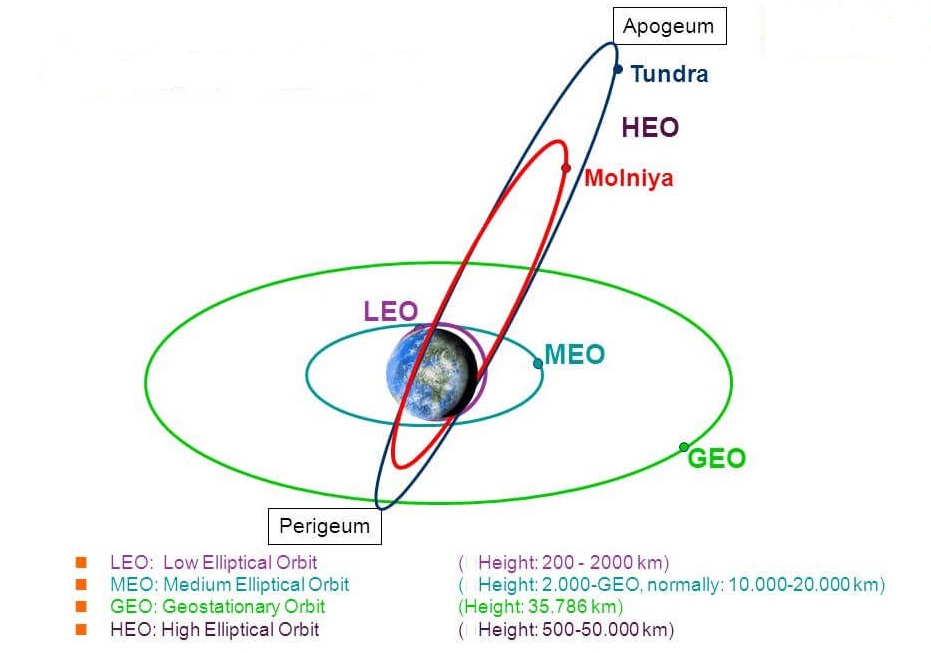
    Back2Basics: Various Orbits of Satellites
    [1] Geostationary orbit (GEO)

    • Satellites in geostationary orbit (GEO) circle Earth above the equator from west to east following Earth’s rotation – taking 23 hours 56 minutes and 4 seconds – by travelling at exactly the same rate as Earth.
    • This makes satellites in GEO appear to be ‘stationary’ over a fixed position.
    • In order to perfectly match Earth’s rotation, the speed of GEO satellites should be about 3 km per second at an altitude of 35 786 km.
    • This is much farther from Earth’s surface compared to many satellites.
    • GEO is used by satellites that need to stay constantly above one particular place over Earth, such as telecommunication satellites.
    • Satellites in GEO cover a large range of Earth so as few as three equally-spaced satellites can provide near-global coverage.

    [2] Low Earth orbit (LEO)

    • A low Earth orbit (LEO) is, as the name suggests, an orbit that is relatively close to Earth’s surface.
    • It is normally at an altitude of less than 1000 km but could be as low as 160 km above Earth – which is low compared to other orbits, but still very far above Earth’s surface.
    • Unlike satellites in GEO that must always orbit along Earth’s equator, LEO satellites do not always have to follow a particular path around Earth in the same way – their plane can be tilted.
    • This means there are more available routes for satellites in LEO, which is one of the reasons why LEO is a very commonly used orbit.
    • It is most commonly used for satellite imaging, as being near the surface allows it to take images of higher resolution.
    • Satellites in this orbit travel at a speed of around 7.8 km per second; at this speed, a satellite takes approximately 90 minutes to circle Earth.

    [3] Medium Earth orbit (MEO)

    • Medium Earth orbit comprises a wide range of orbits anywhere between LEO and GEO.
    • It is similar to LEO in that it also does not need to take specific paths around Earth, and it is used by a variety of satellites with many different applications.
    • It is very commonly used by navigation satellites, like the European Galileo system of Europe.
    • It uses a constellation of multiple satellites to provide coverage across large parts of the world all at once.

    [4] Polar Orbit

    • Satellites in polar orbits usually travel past Earth from north to south rather than from west to east, passing roughly over Earth’s poles.
    • Satellites in a polar orbit do not have to pass the North and South Pole precisely; even a deviation within 20 to 30 degrees is still classed as a polar orbit.
    • Polar orbits are a type of low Earth orbit, as they are at low altitudes between 200 to 1000 km.

    [5] Sun-synchronous orbit (SSO)

    • SSO is a particular kind of polar orbit. Satellites in SSO, travelling over the polar regions, are synchronous with the Sun.
    • This means they are synchronised to always be in the same ‘fixed’ position relative to the Sun.
    • This means that the satellite always visits the same spot at the same local time.
    • Often, satellites in SSO are synchronised so that they are in constant dawn or dusk – this is because by constantly riding a sunset or sunrise, they will never have the Sun at an angle where the Earth shadows them.
    • A satellite in a Sun-synchronous orbit would usually be at an altitude of between 600 to 800 km. At 800 km, it will be travelling at a speed of approximately 7.5 km per second.

    [6] Transfer orbits and geostationary transfer orbit (GTO)

    • Transfer orbits are a special kind of orbit used to get from one orbit to another.
    • Often, the satellites are instead placed on a transfer orbit: an orbit where, by using relatively little energy from built-in motors, the satellite or spacecraft can move from one orbit to another.
    • This allows a satellite to reach, for example, a high-altitude orbit like GEO without actually needing the launch vehicle.
    • Reaching GEO in this way is an example of one of the most common transfer orbits, called the geostationary transfer orbit (GTO).


    UPSC 2023 countdown has begun! Get your personal guidance plan now! (Click here)

More posts