A proposed framework by the Centre for regulating e-waste in India has upset a key link of India’s electronic waste collection system and threatens the livelihood of thousands of people.
Menace of E-Waste in India
Electronic waste, or electronic goods that are past their productive life and old parts, is largely handled by India’s vast informal sector.
Spent goods are dismantled and viable working parts refurbished, with the rest making their way into chemical dismantling units.
Many of these units are run out of unregulated sweatshops that employ child labour and hazardous extraction techniques.
Remedy against this: Extended Producer Responsibility (EPR)
To address all of this, the Environment Ministry brought the E-waste (Management) Rules, 2016.
This introduced a system of Extended Producer Responsibility (EPR) compelling makers of electronic goods to ensure a proportion of the goods they sold every year was recycled.
They are expected to maintain records annually demonstrating this.
Most companies however did not maintain an in-house unit in charge of recycling and this gave rise to a network of government-registered companies, called Producer Responsibility Organisations (PRO).
How PROs work?
PROs act as an intermediary between manufacturers and formal recycling
They are (expected to be) technologically equipped to recycle end-of-life electronic goods safely and efficiently.
The PROs typically bid for contracts from companies and arrange for specified quantities of goods to be recycled.
They provide companies certified proof of recycling that they then maintain as part of their records. Several PROs work on consumer awareness and enable a supply chain for recycled goods.
Functional PROs in India
As of March 2022, the Central Pollution Control Board (CPCB) has registered 74 PROs and 468 authorised dismantlers.
They have a collective recycling capacity of about 1.3 million tonnes.
What is the extent of E-Waste production in India?
The Ministry estimated 7.7 lakh tonnes of e-waste to have been generated in 2018-19.
Around one million tonnes in 2019-20 of which only a fifth (about 22% in both years) has been confirmed to be “dismantled and recycled”.
What is the controversy now?
This May, the Ministry issued a draft notification that does away with the PROs and dismantlers and vests all responsibility of recycling with authorised recyclers.
Only a handful of authorised recyclers exist in India.
Recyclers will source a quantity of waste, recycle them and generate electronic certificates.
Companies can buy these certificates equivalent to their annual committed target and thus do not have to be involved with engaging the PROs and dismantlers.
Dismantling a fledgling system was detrimental to the future of e-waste management in India.
What is the rationale behind?
The Centre has not explained its rationale for dismantling the existing system in its draft notification.
However, a final policy is yet to emerge.
The new rules would track the material that went in for recycling with the output claimed by a recycler when they claimed GST (Goods and Services Tax) input credit.
The Madras High Court has directed the Tamil Nadu government to include the photographs of the President of India and Prime Minister in advertisements on the 44th Chess Olympiad underway in Chennai.
Why in news?
The HC relied on a 2015 Supreme Court ruling that issued guidelines on government spending on advertisements.
How can we classify Govt Ads with other political ads?
The primary cause of government advertisement is to use public funds:
To inform the public of their rights, obligations, and entitlements
To explain Government policies, programs, services and initiatives.
2015 Supreme Court’s Ruling
In Common Cause v Union of India, the Supreme Court sought to regulate the government expenditure on advertisements.
It essentially regulated the 2007 New Advertisement Policy of the Government of India.
The petitioners had argued that there is arbitrary spending on advertisements by the government.
The allegations ranged from wastage of public money for political mileage to using advertisements as a tool to manipulate media.
A three-judge Bench comprising then CJI P Sathasivam, and Justices Ranjan Gogoi and N V Ramana had set up a committee to suggest a better policy.
What are the guidelines?
No endorsement: Patronization of any particular media house must be avoided and award of advertisements must be on an equal basis to all newspapers who may, however, be categorized depending upon their circulation.
The Government Advertisements (Content Regulation) Guidelines 2014 have five broad principles:
Advertising campaigns are to be related to government responsibilities
Materials should be presented in an objective, fair manner and designed to meet objectives of the campaign
Advertisements must not directed at promoting political interests of a party
Campaigns must be justified and undertaken in a cost-effective manner
Advertisements must comply with legal requirements and financial regulations
What did the Supreme Court rule?
It largely accepted the committee report except on a few issues:
The appointment of an ombudsman to oversee the implementation of the guidelines
A special performance audit of government spending
An embargo on publication of advertisements on the eve of elections
The ruling mandated that government advertisements will not contain a political party’s symbol, logo or flag.
They are required to be politically neutral and must refrain from glorifying political personalities.
What about photographs in advertisements?
The Supreme Court agreed with the committee’s suggestion that photographs of leaders should be avoided and only the photographs of the President/ PM or Governor/ CM shall be used for effective government messaging.
Then-Attorney General had opposed the recommendation arguing that if the PM’s photograph is allowed in the advertisement, then the same right should be available to his cabinet colleagues as the PM is the “first among the equals”.
The court, while restricting the recommendation to the photos of the President and Prime Minister, added the photograph of the Chief Justice of India to that list of exceptions.
What are the takeaways from the SC and HC verdicts?
The SC ruling stepped into content regulation, which is a facet of the right to freedom of speech and expression, and was also in the domain of making policy.
This raised questions on the judiciary stepping on the executive’s domain.
The SC ruling did not mandate publication of the photograph of the PM and President, but only restricts publication of photos of government officials other than the President, PM, CJI, CM and the Governor.
In an opposition-ruled state such as Tamil Nadu, exclusion of the PM’s photos is seen as a political move.
The HC said that considering the “national interest” in the issue, the “excuses taken by the state” cannot be accepted.
A Chinese booster rocket made an uncontrolled return to earth, leading to US furore against Beijing for not sharing information about the potentially hazardous object’s descent.
Yet another Chinese irresponsibility
Ending over a week of global anxiety and alarm, the debris from a large Chinese rocket – the Long March 5B — crashed to earth over the Pacific and the Indian oceans.
It felt into the Sulu Sea near Malaysia.
The 22-tonne core stage of the rocket hurtled uncontrollably back to earth. There were fears that it might hit a populated area.
China, however, had dismissed these fears despite widespread criticism for rocket re-entry risks imposed by it on the world.
What is an Uncontrolled Re-entry?
Generally, the core or first stage of a rocket is made up of heavy pieces that usually don’t reach orbit after liftoff, and fall back safely along a near-precise projected trajectory.
If they do enter an orbit, then a costly de-orbit manoeuvre is required for a steered, controlled return using engine burn.
Without a de-orbit manoeuvre, the orbital core stage makes an uncontrolled fall.
Why did it fell back?
Gigantic remnants from China’s Long March 5B rockets’ core stage are known to make such fiery, out-of-control descents back to earth.
Most nations’ rockets, separate the launcher from the payload before leaving the atmosphere.
An extra engine then gives the payload a final boost.
But China’s 5B series does NOT use a second engine and pushes right into orbit, the report points out.
Why is it difficult to track uncontrolled descents?
The variables involved make it difficult to precisely track the re-entry time and drop zone of rocket debris in uncontrolled descents.
The factors that make this prediction extremely challenging include atmospheric drag, variations in solar activity, angle and rotational variation of the object among others.
A miscalculation of even a minute in re-entry time could result in the final resting place of the debris changing by hundreds of kilometres.
It’s important to understand that among the 10 tough things that we do in space, debris re-entry is probably one of the toughest ones to predict.
Are there laws regulating space junk?
Yes. The Space Liability Convention of 1972.
It defines responsibility in case a space object causes harm.
The treaty says that a launching State shall be absolutely liable to pay compensation for damage caused by its space objects on the surface of the earth or to aircraft, and liable for damage due to its faults in space.
The Convention also provides for procedures for the settlement of claims for damages.
However, there is no law against space junk crashing back to earth.
In April this year, suspected debris from a Chinese rocket was found in two Maharashtra villages.
Cases of settlements
In 1979, the re-entry of NASA’s 76-ton Skylab had scattered debris over uninhabited parts of Australia, and the space agency was fined $400 for littering by a local government.
The only settlement using the Liability Convention was between the erstwhile Soviet Union and Canada over the debris of Soviet Cosmos 954 falling in a barren region.
Canada was paid CAD 3 million in accordance with international law for cleaning up the mess.
Do you know?
The 1979 Skylab was rumoured to be falling in India. We may ask our parents who were apparently kids at that time. The event was widely perceived as a Pralay (doomsday) in rural India back then! People were in all joy with festive food/partying every day fearing so that they would never see the next dawn!!
India and Oman will carry out a 13-day military exercise with a focus on counter-terror cooperation.
Exercise AL NAJAH-IV
This is the fourth edition of India-Oman joint military exercise ‘AL NAJAH-IV’.
It is held between contingents of Indian Army and the Royal Army of Oman is scheduled to take place at the Foreign Training Node of Mahajan Field Firing Ranges.
The previous edition of the exercise was organised in Muscat in March 2019.
The scope of the exercise includes “professional interaction, mutual understanding of drills and procedures, the establishment of joint command and control structures and elimination of terrorist threats”.
India-Oman Relations: A Backgrounder
The Sultanate of Oman is a strategic partner of India in the Gulf.
Both nations are linked by geography, history and culture and enjoy warm and cordial relations.
An Indian consulate was opened in Muscat in February 1955 which was upgraded to a consulate general in 1960 and later into a full-fledged embassy in 1971.
The first ambassador of India arrived in Muscat in 1973.
History of the ties
Oman, for many years, was ruled by Sultan Qaboos bin Said al Said, who was a friend of India.
Sultan Qaboos, the longest-reigning leader of the modern Arab world, died in January ‘2020 at the age of 79.
He was a man who was, as a student, taught by Shankar Dayal Sharma who went on to become the President of India.
Sultan Qaboos’s father, an alumnus of Ajmer’s Mayo College, sent his son to study in Pune for some time, where he was former President Shankar Dayal Sharma’s student.
Economic ties
Expatriate community: Oman has over five hundred thousand Indian nationals living there making them the largest expatriate community in Oman. They annually remit $780 million to India.
Bilateral trade: In 2010, bilateral trade between India and Oman stood at $4.5 billion. India was Oman’s second-largest destination for its non-oil exports and its fourth-largest source for Indian imports.
Energy: India has been considering the construction of a 1,100-km-long underwater natural gas pipeline from Oman called the South Asia Gas Enterprise (SAGE).
Defense cooperation
Oman is the first Gulf nation to have formalized defense relations with India.
Naval cooperation: The Indian Navy has berthing rights in Oman, and has been utilizing Oman’s ports as bases for conducting anti-piracy operations in the Gulf of Aden.
Tri-services base: In February 2018, India announced that it had secured access to the facilities at Duqm for the Indian Air Force and the Indian Navy. Duqm had previously served as a port for the INS Mumbai.
Arms trade: The standard issue rifle of the Royal Army of Oman is India’s INSAS rifle.
Bilateral exercises: Naseem al-Bahr (Arabic for Sea Breeze) is a bilateral maritime exercise between India and Oman. The exercise was first held in 1993.
Significance of Oman for India
Oman is India’s closest defense partner in the Gulf region and an important anchor for India’s defense and strategic interests.
It is the only country in the Gulf region with which all three services of the Indian armed forces conduct regular bilateral exercises and staff talks, enabling close cooperation and trust at the professional level.
It also provides critical operational support to Indian naval deployments in the Arabian sea for anti-piracy missions.
Duqm port and its strategic imperative
In a strategic move to expand its footprint in the Indian Ocean region, India has secured access to the key Port of Duqm in Oman for military use and logistical support.
This is part of India’s maritime strategy to counter Chinese influence and activities in the region.
The Port of Duqm is strategically located, in close proximity to the Chabahar port in Iran.
With the Assumption Island being developed in Seychelles and Agalega in Mauritius, Duqm fits into India’s proactive maritime security roadmap.
In recent years, India had deployed an attack submarine to this port in the western Arabian Sea.
Deterrent in ties: Chinese influence in Oman
China started cultivating ties with the Arab countries following the former Soviet Union’s invasion of Afghanistan.
Beijing has cultivated close ties with Oman and the latter was, in fact, the first country to deliver oil to China.
As of today, 92.99 per cent of Oman’s oil exports go to China, making China Oman’s largest oil importer.
Oman and China signed an agreement to establish an Oman-China Industrial Park at Duqm in 2016.
China has identified Oman as a key country in the region and has been enhancing defence ties with it steadily.
Way forward
India does not have enough energy resources to serve its current or future energy requirements. The rapidly growing energy demand has contributed to the need for long term energy partnerships with countries like Oman.
Oman’s Duqm Port is situated in the middle of international shipping lanes connecting East with West Asia.
India needs to engage with Oman and take initiatives to utilise opportunities arising out of the Duqm Port industrial city.
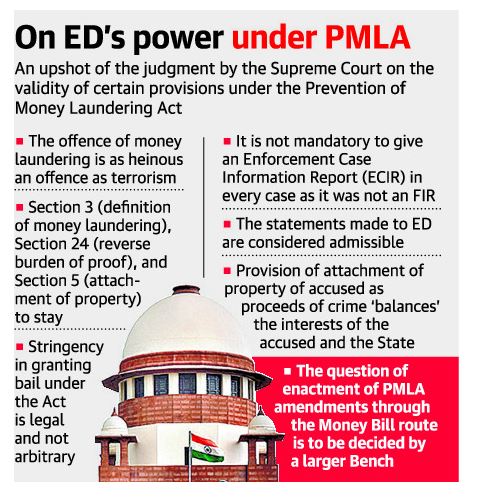
Delivering its verdict on a batch of petitions concerning the interpretation of certain provisions of the Act, the SC bench opined that money laundering is a “heinous” crime.
In this article, we will talk about the Supreme Court’s ruling on the Prevention of Money Laundering Act.
Why in news?
The verdict came on an extensive challenge raised against the amendments introduced in 2002 Act by way of Finance Acts.
Also bail provisions in PMLA act were contested in the apex court.
Key observations by the Supreme Court
Possessions of proceeds: Mere possession of proceeds of crime (without any integration, layering etc.) are sufficient to allege money laundering
Preventing crucial crimes: PMLA not only affects the social and economic fabric of a nation but also tends to promote other serious offenses like terrorism and drug trafficking.
Curbing illicit financing: The court noted that the law was enacted to address the urgent need for comprehensive legislation to prevent money laundering and prosecute those indulging in activities related to the proceeds of crime.
Power of arrests are legible: The court also upheld the EDs powers relating to arrest, attachment of property involved in money laundering, search and seizure under the PMLA, which were challenged by multiple petitioners.
Money laundering is no ordinary offence: It is, therefore, a separate class of offence requiring effective and stringent measures to combat the menace of money laundering,” the Court held.
Enforcement Case Information Report (ECIR): ECIR cannot be equated with FIR and ECIR is an internal document of the ED. Supply of ECIR to accuse is not mandatory and only disclosure of reasons during arrest is enough.
Twin bail: On the issue of twin bail conditions under the PMLA, the court ruled that the stringent conditions for bail under the Act are legal and not arbitrary.
Quantum of Punishment: The punishment provided for the offence is certainly one of the principles in deciding the gravity of the offence. However, it cannot be said that it is the sole factor in deciding the severity of offence as contended by the petitioners.
Predicate offense: The court made it clear that the offence under Section 3 is dependent on illegal gain of property as a result of criminal activity relating to a scheduled offence. It relates to the process or activity connected with such property that constitutes the offence of money laundering.
What were the petitions?
Petitions were filed against the amendments, which the challengers claimed would violate personal liberty, procedures of law and the constitutional mandate.
The petitioners included many veteran politicians who all claimed that the “process itself was the punishment”.
There were submissions that the accused’s right against self-incrimination suffered when the ED summoned them and made them sign statements on threats of arrest.
But the court said these statements were recorded as part of an “inquiry” into the proceeds of crime.
A person cannot claim right against self-incrimination at a summons stage.
What is Money Laundering?
Section 3 of the Act defines money laundering.
It initially read that anyone involved in any process or activity connected with the proceeds of crime including its “concealment, possession, acquisition or use” and projecting or claiming it as untainted property shall be guilty of the offense of money-laundering.
In 2019, the government made a change to Section 3, adding “or” between the words “concealment”, “possession”, and “acquisition”.
The petitioners before the top court, comprising politicians and industrialists, complained that the 2019 amendment enlarged the ambit of the principal section by including mere concealment or possession.
Explaining beyond legal terms
Money laundering is the illegal process of making large amounts of money.
This money is generated by a criminal activity but may appear to come from a legitimate source.
Criminal activities include drug trafficking, terrorist funding, illegal arms sales, smuggling, prostitution rings, insider trading, bribery, and computer fraud schemes that produce large profits.
What are the different stages involved in money laundering?
Generally, money laundering is a three-stage process:
Placement: The crime money is injected into the formal financial system.
Layering: Money injected into the system is layered and spread over various transactions and book-keeping tricks to hide the source of origin.
Integration: Laundered money is withdrawn from the legitimate account to be used for criminal purposes. Now, money enters the financial system in such a way that the original association with the crime is disassociated. The money now can be used by the offender as legitimate money.
Note: All three sources may not be involved in money laundering. Some stages could be combined or repeated many times.
What are different methods of money laundering?
Smurfing (the criminal breaks up large chunks of cash into multiple small deposits, often spreading them over many different accounts, to avoid detection.)
Use of currency exchanges
“Mules” (cash smugglers, who sneak large amounts of cash across borders and deposit them in foreign accounts, where money-laundering enforcement is less strict.)
Investing in commodities such as gems and gold that can be moved easily to other jurisdictions
Discreetly investing in and selling valuable assets such as real estate, cars, and boats;
Gambling and laundering money at casinos;
Counterfeiting
Using shell companies (inactive companies or corporations that essentially exist on paper only).
Hawala transactions
What are some of the national and global efforts to combat money laundering?
[A] Some of the national efforts are:
Smugglers and Foreign Exchange Manipulators (Forfeiture of Property) Act, 1976,
Narcotic Drugs and Psychotropic Substances Act, 1985, and
Prevention of Money-Laundering Act, 2002 (PMLA), PMLA (Amendment) Act, 2012
Other than these efforts two important agencies/ units involved are-
Financial Intelligence Unit-IND: It is an independent body reporting directly to the Economic Intelligence Council (EIC) headed by the Finance Minister.
Enforcement Directorate (ED): It is a law enforcement agency and economic intelligence agency responsible for enforcing economic laws and fighting economic crime in India. Main function of ED is to Investigate offenses of money laundering under the provisions of the Prevention of Money Laundering Act, 2002(PMLA).
Note: India is a full-fledged member of the FATF and follows its guidelines.
[B] Some of the global efforts are
Vienna Convention,
1990 Council of Europe Convention
International Organization of Securities Commissions (IOSCO)
Financial Action Task Force (It has been set up by the governments of the G-7 countries),
IMF
United Nations office on Drugs and Crime
Why prevent money laundering?
Corruption in high offices: This is a major facilitator of money laundering.
Worldwide nexus: Three “supra-national or transnational” crimes which have brought together the global community are narcotics, money laundering and terrorism.
Existence of safe homes: People accused of money laundering run to small nations with no extradition treaty with India where they can buy citizenship.
Preventing terrorism: Money laundering and terrorism financing activity in one country can have serious cross-border and even global adverse effects.
Huge social costs: This include allowing drug traffickers, smugglers, and other criminals to expand operations and the transfer of economic power from the market, government, and citizens to criminals.
Critical view of the Judgment
Lack of judicial standards: It is argued that the judgment falls short of judicial standards of reviewing legislative action.
Downplay of FRs: It invokes legal framework for combating money-laundering so inviolable that possible violation of fundamental rights can be downplayed.
Overemphasis on global pledge: The judgment repeatedly invokes the “international commitment” behind Parliament’s enactment of the law to curb the menace of laundering.
Selective targeting is justified: The ED has also been manifestly selective in opening money-laundering probes, rendering any citizen vulnerable to search, seizure, and arrest at the whim of the executive.
Self-incrimination and reverse burden of proof: This was violative of Article 20(3), which provided protection against self-incrimination.
Obsolete arguments: The Court relied on Article 39 of the Constitution, part of the DPSP that mandates the State to prevent concentration of wealth, to uphold the stringent bail conditions under PMLA.
Free hand to ED: The constitutionality of several provisions of the PMLA has been considered in the latest judgment and all of them have been upheld, the Court should have at least placed some additional safeguards on exercise of powers by the ED.
Is further Constitutional Challenge possible?
The judgment may be reviewed further by a five or seven-judge bench but the likelihood of the same immediately is not high.
As we have seen in the past, judgments of constitutional significance tend to be revisited (if at all) after several years when a situation arises which renders such interference absolutely necessary.
But yes a larger bench is already considering the issue of whether amendments can be passed to PMLA under Finance Act like a money bill.
It may be worth pointing out, however, that it can sometimes take years for a Constitution Bench (a five, seven or nine-judge bench of the top court) to arrive at a conclusion.
Way ahead
The evolving threats of money laundering supported by the emerging technologies need to be addressed with the equally advanced Anti-Money Laundering mechanisms like big data and artificial intelligence.
Both international and domestic stakeholders need to come together by strengthening data sharing mechanisms amongst them to effectively eliminate the problem of money laundering.
Similarly, FRs do exist everywhere. And they cannot be used as brackets to prevent investigation agencies since the FRs of large section of population matters than any individual.
This is for those who missed the amazing session by Mourya Bharadwaj on How to clear UPSC while doing a full time job. Get the recording of the session and a super important Personalized timetable PDF.
Time management is a #UPSCskill that tops all other skills in this long journey. Moreover, the complexity and vastness of the syllabus, unpredictability and ever-changing pattern of the UPSC exam, and cut-throat competition necessitate you to invest your time wisely.
Over that, if you are a working professional, college student, or homemaker, and preparing for this exam, and if you don’t have a workable timetable, you won’t be able to stay consistent and your preparation will suffer.
Time management isn’t the main thing. It is the only thing.
Mourya Bharadwaj, has been CivilsDaily’s mentorship student and he achieved this success, AIR 28 all the while he was working in an MNC.
Mourya concluded up an interactive session where he engaged and took up questions 1-1 from the aspirants on time management, timetable, and staying consistent.
Other than the points mentioned above we will be discussing the following issues as well.
Management of Priorities – UPSC, family, life, and work.
Reducing time on non-priorities.
Planning ahead, making targets, staying consistent w.r.t targets.
How should the syllabus be approached to complete it within the time limit?
Balancing prelims-mains on one hand and GS-current affairs on the other.
How to determine the primary focus areas of the Prelims, Mains, and Personality tests?
How to apply bookish as well as classroom knowledge to the exam?’
Click for Mourya’s epic on consistency and dedication.
What The Hindu mentioned about Civilsdaily Mentorship
Special session with AIR 28 Mourya Bharadwaj concluded.|Register and get: VIDEO RECORDING + PERSONALIZED TIMETABLE + MENTORSHIP CALL |Submit your query, and get Telegram group + access to FREE Samachar Manthan module* and mentorship.
Let’s talk about what’s happening in the aviation sector:
Quite a lot flights are not taking off
Staff are striking,
Luggage is not being loaded or are going missing,
Pilots don’t want to fly
Airports want airlines to cut capacity but airlines won’t oblige
Queues are long and passengers are suffering
India’s ailing Aviation Sector
It is facing a unique crisis a crisis of credibility and safety. Let me show you some recent headlines to start with.
The windshield of a go air flight cracks mid-air, two go air flights suffer engine snags, a flight could not take off because of a dog on the runway.
A bird was found in the cockpit of an Air India Express cruising at 37 000 feet.
One flight suffered an engine snag another noticed smoke in the cabin.
India’s Aviation Industry: A backgrounder
India is the world’s third largest aviation sector it is home to more than 150 million flyers every year.
There are 15 airlines, two more will soon be operational and more than a million flights land and take off from India every year.
The country has 137 airports and dreams of adding 100 more according to airbus. India’s domestic air traffic will grow five times in the next two decades.
Nearly 90% of the aviation traffic is domestic and low-cost carriers account for nearly 70% of the domestic seats.
The average domestic fare has fallen by more than 70% since 2005.
Why are India’s airlines suffering so many technical glitches?
Why are there so many emergency landings you must have heard of the DGCA or the directorate general of civil aviation it is the government body that’s responsible for airline safety issues the dgca is blaming these snags on staff shortage.
Every flight is inspected and certified before take-off.
Aircraft maintenance engineers they’re called AME aircraft maintenance engineers.
This malfunction is happening because of a shortage of engineers.
Who’s responsible for the shortage?
You see a lot of airlines have outsourced engineering to whom the likes of Air India engineering which is still owned by the government of India then there is Artworks Max Aerospace group gmr, spice jet technique.
Some of these companies are short of staff and this staff shortage is risking lives.
Reasons behind the Crisis
In the past years, aviation was one sector that was shining in terms of double-digit growth in passenger traffic for many years.
However, that too is currently seeing complications, reflecting the adverse growth in the general economy.
It should be noted that the aviation sector is a very high multiplier of both economic growth and employment and any downturn would affect the economy itself.
However, airlines are currently in a financial mess.
(1) Pandemic incurred losses
Indian airlines and airports incurred financial losses worth Rs 22,400 crore in the last financial year amid the coronavirus pandemic, according to official data.
Besides, 75 per cent of Airports Authority of India-operated airports are incurring losses. Also, AAI’s revenue came down to Rs 889 crore during April-June this year.
(2) High fuel prices and taxes
As far as the domestic sector is concerned, airlines work at a huge disadvantage as they are burdened by high taxes and levies at one end and high Air Turbine Fuel (ATF) prices on the other.
The ideal cost of ATF should not exceed beyond 25% of the total operating cost.
A central excise imposition of 14% and sales tax levied by the state governments on ATF can be as high as 30%.
Attempts to bring ATF under GST and cutting it down to 12% have not been accepted by the GST Council.
(3) Rupee depreciation
Any deterioration of the exchange rate of rupees to the US dollar also causes adverse impacts on the profits of the airlines.
Deterioration of international fuel prices also plays a role.
Due to this toxic mix, the operational cost in the domestic sector remains high.
(4) Economics of tickets fare
Due to the large order of planes, the total capacity of seats is increasing, leading to the increasing need to fill up the growing availability of seats.
Thus, airline ticket prices are decided by algorithms that change fares based on several factors like past bookings, remaining capacity, average demand per route, probability of selling more seats later etc.
This computer-based dynamic pricing system causes passengers acute distress during holidays/festivals or calamities when price sharply increase.
(5) Airport and aircraft maintenance
The Airports Authority of India (AAI) is the custodian of all civil airports in India.
While a dozen airports are profitable, the rest are cross-subsided by AAI.
Airport improvement involves not just upgrading the terminals, but also the runway, navigational aid and equipment needed for the safety and security.
The AAI is currently leasing out bigger airports on a long-term basis.
However, the lessee company is selected based on the highest percentage of revenue it can share with the AAI.
The Delhi International Airport share 46% of its revenue while Mumbai is a little less. The newly privatized airports are even higher.
(6) Skill shortage
Although India has the world’s second-largest population, the aviation industry faces a severe shortage of skilled workforce.
The low-quality training institutes are not training the necessary engineers, technicians and other professionals to meet the demand of this sector.
These are the reasons behind aircraft maintenance engineers.
(7) Disproportionate workforce
While some airlines like Air India have surplus manpower, some like IndiGo are suffering from manpower shortage.
In fact, the surplus manpower of Air India is one of the major causes of its financial crisis.
(8) Congestions at airports
India’s major airports suffer from congestion of passengers and limited runways.
For instance, Mumbai Airport, which is a single runway airport handles over 900 flights each day on an average.
That is approximately 38 to 40 flights each hour.
Thus, congestion leads to delay in operations and a decrease in the operational efficiency of both airlines and airports.
Impact of such incidences
These incidences are hurting India’s image in recent weeks.
Several Indian flights had to make emergency landings abroad, even in Pakistan.
Now India and Pakistan don’t have an aviation agreement the two countries, do not have direct flights and they don’t see eye to eye we know that.
What about India, the world began questioning India’s aviation sector. The repeated technical snags are making headlines in West Asia in the UK.
This raises concerns about flight safety in India and Indian carriers.
Another aspect: Ambitious UDAN Scheme
The Ude Desh Ka Aam Nagrik (UDAN) scheme is a low-cost flying scheme launched with the aim of taking flying to the masses.
The first flight under UDAN was launched by the PM in April 2017.
It is also known as the regional connectivity scheme (RCS) as it seeks to improve air connectivity to tier-2 and tier-3 cities through revival of unused and underused airports.
Working of the Scheme
Airlines are awarded routes under the programme through a bidding process and are required to offer airfares at the rate of ₹2,500 per hour of flight.
At least 50% of the total seats on an aircraft have to be offered at cheaper rates.
In order to enable airlines to offer affordable fares they are given a subsidy from the govt. for a period of three years.
Present status
A total of nine rounds of bidding have taken place since January 2017.
The Ministry of Civil Aviation has set a target of operationalizing as many as 100 unserved and underserved airports and starting at least 1,000 RCS routes by 2024.
So far, the Airports Authority of India (AAI) has awarded 948 routes under UDAN, of which 403 routes have taken off that connect 65 airports.
Out of the total 28 seaplane routes connecting 14 water aerodromes, only two have commenced.
Issues with the UDAN
Discontinuance: In reality, some of the routes launched have been discontinued as most of the routes awarded under UDAN are not active.
On-paper Ambitions: UDAN was expanded to provide improved connectivity to hilly regions and islands through helicopters and seaplanes. However, they mostly remain on paper.
The reasons include:
Failure to set up airports or heliports due to lack of availability of land
Airlines unable to start flights on routes awarded to them or finding the routes difficult to sustain
Adverse impact of the COVID-19 pandemic
Various challenges
Lack of funds: Many small airlines await infusion of funds, to be able to undertake maintenance of aircraft, pay rentals to lessors, give salaries to its staff, etc.
Maintenance issue: Many players don’t have more than one or two planes and they are often poorly maintained. New planes are too expensive for these smaller players.
Availability of pilots: Often, they also have problems with the availability of pilots and are forced to hire foreign pilots which costs them a lot of money and makes the business unviable.
Competition: Only those routes that have been bagged by bigger domestic players such as IndiGo and SpiceJet have seen a better success rate.
Way forward
Aviation is a critical component of the nation’s transportation sector and plays a pivotal role in economic growth and employment generation.
Aviation could be a major growth engine to make India a $5 trillion economy by 2024.
The government should look into the aviation sector holistically, as a part of the economy as it is going to play a crucial role in economic development and is no more a sector of the privileged class only.
The current model of taxation of the civil aviation industry appears unsustainable.
Therefore, fuel taxes should be brought under the GST to reduce the operation cost of the airlines.
This sector has shown the indomitable spirit- never hesitant to be in the frontline by ensuring the safe movement of people and essential cargo during the nation’s fight against the pandemic.
Some leeway at the right time will safeguard aviation to catch up the growth trajectory faster.
Across several states, the fiscal situation is becoming increasingly challenging. Yet, the common thread that runs through these deficits — state ownership and control — remains unaddressed.
State ownership: structural cause of India’s deficit
Coal India’s inability to raise production to meet growing demand contributed to the recent power crisis.
The state-owned power distribution companies have failed to bring down losses despite many schemes and packages.
The state control of these critical aspects of India’s power chain is central to a higher current account deficit and growing fiscal risks at the state level.
Coal output fails to meet the demand
From 2013-14, the Indian economy has grown by around 50 per cent (in real terms).
But Coal India, which accounts for around 80 per cent of India’s total coal production, was able to raise its output by just 34 per cent over the same period.
Increased reliance on imported coal: India’s coal imports (thermal and cooking) rose to a staggering 230.3 million tonnes in 2020-21, up 37 per cent from 168.5 million tonnes in 2013-14.
Coal imports for thermal power alone have more than doubled in the first quarter, compared to the same period last year.
To put this in perspective — the value of coal imports in just the first three months of this year is likely to be around half of what was imported in all of last year.
Increase in current account deficit: This growing reliance on coal imports (along with crude and gold) is at the root of the country’s widening current account deficit.
An inability to ramp up production, to forecast demand accurately, as every episode of coal shortage over the years has exposed, is the hallmark of the coal sector that is still largely the preserve of a public sector monopoly.
Problem of DISCOMS
No improvement in financial and operational issues: Despite repeated attempts to turn around their financial and operational positions, on key metrics, the divide between the public and private sector discoms is deepening.
In 2019-20, public sector discoms lost Rs 0.72 per unit of power sold, while private discoms made Rs 0.20 per unit.
High AT&C losses: Similarly, in 2019-20, the AT&C losses (due to operational inefficiencies) for state discoms were pegged at 21.7 per cent, while for the private sector, losses were at 8 per cent.
With deteriorating finances, the net worth of all public sector discoms put together stands at a negative Rs 61,757 crore, while for the private sector, it is a positive Rs 24,965 crore.
There have been several attempts to rescue state discoms.
In the early 2000s, the scheme for repayment of SEB dues amounted to Rs 41,473 crore.
In 2012, the financial restructuring plan added up to Rs 1.19 lakh crore.
In 2015, UDAY involved a transfer of Rs 2.01 lakh crore to state government balance sheets.
Notwithstanding various schemes to turn around their finances, the total debt of all discoms put together stood at Rs 5.14 lakh crore at the end of 2019-20.
Of this, Rs 4.87 lakh crore is owed by state discoms.
Impact on entire power chain: A deterioration in the financial position of discoms means that their dues to power generating companies start mounting, which in turn delay payments to coal miners, affecting the financial stability of the entire power chain.
Declining cross-subsidisation
As tariffs charged by discoms are much higher than the cost of alternatives, a sizeable part of non-agricultural sales of discoms (industrial and commercial consumers) have already shifted towards captive and solar.
And with the ministry of power recently reducing the threshold for green energy open access, more and more consumers will increasingly opt out.
This would mean that discom losses will rise as cross subsidisation from commercial and industrial consumers will decline, increasing their dependence on state subsidies.
In 2019-20, the total state subsidy claimed and released was around Rs 1.1 lakh crore or 17 per cent of total discom revenue.
This will only increase down the line, making future bailouts even more fiscally challenging.
Conclusion
Tackling these deficits requires addressing the issue of government control over critical aspects of India’s energy sector. Without shifting to market-determined prices — reforms are ultimately about price — little headway is likely to be made.
Prime Minister has launched India’s first International Bullion Exchange (IIBX) at the Gujarat International Finance Tec-City (GIFT City) near Gandhinagar.
What is Bullion?
Bullion refers to physical gold and silver of high purity that is often kept in the form of bars, ingots, or coins.
It can sometimes be considered legal tender and is often held as reserves by central banks or held by institutional investors.
When was the IIBX announced?
During her 2020 budget speech, Finance Minister announced the setting up of India International Bullion Exchange (IIBX) at International Financial Services Center (IFSC) at GIFT City in Gandhinagar.
The International Financial Services Centres Authority (Bullion Exchange) Regulations, 2020, was notified in December 2020 for trading of precious metals, including gold and silver.
These regulations also cover bullion exchange, clearing corporation, depository and vaults.
What is the IIBX?
India for the first time had liberalised gold imports through nominated banks and agencies in the 1990s.
Now, the eligible qualified jewellers in India have been allowed to directly import gold through IIBX.
For this, jewellers will have to become a trading partner or a client of an existing trading member.
In addition, the exchange has set up necessary infrastructure to store physical gold and silver.
The exchange will sell physical gold and silver and aims to be set up on the lines of the Shanghai Gold Exchange and Borsa Istanbul in order to make India a key regional hub for bullion flows.
How will it work?
The thought process behind setting this up is to enable the trading of commodities on an exchange.
Since this is international exchange, trading can take place in US dollars as well.
India has positioned itself as one of the biggest trading hubs in Asia.
Because of the competitive pricing on IIBX, international players will be happy to use our vaulting services.
Moreover, with this being a free trade zone, no duty will be paid.
What was the practice up until now?
Currently, gold in India is imported on a consignment model into different cities by nominated banks and agencies approved by the RBI and then supplied to traders/jewellers.
The banks and other agencies get a fee from the gold exporter for handling, storage, etc, and also add a premium to the gold while transacting with domestic buyers.
The buyer passes this charge on to the value chain until it reaches the end customer.
What change did IIBX bring?
With the IIBX becoming operational today, qualified domestic buyers can, through a branch in Gift City, purchase the bars and coins.
This purchase can be done from an international supplier who is a member of the IIBX.
What is the advantage of an exchange?
Through the dis-intermediation by facilitating transactions through an anonymously traded exchange platform, bullion is made available across special economic zones (SEZs) at International Financial Services Centres Authority (IFSCA)-approved vaults.
This means the growth of IIBX is not just limited to GIFT City but across jewellery manufacturing hubs nationwide.
The qualified jeweller allowed to import gold through IIBX, or a jeweller who is a client of an IIBX member, can view the available stock and place the order.
This shall nudge jewellers towards just-in-time inventory management.
It will also result in greater transparency in pricing, and order sequencing, thereby removing any room for unfair preference by supplier, importing or logistics agency.
Which jewellers have come on board?
So far, 64 big jewellers have come onboard and more applications are in the pipelines.
Some of the big names include Malabar Gold Pvt Ltd, Titan Company Ltd, Bangalore Refinery Pvt Ltd, RBZ Jewellers Pvt Ltd, Zaveri and Company Pvt Ltd.
What are the new RBI guidelines for importing gold?
Banks may now allow qualified Jewellers to remit advance payments for 11 days for import of gold through IIBX in compliance to the extant Foreign Trade Policy and regulations issued under IFSC Act.
According to the RBI, all payments by qualified jewellers for imports of gold through IIBX shall be made through the exchange mechanism as approved by IFSCA.
Who can enrol on the exchange?
Non-Resident Individual / Proprietorship Firm
Registered Partnership Firm
Private Limited Company
Public Limited Company
Qualified Jewellers
Branches of IBU at GIFT City
Foreign Bullion Suppliers who follow OECD guideline
In order to become a qualified jeweller, entities require a minimum net worth of Rs 25 crore.
And 90 per cent of the average annual turnover in the last three financial years through deals in goods categorised as precious metals.
NRIs and institutes will also be eligible to participate in the exchange after registering with the International Financial Services Centre Association (IFSCA).
Jewellers will be able to transact on IIBX only as trading members or as clients of a trading member.
If one wants to become a trader, a qualified jeweller will have to establish a branch or a subsidiary in IFSC (international financial services centre) and apply to the IFSCA.
What products does IIBX offer?
IIBX offers a diversified portfolio of products and technology services at a cost which is far more competitive than the Indian exchanges as well as other global exchanges in Hong Kong Singapore, Dubai, London and New York.
Gold 1 kg 995 purity and gold 100 gm 999 purity with a T+0 settlement (100% upfront margin) are expected to trade at IIBX initially.
All contracts will be listed, traded and settled in US Dollar
The exchange will have three vaults – one operated by Sequel Global (ready and approved), the second one to be operated by Brinks India is ready and awaiting final approval and the third is under construction.
Once the gold is imported by the authorised entities it will be deposited at one of the vaults which will issue bullion depository receipts.
These receipts will then be traded in dollars on the exchange.
Significance of IIBX
The IIBX shall be the “Gateway for Bullion Imports into India”, wherein all the bullion imports for domestic consumption shall be channelized through the exchange.
The exchange ecosystem is expected to bring all the market participants to a common transparent platform for bullion trading.
It would provide efficient price discovery, assurance in the quality of gold, and enable greater integration with other segments of financial markets.
India’s eight core sectors’ output growth moderated to 12.7% in June, from 18.1% in May, with all sectors except crude oil registering an uptick in production.
What are the Core Industries in India?
The main or the key industries constitute the core sectors of an economy.
In India, there are eight sectors that are considered the core sectors.
They are electricity, steel, refinery products, crude oil, coal, cement, natural gas and fertilizers.
Index of Eight Core Industries (ICI) vs Index of Industrial Production (IIP)
[A] Index of Eight Core Industries
The monthly Index of Eight Core Industries (ICI) is a production volume index.
ICI measures collective and individual performance of production in selected eight core industries viz. Coal, Crude Oil, Natural Gas, Refinery Products, Fertilizers, Steel, Cement and Electricity.
Prior to the 2004-05 series six core industries namely Coal, Cement, Finished Steel, Electricity, Crude petroleum and Refinery products constituted the index basket.
Two more industries i.e. Fertilizer and Natural Gas were added to the index basket in 2004-05 series. The ICI series with base 2011-12 will continue to have eight core industries.
Components covered in these eight industries for the purpose of compilation of index are as follows:
Coal – Coal Production excluding Coking coal.
Crude Oil – Total Crude Oil Production.
Natural Gas – Total Natural Gas Production.
Refinery Products – Total Refinery Production (in terms of Crude Throughput).
Steel – Production of Alloy and Non-Alloy Steel only.
Cement – Production of Large Plants and Mini Plants.
Electricity – Actual Electricity Generation of Thermal, Nuclear, Hydro, imports from Bhutan.
[B] Index of Industrial Production
The Index of Industrial Production (IIP) is an index for India which details out the growth of various sectors in an economy such as mineral mining, electricity and manufacturing.
The all India IIP is a composite indicator that measures the short-term changes in the volume of production of a basket of industrial products during a given period with respect to that in a chosen base period.
Difference between the two
IIP is compiled and published monthly by the National Statistics Office (NSO), Ministry of Statistics and Programme Implementation six weeks after the reference month ends.
However, ICI is compiled and released by Office of the Economic Adviser (OEA), Department of Industrial Policy & Promotion (DIPP), and Ministry of Commerce & Industry.
The Eight Core Industries comprise nearly 40.27% of the weight of items included in the Index of Industrial Production (IIP).
These are Electricity, steel, refinery products, crude oil, coal, cement, natural gas and fertilisers.
Importance of Core Industries
The core sectors have a major impact on the Indian economy and significantly affect most other industries as well.
Their measures help account for the physical volume of production in India.
Their analysis offers a clearer and more realistic assessment of what’s happening in the economy
Their progress is used by government agencies for policy-making purposes.
They remain extremely relevant for the calculation of the quarterly and advanced Gross Domestic Product (GDP) estimates.
The core sector is also known as Infrastructure output as they represent the basic industries that form the base of the economy.
Do you know about the Strategic Sectors?
The government has identified four strategic sectors where the presence of state-run companies will be reduced to a minimum.
Atomic energy, space and defence
Transport and telecommunications
Power, petroleum, coal and other minerals and
Banking, insurance and financial services
Try this PYQ:
Q.In the ‘Index of Eight Core Industries’, which one of the following is given the highest weight?
Every person on the planet has the right to live in a clean, healthy environment, as declared United Nations (UN) in a historic resolution.
Access to Clean, Healthy Environment
The resolution recognizes the right to a clean, healthy and sustainable environment as a human right essential for the full enjoyment of all human rights and, among others.
It calls upon States and international organizations to adopt policies and scale up efforts to ensure a clean, healthy and sustainable environment for all.
The landmark development demonstrates that the member states can unite in the collective fight against the triple planetary crisis of climate change, biodiversity loss and pollution.
The declaration sheds light on almost all the rights connected to the health of our environment.
The declaration adopted by over 160 UN member nations, including India, is not legally binding.
Why such move?
This right was not included in the Universal Declaration of Human Rights, 1948.
So, this is a historic resolution that will change the very nature of international human rights law.
The resolution will help to reduce environmental injustices and protection gaps.
It can empower people, especially those in vulnerable situations, including environmental human rights defenders, children, youth, women and indigenous people.
Landmark resolution after 50 years
Some 50 years ago, the United Nations Conference on the Environment in Stockholm concluded with a resolution placing environmental issues at the global forefront.
Today, over 176 countries have adopted environmental framework laws on the basis of it.
From a foothold in the 1972 Stockholm Declaration, these rights have been integrated into constitutions, national laws and regional agreements.
In October 2021, it was recognised by the UN Human Rights Council.
What were other such developments?
July 28, 2010, the UN general assembly recognised the right to water and sanitation through its resolution.
It stated that clean drinking water and sanitation “are essential to the realisation of all human rights”.
In response to this, governments across the world have changed their laws and regulations related to water and sanitation.
Issues over this declaration
The words’ ‘clean’, ‘healthy’ and ‘sustainable’ lack an internationally agreed definition.
The text fails to refer to the foundational principle of equity in international environmental law.
Nevertheless, this has given more power in the hands of environmental activists to question environmentally destructive actions and policies.
Back2Basics: Right to Clean Environment in India
The right to life has been used in a diversified manner in India.
It includes, inter alia, the right to survive as a species, quality of life, the right to live with dignity and the right to livelihood.
In India, this has been expressly recognised as a constitutional right under Article 21.
It states: ‘No person shall be deprived of his life or personal liberty except according to procedures established by law.’
The Supreme Court expanded this negative right in two ways.
Firstly, any law affecting personal liberty should be reasonable, fair and just.
Secondly, the Court recognized several unarticulated liberties that were implied by article 21.
It is by this second method that the Supreme Court interpreted the right to life and personal liberty to include the right to a clean environment.
Kerala, which slipped to the eighth slot in holding Assembly sittings during the first wave of the COVID-19 pandemic in 2020, returned to the top spot in 2021, with its House sitting for 61 days, the highest in the country.
State Assemblies for 2021 Report
The report on the functioning of State Assemblies for 2021 is published by the PRS Legislative Research (PRS), a New Delhi-based think tank.
How did other states fare?
Odisha followed Kerala with 43 sitting days; Karnataka 40, and Tamil Nadu 34 days.
But for the top three States, the average number of sittings of State legislatures would have been far lower than the present figure of 21 days.
Of the 28 State Assemblies and one Union Territory’s legislature, 17 met for less than 20 days.
Of them, five — Andhra Pradesh, Nagaland, Sikkim, Tripura and Delhi — met for less than 10 days.
The figures for Uttar Pradesh, Manipur and Punjab were 17, 16 and 11, respectively.
Andhra Pradesh with 20 ordinances and Maharashtra with 15 followed Kerala.
Why is this ranking significant?
The National Commission to Review the Working of the Constitution (2000-02), headed by former Chief Justice of India M.N. Venkatachaliah, had prescribed the standards for working of legislatures.
The Houses of State (/Union Territory) legislatures with less than 70 members, for example, Puducherry, should meet for at least 50 days a year and other Houses (Tamil Nadu), at least 90 days.
The Presiding Officers’ conference, held in Gandhinagar in January 2016, suggested State legislatures hold a minimum of 60 days of sittings in a year.
Between 2016 and 2021, the PRS points out, 23 State Assemblies met for an average of 25 days.
As for the ordinance route, which should be, according to the Supreme Court, used under exceptional circumstances, 21 out of 28 States promulgated ordinances last year.
The Supreme Court has upheld the constitutional validity of the provisions of the Prevention of Money Laundering Act (PMLA), calling it a “unique and special legislation” and underlining the powers of the Directorate of Enforcement (ED) to hold inquiries, arrest people and attach property.
Prevention of Money Laundering Act (PMLA)
PMLA, 2002 is an Act of the Parliament of India enacted by the NDA government to prevent money laundering and to provide for confiscation of property derived from money laundering.
It was enacted in response to India’s global commitment (including the Vienna Convention) to combat the menace of money laundering.
PMLA and the Rules notified there under came into force with effect from July 1, 2005.
The act was amended in the year 2005, 2009 and 2012.
Objectives of PMLA
The PMLA seeks to combat money laundering in India and has three main objectives:
To prevent and control money laundering.
To confiscate and seize the property obtained from the laundered money; and
To deal with any other issue connected with money laundering in India.
Issues with the PMLA
Opacity: The Enforcement Case Report (the analogue of an FIR) is not shared with the accused.
Nor are the full grounds of arrest shared with you.
Bail cannot be granted without hearing the prosecution and you are required to prove your innocence to get bail.
Lack of clarity in definition: The definition of crime under this Act is elastic.
The sovereign has immense latitude to define what counts as the relevant crime.
It can also in a classic instance of rule by law change the presumption of innocence.
Lack of safeguard: The list of crimes included overrides similar crimes in other parts of the law.
The code has an exceptional procedure of its own that can trump the safeguards of the Criminal Code of Procedure.
In theory, the law provides safeguards against attaching properties, but those safeguards are weak and do not allow for even reasonable exceptions that might be necessary for your dignity or continuing with your business or livelihood.
Mere possession of the proceeds of a crime, without any surrounding consideration of how one came to be in possession of the proceeds, makes it an offence.
That the state officials are not classed as police. But they, in some respects, have even more power than the police.
Use of Money Bill route: The law itself has been enacted by using the controversial Money Bill route.
Low conviction rate: The conviction rate under this law is very low, less than 0.5 per cent.
Misuse of law: The stringent provisions and vagueness in definitions in the law make it susceptible to misuse against a political opponenet.
International context: Post 9/11, there was concern with terrorist financing and arguably many international treaties actually weakened, rather than strengthened, individual rights protections.
The goal of international treaties is laudable.
But the rhetoric of international treaties is often used to override domestic rights safeguards.
Conclusion
There is a need for a review of the various provision and definitions in the law and their utility.
HOW TO ATTEMPT ANSWERS IN DAILY ANSWER WRITING ENHANCEMENT(AWE)?
Daily 4 questions from General studies 1, 2, 3, and 4 will be provided to you.
A Mentor’s Comment will be available for all answers. This can be used as a guidance tool but we encourage you to write original answers.
You can write your answer on an A4 sheet and scan/click pictures of the same.
Upload the scanned answer in the comment section of the same question.
Along with the scanned answer, please share your Razor payment ID, so that paid members are given priority.
If you upload the answer on the same day like the answer of 11th February is uploaded on 11th February then your answer will be checked within 72 hours. Also, reviews will be in the order of submission- First come first serve basis
If you are writing answers late, for example, 11th February is uploaded on 13th February , then these answers will be evaluated as per the mentor’s schedule.
We encourage you to write answers on the same day. However, if you are uploading an answer late then tag the mentor like @Staff so that the mentor is notified about your answer.
*In case your answer is not reviewed, reply to your answer saying *NOT CHECKED*.
In the intro, mention the provisions of Drugs, Medical Devices and Cosmetics Bill 2022.
In the body mention the advantages such as compliance with storage conditions required for the drugs, compliance with the requirement of valid prescription etc. In the challenges mention the issue of misuse and overuse of certain drugs.
Conclude by mentioning the need for addressing the challenge of compliance.
In the intro, mention the role of the Finance Commission in fiscal transfers in India.
In the body mention the issues with the fiscal federalism such as politicisation of Finance Commission, loss of autonomy due to Centrally Sponsored Schemes, use of cess by central government proceeds of which are not shared with the states, reduction in corporate taxes, higher interest rates than centre etc.
Conclude by mentioning the need for addressing the issues and recognising the important role of the states reducing the socio-economic inequalities.
Noting that the most prestigious FIDE 44th Chess Olympiad had for the first time come to India — the home of chess — during the 75th year of freedom from colonial rule, PM Modi said there had never been a better time for sports in India.
Sports in India
Physical activity is fundamental to human beings: The report states that having a fundamental right to literacy would mean identifying the intrinsic value of physical activity to human living.
Part of elementary education: It would mean not seeing physical activity as an end in itself, and the establishment of physical activity/ physical education as a core component of the education curriculum.
Supportive to other FRs: A fundamental right to physical literacy would actualise and enhance the enjoyment of other fundamental rights. It would go a long way in enhancing the opportunities and freedom to express oneself.
Enhancing life quality: A physically literate individual would have a more fulfilling life of higher quality than one who is not. Physical literacy, as a building block, would go a long way in the promotion and realisation of the right to health and the right to education.
Religion as a barriers: Some sports like swimming and athletics require attire that does not fully cover a woman’s body and are against the laws of some religions. They are often debated in light of modesty of the sportspersons beings violated.
Associated social reforms: Many women perceive sports as an opportunity to escape the confines of a highly regulated life. They use it as a tool to show their potential and tackle the patriarchal mindset. Further success of sportspersons like Mary Kom, Saina Nehwal, etc. have played a pivotal role in curbing the problems of child marriage and son meta preference.
Issues with Sports in India
Poor performance in competitions: India has the worst population to medals ratio at the Olympics. We find our medal tally at the Olympics to be hopelessly out of sync with our 1.3 billion population.
Regressive attitude towards sports: Our attitude towards sport and physical well-being is another debilitating factor. Traditionally, India has not been a sports nation where many deserving candidates are discouraged right at the starting level.
Economic divide: It hard reality which we consistently refuse to acknowledge. Athletes are not generated from the comfortable classes, they invariably come often from the middle and lower economic strata.
Incentivization: There is more focus on post-success incentivization rather than pre-success support in India. For instance, the Haryana Government announced a 6 crore reward after Neeraj Chopra won the gold medal in Tokyo Olympics 2020.
Significance of physical education and sports
Physical development: Fitness, Health
Mental development: It improves decision-making and collective action. It also acts as stress buster.
Character/ personality development: It instils confidence, team spirit, team coordination, group work)
Benefits of augmenting sports career
Alternative career development: For those for whom opportunities are few, and jobs are scarce, sport becomes a powerful mobility device. A strong sports sector encourages an average/ poor academic student to make a career in sports.
Reaping demographic dividend: India is having a very young population and is soon going to become the world’s youngest country. In such a scenario, a robust sports sector can help in reaping the potential demographic dividend.
Revenue generation: Developing robust sports infrastructure in the country will allow India to host a greater number of international events. Such hosting boosts tourism in the country and results in enhancing the revenue and employment in the region. Ex. IPL
Promotes the spirit of Unity in Diversity: People cheer for the Indian athletes and Indian teams at international events. An improvement in sports automatically fosters the spirit of brotherhood amongst the people of diverse nations. For instance, the Pan India support enjoyed by Indian cricket team enhances belongingness between India’s north and south.
Reasons for India’s poor performance
India’s below-par performance in sports can be attributed to the combination of all the factors discussed below:
Lack of facilities: We have thousands of education centres all over the country, but there are very few schools and colleges which have adequate facilities for any sport.
Regional discrepancies: The spending of money is concentrated in major cities where facilities do exist, but the broad-based structure to tap and develop talent is missing. The facilities wherever they are created are confined to a few popular games like cricket, hockey, football, tennis, etc.
Burden of ill-health: Mother and child health is an all-time contested issue in India. This may well be attributed to weather conditions, poor economic condition generally-due to which nutrition is not available to most of our children.
Narrow perception: The parents are keen that their kids should do well studies to get a degree and ultimately fetch a good job. Playing for long hours regularly is considered a waste of time.
Lesser academia for physical education: There are few Sports Colleges which are genuinely making efforts to produce national-level sportsmen, but their number is so small that no perceptible impact is seen due to their existence.
Lack of training: Another reason for our poor performance in sports is the lack of required number of trainers, coaches and psychotherapists. There is also a dearth of quality coaching or the qualified coaches.
Non-interest: The west often accuse that Indians lack the killer’s instinct. The zest and enthusiasm necessary to win over the opponent is naturally absent in the Indian psyche.
Obsession for few sports: There is no doubt that cricket and hockey plays a major unifying role in India. However, other sports and sportsperson are often discouraged due to such obsessions.
Performance anxiety: A high degree of pressure is inflicted upon a sportsperson to perform or else be prepared to live a vulnerable life. This sometimes creates excessive mental stress in them or induces them to resort to unethical means like doping.
Various initiatives for sports promotion
The Ministry of Youth Affairs & Sports has formulated the following schemes to promote sports in the country, including in rural, tribal and backward areas:
Khelo India Scheme
Assistance to National Sports Federations
Special Awards to Winners in International sports events and their Coaches
National Sports Awards, Pension to Meritorious Sports Persons
Pandit Deendayal Upadhyay National Sports Welfare Fund
National Sports Development Fund; and
Running Sports Training Centres through Sports Authority of India
Way forward
Sports is a state subject and therefore uniformity in sports-specific activities of various states in India is extremely important for providing equal sporting opportunities to all the citizens of the country.
We have to take collective action to create a system and a proper environment whereby the young talent is spotted and developed in right earnest.
Integration of sports with education to introduce sports culture in India is the need of the hour.
The allocation of funds to sport, as a percentage of budget, can be increased for broad-basing sports in this country.
There is also a need to develop a culture in whole country by spreading awareness in society by telling benefit of sports in life.
The Ministry of Commerce and Industry is planning to replace the 80-year-old Coffee Act with the new Coffee (Promotion and Development Bill), 2022, which has been listed for the Monsoon Session of Parliament.
What is the Coffee Act?
The Coffee Act, 1942 was first introduced during World War II, in order to protect the struggling Indian coffee industry from the economic downturn caused by the war.
In the 1930s, the Indian coffee industry was facing significant problems, such as large-scale damage by pests and diseases, and the global economic downturn caused by the Great Depression.
With coffee planters making significant losses, the government passed the Coffee Cess Act (XIV of 1935) and established the first Indian Cess Committee in November 1935.
This aimed to promote the sale of coffee and increase consumption of Indian coffee at home and abroad.
These problems from the 1930s were compounded with the outbreak of World War II, as low demands and a loss of foreign markets led to a sharp decline in coffee prices.
Since the Cess Committee was not able to deal with the crisis faced by the industry, the government formed the Coffee Board, through the introduction of the Coffee Act, 1942.
Purpose of the Act
The purpose of the Act was to provide for the development of the coffee industry.
The Board was tasked with supporting the industry in marketing, promotion of consumption, finance and research and development.
Why scrap the old law?
The government is now trying to scrap the law because it claims that many of the provisions have become redundant and are too restrictive.
It has also proposed to repeal the decades old laws on tea, spices and rubber, and introduce new legislations in order to increase the ease of doing business and promote the development of these sectors.
These are very old laws and the idea is only to simplify them, make it easier to do business.
It aims to ensure that the small people in the different areas like coffee growing, tea growing do not have to suffer from high levels of compliance burden.
Major contentious factor: Pooling System
Before India liberalised its economy in 1991, the Coffee Board controlled the marketing of the commodity in its entirety, both in India and abroad.
The Act introduced a pooling system, where each planter was required to distribute their entire crop to a surplus pool managed by the Board, apart from the small quantities that were allowed for domestic use and seed production.
The Board marketed 70% of the total pool for export and 30% for domestic markets, and sold them in separate auctions, according to Takamasa Akiyama, an economist affiliated with the World Bank.
In order to spur domestic consumption, the price of domestic coffee was kept artificially low.
The changes since liberalization
While the Coffee Board no longer maintains its monopolistic control over the marketing of Indian coffee.
Through a series of amendments, the Board’s authority was reduced, and in 1996, the pooling system was abolished and growers were allowed to directly sell to processing firms.
The coffee market was entirely deregulated and the growers exposed to the free market.
Since liberalization, the Coffee Board plays more of an advisory role, and aims at increasing production, promoting further export and supporting the development of the domestic market.
What are the proposed changes?
In order to facilitate growth and ease of doing business, the government would remove the restrictive and redundant provisions.
The centre wants to introduce a simplified version of the Act to suit the present needs of the industry.
The government would not close the Coffee Board, but would rather shift it from the Ministry of Commerce to the Ministry of Agriculture.
Here it aims to ensure that the benefits of all agricultural schemes are extended to coffee growers.
The new legislation is now primarily concerned with promoting the sale and consumption of Indian coffee including through e-commerce platforms, with fewer government restrictions.
It also aims at encouraging further economic, scientific and technical research in order to align the Indian coffee industry with “global best practices.”
Back2Basics: Coffee Production in India
India is the third-largest producer and exporter of coffee in Asia and the sixth-largest producer and fifth-largest exporter of coffee in the world.
The country accounts for 3.14% (2019-20) of the global coffee production.
Coffee production in India is dominated in the hill tracts of South Indian states, with Karnataka accounting for 71%, followed by Kerala with 21% and Tamil Nadu (5%).
Indian coffee is said to be the finest coffee grown in the shade rather than in direct sunlight anywhere in the world.
Almost 80% of Indian coffee is exported.
The two well-known species of coffee grown are the Arabica and Robusta. The first variety was introduced in the Baba Budan Giri hill ranges of Karnataka in the 17th century.
Brazil is, the largest coffee producer in the world.