💥UPSC 2026, 2027, 2028 UAP Mentorship (March Batch) + Access XFactor Notes & Microthemes PDF

Search results for: “”

  • Land Degradation

    Context

    A key element of sustainable food production is healthy soil because nearly 95 per cent of global food production depends on soil. The current status of soil health is worrisome.

    The threat posed by soil degradation

    • The challenge to food security: Soil degradation on an unprecedented scale is a significant challenge to sustainable food production.
    • About one-third of the earth’s soils is already degraded and alarmingly, about 90 per cent could be degraded by 2050 if no corrective action is taken.
    • Soil degradation in India: While soil degradation is believed to be occurring in 145 million hectares in India, it is estimated that 96.40 million hectares — about 30 per cent of the total geographical area — is affected by land degradation.
    • The FAO’s latest ‘State of the World’s Land and Water Resources for Food and Agriculture’ says: “…soil pollution is also an issue. It knows no borders and compromises the food we eat, the water we drink and the air we breathe.
    • Globally, the biophysical status of 5,670 million hectares of land is declining, of which 1,660 million hectares (29 per cent) is attributed to human-induced land degradation, according to the Food and Agriculture Organisation’s ‘State of Land, Soil and Water’ report.

    Cause of the problem

    • Use of agrochemicals: The excessive or inappropriate use of agrochemicals is one cause of the problem.
    • The global annual production of industrial chemicals has doubled since the beginning of the 21st century, to approximately 2.3 billion tonnes.
    • Extensive use of fertilisers and pesticides led to the deterioration of soil health and contamination of water bodies and the food chain, which pose serious health risks to people and livestock.
    • Salination: Another challenge comes from salinisation, which affects 160 million hectares of cropland worldwide.”

    About Soil Health Card Scheme

    • Soil Health Card (SHC) scheme is promoted by the Department of Agriculture & Co-operation under the Ministry of Agriculture and Farmers’ Welfare.
    • An SHC is meant to give each farmer soil nutrient status of his/her holding and advice him/her on the dosage of fertilizers and also the needed soil amendments, that s/he should apply to maintain soil health in the long run.
    • SHC is a printed report that a farmer will be handed over for each of his holdings.
    • It will be made available once in a cycle of 2 years, which will indicate the status of soil health of a farmer’s holding for that particular period.
    • The SHC given in the next cycle of 2 years will be able to record the changes in the soil health for that subsequent period.
    • Under the programme as of date, soil health cards have been distributed to about 23 crore farmers.
    • The scheme has not only helped in improving the health of the soil, but has also benefited innumerable farmers by increasing crop production and their incomes.

    Progress made so far on soil restoration

    • India is well on course to achieving the restoration of 26 million hectares of degraded land by 2030.
    • A study conducted by the National Productivity Council in 2017 on this programme revealed that there has been a decrease in the use of chemical fertilisers in the range of 8-10 per cent as a result of the application of fertilisers and micro-nutrients as per the recommendations on the soil health cards.
    • Overall, an increase in crop yields to the tune of 5-6 per cent was reported as a result.
    • First organic state in the world: “A Healthy Planet for Healthy Children’’ published by the United Nations Institute for Training and Research and the World Future Council highlighted success stories from various countries — including Sikkim in India, which became the first organic state in the world.

    Way forward

    • Natural farming: Several studies have established that natural farming and organic farming are not only cost-effective but also lead to improvement in soil health and the farmland ecosystem.
    • Agro-ecological practices: With the threat to food security looming large globally, the need of the hour is to adopt innovative policies and agro-ecological practices that create healthy and sustainable food production systems.

    Conclusion

    The time has come for collective global action involving governments and civil society to reverse the alarming trend of soil degradation.

    UPSC 2023 countdown has begun! Get your personal guidance plan now! (Click here)

  • Pakistan’s Economic Crisis and the IMF Challenge

    Pakistan’s foreign exchange reserves have been depleting during the last one year and is heading towards a default risk as Sri Lanka did.

    Pakistani economy is said to have been crippling since the discontinuance of US ‘military’ aid which it had used

    What is the news?

    • The Pakistani rupee has been on free fall; from 150 in April 2021 to 213 against the dollar on 21 June, an all-time low.
    • This would mean high oil and electricity prices, to outrage the people who are already to the streets due to ousted PM Imran Khan.
    • The government-International Monetary Fund (IMF) talks have remained complicated.

    Options available for Pakistan

    • Pakistan is under deep Balance of Payment (BoP) crisis (as was India in 1991).
    • Pakistan has exhausted all credit options as SL did.
    • Even the China Pakistan Economic Corridor (CPEC) is at standstill.
    • Even the Saudi’s and so called ‘caliphate’ of Turkey has not come to Pakistan’s rescue.

    Only option left: IMF bail out

    • The immediate future of Pakistan’s economy would depend on IMF resuming its support.
    • Despite an intense discussion between the two, there has not been a consensus until now.

    What is IMF bail-out?

    • Bailout is a general term for extending financial support to a company or a country facing a potential bankruptcy threat.
    • When a country asks the IMF for a loan, the country is facing a major economic crisis.
    • In particular, it does not have enough foreign currency (‘dollars’) to pay for imports and the repayments on its loans. In short, the country cannot pay its international bills. So, it need a bailout.
    • The IMF will give the country an aid, which is ‘cash’ in the sense that it does not have to be spent on a particular project. This money can be used to pay its bills.
    • But, the IMF will impose certain conditions. The basic condition is to spend less – both domestically and internationally.
    • This belt-tightening is not easy – people lose jobs, prices rise, etc. And, one has to repay the loan.
    • These conditions are necessary to ensure that the money is being spent where it is supposed to.

    Pakistan and IMF: A track record

    • Pakistan’s relationship with the IMF has remained complicated. It sees conditions laid as a breach of sovereignty.
    • Though Islamabad has been negotiating with the IMF repeatedly, there has been an economic nationalism, mostly jingoistic, against approaching the IMF in recent years.
    • Imran Khan, the former PM made statements and fuelled the sentiments against the IMF.
    • After becoming the PM in 2018, he preferred approaching friendly countries (China and Saudi Arabia) and avoiding the IMF.
    • The new government is now back to the IMF; it expects the IMF to release the payments, expand the support programme, and give a longer rope to repay.

    Conditions laid out by IMF for recent bail-out

    • The IMF is willing to support Pakistan but has some conditions regarding macroeconomic reforms.
    • It wants Pakistan to be transparent about its debt situation, including what Islamabad owes to China, as a part of the CPEC.
    • Terror-financing in Pakistan is the most favored type of investment!
    • The IMF may agree to support after a few more promises by the government.
    • But the relief may be less than what Pakistan would hope for.

    A vicious cycle

    • Since its inception, Pakistan has spent more years inside an IMF programme than outside of it.
    • Every leader took the money, imposed massive hardships on the population through austerity and demand suppression and then reneges on its commitment through a patchy implementation.
    • Radical fanaticism and anti-India sentiments are successful tools of public appeasement.

    Will Pakistan pursue macroeconomic reforms?

    • In Pakistan, budgets have remained populist.
    • The economic governance declined due to corruption, lack of financial institutions’ independence, and the export decline.
    • The subsidies in the energy sector — fuel, oil and electricity — remain high to appease the public.
    • With the present coalition government facing elections, they are less likely to take any further bold decisions.

    Will “friendly countries” support Pakistan without preconditions?

    • Saudi Arabia and China have been supporting Pakistan. MBS has already pulled his hands.
    • Riyadh’s support is not unconditional.
    • It can ask Pakistan “to return the money at any time if the two countries have divergent views regarding their relationship or ties with a third country, or some other issue.”
    • China has been another significant source for Pakistan. Islamabad has been regularly seeking loans from China within and outside the CPEC projects.
    • However, since the attack on Chinese citizens by Baloch Fighters, China appears to have been disgusted with Pakistan.
    • CPEC is also at a standstill.

    FATF clearance is no panacea

    • During the latest Financial Action Task Force (FATF) meeting, there was an understanding that Pakistan has met its requirement.
    • The FATF has agreed to explore the possibilities of removing Pakistan from the grey list.
    • However, even when Pakistan was on the grey list, the IMF had been holding talks with Islamabad.
    • The big two — China and Saudi Arabia — were not constrained by Pakistan’s listing in the FATF.
    • So, the relaxation is less likely to open gates for big investments.

    Will Pakistan go the Sri Lankan way?

    • The situation was similar in Sri Lanka — the falling value of rupee, declining foreign exchange reserves, differences with the IMF, and rising fuel prices.
    • All of them led to public protests in Sri Lanka against the government.
    • The economic and energy crises in Pakistan have not snowballed into a political storm as it had happened in Sri Lanka.
    • The dope of “threats to Religion” works effectively there.

    Conclusion

    • The experiment of Pakistan (as a separate nation) has failed on various fronts.
    • To conclude, Pakistan’s economic and energy situation is serious and demands bold decisions.
    • The situation will worsen in the short term before it gets better, but this has been Pakistan’s history in the last 75 years.
    • With a relief from the IMF, after a protracted negotiation, a few band-aids, and the US intervention, Islamabad may muddle through this time as well, until the next crisis.


    UPSC 2023 countdown has begun! Get your personal guidance plan now! (Click here)

  • Group wants new order on MGNREGA workers revoked

    Certain groups has asked to discontinue manual attendance for Mahatma Gandhi National Rural Employment Guarantee Scheme (MGNREGS) work sites with more than 20 workers and use a mobile phone-based application.

    What is MGNREGA?

    • The MGNREGA stands for Mahatma Gandhi National Rural Employment Guarantee Act of 2005.
    • This is labour law and social security measure that aims to guarantee the Right to Work’.
    • The act was first proposed in 1991 by P.V. Narasimha Rao.

    Features of the scheme

    • MGNREGA is unique in not only ensuring at least 100 days of employment to the willing unskilled workers, but also in ensuring an enforceable commitment on the implementing machinery i.e., the State Governments, and providing a bargaining power to the labourers.
    • The failure of provision for employment within 15 days of the receipt of job application from a prospective household will result in the payment of unemployment allowance to the job seekers.
    • Employment is to be provided within 5 km of an applicant’s residence, and minimum wages are to be paid.
    • Thus, employment under MGNREGA is a legal entitlement.

    What is so unique about it?

    • MGNREGA is unique in not only ensuring at least 100 days of employment to the willing unskilled workers, but also in ensuring an enforceable commitment on the implementing machinery i.e., the State Governments, and providing a bargaining power to the labourers.
    • The failure of provision for employment within 15 days of the receipt of job application from a prospective household will result in the payment of unemployment allowance to the job seekers.
    • Any Indian citizen above the age of 18 years who resides in rural India can apply for the NREGA scheme. The applicant should have volunteered to do unskilled work.
    • Employment is to be provided within 5 km of an applicant’s residence, and minimum wages are to be paid.
    • Thus, employment under MGNREGA is a legal entitlement.

    Answer this PYQ in the comment box:

    Q.Among the following who are eligible to benefit from the “Mahatma Gandhi national rural employment guarantee act”?

    (a) Adult members of only the scheduled caste and scheduled tribe households.

    (b) Adult members of below poverty line (BPL) households.

    (c) Adult members of households of all backward communities.

    (d) Adult members of any household.


    Post your answers here.


    UPSC 2023 countdown has begun! Get your personal guidance plan now! (Click here)

  • Places in news: Snake Island

    Ukraine has said it has caused “significant losses” to the Russian military in airstrikes on Zmiinyi Island, also known as Snake Island, in the Black Sea.

    Snake Island

    • Zmiinyi Island, also known as Snake or Serpent Island, is a small piece of rock less than 700 metres from end to end, that has been described as being “X-shaped”.
    • It is located 35 km from the coast in the Black Sea, to the east of the mouth of the Danube and roughly southwest of the port city of Odessa.
    • The island, which has been known since ancient times and is marked on the map by the tiny village of Bile that is located on it, belongs to Ukraine.

    Why does Russia seek to control the Black Sea?

    • Domination of the Black Sea region is a geostrategic imperative for Moscow.
    • The famed water body is bound by Ukraine to the north and northwest, Russia and Georgia to the east, Turkey to the south, and Bulgaria and Romania to the west.
    • It links to the Sea of Marmara through the Bosporus and then to the Aegean through the Dardanelles.
    • It has traditionally been Russia’s warm water gateway to Europe.
    • For Russia, the Black Sea is both a stepping stone to the Mediterranean as well as a strategic buffer between NATO and itself.
    • Cutting Ukrainian access to the Black Sea will reduce it to a landlocked country and deal a crippling blow to its trade logistics.


    UPSC 2023 countdown has begun! Get your personal guidance plan now! (Click here)

  • Festival in news: Sao Joao Festival

    As in every monsoon, Catholics in Goa will celebrate Sao Joao, the feast of St John the Baptist.

    Note: The name typically sounds like a North-Eastern festival, but it is not.

    What is Sao Joao and where is it celebrated in Goa?

    • In Goa, Catholics celebrate all the feasts of the Roman Catholic Church, which include the feast of St John the Baptist on June 24.
    • John the Baptist is the person who he had baptised Jesus Christ on the river Jordan.
    • Traditionally, there are spirited Sao Joao festivities in the villages of Cortalim in South Goa and Harmal, Baga, Siolim and Terekhol in North Goa.
    • However, over the years, pool parties and private Sao Joao parties in Goa have been a “complete package of merriment and joy” for tourists.

    Course of celebration

    • The celebrations will include revellers sporting crowns made of fruits, flowers and leaves, and the major draw of the feast is the water bodies – wells, ponds, fountains, rivers – in which the revellers take the “leap of joy”.
    • Enjoyed by children and adults alike, the festival also includes playing the traditional gumott (percussion instrument), a boat festival, servings of feni, and a place of pride for new sons-in-law.

    What does jumping into water bodies symbolise?

    • The youngsters in Goa celebrate this occasion with revelry and perform daredevil feats, by jumping into over flowing wells or rivulets.
    • The boys are found merrily jumping into the water to commemorate the leap of joy, which St John is said to have taken in the womb of his mother St Elizabeth when virgin Mary visited her.


    UPSC 2023 countdown has begun! Get your personal guidance plan now! (Click here)

  • Odisha’s Mo Bus: Recipient of the UN’s prestigious public service award

    Mo Bus, the bus service of Odisha’s Capital Region Urban Transport (CRUT) authority, has been recognized by the United Nations as one of 10 global recipients of its annual Public Service Awards for 2022.

    Mo Bus service

    • The Mo Bus service was launched on November 6, 2018.
    • It aimed to ensure transformation of the urban public transport scenario in the city and its hinterland through use of smart technology, service benchmarking and customer satisfaction.
    • The buses are designed to integrate smart technologies such as free on-board Wi-Fi service, digital announcements, surveillance cameras, and electronic ticketing.
    • CRUT says that to increase women’s participation in the workforce, and to make women riders feel safer, it is committed to ensuring that 50% of Mo Bus Guides (conductors) are women.

    What is the recent award?

    • The public transport service has been recognised for its role in “promoting gender-responsive public services to achieve the SDGs (Sustainable Development Goals)”.
    • The “impact” is that 57 per cent of the city’s commuters now use the Mo Bus, the UN said.
    • Mo E-Ride is estimated to reduce pollution by 30-50 per cent.

    About UN Public Service Award

    • The UN describes its Public Service Awards as the “most prestigious international recognition of excellence in public service”.
    • The first Awards ceremony was held in 2003, and the UN has since received “an increasing number of submissions from all around the world”.
    • It is intended to reward the creative achievements and contributions of public service institutions that lead to a more effective and responsive public administration in countries worldwide.
    • Through an annual competition, the UN Public Service Awards promotes the role, professionalism and visibility of public service.


    UPSC 2023 countdown has begun! Get your personal guidance plan now! (Click here)
  • (Webinar) UPSC Mains is about execution! Meet Mridul- 22yo, First attempt, AIR 247 | Learn writing quality answers, making mains worthy notes, and more | UPSC Mains Bootcamp + Open Test (25th Jun) | Get his notes + Exclusive Telegram group

    (Webinar) UPSC Mains is about execution! Meet Mridul- 22yo, First attempt, AIR 247 | Learn writing quality answers, making mains worthy notes, and more | UPSC Mains Bootcamp + Open Test (25th Jun) | Get his notes + Exclusive Telegram group

    UPSC Mains 2022 is just ~80 days away. Get your Mains prep started with UPSC Ranker, Mridul. Register for CivilsDaily’s Bootcamp: 25th June 2022. This will be followed by an Open Mains Test on the same day. Details below

    Haven’t started with mains prep? Feel nervous about Mains answer writing? Not able to write all 20 questions? Can’t make yourself sit and start answer writing?

    Facing the same issues as mentioned above? This webinar cum UPSC Bootcamp is for you.

    Mridul Shivhare, AIR 247 is a special ranker. He cleared UPSC in his first attempt at the young age of 22. His quality of answers is amazing. He has tricks to literally compel the examiner to give marks. By the way, a crazy fact- Mridul left around 170 marks worth of questions in his Mains and still was able to secure AIR 247 (yup, quality of answer matters).

    In this special session, we will also be joined by Sukanya Rana, UPSC Mains head, CivilsDaily IAS. Sukanya has been able to guide successfully around 50 rankers in 2021 including AIR 28,32, 49, and more.

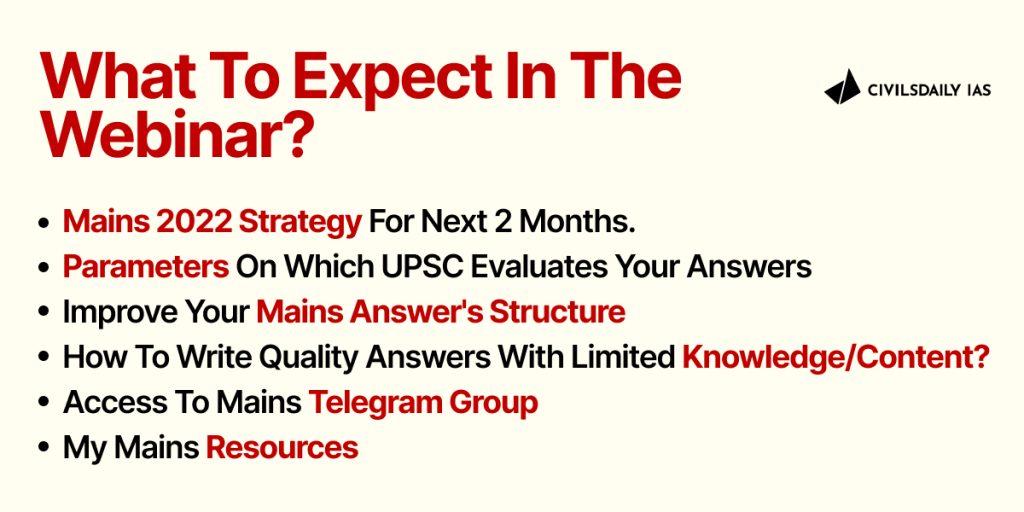
    UPSC Mains 2022 strategy for next 2 months.
Parameters on which UPSC evaluates your answers
Improve your mains answer's structure
How to write quality answers with limited knowledge/content?
Access to Mains Telegram group 
My Mains resources
    After Bootcamp, we will be having an Open Mains Test on 25th June only, at 6 pm. Top five scorers will get a Scholarship for Mains Mentorship Test Series and Program.

    Register for the Bootcamp and we will email you the link for the Telegram group, Open test question paper, and other Mains resources.


    This image has an empty alt attribute; its file name is WhatsApp-Image-2022-05-16-at-3.48.43-PM-1024x745-6.jpeg

    About CivilsDaily’s Mains Programs

    Mains Essential Program FLT EDITION 2022

    Program Inclusion Details:

    • 12 Full-length tests: After the prelims, it is time to go full gear. Practice 3 rounds of FLT based on 4 GS paper.
    • Quality Enrichment Program Notes: QEP is an intensive and holistic program for IAS Mains 2022 GS papers. We aim to cover up to 250 most relevant issues with a 360-degree view, covering all dimensions of each and every topic. Not only you’ll learn and analyze these issues but will also understand how to utilize them via Daily Answer Writing and Mains Test Series.
    • Personalized discussion in 1-to-1 mentorship: You doubt why you are scoring less or how you can improve your score for the next paper. No worries! Just schedule a call with our mentor to clear all your doubts and queries.
    • Civilsdaily’s handholding
    • Civilsdaily magazine: Your current affairs will be covered with access to our 1-year subscription.

    Click Here to Check Details

    Have a query about the program? Reach Us

    Smash Ethics Program

    Smash Ethics 2022 (Batch 2) with 1-to-1 Mentorship | Score 110+ in Ethics GS-4

    Program Inclusion:

    • Comprehensive Video Lectures covering Paper 4
    • Full syllabus Notes.
    • 8 FLT tests
    • 1-1 Mentorship support after every test
    • Membership of Ethics group (exclusive) on Civilsdaily’s Habitat
    • Doubt resolution session on Habitat

    Click Here to Enroll the Course

    Have a query about the program? Reach Us

    MEP Super 100 2023

    Program inclusion:

    • 12 Sectional tests: The whole syllabus will be divided into portions like history, economics, and geography. The test will be spread for a period of 8 months. This will ensure that your basic static preparation happens on a continuous basis alongside your mains answer writing program. Killing two birds with one stone!
    • 12 Full-length tests: After the prelims, it is time to go full gear.
    • Personalized discussion: You doubt why you are scoring less or how you can improve your score for the next paper. No worries! Just schedule a call with our mentor to clear all your doubts and queries.
    • Civilsdaily’s handholding: You will be provided membership to Mains 2023 club on Habitat. There you can put up your doubts and queries. Also can be used to interact with peers on strategies to improve your mains writing. You can also contact mentors like Sajal sir, Sukanya ma’am, Sudhanshu sir and Poornima Ma’am. They all have interview-level experience, so utilize their experience to your benefit.
    • Civilsdaily magazine: Your current affairs will be covered with access to our 1-year subscription. (June 2022 to May 2023)

    Click Here to Enroll the Course

    Have a query about the program? Reach Us

    Essay Program

    Program inclusion:

    • 8 FLTs
    • Detailed orientation for beginners
    • Process building Sessions
    • Content/Approach Building Sessions
    • Model essays
    • One-to-one mentorship
    • Membership in exclusive Essay group on Habitat
    • Notes and references on Habitat
    • Topic-wise arranged PYQs

    Check Out Now

    Have a query about the program? Reach Us

    This image has an empty alt attribute; its file name is CivilsDailys-Hall-of-Fame-UPSC-2028-4-713x1024-8.jpg
  • Let AIR 12, Yasharth Shekhar resolve all your UPSC IAS exam related doubts | 1-1 Live Ask me anything UPSC 2021 Topper’s Session | Registration Free

    Let AIR 12, Yasharth Shekhar resolve all your UPSC IAS exam related doubts | 1-1 Live Ask me anything UPSC 2021 Topper’s Session | Registration Free

    Hi Guys, Interacting with a Topper is always refreshing & confidence boosting.

    So, Yasharth Shekhar, AIR 12 ranker will be LIVE on Saturday for a 1-1 session. He will be taking your questions and will personally resolve each one of your doubts. So, put up your question for Yasharth Shekhar below and set up a reminder for 5 pm coming Saturday.

    What is Yasharth Shekhar going to discuss!

    • Understanding the expectations
    • Planning and Strategizing
    • Learning
    • Analyzing
    • Execution
    • How to pluck loopholes
    • How to write ‘Rule of answers’ what the question demands
    • And many other untold secrets that only a topper can explain

    So, whether you’re a Working Junta or a full-time college fresher, preparing for IAS 2023/24 & made up your mind, a topper’s session can help you strategize and decipher the IAS exam and design a timetable that fits right in your hectic schedule. Besides he can help you pick the right books and craft a practical & personal strategy.

    1-1 Live Session Details:

    Date: 25th June (Saturday)

    Time: 5 pm

    About Yasharth Shekhar

    A graduate in Economics from St. Stephen’s, Yasharth Shekhar secured AIR 12 in his third attempt. His optional was Geography. He wants to use his knowledge in developing better infrastructure for the country.

  • BRICS

    Context

    China is hosting the 14th BRICS summit in virtual mode. The focus of the summit will be centred on the conflict and the association’s future.

    About BRICS

    • BRICS is an acronym for the grouping of the world’s leading emerging economies, namely Brazil, Russia, India, China and South Africa.
    • The BRICS Leaders’ Summit is convened annually.
    • It does not exist in form of an organization, but it is an annual summit between the supreme leaders of five nations.
    • The grouping was formalized during the first meeting of BRIC Foreign Ministers on the margins of the UNGA in New York in September 2006.
    • The first BRIC Summit took place in 2009 in the Russian Federation and focused on issues such as reform of the global financial architecture.
    • South Africa was invited to join BRIC in December 2010, after which the group adopted the acronym BRICS.
    • South Africa subsequently attended the Third BRICS Summit in Sanya, China, in March 2011.
    • The Chairmanship of the forum is rotated annually among the members, in accordance with the acronym B-R-I-C-S.

    Significance of BRICS

    • Economically, militarily, technologically, socially and culturally, BRICS nations represent a powerful bloc.
    • 40 per cent of the world’s population: They have an estimated combined population of 3.23 billion people, which is over 40 per cent of the world’s population.
    • 25 per cent of global GDP: They account for over more than a quarter of the world’s land area over three continents, and for more than 25 per cent of the global GDP.
    • Two fastest growing large economies: The grouping comprises two of the fastest-growing nations, India and China.
    •  It has proved its mettle to an extent by establishing the BRICS New Development Bank (NDB) and the Contingency Reserve Arrangement (CRA).

    How the Ukraine crisis creates challenges for the BRICS

    • The leaders of BRICS countries — Brazil, Russia, India, China and South Africa — will navigate the crucial dilemma of evolving a common stance on the Russian-Ukraine conflict.
    • The primary agenda of BRICS was rebalancing an international system dominated by the West.
    • However, the Ukraine crisis could act as a distraction from that primary agenda.
    • The geopolitical considerations of its members can come in the way of attaining the grouping’s original goal.
    • Target of economic warfare: Some of the BRICS members could be potential targets of the kind of economic warfare deployed by the West against Russia.
    •  The West has so far not expected the BRICS countries to stringently adhere to its sanctions against Russia.
    • But it will be naïve to expect that they will persist with this attitude.

    Way forward

    1] Create institutional arrangement

    • Challenging the economic might of the West in the near future might be close to impossible.
    • Despite the group comprising China, India and Russia, intra-BRICS trade accounts for less than 20 per cent of global trade.
    • BRICS is far from having its own payment mechanisms, international messaging systems or cards.
    • The Ukraine crisis should drive home the need to create institutional arrangements that can cushion against similar financial turbulence in the future.

    2] Recalibrate structure and expand

    • BRICS requires a recalibration of its structure and agenda.
    • Creating financial mechanisms and technological institutions could turn BRICS into a G20 for developing nations.
    • It’s time to revisit the idea of expanding the grouping by inviting new members.
    • This could also impart new vigour to the BRICS’s developmental goals.

    3] Economic cooperation between India and China

    • Economic cooperation between India and China is vital for the success of any future BRICS endeavour.
    • The border conflict has created a mistrust of China in India.
    • In the current situation, New Delhi is unlikely to take an anti-West stance.
    • India, unlike China, is neither a UN Security Council member nor does it have major sticking points with the West.
    • At the same time, India is not a part of the Western camp.
    • That does open up the possibility of New Delhi taking a more proactive position in BRICS.
    • The two powers need to come together for the sake of global governance reform.

    Conclusion

    The Ukraine crisis could be an occasion for the leaders of BRICS nations to commit themselves to the original goal of the bloc. It’s an opportunity they shouldn’t let go of.

    UPSC 2023 countdown has begun! Get your personal guidance plan now! (Click here)

  • 23rd June 2022| Daily Answer Writing Enhancement(AWE)

    Topics for Today’s questions:

    GS-1          Social Empowerment, Regionalism and Secularism

    GS-2         Executive and Judiciary

    GS-3        Issues related to direct and indirect farm subsidies

    GS-4      Contribution of moral thinkers and philosophers from India and the world.

    Question 1)


    Q.1 There exists a wide gap between the constitutionally professed secularism and its practice in India. Do you agree? Substantiate with relevant arguments. (15 Marks)


    Question 2)

    Q.2 Seniormost judge of the Supreme Court is appointed as the Chief Justice of India. What are the issues with such a process? Suggest the way forward. (15 Marks)

    Question 3)

    Q.3 What are the types of the subsidies that Agreement on Fisheries Subsidies (AFS) seek to prohibit? Why does the AFS matter to India? (10 Marks)

    Question 4)  

    Q.4 Shri Lal Bahadur Shastri’s life exemplifies value-driven public service of the highest order. What are the values one can learn from his life to be a good citizen and a good administrator? (10 Marks)


    HOW TO ATTEMPT ANSWERS IN DAILY ANSWER WRITING ENHANCEMENT(AWE)?

    1. Daily 4 questions from General studies 1, 2, 3, and 4 will be provided to you.

    2. A Mentor’s Comment will be available for all answers. This can be used as a guidance tool but we encourage you to write original answers.

    3. You can write your answer on an A4 sheet and scan/click pictures of the same.

    4.  Upload the scanned answer in the comment section of the same question.

    5. Along with the scanned answer, please share your Razor payment ID, so that paid members are given priority.

    6. If you upload the answer on the same day like the answer of 11th  February is uploaded on 11th February then your answer will be checked within 72 hours. Also, reviews will be in the order of submission- First come first serve basis

    7. If you are writing answers late, for example, 11th February is uploaded on 13th February , then these answers will be evaluated as per the mentor’s schedule.

    8. We encourage you to write answers on the same day. However, if you are uploading an answer late then tag the mentor like @Staff so that the mentor is notified about your answer.

    *In case your answer is not reviewed, reply to your answer saying *NOT CHECKED*. 

    1. For the philosophy of AWE and payment: 

  • Q.4 Shri Lal Bahadur Shastri’s life exemplifies value-driven public service of the highest order. What are the values one can learn from his life to be a good citizen and a good administrator? (10 Marks)

    Mentor’s Comments-

    • Give a brief introduction on Shri Lal Bahadur Shastri.
    • Discuss events from his life which exemplify value-driven public service.
    • Conclude accordingly.
  • Q.3 What are the types of the subsidies that Agreement on Fisheries Subsidies (AFS) seek to prohibit? Why does the AFS matter to India? (10 Marks)

    Mentor’s comment-
    • https://indianexpress.com/article/opinion/columns/the-wto-agreement-on-fisheries-is-flawed-but-significant-7985390/
    • In the intro, mention the recently concluded AFS.
    • In the body mention, the types of subsidies AFS seeks to prohibit and its connection with the DSG. In the next part mention the lack of discipline on subsidies for fishing in other members’ waters in the agreement. In the next part mention its implications for India as India seeks to develop its Blue economy.
    • Conclude by mentioning that for the sake of sustainability, countries need to overcome their differences and forge a comprehensive agreement.
  • Q.2 Seniormost judge of the Supreme Court is appointed as the Chief Justice of India. What are the issues with such a process? Suggest the way forward. (15 Marks)

    Mentor’s comment-
    • https://www.thehindu.com/opinion/lead/a-wish-list-for-reform-in-indias-higher-judiciary/article65549982.ece
    • In the intro, mention that Article 124 mentions no special provision for the appointment of the Chief Justice of India.
    • In the body mention the Second Judges case (1993) and the subsequent Memorandum of Procedure that forms the basis for the appointment of the Chief Justice of India and the lack of constitutional basis for such appointment. Also mention that the appointment of the judges of the Supreme Court comes under the power of the President. In the way forward mention appointing the Chief Justice of the High Courts as CJI.
    • Conclude by mentioning the need for changes in order to align it more with the constitutional provisions.
  • Q.1 There exists a wide gap between the constitutionally professed secularism and its practice in India. Do you agree? Substantiate with relevant arguments. (15 Marks)

    Mentor’s Comments-

    • Explain the meaning of the term “secularism” in the Indian context.
    • Mention the constitutional provisions related to secularism in India.
    • Highlight the misuse/abuse of the principle.
    • Conclude appropriately.
  • Agreement on Fisheries Subsidies (AFS)

    Context

    The recently concluded twelfth ministerial conference of the World Trade Organisation (WTO) adopted the trade agreement called the Agreement on Fisheries Subsidies (AFS).

    About the AFS

    • WTO negotiations on fisheries subsidies were launched in 2001 at the Doha Ministerial Conference, with a mandate to “clarify and improve” existing WTO disciplines on fisheries subsidies.
    • At the 2017 Buenos Aires Ministerial Conference (MC11), ministers decided on a work programme to conclude the negotiations by aiming to adopt, at the next Ministerial Conference, an agreement on fisheries subsidies which delivers on Sustainable Development Goal 14.6.
    • The recently concluded twelfth ministerial conference of the World Trade Organisation (WTO) adopted a sustainability-driven trade agreement called the Agreement on Fisheries Subsidies (AFS).

    Provisions adopted in the AFS

    • Prohibits three subsidies: Fundamentally, AFS prohibits three kinds of subsidies:
    • First, illegal, unreported, or unregulated (IUU) fishing.
    • Second, fishing of already over-exploited stocks.
    • Third, fishing on unregulated high seas.
    • Two-year transition period for developing countries: As part of special and differential treatment (S&DT), developing countries like India have been given a two-year transition period for phasing out the first two kinds of subsidies within their Exclusive Economic Zone (EEZ).
    • However, the final negotiated outcome, most crucially, lacks the much-needed discipline on subsidies for fishing in other members’ waters and those that contribute to overcapacity and over-fishing (OCOF).
    • Limited AFS: WTO member countries agreed to a limited AFS sans regulations disciplining OCOF subsidies, which have been pushed to the future and are expected to be completed within four years.
    • If negotiations fail, the AFS will stand terminated, as provided in Article 12.
    • Meanwhile, all countries can continue providing most OCOF subsidies, that is, except for fishing on unregulated high seas.

    What are the implications for India?

    • Longer transition period required: India has been demanding that developing countries be given a longer transition period of 25 years to put an end to OCOF subsidies within their EEZ.
    • Economic growth through ocean resources: Given its long coastline of nearly 7,500 kilometres, the blue economy — sustainable use of ocean resources for economic growth — occupies a cardinal place in India’s development trajectory.
    •  India has set a target of exporting marine products worth $14 billion by 2025.
    • Policy space for marine infrastructure: India needs the policy space to invest in developing the marine infrastructure to harness the full potential of the blue economy.
    • Livelihood concerns: Moreover, India needs to protect the livelihood concerns of close to four million marine farmers, the majority of whom are engaged in small-scale, artisanal fishing, which does not pose a great threat to sustainability.
    • However, India’s demand for a longer transition period was not acceptable to many countries who insisted on this period being seven years

    The disparity between Developed countries and Developing countries

    • India rightly contends that WTO disciplines should not be developed in a manner that throttles its emerging sector while richer nations continue to negotiate exemptions for indefinite subsidisation and exclusion of horizontal, non-specific fuel subsidies in the text.
    • Rich countries have historically provided massive subsidies to build capacity for large-scale fishing and fishing in distant waters, thereby contributing the most to depletion.
    • India provided subsidies worth a mere $277 million in 2018, in sharp contrast to the top five subsidisers: China, EU, US, South Korea, and Japan, whose subsidies range from $7,261-$2,860 million respectively.

    Way forward

    • Comprehensive agreement: For the sake of sustainability, countries need to overcome their differences soon and forge a comprehensive agreement with the inclusion of meaningful S&DT, else they risk the indefinite continuation of harmful subsidies by all players.
    • One balancing act could be to consider different ways to effectuate such flexibilities while accommodating the demands in a more targeted manner.
    • Strengthening infrastructure: India could strengthen infrastructure and mechanisms to be able to utilise any future exemptions.

    Conclusion

    For India, the AFS is less-than-perfect, with a potential of no real outcome at the end of four years if the negotiations fail. But negotiations over the global commons are not easy.

    UPSC 2023 countdown has begun! Get your personal guidance plan now! (Click here)

More posts