💥UPSC 2026, 2027, 2028 UAP Mentorship (March Batch) + Access XFactor Notes & Microthemes PDF

Search results for: “”

  • Major reforms in Banks Board Bureau (BBB)

    The Union Finance Ministry is working to expand and relaunch the Banks Board Bureau (BBB) by bringing in more representatives from the insurance sector.

    What is Banks Board Bureau (BBB)?

    • Banks Board Bureau (BBB) is an autonomous body to Promote excellence in Corporate Governance in Public Sector Financial Institutions.
    • The BBB works as step towards governance reforms in Public Sector Banks (PSBs) as recommended by J. Nayak Committee.
    • It was formed in 2016 to select executive directors, and managing directors and chief executives of state-run banks.
    • It is tasked to search and select personages for Board of Public Sector Banks, Public Sector Financial Institutions and Public Sector Insurance Companies and recommend measures to improve Corporate Governance in these Institutions.
    • It has been selecting directors and chairmen and managing directors of PSU general insurance companies since 2018.

    Its establishment

    • The Central Government notified the amendment to the Nationalised Banks (Management and Miscellaneous Provisions) Scheme, 1980.
    • It provided the legal framework for composition and functions of the Banks Board Bureau on March 23, 2016.
    • The Bureau accordingly started functioning from April 01, 2016 as an autonomous recommendatory body.

    Functions of BBB

    The mandate of the Bureau is to advise the Central Government on –

    • Selection and appointment of Board of Directors in Nationalised Banks, Financial Institutions and Public Sector Insurance Companies (Whole Time Directors and Chairman)
    • Matters relating to appointments, confirmation or extension of tenure and termination of services of the Directors of mandated institutions
    • Desired management structure of mandated institutions, at the level of Board of Directors and senior management
    • Suitable performance appraisal system for mandated institutions
    • Formulation and enforcement of a code of conduct and ethics for managerial personnel in mandated institutions
    • To build a data bank containing data relating to the performance of mandated institutions and its officers
    • Evolving suitable training and development programs for managerial personnel in mandated institutions
    • To help the banks in terms of developing business strategies and capital raising plan and the like;
    • Any other work assigned by the Government in consultation with RBI

    Why such move?

    • The revamp is, in part, pushed by a Delhi High Court order last year.
    • It observed that the bureau was not a competent body to recommend appointments at PSU general insurers.
    • It held that circulars enabling BBB to select general managers and directors of PSU insurers were not legally valid.

    Reasons behind the revamp

    • FM aims to legally empower the body to recommend candidates for public sector insurers, and accelerate top-level hiring at all state-run financial institutions.
    • The ministry plans to identify new members, restructure the bureau, and refer the new names to the appointments committee of the cabinet (ACC) in a couple of months.
    • The revamped BBB may also get a new name to indicate its remit over a wider set of financial institutions.

    Significance

    • A revamp of the BBB will enable it to recommend full-time appointments at financial institutions where the current executives are given additional charge through interim arrangements.


    UPSC 2023 countdown has begun! Get your personal guidance plan now! (Click here)

  • Explained: Occurrence of Lightning

    At least 70 people died in lightning strikes across Uttar Pradesh, Madhya Pradesh and Rajasthan.

    What is lightning?

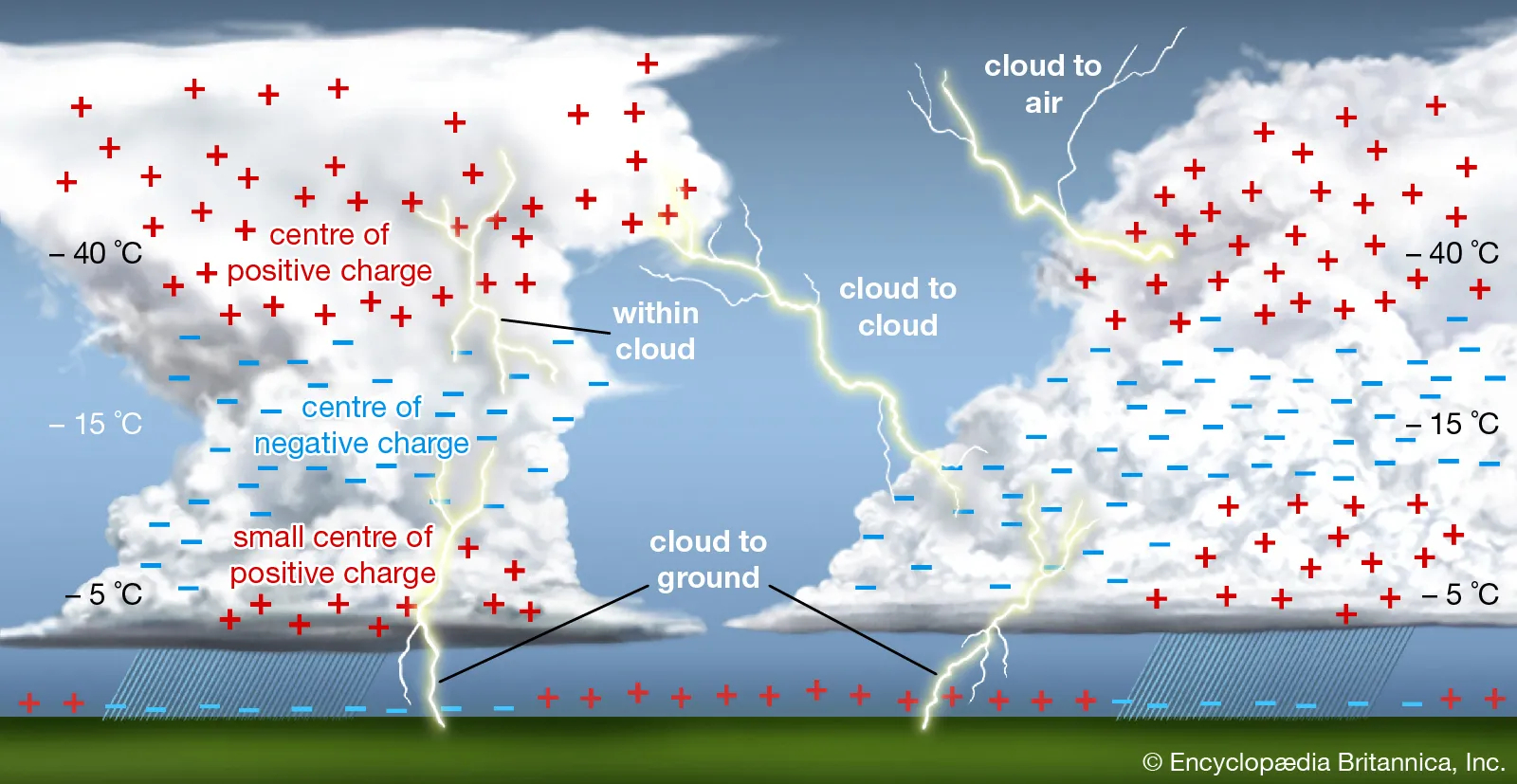
    • Scientifically, lightning is a rapid and massive discharge of electricity in the atmosphere some of which is directed towards earth.
    • The discharges are generated in giant moisture-bearing clouds that are 10-12 km tall.
    • The base of these clouds typically lie within 1-2 km of the Earth’s surface, while the top is 12-13 km away.
    • Temperatures in the top of these clouds are in the range of –35° to –45°C.

    Its formation

    • As water vapour moves upward in the cloud, the falling temperature causes it to condense.
    • As they move to temperatures below 0°C, the water droplets change into small ice crystals.
    • They continue to move up, gathering mass until they are so heavy that they start to fall to Earth.
    • This leads to a system in which, simultaneously, smaller ice crystals are moving up and bigger crystals are coming down.
    • Collisions follow and trigger the release of electrons, a process that is very similar to the generation of sparks of electricity.
    • As the moving free electrons cause more collisions and more electrons, a chain reaction ensues.
    • This process results in a situation in which the top layer of the cloud gets positively charged, while the middle layer is negatively charged.
    • The electrical potential difference between the two layers is huge, of the order of a billion to 10 billion volts.
    • In very little time, a massive current, of the order of 100,000 to a million amperes, starts to flow between the layers.

    Types of lightning

    • Broadly, there are three forms of lightning:
    1. Inter-cloud
    2. Intra-cloud
    3. Cloud-to-ground
    • It is the cloud-to-ground form of lightning that kills humans, as well as animals and livestock, and can substantially damage property.
    • While the Earth is a good conductor of electricity, it is electrically neutral.
    • However, in comparison to the middle layer of the cloud, it becomes positively charged.
    • As a result, about 15%-20% of the current gets directed towards the Earth as well.
    • It is this flow of current that results in damage to life and property on Earth.

    How intensely does it strike?

    • A typical lightning flash is about 300 million volts and 30,000 amps.
    • To put it in perspective, household current is 120 volts and 15 amps.
    • A flash of lightning is enough to light a 100-watt incandescent bulb for about three months.

    Why does lightning kill so many people in India?

    • The reason for the high number of deaths is due to people being caught unawares and more than 70% of fatalities happened due to people standing under isolated tall trees.
    • About 25 per cent of the people were struck in the open.
    • Also, lightning is the direct promulgation of climate change extremities.

    Mitigating lightning incidents

    • Lightning is not classified as a natural disaster in India.
    • But recent efforts have resulted in the setting up of an early warning system that is already saving many lives.
    • More than 96% of lightning deaths happen in rural areas.
    • As such, most of the mitigation and public awareness programmes need to focus on these communities.
    • Lightning protection devices are fairly unsophisticated and low-cost. Yet, their deployment in the rural areas, as of now, is extremely low.
    • States are being encouraged to prepare and implement lightning action plans, on the lines of heat action plans.
    • An international centre for excellence on lightning research to boost detection and early warning systems is also in the process of being set up.


    UPSC 2023 countdown has begun! Get your personal guidance plan now! (Click here)

  • Back in news: Central Vista Project

    The Central Vista Avenue is set to open in the next few days after remaining closed to the public since February 2021 for redevelopment.

    Central Vista Project

    • The project aims to renovate and redevelop 86 acres of land in Lutyens’s Delhi.
    • In this, the landmark structures of the government, including Parliament House, Rashtrapati Bhavan, India Gate, North Block and South Block, etc. stand.
    • This dream project of redeveloping the nation’s administrative heart was announced by the Ministry of Housing and Urban Affairs back in September 13, 2019.

    This project has three main parts:

    1. New parliament building
    2. New secretariat complex to bring all the central govt ministries in one place
    3. Development of the Rajghat and the area around it
    • This project will involve demolition of some non-heritage buildings in the area, and construction of new buildings in place of them.

    Why need this Project?

    The most significant aspect of the project is the construction of a new parliament building.  There are several reasons for needing a new building.

    • Pre Independence building: The current one was built in 1927to house the legislative council and was not intended to house a bicameral legislature that the country has today.
    • Lack of Space: The current building will be under more stress when the number of seats to Lok Sabha and Rajya Sabha are raised. Both Houses are already packed and members have to sit on plastic chairs when joint sessions are held, diminishing the dignity of the House.
    • Safety Concerns: The existing building does not conform to fire safety norms. Water and sewer lines are also haphazard and this is damaging its heritage nature. Security concerns in the wake of the 2001 Parliament attack shows its vulnerable nature. It is also not quake-proof.
    • Cost Advantage: Many central ministries are housed in different buildings with the result that the government ends up paying rent for many of them. The new building, a new central secretariat will help avoid this.
    • Environmental Benefits: The fact that people and officials have to run around the city to go to different ministries also increases traffic and pollution. The project also proposes interlinking of metro stations which will minimise use of vehicles.

    Due to these reasons, a pressing need was felt to construct a new parliament building.

    Significance of the project

    • Modernising parliament’s facilities: The new Parliament building will be India’s first purpose-designed parliament, equipped with state-of-the-art infrastructure to meet all needs of an expanded parliament.
    • Improving productivity and efficiency: All ministries of the government will be consolidated in one place and will be served by highly energy-efficient and sustainable infrastructure.
    • Strengthening cultural and recreational facilities: The National Museum will be relocated and conceptualized to present the rich heritage and achievements of the nation.
    • Providing modern and secure infrastructure: A modern, secure, and appropriately equipped executive enclave is proposed to house executive offices and facilities.
    • Providing residential facilities for the PM: Modern and secure residential facilities for the vice president and the PM are proposed to the north of North Block and south of South Block respectively.
    • Cultural significance: The overall objective of works planned on the Central Vista is to ensure environmental sustainability, restore the vista’s architectural character, protect its heritage buildings, expand and improve public space, and to extend its axis.

    Criticism

    • The Opposition, environmentalists, architects and citizens have raised many concerns even before the pandemic brought in extra issues.
      • They have questioned the lack of studies to ascertain the need for the project and its impact on the environment, traffic and pollution.
    • Several key approvals for the proposed Parliament building have been pushed during the lockdown. This led to allegations of a lack of transparency.
    • They argue that in the situation created by the pandemic, the project must be deferred as the country can’t afford it at this time.

    Back2Basics: Making of New Delhi

    • The Central Vista was designed by Edwin Lutyens and Herbert Baker, to house the capital of British India.
    • The top of the Raisina Hill and adjacent hills in the area was flattened to create space for the buildings.
    • At his coronation as Emperor of India on December 12, 1911, Britain’s King George V announced the transfer of the seat of the Government from Calcutta to the ancient Capital of Delhi.
    • Thereafter, a 20-year-long project to build modern New Delhi was spearheaded by architects Edwin Lutyens and Herbert Baker.
    • They built Parliament House, Rashtrapati Bhavan, North and South Blocks, Rajpath, India Gate, National Archives and the princes’ houses around India Gate.
    • Thus, New Delhi was unveiled in 1931.


    UPSC 2023 countdown has begun! Get your personal guidance plan now! (Click here)

  • IAS Exam Syllabus

    UPSC CSE exam is also known as the IAS exam. Usually, the top 100 rankers are allotted the IAS rank.

    It is part of the most coveted Civil Service Exam (IAS/IPS/IFS), which is conducted by UPSC yearly to recruit candidates for the various all-India services & Posts under the Government of India.

    It comprises two successive stages: 

    1. Civil Services (Preliminary) Examination: It is an objective type screening test & is conducted to shortlist candidates for the Mains examination. 

    Civil Service (Main) Examination: The exam is conducted for the selection of suitable candidates for the posts & services. The question papers for the examination will be of conventional (essay) type.

    The foremost crucial thing for a UPSC Aspirant is to digest the UPSC syllabus and bring it to your fingertips. The most satisfactory way to understand the whole syllabus is to be under the guidance of a topper’s mentor. A serious candidate ought to have a grip on the full syllabus of pre and mains before prelims. Given below is comprehensive coverage of the syllabus for UPSC-CSE.

    UPSC-CSE Preliminary Examination Syllabus:

    The UPSC Civil Services Preliminary Exam is the first phase of the Civil Services Exam but is not necessarily the easiest. There is a broad difference between the syllabi of the Preliminary and Main Exam, the nature of questions, and consequently, the preparation strategy needs to be well thought out. Every year around 15 Lakhs aspirants fill up the form but only less than 1% get selected as an IAS or IPS, etc. posts. And almost 90% of candidates get eliminated in the prelims. So, the very first crucial step is to have a grip on the Syllabus of UPSC prelims. 

    It consists of two papers.

    Paper 1 consists of 100 Questions (200 Marks)

    Subjects 

    • Current Events of National and International Importance.
    • Ancient & Medieval History of India and Indian National Movement.
    • Indian and World Geography-Physical, Social, Economic Geography of India and the World.
    • Indian Polity and Governance-Constitution, Political System, Panchayati Raj, Public Policy, Rights Issues, etc.
    • Economic and Social Development-Sustainable Development, Poverty, Inclusion, Demographics, Social Sector Initiatives, etc.
    • General issues on Environmental ecology, Bio-diversity, and Climate Change – that do not require subject specialization.
    • General Science.

    Paper 2 consists of 80 questions – (200 marks)

    Topics covered

    • Comprehension; Interpersonal Skills including Communication Skills.
    • Logical Reasoning and Analytical Ability.
    • Decision Making and Problem Solving.
    • General Mental Ability.
    • Basic Numeracy (Numbers and their Relations, Orders of Magnitude, etc.) (Class X level).
    • Data Interpretation (charts, graphs, tables, data sufficiency, etc. — Class X level).

    Note: Paper 2 of the UPSC-CSE prelims is a qualifying paper with minimum pass marks fixed @33%. And the type of the questions in Paper 1 & Paper 2 is multiple-choice objective type. There is a negative marking for every wrong answer which is 1/3rd of the marks assigned to a question.

    UPSC-CSE Mains Examination Syllabus:

    UPSC-CSE Main examination consists of a written examination in various stages and a personality test. 

    The papers are divided into 2 categories- 

    • Qualifying papers 
    • Papers to be counted for merit.

    Note : 

    (i) The question papers for the examination will be of conventional (essay) type. 

    (ii) Each paper will be of 3 hours duration. 

    (iii) Candidates will have the option to answer all the question papers, except the Qualifying Language Papers, Paper-A, and Paper-B, in any one of the languages included in the Eighth Schedule to the Constitution of India or English. 

    Syllabi of the papers included in the scheme of Civil Services (Main) Examination are given as follows:— 

    QUALIFYING PAPERS ON INDIAN LANGUAGES AND ENGLISH 

    The paper aims to test the candidates’ ability to read and understand serious discursive prose and to express ideas clearly and correctly, in the English and Indian languages concerned. 

    The pattern of questions would be broad as follows: 

    (i) Comprehension of given passages. 

    (ii) Precis Writing. 

    (iii) Usage and Vocabulary. 

    (iv) Short Essays. 

    Indian Languages:— 

    (i) Comprehension of given passages. 

    (ii) Precis Writing. 

    (iii) Usage and Vocabulary. 

    (iv) Short Essays. 

    (v) Translation from English to the Indian Language and vice-versa. 

    Note 1: The papers on Indian Languages and English will be of Matriculation or equivalent standard and will be qualifying only. The marks obtained in these papers will not be counted for ranking. 

    Note 2: The candidates will have to answer the English and Indian Languages papers in English and the respective Indian language (except where the translation is involved).

    PAPER-I Essay: 

    Candidates may be required to write essays on multiple topics. They will be expected to keep close to the subject of the essay to arrange their ideas in an orderly fashion and to write concisely. Credit will be given for effective and exact expression.

    PAPER-II General Studies-I: 

    Indian Heritage and Culture, History, and Geography of the World and Society.  

    • Indian culture will cover the salient aspects of Art Forms, literature, and Architecture from ancient to modern times.  
    • Modern Indian history from about the middle of the eighteenth century until the present- significant events, personalities, and issues.  
    • The Freedom Struggle — its various stages and important contributors/contributions from different parts of the country.  
    • Post-independence consolidation and reorganization within the country.  
    • History of the world will include events from the 18th century such as the industrial revolution, world wars, redrawing of national boundaries, colonization, decolonization, political philosophies like communism, capitalism, socialism, etc.— their forms and effect on the society.  
    • Salient features of Indian Society, Diversity of India.  
    • Role of women and women’s organization, population and associated issues, poverty and developmental issues, urbanization, their problems, and their remedies.  
    • Effects of globalization on Indian society.  Social empowerment, communalism, regionalism & secularism.  
    • Salient features of the world’s physical geography.  
    • Distribution of key natural resources across the world (including South Asia and the Indian subcontinent); factors responsible for the location of primary, secondary, and tertiary sector industries in various parts of the world (including India).  
    • Important Geophysical phenomena such as earthquakes, tsunamis, Volcanic activity, cyclones, etc., geographical features and their location changes in critical geographical features (including water bodies and ice-caps) and flora and fauna and the effects of such changes.

    PAPER-III General Studies- II: 

    Governance, Constitution, Polity, Social Justice and International relations.

    • Indian Constitution—historical underpinnings, evolution, features, amendments, significant provisions, and basic structure.  
    • Functions and responsibilities of the Union and the States, issues, and challenges pertaining to the federal structure, devolution of powers and finances up to local levels, and challenges therein.  
    • Separation of powers between various organs disputes redressal mechanisms and institutions.  
    • Comparison of the Indian constitutional scheme with that of other countries.  
    • Parliament and State legislatures—structure, functioning, the conduct of business, powers & privileges, and issues arising out of these.  
    • Structure, organization, and functioning of the Executive and the Judiciary—Ministries and Departments of the Government; pressure groups and formal/informal associations and their role in the Polity.
    • Salient features of the Representation of People’s Act.  
    • Appointment to various Constitutional posts, powers, functions, and responsibilities of various Constitutional Bodies.  
    • Statutory, regulatory, and various quasi-judicial bodies.  
    • Government policies and interventions for development in various sectors and issues arising out of their design and implementation.  
    • Development processes and the development industry —the role of NGOs, SHGs, various groups and associations, donors, charities, institutional and other stakeholders.  
    • Welfare schemes for vulnerable sections of the population by the Centre and States and the performance of these schemes; mechanisms, laws, institutions, and Bodies constituted for the protection and betterment of these vulnerable sections.  
    • Issues relating to development and management of Social Sector/Services relating to Health, Education, and Human Resources.  
    • Issues relating to poverty and hunger.  
    • Important aspects of governance, transparency, and accountability, e-governance- applications, models, successes, limitations, and potential; citizens charters, transparency & accountability, and institutional and other measures.  
    • Role of civil services in a democracy.  
    • India and its neighborhood- relations.  
    • Bilateral, regional, and global groupings and agreements involving India and/or affecting India’s interests.  
    • Effect of policies and politics of developed and developing countries on India’s interests, Indian diaspora. 
    • Important International institutions, agencies, and fora- their structure, mandate

    PAPER-IV General Studies-III: 

    Technology, Economic Development, Bio diversity, Environment, Security and Disaster Management  

    • Indian Economy and issues relating to planning, mobilization, of resources, growth, development, and employment.  
    • Inclusive growth and issues arising from it.  
    • Government Budgeting.  
    • Major crops-cropping patterns in various parts of the country, – different types of irrigation and irrigation systems storage, transport, and marketing of agricultural produce and issues and related constraints; e-technology in the aid of farmers.  
    • Issues related to direct and indirect farm subsidies and minimum support prices; Public Distribution System- objectives, functioning, limitations, revamping; issues of buffer stocks and food security; Technology missions; economics of animal-rearing.
    • Food processing and related industries in India- scope’ and significance, location, upstream and downstream requirements, supply chain management.  
    • Land reforms in India.  
    • Effects of liberalization on the economy, changes in industrial policy, and their effects on industrial growth.  
    • Infrastructure: Energy, Ports, Roads, Airports, Railways, etc.  
    • Investment models.  
    • Science and technology- developments and their applications and effects in everyday life.  
    • Achievements of Indians in science & technology; indigenization of technology and development of new technology.  
    • Awareness in the fields of IT, Space, Computers, robotics, nano-technology, bio-technology, and issues relating to intellectual property rights.  
    • Conservation, environmental pollution, and degradation, environmental impact assessment.  
    • Disaster and disaster management.
    • Linkages between development and spread of extremism.  
    • Role of external state and non-state actors in creating challenges to internal security.  
    • Challenges to internal security through communication networks, the role of media and social networking sites in internal security challenges, basics of cyber security; money laundering, and its prevention.  
    • Security challenges and their management in border areas – linkages of organized crime with terrorism.  
    • Various Security forces and agencies and their mandate.

    PAPER-V General Studies- IV: 

    Ethics, Integrity, and Aptitude  

    • This paper will include questions to test the candidate’s attitude and approach to issues relating to integrity, probity in public life, and his problem-solving approach to various issues and conflicts faced by him in dealing with society. Questions may utilize the case study approach to determine these aspects. The following broad areas will be covered:  
    • Ethics and Human Interface: Essence, determinants, and consequences of Ethics in-human actions; dimensions of ethics; ethics – in private and public relationships. Human Values – lessons from the lives and teachings of great leaders, reformers, and administrators; the role of family society and educational institutions in inculcating values.  
    • Attitude: content, structure, function; its influence and relation with thought and behavior; moral and political attitudes; social influence and persuasion.  
    • Aptitude and foundational values for Civil Service, integrity, impartiality and non-partisanship, objectivity, dedication to public service, empathy, tolerance, and compassion towards the weaker sections.  
    • Emotional intelligence concepts, and their utilities and application in administration and governance.
    • Contributions of moral thinkers and philosophers from India and the world.  
    • Public/Civil service values and Ethics in Public administration: Status and problems; ethical concerns and dilemmas in government and private institutions; laws, rules, regulations, and conscience as sources of ethical guidance; accountability and ethical governance; strengthening of ethical and moral values in governance; ethical issues in international relations and funding; corporate governance.  
    • Probity in Governance: Concept of public service; Philosophical basis of governance and probity; Information sharing and transparency in government, Right to Information, Codes of Ethics, Codes of Conduct, Citizen’s Charters, Work culture, Quality of service delivery, Utilization of public funds, challenges of corruption.  
    • Case Studies on the above issues

    PAPER-VI & PAPER VII 

    Optional Subject Papers I & II 

    Candidates have to choose an optional subject from amongst the List of Optional Subjects. He/She has to write 2 different papers on the same subject.

    Some Important Facts:

    The Main Examination is intended to evaluate the overall intellectual traits and depth of understanding of candidates rather than merely the range of their information and memory. 

    The nature and standard of questions in the General Studies papers (Paper II to Paper V) will be such that a well-educated person will be able to answer them without any specialized study. 

    The questions will be such as to test a candidate’s general awareness of a variety of subjects, which will have relevance for a career in Civil Services. 

    The questions are likely to test the candidate’s basic understanding of all relevant issues, and ability to analyze, and take a view on conflicting socio-economic goals, objectives, and demands. The candidates must give relevant, meaningful, and succinct answers. 

    The scope of the syllabus for optional subject papers (Paper VI and Paper VII) for the examination is broad of the honors degree 1evel i.e. a level higher than the bachelor’s degree and lower than the master’s degree. In the case of Engineering, Medical Science, and law, the level corresponds to the bachelor’s degree. 

    Now, to succeed in UPSC-CSE, only knowing the syllabus is not enough. Understanding twists & overlapping areas are a crucial aspect of preparation. To tell the truth, if anyone can be your true torchbearer throughout your IAS journey, he is your mentor. Never deprive yourself of his priceless guidance.
    The desire to complete the course alone in its entirety is the major cause of most time mismanagement. Many applicants set out to cover the entire syllabus blindly only to discover later that many topics are simply too broad or that very few if any, questions are being asked from certain sections. A lot of time is wasted in this effort because those topics are required to be addressed differently, and the time saved on their coverage could have been better spent on other parts of the syllabus.
  • UPSC Exam Syllabus

    UPSC CSE exam is also known as the IAS exam. Usually, the top 100 rankers are allotted the IAS rank.

    It is part of the most coveted Civil Service Exam (IAS/IPS/IFS), which is conducted by UPSC yearly to recruit candidates for the various all-India services & Posts under the Government of India.

    It comprises two successive stages: 

    1. Civil Services (Preliminary) Examination: It is an objective type screening test & is conducted to shortlist candidates for the Mains examination. 

    Civil Service (Main) Examination: The exam is conducted for the selection of suitable candidates for the posts & services. The question papers for the examination will be of conventional (essay) type.

    The foremost crucial thing for a UPSC Aspirant is to digest the UPSC syllabus and bring it to your fingertips. The most satisfactory way to understand the whole syllabus is to be under the guidance of a topper’s mentor. A serious candidate ought to have a grip on the full syllabus of pre and mains before prelims. Given below is comprehensive coverage of the syllabus for UPSC-CSE.

    UPSC-CSE Preliminary Examination Syllabus:

    The UPSC Civil Services Preliminary Exam is the first phase of the Civil Services Exam but is not necessarily the easiest. There is a broad difference between the syllabi of the Preliminary and Main Exam, the nature of questions, and consequently, the preparation strategy needs to be well thought out. Every year around 15 Lakhs aspirants fill up the form but only less than 1% get selected as an IAS or IPS, etc. posts. And almost 90% of candidates get eliminated in the prelims. So, the very first crucial step is to have a grip on the Syllabus of UPSC prelims. 

    It consists of two papers.

    Paper 1 consists of 100 Questions (200 Marks)

    Subjects 

    • Current Events of National and International Importance.
    • Ancient & Medieval History of India and Indian National Movement.
    • Indian and World Geography-Physical, Social, Economic Geography of India and the World.
    • Indian Polity and Governance-Constitution, Political System, Panchayati Raj, Public Policy, Rights Issues, etc.
    • Economic and Social Development-Sustainable Development, Poverty, Inclusion, Demographics, Social Sector Initiatives, etc.
    • General issues on Environmental ecology, Bio-diversity, and Climate Change – that do not require subject specialization.
    • General Science.

    Paper 2 consists of 80 questions – (200 marks)

    Topics covered

    • Comprehension; Interpersonal Skills including Communication Skills.
    • Logical Reasoning and Analytical Ability.
    • Decision Making and Problem Solving.
    • General Mental Ability.
    • Basic Numeracy (Numbers and their Relations, Orders of Magnitude, etc.) (Class X level).
    • Data Interpretation (charts, graphs, tables, data sufficiency, etc. — Class X level).

    Note: Paper 2 of the UPSC-CSE prelims is a qualifying paper with minimum pass marks fixed @33%. And the type of the questions in Paper 1 & Paper 2 is multiple-choice objective type. There is a negative marking for every wrong answer which is 1/3rd of the marks assigned to a question.

    UPSC-CSE Mains Examination Syllabus:

    UPSC-CSE Main examination consists of a written examination in various stages and a personality test. 

    The papers are divided into 2 categories- 

    • Qualifying papers 
    • Papers to be counted for merit.

    Note : 

    (i) The question papers for the examination will be of conventional (essay) type. 

    (ii) Each paper will be of 3 hours duration. 

    (iii) Candidates will have the option to answer all the question papers, except the Qualifying Language Papers, Paper-A, and Paper-B, in any one of the languages included in the Eighth Schedule to the Constitution of India or English. 

    Syllabi of the papers included in the scheme of Civil Services (Main) Examination are given as follows:— 

    QUALIFYING PAPERS ON INDIAN LANGUAGES AND ENGLISH 

    The paper aims to test the candidates’ ability to read and understand serious discursive prose and to express ideas clearly and correctly, in the English and Indian languages concerned. 

    The pattern of questions would be broad as follows: 

    (i) Comprehension of given passages. 

    (ii) Precis Writing. 

    (iii) Usage and Vocabulary. 

    (iv) Short Essays. 

    Indian Languages:— 

    (i) Comprehension of given passages. 

    (ii) Precis Writing. 

    (iii) Usage and Vocabulary. 

    (iv) Short Essays. 

    (v) Translation from English to the Indian Language and vice-versa. 

    Note 1: The papers on Indian Languages and English will be of Matriculation or equivalent standard and will be qualifying only. The marks obtained in these papers will not be counted for ranking. 

    Note 2: The candidates will have to answer the English and Indian Languages papers in English and the respective Indian language (except where the translation is involved).

    PAPER-I Essay: 

    Candidates may be required to write essays on multiple topics. They will be expected to keep close to the subject of the essay to arrange their ideas in an orderly fashion and to write concisely. Credit will be given for effective and exact expression.

    PAPER-II General Studies-I: 

    Indian Heritage and Culture, History, and Geography of the World and Society.  

    • Indian culture will cover the salient aspects of Art Forms, literature, and Architecture from ancient to modern times.  
    • Modern Indian history from about the middle of the eighteenth century until the present- significant events, personalities, and issues.  
    • The Freedom Struggle — its various stages and important contributors/contributions from different parts of the country.  
    • Post-independence consolidation and reorganization within the country.  
    • History of the world will include events from the 18th century such as the industrial revolution, world wars, redrawing of national boundaries, colonization, decolonization, political philosophies like communism, capitalism, socialism, etc.— their forms and effect on the society.  
    • Salient features of Indian Society, Diversity of India.  
    • Role of women and women’s organization, population and associated issues, poverty and developmental issues, urbanization, their problems, and their remedies.  
    • Effects of globalization on Indian society.  Social empowerment, communalism, regionalism & secularism.  
    • Salient features of the world’s physical geography.  
    • Distribution of key natural resources across the world (including South Asia and the Indian subcontinent); factors responsible for the location of primary, secondary, and tertiary sector industries in various parts of the world (including India).  
    • Important Geophysical phenomena such as earthquakes, tsunamis, Volcanic activity, cyclones, etc., geographical features and their location changes in critical geographical features (including water bodies and ice-caps) and flora and fauna and the effects of such changes.

    PAPER-III General Studies- II: 

    Governance, Constitution, Polity, Social Justice and International relations.

    • Indian Constitution—historical underpinnings, evolution, features, amendments, significant provisions, and basic structure.  
    • Functions and responsibilities of the Union and the States, issues, and challenges pertaining to the federal structure, devolution of powers and finances up to local levels, and challenges therein.  
    • Separation of powers between various organs disputes redressal mechanisms and institutions.  
    • Comparison of the Indian constitutional scheme with that of other countries.  
    • Parliament and State legislatures—structure, functioning, the conduct of business, powers & privileges, and issues arising out of these.  
    • Structure, organization, and functioning of the Executive and the Judiciary—Ministries and Departments of the Government; pressure groups and formal/informal associations and their role in the Polity.
    • Salient features of the Representation of People’s Act.  
    • Appointment to various Constitutional posts, powers, functions, and responsibilities of various Constitutional Bodies.  
    • Statutory, regulatory, and various quasi-judicial bodies.  
    • Government policies and interventions for development in various sectors and issues arising out of their design and implementation.  
    • Development processes and the development industry —the role of NGOs, SHGs, various groups and associations, donors, charities, institutional and other stakeholders.  
    • Welfare schemes for vulnerable sections of the population by the Centre and States and the performance of these schemes; mechanisms, laws, institutions, and Bodies constituted for the protection and betterment of these vulnerable sections.  
    • Issues relating to development and management of Social Sector/Services relating to Health, Education, and Human Resources.  
    • Issues relating to poverty and hunger.  
    • Important aspects of governance, transparency, and accountability, e-governance- applications, models, successes, limitations, and potential; citizens charters, transparency & accountability, and institutional and other measures.  
    • Role of civil services in a democracy.  
    • India and its neighborhood- relations.  
    • Bilateral, regional, and global groupings and agreements involving India and/or affecting India’s interests.  
    • Effect of policies and politics of developed and developing countries on India’s interests, Indian diaspora. 
    • Important International institutions, agencies, and fora- their structure, mandate

    PAPER-IV General Studies-III: 

    Technology, Economic Development, Bio diversity, Environment, Security and Disaster Management  

    • Indian Economy and issues relating to planning, mobilization, of resources, growth, development, and employment.  
    • Inclusive growth and issues arising from it.  
    • Government Budgeting.  
    • Major crops-cropping patterns in various parts of the country, – different types of irrigation and irrigation systems storage, transport, and marketing of agricultural produce and issues and related constraints; e-technology in the aid of farmers.  
    • Issues related to direct and indirect farm subsidies and minimum support prices; Public Distribution System- objectives, functioning, limitations, revamping; issues of buffer stocks and food security; Technology missions; economics of animal-rearing.
    • Food processing and related industries in India- scope’ and significance, location, upstream and downstream requirements, supply chain management.  
    • Land reforms in India.  
    • Effects of liberalization on the economy, changes in industrial policy, and their effects on industrial growth.  
    • Infrastructure: Energy, Ports, Roads, Airports, Railways, etc.  
    • Investment models.  
    • Science and technology- developments and their applications and effects in everyday life.  
    • Achievements of Indians in science & technology; indigenization of technology and development of new technology.  
    • Awareness in the fields of IT, Space, Computers, robotics, nano-technology, bio-technology, and issues relating to intellectual property rights.  
    • Conservation, environmental pollution, and degradation, environmental impact assessment.  
    • Disaster and disaster management.
    • Linkages between development and spread of extremism.  
    • Role of external state and non-state actors in creating challenges to internal security.  
    • Challenges to internal security through communication networks, the role of media and social networking sites in internal security challenges, basics of cyber security; money laundering, and its prevention.  
    • Security challenges and their management in border areas – linkages of organized crime with terrorism.  
    • Various Security forces and agencies and their mandate.

    PAPER-V General Studies- IV: 

    Ethics, Integrity, and Aptitude  

    • This paper will include questions to test the candidate’s attitude and approach to issues relating to integrity, probity in public life, and his problem-solving approach to various issues and conflicts faced by him in dealing with society. Questions may utilize the case study approach to determine these aspects. The following broad areas will be covered:  
    • Ethics and Human Interface: Essence, determinants, and consequences of Ethics in-human actions; dimensions of ethics; ethics – in private and public relationships. Human Values – lessons from the lives and teachings of great leaders, reformers, and administrators; the role of family society and educational institutions in inculcating values.  
    • Attitude: content, structure, function; its influence and relation with thought and behavior; moral and political attitudes; social influence and persuasion.  
    • Aptitude and foundational values for Civil Service, integrity, impartiality and non-partisanship, objectivity, dedication to public service, empathy, tolerance, and compassion towards the weaker sections.  
    • Emotional intelligence concepts, and their utilities and application in administration and governance.
    • Contributions of moral thinkers and philosophers from India and the world.  
    • Public/Civil service values and Ethics in Public administration: Status and problems; ethical concerns and dilemmas in government and private institutions; laws, rules, regulations, and conscience as sources of ethical guidance; accountability and ethical governance; strengthening of ethical and moral values in governance; ethical issues in international relations and funding; corporate governance.  
    • Probity in Governance: Concept of public service; Philosophical basis of governance and probity; Information sharing and transparency in government, Right to Information, Codes of Ethics, Codes of Conduct, Citizen’s Charters, Work culture, Quality of service delivery, Utilization of public funds, challenges of corruption.  
    • Case Studies on the above issues

    PAPER-VI & PAPER VII 

    Optional Subject Papers I & II 

    Candidates have to choose an optional subject from amongst the List of Optional Subjects. He/She has to write 2 different papers on the same subject.

    Some Important Facts:

    The Main Examination is intended to evaluate the overall intellectual traits and depth of understanding of candidates rather than merely the range of their information and memory. 

    The nature and standard of questions in the General Studies papers (Paper II to Paper V) will be such that a well-educated person will be able to answer them without any specialized study. 

    The questions will be such as to test a candidate’s general awareness of a variety of subjects, which will have relevance for a career in Civil Services. 

    The questions are likely to test the candidate’s basic understanding of all relevant issues, and ability to analyze, and take a view on conflicting socio-economic goals, objectives, and demands. The candidates must give relevant, meaningful, and succinct answers. 

    The scope of the syllabus for optional subject papers (Paper VI and Paper VII) for the examination is broad of the honors degree 1evel i.e. a level higher than the bachelor’s degree and lower than the master’s degree. In the case of Engineering, Medical Science, and law, the level corresponds to the bachelor’s degree. 

    Now, to succeed in UPSC-CSE, only knowing the syllabus is not enough. Understanding twists & overlapping areas are a crucial aspect of preparation. To tell the truth, if anyone can be your true torchbearer throughout your IAS journey, he is your mentor. Never deprive yourself of his priceless guidance.
    The desire to complete the course alone in its entirety is the major cause of most time mismanagement. Many applicants set out to cover the entire syllabus blindly only to discover later that many topics are simply too broad or that very few if any, questions are being asked from certain sections. A lot of time is wasted in this effort because those topics are required to be addressed differently, and the time saved on their coverage could have been better spent on other parts of the syllabus.

  • IAS Syllabus

    UPSC CSE exam is also known as the IAS exam. Usually, the top 100 rankers are allotted the IAS rank.

    It is part of the most coveted Civil Service Exam (IAS/IPS/IFS), which is conducted by UPSC yearly to recruit candidates for the various all-India services & Posts under the Government of India.

    It comprises two successive stages: 

    1. Civil Services (Preliminary) Examination: It is an objective type screening test & is conducted to shortlist candidates for the Mains examination. 

    Civil Service (Main) Examination: The exam is conducted for the selection of suitable candidates for the posts & services. The question papers for the examination will be of conventional (essay) type.

    The foremost crucial thing for a UPSC Aspirant is to digest the UPSC syllabus and bring it to your fingertips. The most satisfactory way to understand the whole syllabus is to be under the guidance of a topper’s mentor. A serious candidate ought to have a grip on the full syllabus of pre and mains before prelims. Given below is comprehensive coverage of the syllabus for UPSC-CSE.

    UPSC-CSE Preliminary Examination Syllabus:

    The UPSC Civil Services Preliminary Exam is the first phase of the Civil Services Exam but is not necessarily the easiest. There is a broad difference between the syllabi of the Preliminary and Main Exam, the nature of questions, and consequently, the preparation strategy needs to be well thought out. Every year around 15 Lakhs aspirants fill up the form but only less than 1% get selected as an IAS or IPS, etc. posts. And almost 90% of candidates get eliminated in the prelims. So, the very first crucial step is to have a grip on the Syllabus of UPSC prelims. 

    It consists of two papers.

    Paper 1 consists of 100 Questions (200 Marks)

    Subjects 

    • Current Events of National and International Importance.
    • Ancient & Medieval History of India and Indian National Movement.
    • Indian and World Geography-Physical, Social, Economic Geography of India and the World.
    • Indian Polity and Governance-Constitution, Political System, Panchayati Raj, Public Policy, Rights Issues, etc.
    • Economic and Social Development-Sustainable Development, Poverty, Inclusion, Demographics, Social Sector Initiatives, etc.
    • General issues on Environmental ecology, Bio-diversity, and Climate Change – that do not require subject specialization.
    • General Science.

    Paper 2 consists of 80 questions – (200 marks)

    Topics covered

    • Comprehension; Interpersonal Skills including Communication Skills.
    • Logical Reasoning and Analytical Ability.
    • Decision Making and Problem Solving.
    • General Mental Ability.
    • Basic Numeracy (Numbers and their Relations, Orders of Magnitude, etc.) (Class X level).
    • Data Interpretation (charts, graphs, tables, data sufficiency, etc. — Class X level).

    Note: Paper 2 of the UPSC-CSE prelims is a qualifying paper with minimum pass marks fixed @33%. And the type of the questions in Paper 1 & Paper 2 is multiple-choice objective type. There is a negative marking for every wrong answer which is 1/3rd of the marks assigned to a question.

    UPSC-CSE Mains Examination Syllabus:

    UPSC-CSE Main examination consists of a written examination in various stages and a personality test. 

    The papers are divided into 2 categories- 

    • Qualifying papers 
    • Papers to be counted for merit.

    Note : 

    (i) The question papers for the examination will be of conventional (essay) type. 

    (ii) Each paper will be of 3 hours duration. 

    (iii) Candidates will have the option to answer all the question papers, except the Qualifying Language Papers, Paper-A, and Paper-B, in any one of the languages included in the Eighth Schedule to the Constitution of India or English. 

    Syllabi of the papers included in the scheme of Civil Services (Main) Examination are given as follows:— 

    QUALIFYING PAPERS ON INDIAN LANGUAGES AND ENGLISH 

    The paper aims to test the candidates’ ability to read and understand serious discursive prose and to express ideas clearly and correctly, in the English and Indian languages concerned. 

    The pattern of questions would be broad as follows: 

    (i) Comprehension of given passages. 

    (ii) Precis Writing. 

    (iii) Usage and Vocabulary. 

    (iv) Short Essays. 

    Indian Languages:— 

    (i) Comprehension of given passages. 

    (ii) Precis Writing. 

    (iii) Usage and Vocabulary. 

    (iv) Short Essays. 

    (v) Translation from English to the Indian Language and vice-versa. 

    Note 1: The papers on Indian Languages and English will be of Matriculation or equivalent standard and will be qualifying only. The marks obtained in these papers will not be counted for ranking. 

    Note 2: The candidates will have to answer the English and Indian Languages papers in English and the respective Indian language (except where the translation is involved).

    PAPER-I Essay: 

    Candidates may be required to write essays on multiple topics. They will be expected to keep close to the subject of the essay to arrange their ideas in an orderly fashion and to write concisely. Credit will be given for effective and exact expression.

    PAPER-II General Studies-I: 

    Indian Heritage and Culture, History, and Geography of the World and Society.  

    • Indian culture will cover the salient aspects of Art Forms, literature, and Architecture from ancient to modern times.  
    • Modern Indian history from about the middle of the eighteenth century until the present- significant events, personalities, and issues.  
    • The Freedom Struggle — its various stages and important contributors/contributions from different parts of the country.  
    • Post-independence consolidation and reorganization within the country.  
    • History of the world will include events from the 18th century such as the industrial revolution, world wars, redrawing of national boundaries, colonization, decolonization, political philosophies like communism, capitalism, socialism, etc.— their forms and effect on the society.  
    • Salient features of Indian Society, Diversity of India.  
    • Role of women and women’s organization, population and associated issues, poverty and developmental issues, urbanization, their problems, and their remedies.  
    • Effects of globalization on Indian society.  Social empowerment, communalism, regionalism & secularism.  
    • Salient features of the world’s physical geography.  
    • Distribution of key natural resources across the world (including South Asia and the Indian subcontinent); factors responsible for the location of primary, secondary, and tertiary sector industries in various parts of the world (including India).  
    • Important Geophysical phenomena such as earthquakes, tsunamis, Volcanic activity, cyclones, etc., geographical features and their location changes in critical geographical features (including water bodies and ice-caps) and flora and fauna and the effects of such changes.

    PAPER-III General Studies- II: 

    Governance, Constitution, Polity, Social Justice and International relations.

    • Indian Constitution—historical underpinnings, evolution, features, amendments, significant provisions, and basic structure.  
    • Functions and responsibilities of the Union and the States, issues, and challenges pertaining to the federal structure, devolution of powers and finances up to local levels, and challenges therein.  
    • Separation of powers between various organs disputes redressal mechanisms and institutions.  
    • Comparison of the Indian constitutional scheme with that of other countries.  
    • Parliament and State legislatures—structure, functioning, the conduct of business, powers & privileges, and issues arising out of these.  
    • Structure, organization, and functioning of the Executive and the Judiciary—Ministries and Departments of the Government; pressure groups and formal/informal associations and their role in the Polity.
    • Salient features of the Representation of People’s Act.  
    • Appointment to various Constitutional posts, powers, functions, and responsibilities of various Constitutional Bodies.  
    • Statutory, regulatory, and various quasi-judicial bodies.  
    • Government policies and interventions for development in various sectors and issues arising out of their design and implementation.  
    • Development processes and the development industry —the role of NGOs, SHGs, various groups and associations, donors, charities, institutional and other stakeholders.  
    • Welfare schemes for vulnerable sections of the population by the Centre and States and the performance of these schemes; mechanisms, laws, institutions, and Bodies constituted for the protection and betterment of these vulnerable sections.  
    • Issues relating to development and management of Social Sector/Services relating to Health, Education, and Human Resources.  
    • Issues relating to poverty and hunger.  
    • Important aspects of governance, transparency, and accountability, e-governance- applications, models, successes, limitations, and potential; citizens charters, transparency & accountability, and institutional and other measures.  
    • Role of civil services in a democracy.  
    • India and its neighborhood- relations.  
    • Bilateral, regional, and global groupings and agreements involving India and/or affecting India’s interests.  
    • Effect of policies and politics of developed and developing countries on India’s interests, Indian diaspora. 
    • Important International institutions, agencies, and fora- their structure, mandate

    PAPER-IV General Studies-III: 

    Technology, Economic Development, Bio diversity, Environment, Security and Disaster Management  

    • Indian Economy and issues relating to planning, mobilization, of resources, growth, development, and employment.  
    • Inclusive growth and issues arising from it.  
    • Government Budgeting.  
    • Major crops-cropping patterns in various parts of the country, – different types of irrigation and irrigation systems storage, transport, and marketing of agricultural produce and issues and related constraints; e-technology in the aid of farmers.  
    • Issues related to direct and indirect farm subsidies and minimum support prices; Public Distribution System- objectives, functioning, limitations, revamping; issues of buffer stocks and food security; Technology missions; economics of animal-rearing.
    • Food processing and related industries in India- scope’ and significance, location, upstream and downstream requirements, supply chain management.  
    • Land reforms in India.  
    • Effects of liberalization on the economy, changes in industrial policy, and their effects on industrial growth.  
    • Infrastructure: Energy, Ports, Roads, Airports, Railways, etc.  
    • Investment models.  
    • Science and technology- developments and their applications and effects in everyday life.  
    • Achievements of Indians in science & technology; indigenization of technology and development of new technology.  
    • Awareness in the fields of IT, Space, Computers, robotics, nano-technology, bio-technology, and issues relating to intellectual property rights.  
    • Conservation, environmental pollution, and degradation, environmental impact assessment.  
    • Disaster and disaster management.
    • Linkages between development and spread of extremism.  
    • Role of external state and non-state actors in creating challenges to internal security.  
    • Challenges to internal security through communication networks, the role of media and social networking sites in internal security challenges, basics of cyber security; money laundering, and its prevention.  
    • Security challenges and their management in border areas – linkages of organized crime with terrorism.  
    • Various Security forces and agencies and their mandate.

    PAPER-V General Studies- IV: 

    Ethics, Integrity, and Aptitude  

    • This paper will include questions to test the candidate’s attitude and approach to issues relating to integrity, probity in public life, and his problem-solving approach to various issues and conflicts faced by him in dealing with society. Questions may utilize the case study approach to determine these aspects. The following broad areas will be covered:  
    • Ethics and Human Interface: Essence, determinants, and consequences of Ethics in-human actions; dimensions of ethics; ethics – in private and public relationships. Human Values – lessons from the lives and teachings of great leaders, reformers, and administrators; the role of family society and educational institutions in inculcating values.  
    • Attitude: content, structure, function; its influence and relation with thought and behavior; moral and political attitudes; social influence and persuasion.  
    • Aptitude and foundational values for Civil Service, integrity, impartiality and non-partisanship, objectivity, dedication to public service, empathy, tolerance, and compassion towards the weaker sections.  
    • Emotional intelligence concepts, and their utilities and application in administration and governance.
    • Contributions of moral thinkers and philosophers from India and the world.  
    • Public/Civil service values and Ethics in Public administration: Status and problems; ethical concerns and dilemmas in government and private institutions; laws, rules, regulations, and conscience as sources of ethical guidance; accountability and ethical governance; strengthening of ethical and moral values in governance; ethical issues in international relations and funding; corporate governance.  
    • Probity in Governance: Concept of public service; Philosophical basis of governance and probity; Information sharing and transparency in government, Right to Information, Codes of Ethics, Codes of Conduct, Citizen’s Charters, Work culture, Quality of service delivery, Utilization of public funds, challenges of corruption.  
    • Case Studies on the above issues

    PAPER-VI & PAPER VII 

    Optional Subject Papers I & II 

    Candidates have to choose an optional subject from amongst the List of Optional Subjects. He/She has to write 2 different papers on the same subject.

    Some Important Facts:

    The Main Examination is intended to evaluate the overall intellectual traits and depth of understanding of candidates rather than merely the range of their information and memory. 

    The nature and standard of questions in the General Studies papers (Paper II to Paper V) will be such that a well-educated person will be able to answer them without any specialized study. 

    The questions will be such as to test a candidate’s general awareness of a variety of subjects, which will have relevance for a career in Civil Services. 

    The questions are likely to test the candidate’s basic understanding of all relevant issues, and ability to analyze, and take a view on conflicting socio-economic goals, objectives, and demands. The candidates must give relevant, meaningful, and succinct answers. 

    The scope of the syllabus for optional subject papers (Paper VI and Paper VII) for the examination is broad of the honors degree 1evel i.e. a level higher than the bachelor’s degree and lower than the master’s degree. In the case of Engineering, Medical Science, and law, the level corresponds to the bachelor’s degree. 

    Now, to succeed in UPSC-CSE, only knowing the syllabus is not enough. Understanding twists & overlapping areas are a crucial aspect of preparation. To tell the truth, if anyone can be your true torchbearer throughout your IAS journey, he is your mentor. Never deprive yourself of his priceless guidance.
    The desire to complete the course alone in its entirety is the major cause of most time mismanagement. Many applicants set out to cover the entire syllabus blindly only to discover later that many topics are simply too broad or that very few if any, questions are being asked from certain sections. A lot of time is wasted in this effort because those topics are required to be addressed differently, and the time saved on their coverage could have been better spent on other parts of the syllabus.

  • UPSC Civil Services Syllabus

    Don’t fall for the classic blunder: skipping the syllabus!

    1. Knowing the precise demands of the UPSC Syllabus and what not to study is the first step.
    2. Without an understanding of the syllabus, you will be scanning through endless content without any direction, wasting your time and energy.
    3. UPSC has a well-defined topic-wise syllabus. But it doesn’t list the study material/reference books from which these topics must be prepared.
    4. The level of depth demanded by these topics can only be assessed through the previous year’s questions. Rest assured, the Civil Services Exam is an examination to recruit generalist bureaucrats who would be able to handle any department under the government. The exam, therefore, demands the exact same thing, your vastness and breadth of understanding and not depth of understanding.
    5. More often than not, the syllabus requires multiple readings.

    The most satisfactory way to understand the whole syllabus is under the guidance of a mentor. A seasoned mentor can help develop clarity, and save precious time, and iterations in figuring things out.


    The Civil Services Examination is conducted in 3 stages

    1. Preliminary Stage – General Studies & CSAT(qualifying)
    2. Mains Stage – 9 Theory Papers (GS I-IV, Language Papers(qualifying), Essay & Optional)
    3. Personality Test – Interview

    *qualifying papers require you to score minimum marks. Their score is not counted in the final tally.

    UPSC Civil Services Preliminary Exam

    The UPSC Civil Services Preliminary Exam is the first phase of the Civil Services Exam. Every year more than 11 Lakh aspirants fill up the form but around 98-99% get eliminated in the prelims. So, the very first crucial step is to have a grip on the Syllabus of UPSC prelims. 

    It consists of 2 compulsory papers.

    Compulsory PapersPaper-I(GS) Paper-II(CSAT)
    Number of Questions10080
    Total Marks200(2 marks/question)200(2.5 marks/question)
    Negative Marking(0.33) of the marks assigned to that question will
    be deducted as penalty
    (0.33) of the marks assigned to that question will
    be deducted as penalty
    Time Allotted2 Hours (9:30 AM -11:30 AM)2 Hours (2:30 PM – 4:30 PM)
    QualifyingCounted for merit. qualifying paper with
    minimum qualifying marks fixed at 33%. Not counted for merit.
    UPSC Prelims

    Paper 1 GS syllabus is as follows

    • Current Events of National and International Importance.
    • Ancient & Medieval History of India and Indian National Movement.
    • Indian and World Geography-Physical, Social, Economic Geography of India and the World.
    • Indian Polity and Governance-Constitution, Political System, Panchayati Raj, Public Policy, Rights Issues, etc.
    • Economic and Social Development-Sustainable Development, Poverty, Inclusion, Demographics, Social Sector Initiatives, etc.
    • General issues on Environmental ecology, Bio-diversity, and Climate Change – that do not require subject specialization.
    • General Science.

    Paper 2 CSAT Syllabus

    • Comprehension; Interpersonal Skills including Communication Skills.
    • Logical Reasoning and Analytical Ability.
    • Decision Making and Problem-Solving.
    • General Mental Ability.
    • Basic Numeracy (Numbers and their Relations, Orders of Magnitude, etc.) (Class X level).
    • Data Interpretation (charts, graphs, tables, data sufficiency, etc. — Class X level).

    UPSC Civil Services Mains Exam

    The UPSC Mains exam consists of 9 papers, out of which two language papers are qualifying papers of 300 marks each and rest 7 are counted for merit.

    The papers are divided into 2 categories- 

    • Qualifying papers – Any Indian Language Paper and English Language Paper
    • Papers to be counted for merit – Paper 1 to Paper 7
    PaperSubjectDurationTotal marksTime AllottedNature of paper
    Paper ACompulsory Indian language3 hours3003 hoursQualifying
    Paper BEnglish3 hours3003 hoursQualifying
    Paper IEssay3 hours2503 hoursMerit-based
    Paper-IIGeneral Studies I3 hours2503 hoursMerit-based
    Paper IIIGeneral Studies II3 hours2503 hoursMerit-based
    Paper IVGeneral Studies III3 hours2503 hoursMerit-based
    Paper VGeneral Studies IV3 hours2503 hoursMerit-based
    Paper VIOptional I3 hours2503 hoursMerit-based
    Paper VIIOptional II3 hours2503 hoursMerit-based
    UPSC Mains

    Must-Know Facts about UPSC Mains

    1. The Mains examination constitutes the 2nd phase of the Civil Services Examination.
    2. Only after successfully qualifying in the prelims exam would the candidates be allowed to write the IAS Mains.
    3. The Mains exam tests the candidate’s academic talent in depth and his/her ability to present his/her understanding according to the requirements of the question in a time-bound manner.
    4. Candidates will have the option to answer all the question papers, except the Qualifying Language Papers, Paper-A, and Paper-B, in any one of the languages included in the Eighth Schedule to the Constitution of India or English. 

    Syllabi of the papers included in the scheme of Civil Services (Main) Examination are given as follows:— 

    QUALIFYING PAPERS ON INDIAN LANGUAGES AND ENGLISH 

    The paper aims to test the candidates’ ability to read and understand serious discursive prose and to express ideas clearly and correctly, in the English and Indian languages concerned. 

    The pattern of questions would be broad as follows: 

    (i) Comprehension of given passages. 

    (ii) Precis Writing. 

    (iii) Usage and Vocabulary. 

    (iv) Short Essays. 

    Indian Languages:— 

    (i) Comprehension of given passages. 

    (ii) Precis Writing. 

    (iii) Usage and Vocabulary. 

    (iv) Short Essays. 

    (v) Translation from English to the Indian Language and vice-versa. 

    Note 1: The papers on Indian Languages and English will be of Matriculation or equivalent standard and will be qualifying only. The marks obtained in these papers will not be counted for ranking. 

    Note 2: The candidates will have to answer the English and Indian Languages papers in English and the respective Indian language (except where the translation is involved).

    PAPER-I Essay: 

    Candidates may be required to write essays on multiple topics. They will be expected to keep close to the subject of the essay to arrange their ideas in an orderly fashion and to write concisely. Credit will be given for effective and exact expression.

    PAPER-II General Studies-I: 

    Indian Heritage and Culture, History, and Geography of the World and Society.  

    • Indian culture will cover the salient aspects of Art Forms, literature, and Architecture from ancient to modern times.  
    • Modern Indian history from about the middle of the eighteenth century until the present- significant events, personalities, and issues.  
    • The Freedom Struggle — its various stages and important contributors/contributions from different parts of the country.  
    • Post-independence consolidation and reorganization within the country.  
    • History of the world will include events from the 18th century such as the industrial revolution, world wars, redrawing of national boundaries, colonization, decolonization, political philosophies like communism, capitalism, socialism, etc.— their forms and effect on society.  
    • Salient features of Indian Society, Diversity of India.  
    • Role of women and women’s organization, population and associated issues, poverty and developmental issues, urbanization, their problems, and their remedies.  
    • Effects of globalization on Indian society.  Social empowerment, communalism, regionalism & secularism.  
    • Salient features of the world’s physical geography.  
    • Distribution of key natural resources across the world (including South Asia and the Indian subcontinent); factors responsible for the location of primary, secondary, and tertiary sector industries in various parts of the world (including India).  
    • Important Geophysical phenomena such as earthquakes, tsunamis, Volcanic activity, cyclones, etc., geographical features and their location changes in critical geographical features (including water bodies and ice-caps) and flora and fauna and the effects of such changes.

    PAPER-III General Studies- II: 

    Governance, Constitution, Polity, Social Justice and International relations.

    • Indian Constitution—historical underpinnings, evolution, features, amendments, significant provisions, and basic structure.  
    • Functions and responsibilities of the Union and the States, issues, and challenges pertaining to the federal structure, devolution of powers and finances up to local levels, and challenges therein.  
    • Separation of powers between various organs disputes redressal mechanisms and institutions.  
    • Comparison of the Indian constitutional scheme with that of other countries.  
    • Parliament and State legislatures—structure, functioning, the conduct of business, powers & privileges, and issues arising out of these.  
    • Structure, organization, and functioning of the Executive and the Judiciary—Ministries and Departments of the Government; pressure groups and formal/informal associations and their role in the Polity.
    • Salient features of the Representation of People’s Act.  
    • Appointment to various Constitutional posts, powers, functions, and responsibilities of various Constitutional Bodies.  
    • Statutory, regulatory, and various quasi-judicial bodies.  
    • Government policies and interventions for development in various sectors and issues arising out of their design and implementation.  
    • Development processes and the development industry —the role of NGOs, SHGs, various groups and associations, donors, charities, institutional and other stakeholders.  
    • Welfare schemes for vulnerable sections of the population by the Centre and States and the performance of these schemes; mechanisms, laws, institutions, and Bodies constituted for the protection and betterment of these vulnerable sections.  
    • Issues relating to development and management of Social Sector/Services relating to Health, Education, and Human Resources.  
    • Issues relating to poverty and hunger.  
    • Important aspects of governance, transparency, and accountability, e-governance- applications, models, successes, limitations, and potential; citizens charters, transparency & accountability, and institutional and other measures.  
    • Role of civil services in a democracy.  
    • India and its neighborhood- relations.  
    • Bilateral, regional, and global groupings and agreements involving India and/or affecting India’s interests.  
    • Effect of policies and politics of developed and developing countries on India’s interests, Indian diaspora. 
    • Important International institutions, agencies, and fora- their structure, mandate

    PAPER-IV General Studies-III: 

    Technology, Economic Development, Bio diversity, Environment, Security and Disaster Management  

    • Indian Economy and issues relating to planning, mobilization, of resources, growth, development, and employment.  
    • Inclusive growth and issues arising from it.  
    • Government Budgeting.  
    • Major crops-cropping patterns in various parts of the country, – different types of irrigation and irrigation systems storage, transport, and marketing of agricultural produce and issues and related constraints; e-technology in the aid of farmers.  
    • Issues related to direct and indirect farm subsidies and minimum support prices; Public Distribution System- objectives, functioning, limitations, revamping; issues of buffer stocks and food security; Technology missions; economics of animal-rearing.
    • Food processing and related industries in India- scope’ and significance, location, upstream and downstream requirements, supply chain management.  
    • Land reforms in India.  
    • Effects of liberalization on the economy, changes in industrial policy, and their effects on industrial growth.  
    • Infrastructure: Energy, Ports, Roads, Airports, Railways, etc.  
    • Investment models.  
    • Science and technology- developments and their applications and effects in everyday life.  
    • Achievements of Indians in science & technology; indigenization of technology and development of new technology.  
    • Awareness in the fields of IT, Space, Computers, robotics, nano-technology, bio-technology, and issues relating to intellectual property rights.  
    • Conservation, environmental pollution, and degradation, environmental impact assessment.  
    • Disaster and disaster management.
    • Linkages between development and spread of extremism.  
    • Role of external state and non-state actors in creating challenges to internal security.  
    • Challenges to internal security through communication networks, the role of media and social networking sites in internal security challenges, basics of cyber security; money laundering, and its prevention.  
    • Security challenges and their management in border areas – linkages of organized crime with terrorism.  
    • Various Security forces and agencies and their mandate.

    PAPER-V General Studies- IV: 

    Ethics, Integrity, and Aptitude  

    • This paper will include questions to test the candidate’s attitude and approach to issues relating to integrity, probity in public life, and his problem-solving approach to various issues and conflicts faced by him in dealing with society. Questions may utilize the case study approach to determine these aspects. The following broad areas will be covered:  
    • Ethics and Human Interface: Essence, determinants, and consequences of Ethics in-human actions; dimensions of ethics; ethics – in private and public relationships. Human Values – lessons from the lives and teachings of great leaders, reformers, and administrators; the role of family society and educational institutions in inculcating values.  
    • Attitude: content, structure, function; its influence and relation with thought and behavior; moral and political attitudes; social influence and persuasion.  
    • Aptitude and foundational values for Civil Service, integrity, impartiality and non-partisanship, objectivity, dedication to public service, empathy, tolerance, and compassion towards the weaker sections.  
    • Emotional intelligence concepts, and their utilities and application in administration and governance.
    • Contributions of moral thinkers and philosophers from India and the world.  
    • Public/Civil service values and Ethics in Public administration: Status and problems; ethical concerns and dilemmas in government and private institutions; laws, rules, regulations, and conscience as sources of ethical guidance; accountability and ethical governance; strengthening of ethical and moral values in governance; ethical issues in international relations and funding; corporate governance.  
    • Probity in Governance: Concept of public service; Philosophical basis of governance and probity; Information sharing and transparency in government, Right to Information, Codes of Ethics, Codes of Conduct, Citizen’s Charters, Work culture, Quality of service delivery, Utilization of public funds, challenges of corruption.  
    • Case Studies on the above issues

    PAPER-VI & PAPER VII 

    Optional Subject Papers I & II 

    Candidates have to choose an optional subject from amongst the List of Optional Subjects. He/She has to write 2 different papers on the same subject.

    Some Important Facts:

    The Main Examination is intended to evaluate the overall intellectual traits and depth of understanding of candidates rather than merely the range of their information and memory. 

    The nature and standard of questions in the General Studies papers (Paper II to Paper V) will be such that a well-educated person will be able to answer them without any specialized study. 

    The questions will be such as to test a candidate’s general awareness of a variety of subjects, which will have relevance for a career in Civil Services. 

    The questions are likely to test the candidate’s basic understanding of all relevant issues, and ability to analyze, and take a view on conflicting socio-economic goals, objectives, and demands. The candidates must give relevant, meaningful, and succinct answers. 

    The scope of the syllabus for optional subject papers (Paper VI and Paper VII) for the examination is broad of the honors degree 1evel i.e. a level higher than the bachelor’s degree and lower than the master’s degree. In the case of Engineering, Medical Science, and law, the level corresponds to the bachelor’s degree. 

    Now, to succeed in UPSC-CSE, only knowing the syllabus is not enough. Understanding twists & overlapping areas are a crucial aspect of preparation. To tell the truth, if anyone can be your true torchbearer throughout your IAS journey, he is your mentor. Never deprive yourself of his priceless guidance.


    The desire to complete the course alone in its entirety is the major cause of most time mismanagement. Many applicants set out to cover the entire syllabus blindly only to discover later that many topics are simply too broad or that very few if any, questions are being asked from certain sections. A lot of time is wasted in this effort because those topics are required to be addressed differently, and the time saved on their coverage could have been better spent on other parts of the syllabus.

  • UPSC Prelims Syllabus

    The UPSC Civil Services Preliminary Exam is the first phase of the Civil Services Exam but is not necessarily the easiest. There is a broad difference between the syllabi of the Preliminary and Main Exam, the nature of questions, and consequently, the preparation strategy needs to be well thought out. Every year around 15 Lakhs aspirants fill up the form but only less than 1% get selected as an IAS or IPS, etc. posts. And almost 90% of candidates get eliminated in the prelims. So, the very first crucial step is to have a grip on the Syllabus of UPSC prelims. 

    UPSC-CSE Preliminary Examination Syllabus:

    Paper 1 consists of 100 Questions (200 Marks)

    Subjects 

    • Current Events of National and International Importance.
    • Ancient & Medieval History of India and Indian National Movement.
    • Indian and World Geography-Physical, Social, Economic Geography of India and the World.
    • Indian Polity and Governance-Constitution, Political System, Panchayati Raj, Public Policy, Rights Issues, etc.
    • Economic and Social Development-Sustainable Development, Poverty, Inclusion, Demographics, Social Sector Initiatives, etc.
    • General issues on Environmental ecology, Bio-diversity, and Climate Change – that do not require subject specialization.
    • General Science.

    Paper 2 consists of 80 questions – (200 marks)

    Topics covered

    • Comprehension; Interpersonal Skills including Communication Skills.
    • Logical Reasoning and Analytical Ability.
    • Decision Making and Problem Solving.
    • General Mental Ability.
    • Basic Numeracy (Numbers and their Relations, Orders of Magnitude, etc.) (Class X level).
    • Data Interpretation (charts, graphs, tables, data sufficiency, etc. — Class X level).

    Note: Paper 2 of the UPSC-CSE prelims is a qualifying paper with minimum pass marks fixed @33%. And the type of the questions in Paper 1 & Paper 2 is multiple-choice objective type. There is a negative marking for every wrong answer which is 1/3rd of the marks assigned to a question.

  • (Imp Webinar) Toppers’ mindset for UPSC Mains, answer writing, making notes and more – AIR 67, ANAND MALHOTRA | Get FREE-Sajal sir’s PDF on Ans. Writing Best Practices + Mains Telegram group

    (Imp Webinar) Toppers’ mindset for UPSC Mains, answer writing, making notes and more – AIR 67, ANAND MALHOTRA | Get FREE-Sajal sir’s PDF on Ans. Writing Best Practices + Mains Telegram group

    What’s the right time to start writing answers? How to start as a beginner? How to make notes? Should I start writing Essays regularly as a beginner? Can I prepare for UPSC Mains 2022 in 80 days?

    If such questions are bugging you day and night, this Webinar is for you! (Details below)


    Hey aspirants, with Prelims 2022 result around the corner most of you must be studying for UPSC Mains 2022. But what about those appearing for UPSC 2023-24?

    Not only us, but our toppers also feel that you should keep your preparation integrated. Prelims and Mains (answer writing and essays) must go hand in hand.

    Feeling Motivated?
    CivilsDaily’s topper Anand Malhotra, AIR 67, UPSC 2021 wants to discuss a few things with you regarding UPSC Mains preparation. For that, he will be taking a LIVE session (Webinar).

    Webinar Details

    • Date: 22nd June 2022 (Wednesday)
    • Time: 7 pm
    • Zoom link will be emailed to you post-registration.
    • The webinar is Open to All (FREE)

    We will email the Telegram group and Mains resources to you post-registration.

    What to expect in the Webinar?

    1. You will be strategizing with Anand Malhotra, 1-1 for your Integrated UPSC preparation, especially Mains.
    2. Learning to make 1-2 page notes for the most important topics from every subject which helped Anand finish an answer within 250 words?
    3. How to study in the last 80 days for Mains 2022?
    4. When to start writing Mains answers. Is it better to practice 2-3 answers every day even if there is a year more for the UPSC exam?
    5. How many times in a month did Anand Malhotra write Essay answers? Why practicing Essay Paper is important even as a beginner?
    6. How to develop perseverance and self-confidence while preparing for UPSC CSE?

    About Anand Malhotra, AIR 67

    An engineer and an IIM grad, Anand Malhotra secured AIR 67 in his second attempt. Before this, Anand had a stint with a startup and a tech MNC as well. His optional was Sociology.

    Anand loves watching talk shows like TED and would love to motivate and guide you. Watch the video to know more about him.

  • Need for a National Security Doctrine

    Context

    All major powers undertake a periodic (every 4-5 years) review of their evolving national security objectives. The government of India, on the other hand, has neglected to undertake any such exercise, in the past 75 years.

    India’s defence budget for FY 2022-23

    • In 2022-23, the Ministry of Defence has been allocated Rs 5,25,166 crore.
    • This includes expenditure on salaries of armed forces and
      civilians, pensions, modernisation of armed forces, production establishments, maintenance, and research and development organisations.
    • According to the Stockholm International Peace
      Research Institute (SIPRI), India was the third largest defence spender in absolute terms in 2020
      after USA and China.
    • In the last decade (2012-13 to 2022-23), the budget of the Ministry of Defence has grown at an annual average rate of 8.6%, while total government expenditure has grown at 10.8%.
    • Defence expenditure as a percentage of GDP declined from 2.3% in 2012-13 to 2% in 2022-23.

    Neglect of defence expenditure in India

    • Defence expenditure as non-plan expenditure: Independent India saw defence expenditure being relegated to the “non-plan” category, within the ambit of a Soviet-inspired, central economy.
    • Pension bill linked to defence budget: In another anomaly, the pension bill of veteran soldiers — a separate charge on the exchequer — was linked to the defence budget.
    • Neglect of modernisation needs: And the growing pension bill was given as an excuse for the dwindling funds available for force-enhancement and hardware replacement/modernisation.
    • As a result, the finance ministry, instead of finding ways and means of raising essential, additional funds for national defence demanded that they evolve measures for reducing the pension bill.

    Two issues with our national security approach

    1] Lack of periodic review

    • Every nation faces the eternal “guns vs butter” dilemma.
    • Periodic review: All major powers undertake a periodic (every 4-5 years) review of their evolving national security objectives, the options available, and the economic/military means available for achieving them.
    • Apart from providing fiscal guidance, this process also facilitates the evolution of a national security strategy. 
    • China, has, since 2002, been issuing, with unfailing regularity, a biennial “Defence White Paper”, which encapsulates all of the foregoing, and is available on the Internet; for the information of foes and friends, alike.
    • The government of India, on the other hand, has neglected to undertake any such exercise, in the past 75 years.
    • India is amongst the few major powers which has failed to issue a National Security Strategy or Doctrine.

    2] Lack of organisation reforms

    • A second fact that we need to face is that our armed forces have remained in a Second World War time-warp, as far as their organisation and doctrines are concerned.
    • Lack of political will and internal resistance: Attempts at organisational reform have come to naught due to lack of political will as well as internal resistance from the services; with the constitution of a Chief of Defence Staff and creation of a Department of Military Affairs providing the latest examples.

    Way forward

    • Given the transformed nature of warfare, down-sizing of the Indian army, by substituting manpower with smart technology and innovative tactics, has become an imperative need.

    Agnipath Scheme

    • Recently announced Agnipath scheme provides for the recruitment of youths in the age bracket of 17-and-half to 21 years for only four years with a provision to retain 25 per cent of them for 15 more years.
    • Later, the government extended the upper age limit to 23 years for recruitment in 2022.
    • The personnel to be recruited under the new scheme will be known as Agniveers.

    Suggestions for Agneepath Scheme

    • 1] Not the best time to introduce reform: Given the parlous security situation, on the country’s northern and western borders as well as the ongoing domestic turbulence, this is not the best time to cast the armed forces — already short of manpower — into turmoil, with a radical and untried new recruitment system.
    • 2] The scheme is suitable for the army only: Such a scheme, in its present form, is suitable only for the army, whose large infantry component is not excessively burdened with technology.
    • In case of the navy and air force,  at least 5-6 years are required before a new entrant can acquire enough hands-on experience to be entrusted with the operation or maintenance of lethal weapon systems and complex machinery and electronics.
    • 3] Trial before implementation: A radical change of this nature should have been subjected to a trial before service-wide implementation.
    • Ideally, a few units of the regular or Territorial Army could have been earmarked as a testing ground, and feed-back obtained.
    • 4] Legal backing to post-demobilisation employment: Experience of the past has shown that the home ministry has resisted induction of ex-servicemen into the armed-police and para-military forces, on the grounds that it would spoil the career path of their own cadres.
    • Neglect by the state government: Similarly, state governments and other agencies have blatantly ignored the reservations mandated for ESM.
    • Therefore, if the Agnipath scheme has to offer a meaningful promise of post-demobilisation employment or education, this must be mandated by an Act of Parliament, on the lines of the “GI Bill” enacted by the US Congress.

    Conclusion

    A scheme on the lines of Agnipath, appropriately constituted, and focused on enhancing “combat effectiveness” rather than “effecting savings” or “generating employment,” could have triggered a reformative process. But the above given caveats need to be borne in mind in this context.

    UPSC 2023 countdown has begun! Get your personal guidance plan now! (Click here)

  • [Burning Issue] India and the WTO

    UPSC 2023 countdown has begun! Get your personal guidance plan now! (Click here)

    Context

    • The World Trade Organization (WTO) is the principal forum for setting the rules of international trade.
    • For the past two and a half decades, it has helped reduce barriers to trade in both goods and services and created a dispute resolution system that supporters say reduced the threat of trade wars.
    • However, with negotiations on a comprehensive development agenda due to disagreements, the WTO is under considerable pressure to achieve meaningful results.

    Why in news?

    • Recently, member countries of the World Trade Organization (WTO) wrapped up the Ministerial Conference’s twelfth outing (MC12).

    About World Trade Organization (WTO)

    • The WTO is an intergovernmental organization that is concerned with the regulation of international trade between nations.
    • The WTO officially commenced on 1 January 1995 under the Marrakesh Agreement, signed by 123 nations on 15 April 1994.
    • It replaced the General Agreement on Tariffs and Trade (GATT), which commenced in 1948.
    • It is the largest international economic organization in the world.

    Functions of WTO

    • The WTO deals with the regulation of trade in goods, services and intellectual property between participating countries.
    • It provides a framework for negotiating trade agreements and a dispute resolution process aimed at enforcing participants’ adherence to WTO agreements, which are signed by representatives of member governments and ratified by their parliaments.

    Working Principles of the WTO

    The WTO establishes a framework for trade policies; it does not define or specify outcomes. That is, it is concerned with setting the rules of “trade policy.” Five principles are of particular importance in understanding both the pre-1994 GATT and the WTO:

    1. Non-discrimination: It has two major components: the most favored nation (MFN) rule and the national treatment policy. The MFN rule requires that a WTO member must apply the same conditions on all trade with other WTO members. National treatment means that imported goods should be treated no less favorably than domestically produced goods.
    2. Reciprocity: It reflects both a desire to limit the scope of free-riding that may arise because of the MFN rule and a desire to obtain better access to foreign markets.  
    3. Binding and enforceable commitments: The tariff commitments made by WTO members in multilateral trade negotiation and on accession are enumerated in a schedule (list) of concessions. These schedules establish “ceiling bindings”: a country can change its bindings, but only after negotiating with its trading partners.
    4. Transparency: The WTO members are required to publish their trade regulations, to maintain institutions allowing for the review of administrative decisions affecting trade, to respond to requests for information by other members, and to notify changes in trade policies to the WTO.
    5. Safety values: In specific circumstances, governments are able to restrict trade. The WTO’s agreements permit members to take measures to protect not only the environment but also public health, animal health and plant health

    What is the WTO’s Ministerial Conference?

    • The MC is at the very top of WTO’s organizational chart.
    • It meets once every two years and can take decisions on all matters under any multilateral trade agreement.
    • Unlike other organizations, such as the International Monetary Fund or World Bank, WTO does not delegate power to a board of directors or an organizational chief.
    • All decisions at the WTO are made collectively and through consensus among member countries at varied councils and committees.
    • This year’s conference took place in Geneva, Switzerland.

    Key outcomes of MC12: “Geneva Package”

    • The conference has secured key agreements on
    1. Relaxing patent regulations to achieve global vaccine equity
    2. Ensuring food security
    3. According subsidies to the fisheries sector
    4. Continuing moratoriums relevant to e-commerce
    • Together they constitute what WTO Director-General is referred to as the “Geneva Package.”
    • India saw some successes at the MC12 with respect to the above-mentioned sectors.

    Major debates at the MC12

    (1) Agriculture

    • India is a significant contributor to the World Food Programme (WFP).
    • India had earlier stated that it had never imposed export restrictions for procurement under the programme.
    • It put forth that a blanket exemption could constrain its work in ensuring food security back home.
    • In such a situation, it would have to keep its WFP commitments irrespective of its domestic needs.
    • Negotiators could not reach agreements on issues such as permissible public stockholding threshold for domestic food security, domestic support to agriculture, cotton, and market access.

    (2) Fisheries

    • India successfully managed to carve out an agreement on ELIMINATING subsidies to those engaged in illegal, unreported and unregulated fishing.
    • The only exception for continuing subsidies for the overfished stock is when they are deemed essential to rebuild them to a biologically sustainable level.
    • Overfishing refers to exploiting fishes at a pace faster than they could replenish themselves — currently standing at 34% as per the UN Food and Agriculture Organization (FAO).
    • Declining fish stocks threaten to worsen poverty and endanger communities that rely on aquatic creatures for their livelihood and food security.
    • Further, the agreements hold that there would be no limitation on subsidies by developing or least-developed countries for fishing within their exclusive economic zones (EEZ).

    (3) Patent relaxations

    • Member countries agreed on authorizing the use of a patent for producing COVID-19 vaccines by a member country, without the consent of the rights holder.
    • Further, it asks member countries to waive requirements, including export restrictions, set forth by WTO regulations to supply domestic markets and member countries with any number of vaccines.
    • The agreement, however, comes too little, too late for economically poorer countries.

    India and WTO

    Ever since the inception of this organization, India has been an active participant in its affairs and policies and played a crucial role in raising the concerns and demands of developing countries.

    • Reforms Agent: India always worked towards a multilateral trading system that offers a fair, open, transparent and balanced level playing field in the interests of the developing and least developing countries.
    • Leadership: India’s role right from the inception of the institution has always been that of a leader of the South, trying to ensure that fair play is brought into a rule-based system of global trade. It has retained this role till now, given that many smaller developing countries rely on it.

    Issues with WTO

    (1) Persistent North-South divisions

    • WTO talks are mainly seen as a showdown between the North and the South.
    • This is particularly so with the growth in strength of the developing countries and their regional and continental groupings.

    (2) Farm Subsidies

    • The tussle between developed and developing economies over farm subsidies also continues, with rich countries reserving the right to spend billions of dollars on supporting their farmers.
    • The livelihood issues raised by India, on the other hand, are considered only grudgingly, while the “peace” clause, allowing a 10 percent subsidy on public stockholding of foodgrains, was extracted after many negotiations.

     (3) Developed vs. Developing Countries

    • Since the WTO allows countries to unilaterally classify themselves as “developing”, many countries have been happy to make use of this freedom. 
    • So, as many as two-thirds of the 164 members of the WTO have classified themselves as developing countries.

    (4) Decision-making process

    • In WTO decision-making is through consensus. This has translated into making the WTO decision-making long and subject to external manipulation.
    • Most of the time political and ideological differences come in a way of reaching a consensus.

    (5) Implementation problem

    • This relates basically to the difficulties that mainly developing countries face in meeting their obligations under the WTO agreements.
    • The two main areas that have affected implementation by developing countries have been the TRIPS and the Sanitary and Phytosanitary (SPS) measures agreements.

    (6) Not all countries joined

    • With an increasingly global trading system, member countries do not operate in isolation and trade with WTO member countries only.
    • Not all world countries have joined it makes it a less effective organization.  Countries such as Iran, Iraq, Lebanon, and Uzbekistan has not joined WTO yet.

    (7) Strong influence of Corporate

    • The WTO essentially protects multinational corporations based in the North.
    • It is often accused to be acted as a tool of rich and powerful countries – notably the US, the EU, Japan, and Canada.

    (8) Protectionism Vs Free Trade

    • There is a trade war between US and China despite both being a member of WTO.
    • This negates the core non-discriminatory principle of the WTO

    (9) Dispute settlement mechanism

    • While WTO’s dispute settling mechanism allows aggrieved parties to file cases against member-states, some of the cases and issues have remained unresolved for a long time
    • The U.S. has systematically blocked the appointment of new Appellate Body members (“judges”) and de facto impeded the work of the WTO appeal mechanism.
    • Further, the dispute resolution mechanism of the WTO, which can pass judgments on disputes, lacks the powers to enforce them as the enforcement of decisions is left to individual member states.

    Criticisms of WTO

    Although tariffs and other trade barriers have been significantly reduced thanks to GATT and WTO, the promise that free trade will accelerate economic growth, reduce poverty, and increase people’s incomes has been questioned by many critics.

    • Pro-rich: New countries actively reduce trade barriers only after becoming significantly rich. Each of the 164 members has their own protectionist agendas.
    • Western-Hijack: The general perception is that dominant economic powers like the United States and Europe have hijacked the system. 
    • Failure in poverty alleviation: Trade liberalization does not guarantee economic growth and certainly not poverty alleviation.
    • No mutual benefits: Critics also put forward the view that the benefits derived from WTO facilitated free trade are not shared equally.
    • Rich-poor countries rift: The gap between the rich and the poor continues to widen, especially in China and India, where economic inequality is growing even though economic growth is very high.
    • Competition: Trade liberalization that is too early without any prominent domestic barriers is feared to trap the developing economies in the primary sector, which often does not require skilled labor.

    A matter of perception

    • The developing countries do not believe that the WTO works for their benefit.
    • The WTO activities seem like wastage of taxpayer’s money. They only hold expensive conferences at exotic locations each year.  There is no outcome from these conferences.
    • It is often accused that the WTO is turning into an inefficient and useless international bureaucracy.
    • Governments use it as a forum to bestow economic benefits on their allies and penalties on their political rivals.

    The success of the WTO

    • The WTO is the world’s only international organization that supervises 95% of the world’s global trade.
    • The WTO has not only enhanced the value and quantity of trade but has also helped in eradicating trade and non-trade barriers.
    • WTO has also broadened the trade governance scope to trade in investment, services and intellectual property.
    • It has expanded the agenda by including developmental policies which further helped in the settlement of disputes and improved monitoring by introducing the Trade Policy Review and the World Trade Report.
    • WTO also encouraged sustainable trade developments. As trade expands in volume, in the numbers of products traded, and in the numbers of countries and companies trading, there is a greater chance that disputes will arise.  
    • The fact that there is a single set of rules applying to all members greatly simplifies the entire trade regime. The WTO cannot claim to make all countries equal. But it does reduce some inequalities, giving smaller countries more voice.
    • The WTO is still the single most effective international agency after the United Nation.

    Way forward

    • Currently, the WTO trumps all other international agreements. To sum it up, there is no real consensus on the success or failure of WTO.
    • However, there is a need for structural reform in the WTO functioning as a multilateral trading system. They can be summed up as:
    • Decision-making within the organization based on rational and non-partisan principles
    • Streamline reforms related to its dispute settlement system.
    • Implement development-oriented policies in an effective manner.
    • Facilitate global trade liberalization in agriculture and textiles.
    • Encourage NGOs to become an important part of world trade governance.
    • Devise ways to increase staff and resources to ensure effective regulation.
    • Despite WTO being a democratic organization, there is a need to make it more effective in protecting the interests of small nations against stronger countries.
    • WTO needs to strengthen the dispute settlement mechanism as there are issues in the appointment of judges in the new appellate body
    • Lastly, WTO needs to enhance the discussion mechanism by introducing wider consultations.
  • Relentless | 7 yrs, paralysis, multiple failures..but he persevered. Meet Mukesh Kumar, AIR 499, UPSC 2021 | CivilsDaily’s Mentorship student | Talk to his mentors

    Mukesh Kumar after his success, with his guru and mentor
    Today we have something special. A must-read story for all.

    Mukesh’s story is one of grit and determination. Faced with odds and hardships, he was able to pass the UPSC exam with an AIR 499 after a long struggle of 7 years, being paralyzed on his left side, and multiple failures.

    Mukesh was relentless about improving himself in order to serve the country he loves dearly. He was under the personal mentorship of Sajal sir, Sukanya ma’am, and other CivilsDaily mentors. He improved by 60+ marks in this 2021 Mains.

    Mukesh persevered because he had a vision of serving his country through public service and a goal that kept him going – passing the exam that would make it possible.

    Mukesh has made us proud by securing AIR 499 in UPSC 2021 exam. It is yet another validation of CivilsDaily’s vision and approach to personalized mentorship.

    In a candid conversation with us, Mukesh shared his journey, hardships, lessons learned, and his secret of what kept him going. Listen to his story.

    Mukesh has given us inspiration and we wish him all the best. He’s going to be an administrator of great integrity!

    Register for Mukesh’s mains answer copies and notes.

    Schedule your FREE mentorship session with Mukesh’s mentors.

    Mukesh was one of 200 rankers from CivilsDaily’s mentorship programs.

  • 20th June 2022| Daily Answer Writing Enhancement(AWE)

    Topics for Today’s questions:

    GS-1        Population and associated issues, poverty and developmental issues

    GS-2         Bilateral, regional and global groupings and agreements involving India and/or affecting  India’s interests.

    GS-3        Indian Economy, Buffer stocks and food security

    GS-4      Emotional intelligence-concepts, and their utilities and application in administration and governance.

    Question 1)


    Q.1 Enumerate the measures taken for population control in India. Also, discuss whether there is a need for a new population policy in India. (15 Marks)


    Question 2)

    Q.2 Despite challenges, geopolitical logic underpinning India-Iran ties remains unchanged. Comment. (10 Marks)

    Question 3)

    Q.3 India’s excessive dependence on import for edible oil could impact India in several ways. Is oil palm a solution to this problem? What are its benefits and challenges? (10 Marks)

    Question 4)  

    Q.4 “Emotional Intelligence is the ability to make your emotions work for you instead of against you”. Do you agree with this view? Discuss. (10 Marks)


    HOW TO ATTEMPT ANSWERS IN DAILY ANSWER WRITING ENHANCEMENT(AWE)?

    1. Daily 4 questions from General studies 1, 2, 3, and 4 will be provided to you.

    2. A Mentor’s Comment will be available for all answers. This can be used as a guidance tool but we encourage you to write original answers.

    3. You can write your answer on an A4 sheet and scan/click pictures of the same.

    4.  Upload the scanned answer in the comment section of the same question.

    5. Along with the scanned answer, please share your Razor payment ID, so that paid members are given priority.

    6. If you upload the answer on the same day like the answer of 11th  February is uploaded on 11th February then your answer will be checked within 72 hours. Also, reviews will be in the order of submission- First come first serve basis

    7. If you are writing answers late, for example, 11th February is uploaded on 13th February , then these answers will be evaluated as per the mentor’s schedule.

    8. We encourage you to write answers on the same day. However, if you are uploading an answer late then tag the mentor like @Staff so that the mentor is notified about your answer.

    *In case your answer is not reviewed, reply to your answer saying *NOT CHECKED*. 

    1. For the philosophy of AWE and payment: 

  • Q.4 “Emotional Intelligence is the ability to make your emotions work for you instead of against you”. Do you agree with this view? Discuss. (10 Marks)

    Mentor’s Comments-

    • Begin by defining emotional intelligence along with its components.
    • In the body, first talk about how emotional intelligence includes utilizing emotions in a beneficial way. Next, mention some points on how emotional intelligence is helpful for a person. Next, talk about how only emotional intelligence is not enough in real-life situations. Substantiate with examples.
    • Conclude accordingly.


  • Q.3 India’s excessive dependence on import for edible oil could impact India in several ways. Is oil palm a solution to this problem? What are its benefits and challenges? (10 Marks)

    Mentor’s comment-
  • Q.2 Despite challenges, geopolitical logic underpinning India-Iran ties remains unchanged. Comment. (10 Marks)

    Mentor’s comment-
    • https://www.google.com/amp/s/www.bbc.com/news/27731291.amp
    • In the intro, mention how Iran holds key position as India seeks to engage the central Asian countries.
    • In the body mention the US withdrawal from JCPOA and re-imposition if sanctions. In the next part mention how India depend on Iran for its energy needs, for its engagement with Afghanistan and central Asia, for countering China and Pakistan etc.
    • Conclude by mentioning that the two countries need to look for increase the cooperation in various areas.
  • Q.1 Enumerate the measures taken for population control in India. Also, discuss whether there is a need for a new population policy in India. (15 Marks)

    Mentor’s Comments-

    • Introduce with a short note on the fertility rates and population control in India.
    • Mention the measures taken for population control in India.
    • Discuss whether there is a need for a new Population Policy.
    • Conclude appropriately.
  • LIVE Webinar by AIR 67, Anand Malhotra – How to make crisp 1-page notes? When to start writing answers and essays? | UPSC Mains special | Inside his UPSC mark sheet + Get FREE access to Mains Telegram group & Mains resources on registration

    LIVE Webinar by AIR 67, Anand Malhotra – How to make crisp 1-page notes? When to start writing answers and essays? | UPSC Mains special | Inside his UPSC mark sheet + Get FREE access to Mains Telegram group & Mains resources on registration

    What’s the right time to start writing answers? How to start as a beginner? How to make notes? Should I start writing Essays regularly as a beginner? Can I prepare for UPSC Mains 2022 in 80 days?

    If such questions are bugging you day and night, this Webinar is for you! (Details below)


    Hey aspirants, with Prelims 2022 result around the corner most of you must be studying for UPSC Mains 2022. But what about those appearing for UPSC 2023-24?

    Not only us, but our toppers also feel that you should keep your preparation integrated. Prelims and Mains (answer writing and essays) must go hand in hand.

    Feeling Motivated?
    CivilsDaily’s topper Anand Malhotra, AIR 67, UPSC 2021 wants to discuss a few things with you regarding UPSC Mains preparation. For that, he will be taking a LIVE session (Webinar).

    Webinar Details

    • Date: 22nd June 2022 (Wednesday)
    • Time: 7 pm
    • Zoom link will be emailed to you post-registration.
    • The webinar is Open to All (FREE)

    We will email the Telegram group and Mains resources to you post-registration.

    What to expect in the Webinar?

    1. You will be strategizing with Anand Malhotra, 1-1 for your Integrated UPSC preparation, especially Mains.
    2. Learning to make 1-2 page notes for the most important topics from every subject which helped Anand finish an answer within 250 words?
    3. How to study in the last 80 days for Mains 2022?
    4. When to start writing Mains answers. Is it better to practice 2-3 answers every day even if there is a year more for the UPSC exam?
    5. How many times in a month did Anand Malhotra write Essay answers? Why practicing Essay Paper is important even as a beginner?
    6. How to develop perseverance and self-confidence while preparing for UPSC CSE?

    About Anand Malhotra, AIR 67

    An engineer and an IIM grad, Anand Malhotra secured AIR 67 in his second attempt. Before this, Anand had a stint with a startup and a tech MNC as well. His optional was Sociology.

    Anand, loves watching talk shows like TED, and would love to motivate and guide you. Watch the video to know more about him.

  • What West Seti Power Project can mean for India-Nepal ties?

    India will be taking over an ambitious hydropower project in Nepal — West Seti — nearly four years after China withdrew from it, ending a six-year engagement between 2012 and 2018.

    What is West Seti Hydel Project?

    • The West Seti Dam is a proposed 750-megawatt (MW) hydroelectric dam on the Seti River in the Far-Western Development Region of Nepal.
    • Particularly, it is a storage scheme designed to generate and export large quantities of electrical energy to India.
    • The project is envisaged to provide Nepal 31.9% electricity free.
    • Besides, locals affected by the project are being given a share of Nepali Rs 10 million plus 30 units of electricity per month free.

    Why in news now?

    • The project was earlier accorded to a Chinese company.
    • But Nepal feared that India won’t buy power from China-executed projects.

    Significance: India -Nepal Power Relations

    • Nepal is rich in power sources with around 6,000 rivers and an estimated potential for 83,000 MW.
    • India has formally approached Nepal on many occasions, seeking preferential rights over Nepali waters should it match offers coming from elsewhere.
    • India is viewed as a feasible power market for Nepal.
    • India has undertaken to harness or expressed intent to harness major rivers in the north.

    Issues in project execution

    • There has been some uncertainty in Nepal over India’s inability to deliver projects on time.
    • An ambitious Mahakali treaty was signed back in 1996, to produce 6,480 MW, but India has still not been able to come out with the Detailed project Report.
    • The Upper Karnali project, for which the multinational GMR signed the contract, has made no headway for years.
    • Major reasons for stalling of these projects was a lack of consensus over power purchase agreement with India.
    • Also, seismic sensitivity of the Himalayan Region is the prime consideration.

    What has helped build faith recently?

    • India under PM Modi has been successful in executing the 900-MW Arun Three Project in eastern Nepal’s Sankhuwa Sabha.
    • After a standoff between Nepal and India led to the economic blockade of 2015, equations changed after Deuba took over last July, replacing Oli.

    Benefits for Nepal

    • Nepal has a massive power shortfall as it generates only around 900 MW against an installed capacity of nearly 2,000 MW.
    • Although it is currently selling 364 MW power to India, it has over the years importing from India.

    Hurdles from Nepal’s internal crisis

    • Nepal’s Constitution has a provision under which any treaty or agreement with another country on natural resources will require Parliament’s ratification by at least a two-thirds majority.
    • That will also mean homework will be required before any hydro project is signed and given for execution.

    Way forward

    • Until India agrees to value Nepal’s water and the existing focus on power is not reviewed, mutual distrust may continue.
    • India must start executing its projects timely.
    • And its success is expected to restore India’s image in Nepal and give it weightage in future considerations for hydropower projects, when competition is bound to be tough.
    • West Seti, therefore, has the potential to be a defining model for Nepal India’s power relations in future.


    UPSC 2023 countdown has begun! Get your personal guidance plan now! (Click here)

  • Outcomes of the WTO Ministerial Conference

    Recently, member countries of the World Trade Organization (WTO) wrapped up the Ministerial Conference’s twelfth outing (MC12).

    Key outcomes: “Geneva Package”

    • The conference has secured key agreements on
    1. Relaxing patent regulations to achieve global vaccine equity
    2. Ensuring food security
    3. According subsidies to the fisheries sector
    4. Continuing moratoriums relevant to e-commerce
    • Together they constitute what WTO Director-General is referred to as the “Geneva Package.”
    • India saw some successes at the MC12 with respect to the above mentioned sectors.

    What is the WTO’s Ministerial Conference?

    • The MC is at the very top of WTO’s organisational chart.
    • It meets once every two years and can take decisions on all matters under any multilateral trade agreement.
    • Unlike other organisations, such as the International Monetary Fund or World Bank, WTO does not delegate power to a board of directors or an organisational chief.
    • All decisions at the WTO are made collectively and through consensus among member countries at varied councils and committees.
    • This year’s conference took place in Geneva, Switzerland.

    Major debates at the MC12

    (1) Agriculture

    • India is a significant contributor to the World Food Programme (WFP).
    • India had earlier stated that it had never imposed export restrictions for procurement under the programme.
    • It put forth that a blanket exemption could constrain its work in ensuring food security back home.
    • In such a situation, it would have to keep its WFP commitments irrespective of its domestic needs.
    • Negotiators could not reach agreements on issues such as permissible public stockholding threshold for domestic food security, domestic support to agriculture, cotton, and market access.

    (2) Fisheries

    • India successfully managed to carve out an agreement on ELIMINATING subsidies to those engaged in illegal, unreported and unregulated fishing.
    • The only exception for continuing subsidies for overfished stock is when they are deemed essential to rebuild them to a biologically sustainable level.
    • Overfishing refers to exploiting fishes at a pace faster than they could replenish themselves — currently standing at 34% as per the UN Food and Agriculture Organization (FAO).
    • Declining fish stocks threaten to worsen poverty and endanger communities that rely on aquatic creatures for their livelihood and food security.
    • Further, the agreements hold that there would be no limitation on subsidies by developing or least-developed countries for fishing within their exclusive economic zones (EEZ).

    (3) Patent relaxations

    • Member countries agreed on authorising the use of a patent for producing COVID-19 vaccines by a member country, without the consent of the rights holder.
    • Further, it asks member countries to waive requirements, including export restrictions, set forth by WTO regulations to supply domestic markets and member countries with any number of vaccines.
    • The agreement, however, comes too little, too late for economically poorer countries.


    UPSC 2023 countdown has begun! Get your personal guidance plan now! (Click here)

More posts