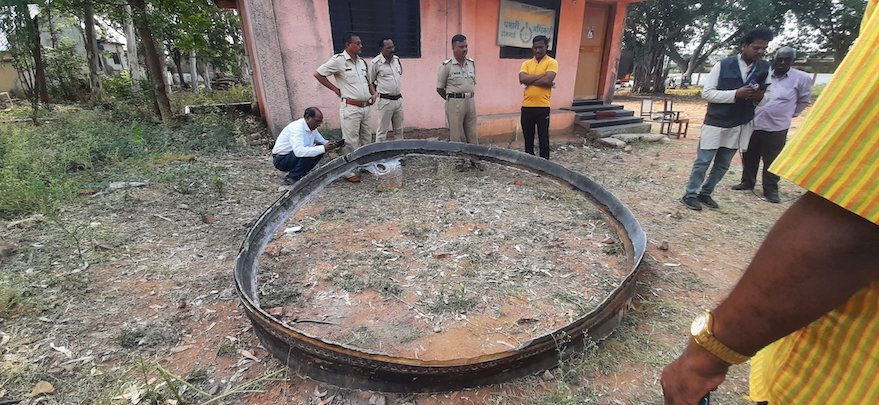
Four spherical metal balls fell from the sky in some villages of Gujarat over the past few days.
Some experts say they are most likely the debris of a Chinese rocket Chang Zheng 3B or fuel storage tanks of space launch vehicles.
With more & more space launches and events like space tourism kicking off, the space above Earth is overcrowded – calling for urgent attention from countries to declutter it.
What is Space Junk?
Space junk, or space debris, is any piece of machinery or debris left by humans in space.
It can refer to big objects such as dead satellites that have failed or been left in orbit at the end of their mission.
It can also refer to smaller things, like bits of debris or paint flecks that have fallen off a rocket.
Space debris encompasses both natural meteoroid and artificial (human-made) orbital debris.
Meteoroids are in orbit about the sun, while most artificial debris is in orbit about the Earth (hence the term “orbital” debris).
How are they generated?
All space junk is the result of us launching objects from Earth, and it remains in orbit until it re-enters the atmosphere.
Some objects in lower orbits of a few hundred kilometres can return quickly.
They often re-enter the atmosphere after a few years and, for the most part, they’ll burn up – so they don’t reach the ground.
But debris or satellites left at higher altitudes of 36,000 kilometres – where communications and weather satellites are often placed in geostationary orbits – can continue to circle Earth for hundreds or even thousands of years.
Some space junk results from collisions or anti-satellite tests in orbit.
How much space junk is there?
While there are about 2,000 active satellites orbiting Earth at the moment, there are also 3,000 dead ones littering space.
What’s more, there are around 34,000 pieces of space junk bigger than 10 centimetres in size and millions of smaller pieces that could nonetheless prove disastrous if they hit something else.
What risks does space junk pose to space exploration?
Fortunately, at the moment, space junk doesn’t pose a huge risk to our exploration efforts.
Collisions: Collisions could cause significant damage to the space properties of the countries. Upon collision, the debris disables the satellites’ onboard electronics and may disrupt the services provided by the space assets.
Collateral damage: The biggest danger it poses is to other satellites in orbit. These satellites have to move out of the way of all this incoming space junk to make sure they don’t get hit and potentially damaged or destroyed.
High momentum strikes: As these debris travel at high speeds in the low earth orbit, they risk colliding with functional satellites or even the space station. Given that these particles travel at speeds of 8 metres per second, even a 100g object could create an impact comparable to a 30-kg stone travelling at 100kmph.
Usability of space: This debris orbit the earth several times a day. As the mass of space junk continues to grow, parts of the space may become unusable.
Kessler Syndrome: It refers to a theoretical scenario in which the amount of space debris becomes so high that a single collision or destruction event could lead to a snowballing cascade of space debris- like a domino effect.
India and Space Debris
India had 103 spacecraft, including active and defunct satellites, and 114 space debris objects, including spent rocket bodies orbiting the earth.
So, the country has a total of 217 space objects orbiting the earth.
Presently, the ISRO has taken up research activities to study the feasibility and technologies required to undertake active debris removal (ADR).
ADR was one of the active methods suggested by the Space Debris Research Community to contain the growth of space debris objects.
Mechanism against damage
Space is beyond national jurisdiction and falls under the ambit of international law:
Under the Convention on International Liability for Damage Caused by Space Objects, countries can claim compensation from other countries for damages incurred from space debris.
The Outer Space Treaty, 1967 and the like outline the guidelines for the countries’ activities in space.
All space objects, including the defunct space debris, are under the jurisdiction of the ‘State of Registry’.
If something goes wrong during such manoeuvres, a liability regime under the applicable international law applies to not only the launching country but also other countries involved in the launch.
The UN Committee on the Peaceful Use of Outer Space (COPUOS) is tasked with space governance and there are already accepted guidelines for space debris mitigation and sustainability of space activities.
Efforts for space debris removal
There are four techniques that can move debris from heavily trafficked orbits:
Deorbiting (the deliberate, forced re-entry of a space object into the Earth’s atmosphere by application of a retarding force, usually via a propulsion system)
Orbital lifetime reduction (accelerating the natural decay of spacecraft and other space objects to reduce the time that they remain in orbit)
Disposal orbits– Moving objects into less populated “disposal” orbits at the end of their functional lifetime
Active removal of debris from orbit
Global efforts
NASA undertakes DAMs or Debris Avoidance Manoeuvres, which are navigation manoeuvres that take the space station away from its normal trajectory to avoid collisions, are undertaken based on the probability of collision.
NORAD, or the North American Aerospace DefenceCommand, is an initiative of the U.S. and Canada that shares selective debris data with many countries.
Clearspace-1(of European Space Agency), which is scheduled to launch in 2025, will be the first space mission to eliminate debris from orbit.
India’s efforts: Project NETRA
NETRA stands for Network for Space Objects Tracking and Analysis (NETRA) project.
Project NETRA is an early warning system in space to detect debris and other hazards to Indian satellites.
In this pursuit, space debris tracking radar with a range of 1,500 km and an optical telescope will be inducted as part of establishing an effective surveillance and tracking network under NETRA.
Way forward
Space junk is no one country’s responsibility, but the responsibility of every spacefaring country.
Spacefaring nations must minimize the risks to people and property on Earth of re-entries of space objects and maximize transparency regarding those operations.
High-accuracy assessment and prediction tools are essential for reducing risk to current systems and future launches.
Space traffic management is a crucial area that requires attention since the satellites in orbit can come in the way of each other.
India is negotiating and signing several free trade agreements (FTAs) with countries like Australia, the UK, Israel, and the EU. While the economic benefits of these FTAs have been studied, there is very little discussion on the lack of parliamentary scrutiny of these treaties.
Provisions in the Constitution
In the Constitution, entry 14 of the Union list contains the following item — “entering into treaties and agreements with foreign countries and implementing of treaties, agreements and conventions with foreign countries”.
According to Article 246, Parliament has the legislative competence on all matters given in the Union list.
Thus, Parliament has the power to legislate on treaties.
This power includes deciding how India will ratify treaties and thus assume international law obligations.
Article 253 elucidates that the power of Parliament to implement treaties by enacting domestic laws also extends to topics that are part of the state list.
Lack of parliamentary oversight and its implications
No law laying down the process: While Parliament in the last seven decades has passed many laws to implement international legal obligations imposed by different treaties, it is yet to enact a law laying down the processes that India needs to follow before assuming international treaty obligations.
Given this legislative void, and under Article 73(the powers of the Union executive are co-terminus with Parliament), the Centre has been not just negotiating and signing but also ratifying international treaties and assuming international law obligations without much parliamentary oversight.
Arguably, Parliament exercises control over the executive’s treaty-making power at the stage of transforming a treaty into the domestic legal regime.
However, this is a scenario of ex-post parliamentary control over the executive.
In such a situation, Parliament does not debate whether India should or should not accept the international obligations; it only deliberates how the international law obligations, already accepted by the executive, should be implemented domestically.
Against the practice in other liberal democracies: This practice is at variance with that of several other liberal democracies.
In the US, important treaties signed by the President have to be approved by the Senate.
In Australia, the executive is required to table a “national interest analysis” of the treaty it wishes to sign in parliament, and then this is examined by a joint standing committee on treaties – a body composed of Australian parliamentarians.
Way forward
Indian democracy needs to inculcate these healthy practices of other liberal democracies.
Conclusion
Effective parliamentary supervision will increase the domestic acceptance and legitimacy of international treaties, especially economic agreements, which are often critiqued for imposing undue restraints on India’s economic sovereignty.
India, after half a century of keeping its higher education doors closed to foreigners, is on the cusp of opening itself to the world.
Higher education reforms
Currently, India does not allow the entry and the operation of foreign university branch campuses.
The NEP 2020 was a turning point for the entry of foreign universities as it recommended allowing foreign universities ranked in the “top 100” category to operate in India — under somewhat unrealistic conditions.
Internationalism: The wide-ranging National Education Policy (NEP) 2020 promises higher education reforms in many areas, and internationalisation is prominent among them.
Strengthening India’s soft power: Among the underlying ideas is to strengthen India’s “soft power” through higher education collaboration, bringing new ideas and institutions from abroad to stimulate reform and show “best practice”, and in general to ensure that Indian higher education, for the first time, is a global player.
In February 2022, Finance Minister Nirmala Sitharaman, in her Budget speech, announced that “world-class foreign universities and institutions would be allowed in the planned business district in Gujarat’s GIFT City”
It was reported that in April 2022, the University Grants Commission (UGC) formed a committee to draft regulations to allow foreign institutions in the “top 500” category to establish campuses in India — realising that more flexibility was needed
Bringing global experience to India: Establishing branch campuses of top foreign universities is a good idea as this will bring much-needed global experience to India.
Challenges
Globally, branch campuses, of which there are around 300 now, provide a mixed picture.
Many are aimed at making money for the sponsoring university — and this is not what India wants.
It will not be easy to attract foreign universities to India and even more difficult to create the conditions for them to flourish.
Many of those top universities are already fully engaged overseas and would likely require incentives to set up in India.
Further, there are smaller but highly regarded universities outside the ‘top 500’ category that might be more interested.
Universities around the world that have academic specialisations focusing on India, that already have research or faculty ties in the country, or that have Non-Resident Indians (NRI) in senior management positions may be easier to attract.
What is most important is to prevent profit-seekers from entering the Indian market and to encourage foreign institutions with innovative educational ideas and a long-term commitment.
Many host countries have provided significant incentives, including building facilities and providing necessary infrastructure.
Foreign universities are highly unlikely to invest significant funds up front.
A big challenge will be India’s “well-known” bureaucracy, especially the multiple regulators.
Opportunities
India is seen around the world as an important country and an emerging higher education power.
It is the world’s second largest “exporter” of students, with 4,61,792 students studying abroad (according to the UNESCO Institute for Statistics).
And India has the world’s second largest higher education system.
Foreign countries and universities will be eager to establish a “beachhead” in India and interested in providing opportunities for home campus students to learn about Indian business, society, and culture to participate in growing trade and other relations.
Benefits of branch campuses: International branch campuses, if allowed, could function as a structurally different variant of India’s private university sector.
Branch campuses, if effectively managed, could bring much needed new ideas about curriculum, pedagogy, and governance to Indian higher education — they could be a kind of educational laboratory.
Current initiatives
There has been modest growth of various forms of partnerships between Indian and foreign institutions.
The joint PhD programmes offered by the Indian Institute of Technology Bombay-Monash Research Academy and the University of Queensland-Indian Institute of Technology Delhi Academy of Research (UQIDAR), both with Australian partners, are some examples.
Another example is the Melbourne-India Postgraduate Academy (MIPA). It is a joint initiative of the Indian Institute of Science Bangalore, the Indian Institute of Technology Madras, the Indian Institute of Technology Kanpur and the Indian Institute of Technology Kharagpur with the University of Melbourne.
MIPA provides students with an opportunity to earn a joint degree accredited both in India and Australia: from the University of Melbourne and one of the partnering Indian institutions.
These partnerships suggest that India could offer opportunities for international branch campuses as well.
Challenges
Globally, branch campuses, of which there are around 300 now, provide a mixed picture.
Many are aimed at making money for the sponsoring university — and this is not what India wants.
It will not be easy to attract foreign universities to India and even more difficult to create the conditions for them to flourish.
Many of those top universities are already fully engaged overseas and would likely require incentives to set up in India.
Further, there are smaller but highly regarded universities outside the ‘top 500’ category that might be more interested.
Universities around the world that have academic specialisations focusing on India, that already have research or faculty ties in the country, or that have Non-Resident Indians (NRI) in senior management positions may be easier to attract.
What is most important is to prevent profit-seekers from entering the Indian market and to encourage foreign institutions with innovative educational ideas and a long-term commitment.
Many host countries have provided significant incentives, including building facilities and providing necessary infrastructure.
Foreign universities are highly unlikely to invest significant funds up front.
A big challenge will be India’s “well-known” bureaucracy, especially the multiple regulators.
Conclusion
After examining national experiences elsewhere, clear policies can be implemented that may be attractive to foreign universities. Once policies are in place, the key to success will be relationships among universities.
The country’s frontline health workers or ASHAs (accredited social health activists) were one of the six recipients of the WHO’s Global Health Leaders Award 2022 which recognises leadership, contribution to the advance of global health and commitment to regional health issues.
Who are ASHA workers?
ASHA workers are volunteers from within the community who are trained to provide information and aid people in accessing benefits of various healthcare schemes of the government.
The role of these community health volunteers under the National Rural Health Mission (NRHM) was first established in 2005.
They act as a bridge connecting marginalised communities with facilities such as primary health centres, sub-centres and district hospitals.
Genesis & evolution
The ASHA programme was based onChhattisgarh’s successful Mitanin programme, in which a Community Worker looks after 50 households.
The ASHA was to be a local resident, looking after 200 households.
The programme had a very robust thrust on the stage-wise development of capacity in selected areas of public health.
Many states tried to incrementally develop the ASHA from a Community Worker to a Community Health Worker, and even to an Auxiliary Nurse Midwife (ANM)/ General Nurse and Midwife (GNM), or a Public Health Nurse.
Qualifications for ASHA Workers
ASHAs are primarily married, widowed, or divorced women between the ages of 25 and 45 years from within the community.
They must have good communication and leadership skills; should be literate with formal education up to Class 8, as per the programme guidelines.
How many ASHAs are there across the country?
The aim is to have one ASHA for every 1,000 persons or per habitation in hilly, tribal or other sparsely populated areas.
There are around 10.4 lakh ASHA workers across the country, with the largest workforces in states with high populations – Uttar Pradesh (1.63 lakh), Bihar (89,437), and Madhya Pradesh (77,531).
Goa is the only state with no such workers, as per the latest National Health Mission data available from September 2019.
What do ASHA workers do?
They go door-to-door in their designated areas creating awareness about basic nutrition, hygiene practices, and the health services available.
They focus primarily on ensuring that pregnant women undergo ante-natal check-up, maintain nutrition during pregnancy, deliver at a healthcare facility, and provide post-birth training on breast-feeding and complementary nutrition of children.
They also counsel women about contraceptives and sexually transmitted infections.
ASHA workers are also tasked with ensuring and motivating children to get immunised.
Other than mother and child care, ASHA workers also provide medicines daily to TB patients under directly observed treatment of the national programme.
They are also tasked with screening for infections like malaria during the season.
They also provide basic medicines and therapies to people under their jurisdiction such as oral rehydration solution, chloroquine for malaria, iron folic acid tablets to prevent anaemia etc.
Now, they also get people tested and get their reports for non-communicable diseases.
The health volunteers are also tasked with informing their respective primary health centreabout any births or deaths in their designated areas.
How much are ASHA workers paid?
Since they are considered “volunteers/activists”, governments are not obligated to pay them a salary. And, most states don’t.
Their income depends on incentives under various schemes that are provided when they, for example, ensure an institutional delivery or when they get a child immunised.
All this adds up to only between Rs 6,000 to Rs 8,000 a month.
Her work is so tailored that it does not interfere with her normal livelihood.
Success of the ASHAs
It is a programme that has done well across the country.
In a way, it became a programme that allowed a local woman to develop into a skilled health worker.
Overall, it created a new cadre of incrementally skilled local health workers who were paid based on performance.
The ASHAs are widely respected as they brought basic health services to the doorstep of households.
Since then ASHA continues to enjoy the confidence of the community.
Challenges to ASHAs
The ASHAs faced a range of challenges: Where to stay in a hospital? How to manage mobility? How to tackle safety issues?
There have been challenges with regard to the performance-based compensation. In many states, the payout is low, and often delayed.
It has a problem of responsibility and accountability without fair compensation.
There is a strong argument to grant permanence to some of these positions with a reasonable compensation as sustaining motivation.
Ideally, an ASHA should be able to make more than the salary of a government employee, with opportunities for moving up the skill ladder in the formal primary health care system as an ANM/ GNM or a Public Health Nurse.
Way forward
The incremental development of a local resident woman is an important factor in human resource engagement in community-linked sectors.
It is equally important to ensure that compensation for performance is timely and adequate.
Upgrading skill sets and providing easy access to credit and finance will ensure a sustainable opportunity to earn a respectable living while serving the community.
Strengthening access to health insurance, credit for consumption and livelihood needs at reasonable rates, and coverage under pro-poor public welfare programmes will contribute to ASHAs emerging as even stronger agents of change.
The Inter-State Council, which works to promote and support cooperative federalism in the country, has been reconstituted with PM Modi as Chairman and CMs of all States and six Union Ministers as members.
What is Inter-State Council (ISC)?
Genesis of ISC
The Constitution of India in Article 263, provides for the establishment of Inter-State Council (ISC).
The objective of the ISC is to discuss or investigate policies, subjects of common interest, and disputes among states.
Temporary or permanent?
The articles says that ISC may be established “if at any time it appears to the President that the public interests would be served by the establishment of a Council”.
Therefore, the constitution itself did not establish the ISC, because it was not considered necessary at the time the constitution was being framed, but kept the option for its establishment open.
Establishment as permanent body
This option was exercised in 1990.
The ISC was established as a permanent body on 28 May 1990 by a presidential order on the recommendation of the Sarkaria Commission.
It had recommended that a permanent Inter-State Council called the Inter-Governmental Council (IGC) should be set up under Article 263.
It cannot be dissolved and re-established.
Therefore, the current status of ISC is that of a permanent constitutional body.
Aims of the ISC
Decentralisation of powers to the states as much as possible
More transfer of financial resources to the states
Arrangements for devolution in such a way that the states can fulfil their obligations
Advancement of loans to states should be related to as ‘the productive principle’
Deployment of Central Armed Police Forces in the states either on their request or otherwise
Composition
The Inter-State Council composes of the following members:
Prime Minister, Chairman.
Chief Ministers of all states.
Chief Ministers of the union territories having legislative assemblies.
Administrators of the union territories not having legislative assemblies.
6 Union Cabinet Ministers, including Home Minister, to be nominated by the Prime Minister.
Governors of the states being administered under President’s rule.
India has signalled its readiness to be part of a new economic initiative led Indo-Pacific Economic Framework for Prosperity (IPEF) by the US for the region.
What is IPEF?
The grouping, which includes seven out of 10 members of the Association of South East Asian Nations (ASEAN), all four Quad countries, and New Zealand, represents about 40% of global GDP.
The negotiations for the IPEF are expected to centre around four main pillars, including trade, supply chain resiliency, clean energy and decarbonisation, and taxes and anti-corruption measures.
Countries would have to sign up to all of the components within a module, but do not have to participate in all modules.
The “fair and resilient trade” module will be led by the US Trade Representative and include digital, labor, and environment issues, with some binding commitments.
The IPEF seeks to strengthen economic partnership amongst participating countries with the objective of enhancing resilience, sustainability, inclusiveness, economic growth, fairness, and competitiveness in the Indo-Pacific region.
Features of IPEF
US officials made it clear that the IPEF would not be a “free trade agreement”, nor are countries expected to discuss reducing tariffs or increasing market access.
The IPEF will not include market access commitments such as lowering tariff barriers,
In that sense, the IPEF would not seek to replace the 11-nation CPTPP (Trans-Pacific Partnership) that the US quit in 2017, or the RCEP, which China, and all of the other IPEF countries (minus the US) are a part of.
Three ASEAN countries considered closer to China — Myanmar, Cambodia and Laos — are not members of the IPEF.
Four pillars of IPEF
Tradethat will include digital economy and emerging technology, labour commitments, the environment, trade facilitation, transparency and good regulatory practices, and corporate accountability, standards on cross-border data flows and data localisations;
Supply chain resiliency to develop “a first-of-its-kind supply chain agreement” that would anticipate and prevent disruptions;
Clean energy and decarbonisationthat will include agreements on “high-ambition commitments” such as renewable energy targets, carbon removal purchasing commitments, energy efficiency standards, and new measures to combat methane emissions; and
Tax and anti-corruption, with commitments to enact and enforce “effective tax, anti-money laundering, anti-bribery schemes in line with [American] values”.
Reasons for creation of IPEF
The IPEF is also seen as a means by which the US is trying to regain credibility in the region after former President Donald Trump pulled out of the Trans Pacific Partnership TPP).
Since then, there has been concern over the absence of a credible US economic and trade strategy to counter China’s economic influence in the region.
China is an influential member of the TPP, and has sought membership of its successor agreement Comprehensive and Progressive Agreement on Trans Pacific Partnership.
It is also in the 14-member Regional Comprehensive Economic Partnership, of which the US is not a member (India withdrew from RCEP).
The Biden Administration is projecting IPEF as the new US vehicle for re-engagement with East Asia and South East Asia.
Disaster struck Dima Hasao, central Assam’s hill district, in mid-May after incessant heavy rainfall.
Impacts of the disaster
The 170 km railway line connecting Lumding in the Brahmaputra Valley’s Hojai district and Badarpur in the Barak Valley’s Karimganj district was severely affected.
The Assam government and Railway Ministry’s assessments said the district suffered a loss of more than ₹1,000 crore, but ecologists say the damage could be irreversibly higher.
How severe has the rain been in Assam?
Assam is used to floods, sometimes even four times a year, resultant landslides and erosion.
But the pre-monsoon showers this year have been particularly severe on Dima Hasao, one of three hill districts in the State.
Landslips have claimed four lives and damaged roads.
The impact has been most severe on the arterial railway, which was breached at 58 locations leaving the track hanging in several places.
The disruption of train services, unlikely to be restored soon, has cut off the flood-hit Barak Valley, parts of Manipur, Mizoram and Tripura.
Why is the railway in focus post-disaster?
Dima Hasao straddles the Barail, a tertiary mountain range between the Brahmaputra and Barak River basins.
The district is on the Dauki fault (the prone-to-earthquakes geological fractures between two blocks of rocks) straddling Bangladesh and parts of the northeast.
British engineers were said to have factored in the fragility of the hills to build the railway line over 16 years by 1899.
The end result was an engineering marvel 221 km long over several bridges and through 37 tunnels, laid along the safer sections of the hills.
A faulty experiment
A project to convert the metre gauge track to broad gauge was undertaken in 1996 but the work was completed only by March 2015 because of geotechnical constraints and extremist groups.
The broad-gauge track was realigned to be straighter, but a 2009-10 audit report revealed that the project had been undertaken without proper planning and visualisation of the soil strata behaviour.
The report gave the example of the disaster-prone Tunnel 10 on the realigned track that was pegged 8 meters below the bed of a nearby stream.
Is only the railway at fault?
There is a general consensus that other factors have contributed to the situation Dima Hasao is in today.
Roads in the district, specifically the four-lane Saurashtra-Silchar (largest Barak Valley town) East-West Corridor, have been realigned or deviated from the old ones that were planned around rivers and largely weathered the conditions.
The arterial roads build over the past 20 years often cave in and get washed away by floods or blocked by landslides.
Shortened cycles of jhum or shifting cultivation on the hill slopes and unregulated mining have accentuated the “man-made disaster”.
Massive extraction of river stone, illegal mining of coal and smuggling of forest timbe has led to the disaster.
These activities have increased water current besides weakening either side of riverbanks.
How vital are the rail and highway through Dima Hasao?
Meghalaya aside, Dima Hasao is the geographical link to a vast region comprising southern Assam’s Barak Valley, parts of Manipur, Mizoram and Tripura.
Moreover, this track is vital for India’s Look East policy that envisages shipping goods to and from Bangladesh’s Chittagong port via Tripura’s border points at Akhaura and Sabroom.
These are the last railway station near the Feni River that serves as the India-Bangladesh border.
Talk to our mentors for a Roadmap to 2023 Attempt. Click Here
Important Rebellions and Peasant Movements
Causative Factors for People’s Uprisings
Colonial land revenue settlements, heavy burden of new taxes, eviction of peasants from their lands, and encroachments on tribal lands.
Exploitation in rural society and growth of intermediary revenue collectors, tenants and moneylenders.
Expansion of revenue administration over tribal lands leading to their loss of hold over agricultural and forest land.
Promotion of British manufactured goods, heavy duties on Indian industries, especially export duties, leading to devastation of Indian handloom and handicraft industries.
Important Civil Uprisings
(1) Sanyasi Revolt (1763-1800)
Cause: The disastrous famine of 1770 and the harsh economic order of the British and the restrictions imposed on the pilgrims visiting the holy places.
Sanyasis were joined by a large number of dispossessed small zamindars, disbanded soldiers and rural poor. They raided Company factories and the treasuries, and fought the Company’s forces.
Curtailed by: Warren Hastings
Also referred to as the Fakir Rebellion.
Important leaders: Majnum Shah, Chirag Ali, Musa Shah, Bhawani Pathak and Debi Chaudhurani
Anandamath, a semi-historical novel by Bankim Chandra Chattopadhyay, is based on the Sanyasi Revolt.
(2) Revolt in Midnapore and Dhalbhum (1766-74)
Cause: Introduction of new land revenue system by the English in 1772.
The zamindars of Midnapore sided with the ryots in case of conflict between the ryots and the English revenue collecting officials.
Important leaders: Damodar Singh and Jagannath Dhal.
(3) Revolt of Moamarias (1769-99)
It was a potent challenge to the authority of Ahom kings of Assam.
The Moamarias were low-caste peasants who followed the teachings of Aniruddhadeva (1553-1624).
To crush these revolts, the Ahom ruler had to request for British help. The revolt weakened kingdom and it fell to a Burmese invasion and finally came under British rule.
(4) Revolt of Raja of Vizianagaram (1794)
In 1758, a treaty was made between the English and Ananda Gajapatiraju, the ruler of Vizianagaram, to jointly oust the French from the Northern Circars. In this mission they were successful.
English refused to honour the terms of the treaty. Anand Raju died before he could seriously tackle the English.
The East India Company demanded a tribute of three lakh rupees from Vizayaramaraju and asked him to disband his troops. This angered the raja as there were no dues to be paid to the Company.
The raja supported by his subjects rose up in revolt. The raja died in a battle at Padmanabham.
(5) Resistance of Kerala Varma Pazhassi Raja (1797; 1800-05)
Kerala Varma Pazhassi Raja, popularly known as Kerala Simham (Lion of Kerala) or ‘Pyche raja’, was the de facto head of Kottayam (Cotiote) in Malabar region.
Cause: The Third Anglo-Mysore War (1790-92), extended English paramountcy over Kottayam in violation of an earlier agreement of 1790 which had recognized the independence of Kottayam.
The Poligars of Dindigal and Malabar rose up against the oppressive land revenue system under the British during 1801-06.
In September 1799, in the first Polygar War, the poligars of Tirunelveli District rose up in open rebellion.
Kattabomma Nayak of Panchalamkurichi was considered as the main leader of the rebellion. Though he managed to escape initially, he was later captured in Pudukottai, and publicly hanged in front of other Polygars as a warning.
The Second Polygar war of 1800-01, given the magnitude of participation, is also known as the ‘South Indian Rebellion’.
The suppression was followed by signing of the Carnatic Treaty on July 31, 1801, whereby the British assumed direct control over Tamil Nadu.
(7) Diwan Velu Thampi’s Revolt (1808-1809)
The East India Company’s harsh conditions imposed on the state of Travancore, after both of them agreed to a subsidiary alliance arrangement under Wellesley in 1805, caused deep resentment in the region.
Prime Minister Velu Thampi rise against the Company and assisted by the Nair troops. Velu Thampi addressed a gathering in Kundara and was later known as the ‘Kundara Proclamation’.
The Maharaja of Travancore had not wholly supported the rebellion and defected to the side of the Company. Velu Thampi killed himself to avoid capture. The rebellion petered out.
(8) Kutch or Cutch Rebellion (1816-1832)
There was a treaty between the British and Maharaja Bharamal II of Kutch in 1816, by which power was vested in the throne.
The British interfered in the internal feuds of the Kutch and, in 1819, Raja Bharmal II raised Arab and African troops with the firm intention of removing the British from his territory.
A British resident governed the areas as the de facto ruler with the help of a regency council.
(9) Rising at Bareilly (1816)
Immediate cause: The imposition of the police tax which aroused the burning indignation of the citizens.
Several armed Muslims from Pilibhit, Shahjahanpur and Rampur rose in rebellion for the defense of the faith and the Mufti.
(10) Upsurge in Hathras (1817)
Cause: Progressive increase in high revenues, talukdar Dayaram constantly failed to pay arrears and even committed many acts of hostility by giving harbour to government fugitives.
So, the Company with a large army attacked Hathras in February 1817.
Rebels involved: Bhagwant Singh, Raja of Mursan
(11) Paika Rebellion (1817)
The Paiks of Odisha were the traditional landed militia and enjoyed rent free land tenures for their military service and policing functions on a hereditary basis.
Cause: British conquest of Odisha in 1803, and the dethronement of the Raja of Khurda had greatly reduced the power and prestige of the Paiks. Further, the extortionist land revenue policy of the Company caused resentment among zamindars and peasants.
Bakshi Jagabandhu Bidyadhar had been the military chief of the forces of the Raja of Khurda. In 1814, Jagabandhu’s ancestral estate of Killa Rorang was taken over by the Company, reducing him to penury.
The spark was lighted by the arrival of a body of Khonds into the Khurda territory in March 1817.
With active support of Mukunda Deva, the last Raja of Khurda, and other zamindars of the region, Bakshi Jagabandhu Bidyadhar led a sundry army of Paikas forcing the East India Company forces to retreat for a time.
The rebellion came to be known as the Paika Bidroh (rebellion). The rebellion was brutally repressed by 1818. In 1825 Jagabandhu surrendered under negotiated terms.
The Paik Rebellion succeeded in getting large remissions of arrears, reductions in assessments, suspension of the sale of the estates of defaulters at discretion, a new settlement on fixed tenures and other adjuncts of liberal governance.
(12) Ahom Revolt (1828)
Cause: Defying on the pledge to withdraw from Assam after the First Burma War (1824-26), the British attempted to incorporate the Ahoms’ territories in the Company’s dominion. This sparked off a rebellion in 1828 under the leadership of Gomdhar Konwar, an Ahom prince along with compatriots.
Finally, the Company decided to follow a conciliatory policy and handed over Upper Assam to Maharaja Purandar Singh Narendra and part of the kingdom was restored to the Assamese king.
(13) Surat Salt Agitations (1840s)
Cause: The government’s step to raise the salt duty from 50 paise to one rupee.
The government withdrew the additional salt levy and its measure to introduce Bengal Standard Weights and Measures in face of people’s determined bid to resort to boycott and passive resistance.
(14)Kolhapur and Savantvadi Revolts
The Gadkaris were a hereditary military class which was garrisoned in the Maratha forts.
These garrisons were disbanded during an administrative reorganization in Kolhapur state after 1844. The Gadkaris rose in revolt and occupied the Samangarh and Bhudargarh forts.
Similarly, the simmering discontent caused a revolt in Savantvadi areas. A number of Sawantwadi rebels were tried for treason and sentenced to various terms of imprisonment.
Ultimately, after the imposition of martial law and meting out brutal punishment to the rebels, the order could be restored in Sawantwadi region.to bring the region under control.
(15) Wahabi Movement
It was essentially an Islamic revivalist movement founded by Syed Ahmed of Rai Bareilly who was inspired by the teachings of Abdul Wahab (1703-87) of Saudi Arabia and Shah Waliullah of Delhi.
Syed Ahmed condemned the western influence on Islam and advocated a return to pure Islam and society. Syed Ahmed was acclaimed as the desired leader (Imam).
A countrywide organization with an elaborate secret code for its working under spiritual vice-regents (Khalifas) was set up, and Sithana in the north-western tribal belt was chosen as a base for operations.
Since Dar-ul-Harb (territory of War or Chaos) was to be converted into Darul-Islam (the land of Islam), a jihad was declared against the Sikh kingdom of Punjab.
After the defeat of the Sikh ruler and incorporation of Punjab into the East India Company’s dominion in 1849, the English dominion in India became the sole target of the Wahabis’ attacks.
The Wahabis played an important role in spreading anti-British sentiments. A series of military operations by the British in the 1860s weakened the Wahabi resistance.
(16) Kuka Movement
Founded in 1840 by Bhagat Jawahar Mal (also called Sian Saheb) in western Punjab. A major leader of the movement after him was Baba Ram Singh (founded the Namdhari Sikh sect).
Its basic tenets were abolition of caste and similar discriminations among Sikhs, discouraging the consumption of meat and alcohol and drugs, permission for intermarriages, widow remarriage, and encouraging women to step out of seclusion.
On the political side, the Kukas wanted to remove the British and restore Sikh rule over Punjab; they advocated wearing hand-woven clothes and boycott of English laws and education and products.
So, the concepts of Swadeshi and non-cooperation were propagated by the Kukas, much before they became part of the Indian national movement in the early twentieth century.
As the movement gained in popularity, the British took several steps to crush it in the period between 1863 and 1872. In 1872, Ram Singh was deported to Rangoon.
Peasant Movements
(1) Narkelberia Uprising
Mir Nithar Ali (1782-1831) or Titu Mir inspired the Muslim tenants in WestBengal to rise against landlords, mainly Hindu, who imposed a beard-tax on the Faraizis, and British indigo planters.
Often considered the first armed peasant uprising against the British, this revolt soon took on a religious hue. The revolt later merged into the Wahabi movement.
(2) The Pagal Panthis
The Pagal Panthi, a semi-religious group mainly constituting the Hajong and Garo tribes was founded by Karam Shah.
But the tribal peasants organized themselves under Karam Shah’s son, Tipu, to fight the oppression of the zamindars.
They refused to pay rent above a certain limit and attacked the houses of zamindars. The government introduced an equitable arrangement to protect these peasants, but the movement was violently suppressed.
(3) Faraizi Revolt
The Faraizis were the followers of a Muslim sect founded by Haji Shariat-Allah of Faridpur in Eastern Bengal. They advocated radical religious, social and political changes.
Shariat-Allah son of Dadu Mian (1819-60) organized his followers with an aim to expel the English intruders from Bengal. The sect also supported the cause of the tenants against the zamindars.
Most of the Faraizis joined the Wahabi ranks.
(4) Moplah Uprisings
Cause: Hike in revenue demand and reduction of field size, coupled with the oppression of officials, resulted in widespread peasant unrest among the Moplahs of Malabar.
The second Moplah uprising occurred after the Moplahs came to be organised by the Congress and the Khilafat supporters during the Non-cooperation Movement.
Tribal Revolts
Causes for Tribal Revolts
The land settlements of the British affected the joint ownership tradition
As agriculture was extended in a settled form by the Company government, the tribals lost their land, Shifting cultivation in forests was curbed and this added to the tribals’ problems.
Exploitation by the police, traders and money-lenders.
Christian missionaries came to these regions and their efforts interfered with the traditional customs of the tribals. Some general laws were also abhorred for their intrusive nature.
Characteristics of Tribal Revolts
Tribal identity or ethnic ties lay behind the solidarity shown by these groups.
The resentment against the imposition of laws by the ‘foreign government’ that was seen as an effort at destroying the tribals’ traditional socioeconomic framework.
Many uprisings were led by messiah-like figures who encouraged their people to revolt.
The tribal uprisings were doomed from the beginning, given the outdated arms.
(1) Pahariyas’ Rebellion
The British expansion on their territory led to an uprising by the martial Pahariyas of the Raj Mahal Hills in 1778.
The British were forced to usher in peace by declaring their territory as damni-kol area.
(2) Chuar Uprising
Cause: Famine, enhanced land revenue demands and economic distress goaded the Chuar aboriginal tribesmen of the Jungle Mahal of Midnapore district and Bankura district (in Bengal) to take up arms.
The most significant uprising was under Durjan (or Durjol) Singh in 1798. Other leaders were Madhab Singh, Raja Mohan Singh.
The uprising lasted from 1766 to 1772 and then, again surfaced between 1795 and 1816.
(3) Kol Mutiny (1831)
Cause: Large-scale transfers of land from Kol headmen to outsiders like Hindu, Sikh and Muslim farmers and money-lenders who were oppressive and demanded heavy taxes. Besides, the British judicial and revenue policies badly affected the traditional social conditions of the Kols (inhabitants of Chhotanagpur).
The Kols resented this and in 1831, under the leadership of Buddho Bhagat, the Kol rebels killed or burnt about a thousand outsiders. Only after large-scale military operations could order be restored.
(4) Ho and Munda Uprisings (1820-1837)
The Raja of Parahat organized his Ho tribals to revolt against the occupation of Singhbhum. The revolt continued till 1827 when the Ho tribals were forced to submit.
However, later in 1831, they again organized a rebellion, joined by the Mundas of Chotanagpur, to protest against the newly introduced farming revenue policy and the entry of Bengalis into their region.
Though the revolt was extinguished in 1832, the Ho operations continued till 1837.
(5) Santhal Rebellion
Cause: The Santhals of Rajmahal Hills resented the oppression by revenue officials, police, money-lenders, landlords—in general, by the “outsiders’ (whom they called diku).
The Santhals under Sido and Kanhu rose up against their oppressors, declared the end of the Company’s rule and asserted themselves independent in 1854.
It was only in 1856 after extensive military operations that the situation was brought under control. Sido died in 1855, while Kanhu was arrested in 1866.
A separate district of Santhal Parganas was created by the Government to pacify the Santhals.
(6) Khond Uprising
The Khonds lived in vast hill tracts stretching from Tamil Nadu to Bengal, covering central provinces, and in virtual independence due to the inaccessible mountainous terrain.
Their uprisings from 1837 to 1856 were directed against the British, in which the tribals of Ghumsar, china-ki-medi, Kalahandi and Patna actively participated.
The movement was led by Chakra Bisoi in the name of the young Raja.
The main issue was the attempt by the government to suppress human sacrifice (Mariah), the introduction of new taxes by the British and the influx of Zamindars and money-lenders.
The British formed a Maria agency, against which the Khonds fought with Tangi, a king of battle-axe, bows-arrows and even swords.
Latter Savaras and some local militia clans also joined in, led by Radha Krishna Dand Sena. Chakra Bisoi disappeared in 1855 after which the movement petered out.
(7) Early Munda Uprising (1789-1832)
In the period of 1789-1832, the Munda rose up in rebellion seven times against the landlords, dikhus, money-lenders and the British, who instead of protesting them sided with the oppressors.
In the post-1857 period with a hope of a better future, many Mundas turned to the Evangelical Lutheran mission, which was overseeing mission work in Chhotanagpur.
However, many apostates became more militant and broke away, spearheading the cause of seeking redressal of their grievances once they realized that the missionaries could not provide the solution to them.
Their movement identified as ‘sardariladai’ or ‘war of the leaders’ was fought with the aim of expelling dikhus; and restoration of the Munda domination over their homeland.
The tribal chiefs rose up against the erosion of Khuntkatti System or Joint tenures.
While it failed it did not peter out but remained dormant and in need of a charismatic leader. It was given a new life by Birsa Munda in 1899.
(8) Bhils and Kolis Uprisings
Cause: The Bhils were concentrated in the hill ranges of Khandesh in the previous Maratha territory. The British occupation in 1818 brought in the outsiders and accompanying dislocations in their community life.
A general Bhil insurrection in 1817-19 was crushed by the British Military forces and though some conciliatory measures were taken to pacify them, they again revolted under the leadership of Seva Ram in 1825 and the situation remained unsettled until 1831 when the Ramosi Leader Umaji Raje of Purandhar was finally captured and executed.
Minor revolts again took place in 1836 and 1846 as well.
The Bhils’ local rivals for power, the Kolis of Ahmednagar district, also challenged the British in 1829 but were quickly subdued by a large army contingent.
The seeds of rebellion, however, persisted, to erupt again in 1844-46, when a local Koli leader successfully defied the British government for two years.
(9) Ramosi Risings
The Ramosis, the hill tribes of the Western Ghats, had not reconciled to British rule and the British pattern of administration.
They rose under Chittur Singh in 1822 and plundered the country around Satara.
(10) Khasi Uprising
The Khasis, Garos, Khamptis and the Singphos organized themselves under Tirath Singh to drive away the strangers from the Brahmaputra Valley.
The uprising developed into a popular revolt against British rule in the area.
Mass Movements
The Non-Cooperation Movement- 1920-22
Following events acted as the catalysts which finally resulted in the launch of the Non-Cooperation Movement by Gandhiji on August 1, 1920.
Backdrop
The Rowlatt Act (February 1919), the Jallianwala Bagh massacre (13 April 1919) and martial law in Punjab had belied all the generous wartime promises of the British.
The Montagu-Chelmsford Reforms satisfied few.
The treatment meted out to Turkey after the World War-I incensed had incensed the Indian Muslim, which led to the launch of Khilafat movement.
What were the aspects of Non-Cooperation Movement?
The program of the non-cooperation included within its ambit-
Surrender of titles and honours.
Boycott of government-affiliated schools and colleges, law courts, foreign cloths and could be included to resignation from government service.
Mass civil disobedience.
Non-payment of taxes.
On the other hand, it also included-
Establishing national schools and colleges.
Establishing panchayats to settle the disputes.
Encouraging hand spinning and weaving.
Maintaining Hindu-Muslim unity.
Observing strict non-violence.
Several changes were made in Congress’ creed and organisation, which include-
The goal of the Congress was changed from attainment of self-government to attainment of Swaraj by peaceful and legitimate means.
The Congress was now to have Working Committee of fifteen members to look after its day-to-day affairs (the same proposal made by Tilak in 1916 was not accepted!).
The provincial Congress Committees were now to be organized on linguistic basis.
Congress was to use Hindi as far as possible.
How the movement unfolded?
Gandhiji, along with Ali Brothers (who were the foremost Khilafat leaders) undertook nationwide tour during which he addressed hundreds of meetings and met a large number of students.
R. Das played a major role in promoting the movement and Subhas Bose became the principal of the National College in Calcutta.
The spirit of unrest and defiance of authority engendered by the Non-Cooperation Movement contributed to rise of many local movements in the different parts of the country.
In May 1921, the British Government tried through Gandhi-Reading talks to persuade Gandhiji to ask Ali brothers to withdraw from their speeches those passages that contained suggestions of violence.
This was an attempt to drive the wedge between the Khilafat leaders and Gandhiji.
By December 1921, the Government had changed the policy and started repression of the movement.
Public meeting and assemblies were banned, newspapers gagged, and midnight raids on Congress and Khilafat movement became common.
In response, Gandhiji declared mass civil disobedience movement would begin in Bardoli taluqa of Surat district.
But before the launch of the mass civil disobedience, the Chauri Chaura incident on February 5, 1922, resulted in the withdrawal of the movement by Gandhiji.
The Civil Disobedience Movement 1930-31
On 2 March 1930 Gandhiji addressed his historic letter to the Viceroy Irwin in which he first explained at great length why he regarded British rule as a curse. He then informed the Viceroy his plan of action. When Gandhiji reached the Dandi on 6 April 1930 by picking up a handful of salt he inaugurated the Civil Disobedience Movement.
Backdrop
An announcement on 8 November 1927 of an all-White Simon Commission to recommend whether India was ready for further constitutional progress and on which lines.
The response in India was immediate. That no Indian should be thought fit to serve on a body that claimed the right to decide the political future of India was an insult no Indian of even the most moderate political opinion was willing to swallow.
The Congress resolved on the boycott of the commission at its annual session in Madras in December 1927.
How the movement unfolded?
Once the way was cleared by Gandhiji’s ritual beginning at Dandi, the defiance of salt laws started all over the country.
The Government’s failure to arrest Gandhiji for breaking the salt law was used by the local level leaders to impress upon the people that ‘the Government is afraid of persons like ourselves’.
In Tamil Nadu, C. Rajagopalachari led a salt march from Trichinopoly to Vedaranniyam on the Tanjore coast.
On 23 April, the arrest of Congress leaders in the North-West Frontier Province led to the mass demonstration of unprecedented magnitude in Peshawar.
In Peshawar, the atmosphere created by the Khudai Khidmatgars contributed to the mass upsurge in Peshawar during which the city was virtually in the hands of non-violent revolutionaries.
It was increasingly becoming clear that the Government’s gamble of non-interference with the movement would result in its spending itself out.
On May 4, the Viceroy finally ordered Gandhiji’s arrest.
Gandhiji’s announcement that he would now proceed to continue his defiance of the salt laws by leading a raid on the Dharasana Salt Works had forced the Government to act.
Coming as it did at a high point in the movement, it only acted as a further spur to activity, and caused endless trouble for the government.
Dharsana Satyagraha carried out in the absence of Gandhiji with Sarojini Naidu in the lead, in which Satyagrahis were beaten with the lathis till they fell down.
This form of Satyagraha was adopted by the people who soon made it a mass affair.
But the salt Satyagraha was only the catalyst and the beginning, for a rich variety of forms of defiance that it brought in its wake.
Eastern India became the scene of a new kind of no-tax campaign-refusal to pay the chowkidara tax levied specifically on the villagers.
In Gujarat, in Kheda district, in Bardoli taluqa in Surat district, and Jambusar in Broach district a determined no-tax movement was in progress.
P. was setting up another kind of movement- a no-revenue no-rent campaign.
On January 5, 1931, the Viceroy announced the unconditional release of Gandhiji and all other members of the Congress working committee.
On March 5, 1931 the fortnight-long discussion culminated in Gandhi-Irwin Pact which was variously described as a truce and a provisional settlement and ended the Non-Cooperation Movement.
The Quit India Movement
‘Quit India’, this powerful slogan launched the legendary struggle which also became famous by the name of the ‘August Revolution’.
Backdrop
The failure of the Cripps Mission in April 1942 made it clear that Britain was unwilling to offer an honourable settlement and real constitutional advance during the war.
The empty gesture of the Cripps offer convinced even those Congressmen like Nehru and Gandhiji, who did not want to do anything to hamper the anti-fascist War efforts.
Other factors that made a struggle both inevitable and necessary were-
Popular discontent product of rising prices and war-time shortages.
The growing feeling of an eminent British collapse.
The manner in which British evacuated from Malaya and Burma leaving the people there to their fate
How the movement unfolded?
A fortnight after Cripps’ departure Gandhiji drafted a resolution for the Congress Working Committee, calling for Britain’s withdrawal and the adoption of non-violent non-cooperation against any Japanese invasion.
Congress edged towards Quit India while Britain moved towards arming itself with special powers to meet the threat.
The historic August meeting at Gowalia Tank in Bombay marked the beginning of the movement. The meeting was unprecedented in the popular enthusiasm it generated.
The Government, however, was in no mood to either negotiate with the Congress or wait for the movement to be formally launched.
In the early hours of 9 August, in a single sweep, all the top leaders of the Congress were arrested and taken to an unknown destination.
The sudden attack by the government produced an instantaneous reaction among the people.
As soon as the news of the arrest spread lakhs of people flocked to Gowalia Tank where a mass meeting had been scheduled.
There were similar disturbances on 9 August in Ahmedabad and Poona.
On the 10th, Delhi and many towns in U.P. and Bihar, including Kanpur, Allahabad, Varanasi, and Patna followed the suit with hartals, public demonstrations and processions in defiance of the law.
Meanwhile, many provincial and local level leaders who had evaded arrest returned to their homes through devious routes set about organising resistance.
As the news spread in the rural areas, the villagers joined the townsmen in recording their protest.
For the first six or seven weeks after 9 August, there was a tremendous mass upsurge all over the country.
The brutal and all-out repression succeeded within a period of six or seven weeks in bringing about a cessation of the mass phase of the struggle.
But in the meantime, underground networks were being consolidated in various parts of the country.
This leadership saw the role of the underground movement as being that of keeping up the popular morale by continuing to provide the line of command and a source of guidance and leadership to the activists all over the country.
Around 36 million women across the US are on the verge of losing their right to legal abortion.
A draft document, leaked a couple of weeks ago, suggests that the Supreme Court has decided to overturn the 1973 Roe v. Wade decision which legalized abortion across the country.
What will be the implications if Roe v Wade is struck down? How will the decision reverberate around the world? Let us analyse.
The Roe vs. Wade case: Upholding the Right to Abortion
Roe, short for Jane Roe, is the pseudonym for a Texas woman who in 1970 sought to have an abortion when she was five months pregnant.
Texas then had ban on abortions except to save a mother’s life. The case then went to the US Supreme Court (SCOTUS).
The 7-2 majority opinion of the SCOTUS written in 1973, paved the way for the recognition of abortion as a constitutional right in the US considering foetal viability.
[Foetal viability is the point at which a foetus can survive outside the womb, at the time considered to be around 28 weeks, but today is closer to 23 or 24 weeks owing to advances in medicine and technology.]
Right to Abortion Judgment: Key takeaways
Based on the Roe vs Wade case, the framework of regulations that applied towards the right to abortion:
Almost no limitations could be placed on that right;
Only limitations to abortion rights that were aimed at protecting a woman’s health were permitted; and in the third trimester,
State governments had greater leeway to limit the right to abortion except for cases in which the life and health of the mother were endangered.
What is the debate?
The abortion debate is the ongoing controversy surrounding the moral, legal, and religious status of induced abortion.
The sides involved in the debate are the self-described “pro-choice” and “pro-life” movements.
Pro-choice emphasizes the woman’s choice whether to terminate a pregnancy.
Pro-life position stresses the humanity of both the mother and foetus, arguing that a fetus is a human person deserving of legal protection.
Ethical questions raised
(1) The primary questions
The moral debate about abortion deals with two separate questions:
Is abortion morally wrong?
Should abortion be legal or illegal?
(2) The secondary questions
But those two questions don’t end the debate.
If we conclude that abortion is not morally wrong, that doesn’t mean that it’s right to have an abortion;
We need to ask whether having an abortion is the best thing (or least bad thing) to do in each particular case.
If we conclude that abortion is morally wrong, that doesn’t mean that it’s always impermissible to have an abortion; we need to ask whether having an abortion is less wrong than the alternatives.
Why is there a possibility of the judgment being overturned?
Foetuses feel the pain: If the foetus is beyond 20 weeks of gestation, gynaecs assume that there will be pain caused to the foetus.
Biblical gospel: The Bible does not draw a distinction between foetuses and babies. By the time a baby is conceived, he or she is recognized by God.
Abortions cause psychological damage: Young adult women who undergo abortion may be at increased risk for subsequent depression.
Abortions reduce the number of adoptable babies: Instead of having the option to abort, women should give their unwanted babies to people who cannot conceive. Single parenthood is also gaining popularity in the US.
Cases of selective abortion: Such cases based on physical and genetic abnormalities (eugenic termination) is overt discrimination.
Abortion as a form of contraception: It is immoral to kill an unborn child for convenience. Many women are using abortion as a contraceptive method.
Morality put to question: If women become pregnant, they should accept the responsibility that comes with producing a child. People need to take responsibility for their actions and accept the consequences.
Abortion promotes throwaway culture: The legalization of abortion sends a message that human life has little value and promotes the throwaway culture.
Racial afflictions: Abortion disproportionately affects African American babies. In the US, black women are 3.3 times as likely as white women to have an abortion.
Arguments in favour for Abortion Rights
Upholding individual conscience and decision-making: The US Supreme Court has declared abortion to be a fundamental right guaranteed by the US Constitution.
Reproductive choice empowers women: The choice over when and whether to have children is central to a woman’s independence and ability to determine her future.
Foetal viability occurs post-birth: Personhood begins after a foetus becomes “viable” (able to survive outside the womb) or after birth, not at conception. Abortion is the termination of a pregnancy, not a baby.
No proof of foetal pain: Most neuroscientists believe that the cortex is necessary for pain perception. The cortex does not become functional until at least the 26th week of a foetus’ development.
Preventing illegal abortions: Access to legal, professionally-performed abortions reduces maternal injury and death caused by unsafe, illegal abortions.
Mother’s health: Modern abortion procedures are safe and do not cause lasting health issues such as cancer and infertility.
Child’s health: Abortion gives pregnant women the option to choose not to bring fetuses with profound abnormalities to full term.
Prevents women’s exclusion: Women who are denied abortions are more likely to become unemployed, to be on public welfare, to be below the poverty line, and to become victims of domestic violence.
Reproductive choice protects women from financial disadvantage: Many women who choose abortion don’t have the financial resources to support a child.
Justified means of population control: Many defends abortion as a way to curb overpopulation. Malnutrition, starvation, poverty, lack of medical and educational services, pollution, underdevelopment, and conflict over resources are all consequences of overpopulation.
Indian Case: Medical Termination of Pregnancy (MTP) Act
Abortion in India has been a legal right under various circumstances for the last 50 years with the introduction of Medical Termination of Pregnancy (MTP) Act in 1971.
The Act was amended in 2003 to enable women’s accessibility to safe and legal abortion services.
Abortion is covered 100% by the government’s public national health insurance funds, Ayushman Bharat and Employees’ State Insurance with the package rate for surgical abortion.
The idea of terminating your pregnancy cannot originate by choice and is purely circumstantial. There are four situations under which a legal abortion is performed:
If continuation of the pregnancy poses any risks to the life of the motheror mental health
If the foetus has any severe abnormalities
If pregnancy occurred as a result of failure of contraception (but this is only applicable to married women)
If pregnancy is a result of sexual assault or rape
These are the key changes that the Medical Termination of Pregnancy (Amendment) Act, 2021, has brought in:
The gestation limit for abortions has been raised from the earlier ceiling of 20 weeks to 24 weeks, but only for special categories of pregnant women such as rape or incest survivors. But this termination would need the approval of two registered doctors.
All pregnancies up to 20 weeks require one doctor’s approval. The earlier law, the MTP Act 1971, required one doctor’s approval for pregnancies upto 12 weeks and two doctors’ for pregnancies between 12 and 20 weeks.
Women can now terminate unwanted pregnancies caused by contraceptive failure, regardless of their marital status. Earlier the law specified that only a “married woman and her husband” could do this.
There is also no upper gestation limit for abortion in case of foetal disability if so decided by a medical board of specialist doctors, which state governments and union territories’ administrations would set up.
Way forward
A search for the middle path perhaps the right of a woman to choose what to do with the foetus has to be balanced with the right of the foetus to survive.
It is only that a foetus does not have the ability to exercise an option while the person who carries it does.
There could be no two opinions that a victim of rape shall be allowed the choice to abort.
Rather than banning abortion, lawmakers must focus on counselling, employment security, social welfare, and financial support to persuade pregnant women to give birth to their children.
We must achieve some degree of protection for the unborn by obtaining voluntary recognition of personal responsibility and respect for the personhood of the unborn.
Every year, a huge number of aspirants sit for the UPSC-CSE exam. Because the age limit is so relaxed, there have been multiple instances where working persons or people who already have a job also apply for the IAS ordeals.
Working aspirants’ biggest challenge is time management, which is critical for studying and taking care of one’s health while working a 9-hour shift.
The two most powerful warriors are time & a mentor’s guidance for a job holder.
We feel that. So, we made the best time managing mentorship, specifically for working professionals on how to break down the syllabus into small chunks, and develop an effective & workable study strategy for UPSC preparation.
Do You Know? We Provide India’s Best UPSC Mentorship Program Instantly.
The Hindu has acknowledged Civilsdaily’s Smash Mains Mentorship Program.
And Civilsdaily’s highly experienced teachers & mentors assure you that you can save up to 40 hours in a week provided you join our mentorship program. Making notes for UPSC-CSE is not only a difficult task but also confusing when you give it a try from current affairs. And realizing that particular pain point, we launch the much-coveted ‘Samachar Manthan’.
Can a Working Professional Clear UPSC with having a serious time crunch?
This is the most familiar & much-debated question that candidates have. The answer is yes,and why not? If you simply sidestep promiscuous reading habits & comes under prominent educators, you’re eligible to crack UPSC-CSE with a single-digit rank.
Examinees are often advised to devote 12 months to study for the civil service examinations. If you have limited time and still wish to pass the exam, you mustn’t waste time.
You can only make the best timetable for IAS preparation when you understand that time is crucial, so utilizing the time in the best possible way is the key. Time table is required to keep track of the time for preparation for the exam.
Is such time killing your dream? → 9 hours office, 1-hour in travel, 1 hour for washing and eating, 8 hours for sleep. This makes a total of 19 hours.
Time is left → 24 hours – 19 hours = 5 hours. Where to start, what to learn & revise in these 300 minutes.
How to complete syllabus, how to cover mock test series in such a short time!
Do you ever know that utilizing these 5 hours can bring such a difference that any working aspirant will beat a full-time one? Get Confused! Not to worry more. Get your personalized mentor here.
The desire to complete the course alone in its entirety is the major cause of most time mismanagement. Many applicants set out to cover the entire syllabus blindly only to discover later that many topics are simply too broad or that very few if any, questions are being asked from certain sections. A lot of time is wasted in this effort because those topics are required to be addressed differently, and the time saved on their coverage could have been better spent on other parts of the syllabus.
To tell the truth, if anyone can be your true torchbearer throughout your IAS journey, he is your mentor. Never deprive yourself of his priceless guidance.
Time mismanagement for any working professional is caused by a lack of understanding of how to divide time according to the priority and relevance of the syllabus, and because the syllabus is wide and often open-ended, it needs smart covering with a select few sources.
In that case, some specialized programs, you ought to think over.
To tell the truth, if anyone is your well-wisher throughout your IAS journey, he is none but a mentor. Never deprive yourself of his priceless guidance.
Since the IAS examination is one of the most insisting exams in India, it necessitates a full-time commitment in terms of hard work and study. However, there are working professionals who are occupied with their professions during the day and find it impossible to prepare for the IAS examination due to a lack of study time. Above are some UPSC preparation ideas for working people who want to follow their dream of passing the IAS exam, which may help them find time to study despite their hectic schedules.
The Government of India announced a sudden ban on export of wheat on May 13, 2022, a few days after Prime Minister Narendra Modi had stated that “at a time when the world is facing a shortage of wheat, the farmers of India have stepped forward to feed the world”.
What led to the sudden wheat export ban?
Low public procurement: The sudden turnaround in the export policy appears to be on account of fears that low public procurement would affect domestic food security.
This summer, procurement of wheat by the Food Corporation of India (FCI) has been very low.
Last year, the FCI and other agencies procured 43.34 million tonnes of wheat.
For the current season, procurement has only been 17.8 million tonnes, as of May 10, 2022.
Given the low levels of procurement, the Government has reduced the procurement target for the current season from 44.4 to 19.5 million tonnes.
Low production: While wheat production this year has been lower than estimated on account of high heat and other factors in March, there is not a big shortfall in production relative to previous years.
Wheat production was 103.6 million tonnes in 2018-19, 107.8 million tonnes in 2019-20, and 109.5 million tonnes in 2020-21.
The most recent estimate of production for 2021-22, revised downwards from the earlier estimate, is 105.
Public procurement in India
The system of public procurement has been in place since the mid-1960s, and has been the backbone of food policy in India.
As part of the liberalisation policy, many other economists suggested that food stocks be run down in India and that needs of food security be met through world trade and the Chicago futures market.
Need for effective PDS
Higher than buffer stock norm: Stocks of wheat in the central pool as of April 30, 2022 were 30.3 million tonnes, much lower than the 52.5 million tonnes of last year, but comfortably higher than buffer stock norms.
While the Government procurement in this marketing season has been lower than the previous two years, the stock position so far is similar to 2019, when we had 35.8 million tonnes of stock in April.
An important role in pandemic: In the two COVID-19 years (2020-21 and 2021-22), the Public Distribution System (PDS) played a stellar role, and, its role showed the wisdom of not dismantling it.
Total offtake of rice and wheat was 102.3 million tonnes in 2021-22 when distribution through the PDS and other welfare schemes is combined.
It is essential that the PDS and open market operations be used to cool down food price inflation.
While most States have high inflation rates, States with better PDS, such as Kerala and Tamil Nadu, have low inflation rates.
Way forward
Provide remunerative prices: To promote production, a key aspect of food policy in India has been to provide remunerative prices to farmers.
As is well known, after the reports of the National Commission on Farmers, the announced minimum support price (MSP) for wheat has often been inadequate to cover costs of cultivation for several regions and classes of farmers, especially if comprehensive costs (or Cost C2) are taken as the base.
Over the last two years, costs of production have risen sharply, one important component being the spiralling price of fuel.
Conclusion
India’s flip-flop on the export of wheat is an example of the Government lacking a coherent policy of food security.
In the fiscal year 2021-22 (FY22), agri-exports scaled an all-time high of $50.3 billion, registering a growth of 20 per cent over the preceding year.
What are the contributing factors?
The all time high agri-export was made possible largely by rising global commodity prices, but also by the favourable and aggressive export policy of the Ministry of Commerce and its various export promotion agencies like APEDA, MPEDA, and commodity boards.
Sustainability issue: From a strategic point of view, an important question that arises is how sustainable is this growth in agri-exports, given India’s resource endowments and the country’s domestic needs?
To answer this question rationally, let us first look at the composition of agri-exports.
Composition of agri-exports
Among the several agri-commodities exported in FY22, rice ranks first with exports of $9.6 billion in value (with 21.2 million metric tonnes (MMT) in quantity).
It is followed by marine products worth $7.7 billion (1.4 MMT), sugar worth $4.6 billion (10.4 MMT), spices worth $3.9 billion (1.4 MMT) and bovine (buffalo) meat worth $3.3 billion (1.18 MMT) (see figure).
Concerns with Rice and Sugar: Of these, two commodities, rice and sugar, are water guzzlers and serious thought should be given to their global competitiveness and environmental sustainability.
Competitiveness and environmental sustainability concerns with Sugar and Rice cultivation
India’s exports of 21 MMT constituted 41 per cent of a global rice market of 51.3 MMT.
Low export price: When most of the other commodity prices were surging in global markets, the price of rice (Thailand supplies 25 per cent) collapsed by about 13 per cent from $484/tonne in April 2021 to $429/tonne in April 2022, largely due to India’s massive exports.
This means that India had to export a greater quantity of rice to get the same amount of dollars.
In trade theory, it is a classic case for levying the optimal export tax of 5 to 10 per cent.
Optimal export: India should optimally not go beyond 12 to 15 MMT of rice exports, else the marginal revenue from exports will keep falling.
Subsidised water: Taking an average of about 4,000 litres of water per kg of rice, and assuming that half of this percolates into groundwater, exporting 21MMT of rice would mean the virtual export of 42 billion cubic meters (m3) of water.
Sugar is another water guzzler, whose exports touched 10.4 MMT in FY22.
Subsidies crossing WTO limits: It was backed partly by subsidies (including export subsidy) that crossed the 10 per cent limit mandated by the World Trade Organisation, bringing India into a dispute with other sugar exporting countries at the WTO.
However, from a sustainability point of view, we must note that exporting one kg of sugar amounts to roughly exporting 2,000 litres of virtual water.
That means in FY22, India exported at least 20 billion m3 of water through sugar exports.
So, by exporting 21 MMT of rice and 10 MMT of sugar in FY22, India exported at least 62 billion cubic meters of virtual water.
Much of this water is extracted from groundwater — as is being done in much of the Punjab and Haryana belt (for rice), where the water table is receding by 9.2 metres and 7 metres over the last two decades (2000-19), and in Maharashtra and Uttar Pradesh for sugar.
This can lead to a water disaster.
Anthropogenic methane emission: Rice production systems are among the most important sources of anthropogenic methane emissions, contributing to 17.5 per cent of GHG emissions generated from agriculture (2021).
This is all because of the distortionary policies of free power and highly-subsidised fertilisers, especially urea.
Way forward: Support farmers smartly
AWD and DSR: Innovative farming practices such as alternate wetting drying (AWD), direct seeded rice (DSR) that can save up to 25-30 per cent water and micro-irrigation that can save up to 50 per cent irrigation water, could be game-changing technologies in reducing the crop’s carbon footprint.
Switching to other crops: The real solution lies in incentivising the farmers to switch some of the area under rice and sugar cultivation to other, less water-guzzling crops.
Haryana has come up with two schemes, Mera Pani, Meri Virasat and Kheti Khaali, Fir Bhi Khushali.
A closer evaluation of non-basmati rice exports brings out another interesting fact.
The unit value of these exports was just $354/tonne, which is below the MSP of rice ($390/tonne).
One possibility is that a substantial part of the supplies through the PDS and PM Garib Kalyan Anna Yojana (PMGKAY) are leaking out and swelling rice exports.
Introduce the option of direct cash transfer: From a policy angle, it may be high time to introduce the option of direct cash transfers in lieu of almost free grains under the PDS and PMGKAY.
This will help plug leakages as well as save costs.
Conclusion
The best way to tackle this upcoming environmental disaster would be to support farmers smartly, by giving them aggregate input subsidy support on a per hectare basis and freeing up the input prices of fertilisers and power to be determined by market forces and their costs of production.
A study published in the JNKVV (Jawaharlal Nehru Krishi Vishwavidyalaya) research journal concluded that heavy metal pollution of soil is “emerging at a speedy rate” in India due to industrialisation.
How does soil get contaminated?
Soil contamination can happen due to a variety of reasons, including manufacturing, mineral extraction, accidental spills, illegal dumping, leaking underground storage tanks, pesticide and fertiliser use etc.
These toxic heavy metals are then absorbed by food crops and other plants before they eventually make their way into our food chain, directly affecting human life along with ecology.
Detoxing the soil
Many technologies have emerged to remediate this soil pollution.
But these methods have been deemed lacking in terms of sustainability as they come with a large cost and have adverse effects themselves.
Novel technique: Hyperaccumulators
Turning toward more sustainable and eco-friendly technologies, scientists have developed methods of “Phytoremediation”.
It is a remediation method that uses living organisms like plants, microalgae, and seaweeds.
One particular way to remove toxic heavy metals from the soil includes the use of “hyperaccumulator” plants that absorb these substances from the soil.
What are hyperaccumulator plants?
Phytoremediation refers to the usage of “hyperaccumulator” plants to absorb the toxic materials present in the soil and accumulate in their living tissue.
Most plants do sometimes accumulate toxic substances.
Hyperaccumulators have the unusual ability to absorb hundreds or thousands of times greater amounts of these substances than is normal for most plants.
Most discovered hyperaccumulator plants typically accumulate nickel and occur on soils that are rich in nickel, cobalt and in some cases, manganese.
Where are they found?
These hyperaccumulator species have been discovered in many parts of the world.
They include the Mediterranean region (mainly plants of the genus Alyssum), tropical outcrops in Brazi, Cuba, New Caledonia (French territory) and Southeast Asia (mainly plants of the genus Phyllanthus).
How can they be used to remove toxic metals from the soil?
Suitable plant species can be used to ‘pick up’ the pollutants from the soil through their roots and transport them to their stem, leaves and other parts.
After this, these plants can be harvested and either disposed or even used to extract these toxic metals from the plant.
This process can be used to remove metals like silver, cadmium, cobalt, chromium, copper, mercury, manganese, molybdenum, nickel, lead and zinc; metalloids such as arsenic and selenium; some radionuclides; and non-metallic components such as boron.
But it cannot be used to remove organic pollutants from the ground due to metabolic breakdown.
Advantages of phytoremediation with hyperaccumulators
One of the primary advantages of phytoremediation is the fact that it is quite cost-effective in comparison with other remediation methods.
The only major costs attached are related to crop management (planting, weed control, watering, fertilisation, pruning, fencing, harvesting etc.).
This method is also relatively simple and doesn’t require any new kinds of specialised technology.
Also, no external energy source is required since the plants grow with the help of sunlight.
Another important advantage of this method is that it enriches the soil with organic substances and microorganisms which can protect its chemical and biological qualities.
Also, while the plants are growing and accumulating toxic heavy metals, they protect the soil from erosion due to wind and water.
Limitations of hyperaccumulators
For all its advantages, this kind of phytoremediation with hyperaccumulators has a big drawback: it is a very slow and time-consuming process.
The restoration of an area with this process can take up to 10 years or more.
This comes with a large economic cost, proportional to the size of the area under rehabilitation.
The plants to conduct this rehabilitation must be carefully selected based on a large number of characteristics or they could act as an invasive species.
They could grow out of control and upsetting the delicate ecological balance of not just the area under rehabilitation, but also the entire region it is part of.
What can be done for their better utilization?
Due to this reason, scientists only propose using species that are native to the region where the phytoremediation project is undertaken.
This also has other benefits: these plants will already be acclimatised to the region and there will be no legal problems concerning the procurement, transport and use of seeds.
Market leader Nvidia recently announced its H100 GPU (graphics processing unit), which is said to be one of the world’s largest and most powerful Artificial Intelligence (AI) accelerators, packed with 80 billion transistors.
What are AI chips?
AI chips are built with specific architecture and have integrated AI acceleration to support deep learning-based applications.
These chips, with their hardware architectures and complementary packaging, memory, storage and interconnect technologies, make it possible to infuse AI into a broad spectrum of applications.
There are different types of AI chips such as application-specific integrated circuits (ASICs), field-programmable gate arrays (FPGAs), central processing units (CPUs) and GPUs, designed for diverse AI applications.
What is Deep Learning?
Deep learning, more commonly known as active neural network (ANN) or deep neural network (DNN), is a subset of machine learning and comes under the broader umbrella of AI.
It combines a series of computer commands or algorithms that stimulate activity and brain structure.
DNNs go through a training phase, learning new capabilities from existing data.
DNNs can then inference, by applying these capabilities learned during deep learning training to make predictions against previously unseen data.
Deep learning can make the process of collecting, analysing, and interpreting enormous amounts of data faster and easier.
Utility of AI chips
The adoption of Artificial Intelligence (AI) chips has risen, with chipmakers designing different types of these chips to power AI applications such as:
Natural language processing (NLP)
Computer vision
Robotics, and
Network security across a wide variety of sectors, including automotive, IT, healthcare, and retail
Are they different from traditional chips?
When traditional chips, containing processor cores and memory, perform computational tasks, they continuously move commands and data between the two hardware components.
These chips, however, are not ideal for AI applications as they would not be able to handle higher computational necessities of AI workloads which have huge volumes of data.
Although, some of the higher-end traditional chips may be able to process certain AI applications.
In comparison, AI chips generally contain processor cores as well as several AI-optimised cores that are designed to work in harmony when performing computational tasks.
The AI cores are optimised for the demands of heterogeneous enterprise-class AI workloads with low-latency inferencing, due to close integration with the other processor cores.
What are their applications?
Use of AI chips for NLP applications has increased due to the rise in demand for chatbots and online channels such as Messenger, Slack, and others
They use NLP to analyse user messages and conversational logic.
Then there are chipmakers who have built AI processors designed to help customers achieve business insights at scale across banking, finance, trading, insurance applications and customer interactions.
What firms are making these chips?
Nvidia Corporation, Intel Corporation, IBM Corporation, Samsung Electronics Co., Ltd, Qualcomm Technologies, Inc., and Apple Inc. are some of the key players in the AI chip market.
Major breakthroughs
Nvidia, which dominates the market, offers a wide portfolio of AI chips including Grace CPU, H100 and its predecessor A100 GPUs.
It is capable of handling some of the largest AI models with billions of parameters.
The company claims that twenty H100 GPUs can sustain the equivalent of the entire world’s internet traffic.
IBM’s new AI chip, announced last year, can support financial services workloads like fraud detection, loan processing, clearing and settlement of trades, anti-money laundering and risk analysis.
Scale of global market
The Worldwide AI chip industry accounted for $8.02 billion in 2020.
It is expected to reach $194.9 billion by 2030, growing at a compound annual growth rate (CAGR) of 37.4% from 2021 to 2030.
What can be expected in the future?
AI company Cerebras Systems set a new standard with its brain-scale AI solution, paving the way for more advanced solutions in the future.
Its CS-2, powered by the Wafer Scale Engine (WSE-2) is a single wafer-scale chip with 2.6 trillion transistors and 8,50,000 AI optimised cores.
The human brain contains on the order of 100 trillion synapses, the firm said, adding that a single CS-2 accelerator can support models of over 120 trillion parameters (synapse equivalents) in size.
Another AI chip design approach, neuromorphic computing, utilises an engineering method based on the activity of the biological brain.
An increase in the adoption of neuromorphic chips in the automotive industry is expected in the next few years.
The Punjab and Haryana High Court has held that a Look Out Circular (LOC), which prevents one from travelling abroad, must be supplied to the person at the time of being stopped at the airport and that the reasons should be communicated to the affected party.
What is a Look Out Circular?
It is a notice to stop any individual wanted by the police, investigating agency or even a bank from leaving or entering the country through designated land, air and sea ports.
Immigration is tasked to stop any such individual against whom such a notice exists from leaving or entering the country.
There are 86 immigration check posts across the country.
Who can issue LOCs?
A large number of agencies which includes the Central Bureau of Investigation (CBI), Enforcement Directorate, Directorate of Revenue Intelligence (DRI), Income Tax, State police and intelligence agencies are authorised to generate LOCs.
The officer should not be below the rank of a district magistrate or superintendent of police or a deputy secretary in the Union Government.
What are the details required to generate an LOC and who issues it?
According to a 2010 official memorandum of the Ministry, details such as First Information Report (FIR) number, court case number are to be mandatorily provided with name, passport number and other details.
The BOI under the MHA is only the executing agency.
They generate LOCs based on requests by different agencies.
Since immigration posts are manned by the BOI officials they are the first responders to execute LOCs by stopping or detaining or informing about an individual to the issuing agency.
The LOCs can be modified; deleted or withdrawn only at the request of the originator.
Further, the legal liability of the action taken by immigration authorities in pursuance of LOC rests with the originating agency.
How are banks authorized?
After several businessmen including liquor baron Vijay Mallya, businessmen Nirav Modi and Mehul Choksi fled the country after defaulting on loans, the MHA in 2018 brought changes to the 2010 guidelines.
It authorised the chairman, managing director and chief executives of all public sector banks to generate LOCs against persons who could be detrimental to economic interests of the country.
Is there any other clause under which any individual can be stopped?
The 2010 Ministry guidelines give sweeping powers to police and intelligence agencies to generate LOCs in “exceptional cases” without keying in complete parameters or case details.
This was against suspects, terrorists, anti-national elements, etc. in larger national interest.
After the special status of J&K under Article 370 was abrogated in 2019, LOCs were opened against several politicians, human rights activists, journalists and social activists to bar them from flying out of the country.
The number of persons and the crime for which they have been placed under the list is unknown.
Are individuals entitled to any remedial measures?
Many citizens have moved courts to get the LOC quashed.
As per norms, an LOC will stay valid for a maximum period of 12 months and if there is no fresh request from the agency then it will not be automatically revived.
The MHA has asserted that LOCs cannot be shown to the subject at the time of detention nor can any prior intimation be provided.
The Ministry recently informed the Punjab and Haryana HC that the LOC guidelines are a secret document and the same cannot be shared with the ‘accused’ or any unauthorised stakeholder.
It cannot be provided or shown to the subject at the time of detention by the BOI since it defeats the purpose of LOC and no accused or subject of LOC can be provided any opportunity of hearing before the issuance of the LOC.
Precedence set by the Judiciary
In January this year, Delhi HC quashed an LOC against a Delhi businessman generated at the instance of the Income Tax department.
The court said no proceedings under any penal law had been initiated against the petitioner” and the LOC was “wholly unsustainable.”
It said that there cannot be any unfettered control or restriction on the right to travel and that it was part of the fundamental rights.
Delhi HC has also asked the Director of the CBI to tender a written apology.
The IHCI project has demonstrated that blood pressure treatment and control are feasible in primary care settings in diverse health systems across various States in India.
India Hypertension Control Initiative (IHCI)
It is a multi-partner initiative involving the Indian Council of Medical Research, WHO-India, Ministry of Health and Family Welfare, and State governments.
It aims to improve blood pressure control for people with hypertension.
The project initiated in 26 districts in 2018 has expanded to more than 100 districts by 2022.
More than two million patients were started on treatment and tracked to see whether they achieved BP control.
The project was built on five scalable strategies:
Simple treatment protocol with three drugs was selected in consultation with the experts and non-communicable disease programme managers.
Supply chain was strengthened to ensure the availability of adequate antihypertensive drugs.
Patient-centric approaches were followed, such as refills for at least 30 days and assigning the patients to the closest primary health centre or health wellness centre to make follow-up easier.
The focus was on building capacity of all health staff and sharing tasks such as BP measurement, documentation, and follow-up.
There was minimal documentation using either paper-based or digital tools to track follow-up and BP control.
Prevalence of hypertension in India
Cardiovascular diseases (CVD) are the leading cause of death among adults in India.
One of the major drivers of heart attack and stroke is untreated high blood pressure or hypertension.
Hypertension is a silent killer as most patients do not have any symptoms.
India has more than 200 million people with hypertension, and only 14.5% of individuals with hypertension are on treatment.
Success of IHCI
Blood pressure treatment and control were feasibly controlled in primary care settings in diverse health systems across various States in India.
Before IHCI, many patients travelled to higher-level facilities such as community health centres (block level) or district hospitals in the public sector for hypertension treatment.
Over three years, all levels of health staff at the primary health centres and health wellness centres were trained to provide treatment and follow-up services for hypertension.
Nearly half (47%) of the patients under care achieved blood pressure control.
The BP control among people enrolled in treatment was 48% at primary health centres and 55% at the health wellness centres.
Contributing to its success: A data-driven approach
One of the unique contributions of the project was a data-driven approach to improving care and overall programme management.
The list of people who did not return for treatment was generated through a digital system or on paper by the nurse/health workers.
Patients were reminded either over the phone or by home visit (if feasible).
This strategy motivated a large number of patients to continue treatment.
In addition, programme managers reviewed aggregate data at the district and State levels to assess the performance of facilities in terms of follow-up and BP control.
Patients were provided generic antihypertensive drugs costing only ₹200 per year.
In addition, E-Sanjeevani, a telemedicine initiative, facilitated teleconsultations.
Back2Basics: Hypertension
Hypertension also known as high blood pressure (HBP), is a long-term medical condition in which the blood pressure in the arteries is persistently elevated.
High blood pressure usually does not cause symptoms.
Long-term high blood pressure, however, is a major risk factor for stroke, coronary artery disease, heart failure, atrial fibrillation, peripheral arterial disease, vision loss, chronic kidney disease, and dementia.
High blood pressure is classified as primary (essential) hypertension or secondary hypertension.
For most adults, high blood pressure is present if the resting blood pressure is persistently at or above 130/80 or 140/90 mmHg.
In order to check China’s illegal fishing in the Indo-Pacific region, the Quadrilateral Security Alliance (Quad) has planned to launch a satellite-based surveillance initiative.
What is the news?
The leaders of Quad are reported to be getting ready to unveil a maritime surveillance initiative to protect exclusive economic zones in the Indo-Pacific against environmental damage.
How will the proposed maritime surveillance system work?
The initiative will use satellite technology to connect existing surveillance centres in India, Singapore and the Pacific.
This will help establish a tracking system to combat illegal, unregulated and unprotected (IUU) fishing.
The satellite-enabled dragnet will track IUU fishing activities from the Indian Ocean and South-east Asia to the South Pacific.
The idea is to monitor illicit fishing vessels that have their AIS (automatic identification system) transponders turned off to evade tracking.
The move by the Quad security group is also seen to be aimed at reducing the small Pacific island nations’ growing reliance on China.
Why is illegal fishing seen as such a big threat?
The unregulated plunder of global fishing stock poses a grave threat to the livelihood and food security of millions of people.
Globally, fish provide about 3.3 billion people with 20% of their average animal protein intake.
According to an FAO report, around 60 million people are engaged in the sector of fisheries and aquaculture.
While the economic loss from illegal fishing has been difficult to precisely quantify, some estimates peg it around USD 20 billion annually.
Threats posed by IUU Fishing
Illegal fishing has now replaced piracy as a global maritime threat.
In the Indo-Pacific region, like elsewhere, the collapse of fisheries can destabilise coastal nations.
It poses a much bigger security risk, as it can fuel human trafficking, drug crime and terror recruiting.
Why is China in the dock?
The 2021 IUU Fishing Index, which maps 152 coastal countries, ranked China as the worst offender.
China is considered responsible for 80% to 95% illegal fishing in the region after having overfished its own waters.
It, in fact, is known to incentivise illegal fishing with generous subsidies to meet its growing domestic demand.
China and distant-water fishing (DWF)
China’s DWF fleet has almost 17,000 vessels and is the largest in the world.
Vessel ownership is highly fragmented among many small companies and the fleet includes vessels registered in other jurisdictions.
Issues with Chinese IUU Fishing
Chinese are often accused of pillaging ocean wealth with great sophistication and with little regard for maritime boundaries.
China also uses them to project strategic influence and to bully fishing vessels from weaker nations.
China uses destructive practises such as bottom trawling and forced, bonded and slave labour and trafficked crew, alongside the widespread abuse of migrant crewmembers.
Punjab’s state procurement agencies (SPAs) are seeking a waiver of ‘storage gain’.
What is ‘storage gain’ in wheat?
Wheat, considered a ‘living grain’, tends to gain some weight during storage.
This is known as ‘storage gain’ and it mostly happens due to absorption of moisture.
There are three parts of the grain — bran (outer layer rich in fibre), germ (inner layer rich in nutrients) and endosperm (bulk of the kernel which contains minerals and vitamins).
The moisture is mostly absorbed by the endosperm.
Who compensates whom for ‘storage gain’?
State procurement agencies, which purchase and store wheat at their facilities, are required to give one kg wheat extra per quintal to the Food Corporation of India (FCI).
While 20% of wheat, procured by the FCI and the SPAs, is moved immediately after procurement.
It is usually on the remaining 80%, which is moved out after July 1 every year that storage gain has to be accounted for due to longer storage duration.
Shubham had been aware of UPSC examinations from a young age. Shubham spent the starting 4 years of his school studies in his village and then moved to Patna for further studies. Shubham completed his B.Tech in civil engineering in 2014 from IIT Bombay. During his time at IIT Bombay, he was a very active student and used to play various sports. He was also the cultural secretary of his hostel. It was in the same institute that he finally, objectively decided to join Civil Services.
Path to Success
It took him 3 attempts to secure AIR 1 in UPSC examinations. What kept him going through the failures was the love & support of his family and friends.
Advice to Aspirants
Shubham urged aspirants to maintain a good friend’s circle, which would work as a great center for support & motivation.
Stay away from social media as much as possible, as it creates a lot of distractions.
During UPSC preparation proper time management is the only most important thing.
Strategy
In his 2019’s attempt, he took as many as 70-75 mock tests, and in 2020 prelims, he took 40-45 mock tests.
During his mains preparation, he used to take 1-hour mock tests daily and a full-length 3-hour mock test every third day. He says mock tests are a great way for analyzing strong and weak areas and work on them.
Speed is very crucial for cracking UPSC Mains Exam. You have approximately 10-11 mins for each question. Try to find which pen is comfortable for you.
Try to keep your answers on point and very precise. Focus on conveying your ideas other than just filling pages. Talking about his subjects, he told he had Anthropology as his optional subject in Mains.
His Vision
He wants to work for the holistic upliftment of Rural India, and improve the overall education & financial level of the people from such areas. He also wants to come up with a solution to manage the flood situation in Bihar.
Rank: 2
Mains
PI
Total
Jagruti Awasthi
859
193
1052
Background
IAS Jagriti Awasthi’s age is 24 years as of 2021. Her marital status is unmarried. She is a confident and dedicated person. Jagriti Awasthi’s education has been completed at Maulana Azad National Institute of Technology (MANIT), Bhopal. She was working in Bharat Heavy Electricals Limited (BHEL) before starting her UPSC preparation.
Path to success
It took her 2 attempts to secure AIR 2 in UPSC examinations.
Strategy
Initially, she studied for 8 to 10 hours. Eventually, she increased it to 10 to 12 hours, and about two months before the exam, she further pushed it to 12 to 14 hours.
She has managed to work positively on the study plan and has succeeded in it.
She prepared online study material and read the newspapers daily. She emphasized the optional subject which is sociology to gain maximum knowledge and high scores.
Rank: 3
Mains
PI
Total
Ankita Jain
839
212
1051
Background
Ankita Jain was born and brought up in Delhi. She did her B. Tech in Computer Science from Delhi Technological University. After completing her studies, she worked in Qualcomm Private Limited, Bangalore for 14 months. Later, she joined Defence Research and Development Organisation (DRDO) as a scientist through her GATE score. Afterward, Ankita Jain was posted at one of the prestigious posts of UPSC, Audit and Accounts Services in Mumbai, after securing a rank in the second attempt. She is married to Abhinav Tyagi who is an IPS officer. Her sister Vaishali Jain has also scored AIR 21 in the civil services examination 2020.
Path to success
Ankita’s success came in the fourth attempt. On the second attempt, she passed the exam. However, she didn’t get the desired rank. She joined the Indian Account Service and continued to prepare for the UPSC exam.
Advice to aspirants
Ankita says that before appearing for the exam, it’s crucial that one is familiar with the syllabus and has the basics clear. Ankita said that the failed attempts had helped her in understanding the exam pattern better.
Strategy
Her optional subject was philosophy.
She consistently studied at least 6 hours a day and studying NCERTs books till the 12th standard helped her in building the base knowledge.
She prepared with her sister, Vaishali Jain who scored AIR 21. Both the sisters claim to have shared notes and helped each other stay motivated throughout their journey.
Rank: 4
Mains
PI
Total
Yash Jaluka
851
195
1046
Background
Born in 1995 in Jharia, Jharkhand, Yash Jaluka at the age of 26 years cracked the civil services exam in the first attempt. He completed his initial schooling until class 8th from Jharia, and then shifted to Odisha, where he studied until the completion of class 10th. Yash did his 11th and 12th from Delhi Public School, Bokaro, Jharkhand. He then moved to Delhi and completed his bachelor’s in Economics from Kirori Mal College, University of Delhi, and got his Master’s degree from the Delhi School of Economics. Yash started his UPSC preparation right after completing his Masters’ course in 2019 and did not join any coaching. He took Economics optional for the UPSC CSE Main
Path to success
Juluka at the age of 26 years cracked the civil services exam on the first attempt.
Strategy
The preparation strategy followed by Yash allowed him to indulge in a minimum of 8 hours of preparation every day.
As a part of his strategy, he spent approximately 3-4 hours reading the newspaper diligently and ensuring that every single part of daily news was covered and notes based on the same were made instantly.
He also maintained proper notes on each topic, along with its historical background, and referred to one book for each subject.
Apart from this, the journals and monthly editorials in newspapers and current affairs magazines are the key sources that he considered during the course of his preparation.
Given below is a list of a few important UPSC books and sources that Yash referred to for prelims and mains preparation.
R.S Sharma’s Old NCERT for Ancient History
Class XI & XII NCERT
History of Medival India by Satish Chandra
A.L Basham – The Wonder that was India (for Buddhism and Jainism)
Indian Polity by Laxmikanth
How India sees the World by Shyam Saran (for static International Relations information)
Rank: 5
Mains
PI
Total
Mamta Yadav
855
187
1042
Background
Mamta Yadav was born in Basai, India, in 1996. She is an Indian Administrative Service officer by profession. She completed her education in a local Delhi school before enrolling at Delhi University’s Hindu College.
Path to success
This was her second attempt at UPSC Civil Services Examination. She took this exam for the first time in 2020 and received a Rank of 556. She began training for the Indian Railway Personnel Service after being selected.
Advice to aspirants
The most important thing would be that your optional subject should be something you love reading. If the subject does not appeal to you, it will be tough to maintain your excitement across numerous efforts. Because you’ve already spent 3 or 4 years studying it, choosing an optional from your graduation stream can assist.
Strategy
Mamta opted for Physics as the optional subject as she did her BSc in Physics Honours. She did self-study for the optional paper.
Learn to debunk all of the Civil Service preparation myths and misconceptions.
Not just gaining conceptual clarity but also being able to link it with the present scene is becoming increasingly important.
Begin with devising a comprehensive and integrated plan for the UPSC civil services prelims and mains examinations. Divide the year into 12 months by designating months to subjects that have a clear strategy.
Lastly, figure out how the test questions are phrased. This procedure necessitates a thorough examination of all prior years’ questions, with a keen eye on what has been asked and why.
Attempt as many questions as possible, then evaluate why your questions were incorrect and how you may have done better.
Meera completed her B Tech in Mechanical Engineering from Government Engineering College, Thrissur in 2016.She got a job in Bengaluru through campus selection. However, she had an inclination towards public service. She gave her first attempt in UPSC Civil Services Examination in 2017 without much preparation. The result was as expected – didn’t qualify. She quit her well-paying job and went back to Kerala to start her UPSC journey.
Path to success
In her second attempt, she qualified Prelims and Mains. Still, luck was not completely on her side. She missed the final selection by a narrow margin of 12 marks. Bad luck continued her in the third attempt too. This time she missed Prelims by just one mark. In her fourth attempt, she qualified Prelims, Mains, and Interview and landed as a UPSC Topper by securing All-India Rank 6!
Advice to aspirants
Meera says, “don’t blindly follow or copy any strategy. Know your strengths and weakness and prepare your own personalized study plan”.
Strategy
Meera believes in the importance of self-notes for success in the UPSC Civil Services Examination.
For each topic mentioned in UPSC Syllabus, Meera prepared her own notes using pen and paper.
Rank: 7
Mains
PI
Total
Praveen Kumar
848
193
1041
Background
He hails from Jamui in Bihar and belongs to a simple middle-class family. Praveen studied from Jamui in Bihar and wished to qualify for the Engineering Entrance Exam and become an engineer. He cleared JEE Main and went on to study in IIT Kanpur. However after he completed his B.Tech from such a prestigious institution, he did not wish to sit for job interviews but study for Civil Services Exam.
Path to success
He succeeded in his third attempt at UPSC which was in 2020.
Advice to aspirants
He found the problem in the first two attempts to be him following the strategy set by someone else. It was not working for him. He suggests that everyone should follow their own strategy depending on own capabilities and mental caliber.
Strategy
He followed a few books but read them thoroughly and made a separate strategy for Prelims, Mains and Interview.
He emphasizes reading newspapers and magazines to get connected with the entire globe at the same time.
He also suggests the candidates prepare separately for Prelims, Mains & Personality Test of UPSC CSE.
Rank: 8
Mains
PI
Total
Jivani Kartik Nagjibhai
858
182
1040
Background
After completing Class 12, Kartik cracked the JEE examination and landed admission in the prestigious Indian Institute of Technology (IIT) Mumbai in the Mechanical Engineering field. In his fourth year in college, Kartik Jivani decided to pursue a career as a civil servant and started preparing for the UPSC exam in 2016.
Path to success
He failed in his first attempt in 2017. However, after grinding it out for three years, Kartik was successfully able to crack the UPSC exam in his second attempt. He obtained a rank of AIR 94, thereby securing selection as an IPS officer. He reappeared the next year and climbed ten places to AIR 84.
Advice to Aspirants
He mentioned that reading for many sources won’t help you. You should pick one newspaper and one current affair from a coaching institute.
Strategy
To crack his exam, Kartik Jivani a 10-hour study regimen and did most of his UPSC preparation during at night.
Kartik has stated in the past that he chose smart work over hard work. He took guidance from several places and books.
He took Geography as his optional subject. He summarized his entire notes in around 50 pages.
Practice the elimination technique in the exam hall. To get better in this technique, solve a lot of mock tests before the exam day.
Rank: 9
Mains
PI
Total
Apala Mishra
816
215
1031
Background
Apala Mishra was born in the Uttar Pradesh district of Ghaziabad. Mishra attended school in Dehradun until the tenth grade, then moved to Delhi for grades eleven and twelve. She then graduated from the Army College of Dental Sciences in Hyderabad with a bachelor’s degree in dental surgery and went on to work as a dentist. Apala claimed that by the time she was in her final year of dentistry, she was leaning toward civil service because it provides a lot of work opportunities. Anthropology was her optional subject. She intends to work in the field of health, with a focus on women’s health.
Path to success
This was her third attempt at UPSC Examination. She could not clear prelims in her first two attempts.
Advice to Aspirants
She then devised a study schedule of 7-8 hours per day. She believes that coaching centres can help them, but they must study by themselves at the end of the date. “Balance your emotional and mental health because this exam will put your patience to the test. Have faith in yourself that you can succeed,” she says.
Strategy
She says that one should revise the basic books as many times as possible.
Practice a lot of MCQs & PYQs, and write as many mock exams as possible. When you don’t get a question, then make the answer a part of your notes, so that you don’t forget it.
One should go beyond the static portion, in the mains examination.
She studied for 7 to 8 hours every day and used a timer to keep track of how much time she spent on each topic.
She used the basic books as well during her preparation. Apart from that, she used Google and Youtube to find online study materials to help her understand topics that were not covered in the basic books.
Rank: 10
Mains
PI
Total
Satyam Gandhi
827
201
1028
Background
Satyam Gandhi was born in 1999 in the Samastipur district of Bihar. He completed his schooling at Kendriya Vidyalaya. He was an intelligent student from childhood. He was even topper in his 10th and 12th with a science background. Then for his graduation, he moved to Delhi. There he pursued Political Science at Dayal Singh College, Delhi University. In the third year of his graduation, he started his UPSC preparation. He worked on his subject and hence took Political Science International Relations as his optional subject.
Path to success
In the very first attempt, he secured 10th rank all over India.
Advice for aspirants
Satyam Gandhi does not believe in any single or set plan to clear UPSC. He believes that everyone should follow his or her plan. But before making a plan they should analyze the pattern for UPSC well. Remember to make shorter goals to accomplish.
Strategy
He emphasizes the importance of Economics, Polity, and Economics for the prelims preparation.
He took regular mock tests and test series to track your performance and amend your strategy.
He planned his time well. He divided his time into months, weeks, and daily targets to accomplish goals.
Moreover, he prepared a concise list of books for UPSC preparation. He evaluated his strengths and weaknesses.
He gave more time to weaker subjects like History and Ethics. He spends hours memorizing dates and events of historical background.
Rank: 11
Mains
PI
Total
Devyani Yadav
842
182
1024
Background
In 2014, Devyani graduated in Electronics and Instrumentation Engineering from the Goa Campus of BITS Pilani. Thereafter she took up a job in the private sector.
Path to success
Devyani Yadav, who secured an All India Rank (AIR) of 11 in 2020, attempted the exam four times before she was successful. She attempted the UPSC CSE for the first time in 2015 and again in 2016, however in both these attempts she was unable to clear the prelims. In 2017, she made progress and reached the interview stage but did not find her name in the final list. In 2018, her fourth attempt, she secured an AIR of 222 and was allotted to the Central Audit Department.
Advice to aspirants
“Being 100 percent honest with yourself while preparing is very important. No matter how many attempts you have given, approach each exam with a clear mindset. Overconfidence and under confidence should both be kept away from you,” says Devyani.
Strategy
Focus on limited resources while ensuring that you spend maximum time in revision.
Mock tests are a great way of self-evaluation. Devyani recommends solving a minimum of 40 tests before attempting the exam.
Striking a good balance between answering questions you are unsure about and completely unaware of is an important aspect. “I would attempt between 85 to 90 questions”, she says.
Various online portals are useful for aspirants.
Pick the last 10 years’ prelims paper and ensure that you go through them with a fine-tooth comb.
As much as content is important, remember that presentation is also a key aspect.
Make comprehensive notes in your own words. Optional paper requires extensive reading and making notes for that is prudent. However, content for general studies is readily available in note format, so you can skip it,” says Devyani.
Rank: 12
Mains
PI
Total
Mithun Premraj
845
179215
1024
Background
Mithun Premraj was a diligent student since childhood. After class 12, he studied medicine at the Jawaharlal Institute of Postgraduate Medical Education & Research (JIPMER) in Puducherry. He then received a diploma in public health from the Indian Institute of Public Health, New Delhi.
Path to success
He took the exam for the first time in 2016 after a year of preparation, but he failed. Three times, he also advanced to the interview round but failed. Finally, in the fifth attempt, he succeeded in 2020 and became an IAS officer by securing All India Rank 12.
Advice to aspirants
He says, “be confident, calm, and positive. If you find the topics difficult to understand you should join coaching.”
Strategy
He created a certain interest in the subject of Geography and thought of opting for it as an optional subject.
He motivated himself so that he doesn’t lack motivation in the middle of the preparation.
It is important to be in a stable position during the exam as when you rush in you make mistakes.
He Started from easy topics and gradually proceeded towards harder topics, made notes after completing each topic for understanding better, and revised and took practice tests to check his preparation.
He was born and brought up in Churu, Rajasthan. He completed his high school in the small district of Rajasthan, Churu. Later on, he went to college at BHU where completed his graduation in Mining Engineering and after that, he completed his Master’s in Sociology. He secured All India Rank 80 in the GATE exam. Gaurav Budania’s medium was Hindi. He gave his written exam in English and during the interview, he chose the option of Hindi language to answer.
Path to success
Gaurav is one of the lucky candidates who cleared the UPSC exam in the first attempt.
Advice for aspirants
According to him, hard work, the right strategy, maximum revision, making notes, practice answer writing, and a positive attitude are very important for success. Gaurav says that always keep the sources of your preparation limited and follow the strategy completely.
Strategy
Budania chose Anthropology as his optional subject.
He shared a special tip on how to choose the best optional subject, you just need to pay attention to your strengths and weaknesses, in that way you will be able to find out which subject you are good at.
According to Gaurav, he first saw the syllabus and then decided to go ahead with limited books.
For Mains, make notes and revise as many as you can.
According to him, by working hard in the right direction, you can get success in this exam on the very first attempt.
Rank: 14
Mains
PI
Total
Karishma Nair
834
187
1021
Background
Karishma Nair hails from the Palakkad district of Kerala. She has lived in Mumbai for the past 20 years, where she finished her education. She earned a B.Sc. in forensic science and spent a year in Delhi studying for the UPSC.
Path to success
This was her second attempt. She had made it to the interview round in her first attempt but couldn’t make it to the final list.
Advice to aspirants
Karishma believes in hard work, proper strategy, limited books, maximum revision, answer writing practice, and a positive attitude to clear the UPSC CSE exam. And do not stick to NCERT only, visit government websites also, and do value addition to your preparation,” she advised.
Strategy
She focused on reading newspapers daily, watched TV news channels, and studied the syllabus pattern thoroughly.
Karishma’s optional subject was Public Administration. According to her, one must choose their optional subject after analyzing their strengths and weaknesses.
She had a separate notebook in which she jotted down the significant themes from the sample papers that were vital for the examination and concentrated on them.
She advises that the final 2 months before the examination be spent taking as many fake exams as possible in order to assess one’s own performance.
Too many exams should not be taken before you are well-prepared, as low scores might lead to a loss of confidence.
Rank: 15
Mains
PI
Total
Ria Dabi
859
162
1021
Background
Ria Dabi who resides in Delhi has completed her Graduation in Political Science from Lady Sri Ram College, New Delhi.
Path to success
She cracked the UPSC Civil Service Exam 2020 in her first attempt and secured an all-India rank of 15.
Advice to aspirants
Ria Added that most aspirants make the mistake of collecting too many resources for the study which makes their preparation more confusing. So it’s always better to stick to the syllabus.
Strategy
She admits that she used to devote 10 hours per day and she started preparing for this exam just after she completed her graduation.
According to Ria, the key to success in the UPSC Exam is consistency in studies. The other things that are required for UPSC IAS Exam preparation are discipline, dedication, and patience.
Ria said she used to study fiction and do a painting to lower her stress.
She started her day by reading the newspaper. She took approx. 1.5 hours to read it. Special attention needs to be given to the editorial as this offers great material while writing the essay answers at a later stage.
If there is news about a specific event or occurrence, she tries to make a note of it and tries to find relevant information related to that event and collect them in her folder. This helps her in retaining information about that news.
And most importantly, she revisits the notes every few days so that it remains fresh in her mind.
The news articles that Ria usually cut and pastes in her folder are articles that include Newly launched government schemes, information about any summit or conference being held, articles about the environmental condition in the country and international relations, etc.
Rank: 16
Mains
PI
Total
Arth Jain
853
168
1021
Background
His hometown is Jabalpur where he was born and raised. He currently resides in the capital city, Delhi. Arth Jain completed his schooling at Sanskriti School, New Delhi. After this, he did Mechanical Engineering from IIT-Delhi. In the second year of his graduation, he decided to prepare for UPSC. He kept his optional subject mathematics.
Path to success
In 2019, he gave his first attempt at CSE. In this attempt, he was not even able to clear prelims. Rather than getting disappointed, he reflects on where he went wrong.
Advice to aspirants
“On exam day you should relax and have faith in yourself. You should not be busy revising your notes. Rather you should smile and say clearly yes I can do it”, he says.
Strategy
Arth Jain emphasizes the importance of revision. He says that everyone should at least revise each book three times rather than reading nine books at one time.
Every candidate should read the syllabus at least three times and then divide their time accordingly. They should give more importance to weaker subjects. Moreover, special importance should be given to optional subjects. One should give at least 50% of his time to his optional subject preparation.
According to Arth Jain, candidates should opt for the subject that is more scoring and which they find interesting.
Arth Jian divided the syllabus into different smaller goals. He set his daily and weekly targets. This gave him a clear roadmap.
You should also read answer sheets of previous year’s successful candidates. This will give you a clear idea of how to structure your answers
According to Arth Jain, everyone should give attention to this scoring subject. They should practice writing one to two essays daily.
For the interview, candidates should be ready for questions related to their DAF.
Rank: 17
Mains
PI
Total
Sarthak Agrawal
822
195
1017
Background
Sarthak was born in Old Delhi and after spending a few years, moved to Gurugram, Haryana. He completed his schooling at Delhi Public School, Vasant Kunj, and had scored 99.6% marks in class XII, and emerged as the CBSE topper for that year. He did BA (Hons) Economics from Sri Ram College of College (SRCC) Sarthak completed his master’s and did M Phil in Economics from Oxford University. At the time of his selection for UPSC, he was working at the World Bank as a Researcher in the Poverty and Equity Global Unit.
Path to success
He cracked the exam in his very first attempt with barely 5-6 months of preparation.
Advice to aspirants
“The strategy worked for me, but it may not for someone else. The idea should be to absorb insights from a variety of sources and use them to arrive at what makes the most sense for you”, he says. Finally, he would suggest not going with any preconceived notions in the ethics paper. It is one of the easiest papers to write, but the hardest to prepare. “Instead, if one spends plenty of time thinking deeply about the ethical issues that confront civil servants in India and develops an independent and innovative perspective on them, they should do well”, he says.
Strategy
He did not enroll in any coaching classes but referred to the study material that was available online on various reliable portals.
His strategy did not comprise making too many notes as that could have been a time taking procedure for him. He rather relied on reading things again and again to get a better understanding of them.
For prelims, he focused on reading newspapers more than reading any particular book. As for mains, he worked on his answer writing skills.
For prelims, he used a combination of common-sense, elimination, and intelligent guessing.
He consulted some free resources regularly — Live History India, Down to Earth, IndiaSpend, The Diplomat, PRS Legislative Research, and ORF publications.
Sarthak took many mock interviews to get a better understanding of how to present oneself and answer questions in front of the esteemed panelists.
He enrolled in a General Studies and essay test series 40 days before the Mains and ended up writing over 25 full-length exams. I received good feedback, some of which I incorporated.
He believes his approach to his optional subject Economics was different from those of others. He looked over undergraduate textbooks because he only had three months to study for the mains and a lot to cover. For his second Economics paper, he read academic literature on the economy and what is going on in various sectors.
Rank: 18
Mains
PI
Total
Radhika Gupta
838
179
1017
Background
She is a resident of Alirajpur, in Madhya Pradesh. Radhika completed her schooling in her hometown only and did B.Tech in Mechanical Engineering from GSITS, Indore. After the completion of her graduation, she started working with Honda Motors for a year. Later, she decided to quit her job in order to prepare for UPSC. She wants to work for the upliftment of tribal and women’s education.
Path to success
In the year 2019, Radhika appeared in the Civil Service exam for the first time. She got selected for the IRPS services. This was her second attempt.
Advice to aspirants
She stated, “If we rigorously study for 8 to 10 hours each day, that preparation is as fruitful as spending 14-15 hours. I have an interest in sports, hence I shell out a fixed amount of time to play table tennis every day. It helped me keep my mind rejuvenated during the preparation and also killed the monotony.”
Strategy
Radhika used to study for 9-10 hours and follow a timetable. She made sure she had time for her hobbies. However, she kept herself away from social media sites.
Radhika followed general books including Laxmikant for Indian Polity, Spectrum for Indian History, NCERTs for all subjects, and some online platforms.
For other main subjects, she relied on self-study. She chose Anthropology as an optional subject.
Shashwat Tripurari from Prayagraj, Uttar Pradesh, secured an all-India rank of 19 in UPSC Civil Services Examination 2020. Shashwat is an alumnus of IIT Delhi and passed out from the institute in 2018. He immediately started his preparation.
Path to success
This was his second attempt at UPSC Examination. Previously, he had cracked UPSC Civil Services 2019 in his very first attempt with an all-India rank of 78.
Advice to aspirants
He insists every aspirant should read the news daily, instead of just relying on monthly magazines.
Strategy
When Shashwat initially started his preparation, he started with the previous year’s question papers. This gave him a clear idea of which angles of a topic he must pay more attention to.
He followed this up by looking through the syllabus thoroughly. This allowed him to only study topics that UPSC mentions in its syllabus, instead of getting lost in a vast array of information. Stick to standard books only and keep your sources as limited as possible.
Initially, Shashwat had joined a coaching institute, but he soon realized self-study was the way to go for him. Since his initial year’s rank was quite good, he realized his strategy was favorable and made tweaks to his original plan to improve on the few areas where his marks could improve.
The first step he took was to work harder on his Anthropology Optional, which helped him pull his rank up.
Shashwat puts a lot of emphasis on reading the daily newspaper as the UPSC Civil Services Examination has gradually become very dynamic, including in the Preliminary Stage.
Rank: 20
Mains
PI
Total
P Srija
831
184
1015
Background
P Srija is a resident of Hyderabad who originally hails from Warangal. She is a graduate of the Osmania Medical College. As a medical professional, she had selected medical sciences as her optional.
Path to success
She cleared the exam on her first attempt.
Advice to aspirants
Her advice to aspirants is “don’t be too hard on yourself. Be practical and have a plan B”.
Strategy
She began by deciding on short-term and long-term timelines for her preparation. She started with her optional preparation first as the weightage is very high.
Along with her optional, she completed ethics too as the rest of the subjects are common to prelims and mains.
She emphasized the importance of economics and polity for prelims and mains both. These subjects also help us understand current issues better.
After she completed the main subjects including history and geography, she prepared the other minor ones.
She started practicing mocks four months before prelims by writing 1 mock every three to four days. Not just this, analyzing the scores on these tests is also very important.
For mains, answering writing can be started once we complete half of the syllabus. She also wrote answers to mains questions once in three to four days and timed herself.
For current affairs, she combined newspapers with insights IAS daily current affairs and monthly current affairs magazine.
Rank: 21
Mains
PI
Total
Vaishali Jain
835 6
177
1012
Background
Vaishali Jain has pursued her B. Tech from Delhi Technological University. There she was a gold medalist. She did her post-graduation in M. Tech from IIT Delhi. She was again a gold medalist there. Her optional was mechanical engineering.
Path to success
After M. Tech, she started preparing for UPSC. In 2019 she gave her first attempt. Unfortunately, she was not able to clear even prelims back then. This was her second attempt.
Advice to aspirants
“Your environment affects your thought process. If you live in an inspiring and motivating environment you can think and work better”, she says.
Strategy
According to Vaishali Jain, time management is crucial for your preparation. She gave her preparation an engineering thinking, she writes down how many hours is the demand and what is the supply for it.
She gave around 11-12 hours daily for preparation. According to her, if she set a higher time limit she would easily study for at least 9 hours efficiently.
According to Vaishali Jain, she has solved different papers to understand the exam pattern and question type nicely.
She said that she divided her syllabus into smaller targets. Hence she was able to achieve those small goals that combined and gave her big success.
She also emphasized the importance of exercise and yoga.
Rank: 22
Mains
PI
Total
Nitesh Kumar Jain
805
206
1011
Background
Nitish Kumar Jain belongs to Bihar. He holds a B.COM degree from the University of Calcutta, West Bengal. He had opted for commerce and accountancy as an optional subject in CSE 2019.
Path to success
He started his preparation in 2019. This was his second attempt.
Advice to aspirants
The key to success in this examination is to have faith in yourself and maintaining a positive attitude.
Strategy
He emphasized the importance of current affairs and reading newspapers.
He kept his sources limited and revised them multiple times.
He formed his preparation strategy around the UPSC syllabus and referred to it again and again.
Answer writing plays a crucial role in the Mains exam so he emphasized practicing mocks.
It is very important to remain conscious of your physical and mental health. He recommends spending some time with family and friends to reduce stress and regular exercise for maintaining health.
Rank: 23
Mains
PI
Total
Sadaf Choudhary
804
206
1010
Background
Sadaf, a native of Joya, a small town in the district along the National Highway, graduated from LSA Amroha with an Intermediate diploma. With a 10 CGPA on the board high school examination CBSE year 2010, she was the district’s top student. In 2012, she received a 91 percent on the CBSE Board Intermediate Exam. Following that, she passed the JEE Mains exam. She was accepted into NIT Jalandhar. From here, she earned her bachelor’s degree in Chemical Engineering. In 2016, she started working for an American bank and remained in Delhi until 2018. In the year 2018, she left her job. She began her preparation for the IAS on her own, without any coaching.
Path to success
She cleared the UPSC exam on her second attempt.
Advice to aspirants
She advises the candidates to also pick the subject of their own interests, which will add them a benefit. She asks aspirants to Remove all negative thoughts from their minds and focus on the task at hand.
Strategy
Sadaf’s optional subject was Political Science. She was always interested in the subject and that was a game-changer for her.
Separate files or notebooks can be kept for different subjects. Many people prefer files because they make it easier to add notes to a topic. This is especially useful when adding current-events-related news to a specific topic.
She admits when taking an exam as difficult as the UPSC, revision formed a crucial strategy of her preparation.
Rank: 24
Mains
PI
Total
Krishan Kumar Singh
801
209
1010
Background
IPS Krishan Former Manager in Reserve Bank of India, RBI. He graduated in Computer engineering. He has studied at Netaji Subhash Institute of Technology. Krishan belongs to Jaunpur, Uttar Pradesh.
Path to success
He cracked the UPSC CSE examination initially in 2018 with AIR 181 and then in 2020.
Advice to aspirants
He says, “If you have the potential and trust towards something, don’t quit even after failing, rather put more effort and prove your dedication and skills”.
Strategy
He chose Public administration & IR as his optional. The reasons being, “my comfort and compatibility with the subject, easy availability of material, and its scoring nature.”
Mr. Krishan said that the answer-writing is the most important section. The candidates must practice answer-writing for their Mains exam.
According to him, the 10 markers can be prepared at the end but the 15 and 20 markets require a lot of analysis and proper structure, so these should be prepared properly by giving adequate time.
He said that while writing the answers, one should write in paragraphs where each paragraph should represent a different cause, argument, or motive. It helps define the topic concisely and precisely.
You should include theoretical aspects in the applied papers i.e. section B of both the question papers. It balances your answer well.
Rank: 25
Mains
PI
Total
Vaibhav Rawat
814
195
1009
Background
Vaibhav Rawat is a native of Rajasthan and a graduate of the Institute of Technology – BHU (IT-BHU). He held the 7th rank in the All India Science Olympiad. He worked at Samsung R&D before attempting the UPSC Exams.
Path to success
This was his second attempt where he acquired the 25th rank.
Vaibhav Rawat opted for the Indian Foreign Services (IFS) as it was a passion to represent India on the world stage.
Advice to aspirants
Along with being well prepared for the exam, one must also focus on their own attitude. It is not enough to be well prepared with the subject knowledge at hand but also to be mentally prepared for the UPSC exams which will help immensely in the final interview.
Strategy
Understanding the requirements of the UPSC Syllabus is a key step. That way candidates can have an idea of what they can expect in the exams themselves.
In the UPSC Mains, mastering the art of answer writing is crucial as some of your characteristics will be assessed on the quality of the answers you will write.
It is highly recommended not to wait for the UPSC Prelims results in order to start preparing for the mains because the time gap between the two stages is not enough to practice answer writing. One must practice the same at the very beginning of the UPSC preparation.
One must remain motivated despite any setback that may come about, by giving their best no matter what. This way the candidates will be clear-headed and focused on their goals and that will help them immensely.