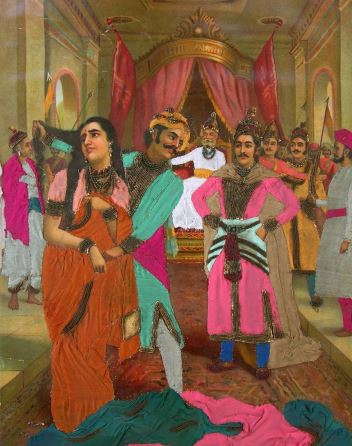
Raja Rai Varma’s Draupadi Vastraharan is expected to fetch between Rs 15 and Rs 20 crore at an auction.
Who was Raja Ravi Varma?
Raja Ravi Varma was born in April 1848 in Kilimanoor, Kerala, to a family which was very close to the royals of Travancore.
Often referred to as the father of modern Indian art, he is widely known for his realistic portrayal of Indian gods and goddesses.
While he majorly painted for the royalty, he is also credited for taking art to the masses with his prints and oleographs.
At a young age, he would draw animals and everyday scenes on the walls in indigenous coloursmade from natural materials such as leaves, flowers and soil.
His uncle, Raja Raja Varma, noticed this and encouraged his talent.
Patronised by Ayilyam Thirunal, the then ruler of Travancore, he learnt watercolour painting from the royal painter Ramaswamy Naidu, and later trained in oil painting from Dutch artist Theodore Jensen.
How he became an artist of the royals?
Varma became a much sought-after artist for the aristocrats and was commissioned several portraits in late 19th century.
Arguably, at one point, he became so popular that the Kilimanoor Palace in Kerala opened a post office due to the sheer number of painting requests that would come in for him.
He travelled across India extensively, for work and inspiration.
Fame as a notable painter
Following a portrait of Maharaja Sayajirao of Baroda, he was commissioned 14 Puranic paintings for the Durbar Hall of the new Lakshmi Vilas Palace at Baroda.
Depicting Indian culture, Varma borrowed from episodes of Mahabharata and Ramayana for the same.
He also received patronage from numerous other rulers, including the Maharaja of Mysore and Maharaja of Udaipur.
As his popularity soared, the artist won an award for an exhibition of his paintings at Vienna in 1873.
He was also awarded three gold medals at the World’s Columbian Exposition in Chicago in 1893.
Nature of his artforms
Much of his celebrated art also borrows heavily from Indian mythology.
In fact, he is often credited with defining the images of Indian gods and goddesses through his relatable and more realistic portrayals often painted with humans as models.
The depictions include Lakshmi as the goddess of wealth, Saraswati as the goddess of knowledge and wisdom, and Lord Vishnu with his consorts, Maya and Lakshmi.
How he took Indian art to the masses?
Raja Ravi Varma aspired to take his art to the masses and the intent led him to open a Lithographic Press in Bombay in 1894.
The idea, reportedly, came from Sir T Madhava Rao, former Dewan of Travancore and later Baroda, in a letter where he pointed out to Varma that since it was impossible for him to meet the large demand for his work, it would be ideal for him to send some of his select works to Europe and have them produced as oleographs.
Varma, instead, chose to establish a printing press of his own.
The first picture printed at Varma’s press was reportedly The Birth of Shakuntala, followed by numerous mythological figures and saints such as Adi Shankaracharya.
Try this PYQ:
Q. There are only two known examples of cave paintings of the Gupta period in ancient India. One of these is paintings of Ajanta caves. Where is the other surviving example of Gupta paintings?
The Rajya Sabha recently bade farewell to 72 members retiring this year as Prime Minister Narendra Modi hailed their contribution and MPs fondly reminisced on their experiences.
In this article, we will discuss and analyze the journey, significance and achievements of the Upper House of Parliament – Rajya Sabha.
The Rajya Sabha
The Rajya Sabha or Council of States is the upper house of the bicameral Parliament.
It currently has a maximum membership of 245, of which 233 are elected by the legislatures of the states and union territories using single transferable votes through Open Ballot.
The President can appoint 12 members for their contributions to art, literature, science, and social services.
Members sit for terms lasting six years, with elections every year but almost a third of the 233 designates up for election every two years, specifically in even-numbered years.
A Historical background
The Rajya Sabha came into being on April 3, 1952, and held its first session on May 13 the same year.
The Constituent Assembly, which was formed in 1947, after the adoption of the Constitution became the Provisional Parliament and made laws till 1952.
Before its existence
The central legislature that came into being under the Government of India Act, 1919was bicameral.
Under 1919 Act, Council of States had 60 members and Legislative Assembly had 145 members.
The membership and voting norms for the Council of States were restrictive. These restrictions meant only wealthy landowners, merchants and those with legislative experience could enter it.
Women could neither vote nor seek membership.
The Government of India Act, 1935 proposed an elaborate and improved version of the second chamber, but this never materialized.
Elections to the Rajya Sabha
Qualifications
Article 84of the Constitution lays down the qualifications for membership of Parliament. A member of the Rajya Sabha must:
Be a citizen of India;
Be at least 30 years old. (Article 84 constitution of India)
Be elected by the Legislative Assembly of States and UTs by means of the single transferable vote through proportional representation.
Not be: a proclaimed criminal, a subject of an insolvent, of unsound mind.
Not hold any other office of profit under the Government of India.
Possess such other qualifications as may be prescribed in that behalf by or under any law made by Parliament.
In addition, twelve members are nominated by the President of India having special knowledge in various areas like arts and science. However, they are not entitled to vote in Presidential elections as per Article 55 of the Constitution.
Election procedure
Candidates fielded by political parties have to be proposed by at least 10 members of the Assembly or 10% of the party’s strength in the House, whichever is less.
For independents, there should be 10 proposers, all of whom should be members of the Assembly.
Voting procedure
Voting is by single transferable vote, as the election is held on the principle of proportional representation.
A single transferable vote means electors can vote for any number of candidates in order of their preference.
A candidate requires a specified number of first preference votes to win. Each first choice vote has a value of 100 in the first round.
To qualify, a candidate needs one point more than the quotient obtained by dividing the total value of the number of seats for which elections are taking place plus one.
The formula simply is [(Number of MLAs X 100) / (Vacancies + 1)] + 1.
Example: If there are four seats and 180 MLAs voting, the qualifying number will be 180/5= 36 votes or value of 3,600.
Note: The Rajya Sabha polls have a system of the open ballot, but it is a limited form of openness. There is a system of each party MLA showing his or her marked ballots to the party’s authorised agent (called Whip), before they are put into the ballot box.
The NOTA option has been struck down by the Supreme Court in RS elections.
The Power Equation: Lok Sabha Vs. Rajya Sabha
The Indian Constitution provides for parity of powers between the Lok Sabha and the Rajya Sabha in law, making an exception in some cases.
The Money Bill or Finance Bills can be introduced only in the Lok Sabha which only can approve the Demands for Grants.
On the other hand, the Rajya Sabha has some special powers as requiring adopting a resolution allowing Parliament to legislate on subjects in the State List and creating All India Services, besides approving proclamations of Emergency and President’s Rule when the Lok Sabha is dissolved.
Renowned British philosopher and political economist John Stuart Mill as early as in 1861 said in his great treatise Considerations on Representative Government that management of free institutions requires conciliation; a readiness to compromise; a willingness to concede something to opponents and mutual give and take. Truly, Rajya sabha plays this role in Indian legislature.
In detail: Powers and Functions of the Rajya Sabha
[1] Legislative Powers:
In the sphere of ordinary law-making, the Rajya Sabha enjoys equal powers with the Lok Sabha. An ordinary bill can be introduced in the Rajya Sabha and it cannot become a law unless passed by it.
In case of a deadlock between the two Houses of Parliament over an ordinary bill and if it remains unresolved for six months, the President can convene a joint sitting of the two Houses for resolving the deadlock.
This joint sitting is presided over by the Speaker of the Lok Sabha. But if the deadlock is not resolved, the bill is deemed to have been killed.
[2] Financial Powers:
In the financial sphere, the Rajya Sabha is a weak House.
A money bill cannot be introduced in the Rajya Sabha. It can be initiated only in the Lok Sabha.
A money bill passed by the Lok Sabha comes before the Rajya Sabha for its consideration.
[3] Executive Powers:
Members of the Rajya Sabha can exercise some control over the ministers by criticizing their policies, by asking questions and moving motions etc.
Some of the ministers are also taken from the Rajya Sabha. The PM can also be from Rajya Sabha if the majority party in the Lok Sabha may elect/adopt him as its leader.
[4] Electoral Powers:
The Rajya Sabha has some electoral powers also. The elected members of the Rajya Sabha along with the elected members of the Lok Sabha and all the State Legislative Assemblies together elect the President of India.
The members of the Rajya Sabha Lok Sabha together elect the Vice- President of India.
Members of the Rajya Sabha also elect a Deputy Chairman from amongst themselves.
[5] Judicial Powers:
The RS acting along with the Lok Sabha can impeach the President on charges of violation of the Constitution.
The RS can also pass a special address for causing the removal of a judge of the Supreme Court or of any High Court.
The charges against the Vice-President can be levelled only in the RS.
The RS can pass a resolution for the removal of some high officers like the Attorney General of India, Comptroller and Auditor General and Chief Election Commissioner.
[6] Miscellaneous Powers:
The Rajya Sabha and Lok Sabha jointly perform the following functions:
Approval of the ordinances issued by the President,
Ratification of an emergency proclamation,
Making any change in the jurisdiction of the Supreme Court and the High Courts, and
Making any change in the qualifications for the membership of the Lok Sabha and the Rajya Sabha.
[7] Exclusive Powers
The Rajya Sabha enjoys two exclusive powers:
(i) The Power to declare a Subject of State List as a subject of National Importance:
The Rajya Sabha can pass a resolution by 2/3rd majority of its members for declaring a State List subject as a subject of national importance. Such a resolution empowers the Union Parliament to legislate on such a state subject for a period of one year. Such resolutions can be repeatedly passed by the Rajya Sabha.
(ii) Power in respect of Creation or Abolition of an All India Service:
The Rajya Sabha has the power to create one or more new All India Services. It can do so by passing a resolution supported by 2/3rd majority on the plea of national interest. In a similar way, the Rajya Sabha can disband an existing All India Service.
Limitations to its powers
The Constitution places some restrictions on Rajya Sabha; the Lok Sabha is more powerful in certain areas as such:
1. Money bills
A money bill can be introduced only in the Lok Sabha by a minister and only on recommendation of President of India.
When the Lok Sabha passes a money bill then the Lok Sabha sends money bill to the Rajya Sabha for 14 days during which it can make recommendations.
Even if Rajya Sabha fails to return the money bill in 14 days to the Lok Sabha, that bill is deemed to have passed by both the Houses.
Also, if the Lok Sabha rejects any (or all) of the amendments proposed by the Rajya Sabha, the bill is deemed to have been passed. Hence, Rajya Sabha can only give recommendations for a money bill but Rajya Sabha cannot amend a money bill.
There is no joint sitting of both the houses with respect to money bills, because all final decisions are taken by the Lok Sabha.
2. Joint Sitting of the Parliament
Article 108 provides for a joint sitting of the two Houses of Parliament in certain cases.
Considering that the numerical strength of Lok Sabha is more than twice that of Rajya Sabha, Lok Sabha tends to have a greater influence in a joint sitting of Parliament. A joint session is chaired by the Speaker of Lok Sabha.
Joint sessions of Parliament are a rarity, and have been convened only three times in last 71 years, for the purpose of passage of a specific legislative act, the latest time being in 2002:
The Union Council of Ministers is collectively responsible before the Lok Sabha and not the Rajya Sabha.
Lok Sabha alone can cause the fall of the Council of Ministers by passing a vote of no-confidence.
Rajya Sabha: A destructionist?
An analysis by the Secretariat revealed that the productivity of the Rajya Sabha till 1997 has been 100% and above and the past 23 years have thrown up a disturbing trend of rising disruptions.
This decline is primarily on account of disruptions forcing cancellation of Question Hour frequently.
Disruptions also dent the quality of law-making as seen in passing of Bills without discussion sometimes.
However, the Rajya Sabha is proving to be more and more a ‘deliberative’ body with increasingly more time being spent on this function.
According to various members of Lok Sabha, Rajya Sabha has done nothing except stalling legislative works and causing policy paralysis in the country.
For critics, the Upper House serves no purpose as its members are not directly elected and hence are not accountable to the people.
Rajya Sabha often has members from the party defeated in various elections, or are from political families, and due to political differences, they do not allow passage of important bills.
So many extra members are an added burden on exchequer which can be done away with.
Politics of boycotting and creating ruckus in the house and toeing on the party-line even on the issue that won’t attract disqualification provisions is a worrying thing.
At the same time, in terms of working, Rajya Sabha does not have sufficient powers in financial matters to bring any change and they are without any direct public interaction. Hence its purpose in modern democracy seems outdated.
Importance of Rajya Sabha and Why It Should Continue
According to President Radhakrishnan, there are functions, which a revising chamber like Rajya Sabha can fulfil fruitfully. Parliament is not only a legislative but a deliberative body. So far as its deliberative functions are concerned, Rajya Sabha has made very valuable contributions time and again.
It’s true that party dynamics affects the working of Rajya Sabha. But in democracy passion often defeat the normal rationality.Thus a revising house is needed to check such adrenal rush.
While the argument of members not able to win in direct elections holds true, but retaining talent is essential for any democratic system. Losing valuable talent during election fervours has mostly been corrected by Rajya Sabha. It has also given entry to other experts like scientist, artist, sportsmen etc that can rarely face the electoral politics.
While Lok Sabha have members for each state, the Hindi belt domination is a constant theme. Hence other state interests, like those in North East, have always been taken up by the Rajya Sabha.
While it can’t bring no confidence motion or amend money bill, its role in checking arbitrariness of government as reflected in Land Ordinance, is necessary in democracy. Besides its special role in All India Services, legislation in State List too necessitates its existence.
Men and women of prodigious talent and calibre have adorned the benches of the upper house and have contributed significantly towards realising the vision of the founding fathers of the Constitution.
A permanent Upper House is also a check against any abrupt changes in the composition of the Lower House.
Rajya Sabha has continuity and is a permanent house.
Unlike Lok Sabha, it cannot be dissolved by anyone. Thus it has, time and often, carried out some administrative functions even when the lower house is dissolved. It has members with experienced playerswhile there may be new entrants in the Lok Sabha.
By virtue of this, Rajya Sabha can’t be said to be ‘obstructive’.
Conclusion
A study of the powers of the Rajya Sabha leads us to the conclusion that it is neither a very weak house like the British House of Lords nor a very powerful house as the American Senate. Its position is somewhat mid-way between the two. It has been less powerful than Lok Sabha but it has been not a very weak or insignificant House.
Instead of engaging in the debate of if we need upper house or not, more constructive outlook would be improve it’s functioning. Clearly, the recommendations are present from NCRWC to 2nd ARC. The need is implementation and political support.
No more just the reading of your standard NCERTs is sufficient to clear prelims. Prelims is becoming more Dynamic Year by Year. From 5 lakh plus students making it to roughly 10,000 students for mains stage is not an easy task.
LAST 60 DAYS
60 days is an apt time to not only prepare but clear prelims. Many veterans/topper who appear for prelims shift to PRELIMS MODE in the last 60 days.
This is because 60 days period comfortably allows to finish your one last static revisions of all subject, also cover current affairs revisions and write mocks. Few days less than 60, just adds on to add mental pressure, which can compromise your preparation.
Prelims is the most trickiest stage in UPSC Examination. Last 60 days is surely a DO OR DIE situation.
KEY TAKEAWAYS FROM THIS WEBINAR:
1. Know about essentials which should be part of your timetable in the next 60 days. How to make a perfect timetable in the last 60 days?
2. Every day counts and each subject counts! How much time should be devoted to each subject? Let the experts tell you!
3. 20, 30, 40 or 60 tests! How many tests are enough before prelims? Is there a magic number?
4. Not just do’s but one should be aware about the don’t as well. What mistakes one needs to avoid in last 60 days?
5. Revision is the most important part of UPSC preparation. Know about 5R Revision plan.
6. Time test Elimination techniques for prelims. How to use Tikdam/Logical reasoning to score extra 25 marks?
7. Confused between 2 options because they sound very similar. Know how to maximize efficiency while solving question?
8. Last few days is not about making long notes. Discuss the process of making micro notes in last 60 days.
Towards the end of the session, Sajal sir will hold a Q&A session for all aspirants to share their doubts and get answers from him.
Webinar Details
Prelims question papers have become more or less like a game of Sudoko. Except, in Sudoko you can solve the puzzle at your leisure and over here you are limited by 2 hours. We hope this webinar will help all 2022 aspirants implement the suggestions of Sajal sir
He is the founder and Core Faculty at CD. SajalSingh has the distinction be being 2017 topper of GS Mains. Over 400 students have emerged as toppers under SajalSir’s mentorship in the last 7 years.
Thank you messages from students who cleared Mains 2021 under the mentorship of Sajal sir
Last Minute Mentorship can help you a long wayGratitude for Mains mentorshipAppearing in Interview 2021
No more just the reading of your standard NCERTs is sufficient to clear prelims. Prelims is becoming more Dynamic Year by Year. From 5 lakh plus students making it to roughly 10,000 students for mains stage is not an easy task.
LAST 60 DAYS
60 days is an apt time to not only prepare but clear prelims. Many veterans/topper who appear for prelims shift to PRELIMS MODE in the last 60 days.
This is because 60 days period comfortably allows to finish your one last static revisions of all subject, also cover current affairs revisions and write mocks. Few days less than 60, just adds on to add mental pressure, which can compromise your preparation.
Prelims is the most trickiest stage in UPSC Examination. Last 60 days is surely a DO OR DIE situation.
KEY TAKEAWAYS FROM THIS WEBINAR:
1. Know about essentials which should be part of your timetable in the next 60 days. How to make a perfect timetable in the last 60 days?
2. Every day counts and each subject counts! How much time should be devoted to each subject? Let the experts tell you!
3. 20, 30, 40 or 60 tests! How many tests are enough before prelims? Is there a magic number?
4. Not just do’s but one should be aware about the don’t as well. What mistakes one needs to avoid in last 60 days?
5. Revision is the most important part of UPSC preparation. Know about 5R Revision plan.
6. Time test Elimination techniques for prelims. How to use Tikdam/Logical reasoning to score extra 25 marks?
7. Confused between 2 options because they sound very similar. Know how to maximize efficiency while solving question?
8. Last few days is not about making long notes. Discuss the process of making micro notes in last 60 days.
Towards the end of the session, Sajal sir will hold a Q&A session for all aspirants to share their doubts and get answers from him.
Webinar Details
Prelims question papers have become more or less like a game of Sudoko. Except, in Sudoko you can solve the puzzle at your leisure and over here you are limited by 2 hours. We hope this webinar will help all 2022 aspirants implement the suggestions of Sajal sir
He is the founder and Core Faculty at CD. SajalSingh has the distinction be being 2017 topper of GS Mains. Over 400 students have emerged as toppers under SajalSir’s mentorship in the last 7 years.
Thank you messages from students who cleared Mains 2021 under the mentorship of Sajal sir
Last Minute Mentorship can help you a long wayGratitude for Mains mentorshipAppearing in Interview 2021
The fifth summit of the regional grouping, the Bay of Bengal Initiative for Multi-Sectoral Technical and Economic Cooperation (BIMSTEC), held virtually in Colombo on March 30, has advanced the cause of regional cooperation and integration.
Colombo package
Economic challenges: Representing a fifth of the world’s population that contributes only 4% of the global GDP, can this multilateral grouping trigger accelerated economic development?
It was clear that BIMSTEC first needed to strengthen itself — by re-defining its purpose and rejuvenating its organs and institutions.
The eventual result is now seen in the package of decisions and agreements announced at the latest summit.
Achievement of Colombo Summit
1] Adoption of Charter: Adopted formally, it presents BIMSTEC as “an inter-governmental organization” with “legal personality.”
BIMSTEC’s purposes: Defining BIMSTEC’s purposes, it lists 11 items in the first article.
Among them is acceleration of “the economic growth and social progress in the Bay of Bengal region”, and promotion of “multidimensional connectivity”.
The grouping now views itself not as a sub-regional organisation but as a regional organisation whose destiny is linked with the area around the Bay of Bengal.
2] Reduction in the sectors of cooperation: The second element is the decision to re-constitute and reduce the number of sectors of cooperation from the unwieldy 14 to a more manageable seven.
Each member-state will serve as a lead for a sector: trade, investment and development (Bangladesh); environment and climate change (Bhutan); security, including energy (India); agriculture and food security (Myanmar); people-to-people contacts (Nepal); science, technology and innovation (Sri Lanka), and connectivity (Thailand).
3] Adoption of the Master Plan for Transport Connectivity: the summit participants adopted the Master Plan for Transport Connectivity applicable for 2018-2028.
It was devised and backed by the Asian Development Bank (ADB).
It lists 264 projects entailing a total investment of $126 billion.
Projects worth $55 billion are under implementation. BIMSTEC needs to generate additional funding and push for timely implementation of the projects.
4] Signing of three new agreements: Finally, the package also includes three new agreements signed by member states, relating to mutual legal assistance in criminal matters, cooperation between diplomatic academies, and the establishment of a technology transfer facility in Colombo.
Challenges
The pillar of trade, economic and investment cooperation needs greater strengthening and at a faster pace.
Absence of FTA: Despite signing a framework agreement for a comprehensive Free Trade Agreement (FTA) in 2004, BIMSTEC stands far away from this goal.
Lack of legal instruments: The need for expansion of connectivity was stressed by one and all, but when it comes to finalising legal instruments for coastal shipping, road transport and intra-regional energy grid connection, much work remains unfinished.
There needs to be mention of the speedy success achieved in deepening cooperation in security matters and management of Humanitarian Assistance and Disaster Relief (HADR).
Focus more on new areas: BIMSTEC should focus more in the future on new areas such as the blue economy, the digital economy, and promotion of exchanges and links among start-ups and Micro, Small and Medium Enterprises (MSMEs).
Step up the personal engagement of political leadership: The personal engagement of the political leadership should be stepped up.
The decision taken in Colombo to host a summit every two years is welcome if implemented.
India’s turn to host the G20 leaders’ summit in 2023 presents a golden opportunity, which can be leveraged optimally. Perhaps all its members should be invited to the G20 summit as the chair’s special guests.
Simplify the groupings name: The suggestion to simplify the grouping’s name needs urgent attention.
The present name running into 12 words should be changed to four words only — the Bay of Bengal Community (BOBC).
It will help the institution immensely. Brevity reflects gravitas.
Conclusion
BIMSTEC is no longer a mere initiative or programme. The question to address is whether it is now capable of tackling the challenges facing the region.
The image of the institution of police is regrettably tarnished by allegations of corruption, police excesses, lack of impartiality and close nexus with the political class.
Police and investigation agencies need social legitimacy
The police and investigative agencies may have de-facto legitimacy, but as institutions, they are yet to gain social legitimacy.
Police should work impartially and focus on crime prevention. They should also work in cooperation with the public to ensure law and order.
The CBI possessed immense trust of the public in its initial phase.
But with the passage of time, like every other institution of repute, the CBI has also come under deep public scrutiny.
The need of the hour is to reclaim social legitimacy and public trust.
Issues affecting the system and causing delay in trial
Lack of infrastructure, lack of sufficient manpower, inhuman conditions, especially at the lowest rung, lack of modern equipment, questionable methods of procuring evidence, officers failing to abide by the rule book and the lack of accountability of erring officers.
Then there are certain issues that lead to delays in trials.
They are: Lack of public prosecutors and standing counsels, seeking adjournments, arraying hundreds of witnesses and filing voluminous documents in pending trials, undue imprisonment of undertrials, change in priorities with the change in the political executive, cherry-picking of the evidence, and repeated transfers of officers leading to a change in the direction of the investigation.
Way forward
Break the nexus with political executive: The first step to reclaim social legitimacy and public trust.is to break the nexus with the political executive.
Reform of the police system is long overdue in our country.
The Ministry of Home Affairs has itself recognised the glaring need for the same in the “Status Note on Police Reforms in India”.
Comprehensive law: Our investigative agencies still do not have the benefit of being guided by a comprehensive law.
Independent and autonomous investigative agency: The need of the hour is the creation of an independent and autonomous investigative agency.
Umbrella organisation: There is an immediate requirement for the creation of an independent umbrella institution, so as to bring various agencies like the CBI, SFIO, and ED under one roof.
This body is required to be created under a statute, clearly defining its powers, functions and jurisdictions.
Such a law will also lead to much-needed legislative oversight.
Separation of prosecution and investigation: One additional safeguard that needs to be built into the scheme, is to have separate and autonomous wings for prosecution and investigation, in order to ensure total independence.
Annual audit of performance: A provision in the proposed law for an annual audit of the performance of the institution by the appointing committee will be a reasonable check and balance.
Strengthening state investigative agencies: There is no reason why state investigative agencies, which handle most of the investigations, cannot enjoy the same level of credibility as that of the national agency.
The proposed Central law for the umbrella investigative body can be suitably replicated by the states.
Ensure women’s representation: An issue that needs addressing at this stage is the representation of women in the criminal justice system.
Often, women feel deterred in reporting certain offences due to a lack of representation.
Relations with community: Relations between the community and police also need to be fixed.
This is only possible if police training includes sensitisation workshops and interactions to inspire public confidence.
Consider the question “The police and investigative agencies may have de-facto legitimacy, but as institutions, they are yet to gain social legitimacy. In the context of this, examine the challenges faced by the police and the investigative agencies in India and suggest ways to help them gain social legitimacy.”
Conclusion
It is imperative for the police and the public to work together to create a safe society. Ultimately the police must remember that their allegiance must be to the Constitution and the rule of law and not to any person.
The government has introduced the ‘Antarctica Bill, 2022’ in the Lok Sabha that envisages regulating visits and activities to Antarctica as well potential disputes that may arise among those present on the continent.
Indian Antarctic Bill, 2022
Aims and objectives:
To provide for national measures to protect the Antarctic environment and associated ecosystems and to give effect to the Antarctic Treaty
To provide a harmonious policy framework for India’s Antarctic activities through a well-established legal mechanism
Facilitate activities of the Indian Antarctic programme, including management of Antarctic tourism and sustainable development of fisheries
To prohibit Indian expedition to Antarctica or carrying of certain activities in Antarctica without a permit or the written authorisation of another party to the protocol
To provide for inspection in India by an officer designated by the Central government as an Inspector and to constitute an inspection team to carry out inspections in Antarctica
Key feature: Committee on Antarctic governance
It will empower the government to establish a committee on Antarctic governance and environmental protection to monitor, implement and ensure compliance with the relevant international laws, emissions standards and rules of protection.
The panel is to be headed by the secretary of the Ministry of Earth Sciences, as ex officio chairperson.
Among other roles, he has also been the vice-president of the Scientific Committee on Antarctic Research of the International Science Council since 2018.
The committee will have ten members from various ministries, departments and organizations of the Union government, plus two experts on the Antarctic environment or other relevant areas.
About Antarctica Treaty
Antarctica has a geographical area of 14 million sq. km and has had no indigenous population (i.e. “Antarcticans” don’t exist).
However, a few thousand people reside there, in some 40 research stations spread across the continent, throughout the year.
In 1959, 12 countries – Argentina, Australia, Belgium, Chile, France, Japan, New Zealand, Norway, South Africa, the USSR, the UK and the US signed the ‘Antarctic Treaty’.
Their aim was to prevent the continent from being militarised and to establish it as a centre of peaceful activities.
Later, more countries, including India, have become party to the treaty, and today it counts more than 54 members.
The treaty requires each party to take appropriate measures within its competence, including the adoption of laws and regulations, administrative actions and enforcement measures, to ensure compliance with the protocol.
Countries also signed the ‘Protocol on Environmental Protection’ to the Antarctic Treaty in 1991, which designates Antarctica as a “natural reserve, devoted to peace and science”.
Need for the Antarctic Legislation
The growing presence of Indian scientists in Antarctica and the commitment to Antarctic research and protection prompted the government to adopt domestic legislation consistent with its obligations as a member of the Antarctic Treaty system.
These laws will enable India’s courts to deal with disputes or crimes committed in parts of Antarctica, and help build credibility vis-à-vis India’s participation.
India at the Poles
India maintains two research stations on the continent: ‘Maitri’ (commissioned in 1989) at Schirmacher Hills and ‘Bharati’ (2012) at Larsemann Hills.
It has also launched 41 scientific expeditions every year thus far.
Together with the ‘Himadri’ station in Svalbard, above the Arctic circle, India is among an elite group of countries with multiple research in the polar regions.
The Lok Sabha recently passed a bill to amend a constitutional order to include Darlong, a tribal clan in Tripura which was among the generic Halam community till now, in the list of Scheduled Tribes (ST).
Who are Darlongs?
Darlong is a tribal community of 11,000 people.
Despite its small population, the community has a high prevalence of education, cultural activities and members of the community are serving in different high positions in the local administration.
Darlongs, despite being Scheduled Tribes, were never given ST certificates.
Since they were considered a generic tribe under the Kuki community, they were handed their tribal certificates as members of ‘Kuki’ community.
The subsequent identity crisis among them, especially Darlong youths, who were equipped with modern education, culminated in the demand for a separate statutory identity of their own in 1995.
The group is a small tribal clan but has produced a high number of educated people proportionate to its population in the state.
People from the Darlong community, like many other tribal communities, are now serving in high positions in the state administration, academia, and public services.
Tribal musicologist and Rosem (tribal instrument) maestro Thanga Darlong was conferred the prestigious Padma Shri award a few years back for his contribution to culture.
Why is tribal identity a big issue in Tripura?
Out of 37 lakh people of Tripura, nearly 30 per cent are tribals, who mostly live in areas under jurisdiction of the Tripura Tribal Areas Autonomous District Council (TTAADC).
They are spread in patches across all eight districts and covering 70 per cent of the state’s geographical area.
The state saw tribals become minority in their own state due to arrival of East Pakistani refugees who fled their country.
Tribal identity is a major issue in Tripura, which is also one of the major subjects dominating the state politics now.
There is rising demand of Greater Tipraland – a proposed separate state for Tiprasa or Tripuris (tribal and non-tribal) living in the state.
Back2Basics: Tribes of Tripura
Tripura, the tiny Northeast state of 37 lakh people houses 19 tribal communities.
These include Tripuri or Debbarma, Reangs or Brus, Jamatia, Noatia, Uchoi, Chakma, Mog, Lushai, Kuki, Munda, Kour, Oram, Santhal, Bhil, Bhutia, Chaimar or Sermai, Garo, Khasi, Lepcha and Halam.
Many of these communities are further divided into sub-tribes.
For example, Kukis have nearly 17-18 sub-tribes within the community.
It is an umbrella tribal community including many smaller clans like Khasi, Lushai, Hmars and other generic clans.
In course of time, Lushai, Hmar, Garo etc. came out of Kuki as separate communities.
Halam community also has several sub-tribes such as Rangkhawl, Ranglong, Dab, Chaimar or Sermai, Bong, Korbong, Harbong, Bongcher etc.
Delhi High Court has sought the Enforcement Directorate’s (ED’s) response on a journalist’s challenge to its action of restraining her from leaving the country. She was stopped in Mumbai on Tuesday evening based on a look out circular (LOC) issued by the ED.
Look out notice: What is it, when is it issued?
An LOC is issued to make sure that an individual who is absconding or wanted by law enforcement agencies is not able to leave the country.
It is mostly used at immigration checkpoints at international airports and seaports by the immigration branch.
In certain cases, the police can approach a court asking for the restriction of a person’s movement outside the country, when that person is a suspect and there is an apprehension that they may not join the investigation at a later stage.
The subject of an LOC can challenge the circular and get relief from a court.
Who can issue an LOC?
An LOC can be initiated by a large number of authorised officers, including an officer not below the rank of deputy secretary, an officer not below the rank of joint secretary in the state government, a district magistrate or superintendent of police.
Also, designated officers of various law enforcing and security agencies, a designated officer of Interpol, an officer not below the rank of additional director in the Serious Fraud Investigation Office, and the Ministry of Corporate Affairs can also issue LOC.
In 2018, the government also empowered the heads of public sector banks to directly request the authorities to issue an LOC against wilful defaulters to prevent them from leaving the country.
So now, an officer not below the rank of chairman/managing director/chief executive of any public sector bank can make a request.
An LOC can be modified/deleted/withdrawn by the Bureau of Immigration only on the specific request of the authorised originator on whose request the LOC was issued.
Does an LOC lead to arrest?
Not necessarily. LOCs can be of several types.
They can seek to merely stop a person against whom the circular has been issued from travelling outside the country, to prevent a person from entering the country, or inform the concerned investigation agencies.
The proforma of the LOC also contains a request to detain the individual at the local police/investigation agency, which generally leads to arrest.
Back2Basics: Directorate of Enforcement (ED)
ED is a law enforcement agency and economic intelligence agency responsible for enforcing economic laws and fighting economic crime (esp Money Laundering) in India.
It is part of the Department of Revenue of the Ministry of Finance.
It is composed of officers from the Indian Revenue Service, Indian Police Service and the Indian Administrative Service as well as promoted officers from its own cadre.
The total strength of the department is less than 2000 officers out of which around 70% of officials came from deputation from other organizations while ED has its own cadre, too.
The prime objective of the Enforcement Directorate is the enforcement of two key Acts namely, the Foreign Exchange Management Act 1999 (FEMA) and the Prevention of Money Laundering Act 2002 (PMLA)
The President of India has sent his greetings to fellow citizens on the eve of Chaitra Sukladi, Ugadi, Gudi Padwa, Cheti Chand, Navreh and Sajibu Cheiraoba.
Gudi Padwa
Gudi Padwa is a spring-time festival that marks the traditional New Year for Marathi and Konkani Hindus, but is also celebrated by other Hindus as well.
It is celebrated in and around Maharashtra, Goa, and the union territory of Damaon on the first day of the Chaitra month, to mark the beginning of the New Year according to the luni-solar method of the Hindu calendar.
Padava or paadvo comes from the Sanskrit word pratipada, which is the first day of a lunar fortnight.
The spring festival is observed with colourful floor decorations called rangoli, a special Gudhi dvaja (flag garlanded with flowers, mango and neem leaves, topped with upturned silver or copper vessels), street processions, dancing& festive foods.
Significance
Gudhi Padva signifies the arrival of spring and to the reaping of Rabi crops.
The festival is linked to the mythical day on which Hindu god Brahma created time and universe.
To some, it commemorates the coronation of Rama in Ayodhya after his victory over evil Ravana, or alternatively the start of Shalivahan calendar after he defeated the Huns invasion in the 1st century.
State-wide celebrations
Bihu among the Assamese of Assam.
Cheti Chand among the Sindhi people
Navreh among the Kashmiri Pandits in Jammu and Kashmir.
Pahela Baishakh among the Bengalis in West Bengal and Bangladesh.
Puthandu among the Tamils in Tamil Nadu.
Samvatsar Padvo among Hindu Konkanis of Goa and Konkani diaspora in Kerala
Vaisakhi or Baisakhi among the Punjabis in Punjab.
Vishu or among the Malayalis in Kerala.
Ugadi among the south-Indian states of Karnataka, Andhra Pradesh and Telangana.
The theme of this year’s World Water Day was ‘Groundwater: Making the Invisible Visible’. The primary focus is to draw attention to the role of groundwater in water and sanitation systems, agriculture, industry, ecosystems, and climate change adaptation. Groundwater helps reduce the risk of temporary water shortage and caters to the needs of arid and semiarid regions, but its value has not been fully recognized in policymaking. Due to its high storage capacity, groundwater is more resilient to the effects of climate change than surface water. The international conference on ‘Groundwater, Key to the Sustainable Development Goals’ and the UNWater Summit on Groundwater are part of global initiatives to highlight the significance of groundwater in sustainable development.
Important Facts
Estimates:85% of the rural and 50% of the urban population in India is dependent on groundwater for fulfilling their needs.
With an annual groundwater extraction of 248.69 billion cubic meters (2017), India is among the largest users of groundwater in the world.
Almost 89% of the groundwater extracted is used for irrigation and the rest for domestic and industrial use (9% and 2%).
High water stress: India is one of 17 countries facing extremely high water stress, according to a report by the World Resources Institute.
According to the Fifth Minor Irrigation Census, the groundwater level in India has declined by 61 percent between 2007 and 2017. It was further observed that more than 1,000 blocks in India have become water-stressed.
Composite Water Management Index (CWMI), 2018 by NITI Aayog: The water demand will exceed the supply by 2050. Groundwater in India depleted at 10-25 mm per year between 2002 and 2016.
54 percent of India’s groundwater wells are declining.
It added that about 40% of India’s population possibly would have no access to drinking water by 2030.
Extraction value: According to the Central Ground Water Board, the annual groundwater withdrawal is considered to be safe when the extraction rate is limited to below 70% of the annual replenishable recharge.
Available data indicate that the level of extraction for the country in 2017 was 63%, from 58% in 2004.
Variation across regions: However, the level varied across regions. Punjab, Rajasthan, Haryana, Delhi, Chandigarh, Himachal Pradesh, Tamil Nadu, and Puducherry have crossed the 70% mark.
Of 534 districts in 22 States/UTs, 202 districts had stage of extraction ranging from 71% to 385%. NITI Aayog has set the 70% extraction value as the target to be achieved by 2030.
Recent studies suggest that groundwater levels are declining in several parts of northern India, especially in regions of high population densities.
Quality concern: A quantitywise safe district may be vulnerable due to deterioration of water quality. Fluoride, iron, salinity, nitrate, and arsenic contamination are major problems.
As many as 335 districts reported nitrate pollution compared to 109 in 2006. A high level of nitrate affects human health.
Sources of nitrates are mainly anthropogenic and depend on local actions.
Biological contamination has also been reported from different parts of the country.
Reasons for Depletion
Increased demand for water for domestic, industrial and agricultural needs and limited surface water resources lead to the over-exploitation of groundwater resources.
Limited storage facilities owing to the hard rock terrain, along with the added disadvantage of lack of rainfall, especially in central Indian states.
Green Revolution enabled water-intensive crops to be grown in drought-prone/ water deficit regions, leading to over-extraction of groundwater.
Frequent pumping of water from the ground without waiting for its replenishment leads to quick depletion.
Subsidies on electricityand high MSP for water-intensive crops is also leading reasons for depletion.
Water contamination as in the case of pollution by landfills, septic tanks, leaky underground gas tanks, and overuse of fertilizers and pesticides leads to damage and depletion of groundwater resources.
Inadequate regulation of groundwater laws encourages the exhaustion of groundwater resources without any penalty.
Deforestation, unscientific methods of agriculture, chemical effluents from industries, and lack of sanitation also lead to pollution of groundwater, making it unusable.
Natural causes include uneven rainfall and climate change that are hindering the process of groundwater recharge.
Impact
Lowering of the water table: Groundwater depletion may lower the water table leading to difficulty in extracting groundwater for usage.
Reduction of water in streams and lakes: A substantial amount of the water flowing in rivers comes from seepage of groundwater into the streambed. Depletion of groundwater levels may reduce water flow in such streams.
Subsidence of land: Groundwater often provides support to the soil. When this balance is altered by taking out the water, the soil collapses, compacts, and drops leading to subsidence of land.
Increased cost for water extraction: As the depleting groundwater levels lower the water table, the user has to delve deep to extract water. This will increase the cost of water extraction.
Contamination of groundwater: Groundwater that is deep within the ground often intermingles with saltwater that we shouldn’t drink.
Constraints in food supply: If groundwater availability faces difficulties then there will be hindrances in agricultural production leading to a shortage of food.
Limitations to biodiversity and creation of sinkholes: Water table plays a major role in sustaining biodiversity. Often, sinkholes are created when the water table lowers. These sinkholes are dangerous for buildings and towers.
Policy challenges
Estimation of groundwater resources: There is a lack of data available for estimation of groundwater sources and even if they are available, they are indicative and not representative.
Crop pricing and water-intensive crops: Decisions such as cropping pattern and cropping intensity are taken independent of the groundwater availability in most areas.
Minimum Support Price (MSP) is also available for water-intensive crops leading to widespread cultivation of such crops.
Energy subsidies: The challenge is to find a balance between the needs of farmers and the need to ensure the sustainable use of groundwater.
Inadequate regulation: Lack of proper regulations and their further implementation has been one of the major challenges in managing groundwater levels in India.
Lack of local management: There is a lack of local management of groundwater resources. Local communities have an important role to play in groundwater management and there is a need for devolution of power for local management of such resources.
Government initiatives
(1) National Water Policy (2012) by Department of Water Resources, River Development & Ganga Rejuvenation. The policy advocates –
Rainwater harvesting and conservation of water.
Highlights the need for augmenting the availability of water through direct use of rainfall.
Conservation of river, river bodies and infrastructure in a scientifically planned manner through community participation.
(2) Creation of a new Ministry of Jal Shakti for dealing with all matters relating to water at one place in an integrated manner.
(3) Atal Bhujal Yojana (Atal Jal): It is a Central Sector Scheme, for sustainable management of groundwater resources with community participation in water-stressed blocks.
(4) Mass awareness programs (Training, Seminars, Workshops, Exhibitions, Trade Fares and Painting Competitions, etc.) are conducted from time to time each year under the Information, Education & Communication (IEC) Scheme.
(5) Encouraging farmers to adopt micro-irrigation techniques such as drip irrigation and micro-sprinklers.
The government has initiated schemes like the DRIP program, more drop per crop, Krishi Sinchai Yojana to ensure economical water use practices in agriculture.
(6) Use of tensiometer: The tensiometer gives visual information about the availability of soil moisture conditions. Irrigating the field based on this information will help conserve groundwater.
Way Forward
Routine survey at regular intervals: There should be regular assessment of groundwater levels to ensure that adequate data is available for formulating policies and devising new techniques.
Assessment of land use pattern: Studies should be carried out to assess land use and the proportion of agricultural land falling under overt-exploited units.
This will help in determining suitable crop patterns in water-stressed areas.
Changes in farming methods: To improve the water table in those areas where it is being overused, on-farm water management techniques and improved irrigation methods should be adopted.
Methods for artificial recharge of groundwater are also welcome.
Bottom-up approach by empowering the local community to become active participants in managing groundwater.
Creating regulatory options at the community level such as panchayat is also one among the feasible solutions.
Traditional methods of water conservation should be encouraged to minimize the depletion of water resources.
Reforms in power supply subsidies for agriculture: The agricultural power-pricing structure needs to be revamped as the flat rate of electricity adversely affects the use of groundwater.
Monitoring groundwater extraction: There should be a policy in place to monitor the excessive exploitation of groundwater resources to ensure long-term sustainability.
Water meters could be installed to monitor overuse.
There should be restrictions to cut off the access to groundwater in areas identified as “critical” and “dark zones”, where the water table is overused or very low.
There is a need to treat water as a common resource rather than private property to prevent its overexploitation
Preventing groundwater pollution – Steps to minimize and control the dumping of industrial waste into surface water and underground aquifers should also be taken to prevent groundwater from getting polluted.
Problems and issues such as waterlogging, salinity, agricultural toxins, and industrial effluents, all need to be properly looked into.
The synergy between Central, State and Local governments – Steps need to be taken to achieve optimum benefits of groundwater conservation schemes.
This can be done by ensuring coordination between all the ministries and departments of government at the Central, State, and Local levels.
Water to be brought under Concurrent List – If water is brought under the Concurrent List of the Indian Constitution, this can help in the development of a comprehensive action plan.
Consensus between the centre and states will result in better conservation, development and management of water, including groundwater.
Surface water body management: Restoration of ponds, lakes and other traditional water resource structures should be an integral part of the development projects of urban and rural areas and it will substantially develop groundwater potential.
Wastewater management: Dual sewage system for grey water and black water and promoting reuse of the recycled water in agriculture and horticulture.
Industries should also be encouraged to increase water use efficiency, effluent treatment, reuse of used water, zero liquid discharge, etc.
Implementing Mihir Shah Committee (2016) recommendations: Central Water Commission and the Central Ground Water Board could be united and a national water framework with an integrated perspective developed.
There is also a need to work out locallevel plans covering water resources in all their forms: rainwater, surface water, soil water and groundwater and the resource use sectors.
Conclusion
Groundwater depletion is becoming an alarming issue day by day. It is high time that the causes are paid attention to and appropriate measures are taken to prevent a possible water crisis in the future. Leveraging schemes like Atal Bhujal Yojana which seeks to strengthen the institutional framework and bring about behavioral changes at the community level for sustainable groundwater resource management is vital.
The new paradigm for groundwater management is a socioecological challenge, where localism matters. It warrants technical, economic, legal and governance remediation with space for active public participation and community regulatory options to maintain groundwater balance at the village/watershed level.
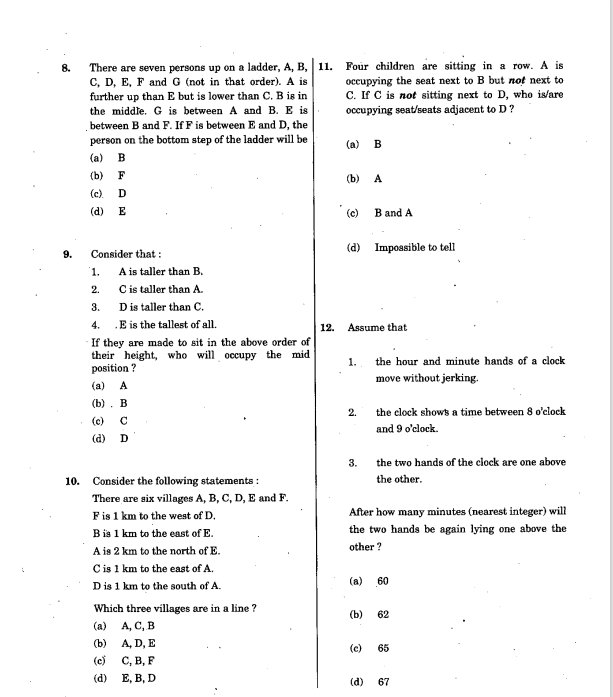
Most of the aspirants don’t think about CSAT preparation until the fag end of UPSC Prelims only because it’s a qualifying paper. You have to get 33% of total marks i.e 66 marks to be clear Prelims. Failure to do so, will prevent you from writing Mains even if you have scored above 100+ marks in the GS Paper.
Since the last two years, the English Comprehension passages are getting lengthier and the Mathematical questions trickier. Let’s take a look at the 2012 CSAT Paper and compare it with the 2021 CSAT paper.
2014 CSAT Paper
Here the questions are asked chapter by chapter and are basic-to-moderate. Questions are direct and straightforward without much combination numerals.
2021 CSAT Paper
There is no particular order of questions asked. Immediately after LR questions, we have a question on time and distance. Also the questions are moderate-to-advanced. One cannot find out the answer in first glance itself. There is no one-size fits for all approach or a uniform formula by which you can crack the sequential questions.
Free Open to All CSAT Session by Civilsdaily Mentor Ravi Sir
If you have to clear the paper, then you have to attempt atleast 50 questions out of 80. Out of these 50 questions, 27 need to be right. There is also negative marking of 1.5 marks for every wrong answer. Hence, for aspirants from a non-mathematics background the challenge lies in practising for CSAT without reducing time for GS Preparation.
Do you want to know how you can complete both the lengthy comprehension passages and tricky mathematical questions within the stipulated time? Then it’s time you attended Civilsdaily Mentor Ravi sir’s webinar on Sunday.
Ravi sirhas cleared UPSC Prelims six times and attended the Interview round thrice. As a mentor, Ravi sir is a lifelong UPSC aspirant because he daily reads, checks and evaluates the right study materials for his students. On Monday, he will conduct a session on CSAT which is free for every aspirant to attend. All you have to do is register yourself for the session.
Key Takeaways in the CSAT Session Conducted by Ravi Sir
1. Topic-wise live demonstration on how to solve problems.
2. Examples of easy, moderate and advanced questions to solve.
3. Variety of questions under each topic.
4. Previous year question paper analysis from 2013 onwards. How to be ready for the new paper pattern.
5. Books one can refer for CSAT test series practice and to understand the concepts.
6. How to practice CSAT without compromising on GS paper studies.
7. Topic-wise weightage in Quantitative Aptitude.
8. Ravi sir will solve your doubts in a Q&A discussion towards the end of the session.
Webinar Details
If you want to know the secrets of finishing the CSAT paper in 2 hours, then this webinar is for you! We hope this webinar will help all 2022 aspirants implement the suggestions of Ravi sir
Most of the aspirants don’t think about CSAT preparation until the fag end of UPSC Prelims only because it’s a qualifying paper. You have to get 33% of total marks i.e 66 marks to be clear Prelims. Failure to do so, will prevent you from writing Mains even if you have scored above 100+ marks in the GS Paper.
Since the last two years, the English Comprehension passages are getting lengthier and the Mathematical questions trickier. Let’s take a look at the 2012 CSAT Paper and compare it with the 2021 CSAT paper.
2014 CSAT Paper
Here the questions are asked chapter by chapter and are basic-to-moderate. Questions are direct and straightforward without much combination numerals.
2021 CSAT Paper
There is no particular order of questions asked. Immediately after LR questions, we have a question on time and distance. Also the questions are moderate-to-advanced. One cannot find out the answer in first glance itself. There is no one-size fits for all approach or a uniform formula by which you can crack the sequential questions.
Free Open to All CSAT Session by Civilsdaily Mentor Ravi Sir
If you have to clear the paper, then you have to attempt atleast 50 questions out of 80. Out of these 50 questions, 27 need to be right. There is also negative marking of 1.5 marks for every wrong answer. Hence, for aspirants from a non-mathematics background the challenge lies in practising for CSAT without reducing time for GS Preparation.
Do you want to know how you can complete both the lengthy comprehension passages and tricky mathematical questions within the stipulated time? Then it’s time you attended Civilsdaily Mentor Ravi sir’s webinar on Sunday.
Ravi sirhas cleared UPSC Prelims six times and attended the Interview round thrice. As a mentor, Ravi sir is a lifelong UPSC aspirant because he daily reads, checks and evaluates the right study materials for his students. On Monday, he will conduct a session on CSAT which is free for every aspirant to attend. All you have to do is register yourself for the session.
Key Takeaways in the CSAT Session Conducted by Ravi Sir
1. Topic-wise live demonstration on how to solve problems.
2. Examples of easy, moderate and advanced questions to solve.
3. Variety of questions under each topic.
4. Previous year question paper analysis from 2013 onwards. How to be ready for the new paper pattern.
5. Books one can refer for CSAT test series practice and to understand the concepts.
6. How to practice CSAT without compromising on GS paper studies.
7. Topic-wise weightage in Quantitative Aptitude.
8. Ravi sir will solve your doubts in a Q&A discussion towards the end of the session.
Webinar Details
If you want to know the secrets of finishing the CSAT paper in 2 hours, then this webinar is for you! We hope this webinar will help all 2022 aspirants implement the suggestions of Ravi sir
The footprint of the Covid-19 pandemic across the sectors of the economy has instilled a new reckoning for resilience and sustainability on the economic, social and environmental (ESG) front.
IPCC reports suggest adaption for resilience
The Intergovernmental Panel on Climate Change (IPCC) published its latest report on climate impacts, vulnerability and adaptation last month.
The report suggests that adaptation to climate impacts in the near to medium term can help communities and ecosystems become resilient against the threats from current and future levels of warming.
Ecosystem-based adaptation, for instance, is recommended for taking care of communities and social well-being, while restoring forests, lands and marine ecosystems.
The report details the variability in projected climate impacts and the vulnerabilities that can be expected across regions the world over due to differences in the range of warming, geographical location, demographics and the unique biophysical, social and cultural contexts.
Cost-effective adaptation: It depends on a host of enablers on which global partnerships need to deliver.
Enablers include international cooperation, inclusive technology, financial flows, knowledge sharing and capacity building, with institutions and innovations to support policy development and on-ground implementation.
Gaps in the literature, acknowledge the uncertainties in climate science
The IPCC has been consistently drawing attention to the lack of adequate science from and on developing countries.
These countries have in turn been asking for the inclusion of what is broadly termed as “grey literature” or non-peer-reviewed literature in the IPCC process.
Good science encompasses the formal and the informal, theory and empiricism, the traditional along with the modern.
It relies on evolution through acknowledging the gaps and unknowns, the negatives and positives of past knowledge.
The understanding of adaptation finance, adaptation costing, and mapping of climate impacts and adaptation needs of communities in geographically remote locations, for instance, could improve with suitable sourcing of information.
Way forward
Sustainable development, inclusive of climate resilience, calls for an ensemble approach — one that places contextually appropriate emphasis on tackling climate change impacts and development needs in a world with growing challenges.
The pathway to be adopted is one of an integrated risk assessment approach, where solutions are interventions that impact the immediate, near and medium-term outcomes for developing economies.
Striking the right balance is at any time a choice driven as much by enablers (capabilities, lifestyles and values, financial flows, technical know-how) as by constraints (warming levels, poverty, inequality, lack of health and education).
Conclusion
The pandemic highlighted the need for balance in nature-people relationships, even as it tested the ability of the developing world.
After beating lakhs of aspirants to be among the top two thousand UPSC candidiates, you might think the final round would be a breezer and requires no prior preparation. For someone who has prepared current affairs intensively for a year, they feel that they can answer the questions in the interview rounds impromptu.
However, let’s not forget that though the amount of competition decreases substantially in the interview round so much that you have 50% chances of clearing it, the quality of competition increases. You are set up against those aspirants whose average score in Mains is between 900-1000 marks. Most of the candidates fall in this marks bracket. The only way you can create a difference, is by performing exceeding well in the interview.
To understand how seriously Civilsdaily conducts its UPSC mock interviews, watch this video.
Why Mock Interviews Are a Better Way to Practice Than By Yourself or With Your Friends?
Rahul Reddy AIR 218, 2020 tries his best to answer international crisis issues in a diplamtic way
So, how can you practice for Interview round before you attend it? Does it have to be with friends or in front of the mirror? Remember, the most effective option is the one where you are simulating an actual UPSC interview enviornment. .
Casual DAF-II filling can cost you a UPSC attempt and thus, you must start your preparation with DAF II curation. The aspirants who have cleared UPSC Mains 2021 can register for our interview support program without any fee (FREE).
The purpose of mock interviews is to refine your approach, attitude and aptitude to excel in UPSC’s personality test. Mock interviews must support your quest at excelling in the final interview. You must be ready to tackle unexpected questions with your knowledge. You must have a solid opinion backed by data and facts for any issue.
That’s why Civilsdaily has brought the free mock interview initiative for all Mains-Qualified aspirants. You can practice as many times you would like before you are perfect. If you want to analyse your performance, we will share the video for your reference.
Here Are the Distinguished Panellists of Civilsdaily Mock Interview 2022
AIR 268 Nitish Rajora answers questions on Indian Economy with ease
One of the major advantages of attending the free mock interviews of Civilsdaily is that you will gain exposure to some of the finest bureaucrats retired as well as working, subject matter experts, psychoanalysts and faculty members. Our panellists have direct experience in recruitment and personality analysis.
1. Mr. Shankar Agarwal (Chairman)– Retired IAS Officer, 1980 Batch, Uttar Pradesh Cadre. Last held position: Joint Secretary for the Government of India.
The Union Minister of State for Home Affairs introduced the Criminal Procedure (Identification) Bill 2022.
Purpose of the introduction of the Bill
The Bill aims to replace the Identification of Prisoners Act 1920 that has been in need of amendment for several decades.
The criticism and the need for amendment was predominantly in respect of the limited definition of ‘measurements’ as under that Act.
Back in the 1980s, the Law Commission of India (in its 87th Report) and the Supreme Court of India in a judgment titled State of U.P. vs Ram Babu Misra had nearly simultaneously suggested the need to amend the statute.
What are the issues with the provisions in the Bill?
1] Definition of ‘measurement’ includes analysis of the data
The definition of measurements is not restricted to taking measurements, but also their “analysis”.
The definition now states “iris and retina scan, physical, biological samples and their analysis, behavio[u]ral attributes including signatures….”
It goes beyond the scope of a law that is only designed for taking measurements and could result in indirectly conferring legislative backing for techniques that may involve the collection of data from other sources(For instance, using facial recognition).
At present there are extensive facial recognition technology programmes for “smart policing” that are deployed all across the country.
Such experimental technologies cause mass surveillance and are prone to bias, impacting the fundamental rights of the most vulnerable in India.
2] Power of the police and prison officials widened
The existing law permits data capture by police and prison officers either from persons convicted or persons arrested for commission of offences punishable with a minimum of one year’s imprisonment.
Parallel powers are granted to judges, who can order any person to give measurements where it is in aid of investigation.
While the judicial power is left undisturbed, it is the powers of the police and prison officials that are being widened.
The law removes the existing — albeit minimal — limitation on persons whose measurements could be taken.
It is poised to be expanded to all persons who are placed under arrest in a case.
Here, the proposed Bill also contains muddied language stating that a person, “may not be obliged to allow taking of his biological samples”.
3] Storage and retention of data for a long period
The National Crime Records Bureau (NCRB) shall for a period of 75 years from the date of collection maintain a digital record, “in the interest of prevention, detection, investigation and prosecution of any offense”.
The provision permits the NCRB to, “share and disseminate such records with any law enforcement agency, in such manner as may be prescribed”.
The NCRB already operates a centralised database, namely the Crime and Criminal Tracking Network & Systems (CCTNS), without any clear legislative framework.
The existence of such legislative power with a technical framework may permit multiple mirror copies and parallel databases of the “measurements” being stored with law enforcement, beyond a State Police department which will be prosecuting the crime and the NCRB which will store all records centrally.
For instance, in response to a Standing Committee of Parliament on police modernisation, Rajasthan has stated that it maintains a ‘RajCop Application’ that integrates with “analytics capabilities in real-time with multiple data sources (inter-department and intra-department)”.
Similarly, Punjab has said that the “PAIS (Punjab Artificial Intelligence System) App uses machine learning, deep learning, visual search, and face recognition for the identification of criminals to assist police personnel.
Hence, multiple copies of “measurements” will be used by State government policing departments for various purposes and with experimental technologies.
This also takes away the benefit of deletion which occurs on acquittal and will suffer from weak enforcement due to the absence of a data protection law.
The end result is a sprawling database in which innocent persons are treated as persons of interest for most of their natural lives.
Conclusion
To protect individual autonomy and fulfil our constitutional promises, the Supreme Court of India pronounced the Justice K.S. Puttaswamy judgment, reaffirming its status as a fundamental right. The responsibility to protect it falls to each organ of the government, including the legislature and the union executive.

![[Very Important] Target Prelims 2022|| Learn Over 10 different types of Question solving Techniques || Free Webinar by Mentors of 400 UPSC-CSE Toppers, Sajal Sir || Limited Slots](https://d18x2uyjeekruj.cloudfront.net/wp-content/uploads/2022/04/5_6212758279148274812.jpg)






![UPSC 2021 Free Mock Interview [LAST 2 SLOTS] || Unlimited Practice Sessions with India’s Most Experienced & Eminent IAS Interview Panel|| Limited Slots Available, Register Now](https://d18x2uyjeekruj.cloudfront.net/wp-content/uploads/2022/03/Interview-2.jpg)
