💥UPSC 2026, 2027, 2028 UAP Mentorship (March Batch) + Access XFactor Notes & Microthemes PDF

Search results for: “”

  • [Burning Issue] Political Crisis in Pakistan

    UPSC 2022 countdown has begun! Get your personal guidance plan now! (Click here)

    Context

    Pakistan’s opposition parties are ready to move a no-confidence vote against Prime Minister Imran Khan. The country is facing a recurring financial crisis and Khan is accused of mismanaging the economy.

    What is the real issue?

    • Anger against the govt: Pakistan’s economy was already facing a crisis that Khan has been unable to resolve. He has been accused of mismanaging the economy and the country’s foreign policy.
    • Pakistan military’s stance: When Khan came to power, he had the complete support of the military. As pressure grows on Khan, Pakistan’s powerful military is said to have withdrawn support to the government.
    • Support within his government: Ahead of the crucial no-confidence vote, Khan’s cabinet ministers are resigning. Khan is losing support quickly and it is unlikely that he will survive the no-confidence vote.

    Pakistan has a history of political crisis

    • Political instability has been endemic with the country alternating between military interventions and civilian rule.
    • Inherent motives of elite class: Reforms that could have transformed the country and placed its economy on a high-growth were repeatedly postponed as they would have threatened the ruling elite’s privileges and hold on power.
      • Complicating the quest to address persistent economic, governance and security challenges was the impact of global and regional developments.
    • Reasons for the political conflict in Pakistan: The political conflict in Pakistan is because of the gap between –
      1. the modern state and traditional society,
      2. between institutional design and practice and
      3. between “a ‘Western’ framework of authority and Islamic norms and practices”.
    • Governance failures and the ruling elite’s resistance to reform have marked Pakistan’s political history.
    • An Establishmentarian Democracy: Pakistan’s present hybrid regime is democratic only in form and not substance. There is also a long history of manipulation of elections by extra-parliamentary forces to shape outcomes.

    Pakistan leaning toward a failed state

    • Advance by Taliban: Concerns about stability in Pakistan became more acute when the Taliban began their advance out of Swat towards Punjab. The Taliban had come within 100 miles of Islamabad.
    • A collapsed Pakistan will be a nightmare for the US and the region: The US fears that Al Qaeda could launch attacks against the US from Pakistani territory.
      • An even greater fear is that Pakistani nuclear weapons may fall into the hands of radicals. Thus, it is imperative for the US to stabilize Pakistan.
    • Pakistan’s approach towards terrorism: Despite military action against the Taliban, Pakistan’s attitude towards terrorism remains ambiguous.
      • It has done precious little to bring to book the perpetrators of the Mumbai terror attacks. Terror groups from Punjab and PoK are regarded as assets against India.
    • Seeds of long-term instability have sown: The military has once again become stronger after the Swat operations although.
      • The army has about 20 per cent Pushtuns. The operations against the Taliban who are also Pushtuns may affect the morale within the army.

    Failure of CPEC

    • China has played the game: China will largely be benefitted by CPEC at the cost of Pakistan. Pakistan is slowly moving towards a financial doomsday.
    • Negative Economic Growth of Pakistan: Almost half of the time has passed and CPEC has not been able to contribute even a single penny towards the GDP of Pakistan.
      • At the same time, Chinese debts are mounting and the re-payment of these loans and interests is causing holes in the Pakistan economy.
      • CPEC failed to generate even a single job except for casual labour for the construction of some of the projects.
    • No accountability for delay/cost escalations: Except early harvest power projects, not even a single CPEC project was completed in time. Each and every project is running late with major cost escalations.
    • Ceding of strategic assets: Pakistan has already ceded two islands and is in the process of ceding a few more assets including the entire Gwadar Free Trade Zone to China.
      • In mid-2020, Pakistan also gave total mining rights at its Saindak Mines to China at a throwaway price of just 350 Million USD.
    • Military Aspects of CPEC: Military have been ruling the country ever since its inception in 1947 and will continue to do so.
      • Also, Pakistan is facing the wrath of US and other international powers because of its involvement in terror-related activities.
      • Pakistan needs military hardware and at this point of time, China is the only source.
    • Industrial output in Chinese Hands: China is slowly acquiring Pakistani industries.
      • As such there is negative growth in the Industrial output of Pakistan in the last 5 years, handing over key industries to China will invariably put China in the driving seat of its economic growth.
      • China is never going to use it for benefit of Pakistan but will make all efforts to achieve maximum profits in the least possible time. It will put a serious strain on Pakistan’s Economy and overall GDP.
    • Pakistan is fast turning into a Chinese colony: China is known for its aggressive policies and debt-trap diplomacy. Their union has created a serious impact on the foreign relations of Pakistan.
      • Recently, Pakistan lost all its rapport among the Organisation of Islamic Co-operation (OIC) especially Saudi Arabia and UAE and one of the major reasons is the dirty association of China-Pakistan.

    Balochistan’s Uprising

    • During the British withdrawal from the Indian subcontinent, the Kingdom of Balochistan was given the choice of joining India, Pakistan, or remaining independent.
    • Balochistan’s king chose to remain independent, and the country did remain independent for over a year.
    • In 1948, the Pakistani government used a combination of military and diplomatic means to seize control of the region and incorporate it into Pakistan.
    • The insurgency in Balochistan has been active since 1948, owing to a lack of development and the human rights violations in the province by the Pakistani military and terror groups.
    • Pakistan claims that India has provided arms and intelligence to these rebel fighters.

    Back to Basics: About Balochistan

    • Balochistan is one of Pakistan’s four provinces. Despite being the largest province in terms of land area, it is the least populated.
    • It is populated by ethnic Baloch people who can be found across modern-day Iran and Afghanistan, while Balochistan has the majority of the Baloch population.
    • Balochistan is one of Pakistan’s most important areas, rich in natural gas and oil reserves.

    India’s position in Balochistan

    • India has always maintained a stance of not intervening in Pakistan’s or any other country’s internal affairs.
    • Despite Pakistan’s repeated references to the Kashmir issue over the years, India has remained silent on the Balochistan issue.
    • In 2016, however, comments about Balochistan were made in the immediate aftermath of Pakistan’s Independence Day celebrations, which were dedicated to the independence of Kashmir.
    • The government of India is now making an issue of annexed areas like Baluchistan should be given back to their people along with independence.
    • It is now for the first time taking about such issues a bold step in the right direction, and gets their people the human rights denied to them for long. Pakistan and its Army has not dreamt of this changed India.
    • By invoking Balochistan freedom struggle, PM targeted both Pakistan & China, whose CPEC depends on safe passage from Gwadar.

    Area of conflict with Afghanistan

    • Durand line conflict: Durand line is separating Afghanistan and Pakistan, forced by the British dividing the Pashtun people between Pakistan and Afghanistan, is not endorsed by any Afghan government including the Taliban.
    • Independent Pashtunistan can also soon be a reality with areas from Afghanistan and Pakistan making up their country. The Pashtun people are Sunni Muslims.
    • Independent Kurdistan freedom movement: The actions in the area for an Independent Kurdistan are also having ramifications on freedom movements of other ethnic groups divided by history.
      • The Kurds are much ahead than all other freedom movements in the area, as they are backed by oil wealth from the region under their control.
      • The Kurds are also divided into three parts: one part with Syria, the second part with Turkey and the third part with Iraq.

    Shia-Sunni Divide in Pakistan

    • The origin of Shia–Sunni relations can be traced back to a dispute over the succession to the Islamic prophet Muhammad as a caliph of the Islamic community.
    • After the death of the Islamic prophet Muhammad in 632, a group of Muslims, who would come to be known as the Sunnis, believed that Muhammad’s successor should be Abu Bakr whereas a second group of Muslims, who would come to be known as the Shia, believed that his successor should have been Ali.
    • Recently, thousands of Deobandi followers seen chanting anti-Shia slogans in Pakistan, referring to the community as ‘kafir’ (non-Muslim) and calling upon the state to ban Ashura, the Shias’ main religious event to mourn the death of Prophet Muhammad’s grandson Hussain in 680 AD.
    • The Pakistan government tried to contain any outbreak of violence, because Shias in Pakistan are a sizeable minority. They represent about 21% of the total Muslim population, the highest number in a country after Iran.
    • Violence is inevitable: Deobandi ideology has been given a freer hand, as demonstrated by the passing of the Tahaffuz-e-Bunyad bill in July 2020 in the provincial Punjab Assembly.
      • The bill is problematic due to its lack of consensus on key religious concepts between Sunnis and Shias.
      • Pakistan has reportedly witnessed the killing of approximately 4,847 Shias in incidents of sectarian violence between 2001 and 2018. Karachi saw the targeted killing of Shia doctors and lawyers in 1999, even before 9/11.
      • The Barelvis who are known for greater sympathy with the Shias also seem to have turned against them in recent times.

    The state of Pakistan’s economy

    • Forex and currency crises: Pakistan has repeatedly run into macroeconomic crises- runaway inflation, current account and trade deficits, depleting foreign reserves, and currency devaluations.
    • The two immediate threats to the country’s economy come from the build-up of inflationary pressures, and a payments crisis that stems from a combination of global and domestic factors.
    • Foreign exchange reserves crisis: Pakistan’s Forex reserves are plummeting continuously.
    • Currency devaluation: A persistently high deficit can potentially lead to an excess supply of a country’s currency in its foreign exchange market, which eventually negatively impacts the value of the currency.
    • The IMF bailout: As growth fell and debt services obligations mounted, the country has been faced with a potential balance-of-payments crisis.
      • Pakistan imports most items of domestic consumption, making it more vulnerable to these pressures; the increasing debt servicing obligations have added to the pressure.
      • In exchange for a $6 billion funding package, Pakistan had to commit to structural reforms and reducing public debt. But the funding plan stalled earlier this year over issues related to reform commitments.

    Pakistan Army and the State

    • The army disregarded the development of the people in order to control more assets.
    • In order to justify its existence, it converted Pakistan into a security-seeking State (over-emphasizing the threat from India) where a strong army was considered a necessity for the existence of the country.
    • The first military coup happened early in its history — Pakistan President Iskander Mirza abrogated the Constitution and declared martial law on 27 October 1958, and appointed General Ayyub Khan as chief martial law administrator.
    • After this incident, the army in Pakistan has always been in control. They have controlled defense and external affairs portfolios since then.
    • The Pakistani army is essentially meant to handle external threats, but it is also involved in domestic affairs of the State.

    New dynamic Pakistan has to face

    • As the US withdraws its troops from Afghanistan, Pakistan is eager to build a relationship with Washington that is not tied to US stakes in Afghanistan.
    • Pakistan does not want to be totally alienated from U.S. in the new geopolitical jousting between the US and China.
    • How Pakistan copes with the new dynamic between the US and China as well as manages the deepening crisis in Afghanistan would be of great interest to India.

    Pakistan’s approach to alliances

    • Pakistan’s insecurities in relation to India meant it was eager for alliances.
    •  And as the Anglo-Americans scouted for partners in the crusade against global communism, Pakistan signed a bilateral security treaty with the US and joined the South East Asia Treaty Organisation and Central Treaty Organisation in the mid-1950s.
    • Rather than target Pakistan’s alliance with a West that was intensely hostile to Beijing in the 1950s, Chinese premier Zhou Enlai saw room to exploit Pakistan’s insecurities on India.
    • While Pakistan’s ties with the US went up and down, its relationship with China has seen steady expansion.
    • Pakistan’s relations with the US flourished after the Soviet Union sent its troops into Afghanistan at the end of 1979.
    • The US and Pakistan reconnected in 2001 as Washington sought physical access and intelligence support to sustain its intervention in Afghanistan following the attacks on September 11.
    • Now the US wants Pakistan to persuade the Taliban to accept a peaceful transition to a new political order in Afghanistan.

    Pakistan’s ability to adapt to shifting geopolitical trends

    • Pakistan worries that its leverage in U.S. will diminish once the US turns its back on Afghanistan and towards the Indo-Pacific.
    • Pakistan does not want to get in the Indo-Pacific crossfire between the US and China.
    • It would also like to dent India’s growing importance in America’s Indo-Pacific strategy.
    • India should not underestimate Pakistan’s agency in adapting to the shifting global currents.
    • Pakistan has been good at using its great power alliances to its own benefit.

    Way Forward

    • Despite the democratic elections in Pakistan, the military wields real power in the country. This holds true, especially on matters of defense, national security and foreign policy.
    • Pakistan’s Inter-Service Intelligence (ISI), consisting for personnel from Pakistan Armed Forces, is often accused of supporting and training separatist militant groups operating in India.
    • Thus, a strong political reform in Pakistan, one that focuses on the welfare of the Pakistani nationals is vital to improving its relations with India.
    • There is a need to focus on trade to revive the economy for Pakistan. It need to understand that China is present only for its economic gains and accordingly steps need to be taken.
    • Solutions of the problem of mass illiteracy and economic inequities and the imperatives of national integration and national security will determine the degree of political stability, or instability in Pakistan in future.
    • Support from the IMF and friendly countries like Saudi Arabia, China, and the UAE will only provide some breathing room in the short term to its shattered economy.
    • Promoting manufacturing by creating a more investment-friendly environment, broadening its tax base, and encouraging innovation and modernization in export-led industries are just some of the most urgent measures the government can take to address the growing fiscal and current account deficit.
    • It is essential for Pakistan to do away with supporting terrorism and terrorist activities as the people of Pakistan are becoming the main victims of their policies.

    UPSC 2022 countdown has begun! Get your personal guidance plan now! (Click here)
  • In endgame of Vienna nuclear talks, Tehran holds the cards

    Context

    Iran’s foreign minister during his recent visit to Syria, noted that Iran and the major powers, who have been negotiating a mutual return to the Iran nuclear deal — or the Joint Comprehensive Plan of Action (JCPOA) — over the last eleven months, were closer to an agreement “than ever before”.

    Issues in the negotiation over Iran’s return to JCPOA

    • The ongoing eighth round of talks between Iran and P4+1, has been going on since December 27, 202.
    • These issues remaining are understood to be Tehran’s demand for guarantees against another withdrawal in the future, the verifiable lifting of all US sanctions, and the IAEA investigation into Iran’s past nuclear activities.
    • Guarantees against another withdrawal: On the issue of guarantees against another withdrawal, Iran is no longer demanding legal guarantees from Washington.
    • Lifting all sanctions: Tehran has refused to retreat from its uncompromising stance on the lifting of all US sanctions, while the Biden administration has so far been prepared to lift only those “inconsistent” with the deal.
    • Another key sticking point, though not directly related to the nuclear deal, is Iran’s demand that President Biden reverse his predecessor’s designation of Iran’s Islamic Revolutionary Guard Corps as a Foreign Terrorist Organisation.

    Concerns

    •  Western interlocutors are alarmed by Iran’s shrinking breakout time — the time needed for gathering enough weapons-grade uranium to make a single nuclear warhead.
    • Also, they are concerned that the longer Iran stays outside the agreement, the more nuclear expertise and fissile material it will accumulate, thus making the original deal obsolete.
    • Thus, time is of the essence for reaching an agreement that will turn the clock back on Iran’s nuclear activities.

    Conclusion

    Iran uses its nuclear activities as a bargaining counter to seek an agreement that will best serve its interests. So, the early conclusion of the deal is important to turn the clock back on Iran’s nuclear activities.

    UPSC 2022 countdown has begun! Get your personal guidance plan now! (Click here)


    Back2Basics: What is JCPOA

    • The Joint Comprehensive Plan of Action (JCPOA) is a agreement reached by Iran and the P5+1 (China, France, Germany, Russia, the United Kingdom, and the United States) on July 14, 2015.
    • The nuclear deal was endorsed by UN Security Council Resolution 2231, adopted on July 20, 2015.
    • Iran’s compliance with the nuclear-related provisions of the JCPOA is verified by the International Atomic Energy Agency (IAEA) according to certain requirements set forth in the agreement.
    • Despite Iran’s verified compliance with the deal, the United States unilaterally withdrew from the JCPOA on May 8, 2018, and subsequently re-imposed all U.S. sanctions on Iran lifted by the accord.
    • Then-U.S. President Donald Trump cited the deal’s sunset provisions and its failure to account for Iran’s ballistic missile program, among other things, as impetus for withdrawal from the accord.
  • Do You Know Getting 1-1 Mentorship for UPSC-CSE Increases your Success Rate by 80%? || 41 out of 50 Smash 2021 Mains Aspirants Qualify for Interview|| Need a Personalised Revision Timetable for Prelims 2022?|| Want to Know the 30 Most Important Prelims Topics for Every Subject?|| Then, Register Yourself For Samanvaya Free 1-on-1 Mentorship

    Smash 2021 Mentorship Results

    As UPSC Mains results were announced last week, Sajal sir (Co-Founder of Civilsdaily and Mentor of Smash Mains 2021 Program) was flooded with calls by delighted aspirants who thanked him for his mentorship. Sajal Sir himself is the topper of GS 2017 Mains paper and mentor of 400 UPSC Toppers.

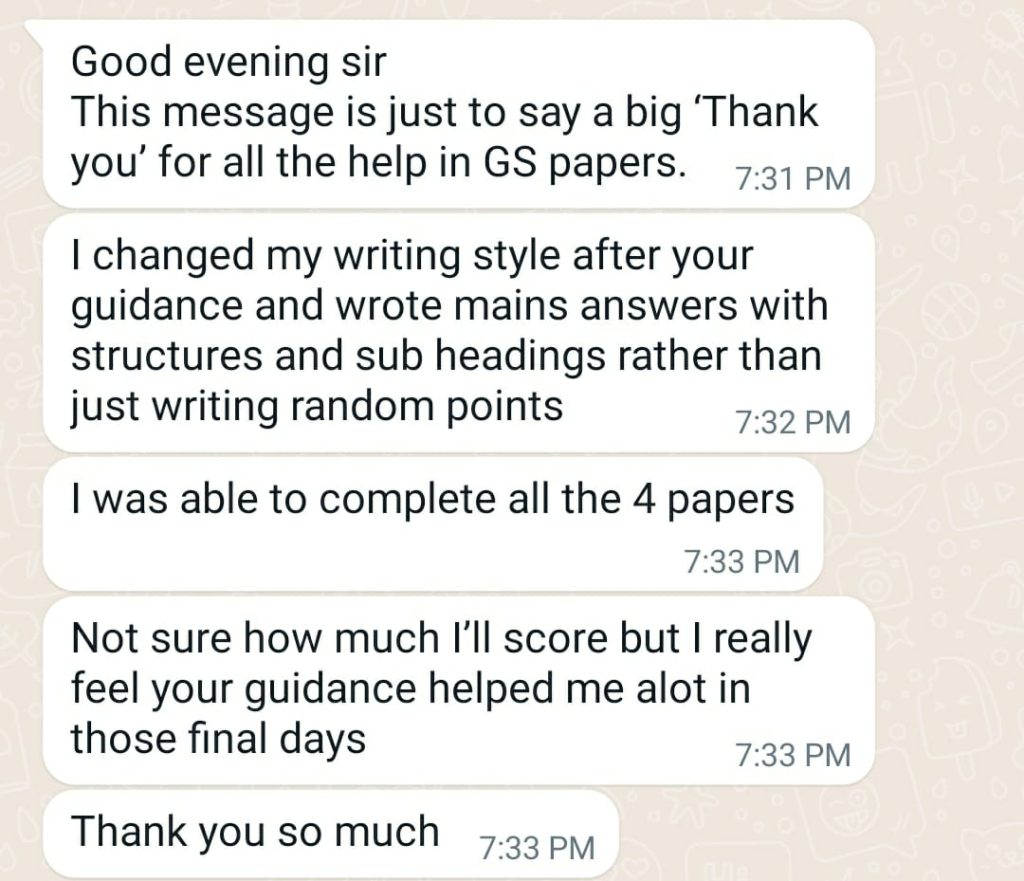
    After a quick check, we found out 41 Smash Mains students are qualified to attend the interview this year. As we are waiting for their interview results, we will not be announcing their names right now. However, we are sharing the testimonials of the qualified aspirants. We wish them all the very best!

    Prelims Must-Read Topics for Every Subject

    As prelims is round the corner, you would have already started your revision. The main purpose of the UPSC prelims exam is to test your conceptual clarity in basic topics and application of current affairs in subject-related questions.  Since the questions in prelims aren’t direct or straightforward, they appear to be outside the standard book and NCERTs.

    Based on our research, we have come up with nearly 30-35 important subject-wise topics for Prelims 2022. In this article, we will be highlighting only 3 topics per subject. Those aspirants interested to get the complete handbook of Must-Read Static+ Current Affairs Prelims Topics can register for our Free 1-on-1 Mentorship Session. Along With the Free Consultation+Handbook, aspirants will Get Free Personalised 60 Days Revision Timetable for Prelims 2022.

    Polity

    1. Important Supreme Court Judgements.

    Revise  important judgements passed by the Supreme Court in the year 2021 along with those mentioned in your polity standard books like Keshvananda Bharati case, Uman Rao Case and Minerva Mills Case. While reading up the reasoning behind the judgements, you will gain clarity of the constitutional provisions. 

    1. Fundamental Rights from Article 12-35

    Every year, a minimum of 2-3 questions mandatorily ask about the basic human rights guaranteed by the constitution, their significance and limitations. Sample these questions from Prelims 2021.

    1. Under the Indian constitution concentration of wealth violates

    (a) The Right to Equality

    (b) The Directive Principles of State Policy

    (c) The Right to Freedom

    (d) The Concept of Welfare

    2. A legislation which confers on the executive or administrative authority an unguided and uncontrolled discretionary power in the matter of the application of law violates which one of the following Articles of the Constitution of India?

    (a) Article 14

    (b) Article 28

    (c) Article 32

    (d) Article 44

    1. Non-constitutional Bodies

    Questions have been consistently asked about the recent developments in the quasi-judicial, statutory and regulatory bodies set up by the state legislatures. Examples include the National Human Rights Commission, National Green Tribunal and National Law Commission. One must be aware of the corresponding laws around which these bodies were established. 

    Economy

    1. Inflation

    Inflation has been a persistent issue that has affected Indians every year. Everytime, there is news on how the RBI plans to tackle the issue or how foreign crises result in inflation of goods in India. Aspirants are expected to understand types of inflation like demand-pull inflation, cost-push inflation and wholesale price inflation. Remedies for inflation can be found in the current affairs section. One can expect 2-3 questions in prelims from this section. The prelims questions would test the conceptual clarity in fiscal policy and inflation.

    1. Money market

    Aspirants are expected to have a general and not specialized knowledge on the financial instruments with high liquidity and short term maturities. The different kinds of credit that exist for different sections of the society needs to be read. 

    1. GDP Estimates

    Every year one question in prelims is about the GDP estimates of a particular year. While reading this topic, aspirants must note down the department that releases this report, the difference between GDP and GVA and the Index of Industrial Production (IIP).

    Environment 

    1. Environment Conventions from 1980s onwards

    Aspirants are expected to make micronotes from the standard books they are reading on the role of international institutions in combating environmental pollution through conventions, acts and policies. Examples of such conventions are Stockholm convention, Ramsar Convention, CITES etc. 

    1. Biogeochemical cycles

    Aspirants need to be familiar with the process of biogeochemical cycle, the types of biogeochemical cycle and the significance of the same. Questions around this are typically direct and straightforward. 

    1. Mapping of national parks, wildlife sanctuaries and wetlands

    Every year, aspirants definitely get 3-5 fact based questions on national parks. Some of these questions could be asked due to a recent development in a particular park. For example, the Chilika Lake wetland was recently in news in January due to migratory birds like the Mongolian Gull staying there. The Chilika Lake is the first wetland of international importance under Ramsar convention. Certain aspects the aspirants must note down are the areas where the particular national park or wetland is spread across, the major attractions, the economic and social significance of the place. 

    Social Issues and Government Schemes

    1. Reports and Indices

    Any report released by an international organisation on the performance of India against other countries under certain parameters must be revised. This includes The Global Hunger Index, World Happiness Report and Human Development Index.

    1. GOI schemes for 2021

    Ranging from agriculture, education, MSMEs, vulnerable sections and banking, aspirants need to have awareness on government initiatives in 2021. This will make it easier for them to solve indirect questions as well. 

    Science and Technology

    1. Electric Vehicles:
      India’s commitment towards electric vehicles and COP26 of Glasgow might be areas where prelims questions would be asked. Aspirants should understand the various measures to develop and promote the EV ecosystem in the country such as Faster Adoption and Manufacturing of Electric Vehicles (FAME II) scheme, Production-Linked Incentive (PLI) scheme for Advanced Chemistry Cell (ACC) and the recently launched PLI scheme for Auto and Automotive Components for manufacturers of electric vehicles.
    1. Dark Genome 

    This is a hot topic in DNA research and aspirants must understand why research in this area is essential for treatment of diseases. Questions on genetics can be expected from Prelims this time. 

    1. Emerging technologies (5G, AI, Machine learning)

    In recent years, a lot of questions have appeared about the latest developments in technology, their discoveries and the latest theories related to them. Few of these technologies are 5G, Quantum Key Distribution technology, hydrogen fuel cell etc. Aspirants must micronotes on these topics from prelims perspective. 

    Indian Geography

    1. Maps

    Aspirants must practice places in the Indian Map on a regular basis. Particularly, they must  focus on himalayan rivers like Ganga, Brahmaputra and Yamuna, peninsular rivers like Damodar, Mahanadi, Godavari, Krishna, Kaveri and Periyar. Not only rivers, but aspirants must know where exactly their tributaries are located. Apart from this, North to South Alignment of Mountains in Eastern ghat and Western Ghat, Andaman, Nicobar and Lakshadweep islands and Industrial Location and Ports need to be marked. 

    1. Climatic Regions in India

    Aspirants must learn about the onset and withdrawal of the Indian Monsoon system, tropical cyclones, different climatic zones, factors that cause shifts in climate and intertropical convergence zone. 

    1. Continental Shift Theory

    Present in the NCERT textbooks, this theory talks about the formation of different continents. Aspirants must keep an eye for one or two questions that might come from this topic in the Geography section. 

    Want to Know How a Free 1-on-1 Mentorship Looks Like? Watch This Video

    In this video, there is first an initial discussion of the test performance, which is then followed by the mentor discussing the questions which the aspirant had got wrong and then he will ask the aspirant, where did he study the topic and to share the notes he made on that topic. The mentor will find out the problem and suggest the correct method of studying the topics. After the session gets over, the aspirant has to study the topics where he couldn’t score high marks in polity. After this, the next day the mentor will conduct another test only on those topics. This way the aspirant gains an understanding on how to approach the whole subject of polity.

  • 28th March 2022| Daily Answer Writing Enhancement(AWE)

    Topics for Today’s questions:

    GS-1         Modern Indian History

    GS-2        Effect of policy and politics of world on India’s interests

    GS-3        Cyber Security

    GS-4        Probity in Governance, Code of Ethics, Code of Conduct

    Question 1)


    Q.1 Explaining the reasons behind partition of Bengal, discuss the successes and limitations of the Swadeshi movement launched in its wake. (15 Marks)


    Question 2)

    Q.2 How does foreign policy influence our lives at personal and collective levels? (10 Marks)

    Question 3)

    Q.3 What are the issues with the Draft India Data Accessibility and Use Policy 2022? ? Suggest the way forward. (10 Marks)

    Question 4)  

    Q.4 It is imperative for a country like India, that code of ethics should be implemented for civil servants on social media platforms as well. Discuss. (10 Marks)


    HOW TO ATTEMPT ANSWERS IN DAILY ANSWER WRITING ENHANCEMENT(AWE)?

    1. Daily 4 questions from General studies 1, 2, 3, and 4 will be provided to you.

    2. A Mentor’s Comment will be available for all answers. This can be used as a guidance tool but we encourage you to write original answers.

    3. You can write your answer on an A4 sheet and scan/click pictures of the same.

    4.  Upload the scanned answer in the comment section of the same question.

    5. Along with the scanned answer, please share your Razor payment ID, so that paid members are given priority.

    6. If you upload the answer on the same day like the answer of 11th  February is uploaded on 11th February then your answer will be checked within 72 hours. Also, reviews will be in the order of submission- First come first serve basis

    7. If you are writing answers late, for example, 11th February is uploaded on 13th February , then these answers will be evaluated as per the mentor’s schedule.

    8. We encourage you to write answers on the same day. However, if you are uploading an answer late then tag the mentor like @Staff so that the mentor is notified about your answer.

    *In case your answer is not reviewed, reply to your answer saying *NOT CHECKED*. 

    1. For the philosophy of AWE and payment: 

  • Q.4 It is imperative for a country like India, that code of ethics should be implemented for civil servants on social media platforms as well. Discuss. (10 Marks)

    Mentor’s Comments-

    • Briefly define code of ethics.
    • Then with examples bring out the need for implementation of code of ethics for civil servants on
      social media platforms.
    • Then give a brief idea about what should be the code of ethics in this context.
    • Then discuss why a balanced approach is required in this context.
  • Q.3 What are the issues with the Draft India Data Accessibility and Use Policy 2022? ? Suggest the way forward. (10 Marks)

    Mentor’s comment-
    • https://www.thehindu.com/opinion/op-ed/forging-a-social-contract-for-data/article65259953.ece
    • In the intro, mention that the Draft policy aims at providing a robust scaffolding for harnessing public sector data for informed decision-making, citizen-centric delivery of public services, and economy-wide digital innovation.
    • In the body, mention the issues such as ignoring the canons of RTI as the draft confines transparency of public data to non-personal data sets, lack of the trusteeship paradigm recommended by the 2020 Report of the MEITY Committee of Experts on non-personal data governance. In the way forward mention creating conditions for voluntary data sharing, mandatory data-sharing arrangement, creation of institutional mechanism etc.
    • Conclude by mentioning the need to take into account these factor while finalising the policy.
  • Q.2 How does foreign policy influence our lives at personal and collective levels? (10 Marks)

    Mentor’s comment-
    • https://indianexpress.com/article/opinion/columns/foreign-policy-must-also-make-a-difference-at-home-india-china-russia-ukraine-7836635/
    • In the intro, mention that the operation Ganga recently carried out to evacuate students from Russia.
    • In the body mention that foreign policy is a link to the outside world. At a personal level foreign policy comes into play from getting visa to access to foreign markets, receiving information about regulations and practices, for the professionals and workers, this may be visible in ensuring fair employment contracts, a stronger sense of protection and welfare measures in times of difficulty. At the collective level, it helps in furthering security, economic well being, technology etc.
    • Conclude by mentioning that a good foreign policy must work for us all and our everyday needs from the world must be better met.
  • Q.1 Explaining the reasons behind partition of Bengal, discuss the successes and limitations of the Swadeshi movement launched in its wake. (15 Marks)

    Mentor’s Comments-

    • Briefly mention how and when the Bengal partition was carried out.
    • Give reasons, official and real, for the partition of Bengal.
    • Explain the successes and limitations of the Swadeshi movement launched after the Bengal partition.
    • Conclude by highlighting the importance of Swadeshi movement in terms of lessons learnt.
  • Self reliance in Agriculture

    Context

    For the Amrit Kaal (next 25 years) that the government has announced, we need to be self-reliant not just in missiles (defence equipment) but also in meals (food).

    What does self-reliance in food mean?

    • Its true meaning lies in specialising in commodities in which we have a comparative advantage, export them, and import those in which we don’t have a significant comparative advantage.
    • Self-reliance in food does not mean that we have to produce everything ourselves at home, irrespective of the cost.
    • If some protection is needed for new areas to develop (infant industry argument), that may be okay.
    • But one should not aspire to be self-sufficient behind high tariff walls.

    Importance of agri-R&D

    • What is it that gives a country an edge over others in attaining comparative advantage?
    • There is ample literature to show that agri-R&D raises total factor productivity and makes agriculture more competitive globally.
    • If India wants to be fully self-reliant in food, it is generally agreed that it must invest at least 1 per cent of its agri-GDP in agri-R&D.
    • The Economic Survey (2021-22) explicitly highlighted the correlation between spending on agri-R&D and agricultural growth.
    • Low expenditure on agri-R&D: But the budgets of both the Union government and the states put together reveal that this expenditure on agri-R&D and education hovers around 0.6 per cent of agri-GDP.
    • This is way below the minimum cut off point of 1 per cent and government policy must urgently work towards raising this substantially.
    • There are some global and local companies like Bayer, Syngenta, MAHYCO, Jain Irrigation, and Mahindra and Mahindra that spend a considerable amount of their turnover on R&D programmes and developing high-tech inputs.
    • The USP of these companies is that they develop technology that increases productivity while addressing the current challenges of limited net sown area, depleting water resources, vulnerability to climate change, and the need to produce nutrient-rich food.

    Way forward

    • Role of private sector: The private sector need to come forward and help India attain supremacy in agri-R&D and innovation systems and a hub for exports and agri-technology.
    • Increase expenditure on Agri-R&D and education: The need of the hour is to focus on increasing expenditure on ARE and other development projects, which can aid in the sustainable growth of the agriculture sector.
    • India’s budget allocations in the agri-food space should thrive on creating “more from less”.
    • There is a need to work on building long-term sustainable solutions that have an aggressive approach to implementing relevant policies and developing new ones.
    • India’s current budgetary allocation strategy and trends need to be reoriented to ensure that there is more room for R&D expenditure by the government.
    • Incentivise private companies for R&D: In addition to this, the government should come out with policies that incentivise private companies to expand their R&D programmes and invest more financial resources on development projects, which have the potential to overcome the challenges of the current agrarian setup of India.

    Conclusion

    If India wants to be fully self-reliant in food, it must focus on agri-R&D and increase allocation in the Budget.

    UPSC 2022 countdown has begun! Get your personal guidance plan now! (Click here)

  • Do You Know Getting 1-1 Mentorship for UPSC-CSE Increases your Success Rate by 80%? || 41 out of 50 Smash 2021 Mains Aspirants Qualify for Interview|| Need a Personalised Revision Timetable for Prelims 2022?|| Want to Know the 30 Most Important Prelims Topics for Every Subject?|| Then, Register Yourself For Samanvaya Free 1-on-1 Mentorship

    Smash 2021 Mentorship Results

    As UPSC Mains results were announced last week, Sajal sir (Co-Founder of Civilsdaily and Mentor of Smash Mains 2021 Program) was flooded with calls by delighted aspirants who thanked him for his mentorship. Sajal Sir himself is the topper of GS 2017 Mains paper and mentor of 400 UPSC Toppers.

    After a quick check, we found out 41 Smash Mains students are qualified to attend the interview this year. As we are waiting for their interview results, we will not be announcing their names right now. However, we are sharing the testimonials of the qualified aspirants. We wish them all the very best!

    Prelims Must-Read Topics for Every Subject

    As prelims is round the corner, you would have already started your revision. The main purpose of the UPSC prelims exam is to test your conceptual clarity in basic topics and application of current affairs in subject-related questions.  Since the questions in prelims aren’t direct or straightforward, they appear to be outside the standard book and NCERTs.

    Based on our research, we have come up with nearly 30-35 important subject-wise topics for Prelims 2022. In this article, we will be highlighting only 3 topics per subject. Those aspirants interested to get the complete handbook of Must-Read Static+ Current Affairs Prelims Topics can register for our Free 1-on-1 Mentorship Session. Along With the Free Consultation+Handbook, aspirants will Get Free Personalised 60 Days Revision Timetable for Prelims 2022.

    Polity

    1. Important Supreme Court Judgements.

    Revise  important judgements passed by the Supreme Court in the year 2021 along with those mentioned in your polity standard books like Keshvananda Bharati case, Uman Rao Case and Minerva Mills Case. While reading up the reasoning behind the judgements, you will gain clarity of the constitutional provisions. 

    1. Fundamental Rights from Article 12-35

    Every year, a minimum of 2-3 questions mandatorily ask about the basic human rights guaranteed by the constitution, their significance and limitations. Sample these questions from Prelims 2021.

    1. Under the Indian constitution concentration of wealth violates

    (a) The Right to Equality

    (b) The Directive Principles of State Policy

    (c) The Right to Freedom

    (d) The Concept of Welfare

    2. A legislation which confers on the executive or administrative authority an unguided and uncontrolled discretionary power in the matter of the application of law violates which one of the following Articles of the Constitution of India?

    (a) Article 14

    (b) Article 28

    (c) Article 32

    (d) Article 44

    1. Non-constitutional Bodies

    Questions have been consistently asked about the recent developments in the quasi-judicial, statutory and regulatory bodies set up by the state legislatures. Examples include the National Human Rights Commission, National Green Tribunal and National Law Commission. One must be aware of the corresponding laws around which these bodies were established. 

    Economy

    1. Inflation

    Inflation has been a persistent issue that has affected Indians every year. Everytime, there is news on how the RBI plans to tackle the issue or how foreign crises result in inflation of goods in India. Aspirants are expected to understand types of inflation like demand-pull inflation, cost-push inflation and wholesale price inflation. Remedies for inflation can be found in the current affairs section. One can expect 2-3 questions in prelims from this section. The prelims questions would test the conceptual clarity in fiscal policy and inflation.

    1. Money market

    Aspirants are expected to have a general and not specialized knowledge on the financial instruments with high liquidity and short term maturities. The different kinds of credit that exist for different sections of the society needs to be read. 

    1. GDP Estimates

    Every year one question in prelims is about the GDP estimates of a particular year. While reading this topic, aspirants must note down the department that releases this report, the difference between GDP and GVA and the Index of Industrial Production (IIP).

    Environment 

    1. Environment Conventions from 1980s onwards

    Aspirants are expected to make micronotes from the standard books they are reading on the role of international institutions in combating environmental pollution through conventions, acts and policies. Examples of such conventions are Stockholm convention, Ramsar Convention, CITES etc. 

    1. Biogeochemical cycles

    Aspirants need to be familiar with the process of biogeochemical cycle, the types of biogeochemical cycle and the significance of the same. Questions around this are typically direct and straightforward. 

    1. Mapping of national parks, wildlife sanctuaries and wetlands

    Every year, aspirants definitely get 3-5 fact based questions on national parks. Some of these questions could be asked due to a recent development in a particular park. For example, the Chilika Lake wetland was recently in news in January due to migratory birds like the Mongolian Gull staying there. The Chilika Lake is the first wetland of international importance under Ramsar convention. Certain aspects the aspirants must note down are the areas where the particular national park or wetland is spread across, the major attractions, the economic and social significance of the place. 

    Social Issues and Government Schemes

    1. Reports and Indices

    Any report released by an international organisation on the performance of India against other countries under certain parameters must be revised. This includes The Global Hunger Index, World Happiness Report and Human Development Index.

    1. GOI schemes for 2021

    Ranging from agriculture, education, MSMEs, vulnerable sections and banking, aspirants need to have awareness on government initiatives in 2021. This will make it easier for them to solve indirect questions as well. 

    Science and Technology

    1. Electric Vehicles:
      India’s commitment towards electric vehicles and COP26 of Glasgow might be areas where prelims questions would be asked. Aspirants should understand the various measures to develop and promote the EV ecosystem in the country such as Faster Adoption and Manufacturing of Electric Vehicles (FAME II) scheme, Production-Linked Incentive (PLI) scheme for Advanced Chemistry Cell (ACC) and the recently launched PLI scheme for Auto and Automotive Components for manufacturers of electric vehicles.
    1. Dark Genome 

    This is a hot topic in DNA research and aspirants must understand why research in this area is essential for treatment of diseases. Questions on genetics can be expected from Prelims this time. 

    1. Emerging technologies (5G, AI, Machine learning)

    In recent years, a lot of questions have appeared about the latest developments in technology, their discoveries and the latest theories related to them. Few of these technologies are 5G, Quantum Key Distribution technology, hydrogen fuel cell etc. Aspirants must micronotes on these topics from prelims perspective. 

    Indian Geography

    1. Maps

    Aspirants must practice places in the Indian Map on a regular basis. Particularly, they must  focus on himalayan rivers like Ganga, Brahmaputra and Yamuna, peninsular rivers like Damodar, Mahanadi, Godavari, Krishna, Kaveri and Periyar. Not only rivers, but aspirants must know where exactly their tributaries are located. Apart from this, North to South Alignment of Mountains in Eastern ghat and Western Ghat, Andaman, Nicobar and Lakshadweep islands and Industrial Location and Ports need to be marked. 

    1. Climatic Regions in India

    Aspirants must learn about the onset and withdrawal of the Indian Monsoon system, tropical cyclones, different climatic zones, factors that cause shifts in climate and intertropical convergence zone. 

    1. Continental Shift Theory

    Present in the NCERT textbooks, this theory talks about the formation of different continents. Aspirants must keep an eye for one or two questions that might come from this topic in the Geography section. 

    Want to Know How a Free 1-on-1 Mentorship Looks Like? Watch This Video

    In this video, there is first an initial discussion of the test performance, which is then followed by the mentor discussing the questions which the aspirant had got wrong and then he will ask the aspirant, where did he study the topic and to share the notes he made on that topic. The mentor will find out the problem and suggest the correct method of studying the topics. After the session gets over, the aspirant has to study the topics where he couldn’t score high marks in polity. After this, the next day the mentor will conduct another test only on those topics. This way the aspirant gains an understanding on how to approach the whole subject of polity.

  • What is the Affinity Test to Identify Scheduled Tribes?

    The Supreme Court wants to fix foolproof parameters to determine if a person belongs to a Scheduled Tribe and is entitled to the benefits due to the community as it is no longer sure about an “affinity test”.

    What is the Affinity Test?

    • Affinity Test is used to shift through anthropological and ethnological traits to link a person to a tribe.
    • There is the likelihood that contact with other cultures, migration and modernization would have erased the traditional characteristics of a tribe.
    • The claim by an applicant that he is a part of a Scheduled Tribe and is entitled to the benefit extended to that tribe, cannot per se be disregarded on the ground that his present traits do not match his tribes.
    • These include peculiar anthropological and ethnological traits, deity, rituals, mode of marriage, death ceremonies, method of burial of dead bodies etc.
    • Worship is an integral part of the life of a community and tribes have specific modes which need to be ascertained by the officers who decide the claims (for ST status).

    Who are the Scheduled Tribes?

    • The term ‘Scheduled Tribes’ first appeared in the Constitution of India.
    • Article 366 (25) defined scheduled tribes as “such tribes or tribal communities or parts of or groups within such tribes or tribal communities as are deemed under Article 342 to be Scheduled Tribes for the purposes of this constitution”.
    • Article 342, which is reproduced below, prescribes procedure to be followed in the matter of specification of scheduled tribes.
    • The first specification of Scheduled Tribes in relation to a particular State/ Union Territory is by a notified order of the President, after consultation with the State governments concerned.
    • These orders can be modified subsequently only through an Act of Parliament.
    • The above Article also provides for listing of scheduled tribes State/Union Territory wise and not on an all India basis.

    What did the Supreme Court say?

    • It has been considered it best to refer the question of fixing the parameters to a larger Bench.
    • The Bench emphasized that the issue was a “matter of importance” when it came to the issuance of caste certificates.
    • The affinity test may be used to corroborate the documentary evidence and should not be the sole criteria to reject a claim the apex court had warned.

    Why discuss this?

    • The Supreme Court has decided to refer the question to a larger Bench for an authoritative decision.
    • It realised that the courts were faced with varied opinions about the efficacy of the affinity test.

    Status of STs in India

    • The Census 2011 has revealed that there are said to be 705 ethnic groups notified as Scheduled Tribes (STs).
    • Over 10 crore Indians are notified as STs, of which 1.04 crore live in urban areas.
    • The STs constitute 8.6% of the population and 11.3% of the rural population.

    Precursor to this Judgements

    • On one side, a full Bench of the Bombay High Court in Shilpa Vishnu Thakur v State of Maharashtra accepted the “relevance and importance of the affinity test”.
    • The full Bench, in a decision in 2009, held that the affinity test was an “integral part” of the verification process for caste certificates.
    • Scrutiny committees could easily determine the authenticity of a claim by running an affinity test on the basis of ethnicity and anthropology.
    • The HC had said that the term ‘affinity’ meant the ‘association’ of the applicant for a caste certificate with a Scheduled Tribe into which he or she has been born.
    • However, two years later, in 2011, the Supreme Court adopted a cautionary note. It indicated that the affinity test may have run its course.


    UPSC 2022 countdown has begun! Get your personal guidance plan now! (Click here)

  • The move to ease Voting for Overseas Citizens

    The Union Government was exploring the possibility of allowing online voting for non-resident Indians (NRI).

    Why in news?

    • The matter of to ease voting for NRIs comes in the wake of a proposal made by the Election Commission of India (ECI).
    • The Law Ministry in November 2020 decided to extend the facility of postal ballots to eligible NRIs for the various State Assembly elections to be held in 2021.
    • The ECI then, had proposed amending the Conduct of Election Rules, 1961, in order to allow this facility.

    NRI vs. OCI

    • The term NRI is a residential status designed by the Income Tax Department of the Indian government and has efficiency only during filing Income Tax returns.
    • On the other hand, OCI is an immigration status or special visa in layman’s language provided to foreign nationals of Indian origin by the Indian government to work or live indefinitely.

    How can overseas voters currently vote in Indian elections?

    • Prior to 2010, an Indian citizen who is an eligible voter and was residing abroad for more than six months, would not have been able to vote in elections.
    • This was because the NRI’s name was deleted from electoral rolls if he or she stayed outside the country for more than six months at a stretch.
    • After the passing of the Representation of the People (Amendment) Act, 2010, eligible NRIs who had stayed abroad beyond six months have been able to vote, but only in person at the polling station where they have been enrolled as an overseas elector.
    • Just as any resident Indian citizen above the age of 18 years) is eligible to vote in the constituency where she/he is a resident, overseas Indian citizens are also eligible to do so.
    • In the case of overseas voters, their address mentioned in the passport is taken as the place of ordinary residence and chosen as the constituency for the overseas voter to enroll in.

    How has the existing facility worked so far?

    • Hike in voters: From merely 11,846 overseas voters who registered in 2014, the number went up to close to a lakh in 2019. But the bulk of these voters (nearly 90%) belonged to just one State — Kerala.
    • Section 20-1A, Part III of the RP Act: It addresses this to some extent by qualifying “a person absenting himself temporarily from his place of ordinary residence shall not by reason thereof cease to be ordinarily resident therein.
    • Proxy provisions: The Bill provided for overseas voters to be able to appoint a proxy to cast their votes on their behalf, subject to conditions laid down in the Conduct of Election Rules, 1961.
    • Electronically Transmitted Postal Ballot System: The ECI then approached the government to permit NRIs to vote via postal ballots similar to a system that is already used by service voters, (a member of the armed Forces of the Union; or a member of a force to which provisions of the Army Act, 1950 (46 of 1950) which is ETPBS. The ECI proposed to extend this facility to overseas voters as well.

    What is ETPBS and how does it function?

    • The Conduct of Election Rules, 1961 was amended in 2016 to allow service voters to use the ETPBS.
    • Under this system, postal ballots are sent electronically to registered service voters.
    • The service voter can then download the ETPB (along with a declaration form and covers), register their mandate on the ballot and send it to the returning officer of the constituency via ordinary mail.
    • The post will include an attested declaration form (after being signed by the voter in the presence of an appointed senior officer who will attest it).
    • The postal ballot must reach the returning officer by 8 a.m. on the day of the counting of results.
    • In the case of NRI voters, those seeking to vote through ETPBS will have to inform the returning officer at least five days after notification of the election.

    Will this facility be available to all overseas voters across countries?

    • There were news reports that the ECI had indicated to the Ministry of External Affairs that it would want postal voting introduced on a pilot basis in non-Gulf countries.
    • But the ECI had asked the Law Ministry to explore the possibility of extending postal ballots to overseas electors and not restrict it to any particular country.
    • In March 2021, the Ministry of External Affairs informed ECI that the implementation could require to overcome “huge logistical challenges” and needs “a realistic assessment of requirements”

    Are postal ballots a viable means of voting?

    • The ETPBS method allowed for greater turnout among service voters in the 2019 Lok Sabha election.
    • With the increasing mobility of citizens across countries for reasons related to work, the postal ballot method has been internationally recognized.
    • A postal ballot mechanism that allows for proper authentication of the ballot at designated consular/embassy offices and an effective postal system should ease this process for NRIs.

    Back2Basics: NRI vs OCI

    Non-Resident Indian (NRI)

    • To mention it, NRI is someone who is not a resident of India.
    • However, the law is much more complicated and must be delved deeper to gain an inclusive insight into the sector.
    • A person is considered a resident of India if he/she has been staying in India for a minimum tenure of 182 days during the previous financial year of a particular year. OR
    • A person living in India for a total of 365 days during the previous four financial years and a minimum of 60 days during the last financial years is considered a citizen for a particular year.
    • Now an NRI or a non-resident of India is eligible to pay charges for only the first two situations, which means either the income received or earned in India.
    • Therefore, the NRI status also influences the enjoyable rights of that person.

    Overseas Citizen of India (OCI)

    • OCI is a card issued by the government of India that denotes that a non-resident or foreigner has been permitted to stay and work within Indian boundaries.
    • Hence, this card provides foreigners with an immigration status without any limited tenure.
    • There are cases where PIOs of specific categories are allowed for OCI cards that have migrated from India to foreign countries (except Pakistan and Bangladesh) if the other government agrees for dual citizenship.
    • An individual holding an OCI card can be an overseas citizen of India in the layman’s language.
    • So an OCI is not a citizen of India, but the Indian government has given the cardholder permission to reside and work within the boundaries of India.
    • Residents migrating from Pakistan and Bangladesh are not eligible for holding the OCI card. Even if their parents are citizens of both countries, the applicants will be denied having an OCI card.


    UPSC 2022 countdown has begun! Get your personal guidance plan now! (Click here)

  • DRDO’s Corner-Shot Weapon System

    A corner-shot weapon system (CSWS), designed and developed by the Defence Research and Development Organisation (DRDO), is at an advanced stage of being inducted by the Central Reserve Police Force (CRPF) and the Jammu and Kashmir police.

    What is CSWS?

    • The CSWS is a special purpose weapon designed by the Armament Research and Development Establishment (ARDE), Pune.
    • It can engage targets located around the corners as the system bends and captures video feed thus saving soldiers from any surprise counter-attack and is best suited for urban, close quarter situations.
    • It is equipped with weapon, camera, laser, infrared illuminator and torch in front portion, while display, electronics, battery and swivelling mechanism are located at rear portion.
    • The body is made from high-grade aluminium alloy to make it lighter and durable.

    Key features

    • Day-night firing capability, colour display, digital zoom, zeroing facility, hot keys, high power battery along with status display and compliance with JSS 5855 makes it a very potent system for security forces.
    • It is very helpful in Counter Insurgency and Counter Terror (CI/CT) operations.
    • This indigenously developed system has many superior features compared to its contemporary international systems and available for 9 mm GLOCK 17/19 and 1A1 Auto Pistol variant.


    UPSC 2022 countdown has begun! Get your personal guidance plan now! (Click here)

  • What is T-Cell Immunity?

    A new study from Wuhan has studied the role of T-Cell Immunity against prolonged and sever COVID-19.

    What are T-Cells?

    • Like B cells, which produce antibodies, T cells are central players in the immune response to viral infection.
    • For your immune system to fight off any kind of invader, such as a virus, you need a kind of white blood cell called a B cell, which makes antibodies, and a similar-looking white blood cell called a T cell.
    • T cells can play different roles altogether.
    • They can act as “killer cells”, attacking cells which have been infected with a virus or another kind of pathogen, or they can act as “helper cells” by supporting B cells to produce antibodies.

    How do they function?

    • Alongside antibodies, the immune system produces a battalion of T cells that can target viruses.
    • Some of these, known as killer T cells (or CD8+ T cells), seek out and destroy cells that are infected with the virus.
    • Others, called helper T cells (or CD4+ T cells) are important for various immune functions, including stimulating the production of antibodies and killer T cells.
    • T cells do not prevent infection, because they kick into action only after a virus has infiltrated the body. But they are important for clearing an infection that has already started.
    • In the case of COVID-19, killer T cells could mean the difference between a mild infection and a severe one that requires hospital treatment.

    What did the latest research find?

    • The researchers found that neutralising antibodies were detectable even 12 months after infection in “most individuals”.
    • It remained stable 6-12 months after initial infection in people younger than 60 years.
    • The researchers found that “multifunctional T cell responses were detected for all SARS-CoV-2 viral proteins tested”.
    • And most importantly, the magnitude of T cell responses did not show any difference immaterial of how severe the disease was.
    • While the ability of antibodies to neutralise was nearly absent against the Beta variant, it was reduced in the case of the Delta variant.

    Neutralizing antibodies

    • SARS-CoV-2-specific neutralising antibody and T cell responses were retained 12 months after initial infection.
    • Neutralising antibodies to the D614G, Beta, and Delta were reduced compared with those for the original strain, and were diminished in general.
    • Memory T cell responses to the original strain were not disrupted by new variants.
    • The findings show that robust antibody and T cell immunity against SARS-CoV-2 is present in majority of recovered patients 12 months after moderate-to-critical infection.

    Robustness of antibodies

    • The study reveals the durability and robustness of the T cell responses against variants, including Delta, even after one year of infection.
    • Most importantly, the robust and longstanding T cell responses were seen in people who have not been reinfected or vaccinated.
    • This would mean even in the absence of vaccination, a person who has been infected by the virus even one year ago would have robust immune responses.
    • It would offer protection against disease progressing to a severe form requiring hospitalization.


    UPSC 2022 countdown has begun! Get your personal guidance plan now! (Click here)

  • Gahirmatha beach witnesses Arribada

    About 2.45 lakh Olive Ridley sea turtles crawled ashore on the Nasi-II beach of the Gahirmatha Marine Sanctuary along the Odisha coast for laying eggs, marking one of the largest opening day arrivals of turtles at the site.

    Olive Ridley Turtles

    • The Olive Ridley Sea Turtle (Lepidochelys olivacea), also known as the Pacific ridley sea turtle, is a medium-sized species of sea turtle found in warm and tropical waters, primarily in the Pacific and Indian Oceans.
    • In the Indian Ocean, the majority of olive ridleys nest in two or three large groups at Rushikulya rookery near Gahirmatha in Odisha.
    • The coast of Odisha in India is the largest mass nesting site for the olive ridley, followed by the coasts of Mexico and Costa Rica.
    • The species is listed as Vulnerable in the IUCN Red List, Appendix 1 in CITES, and Schedule 1 in Wildlife Protection Act, 1972.

    Special feature: Mass nesting

    • They are best known for their behavior of synchronized nesting in mass numbers, termed Arribadas.
    • Interestingly, females return to the very same beach from where they first hatched, to lay their eggs.
    • They lay their eggs in conical nests about one and a half feet deep which they laboriously dig with their hind flippers.
    • They hatch in 45 to 60 days, depending on the temperature of the sand and atmosphere during the incubation period.


    UPSC 2022 countdown has begun! Get your personal guidance plan now! (Click here)

  • Prelims Spotlight: Key/Important Terms related to Ancient/ Medieval History

    Dear Aspirants,

    This Spotlight is a part of our Mission Nikaalo Prelims-2022.

    You can check the broad timetable of Nikaalo Prelims here

    Session Details

    Morning 12 PM  – Prelims Spotlight Session

    Evening 06:30  PM  – TIKDAM/MCQs Session

    Noon 03:00 PM – CSAT Google Meet Session

    Evening 08 PM  – Tests on Alternate Days

    Join our Official telegram channel for Study material for GS and CSAT Here


    28th March 2022
    Important officers and their role in the Maurya Empire
    1. Sannidhata – Treasurer and keeper of the stores in Maurya PeriodHe was in charge of the collection of revenue from various parts of the kingdom and looked after the income and expenditure by supervising the works of akshapataladhyaksha (Accountant-General)
    2. Samharta– His function was to collect Revenue both in cash and kind.
    3. AmatyasThey were some sort of administrative personnel or civil servants who filled the highest administrative and judicial appointments.
    4. RajukasAshoka appointed a class of officers known as the Rajukas, who were vested with the authority of rewarding as well we punishing people.
    5. Adhyaksas-­ The officers who looked after the various departments.
    6. Yuktas- They appear to have been the subordinate official whose duties were largely secretarial works and accounting.
    7. Gopa and Sthanika- There was an intermediate level of administration between the district level and village level, which was administered by the Gopa and Sthanikas.
    8. Gramika- Head of the village. He was not a paid servant and was chosen among village elders.
    9. Grambhojaka- Gramika was helped by Grambhojaka.
    10. Pramukha- Eighteen chief handicrafts of the time were organised in guilds called as Shrenis, the president of Shrenis was known as Pramukha.

    Important officers of the Gupta empire

    1. Uparika- He was directly appointed by the king as a provincial governor.
    2. Kumaramatyas- A link between the central and the provincial administration under the Guptas was provided by the officers called Kumaramatyas and Ayuktas. Kumaramatyas was a body of top-ranking officials attached not only to the king but also to the crown-prince and sometimes placed in charge of district.
    3. Gopasramin- In Samudraguptas period an officer working as akshapataladhikrita. Their function was to enter numerous matters in the accounts register, recover royal dues and to check embezzlement and recover fines.
    4. Sandhivigrahika-The foreign minister, minister of war and peace. First appeared under the rule of Samudragupta.
    5. Mahabaldikarta-Commander-in-Chief.
    6. Mahadandanayaka-
    7. Mahapratihara- Chief of palace guards.
    8. Pustapala- Record-keeper. Maintained record of land transactions in a district. They were also known as Karanika.
    9. Vishaya- Vishayas were divided into smaller parts called Vithis which were the villages and consisted of the lowest unit of administration.
    10. Mahattama,Mahattaka and Mahattara- Elder who assisted the Gramika in the village administration.
    11. Agharikas- During the reign of Harsha, Agharikas looked after the land given in charity.
    12. Samantas- Feudal chiefs.

    Important officers of Satvahana Period

    1. Uparakshita- In Satvahanas kingdom, their function was building caves for monks.
    2. Gaulamika- Administration of the villages was placed under them in the Satvahana period.
    3. Valaikkarars- Troops in the royal service and were the bodyguard of the monarch.


    Medieval India

    Amils Revenue officers

    Arz-i-mamalik Minister in-charge of the army of the whole country.

    Ahl-i-qalam– Reporter

    Baqqal– Trader, grain-dealer

    Batai– Division of crop between the cultivator and landlord or the government, payments may be in

    kind or cash

    Barid- An intelligence officer appointed by the state to collect information

    Chachar– Land out of cultivation for 3-4 years.

    Chaauth or Chauthaai– One-fourth of the land revenue, originally a Zamindari charge in Gujrat demanded by Shivaji as a war expense.

    Charai– A tax on cattle.

    Dagh System– A system of branding of horses and animal.

    Dam- A copper coin considered as 1/40* the silver rupee for the official purposes.

    Dastur-al-amal- Rule book

    Dhimmi-  A non-Muslim client or subject

    Darul Mulk- Capital

    Gumashta- An agent or representative

    Hamam– A room for the bath of hot and cold water

    Hundi- A bill of exchange

    Jamabandi– Settlement of the amount of revenue assessed upon an estate or district

    Jarib– A measurement, land measurement or survey

    Jihat– Extra cesses

    Jizya– (a) In the literature of Delhi sultanate, any tax which is not kharaj or land tax

    (b) In the Shariat, a personal and yearly tax on non-Muslims.

    Kankut– Estimation of land revenue

    Karori– A revenue officer.

    Khiraj– Land revenue

    Mahal- A group of land regarded as a unit for land revenue purposes.

    Mansab– A military rank conferred by the Mughal emperor.

    Mauza- Revenue term for village

    Mokasa- Grant of land for military service, rent-free land.

    Nabud– Remission of land revenue on account of natural disasters.

    Paibaqi- Land reserved for allotment in jagir

    Polaj- Land continuously in cultivation

    Sarrafs– Money Chargers, bankers

    Saurghal-Rent-free land

    Taqavi- Advance of money for sowing or extending cultivation

    Upari- Temporary occupant; tenant at will.

    Usar- Barren land

    Zawabit- Secular laws

    Read More keywords here


  • What is the 3-2-1-0 E Method of Solving UPSC Prelims Paper? || Free Q& A Webinar by IAS Officer Kunal Chavan, Orissa Cadre [2020 Batch]|| Limited Slots Available, Register Now to Get Tikdam: Art of Elimination Handbook for Free|| Also Read: 41 out of 50 Smash Mains 2021  Aspirants Qualify for Interview This Year, They Share Their Joy with Us

    What is the 3-2-1-0 E Method of Solving UPSC Prelims Paper? || Free Q& A Webinar by IAS Officer Kunal Chavan, Orissa Cadre [2020 Batch]|| Limited Slots Available, Register Now to Get Tikdam: Art of Elimination Handbook for Free|| Also Read: 41 out of 50 Smash Mains 2021 Aspirants Qualify for Interview This Year, They Share Their Joy with Us

    Civilsdaily Team is inviting you to a scheduled Zoom meeting.

    Ask Me Anything || What is the 3-2-1-0 E Method of Solving UPSC Prelims Paper? || by IAS Kunal Chavan (2020 Batch)
    Date & Time: Mar 27, 2022 @08:00 PM (Start Login By 07:45 PM) India

    Join Zoom Meeting
    https://zoom.us/j/92159262670?pwd=Vit5azdNaUdpUnZGRFJmU1dGalFFZz09

    Meeting ID: 921 5926 2670
    Passcode: 537992

    Quick Note Before Webinar Annoucement:

    As UPSC Mains results were announced last week, Sajal sir (Co-Founder of Civilsdaily and Mentor of Smash Mains 2021 Program) was flooded with calls by delighted aspirants who thanked him for his mentorship. Sajal Sir himself is the topper of GS 2017 Mains paper and mentor of 400 UPSC Toppers.

    After a quick check, we found out 41 Smash Mains students are qualified to attend the interview this year. As we are waiting for their interview results, we will not be announcing their names right now. However, we are sharing the testimonials of the qualified aspirants. We wish them all the very best!

    How Do You Solve UPSC-CSE Prelims Papers?

    What would you do if UPSC Civil Services Preliminary Exam was conducted right now? What method would you use to solve the question paper? Would you start with Question 1 and work your way  up to the 100th question, or would you take a different approach? Given  the possibility of negative marking, how many questions would you  generally  attempt?

    Any UPSC-CSE topper who has successfully cleared the Prelims exam, use the 3-2-1-0 E method, otherwise also called the 100-50-33-25 per cent method. What’s that?

    Free Live Q&A Webinar with IAS Officer Kunal Chavan

    The 3-2-1-0 E Method is nothing but the 4 stages of answering the UPSC Prelims paper. In the first round, you have to answer those questions you are 100% sure of (i.e you can eliminate all the 3 options), in the second round, answer those questions you are 50% sure of (can eliminate only 2 options) and the third round answer those question you are only 33% sure of (can eliminate only 1 option). Finally, just check those questions where you are unable to eliminate any options. To be on a safer side, leave those questions unanswered.

    However, since UPSC prelims is a competitive exam, what can we do about those questions where you are 50-25% sure of? How do you find the right answers using your exisiting knowledge? This free live webinar, we have invited IAS officer Kunal Chavan to help you out.

    IAS Officer Kunal Chavan belongs to the Orissa cadre. He started his UPSC-CSE preparation in 2015. The first time he was unable to clear prelims. In the next three attempts, he reached the interview stage. Finally he cleared the exam with an All India Rank 211 to become an IAS officer.

    What Will You Learn in This Q&A Webinar with IAS Officer Kunal Chavan

    1. Analysing a test when attempting the paper. How to save time while answering each question?

    2. What was the change in Kunal’s strategy after 2015? He will talk about the mistakes he made while studying for his first attempt.

    3. The online revision sources Kunal used in the last few days to prelims. Why is it important to revise online sources of those topics you couldn’t score well in your test series?

    4. The static part of current affairs and the dynamic part of NCERTs and standard books. What’s that?

    5. How to use elimination techniques for each of the 4 rounds? Kunal Chavan speaks from his experience.

    6. Finding hints in prelims questions. Kunal Chavan IAS will conduct live demonstration of certain UPSC questions.

    7. The important prelims topics for 2022. Kunal Chavan IAS will list out the important topics for every subject.

    Webinar Details

    The free live webinar will be mostly in Q&A format, where IAS officer Kunal Chavan will answer every aspirant’s doubts. Since, it’s only a 1-hour session, the intake is limited. Hence, fill the registration form ASAP to confirm you slot!

    Date: 27 March, 2022

    Time: 8PM

  • Free Live Webinar Today @ 8PM, Registrations Closing in 4Hrs||What is the 3-2-1-0 E Method of Solving UPSC Prelims Paper? || Free Q& A Webinar by IAS Officer Kunal Chavan, Orissa Cadre [2020 Batch]|| Limited Slots Available, Register Now to Get Tikdam: Art of Elimination Handbook for Free|| Also Read: 41 out of 50 Smash Mains 2021  Aspirants Qualify for Interview This Year, They Share Their Joy with Us

    Free Live Webinar Today @ 8PM, Registrations Closing in 4Hrs||What is the 3-2-1-0 E Method of Solving UPSC Prelims Paper? || Free Q& A Webinar by IAS Officer Kunal Chavan, Orissa Cadre [2020 Batch]|| Limited Slots Available, Register Now to Get Tikdam: Art of Elimination Handbook for Free|| Also Read: 41 out of 50 Smash Mains 2021 Aspirants Qualify for Interview This Year, They Share Their Joy with Us

    Quick Note Before Webinar Annoucement:

    As UPSC Mains results were announced last week, Sajal sir (Co-Founder of Civilsdaily and Mentor of Smash Mains 2021 Program) was flooded with calls by delighted aspirants who thanked him for his mentorship. Sajal Sir himself is the topper of GS 2017 Mains paper and mentor of 400 UPSC Toppers.

    After a quick check, we found out 41 Smash Mains students are qualified to attend the interview this year. As we are waiting for their interview results, we will not be announcing their names right now. However, we are sharing the testimonials of the qualified aspirants. We wish them all the very best!

    How Do You Solve UPSC-CSE Prelims Papers?

    What would you do if UPSC Civil Services Preliminary Exam was conducted right now? What method would you use to solve the question paper? Would you start with Question 1 and work your way  up to the 100th question, or would you take a different approach? Given  the possibility of negative marking, how many questions would you  generally  attempt?

    Any UPSC-CSE topper who has successfully cleared the Prelims exam, use the 3-2-1-0 E method, otherwise also called the 100-50-33-25 per cent method. What’s that?

    Free Live Q&A Webinar with IAS Officer Kunal Chavan

    The 3-2-1-0 E Method is nothing but the 4 stages of answering the UPSC Prelims paper. In the first round, you have to answer those questions you are 100% sure of (i.e you can eliminate all the 3 options), in the second round, answer those questions you are 50% sure of (can eliminate only 2 options) and the third round answer those question you are only 33% sure of (can eliminate only 1 option). Finally, just check those questions where you are unable to eliminate any options. To be on a safer side, leave those questions unanswered.

    However, since UPSC prelims is a competitive exam, what can we do about those questions where you are 50-25% sure of? How do you find the right answers using your exisiting knowledge? This free live webinar, we have invited IAS officer Kunal Chavan to help you out.

    IAS Officer Kunal Chavan belongs to the Orissa cadre. He started his UPSC-CSE preparation in 2015. The first time he was unable to clear prelims. In the next three attempts, he reached the interview stage. Finally he cleared the exam with an All India Rank 211 to become an IAS officer.

    What Will You Learn in This Q&A Webinar with IAS Officer Kunal Chavan

    1. Analysing a test when attempting the paper. How to save time while answering each question?

    2. What was the change in Kunal’s strategy after 2015? He will talk about the mistakes he made while studying for his first attempt.

    3. The online revision sources Kunal used in the last few days to prelims. Why is it important to revise online sources of those topics you couldn’t score well in your test series?

    4. The static part of current affairs and the dynamic part of NCERTs and standard books. What’s that?

    5. How to use elimination techniques for each of the 4 rounds? Kunal Chavan speaks from his experience.

    6. Finding hints in prelims questions. Kunal Chavan IAS will conduct live demonstration of certain UPSC questions.

    7. The important prelims topics for 2022. Kunal Chavan IAS will list out the important topics for every subject.

    Webinar Details

    The free live webinar will be mostly in Q&A format, where IAS officer Kunal Chavan will answer every aspirant’s doubts. Since, it’s only a 1-hour session, the intake is limited. Hence, fill the registration form ASAP to confirm you slot!

    Date: 27 March, 2022

    Time: 8PM

More posts