💥UPSC 2026, 2027, 2028 UAP Mentorship (March Batch) + Access XFactor Notes & Microthemes PDF

Search results for: “”

  • [pib] Chalcolithic sites in news: Eran and Tewar

    The Chalcolithic cultures of Central India are adequately investigated and studied informed the Ministry of Culture in particular reference to the sites of Eran and Tewar.

    Major sites in Central India

    [1] Eran (Dist. Sagar, MP )

    • Eran (ancient Airikina) is situated on the left bank of the Bina (ancient Venva) river and surrounded by it on three sides.
    • The recent excavation has unearthed a variety of antiquities including a copper coin, an iron arrowhead, terracotta bead, stone beads along with copper coins, stone celt, beads of steatite and jasper, etc.
    • The occurrence of few specimens of plain, thin grey ware is noteworthy.
    • The use of iron was evidenced by few metallic objects at the site.

    [2] Tewar (Dist. Jabalpur, MP)

    • Tewar (Tripuri) village is located 12 km west of Jabalpur district on Jabalpur – Bhopal highway.
    • This excavation did not reach the natural soil and revealed four folds of cultural sequences i.e. Kushana, Shunga, Satvahana, and Kalachuri.
    • Antiquarian remains in this excavation include viz remains of sculptures, hopscotch, terracotta balls, Iron nails, copper coins, terracotta beads, implements of Iron and terracotta figurine, ceramics red ware etc.
    • It also revealed structural remains consist of brick wall and structure of sandstone columns.

    Back2Basics: Chalcolithic Culture in India

    • A completely different kind of culture known as Chalcolithic Culture was developed in central India and Deccan region by the end of the Neolithic period.
    • It is characterized by the use of both stone and bronze implements.

    Major Chalcolithic complexes in India

    1. Ahar culture c. 2,800-1,500 B.C.
    2. Kayatha culture c. 2,450-700 B.C.
    3. Malwa culture c. 1,900-1,400 B.C.
    4. Savalda culture c. 2,300-2,000 B.C.
    5. Jorwe culture c. 1,500 -900 B.C.
    6. Prabhas culture c. 2,000-1,400 B.C.
    7. Rangpur culture c. 1,700-1,400 B.C.

    Important features

    • The people of Chalcolithic culture had used unique painted earthenware usually black-on-red.
    • The use of copper and bronze tools also evidenced on a limited scale.
    • The economy was largely based on subsistence agriculture, stock-raising, hunting, and fishing.
    • They, however, never reached the level of urbanization in spite they were using metal.
    • They were contemporary of the Harappan culture, but some other were of later Harappan age.

    Their locations

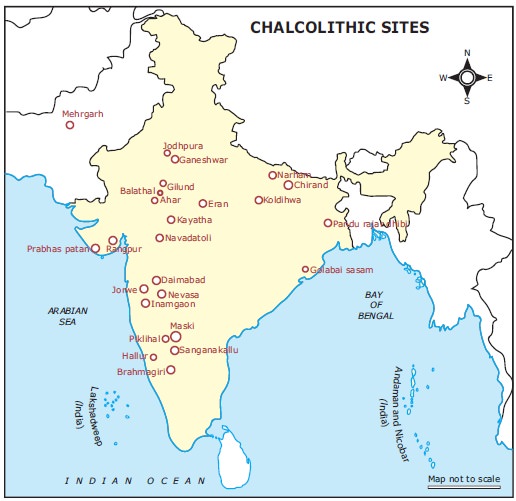
    • The centers of Chalcolithic cultures flourished in semi-arid regions of Rajasthan, Madhya Pradesh, Gujarat, and Maharashtra.
    • The settlements of Kayatha culture were mostly located on the Chambal River and its tributaries.
    • The settlements of Malwa culture are mostly located on the Narmada and its tributaries.
    • The three best known settlements of Malwa culture are at Navdatoli, Eran, and Nagada.
    • Navdatoli was one of the largest Chalcolithic settlements in the country spread in almost 10 hectares.
    • The settlements of Rangpur culture are located mostly on Ghelo and Kalubhar rivers in Gujarat.
    • More than 200 settlements of Jorwe culture are known. Greater numbers of these settlements are found in Maharashtra.
    • The best known settlements of Jorwe culture are Prakash, Daimabad, and Inamgaon. Daimabad was the largest one that measured almost 20 hectares.

    Development of Agriculture

    • They cultivated both Kharif and Rabi crops in rotation and also raised cattle with it.
    • They cultivated wheat and barley in Malwa region. Rice was cultivated in Inamgaon and Ahar.
    • They also cultivated jowar, bajra, kulth, ragi, green peas, lentil, and green and black grams.
    • Largely, the Chalcolithic cultures flourished in the black cotton soil zone.

    Trade and Commerce

    • The Chalcolithic communities traded and exchanged materials with other contemporary communities.
    • A large settlement serves as the major centers of trade and exchange.
    • Some of them were Ahar, Gilund, Nagada, Navdatoli, Eran, Prabhas, Rangpur, Prakash, Daimabad, and Inamgaon.
    • The Ahar people settled close to the copper source and were used to supply copper tools and objects to other contemporary communities in Malwa and Gujarat.
    • Identical marks embedded on most of the copper axes found in Malwa, Jorwe, and Prabhas cultures that might indicate that it may be the trademarks of the smiths who made them.
    • It is found that Conch shell for bangles was traded from the Saurashtra coast to various other parts of the Chalcolithic regions.
    • Gold and ivory come to Jorwe people from Tekkalkotta in Karnataka and semiprecious stones may have been traded to various parts from Rajpipla in Gujarat.
    • Wheeled bullock carts were used for long distance trade, besides the river transport. The drawings of wheeled bullock carts have been found on pots.

    Try this PYQ from CSP 2019. It is dicey, but you cannot escape such questions.

    Q. Which one of the following is not a Harappan site?

    (a) Chanhudaro

    (b) Kot Diji

    (c) Sohgaura

    (d) Desalpur


    Post your answers here.


    UPSC 2022 countdown has begun! Get your personal guidance plan now! (Click here)

  • [Yojana Archive] Financial Devolution

    UPSC 2022 countdown has begun! Get your personal guidance plan now! (Click here)

    November 2021: Panchayati Raj

    Financial powers to Panchayat

    • The 73rd Constitutional Amendment Act, 1992, promulgated on 24 April 1993, has been inserted as Part IX in the Constitution that enjoins the States to establish Panchayats.
    • It lays down that “the State shall take steps to organise village Panchayats and endow them with such powers and authority as may be necessary to enable them to function as units of self-government.”

    Need for financial devolution:

    • To strengthen democracy at grass root level with more revenue resources for better service delivery.
    • To increase accountability to people so performance can be realized as direct contact with people.

    Various Constitutional Provisions

    • Collection of Taxes: States have been provided the powers to authorise the PRIs to levy, collect, and appropriate certain taxes, duties, tolls, fees, etc.
    • Share of revenues: They can also assign to them the revenues of certain State-level taxes, subject to such conditions as are imposed by the State Government.
    • Grant-in-aid: The PRIs may also be provided with grant-in-aid.
    • State Finance Commission for review: In support of these requirements, Article 243-I of the Constitution mandates setting up of the State Finance Commission (SFC) every five years.
    • Central provisions: Under the Article 280(3) (bb) of the Constitution, Central Finance Commissions are required to make recommendations to augment the Consolidated Fund of the State to supplement the resources of the Panchayats in the State.

    Central Finance Commission Recommendations

    • Recommendations for devolution to the Rural Local Bodies (RLBs) began from the Tenth Finance Commission onwards (period 1995-2000).
    • Up to the Twelfth Finance Commission (period 2005-10), nominal amounts of devolution were made to the RLBs on a lump sum basis.
    • Thirteenth Finance Commission (XIII FC) made a radical departure by awarding a percentage of the divisible pool.

    Fourteenth Finance Commission (XIV FC)

    • It has recommended an amount of Rs 200292.20 crore to the GPs in the country.
    • This amount was divided in Basic Grant (Rs. 180262.98 crores) and Performance Grant (Rs. 20029.22 crore).
    • It adopted a trust-based approach and recommended that the devolutions be made directly to the GPs without any share at the levels of other tiers.

    Fifteenth Finance Commission (XV FC)

    • It recommended devolution to all tiers of the Panchayati Raj including the Traditional Bodies of Non-Part IX States and Fifth and Sixth Schedule Areas.
    • XV FC grants are provided in two parts, namely-
    • Basic (Untied) Grant: For general purposes
    • Tied Grant: 30% of the total grants be utilised for drinking water, rainwater harvesting, and water recycling

    Own Sources of Revenues (OSRs) of RLB

    • The three tiers of the Panchayats have been provided with own revenue generating powers.
    • However, the GPs in general are empowered to levy the most number of taxes and non-taxes within their jurisdiction.
    • Property tax, cess on land revenue, surcharge on additional stamp duty, tolls, tax on professions, tax on advertisements, non-motor vehicle tax, user charges, etc. contribute the maximum to the OSR.

    Issues

    • OSR amounts manage to meet only around 10 per cent of the total expenditure of the panchayats.
    • In most States, the property tax generates the maximum revenue. However, this tax remains inelastic and adds to the inefficient ways of its administration.
    • A few progressive States like Karnataka have reformed the tax structure and are using the unit area method in determining the tax base.

    Hurdles in Financial Devolution

    • Political will: Reluctance of Politicians and bureaucrats to relinquish power to local bodies remain major hurdle.
    • Lack of resources: Issues like lack of expertise to plan development priorities and use resources optimally, lack of resources to implement development agenda with minimal avenues for taxation and income.
    • Lack of institutional mechanism: Non-uniformity of various programmes at local level can make regulatory oversight difficult.

    Way Forward

    • Updating of PRI Acts/Financial Rules and making them available to change in tax and non-tax levy, rate structure etc.
    • Better assessment of properties required for levying Property Tax (classified plinth area-based valuation seems to be the most scientific)
    • Relook on various exemptions to rationalise the taxes/levies
    • Augmentation of Tax Administration Structure
    • Technology-based Tax Administration may also be further expanded to cover even utility charges like water, street lights, sanitation charges, etc.
  • The price of food must figure in the policy

    Context

    The essential challenge of public policy for agriculture- the high price of food remains unsolved.

    Implications of high food prices

    • Increases poverty: A higher price of food increases poverty, especially as the rice and wheat supplied through the PDS constitute only a part of the total expenditure on food of the average Indian household.
    • Reduces the expenditure on other item: For the household, a high price of food crowds out expenditure on other items ranging from health and education to non-agricultural goods.
    • This prevents the market for non-agricultural goods from expanding.
    • This was one of the first discoveries in economics, made by the English economist David Ricardo about two centuries ago.

    Rising food prices in India

    • An indication of the elevation of the price of food in an economy is the share of food in a household’s budget.
    • In a global comparison we would find that this share is very large for India.
    • Data from the U.S. Department of Agriculture (2016) show that this share ranges from over 30% for India to less than 10% for the U.S. and the U.K.
    • This is in line with Ricardo’s understanding of how economies progress i.e., as food gets cheaper, growth in the non-agricultural economy is stimulated.
    • Agricultural policy in India has remained quite unaccountable in the face of a rising relative price of food.
    • Impact on manufacturing sector: Arguably, the high price of food has been a factor in the disappointing lack of expansion of the manufacturing sector in India despite repeated efforts to bring it about.

    Changes needed in agricultural policy

    • Both from the point of view of food security for low-income households and the dynamism of the non-agricultural sector, agricultural policy cannot ignore the price at which food is produced.
    • Focus on improving the yield: The fact of low agricultural yield in India by comparison with the rest of the world has been known for long, and little is done about it.
    • Management of soil nutrients and moisture: A superior management of soil nutrients and moisture, assured water supply and knowledge inputs made available via an extension service would be crucial.
    • Raising yields will ensure profitability without raising producer prices, which will inflate the food subsidy bill.

    How government intervention created problems

    • Given the importance of food for our survival, this justifies public intervention in agriculture.
    • The issue is the design and scale of this intervention.
    • In the mid-sixties, when India was facing food shortage that could not be solved through trade, a concerted effort was made to raise domestic agricultural production.
    • Profitability through MSP: It introduced the strategy of ensuring farm profitability though favourable prices assured by the state.
    • Further, it entrenched the belief that it is the farmer’s right to have the state purchase as much grain as the farmer wishes to sell to the state agency.
    • Created grain stockpile: This has resulted in grain stockpiles far greater than the officially announced buffer-stocking norm.
    • These stocks have often rotted, resulting in deadweight loss, paid for by the public though taxes or public borrowing.
    • Supply more than demand: Finally, with all costs of production reimbursable and all of output finding an assured outlet, supply has outstripped demand. 
    • Damage to natural environment: This has led to unimaginable pressure on the natural environment, especially water supply.

    Consider the question “India faces the challenge of high food prices. Examine the ways in which high food prices affects the overall economy. How far is the India’s agriculture policy responsible for the problem?”

    Conclusion

    India needs an agricultural policy that ensures that farming is profitable but this cannot be at the cost of a high price of food. The ‘food problem’ should no longer be seen only in terms of the availability of food from domestic sources.

    UPSC 2022 countdown has begun! Get your personal guidance plan now! (Click here)

  • MEETING LINK INSIDE|| Register & Join Now|| How to Narrow the Revision Gap in Mid of UPSC-CSE Syllabus Completion?|| Free Open to All Q&A Webinar by IAS Officer Harvinder Singh|| Learn about the Standard, Normal and Frequent Revision Techniques

    MEETING LINK INSIDE|| Register & Join Now|| How to Narrow the Revision Gap in Mid of UPSC-CSE Syllabus Completion?|| Free Open to All Q&A Webinar by IAS Officer Harvinder Singh|| Learn about the Standard, Normal and Frequent Revision Techniques

    Team is inviting you to a scheduled Zoom meeting.

    Ask me Anything Session with IAS Harvinder Singh CSE 2018, J&K Cadre
    Date & Time: Dec 16, 2021 @07:00 PM (Login starts at 06:45 PM) India

    Join Zoom Meeting
    https://zoom.us/j/92961280446?pwd=c1FwK1NBQWQ1dkt4N1pUSXBIVCs4dz09

    Meeting ID: 929 6128 0446
    Passcode: 276929

    When I decided to prepare for UPSC-CSE, I knew I was not in a position to quit my private job. The work load was high at my present company, I was left with doubt if I could clear UPSC-CSE or not. That’s when I decided I needed a highly experienced personal mentor who will not only provide me study materials or evaluate test-series and mock interviews, but also won’t hesitate to motivate me whenever I felt uneasy or anxious. I found that in Civilsdaily mentor, Pravin sir. He was my go to mentor for Mains and Interview. I always made it a point to visit him weekly once and vent my feelings to him. After speaking to him, the clouds of negativity drifted away. I became confident to complete my studies for the day. It took me 3 attempts to fulfill not only my dream but my family’s dream.”

    Harvinder Singh’s life was filled with many hardships. Not because of UPSC-CSE preparation, but due to the unpredictable turn of events. When he was a three year old kid, his hand accidently fell into a pan of boiling hot oil in the kitchen. Due to this, three of his fingers have been severely impaired. As a 12th standard student, Harvinder studiously prepared for both AIEEE and NDA exams. Though he successfully, cleared the former exam, he failed the medical round of NDA (due to his fingers). Dejected that he missed an opportunity to serve the nation, Harvinder thought he cannot overlook supporting his family. His dad worked both as a farmer and truck driver to make ends meet. However, as a graduate in J&K, he found it extremely difficult to find a job.

    In 2013, he started his work as an engineer for a private company in Allahabad. Well settled, Harvinder thought of fulfilling his dream of serving the nation. If he couldn’t do it through Army, he could through civil services. After failing the prelims in first attempt, mains in second attempt, he finally cleared the exams in his third attempt to be an IAS officer. “I feared that in my third attempt, I will fail the personality round”, Harvinder jokes. Despite back to back failures, Harvinder always looked forward to his next attempt like it was his final attempt.

    Free to Attend (with mandatory registration) Ask me Anything Session with Harvinder Singh IAS

    As a result of which, the same lad who once suffered unemployment and other issues in J&K, is working to bring changes to J&K for the poor, needy, vulnerable and youth.

    This Thursday, Harvinder IAS is going to take some time off his busy schedule to address Civilsdaily aspirants. He will not only be talking about the specifics of UPSC-CSE journey, but also answering all your questions. If you are getting stuck due to any comprehension or consistency issue, it’s time to take Harvinder IAS sir’s help to solve them. And the good news is webinar is absolutely free for all to attend!

    Key Takeways of Ask me Anything Session with Harvinder Singh IAS

    1. Complete study booklist of Harvinder Singh IAS. For Prelims & Mains. Do you want to check if the current booklist you have are the right sources to prepare for UPSC-CSE?

    2. Complete timeline of UPSC-CSE Preparation as a working professional. When did Harvinder IAS prepare for Prelims, Mains and Interview?

    3. The art of making notes. What topics require notes and what topics don’t.

    4. Harvinder Singh IAS during Mains examination. What kind of questions came and how did he answer it?

    5. Hardwork in right direction vs Hardwork in wrong direction. Can only studying hard make you successful?

    6. Normal, standard and frequent revision techniques. What are they?

    Webinar Details

    If you are studying hard but are unsure that you are studying right, then its time to get some assurance from the topper himself! Register for this free webinar by IAS officer Harvinder Singh.

    Date: 16 December 2021 (Thursday)

    Time: 7 P.M

  • 1 More Hour for Registrations to Close, Webinar @ 7PM||How to Narrow the Revision Gap in Mid of UPSC-CSE Syllabus Completion?|| Free Open to All Q&A Webinar by IAS Officer Harvinder Singh|| Learn about the Standard, Normal and Frequent Revision Techniques

    1 More Hour for Registrations to Close, Webinar @ 7PM||How to Narrow the Revision Gap in Mid of UPSC-CSE Syllabus Completion?|| Free Open to All Q&A Webinar by IAS Officer Harvinder Singh|| Learn about the Standard, Normal and Frequent Revision Techniques

    When I decided to prepare for UPSC-CSE, I knew I was not in a position to quit my private job. The work load was high at my present company, I was left with doubt if I could clear UPSC-CSE or not. That’s when I decided I needed a highly experienced personal mentor who will not only provide me study materials or evaluate test-series and mock interviews, but also won’t hesitate to motivate me whenever I felt uneasy or anxious. I found that in Civilsdaily mentor, Pravin sir. He was my go to mentor for Mains and Interview. I always made it a point to visit him weekly once and vent my feelings to him. After speaking to him, the clouds of negativity drifted away. I became confident to complete my studies for the day. It took me 3 attempts to fulfill not only my dream but my family’s dream.”

    Harvinder Singh’s life was filled with many hardships. Not because of UPSC-CSE preparation, but due to the unpredictable turn of events. When he was a three year old kid, his hand accidently fell into a pan of boiling hot oil in the kitchen. Due to this, three of his fingers have been severely impaired. As a 12th standard student, Harvinder studiously prepared for both AIEEE and NDA exams. Though he successfully, cleared the former exam, he failed the medical round of NDA (due to his fingers). Dejected that he missed an opportunity to serve the nation, Harvinder thought he cannot overlook supporting his family. His dad worked both as a farmer and truck driver to make ends meet. However, as a graduate in J&K, he found it extremely difficult to find a job.

    In 2013, he started his work as an engineer for a private company in Allahabad. Well settled, Harvinder thought of fulfilling his dream of serving the nation. If he couldn’t do it through Army, he could through civil services. After failing the prelims in first attempt, mains in second attempt, he finally cleared the exams in his third attempt to be an IAS officer. “I feared that in my third attempt, I will fail the personality round”, Harvinder jokes. Despite back to back failures, Harvinder always looked forward to his next attempt like it was his final attempt.

    Free to Attend (with mandatory registration) Ask me Anything Session with Harvinder Singh IAS

    As a result of which, the same lad who once suffered unemployment and other issues in J&K, is working to bring changes to J&K for the poor, needy, vulnerable and youth.

    This Thursday, Harvinder IAS is going to take some time off his busy schedule to address Civilsdaily aspirants. He will not only be talking about the specifics of UPSC-CSE journey, but also answering all your questions. If you are getting stuck due to any comprehension or consistency issue, it’s time to take Harvinder IAS sir’s help to solve them. And the good news is webinar is absolutely free for all to attend!

    Key Takeways of Ask me Anything Session with Harvinder Singh IAS

    1. Complete study booklist of Harvinder Singh IAS. For Prelims & Mains. Do you want to check if the current booklist you have are the right sources to prepare for UPSC-CSE?

    2. Complete timeline of UPSC-CSE Preparation as a working professional. When did Harvinder IAS prepare for Prelims, Mains and Interview?

    3. The art of making notes. What topics require notes and what topics don’t.

    4. Harvinder Singh IAS during Mains examination. What kind of questions came and how did he answer it?

    5. Hardwork in right direction vs Hardwork in wrong direction. Can only studying hard make you successful?

    6. Normal, standard and frequent revision techniques. What are they?

    Webinar Details

    If you are studying hard but are unsure that you are studying right, then its time to get some assurance from the topper himself! Register for this free webinar by IAS officer Harvinder Singh.

    Date: 16 December 2021 (Thursday)

    Time: 7 P.M

  • Registrations Closing in 3 Hours, Webinar @ 7PM||How to Narrow the Revision Gap in Mid of UPSC-CSE Syllabus Completion?|| Free Open to All Q&A Webinar by IAS Officer Harvinder Singh|| Learn about the Standard, Normal and Frequent Revision Techniques

    Registrations Closing in 3 Hours, Webinar @ 7PM||How to Narrow the Revision Gap in Mid of UPSC-CSE Syllabus Completion?|| Free Open to All Q&A Webinar by IAS Officer Harvinder Singh|| Learn about the Standard, Normal and Frequent Revision Techniques

    When I decided to prepare for UPSC-CSE, I knew I was not in a position to quit my private job. The work load was high at my present company, I was left with doubt if I could clear UPSC-CSE or not. That’s when I decided I needed a highly experienced personal mentor who will not only provide me study materials or evaluate test-series and mock interviews, but also won’t hesitate to motivate me whenever I felt uneasy or anxious. I found that in Civilsdaily mentor, Pravin sir. He was my go to mentor for Mains and Interview. I always made it a point to visit him weekly once and vent my feelings to him. After speaking to him, the clouds of negativity drifted away. I became confident to complete my studies for the day. It took me 3 attempts to fulfill not only my dream but my family’s dream.”

    Harvinder Singh’s life was filled with many hardships. Not because of UPSC-CSE preparation, but due to the unpredictable turn of events. When he was a three year old kid, his hand accidently fell into a pan of boiling hot oil in the kitchen. Due to this, three of his fingers have been severely impaired. As a 12th standard student, Harvinder studiously prepared for both AIEEE and NDA exams. Though he successfully, cleared the former exam, he failed the medical round of NDA (due to his fingers). Dejected that he missed an opportunity to serve the nation, Harvinder thought he cannot overlook supporting his family. His dad worked both as a farmer and truck driver to make ends meet. However, as a graduate in J&K, he found it extremely difficult to find a job.

    In 2013, he started his work as an engineer for a private company in Allahabad. Well settled, Harvinder thought of fulfilling his dream of serving the nation. If he couldn’t do it through Army, he could through civil services. After failing the prelims in first attempt, mains in second attempt, he finally cleared the exams in his third attempt to be an IAS officer. “I feared that in my third attempt, I will fail the personality round”, Harvinder jokes. Despite back to back failures, Harvinder always looked forward to his next attempt like it was his final attempt.

    Free to Attend (with mandatory registration) Ask me Anything Session with Harvinder Singh IAS

    As a result of which, the same lad who once suffered unemployment and other issues in J&K, is working to bring changes to J&K for the poor, needy, vulnerable and youth.

    This Thursday, Harvinder IAS is going to take some time off his busy schedule to address Civilsdaily aspirants. He will not only be talking about the specifics of UPSC-CSE journey, but also answering all your questions. If you are getting stuck due to any comprehension or consistency issue, it’s time to take Harvinder IAS sir’s help to solve them. And the good news is webinar is absolutely free for all to attend!

    Key Takeways of Ask me Anything Session with Harvinder Singh IAS

    1. Complete study booklist of Harvinder Singh IAS. For Prelims & Mains. Do you want to check if the current booklist you have are the right sources to prepare for UPSC-CSE?

    2. Complete timeline of UPSC-CSE Preparation as a working professional. When did Harvinder IAS prepare for Prelims, Mains and Interview?

    3. The art of making notes. What topics require notes and what topics don’t.

    4. Harvinder Singh IAS during Mains examination. What kind of questions came and how did he answer it?

    5. Hardwork in right direction vs Hardwork in wrong direction. Can only studying hard make you successful?

    6. Normal, standard and frequent revision techniques. What are they?

    Webinar Details

    If you are studying hard but are unsure that you are studying right, then its time to get some assurance from the topper himself! Register for this free webinar by IAS officer Harvinder Singh.

    Date: 16 December 2021 (Thursday)

    Time: 7 P.M

  • Conflation between duties and rights

    Context

    There has been growing advocacy for the integration of duty with rights. On Constitution Day last month, many Union Ministers used the occasion to underline this proposal.

    What do rights come with duty mean?

    • It is a basic proposition that all rights come with duties.
    • But those duties are quite distinct from the meaning ascribed to them in the popular discourse.
    • When a person holds a right, she is owed an obligation by a duty-bearer.
    • For example, when citizens are promised a right against discrimination, the government is obliged to ensure that it treats everybody with equal care and concern.
    • Similarly, the guarantee of a right to freedom of speech enjoins the state to refrain from interfering with that liberty.

    Integrating rights with duties

    • Proponents of integration of duty with rights aim to treat otherwise non-binding obligations — the “fundamental duties” as Article 51A describes them on a par with, if not superior to, the various fundamental rights that the Constitution guarantees.
    • In an inversion of the well-known dictum, they see duties, and not rights, as trumps.
    • On Constitution Day last month, many Union Ministers used the occasion to underline this proposal.
    • The government puts forward an idea that our rights ought to be made conditional on the performance of a set of extraneous obligations.

    Issues with the proposal

    • This suggestion is plainly in the teeth of the Constitution’s text, language, and history.
    • To the framers of the Constitution, the very idea of deliberating over whether these rights ought to be provisional, and on whether these rights ought to be made subject to the performance of some alien duty, was against the republic’s vision.
    • Imposing duties a legislative prerogative: The Constitution’s framers saw the placing of mandates on individual responsibilities as nothing more than a legislative prerogative.
    • For example, the legislature could impose a duty on individuals to pay a tax on their income, and this duty could be enforced in a variety of ways.
    • If the tax imposed and the sanctions prescribed were reasonable, the obligations placed on the citizen will be constitutionally valid.
    • In this manner, Parliament and the State legislatures have imposed a plethora of duties — duties to care for the elderly and for children; duties to pay tolls and levies; duties against causing harm to others; duties to treat the environment with care, the list is endless.
    • Against Constitution: What is critical, though, is that these laws cannot make a person’s fundamental right contingent on the performance of a duty that they impose.
    • A legislation that does so will violate the Constitution.

    Background

    • The fundamental duties that are now contained in Article 51A were introduced through the 42nd constitutional amendment.
    • The Swaran Singh Committee, which was set up during the Emergency, and which recommended the insertion of the clause, also suggested that a failure to comply with a duty ought to result in punishment.
    • Ultimately, the amendment was introduced after the binding nature of the clause was removed.
    • In its finally adopted form, Article 51A encouraged citizens to perform several duties.

    Way forward

    • Know the precise nature of duties the rights create: The philosopher Onora O’Neill has argued with some force that we would do well to discuss the precise nature of duties that rights create.
    • Unless we do so, our charters of human rights may not by themselves be enough.
    • For example, we may want to ask ourselves if the promise of a right to free expression imposes on the state something more than a duty to forebear from making an unwarranted restriction on that liberty.
    •  Does it require the state to also work towards creating an equal society where each person finds herself in a position to express herself freely?

    Consider the question “How fundamental duties are related to the fundamental rights in the context of the Indian Constitution? What are the issues with making the enforcement of rights contingent on adhering to the duties?”

    Conclusion

    When we speak about the importance of obligations, it is these questions that must animate our discussions. Should we instead allow the language of fundamental duties to subsume our political debates, we would only be placing in jeopardy the moral principles at the heart of India’s republic.

    UPSC 2022 countdown has begun! Get your personal guidance plan now! (Click here)

  • A case for in inclusion of Ladakh under Sixth Schedule

    A ruling party MP from Ladakh has demanded that the region be included in the Sixth Schedule of the Constitution to safeguard land, employment, and cultural identity of the local population.

    What is the Sixth Schedule?

    • The Sixth Schedule under Article 244 provides for the formation of autonomous administrative divisions — Autonomous District Councils (ADCs).
    • ADCs have some legislative, judicial, and administrative autonomy within a state.
    • The Sixth Schedule applies to the NE states of Assam, Meghalaya, Mizoram (three Councils each), and Tripura (one Council).

    Composition of ADCs

    • ADCs have up to 30 members with a term of five years.
    • It can make laws, rules and regulations with regard to land, forest, water, agriculture, village councils, health, sanitation, village- and town-level policing, inheritance, marriage and divorce, social customs and mining, etc.
    • The Bodoland Territorial Council in Assam is an exception with more than 40 members and the right to make laws on 39 issues.

    Why does Ladakh want to be part of the Sixth Schedule?

    • Local aspirations: There was much enthusiasm initially, mostly in Leh, after the repeal of Art. 370 which created two new UTs.
    • Negligence in erstwhile J&K state: Buddhist-dominated Leh district had long demanded UT status because it felt neglected by the erstwhile state government.
    • Denial of Legislature: The enthusiasm waned as it was understood that while the UT of J&K would have a legislature, the UT of Ladakh would not.
    • Inadequate representation: The administration of the region is now completely in the hands of bureaucrats with only 1 MP.
    • New domicile criteria: The changed domicile policy in Jammu and Kashmir has raised fears in the region about its own land, employment, demography, and cultural identity.
    • Statehood demands: A coalition of social, religious, and political representatives in Leh and Kargil has demanded full statehood for Ladakh.

    Cultural significance of Ladakh

    • Ladakh is historically perceived as a cosmopolitan region with centuries of multiple cultural settings.
    • It was an Asian pivot – the people here traversed diverse cultural boundaries and engaged with ideas.

    Can Ladakh be included in Sixth Schedule?

    • NCST Recommends: In September 2019, the National Commission for Scheduled Tribes recommended the inclusion of Ladakh under the Sixth Schedule.
    • Distinct culture: It was predominantly tribal (more than 97%), people from other parts of the country had been restricted from purchasing or acquiring land there, and its distinct cultural heritage needed preservation.

    Legal hurdles

    • Fifth schedule as an alternative: The Constitution is very clear, Sixth Schedule is for the Northeast. For tribal areas in the rest of the country, there is the Fifth Schedule.
    • Exclusive provision for NE: Notably, no region outside the Northeast has been included in the Sixth Schedule.
    • Requires Constitutional Amendment: It remains the prerogative of the government. For this, a constitutional amendment is required.

    Government’s response in this regard

    • The Centre woke up to the anxieties of the region when, a year after the abrogation of Article 370, when all political parties announced a boycott of the LAHDC-Leh elections.
    • The political factions in Ladakh were promised “Sixth Schedule-like” protections by the Home Minister.
    • The MHA has in Jan announced that a committee under then MoS Home G Kishan Reddy would be formed to address the issues related to language of Ladakh, culture of Ladakh and conservation of land in Ladakh.
    • It had assured representatives of Kargil and Leh that the government was committed to look into their concerns.

    Try this question from CSP 2015:

    Q.The provisions in Fifth Schedule and Sixth Schedule in the Constitution of India are made in order to-

    (a) protect the interests of Scheduled Tribes

    (b) determine the boundaries between States

    (c) determine the powers, authority and responsibilities of Panchayats

    (d) protect the interests of all the border States


    Post your answers here.


    UPSC 2022 countdown has begun! Get your personal guidance plan now! (Click here)

  • Cabinet clears push to raise marriage age of women from 18 to 21

    The proposal to raise the minimum age of marriage for women from 18 to 21 was cleared by the Union Cabinet based on the recommendations of a task force headed by Jaya Jaitley.

    Minimum Age for Marriage in India

    • Personal laws of various religions that deal with marriage have their own standards, often reflecting custom.
    • For Hindus, The Hindu Marriage Act, 1955 sets 18 years as the minimum age for the bride and 21 years as the minimum age for the groom.
    • In Islam, the marriage of a minor who has attained puberty is considered valid.
    • Now, the govt will have to amend the Prohibition of Child Marriage Act, 2006, the Special Marriage Act and personal laws such as the Hindu Marriage Act, 1955.

    Reasons behind the decision

    • Gender-neutrality: With this decision, the government will be bringing the age of marriage for both men and women at par.
    • Motherhood complexities: An early age of marriage, and consequent early pregnancies, also have impacts on nutritional levels of mothers and their children, and their overall health and mental wellbeing.
    • Mother and Child Mortality: It also has an impact on Infant Mortality Rate and Maternal Mortality Rate.
    • Women empowerment: The decision would empower women who are cut off from access to education and livelihood due to an early marriage.
    • Protection from abuse: This will essentially outlaw premature girls marriages and prevent the abuse of minors.

    What is the Jaya Jaitly Committee?

    • In June 2020, the Ministry of WCD set up a task force to look into the correlation between the age of marriage with issues of women’s nutrition, prevalence of anemia, IMR, MMR and other social indices.
    • The committee was to look at the feasibility of increasing the age of marriage and its implication on women and child health, as well as how to increase access to education for women.

    Key recommendations

    • The committee has recommended the age of marriage be increased to 21 years, on the basis of feedback they received from young adults from 16 universities across the country.
    • The committee also asked the government to look into increasing access to schools and colleges for girls, including their transportation to these institutes from far-flung areas.
    • Skill and business training has also been recommended, as has sex education in schools.
    • The committee said these deliveries must come first, as, unless they are implemented and women are empowered, the law will not be as effective.

    Criticism of the move

    • Illegal marriages: Such legislation would push a large portion of the population into illegal marriages leading to non-institutional births.
    • Ineffectiveness of existing laws: Decrease in child marriages has not been because of the existing law but because of an increase in girls’ education and employment opportunities.
    • Unnecessary coercion: The law would end up being coercive, and in particular negatively impact marginalized communities, such as the Scheduled Caste and Scheduled Tribes, making them law-breakers.


    UPSC 2022 countdown has begun! Get your personal guidance plan now! (Click here)

  • Zero Budget Natural Farming

    Zero budget natural farming (ZBNF) is back on top of the Government’s agricultural agenda, with PM set to highlight it at a national conclave.

    Zero Budget Natural Farming (ZBNF)

    • ZBNF is a set of farming methods, and also a grassroots peasant movement, which has spread to various states in India.
    • Subhash Palekar perfected it during the 1990s at his farm in Amravati district in Maharashtra’s drought-prone Vidarbha region.
    • According to the “zero budget” concept, farmers won’t have to spend any money on fertilisers and other agricultural inputs.
    • Over 98% of the nutrients that crops require — carbon dioxide, nitrogen, water, solar energy — are already present in nature.
    • The remaining 1.5-2% are taken from the soil, after microorganisms convert them from “non-

    Four Wheels of ZBNF

    The “four wheels” of ZBNF are ‘Jiwamrita’, ‘Bijamrita’, ‘Mulching’ and ‘Waaphasa’.

    • Jiwamrita is a fermented mixture of cow dung and urine (of desi breeds), jaggery, pulses flour, water and soil from the farm bund.
    • This isn’t a fertilizer, but just a source of some 500 crore micro-organisms that can convert all the necessary “non-available” nutrients into “available” form.
    • Bijamrita is a mix of desi cow dung and urine, water, bund soil and lime that is used as a seed treatment solution prior to sowing.
    • Mulching, or covering the plants with a layer of dried straw or fallen leaves, is meant to conserve soil moisture and keep the temperature around the roots at 25-32 degrees Celsius, which allows the microorganisms to do their job.
    • Waaphasa, or providing water to maintain the required moisture-air balance, also achieves the same objective.

    Astra’s of ZBNF against pest attacks

    • ZBNF advocates the use of special ‘Agniastra’, ‘Bramhastra’, and ‘Neemastra’ concoctions.
    • They are based on cow urine and dung, plus pulp from leaves of neem, white datura, papaya, guava, and pomegranates — for controlling pest and disease attacks.

    Is it organic farming?

    • ZBNF uses farmyard manure or vermicompost.

    Issues with ZBNF

    • Cost of labor: The cost of labor for the collection of dung and urine, apart from the other inputs used in the preparation of Jiwamrita, Neemastra or Bramhastra is quit higher.
    • Bovine cost: Keeping cows is also a cost that has to be accounted for. Farmers cannot afford to keep desi cows that yield very little milk.
    • Vulnerability to pest attacks:  ZBNF is scarcely practiced.  The crop grown would be vulnerable to attacks by insects and pests have already become pest-immune.


    UPSC 2022 countdown has begun! Get your personal guidance plan now! (Click here)

  • Program for Development of Semiconductors and Display Manufacturing Ecosystem in India

    The Union Cabinet has approved a ₹76,000 crore scheme to boost semiconductor and display manufacturing in the country.

    About the Program

    • The scheme would provide financial support of up to 50% of the project cost for setting up semiconductor and display fabrication units.
    • The scheme was aimed at making India a global hub of electronic system design and manufacturing, the statement noted.
    • In addition, the Centre would work with the States to set up high-tech clusters with the necessary infrastructure such as land and semiconductor-grade water.

    Components of the mission

    [1] Semiconductor Fabs and Display Fabs

    • This shall extend fiscal support of up to 50% of project cost to eligible applicants.
    • The govt will work closely with the states establish High-Tech Clusters with requisite infrastructure in terms of land, semiconductor grade water, high quality power, logistics and research.

    [2] Semi-conductor Laboratory (SCL):

    • The Ministry of Electronics and Information Technology will take requisite steps for the modernization and commercialization of the Semi-conductor Laboratory (SCL).
    • MeitY will explore the possibility for the Joint Venture of SCL with a commercial fab partner to modernize the brownfield fab facility.

    [3] Semiconductor Design Companies:

    • The Design Linked Incentive (DLI) Scheme shall extend product design linked incentive of up to 50% of eligible expenditure and product deployment linked incentive of 6% – 4% on net sales for five years.
    • Support will be provided to 100 domestic companies of semiconductor design for Integrated Circuits (ICs), Chipsets, System on Chips (SoCs), Systems & IP Cores.

    [4] India Semiconductor Mission:

    • In order to drive the long-term strategies for developing sustainable semiconductors and display ecosystem, a specialized and independent ISM will be set up.
    • The ISM will be led by global experts in the semiconductor and display industry.
    • It will act as the nodal agency for efficient and smooth implementation of the schemes on Semiconductors and Display ecosystem.

    [5] Chips to start-ups Program

    • This program would develop 85,000 well-trained engineers, he claimed. Semiconductor designers would be given the opportunity to launch start-ups.
    • The government would bear 50% of the expense under the design-linked incentive scheme.
    • The entire programme would lead to 35,000 high-quality direct jobs and 1 lakh indirect employment.

    Significance of the scheme

    • In the current geopolitical scenario, trusted sources of semiconductors and displays hold strategic importance and are key to the security of critical information infrastructure.
    • The approved program will propel innovation and build domestic capacities to ensure the digital sovereignty of India.
    • It will also create highly skilled employment opportunities to harness the demographic dividend of the country.
    • Development of semiconductor and display ecosystem will have a multiplier effect across different sectors of the economy with deeper integration to the global value chain.


    UPSC 2022 countdown has begun! Get your personal guidance plan now! (Click here)

  • 16th December 2021| Daily Answer Writing Enhancement(AWE)

    Topics for Today’s questions:

    GS-1     Post-independence consolidation and reorganization within the country

    GS-2    Effect of policies and politics of developed and developing countries on India’s interests, Indian diaspora.

    GS-3   Indian Economy, Infrastructure: Energy, Ports, Roads, Airports, Railways etc., Investment models.

    GS-4   Emotional intelligence-concepts, and their utilities and application in administration and governance

    Questions:

    Question 1)


    Q.1 Identify the reasons for rise in insurgency and violence in Punjab in the 1980s. What steps were taken by the government to quell this violence? (15 Marks)


    Question 2)

    Q.2 The American withdrawal from Afghanistan would alter the regional geopolitics in Asia. In this context, examine the implications of the transition of the global order from American unipolarity for India and suggest a way forward. (10 Marks)

    Question 3)

    Q.3 Notwithstanding the merit of the National Monetisation Pipeline, it becomes imperative for policymakers to introspect the decline of profit-making government assets. Also suggest the steps that need to be taken to strengthen the public sector business. (10 Marks)

    Question 4)  

    Q.4 Emotions, earlier considered as an irrational factor in decision-making, are now recognised as a critical factor of judgment. In this regard, answer the following questions: (a) How can Emotional Intelligence help in coping with the intense pressure and occupational stress faced by police officers and armed forces in discharge of their duties? (b) What are the some of the concerns in incorporating and assessment of emotional intelligence skills in public service? (10 Marks)


    HOW TO ATTEMPT ANSWERS IN DAILY ANSWER WRITING ENHANCEMENT(AWE)?

    1. Daily 4 questions from General studies 1, 2, 3, and 4 will be provided to you.

    2. A Mentor’s Comment will be available for all answers. This can be used as a guidance tool but we encourage you to write original answers.

    3. You can write your answer on an A4 sheet and scan/click pictures of the same.

    4.  Upload the scanned answer in the comment section of the same question.

    5. Along with the scanned answer, please share your Razor payment ID, so that paid members are given priority.

    6. If you upload the answer on the same day like the answer of 11th  October is uploaded on 11th October then your answer will be checked within 72 hours. Also, reviews will be in the order of submission- First come first serve basis

    7. If you are writing answers late, for example, 11th October is uploaded on 13th October, then these answers will be evaluated as per the mentor’s schedule.

    8. We encourage you to write answers on the same day. However, if you are uploading an answer late then tag the mentor like @Staff so that the mentor is notified about your answer.

    *In case your answer is not reviewed, reply to your answer saying *NOT CHECKED*. 

    For the philosophy of AWE and payment: 

  • Historical episodes that PM spoke about in Kashi

    In his speech at Kashi, PM has referred to several historical episodes including the battle between Salar Masud and Raja Suhaldev and the conflict between Governor-general Warren Hastings and Raja Chait Singh.

    He also mentioned the contributions of historical figures like Rani Bhabani from Bengal.

    Note: UPSC is known to ask contemporaries.

    [1] Salar Masud and Raja Suhaldev

    • The story of Salar Masud, also known as Ghazi Mian, and Suhaldev is a mix of history and myth.
    • Ghazi Mian is believed to have acquired popularity as a warrior in the 12th century.
    • He was the nephew of the 11th-century Turkik invader, Mahmud of Ghazni, whose invasion of India is known as the moment when Islam entered large parts of the subcontinent.
    • Interestingly, his tomb at Bahraich in Uttar Pradesh stands as a place of pilgrimage for a large number of Muslims as well as Hindus.
    • The most comprehensive source of information about Ghazi Mian is the Mirat-e-Masaud (Mirror of Masaud), a 17th-century Persian hagiography written by Abdur Rahman Chisti, a Sufi saint.
    • He asserted that Masud was the disciple of Sheikh Moinuddin Chisti, the founder of the Chistiya order of Sunni mysticism.

    His conquest and Suheldev

    • Masud arrived in Multan as a 17-year old head of the Afghan army and after having subjugated it made for Delhi where he spent almost half a year.
    • Advancing his aggressive campaigns, Masud on the way destroyed several temples and converted many to Islam.
    • It was at Bahraich, where in the course of a battle in 1034 CE between Masud and a local king by the name Suhaldev that the former was wounded by an arrow and succumbed.
    • Suheldev is believed to have been the eldest son of the king of the Bhar community, from which emerged the Pasi community, a Dalit caste group of the region.

    [2] Warren Hastings and Maharaja Chait Singh

    • Another historical episode cited by Modi in his Kashi speech was about the first governor-general of Bengal Warren Hastings fleeing the city in 1781.
    • By the late 18th century, Benaras had declared independence from the Nawab of Awadh.
    • In 1771, Maharaja Chait Singh succeeded to the throne of Banaras with the help of British authorities.
    • Two years later, the Maharaja transferred the domain to the East India Company under the control of Hastings.

    Issues over Mysore war

    • When faced with the need for resources to fight the Mysore War against Hyder Ali, Hastings pressed Maharaja Chait Singh to make additional revenue payments and supply troops in 1778 and 1779.
    • When Singh failed to comply, Hastings marched to Benaras with his troops to confront the king.
    • A skirmish erupted between the British troops on the one hand and the Raja’s forces and his large number of supporters on the other.
    • As they fought, the Raja managed to escape from the fort through a window facing the Ganges.

    An embarrassing defeat for Hastings

    • Several of Hastings’ men were killed in the conflict and, left with no other option, the governor-general was forced to retreat.
    • Popular narrative goes that he left hurriedly at night for the nearby Chunar Fort riding an elephant.
    • The incident is believed to have given rise to the popular saying in Banaras: “Ghode par haudah, hathi par jeen, Kashi se bhaga Warren Hastings”.

    [3] Rani Bhabani

    • Bhabani was married to Raja Ramkanta Ray, the zamindar of the Natore estate in Rajshahi (present day Bangladesh).
    • After the death of her husband in 1748, the zamindari passed on to the hands of Bhabani, making her one among the very few women zamindars of the time.
    • For the next four decades, Bhabani is said to have managed the estate of Natore with utmost efficiency.
    • Bhabani is remembered most for her philanthropic efforts. She is known to have built several schools across Rajshahi district and offered a number of scholarships.
    • She is also known to have built the Durga Kund Mandir in Varanasi.
    • She also desired to build a Kashi in Bengal and, consequently in 1755 a complex consisting of a dozen temples was built in Baronagar in Murshidabad by her.


    UPSC 2022 countdown has begun! Get your personal guidance plan now! (Click here)

  • Q.3 Notwithstanding the merit of the National Monetisation Pipeline, it becomes imperative for policymakers to introspect the decline of profit-making government assets. Also suggest the steps that need to be taken to strengthen the public sector business. (10 Marks)

    Mentor’s comment-
    • https://www.thehindu.com/opinion/op-ed/the-nmp-is-hardly-the-panacea-for-growth-in-india/article37956016.ece
    • In the intro, briefly mention the monetisation potential of Rs. 6-lakh crores.
    • In the body, mention the important role of public enterprises as mentioned in Economic Survey 2019-20 to become a $5 trillion economy. In the next part, mention the primary reasons for the failure of public sector enterprises such as cost overruns, lack of optimum input-output ratio, reluctance to implement the labour reforms etc.
    • In the suggestions mention government initiatives such Gati Shakti National Master Plan, revamping of governance structure as suggested in Economic Survey, protection from unfair business practices etc.
    • Conclude by mentioning implementations of suggestions to strengthen the PSUs.
  • Q.2 The American withdrawal from Afghanistan would alter the regional geopolitics in Asia. In this context, examine the implications of the transition of the global order from American unipolarity for India and suggest a way forward. (10 Marks)

    Mentor’s comment-
    • https://www.thehindu.com/opinion/lead/fathoming-the-new-world-disorder/article37947499.ece
    • In the intro, mention the US withdrawal from Afghanistan after fighting a protracted war there.
    • In the body, mention the implications for India in the form of security challenges and challenges in dealing with China and Pakistan.
    • Next, mention the realignment in the US foreign policy which focuses on dealing with China and mention the role for India in it. In the need for maintaining the strategic autonomy as India aligns closely with the US.
    • Conclude by mentioning the need for India to tackle the challenges posed by the changing geopolitical order by focusing its own strengths and balancing by forming coalitions whenever it is necessary.
  • [pib] Durga Puja gets UNESCO Intangible Cultural Heritage tag

    UNESCO has inscribed ‘Durga Puja in Kolkata’ on the Representative List of Intangible Cultural Heritage of Humanity.

    What is Intangible Cultural Heritage (ICH)?

    • ICH means the practices, representations, expressions, knowledge, skills – as well as the instruments, objects, artefacts and cultural spaces associated with them that communities, groups and, in some cases, individuals recognize as a part of their cultural heritage.
    • Furthermore, its importance is not in the cultural manifestation itself, but in the wealth of knowledge, know-how and skills that are transmitted from one generation to the next.

    About Durga Puja

    • Durga Puja, also known as Durgotsava or Sharodotsava, is an annual Hindu festival that reveres and pays homage to the goddess Durga.
    • It is an important festival in the Shaktism tradition of Hinduism.
    • It is celebrated because of Durga’s victory over Mahishasur.
    • It is particularly popular and traditionally celebrated in the Indian states of West Bengal, Bihar, Jharkhand, and Odisha among other states.
    • It is a ten-day festival, of which the last five are of the most significance.

    Citation for the UNESCO tag

    • The UNESCO Committee commended its initiatives to involve marginalized groups, and individuals as well as women in their participation in safeguarding the element.
    • The festival is also marked by scripture recitations, performance arts, revelry, gift-giving, family visits, feasting, and public processions.
    • Durga Puja not only is a celebration of the feminine divinity but is a consummate expression of dance, music, crafts, rituals, practices culinary and cultural aspects.
    • The festival transcends the boundaries of caste, creed and economic classes and joins the people together in its celebration.

    Also read: National List for Intangible Cultural Heritage (ICH)

    Other ICH in India

    • With the inscription of Durga Puja in Kolkata, India now has 14 intangible cultural heritage elements on the prestigious UNESCO Representative List of ICH of Humanity.
    • In recent years, the ICH elements that saw inscriptions are Kumbh Mela (inscribed 2017), Yoga (inscribed 2016) among others.
    • Also, India is a SIGNATORY of the 2003 UNESCO Convention which aims for the Safeguarding of the Intangible Heritage along with traditions and living expression.


    UPSC 2022 countdown has begun! Get your personal guidance plan now! (Click here)

  • Q.1 Identify the reasons for rise in insurgency and violence in Punjab in the 1980s. What steps were taken by the government to quell this violence? (15 Marks)

    Mentor’s Comments-

    • Briefly highlight upon the violent phase in Punjab during 1980s.
    • Discuss the reasons for rise and insurgency and violence such as reorganisation of Punjab, Anandpur Sahib resolution, Khalistan movement, Anti-Sikh riots, communal politics etc
    • State the steps taken by the government to quell the violence- imposition of AFSPA, Operation Blue Star, Punjab Accord etc
    • Conclude on the basis of above points.

More posts
