Prime Minister laid the foundation stone for a ₹100 crore temple dedicated to Sant Ravidas in Madhya Pradesh’s Sagar.
Guru Ravidas
Ravidas was an Indian mystic poet-saint of the Bhakti movement and founder of the Ravidassia religion during the 15th to 16th century CE.
Venerated as a guru (teacher) in the region of Uttar Pradesh, Rajasthan, Maharashtra, Madhya Pradesh and mainly Punjab and Haryana. He was a poet-saint, social reformer and spiritual figure.
The life details of Ravidas are uncertain and contested. Scholars believe he was born in 1450 CE, in the cobbler caste.
Ravidas’s devotional verses were included in the Sikh scriptures known as Guru Granth Sahib.
The Panch Vani text of the Dadupanthi tradition within Hinduism also includes numerous poems of Ravidas.
He taught the removal of social divisions of caste and gender and promoted unity in the pursuit of personal spiritual freedoms.
Significance of his teachings
Philosophy and values of Sant Ravidas like social justice, equality and fraternity have been imbued in our constitutional values.
He had envisaged a society that is based on equality and free from any kind of discrimination.
He gave it the name ‘Be-gampura’ (a city near Lahore) where there is no place for any kind of grief or fear.
Such an ideal city would be bereft of fear, vulnerability or scarcity. Rule of law based on the right ideas like equality and welfare of all would be the principle for governance.
There are ongoing Supreme Court deliberations regarding the abrogation of Article 370.
This article delves into the historical context, legal intricacies, and broader socio-political implications of this pivotal constitutional provision.
Historical Context of Accession
Geo-Political Situation: Jammu and Kashmir’s unique special status originated from the tumultuous geo-political circumstances following India’s Independence and Partition.
Standstill Agreements: Maharaja Hari Singh’s decision to enter into “Standstill Agreements” with both India and Pakistan highlighted the State’s strategic positioning and economic interests.
Instrument of Accession: Faced with internal turmoil and external aggression, Maharaja Hari Singh’s Instrument of Accession sought India’s military assistance while retaining significant autonomy in internal matters.
Evolution of Article 370
Instrument of Accession’s Reflection: Article 370 was crafted in line with the Instrument of Accession’s principles, preserving the unique terms of Jammu and Kashmir’s association with India.
Autonomy Preserved: This provision aimed to strike a balance between safeguarding the State’s autonomy and integrating it into the larger Indian Union.
Limited Legislative Authority: Article 370 outlined a limited scope for Parliament to legislate on certain subjects, primarily defense, foreign affairs, and communications, with consultation and concurrence requirements.
Special Relationship: This provision established Jammu and Kashmir’s distinct relationship with India, emphasizing that its integration would be contingent on mutual consent.
Abrogation of Article 370
Long-Standing Opposition: The abrogation of Article 370 was a persistent demand of the mainstream political party and its precursor.
Multistage Process: The process of abrogation involved presidential orders, amendments, and parliamentary resolutions, culminating in its nullification.
Petitioners’ Arguments against Revocation
Lack of Consultation: Senior litigant accused the Union government of ignoring the will of the people of Jammu and Kashmir during the Article 370 abrogation process.
Series of Executive Acts: He highlighted that the abrogation was executed through a series of executive acts, starting from the dissolution of the Jammu and Kashmir Legislative Assembly and state government.
Changing Provisions: He pointed out that the proviso to Article 370 (3) was altered to sidestep the need for the recommendation of the now-defunct Jammu and Kashmir Constituent Assembly before rendering Article 370 inoperative.
Nature of Relationship
Federal vs. Quasi-Federal: Litigant underscored that the relationship between the Union government and Jammu and Kashmir was purely federal, distinct from other states’ quasi-federal relationships.
Consent of the State: He argued that such significant decisions should have required the consent of the state and its people, considering the unique federal structure.
CJI’s Inquiries
Permanent Character of Article 370: The CJI raised a significant question about the permanence of Article 370 in the Constitution. He inquired whether a constitutional amendment was required to transform its temporary nature into permanence.
Jammu and Kashmir Constituent Assembly: He asked whether the absence of abrogation by the Jammu and Kashmir Constituent Assembly before its dissolution in 1957 should be considered as deeming Article 370 permanent.
Supreme Court’s Interpretation
Ans. No Comparison with Brexit-Type Referendum
Brexit Referendum: The CJI referenced the Brexit referendum as a political decision taken in the U.K. which does not align with India’s constitutional framework.
Uniqueness of Constitutional Democracy: India’s democracy is grounded in the Constitution, and thus decisions like Article 370’s abrogation involve adherence to established legal procedures.
Conclusion
The ongoing courtroom exchange underlines the essence of constitutional democracy in India, wherein the expression of public opinion occurs through established democratic mechanisms.
The Chief Justice’s observations and the petitioners’ arguments shed light on the intricate balance between executive actions, parliamentary representation, and the preservation of constitutional principles.
India’s rich heritage of ancient manuscripts, ranging from mathematical texts to religious scriptures, holds invaluable historical and cultural significance.
The proposed National Manuscripts Bill, 2023, aims to safeguard and document this wealth, ensuring accurate records, accessibility, and conservation.
Unveiling the National Manuscripts Bill
Bill Objectives: The forthcoming National Manuscripts Bill, 2023, plans to document, catalog, and preserve Indian heritage texts. It is set to be introduced in the Winter Session of Parliament.
NMA Composition: The bill proposes the formation of a 10-member National Manuscripts Authority (NMA) with representatives from Culture, Finance, and Education ministries, Central Sanskrit University, State representatives, and private agencies.
Apex Policy Making Body: NMA will oversee digitization, conservation, preservation, editing, and publication of manuscripts. It will function as the apex policy-making body in these areas.
India’s Manuscript Treasure
Historic Significance: The Bakhshali manuscript, with its early use of zero, symbolizes the intellectual and mathematical achievements of ancient India. Numerous such manuscripts in various scripts exist in libraries worldwide.
Vast Manuscript Collection: India boasts around 10 million manuscripts in 80 ancient scripts, encompassing themes like history, religion, literature, and more.
Cultural Diversity: Manuscripts are written on diverse materials and span themes in Sanskrit as well as regional languages.
Preservation Challenge: The National Mission for Manuscripts (NMM) is tasked with preserving this treasure, an essential endeavor to safeguard cultural and historical identity.
Empowering the National Manuscripts Authority
Regulation and Investigation: NMA will possess the powers of a civil court to manage manuscript access. It will also have an investigative arm to probe theft and desecration incidents.
Collaboration: NMA can partner with educational institutions for scholarships and fellowships related to manuscript studies.
Digital Portal: The NMA will establish a dedicated digital portal for indexing, cataloguing, and sharing manuscript copies.
Private Ownership: The authority can acquire manuscripts from private owners if their uniqueness and content’s significance warrants it. Compensation would be determined by experts.
Revitalizing Manuscript Studies
Linking Manuscripts with Livelihood: There is a need to intertwine manuscript studies with livelihood, fostering renewed cultural engagement.
Global Interest: The proposed survey and documentation of Indian manuscripts abroad are expected to elevate global interest in these texts.
Digital Endeavors by NMM
Digitization Efforts: The National Mission for Manuscripts has digitized a substantial number of manuscripts, totaling around 3.3 lakh manuscripts and 3.1 crore folios.
Online Access: While over 1.18 lakh manuscripts have been uploaded, approximately 70,000 are accessible to the public online.
Other Cultural Institutions: Manuscripts are housed in esteemed institutions like the Sarasvati Mahal Library in Thanjavur, Bhandarkar Oriental Research Institute in Pune, Sampurnanand Sanskrit University in Varanasi, and the Oriental Research Institute in Jammu and Kashmir.
Conclusion
The proposed National Manuscripts Bill seeks to bridge the past with the present, ensuring the preservation and accessibility of India’s diverse manuscript legacy.
By establishing the National Manuscripts Authority and promoting digital initiatives, India aims to share its invaluable cultural wealth with the world, fostering a deeper understanding of its historical and intellectual heritage.
Back2Basics: Bakhshali Manuscript
The Bakhshali Manuscript is an ancient mathematical document. It was discovered in 1881, buried in a field in Bakhshali village near Peshawar (Pakistan).
It is written in Sharda Script.
It predates the work of Brahmagupta, a 7th-century mathematician, and an inscription in the 9th-century Gwalior’s Chaturbhuj Temple.
The manuscript is composed of 70 fragile leaves made of birch bark.
It contains hundreds of mathematical notations, including the use of zero as a placeholder.
Zeros in the manuscript are represented by dots that serve as placeholders for different place values.
In 1902, the manuscript was presented to the University of Oxford’s Bodleian Library, where it has been preserved since.
The manuscript is a compilation of mathematical material from multiple periods. Some pages date as far back as the 3rd to 4th century, while others are from the 8th and 10th centuries.
Influence on Modern Mathematics
The manuscript is a compendium of rules and illustrative examples.
Each example is stated as a problem, the solution is described, and it is verified that the problem has been solved.
The sample problems are in verse and the commentary is in prose associated with calculations.
The topics covered include fractions, square roots, arithmetic and geometric progressions, solutions of simple equations, simultaneous linear equations, quadratic equations and indeterminate equations of the second degree.
The President of India granted approval to four significant legislations, encompassing the Digital Personal Data Protection Act and a law related to controlling services in Delhi.
These Bills, recently endorsed during the Monsoon Session of Parliament, signify the nation’s resolve to adapt its legal framework to contemporary challenges.
Legislations receiving President’s Assent
The Digital Personal Data Protection Act: This law aims to establish a framework to prevent the misuse of individuals’ data by online platforms. It addresses issues related to data privacy and protection in the digital realm. Tap here to read more.
The Government of National Capital Territory of Delhi (Amendment) Act: This act provides for the establishment of a three-member authority responsible for handling the transfer and postings of Group A officers under the Delhi government. It pertains to the administration of services in the National Capital Territory of Delhi. Tap here to read more.
The Registration of Births and Deaths (Amendment) Act: This act designates digital birth certificates as the exclusive conclusive proof of age, which can be used for various purposes. It introduces the concept of digital certificates for births and deaths. Tap here to read more.
The Jan Vishwas (Amendment of Provisions) Act: This act focuses on promoting ease of business by decriminalizing minor offenses. It introduces amendments to 183 provisions of 42 Acts to reduce legal complexities and facilitate business operations. Tap here to read more.
What isPresident’s Assent?
Article 111 of the Indian Constitution governs the President’s assent to bills, which marks the final step in the legislative process.
The President possesses the power of veto, giving them three options under Article 111 when presented with a bill passed by Parliament:
Assent: The President can give their approval to the bill, leading to its enactment as a law.
Withhold Assent: The President can refuse to sign the bill, preventing it from becoming a law.
Return for Reconsideration: If the bill is not a Money Bill, the President can send it back to Parliament for reconsideration. If Parliament passes the bill again, with or without amendments, the President must give their assent.
Types of Veto
Absolute Veto: The President exercises this veto when refusing to sign a bill, causing it to be rejected and not turned into law. It is typically used when a Private Member’s Bill is used to pass a law or in the event of a change in the cabinet before the President’s signature, where the incoming government advises against signing the legislation.
Suspensive Veto: This allows the President to send a bill back to Parliament for further examination or deliberation. If Parliament reapproves the bill with or without amendments, it is adopted as law without the President’s veto.
Pocket Veto: In this form of veto, the President neither signs the bill nor sends it back to the legislature. The bill remains pending, and its outcome is uncertain. Unlike the U.S. President, the Indian President is not required to return the bill within a specific timeframe.
Qualified Veto: Unlike other types, this veto can be overridden by the legislature with a higher majority. However, this type of veto is not vested with the Indian President.
[A] Assent to Ordinary Bill:
For an ordinary bill, the President has three options:
Assent: The President can sign the bill, transforming it into an act.
Withhold Assent: The President can withhold their approval, resulting in the bill not becoming law.
Return for Reconsideration: The President can send the bill back to the Houses for reconsideration. The Houses may amend the bill or not before returning it to the President for assent.
[B] Assent to Money Bill:
The President can give or withhold assent to a Money Bill. However, a Money Bill cannot be returned by the President to the House for reconsideration under the Indian Constitution.
[C] Assent to Constitutional Amendment Bill:
In the case of Constitutional Amendment Bills, the President’s assent is mandatory.
The President cannot withhold or return such bills; they become Constitutional Amendment Acts, modifying the Constitution in accordance with their provisions.
Making a Law Operational
After receiving the President’s assent, a law becomes effective.
The government drafts guidelines and standards to operationalize the law.
Implementation requires the issuance of these guidelines.
Rules should be issued within 6 months of law passage, as recommended by the parliament.
Try this PYQ from CSP 2022:
Q. Consider the following statements:
A bill amending the Constitution requires a prior recommendation of the President of India.
When a Constitution Amendment Bill is presented to the President of India, it is obligatory for the President of India to give his/her assent.
A Constitution Amendment Bill must be passed by both the Lok Sabha and Rajya Sabha by a special majority and there is no provision for joint sitting.
The countdown for UPSC 2024-25 has already begun, and with every passing day, the competition is getting fiercer.
While you’re still picking up standard books like Laxmikanth for Polity, reading newspapers daily in the name of doing current affairs or just enrolling in coaching classes, many repeat aspirants/rankers will be giving attempts, many have made serious progress. The gap is widening, and the clock is ticking!
Aspirants, just 10 months are left for UPSC Prelims 2024. And if you haven’t started yet, even if it is going to be from scratch, today is the best time to start.
Soham Mandhare, IPS
Feeling lost or stuck? Don’t worry, you’re not alone, and catching up with others is not only possible but promised!
Let’s welcome Soham Mandhare, IPS and Civilsdaily’s Super Mentor, who cracked UPSC twice. He’ll tell you how to get ready for the next 10 months for UPSC Prelims 2024 and if required, how to start from scratch.
Soham Mandhare was also a Civilsdaily’s mentorship student under Sajal sir.
Whether you’re just starting, want to move faster, or find and fix what’s holding you back, Soham will help you race with the best.
Topic: Starting UPSC Prep from Level ‘0’ and next 10-month detailed blueprint for UPSC 2024 Prelims
Date: 14th August 2023 (Monday)
Time: 7:30 pm Onwards
Zoom Meeting Link will be sent via your registered email address.
From Level ‘O’ to LBSNAA
Who should attend this webinar?
Aspirants who want to crack a top-50 rank in UPSC 2024-25
Aspirants gearing up for UPSC 2024-25, be it college students, working professionals, or candidates who are at the very onset of their journey.
Aspirants who have just begun their UPSC journey with standard books but lack direction.
Enrolled in UPSC coaching but are yet to start serious, effective preparation.
If you have already started but want to gain momentum and find gaps in your preparation.
Those who attempted UPSC 2022-23 but couldn’t make it through and aim to make critical improvements for a stronger comeback in 2024.
What you should expect in 1-1 LIVE with Soham Mandhare sir?
How to start UPSC 2024 Preparation like a topper and take level ‘0’ advantage?
Getting a situational awareness wrt your UPSC Preparation. Where do you stand currently, what do you have to do now, and how to go about it?
Understanding UPSC’s current expectations, recent trend, and pattern shifts seen in 2023’s Prelims paper.
Avoiding a random one: How to select the right NCERTs/subject or topic to start preparation and build a strong subjective foundation for both Prelims and Mains.
What is the easiest and most effective way for all background aspirants to complete the UPSC syllabus?
How to divide your time for Daily newspapers, NCERTs, Advanced books like M. Laxmikant etc?
How to make notes current affairs and GS and update later by removing redundant information?
How do you start your Optional Subject? and in how many months do you have to finish it?
How to pick conceptual subjects first and finish them one by one by December 2023
How to start minor subjects as soon as the conceptual subjects are finished?
How to focus on only Prelims after December 2023 and revise by following 60, 45, 25, and 15 rules.
How to stick to the bare minimum sources so that your revision will be maximum?
Complete UPSC-CSE Preparation Timeline for a Working Professional and college aspirant
The session will cover a 10-month Phase-wise blueprint for UPSC 2024 that will incorporate a 5-phase plan.
We’ll be sharing a personalized study plan after the webinar
Post-webinar you will get your Personalized 10-month study plan, important PDFs, timetable framework, and mentorship session.
Based on your UPSC prep situation (working aspirant, full-time aspirant), your learning style, previous attempts, and other such factors, we will be preparing and sharing a personalized PDF study plan for you.
On the final day of the Monsoon Session, Home Minister Amit Shah unleashed a surprising and profound transformation of India’s criminal justice system.
Central idea
The introduction of three key Bills in the Lok Sabha signals a pivotal departure from the colonial-era approach to criminal laws. The intent to supplant the archaic Indian Penal Code (IPC) of 1860, the Evidence Act of 1872, and the Code of Criminal Procedure (CrPC) of 1973 aims to usher in relevance, simplicity, and expedited justice.
Three Key Bills
Bharatiya Nyaya Sanhita Bill:
This bill aims to replace the colonial-era Indian Penal Code (IPC) of 1860.
The IPC defines crimes, sets out their elements, and prescribes corresponding penalties.
The proposed Bharatiya Nyaya Sanhita Bill seeks to revamp the existing penal code to ensure it aligns with contemporary values and caters to the needs of modern society.
Bharatiya Nagarik Suraksha Sanhita Bill:
This bill is presented alongside the others and intends to replace the Code of Criminal Procedure (CrPC) of 1973.
The CrPC outlines procedures related to the administration of criminal justice, including aspects like investigation, arrest, bail, trial, and sentencing.
The Bharatiya Nagarik Suraksha Sanhita Bill’s primary objective is to streamline these procedures, enhance efficiency, and ensure the equitable treatment of all citizens under the law.
Bharatiya Sakshya Bill:
The third bill aims to replace the Indian Evidence Act of 1872.
The Indian Evidence Act governs the rules of evidence in legal proceedings, including what can be presented as admissible evidence and how it should be evaluated.
The proposed Bharatiya Sakshya Bill seeks to modernize and adapt the rules of evidence to current legal requirements, making the legal process more effective and transparent.
The need for codification
Complex Legal Landscape: The intricate mix of legal sources—parliamentary charters, Acts, Regulations, customary laws, and religious laws—led to confusion, contradictions, and inconsistencies.
Administrative Challenges: The need for effective governance under expanding British colonial control was hindered by fragmented legal systems, causing disorder and unequal justice.
Clarity and Predictability: The absence of a unified legal framework caused uncertainty for citizens and administrators, lacking clear guidelines for legal matters.
Efficiency in Governance: Codification streamlined administration, enabling efficient enforcement, and consistent application of laws.
Enhancing the Rule of Law: Codified laws ensured fairness, transparency, and accessibility, upholding the rule of law more effectively.
Eliminating Contradictions: A uniform code resolved inconsistencies and conflicts among different legal systems, ensuring equitable treatment.
Rationale behind the new bills
Eliminating Colonial Influence: The current laws, such as the Indian Penal Code (IPC) of 1860, carry a British colonial stamp. The new bills aim to discard this colonial legacy and establish laws that are truly representative of the needs and aspirations of the Indian population.
Relevance to Modern Society: The colonial-era laws were formulated in a different historical context and might not effectively address the complexities of contemporary Indian society. The new bills intend to update and adapt the legal framework to align with present-day realities.
Enhancing Justice for Citizens: The colonial laws were primarily designed to protect British interests. The new bills seek to prioritize the interests of common Indian citizens, ensuring that the justice system serves their needs and rights.
Simplification and Speedy Justice: The new bills aim to simplify legal procedures, making them more accessible and understandable. This simplification is expected to expedite legal processes, ensuring a quicker delivery of justice.
Adapting to Technological Advancements: Rapid technological progress has introduced new dimensions to crime and evidence. The new bills are likely to address cybercrime, digital evidence, and other technological challenges in the modern context.
Aligning with Contemporary Values: The bills aim to incorporate modern values, human rights principles, and global legal standards into the legal framework. This ensures that the laws are relevant, progressive, and in harmony with present-day societal values.
Removing Outdated Provisions: Over time, some provisions of the colonial laws might have become obsolete or irrelevant. The new bills aim to remove or modify such provisions to ensure a more coherent and effective legal framework.
How did the rebellion of 1857 influence the fate of the IPC?
Initial Delays and Resistance: Despite Macaulay’s efforts to draft the IPC, its enactment faced hurdles. The project encountered governmental inertia, resistance from European residents who opposed having the same legal status as indigenous populations, and a loss of momentum for reform.
Governors-General’s Opposition: Governors-General like Auckland and Ellenborough opposed reforms, considering them unnecessary. This opposition reflected a reluctance to change the existing legal framework and resisted codifying the legal system.
East India Company Rule: The governance of India was under the control of the East India Company rather than the British Crown. This administrative structure affected the decision-making process and the pace of legal reforms.
Impact of the Rebellion of 1857: The Rebellion of 1857 (also known as the Indian Mutiny or the Sepoy Mutiny) was a widespread uprising against the East India Company’s rule. It challenged the authority of the Company and led to significant consequences.
Change in Ruling Authority: The Rebellion marked the decline of the East India Company’s control. In 1858, the British Crown assumed direct control over India, ending the Company’s rule. This transition from Company rule to direct Crown rule was a significant historical shift.
Crisis of Legitimacy: The Rebellion and its aftermath raised a crisis of legitimacy for colonial rule. The British claim to enlightened and just governance was seriously undermined by the harsh reprisals and brutal actions taken in response to the Rebellion.
Impact on British Perception: The British political classes became aware of the damage caused to the legitimacy of British rule due to the repressive responses to the Rebellion. The principles of constitutionalism and the rule of law, which formed the basis of British governance claims, were called into question.
Enactment of the IPC: In this context, the enactment of the IPC was seen as a means to address legitimacy concerns. The codification of laws was considered a step towards presenting a more just and orderly legal system, aiming to restore confidence in British rule’s claims of legality and fairness.
Macaulay’s complex role in shaping India’s legal landscape
Macaulay’s Role in Charter Act Debates: During the deliberations of the 1833 Charter Act in the UK Parliament, Macaulay played a significant role in advocating for a uniform legal code for India.
Advocating Uniformity and Certainty: Macaulay passionately argued that India needed a legal system characterized by uniformity where possible; diversity where necessary, and certainty in all cases. This approach would provide clarity and consistency in legal matters.
Advantage of Absolute Governments: Macaulay believed that the ability to establish a comprehensive legal code was a distinct advantage of absolute governments over popular ones. This viewpoint underscored his belief in the efficacy of centralized legal reforms.
Desire for a Role in India: While advocating for the uniform code, Macaulay subtly indicated his interest in securing a role as a law member in India. He recognized the potential financial benefits that such a position could bring.
Financial Motivations: Macaulay’s interest in the law member role was driven by financial considerations. He anticipated a substantial salary and the prospect of accumulating wealth during his tenure in India, which would significantly improve his financial situation.
Impactful Arrival in India: Macaulay’s arrival in India in 1834 marked the beginning of his active involvement in the legal and legislative affairs of the country. His subsequent contributions and initiatives left a lasting impact on India’s legal landscape.
Conclusion
While Macaulay’s legacy carries both praise and censure, his codification journey serves as a foundation for the ongoing transformation. As the new Bills navigate legislative processes, India must remain committed to justice that transcends punitive measures and embodies equity, accessibility, and modern relevance.
On the 75th anniversary of the Treaty of Friendship, Switzerland and India commemorate a historic alliance that has fostered achievements in diverse sectors and look forward to deepening collaboration in areas like innovation, sustainable development, and healthcare.
Central idea
In the annals of diplomatic history, the Treaty of Friendship and Establishment signed between Switzerland and India in 1948 stands as a testament to the enduring bond that has flourished for 75 years. As we commemorate this significant milestone, it is both opportune and prudent to reflect on the accomplishments achieved and envision the promising avenues that lie ahead.
What is The Treaty of Friendship and Establishment?
The Treaty of Friendship and Establishment between Switzerland and India, signed in 1948, holds historical significance as one of India’s earliest diplomatic agreements after gaining independence.
It marked the establishment of formal diplomatic ties between the two nations and set the tone for their subsequent bilateral relationship.
This treaty emphasized mutual respect and cooperation, laying the groundwork for collaborations across various sectors such as vocational training, economic investments, technological exchange, and sustainable development.
Historical Significance and Diverse Achievements
India’s Earliest Diplomatic Endeavors: The 1948 Treaty marked one of India’s earliest diplomatic endeavors and established a foundation of mutual respect. The ensuing decades witnessed fruitful cooperation in various sectors.
Investments in Skill Development: Switzerland’s investment in vocational training institutes and rail wagon factories aided India’s workforce development.
Milk Cooperatives: The establishment of milk farmer cooperatives in Kerala contributed to the dairy industry’s growth.
Technological Synergy: India’s IT expertise supported global undertakings, including Y2K bug resolution.
Climate-Friendly Innovation: Swiss-Indian collaboration led to Limestone Calcined Clay Cement (LC3), a low-carbon cement alternative.
Economic Partnership: Switzerland’s position as India’s 12th largest foreign investor fostered economic growth.
Future Trajectory in the Swiss-Indian Partnership
Swiss-Indian Innovation Platform:
An upcoming milestone, the Swiss-Indian Innovation Platform, is a testament to the commitment of both nations towards fostering innovation.
By harnessing the strengths of India’s technological advancements and Switzerland’s innovation prowess, this platform aims to address pressing global challenges.
Notably, the focus on combating Antimicrobial Resistance (AMR) showcases the partnership’s practical relevance in tackling contemporary healthcare concerns.
Sustainable Development:
Both nations share a steadfast commitment to sustainable development.
Building on their historical collaboration, they are likely to channel their efforts towards joint initiatives that promote eco-friendly practices, address climate change, and ensure responsible resource utilization.
Healthcare Cooperation:
The partnership’s trajectory is expected to be marked by deeper collaboration in healthcare.
Drawing upon India’s technological prowess and Switzerland’s pharmaceutical innovations, joint ventures can pave the way for groundbreaking medical solutions, contributing to global health and well-being.
Investment and Trade:
Switzerland’s position as India’s 12th largest foreign investor underscores the depth of economic engagement.
With over 330 Swiss companies actively operating in India, this partnership has facilitated investment, job creation, and technology transfer, contributing to India’s economic growth.\
Free Trade Agreement:
Anticipating the horizon, discussions surrounding a Free Trade Agreement between the European Free Trade Association (EFTA) and India hold immense promise.
This agreement not only deepens trade ties but also catalyzes increased investments and innovation in both regions, boosting economic vitality.
Shared Values, Shared Growth:
Built upon the foundation of shared values, the economic relationship is characterized by mutual respect and common interests.
The economic collaborations not only boost trade figures but also underscore the friendship’s ability to drive prosperity for both nations.
Conclusion
As we celebrate this milestone, the trajectory ahead appears promising, anchored in sustainable development, innovative solutions, and cooperative endeavors. It is a tryst with destiny that not only celebrates past achievements but anticipates an even brighter future for the intertwined destinies of Switzerland and India.
A recent study, as depicted in the Youth Well-being Framework, underscores the multifaceted nature of well-being among the younger population. This framework serves as a guiding principle for policymakers and societies alike to holistically address the needs of adolescents.
Central idea
Investing in youth is recognized as a cornerstone for human capital advancement. This investment goes beyond economic implications, integral to intrinsic well-being. Modern youth development covers various factors—physical health, nutrition, skills, employability. While physical and mental health are vital, well-being extends to personal experiences, life quality assessments.
What is youth well-being framework?
The Youth Well-being Framework is a comprehensive and multidimensional approach to assessing and promoting the well-being of young individuals.
It goes beyond traditional measures of well-being that focus solely on economic indicators and instead considers a wide range of factors that contribute to the overall quality of life and life satisfaction of young people.
Key domains:
Physical Health: This domain includes factors such as access to healthcare, nutrition, physical activity, and overall health status. It recognizes the importance of physical well-being as a foundational element for a good quality of life.
Mental and Emotional Well-being: Mental health, emotional resilience, and psychological well-being are essential components of this domain. It addresses issues like stress, anxiety, depression, and other mental health challenges that young individuals may face.
Social Connections: This domain focuses on the importance of social relationships, friendships, family support, and a sense of belonging. Positive social connections are vital for emotional well-being and overall life satisfaction.
Education and Skills Development: Access to quality education, skills training, and the ability to acquire knowledge and competencies for personal and professional growth are central to this domain.
Economic Empowerment: This domain emphasizes the importance of economic opportunities, employment prospects, and financial stability for young people as they transition into adulthood.
Human Rights and Empowerment: Recognizing the rights of young individuals and empowering them to participate in decision-making processes, engage in civic activities, and contribute to their communities are key aspects of this domain.
Subjective Well-being: Beyond objective measures, this domain considers young people’s subjective experiences and perceptions of their own well-being and life satisfaction.
Social and Cultural Context: The broader social and cultural environment in which young people live influences their well-being. This domain takes into account factors like cultural norms, social inequalities, and policy frameworks.
Linking youth well-being with Sustainable Development Goals
SDG 3 – Good Health and Well-being: Investing in the well-being of young individuals during the critical transition to adulthood establishes lifelong health habits.
SDG 4 – Quality Education: Access to quality education equips youth with essential skills, enabling informed decisions about their lives and contributing to overall well-being.
SDG 8 – Decent Work and Economic Growth: Empowering youth with meaningful employment opportunities enhances financial well-being, purpose, and self-esteem.
SDG 10 – Reduced Inequality: Addressing structural inequalities supports the well-being of marginalized youth, promoting equality and inclusivity.
SDG 16 – Peace, Justice, and Strong Institutions: Creating safe environments for youth by addressing issues like violence and discrimination contributes to overall well-being.
SDG 17 – Partnerships for the Goals: Engaging youth in decision-making and policy processes amplifies the impact of sustainable development efforts.
What are the challenges?
Health Disparities: Ensuring good health and well-being for all youth is hindered by disparities in access to healthcare and nutritious food, especially among marginalized groups.
Education Inequities: Quality education remains elusive for many young individuals, particularly those in disadvantaged regions, due to inadequate infrastructure, resources, and skilled educators.
Youth Employment: Providing decent work and economic opportunities for youth is a challenge, exacerbated by global economic fluctuations and the changing nature of work.
Marginalization: Vulnerable groups, including ethnic minorities and those with disabilities, face discrimination, limiting their access to education, healthcare, and economic opportunities.
Mental Health: The prevalence of mental health issues among youth, exacerbated by factors like the COVID-19 pandemic, poses a significant challenge to overall well-being.
Inclusive Governance: Involving youth in decision-making processes is often hindered by institutional barriers and lack of platforms for meaningful participation.
Inadequate Resources: Insufficient financial investment in youth-related programs, education, and healthcare limits progress in enhancing well-being.
Data Gaps: Lack of comprehensive data on youth well-being and its intersections with SDGs hampers evidence-based policymaking
A human rights approach to youth well-being
Empowerment: Empowering marginalized groups by advocating for their rights and providing opportunities for personal growth and societal progress.
Inclusion: Mainstreaming youth perspectives into government departments, policymaking, and budget allocation for youth development.
Equity: Addressing power imbalances and discrimination to ensure equal access to education, healthcare, and economic opportunities.
Progress Monitoring: Monitoring youth progress and well-being to ensure that policies and initiatives effectively cater to their needs.
Youth Participation: Engaging youth in policymaking and community development projects, fostering their sense of purpose and contributing to positive change.
Way forward
Empowering Youth Voices: Actively involve young individuals in decision-making processes, policy formulation, and community initiatives. Their unique perspectives and insights are essential for effective solutions.
Creating Safe Spaces: Establish platforms where youth can express themselves without fear of discrimination. Safe spaces encourage open dialogue and the sharing of diverse viewpoints.
Youth-Led Projects: Support and fund projects initiated by young people that address local challenges. These initiatives empower youth to drive positive change within their communities.
Education for Empowerment: Design education programs that equip young individuals with critical thinking skills, empowering them to engage constructively in society and effect meaningful change.
Diverse Representation: Ensure diverse representation of youth, including those from marginalized backgrounds and ethnic minorities, in decision-making bodies and leadership roles.
Equal Access to Opportunities: Remove barriers that hinder marginalized youth from accessing education, healthcare, and employment opportunities. Promote equitable access to resources.
Collaborative Networks: Build networks that connect youth with mentors, professionals, and organizations. Such networks provide guidance, exposure, and pathways for personal and professional growth.
Data-Driven Strategies: Gather data on the challenges faced by different youth groups. Utilize this data to tailor policies and programs that address specific needs and enhance overall well-being
Conclusion
Investing in youth well-being extends beyond economic growth, encompassing physical health, mental resilience, education, and empowerment. The alignment with SDGs, adoption of human rights principles, and inclusive policies are pivotal for fostering holistic youth development. Empowering youth to shape their future ensures a brighter and more prosperous society for all.
GS feels like a massive, insurmountable mountain with 1000 marks spread across the four papers in Mains. Polishing your thoughts is essential for success, and to keep up with the hands of the clock, practice, and practice are the only things that matter the most to an IAS aspirant.
What should be your motto to clear UPSC Mains?
The simple answer is writing more tests, Doing more practice, and improving answer writing skills, for fetching better scores.
Replicating 85% Success Rate of Mains 2022 and 2023 results
Civilsdaily had a great 2022 and 2023 Mains session. With 85% of the questions in UPSC Mains were directly/indirectly from our previous MEP tests. And after receiving feedback from nearly 1000+ of our successful UPSC candidates, we decided to increase the number of tests this time.
Super 50 MEP is mentor-guided, and Rankers directed Mains Answer Writing and Evaluation program. With just 50 students per batch this is aimed at imparting answer writing skills, filling critical gaps for mains, and undergoing rigorous practice for a 430+ score in UPSC 2024.
Super -50 is your solution to low confidence wrt Mains Answer writing. You shouldn’t procrastinate and instead deliberately start answer writing, learning the skills and techniques right now.
This program will ensure comprehensive and intensive prep for GS Mains papers. The focus is on making students understand the requirement of the Mains Question, and its elements, using information and imparting answer writing skills for that.
With just a couple of months to UPSC mains this is the right time to get into mains answer writing mode.
Your knowledge is tested through your answers: If you have not learned the art to articulate your thoughts on paper, then that’s a disaster waiting to happen. Studying and writing answers is a symbiotic relationship and one reinforces the other.
Helps you retain concepts, facts, and figures.
Learning the trick to formulate the structure of the answer.
Helps to revise things and learn new things not covered by conventional books.
Improves your writing speed, and handwriting.
https://www.youtube.com/watch?v=mhKgcq_AOqY
Know-How Our Mains Test Program Stands Apart?
1. Personalised 1-1 Mentorship to correct you at each step
We believe in personalized individual attention. A one-to-one discussion with your Mentor will not only highlight your weaknesses but will also help in tracking your improvements over the subsequent tests. It will also ensure consistency, continuity, and progressive improvement.
Students usually get swayed by only seeing the theme of the question. The question is not about electoral bonds only. Many aspirants write everything they know about electoral bonds. You need to first mention how it will cleanse India’s electoral system. After that, link it with democracy. How it violates key features of democracy like transparency, accountability, and a level playing field. Writing only Pros and Cons will not fetch you marks.
Just schedule a call with our mentor to clear all your doubts and queries.
2. Our performance review system ensures your progress is being evaluated and measured
After every test we prepare and update your performance on two levels: one by the evaluator – who actually checked your test answer copy, and at the second level by Mentor.
We evaluate and review it on the basis of gaps that you have to overcome and there are four such gaps identified by Sukanya ma’am:
Knowledge gap
Value addition gap
Structure gap
Representation gap
3. Quality standards of questions in our test series
Our Test series questions have consistently proven to be similar to UPSC standards.
The whole syllabus will be divided into portions like history, economics, and geography. The other 12 tests will be spread over 8 months. This will ensure that your basic static preparation happens continuously alongside your Mains answer writing program. Killing two birds with one stone!
Enroll here for Super 50 MEP | Register to book your FREE 1-1 session
36 Tests: 24 sectional + 12 FLT – We are adding 12 extra tests from our test series – to practice sectional subjects better
1-on-1 mentorship after every test
Lecture sessions with IAS-IPS Rankers – Exclusive for students of this test series, we’ll have IAS-IPS rankers like Areeba (AIR 109), Shubham, IPS and Soham (AIR 267) take LIVE sessions with students on answer writing skills, strategy building, conceptual clarity, doubt resolution and more of such topics. This will ensure that you are learning from the best and keeping up to date with the latest Main trends.
Monthly webinar session with Sajal sir to discuss Mains strategy.
Performance Review report – New feature added for this series.(Check here)
Civilsdaily’s hand holding: Interact with peers on strategies to improve your Mains writing. You can also contact mentors like Sajal sir, Sukanya ma’am, Rahul sir, and Parth sir. They all have interview-level experience, so utilize their experience to your benefit.
High-value Mains Content:
Mains Value added material: 250+ Most Probable Topics
Sajal sir’s High-Value Mains Toolkit PDF
Documents on the latest and most relevant Case Studies, data
Best answer writing practices PDF
Civilsdaily magazine: Your current affairs will be covered with access to our 1-year subscription.
It happens under a team of experienced Civilsdaily faculty. Questions framed are from the most important UPSC relevant themes and papers are based on the latest pattern of UPSC.
Our questions specifically state:
Whether they are straightforward or thought-provoking/analytical.
Whether they have subparts.
Why this question – similar to previous year’s questions, the importance of the theme, etc.
CD Innovation – Red highlight – to let you know about the necessary and innovative points.
2. One-to-One Discussion
We believe in personalized individual attention. This is the biggest reason why you should join our TS. Students can schedule a call within 2 days of receiving their checked copies.
A one-to-one discussion with your Mentor will not only highlight your weaknesses but will also help in tracking your improvements over the subsequent tests. It will also ensure consistency, continuity, and progressive improvement.
3. Answer Checking
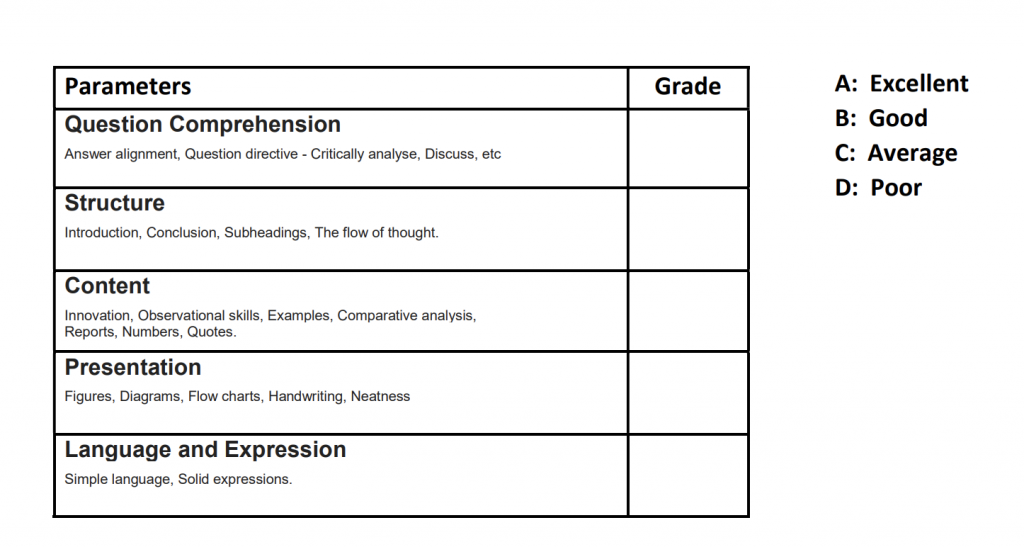
Our evaluation focuses on multiple dimensions and parameters like structure, flow, presentation, contextuality, relevance to question, analytical excellence, and cross-domain inter-linkages than simply on superficial, memory-based lapses.
More than just simply providing information, our model answers cover all the aspects of a question and provide enriching points to the student. They also include:
For ‘thought-provoking/analytical’ type of questions, we’ll provide the best way to approach them.
Alternate introductions
Subheadings and categorization to enhance readability and answer structure.
Colour coding for main arguments, reports, data, scholars, etc. OTB – Out-of-the-box points for additional marks
5. Civilsdaily’s Handholding
You’ll be assigned to a special group on Civilsdaily’s Habitat, there you can interact with different mentors like Sajal Sir, Sukanya Ma’am, Parth Sir, Rahul sir, and others.
6. Value-added material
Current affairs magazines – Civilsdaily’s Magazines are the best in terms of comprehensive coverage, superb design, and high readability.
Listicles and other relevant study material – Supplementary content provided will help cover multiple related questions.
Civilsdaily’s Mains Team Guided 250+ Rankers in UPSC 2022
Abour Sukanya Rana, Mains Program Head:
Sukanya Ma’am has firsthand experience of 4 mains and 2 interviews with UPSC. In 2019, she scored 140 in ethics. She has also appeared in the State PCS interview. Before she worked as a Probationary officer at Canara Bank. Now at Civilsdaily, she heads the Mains program and is engaged in a core team of Civilsdaily.
As per need, we will also involve our Civilsdaily core mentors like Swatantra sir, Parth sir, etc.
Enroll here for Super 50 MEP | Register to book your FREE 1-1 session