A women farmers’ collective from Karnataka has been recognised among the ten global winners of the United Nations Development Programme’s (UNDP) Equator Prize 2025.
About UNDP Equator Initiative Award:
Overview: Presented under the Equator Initiative of the UNDP.
Awardedbiennially: To community-led initiatives reducing poverty through biodiversity conservation and sustainable use.
Significance: Often called the “Nobel Prize for Biodiversity Conservation”.
Award: Includes a cash prize of $10,000.
Eligibility:
Initiative must have existed for at least three years.
Must be a community-based group in a rural area of a UNDP-supported country, or an Indigenous Peoples’ community in a rural area.
Actions must be nature-based and benefit two or more SDGs.
Back2Basics: United Nations Development Programme (UNDP):
Established: 1966 by the UN General Assembly; Headquarters: New York, USA.
Mission: End poverty, promote democratic governance, rule of law, and inclusive institutions.
Focus Areas:
Sustainable development.
Democratic governance and peacebuilding.
Climate and disaster resilience.
Funding: Entirely from voluntary contributions of member states.
Role: Advocates for change, connects countries to knowledge, resources, and expertise for sustainable human development.
Key initiatives:
Human Development Index (HDI).
Sustainable Development Goals (SDG) Reports.
Gender Inequality Index (GII).
[UPSC 2012] The Multi-dimensional Poverty Index developed by Oxford Poverty and Human Development Initiative with UNDP support covers which of the following?
1. Deprivation of education, health, assets and services at household level
2. Purchasing power parity at national level
3. Extent of budget deficit and GDP growth rate at national level
Options: (a) 1 only * (b) 2 and 3 only (c) 1 and 3 only (d) 1, 2 and 3
[UPSC 2018] Appropriate local community level healthcare intervention is a prerequisite to achieve ‘Health for All’ in India. Explain.
Linkage: Organ donation supports “Health for All” by requiring grassroots awareness, local leader engagement, and trained counsellors at PHCs to address myths and secure consent. Integrating it into programmes like Ayushman Bharat ensures equitable access to life-saving transplants beyond metros.
Mentor’s Comment:
Organ transplantation is one of modern medicine’s greatest achievements, yet India’s deceased donor rate is among the lowest globally. This editorial breaks myths, outlines systemic gaps, and suggests awareness and policy measures, crucial for UPSC aspirants studying public health, ethics, and governance.
Introduction
On World Organ Donation Day (August 13), India’s organ shortage stands out starkly. Annual transplants rose from 4,990 in 2013 to 18,378 in 2023, but only 1,099 came from deceased donors. The donation rate remains just 0.8 per million, far behind Spain’s 45+, causing over half a million preventable deaths each year. Myths, misinformation, and mistrust worsen the crisis, making awareness drives, medical transparency, and strong policy reforms urgent.
Scale of India’s Organ Donation Gap
High fatalities: 5 lakh+ deaths yearly due to organ shortage
PYQ LinkageLow deceased donor rate: 0.8/million vs Spain’s 45+/million
Growing numbers, limited impact: 18,378 transplants in 2023 but majority from living donors.
Prevailing Myths and Misconceptions
Body disfigurement fear: Retrieval preserves appearance for rites
Religious objections: All major faiths endorse donation as compassion
Brain death mistrust: Legal safeguards under Transplantation of Human Organs and Tissues Act, 1994 ensure ethical process
Eligibility Beyond Young Accident Victims
Older donors viable: Kidneys, liver segments, lungs, corneas possible from natural deaths
Tissue donations are valuable: Bone, skin, heart valves save/improve lives
Strengthening Awareness and Trust
Community workshops: Address myths, explain medical protocols
Education integration: Include donation ethics in schools/colleges
Media storytelling: Use real donor-recipient cases to inspire
Medical leadership: Train healthcare staff for sensitive family outreach
Policy Measures for Closing the Gap
Presumed consent model: Opt-out system like Spain, Croatia
Family support systems: Ensure transparency, grievance redressal
Dedicated coordination teams: Guide families with empathy
Conclusion
India stands at a moral and medical crossroads. Organ donation must shift from being a rare, heroic act to a societal norm supported by robust legal safeguards and empathetic outreach. Busting myths, embedding awareness into education, and exploring bold policy innovations like presumed consent could ensure no Indian dies for want of an organ. On World Organ Donation Day, the call is clear: pledge, register, and respect the choice to give life.
Value Addition
Ethical dimension: Organ donation as a moral responsibility and act of altruism (GS4)
Comparative policy analysis: Presumed consent systems in Europe (Spain, Croatia)
Health policy reforms: Strengthening National Organ and Tissue Transplant Organisation (NOTTO) functioning
Behavioral change models: Role of social proof, cultural integration, and trust-building in public health campaigns.
Transplantation of Human Organs and Tissues Act (THOTA), 1994
Provides a legal framework for removal, storage, and transplantation of human organs/tissues for therapeutic purposes.
Recognizes brain death as a legal definition of death, enabling cadaver organ donation.
Regulates hospitals, mandates authorization committees to approve donations (esp. for unrelated donors).
Prohibits commercial trading of organs; penalizes violations with imprisonment and fines.
Amended in 2011 to include tissues (e.g., cornea, skin) and strengthen enforcement.
National Organ and Tissue Transplant Organization (NOTTO): Apex body under the Ministry of Health & Family Welfare.
Maintains the National Waiting List & Organ Allocation Registry
Coordinates procurement, distribution, and transplantation at the national level
Provides training, guidelines, and awareness campaigns
Oversees ROTTOs (Regional) and SOTTOs (State) for decentralized coordination
Current Affairs Linkage
The National Organ and Tissue Transplant Organization (NOTTO) has issued a landmark advisory recommending priority in organ transplants for women patients and relatives of deceased donors, a direct attempt to correct a deep-seated gender imbalance in organ transplantation.
This is significant because, despite women making up 63% of living organ donors in 2023, they represented only 24% to 47% of beneficiaries across organ categories.
Ethical challenges/dilemmas related to organ donation for GS-IV:
Informed Consent & Autonomy: Ensuring the donor (or family) fully understands the implications and voluntarily agrees, without coercion.
Transparency vs. Privacy: Balancing public accountability with the donor’s and recipient’s confidentiality.
Cultural & Religious Sensitivities: Respecting diverse beliefs while promoting organ donation awareness.
Prevention of Commercialization & Exploitation: Safeguarding against organ trade, coercion of vulnerable groups, and unethical incentives.
Micro Theme Mapping
GS Paper
Topic
Micro Themes
Example
GS Paper II
Health
Organ donation rates & public health policy
India’s 0.8 donors/million vs Spain’s 45/million
GS Paper II
Governance
Legal safeguards in brain death declaration
Transplantation of Human Organs and Tissues Act, 1994
GS Paper II
Education
Health awareness through curriculum
Introducing organ donation in schools/colleges
GS Paper IV
Ethics
Compassion and altruism in health decisions
Faith leaders endorsing organ donation
Practice Mains Questions:
“In India, organ donation is more a matter of societal will than medical capacity.” Critically examine, suggesting measures to improve donation rates. (250 words)
Elon Musk’s Starlink will soon launch in India, promising high-speed internet access in regions beyond the reach of ground-based networks. This is significant as it can bridge rural-urban gaps, improve disaster resilience, and strengthen defence capabilities. Globally, satellite internet has been a lifeline during Hurricane Harvey and a tactical tool in the Russia-Ukraine war. For India, it represents both a technological leap and a strategic necessity.
Introduction:
In today’s digitised and interconnected world, internet access is as vital as electricity or transport. Traditional cable and tower-based networks excel in cities but falter in remote terrains. Satellite internet, powered by mega-constellations like Starlink, offers a borderless, high-resilience alternative that operates irrespective of geography.
Why are ground-based internet networks economically unviable in certain regions?
Physical Infrastructure Limits: Cables and towers are uneconomical for sparsely populated or remote regions
Disaster Vulnerability: Infrastructure can be wiped out during floods, earthquakes, or storms
On-the-Go Connectivity Gap: Mobile and temporary operations (airplanes, ships, oil rigs) often remain underserved
How does satellite internet overcome these challenges?
Global Coverage: Operates regardless of terrain or terrestrial infrastructure
Rapid Deployment: Can be set up quickly to meet sudden demand surges
Mobility Advantage: Supports moving platforms and remote sites
Dual-Use Potential: Functions for both civil and military purposes (e.g., Ukrainian defence, Siachen Glacier operations)
What makes the new wave of satellite internet significant?
Mega-Constellations: Networks like Starlink have thousands of satellites in Low Earth Orbit (LEO)
Disaster Response Role: Viasat aided Hurricane Harvey operations when 70% of cell towers failed.
Defence Integration: Ukrainian drones fitted with Starlink to bypass Russian jamming; Indian Army use in high-altitude conflict zones
Security Concerns: Smuggled Starlink devices used by insurgent groups and drug cartels
Working of satellite internet:
Two Segments: Space segment (satellites) and ground segment (user terminals, gateways).
Service Life: Satellites operate for 5–20 years depending on design.
Orbits:
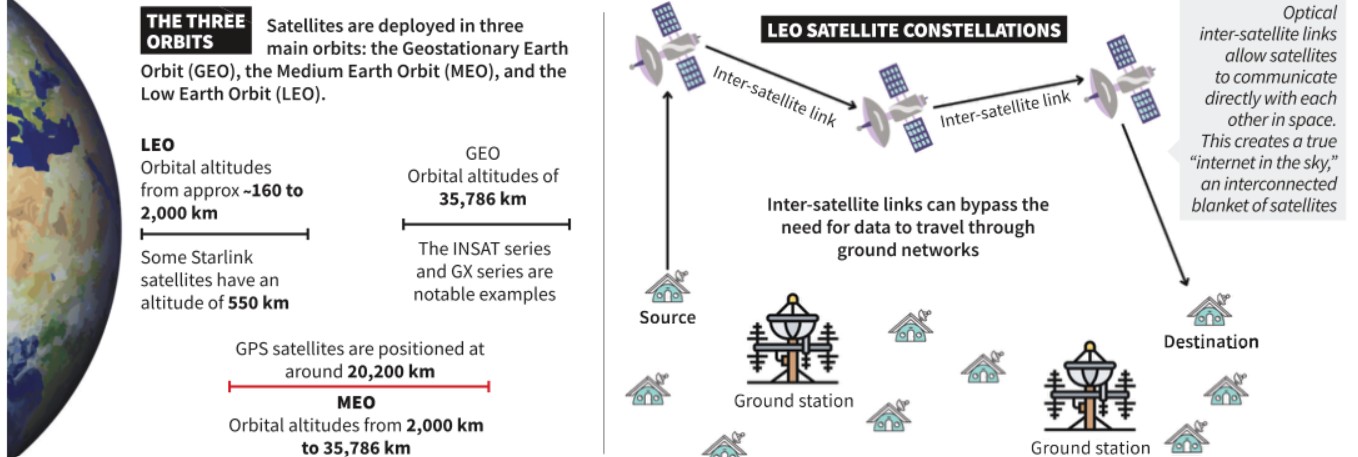
GEO (35,786 km): Wide coverage, high latency; unsuitable for real-time apps. Example: Viasat GX.
MEO (2,000–35,786 km): Medium latency, requires constellations. Example: O3b.
LEO (<2,000 km): Low latency, small coverage; requires mega-constellations. Example: Starlink’s 7,000+ satellites.
Key Differences between satellites in GEO, MEO AND LEO:
Feature
Geostationary Earth Orbit (GEO)
Medium Earth Orbit (MEO)
Low Earth Orbit (LEO)
Altitude
35,786 km above equator
2,000 – 35,786 km
Below 2,000 km
Relative Motion
Stationary relative to a point on Earth
Moves relative to Earth
Moves quickly relative to Earth
Coverage
~1/3 of Earth (no polar coverage)
Larger than LEO, smaller than GEO; needs constellation for global coverage
Small footprint; single satellite covers area like an Indian metro city
Satellite Size
Large
Large
Smaller, often table-sized
Cost & Deployment
Expensive, long deployment
Expensive, smaller constellations
Cheaper, quicker to deploy
Latency
High (unsuitable for time-sensitive apps)
Medium (lower than GEO but still limits real-time use)
Very low (good for real-time use)
Example
Viasat Global Xpress (GX)
O3b constellation (20 satellites)
Starlink (7,000+ satellites, aiming for 42,000)
Key Drawback
High delay due to distance
Still costly, latency not ideal for all uses
Needs thousands of satellites for global coverage
How do LEO mega-constellations maintain connectivity?
On-Board Processing: Improves efficiency and reduces terminal complexity
Optical Inter-Satellite Links: Satellites communicate directly in space for faster routing
Seamless Handoff: Steerable antennas track multiple satellites to maintain uninterrupted service
What are the key applications of satellite internet?
Civil Connectivity: Rural broadband, IoE (Internet of Everything)
Public Administration: Smart cities, disaster warnings, rescue coordination
Healthcare: Telemedicine, remote diagnostics
Agriculture: Precision farming, crop health monitoring
Defence & Security: Real-time communication in conflict zones, strategic surveillance
Conclusion
Satellite internet represents not just a technological upgrade but a strategic asset in the digital era. For India, it offers a pathway to bridge the digital divide, enhance national resilience, and project influence in the global communications domain. However, its dual-use nature demands strong regulatory frameworks to balance innovation, accessibility, and security.
Value Addition
Key Terms & Phrases Explained
Satellite Internet: A communication service where internet connectivity is provided through satellites orbiting the Earth, rather than terrestrial cables/towers. It enables access in remote, disaster-hit, or mobile scenarios.
Mega-Constellation: A large network of hundreds or thousands of satellites, often in Low Earth Orbit (LEO), working in coordination to provide continuous coverage. Example: Starlink (planned 42,000 satellites).
Latency: Time taken for a signal to travel from sender to receiver; critical for real-time applications like video conferencing or online gaming.
Optical Inter-Satellite Links (OISL): Laser-based connections between satellites, enabling direct space-to-space data transfer without routing through ground stations, reducing delays and congestion.
Dual-Use Technology: A technology with both civilian and military applications. In satellite internet, the same network can support remote learning and healthcare or battlefield communication and drone operations.
Digital Divide: The socio-economic gap between those with access to modern digital technologies (internet, computing) and those without.
International Telecommunication Union (ITU): A UN agency responsible for coordinating global telecom networks, including orbital slot and spectrum allocation for satellites.
On-Board Processing: Satellite’s ability to process data directly in orbit, improving signal quality, speed, and reducing complexity of user terminals.
Seamless Handoff: Automatic switching of user connection from one satellite to another as satellites move, ensuring uninterrupted service.
Internet of Everything (IoE): An extension of IoT where not only devices, but also data, processes, and people are interconnected via the internet.
Discuss the potential of satellite internet in bridging the digital divide in India. Examine the associated security and regulatory challenges.
PYQ Linkage:
[UPSC 2018] Why is the Indian Regional Navigational Satellite System [IRNSS] needed? How does it help in navigation?
Linkage: IRNSS (also called NavIC) is India’s indigenous satellite-based navigation system providing accurate position information over India and surrounding regions.
Just like IRNSS uses satellites for positioning, satellite internet uses similar orbital infrastructure for data connectivity. Understanding satellite orbits, latency, and ground segments from this topic directly aids in explaining IRNSS’s working, advantages, and strategic value in navigation.
The government has recently approved the Employment Linked Incentive (ELI) Scheme as one of the largest fiscal commitments towards employment generation in recent years. The scale of underemployment in India is striking, over 53% of graduates are working in semi-skilled jobs and 46% of low-skill workers earn less than ₹1 lakh a year raising questions about whether such a scheme can genuinely address unemployment or will deepen structural inequalities.
Significance of ELI Scheme:
Government Approval: Cleared on July 1, 2025, with ₹99,446 crore outlay.
Primary Aim: Provide fiscal incentives to employers for job creation, especially in manufacturing.
Significance: Represents one of the largest government-led employment incentive packages in India.
Issues with the ELI Scheme’s design:
Employer-Centric Approach: Focuses on incentivising employers rather than directly empowering workers.
Capital-Labour Asymmetry: Risks strengthening employer bargaining power while leaving workers vulnerable.
Exclusion of Informal Sector: 90% of India’s workforce, largely informal, is excluded as the scheme prioritises EPFO-registered firms.
Underprepared Workforce: Only 4.9% of youth have received formal vocational training, creating a mismatch between jobs and skills.
Skill Mismatch and Underemployment Trends in India:
Low Skill Utilisation: Only 8.25% of graduates work in jobs matching their qualifications.
High Underemployment: 53% of graduates and 36% of postgraduates in semi-skilled or elementary roles.
Wage Disparity: 46% of low-skilled workers earn < ₹1 lakh/year, while only 4.2% of specialised graduates earn ₹4–8 lakh/year.
Inefficient Education-to-Employment Pipeline: Shows systemic disconnect between education system and industry needs.
Sectoral Imbalance and Employment Implications:
Manufacturing Bias: Targets manufacturing despite its declining employment elasticity.
Employment Share: Manufacturing employs <13% of total workforce, while agriculture and services employ ~70%.
Potential Marginalisation: Rural youth, women, and informal workers, largely in low-skill services/agriculture, risk being left out.
Automation Pressure: Capital-intensive manufacturing growth reduces labour absorption.
Risks to Job Quality and Employment Sustainability:
Disguised Unemployment: May encourage enterprises to relabel old jobs as new to claim subsidies.
Structural Inequality: Channels fiscal benefits to already formalised enterprises.
Bypassing Informal Workforce: Misses the majority of new labour market entrants in the informal sector.
Stagnant Productivity: Without skill investment, job creation may remain low-quality.
Policy Alternatives for Equitable Employment Generation:
Investment in Skilling: Strengthen vocational training to prepare low-skilled workers
Education Reforms: Align curricula with industry demands
Social Security Inclusion: Extend benefits to informal workers for equity
Shift to Long-Term Strategy: Focus on productivity, job quality, and labour rights rather than short-term headcount increases.
Conclusion
The ELI Scheme reflects a high-investment, employer-focused strategy that risks deepening existing inequalities in India’s labour market. Without addressing the skill mismatch, informal sector exclusion, and sectoral imbalances, the scheme may generate headcount without creating sustainable livelihoods. A shift towards worker-centric, skill-driven, and socially inclusive employment policies is essential to ensure equitable economic growth.
Value Addition
Economic Survey 2024–25
Key Insight: Reveals that only 8.25% of graduates are in jobs matching their qualifications, with 53% of graduates underemployed in semi-skilled or elementary roles.
Relevance: Strengthens arguments on the education–employment disconnect and the urgent need for targeted skilling reforms.
Application: Can be quoted in answers on unemployment, skill development, or human capital formation.
Dual Labour Market Theory
Concept: The labour market is split into two segments, formal (primary) with stable jobs, better wages, and benefits; and informal (secondary) with insecure, low-paid work and no social protection.
Relevance to ELI Scheme: The scheme’s EPFO-based targeting inherently supports the formal sector while neglecting the 90% informal workforce, deepening this divide.
Application: Useful in analysing structural inequality in employment policies.
Employment Elasticity
Definition: The responsiveness of employment growth to GDP growth.
India’s Case: Manufacturing’s employment elasticity is declining due to automation and capital-intensive processes.
Relevance to ELI Scheme: Explains why heavy focus on manufacturing may not yield proportional employment gains.
Application: Adds depth when evaluating sectoral choices in employment policy.
ILO’s “Decent Work” Agenda
Framework: Promotes productive employment, rights at work, social protection, and social dialogue.
Relevance: The ELI Scheme lacks strong components on worker rights, social protection for informal workers, or job quality improvement — thereby falling short of ILO’s standards.
Application: Ideal for international comparison in labour policy answers.
Disguised Unemployment
Definition: A situation where more workers are employed than necessary, resulting in negligible or zero marginal productivity.
Indian Context: Common in agriculture and informal services.
Relevance to ELI Scheme: Risk of enterprises relabeling existing jobs as new to claim subsidies, creating apparent employment without productivity gains.
Application: Can be linked to inefficiencies in job creation schemes and low productivity traps.
Mapping Microthemes:
GS Paper
Theme
Micro Theme
Example from Article
GS Paper III
Economy
Employment generation policies
₹99,446 crore ELI Scheme
GS Paper III
Economy
Formal–informal sector divide
90% informal workforce excluded
GS Paper III
Economy
Skill mismatch & underemployment
8.25% graduates in matching jobs
GS Paper III
Economy
Sectoral imbalance
Manufacturing bias despite low share in jobs
GS Paper II
Governance
Policy design flaws
Employer-centric incentives
Practice Mains Question
Critically evaluate the Employment Linked Incentive (ELI) Scheme in the context of India’s structural labour market challenges. Suggest policy measures to ensure equitable and sustainable employment growth. (250 words)
PYQ Linkage:
[UPSC 2014] “While we flaunt India’s demographic dividend, we ignore the dropping rates of employability.” What are we missing while doing so? Where will the jobs that India desperately needs come from? Explain.
Linkage: Address the role of skilling in tackling unemployment, evaluate gaps in current initiatives, and connect with how ELI Scheme mirrors or misses these elements. The PMKVY question emphasises the necessity of industry-relevant skills for employment generation. The ELI Scheme, while aiming at job creation, lacks a robust skilling component, risking the same shortcomings seen in earlier programmes like PMKVY.
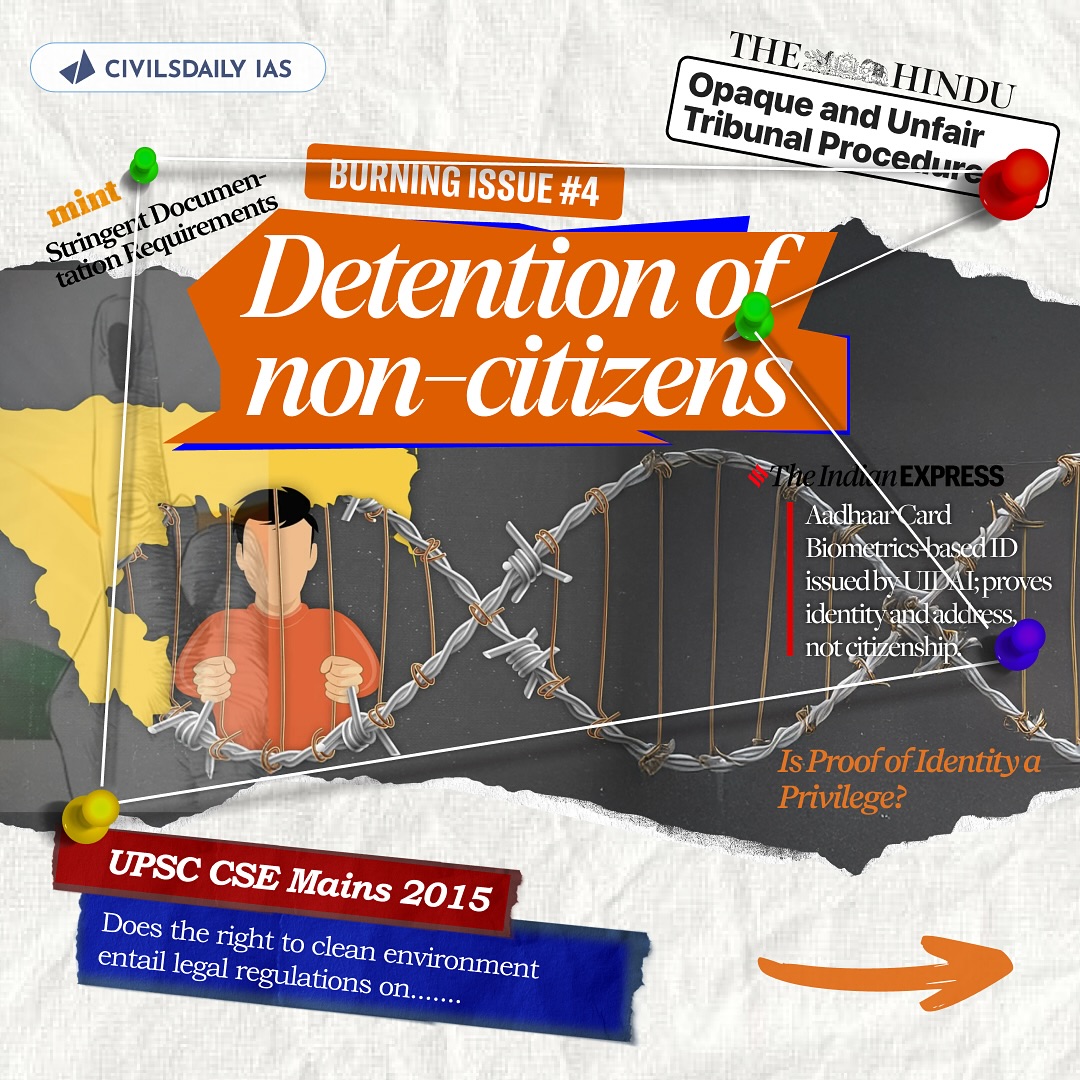
N4S: “When identity becomes a burden, not a right.” That’s the core message of this article. UPSC often frames questions on such topics through the lens of Fundamental Rights, constitutional morality, or state vs individual debates. For instance, the 2015 question on the right to a clean environment during Diwali used Article 21 to anchor a contemporary issue. Similarly, detention and citizenship in Assam can be asked through Article 21 (life and liberty), Article 22 (procedural safeguards), or Article 14 (equality). Many aspirants falter because they either stick to legal jargon without connecting to ground realities, or they narrate facts without showing how it affects real lives or violates constitutional values. This article helps bridge that gap. It does not just list laws and events but humanises them. When it says detention “detains rights” (see ‘Impact on Detainees’ section), it moves from abstract policy to lived experience. The example of a woman being excluded due to spelling errors (“Rahima Khatun” vs “Rahima Khatoon”) underlines how a minor glitch can alter one’s life — making your answer come alive. A very special feature of this article is how it connects macro-constitutional ideals with micro-level injustices (like in the section ‘Marginalisation of Vulnerable Groups’ and ‘Loss of Records due to Floods’).
PYQ ANCHORING
GS 2: Does the right to clean environment entail legal regulations on burning crackers during Diwali? Discuss in the light of Article 21 of the Indian Constitution and Judgement(s) of the Apex Court in this regard. [2015]
MICROTHEMES: Fundamental Rights
Assam’s immigration detention system, initially designed to manage undocumented migration, has become a symbol of bureaucratic overreach and human suffering. Far from being just an administrative process, it has trapped thousands—many of them poor, marginalised, and paperless—in a cycle of fear, uncertainty, and indefinite confinement. At its core, this regime doesn’t just detain people—it detains rights, raising urgent alarms about India’s constitutional promises of liberty, dignity, and fair procedure.
How can a democracy justify indefinite detention without trial? What happens when proof of identity becomes a privilege? And can a nation uphold its Constitution while turning detention into default?
‘Proof of Identity’ : India & Assam
In India, the proof of identity system is largely document-based and applies to citizens for various purposes — accessing government schemes, voting, banking, travel, etc. There is no single universal ID that conclusively establishes citizenship; instead, a mix of documents are used to prove identity, address, and date of birth.
Common Identity Documents in India:
Aadhaar Card – Biometrics-based ID issued by UIDAI; proves identity and address, not citizenship.
Voter ID (EPIC) – Issued by the Election Commission; used to prove Indian citizenship for electoral purposes.
Passport – Issued by the Ministry of External Affairs; considered proof of citizenship.
PAN Card – Primarily for income tax; proves identity, not citizenship.
Birth Certificate, School Certificates, and Government Service Records – Used to prove date/place of birth and lineage.
Ration Card, Driving Licence, etc. – Often used for address and family-based identification.
Most of these documents are accepted in a presumptive and inclusive way, meaning people are generally presumed to be citizens unless proven otherwise.
How is Assam Different?
Assam operates under a distinct and exclusionary framework due to its unique history of migration and the NRC (National Register of Citizens) process. Here, the burden of proving citizenship is far higher, more complex, and often punitive in nature.
Key Differences in Assam:
Legacy Data Requirement: Individuals must prove that they or their ancestors were in Assam before March 24, 1971 (as per the Assam Accord). Requires linking one’s name to pre-1971 documents (like 1951 NRC or 1971 electoral rolls), a huge burden in a state prone to floods and displacement.
Family Tree Verification: People must prove lineage through official documents — often not available for women, orphans, or displaced persons. Minor spelling errors (e.g., “Rahima Khatun” vs. “Rahima Khatoon”) can lead to exclusion.
Foreigners Tribunals (FTs): Individuals suspected of being illegal immigrants may be summoned by FTs to prove citizenship. Even if one has Aadhaar or Voter ID, it may not be accepted as conclusive proof.
Presumption of Illegality: Unlike the rest of India, in Assam, individuals are presumed to be foreigners until proven otherwise, reversing the usual principle of natural justice.
Detention and Exclusion: Failure to prove identity/citizenship can lead to detention in designated centres and loss of legal rights.
While most Indians rely on flexible, inclusive identity documentation for everyday life, Assam applies a rigid, high-stakes system focused on citizenship verification, rooted in historical anxieties over migration. This makes identity not a tool for inclusion, but a test of belonging — often with life-altering consequences.
Issues in NRC Process
The NRC (National Register of Citizens) process in Assam, intended to identify illegal migrants, has been mired in controversy due to deep procedural and structural flaws. While the goal was to create a fair and accurate record of legal residents, the implementation raised serious humanitarian and constitutional concerns. The process disproportionately affected the poor, rural, and marginalized communities—often not because they were illegal immigrants, but because they lacked paperwork, faced systemic disadvantages, or encountered bureaucratic opacity. The table below highlights key issues that plagued the NRC process, undermining both its credibility and fairness.
Factor
Explanation
Example
Stringent Documentation Requirements
Proof of ancestry before March 24, 1971 required.
Rural residents lacked land/birth records due to illiteracy or displacement.
Loss of Records
Floods and natural disasters destroyed old documents.
Many families in flood-prone Assam lost records multiple times.
Minor Discrepancies
Differences in names/spelling across documents led to exclusion.
“Rafiqul” vs “Rafiqul Islam” flagged as suspicious.
Marginalisation of Vulnerable Groups
Affected women, Bengali Muslims, and tribal groups disproportionately.
Women lacked independent lineage proof due to patriarchal norms.
Opaque and Unfair Tribunal Procedures
No transparency or meaningful opportunity to appeal decisions.
People declared foreigners without notice or hearing.
Impact on Detainees
Threat to Liberty & Well-being
Constitutional Principles Affected
Examples
1. Indefinite detention without trial
Article 21 – Right to Life and Personal Liberty
Many declared foreigners have been held in detention for years without deportation or conviction.
2. Detention of Indian citizens due to document issues
Article 14 – Right to Equality before Law
Poor, illiterate individuals lacking documents are more likely to be wrongfully detained.
3. Poor living conditions in detention centres
Article 21 – Dignity as part of Right to Life
Reports reveal lack of medical care, overcrowding, and denial of basic needs in detention facilities.
4. No legal aid or fair representation
Article 22 – Protection against arbitrary arrest and detention
Many accused of being foreigners are tried in quasi-judicial Foreigners Tribunals without proper legal help.
5. Disproportionate impact on marginalized groups
Article 15 – Non-discrimination on grounds of religion, caste, etc.
Bengali Hindus and Muslims are most affected, raising concerns of discriminatory implementation.
6. Uncertainty, fear and mental health trauma
Directive Principles – Human dignity and social justice (Article 39A)
Even children of detainees suffer from trauma, education loss, and social stigma.
Constitutional Violations Under Article 21 and 22
Provision
Violation
Example
Article 21: Right to Life and Personal Liberty
Detention without fair legal basis undermines personal liberty.
Innocent individuals held for years without real deportation prospects.
Article 22: Procedural Safeguards
Lack of information on grounds of detention; no legal aid.
Detainees often unaware of reasons or denied timely counsel.
Detention Without Trial or Conviction
Law allows detention mainly through judicial process, not executive action.
People detained by quasi-judicial tribunals despite no criminal charge.
No Legitimate Preventive Purpose
Preventive detention requires imminent threat, not document issues.
Detentions continue even when deportation is not feasible.
Executive Overreach
Detentions ordered by executive/tribunals without judicial oversight.
Judiciary bypassed, undermining rule of law and access to remedy.
Way Forward for Reforming India’s Detention Regime
India’s detention regime urgently requires a rights-based, rule-of-law-oriented overhaul. The following steps offer a tight and actionable path forward:
Enact a Comprehensive Law: India needs a dedicated and codified immigration and detention law that clearly defines grounds for detention, outlines procedures, provides safeguards, and distinguishes between illegal immigrants, stateless persons, and asylum seekers.
Reform Foreigners Tribunals: Make Foreigners Tribunals more transparent and accountable by ensuring judicial oversight, standardized procedures, and access to free legal aid. Appeals must be allowed before a competent and impartial authority.
Cap Detention Periods: Introduce a legally mandated, time-bound limit on administrative detention — for example, six months — beyond which individuals must be released if deportation is not feasible.
Develop Alternatives to Detention: Shift towards community-based monitoring, reporting obligations, or bail systems for those not posing security risks, especially families, the elderly, and children.
Ensure Humane Conditions: Detention centres must comply with basic human rights standards, including access to healthcare, clean living spaces, and education for children. Independent bodies should regularly audit these facilities.
Address Statelessness and Identity Gaps: Formulate a clear national protocol for dealing with stateless persons and those excluded from citizenship due to documentation gaps, in line with international principles.
Protect the Vulnerable: Women, children, and marginalised communities require special procedural protections during verification and detention processes to avoid systemic injustice.
Establish Parliamentary Oversight: Institutionalise regular reporting to Parliament or a standing committee on the number of detainees, conditions in centres, and legal outcomes to ensure transparency and accountability.
Only by combining legal clarity, administrative fairness, and humane treatment can India reconcile its immigration control with constitutional values and international obligations.
#BACK2BASICS: Detention Regime in India
India’s detention regime refers to the legal and administrative framework under which individuals are detained — either as foreigners or under preventive detention laws — without regular criminal trial. It is especially relevant in the context of immigration enforcement and national security.
1. Detention under Foreigners Act, 1946
Who can be detained? Foreigners who are:
Overstaying visas
Entering illegally
Declared as “foreigners” by a Foreigners Tribunal (particularly in Assam)
Legal Basis: The Foreigners Act, 1946 empowers the government to detain and deport any foreign national without a criminal conviction.
Purpose: Detention is considered administrative, not punitive — aimed at deportation.
2. Detention in the Context of NRC (National Register of Citizens) in Assam
Special Case: People excluded from the NRC and declared as “foreigners” by Foreigners Tribunals may be detained.
Problem: Many of those detained:
Were Indian citizens wrongfully excluded
Had no country to be deported to (e.g., stateless)
Detention Centres: Special prisons within jails, and standalone facilities, such as the large centre in Goalpara (Assam).
3. Preventive Detention under Indian Constitution
Constitutional Provision: Article 22(3)–(7) allows preventive detention in the interest of:
Detainee may not be told full grounds of arrest if it’s against public interest.
4. Detention of Refugees and Asylum Seekers
India is not a signatory to the 1951 UN Refugee Convention.
Refugees like Rohingyas and undocumented migrants may be detained as illegal foreigners.
Detention is not governed by a uniform refugee law — policies vary by government orders.
5. Key Concerns with India’s Detention Regime
Issue
Explanation
Lack of Legal Aid
Many detainees cannot access lawyers or understand the legal process.
Indefinite Detention
Without bilateral agreements, deportation is impossible — leading to endless jailing.
Poor Detention Conditions
Overcrowding, lack of medical care, and absence of facilities for women/children.
Statelessness Risk
Many excluded individuals have no citizenship anywhere.
Arbitrary and Disproportionate
Minor documentary issues lead to grave consequences, violating natural justice.
India’s detention regime, particularly in Assam, raises serious human rights, constitutional, and due process concerns. While the state has a right to control illegal immigration and ensure national security, the current system lacks transparency, uniform safeguards, and accountability, making it vulnerable to misuse and injustice — especially for the poor and marginalised.
Chronology of NRC (National Register of Citizens) in Assam
Year/Period
Event/Development
1951 – The First NRC
After India’s first Census, the NRC was created in Assam to record who was living there legally. It wasn’t updated thereafter — it stayed frozen in time.
1971 – Bangladesh Liberation War
War in East Pakistan (now Bangladesh) led to a massive refugee influx into Assam. This caused tensions over identity, jobs, and land among locals.
1979–1985 – Assam Agitation
A mass movement led by student bodies like AASU demanded the identification and deportation of “illegal foreigners” (mainly from Bangladesh).
1985 – Assam Accord Signed
The Centre and protest leaders signed the Assam Accord. It set March 24, 1971, as the cut-off date for identifying foreigners and promised an NRC update.
2005–2013 – NRC Update Gains Steam
NRC update efforts revived under Congress and BJP. Pilot projects began but stopped due to violence. In 2013, the Supreme Court took charge of the process.
2015 – NRC Update Process Officially Begins
People in Assam had to prove that they or their ancestors were in India before March 24, 1971, using documents like land records and voter lists.
2018 – Draft NRC Released
The first draft excluded over 40 lakh people, leading to panic, confusion, and widespread controversy.
2019 – Final NRC Published
On August 31, 2019, the final NRC was released, excluding 19.06 lakh people. Appeals were to be made in Foreigners Tribunals. Many were dissatisfied with the list.
Post-2019 – What Now?
The NRC hasn’t been officially notified. The Assam government rejected it, and it may be rechecked or redone. Excluded individuals face legal uncertainty and fear.
SMASH MAINS MOCK DROP
In the context of the NRC process in Assam, examine how document-based identity verification challenges the constitutional promises of liberty, equality, and due process. Suggest a rights-based framework to reconcile immigration control with fundamental rights.”
Lok Sabha Speaker has initiated removal proceedings against a Judge of the Allahabad High Court by admitting a motion signed by 146 members and forming a three-member inquiry committee.
About Appointment of High Court Judges:
Constitutional Basis: Article 217 of the Constitution of India.
Appointing Authority: President of India, in consultation with the Chief Justice of India (CJI), Governor of the concerned State, and Chief Justice of the concerned High Court.
Collegium System: The proposal is initiated by the High Court’s Chief Justice, forwarded through the Chief Minister and Governor, and decided by the CJI along with the two senior-most judges of the Supreme Court.
Chief Justice Posting Policy: Chief Justices are appointed from outside the State to ensure impartiality.
Transfers: The CJI and senior-most judges of the Supreme Court decide transfers to maintain judicial independence.
Removal Process:
Grounds: Proved misbehaviour or incapacity.
Procedure: Impeachment process under Articles 124(4) and 217, and Section 3(2) of the Judges (Inquiry) Act, 1968.
Initiation: Motion signed by at least 100 Lok Sabha MPs or 50 Rajya Sabha MPs.
Inquiry: 3-member committee comprising a Supreme Court judge, a Chief Justice of a High Court, and a distinguished jurist investigates the charges.
Voting Requirement: Two-thirds majority in both Houses of Parliament for removal.
In-House Mechanism: CJI can initiate internal inquiries and advise resignation in serious cases.
Other Notable Cases:
Justice V. Ramaswami (1993): Faced impeachment for financial misconduct; motion failed in Lok Sabha.
Justice Soumitra Sen (2011): Resigned after Rajya Sabha voted for removal over fund misappropriation.
Justice K. Veeraswamy: Corruption case remained unresolved until his death.
Justice Shamit Mukherjee (2003), Justice Nirmal Yadav (2008), Justice S.N. Shukla (2017): Faced criminal charges for corruption after in-house inquiries.
[UPSC 2007] Consider the following statements:
1. The mode of removal of a Judge of a High Court in India is the same as that of the removal of a Judge of the Supreme Court.
2. After retirement from office, a permanent Judge of a High Court cannot plead or act in any court or before any authority in India.
Which of the statements given above is/are correct?
Options: (a) 1 only * (b) 2 only (c) Both 1 and 2 (d) Neither 1 nor 2
The Union Health Ministry has launched the State Health Regulatory Excellence Index (SHRESTH), a first-of-its-kind national framework to benchmark and strengthen state drug regulatory systems.
About State Health Regulatory Excellence Index (SHRESTH):
Purpose: National initiative by Union Health Ministry to benchmark and strengthen state drug regulatory systems.
Developer: Designed by Central Drugs Standard Control Organization (CDSCO).
Objective: To benchmark and improve the performance of state-level drug regulatory authorities across India through a transparent, data-driven framework.
Method: Uses a transparent, data-driven framework and acts as a virtual gap assessment tool for maturity certification.
Key Features:
State Categories: Manufacturing states assessed on 27 indices; distribution-focused states/UTs assessed on 23 indices.
Evaluation Themes: Human resources, infrastructure, licensing, surveillance, and responsiveness.
Data Submission: Monthly metric data submitted by the 25th; scores shared on the 1st of the next month.
Performance Benchmarking: Rankings encourage cross-learning and adoption of best practices.
Capacity Building: Workshops, joint trainings, and regulatory audits to strengthen state systems.
Digital Integration: Dashboards like Not of Standard Quality (NSQ) for real-time monitoring.
Global Standards: Supports India’s goal to meet WHO-equivalent medicine quality norms, building on WHO Maturity Level-3 vaccine status.
[UPSC 2023] Consider the following statements:
Statement-I: India’s public sector health care system largely focuses on curative care with limited preventive, promotive and rehabiliative care.
Statement-II: Under India’s decentralized approach to health care delivery, the States are primarily responsible for organizing health services.
Which one of the following is correct in respect of the above statements?
Options: (a) Both Statement-I and Statement-II are correct and Statement-II is the correct explanation for Statement-I
(b) Both Statement-I and Statement-II are correct and Statement-II is not the correct explanation for Statement-I *
(c) Statement-I is correct but Statement-II is incorrect
(d) Statement-I is incorrect but Statement-II is correct
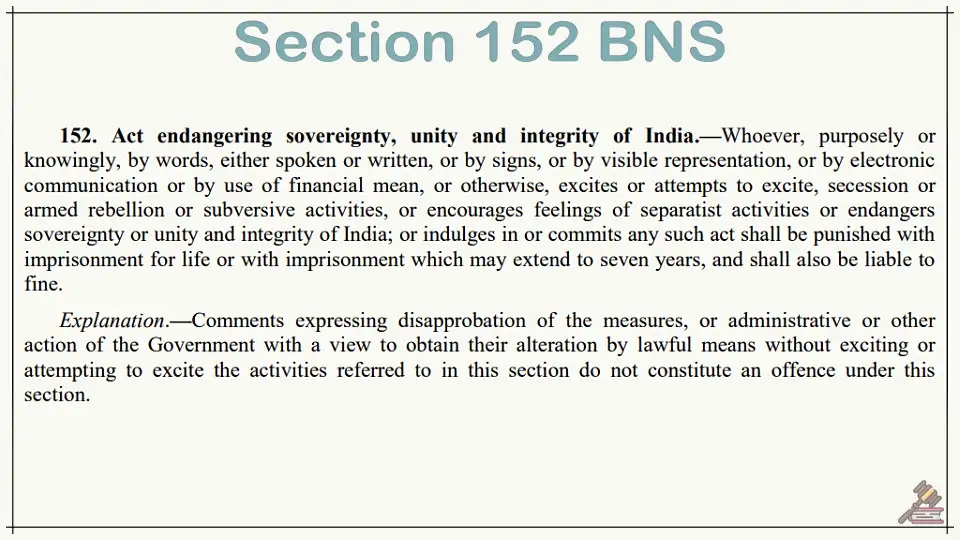
The Supreme Court has raised a key question—whether the “potentiality of abuse” of Section 152 of the Bharatiya Nyaya Sanhita (BNS), which punishes acts endangering the sovereignty, unity, and integrity of India, could be a ground to declare the provision unconstitutional.
About Section 152 BNS:
Deals with: Acts endangering sovereignty, unity, and integrity of India.
Origin: Introduced in the Bharatiya Nyaya Sanhita, 2023, effective 1 July 2024, replacing Section 124A IPC (sedition).
Scope: Criminalises purposeful or knowing acts that:
Excite secession, armed rebellion, or subversive activities.
Encourage separatist feelings.
Endanger sovereignty, unity, or integrity of India.
Means Covered: Words (spoken/written), signs, visible representation, electronic communication, financial means, or any other method.
Punishment: Life imprisonment or imprisonment up to 7 years + fine.
Nature of Offence: Cognizable, non-bailable, triable by Court of Session.
Exception Clause: Lawful criticism of government measures to seek change—without inciting rebellion/secession—is not an offence.
Key Difference from Section 124A IPC: Focus shifted from “disaffection against Government” to direct threats against the nation’s unity and sovereignty, with explicit recognition of digital-era methods.
Issues with Section 152 BNS:
Potential for Misuse: Broad and subjective terms like “endangering sovereignty” can be stretched to target political dissent, journalism, and activism.
Vagueness: Undefined concepts (e.g., “sovereignty” in context of speech) create uncertainty, enabling arbitrary interpretation by authorities.
Similarity to Sedition Law: Despite rewording, its core effect mirrors Section 124A IPC, which is under constitutional challenge for curbing free speech.
Chilling Effect on Free Speech: Risk of self-censorship among journalists, activists, and citizens due to fear of prosecution.
High Punishment and Cognizability: Harsh penalties combined with arrest without warrant heighten scope for harassment before judicial scrutiny.
Digital Surveillance Concerns: Explicit coverage of electronic communication and financial means may widen investigative reach into personal digital activities.
Judicial Burden: Courts will need to repeatedly interpret the law to balance Article 19(1)(a) freedom of speech with state security.
[UPSC 2025] Sedition has become my religion” was the famous statement given by Gandhiji at the time of:
(a) the Champaran Satyagraha (b) publicly violating Salt Law at Dandi* (c) attending the Second Round Table Conference in London (d) the launch of the Quit India Movement
The Union Cabinet has approved four new projects under the India Semiconductor Mission (ISM), adding to the country’s push for a robust semiconductor and display manufacturing ecosystem.
About India Semiconductor Mission (ISM):
Overview: Launched in 2021; Operates under the Ministry of Electronics and Information Technology (MeitY)
Purpose: Develop a sustainable semiconductor and display manufacturing ecosystem in India.
Scope: Supports the entire value chain — from chip design to fabrication, assembly, testing, packaging, and display manufacturing.
Administrative Role: Receives and evaluates applications for schemes under the Semicon India Programme and engages with industry stakeholders to attract investment.
Key Components:
Semiconductor Fabs Scheme: Fiscal support for setting up semiconductor wafer fabrication plants in India.
Display Fabs Scheme: Incentives for manufacturing TFT LCD and AMOLED display panels.
Compound Semiconductors / Silicon Photonics / Sensors Fab & ATMP/OSAT Scheme: Support for advanced semiconductor technologies and packaging facilities.
Design Linked Incentive (DLI) Scheme: Incentives and infrastructure support for IC, SoC, chipset, and semiconductor-linked design projects; administered by CDAC; includes support for startups.
Modernisation of Semi-Conductor Laboratory (SCL), Mohali: Upgrading as a brownfield fab.
Comprehensive Coverage: Includes manufacturing, R&D, packaging, and design support.
[UPSC 2012] Recently there has been a concern over the short supply of a group of elements called rare earth metals. Why?
1. China, which is the largest producer of these elements, has imposed some restrictions on their export.
2. Other than China, Australia, Canada, Chile, these elements are not found in any country.
3. Rare earth metals are essential for the manufacture of various kinds of electronic items and there is growing demand for these elements.
Select the correct answer using the code given below:
Options: (a) 1 only (b) 2 and 3 only (c) 1 and 3 only * (d) 1, 2 and 3