On August 15, 2025, Prime Minister delivered the longest Independence Day speech (103 minutes) from the Red Fort, continuing a tradition started by Jawaharlal Nehru in 1947.
The fort’s choice as the venue reflects its historic role as Delhi’s seat of power and symbol of sovereignty.
About the Red Fort:
Construction: Built in 1648 by Mughal Emperor Shah Jahan as the palace fort of Shahjahanabad, his new capital.
Material: Enclosed by massive red sandstone walls with royal pavilions and apartments.
Water Feature: Contained the Nahr-i-Behisht (“Stream of Paradise”), a continuous water channel.
Architectural Value: Prime example of Mughal architecture, blending Islamic traditions with Indian craftsmanship.
Recognition: Declared a UNESCO World Heritage Site in 2007.
Historical Significance of Delhi and Red Fort:
Delhi’s Role: Seat of power for nearly a thousand years, regarded as “capital of all Hindustan” by Babur.
Shahjahanabad: Inaugurated in 1648 with the Red Fort at its centre.
Symbol of Sovereignty: Even after Mughal decline, Delhi remained central; East India Company minted coins in the emperor’s name.
1857 Revolt and British Authority:
Revolt Centre: Bahadur Shah Zafar was declared leader by sepoys in Delhi.
Aftermath: Fall of Delhi ended Mughal rule; Zafar was exiled.
Fort Damage: British converted Red Fort into a military garrison, destroying ~80% of interiors.
Imperial Authority: Delhi Durbars (1877, 1903, 1911) asserted British control before capital shifted from Calcutta to Delhi in 1911.
Significance of Red Fort for Independence Day:
INA Trials: Held in Red Fort in 1946, igniting nationalist fervour.
1947 Ceremony: Jawaharlal Nehru hoisted the national flag on 15 August 1947 and gave the first Independence Day address.
Tradition: Since then, every Prime Minister hoists the flag and addresses the nation from its ramparts.
Symbolism: Site once stamped with colonial dominance, now reclaimed as a symbol of India’s sovereignty.
[UPSC 2021] What was the exact constitutional status of India on 26th January, 1950?
Options: (a) A democratic Republic (b) A Sovereign Democratic Republic* (c) A Sovereign Secular Democratic Republic (d) A Sovereign Socialist Secular Democratic Republic
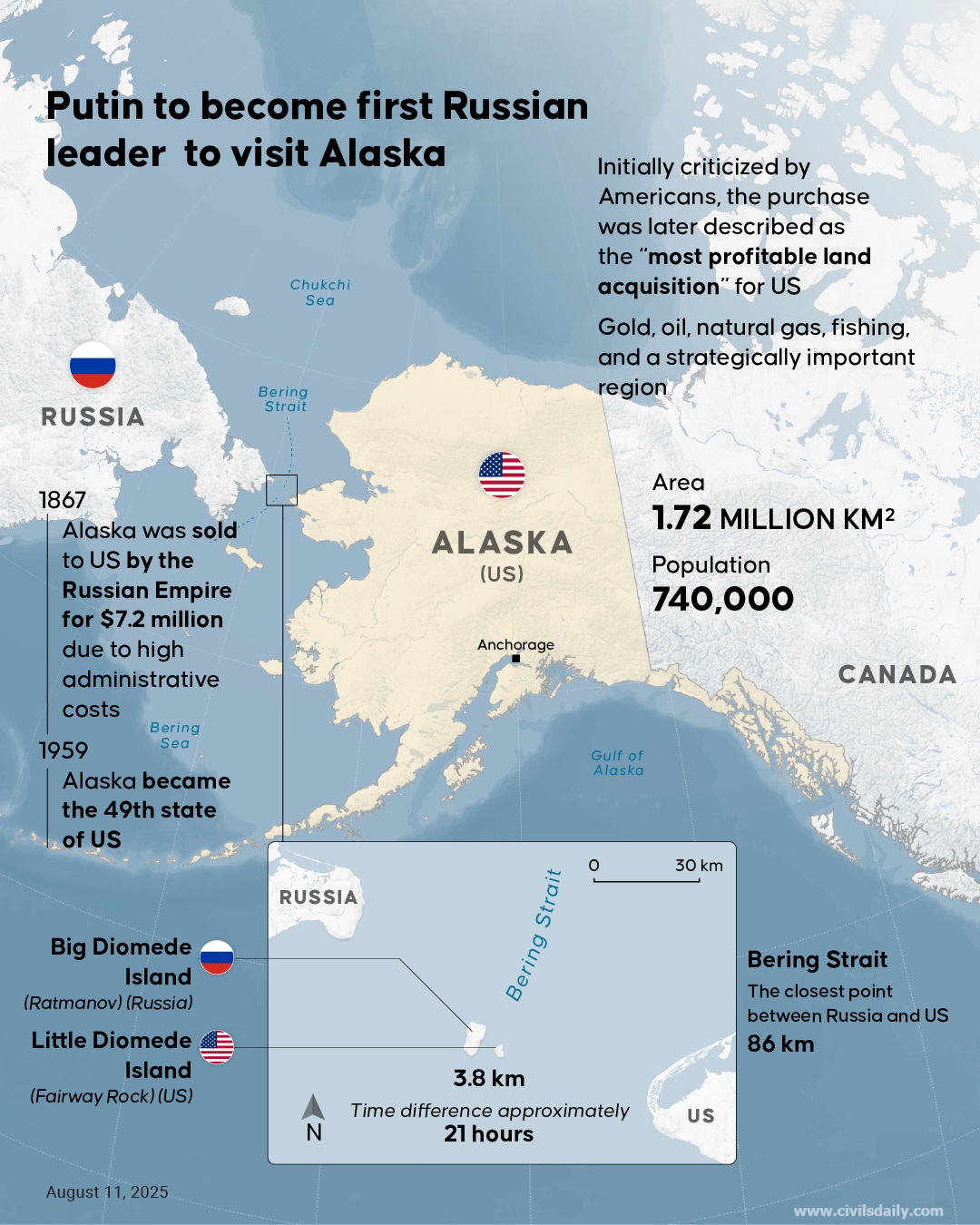
United States President Donald Trump and his Russian counterpart Vladimir Putin are set to meet in Anchorage, Alaska to discuss how to end the war in Ukraine.
About Alaska:
Acquisition: Largest U.S. state; Purchased from Russia in 1867 for $7.2 million.
Mountains: Includes Alaska Range with Mount Denali (20,310 ft), the highest peak in North America.
Geography: Brooks Range separates central Alaska from the Arctic far north.
Tundra: Northern regions feature vast tundra, permafrost, and Arctic coastal plains.
Glaciers: Hosts 100,000+ glaciers, including Bering Glacier, the largest in North America.
Forests: About 5% glacier ice, with extensive boreal and temperate rainforests in the south.
Volcanoes: More than 70 active volcanoes in Aleutians and Alaska Peninsula.
Seismic Activity: Located on the circum-Pacific seismic belt, prone to powerful quakes (e.g., 1964 Alaska earthquake).
Water Resources: Contains 3 million+ lakes and 3,000+ rivers, among the most water-rich regions globally.
Peninsulas: Includes Alaska Peninsula, Kenai Peninsula, and Seward Peninsula (linked to ancient Bering land bridge).
Why did Russia sell Alaska to the US?
After the Crimean War (1853–56), Russia was financially strained and needed funds.
Alaska was seen as a remote, unprofitable liability with declining fur trade.
Russia feared Britain might seize Alaska easily from nearby Canada in a future war.
Selling it to the United States ensured goodwill and balanced British power.
The $7.2 million sale (1867) turned a weakly defended outpost into cash for reforms.
Geopolitical Significance of Alaska:
Natural Resources: Rich in oil, gas (e.g., Prudhoe Bay discovery, 1968), fisheries, and minerals vital for U.S. energy security.
Shipping Routes: Offers access to Arctic Sea routes, increasingly navigable due to climate change.
Strategic Gateway: Provides access to the Arctic and Pacific, enhancing U.S. naval and air capabilities.
Defense Value: Proximity to Russia made it critical in the Cold War and remains vital in Arctic competition.
Military Presence: Hosts major U.S. bases and radar systems for missile defense and surveillance.
Arctic Council Role: Strengthens U.S. claims in polar governance and Arctic Council negotiations.
Scientific Hub: Serves as a center for climate, seismic, and polar ecosystem research.
[UPSC 2025] Consider the following statements:
I. Anadyr in Siberia and Nome in Alaska are a few kilometers from each other, but when people are waking up and getting set for breakfast in these cities, it would be different days.
II. When it is Monday in Anadyr, it is Tuesday in Nome.
Which of the statements given above is/are correct?
(a) I only * (b) II only (c) Both I and II (d) Neither I nor II
This article helps you clearly understand the power boundaries between the legislature and the judiciary, especially in the context of contempt of court and judicial review. UPSC often picks such complex, ongoing debates and frames open-ended, analytical questions around them. For instance, a question like “The Supreme Court checks arbitrary parliamentary power” demands that aspirants critically analyse constitutional boundaries, institutional roles, and recent judgments. However, many aspirants falter by presenting emotional arguments instead of structured reasoning. Some avoid using real-life examples, which weakens their answers. This article addresses all of that. It uses actual cases like Prashant Bhushan, Justice Karnan, and the Salwa Judum verdict to anchor theoretical principles in real events. One standout feature of this article is the section “Should the contempt provision be retained?” which walks you through the constitutional basis, global comparisons, and legal safeguards in a way that is directly useful in the exam.
PYQ ANCHORING
GS 2: The Supreme Court of India keeps a check on arbitrary power of the Parliament in amending the Constitution. Discuss critically. [GS 2]
Microtheme: Judiciary Vs Legislature
The Supreme Court has clarified that simply passing a law, even if it contradicts a previous court order, cannot be deemed contempt of court. This ruling came in the context of a contempt petition concerning Chhattisgarh’s law that legalized auxiliary armed police (Special Police Officers or SPOs) despite an earlier Supreme Court directive to disband the “Salwa Judum” force.
The Court underlined that legislatures have full authority to enact or repeal laws. Even if they choose to override a court directive, such acts are not contemptuous, as long as the new law isn’t struck down under judicial review. This reinforces the doctrine of separation of powers, maintaining that courts interpret laws – but don’t veto legislative functions .
Upholding Separation of powers //mains
Dimension
Judgment’s Contribution
Example
Legislative Supremacy in Lawmaking
Recognized that legislatures can make or amend laws, even if it affects a prior court judgment.
Chhattisgarh passed a law legalizing SPOs despite SC’s earlier Salwa Judum verdict.
Judicial Review, Not Contempt
Said that if a law is unconstitutional, the remedy is judicial review, not contempt of court.
Petitioners were told to challenge the Chhattisgarh law’s validity, not seek contempt action.
Prevents Judicial Overreach
Ensures courts do not punish legislatures for exercising their core function of lawmaking.
SC declined to hold the state legislature in contempt merely for enacting a new law.
Checks and Balances Maintained
Allows courts to strike down unconstitutional laws but not criminalize the act of legislating.
If the SPO law violates fundamental rights, it can be struck down, not treated as contempt.
Issues with Contempt of Court
Issue
Explanation
Examples
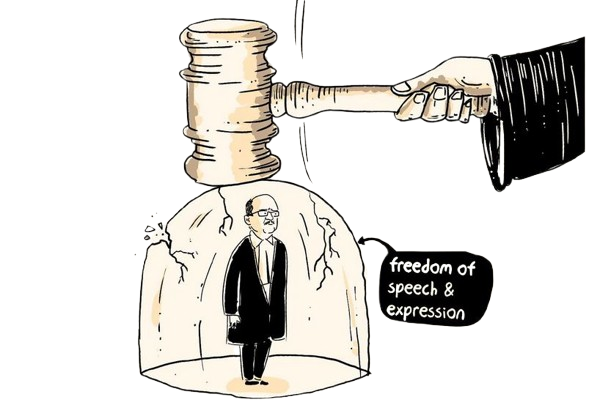
1. Chilling Effect on Freedom of Speech
Contempt law can discourage individuals from voicing legitimate criticism of the judiciary, even when done in public interest.
Prashant Bhushan (2020): Held guilty for tweets criticizing the CJI and the judiciary’s handling of cases during the pandemic. His tweets were argued to be fair criticism, yet resulted in conviction.
2. Vague and Broad Definition
The definition of criminal contempt includes “scandalising the court” and “lowering the authority of the court”, which are subjective and open-ended.
Arundhati Roy (2002): Faced contempt for her affidavit alleging bias in the court’s order against Narmada Bachao Andolan.Suo motu contempt proceedings are often triggered by media statements or articles critical of court judgments.
3. Violates Natural Justice
Judges who feel aggrieved often sit on benches deciding contempt, raising conflict of interest concerns.
In Justice C.S. Karnan case (2017), the Supreme Court initiated contempt against a sitting High Court judge and sentenced him to jail—he was denied legal representation and hearing on merits.
4. Limited Right to Appeal
After conviction for criminal contempt, the only recourse is a review petition, usually heard in chambers by the same judges, with no guaranteed oral hearing.
Prashant Bhushan’s review plea (2021) was rejected in chambers without an oral hearing, despite public debate and support for open justice.
5. Executive Paralysis / Misuse
Fear of contempt may lead government officers to over-comply with court directions or hesitate in exercising discretion.
In UP police encounter cases, officials reportedly hesitated in following SOPs for fear of judicial reprimand.Delhi sealing drive: Municipal officers rushed action fearing contempt of Supreme Court orders, often at cost of public order and process.
6. Outdated in Global Context
The offence of “scandalising the court” has been abolished in many democracies as inconsistent with freedom of speech.
UK abolished it through the Crime and Courts Act, 2013. In R v. Gray (1900), this was a valid offence, but modern courts in US, Canada, and NZ now permit robust public scrutiny of judges and courts. India still uses this colonial-era tool.
Should the contempt provision be retained?
The recent judgement is more than just a technical clarification. It establishes a constitutional norm: judges interpret laws, legislatures make laws, and neither should step into the domain of the other. This is especially relevant in the context of India’s contempt of court jurisprudence, which has long drawn criticism for various reasons.
In 2018, the Department of Justice asked the Law Commission of India to examine whether the Contempt of Courts Act, 1971 should be amended or diluted. After due consultation, the Law Commission concluded that the law should be retained, and offered the following reasons:
Ground
Explanation
Example
Volume of Cases
A significant number of pending civil and criminal contempt cases shows that the law is still frequently used.
Numerous contempt proceedings in High Courts and the SC over non-compliance of orders.
Constitutional Source
The contempt power originates in the Constitution (not the Act). The 1971 Act merely outlines procedure, not substance.
Even if the Act is repealed, Articles 129 & 215 allow courts to punish contempt.
Subordinate Courts Protection
The Act allows High Courts to punish contempt of subordinate courts, a power not clearly provided by the Constitution.
If the Act is diluted, district courts may become vulnerable to interference without remedy.
Global Comparison
While the UK formally abolished “scandalising the court,” it remains punishable under other laws. India faces far more such cases.
UK’s last such case was in 1931, but India still regularly sees contempt cases.
Safeguards Exist
The Act has inbuilt filters, like requiring AG/SG consent for criminal contempt. Not every criticism is punished.
Courts routinely drop cases if intent to obstruct justice is absent.
Checks Judicial Overreach
Ironically, the 1971 Act helps discipline the courts by laying down procedures for contempt. Diluting it may give more arbitrary power.
Without statutory procedure, judges may exercise inherent contempt powers more broadly.
Judicial Decisions to constitute Contempt of Court in India
Interference with Administration of Justice: In Brahma Prakash Sharma v State of Uttar Pradesh, the Supreme Court had held that in order to constitute the offence of Contempt of Court, it was not necessary to specifically prove that an actual interference with administration of justice has been committed.
Scandalizing the Court: In the case of PN Dua v Shiv Shankar and others, the Supreme Court held that mere criticism of the Court does not amount to contempt of Court.
Vilification of the Judge : In the case of Baradanath Mishra v the Registrar of Orissa High Court judgement, the court said that in a contempt case the court has to ask whether the vilification is of the Judge as a judge, or it is the vilification of the Judge as an individual. If the latter the Judge is left to his private remedies and the Court has no power to commit for contempt.
Interference with due course of Justice: In Pritam Lal v. High Court of M.P the Supreme Court held that to preserve the proceedings of the Courts from interference and to keep the streams of justice pure, it becomes the duty of the Court, to punish the contemnor in order to preserve its dignity.
Way Forward
Narrow the definition of “scandalising the court”: Amend the Contempt of Courts Act to exclude fair criticism and clearly define what amounts to criminal contempt.
Create a screening mechanism for contempt cases: Set up a panel (e.g. senior advocate or retired judge) to filter cases before courts take them up, especially in suo motu matters.
Train judges to handle criticism democratically: Include modules on media literacy, democratic tolerance, and public accountability in judicial training programs.
Protect subordinate courts through administrative mechanisms: High Courts should establish support systems for subordinate judges instead of relying only on contempt powers.
Publish annual data on contempt cases: Courts should release regular reports on contempt filings, hearings, and outcomes to ensure transparency and public trust.
#BACK2BASICS: Contempt of Court //pre
Contempt of court refers to actions or behaviors that are disrespectful to, or that obstruct or interfere with, the administration of justice by a court. It protects the authority and dignity of the judiciary from acts that obstruct or interfere with justice.
Constitutional Basis:
The Supreme Court’s authority to penalize contempt – whether civil or criminal – stems directly from the Constitution itself:
Article 129 declares the Supreme Court a court of record and grants it inherent power to punish for contempt of itself.
Article 142(2) further empowers the Court to enforce its orders by punishing anyone in contempt of its decrees.
While the Contempt of Courts Act, 1971 and the 1975 Rules outline how contempt cases should be handled (like requiring AG/SG consent), they don’t actually provide the constitutional authority – the root power lies in the Constitution.
In the 2020 Prashant Bhushan case, the Supreme Court reaffirmed that even if certain legal procedures weren’t followed, its inherent constitutional power under Article 129 still permitted it to proceed – though it acknowledged contempt proceedings must still be conducted fairly. Additionally, during the Constitution drafting, Dr. Ambedkar ensured that this contempt power would be explicitly recognized under Article 129 to avoid future ambiguity.
Legal Definition
The Contempt of Courts Act, 1971 defines contempt; the 2006 amendment allows truth and good faith as defences.
Types:
Civil Contempt is the wilful disobedience of court orders.
Punishment: Offenders may face up to 6 months imprisonment, or a ₹2,000 fine, or both.
What Is Not Contempt: Fair reporting and genuine criticism of judgments after disposal are not considered contempt.
SMASH MAINS MOCK DROP
In India’s constitutional scheme, the legislature has the authority to make laws, while the judiciary has the power of review. Critically examine this separation of powers in light of recent judicial pronouncements on contempt of court and legislative supremacy.
[UPSC 2014] Should the premier institutes like IITs/IIMs be allowed to retain premier status, allowed more academic independence in designing courses and also decide mode/criteria of selection of students? Discuss in light of the growing challenges.
Linkage: This PYQ directly links to the article’s core theme of academic autonomy by addressing whether premier institutions should have greater freedom in curriculum design, student selection, and governance. The article highlights how over-regulation, political interference, and funding control erode such freedoms across Indian universities. Answering this PYQ can draw on the article’s arguments for institutional autonomy, diversity, and the dangers of one-size-fits-all regulation.
Mentor’s Comment
Academic freedom is central to nurturing innovation, fostering critical thought, and sustaining democratic accountability in higher education. It ensures that universities remain spaces for questioning, debate, and independent research, free from undue political or bureaucratic interference. In the Indian context, constitutional guarantees under Articles 19(1)(a) and 21, along with policy frameworks like the NEP 2020, lay a foundation for such autonomy, yet over-regulation and ideological pressures often undermine it. This article illustrates these challenges vividly, linking them to global patterns and emphasising the need for reforms that safeguard autonomy while ensuring institutional accountability.
Introduction
Academic freedom is the lifeblood of higher education, enabling questioning, debate, and independent thought. Any restriction on this freedom undermines knowledge creation, weakens the teaching–learning process, and, in the long run, hampers the nation’s intellectual, social, and economic progress.
Core Arguments in Favour of Academic Freedom in Universities
Universities as Centres of Critical Inquiry:
Universities must be spaces where students and faculty can challenge existing ideas, debate openly, and explore new perspectives.
Questioning is not rebellion, it is the foundation of knowledge development.
Freedom for Students & Faculty: Students need the right to ask questions without fear. Faculty must have autonomy to challenge conventional wisdom in their fields.
Institutional Autonomy:
Universities must independently decide curriculum and pedagogy.
External political or bureaucratic interference in academic content dilutes intellectual rigour.
Universities contribute ideas for science, technology, economic policy, and social reform.
Act as “conscience-keepers” through public intellectual engagement.
Autonomy fosters accountability but accountability should be through transparent institutional mechanisms, not political intervention
Rankings, despite flaws, can help ensure performance-based accountability
Impact on Innovation & Society:
Restricting academic discourse narrows creativity in research and stifles innovation.
Over time, the economy, society, and polity bear the cost through diminished problem-solving capacity.
Open Intellectual Spaces:
Universities should freely invite diverse voices and speakers.
Restricting platforms for dialogue harms learning outcomes and social progress.
Erosion of Academic Autonomy: Challenges and Way Forward
Freedom in Research:
Universities and faculty must set research priorities and agendas free from political or ideological bias.
Funding should be based on peer review, not prejudice or preference.
Fundamental research needs time, resources, and tolerance for dissenting views.
Lack of such an environment partly explains why Indian universities have not produced Nobel laureates in recent decades.
The Indian Reality:
Curricula are regulated and straitjacketed; reading lists are often politically vetted.
Promising non-mainstream research, especially in humanities and social sciences, is discouraged.
Government-controlled funding bodies can indirectly dictate research themes.
Even private universities self-censor to avoid antagonising political authorities.
Regulation and Autonomy:
UGC Act, 1956 grants regulation powers but often centralises control.
NEP 2020 proposes Higher Education Commission of India to streamline governance but risks uniformity over diversity.
Autonomy must be administrative, financial, and academic with accountability ensured via transparent governance systems, not political directives.
Case in Point – Academic Freedom Under Strain in India
JNU Reading List Controversy (2019): Certain texts removed from syllabi for “ideological bias.”
IIT-Madras Student Group Derecognition (2015): Suspension after alleged criticism of government policies.
Ashoka University Resignations (2021 & 2023): Faculty exits over lack of institutional support for academic freedom.
UGC Advisory (2022): Urged avoidance of events critical of government policies.
Global Context
Restrictions in democracies (Argentina, Hungary, Türkiye) and authoritarian states (China, Russia, Vietnam).
The US faced funding cuts under the Trump administration, risking erosion of its innovation edge.
China limits social sciences freedom but maintains merit-based appointments in top institutions.
Conclusion
Academic freedom is not a privilege, it is a necessity for national growth. Curtailing it is an attack on the very roots of innovation, democratic engagement, and societal advancement.
Value Addition
India’s Academic Freedom Snapshot
Academic Freedom Index 2023: Low score; declining trend since 2013
QS World University Rankings – Few Indian universities in global top 200; autonomy cited as a factor
NAAC Accreditation: Less than 35% of HEIs accredited
UGC Autonomy Regulations: 82 universities granted autonomy (2018–2023)
Global Comparison: US, UK, Germany ranked significantly higher in academic freedom
The Union Ministry of Home Affairs (MHA) has told the J&K High Court that the Lieutenant-Governor (L-G) can nominate five Assembly memberswithout the “aid and advice” of the elected government. This position has sparked a constitutional debate over democratic accountability in a politically sensitive Union Territory where such nominations could alter the balance of power. This is significant because these nominations could decide the majority in a 119-member House, potentially overturning the people’s electoral verdict. The High Court is examining whether this undermines the Constitution’s basic structure.
Core issues before the J&K High Court
Constitutional question: Whether the 2023 amendments to the J&K Reorganisation Act, allowing the L-G to nominate five members, violate the Constitution’s basic structure.
Potential impact: These five voting members could “convert a minority government into a majority government and vice versa,” influencing governance stability.
Judicial scope: Goes beyond statutory interpretation into democratic essence.
Provisions of the 2023 amendments
Sections 15A & 15B of the Jammu and Kashmir Reorganisation Act, 2019: Allows nomination of two Kashmiri migrants (including one woman) and one from Pakistan-occupied J&K, in addition to two women if inadequately represented.
Total seats: Creates five nominated members in the 119-member Assembly.
Voting rights: These nominees have full voting powers.
Centre’s justification of this power
MHA’s submission: Nominations fall outside the elected government’s remit, citing K. Lakshminarayanan vs Union of India (Puducherry).
Legal references: Invokes “sanctioned strength” concept, including elected + nominated members, and Section 12 of the 1963 Union Territories Act on voting procedures.
Approach: Focuses on legal technicalities rather than broader constitutional implications.
Concerns over democratic implications
Risk of mandate distortion: In a tight Assembly, nominees could decide government stability.
Precedent in Puducherry: In 2021, nominated members plus defectors contributed to the collapse of the Congress-led government.
UT context: J&K’s downgrade from State to UT in 2019 happened without consultation with elected representatives, making accountability critical.
Supreme Court jurisprudence on L-G’s powers
Delhi Services Cases (Government of NCT of Delhi vs. Union of India (2018), Government of NCT of Delhi vs. Union of India & Anr. (2023)): SC held that the L-G should act on the “aid and advice” of the elected government, with discretion as the exception.
Contradiction: MHA’s stance that nominations lie outside the elected government’s domain runs counter to this jurisprudence.
Conclusion
The J&K nominations issue highlights the tension between administrative authority and the democratic mandate. In politically sensitive regions, bypassing elected governments in decisions that can shift Assembly majorities risks undermining public trust and the constitutional promise of representative governance.
Value Addition
Basic Structure Doctrine: It evolved through landmark cases such as Kesavananda Bharati vs State of Kerala (1973), which holds that Parliament cannot amend the Constitution in a way that damages its essential features. Representative democracy and federalism are recognised as part of this basic structure.
Lakshminarayanan Case (2019): In K. Lakshminarayanan vs Union of India, the Supreme Court upheld the Centre’s power to nominate MLAs in Puducherry without consulting the elected government. While constitutionally valid, the aftermath showed that nominated members could be politically aligned with the Centre, leading to destabilisation of the elected government. This precedent is now central to the J&K dispute, as similar powers are being exercised by the L-G.
Delhi vs L-G Jurisprudence: Through Government of NCT of Delhi vs Union of India (2018) and Government of NCT of Delhi vs Union of India & Anr. (2023), the Supreme Court emphasised that the L-G should act on the “aid and advice” of the elected Council of Ministers, except in explicitly stated matters of discretion. This jurisprudence reinforces the principle that administrative authority should not override the electoral mandate, making the MHA’s argument in J&K appear contrary to evolving constitutional norms.
Union Territory Governance Model: Union Territories with legislatures (like Delhi, Puducherry, and now J&K) operate under a hybrid governance system where the Centre retains significant control while local governments have legislative powers. This model inherently contains tensions between central authority and local democratic accountability. In politically sensitive UTs like J&K, such tensions are magnified, especially when powers like nominations can shift legislative majorities.
Mapping Micro Themes for GS Paper II
Topic
Micro Theme
Example
Centre–State Relations
Constitutional role of L-G in UTs & states
J&K L-G nominations without elected govt’s aid and advice
Electoral Process Integrity
Impact of nominated members on Assembly majority
Puducherry 2021 govt collapse case
Basic Structure Doctrine
Threat to democratic accountability
HC challenge to J&K Reorganisation Act amendments
Comparative Jurisprudence
Lakshminarayanan vs Union of India precedent
Puducherry nominated MLAs case
Federalism in Special Regions
J&K statehood restoration debate
SC acknowledgement & public demand
PYQ RELEVANCE
[UPSC 2016] Discuss the essentials of the 69th Constitutional Amendment Act and the controversies regarding the powers of the Lieutenant Governor vis-à-vis the elected government in the NCT of Delhi.
Linkage: The 69th Constitutional Amendment Act created a legislative assembly for Delhi and defined the relationship between the L-G and the elected government, leading to recurring disputes over whether the L-G must act on the “aid and advice” of the Council of Ministers.
The J&K nominations case mirrors this constitutional tension—while Delhi’s dispute involved administrative control and services, J&K’s controversy centres on the L-G’s power to nominate voting members without elected government concurrence. Both situations raise a common constitutional question: Can the L-G exercise discretionary powers in a manner that can override or alter the democratic mandate? This makes Delhi’s precedent and Supreme Court rulings directly relevant to interpreting J&K’s case.
Practice Mains Question
Discuss the constitutional implications of granting the Lieutenant-Governor of Jammu & Kashmir the power to nominate Assembly members without the aid and advice of the elected government. In your answer, examine its impact on the democratic process in light of Supreme Court jurisprudence.
For two decades, China has led Africa’s mining sector, securing vast stakes in cobalt, lithium, copper, and iron ore. Now, African governments and civil society are challenging opaque contracts, environmental damage, and lack of value addition. The old “raw resources for infrastructure” model is giving way to demands for local processing, transparency, and economic sovereignty.
Significance
For the first time in decades, China’s unchallenged hold on African mining is weakening. Nations like the DRC, Namibia, and Zimbabwe are renegotiating deals, banning raw mineral exports, and holding Chinese firms accountable for environmental and labour violations. The scale is significant, in 2024 alone, DRC lost $132 million due to tax exemptions for Chinese companies. These actions could reshape global cobalt and lithium supply chains essential for the green economy.
China’s Long-standing Dominance in Africa’s Mining
Control over critical minerals: DRC produces 80% of the world’s cobalt; China controls ~80% of that output via deals like Sicomines.
Infrastructure-for-resources model: Chinese firms exchanged infrastructure for mining rights, but local benefits have been minimal.
Drivers of the Pushback Against Chinese Projects
Civil society pressure: Groups like Congo Is Not for Sale exposed $132 million revenue loss in 2024.
Market-linked risks: Contracts tied to commodity prices risk leaving nations with no investment in downturns.
Government renegotiations: DRC raising stake in joint venture with Sinohydro & China Railway Group from 32% to 70%.
African Nations Taking Assertive Measures
DRC: Cancelled Chemaf Resources’ sale to China’s Norin Mining after state miner Gecamines’ opposition.
Namibia: Alleged $50 million bribe by Xinfeng Investments; failure to build promised processing facilities.
Zimbabwe: $300 million Huayou Cobalt lithium plant; benefits may flow back to China without safeguards.
Environmental and Social Concerns from Chinese Mining
Pollution incidents: Acid spill in Zambia contaminated the Kafue River.
Biodiversity protection: Hwange National Park coal permit blocked for ecological reasons.
Community and heritage impacts: Cameroon’s Lobé-Kribi Iron Ore Project opposed by NGOs over health and cultural threats.
Policy Shifts for Economic Sovereignty
Export bans: Zimbabwe (2022) and Namibia (2023) banned unprocessed lithium exports to promote local beneficiation.
Retention of value: Policy aims to strengthen domestic processing, but risk of elite capture remains without broader reforms.
Conclusion
China remains Africa’s largest mining partner, but African nations are increasingly asserting control through renegotiations, environmental enforcement, and value addition. If sustained, these actions could reposition Africa from a raw material supplier to an active player in global green economy supply chains.
Value Addition
China’s Role in Mining in Africa (2000–2024)
Scale of Presence
Largest external mining partner: Operates in over 15 African countries.
Dominance in cobalt & lithium: Controls ~80% of DRC’s cobalt output; major stakes in lithium mines in Zimbabwe, Namibia.
Investment Model
Infrastructure-for-resources deals: e.g., Sicomines agreement in DRC (mining rights in exchange for roads, hospitals, railways).
High-value acquisitions: Purchase of mining stakes from global and local firms to secure long-term supply chains.
Strategic Objectives
Securing supply for EV & battery industries: Critical minerals channelled to Chinese manufacturing hubs.
Vertical integration: Ownership from extraction to processing facilities (mostly located in China).
Criticism & Concerns
Limited local benefits: Minimal skills transfer, inadequate job creation.
Environmental damage: Incidents like Zambia’s Kafue River acid spill.
Opaque contracts: Alleged bribery (Namibia) and lack of transparency in revenue flows.
Shifts & Resistance
Renegotiations and policy pushback: DRC increasing state stake in ventures; export bans in Zimbabwe and Namibia.
Civil society pressure: Activist coalitions exposing revenue losses and demanding fairer contracts.
Critical Minerals Geopolitics
Strategic importance: Minerals like cobalt, lithium, and copper are essential for EV batteries, renewable energy storage, and electronics manufacturing.
Global competition: Control over their supply chains influences technological dominance in the clean energy transition.
China’s leverage: By securing ~80% of DRC’s cobalt and significant lithium reserves, China holds a strategic advantage over rivals such as the US, EU, and Japan.
UPSC linkage – Relevant for GS II (International Relations) and GS III (Economy, Technology), particularly in questions on energy security and global trade politics.
Resource Nationalism
Definition: A policy stance where nations assert control over natural resources to maximise domestic benefit and reduce foreign dependency.
African examples: Zimbabwe and Namibia banning export of unprocessed lithium; DRC renegotiating mining contracts to increase state ownership.
Implications: Can boost domestic processing industries but may deter foreign investment if not paired with stable policy frameworks.
Mapping Micro Themes
GS Paper
Theme/Topic
Micro Theme
Example
GS Paper II
International Relations
South-South cooperation & friction
China-Africa mining ties
GS Paper II
Governance
Resource nationalism
DRC renegotiation of Sicomines
GS Paper III
Environment
Ecological threats from mining
Hwange NP permit denial, Kafue River spill
PYQ Relevance
[UPSC 2021] “The USA is facing an existential threat in the form of China, that is much more challenging than the erstwhile Soviet Union.” Explain
Linkage: While the question is US–China centric, Africa’s mining sector is a key arena of US–China competition. China’s dominance over Africa’s critical minerals gives it strategic leverage in global supply chains, posing long-term geopolitical and economic challenges to the US, a dimension comparable to Cold War-era resource and influence battles.
Practice Mains Question
Examine how Africa’s policy shift in mineral governance could alter global supply chains for critical minerals.
The Supreme Court has recently called returning sterilised stray dogs to the streets under the Animal Birth Control (ABC) Program as “unreasonable and absurd” and ordered they be moved to shelters.
About Animal Birth Control (ABC) Program:
Purpose: Humane, scientifically proven method to control stray dog populations and reduce rabies.
Legal Basis: First under Animal Birth Control (Dogs) Rules, 2001 (under the Prevention of Cruelty to Animals Act, 1960); updated as Animal Birth Control Rules, 2023.
Development: Created with support from the World Health Organization (WHO).
Core Method: “Catch–sterilise–vaccinate–release” model; prohibits relocation or culling.
Implementation: Managed by municipalities, municipal corporations, and panchayats.
Authorisation: Only organisations recognised by the Animal Welfare Board of India (AWBI) can conduct programs.
Animal Birth Control Rules, 2023:
Implemented to comply with Supreme Court guidelines in Writ Petition No. 691 of 2009.
Assigns responsibility to local bodies (municipalities, corporations, panchayats) to conduct ABC programs for sterilisation and immunisation of stray dogs.
Prohibits relocation of stray dogs as a means of population control; instead, they must be sterilised and returned to the same area.
Only organisations recognised by the Animal Welfare Board of India (AWBI) can conduct ABC programs.
Key Features:
Sterilisation Target: Minimum 70% of stray dogs in an area within one reproductive cycle (~6 months).
Focus: Female sterilisation at a 70:30 female-to-male ratio.
Rabies Control: Mandatory rabies vaccination (ABC–ARV) for every sterilised dog.
Infrastructure: Kennels, veterinary facilities, vehicles, and hygienic shelters required.
Recordkeeping: Detailed records for catching, surgery, vaccination, and release.
Monitoring: State and local committees ensure compliance and handle complaints.
Legal Protection: Mass relocation or killing prohibited under the Prevention of Cruelty to Animals (PCA) Act, 1960.
[UPSC 2010] Consider the following statements:
1. Every individual in the population is equally susceptible host for Swine Flu.
2. Antibiotics have no role in the primary treatment of Swine Flu
3. To prevent the future spread of Swine Flu in the epidemic area, the swine (pigs) must all be culled.
Which of the statements given above is/are correct?
Options: (a) 1 and 2 only* (b) 2 only (c) 2 and 3 only (d) 1, 2 and 3
Parliament has passed the Income-tax Bill, 2025, replacing the 1961 law with a leaner, simpler version free of redundant provisions and archaic language, effective April 1, 2026.
About New Income Tax Bill, 2025:
Purpose: Replaces the Income Tax Act, 1961 after more than 60 years to simplify the law, remove redundant provisions, and modernise tax administration.
Effective Date: Comes into effect from April 1, 2026.
Structural Changes: Sections reduced from 819 to 536; chapters from 47 to 23.
Conciseness: Word count cut from 5.12 lakh to 2.6 lakh, with 39 tables and 40 formulas for clarity.
New Concept: Introduces “tax year” defined as April 1 to March 31.
Key Features:
Refunds: Restores refund claims on belated returns by removing the earlier restriction.
Tax Collected at Source (TCS) Clarity: Nil TCS for Liberalised Remittance Scheme (LRS) remittances for education funded by financial institutions.
Corporate Tax: Corrects errors in inter-corporate dividend deduction for companies opting for concessional tax rates.
Alternate Minimum Tax (AMT) Alignment: Aligns AMT provisions for Limited Liability Partnerships (LLPs) with existing rates.
Nil-Tax Deducted at Source (TDS) Certificate: Permits taxpayers with no liability to obtain a nil-TDS certificate.
Transfer Pricing: Clarifies transfer pricing provisions, set-off of losses, and alignment with Section 79 on “beneficial owner.”
Non-Profit Organisation (NPO) Benefit: Expands exemption to 5% of total donations, instead of only anonymous donations.
House Property Income: Clarifies 30% standard deduction after municipal taxes.
Search Definition: Retains “virtual digital space” definition to include cloud storage, email, and social media accounts.
Data Handling: Standard Operating Procedure (SOP) to be issued for handling personal digital data seized in searches.
[UPSC 2025] Consider the following statements: Statement I: In India, income from allied agricultural activities like poultry farming and wool rearing in rural areas is exempted from any tax. Statement II: In India, rural agricultural land is not considered a capital asset under the provisions of the Income-tax Act, 1961.
Which one of the following is correct in respect of the above statements?
(a) Both Statement I and Statement II are correct and Statement II explains Statement I
(b) Both Statement I and Statement II are correct but Statement II does not explain Statement I*
(c) Statement I is correct but Statement II is not correct
(d) Statement I is not correct but Statement II is correct
75 years ago on August 15, 1950, a magnitude 8.6 earthquake — the strongest recorded on land — struck Northeast India and surrounding regions.
About the Earthquake:
Magnitude: 8.6, the strongest recorded earthquake on land.
Impact Area: Tremors lasted 4–8 minutes, felt over 3 million sq. km in India, Myanmar, Bangladesh, Tibet, and South China.
Casualties: Over 1,500 deaths in India and 4,000+ in Tibet; heavy livestock losses and infrastructure destruction.
Secondary Disasters: Triggered landslides blocking rivers, followed by devastating flash floods.
Geological and Tectonic Setting:
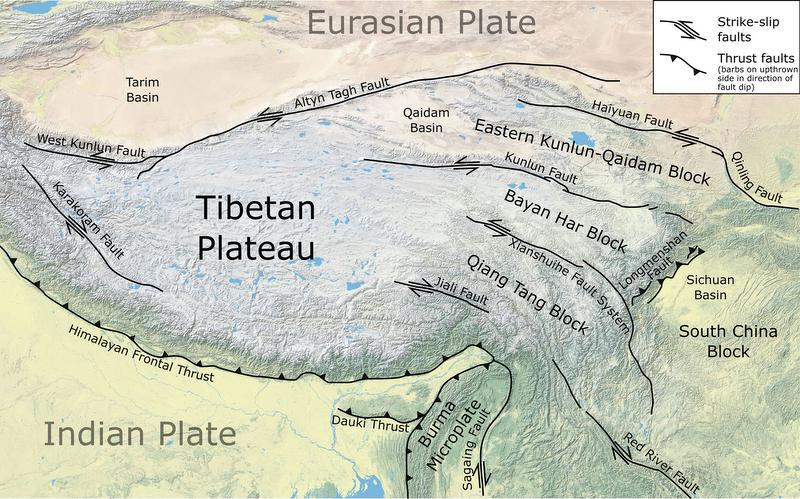
Epicentre: 40 km west of Rima (Zayu), near India–Tibet border in the Mishmi Hills.
Tectonic Context: Located on Indian–Eurasian Plate boundary within Eastern Himalayan Syntaxis (EHS), influenced by the Sunda Plate.
Fault Type: Strike-slip motion with thrust faulting — atypical for Himalayan quakes.
Plate Convergence: Eastern Himalayas converge at 10–38 mm/year vs. ~20 mm/year elsewhere.
Aftershocks: Indicated activation of multiple faults from the Syntaxial bend to Himalayan thrust faults in Arunachal Pradesh.
Lessons and Future Risks:
Magnitude Potential: Confirms Himalayan segments can produce ≥8.6 magnitude events.
Central Himalayan Risk: Identified as likely site for similar future quake.
Vulnerability Today: Increased due to urbanisation and large infrastructure in seismic zones.
Infrastructure Safety: Necessitates strict norms for dams and high-risk projects in Eastern Himalayas.
Preparedness: Highlights need for seismic hazard mapping and disaster readiness.
[UPSC 2024] Consider the following statements:
1. In a seismograph, P waves are recorded earlier than S waves.
2. In P waves, the individual particles vibrate to and fro in the direction of waves propogation whereas in S waves, the particles vibrate up and down at right angles to the direction of wave propagation. Which of the statements given above is/are correct?
Options: (a) 1 only (b) 2 only (c) Both 1 and 2* (d) Neither 1 nor 2
The Trump administration seeks to end two NASA missions under the Orbiting Carbon Observatories (OCO) program, which monitor global carbon dioxide emissions and plant health.
About Orbiting Carbon Observatories (OCO) Program:
Overview: A NASA Earth remote sensing initiative dedicated to monitoring atmospheric carbon dioxide (CO₂) from space.
Objective: Designed to enhance understanding of climate change by precisely tracking CO₂ sources and sinks.
Comprises three missions:
OCO-1: Launched in 2009 but failed shortly after launch.
OCO-2: Launched in July 2014 as a replacement.
OCO-3: Installed on the International Space Station in May 2019.
Key Features:
Precision Measurement: Provides high-resolution global CO₂ data and maps of plant photosynthesis.
Dual Capability: Measures CO₂ levels and solar-induced chlorophyll fluorescence to assess photosynthesis.