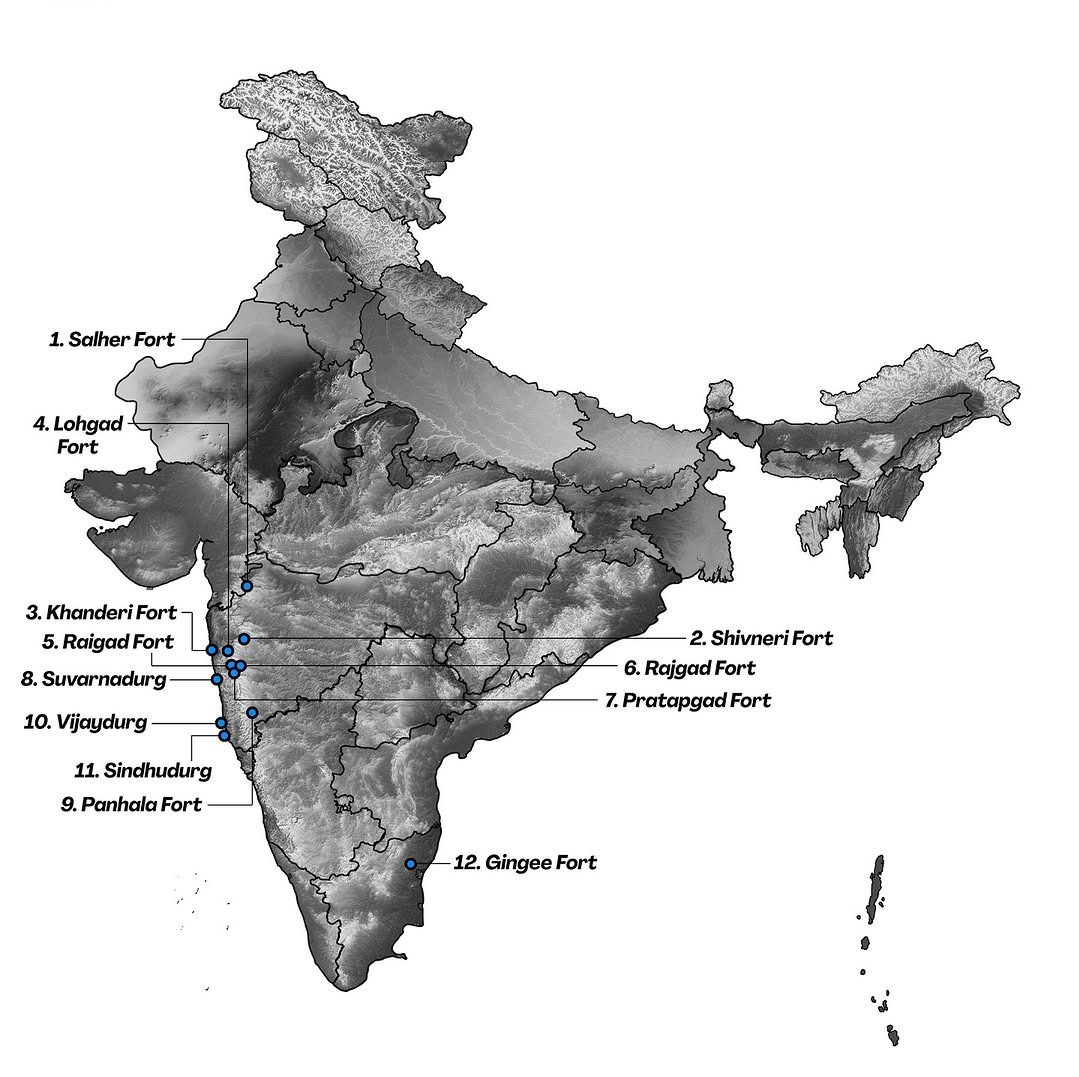
The ‘Maratha Military Landscapes’ of India have been inscribed on the UNESCO World Heritage List under the cultural category during the 47th session of the World Heritage Committee held in Paris.
AboutMaratha Military Landscapes:
Overview: A network of 12 forts showcasing the Maratha Empire’s military architecture and strategic fortification from the 17th to 19th centuries.
Time Period: Developed between 1670 CE (Shivaji’s era) and 1818 CE (end of Peshwa rule).
Geographical Spread: 11 forts in Maharashtra and 1 in Tamil Nadu (Gingee Fort), covering hill, coastal, forest, plateau, and island terrains.
The Department of Telecommunications (DoT) has launched an expanded Sanchar Mitra Scheme to engage engineering students as digital ambassadors for promoting telecom literacy, digital safety, and citizen engagement.
What is the Sanchar Mitra Scheme?
Launching Body: An initiative by the Department of Telecommunications (DoT), Government of India.
Primary Aim: To engage student volunteers as “Sanchar Mitras” or digital ambassadors to spread awareness about telecom-related issues.
Purpose:
Bridge the communication gap between citizens and the telecom ecosystem.
Promote safe and informed use of telecom services.
Encourage public participation in India’s digital transformation.
Implementation Status:
Piloted in select institutions.
Now being scaled up for nationwide rollout.
Key Features and Highlights:
Target Audience: It primarily targets students from engineering and technical backgrounds such as telecommunications, computer science, electronics, and cybersecurity.
Selection of Volunteers: Students will be nominated as Sanchar Mitras in consultation with DoT field units and educational institutions.
Training Modules: Volunteers will be trained to conduct grassroots campaigns on cyber fraud prevention, EMF radiation concerns, and responsible digital behavior.
Training Institutions: Training will be delivered by the National Communications Academy–Technology (NCA-T) and the Media Wing of the DoT.
Core Pillars: The scheme is structured around three key pillars: Connect, Educate, and Innovate.
Tech Awareness Promotion: Sanchar Mitras will promote awareness on emerging telecom technologies like 5G, 6G, AI, and cybersecurity.
Community Outreach: Students will engage with communities, NGOs, and schools to foster a culture of informed digital citizenship.
Strategic Alignment: It aligns with India’s strength in the “Four Ds”: Democracy, Demography, Digitisation, and Delivery.
[UPSC 2010] Which among the following do/does not belong/belongs to the GSM family of wireless technologies?
Options: (a) EDGE (b) LTE (c) DSL* (d) Both EDGE and LTE
The Ministry of Heavy Industries (MHI) has launched E-Truck Incentive Scheme to provide financial incentives for electric trucks (e-trucks) under the PM E-DRIVE initiative.
What is E-Truck Incentive Scheme?
Overview: It is a dedicated scheme to provide financial incentives for electric trucks under the broader PM E-DRIVE initiative.
First-of-its-Kind Support: This is the first direct government support specifically for electric trucks to promote clean, efficient, and sustainable freight mobility.
Target Vehicle Categories: It targets N2 and N3 category trucks, as per Central Motor Vehicle Rules (CMVR):
N2: GVW above 3.5 tonnes up to 12 tonnes
N3: GVW above 12 tonnes up to 55 tonnes
Incentive for Articulated Vehicles: For articulated vehicles, the incentive applies only to the puller tractor of the N3 category, not the trailer.
Warranty Requirements:
Battery: 5 years or 5 lakh km, whichever comes first
Motor & Vehicle: 5 years or 2.5 lakh km
Incentive Details:
Based on Gross Vehicle Weight (GVW)
Maximum support capped at ₹9.6 lakh per e-truck
Incentives are given as upfront discounts, reimbursed to Original Equipment Manufacturers (OEMs) through the PM E-DRIVE portal
Deployment Goal: It aims to support the deployment of 5,600 electric trucks across India.
1,100 trucks reserved for Delhi, with ₹100 crore allocated due to high pollution levels
Mandatory Scrappage Clause: To qualify, applicants must scrap an old diesel truck via scrappage centres approved by the Ministry of Road Transport and Highways (MoRTH).
Sectoral Impact: It is expected to benefit sectors like steel, ports, cement, and logistics by reducing fuel costs and improving air quality.
About PM E-DRIVE Scheme:
Overview: It stands for Prime Minister’s Electric Drive Revolution in Innovative Vehicle Enhancement, launched by the Ministry of Heavy Industries in September 2024.
Long-Term Goal: To to foster an EV ecosystem, reduce carbon emissions, and help India achieve Net Zero emissions by 2070.
Budget Allocation: It has a total outlay of ₹10,900 crore for two years, aimed at accelerating India’s electric mobility transition.
Scope and Coverage: It supports multiple vehicle categories: Two-wheelers; Three-wheelers; Electric trucks; Electric buses and Electric ambulances.
Demand Incentive: It provides direct demand incentives to buyers through OEMs, lowering the upfront cost of EVs.
Category-wise Allocation:
₹3,679 crore: For two-wheelers, three-wheelers, ambulances, and trucks
₹500 crore: Specifically for electric ambulance procurement
₹4,391 crore: To procure 14,028 electric buses in 9 major cities (Delhi, Mumbai, Kolkata, Chennai, Ahmedabad, Surat, Bangalore, Pune, Hyderabad)
Charging Infrastructure: ₹2,000 crore allocated to build 72,300 public charging stations nationwide, including:
Fast chargers for four-wheelers, buses, two-wheelers, and three-wheelers
Digital E-Voucher System:
Incentives claimed through Aadhaar-authenticated e-vouchers
Signed digitally by both buyer and dealer for transparency
Vehicle Scrappage Mandate: Scrapping of old vehicles is mandatory to claim certain incentives, especially for electric trucks, promoting fleet modernization.
[UPSC 2025] Consider the following types of vehicles:
I. Full battery electric vehicles II. Hydrogen fuel cell vehicles III. Fuel cell electric hybrid vehicles
How many of the above are considered as alternative (powertrain) vehicles?
Options: (a) Only one (b) Only two (c) All the three* (d) None
Mizoram Governor has imposed Governor’s Rule in the Chakma Autonomous District Council (CADC) due to prolonged political instability and repeated leadership changes.
About Autonomous District Councils (ADCs):
Basis: They are local self-governing institutions established under the Sixth Schedule of the Indian Constitution.
Coverage: ADCs are constituted in tribal areas of the northeastern states—Assam, Meghalaya, Tripura, and Mizoram (ATM2) [Sixth Schedule]
Purpose: These councils aim to provide autonomy to tribal communities to preserve their culture, customs, and govern their local affairs.
Notification: Each tribal area notified under the Sixth Schedule is declared an autonomous district, governed by its respective ADC.
Objective: The primary objectives of ADCs are to promote tribal self-governance, ensure local development, and protect tribal identity and rights.
Note: The Constitution provides for the reservation of seats in Panchayats for STs.
Key Features of ADCs
Legal Status: ADCs are formed through constitutional provisions under the Sixth Schedule and are not governed by state laws.
Council Composition: Each ADC comprises up to 30 members, of which 26 are elected by adult suffrage and 4 are nominated by the Governor.
Tenure: The tenure of an ADC is 5 years from the date of its constitution.
Scope of Authority: ADCs have legislative, executive, and limited judicial powers specific to the needs of tribal communities.
Applicability of Laws: State and Central laws do not automatically apply in ADC areas unless explicitly extended by the Governor.
Powers and Functions of ADCs:
Law-Making Powers: ADCs can enact laws on land management, agriculture, and forest use (excluding reserved forests).
Customary Regulations: They can regulate inheritance, marriage, divorce, and social customs, and appoint traditional chiefs and headmen.
Local Administration: It oversee services such as primary education, dispensaries, roads, markets, and fisheries.
Judicial Functions: Councils can establish village courts to try civil and criminal cases involving tribal members, with sentencing powers up to five years.
Regulation of Trade: They may regulate money lending and trade by non-tribals, subject to Governor’s approval.
Revenue Sources: It can levy taxes on professions, trades, animals, vehicles, markets, ferries, and public infrastructure like roads and schools.
Autonomy and Limitations:
Degree of Autonomy: ADCs enjoy substantial legislative and administrative autonomy within their territorial jurisdiction.
Non-Applicability of General Laws: Parliamentary and State laws apply only when directed by the Governor, ensuring self-rule.
Governor’s Oversight: Despite autonomy, the Governor retains discretionary powers and can approve, modify, or annul council decisions.
Financial Constraints: ADCs often face limited revenue generation, which restricts their developmental effectiveness.
Administrative Challenges: Operational issues include leadership instability, shortage of trained personnel, and state-level interference in council functions.
[UPSC 2015] The provisions in Fifth Schedule and Sixth Schedule in the Constitution of India are made in order to:Options: (a) protect the interests of Scheduled Tribes * (b) determine the boundaries between States (c) determine the powers, authority and responsibilities of Panchayats (d) protect the interests of all border States
The International Criminal Court (ICC) has issued arrest warrants for senior Taliban leaders in Afghanistan over the persecution of women, a crime against humanity.
About the International Criminal Court (ICC):
Established: 2002 under the Rome Statute (1998); headquartered at The Hague, Netherlands.
Nature: First permanent international court to try individuals for grave crimes.
Jurisdiction over 4 core crimes:
Genocide
Crimes against humanity
War crimes
Crime of aggression
Members: 124 States Parties
NON-members: India, China, USA, Russia, Israel, Ukraine
Structure:
Office of the Prosecutor – investigates and prosecutes cases.
18 Judges – elected for 9 years.
Assembly of States Parties – governs ICC administration.
Recent U.S. domestic policies on universities, companies, and immigration are causing short-term economic pain for India. However, they also offer long-term strategic opportunities. These changes may indicate the end of Pax Americana.
Why do U.S. policy shifts offer both risks and opportunities for India?
Opportunities for India:
Manufacturing Opportunity: As U.S.–China tensions disrupt global supply chains, India can attract companies looking to diversify production. Eg: Apple shifting iPhone assembly to India reflects the country’s growing role as a China+1 manufacturing hub.
Chance to Implement Bold Domestic Reforms: With reduced global dependence, India can focus on strengthening its internal systems through deregulation, decentralisation, and investment in human capital. Eg: A proposed 180-day plan calls for cutting compliance burdens, empowering state governments, and granting autonomy to top institutions like IITs and IIMs.
Higher Education and Innovation Ecosystem: As American universities face political and financial pressure, India can position its institutions as global research and innovation leaders. Eg: Granting “poorna swaraj” (full autonomy) to institutions like IISc, Ashoka, and IITs can help them climb global university rankings and drive home-grown R&D.
Risks for India:
Decline in Remittances and Student Enrolment: Stricter U.S. immigration and visa policies can reduce the flow of Indian students and workers, affecting remittances and global exposure. Eg: H-1B visa tightening under Trump led to fewer Indian tech workers entering the U.S., impacting remittancesand brain circulation.
Disruption to Exports and Supply Chains: Protectionist trade measures and tariffs can disrupt India’s export-dependent sectors like software, pharmaceuticals, and electronics.
What impact has U.S. research and immigration had on India’s growth?
Skilled Immigration: Indian immigrants in the U.S. contribute significantly to tech and scientific advancement, creating reverse knowledge flow to India. Over 70% of H-1B visas (2022) were granted to Indians, many of whom later founded companies or returned with expertise. Eg: Infosys, Wipro, and TCS have benefited from U.S.-trained professionals in leadership and innovation roles.
High Remittances Fueling Economic Stability: Indian diaspora in the U.S. contributes a major share of remittance inflows, supporting India’s foreign exchange reservesand rural economy. According to the World Bank (2023), the U.S. contributed over $23 billion in remittances to India, nearly 25% of India’s total remittance receipts.
Advancing Indian R&D and Education: U.S. federal funding has indirectly boosted India’s scientific growth through collaborations and return migration. The National Institutes of Health (NIH) funded research contributed to 99% of new drugs approved between 2010–2019. Eg: Indian researchers trained in U.S. labs or funded via U.S.-India Science and Technology Forum (USISTEF)have driven innovation in biotech, vaccines, and AI in India.
What does a weakening Pax Americana mean for India’s strategy?
Pax Americana refers to the period of relative global peace and stability under the dominance of the United States, particularly after World War II.
Push for Strategic Autonomy and Multipolar Engagement: As U.S. dominance declines, India must strengthen ties with multiple global powers while maintaining independence in foreign policy. India’s active role in BRICS, QUAD, and IMEC reflects efforts to diversify strategic partnerships and avoid overdependence on any one nation.
Accelerated Domestic Reforms for Economic Resilience: With global uncertainty, India needs internal strength through deregulation, decentralisation, and investment in infrastructure and skills. PLI schemes, Digital Public Infrastructure, Make in India, and self-reliance efforts show a move toward economic resilience.
Enhanced Role in Global Governance and Norm Setting: A weakening U.S. opens space for India to shape the global agenda in climate change, digital governance, and international trade. India’s G20 presidency and promotion of Digital Public Infrastructure as a global good underline its leadership in global norm-setting.
What are the key reforms that can boost India’s global economic standing? (Way forward)
Simplification: Simplifying regulations for employers by reducing compliance burdens, redundant filings, and removing criminal penalties in business laws can foster a more business-friendly environment. A focused 180-day plan to cut red tape would significantly improve ease of doing business and attract global investors.
Decentralisation: Decentralising power to States and cities by transferring funds, functions, and personnel empowers local governments to drive regional economic development. This enhances capacity for targeted innovation and creates globally competitive manufacturing ecosystems.
Autonomy: Empowering higher education and research institutions like IITs, IISc, and IIMs through full autonomy allows them to innovate, form global collaborations, and improve their position in international rankings.
Mains PYQ:
[UPSC 2018] How would the recent phenomena of protectionism and currency manipulations in world trade affect the macroeconomic stability of India?
Linkage: The rise of protectionism, which can be associated with policies like “Make America Great Again” mentioned in the article, signifies a shift in global trade dynamics. This question asks about the impact of such phenomena on India’s macroeconomic stability, underscoring the need for India to adapt and strengthen its economy in response to these global changes.
The Indian government recently claimed that India is among the world’s most equal societies, citing a Gini Index of 25.5 from the World Bank’s Poverty and Equity Brief, which would place India as the fourth most equal country globally. However, this claim has sparked debate and criticism from economists and inequality researchers.
What is the Gini Index?
The Gini Index (or Gini coefficient) is a statistical measure of inequality within a population. It is commonly used to measure income or wealth inequality, but can also be applied to consumption inequality.
What are the flaws in using consumption-based Gini to measure inequality?
Underestimates Real Inequality: Consumption is usually smoother than income because high earners tend to save more rather than spend proportionately. This leads to an underestimation of inequality. Eg: A billionaire may consume modestly while saving most income, appearing similar to a middle-class consumer in surveys, but with vastly different wealth.
Poor Cross-Country Comparability: India uses consumption-based data while most other countries use income-based Gini, making international comparisons misleading. Eg: India’s Gini of 25.5 (consumption-based) appears more equal than OECD countries, but income-based Gini (62) shows much higher inequality.
Low survey participation: Surveys often miss the richest due to non-response or sampling issues, failing to reflect the real inequality they contribute to. Eg: The richest 1% earn disproportionately more, but their low survey participation leads to underreported inequality.
Why is the World Inequality Database seen as more reliable?
Uses Income and Wealth Tax Data: Unlike consumption surveys, WID incorporates income tax and wealth tax data, which captures the top 1% of earners often missed in surveys. Eg: WID shows India’s income Gini Index rose from 52 in 2004 to 62 in 2023, revealing growing inequality missed by consumption-based metrics.
Captures Extreme Disparities: WID focuses on distributional national accounts, helping identify disparities between the top 10% and bottom 50%, which Gini often misses. Eg: In 2023-24, the top 10% in India earned 13 times more than the bottom 10%, a gap accurately captured by WID.
Global Comparability and Peer Review: WID data is transparent, methodologically standardised, and peer-reviewed by global economists, making it a trusted source for cross-country comparison. Eg: Countries like France and the US use WID for policy framing on progressive taxation and redistribution.
What are the alternatives to the Gini Index that better reflect extreme disparities?
Palma Ratio: The Palma Ratio compares the income share of the top 10% to that of the bottom 40%, focusing directly on income inequality between the rich and poor. Eg: In countries like South Africa, the Palma Ratio highlights stark disparities that are often missed by the Gini Index.
Theil Index (Generalized Entropy Measures): The Theil Index allows for decomposition of inequality within and between population groups like rural vs urban. Eg: In Brazil, it has been used to analyze racial and regional disparities more precisely than the Gini Index.
What are the policy risks of underestimating inequality?
Misguided Policy Design: When inequality is underestimated, governments may prioritize growth-focused policies without ensuring inclusive development. This can lead to insufficient investment in social protection, health, and education for marginalized groups.
Widening Socioeconomic Gaps: Underestimating inequality allows elite capture of resources and opportunities, worsening wealth concentration. This can deepen inter-generational poverty, especially for rural, low-caste, and female-led households.
Social and Political Instability: Failure to address real inequality can fuel public discontent, protests, and even extremism. It undermines trust in institutions and weakens democratic legitimacy over time.
What are the policy risks of underestimating inequality?
Misguided Policy Priorities: Underestimating inequality leads to policies focused only on aggregate growth, neglecting equity. Eg: India’s high GDP growth often overshadowed poor social investment in rural health and education, worsening human development gaps.
Weak Targeting of Welfare Schemes: If inequality is not accurately measured, social protection may miss the truly needy. Eg: Exclusion errors in schemes like PDS or PM-KISAN arise because top income groups are not properly excluded due to lack of granular data.
Rising Social Unrest and Distrust: Ignoring inequality can result in resentment, protests, and political instability. Eg: Farmer protests in India reflected deeper rural-urban income divides and perceived neglect of smallholder concerns.
Way forward:
Improve Data Collection Methods: Strengthen surveys by combining consumption data with income tax records, and ensure better representation of top income groups to capture true inequality.
Adopt Comprehensive Inequality Metrics: Use alternative indicators like the Palma Ratio or income shares of top 10% vs bottom 50%, alongside the Gini Index, for a more accurate assessment.
Design Inclusive Policy Frameworks: Align fiscal policies, welfare schemes, and tax reforms with accurate inequality data to target marginalized groups effectively and reduce social and regional disparities.
Mains PYQ:
[UPSC 2024] Despite comprehensive policies for equity and social justice, underprivileged sections are not yet getting the full benefits of affirmative action envisaged by the Constitution. Comment.
Linkage: This question critically examines the effectiveness of current policies intended to reduce inequality and promote social justice. It suggests that, despite official claims or stated objectives, the intended benefits are not effectively reaching the marginalised groups, thereby raising doubts about the actual progress in reducing inequality. It reflects the broader issue of implementation challenges in governance.
Why Civilsdaily’s UPSC Mentorship Program Is Unique? UAP is NOT your regular course. This isn’t just a program, it’s an ecosystem built to deliver ranks. The core of UAP is – Fault Finding & Course Correction. While other mentorships feel like blackboxes-random calls, vague advice, zero accountability & mere doubt solving-ours is a precision system built to spot your faults and fix them fast. No fluff, no guesswork. Real mentorship means real corrections.
We follow 5 steps: The Approach → Weekly Targets → Note-Building → Testing → Test Discussions. Every step sharpens you. Every step pulls you closer to the list. From crafting your strategy to squeezing out every last mark in Mains, UAP goes all in. In 2023, AIR 2 came from UAP. Many cleared in their first attempt. Others cracked it in their final shot.
What’s common? Grind, Focus, Clarity, and UAP. This alone is a strong enough reason why UAP is a unique program.
The heart of the Civilsdaily is the Ultimate Assessment Program (UAP). For years, aspirants have enrolled here because they couldn’t find such depth and passion towards quality content and Mentorship anywhere. Their search for Mentorship inevitably ends at Civilsdaily.
What You Need to Crack UPSC-CSE in One Attempt
To succeed in UPSC-CSE in a single attempt, it’s essential to have a well-structured, strategic approach. Here’s a breakdown of the key program inclusions that will help you achieve that:
Goal Setting: The Foundation of Preparation Every month, you’ll have a clear timeline of what needs to be covered and by when. This ensures consistent progress, avoids burnout, and keeps you on the right track throughout your preparation.
Assessment-Based Approach A comprehensive strategy that focuses on covering the entire syllabus in the shortest time possible, while still allowing room for multiple revisions. This approach ensures you stay on top of every subject while reinforcing your understanding.
Concise & Comprehensive Notes Access to crisp, ranker-recommended notes on relevant micro themes, based on trends from previous years’ questions (PYQs). These notes will help you focus on high-priority topics without getting overwhelmed.
Practical & Effective Revision Strategy A tailored revision plan focused on one goal: qualifying both Prelims and Mains. This strategy ensures you’re not just learning but retaining information effectively for the exams.
Mastering the Theme & Demand of Mains Questions Understand how to approach Mains questions with the right “Theme-Demand” analysis. Build a ready reference of “Intro-Body-Conclusion” structures for repeated themes, helping you develop muscle memory for answering questions efficiently.
Sharp Feedback from Mentors Consistent, detailed feedback on every mock test you attempt for Prelims and Mains. The goal is to make all your mistakes during the mocks, so you go into the final exam fully prepared and confident.
By mastering these elements, you’ll build the skills, mindset, and preparation necessary to clear UPSC-CSE in one attempt.
Schedule a 1-1 call with Civilsdaily’s Mentorfor focused UPSC Prep
Secondly, Let’s Understand Why Traditional Methods Fall Short
Relying solely on traditional methods attending 1:many classes, reading model answers, and taking a few mock tests-often creates the illusion that this is the core of Prelims and Mains preparation. In reality, these approaches make up only about 10% of a comprehensive strategy. When your goal is to secure a rank in the least number of attempts, the stakes are even higher. Here’s how UAP Mentorship elevates your preparation to the next level:
Personalized Study Plan: Sit down with a mentor to craft a detailed, fortnightly study schedule that covers the syllabus systematically. After each cycle, attempt a mock test to evaluate your progress and identify areas for improvement.
Expert Feedback: Practicing mocks is great, but imagine receiving sharp, actionable feedback from a mentor who has guided toppers like AIR 2, 22, 48, and others. Learn how to gain those crucial extra marks for each question and unlock the X-factor in your preparation.
Mapping Mains Themes: Solving Prelims and Mains PYQs is just the beginning. With UAP, you’ll work with mentors to map the UPSC syllabus onto key Mains themes, using PYQs to prioritize your revision efforts efficiently.
Crafting Concise Notes: Already created your Mains revision notes? Let’s take it further by refining them into concise one-pagers for each theme, complete with updated examples and multiple dimensions for deeper understanding.
Actionable Evaluation: Receiving an evaluated mock test copy is crucial-but what’s next? With UAP, we provide clear, actionable points to work on before you attempt your next mock, ensuring continuous improvement.
If you’re relying on outdated methods, UAP Mentorship might not be for you. But if you’ve tried those approaches and seen their limitations, now’s the time to level up. Apply for UAP Mentorship and experience the difference in your UPSC preparation journey.
What is the Ultimate Assessment Program (UAP)?
UAP is far from your typical course-it’s a complete ecosystem designed to handle every aspect of your UPSC preparation, from refining your strategy to significantly boosting your rank. In 2023, AIR 2 was one of the top ranks produced by UAP, alongside several other rankers. Many of these aspirants cleared the exam in their first attempt, while others succeeded in their final or second-to-last attempts.
These aspirants not only cleared Prelims with ease but also scored 400+ marks in their GS Mains papers. If your goal is to secure a top rank-be it IAS, IPS, or IFS-scoring 400+ in Mains is essential. To make your rank “interview-proof,” you should aim for nothing less than 450+. This is where UAP truly stands out.
UAP cuts through the overwhelming chaos of conventional preparation, bringing intense focus and clarity to your journey. With UAP, you’re not just preparing for an exam-you’re setting yourself up for success. The result? Your name on the final list next year.
Our program goes beyond generic study plans and superficial guidance. We believe that every aspirant is unique, and so are the challenges they face. Our mentorship is focused on providing personalized support that ensures you remain focused, disciplined, and efficient in your preparation.
Three Pillars of UAP
1. Mentorship:
Each student will be assigned a dedicated mentor who will track your progress, understand your strengths and weaknesses, and design a roadmap specific to your needs. Your mentor will provide continuous monitoring, regular check-ins, and feedback, helping you stay on track with your goals. Whether it’s time management, overcoming distractions, or mastering specific subjects, our mentors will be there to guide you.
Year-long Mentorship that’s all encompassing
Ensure you hit your next milestone
Subject strategy, target setting – providing base schedule.
Post test discussion
Phases of Mentorship
One-on-one mentor calls every week to provide the target and planner for the first 2 months. Mentor calls will thereafter be held every 10 days after that.
Weekly Report Card
Macro-strategy & macro targets for every three months
Test-related 1-on-1 detail disucssion.
Philosophy: Every Student Is A Batch
2. Core Programs:
Five Core Programs that are industry standards in themselves:
Samachar Manthan
Prelims Test Series
Mains Test Series
Essay Test Series
Dominate Prelims Crash Course
3. Pre-Acceleration Phase
We combine the knowledge and best practices from all rankers and present the learning in the prep acceleration sessions. This includes
ܳDedicated Monthly CA Test: Focus on Risk-Taking, Logical Problem Solving
Monthly CA Magazines (News, Op-Ed,PIB, Govt. Reports)
ܳDetailed Explainations
ܳAll India Rankings
2. Samachar Manthan:
Civilsdaily is renowned for its Samachar Manthan Program, an intensive current affairs initiative that will ensure you are fully prepared to tackle the dynamic aspects of the UPSC syllabus. With expert analysis, structured explanations, and discussions on major national and international issues, you’ll be equipped to handle both Prelims and Mains questions related to current affairs with confidence.
ܳ Weekly News Analysis (Video + Notes)
ܳ Mains Level Q&A Evaluation To Compliment The Lectures
ܳ Checked Copy Discussion On Phone/In-Person
3. Mains TS
Mock tests are crucial for success, and our test series is designed to simulate the actual exam environment. From day one, you’ll have access to a structured test series, including:
With detailed feedback on every answer you write, ensuring you develop a strong, exam-oriented answer writing style.
Custom Test Plans tailored to your progress, providing just the right amount of challenge to improve performance steadily.
Civilsdaily’s 1.5-Year Mentorship Program for UPSC CSE 2026 is your ticket to success in this prestigious exam. Limited seats are available, ensuring each student gets personalized attention and mentorship. Enroll today to kickstart your journey toward becoming a future civil servant.
Schedule a 1-1 call with Civilsdaily’s Mentorfor focused UPSC Prep
[UPSC 2019] Empowering women is the key to control population growth”. Discuss
Linkage: The PYQ’s focus on “Empowering women” directly reflects this crucial aspect of granting individuals, particularly young women, the choice and control over their bodies and lives. The article further elaborates that true empowerment means equipping adolescents, especially girls, with the skills, education, and opportunities.
Mentor’s Comment: The World Population Day 2025 has reignited global and national discussions on youth empowerment, reproductive rights, and falling fertility rates. With the theme “Empowering young people to create the families they want in a fair and hopeful world”, the UN highlights the need for informed reproductive choices and access to health, education, and economic opportunities, especially for India’s large youth population. The day also coincides with the release of the UNFPA’s State of World Population Report 2025, which warns that the real fertility crisis lies not in declining birth rates, but in the unmet reproductive goals due to financial, social, and infrastructural constraints.
Today’s editorial analyses the youth empowerment, reproductive rights, and falling fertility rates. This topic is important for GS Paper I (Indian Society) in the UPSC mains exam.
_
Let’s learn!
Why in the News?
Recently, World Population Day 2025 has brought renewed attention to global and national debates on empowering youth, ensuring reproductive rights, and addressing the challenges of declining fertility rates.
Why is youth empowerment essential for harnessing India’s demographic dividend?
India’s youth population is a major economic asset: With over 371 million people aged 15–29, India has the world’s largest youth population. If equipped with quality education, skills, health, and family planning services, this segment can become a powerful engine of economic growth and innovation.
Youth empowerment boosts national productivity and employment: Empowered youth can significantly reduce unemployment and enhance social outcomes. According to the World Bank and NITI Aayog, unlocking youth potential could increase India’s GDP by up to $1 trillion by 2030.
Empowerment ensures participation in nation-building: By promoting reproductive autonomy, gender equality, and economic independence, youth, especially young women, can participate in decision-making and shape their futures, contributing meaningfully to sustainable development.
What barriers hinder reproductive autonomy and fertility choices in India?
Limited access to family planning services and information: A significant share of the population lacks access to modern contraceptives, comprehensive sexual and reproductive health education, and counselling. Eg: According to the UNFPA State of World Population Report 2025, 36% of Indian adults faced unintended pregnancies, while 30% had unmet reproductive goals, reflecting systemic gaps in reproductive healthcare access.
Socio-cultural norms and gender inequality: Patriarchal attitudes, early marriages, and taboos around women’s reproductive rights often prevent young women from making independent fertility decisions. Eg: Though child marriage rates have declined, they remain high at 23.3% (NFHS-5, 2019–21), indicating how cultural practices continue to limit women’s reproductive autonomy.
Economic insecurity and structural barriers: Financial constraints, lack of housing, quality childcare, and secure employment inhibit couples from achieving their desired family size. Eg: A UNFPA survey found that 38% of Indian respondents cited financial limitations and 22% housing constraintsas major reasons for not fulfilling fertility aspirations.
How have schemes tackled child marriage and women’s empowerment?
Promoting girls’ education to delay early marriages: Schemes like Project Udaan in Rajasthan focused on keeping girls in secondary school using government scholarships, reducing the incidence of child marriage and teenage pregnancy.
Enhancing reproductive health awareness and services: Programmes such as Udaan and Advika improved access to modern contraceptives and sexual and reproductive health education, thereby strengthening reproductive agency among young women.
Empowering adolescents through life skills and leadership training: The Advika programme in Odisha helped prevent child marriage by providing life-skills training, leadership development, and child protection awareness across thousands of villages.
Fostering economic independence and employment: Project Manzil, implemented in Rajasthan, aligned skill training with young women’s aspirations and connected them to gender-sensitive workplaces, empowering over 16,000 women with employment and negotiation power.
Engaging communities to shift social norms: Behaviour change strategies under projects like Manzil worked to challenge harmful gender norms and involved families and communities, leading to reduced resistance against girls’ education and work.
Why should population discourse focus on rights and gender equity over fertility panic?
Respecting reproductive autonomy prevents coercion: Framing falling fertility as a “crisis” can lead to target-driven pronatalist policies that pressure women to reproduce, threatening their right to bodily autonomy. Eg: In countries like Hungary and Iran, such policies have led to restrictions on abortion and contraception, undermining women’s freedom.
Empowering women yields long-term social gains: Promoting gender equality, economic participation, and education for women improves both fertility decisions and broader development outcomes. Eg: Nordic countries like Sweden focus on workplace equality and parental leave, ensuring women can choose when and whether to have children.
Inclusive policy design avoids harmful stereotyping: Fertility panic often ignores the needs of those who want children but face barriers, while blaming those who are voluntarily childfree. Eg: The UNFPA’s 2025 report shows that 40% of respondents globally had to forgo childbearing due to financial and structural obstacles, not personal choice.
What can India learn from global responses to fertility decline?
Focus on enabling choices, not coercion: Countries like South Korea have spent billions on pronatalist incentives, but results remained limited until recent societal support systems (e.g., childcare, housing, and financial aid) improved. India must prioritize voluntary reproductive agency over target-driven incentives.
Promote gender equity in workforce and caregiving: Fertility policies that reinforce traditional gender roles have backfired. Instead of pressuring women to bear more children, countries like Sweden have boosted fertility by promoting gender-equal parenting, paternal leave, and women’s employment, which India can emulate.
Way forward:
Invest in rights-based reproductive health systems: Ensure universal access to quality contraceptives, safe abortion, maternal care, and infertility services, while safeguarding individuals’ reproductive autonomy through accurate health education and gender-sensitive policies.
Shift from fertility targets to gender equity: Focus on empowering women through education, economic independence, and childcare support, instead of promoting pronatalist incentives that risk reinforcing patriarchal norms and limiting personal choices.
Recently, a span of a 40-year-old bridge collapsed in Vadodara, Gujarat, on July 9, sending multiple vehicles into the Mahisagar river and resulting in the death of 18 people.
What causes recurring public infrastructure failures in India?
Ageing and outdated infrastructure: Many structures like the Morbi suspension bridge (2022) in Gujarat had exceeded their intended lifespan, yet continued to be in use without adequate upgrades.
Overuse and overload beyond design capacity: Bridges and roads originally designed for lower traffic volumes now face high urban and industrial load, as seen in the Indrayani pedestrian bridge collapse in Pune (2024) due to overloading.
Neglect and poor maintenance: Lack of routine inspections and maintenance led to incidents like the Vadodara bridge collapse (2024), where locals had raised concerns that were ignored by authorities.
Institutional inefficiency and under-resourcing: Municipal and local bodies often remain understaffed and underfunded, unable to monitor and maintain growing infrastructure needs, especially in peri-urban areas.
Lack of accountability and transparency: Even after fatal accidents like the Mizoram railway bridge girder collapse (2023), failure analysis reports are rarely made public, limiting systemic learning and corrective action.
What is Peri-urban infrastructure?
Peri-urban infrastructure refers to the basic facilities and services (like roads, bridges, water supply, drainage, electricity, etc.) found in the transitional zones between urban and rural areas.
Why is peri-urban infrastructure more prone to collapse?
Unregulated and informal urban expansion: Peri-urban areas often develop without proper zoning laws, building codes, or infrastructure planning. This results in substandard construction, making infrastructure vulnerable to collapse. In many Indian outskirts, flyovers and water systems are built around unplanned colonies, lacking load assessment.
Jurisdictional ambiguity and poor coordination: Peri-urban regions often fall between urban and rural governance structures, leading to confusion in responsibility for maintenance and oversight. In Delhi NCR’s fringes, conflicts between municipal bodies and panchayats delay repair and auditing of key infrastructure.
Low visibility and weak political prioritization: These areas lack media attention and political pressure seen in core urban centres, resulting in deferred maintenance. In Hyderabad’s outer zones, repeated complaints about weakening culverts were ignored until seasonal floodingcaused failure.
How can AMRUT and UIDF improve asset upkeep?
Focused maintenance and retrofitting: AMRUT 2.0 prioritizes the retrofitting of old urban infrastructure such as pipelines, water supply, and sewerage systems. Eg: In cities like Agra and Pune, AMRUT funding has helped upgrade outdated drainage systems to prevent floodingand infrastructure degradation.
Targeted financial support for smaller cities: UIDF provides low-cost loans to Tier-2 and Tier-3 cities that often lack budgetary resources for upkeep. Eg: In peri-urban areas of Madhya Pradesh, UIDF enabled the repair of worn-out roads and bridges strained by rapid population growth.
Promotion of digital monitoring and audits: Both schemes encourage the use of geo-tagging and digital tracking tools to monitor asset health and schedule timely repairs. Eg: Cities like Bhubaneswar and Surat use AMRUT-linked dashboards to track infrastructure health and flag issues before failures occur.
What gaps delay audits and accountability post-collapse?
Jurisdictional overlap between agencies: Multiple departments—urban development, public works, and local bodies—often share responsibility for infrastructure. This leads to confusion over which authority must initiate audits after a collapse. Eg: After a flyover collapse in Hyderabad, delays occurred as both the GHMC and state PWD passed the responsibility to each other.
Political interference and blame-shifting: In high-profile accidents, inquiries are sometimes delayed or diluted due to political pressures or attempts to shield influential contractors. Eg: In the Kolkata Vivekananda flyover collapse (2016), early accusations were politicized, stalling a clear and prompt audit process.
Way forward:
Establish a unified statutory audit authority: Create a dedicated, independent body responsible for conducting post-collapse audits across all public infrastructure, ensuring timely investigations, clear jurisdiction, and mandatory public disclosure of findings.
Implement real-time digital monitoring systems: Use GIS mapping, IoT sensors, and AI-based predictive maintenance tools to track structural health and alert authorities proactively, minimizing risks and improving accountability.
Mains PYQ:
[UPSC 2014] Explain how Private Public Partnership arrangements, in long gestation infrastructure projects, can transfer unsustainable liabilities to the future. What arrangements need to be put in place to ensure that successive generations’capacities are not compromised?
Linkage: The article highlights several incidents of catastrophic public infrastructure failures in India, such as a 40-year-old bridge collapse in Vadodara, a pedestrian bridge collapse in Pune, and a metro pillar collapse in Bengaluru. This PYQ is highly relevant as it directly addresses the critical themes of long-term infrastructure management, potential liabilities, and ensuring future capacity.