The Union Ministry of Agriculture has approved the procurement of Moong and Urad in Madhya Pradesh and Urad in Uttar Pradesh under the Price Support Scheme (PSS).
Back2Basics:
Moong (Green Gram):
Moong is a high-protein pulse grown mainly in the Kharif season (June–July) and also in summer (March–April) and limited Rabi areas.
It thrives in well-drained loamy to sandy-loam soils with a temperatures of 25–35°C.
Fits well into crop rotations like Moong–Wheat or Summer Moong–Kharif Moong–Raya due to its short duration (60–75 days).
Major producers are Rajasthan, Maharashtra, MP, Andhra Pradesh, and UP.
Urad (Black Gram):
Urad is grown mainly in the Kharif season (June–July) and also as a Rabi crop in southern India, needing a warm, humid climate.
Prefers well-drained loamy soils, unsuitable for waterlogged or saline areas; ideal temperature is 25–35°C.
Often sown in rotations with cereals like rice or wheat and widely used in intercropping/mixed cropping systems.
Key producing states include UP, MP, Andhra Pradesh, and Tamil Nadu.
About Price Support Scheme (PSS):
Overview: PSS is a component of the Pradhan Mantri Annadata Aay Sanrakshan Abhiyan (PM-AASHA), launched in 2018 to ensure remunerative prices for farmers.
Objective: It ensures procurement at the Minimum Support Price (MSP) for oilseeds, pulses, and cotton when market prices fall below MSP.
Nodal Agency: It is implemented by the Department of Agriculture & Cooperation through:
National Agricultural Cooperative Marketing Federation of India (NAFED) (Central nodal agency)
Food Corporation of India (FCI) (in specific cases)
How PSS Works:
MSPs are announced before each cropping season based on recommendations from the Commission for Agricultural Costs and Prices (CACP).
If the market price falls below MSP, central and state nodal agencies procure the produce directly from farmers.
Only crops meeting the Fair Average Quality (FAQ) standards are procured.
Procurement continues until market prices stabilise at or above MSP.
Eligibility and Access:
All farmers cultivating notified crops are eligible to benefit under PSS.
They must sell their produce at designated procurement centres, such as APMCs.
Government employees are typically excluded from the scheme’s benefits.
What is the PM-AASHA Scheme?
Launch: PM-AASHA, launched in September 2018, is an umbrella scheme by the Government of India designed to ensure fair prices for farmers’ produce, specifically for pulses, oilseeds, and copra.
Goal: It complements the government’s policy of setting MSP at 1.5 times the cost of production.
Components: The scheme aims to translate increased MSPs into actual income gains through three implementation pathways:
Price Support Scheme (PSS): Physical procurement at MSP by central agencies like NAFED.
Price Deficiency Payment Scheme (PDPS): Farmers receive the difference between MSP and actual selling price directly into their bank accounts; no physical procurement.
Private Procurement and Stockist Scheme (PPSS): Pilot scheme allowing private players to procure at MSP to supplement government efforts.
Nodal Agency: It is implemented by the Ministry of Agriculture and Farmers Welfare, with procurement agencies operating at both central and state levels.
[UPSC 2020] With reference to pulse production in India, consider the following statements:
1. Black gram can be cultivated as both kharif and rabi crop. 2. Green-gram alone accounts for nearly half of pulse production. 3. In the last three decades, while the production of kharif pulses has increased, the production of rabi pulses has decreased. Which of the statements given above is/are correct?
Options: (a) 1 only * (b) 2 and 3 only (c) 2 only (d) 1, 2 and 3
A fresh political and inter-state water dispute has erupted between Telangana and Andhra Pradesh over the proposed Banakacherla Reservoir Project.
About the Banakacherla Project:
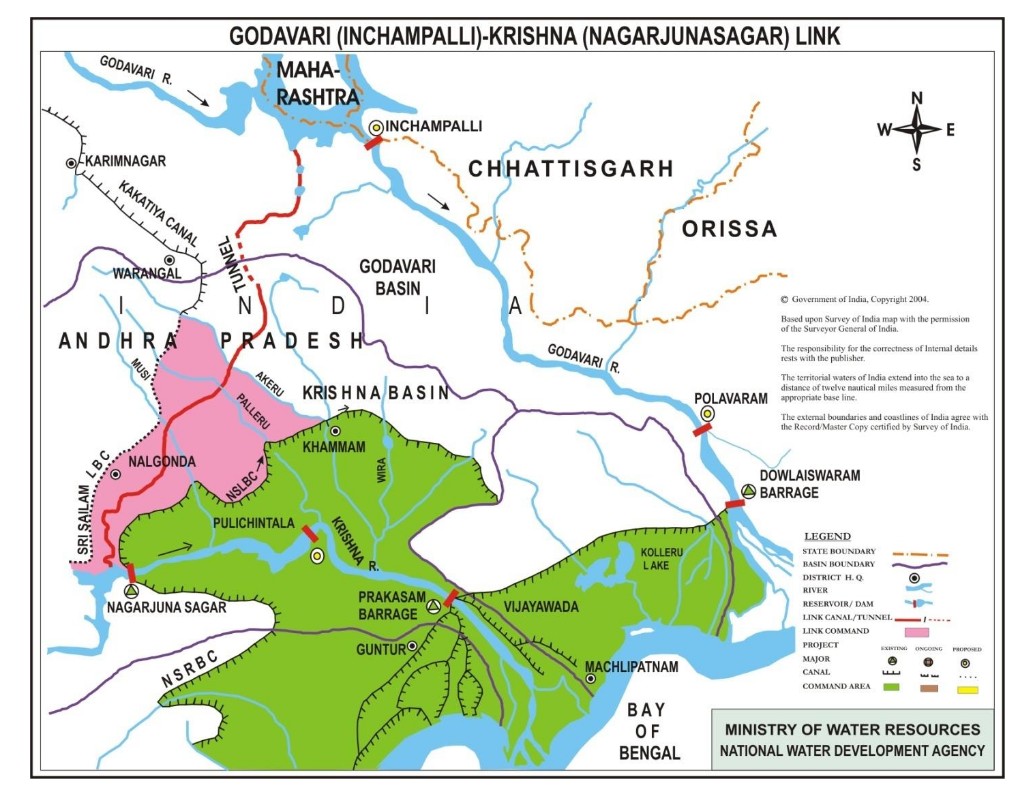
About: Also known as the Godavari-Banakacherla or Polavaram-Banakacherla Link Project, it is an ambitious interlinking plan proposed by the Andhra Pradesh government.
Objective: It aims to divert surplus Godavari River water via the Polavaram Project, through the Krishna basin, to reach the Banakacherla regulator in Kurnool district.
Reservoirs: The project involves construction of a new Bollapalli reservoir in Guntur district, enhancement of canal capacities (e.g., Polavaram canal from 17,500 to 38,000 cusecs), and a network of lift stations and tunnels through the Nallamala forest.
Water Pathway: It begins at Polavaram dam, moves to Bollapalli, and ends at Banakacherla, integrating Godavari, Krishna, and Penna River basins.
Violation of the AP Reorganisation Act (2014): Telangana claims that Andhra’s project infringes upon legal frameworks laid out during the bifurcation of the state.
Lack of Clearances: Telangana argues the project has not received mandatory approvals from:
Apex Council (Krishna River Management Board and Godavari River Management Board).
Central Water Commission (CWC).
Water Sharing: Telangana cites the Godavari Water Disputes Tribunal, which allocated 968 TMC to Telangana and 518 TMC to Andhra but did not quantify surplus water, making the legality of Andhra’s claim ambiguous.
Political Sensitivity: Water-sharing has historically been central to Telangana’s statehood movement; any diversion is seen as a betrayal of regional interests.
Ecological Concerns: The tunnel under the Nallamala forest may have environmental repercussions that have not been assessed or cleared.
[UPSC 2012] Which of the following are included in the original jurisdiction of the Supreme Court? 1. A dispute between the Government of India and one or more States 2. A dispute regarding elections to either House of the Parliament or that of Legislature of a State 3. A dispute between the Government of India and a Union Territory 4. A dispute between two or more States
Select the correct answer using the code given below:
Options: (a) 1 and 2 only (b) 2 and 3 only (c) 1 and 4 only* (d) 3 and 4 only
The Prime Minister recently addressed a commemorative event marking 100 years of the historic conversation between Sree Narayana Guru and Mahatma Gandhi.
About Sree Narayana Guru:
Early Life: Sree Narayana Guru was born on 22 August 1856 in Chempazhanthy, Kerala, into the Ezhava community, considered the so-called ‘avarna’ or outside the caste system.
Social Reform: He led a peaceful revolution against caste discrimination and promoted social equality and spiritual upliftment in Kerala.
Famous Slogan: Guru gave the powerful message — “One Caste, One Religion, One God for All”, calling for unity beyond caste or creed.
Spiritual Philosophy: A follower of Advaita Vedanta, he reinterpreted it to assert that divinity exists in every individual, regardless of caste.
Death and Legacy: He passed away on 20 September 1928, and his birth and death anniversaries are now observed as public holidays in Kerala and other states.
His Contributions:
Temple Reform: In 1888, he consecrated a Shiva idol at Aruvippuram, challenging Brahminical control over temples.
Organisational Impact: He founded the Sree Narayana Dharma Paripalana (SNDP) Yogam in 1903, with Kumaran Asan as its first general secretary.
Spiritual Centres: Guru established the Sivagiri Mutt (1904), which became the heart of the Sivagiri Pilgrimage (Theerthadanam).
Writings: His works, like Advaitha Deepika, Atmavilasam, Daiva Dasakam, and Brahmavidya Panchakam, reflect a spiritual and reformist vision.
Holistic Upliftment: He promoted education, cleanliness, agriculture, and handicrafts for self-reliance.
Against Conversions: Guru opposed religious conversion as a caste solution, favouring internal reform within Hindu society.
His Conversations with Gandhiji (1925):
Historic Meeting: Mahatma Gandhi met Guru on 13 March 1925 at Sivagiri Mutt during the Vaikom Satyagraha.
On Scriptures: Guru clarified that Hindu texts do not support untouchability and backed the Vaikom movement fully.
On Salvation: He believed that all religions lead to moksha but stressed that material freedom is key to dignity.
Inclusive Ashrams: He shared that his ashrams welcomed all castes, with children studying and praying together.
View on Caste: While Gandhi defended varna in principle, Guru critiqued caste as rigid, anti-freedom, and regressive.
Mutual Respect: Gandhi was deeply moved and later praised Guru as a “holy soul”, calling Sivagiri a model of harmony.
Enduring Legacy: The meeting symbolised a blend of spiritual wisdom and social reform, with lasting national impact.
[UPSC 2019] Consider the following pairs:
Movement/Organization Leader
1. All India Anti-Untouchability League Mahatma Gandhi 2. All India Kisan Sabha Swami Sahajanand Saraswati 3. Self-Respect Movement E. V. Ramaswami Naicker
Which of the pairs given above is/are correctly matched?
Options: (a) 1 only* (b) 1 and 2 only (c) 2 and 3 only (d) 1, 2 and 3
WHY THIS? Sonam Wangchuk’s detention at the Delhi border highlights ongoing demands for Ladakh’s inclusion in the Sixth Schedule of the Constitution, pushing for greater autonomy. For UPSC CSE 2025, grasping asymmetrical federalism is vital as it connects directly to questions on regional governance, political autonomy, and social justice. As you study this topic, focus on how such frameworks shape India’s diverse needs—these insights will enrich your understanding and responses in the exam. Remember to link current events like these to broader themes in federalism and regional identity in your notes!
GS 1: Indian Society: Tribal Movements, Diversity of India, Population and associated issues
Note4Students: Analyze how asymmetrical federalism shaped the reorganization of regions like Ladakh. Focus on tribal movements, such as Sonam Wangchuk’s activism, to understand their role in regional autonomy and cultural preservation.
Microthemes: Diversity and pluralism, Population and associated issues
GS 2: Indian Constitution: Features of Federalism; Separation of Powers; Government Policies and Welfare Schemes
Note4Students: Study how the Fifth and Sixth Schedules address demands for autonomy in regions like Ladakh and North-East India, balancing regional identity with national unity under asymmetrical federalism.
Microthemes: Nature of Indian Federalism, Special Provisions
GS 3: Internal Security; Economic Development and Resource Management; Environment and Regional Development
Note4Students: Evaluate how asymmetrical federalism helps manage security and economic development in sensitive regions like Ladakh through provisions like the Sixth Schedule and special resource allocation.
Microthemes: Role of media and social networking sites in internal security threats
GS 4: Ethics in Governance; Integrity, Probity, and Accountability in Public Administration
Note4Students: Reflect on the ethical challenges of managing regions with special provisions, ensuring accountability and preventing corruption in governance, while balancing autonomy with national integrity.
Microthemes: Ethical dilemma in public administration.
Climate activist Sonam Wangchuk was detained at the Delhi border while leading a group of protesters seeking to petition the Central government for Ladakh’s inclusion in the Sixth Schedule of the Constitution, along with other demands for greater autonomy for the region.
What is Asymmetrical federalism?
Asymmetrical federalism is a federal system entailing uneven distribution of powers and autonomy among constituent units of a federation, to accommodate their distinct needs and circumstances.
Which are the other States seeking constitutional safeguards?
Ladakh: The Union Territory of Ladakh has seen increasing demands for inclusion in the Sixth Schedule of the Constitution to safeguard its indigenous culture and provide greater autonomy.
Arunachal Pradesh: The state has passed a resolution seeking inclusion in the Sixth Schedule to grant more autonomy to its tribal populations.
Manipur: The Hill Area Committee in Manipur has also demanded inclusion in the Sixth Schedule for its tribal areas, particularly the ‘Hill areas’.
Do the Fifth and Sixth schedules grant areas under them more autonomy?
Fifth Schedule: Grants special protections to ‘scheduled areas’ in 10 states. These areas are governed by Tribes Advisory Councils (TACs) and Governors, who have the power to regulate land transfers, businesses, and the applicability of laws.
Sixth Schedule: Provides greater autonomy to ‘tribal areas’ in four northeastern states (Assam, Meghalaya, Mizoram, and Tripura) through Autonomous District Councils (ADCs).
ADCs have more legislative, executive, and financial powers, including the ability to regulate land use, social customs, and taxation.
Why did the British create provisions for ‘excluded’ and ‘partially excluded’ areas?
British Policy of Isolation: To avoid unrest and rebellion among the tribal populations, the British adopted a policy of ‘isolation’ by creating ‘excluded’ and ‘partially excluded’ areas in tribal regions under the Government of India Act, 1935.
Excluded Areas: These were mostly in the northeastern hilly regions, where the Governor had the authority to legislate.
Partially Excluded Areas: These included tribal regions in Central and Eastern India, where laws from central and provincial legislatures were applicable but with modifications, ensuring minimal interference with tribal customs and governance.
NEED
POLITICAL, LEGAL AND GOVERNANCE
SOCIAL
ECONOMIC
UT AND ASYMMETRICAL FEDERALISM
Safeguard Territorial Integrity & Sovereignty
Provides Union with both: –Carrot: Accommodates sub-regional demands, reducing appeal of secessionist groups. –Stick: Emergency powers to address security threats. Example: Naga Peace Accord, AFSPA.
Secure Unity in Diversity Fosters cultural preservation, accommodates ethnic diversity. Example: Linguistic reorganization, Article 371 for NER regions.
Reducing Dissatisfaction Tailored economic policies for regional needs. Example: Special Category states provisions.
Union’s Obligation toward National Security Direct control ensures effective management of strategic interests. Example: A&N Islands’ strategic location.
Better Representation
Provides representation to minority areas and regions with lower populations. Example: Fifth and Sixth Schedules for tribal groups.
Reducing Radicalization Special powers mitigate radicalization in diverse regions. Example: Autonomy for tribal areas under 5th Schedule.
Resource Allocation Centre allocates resources based on diverse state needs. Example: Tax devolution based on Population (45%).
Special Administrative Needs Consistent governance for UTs with smaller populations. Example: Governance of UTs except Delhi and J&K.
Enable Inter-state Equity
Addresses unequal resource distribution post-state reorganization. Example: Article 371D for AP and Telangana.
Compensating Social Inequalities Helps bridge historical inequalities through affirmative action policies and autonomy. Example: Article 371J for backward areas.
Economic Flexibility Allows states with special provisions to have more flexibility in using resources for development goals. Example: Flexibility in using central funds for NER development.
Direct Economic Intervention Union government can directly intervene in the economic management of UTs, boosting socio-economic development. Example: Special Development Package for J&K and Ladakh.
Address Intra-state Inequality
Corrects historical negligence of sub-regions. Example: Article 371J for backward districts in Hyderabad-Karnataka.
Promoting Cultural Identity Provides autonomy to preserve distinct cultural identities, ensuring protection of indigenous rights. Example: Article 371 for NER tribal autonomy.
Regional Development Ensures tailored economic interventions to address disparities between regions within a state. Example: Special financial allocations for development of backward regions like Vidarbha and Saurashtra.
Strategic Governance in Sensitive Areas Provides for governance arrangements in politically or geographically sensitive regions, ensuring stability. Example: Special governance structures for UTs like Lakshadweep and A&N Islands for national security.
Secure Legal Framework
Provides a legal structure to manage inter/intra-state tensions and make concessions. Example: Article 371 for Vidarbha and Saurashtra regions.
Protecting Marginalized Communities Legal autonomy provisions protect marginalized communities from exploitation and ensure inclusive governance. Example: Fifth and Sixth Schedules for tribal areas.
Encouraging Balanced Growth Special provisions encourage balanced growth by addressing the specific needs of less developed states or regions. Example: Focused growth schemes for Special Category states.
Consistent Policy Implementation Ensures streamlined governance, avoiding administrative fragmentation, especially in regions with unique strategic or demographic conditions. Example: Andaman & Nicobar’s direct administration ensures consistent national security policies.
While asymmetrical federalism addresses the diverse political, social, and economic needs of various regions, it also brings challenges that raise questions about equity, administrative efficiency, and national integration.
Issues with Asymmetrical Federalism
ISSUES
MAJOR ISSUES DUE TO ASYMMETRICAL FEDERALISM
Exacerbates Regional Inequalities
States with more autonomy may gain advantages in resource allocation, taxation, and economic development. Example: Himachal Pradesh (Special Category) vs Bihar.
Political Discontent & Secessionist Tendencies
Unequal political power may lead to discontent and perceived injustice. Example: NER’s lack of parliamentary representation fuels secessionism.
Administrative Complexity & Inefficiency
Diverse constitutional arrangements create overlapping responsibilities, leading to inefficiency. Example: AFSPA regions face allegations of human rights violations.
Lack of uniform laws, taxation, and governance creates obstacles for businesses. Example: NER and J&K rank low in ease of doing business.
Inconsistent Application
Differential treatment and selective application of autonomy based on political considerations. Example: Special status of Jammu and Kashmir.
Way Forward
Acknowledging Diversity: India’s progress requires acknowledging and accommodating its diversity; a one-size-fits-all approach is inadequate.
Institutionalizing Asymmetric Arrangements: Transparent asymmetric arrangements contribute to nation-building and benefit the federation overall.
Caution Against Unitary Policies: Unitary policies pursued for short-term gains can jeopardize the long-term stability and interests of federalism.
Gradual Reform Process: Any adjustments to existing constitutional asymmetry should be gradual and long-term, with careful consideration both legally and politically.
[UPSC 2018] In what ways would the ongoing US-Iran Nuclear Pact Controversy affect the national interest of India? How should India respond to this situation?
Linkage: “Operation Midnight Hammer: B-2 Bombers Strike Iran’s Nuclear Facilities,” details a significant event where the “U.S. military carried out precision strikes on three key Iranian nuclear facilities, mainly Fordow, Natanz and Isfahan”. This PYQ is highly relevant as it requires an analysis of the broader implications for India arising from such direct military actions and controversies involving the US and Iran’s nuclear capabilities, which are central to the “Operation Midnight Hammer” narrative.
Mentor’s Comment: On June 21, 2025, the U.S. officially entered the ongoing Israel-Iran conflict by launching “Operation Midnight Hammer”, a precision strike on Iran’s key nuclear enrichment facilities at Fordow, Natanz, and Isfahan. What makes this operation historic is the first-ever operational use of the GBU-57 Massive Ordnance Penetrators (MOP), dropped by B-2 Spirit stealth bombers. Fordow, an ultra-hardened site buried deep within a mountain, had long been considered impregnable — even to Israeli firepower. This high-stakes attack involving stealth bombers, Tomahawk cruise missiles, and elaborate deception tactics showcases the evolving nature of strategic warfare, stealth technology, and nuclear deterrence dynamics, with significant implications for global security and geopolitics.
Today’s editorial discusses the effects of the recent U.S.A. Operation Midnight Hammer: B-2 Bombers Strike Iran’s Nuclear Facilities. This topic is important for GS Paper II (International Relations) in the UPSC mains exam.
_
Let’s learn!
Why in the News?
Recently, the U.S. joined the ongoing conflict between Israel and Iran by launching “Operation Midnight Hammer”, a targeted military strike on Iran’s main nuclear sites located at Fordow, Natanz, and Isfahan.
What is the B-2 Stealth Bomber?
The B-2 Stealth Bomber, also known as the B-2 Spirit, is an advanced long-range, heavy bomber used by the United States Air Force.
What are the geopolitical impacts of the U.S. strikes on Iran’s nuclear sites?
Undermining diplomatic efforts: The attack weakens ongoing negotiations over Iran’s nuclear programme, especially efforts to revive the Joint Comprehensive Plan of Action (JCPOA), which the U.S. exited in 2018.
Message of deterrence and alliance assurance: The operation signals U.S. commitment to Israel’s security and aims to deter Iran’s nuclear ambitions, reaffirming strategic dominance in West Asia and setting a precedent like the 1981 Israeli strike on Iraq’s Osirak reactor.
How do technologies like B-2 bombers and bunker-busters shape modern warfare?
Enhanced penetration of fortified targets: Bunker-buster bombs like the GBU-57 Massive Ordnance Penetrator can destroy deeply buried nuclear facilities, such as Iran’s Fordow site, which is located inside a mountain.
Stealth and survivability in hostile environments: The B-2 Spirit bomber, with its low radar signature and long-range capabilities, allows undetected strikes deep into enemy territory, demonstrated during Operation Midnight Hammerover Iran.
Precision and reduced collateral damage: The use of GPS-guided munitions enables targeted destruction of critical infrastructure while minimizing civilian harm. The Tomahawk cruise missiles used alongside the B-2s in the Iran strike are an example.
What does U.S. involvement in the Israel-Iran conflict indicate about its West Asia strategy?
Reinforcement of strategic alliances: The U.S. action shows its continued military and political support for Israel, especially after Israel’s initial strikes on Iran’s nuclear sites. This underscores a long-standing alliance.
Deterrence against nuclear proliferation: By targeting Iran’s Fordow, Natanz, and Isfahan facilities, the U.S. aims to send a strong message against the development of nuclear weapons by adversarial states in the region.
Projection of power and dominance: The deployment of B-2 bombers and Tomahawk missiles illustrates America’s intent to maintain military superiority and influence over regional conflicts, ensuring its leadership role in West Asia’s security architecture.
What challenges arise in attacking underground nuclear sites like Fordow?
Depth and Fortification: The Fordow nuclear site is buried 80–90 meters underground and shielded by reinforced concrete, making it resilient to conventional strikes. Even the GBU-57 bunker-busters caused only partial damage, revealing the limits of aerial assaults.
Operational Complexity: Missions to strike such sites need advanced platforms like the B-2 Spirit stealth bomber, supported by decoy tactics, mid-air refuelling, and long-duration flights. The limited number of B-2s and their high maintenance make repeated missions challenging.
Does India have B-2 bomber capability?
Lack of Stealth Bomber Technology: India does not possess any stealth bombers like the U.S. B-2 Spirit, which is capable of penetrating heavily fortified targets with low radar visibility. The B-2 is a unique platform operated exclusively by the United States.
Current Indian Bomber Fleet: India relies on multirole fighter jets such as the Sukhoi Su-30MKI, Rafale, and Mirage-2000 for strike missions. These aircraft are effective but lack deep-strike stealth capabilities and the payload capacity of strategic bombers.E.g. The Sukhoi Su-30MKI can carry cruise missiles like BrahMos, but not bunker-busters like the GBU-57.
Strategic Focus and Alternatives: Instead of stealth bombers, India invests in missile-based deterrents such as the Agni series (ballistic missiles) and long-range cruise missiles. These provide strategic strike capability without the need for a dedicated stealth bomber. E.g. The Nirbhay cruise missile offers precision strike capability with a range of 1000+ km.
What can India do? (Way forward)
Invest in Indigenous Stealth and Deep-Strike Platforms: India can accelerate development of indigenous stealth bombers or long-range unmanned combat aerial vehicles (UCAVs) under future programs like AMCA (Advanced Medium Combat Aircraft) to enable penetration of heavily defended targets.
Enhance Precision Missile and Bunker-Buster Arsenal: India can develop or acquire heavy bunker-busting munitions and integrate them with existing platforms like the Su-30MKI or future drones, while also upgrading satellite-guided targeting systems for deeper and more accurate strikes.
India’s cities will host over 800 million people by 2050. While women’s role in local politics has grown, urban bureaucracies still lack gender balance, which limits truly inclusive urban development.
What challenges hinder women’s inclusion in urban bureaucracy despite higher political representation?
Male-Dominated Administrative Structure: Despite 46% representation of women in local bodies (Ministry of Panchayati Raj, 2024), only 20% of IAS officers are women (IndiaSpend, 2022).
Gender Imbalance in Policing and Field Roles: Only 11.7% of India’s police force are women (BPRD, 2023), and most serve in non-field, clerical roles. Similarly, engineering and sanitation departments have low female participation.
Lack of Affirmative Action in Urban Technical Cadres: While reservations exist in elected offices, there are no parallel affirmative policies in bureaucracy for women.
Why is gender-responsive budgeting essential for inclusive urban development?
Addresses Gender-Specific Needs in Urban Planning: GRB ensures that urban budgets reflect the different needs of women, men, and marginalised groups. Eg: Delhi used GRB to fund women-only buses and public lighting, improving women’s mobility and safety in public spaces.
Prevents Reinforcement of Existing Inequities: Without GRB, cities may overinvest in flyovers or metros while neglecting community toilets, crèches, or footpaths that benefit women and marginalised groups.
Enhances Accountability and Participatory Governance: GRB fosters transparency and encourages civic engagement by linking public spending to gender equity outcomes. For instance, Kerala’s People’s Plan Campaign integrates gender goals into local budgets, empowering women at the grassroots level.
What is the Impact of Gender Gaps in Urban Administration?
Skewed Infrastructure Priorities: Male-dominated bureaucracies often overlook the everyday mobility and safety needs of women. In Delhi and Mumbai, 84% of women use public or shared transport.
Underfunding of Social Infrastructure: Services such as water, sanitation, maternal health, or childcare are underprioritised in male-led departments.
Delayed Response to Community Demands: Studies by ICRIER and UN Women show female administrators are more responsive to grassroots needs, yet their absence restricts outcome-orientated planning.
Which global practices can guide India toward gender-inclusive urban governance?
Mandatory Gender Budgeting and Oversight: The Philippines mandates that 5% of local budgets be allocated to gender programmes, and Uganda requires gender equity certificates before fund approvals.
Participatory Planning: South Korea uses gender impact assessments to redesign public transport and urban spaces, and South Africa pilots participatory planning for grounded, inclusive decision-making.
What are the steps taken by the Indian Government?
Constitutional Mandates for Political Representation: The 73rd and 74th Constitutional Amendments mandate 33% reservation for women in Panchayati Raj Institutions and Urban Local Bodies. 17 States and 1 Union Territory have increased this to 50%, leading to over 46% women among elected local representatives (Ministry of Panchayati Raj, 2024).
Gender Budgeting Initiatives: India introduced the Gender Budget Statement in 2005-06 to integrate gender perspectives in public finance. Eg: Delhi funds women-only buses and street lighting; Tamil Nadu applies GRB across 64 departments; Kerala links gender goals to the People’s Plan Campaign.
Support for Women-Centric Governance Models: The government promotes models like Kudumbashree in Kerala for grassroots women-led governance. Eg: Kudumbashree empowers women in planning and implementation in small and transitioning cities.
Way forward:
Ensure Gender Parity in Urban Bureaucracy: Implement affirmative action (like quotas and scholarships) to recruit and promote women in urban planning, engineering, policing, and administrative roles.
Institutionalise Gender-Responsive Budgeting (GRB): Mandate gender audits, participatory budgeting, and monitoring frameworks across all Urban Local Bodies (ULBs).
Mains PYQ:
[UPSC 2024] Distinguish between gender equality, gender equity and women’s empowerment. Why is it important to take gender concerns into account in programme design and implementation?
Linkage: The article highlights that despite an increasing presence of women in local elected representative roles (over 46% in ULGs), the bureaucratic apparatus responsible for implementing decisions remains “overwhelmingly male”. This question directly addresses the fundamental importance of incorporating “gender concerns into programme design and implementation”.
It’s shocking that 2 billion people around the world still don’t have access to safe drinking water, even though 95% of the global population uses what are called “improved water sources”. This reveals a hidden but serious public health problem.
What defines ‘safe drinking water’?
Safe drinking water refers to water that is free from harmful contaminants such as bacteria, viruses, and chemicals. It must be located on the premises, readily available when needed, and safe to consume without causing health issues.
How does access vary across populations?
Majority Have Access, but Not Always at Home: While nearly 6 billion people have access to drinking water, around 2 billion still lack safe water at home. Just 156 million people (around 1.4% of the global population) still collect water from unsafe sources like rivers or lakes.
Disparities Exist Across Income and Geography: People in low-income or rural areas are more likely to lack access to safe, on-premises water. In most parts of Sub-Saharan Africa and South Asia, people still get their water from open sources such as rivers and lakes.
How does a lack of safe water impact public health in poor countries?
Spread of Waterborne Diseases: Unsafe water is a major source of diarrhoeal diseases like cholera, dysentery, polio, and hepatitis A. Over 800,000 deaths annually are attributed to waterborne illnesses, especially in low-income nations with inadequate sanitation.
Child Mortality and Malnutrition: Contaminated water contributes to malnutrition, as diarrhoeal diseases hinder nutrient absorption in children. In India, nearly 21% of children under five suffer from wasting (NFHS-5), with poor water and sanitation as key contributors.
Healthcare Burden and Economic Loss: Frequent illness from unsafe water overwhelms fragile public health systems and reduces workforce productivity. In India, poor access to safe water and sanitation leads to an annual GDP loss of over 4% due to health and productivity issues (Ministry of Jal Shakti, 2021).
SDG Goal 6 (Clean Water): Progress and challenges since its adoption
Progress in Access to Improved Water Sources: As of recent estimates, 95% of the global population uses an improved water source like piped water, borewells, and springs, even in many low-income countries.
Challenge of Household-Level Accessibility: Despite improvements, safe water is often not available at home, requiring people—mostly women—to travel long distances. Around 1.5 billion people still lack on-premise access, which limits reliability and increases the risk of contamination during transport.
Polluted water at the point of use: Water may be clean at the source, but it becomes contaminated during collection, storage, or transport.
What are the alternative technologies which can solve this crisis?
Desalination Technology: Converts seawater into freshwater by removing salts and impurities using methods like reverse osmosis. Israel’s Sorek Desalination Plant provides 20% of the country’s water supply.
Solar Water Disinfection (SODIS): Uses UV rays from sunlight to kill bacteria and viruses in water stored in transparent bottles. It is widely used in rural Africa and India by households.
Atmospheric Water Generators (AWG): Extracts moisture from humid air and condenses it into clean drinking water. It was deployed in Rajasthan and UAE for areas with limited water but high humidity.
What are the steps taken by the Government?
Jal Jeevan Mission (JJM): Aims to provide functional household tap connections (FHTCs) with safe and adequate drinking water to all rural households by 2024. Eg: As of 2024, over 13 crore rural households have been provided with tap water connections under JJM.
Swachh Bharat Mission and Water Quality Monitoring: Focuses on reducing open defecation and water contamination by improving sanitation infrastructure and promoting hygiene.
Atal Mission for Rejuvenation and Urban Transformation (AMRUT): Ensures universal water supply coverage in urban areas, with a focus on poor and underserved households. Under AMRUT, cities like Surat and Nagpur have significantly improved their 24×7 piped water supply networks.
Way forward
Strengthen Last-Mile Delivery through Infrastructure Expansion: Focus on household-level water connections, especially in rural and remote regions, by upgrading existing water supply networks and ensuring regular quality checks.
Promote Community-Based Water Management and Awareness: Encourage local governance (Panchayats, SHGs) and water user groups to manage water resources and promote safe water handling practices.
Mains PYQ:
[UPSC 2024] The world is facing an acute shortage of clean and safe freshwater. What are the alternative technologies which can solve this crisis? Briefly discuss any three such technologies, citing their key merits and demerits.
Linkage: The artice talks about the emphasizes that for water to be considered “safe drinking water,” it must be “free from contamination, located at home, and available whenever needed. This question directly addresses the global issue of an “acute shortage of clean and safe freshwater”. This directly aligns with the core problem presented in the article , which states that “two billion people” still do not have safe drinking water in their homes.
The Ministry of Tribal Affairs has launched Dharti Aaba Jan-bhagidari Abhiyan (DAJA), India’s largest tribal outreach and empowerment campaign to date.
About Dharti Aaba Jan-bhagidari Abhiyan (DAJA):
Overview: It runs from 15 June to 15 July 2025, covering over 5.5 crore tribal citizens across 1 lakh+ tribal villages and PVTG habitations.
Premise of launch: It is launched under the Janjatiya Gaurav Varsh to honour Bhagwan Birsa Munda, also known as Dharti Aaba, a symbol of tribal pride and resistance.
Objective: To achieve full saturation of central welfare schemes in tribal areas, ensuring that every eligible beneficiary receives entitlements.
A new study published in Science journal shows that “In-Body CAR T-Cell Therapy” marks a breakthrough by enabling direct immune cell reprogramming for faster, safer treatment of cancer and autoimmune diseases.
What is CAR T-Cell Therapy?
Overview: CAR T-cell therapy is a treatment where a patient’s own T cells are genetically modified to detect and kill cancer cells.
Science behind it: Scientists extract T cells and add a Chimeric Antigen Receptor (CAR)gene, which enables them to identify cancer cells.
Working: These modified T cells are infused back into the patient, where they multiply and actively attack cancer.
Effectiveness: The therapy has shown high success against certain blood cancers and is now being studied for autoimmune disorders like lupus.
Issues: The traditional therapy is expensive (₹60–70 lakh), slow, and requires chemotherapy and specialised lab facilities.
Recent Breakthrough: In-Body CAR T-Cell Therapy
Approach: A new technique uses mRNA-loaded lipid nanoparticles (LNPs) to deliver instructions directly inside the body.
Targeting Cells: These nanoparticles are programmed to locate and enter killer T cells, converting them into CAR T-cells internally.
Benefits offered: This method eliminates the need for cell extraction, chemotherapy, or viral vectors, making it faster and safer.
Significance for India:
Scalable Innovation: This platform may lower treatment costs and offer wider access in countries like India with high cancer and autoimmune burdens.
Infrastructure Relief: Its in-body nature avoids dependence on advanced labs, making it suitable for resource-constrained settings.
[UPSC 2019] What is Cas9 protein that is often mentioned in news?
Options: (a) A molecular scissors used in targeted gene editing* (b) A biosensor used in the accurate detection of pathogens in patients (c) A gene that makes plants pest-resistant (d) A herbicidal substance synthesized in genetically modified crops
Scientists have coined a new term, “thirstwave”, to describe spikes in evaporative demand, where a warmer atmosphere draws more water from plants, soil, and trees.
What is Evaporative Demand?
Definition: Evaporative demand is the measure of how much water the atmosphere can potentially absorb from land, plants, and water surfaces if there is unlimited water available. It tells us how “thirsty” the atmosphere is.
Nature of Measurement: It is not about how much water is actually lost but how much could be lost if water was fully available. It depends on weather conditions, not the amount of water in the soil.
Standard Metric: The most widely used metric to quantify this is Standardized Short-Crop Reference Evapotranspiration (ETos)—which assumes a 12 cm grass surface with unlimited water availability.
Impact of Global Warming: As global warming increases atmospheric heat, evaporative demand also rises, making the air more “thirsty”.
What is a Thirstwave?
Origin: “Thirstwave” is a newly coined term (2025) by Meetpal Kukal and Mike Hobbins to describe three or more consecutive days of extreme evaporative demand.
Definition: A thirstwave is a period of sudden and intense increase in evaporative demand, caused by hot, dry, and sunny weather. It means the atmosphere becomes extremely “thirsty” and starts pulling water rapidly from soil, plants, and water bodies, even if they already have limited moisture.
Distinction from Heatwaves: Unlike heatwaves, thirstwaves account for multifactorial stress, combining temperature, humidity, wind, and solar input.
Thirstwave in India: There is no dedicated data yet on thirstwaves in India, but researchers are beginning to investigate, especially in South Asia’s climate-vulnerable zones.
[UPSC 2018] Which of the following leaf modifications occur(s) in the desert areas to inhabit water loss?
1. Hard and waxy leaves
2. Tiny leaves
3. Thorns instead of leaves
Select the correct answer using the code given below:
Options: (a) 2 and 3 only (b) 2 only (c) 3 only (d) 1, 2 and 3 *