đŸ’„Join UPSC 2027,2028 Mentorship (July Batch) + XFactor Notes & Microthemes PDF

Subject: Agriculture

  • Redefining a farmer

    The article analyses the issues of multiple definitions of a farmer. The issues of ownership as a criterion for being a farmer and its impact on tenant farmers in discussed.

    Is land ownership right criterion

    • Traditionally, land ownership is a mandatory criterion for availing benefits under various agricultural schemes in India.
    • Laws governing land leasing operate at different levels across India.
    • The Model Agricultural Land Leasing Act, 2016 was introduced to formalise land leasing.
    • However, except a few States, a majority of State governments have not extended the scope of the Act to farmers.
    • According to the 2015-16 agricultural census, about 2.65 million operational holdings are either partially or wholly leased.

    How this impact tenants

    • The impact of agrarian distress is felt disproportionately by tenant farmers.
    • The tenant farmer incurs the costs and faces the risks, while the owner receives the rent, subsidies and other support.
    • The lessees do not benefit from loan waivers, moratorium and institutional credit, and are forced to be at the mercy of moneylenders.
    • The distress is reflected in the fact that tenant farmers account for a majority of farmer suicides reported in the NCRB data.

    Multiple definitions of farmers

    • There are multiple definitions for a ‘farmer’ in official data published by the Government of India.
    • The population census defines ‘cultivators’ as a person engaged in cultivation of land either ‘owned’ or held in kind or share.
    • The 59th round of the Situation Assessment Survey (SAS) of farmers also stresses on ‘possession of land’ either owned or leased or otherwise possessed for defining ‘farmers’.
    • Delinking of land as the defining criterion for a ‘farmer’ was done in the 70th round of SAS carried out by the NSSO.
    • The 70th Round of NSSO refined the definition of a farmer as one who earns a major part of the income from farming. 

    Conclusion

    Access to land as a policy instrument in bringing about equitable growth of rural economies needs no further emphasis. However, until the time ‘land to the tiller’ remains just wishful thinking, adopting a broader definition of a ‘farmer’ is a short-term solution to ensure inclusive and sustainable growth.

  • Pradhan Mantri Matsya Sampada Yojana

    PM will digitally launch the PM Matsya Sampada Yojana (PMMSY) today.

    PM Matsya Sampada Yojana

    • The PMMSY aims to bring about the Blue Revolution through sustainable and responsible development of the fisheries sector in India.
    • It has an estimated investment of Rs. 20,050 crores for its implementation during a period of 5 years from FY 2020-21 to FY 2024-25 in all States/UTs, as a part of AatmaNirbhar Bharat Package.
    • PMMSY aims at enhancing fish production by an additional 70 lakh tonne by 2024-25, increasing fisheries export earnings to Rs.1,00,000 crore by 2024-25.
    • Thus it aims doubling of incomes of fishers and fish farmers, reducing post-harvest losses from 20-25% to about 10% and generation of gainful employment opportunities in the sector.

    Aims and objectives of PMMSY

    • Harnessing of fisheries potential in a sustainable, responsible, inclusive and equitable manner
    • Enhancing of fish production and productivity through expansion, intensification, diversification and productive utilization of land and water
    • Modernizing and strengthening of the value chain – post-harvest management and quality improvement
    • Doubling fishers and fish farmers incomes and generation of employment
    • Enhancing contribution to Agriculture GVA and exports
    • Social, physical and economic security for fishers and fish farmers
    • Robust fisheries management and regulatory framework

    Implementation strategy

    The PMMSY will be implemented as an umbrella scheme with two separate components namely:

    (a) Central Sector Scheme and

    (b) Centrally Sponsored Scheme

    • Majority of the activities under the Scheme would be implemented with the active participation of States/UTs.
    • A well-structured implementation framework would be established for the effective planning and implementation of PMMSY.
    • For optimal outcomes, ‘Cluster or area-based approach’ would be followed with requisite forward and backward linkages and end to end solutions.

    Other inaugurations: e-Gopala App

    • e-Gopala App is a comprehensive breed improvement marketplace and information portal for direct use of farmers.
    • At present no digital platform is available in the country for farmers managing livestock including buying and selling of disease-free germplasm in all forms (semen, embryos, etc); availability of quality breeding services and guiding farmers for animal nutrition etc.
    • There is no mechanism to send alerts (on the due date for vaccination, pregnancy diagnosis, calving etc) and inform farmers about various government schemes and campaigns in the area.
    • The e-Gopala App will provide solutions to farmers on all these aspects.
  • Making agricultural reforms successful

    The article analyses the issues with the reforms in the agricultural marketing policies.

    Recent reforms in agricultural marketing

    • The 3 recent reforms in agricultural marketing bring major changes in policy.
    • The removal of restrictions under the Essential Commodities Act (ECA) should help attract private investment in agriculture.
    • The two new ordinances are expected to enable inter-State trade and promote contract farming, thereby providing a large number of options to farmers.

    Concerns that need to be addressed

    1) Policy credibility problem

    • The first problem is ‘time-inconsistency’ problem or the policy credibility problem.
    • This situation arises when a decision maker’s preferences change over time in such a way that the preferences are inconsistent at different points in time.
    • Because the policy signals are not very clear in the last few years as relates to agricultural marketing, as we will see below.
    • This clarity of clear signal is reflected in rollout of multiple schemes: e-NAM, PM-AASHA, PM-KISAN.
    • In 2016, the electronic national agricultural market (e-NAM) was launched with a lot of fanfare.
    • States needed to amend their respective Agricultural Produce Market Committee (APMC) Acts.
    • Several States could not or did not carry out these amendments and the e-NAM proved to be far less effective than desired.
    • As a result, the government reverted back to public price support by launching an ambitious programme, PM-AASHA, in September 2018.
    • The programme was confined to pulses and oilseeds to limit the fiscal costs.
    • However, the initial budgetary outlay did not match the level of ambition of the programme.
    • In addition to the PM-AASHA programme, two Model Acts were formulated by the Central government in 2017 and 2018 to promote agricultural marketing and contract farming in States.
    • States were required to legislate these Model Acts.
    • However, progress has been tardy and many States have not adopted the Model Acts.
    • This uninspiring performance of PM-AASHA necessitated a more radical and direct approach.
    • Thus evolved the PM-KISAN, a direct cash transfer programme, in the interim Budget of 2019-2020 (February 2019).
    • This programme involved a fixed payment of â‚č6,000 per annum to each farm household with a budgetary outlay of â‚č75,000 crore.
    • The frequent flip-flops in farm policy — from a market-based e-NAM to a public funded PM-AASHA and now back to market-based measures — may not inspire much confidence in the minds of private investors about the continuance of the present policies.

    2) Centre-State and State-State relations

    • Recent Ordinances were passed by the Central Government using the constitutional provisions but the implementation of the same vests with the States.
    • Also, inter-State trade involves movement of goods across the State boundaries.
    • Thus, coordination between the Central and the State governments, and also among various States becomes crucial.
    • Also, the States must have faced several problems in legislating and implementing the earlier Model Acts.
    • Thus, the Centre must engage with the States about these constraints in order to iron out the potential problems in the implementation of the ordinances.

    3) Multiple market failures and the resultant inter-linkage of rural markets

    • Absence or failure of credit and insurance markets may lead a farmer to depend upon the local input dealer.
    • This, in turn, may tie him to these intermediaries and constrain his choice of output markets.
    • Similarly, the widespread restrictions on land leasing in many States lead to an inefficient scale of production.
    • Thus, reforms in the output market alone are not sufficient.
    • Reforms in output must be supplemented and complemented with the liberalisation of the lease market and better access to credit and insurance markets.

    Consider the question “What are the reform measures taken by the government to deal with the issues in the agricultural marketing by farmers? What are the concerns with such measures?”

    Conclusion

    In conclusion, consistency in policy, collaborative approach and complementary reforms are necessary for the success of the recent agricultural market reforms.


    Back2Basics: Agricultural reform

    Read in detail about the 3 reforms form here-

    Agri reforms and way forward

  • Correcting the agri market

    The article analyses the highlights the importance of post harvest infrastructure for the better price realisation of agri-commodities. It also suggests the two areal which could help the farmers in this regard.

    Purpose of Agriculture Infrastructure Fund

    • Creating post-harvest physical infrastructure is as important as the changes in the legal framework (like the recent ordinances).
    • The recently announced Rs 1 lakh crore Agriculture Infrastructure Fund (AIF) will be used over the next four years.
    • This fund will be used to build post-harvest storage and processing facilities.
    • NABARD will steer this initiative in association with the Ministry of Agriculture and Farmers Welfare, largely anchored at FPOs.
    • The creation of the AIF presumes that there is already large demand for storage facilities and other post harvest infrastructure.

     Reforms in 2 areas which could help farmers get better price realisation

    1) Negotiable warehouse receipt

    • More and better storage facilities can help farmers avoid distress sellingimmediately after the harvest.
    • But small farmers cannot hold stocks for long as they have urgent cash needs to meet family expenditures.
    • Therefore, the value of the storage facilities at the FPO level could be enhanced by a negotiable warehouse receipt system.
    • FPOs can give an advance to farmers, say 75-80 per cent of the value of their produce at the current market price.

    How NABARD can play an important role

    • Since NABARD is also responsible for the creation of 10,000 more FPOs, it can create a package that will help these outfits realise better prices
    • FPOs will need large working capital to give advances to farmers against their produce as collateral.
    • NABARD can ensure that FPOs get their working capital at interest rates of 4 to 7 per cent.
    • Currently, most FPOs get capital from microfinance institutions at rates ranging from 18-22 per cent per annum which is not economically viable unless the off-season prices are substantially higher than the prices at harvest time.

    2)Improving Agri-futures markets

    • A vibrant futures market is a standard way of reducing risks in a market economy.
    • Several countries — be it China or the US — have agri-futures markets that are multiple times the size of those in India.

    Way forward

    • 1) NABARD  should devise a compulsory module that trains FPOs to use the negotiable warehouse receipt system and navigate the realm of agri-futures to hedge their market risks.
    • 2) Government agencies dealing in commodity markets — the FCI, NAFED, State Trading Corporation (STC) — should increase their participation in agri-futures.
    • That is how China deepened its agri-futures markets.
    • 3) The banks that give loans to FPOs and traders should also participate in commodity futures as “re-insurers” for the healthy growth of agri-markets.
    • 4)  Government policy has to be more stable and market friendly.
    • In the past, it has been too restrictive and unpredictable.

    Consider the question “Creating post-harvest physical infrastructure is as important as the changes in the legal framework. In light of this, highlight the importance of recently announced Agriculture Infrastructure Fund and suggest the measures to increase the price realisation of agri-products by farmers.” 

    Conclusion

    India needs to not only spatially integrate its agri-markets (one nation, one market) but also integrate them temporally — spot and futures markets have to converge. Only then will Indian farmers realise the best price for their produce and hedge market risks.

  • Agriculture Infrastructure Fund (AIF) Scheme

    PM has launched a new financing scheme under the â‚č1 lakh crore AIF.

    Note the following things about AIF:

    1) It is a Central Sector Scheme

    2) Duration of the scheme

    3)Target beneficiaries

    Agriculture Infrastructure Fund (AIF)

    • It is a Central Sector Scheme meant for setting up storage and processing facilities, which will help farmers, get higher prices for their crops.
    • It will support farmers, PACS, FPOs, Agri-entrepreneurs, etc. in building community farming assets and post-harvest agriculture infrastructure.
    • These assets will enable farmers to get greater value for their produce as they will be able to store and sell at higher prices, reduce wastage and increase processing and value addition.

    What exactly is the AIF?

    • The AIF is a medium – long term debt financing facility for investment in viable projects for post-harvest management infrastructure and community farming assets through interest subvention and credit guarantee.
    • The duration of the scheme shall be from FY2020 to FY2029 (10 years).
    • Under the scheme, Rs. 1 Lakh Crore will be provided by banks and financial institutions as loans with interest subvention of 3% per annum.
    • It will provide credit guarantee coverage under Credit Guarantee Fund Trust for Micro and Small Enterprises (CGTMSE) for loans up to Rs. 2 Crore.

    Target beneficiaries

    The beneficiaries will include farmers:

    • PACS, Marketing Cooperative Societies, FPOs, SHGs, Joint Liability Groups (JLG), Multipurpose Cooperative Societies, Agri-entrepreneurs, Startups, and Central/State agency or Local Body sponsored Public-Private Partnership Projects
  • [pib] First “Kisan Rail” flagged off

    Indian Railways introduced the first “Kisan Rail” from Devlali (Maharashtra) to Danapur (Bihar).

    Try this question for mains:

    Q.Discuss the role of agricultural marketing and logistics for doubling farmer’s income by 2022.

    Kisan Rail

    • From Maharashtra’s Devlali to Bihar’s Danapur, the train will cover the journey of 1,519 kilometres in over 31 hours.
    • It will take stops at Nasik Road, Manmad, Jalgaon, Bhusaval, Burhanpur, Khandwa, Itarsi, Jabalpur, Satna, Katni, Manikpur, Prayagraj Chheoki, Pt. Deendayal Upadhyay Nagar and Buxar.
    • This train will help in bringing perishable agricultural products like vegetables, fruits to the market in a short period of time.
    • The train with frozen containers is expected to build a seamless national cold supply chain for perishables, inclusive of fish, meat and milk.
    • It is a step towards realizing the goal of doubling farmers’ incomes by 2022.

    Other facts

    • Indian Railways have earlier run single commodity special trains like Banana Specials etc.
    • But this will be the first-ever multi-commodity trains and will carry fruits like Pomegranate, Banana, Grapes etc and vegetables like Capsicum, Cauliflower, Drumsticks, Cabbage, Onion, Chilies etc.
  • [pib] 15th Finance Commission submits report on Agricultural Exports

    The High-Level Group on Agricultural Exports set up by the Fifteenth Finance Commission has submitted its report to the Commission.

    Try this PYQ from CSP 2019

    Q.In India, which of the following reviews the independent regulators in sectors like telecommunications, insurance, electricity, etc.?

    1. Ad Hoc Committees set up by the Parliament
    2. Parliamentary Department Related Standing Committees
    3. Finance Commission
    4. Financial Sector Legislative Reforms Commission
    5. NITI Aayog

    Select the correct answer using the code given below.

    (a) 1 and 2

    (b) 1, 3 and 4

    (c) 3, 4 and 5

    (d) 2 and 5

    Why focus on Agri-exports?

    • India’s agricultural export has the potential to grow from USD 40 billion to USD 70 billion in a few years.
    • The estimated investment in agricultural export could be in the tune to USD 8-10 billion across inputs, infrastructure, and processing and demand enablers.
    • Additional exports are likely to create an estimated 7-10 million jobs.
    • It will lead to higher farm productivity and farmer income.

    Highlights of the report

    (A) The HLEG has made its recommendations, major among which are:

    • Focus on 22 crop value chains – demand-driven approach.
    • Solve Value Chain Clusters (VCC) holistically with a focus on value addition.
    • Create a State-led export plan with participation from stakeholders.
    • Private Sector should play an anchor role.
    • The centre should be an enabler.
    • The robust institutional mechanism to fund and support implementation.

    (B) State-led Agri Exports

    The Group has recommended a State-led Export Plan –  a business plan for a crop value chain cluster. It will lay out the opportunity, initiatives and investment required to meet the desired value chain export aspiration.

    The Group has also said that for its success, the following factors needed to be considered:-

    • Plans should be collaboratively prepared with private sector players and Commodity Boards.
    • Leveraging of state plan guide and value chain deep dives.
    • The private sector should play an anchor role in driving outcomes and execution.
    • The centre should enable state-led plans.
    • Institutional governance should be promoted across the state and centre.
    • Funding through the convergence of existing schemes, Finance Commission allocation and private sector investment.

    Back2Basics: Finance Commission (FC)

    • The FC is a constitutionally mandated body that decides, among other things, the sharing of taxes between the Centre and the states.
    • Article 280 (1) requires the President to constitute, “within two years from the commencement of this Constitution.
    • And thereafter constitute FC at the expiration of every fifth year or at such earlier time as the President considers necessary.
    • An FC “which shall consist of a Chairman and four other members”.

    Divisible Pool of Taxes

    • Under Article 280(3) (a) the FC must make recommendations to the President “as the distribution between the Union and the States of the net proceeds of taxes which are to be, or maybe, divided between them under this Chapter and the allocation between the States of the respective shares of such proceeds”.
    • Accordingly, the FC determines a formula for tax-sharing between the states, which is a weighted sum of the states’ population, area, forest cover, tax capacity, tax effort and demographic performance, with the weights expressed in percentages.
    • This crucial role of the Commission makes it instrumental in the implementation of fiscal federalism.
  • What is Green-Ag Project?

    The Union government has launched the Green-Ag Project in Mizoram, to reduce emissions from agriculture and ensure sustainable agricultural practices.

    Note the following things about Green-Ag Project:

    1)Core objective

    2)Implementing agencies

    3)Regions of Implementation

    Green-Ag Project

    • The Green-Ag project is designed to achieve multiple global environmental benefits in at least 1.8 million hectares (ha) of land in five landscapes, with mixed land-use systems.
    • It aims to bring at least 104,070 ha of farms under sustainable land and water management.
    • The project will also ensure 49 million Carbon dioxide equivalent (CO2eq) sequestered or reduced through sustainable land use and agricultural practices.

    Implementing agencies

    • The project is funded by the Global Environment Facility, while the Department of Agriculture, Cooperation, and Farmers’ Welfare (DAC&FW) is the national executing agency.
    • Other key players involved in its implementation are the Food and Agriculture Organization (FAO) and the Environment Ministry (MoEF&CC).

    Regions of implementation

    The project has been launched in high-conservation-value landscapes of five States namely

    • Madhya Pradesh: Chambal Landscape
    • Mizoram: Dampa Landscape
    • Odisha: Similipal Landscape
    • Rajasthan: Desert National Park Landscape
    • Uttarakhand: Corbett-Rajaji Landscape
  • Kashmir saffron gets GI certificate

    The J&K administration has issued the certificate of geographical indication (GI) registration for saffron grown in the Kashmir Valley.

    Must read:

    GI Tags in news for 2020 Prelims

    All time GI tags in news

    Kashmir saffron

    • It is cultivated and harvested in the Karewa (highlands) in some regions of Kashmir, including Pulwama, Budgam, Kishtwar and Srinagar.
    • It is a very precious and costly product. Iran is the largest producer of saffron and India is a close competitor.
    • It rejuvenates health and is used in cosmetics and for medicinal purposes.
    • It has been associated with traditional Kashmiri cuisine and represents the rich cultural heritage of the region.
    • Saffron cultivation is believed to have been introduced in Kashmir by Central Asian immigrants around 1st Century BCE. In ancient Sanskrit literature, saffron is referred to as ‘bahukam’.

    3 Types

    The saffron available in Kashmir is of three types —

    • ‘Lachha Saffron’, with stigmas just separated from the flowers and dried without further processing;
    • ‘Mongra Saffron’, in which stigmas are detached from the flower, dried in the sun and processed traditionally; and
    • ‘Guchhi Saffron’, which is the same as Lachha, except that the latter’s dried stigmas are packed loosely in air-tight containers while the former has stigmas joined together in a bundle tied with a cloth thread

    Whats’ so special about Kashmir Saffron?

    • The unique characteristics of Kashmir saffron are its longer and thicker stigmas, natural deep-red colour, high aroma, bitter flavour, chemical-free processing, and high quantity of crocin (colouring strength), safranal (flavour) and picrocrocin (bitterness).
    • It is the only saffron in the world grown at an altitude of 1,600 m to 1,800 m AMSL (above mean sea level), which adds to its uniqueness and differentiates it from other saffron varieties available the world over.
  • APMC Act is not the main problem

    The APMC Act, which is often blamed for the woes of the farmers is not the main problem. This article argues that the root of the problems of Indian agriculture lies somewhere else.

    Agriculture post-1991

    • The priority post-1991 has been given to industry as well as services.
    • Middle-class consumers have been favoured by at the expense of farmers.
    • This neglect of agriculture resulted in an equally unprecedented gap between the standard of living in the rural and urban parts of the country.
    • As a result, the urban/rural ratio, in terms of monthly per capita expenditures, has jumped from 1.84 to 2.42 between 2012 and 2018.
    • This means that an average urban-dweller today can consume almost 2.5 times more than an average person in a village.

    Reforms by the government

    • Government has decided to liberalise India’s agriculture by amending the APMC Act and the Essential Commodities Act.
    • Contract farming will also be introduced in such a way that the buyer can assure a price to the farmer at the time of sowing.

     APMC Act in the context of Shanta Kumar Committee report

    • The argument against the APMC Act is that it does not allow the free market to function due to government intervention.
    •  It denies farmers the opportunity to determine the prices of crops in the marketplace.
    • In theory, this is a valid argument.
    • But, Shanta Kumar Committee observed in 2015 that only 6 per cent of farmers get the Minimum Support Price (MSP).
    • This is because of barriers to access for farmers as only 22 crops are procured under MSP.
    • Infrastructure is also inadequate as there are only an estimated 7,000 APMC mandis across India.
    • Procurement depends on the stocks required by the state.

    Why the APMC Act is not the problem

    1) Farm Pricing is the problem

    • The living costs of farmers was considered while determining agricultural pricing by the Agricultural Prices Commission (APC).
    • CACP that replaced the APC in 1985 added a 10 per cent mark-up over the MSP to account for entrepreneurial costs.
    • Such practices have been gradually eroded post-1991.
    • The problem, therefore, is not state intervention but the way the government deals with agriculture.

    2) APMC Act helped India build up food stocks

    • India managed to weather the 2008 global food crisis only because it had enough food stocks as Indian agriculture was not linked to the international futures market.
    • This was possible due to the procurement done through the APMC Act.

    3) APMC Act reformed already by States

    • Since agriculture is a state subject, the Act has been modified in 17 states.
    •  On the contrary, the condition of peasants has often been affected when the APMC Act has been diluted.
    • Bihar is a case in point.
    • The APMC Act was revoked in 2006 with the same rationale that further deregulation will attract private investment in infrastructure.
    • Not only has that not materialised, but the existing APMC market infrastructure was also dismantled.

    Reforms that Indian Agriculture needs

    1) Subsidy Reforms

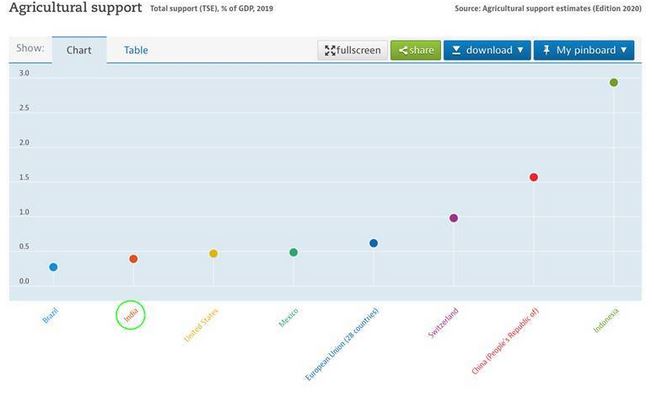
    • Indian Agriculture is still too heavily subsidised in favour of the big players.
    • In the Union Budget 2019-20, the allocation for the Ministry of Agriculture was Rs 1,30,485 crore and the fertiliser subsidy alone was estimated at Rs 79,996 crore.
    • But these subsidies are concentrated on a few crops.
    • Agriculture economist Bruno Dorin has shown, only three crops receive more than 60 per cent of the so-called “non-product-specific” support to agriculture — rice, wheat and sugarcane.
    • This has led to environmental degradation like the depletion of groundwater levels and monocultures which are a threat to biodiversity.
    • It has also led to the industrialisation of agriculture, that results in the strengthening of a handful of multinational companies, which supply chemical inputs.
    • Liberalisation would only strengthen the role of large companies — including those in the agri-food sector.

    2) Agriculture needs to be ecologically viable

    • Structurally, farming needs to be made economically and ecologically viable in India.
    • State intervention for better pricing, investments in water harvesting and an agroecological transition could ensure a more resilient system to weather shocks like the current one.
    • The government could draw inspiration from the Andhra Pradesh Community Managed Farming model.
    • It promotes agroecological principles with the use of locally-produced, ecologically-sustainable inputs focusing on soil health..
    • Since the agro-ecological system of farming is more biodiverse in nature, it will make the system more resilient overall.
    • It will provide a safety net for farmers in case of crop damage due to various factors such as climate change or droughts.

    Consider the question “Though the APMC Act has been blamed for the farmers’ issues, it has historically been part of the solution. Critically analyse.”

    Conclusion

    By investing again in agriculture and following, at last, the recommendations of the M S Swaminathan Committee, the Government of India would also help bridge the drastic urban-rural divide.

    To read more about the issue:

    Marketing of Agricultural Produce in India: Definition; Role; APMC Act, Model APMC Act, 2003

    Original article:

    https://indianexpress.com/article/opinion/columns/rural-india-coronavirus-farm-trade-ordinance-apmc-act-6515414/