Which one of the following statements with regard to the Moidams, built by the Tai-Ahom kingdom and inscribed as a World Heritage Site by UNESCO, is/are correct?
1. They acted as army fortresses.
2. They were recreation centres of the Royals and Nobles.
3. They were burial grounds of the Royals and Nobles.
4. They were battle drill centres of the Royals and Nobles.
Subject: Art and Culture
-
Which one of the following statements with regard to the Moidams, built by the Tai-Ahom kingdom and inscribed as a World Heritage Site by UNESCO, is/are correct
-
Return of Leiden Copper Plates to India
Why in the News?
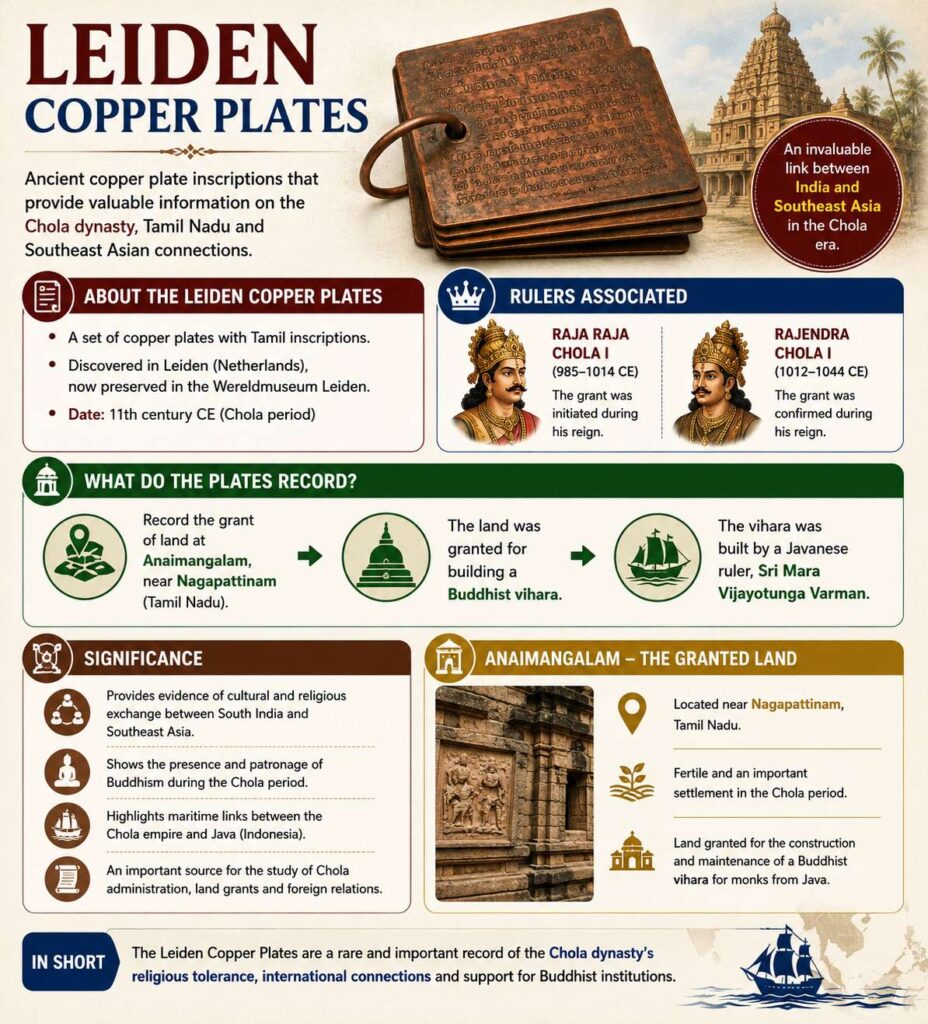
The Chola-era Anaimangalam copper plates, popularly known as the Leiden copper plates, were returned to India from the Leiden University during Prime Minister Narendra Modi’s visit to the Netherlands.
Key Highlights
- The copper plates had remained in Leiden University’s possession since 1862.
- Historians termed the repatriation a major step in returning India’s cultural heritage.
- Archaeologists also called for the return of the Velvikkudi copper plates from the British Museum.
About the Leiden Copper Plates
- Associated with Raja Raja Chola I and Rajendra Chola I.
- Record the grant of land at Anaimangalam near Nagapattinam for building a Buddhist vihara.
- The vihara was built by a Javanese ruler, Sri Mara Vijayotunga Varman.
Historical Significance
- Demonstrates religious tolerance during the Chola period.
- Shows a Shaivite Chola ruler supporting a Buddhist institution.
- Reflects India’s maritime and cultural links with Southeast Asia.
Features of the Plates
- Consist of:
- 21 large plates
- 3 small plates
- Written in:
- Sanskrit
- Tamil
- Plates carry Chola royal insignia:
- Tiger (Chola emblem)
- Fish (Pandya symbol)
- Bow (Chera symbol)
[2025] Who among the following led a successful military campaign against the kingdom of Srivijaya, the powerful maritime state, which ruled the Malay Peninsula, Sumatra, Java and the neighbouring islands?
(a) Amoghvarsha (Rashtrakuta)
(b) Prataprudra (Kakatiya)
(c) Rajendra 1 (Chola)
(d) Vishnuvardhana (Hoysala) -
Somnath Gates Controversy
Why in the News?
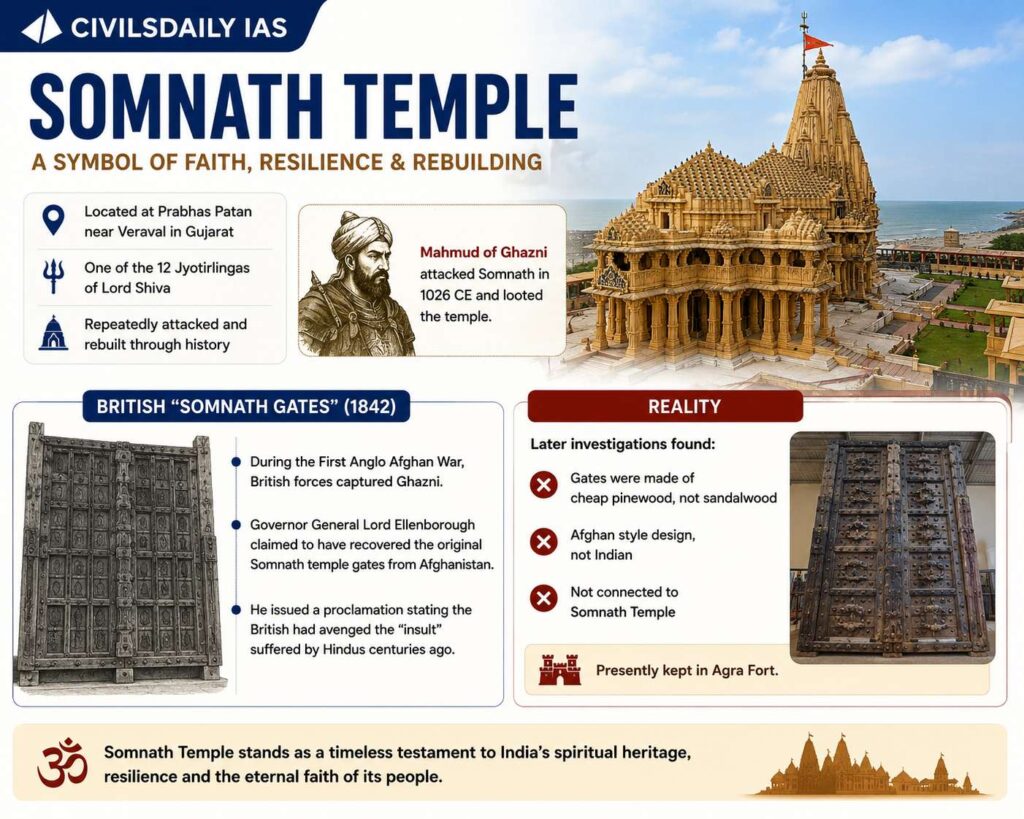
Prime Minister Narendra Modi recently visited Somnath Temple marking 75 years of its restoration, reviving discussion on the British claim of bringing back the “Somnath Gates” from Afghanistan in 1842.
Somnath Temple
- Located at Prabhas Patan near Veraval in Gujarat
- One of the 12 Jyotirlingas of Lord Shiva
- Repeatedly attacked and rebuilt through history
- Mahmud of Ghazni attacked Somnath in 1026 CE and looted the temple.
British “Somnath Gates” (1842)
- During the First Anglo Afghan War, British forces captured Ghazni.
- Governor General Lord Ellenborough claimed to have recovered the original Somnath temple gates from Afghanistan.
- He issued a proclamation stating the British had avenged the “insult” suffered by Hindus centuries ago.
Reality
- Later investigations found:
- Gates were made of cheap pinewood, not sandalwood
- Afghan style design, not Indian
- Not connected to Somnath Temple
- Presently kept in Agra Fort.
Importance
- Example of British “divide and rule” politics
- Use of religious symbolism for colonial legitimacy
[2022] The Prime Minister recently inaugurated the new Circuit House near Somanath Temple at Verval. Which of the following statements are correct regarding Somnath Temple?
1. Somnath Temple is one of the Jyotirlinga shrines
2. A description of Somnath Temple was given by Al-Biruni.
3. Pran Pratistha of Somnath Temple (installation of the present-day temple) was done by President S. Radhakrishnan.
Select the correct answer using the code given below:
[A] 1 and 2 only [B] 2 and 3 only [C] 1 and 3 only [D] 1, 2 and 3 -
Return of Trafficked Artefacts to India
Why in the News?
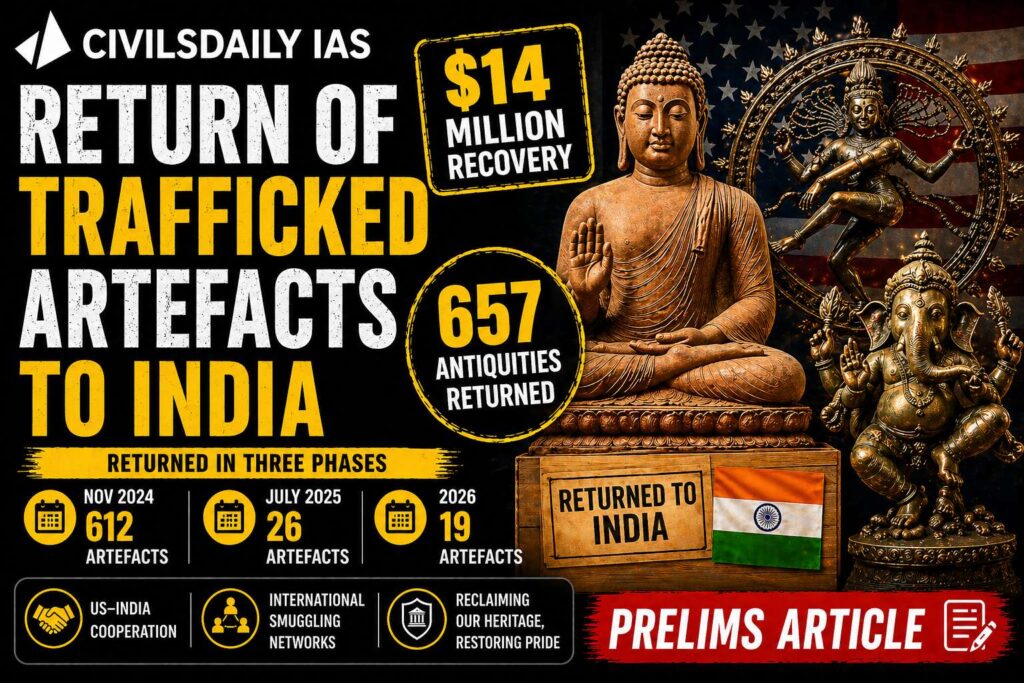
Authorities in the United States have returned 657 trafficked antiquities worth about 14 million dollars to India. The artefacts were recovered from international smuggling networks linked to traffickers like Subash Kapoor and Nancy Wiener.
Key Facts
- Total artefacts returned: 657
- Total value: 14 million dollars
- Returned in three phases:
- 612 artefacts in November 2024
- 26 artefacts in July 2025
- 19 artefacts in 2026
- Major recovery led by investigative agencies in New York
Important Artefacts Returned
Buddha Sculpture
- Material: Red sandstone
- Value: 7.5 million dollars
- Depicts Abhaya Mudra (gesture of protection)
Avalokiteshvara Bronze
- Value: 2 million dollars
- Origin: Sirpur
- Associated with Lakshmana Temple region
Dancing Ganesha Sculpture
- Origin: Temple in Madhya Pradesh
- Smuggled through international art networks
[2012] Lord Buddha’s image is sometimes shown with the hand gesture called ‘Bhumisparsha Mudra’. It symbolizes: (a) Buddha’s calling of the Earth to watch over Mara and to prevent Mara from disturbing his meditation. (b) Buddha’s calling of the Earth to witness his purity and chastity despite the temptations of Mara. (c) Buddha’s reminder to his followers that they all arise from the Earth and finally dissolve into the Earth, and thus this life is transitory. (d) Both (a) and (b) -
Thrissur Pooram 2026: Cultural Splendour Amidst Tragedy
Why in the News?
On April 26, 2026, the historic Thrissur Pooram was celebrated at the Thekkinkadu Maidan in Kerala. However, this edition was notably scaled-down and held without its signature fireworks display (Vedikettu) following a tragic accident at Mundathikode earlier in the month that claimed 15 lives.
About Thrissur Pooram
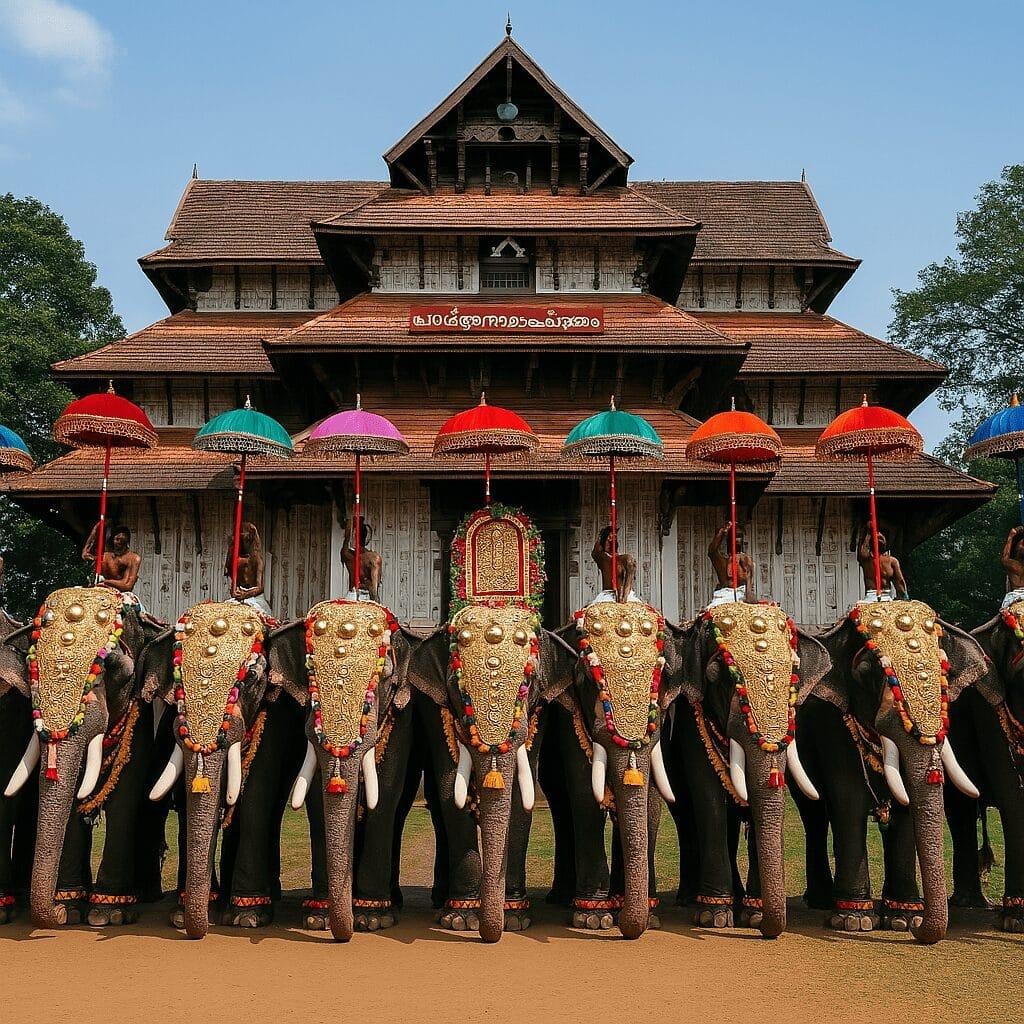
- One of the grandest temple festivals of Kerala
- Held at: Sree Vadakkunnathan Temple
- Venue: Thekkinkadu Maidan
[2014] Consider the following pairs:
1 Garba : Gujarat
2 Mohiniattam : Odisha
3 Yakshagana : Karnataka
Which of the pairs given above is / are correctly matched?
a) 1 only b) 2 and 3 only c) 1 and 3 only d) 1, 2 and 3 -
1,500 Year Old Stepped Reservoir Found on Elephanta Island
Why in the News?
The Archaeological Survey of India (ASI) discovered a 1,500 year old stepped reservoir on Elephanta Island near Mumbai, indicating advanced water management and maritime trade.
Key Findings
- Age: ~1,500 years old
- Shape: T shaped stepped reservoir
- Size:
- Length: 14.7 metres
- Width: 6.7 to 10.8 metres
- Depth: 5 metres excavated
- 20 steps discovered so far
Why Reservoir Was Built
- Elephanta Island is rocky
- Rainwater quickly flows into sea
- Reservoir helped:
- Store rainwater
- Ensure water supply
- Shows advanced ancient engineering.
Other Discoveries
Excavation yielded:
- Brick structure (possibly dyeing vat)
- Terracotta figurines
- Glass and stone bangles
- Carnelian and quartz beads
- Storage pots
- Stone anchors
Evidence of Maritime Trade
- 3,000 amphorae sherds from Mediterranean
- Torpedo jars from West Asia and Mesopotamia
- Used to store:
- Wine
- Oil
- Fish sauce
- Shows trade with Rome and West Asia.
Coins Discovered
- 60 coins found
- Copper coins of Kalachuri ruler Krishnaraja
- Period: 6th century CE
About Elephanta Island
- Located near Mumbai coast
- Known for Elephanta Caves
- Dedicated to Lord Shiva
- Period: 5th century CE
- UNESCO World Heritage Site
[2021] Which one of the following ancient towns is well-known for its elaborate system of water harvesting and management by building a series of dams and channelizing water into connected reservoirs? (a) Dholavira (b) Kalibangan (c) Rakhigarhi (d) Ropar -
Samrat Samprati: Ashoka’s Grandson Who Helped Spread Jainism
Why in the News?
The Samrat Samprati Museum was inaugurated in Koba, Gandhinagar on Mahavir Jayanti, highlighting the role of Samrat Samprati, grandson of Ashoka, in spreading Jainism.
Mauryan Dynasty and Religion
Ashoka and Buddhism
- Ashoka ruled: 269–232 BCE
- Adopted Buddhism after Kalinga War
- Spread Buddhism:
- Sri Lanka
- Southeast Asia
- Central Asia
- Promoted ethical kingship and Dhamma
Jain Connections in Mauryan Dynasty
Chandragupta Maurya
- Founder of Mauryan Empire
- According to Jain tradition:
- Converted to Jainism
- Migrated to Shravanabelagola (Karnataka)
- Practised Sallekhana (fast unto death)
- Ashoka’s First Wife
- Padmavati believed to be Jain
Who Was Samrat Samprati
- Grandson of Ashoka
- Son of Kunala
- Ruled: c. 230–220 BCE
- Associated with Shvetambara Jain tradition
- Often called: “Ashoka of Jainism”
[2018] With reference to the religious practices in India, the “Sthanakvasi” sect belongs to: (a) Buddhism (b) Jainism (c) Vaishnavism (d) Shaivism -
ASI Excavation at Balirajgarh
Why in the News?
On March 28, 2026, the Archaeological Survey of India (ASI) Patna Circle officially commenced a large-scale scientific excavation at the Balirajgarh site in the Madhubani district of Bihar. The project aims to uncover the “virgin soil” to determine the earliest human habitation and explore the site’s potential links to the Iron Age Videha Kingdom and the ancient civilization of Mithila.
Key Highlights of the Balirajgarh Site
- Location: Situated in the Babubarhi block of Madhubani district, Bihar.
- Historical Identity: Locally known as Raja Bali Ka Garh, it is traditionally believed to be the capital of the legendary King Bali and a major administrative hub of the ancient Videha Kingdom.
- Archaeological Status: Declared a protected site of national importance by the ASI in 1938.
- Site Features: The site spans approximately 176 acres and features a massive brick fortification and over 20 archaeological mounds.
[2023] With reference to the Indian History, Alexander Rea, A.H. Longhurst, Robert Sewell, James Burgess and Walter Elliot were associated with
(a) archaeological excavations (b) establishment of English Press in Colonial India (c) establishment of Churches in Princely States (d) construction of railways in Colonial India -
Masi Magam & Irular Community
Why in the News
- The festival Masi Magam highlights the cultural and spiritual practices of the Irular community, a Scheduled Tribe in Tamil Nadu.
What is Masi Magam
- Celebrated in Tamil month of Masi (Feb–March)
- Occurs on full moon day (Magam star)
- Associated with:
- Ritual bathing in sea and water bodies
- Temple festivals across Tamil Nadu
About Irular Community
- Recognised as a Scheduled Tribe in Tamil Nadu
- Known for:
- Traditional ecological knowledge
- Snake handling
- Herbal medicine
- Honey collection
- Socio-economic condition:
- Marginalised, with some history of bonded labour
[2019] Consider the following statements about Particularly Vulnerable Tribal Groups (PVTGs) in India:
1.PVTGs reside in 18 States and one Union Territory.
2. A stagnant or declining population is one of the criteria for determining PVTG status.
3. There are 95 PVTGs officially notified in the country so far.
4. Irular and Konda Reddi tribes are included in the list of PVTGs.
Select the correct answer using the code given below: (a) 1, 2 and 3 (b) 2, 3 and 4 (c) 1, 2 and 4 (d) 1, 3 and 4 -
World Sparrow Day 2026: ‘Chidi’ in Sikh Tradition
Why in the News
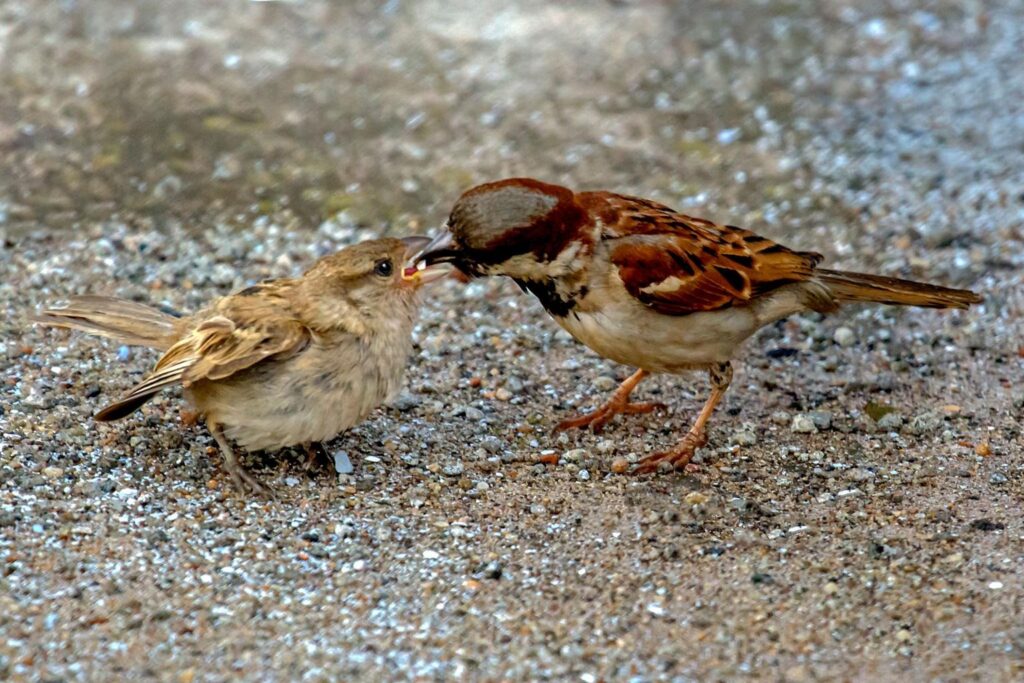
- World Sparrow Day (March 20) highlights declining sparrow populations and their cultural significance, especially in Sikh tradition.
Sparrow: Ecological Importance
- One of the most common birds in human settlements
- Plays role in:
- Insect control
- Maintaining urban biodiversity
- Decline linked to:
- Urbanisation
- Loss of nesting spaces
- Pollution
‘Chidi’ in Sikh Tradition
Symbolism
- Sparrow (‘chidi’) represents: Ordinary, weak, or downtrodden people
Spiritual Meaning
- In Sikh philosophy: Even the weakest can become powerful through divine grace and courage
Cultural Expression
- Sikh teachings, especially in: Guru Granth Sahib
- Use nature imagery: Birds, animals, insects
- Reflects rural Punjabi life and ethics
Famous Metaphor
- Linked with Sikh ethos: “Making sparrows fight hawks”
- Symbolises: Empowerment of the weak against the strong
Broader Insight
- Sparrow is not just a bird but: A moral and spiritual metaphor
- Shows connection between: Nature and religious philosophy
[2013] Consider the following Bhakti Saints:
1. Dadu Dayal
2. Guru Nanak
3. Tyagaraja
Which among the above was/were preaching when the Lodi Dynasty fell and Babur took over?
(a) 1 and 3 (b) 2 only (c) 2 and 3 (d) 1 and 2