💥Mains Ready By December. Smash Mains & Smash PYQ Admissions Open

Subject: Bilateral Relations

1. Major World Events
2. India’s Interests in neighbourhood
3. Effects of our Policies

  • Keeping the southern neighbour engaged

    Context

    During Mahinda Rajapaksa’s India visit, New Delhi is likely to talk to Colombo on the Tamil issue and counterbalance Beijing’s influence in the Indian Ocean.

    Background of the current politics in Sri Lanka

    • Sri Lankan Prime Minister official visit to India is taking place a few months after he assumed office and his brother was sworn in as president
    • Nationalist wave after attacks: The brothers were voted to the office on a Sinhala nationalist wave, a sentiment that is a fallout of the Easter attacks on Christian shrines, including the Saint Anthony’s shrine, in April last year.
      • The attacks had killed more than 250 people, six months before the elections.
      • The polarisation worked in favour of the Rajapaksas vis-à-vis Sri Lanka’s 10 per cent Muslim population, mostly Tamils, who are especially numerous on the country’s east coast.

    Tamil issue in Sri Lanka

    • No engagement with Hindu Tamil: While Muslims have become the number one scapegoat for the Easter tragedy, the Rajapaksas have not tried to engage the Hindu Tamils
    • LTTE background: Hindu Tamils, who make about 11 per cent of Sri Lanka’s population, have had an acrimonious relationship with Mahinda Rajapaksa ever since he wiped out the LTTE in 2009.
      • Many members of the community became collateral victims in the process.
    • Implications for India-Sri Lanka relations: Gotabaya was the defence secretary at that time. The Hindu Tamil factor may complicate India-Sri Lanka relations.
    • No inclusion minorities from Sri Lanka in CAA: In the Citizenship Amendment Act the Indian Parliament passed in 2019, the persecuted minorities of Sri Lanka are not taken into account.
      • However, the Hindu Tamils of Sri Lanka are feeling insecure again.

    China-Sri Lanka axis

    • The China factor is likely to aggravate the complication: The Rajapaksas are known to be pro-Sri Lanka. Mahinda Rajapaksa was largely responsible for opening Sri Lanka to massive — and strategic -Chinese investments.
    • The Hambantota port issue: The Hambantota Port and 15,000 acres have been conceded to China on a 99-year lease, causing considerable consternation in New Delhi, which apprehends that this deep seaport could be used for military purposes, and not just trade.
      • The deal was put on a hold by former PM but the present dispensation wants it to be restored.
    • China’s growing clout in the Indian Ocean: India’s efforts were also designed to thwart China extending its influence in Sri Lanka at a time when the Narendra Modi administration is trying to counter Beijing’s clout in the Indian Ocean.
    • Modi’s visited on May 30, 2019, just after beginning his second tenure as PM.

    Past engagement events

    • New Delhi has tried to engage the new Sri Lankan government after the Rajapaksas assumed office.
      • India’s foreign minister S Jaishankar, landed in Sri Lanka on November 20, 2019, to invite Gotabaya for his first visit to India — rather than to China.
    • Gotabaya visited New Delhi for three days in late November last year.
    • Tamil issue discussed: Jaishankar is said to have told Gotabaya that India expects his government to treat Tamils with dignity in the process of reconciliation.
      • There is speculation that India might appoint an ambassador of Tamil origin to Colombo.
    • Cooperation against terrorism: The Indian PM went further when Gotabaya Rajapaksa visited New Delhi: He announced a $50 million line of credit for security and counter-terrorism
    • Line of credit for Infra: India also announced another $400 million for development and infrastructure projects in Sri Lanka.
      • That the counter-terror fund would further strengthen cooperation against terrorism.
    • Allaying the fears over China: Gotabaya allayed India’s fears on China by saying that Sri Lanka would not allow a third country to affect Sri Lanka-India ties.

    Conclusion

    While addressing the issue of minority and growing Chinese influence in Sri Lanka both countries need to focus on the other areas of cooperation like counter-terrorism, trade, security, development, technology etc.

  • [op-ed of the day] In defence of a shared vision

    Context

    Defence cooperation has been one of the fundamentals of the bilateral relationship between India and France, which developed a close and ambitious strategic partnership for over 20 years.

    Defence cooperation between France and India

    • A long history of cooperation: The defence cooperation between our two countries can be traced back to the first few years following India’s Independence.
      • As early as 1953, the Indian Air Force was equipped with a hundred Toofani fighter jets from Dassault, then the Mystère IV, which defended India in tough times.
    • This marked the first page in the history of cooperation in military aviation, which also recorded the supply of 60 Mirage 2000s in the 1980s.
    • Rafale deal: The ongoing delivery of 36 Rafales is being done as per the schedule.
      • The first batch of aircraft, currently being used to train Indian pilots, will land at Air Force Station Ambala within a few months.
    • Partnership in maritime domain: Today, the partnership has been deployed in the maritime domain, in support of our joint strategic vision for the maintenance of stability and security in the Indo-Pacific.
      • As far as naval equipment is concerned, the Indian Navy has already commissioned two of the six submarines built in Mumbai as part of an industrial partnership between Mazagon Dock Shipbuilders Limited (MDL) and Naval Group.

    Industrial cooperation between the two countries

    • Support to indigenous production: As for industrial cooperation, the French approach has always been, whenever possible, to offer partial indigenous production in India.
      • France was largely a precursor with regard to Make in India, with HAL manufacturing the light helicopters Cheetah and Chetak, and BDL’s Milan anti-tank missile in India in the 1960s.
      • It continues this policy today. The plant built under the Dassault Aviation and Reliance joint venture will enable, for example, the complete production of the Falcon 2000 business jet here in India by 2022.
    • Transfer of technology: After the delivery of the first two Scorpene submarines, transfers of technology provided by the Naval Group enabled MDL to be solely in charge of building the next four submarines.
      • The design of these submarines has thus become largely Indian knowhow.
      • Safran will soon inaugurate an aircraft wiring systems factory in Hyderabad and also build another major facility to manufacture LEAP turbofan engine components.
      • Thales is investing massively in engineering works in Bengaluru, MBDA is building a plant in Coimbatore and French aeronautical equipment manufacturer Latécoère recently inaugurated a factory in Belgaum.

    Opportunities for further cooperation

    • Developing the supply chain at all the levels: The French aerospace industries association, GIFAS, and GICAN, the French Marine Industry Group, are organising a seminar focused on this subject during DefExpo.
      • Along with the Society of Indian Defence Manufacturers (SIDM), they are exploring opportunities for developing Indo-French industrial partnerships at all stages of the production chain.
      • Promoting Make in India: India can count on France being by its side for its Make in India enterprise.

    Conclusion

    India and France both share the same vision for a new balanced multipolar world, which must be based on the rule of law. They also share the same vision on the main challenges of the times, be they security developments in Asia and the Indo-Pacific, or combating international terrorism. But it is by possessing the capability of ensuring national security and making strategic choices that most efficiently defend their shared principles and visions.


  • [pib] Exercise SAMPRITI-IX

    As part of the ongoing Indo-Bangladesh defence cooperation, a joint military training exercise SAMPRITI-IX is being conducted in Meghalaya.

    Exercise SAMPRITI

    • It is an important bilateral defence cooperation endeavour between India and Bangladesh and will be the ninth edition of the exercise which is hosted alternately by both countries.
    • During the joint military exercise SAMPRITI-IX, a Command Post Exercise (CPX) and a Field Training Exercise (FTX) will be conducted.
    • For both the CPX and FTX, a scenario where both nations are working together in a Counter-Terrorism environment will be simulated under the UN Charter.
    • The FTX curriculum is progressively planned where the participants will initially get familiar with each other’s organizational structure and tactical drills.
    • The training will culminate with a final validation exercise in which troops of both armies will jointly practice a Counter Terrorist Operation in a controlled and simulated environment.
  • Sagarmatha Sambaad


    Nepal has invited the PMs of India and Pakistan along with several other heads of government and heads of state for the Sagarmatha Sambaad.

    Sagarmatha Sambaad

    • Sagarmatha Sambaad is a multi-stakeholder, permanent global dialogue forum initiated by the Government of Nepal.
    • It is scheduled to be held biennially in Nepal.
    • The Sambaad (dialogue) is named after the world’s tallest mountain Sagarmatha (Mount Everest).
    • The Everest is also a symbol of friendship and is meant to promote the notions of common good and collective well-being of humanity.
    • The first episode of the Sambaad is scheduled to be held from 2 to 4 April 2020 by the Ministry of Foreign Affairs (Nepal).
    • The theme of the first Sambaad is “Climate Change, Mountains and the Future of Humanity.”

    Significance

    • This is the first ever multi-stakeholder dialogue and a biggest diplomatic initiative in Nepal’s recent history.
    • India and Pakistan have been caught up in a cycle of hostility, which had prevented Islamabad from hosting the SAARC Summit in 2016.
    • The Kathmandu event aims to draw all the SAARC leaders and provide an opportunity to break the ice.
    • India had accused Pakistan of cross border terrorism while boycotting the Islamabad summit leading to its cancellation.
  • [op-ed snap] It’s not yet Howdy, Modi!

    Context

    Persistent in their efforts to remake their countries and their engagement with the world, Mr Modi and Mr Trump are shaking up the bilateral ties between the two countries, and the resultant flux could outlive their tenures.

    The emergence of both the leaders on similar promises

    • Improvements over the legacy of their predecessors: Both leaders continuously reiterate that their predecessors were incapable of protecting national interest.
      • The compulsion to reframe the national interest: Such premises commits them both to reframe the national interest, and both have articulated it with clarity and force.
      • For instance, Mr Modi, in Houston in September 2019 and Mr Trump in Davos this week, went great lengths to lay out figures that presented their respective regimes as the most effective guardians.
    • Both have cultural and economic agenda: Both dispensations believe that “the people” had been given a raw deal by earlier regimes.
      • Both have a cultural and economic agenda.
      • National awakening: They are now leading a national reawakening, and working hard for the hard-working people.
      • Both believe that cultural nationalism is a force for the good.
      • Securing borders and entry barriers: Both believe that national borders need to be strengthened by stricter monitoring and setting new bars for entry.
      • Renegotiating the treaties: Both leaders try to renegotiate the contract between the union and the States, and between citizens and the state within their respective countries.
      • The supremacy of executive: They assert the supremacy of the executive over the legislature and the judiciary.
      • Shared values: The notion of shared values of India and the U.S. has acquired a whole new meaning under Mr Trump and Mr Modi.

    Politics and governance

    • Hopes of status-quo in bilateral relations shattered: It was hoped that the stronger U.S.-India ties- that have autonomous drivers of convergence-would not be impacted by the nationalist politics of these two leaders.
      • But both leaders have been remarkably true to their politics in their governance.
      • Current tumult in the India-US ties: Shared values notwithstanding, national interests as perceived by these leaders have several points of divergence and therein lies in the current tumult in India-U.S. ties.
      • Opposition to the “world order”: Mr Trump has been outspokenly confrontational with the “world order” that he says has worked against American interests.
      • Dismantling the treaties: America under Mr Trump has wrecked treaties such as the Paris climate agreement and institutions such as the World Trade Organization and the United Nations, disrupting the “rule-based order”.
      • India’s relations with Bangladesh: India’s spirited outreach in the neighbourhood is still playing out. India’s historically warm ties with Bangladesh have been frayed after CAA.
    • India’s ambitions on the global level
    • The seat at the UNSC: India under continues to push for more space for itself in global affairs by seeking a permanent seat in the UN Security Council and membership.
    • NSG membership: India is also pushing for the membership of the Nuclear Suppliers Group.
    • The US actions at global levels
      • Expansion of the principle of the pre-emptive strike: America expanded the principle of pre-emptive strike to include the assassination of a senior official of Iran.
      • Renegotiating the treaties: After dismantling the North American Free Trade Agreement, Mr Trump forced Mexico and Canada to accede to his demands in a new trade deal.
    • The India-US relations and impact of U.S. relations with other countries
      • Impact on India-US ties: India’s ties with the U.S. are impacted by America’s ties with India’s adversaries and neighbours, China and Pakistan.
      • Hopes of alignment in the Indo-US ties: Mr Trump’s bluster against both had lit hope that there would finally be a near-complete alignment between India and the U.S. on strategy.
      • US-Iran conflict: Despite Mr Trump’s avowed opposition to America’s endless wars in West Asia, the US is going against Iran headlong, which is not in India’s interest.
      • Relations with Gulf Countries: Trump and Mr Modi share a strong bonding with the Gulf Cooperation Council kings, but their courses in the region are diverging.
      • US-Pakistan coming closer once again: The American President’s impatience to get out of Afghanistan has already pushed his administration closer to Pakistan, which is now further necessitated by his adventurist Iran policy.
      • The US disregard for China’s expansionist policies: Mr Trump has been singularly focused on one question-trade. He cares little about China’s expansionism and at any rate that is not a factor in his ties with other Asian countries.

    India-US ties- Points of fission

    • On the trade front: Mr Trump has bracketed India and China as two countries that have duped his predecessors to gain undue advantage. Which is far from seeing India as deserving special concessions to counterbalance China as old wisdom demanded.
      • Ending GSP: The US ended India’s status under the World Trade Organization’s Generalized System of Preferences and took other punitive measures.
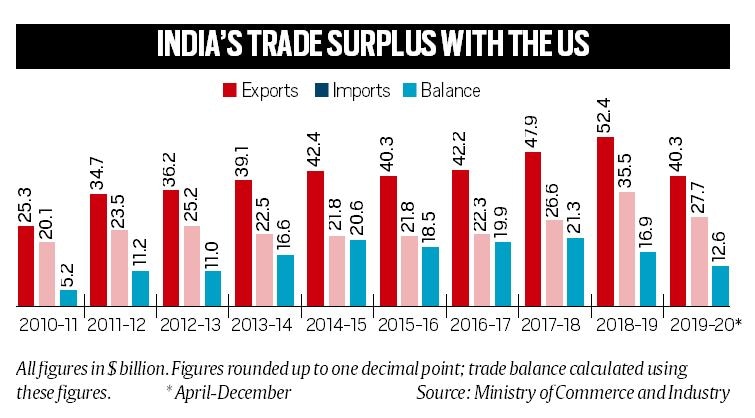
      • India trying to decrease the trade surplus: By increasing hydrocarbon imports from the U.S., the government is trying to reduce India’s trade surplus.
    • Restrictions on H1-B visa: The US has tightened the restrictions on the H1-B visa which is used by the Indian companies.
    • Decreasing bipartisan support in the US: The mobilisation of Indian diaspora in America by the government has resulted in the inevitable blowback.
      • Diaspora divided and bipartisan support waning: The diaspora has been divided, and the bipartisan support for India is now squandered. Progressive sections on the Democratic side and religious libertarians and evangelicals on the Trump side are both concerned over India’s actions back home.

    Conclusion

    Partnership with America is critical to India. India must take the steps to align the interest but whenever it diverges India must take measures to minimise its impact on India while furthering its interests.

  • [op-ed snap] Same country, different script

    Context

    Pakistan is changing significantly, which is good for itself and its neighbour as well.

    Changing Pakistan

    • Major stakeholders in favour of peace: The civil society, the political parties, and even the military establishment of Pakistan have come to favour peaceful and cooperative relations with India.
    • Both the power-centre on the same page: Both Islamabad and Rawalpindi, Pakistan’s two centres of power, are now on the same page in seeking “honourable peace” with New Delhi on the basis of “sovereign equality”.
      • Heavy price paid by Pakistan: There is a broad consensus in Pakistani society and polity that their country has paid a very heavy price by supporting the forces of Islamist extremism and terrorism.
      • The futility of using terrorism as foreign policy: There is also consensus that using terrorism for achieving mistaken foreign policy ends in Afghanistan and India.

    Conducive conditions for dialogues

    • Four factors have influenced the welcome winds of change in Pakistan.
    • First-Realisation that Pakistan has suffered a lot:
      • Harm at home and to the global image: There is the across-the-board realisation that Pakistan has suffered a lot, both domestically and in terms of damage to its global image, by supporting religious extremism and terrorism.
      • A large number of casualties: Terrorists have killed a shockingly large number of civilians -certainly far many more than in India. Several thousand soldiers have lost their lives in the army’s “war on terror”-more than the number of casualties in all the wars with India.
      • The threat of FATF blacklisting: Furthermore, Islamabad is under relentless pressure from the Financial Action Task Force (FATF) to act decisively and irreversibly against terrorist organisations.
    • Second-Decrease in religious radicalisation in Pakistan
      • The decrease in the financial support to radicalism: What has contributed to the diminished importance of religious radicalism is also the shrinking inflow of petrodollars from Saudi Arabia and Gulf countries that promoted this agenda.
      • The ideological influence of religious radicalisation on Pakistan’s civil society is clearly declining.
      • Change in Saudi Government Policy: Export of Wahhabism is no longer a foreign policy priority of the Saudi Arabian government.
      • Changing policies in UAE: The United Arab Emirates has gone a step further, under the leadership of Abu Dhabi’s Crown Prince Mohammed bin Zayed Al Nahyan, it is pursuing inter-religious tolerance with a zeal that has surprised Muslims and non-Muslims alike.
    • Third-Interest of China
      • Rise of China as an economic and security partner: The third factor is China, which has emerged as Pakistan’s most important economic and security partner.
      • The China-Pakistan Economic Corridor (CPEC) and BRI: The flagship projects under Beijing’s BRI has begun to modernise Pakistan’s infrastructure spectacularly, but its security is which could be threatened by terrorism is also the concern for China.
      • Connection with China’s Xinjiang Province: China has urged Pakistan’s ruling establishment to take firm steps to curb the activities of Islamist groups because they can easily foment trouble in China’s Muslim-majority Xinjiang province.
      • India-China relation factor: Beijing is also engaged in a steady effort to improve relations with New Delhi, in recognition of India’s rising economic and geopolitical stature in Asia and globally.
      • Possibility of India-China-Pakistan cooperation: China’s President Xi Jinping even mooted cooperation among China, India and Pakistan at Mamallapuram summit.
    • Fourth-Military establishment in favour of peace.
      • The military establishment seems to be fully convinced of the need for normalisation of India-Pakistan
      • Opening of Kartarpur Sahib Corridor: The opening of the Kartarpur Sahib Corridor, perhaps the greatest confidence-building measure between the two countries since 1947, is almost entirely due to Gen. Bajwa’s personal commitment to the project.
      • The economic crisis in Pakistan: Bajwa’s is also said to be convinced of the need to open the doors for economic and trade cooperation between the two countries given a serious economic crisis Pakistan is going through.
      • Discussion on the Kashmir issue: The Pakistan Army may also be ready to discuss a solution to the Kashmir issue on the basis of a formula Gen. Pervez Musharraf had discussed with PMs Atal Bihari Vajpayee and Dr Manmohan Singh.

    Conclusion

    India needs to seize the opportunity to resume the talks with Pakistan on all the contentious issues and try to resolve the disputes so that the improved relations could help both the countries and the neighbouring countries.

  • India-Pakistan Trade

    Tensions between India and Pakistan in 2019 have reduced the already low volumes of trade between the two countries to near zero.

    India-Pakistan trade, in the beginning

    • In 1948-49, about 56% of Pakistan’s exports were to India, and 32% of its imports came from India.
    • From 1948-65, India and Pakistan used a number of land routes for bilateral trade; there were eight customs stations in Pakistan’s Punjab province and three customs checkpoints in Sindh.
    • India remained Pakistan’s largest trading partner until 1955-56. Between 1947 and 1965, the countries signed 14 bilateral agreements on trade, covering avoidance of double taxation, air services, and banking, etc.
    • In 1965, nine branches of six Indian banks were operating in Pakistan.

    Close to vanishing

    • Following the terrorist attack on the CRPF convoy in Pulwama in February, India withdrew Most Favoured Nation (MFN) status for Pakistan and raised customs duty on Pakistani imports to 200% .
    • In April, India suspended cross-LoC trade to stop the misuse of this route by Pakistan-based elements.
    • Pakistan on its part closed its airspace to India for a prolonged period.
    • The decisions by both countries, while targeted at hurting the neighbour, have severely impacted the livelihoods of individuals and families involved in cross-border trading activities.
  • [op-ed snap] Seize the summit

    Context

    India announced that it will invite all heads of government of Shanghai Co-operation Organisation member countries, including Pakistan.

    Significance of the invitation

    • First since 2014: The summit will assume significance should Pakistan Prime Minister accept the invitation.
      • As it will be the first by a head of government or state of that country to India since former Prime Minister Nawaz Sharif attended the swearing-in ceremony of Prime Minister in 2014.
    • Hopes belied: Nothing came from that meeting and hopes created by the invitation were belied.
    • Failed attempts to engage: Attempts to engage after that failed, including at a previous SCO summit at Ufa in 2015.

    Latest events that further reduced the engagement

    • Pulwama attack: First, there was the February 2019 Pulwama attack, India’s Balakot response, and Pakistan’s counter-response.
    • Article 370: After India did away with Jammu & Kashmir’s special status, India and Pakistan have downgraded even their diplomatic presence in each other’s countries.
    • Both the countries withdrew their high commissioners after the Article 370 issue.
    • Trade stopped completely: Bilateral trade, which had managed to survive earlier shocks to relations, has stopped completely.

    Opportunities presented by SCO summit

    • “Inputs of all stakeholders”: In deciding whether to accept the invitation, the Pakistan PM will have to take into consideration “inputs of all stakeholders”.
    • A polite way of saying that the final yes or no will rest with the Pakistan Army.
    • A chance for a high-level meeting: Even if Imran Khan stays away and sends a minister instead, it would still be a chance for a high-level bilateral meeting.
    • The world wants India and Pakistan to engage: The world wants India and Pakistan to engage, and this was evident in the way the UNSC refused to take up the Kashmir issue, saying it was not the forum for it.
    • Opportunity for India to make a start: India has declared several times recently that it wants to peel away from historical foreign policy baggage.
      • India should make a start with Pakistan by making it possible for such a meeting to take place.
    • Making acceptance of invitation easier: India can make it easier for the Pakistan Prime Minister to accept the invitation.
    • Resuming trade: A start could be made by resuming trade, which has ground to a dead halt
    • Sending High Commissioner back: India can start by sending India’s High Commissioner back to his office in Islamabad.

     Conclusion

    The SCO summit presents an opportunity for both the countries to end the long hiatus in the relations which is essential for both the countries to resolve the long-standing issues and progress of both the countries.


  • Indian Origin Tamils and Sri Lanka’s Citizenship Law

    Recently an MHA spokesperson wrote on Twitter that about 4.61 lakh Tamils of Indian origin were given Indian citizenship during 1964-2008. The reference was to the Indian Origin Tamils (IOTs) of Sri Lanka, and the Lal Bahadur Shastri-Sirimavo Bandaranaike Pact of 1964.

    The Indian Origin Tamils

    • Different from Sri Lankan Tamils who live predominantly in the North and East, the IoTs are descendants of indentured Tamil workers.
    • The British had shipped them to the island in the mid 19th century to work on tea estates in the five hill districts of the Central and Uva provinces.
    • These people now call themselves Malayaha (hill country) Tamils — because of the historical stigma attached to being “Indian” Tamils.
    • At the time of Sri Lanka’s independence, the IOTs numbered around 800,000.
    • They were the backbone of the tea industry, politically active, and keen to ensure their rights in independent Sri Lanka through strategic alliances with unions and left parties.
    • Determined to blunt their political rights, the ruling parties described IOTs as “birds of passage” with no loyalty to the country, as India’s fifth column in Sri Lanka, and as people who stole the locals’ jobs.

    SL’s 1948 Citizenship Act

    • Sri Lanka’s Nov. 1948 Citizenship Act was the first in a series of divisive moves by the Sinhala rulers to consolidate their political base in the majority Sinhalese (Buddhist and Christian) community.
    • It was aimed at excluding IOTs — then as now, the predominant workforce in the upcountry tea estates — whose numbers and growing association with leftist parties were proving to be politically inconvenient.
    • The IOTs that India accepted through the 1964 agreement were not “fleeing” Sri Lanka.
    • Most were, in fact, reluctant to leave the country in which they had lived for three generations or longer.
    • Those that remained, were stateless in Sri Lanka for decades until their status as citizens was settled ironically because the ruling party now wanted their votes.

    What did the Act provide?

    • Under the Act, citizenship could be only by patrilineal descent or registration.
    • For citizenship by registration, umarried persons had to show 10 years of uninterrupted stay in Sri Lanka from the date of application; married persons had to show 7 years.
    • Most IOTs were unlettered and poor, with no documents. Effectively an entire community was rendered stateless.
    • Soon afterward came the Indian & Pakistani Residents’ Act of 1949, which opened a window for those above a certain income level.
    • Only 1,40,000 had been granted citizenship under the Indian & Pakistani Residents’ Act, and 2,50,000 were accepted by India as its citizens.
    • Finally, the 1949 Ceylon (Parliamentary Elections) Amendment was passed, under which only citizens could vote.
    • The IOTs were stripped of voting rights, and the fallout was immediate: in 1947, there were 7 Indian Tamils in the legislature; in 1952, there were none.

    Issues with the Act

    • This Act sharply delineated ethnic differences, and distorted the political system to weight it in favour the Sinhalese majority.
    • This created an intractable dynamic of ethnic outbidding between the two major Sinhalese-dominated parties to attract Sinhalese voters at the expense of the Sri Lankan Tamil minority.
    • This directly contributed to the latter’s alienation, support for secessionism, and the outbreak of ethnic violence and civil war in the 1970s and 1980s.

    India’s response

    • The treatment of Indian Tamils had cast a shadow on India-Sri Lanka relations even before independence; post-independence, the citizenship laws became a major irritant.
    • They were denounced in India, and the Madras legislature passed a resolution against them.
    • In 1947, PM Nehru had tried unsuccessfully to persuade Senanayake to give citizenship to all Indian Tamils who had lived in the country for 7 years prior to January 1, 1948.
    • The two countries corresponded on this issue until Nehru’s death in 1964.
    • Nehru rejected the Sri Lankan position that the “stateless” IOTs were automatically Indian citizens, and would have to be shipped to India.

    Repatriation of IOTs

    • After the 1962 war with China, PM Shastri was eager to mend fences with Sri Lanka. He gave in to Bandaranaike’s demands, and it was agreed that Sri Lanka would accept 3,00,000 IOTs and their natural increase, while India would accept 5,25,000 IOTs and their natural increase.
    • The status of the balance 1,50,000 IOTs was to be decided later.
    • Some 4,00,000 reluctantly applied for citizenship of India; 6,30,000 applied for Sri Lanka’s.
    • By the time the window agreed upon in 1964 closed, only 1,62,000 IOTs had been given Sri Lankan citizenship. In the same period, India gave citizenship to over 3,50,000.
  • Ethnic Unity Law in Tibet

    The People’s Congress of Tibet passed a law that makes ethnic unity in the region mandatory, reflecting the significant role that the autonomous Himalayan region plays in its economic and social development.

    About the Law

    • The law makes it clear that Tibet has been an inalienable part of China since ancient times.
    • It states that it is the common responsibility of the people of all ethnic groups to safeguard national reunification and take a clear stand against separatism.

    Ethnic Unity in China

    • This is not the first time that the phrase ethnic unity has been mentioned by China.
    • In October 2019 the Communist Party of China published a guideline for enhancing ethnic unity.
    • It stressed on efforts to improve the governance of ethnic affairs, guaranteeing the legal rights and interests of citizens of ethnic groups.
    • It called for cracking down on “criminal acts” that sabotage ethnic unity or cause ethnic separation.
    • Before this, in 2016, China began a campaign in the autonomous territory of Xinjiang to promote ethnic unity and called for people to respect the cultures of the minorities who call the region home.

    Why such Law?

    • There are more than 40 ethnic minorities in the region, which account for 95 per cent of Tibet’s population of over three million.
    • Like Tibet, Xinjiang is another region of China that houses multiple ethnic minorities.
    • A similar legislation was passed there four years ago and in recent times, China has faced criticism for detaining at least a million Uighur and other Muslims, along with some ethnic Kazakhs and Uzbeks.
    • China has began “re-education camps” in Xinjiang, a region that has been claimed by China since 1949.
    • China has denied these allegations and maintains that the facilities where the detainees are housed are vocational training centers.