💥Join UPSC 2027,2028 Mentorship (July Batch) + XFactor Notes & Microthemes PDF

Subject: Bilateral Relations

1. Major World Events
2. India’s Interests in neighbourhood
3. Effects of our Policies

  • Old ties, new Nepal: What India needs to negotiates

    Why in the News?

    The visit of Rabi Lamichhane, chief of Nepal’s ruling Rashtriya Swatantra Party (RSP), to India has emerged as the most significant political engagement between the two countries since Nepal’s new government assumed office. This comes at a time when Prime Minister Balen Shah has imposed restrictions on foreign travel and prioritized domestic governance, resulting in limited high-level diplomatic exchanges. 

    Why Does Lamichhane’s Visit Mark a Turning Point in India-Nepal Relations?

    Political Transition

    1. Emerging Leadership: Rabi Lamichhane represents a new generation of political actors challenging Nepal’s traditional political establishment.
    2. Changing Political Landscape: Nepal’s political discourse is increasingly shaped by younger leaders and new political formations.
    3. Generational Shift: Nepal’s median age is approximately 38 years, while decision-making is gradually moving towards younger leadership groups.

    Diplomatic Significance

    1. Highest-Level Engagement: Lamichhane’s visit constitutes the most significant political engagement since Nepal’s new government came to power.
    2. Deadlock Resolution: The visit helps break a period of limited diplomatic interaction between the two countries.
    3. Recognition of New Nepal: India acknowledges that future engagement cannot remain confined to traditional political actors.

    Priority Signal from India

    1. Strategic Importance: Prime Minister Narendra Modi conveyed that Nepal remains India’s “priority partner.”
    2. Future Cooperation: India expressed willingness to elevate bilateral relations to “greater heights.”
    3. Continuity in Engagement: New Delhi signalled that engagement will continue irrespective of changes in Nepal’s domestic political landscape.

    How Is Nepal’s New Political Leadership Different from the Traditional Establishment?

    Governance-First Approach

    1. Domestic Prioritisation: Prime Minister Balen Shah has emphasized governance reforms over foreign policy activism.
    2. Foreign Travel Restriction: Shah imposed a self-declared restriction on foreign travel during the initial phase of his tenure.
    3. Administrative Focus: Greater emphasis on domestic accountability and service delivery.

    Protocol Changes

    1. Rank-Based Engagement: Shah declared that he would not meet officials below his own rank.
    2. Departure from Convention: Represents a shift from established diplomatic practices.
    3. Assertion of Sovereignty: Reflects increasing confidence among Nepal’s new political leadership.

    Anti-Establishment Politics

    1. Political Disruption: New political actors challenge long-established parties.
    2. Youth Mobilisation: Younger voters increasingly favour alternatives to traditional elites.
    3. Institutional Reconfiguration: Nepal’s political system is experiencing a broader transition.

    Why Can India No Longer Depend Solely on Traditional Political Networks in Nepal?

    Historical Pattern

    1. Elite-Centric Engagement: India traditionally dealt with established political leaders and long-term political actors.
    2. Political Continuity: Familiar actors often alternated in government, facilitating predictable diplomacy.
    3. Institutional Comfort: New Delhi developed extensive networks with traditional parties.

    Changing Political Reality

    1. New Stakeholders: Emerging leaders possess different political priorities and constituencies.
    2. Youth Influence: Younger demographics increasingly shape electoral outcomes.
    3. Political Fragmentation: Greater diversity within Nepal’s political landscape.

    Diplomatic Adaptation

    1. Broader Outreach: India must engage across the political spectrum.
    2. Institutional Engagement: Relationships cannot depend on a limited set of actors.
    3. Long-Term Relevance: Successful diplomacy requires adaptation to Nepal’s evolving political realities.

    How Did the 2015 Constitutional Crisis Damage India’s Image in Nepal?

    Constitutional Dispute

    1. Madhesi Concerns: India raised concerns regarding representation and rights of Madhesis with strong social and cultural links to India.
    2. Constitution Drafting: Differences emerged during Nepal’s constitution-making process.
    3. Political Sensitivity: Sovereignty concerns became central to public debate.

    Border Blockade Legacy

    1. Economic Disruption: The India-Nepal border witnessed months-long disruptions.
    2. Public Hardship: Fuel shortages and supply constraints generated public dissatisfaction.
    3. Political Fallout: The episode became a defining moment in Nepalese perceptions of India.

    Trust Deficit

    1. Anti-India Sentiment: Sections of Nepal’s population viewed India as interfering in domestic affairs.
    2. Youth Perception: Negative narratives gained traction among younger Nepalese citizens.
    3. Diplomatic Challenge: Residual mistrust continues to influence bilateral relations.

    Why Has the “Big Brother” Narrative Become a Strategic Challenge for India

    1. Perception Problem
      1. Big Brother Image: India is viewed by some Nepalese groups as an overbearing neighbour.
      2. Sovereignty Concerns: Domestic political debates often invoke concerns regarding external influence.
      3. Political Mobilisation: Anti-India narratives occasionally become instruments of domestic politics.
    2. India’s Preferred Image
      1. Elder Brother Approach: India seeks to project itself as a supportive and benevolent partner.
      2. Mutual Respect: Emphasizes cooperation rather than dominance.
      3. Shared Prosperity: Focuses on development and connectivity partnerships.
    3. Strategic Consequences
      1. Influence Competition: Perceptions shape Nepal’s foreign policy choices.
      2. Youth Outreach Requirement: Future relations depend significantly on younger generations.
      3. Diplomatic Sensitivity: Managing perceptions becomes as important as managing policies.

    How Deep Is India-Nepal Interdependence Despite Political Differences?

    1. Open Border
      1. Mobility Framework: Citizens enjoy unrestricted cross-border movement.
      2. Social Integration: Facilitates extensive familial and cultural connections.
      3. Economic Benefits: Supports employment and commercial activities.
    2. Migration Linkages
      1. Nepalese in India: Approximately 80 lakh Nepalese citizens live and work in India.
      2. Indians in Nepal: Around 6 lakh Indians reside in Nepal.
      3. Human Connectivity: Creates one of the world’s most extensive people-to-people networks.
    3. Economic Interdependence
      1. Trade Relationship: India remains Nepal’s largest trading partner.
      2. Investment Flows: Indians account for nearly 30% of foreign investment in Nepal.
      3. Remittances: Estimated remittance flows amount to nearly US$3 billion from Nepal to India and US$1 billion from India to Nepal.
    4. Civilisational Bonds
      1. Shared Heritage: Common religious, cultural and historical traditions.
      2. Cross-Border Communities: Deep kinship networks across the border.
      3. Societal Integration: Civilisational links reinforce strategic relations.

    How Is China Benefiting from India’s Trust Deficit in Nepal?

    1. Geopolitical Competition
      1. Strategic Location: Nepal lies between two major Asian powers.
      2. Balancing Strategy: Kathmandu increasingly seeks leverage through diversified partnerships.
      3. Competitive Diplomacy: India and China compete for influence.
    2. China Card Diplomacy
      1. Political Instrument: Nepalese political actors increasingly use ties with China to strengthen bargaining power vis-à-vis India.
      2. Strategic Signalling: Chinese engagement provides alternatives to dependence on India.
      3. Policy Flexibility: Kathmandu seeks greater strategic autonomy.
    3. Boundary Dispute Context
      1. Territorial Claims: Nepal alleged Indian encroachment on Nepalese territory.
      2. Third-Party Involvement: Nepal sought Chinese and UN engagement on the issue.
      3. India’s Position: New Delhi firmly rejected any external role in resolving bilateral boundary matters.
    4. Institutional Penetration
      1. Diplomatic Presence: China maintains sustained engagement with Nepal’s political actors.
      2. Policy Influence: Beijing seeks long-term strategic partnerships.
      3. Regional Competition: Nepal has become an important arena of India-China competition.

    Why Is Connectivity Emerging as India’s Most Effective Diplomatic Tool?

    1. Development Partnership: Strengthens economic integration, delivers infrastructure benefits, and reinforces India’s role as a trusted development partner.
    2. Seamless Connectivity: Expands road, rail, air and digital links, facilitating trade, mobility and regional integration.
    3. Civilisational Linkages: Leverages shared cultural and religious heritage to strengthen people-to-people ties and soft power.
    4. Strategic Advantage: Generates goodwill, counters growing Chinese influence, and promotes long-term bilateral stability.

    What Should Be India’s Approach Towards the New Nepal?

    1. Respect for Sovereignty: Adopt a non-interference approach, engage all political stakeholders, and treat Nepal as an equal partner.
    2. Broad-Based Engagement: Build ties beyond traditional elites through outreach to emerging leaders, youth groups and institutions.
    3. Connectivity and Development: Expand infrastructure, digital integration and economic cooperation to deepen mutual interdependence.
    4. Trust-Based Diplomacy: Strengthen public goodwill, address historical mistrust and replace “big brother” perceptions with a partnership model.

    Conclusion

    As Nepal’s political landscape evolves, India must move beyond historical ties and engage a new generation of leaders through respect, trust and development partnership. An approach based on sovereignty, connectivity and equal partnership will be key to sustaining strong India-Nepal relations in a changing geopolitical environment.

    Value Addition

    India-Nepal Border Facts

    Border Length: 1,751 km open international border.

    Indian States Sharing Border

    1. Uttarakhand
    2. Uttar Pradesh
    3. Bihar
    4. West Bengal
    5. Sikkim

    Major India-Nepal Connectivity and Infrastructure Projects

    1. Jayanagar-Kurtha-Bijalpura Railway: Connects Jayanagar (Bihar, India) with Kurtha and Bijalpura (Madhesh Province, Nepal). It is Nepal’s first broad-gauge passenger railway and strengthens cross-border trade, mobility and regional integration.
    2. Motihari-Amlekhgunj Petroleum Pipeline: Connects Motihari (Bihar, India) with Amlekhgunj (Nepal). It is South Asia’s first cross-border petroleum pipeline and ensures reliable fuel supply while reducing transportation costs and leakages.
    3. Arun-III Hydropower Project: Located on the Arun River in Sankhuwasabha district of eastern Nepal. Developed by India’s SJVN Ltd, it strengthens bilateral energy cooperation and facilitates power exports to India.
    4. Cross-Border Transmission Lines: Includes the Muzaffarpur (Bihar)-Dhalkebar (Nepal) transmission line and new high-capacity corridors. These facilitate electricity trade and support Nepal’s emergence as a power-exporting nation.
    5. Integrated Check Posts (ICPs): Operational at Raxaul-Birgunj, Jogbani-Biratnagar, Sunauli-Bhairahawa and Nepalgunj Road-Nepalgunj. They streamline customs clearance, trade logistics and border management.
    6. Terai Road Project: India-assisted road network across Nepal’s Terai region improves connectivity along the India-Nepal border and enhances economic integration.
    7. Cross-Border Rail Corridors (Proposed/Under Development):
      1. Jogbani (Bihar)-Biratnagar (Nepal)
      2. Raxaul (Bihar)-Kathmandu Railway
      3. Nautanwa (UP)-Bhairahawa (Nepal)
    8. These projects aim to connect Nepal’s major economic centres with Indian transport networks.

    Important Border Areas Frequently in News

    1. Kalapani: Strategic Himalayan region claimed by both India and Nepal; located near the India-Nepal-China tri-junction.
    2. Lipulekh Pass: Important trade and pilgrimage route connecting India with Tibet; frequently features in territorial disputes.
    3. Limpiyadhura: Claimed by Nepal as part of its territory and included in Nepal’s revised political map in 2020.
    4. Susta: Border dispute area along the Gandak River due to changes in river course.

    Important Border Crossing Points

    1. Raxaul-Birgunj: Nepal’s busiest trade gateway; handles a major share of bilateral trade.
    2. Sunauli-Bhairahawa: Key route for trade and Buddhist tourism.
    3. Jogbani-Biratnagar: Major commercial corridor in eastern Nepal.
    4. Banbasa-Mahendranagar: Important western border crossing.
    5. Panitanki-Kakarbhitta: Connects eastern Nepal with West Bengal and the Siliguri Corridor.

    PYQ Relevance

    [UPSC 2022] “India is an age-old friend of Sri Lanka.” Discuss India’s role in the recent crisis in Sri Lanka in the light of the preceding statement.

    Linkage: The PYQ tests India’s neighbourhood policy, management of bilateral relations, and balancing of strategic interests in South Asia. Similar to Sri Lanka, the article examines how India must adapt its diplomacy towards a changing Nepal while preserving influence amid growing Chinese presence and shifting domestic politics.

  • India-U.K. Critical Minerals Partnership

    Why in the news?

    India and the United Kingdom launched the Critical Minerals Global Supply Chain Observatory (GSCO) to strengthen cooperation in critical minerals, clean energy, and resilient supply chains.

    Key Highlights

    • Observatory launched: Critical Minerals Global Supply Chain Observatory (GSCO).
    • Objective: Monitor and analyse global critical mineral supply chains using data-driven systems.
    • Aim:
      • Expand cooperation in:
        • Critical minerals
        • Technology sharing
        • Clean energy transition
        • Supply chain resilience
    • Jointly operated by:
      • Technology Innovation in Exploration and Mining Foundation (TEXMiN)
      • Indian Institute of Technology (ISM) Dhanbad
      • University of Cambridge
    • First announced during:
      • Visit of Keir Starmer to India in October 2025.
    • Indian side:
      • Union Mines Minister G. Kishan Reddy highlighted the role of the initiative in strengthening global supply chains.
    • Other areas discussed during India-U.K. talks:
      • Trade
      • Defence
      • AI
      • Climate cooperation
      • Technology
      • Education
      • People-to-people ties
    • External Affairs Minister: S. Jaishankar held discussions with U.K. Foreign Secretary Yvette Cooper.

    What are Critical Minerals?

    • Critical minerals are minerals essential for:
      • Clean energy technologies
      • Electronics
      • Defence manufacturing
      • Electric vehicles
      • Renewable energy systems
    • Examples: Lithium, Cobalt, Nickel, Graphite, and Rare Earth elements
    • Importance: Supply disruptions can affect economic and national security.

    [2025] Consider the following statements:
    I. India has joined the Minerals Security Partnership as a member.
    II. India is a resource-rich country in all the 30 critical minerals that it has identified.
    III. The Parliament in 2023 has amended the Mines and Minerals (Development and Regulation) Act, 1957 empowering the Central Government to exclusively auction mining lease and composite license for certain critical minerals.
    Which of the statements given above are correct?

    [A] I and II only

    [B] II and III only

    [C] I and III only

    [D] I, II and III

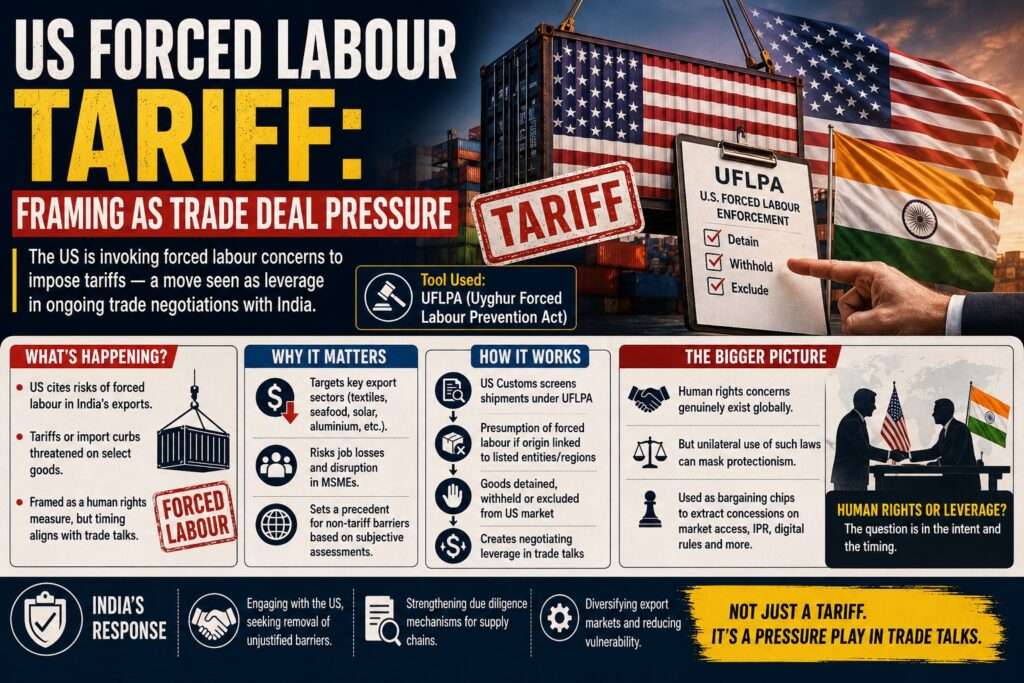
  • U.S. Proposal for 12.5% Tariff on India under Section 301

    Why in the news?

    The Office of the United States Trade Representative proposed a 12.5% tariff on imports from India and several other countries for allegedly failing to effectively enforce prohibitions on goods produced using forced labour.

    Key Highlights

    • Proposed tariff: 12.5% on imports from 54 countries including India.
    • Investigation launched under: Section 301 of the U.S. Trade Act, 1974.
    • The proposal is: Not final yet.
    • Public hearings scheduled for: July 7, 2026.

    What is Section 301 of the U.S. Trade Act?

    Section 301 empowers the U.S. government to:

    • Investigate unfair trade practices by foreign countries.
    • Impose:
      • Tariffs
      • Trade restrictions
        if practices are seen as harmful to U.S. commerce.

    Reason for the Investigation

    The U.S. alleged that some countries:

    • Failed to effectively prevent imports of goods produced using: Forced labour.

    India’s Response

    The Ministry of Commerce and Industry stated that:

    • India remains engaged with the U.S. regarding:
      • Section 301 proceedings
      • Interim trade agreement negotiations.

    Timeline of Key Events

    • March 2026: USTR launched investigations.
    • June 2026: U.S. trade delegation visited India.
    • June 22: Deadline for hearing participation requests.
    • July 6: Deadline for written submissions.
    • July 7: Public hearings.

    Sectors Likely to be Impacted

    Labour intensive sectors may face major impact:

    • Textiles
    • Garments
    • Leather products
    • Carpets
    • Brassware

    What is Forced Labour?

    According to international labour standards:

    • Forced labour refers to work extracted under threat, coercion or without voluntary consent.

    [2018] International Labour Organization’s Conventions 138 and 182 are related to –

    A Child labour

    B Adaptation of agricultural practices to global climate change

    C Regulation of food prices and food security

    D Gender parity at the workplace

  • Cross Border UPI Payments Launched in Cambodia

    Why in the news?

    NPCI International Payments Limited and ACLEDA Bank Plc. launched cross border UPI payments in Cambodia through KHQR, Cambodia’s national QR code system.

    Key Highlights

    • Indian travellers can now use:
      • Unified Payments Interface (UPI)
        for QR based payments in Cambodia.
    • Integration completed through: Bakong’s KHQR system.
    • Launch ceremony held in Phnom Penh.

    What is UPI?

    The Unified Payments Interface (UPI):

    • Is a real time digital payment system developed in India.
    • Operated by: National Payments Corporation of India.
    • Enables: Instant bank to bank transfers using mobile applications.

    What is NIPL?

    NPCI International Payments Limited (NIPL):

    • International arm of NPCI.
    • Responsible for:
      • Expanding UPI and RuPay globally.

    About KHQR

    • Cambodia’s national QR code standard.
    • Operates through:
      • Bakong payment system.
    • Managed by:
      • National Bank of Cambodia.

    Features of the Partnership

    Phase 1

    • Indian travellers in Cambodia can:
      • Scan KHQR codes and make payments.
    • Covers:
      • More than 4.5 million Cambodian merchants.

    Future Phase

    • Cambodian citizens visiting India will also be able to:
      • Use Cambodian banking apps to scan UPI QR codes in India.

    Benefits of the Initiative

    For Travellers

    • Reduces need for:
      • Currency exchange
      • Carrying cash.
    • Enables:
      • Seamless digital transactions.

    For Merchants

    • Access to Indian tourists.
    • Faster and secure payments.
    • Lower cash handling costs.

    Importance of UPI Internationalisation

    • Promotes: India’s digital public infrastructure globally.
    • Strengthens: FinTech diplomacy.
    • Supports: Cross-border digital payments and trade.

    Countries Accepting UPI

    • UPI is currently accepted in Singapore, United Arab Emirates, France, Mauritius, Nepal, Bhutan, Qatar, Sri Lanka, and Cambodia.

    Legal Status of NPCI

    • Company Status: Registered as a Non-Profit Company under Section 8 of the Companies Act, 2013.
    • Ownership: Owned and operated by a consortium of major banks in India.
    • Regulatory Oversight: It is regulated and supervised by the Reserve Bank of India (RBI) under the Payment and Settlement Systems Act, 2007.

    [2025] Consider the following countries:
    I. United Arab Emirates
    II. France
    III. Germany
    IV. Singapore
    V. Bangladesh
    How many countries amongst the above are there other than India where international merchant payments are accepted under UPI?

    [A] Only two

    [B] Only three

    [C] Only four

    [D] All the five

  • [2nd June 2026] The Hindu OpED: IMEC is caught between commerce and geopolitics

    PYQ Relevance[UPSC 2022] How will I2U2 (India, Israel, UAE and USA) grouping transform India’s position in global politics?Linkage: The question focuses on emerging minilateral partnerships involving India, Israel and Gulf countries, which form the geopolitical foundation of IMEC. IMEC is the economic and connectivity manifestation of the same India-Middle East strategic architecture represented by I2U2.

    Mentor’s Comment

    The recent Iran-Israel conflict has renewed attention on the India-Middle East-Europe Economic Corridor (IMEC) by exposing the vulnerability of global trade routes such as the Strait of Hormuz and the Suez Canal. While the conflict strengthens the strategic case for alternative connectivity corridors like IMEC, it has simultaneously delayed the project’s implementation due to growing instability across West Asia.

    What is India-Middle East-Europe Economic Corridor (IMEC)?

    1. It is a planned multimodal transport and infrastructure network designed to connect India, the Arabian Gulf, and Europe. 
    2. Formalised via a Memorandum of Understanding (MoU) signed at the G20 Summit in New Delhi, the initiative aims to create a highly efficient ship-to-rail transit system. 
    3. It acts as a transparent, sustainable, and debt-free alternative to China’s Belt and Road Initiative (BRI) while significantly reducing the global reliance on traditional maritime chokepoints like the Suez Canal.

    How Has the Iran-Israel Conflict Exposed the Vulnerability of Existing Global Trade Routes?

    1. Military Vulnerability: The conflict challenged assumptions regarding technological and military superiority as guarantees of strategic success.
    2. Aircraft Losses: Reports indicate that 42 U.S. aircraft were reportedly lost or damaged during “Operation Epic Fury.”
    3. Missile Defence Stress: More than half of the inventories of Patriot, THAAD and Terminal High Altitude Area Defence interceptors were reportedly expended.
    4. Asymmetric Warfare: Iranian missile and drone capabilities imposed substantial costs on technologically superior adversaries.
    5. Trade Route Fragility: The conflict highlighted how disruptions in strategic chokepoints can generate global economic consequences.
    6. Hormuz Significance: Nearly 20 million barrels of crude oil move through the Strait of Hormuz every day.
    7. Global Share: The strait carries roughly one-third of global seaborne oil supplies.
    8. India’s Exposure: India imports around 88% of its crude oil requirements, making it highly vulnerable to disruptions.
    9. Economic Impact: Even temporary blockades can increase freight costs, insurance premiums, and energy prices globally.

    Why Has IMEC Gained Strategic Importance After the Conflict?

    1. Connectivity Diversification: Provides alternatives to vulnerable maritime chokepoints.
    2. Supply Chain Resilience: Reduces excessive dependence on the Suez Canal and Strait of Hormuz.
    3. Strategic Redundancy: Creates multiple transportation pathways during geopolitical crises.
    4. Economic Security: Enhances reliability of trade flows between India, West Asia and Europe.
    5. Geopolitical Necessity: Demonstrates the need for trade corridors that avoid conflict-prone regions.
    6. Regional Integration: Links major production centres, consumption markets and logistics hubs.

    What is the Structure and Design of IMEC?

    Eastern Corridor

    1. India-UAE Linkage: Connects India to West Asia through maritime routes linked with the UAE.
    2. Gateway Function: Serves as the entry point of the corridor into the Arabian Peninsula.

    Central Corridor

    1. Transit Route: Passes through UAE, Saudi Arabia, Jordan and Israel.
    2. Haifa Terminus: Ends at the Israeli port of Haifa on the Mediterranean coast.
    3. Multimodal Connectivity: Integrates ports, railways, logistics facilities and customs infrastructure.

    Western Corridor

    1. European Connection: Links Haifa to European ports through Mediterranean maritime routes.
    2. Market Access: Facilitates faster movement of goods into European markets.

    Infrastructure Components

    1. Rail Networks: Ensures seamless cargo movement across West Asia.
    2. Ports and Logistics: Strengthens multimodal transport efficiency.
    3. Energy Corridors: Supports electricity transmission and hydrogen trade.
    4. Digital Connectivity: Includes high-speed data cables and digital infrastructure.
    5. Green Transition: Integrates renewable energy and green hydrogen networks.

    How Does IMEC Compare with Other Connectivity Corridors?

    International North-South Transport Corridor (INSTC)

    1. Route Objective: Connects India with Russia and Europe through Iran.
    2. Strategic Purpose: Reduces dependence on the Suez Canal.
    3. Geographic Advantage: Provides shorter transit times to Eurasian markets.

    Belt and Road Initiative (BRI)

    1. Chinese Connectivity Model: Links Asia, Africa and Europe through infrastructure projects.
    2. Land Connectivity: Seeks alternatives to maritime chokepoints.
    3. Strategic Competition: Represents China’s connectivity vision, while IMEC serves as an alternative architecture.

    IMEC Distinction

    1. Multidimensional Design: Integrates trade, energy, digital and logistics connectivity.
    2. West Asian Focus: Traverses economically significant regions of the Arabian Peninsula.
    3. India-Europe Orientation: Establishes a dedicated connectivity route linking India with Europe.

    How Has the Conflict Delayed the Execution of IMEC?

    1. Gaza War Impact: The October 2023 Gaza conflict stalled implementation soon after IMEC’s announcement.
    2. Haifa Disruptions: The corridor’s Mediterranean endpoint became directly affected by regional instability.
    3. Iran-Israel Escalation: Renewed conflict increased uncertainty regarding infrastructure investments.
    4. Port Security Risks: UAE ports such as Jebel Ali and Fujairah faced repeated regional security concerns.
    5. Hormuz Dependency: Disruptions in the Strait of Hormuz affected broader maritime logistics.
    6. Investor Caution: Heightened geopolitical risks increased concerns regarding project viability and timelines.

    How Do Regional Political Divisions Threaten IMEC?

    1. Saudi-UAE Coordination: Successful implementation requires close strategic coordination among Gulf partners.
    2. Emerging Divergences: Differences have emerged regarding regional security and foreign policy priorities.
    3. OPEC Exit Decision: UAE announced plans to leave OPEC’s production framework, indicating policy divergence.
    4. Israel Security Cooperation: Growing defence cooperation between Israel and Gulf states adds complexity to regional diplomacy.
    5. Strategic Trust Requirement: Corridor success depends upon long-term political alignment among participating states.

    What Alternative Pathways Can Strengthen IMEC’s Viability?

    Oman-Centric Entry Routes

    1. Salalah Port: Offers access away from conflict-prone Hormuz waters.
    2. Duqm Port: Provides strategic logistics infrastructure on the Arabian Sea.
    3. Muscat Connectivity: Expands alternative maritime entry options.

    Mediterranean Alternatives

    1. Haifa Supplementation: Reduces excessive dependence on a single terminal.
    2. Egyptian Ports: Utilises established logistics ecosystems.
    3. Suez Economic Zone: Provides industrial and manufacturing support.
    4. Industrial Base: Hosts specialised facilities in green hydrogen, LNG, shipping and advanced manufacturing.

    Flexible Corridor Design

    1. Network Approach: Develops multiple routes rather than a single fixed corridor.
    2. Risk Mitigation: Ensures continuity despite regional disruptions.
    3. Strategic Adaptability: Allows route modifications during crises.

    What Role Can India Play in Advancing IMEC?

    1. Connectivity Leadership: Positions India as a major architect of transcontinental connectivity.
    2. Diplomatic Balancing: Maintains strong relations with Saudi Arabia, UAE, Israel and Europe simultaneously.
    3. Economic Integration: Expands trade access to Europe and West Asia.
    4. Strategic Autonomy: Diversifies supply chains beyond traditional routes.
    5. Infrastructure Cooperation: Encourages investments in logistics, digital and energy networks.
    6. India-Europe Engagement: Strengthened by Prime Minister Narendra Modi’s Europe visit in May 2026 and growing India-Europe connectivity cooperation.

    Conclusion

    The Iran-Israel conflict has reinforced the strategic necessity of IMEC by exposing the vulnerabilities of existing trade routes and energy chokepoints. At the same time, it has highlighted that connectivity projects cannot succeed through infrastructure alone; they require sustained political stability, regional cooperation and strategic trust. The future success of IMEC will depend on its ability to balance commercial objectives with the geopolitical realities of West Asia.

  • [1st June 2026] The Hindu OpED: Shaping the next chapter in India-Canada relations

    PYQ Relevance[UPSC 2019] “The time has come for India and Japan to build a strong contemporary relationship, one involving global and strategic partnership that will have a great significance for Asia and the world as a whole.” Comment.Linkage: The PYQ tests understanding of how bilateral relations evolve into comprehensive strategic partnerships driven by economic, geopolitical, technological, and security considerations. Similar to India-Japan ties, the India-Canada relationship is moving beyond traditional diplomacy towards a broader partnership

    Mentor’s Comment

    India-Canada relations are back in focus following Canadian Prime Minister Mark Carney’s visit to India in February 2026, his first visit to India since assuming office, and the revival of discussions on the Comprehensive Economic Partnership Agreement (CEPA). The visit marks a significant attempt by both countries to reset ties after a period of diplomatic tensions.

    Why Is the Revival of India-Canada Relations Significant at This Juncture?

    1. Diplomatic Re-engagement: Marks a shift from recent diplomatic strains towards structured economic and strategic engagement.
    2. CEPA Revival: Restarts negotiations on the Comprehensive Economic Partnership Agreement after prolonged uncertainty.
    3. Trade Ambition: Targets bilateral trade of $50 billion by 2030, signalling renewed economic confidence.
    4. Strategic Timing: Occurs amid global supply-chain diversification, geopolitical realignments, and Indo-Pacific competition.
    5. Economic Complementarity: Connects Canada’s resource-rich economy with India’s rapidly growing manufacturing and consumption base.

    How Do India and Canada Complement Each Other Economically?

    Economic Synergies

    1. Market Access: India provides one of the world’s largest consumer markets and expanding middle-class demand.
    2. Resource Endowment: Canada possesses substantial reserves of critical minerals, uranium, clean energy resources, and agricultural commodities.
    3. Manufacturing Potential: India offers large-scale manufacturing capacity and skilled human resources.
    4. Investment Opportunities: Facilitates two-way investments across technology, healthcare, infrastructure, and advanced manufacturing.

    Strategic Complementarity

    1. Critical Minerals: Supports India’s energy transition and semiconductor ambitions through reliable mineral supplies.
    2. Clean Energy Cooperation: Strengthens collaboration in renewable energy and decarbonisation initiatives.
    3. Supply-Chain Resilience: Reduces dependence on concentrated supply networks.

    Why Is the Comprehensive Economic Partnership Agreement (CEPA) Central to the Relationship?

    Trade Liberalisation

    1. Market Integration: Reduces tariff and non-tariff barriers.
    2. Investment Facilitation: Improves investor confidence and regulatory predictability.
    3. Business Mobility: Enhances movement of professionals and service providers.
    4. Export Expansion: Creates opportunities in manufacturing, agriculture, pharmaceuticals, and services.

    Strategic Outcomes

    1. Economic Diversification: Helps both economies reduce dependence on traditional trading partners.
    2. Commercial Confidence: Converts political goodwill into measurable economic outcomes.
    3. Institutional Framework: Provides long-term predictability for businesses and investors.

    What Role Do Investments Play in Strengthening Bilateral Relations?

    Indian Investments in Canada

    1. Technology Sector: Expands innovation partnerships and digital collaboration.
    2. Life Sciences: Supports pharmaceutical and biotechnology cooperation.
    3. Manufacturing: Generates employment and deepens industrial linkages.

    Canadian Investments in India

    1. Infrastructure Financing: Supports large-scale development projects.
    2. Clean Energy Projects: Facilitates green transition initiatives.
    3. Financial Services: Expands capital availability for growth sectors.
    4. Digital Ventures: Supports innovation and startup ecosystems.

    Economic Impact

    1. Employment Generation: Creates jobs in both economies.
    2. Capital Formation: Enhances productive investment flows.
    3. Commercial Trust: Strengthens long-term business confidence.

    How Does the Indian Diaspora Function as a Strategic Bridge Between the Two Countries?

    Human Connectivity

    1. Population Linkages: Serves as a living bridge connecting societies and economies.
    2. Academic Contributions: Strengthens educational and research cooperation.
    3. Entrepreneurship: Expands innovation and business networks.

    Soft Power Benefits

    1. Cultural Exchange: Promotes mutual understanding and societal engagement.
    2. Knowledge Transfer: Facilitates technology diffusion and professional collaboration.
    3. Investment Networks: Encourages bilateral investment and business partnerships.

    Strategic Significance

    1. People-to-People Ties: Provides resilience to bilateral relations during political challenges.
    2. Trust Building: Enhances societal confidence and institutional cooperation.

    Why Are Critical Minerals and Clean Energy Emerging as Key Pillars of Cooperation?

    1. Energy Transition
      1. Lithium and Rare Minerals: Supports battery manufacturing and electric mobility.
      2. Uranium Cooperation: Assists India’s long-term energy security strategy.
      3. Clean Technologies: Promotes sustainable industrial development.
    2. Strategic Importance
      1. Supply Security: Ensures reliable access to critical resources.
      2. Industrial Competitiveness: Strengthens emerging technology sectors.
      3. Climate Commitments: Supports net-zero and renewable energy goals.

    How Does the Indo-Pacific Framework Enhance India-Canada Cooperation?

    1. Shared Strategic Vision
      1. Rules-Based Order: Supports international law and freedom of navigation.
      2. Regional Stability: Promotes peace and security in the Indo-Pacific.
      3. Economic Connectivity: Facilitates resilient trade and investment networks.
    2. Emerging Areas
      1. Artificial Intelligence: Expands technology cooperation.
      2. Cybersecurity: Enhances digital resilience.
      3. Maritime Security: Supports secure sea lanes and trade routes.
      4. Supply Chains: Reduces vulnerabilities in strategic sectors.
    3. Geopolitical Relevance
      1. Middle Power Cooperation: Demonstrates collaboration among democratic powers.
      2. Regional Balancing: Contributes to stability amidst strategic competition.

    What Challenges Could Limit the Full Potential of the Partnership?

    1. Political Challenges
      1. Diplomatic Trust Deficit: Requires sustained engagement and confidence-building.
      2. Domestic Political Sensitivities: Can influence bilateral decision-making.
    2. Economic Challenges
      1. Delayed Trade Negotiations: Slows market integration.
      2. Regulatory Differences: Creates barriers for investors and businesses.
    3. Strategic Challenges
      1. Geopolitical Divergences: May occasionally affect policy alignment.
      2. Competing Priorities: Can reduce momentum in bilateral initiatives.

    Conclusion

    India and Canada possess strong economic complementarities, democratic values, technological capabilities, and people-to-people connections. The renewed effort to revive CEPA, deepen critical mineral cooperation, expand investment flows, and strengthen Indo-Pacific engagement reflects a pragmatic recognition of mutual interests. Sustained trust-building and institutional cooperation can transform the relationship into a major strategic and economic partnership of the coming decade.

  • Nepal PM’s Remarks on India-Nepal Border Dispute

    Why in the news?

    Nepal Prime Minister Balendra Shah stated in Parliament that Nepal has also “encroached upon Indian territory in many places,” triggering political controversy in Nepal.

    Key Highlights

    • The statement was made while discussing the disputed:
      • Kalapani
      • Lipulekh
      • Limpiyadhura regions.
    • Opposition lawmakers in Nepal demanded clarification and removal of the remarks from parliamentary records.

    India-Nepal Border Dispute

    Main disputed areas:

    • Kalapani: A strategic Himalayan region near the India-Nepal-China trijunction.
    • Lipulekh Pass: Important trade and Kailash Mansarovar pilgrimage route.
    • Limpiyadhura: Claimed by Nepal as part of its territory.

    Background of the Dispute

    • The dispute intensified after:
      • India released a new political map in 2019.
      • Nepal amended its Constitution in 2020 to include the disputed regions in its official map.
    • Nepal bases its claims mainly on interpretations of the: Treaty of Sugauli (1816).

    What is Dasgaja?

    • “Dasgaja” refers to the no man’s land along the India-Nepal border.
    • Nepal’s Foreign Ministry later clarified that the PM’s remarks referred mainly to:
      • Cross border occupation
      • Technical boundary irregularities in riverine areas.

    Treaty of Sugauli (1816)

    • Signed between the East India Company and the Kingdom of Nepal.
    • Signed after the Anglo-Nepal War.
    • Importance: Forms the basis of the present India-Nepal boundary disputes.

    India’s Position

    • India maintains that:
      • Lipulekh lies within Indian territory.
      • It is a historic trade and pilgrimage route.
    • India supports resolving disputes through diplomatic dialogue.

    [2020] Consider the following statements:  

    1. The value of Indo-Sri Lanka trade has consistently increased in the last decade 

    2. “Textile and textile articles” constitute an important item of trade between India and Bangladesh. 

    3. In the last five years, Nepal has been the largest trading partner of India in South Asia.

    Which of the statements given above is/are correct? 

    (a) 1 and 2 only 

    (b) 2 only 

    (c) 3 only 

    (d) 1, 2 and 3 

  • The Chancellor of Germany visited India in January 2026. Which of the following is/are NOT correct in terms of outcomes

    The Chancellor of Germany visited India in January 2026. Which of the following is/are NOT correct in terms of outcomes?
    1. MoU between All India Institute of Ayurveda and University of Hamburg
    2. MoU on Youth Hockey Development between Hockey India and German Hockey Federation
    3. Establishment of a bilateral dialogue mechanism on the Indo-Pacific
    4. Opening of an Honorary Consul of Germany in Lucknow

  • [28th May 2026] The Hindu OpED: Tariff to carbon, the new rules shaping India’s trade

    PYQ Relevance[UPSC 2022] Discuss global warming and mention its effects on the global climate. Explain the control measures to bring down the level of greenhouse gases which cause global warming, in the light of the Kyoto Protocol, 1997.Linkage: CBAM directly links climate action with trade regulation, making carbon emissions economically consequential for exports. It bridges climate governance and international trade policy.

    Mentor’s Comment

    The European Union’s Carbon Border Adjustment Mechanism (CBAM) will enter its definitive phase from January 1, 2026, imposing a carbon-linked levy on imports based on embedded emissions. This marks a major shift because, for the first time, global trade access is increasingly being linked to carbon intensity of production rather than conventional tariffs alone. For India, sectors such as steel, cement, aluminium, fertilizers, electricity, and hydrogen face direct exposure.

    What is the Carbon Border Adjustment Mechanism (CBAM)?

    1. It is the European Union’s policy tool designed to put a fair price on carbon emitted during the production of carbon-intensive goods entering the EU. 
    2. By charging importers for embedded emissions, it aims to prevent “carbon leakage,” ensuring EU producers are not at a disadvantage compared to foreign producers and encouraging cleaner global industrial production.

    Key Aspects of CBAM:

    1. Purpose: Mitigates the risk of carbon leakage, where companies move production to countries with lenient environmental regulations.
    2. Covered Sectors: Initially, CBAM covers imports of iron and steel, cement, fertilizers, aluminum, hydrogen, and electricity.
    3. How it Works: Importers must report the GHG emissions embedded in their products. From 2026, they will need to purchase “CBAM certificates” to pay for these emissions, aligned with the carbon price paid by EU producers under the EU Emissions Trading System (ETS).
    4. Goal: The policy is a central part of the “Fit for 55” package, aiming for a 55% reduction in greenhouse gas emissions by 2030, compared to 1990 levels.

    How is CBAM reshaping the rules of global trade?

    1. Carbon-linked Market Access: Links export competitiveness to embedded carbon emissions rather than only product quality or price competitiveness.
    2. Carbon Leakage Prevention: Imposes charges on imported products to prevent industries from relocating production to countries with weaker environmental regulations.
    3. Trade Governance Shift: Moves global trade away from traditional tariff barriers toward climate-linked compliance mechanisms.
    4. Policy Diffusion: Encourages wider adoption of carbon-pricing policies by developed economies, increasing compliance burdens globally.
    5. Competitiveness Redefinition: Makes production efficiency dependent not only on cost but also on carbon efficiency of manufacturing processes.
    6. Example: The EU’s CBAM applies to steel, cement, aluminium, fertilizers, electricity, and hydrogen, sectors with high embedded carbon intensity.

    Why does CBAM pose a major challenge for India’s exports?

    1. Export Competitiveness Risk: Increases costs for carbon-intensive exports entering the European market.
    2. Steel and Aluminium Exposure: Creates immediate vulnerabilities because these sectors depend significantly on European markets and involve carbon-intensive production.
    3. Compliance Burden: Forces exporters to adopt cleaner technologies and stricter reporting systems to retain market access.
    4. Profit Margin Compression: Shrinks margins as firms absorb additional compliance costs or face stricter contractual requirements.
    5. Buyer Preference Shift: Encourages European buyers to prefer low-emission suppliers, reducing competitiveness of carbon-intensive exporters.
    6. Example: Although EU importers formally pay CBAM charges, the burden may shift to Indian exporters through stricter contracts and supplier selection mechanisms.

    How could CBAM indirectly affect India’s domestic economy?

    1. Fertilizer Price Transmission: Raises input costs because India imports fertilizers from regions affected by CBAM-related carbon pricing.
    2. Import Cost Escalation: Increases prices of imported emission-intensive goods, affecting production costs domestically.
    3. Agricultural Vulnerability: Raises fertilizer costs, potentially affecting farm profitability and food prices.
    4. Inflationary Pressure: Creates cost-push inflation through higher import prices of industrial inputs.
    5. Supply Chain Spillover: Extends impacts beyond directly targeted export sectors through global production linkages.
    6. Example: Major fertilizer exporters to India, Egypt, Russia, Morocco, and China, may pass carbon-compliance costs into export prices.

    How is CBAM different from traditional non-tariff measures (NTMs)?

    1. Structural Difference: Functions as a price-based and quantifiable carbon levy, unlike conventional product standards.
    2. Compliance Nature: Traditional NTMs rely on qualitative product standards, whereas CBAM directly prices embedded emissions.
    3. Reduced Interpretational Scope: Creates measurable obligations linked to carbon emissions rather than broad compliance requirements.
    4. Carbon Accountability: Establishes a direct relationship between production emissions and market access.
    5. Key Distinction: Traditional product standards determine whether a product qualifies for entry. CBAM determines how expensive market access becomes based on carbon intensity.

    Why are developing countries particularly vulnerable to carbon-linked trade barriers?

    1. Technology Constraints: Face limited access to low-carbon technologies and cleaner industrial systems.
    2. Cost Asymmetry: Experience higher transition costs because carbon-neutral production remains expensive.
    3. Equity Concerns: Encounter climate-linked barriers despite historically lower contributions to global emissions.
    4. Market Access Restrictions: Risk exclusion from developed markets if carbon standards tighten further.
    5. Trade Negotiation Imbalance: Face pressure to comply despite differences in developmental capacity.
    6. Example: India’s ongoing Free Trade Agreement (FTA) negotiations with the European Union continue even as CBAM raises concerns regarding fair market access.

    What domestic reforms must India undertake to remain competitive?

    1. Clean Energy Investment: Strengthens industrial decarbonisation through renewable energy and cleaner fuel adoption.
    2. Carbon Efficiency: Improves industrial competitiveness through lower emission-intensive production processes.
    3. Industrial Modernisation: Facilitates adoption of cleaner technologies in steel, cement, aluminium, and fertilizer sectors.
    4. Soil Health Management: Reduces fertilizer dependency through effective implementation of the Soil Health Card Scheme and balanced nutrient application.
    5. Domestic Production Capacity: Lowers import vulnerability by expanding local manufacturing of emission-intensive inputs.
    6. Carbon Policy Framework: Ensures gradual implementation of domestic carbon-pricing mechanisms.

    How should India respond at the international level?

    1. Equitable Trade Negotiation: Seeks fair treatment for developing countries in climate-linked trade regimes.
    2. Transition Support: Demands technology transfer and transitional finance from developed countries.
    3. Climate Justice Framework: Strengthens arguments around Common But Differentiated Responsibilities (CBDR).
    4. Multilateral Coordination: Builds coalitions among developing countries against discriminatory carbon-linked trade measures.
    5. WTO Compatibility Concerns: Questions whether climate-linked tariffs violate principles of non-discrimination in trade.

    Conclusion

    CBAM represents a structural transformation in global trade where carbon intensity increasingly determines market access. For India, the challenge lies not merely in adapting to climate-linked trade regimes but in balancing industrial competitiveness, developmental priorities, and climate commitments. A calibrated strategy combining domestic industrial decarbonisation, technology adoption, and equitable global negotiations will remain essential.

  • India-US Critical Minerals Framework

    Why in the news?

    India and the United States signed a Critical Minerals Framework to secure supply chains amid concerns over China’s rare earth export restrictions.

    Critical Minerals

    Essential for:

    • Economic development
    • National security
    • Clean energy transition
    • Examples: Lithium, Cobalt, Nickel, Graphite, and Rare Earth Elements (REEs)

    Rare Earth Elements (REEs)

    • Group of 17 metallic elements used in: EVs, Defence systems, Electronics, Renewable energy, and Semiconductors

    Why Important?

    • Crucial for EVs, solar panels, batteries
    • Used in missiles, fighter jets, AI hardware
    • Key to semiconductor and telecom industries

    China’s Dominance

    China dominates rare earth processing and refining, creating:

    • Supply chain vulnerabilities
    • Geopolitical risks
    • Export control concerns

    [2025] Consider the following statements:
    I. India has joined the Minerals Security Partnership as a member.
    II. India is a resource-rich country in all the 30 critical minerals that it has identified.
    III. The Parliament in 2023 has amended the Mines and Minerals (Development and Regulation) Act, 1957 empowering the Central Government to exclusively auction mining lease and composite license for certain critical minerals.
    Which of the statements given above are correct?

    [A] I and II only

    [B] II and III only

    [C] I and III only

    [D] I, II and III