Three of the following criteria have contributed to the recognition of western Ghats, Sri Lanka and Indo-Burma regions as hotspots of biodiversity: 1. Species richness 2. Vegetation density 3. Endemism 4. Ethno-botanical importance 5. Threat perception 6. Adaptation of flora and fauna to warm and humid conditions Which three of the above are correct criteria in this context?
Subject: Biodiversity
1. Ecology & Ecosystems
2. Indian Biodiversity
-
The Himalayan Range is very rich in species diversity. Which one among the following is the most appropriate reason for this phenomenon
The Himalayan Range is very rich in species diversity. Which one among the following is the most appropriate reason for this phenomenon?
-
New Evergreen Tree Species Discovered in Kerala
Why in News?
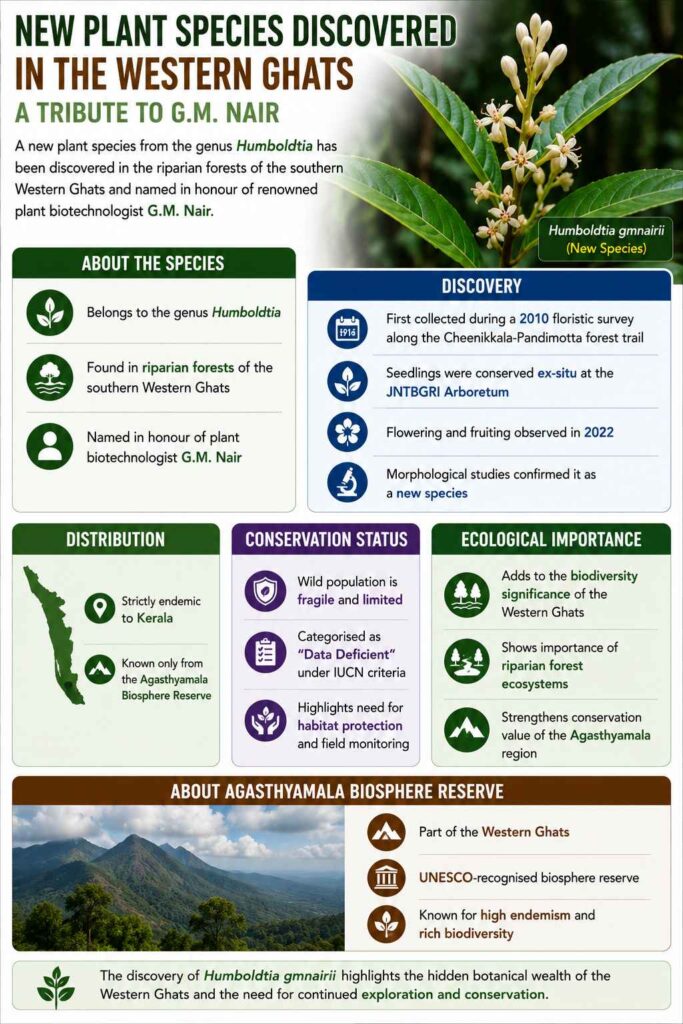
Scientists from Jawaharlal Nehru Tropical Botanic Garden and Research Institute discovered a new evergreen tree species, Humboldtia nairiana, in Shendurney Wildlife Sanctuary.
About the Species
- Belongs to the genus Humboldtia
- Found in riparian forests of the southern Western Ghats
- Named in honour of plant biotechnologist G.M. Nair
Discovery
- First collected during a 2010 floristic survey along the Cheenikkala-Pandimotta forest trail
- Seedlings were conserved ex-situ at the JNTBGRI Arboretum
- Flowering and fruiting observed in 2022
- Morphological studies confirmed it as a new species
Distribution
- Strictly endemic to Kerala
- Known only from the Agasthyamala Biosphere Reserve
Conservation Status
- Wild population is fragile and limited
- Categorised as “Data Deficient” under IUCN criteria
- Highlights need for habitat protection and field monitoring
Ecological Importance
- Adds to the biodiversity significance of the Western Ghats
- Shows importance of riparian forest ecosystems
- Strengthens conservation value of Agasthyamala region
About Agasthyamala Biosphere Reserve
- Part of the Western Ghats
- UNESCO-recognised biosphere reserve
- Known for high endemism and rich biodiversity
[2019] “Neyyar, Peppara and Shendurney Wildlife Sanctuaries” are part of which of the following?
[A] Agasthyamalai biosphere reserve
[B] Nilgiri biosphere reserve
[C] Seshachalam Hills
[D] Panna biosphere reserve
-
Long-tailed Duskhawker Rediscovered in Arunachal Pradesh
Why in News?
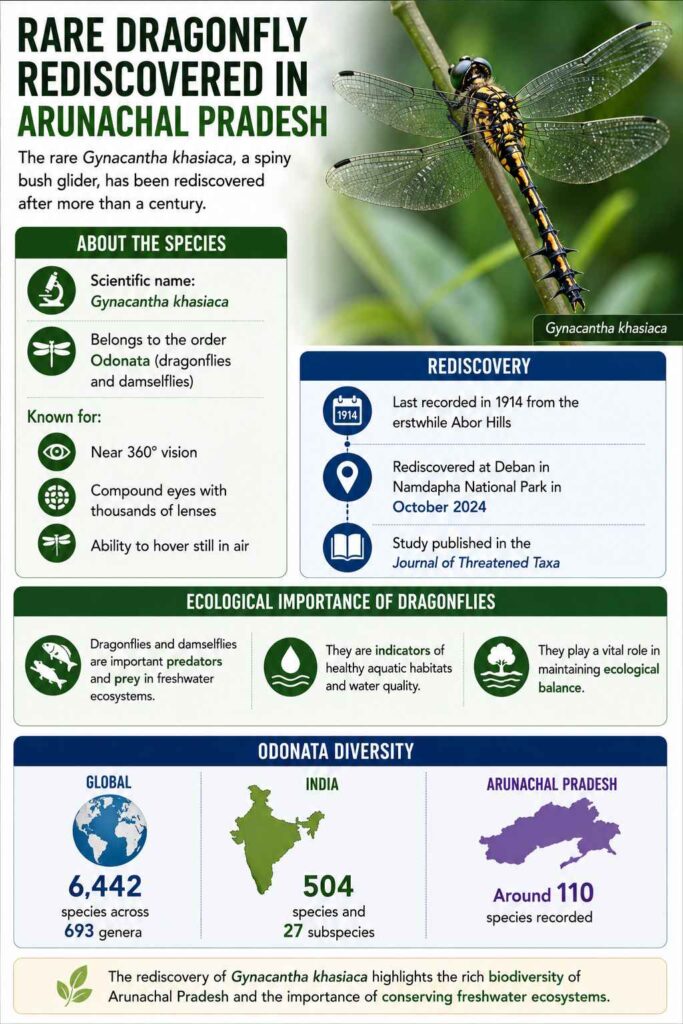
A rare dragonfly species, the Long-tailed Duskhawker, has been rediscovered in Arunachal Pradesh after 110 years in Namdapha National Park and Tiger Reserve.
About the Species
- Scientific name: Gynacantha khasiaca
- Belongs to the order Odonata (dragonflies and damselflies)
- Known for:
- Near 360° vision
- Compound eyes with thousands of lenses
- Ability to hover still in air
Rediscovery
- Last recorded in 1914 from the erstwhile Abor Hills
- Rediscovered at Deban in Namdapha National Park in October 2024
- Study published in the Journal of Threatened Taxa
Ecological Importance of Dragonflies
Dragonflies and damselflies are:
- Predators and prey in freshwater ecosystems
- Indicators of healthy aquatic habitats
- Important for ecological balance
Odonata Diversity
- Global: 6,442 species across 693 genera
- India: 504 species and 27 subspecies
- Arunachal Pradesh: Around 110 species recorded
Distribution of Long-tailed Duskhawker
Apart from Arunachal Pradesh, reported from:
- Assam
- Maharashtra
- Meghalaya
- Uttarakhand
- West Bengal
Significance of Rediscovery
- Highlights rich biodiversity of Northeast India
- Emphasises habitat protection and biodiversity monitoring
- Shows importance of citizen science in conservation
About Namdapha National Park
- Located in Changlang district, Arunachal Pradesh
- One of India’s largest protected areas
- Known for tropical rainforests and rich wildlife diversity
[2017] Due to some reasons, if there is a huge fall in the population of species of butterflies, what could be its likely consequence/consequences?
1. Pollination of some plants could be adversely affected.
2. There could be a drastic increase in the fungal infections of some cultivated plants.
3. It could lead to a fall in the population of some species of wasps, spiders and birds.
Select the correct using the code given below:[A] 1 only
[B] 2 and 3 only
[C] 1 and 3 only
[D] 1, 2 and 3
-
Vembanad Lake
Why in the news?
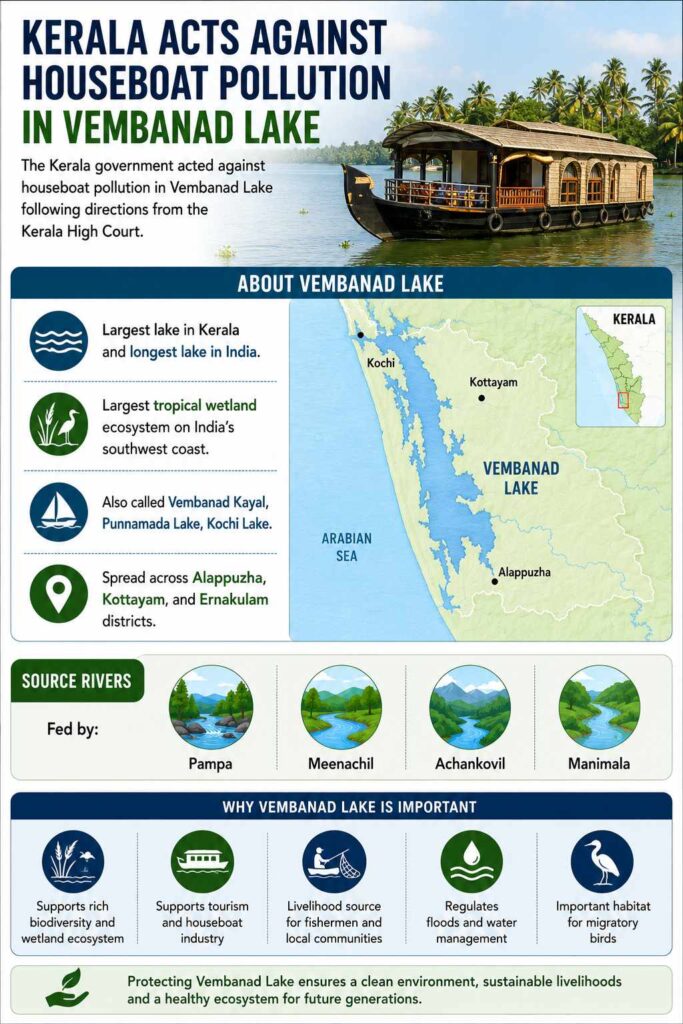
The Kerala government acted against houseboat pollution in Vembanad Lake following directions from the Kerala High Court.
About Vembanad Lake
- Largest lake in Kerala and longest lake in India
- Largest tropical wetland ecosystem on India’s southwest coast
- Also called Vembanad Kayal, Punnamada Lake, Kochi Lake
- Spread across Alappuzha, Kottayam, and Ernakulam districts
Source Rivers
Fed by:
- Pampa
- Meenachil
- Achankovil
- Manimala
Ecological Importance
- Ramsar Site since 2002
- Supports fisheries, biodiversity, flood control, and groundwater recharge
- Part of National Wetlands Conservation Programme
Agriculture
- Famous for below sea-level farming in the Kuttanad region
Tourism and Culture
- Major part of Kerala backwaters tourism
- Known for houseboats and inland water transport
- Hosts Nehru Trophy Snake Boat Race in August
[2022] Consider the following pairs : Wetland/Lake Location
1. Hokera Wetland: Punjab
2. Renuka Wetland: Himachal Pradesh
3. Rudrasagar Lake: Tripura
4. Sasthamkotta Lake: Tamil Nadu
How many pairs given above are correctly matched?[A] Only one pair
[B] Only two pairs
[C] Only three pairs
[D] All four pairs
-
First National Report on the Nagoya Protocol on ABS
Why in the News?
The Ministry of Environment, Forest and Climate Change released insights from India’s first national report on the Nagoya Protocol related to Access and Benefit Sharing (ABS), highlighting India’s progress in ensuring equitable sharing of benefits arising from biological resources.
About the Nagoya Protocol
- Adopted Under: Convention on Biological Diversity (CBD)
- Objective: To ensure Fair and equitable sharing of benefits arising from the utilisation of genetic resources and associated traditional knowledge.
What is Access and Benefit Sharing (ABS)?
- ABS means: Users of biological resources must share benefits with:
- Local communities
- Indigenous groups
- Traditional knowledge holders
- Benefits can include:
- Monetary compensation
- Technology transfer
- Community development
- Conservation support
Key Findings of the Report
- Large-Scale Implementation Between 2017 and 2025: 12,830 ABS approvals granted.
- India’s Global Contribution
- India issued:
- 3,556 Internationally Recognised Certificates of Compliance (IRCCs)
- Around 60% of global issuance.
- Revenue Generated: ₹216.31 crore realised by: National Biodiversity Authority (NBA)
- Community Benefit: ₹139.69 crore disbursed to benefit claimers and local communities.
[2023] Consider the following statements:
1. In Biodiversity the India, Management Committees are key to the realization of the objectives of the Nagoya Protocol.
2. The Biodiversity Management Committees have important functions in determining access and benefit sharing, including the power to levy collection fees on the access of biological resources within its jurisdiction.
Which of the statements given above is/are correct?[A] 1 only
[B] 2 only
[C] Both 1 and 2
[D] Neither 1 nor 2
-
[13th May 2026] The Hindu OpED: Managing co-existence is human-wildlife conflict zones
PYQ Relevance[UPSC 2018] How does biodiversity vary in India? How is the Biological Diversity Act, 2002 helpful in conservation of flora and fauna?Linkage: The PYQ tests understanding of biodiversity conservation, habitat protection, and institutional mechanisms for ecological sustainability. Human-wildlife conflict arises from habitat fragmentation and biodiversity loss; coexistence strategies require stronger ecological conservation and legal protection frameworks like the Biological Diversity Act. Mentor’s comment
Human-wildlife conflict (HWC) has emerged as a major conservation and governance challenge. This is because habitat fragmentation, infrastructure expansion, climate stress, and shrinking ecological corridors intensify encounters between humans and wildlife. India reports hundreds of human deaths annually due to elephant encounters, while crop damage and livestock predation continue to affect livelihoods.
Why is human-wildlife conflict increasing globally and in India?
- Habitat Fragmentation: Roads, railways, dams, mining, and urbanisation disrupt migratory routes and ecological corridors. Elephants and large mammals increasingly move through agricultural landscapes.
- Case Study (India): The Siliguri-Alipurduar railway track in North Bengal acts as a barrier, causing frequent train-elephant collisions.
- Agricultural Expansion: Cultivation near forest fringes increases overlap between biodiversity-rich habitats and settlements.
- Case Study (India): In the Western Ghats (Kerala, Karnataka, Tamil Nadu), the expansion of tea, coffee, and banana plantations adjacent to protected areas has severely disrupted elephant movement. This has resulted in high crop raiding in districts like Coimbatore and Wynad.
- Ecological Imbalance: Decline in natural prey and food sources pushes wildlife towards human settlements.
- Case Study (India): In Manas National Park, Assam, the degradation of traditional fodder habitats has led to increased crop raiding. Furthermore, the substitution of native trees with commercial monoculture like Eucalyptus has reduced natural grazing, forcing herds into villages.
- Climate Change: Alters vegetation and water availability, intensifying competition for resources.
- Case Study (India): During intense summers, elephants in the state of Odisha and in the Kaziranga-Karbi Anglong landscape have been observed moving into human settlements looking for water and raiding paddy fields.
- Population Pressure: Expands human settlements near forests and ecologically sensitive regions.
- Case Study (India): In Karnataka’s Kodagu region, rapidly growing population and land conversion into ginger and coffee farms have shrunk elephant corridors, forcing them into intense competition with locals for space.
- India’s Vulnerability: Elephant encounters, livestock depredation, and crop raiding impose significant economic and social costs.
- Livestock Depredation: In Hemis National Park, Ladakh, Snow Leopards preying on sheep and goats are a major source of conflict, with a study finding that they are responsible for 31% of livestock predation in some valleys.
How does ecological imbalance shape human-wildlife conflict?
- Disrupted Corridors: Forest fragmentation interrupts migratory pathways, increasing accidental encounters.
- Adaptive Wildlife Behaviour: Wildlife adapts to ecological stress rather than acting aggressively.
- Elephants: Raid crops due to disrupted migration and food shortages.
- Carnivores: Attack livestock due to prey depletion.
- Monkeys and Wild Boars: Exploit food near agricultural zones.
- Resource Competition: Scarcity of water and vegetation increases interactions in shared landscapes.
- Landscape Transformation: Peri-urban expansion creates interface zones between forests and settlements.
What lessons do international models offer for coexistence?
- Community-Based Conservation (Botswana, Namibia): Shares tourism benefits and local wildlife management rights, reducing hostility towards conservation.
- Namibia Example: Communal Conservancies manage trophy hunting and eco-lodges, directly funding local schools and clinics.
- Botswana Example: Chobe Enclave Trust uses photographic tourism payouts to offset community crop losses.
- Ecological Corridors (Costa Rica): Integrates biodiversity corridors into national development planning.
- Costa Rica Example: The National Program of Biological Corridors covers 30% of the country’s landmass.
- Technology-Based Monitoring (Finland): Herders use satellite and LoRaWAN GPS collars on over 300,000 free-roaming reindeer.
- Participatory Governance: Encourages local participation, ecological data use, and benefit-sharing mechanisms.
- Maasai landowners in the Mara North Conservancy lease and consolidate plot boundaries.
- Shared Management Model: Treats conflict as a socio-ecological challenge instead of a law-and-order issue.
What are India’s major policy responses to human-wildlife conflict?
- Compensation Mechanisms: Provide relief for crop damage, livestock loss, and human casualties.
- Solar Fencing: Deters crop-raiding animals in vulnerable areas.
- Early Warning Systems: Facilitate real-time alerts for elephant movement in conflict-prone zones.
- Legal Framework:
- Wildlife Protection Act, 1972: Ensures legal safeguards for wildlife.
- Project Elephant (1992): Strengthens elephant conservation and corridor protection.
- National Wildlife Action Plan (2017-2031): Promotes landscape-level conservation.
- Implementation Gaps: Delayed compensation, weak accessibility, and uneven implementation reduce effectiveness.
Why are isolated technical fixes insufficient for resolving conflict?
- Habitat Loss: Continues to remain the structural driver of conflict.
- Fragmented Landscapes: Disconnected habitats reduce the effectiveness of local interventions.
- Fertility Control Debate: Has limited applicability beyond small managed populations.
- Reactive Governance: Compensation without ecological restoration limits long-term outcomes.
- Planning Deficit: Weak coordination between conservation, infrastructure, and development planning persists.
How can community-led coexistence models reduce conflict?
- Community Participation: Improves ownership and reduces hostility toward wildlife.
- Community Forest Management (Bhutan, Nepal): Encourages local stewardship for conservation.
- Predator-Proof Enclosures: Reduce livestock losses in vulnerable areas.
- Coordinated Grazing: Limits wildlife intrusion into settlements.
- Stable Financing: Sustains long-term coexistence efforts.
Why are education and awareness central to coexistence?
- Behavioural Change: Reduces retaliatory actions against wildlife.
- Risk Awareness: Promotes safer responses in conflict-prone regions.
- Climate Adaptation: Builds preparedness for ecological stress.
- Community Partnership: Reframes local populations as conservation stakeholders.
What should be India’s future strategy for managing human-wildlife conflict?
- Habitat Restoration: Improves prey availability and ecosystem resilience.
- Ecological Connectivity: Secures wildlife corridors to reduce accidental encounters.
- Scientific Land-Use Planning: Integrates biodiversity concerns into development projects.
- Rapid Compensation: Strengthens trust among affected communities.
- Data-Based Governance: Uses GIS mapping and wildlife monitoring for prevention.
- Participatory Conservation: Ensures community involvement and benefit-sharing.
Conclusion
Human-wildlife conflict reflects a deeper ecological imbalance rather than isolated wildlife aggression. Sustainable coexistence requires integrating conservation with local livelihoods through habitat restoration, ecological corridors, participatory governance, and scientific planning. India’s long-term success will depend on shifting from reactive mitigation to coexistence-centred conservation.
- Habitat Fragmentation: Roads, railways, dams, mining, and urbanisation disrupt migratory routes and ecological corridors. Elephants and large mammals increasingly move through agricultural landscapes.
-
Binsar Wildlife Sanctuary
Why in the News
The forest department has launched a comprehensive scientific wildlife census in Binsar Wildlife Sanctuary to assess the population status and movement patterns of major wildlife species.
About Binsar Wildlife Sanctuary
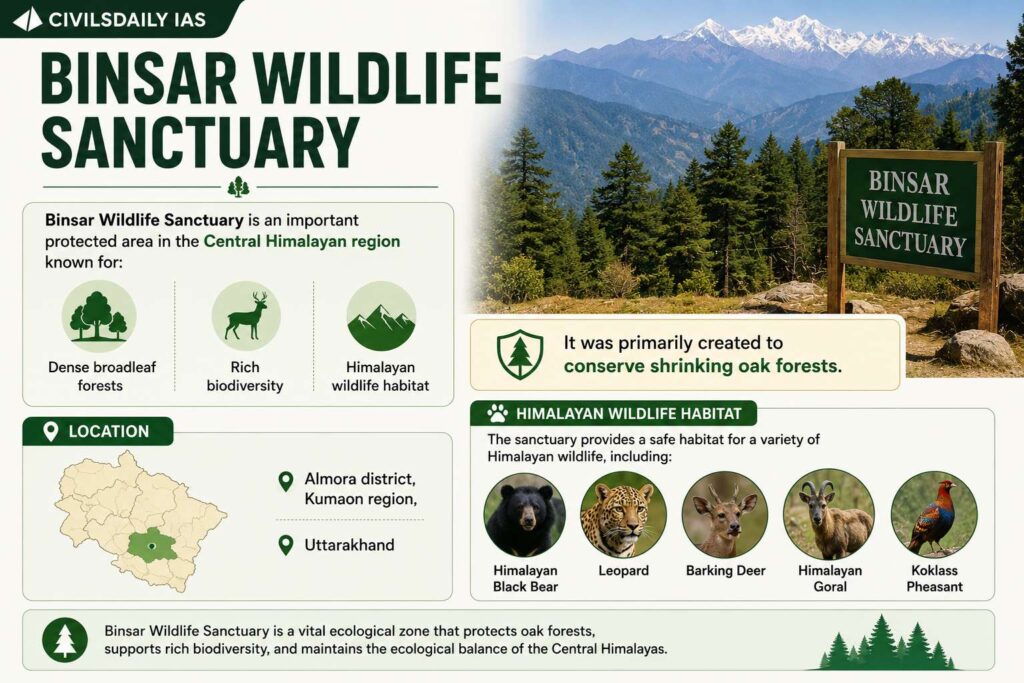
- Binsar Wildlife Sanctuary is an important protected area in the Central Himalayan region known for:
- Dense broadleaf forests
- Rich biodiversity
- Himalayan wildlife habitat
- It was primarily created to conserve shrinking oak forests.
- Location: Almora district, Kumaon region, and Uttarakhand.
[2014] If you travel through the Himalayas, you are Iikely to see which of the following plants naturally growing there?
1. Oak
2. Rhododendron
3. Sandalwood
Select the correct answer using the code given below
[A] 1 and 2 only [B] 3 only [C] 1 and 3 only [D] 1, 2 and 3 - Binsar Wildlife Sanctuary is an important protected area in the Central Himalayan region known for:
-
Project Cheetah
Why in the News
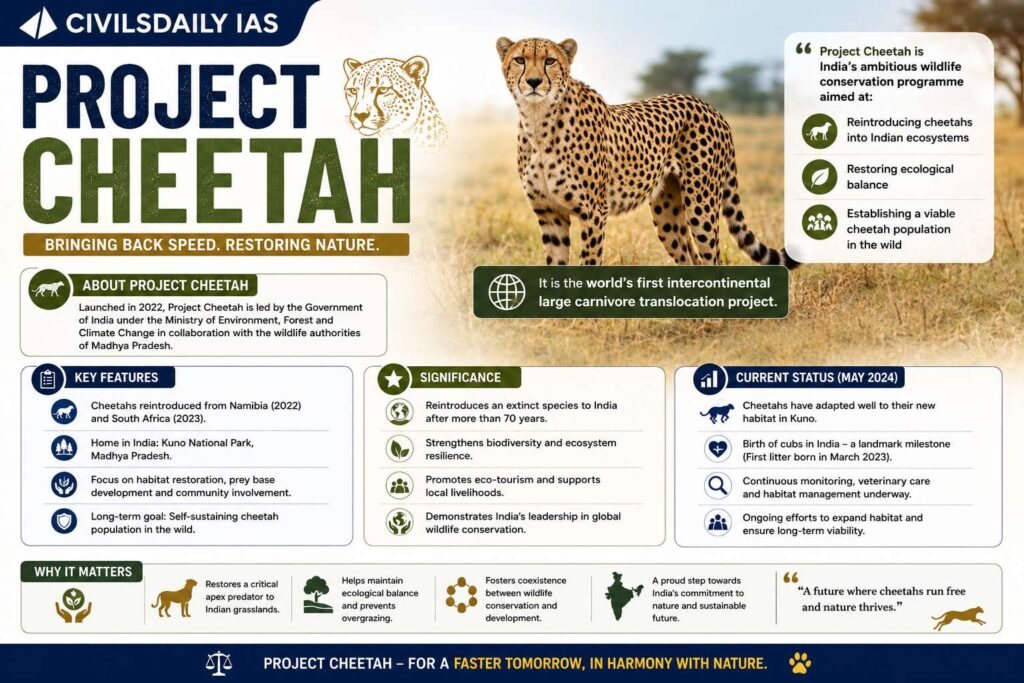
Two cheetahs brought from Botswana were released into the wild at Kuno National Park (MP) after completing quarantine and acclimatisation. With this, India’s total cheetah population has increased to 57, including cubs born in India.
About Project Cheetah
- Project Cheetah is India’s ambitious wildlife conservation programme aimed at:
- Reintroducing cheetahs into Indian ecosystems
- Restoring ecological balance
- Establishing a viable cheetah population in the wild
- It is the world’s first intercontinental large carnivore translocation project.
Launch of the Project
- The project was launched in September 2022 by Narendra Modi at Kuno National Park
Background
- Extinction in India: The Asiatic cheetah became extinct in India in 1952
- Main reasons: Hunting, Habitat loss, and Decline in prey base
- India declared the cheetah extinct officially in 1952.
Source Countries of Cheetahs
- Namibia: 8 cheetahs brought in September 2022
- South Africa: 12 cheetahs brought in 2023
- Botswana: 9 cheetahs brought in 2026
[2024] Consider the following statements:
1. Lions do not have a particular breeding season.
2. Unlike most other big cats, cheetahs do not roar.
3. Unlike male lions, male leopards do not proclaim their territory by scent marking.
Which of the statements given above are correct?
[A] 1 and 2 only [B] 2 and 3 only [C] 1 and 3 only [D] 1,2 and 3 - Project Cheetah is India’s ambitious wildlife conservation programme aimed at:
-
Cyphostemma annamalaii
Why in the News?
Researchers from Annamalai University discovered a new plant species named Cyphostemma annamalaii in the southern Eastern Ghats of Tamil Nadu.
About Cyphostemma annamalaii
- Newly discovered plant species belonging to: Vitaceae (grape family)
- Found in: Tropical dry forests of the southern Eastern Ghats
- Habitat:
- Open scrubby vegetation
- Dry forest ecosystems
About the Vitaceae Family
Vitaceae
- Commonly known as: Grape family
- Includes climbing plants and vines
- Economically important due to grape cultivation
About Eastern Ghats
- Discontinuous mountain range along eastern India
- Passes through:
- Odisha
- Andhra Pradesh
- Telangana
- Karnataka
- Tamil Nadu
- Known for rich biodiversity and endemic species
[2016] With reference to ‘Red Sanders’, sometimes seen in the news, consider the following statements:
1. It is a tree species found in a part of South India.
2. It is one of the most important trees in the tropical rainforest areas of South India.
Which of the statements given above is/are correct?
a) 1 only b) 2 only c) Both 1 and 2 d) Neither 1 nor 2