💥Join UPSC 2027,2028 Mentorship (July Batch) + XFactor Notes & Microthemes PDF

Subject: Climate Change

1. Global Warming and Issues
2. All about Pollution

  • Places in News: Kariyachalli Island

    Why in the News?

    The Tamil Nadu government, with World Bank support, has launched a ₹50 crore restoration project for the sinking Kariyachalli Island.

    About Kariyachalli Island:

    • Overview: Kariyachalli Island is one of the 21 uninhabited islands in the Gulf of Mannar Marine National Park.
    • Geographic Location: It lies 4 km south of Sippikulam and 20 km northeast of Thoothukudi, between Rameswaram and Thoothukudi.
    • Made of Reef Sediments: The island is a low-lying landform made of reef debris, sand dunes, spits, and sandy plains.
    • Biodiversity Hotspot: Located in India’s coral reef zone, it supports 4,300+ marine species, including 132 coral types and the endangered dugong.
    • Ecological Importance: It has seagrass beds and coral reefs that provide food and shelter for marine life.
    • Natural Coastal Shield: Kariyachalli acts as a barrier against cyclones and tsunamis, helping protect the Tamil Nadu coast.
    • Historical Significance: It played a role in mitigating the 2004 Indian Ocean tsunami impact.

    Why is it sinking?

    • Rapid Land Loss: The island has shrunk by over 70%, from 20.85 ha in 1969 to under 6 ha in 2024.
    • High Tide Erosion: At high tide, only 3.14 ha remains, per an IIT Madras (2025) study.
    • Wave and Sediment Pressure: Wave action, sediment loss, and lack of natural shoreline defense are accelerating erosion.
    • Climate Change Impact: Rising sea levels and coral bleaching have weakened the island’s natural protection.
    • Seagrass Depletion: Loss of seagrass beds has reduced the island’s ability to hold sediments and resist erosion.
    • Extreme Weather Events: Frequent cyclones and storms are making the island more vulnerable.
    • Future Risk: If the current trend continues, Kariyachalli may vanish by 2036.
    [UPSC 2023] Which one of the following is the best example of repeated falls in sea level, giving rise to present-day extensive marshland?

    Options: (a) Bhitarkanika Mangroves (b) Marakkanam Salt Pans (c) Naupada Swamp (d) Rann of Kutch*


  • Climate Threat Emerging from Rising Evaporative Demand and Thirstwaves

    Why in the News?

    Scientists have coined a new term, “thirstwave”, to describe spikes in evaporative demand, where a warmer atmosphere draws more water from plants, soil, and trees.

    What is Evaporative Demand?

    • Definition: Evaporative demand is the measure of how much water the atmosphere can potentially absorb from land, plants, and water surfaces if there is unlimited water available. It tells us how “thirsty” the atmosphere is.
    • Nature of Measurement: It is not about how much water is actually lost but how much could be lost if water was fully available. It depends on weather conditions, not the amount of water in the soil.
    • Standard Metric: The most widely used metric to quantify this is Standardized Short-Crop Reference Evapotranspiration (ETos)—which assumes a 12 cm grass surface with unlimited water availability.
    • Impact of Global Warming: As global warming increases atmospheric heat, evaporative demand also rises, making the air more “thirsty”.

    What is a Thirstwave?

    • Origin: “Thirstwave” is a newly coined term (2025) by Meetpal Kukal and Mike Hobbins to describe three or more consecutive days of extreme evaporative demand.
    • Definition: A thirstwave is a period of sudden and intense increase in evaporative demand, caused by hot, dry, and sunny weather. It means the atmosphere becomes extremely “thirsty” and starts pulling water rapidly from soil, plants, and water bodies, even if they already have limited moisture.
    • Distinction from Heatwaves: Unlike heatwaves, thirstwaves account for multifactorial stress, combining temperature, humidity, wind, and solar input.
    • Thirstwave in India: There is no dedicated data yet on thirstwaves in India, but researchers are beginning to investigate, especially in South Asia’s climate-vulnerable zones.
    [UPSC 2018] Which of the following leaf modifications occur(s) in the desert areas to inhabit water loss?

    1. Hard and waxy leaves

    2. Tiny leaves

    3. Thorns instead of leaves

    Select the correct answer using the code given below:

    Options: (a) 2 and 3 only (b) 2 only (c) 3 only (d) 1, 2 and 3 *


  • Rising Evaporative Demand and Thirstwaves

    Why in the News?

    Scientists have coined a new term, “thirstwave”, to describe spikes in evaporative demand, where a warmer atmosphere draws more water from plants, soil, and trees.

    What is Evaporative Demand?

    • Definition: Evaporative demand is the measure of how much water the atmosphere can potentially absorb from land, plants, and water surfaces if there is unlimited water available. It tells us how “thirsty” the atmosphere is.
    • Nature of Measurement: It is not about how much water is actually lost but how much could be lost if water was fully available. It depends on weather conditions, not the amount of water in the soil.
    • Standard Metric: The most widely used metric to quantify this is Standardized Short-Crop Reference Evapotranspiration (ETos)—which assumes a 12 cm grass surface with unlimited water availability.
    • Impact of Global Warming: As global warming increases atmospheric heat, evaporative demand also rises, making the air more “thirsty”.
    • Key Features:
      • Simplified Model: ETos simplifies evapotranspiration by assuming fixed vegetation properties and only variable weather conditions.
      • Indicators of Stress: An increase in ETos indicates higher temperatures, lower humidity, faster wind, and stronger solar radiation.
      • Effect on Soil and Crops: Rising evaporative demand leads to more rapid drying of soil and plants, even with ample irrigation.
      • Agricultural Relevance: This directly affects irrigation scheduling, crop productivity, and climate-resilient farming strategies.

    What is a Thirstwave?

    • Origin: “Thirstwave” is a newly coined term (2025) by Meetpal Kukal and Mike Hobbins to describe three or more consecutive days of extreme evaporative demand.
    • Definition: A thirstwave is a period of sudden and intense increase in evaporative demand, caused by hot, dry, and sunny weather. It means the atmosphere becomes extremely “thirsty” and starts pulling water rapidly from soil, plants, and water bodies, even if they already have limited moisture.
    • Distinction from Heatwaves: Unlike heatwaves, thirstwaves account for multifactorial stress, combining temperature, humidity, wind, and solar input.
    • Thirstwave in India: There is no dedicated data yet on thirstwaves in India, but researchers are beginning to investigate, especially in South Asia’s climate-vulnerable zones.
    [UPSC 2018] Which of the following leaf modifications occur(s) in the desert areas to inhabit water loss?

    1. Hard and waxy leaves

    2. Tiny leaves

    3. Thorns instead of leaves

    Select the correct answer using the code given below:

    Options: (a) 2 and 3 only (b) 2 only (c) 3 only (d) 1, 2 and 3 *


  • WMO’s State of the Climate in Asia 2024 Report

    Why in the News?

    The World Meteorological Organisation (WMO) has released its “State of the Climate in Asia, 2024” report.

    About the World Meteorological Organisation (WMO):

    • Overview: It is a specialised agency of the United Nations that deals with meteorology (weather and climate), operational hydrology, and related geophysical sciences.
    • Historical Origin: It was established in 1950, evolving from the International Meteorological Organisation (IMO), which was founded in 1873.
    • Headquarters Location: The headquarters of WMO is located in Geneva, Switzerland.
    • Global Coordination Role: WMO plays a key role in coordinating international efforts for climate data collection, forecasting, disaster preparedness, and climate change assessment.
    • Members: It has a membership of 193 members (187 member states + 6 Territories), including India.
    • Flagship Reports: WMO publishes annual climate reports such as the “State of the Climate” to highlight key trends and extreme weather impacts.

    Key Highlights of the State of the Climate in Asia – 2024 Report:

    • Record Warmth: 2024 was the warmest year on record in Asia, with heatwaves, extreme rainfalls, cyclones, and droughts devastating the region.
    • Global Temperature Spike: The global mean temperature reached its highest level since 1850, surpassing the 2023 record of 1.45°C.
    • Glacier Loss: 23 out of 24 monitored glaciers in the Himalayas and Tian Shan suffered mass loss, increasing the risk of glacial lake outburst floods (GLOFs).
    • Marine Heatwaves: Marine heatwaves of unprecedented extent and intensity affected Asian oceans, particularly around India, Japan, and China.
    • Major Cyclones: Cyclone Remal struck Bangladesh and India with 111 km/h winds and 2.5-metre-high storm surges; Asna and Fengal also caused major damage in Oman, Sri Lanka, and India.
    • Flash Floods and Landslides: Flash floods and landslides in Kerala, Nepal, and Sri Lanka resulted in hundreds of deaths and mass displacement.
    • Extreme Heatwaves: Heatwaves broke records across East and South Asia, including Japan, South Korea, China, Thailand, and India. Myanmar set a new national record at 48.2°C.
    • Severe Drought in China: Drought in China affected 4.8 million people, damaged over 335,000 hectares of crops, and caused losses of CNY 2.89 billion.
    [UPSC 2018] Momentum for Change: Climate Neutral Now” is an initiative launched by

    Options: (a) The Intergovernmental panel on Climate Change (b) The UNEP Secretariat (c) The UNFCCC Secretariat* (d) The World Meteorological Organization


  • Ocean Darkening: A New Ecological Crisis

    Why in the News?

    A new study from the University of Plymouth has revealed that over 21% of the global ocean has significantly darkened in the last two decades.

    What is Ocean Darkening?

    • Ocean darkening refers to the reduction in sunlight penetration into the ocean’s upper layers, known as the photic zone (up to 200 meters deep), where sunlight drives photosynthesis and supports marine biodiversity.
    • This process is measured using the diffuse attenuation coefficient (Kd 490), which tracks how quickly light diminishes as it passes through seawater.
    • The photic zone is essential for phytoplankton productivity, oxygen generation, marine food chains, and the regulation of global climate.

    Recent Report Citing Ocean Darkening:

    • A new study by researchers from the University of Plymouth, published in 2024, titled “Darkening of the Global Ocean”, revealed that 21% of the global ocean has significantly darkened from 2003 to 2022.
    • Key findings:
      • 9% of the ocean saw a drop of more than 50 meters in light penetration—equal to the area of Africa.
      • 2.6% experienced a loss exceeding 100 meters in photic depth.
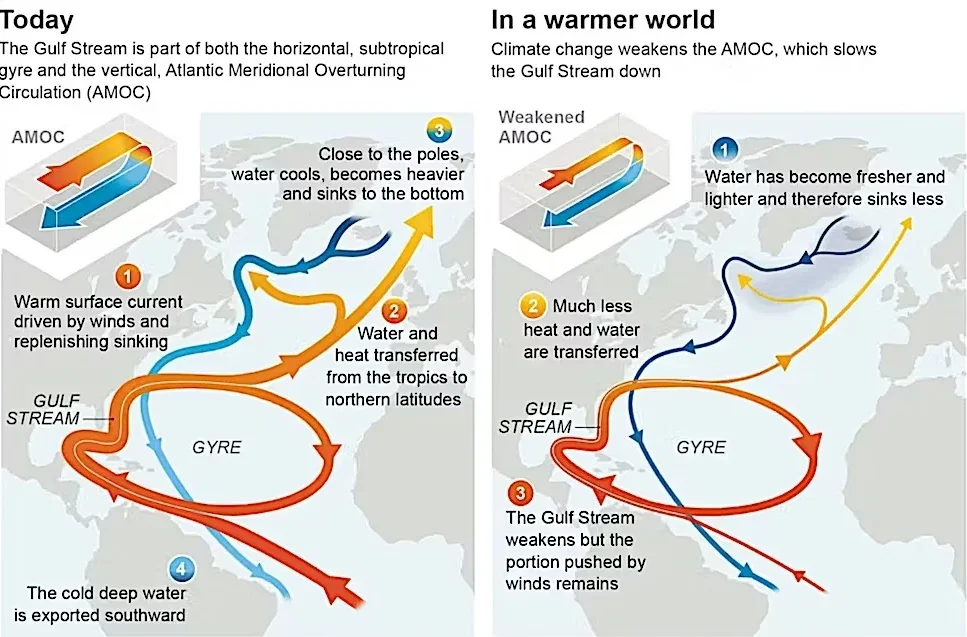
    • Affected Region: The study found the Arctic, Antarctic, Gulf Stream, and North Sea among the worst affected regions.
    • Causes:
      • Algal blooms from nutrient runoff in coastal areas.
      • Warming seas, altered plankton dynamics, and changing ocean currents in open ocean zones.

    Implications of Ocean Darkening:

    • Ecosystem Disruption: Light-dependent species, such as Calanus copepods, are being pushed into shallower zones, increasing predation and competition.
    • Loss of Habitat: The shrinkage of the photic zone could be one of the largest marine habitat losses ever, affecting fish stocks and biodiversity.
    • Climate Feedback Loop: Reduced photosynthesis in oceans could weaken the ocean’s role in carbon sequestration and oxygen production, worsening climate change.
    • Threat to Global Fisheries: The contraction of productive zones affects fish populations, jeopardising fisheries and food security.
    • Scientific Concern: Researchers warn that this hidden crisis could fundamentally alter marine ecosystems if not urgently addressed.
    [UPSC 2025] With reference to the planet Earth, consider the following statements:

    I. Rain forests produce more oxygen than that produced by oceans. II. Marine phytoplankton and photosynthetic bacteria produce about 50% of the world’s oxygen. III. Well-oxygenated surface water contains several folds higher oxygen than that in atmospheric air.

    Which of the statements given above is/are correct?

    Options: (a) I and II (b) II only * (c) I and III (d) None of the above statements is correct


  • [pib] Third United Nations Ocean Conference (UNOC3)

    Why in the News?

    At the Third United Nations Ocean Conference (UNOC3) in Nice, co-hosted by France and Costa Rica, India made a powerful case for urgent international cooperation to protect the world’s oceans.

    About United Nations Ocean Conference (UNOC)

    • What is it: The UNOC is a major international forum dedicated to supporting Sustainable Development Goal 14 (SDG 14): Life Below Water.
    • Primary Focus: It promotes the conservation and sustainable use of oceans, seas, and marine resources.
    • Multi-Stakeholder Participation: UNOC brings together governments, NGOs, academia, intergovernmental organizations, private companies, and Indigenous communities to address ocean-related challenges.
    • Key Themes: The conference tackles issues like marine pollution, overfishing, climate change, and habitat degradation, and encourages policy coordination and financial pledges.
    • Timeline of Conferences:
      • 2017: First conference in New York, co-hosted by Fiji and Sweden
      • 2022: Second in Lisbon, co-hosted by Portugal and Kenya
      • 2025: Third in Nice, co-hosted by France and Costa Rica
      • 2028: Fourth conference to be hosted by Chile and South Korea (yet to be announced officially)
    • Legal Framework: UNOC operates within the UN Convention on the Law of the Sea (UNCLOS).
    • Financial and Policy Impact: Since 2014, UNOC has mobilized over $130 billion and generated 2,160+ voluntary commitments toward protecting ocean health.

    Major Indian Initiatives Showcased at UNOC3 (2025):

    • Deep Ocean Mission: India showcased progress on the ‘Samudrayaan’ mission, a deep-sea manned submersible targeting 6,000-meter depth by 2026.
    • Plastic Pollution Action: India emphasized the national ban on single-use plastics and the ‘Swachh Sagar, Surakshit Sagar’ campaign, which has cleaned 1,000+ km of coastline and removed over 50,000 tonnes of plastic waste. A draft Marine Litter Policy has been prepared and India strongly supports a Global Plastics Treaty.
    • Blue Economy Development: Under the Sagarmala Programme, $80 billion has been invested in port-led infrastructure. An additional $2.5 billion has been deployed under PM Matsya Sampada Yojana, leading to a 10% rise in fish production and creation of 1,000+ fish farmer producer organizations.
    • Marine Biodiversity Efforts: India expanded Marine Protected Areas to 6.6% of its Exclusive Economic Zone and restored over 10,000 hectares of mangroves.
    • Marine Data Transparency: India launched the SAHAV Portal, a digital ocean governance platform for science-based and transparent decision-making.
    • International Leadership: India co-led the ‘Blue Talks’ with France and Costa Rica, participated in high-level panels, and advocated for equitable ocean data access and capacity-building in developing nations.

    Back2Basics: United Nations Convention on the Law of the Sea (UNCLOS)

    • UNCLOS is a global treaty that regulates all maritime activities and ocean space.
    • It defines maritime zones such as: Internal Waters (within the baseline), Territorial Sea (up to 12 nautical miles), Contiguous Zone (up to 24 nautical miles), Exclusive Economic Zone (EEZ) (up to 200 nautical miles), High Seas, which lie beyond national jurisdiction.
    • It came into force in 1994 and has 169 parties (as of 2024), including India, but not the U.S.
    • It established the International Seabed Authority and declared the deep seabed as the “common heritage of mankind.”
    • India ratified UNCLOS in 1995 and uses it to claim maritime rights, including its extended continental shelf.
    • It supports freedom of navigation and advocates for a rules-based maritime order under UNCLOS.


    [UPSC 2022] With reference to the United Nations Convention on the Law of Sea, consider the following statements:

    1. A coastal state has the right to establish the breadth of its territorial sea up to a limit not exceeding 12 nautical miles, measured from baseline determined in accordance with the convention.

    2. Ships of all states, whether coastal or land-locked, enjoy the right of innocent passage through the territorial sea.

    3. The Exclusive Economic Zone shall not extend beyond 200 nautical miles from the baseline from which the breadth of the territorial sea is measured.

    Which of the statements given above are correct?

    Options: (a) 1 and 2 only (b) 2 and 3 only (c) 1 and 3 only (d) 1, 2 and 3*


  • What are Shared Socioeconomic Pathways (SSPs)?

    Why in the News?

    A new ETH Zurich study warns that under the Shared Socioeconomic Pathway (SSP) 5-8.5 scenario, warming could make cyclones more intense and hit unusual regions with greater damage.

    What are Shared Socioeconomic Pathways (SSPs)?

    • Definition: SSPs are 5 global scenarios that show how changes in society, economy, and technology might influence climate adaptation and mitigation.
    • Purpose: They complement Representative Concentration Pathways (RCPs) by adding socioeconomic context to climate models.
    • Development: Created in the late 2000s, published in 2016, and used in the IPCC 6th Assessment Report and CMIP6 models.
    • Function: SSPs assume no new climate policies, helping scientists explore how global trends affect emissions and climate action.
    • The Five Pathways:
      1. SSP1: Sustainable and equitable world
      2. SSP2: Continuation of current trends
      3. SSP3: Regional rivalry with high population growth
      4. SSP4: Unequal world with high disparities
      5. SSP5: Fossil-fuel-based rapid economic growth
    • Usage: SSPs are used with RCPs to explore how different futures could affect the 1.5°C or 2°C warming targets.
    • Significance: They help policymakers assess how societal choices impact climate risks, emissions, and the feasibility of global goals.

    About SSP5-8.5 and Cyclone Risks:

    • Scenario Summary: SSP5 shows rapid economic growth fuelled by fossil fuels.
    • Radiative Forcing: SSP5-8.5 implies 8.5 W/m² of energy, compared to about 2.7 W/m² today.
    • Climate Target Gap: To limit warming below 2°C, forcing must stay around 2.6 W/m².
    • Cyclone Projections: Using the CLIMADA (climate adaptation) AI model, scientists studied past cyclone patterns and projected risks from 2015–2050.
    • Ecoregion Types:
      1. Resilient: Often affected, but recover quickly
      2. Dependent: Moderately impacted and adaptive
      3. Vulnerable: Rarely hit but slow to recover
    • Findings:
      • Time between severe cyclones in resilient areas may drop from 19 to 12 years.
      • East Asia, Central America, and the Caribbean will face stronger, more frequent cyclones.
      • Madagascar, Oceania, and the Philippines will face unprecedented cyclone activity.

    Impact on Mangroves and Coastal Ecosystems:

    • Mangrove Risk: By 2100, up to 56% of global mangroves could be at high to severe risk.
    • Most Affected Region: Southeast Asia, with 52–78% of mangroves at risk.
    • Other Scenario Impact (SSP3-7.0): Even under less severe warming, 97–98% of protective mangroves in Southeast Asia could still face critical threats.
    • Environmental Concern: These losses would severely weaken coastal protection, biodiversity, and carbon storage.
    [UPSC 2020] Consider the following statements:

    1. Jet streams occur in the Northern Hemisphere only. 2. Only some cyclones develop an eye. 3. The temperature inside the eye of a cyclone is nearly 10°C lesser than that of the surroundings.

    Which of the statements given above is/are correct?

    Options: (a) 1 only (b) 2 and 3 only (c) 2 only* (d) 1 and 3 only


  • [pib] 20th Session of UN Forum on Forests (UNFF20)

    Why in the News?

    India participated in the 20th session of the United Nations Forum on Forests (UNFF20) held at the UN Headquarters, New York, reaffirming its commitment to the United Nations Strategic Plan for Forests (UNSPF) 2017–2030.

    About United Nations Forum on Forests (UNFF):

    • UNFF was established in 2000 by the UN Economic and Social Council (ECOSOC).
    • It aims to promote sustainable forest management and global forest policy coordination.
    • It holds annual sessions at UN Headquarters:
      • Technical discussions in odd years
      • Policy-level dialogues in even years
    • It has universal membership — includes all UN Member States and relevant forest-related agencies.
    • India is a founding member and plays an active role in shaping forest policies.
    • The UN Strategic Plan for Forests (UNSPF) is the guiding framework for achieving global forest goals by 2030.
    • The 19th UNFF Declaration secured high-level political commitment for forest conservation.

    Key Highlights of UNFF20:

    • India reaffirmed its commitment to Voluntary National Contributions (VNCs) under the UNSPF (2017–2030).
    • It reported an increase in forest and tree cover to 25.17% of its geographical area.
    • National efforts included the Aravalli Green Wall, a 7.86% rise in mangrove cover, 1.55 lakh hectares afforested under the Green India Mission, and 1.4 billion seedlings planted under the Ek Ped Maa Ke Naam campaign.
    • India invited countries to join the International Big Cat Alliance (IBCA) for big cat conservation.
    • It urged support for outcomes of the Country-Led Initiative (CLI) on forest fire management held in Dehradun (2023).
    • In a high-level panel, India presented findings on carbon sequestration, water services, biodiversity, and tools like System of Environmental Economic Accounting (SEEA) and Millennium Ecosystem Assessment (MEA).
    • It stressed the need to mainstream ecosystem valuation in forest policy.
    [UPSC 2021] With reference to the ‘New York Declaration on Forests’, which of the following statements are correct?

    1. It was first endorsed at the United Nations Climate Summit in 2014.

    2. It endorses a global timeline to end the loss of forests.

    3. It is a legally binding international declaration.

    4. It is endorsed by governments, big companies, and indigenous communities.

    5. India was one of the signatories at its inception.

    Select the correct answer using the code given below:

    Options: (a) 1, 2, and 4* (b) 1, 3, and 5 (c) 3 and 4 (d) 2 and 5


  • Centre releases Draft Climate Finance Taxonomy Framework

    Why in the News?

    To channel investments into clean-energy projects and climate-resilient infrastructure, the Finance Ministry has released a draft document titled ‘Framework of India’s Climate Finance Taxonomy’.

    What is a Climate Finance Taxonomy?

    • A CFT is a classification system that defines which economic activities qualify as climate-friendly or sustainable investments.
    • It helps investors, financial institutions, and policymakers channel funds into low-emission and climate-resilient projects.
    • It acts as a safeguard against green-washing, where non-sustainable initiatives are falsely labelled as green.
    • It supports the mobilization of finance necessary to achieve global climate goals, including Net Zero targets.
    • It offers a structured decision-making framework to ensure that investments deliver measurable environmental benefits.

    About India’s Draft ‘Climate Taxonomy’ (May 2025)

    • The Finance Ministry released the draft ‘Framework of India’s Climate Finance Taxonomy’ to help meet India’s Net Zero by 2070 goal while maintaining energy access.
    • It categorizes activities as:
      • Climate Supportive Activities: Those that reduce GHG emissions, enable adaptation, or promote clean tech R&D.
      • Climate Transition Activities: Those that encourage gradual progress, especially in hard-to-abate sectors like steel, iron, and cement.
    • It aligns with the national vision of ‘Viksit Bharat 2047’.
    • It includes key sectors such as power, mobility, buildings, agriculture, food, and water security.
    • The framework was first announced in the Union Budget 2025.

    Global Context and Negotiation Relevance:

    • A standard taxonomy is critical in global forums like the Conference of Parties (COP) to resolve disputes over climate finance commitments.
    • Developing nations, including India, advocate for grants and technology transfers, while developed countries often include private investments in their finance counts.
    • At the Baku Climate Conference, developed countries pledged $300 billion annually by 2035, far below the $1.35 trillion required.
    • India’s taxonomy aims to provide a clear benchmark for climate-related financial flows, promoting transparency, credibility, and trust in international climate funding.
    [UPSC 2015] With reference to ‘Green Climate Fund’ is/are correct?

    1. It is intended to assist the developing countries in adaptation and mitigation practices to counter climate change.

    2. It is founded under the aegis of UNEP, OECD, Asian Development Bank and World Bank.

    Select the correct answer using the code given below.

    Options: (a) 1 only* (b) 2 only (c) Both 1 and 2  (d) Neither 1 nor 2


  • What is AIM4NatuRe Initiative?

    Why in the News?

    On Earth Day, April 22, the Food and Agriculture Organization (FAO) launched the Accelerating Innovative Monitoring for Nature Restoration (AIM4NatuRe) Initiative aimed at accelerating nature restoration.

    About the AIM4NatuRe Initiative:

    • AIM4NatuRe is a global initiative launched by the FAO aimed at enhancing countries’ ability to monitor and report ecosystem restoration efforts.
    • With ÂŁ7 million (approximately USD 9.38 million) from the United Kingdom, the initiative will run from 2025 to 2028, focusing on restoring 30% of degraded ecosystems globally by 2030, in alignment with the Global Biodiversity Framework (GBF).
    • Key aspects:
      • Utilizes advanced technology and data frameworks for ecosystem restoration monitoring.
      • Targets restoration across forests, wetlands, grasslands, marine ecosystems, and agricultural landscapes.
      • Integrates Indigenous knowledge in restoration efforts.
      • Develops tools like the Framework for Ecosystem Restoration Monitoring (FERM) and builds a unified global dataset for transparency.

    Key Stakeholders:

    • FAO: Leads the initiative, providing tools, data, and frameworks to support restoration.
    • UK: Provides financial backing and focuses on helping countries achieve the 30×30 target.
    • Indigenous Communities: Contribute traditional knowledge and participate in restoration efforts.
    • World Resources Institute (WRI): Supports global restoration initiatives, including the Kham River Restoration Mission in India.
    • Convention on Biological Diversity (CBD): Shapes the biodiversity framework for monitoring progress on 30% ecosystem restoration by 2030.
    • World Bank: Provides funding and technical expertise for financing and implementing ecosystem restoration.
    [UPSC 2014] Consider the following international agreements:

    1. The International Treaty on Plant Genetic Resources for Food and Agriculture. 2. The United Nations Convention to Combat Desertification. 3. The World Heritage Convention.

    Which of the above has/have a bearing on the biodiversity?

    Options: (a) 1 and 2 only (b) 3 only (c) 1 and 3 only (d) 1, 2 and 3 *