💥Mains Ready By December. Smash Mains & Smash PYQ Admissions Open

Subject: Economics

  • [op-ed of the day] Business possibilities in a world of digital payments

    Context

    UPI has brought digital payments to the common man and it has immense scope for growth.

    Zero MDR rate

    • Recently the finance minister made the announcement of the zero merchant discount rate (MDR) policy for payments through RuPay debit cards and Unified Payments Interface (UPI) instruments.
    • What does it mean? This policy dictates that when a consumer pays a merchant using RuPay or UPI, the bank may not charge the merchant a commission on the sale value that it usually charges a merchant.
    • Criticism of the move: Critics of this policy lament that it would begin to reverse the progress India has made in recent years to expand the digital payments network.

    Some facts and figures

    • Setting up of NPCI: In 2008 the National Payments Corporation of India (NPCI) was set up as an umbrella organization for operating retail payments and settlements in India
    • UPI:  In 2016, NPCI introduced UPI.
      • UPI has since registered 100 million users.
      • UPI now clocks more than 1 billion transactions every month.
    • Growth prospects for mobile payments: According to the NITI Aayog, mobile payments in India are expected to grow nearly 20-fold to $190 billion in the next three years.
    • Digital payment for the common man: There are 1 billion mobile phone users in India.
    • 420 million users have a feature phone, these users can use the *99# USSD service to dial into 13 different languages.
    • Which would connect them to UPI and brings digital payments to the common man.

    Need for innovation

    • We are far behind: India is far behind china, where 55% of spending is done digitally, compared to only 11% in India.
      • The outlook for future growth is mind-boggling.
      • There is a need for innovation at three levels.
    • First level-Adoption
      • A better understanding of human behaviour, technology, use cases and dis-use cases will facilitate the 10x growth necessary in adoption rates to cover the entire population.
    • Second level-Policy
      • The government has the rare opportunity to develop a data-centric understanding of how the economy conducts itself and uses money, and can set taxes accordingly.
    • Third level-Technology
      • Voice for authentication: At the technology level, there is an opportunity to use voice as a means for authentication and conduct transactions across multiple local languages.
      • Data analysis: Copious amounts of data from payment transactions can be analysed to understand user needs and develop personalized loans and financial solutions at scale.

    Taking UPI to Global Level

    • UPI in Singapore and UAE: The NCPI is gearing up to take UPI to other countries, beginning with Singapore and the United Arab Emirates.
      • NCPI is working with its counterpart in Singapore, the Network for Electronic Transfers for Singapore, to bring UPI live in Singapore.
    • The low hanging fruit is to provide payment solutions to Indians travelling abroad.
    • Competition with global peers: The bigger and tougher game is to increase its usage among local people in countries outside India.
      • This would put UPI in competition with the likes of PayPal and Skrill.

    Conclusion

    We have seen just the tip, albeit a very substantial tip, of the digital payments iceberg. In the coming years, young business leaders of today must learn to uncover the iceberg itself.


  • [op-ed snap] When the FRDI Bill Returns

    Context

    The amendments to the FRDI Bill, 2017—now renamed the Financial Sector Development and Regulation (Resolution) Bill, 2019—are being worked out.

    Three crucial issues

    • Specifics are being worked out in the bill on three crucial issues.
      • First issue: The first issue is regarding the increase in the deposit insurance cover of customers.
      • Second issue: To iron out the contentious issues related to the bail-in clause
      • Third issue: To decide whether this resolution framework should apply to the public sector banks.
    • Advantages of the move: At a time when the public sector banks have come under the stress of bad loans, increasing the deposit insurance coverage limit would be a welcome approach.
      • Increasing the depositor’s confidence: The move will reinforce depositors’ confidence in the banking system in general, and the public sector banks in particular.

    The issue of the government “ownership” of the banks and financial stability

    • Ownership of government: The role of the “ownership” of banks towards financial stability is a much-debated issue in the country.
      • RBI is positive about govt. ownership: The Reserve Bank of India (RBI) has attributed a positive role to the government ownership of banks in attaining financial stability.
      • The issue of competitive neutrality: Committee to Draft Code on the Resolution of Financial Firms has blamed govt. ownership for causing a “lack of competitive neutrality” in the financial sector.
      • Need of level playing field: Committee argued for the need of a “level playing field” for both the public and private sector financial firms for the sake of competitive neutrality.
      • The concept of an overarching resolution framework for all financial firms gained traction.

    Would the all-encompassing Resolution Corporation be efficacious?

    • The FRDI Bill, 2017 sought to amend as many as 20 legislations for the diverse financial sector in this country, which is regulated by various institutions, like-
      • RBI for the banks and the non-banking financial corporations.
      • Insurance Regulatory and Development Authority (IRDA) for the insurance markets,
      • Securities and Exchange Board of India (SEBI) for securities markets and mutual funds.
      • The Pension Fund Regulatory and Development Authority for pension funds.
    • The pertinent question
      • The pertinent question is whether an all-encompassing resolution corporation can be really efficacious for the much-discussed financial stability of this country.


    Fundamental issues

    • Neutrality of ownership
      • Different motives behind operations: While private financial institutions are predominantly governed by profit motives, for the public sector agencies, various social obligations, such as “financial inclusion,” assume primacy.
      • Reason for commoner’s confidence: It is the sense of the government’s involvement (or ownership) that has forged commoners’ confidence to park their financial savings with them.
      • The move may end up destabilising the financial sector: If the sovereign guarantee and resolving power are taken away from the government domain to some resolution corporation, it may destabilise the financial system.
    • The Bail-in clause
      • Deposit over 1 lakh included in bail-in mechanism: The FRDI Bill 2017 suggests that deposit amounts over and above the cover limit (which currently is at one lakh) will be included in the bail-in mechanism.
      • Further, despite the RBI’s caution against financial instability, short-term debts and uncategorised client assets are also currently under this mechanism.
      • The falling growth rate of deposits: These provisions and the bill per se came against the backdrop of the Financial Stability Report, 2017 that revealed a 3.3% drop in the year-on-year growth rate of deposits for all scheduled banks in the country.

    Conclusion

    In the context of decelerating financial stability, the government needs to undertake these resolution reforms with caution that the reforms do not end-up eroding depositors’ faith in the domestic financial institutions.


    .


  • National E-Mobility Mission Plan 2020


    The Supreme Court has sought the response of the government on a petition that alleges the non-implementation of the National E-Mobility Mission Plan, 2020 (NEMMP), which came out in 2012.

    National Electric Mobility Mission Plan (NEMMP) 2020

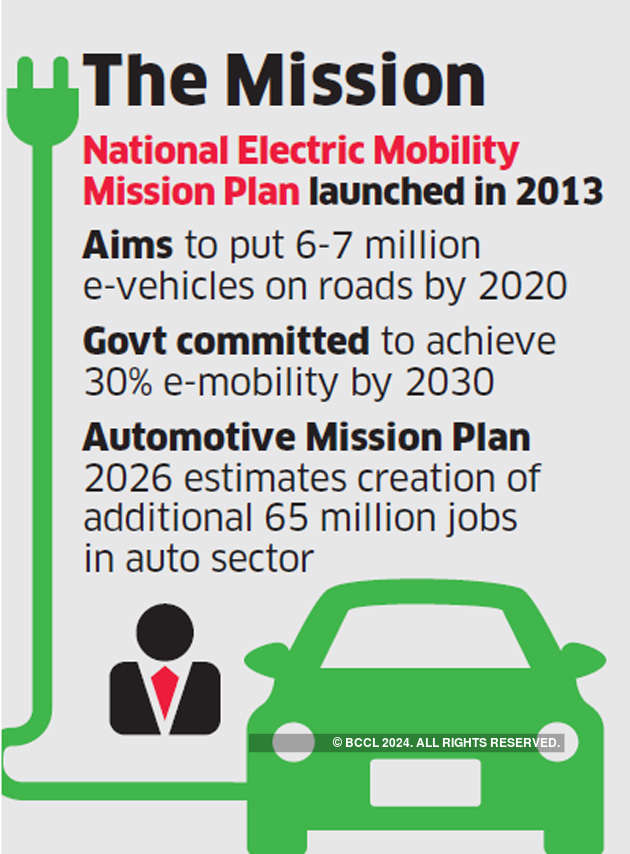
    • The plan was launched by the Government of India in 2013 with the objective of achieving national fuel security by promoting electric and hybrid vehicles.
    • It had set a target of achieving a sale of seven million EVs by 2020 and thereby aimed to cut total carbon dioxide emissions by three per cent from the ‘do nothing’ scenario.
    • The government would provide fiscal and monetary incentives for this industry.
    • The plan had made several recommendations for the adoption of electric vehicles (EVs), including electric-powered government fleets and public transportation and subsidies for those who opt for EVs.

    What was the petition about?

    • The petition contended that the governmental apathy has violated the fundamental rights of citizens to health and clean environment guaranteed under Articles 14 and 21 of the Constitution.
    • The government had failed in its obligation to mitigate the impact of climate change and air pollution partly attributable to emissions from vehicles that burn fossil fuels.
    • Government’s failure to suitably implement these recommendations is the direct cause of air pollution levels that have turned our cities into virtual ‘gas chambers’.
  • [pib] APNA UREA – SonaUgle


    APNA UREA – SonaUgle

    • The Union Minister for Chemicals and Fertilizers launched the “APNA UREA – SonaUgle” brand of Hindustan Urvarak & Rasayan Limited (HURL).
    • HURL is Joint Venture Company promoted by the three Maharatna Companies i.e. Coal India Limited (CIL), NTPC Limited (NTPC) and Indian Oil Corporation Limited (IOCL) as the lead promoters with FCIL and HFCL as other two partners.
    • The commissioning of the HURL’s three Units in the states of UP, Bihar and Jharkhand will open forward and backward linkages for business activity in the Eastern part of India.
    • It will be instrumental in opening new avenues for the generation of income and employment in the Eastern part of our country.
  • Telecommunication Consumers Education and Protection Fund (TCEPF)

    The Telecom Regulatory Authority of India (TRAI) has informed that telecom service providers will need to deposit all unclaimed money of consumers, including excess charges and security deposit, in the Telecommunication Consumers Education and Protection Fund (TCEPF).

    Telecommunication Consumers Education and Protection Fund (TCEPF)

    • The TCEPF Regulations, 2007 have been amended to provide the basic framework for depositing unclaimed money of consumers by service providers, maintenance of the TCEPF and other related aspects.
    • Any unclaimed / unrefundable amount belonging to consumers in the TCEP fund will be utilized for the welfare measures of the consumers.
    • With this amendment, service providers will deposit any unclaimed consumer money of any form such as excess charges, security deposit, plan charges of failed activations, or any amount belonging to a consumer, which service providers are unable to refund to consumers.

    Why such move?

    • The TRAI observed that there is a need to bring clarity among service providers in depositing money which they are unable to refund to the consumers.
    • While some service providers were depositing money only on account of excess billing revealed in the audit, others were depositing unclaimed money such as security deposits and plan charges of failed activations.
  • [op-ed snap] The perils of RBI’s fixation on inflation

    Context

    The RBI’s responsibility to regulate the financial sector may have taken a back seat after the adoption of inflation targeting as the main objective. Has a fixation with inflation rate made the RBI take its eyes off the loan books of the banks?

    Evolution of the role of the Central Banks

    • Maintaining financial stability: The establishment of some of the world’s oldest central banks was inspired by the goal of maintaining financial stability.
      • Harm to the depositors: It was recognised that when private commercial banks fail, whether due to malfeasance or misjudgement, they harm their trusting depositors.
      • Harm to the entire system: But when banks fail they not only harm the depositors they can also take down with them the rest of the financial system.
    • Banks lending to one another: The entire financial system also gets harmed when banks have lent to one another, which is not uncommon.
      • The collapse of credit: In the crisis that ensues, there is a collapse of credit which, in turn, leads to a downturn in economic activity.
    • Lender of last resort: To avoid this, the central bank was conceived of as the lender of last resort.
      • Prevention of run on the banks: Lender of last resort is the one that could pre-empt a run on banks and give them time to put their books back in order.
      • Regulation of banks: However, this was to be accompanied by the adoption of a tough regulatory stance.
      • Whereby the central bank would stay hawk-eyed towards the activities of banks, particularly risky lending.
    • Rise of neo-liberalism and change in a role: With the rise of neoliberalism, the central tenet of which is that markets should be given free play, the regulatory role of central banks took a back seat.
      • Inflation control as primary role: The Central banks came to be primarily mandated with inflation control.

    Inflation targeting and regulation of the financial market by RBI

    • Multiple indicator approach: In India, the RBI had earlier pursued a ‘multiple indicators approach’.
      • What was the multiple indicator approach: The approach involves concern for outcomes other than inflation, including even the balance of payments.
      • Discouraging the approach: Developments in economic theory discouraged ‘multiple indicators approach’.
      • It was argued that having economic activity as an objective of monetary policy leads to higher inflation.
    • Favouring low inflation over lower unemployment: Discouraging the ‘multiple indicator approach’ encouraged low inflation over low unemployment.
    • Inflation targeting as the sole objective of monetary policy: The Indian government also instituted inflation targeting as the sole objective of monetary policy.
      • The fixed target for the RBI: The RBI was permitted to exceed or fall short of a targeted inflation rate of 4% by a margin of 2 percentage points.
    • But have the RBI’s original mandate as a central bank been met?
      • IL&FS crisis: In 2018, within three years of the adoption of inflation targeting goal, a crisis engulfed IL&FS, a non-banking financial company in the infrastructure space.
      • Not a small player: It operated over 100 subsidiaries and was sitting on a debt of ₹94,000 crores.
      • Effects of default: Given this, IL&FS default had a chilling effect on the investors, banks and mutual funds associated with it both directly or indirectly.
      • PMC bank crisis: In 2019, a run on the Punjab and Maharashtra Co-operative Bank had to be averted by imposing withdrawal limits.
      • Outright fraud in PMC case: While in the case of IL&FS, some part of the problem may have been caused by a slowing economy, outright fraud underlay the crisis at PMC Bank.
      • Raghavendra Sahakara Bank case: In early 2020, curbs have had to be placed on withdrawals from the Bengaluru-based Sri Guru Raghavendra Sahakara Bank.
    • Pertinent question
      • Regulatory sector at the backseat? It is not too early to ask if the RBI’s responsibility to regulate the financial sector may have taken a back seat after the adoption of inflation targeting as the main objective.
      • Has a fixation with inflation rate made the RBI take its eyes off the loan books of the banks?

    The recent rise in inflation and shortfall of currency notes

    • Inflation at 7%: At over 7%, the inflation rate in December is the highest in five years.
      • Not cause of concern: This may not be the reason to panic, for the price rise could be seasonal and may well abate.
      • Question on inflation targeting: But it does raise a question on the efficacy of inflation targeting as a means of inflation control.
      • Reason for moderate inflation so far: If the inflation rate was within the intended range so far, that may have been due to both declining food prices and, for a phase, oil prices.
    • The shortfall of notes: The central bank has a monopoly on the issue of notes.
      • There is an absolute shortage of small denomination notes in the bazaars of India.
      • Small-denomination notes are mostly unavailable.

    Conclusion

    While focusing on the inflation, the Central bank also needs to keep the other mandates especially the regulation of the finance sector in check.


  • [pib] Assam Inland Water Transport Project

    India and the World Bank signed a loan agreement of $88 million for Assam Inland Water Transport Project.

    Assam Inland Water Transport Project

    • A majority of Assam’s more than 361 ferry routes cross the Brahmaputra or serve its islands, providing a crucial means of transport to thousands of commuters in both the urban and rural areas of the Brahmaputra Valley.
    • The project will draw guidance from ‘working with nature’ principles that aim to design new infrastructure or rehabilitate existing infrastructure in a way that works with natural river processes.
    • The terminals will have better access, lighting and signage while the new vessels will allow for individual seats, and separate toilets. Moreover, a strengthened regulatory regime will ensure reduction in overloading, adherence to time schedule and better crew standards.
    • The Project will help Assam improve the passenger ferry infrastructure and its services and strengthen the capacity of the institutions running the inland water transport.

    Significance

    • Inland Water Transport is also a more sustainable mode of transport. And Assam has the largest network of navigable waterways in India.
    • It provides low-carbon and low-cost options when compared to the cost of constructing and maintaining flood-resilient roads and bridges across the long stretches of the Brahmaputra river.
    • Technically better-designed terminals and energy-efficient vessels (both new and retrofitted) will make the ferry services more sustainable with least disruption to nature.
  • [op-ed snap] Power replay

    Context

    Five years after the launch of UDAY, power-sector once again seems to be going deep into the troubles.

    Where the Discoms stand now?

    • Losses increased: The losses of state-owned distribution companies (discoms) risen.
    • Dues increased: Discom’s dues for power purchases have also surged.
      • Dues owed by discoms to power producers, both independent and state-run entities, stood at Rs 80,930 crore.
      • Of these, Rs 71,673 crore extends beyond the allowed grace period of 60 days.
      • Rajasthan leads the states with the most dues, followed by Tamil Nadu and Uttar Pradesh.

    Components of UDAY and progress made

    • The UDAY scheme, which involved state governments taking over the debt of discoms, had three critical components
    • First-Reduction in AT&C losses: While progress has been made on some of these fronts, it hasn’t been in line with the targets laid out under UDAY.
      • AT&C (Aggregate Technical and Commercial) losses have declined in some states, but not to the extent envisaged.
      • Under UDAY, discoms were to bring down AT&C losses to 15 per cent by FY19.
    • Second- Timely revision of tariffs: While some states have raised power tariffs, the hikes have not been sufficient.
      • In tariff revision decisions political considerations prevailed over commercial decisions.
    • Third- elimination of the gap between per unit of cost and revenue realised: The gap between the average cost per unit of power and the revenue realised has not declined in the manner envisaged.
      • Because of this discoms were forced to reduce their power purchases and delay payments to power producers.

    Way forward:

    • The new plan, being formulated by the government reportedly, aims to address these issues by-
      • Reducing electricity losses.
      • Eliminating the tariff gap.
      • Smart metering.
      • Privatising discoms.
      • Having distribution franchisees.
    • Altering incentive structure: Along with the above, the Centre should also look at altering the incentive structures of states in order to ensure compliance.
    • Provision of penalties: Stiff penalties need to be imposed for not meeting the targets laid out in the new scheme.


  • [op-ed snap] Reset and reform

    Context

    With the Indian economy caught in the middle of a socio-economic upheaval, the government needs to make its focus on the economy clear and pronounced.

    India in the middle of a socio-economic upheaval

    • Weakening economy: The economy has been weakening for a couple of years now.
    • Social upheaval: The social upheaval is new but its seeds have been fermenting for a while.
    • Consequences of the two: The social and economic sides of an economy are not divorced from each other.
      • Each influences the other and the current quagmire threatens to unleash the worst type of feedback between the two.

    Consequences for the employment

    • Most severe consequence due to the interaction between the social and economic sides is unemployment.
    • Rising unemployment disproportionately affects the young.
    • India’s job market: India whose median citizen is in the 30s and which is inducting 10 million new young people to the job market every year.
    • Demographic dividend turning into a curse: This dynamic, popularly hailed as India’s demographic dividend, can rapidly turn into a demographic curse if the employment situation doesn’t improve.

    Falling investment rate, increased risk perception

    • Where will the jobs come from? The job creators are entrepreneurs, conglomerates, and multinationals.
      • It is in their nature to take investment risks as long as the returns are high enough.
    • Investment rates below 30: In India, investment rate fell well below 30 per cent a while back.
      • Falling returns: The returns on investment were not compensating entrepreneurs for the risk.
      • The recent social upheaval is only adding to the perceived risk.
    • Wait and see approach: The more investors adopt a “wait-and-see” approach, the worse the job situation will become.

    Way forward

    • Structural reforms: The government needs to announce a clear plan and timeline for structural reforms.
    • Prioritising domain competence in staff: The government has to start staffing technical positions by prioritising domain competence and empowering these hires with policy relevance.
    • Maintaining the integrity of institutions: The government need to maintain the integrity of institutions tasked with the regulation of corporations and banks, monetary policy management, data collection/dissemination and law enforcement.
    • Accommodate dissent: The government also needs to desist from trying to drown out protesting voices with state muscle power.


  • HSN Code


    No imports will be allowed without HSN code into the country clarified the Union Minister of Commerce & Industry.

    What is HSN Code?

    • HSN code stands for “Harmonized System of Nomenclature”.
    • This system has been introduced for the systematic classification of goods all over the world.
    • HSN code is a 6-digit uniform code that classifies 5000+ products and is accepted worldwide.
    • It was developed by the World Customs Organization (WCO) and it came into effect from 1988.
    • The main purpose of HSN is to classify goods from all over the World in a systematic and logical manner. This brings in a uniform classification of goods and facilitates international trade.