💥Mains Ready By December. Smash Mains & Smash PYQ Admissions Open

Subject: Economics

  • Video based Customer Identification Process (V-CIP)

    The RBI has amended the KYC norms allowing banks and other lending institutions regulated by it to use Video-based Customer Identification Process (V-CIP), a move which will help them, onboard customers, remotely.

    V-CIP

    • The V-CIP will be consent-based, will make it easier for banks and other regulated entities to adhere to the RBI’s KYC norms by leveraging the digital technology.
    • The regulated entities will have to ensure that the video recording is stored in a safe and secure manner and bears the date and time stamp.
    • As per the circular, the reporting entity should capture a clear image of PAN card to be displayed by the customer during the process, except in cases where e-PAN is provided by the customer.
    • The PAN details should be verified from the database of the issuing authority.
    • Live location of the customer (Geotagging) shall be captured to ensure that customer is physically present in India.
  • [op-ed snap] Limited scope for sharp recovery

    Context

    In order to revive the economy, the Government must choose between tax reductions and increasing rural spending.

    The Current Status of the Indian Economy

    • 5 % in 2019-20: The first advance estimate pegs India’s economic growth at 5 per cent in 2019-20.
    • Cause of the slowdown: The slowdown can be attributed largely to a structural demand problem in the economy along with some cyclical
    • Stagnant income and stagnant incomes: Despite largely stagnant incomes, private consumption has been financed over the past few years through lower savings, easy credit, and certain one-offs such as the Seventh Pay Commission led pay-outs.
    • Private consumption is the largest driver of growth.
    • Depleting savings: The household savings rate has dipped to 17.2 per cent of GDP in FY18, from 22.5 per cent in FY13.
    • Depleting credit in the system: Overall credit in the system has dried up.

     Rural economy

    • Low wages and stagnant incomes: Rural wage growth has averaged around 4.5 per cent over the past five years, but adjusting for inflation it has been only 0.6 per cent.
    • Weak real estate sector: The rural population, which was dependent on urban real estate/construction has faced headwinds in the recent past.
    • The sector is experiencing lower private sector investments recently.

    Limited scope for a sharp recovery

    • The following factors render the scope for sharp recovery limited.
    • Consumption issue is structural:  The slowdown in private consumption is a structural issue linked to low household income growth.
    • Low job creation: Low consumption is in turn, linked to the basic problems of low job creation.
    • Low Income: Low consumption is also linked with stagnant farm incomes.
    • None of the above factors is likely to change suddenly, limiting the scope of recovery.
    • Low Investments: Investment is unlikely to rebound sharply given the challenges on both income and balance sheet of the government, private sector, and households.
    • Stressed Government consumption: Which has been supporting growth over the past few years, remains under stress.
    • The combined Centre and states’ fiscal deficit is close to 6.5 per cent of GDP.
    • The public sector is already weighing on the limited domestic financial resources, ruling out space for an aggressive fiscal stimulus.
    • NBFC’s role: Recovery will also depend on the health of the financial sector, especially that of NBFCs.

     Use of the fiscal space

    • Supply-side: The government has shown a clear preference to rely on supply-side measures (like corporate tax cut) to support growth.
    • Need to address demand-side: Expectations will be high that the upcoming Union budget addresses the demand side concerns as well.
    • Spending on rural infrastructure and employment (MGNREGA, PM-KISAN, PMGSY) can decrease pain in rural areas.
    • Given the narrow income tax base, any sacrifice of the fiscal room would be beneficial only for a limited number of people.

    Way forward

    • Widening of the tax base- Given the narrow income tax base, any sacrifice of the fiscal room would be beneficial only for a limited number of people.
    • Broad-basing of the income and consumption profile: Economic reforms in the past have worked to enhance the capacity of the top few hundred million consumers.
    • The next set of reforms should enhance the capacity of those in the middle and the bottom of the income pyramid.
    • Role of the private sector: Given the huge infrastructure gap in the country, it is essential that the private sector’s role in infrastructure creation is much more inclusive.

    Conclusion

    Reforms that increase the productivity of the factors of production, provide an enabling environment for competitive production of goods and services and ensure steady and substantial growth in purchasing power for a larger section of the population should be the focus.
     

  • Explained: Voting at the GST Council

    • Breaking the tradition of consensus-based decisions in its 37 earlier meetings, the GST Council voted for the first time in its 38th meeting held on December 18.

    GST Council voting rules

    • As per The Constitution (One Hundred and First Amendment) Act, 2016, in case of a voting, every decision of the GST Council has to be taken by a majority of not less than three-fourths of the weighted votes of the members present.
    • The vote of the central government has a weightage of one-third of the total votes cast, and the votes of all the state governments taken together have a weightage of two-thirds of the total votes cast in that meeting.
    • As of now, out of the total 30 states and UTs (excluding J&K), 20 are ruled by the NDA.
    • This essentially means that a vote in the Council could largely be an academic exercise — unless a number of the BJP’s allies switch sides.

    Impacts of imbibing Voting

    • With the precedent of voting now established, consensus at the Council could be challenged again in the future.
    • The rules of voting in the GST Council are such that the odds are stacked in favour of the Centre in the normal course.
    • However, in case of a vote, any disagreements within the ruling coalition at the Centre may bring its support below the three-fourths majority that is needed for the passage of a decision.

    Way Forward

    • Differences of opinion are likely to crop up on proposals to raise rates, especially of the lower slabs, in the future — a concern that made most states rule out an immediate rate hike in the last Council meeting, even as they were in agreement over a broader overhaul of the GST structure.
    • So far, even if states voiced their differences over a proposal in the Council, all decisions had been taken by consensus in the meetings of the GST Council.
    • With a departure from the consensus approach having been made, there could be more instances of voting exercises going forward — especially as revenue-raising measures come up in future meetings.

    Back2Basics

    GST Council

    • The GST Council is a federal body that aims to bring together states and the Centre on a common platform for the nationwide rollout of the indirect tax reform.
    • It is an apex member committee to modify, reconcile or to procure any law or regulation based on the context of goods and services tax in India.
    • The GST Council dictates tax rate, tax exemption, the due date of forms, tax laws, and tax deadlines, keeping in mind special rates and provisions for some states.
    • The predominant responsibility of the GST Council is to ensure to have one uniform tax rate for goods and services across the nation.

    How is the GST Council structured?

    • The Goods and Services Tax (GST) is governed by the GST Council. Article 279 (1) of the amended Indian Constitution states that the GST Council has to be constituted by the President within 60 days of the commencement of the Article 279A.
    • According to the article, GST Council will be a joint forum for the Centre and the States. It consists of the following members:
    1. The Union Finance Minister will be the Chairperson
    2. As a member, the Union Minister of State will be in charge of Revenue of Finance
    3. The Minister in charge of finance or taxation or any other Minister nominated by each State government, as members.

    Terms of reference

    • Article 279A (4) specifies that the Council will make recommendations to the Union and the States on the important issues related to GST, such as, the goods and services will be subject or exempted from the Goods and Services Tax.
    • They lay down GST laws, principles that govern the following:
    1. Place of Supply
    2. Threshold limits
    3. GST rates on goods and services
    4. Special rates for raising additional resources during a natural calamity or disaster
    5. Special GST rates for certain States
  • FDI in coal mining

    The Union Cabinet has approved an ordinance to amend two laws to ease mining rules, enabling foreign direct investment in coal mining.

    About the Ordinance

    • At a Cabinet meeting chaired by PM the ordinance to amend the Mines and Minerals (Development and Regulation) Act, 1957 and the Coal Mines (Special Provisions) Act, 2015 was approved.

    Benefits of the proposed FDI

    • The decision would boost the ease of doing business and increase the growth avenues.
    • The Coal India would be strengthened and the government was aiming at achieving production of one billion tonnes by 2023-2024.
    • The “end-use restrictions” had been done away with allowing “anyone to participate in the auction of coal blocks”.
    • The ordinance would strengthen the auction process of those mines whose leases were expiring on March 31, 2020. Seamless transfer of clearances would also be facilitated.

    Back2Basics

    Foreign Direct Investment (FDI)

    • A FDI is an investment in the form of a controlling ownership in a business in one country by an entity based in another country.
    • It is thus distinguished from a foreign portfolio investment by a notion of direct control.
    • FDI are commonly made in open economies that offer a skilled workforce and above-average growth prospects for the investor, as opposed to tightly regulated economies.
    • FDI frequently involves more than just a capital investment. It may include provisions of management or technology as well.
  • Explained: First Advance Estimates (FAE)

    The First Advance Estimates (FAE) were recently released by the Ministry of Statistics and Programme Implementation (MoSPI).

    The First Advance Estimates and their significance

    • The First Advance Estimates (FAE) extrapolate a variety of data, such as the Index of Industrial Production (IIP), the financial performance of listed companies, first advance estimates of crop production etc., for the first 7 to 8 months to arrive at the annual figure.
    • The significance of the FAE is that this is the final bit of official data before the government presents its next Budget.
    • The sector-wise Estimates are obtained by extrapolation of indicators like-
    1. IIP of first 7 months of the financial year,
    2. financial performance of Listed Companies in the Private Corporate sector available upto quarter ending September, 2019
    3. 1st Advance Estimates of Crop production,
    4. accounts of Central & State Governments, information on indicators like Deposits & Credits, Passenger and Freight earnings of Railways, Passengers and Cargo handled by Civil Aviation, Cargo etc., available for first 8 months of the financial year”.

    Estimates for 2018-19

    • It estimated India’s GDP will grow by just 5 per cent in the current financial year (2019-20). Last financial year, 2018-19, the Indian economy grew at 6.8 per cent.
    • The gross value added (GVA), which maps the economic activity from the income side as against the GDP which maps it from the expenditure side, is expected to grow by 4.9 per cent in 2019-20 as against 6.6 per cent in 2018-19.

    Drivers of the GDP

    There are four main drivers of the GDP:

    • One, the private consumption expenditure – that is the expenditure that you and I make in our personal capacity. This category has grown by just 5.7 per cent in 2019-20 while it grew by 8 per cent last financial year.
    • The second driver is the expenditure made by the Government. This grew by 10.5 per cent, which is higher than the rate of growth (9.2 per cent) in the last financial year.
    • But the most disappointing number is the deceleration in business investments in the economy.
    • This driver, which is the key to sustainable long-term growth, grew by less than 1 per cent; last financial year it grew by 10 per cent.
    • This shows that while the private consumption demand is tepid, businesses have completely turned off the tap on new investments despite the government making a once-in-generation cut in corporate taxes.

    Performance in terms of GVA

    • The GVA data provides a detailed picture. Given that the overall GVA has decelerated sharply, almost all sectors have witnessed slower growth in economic activity.
    • Only “Public Administration, Defence and Other Services,“ which essentially measures how the government did, grew by 9.1 per cent.
    • All other sectors saw a GVA growth that was slower than the average growth in the last financial year.
    • The worst performing sectors are ‘Agriculture, Forestry and Fishing’, ‘Mining and Quarrying’, ‘Manufacturing’ and ‘Construction’, which are expected to see a GVA growth of 2.8 per cent, 1.5 per cent, 2.0 per cent and 3.2 per cent respectively.

    Back2Basics

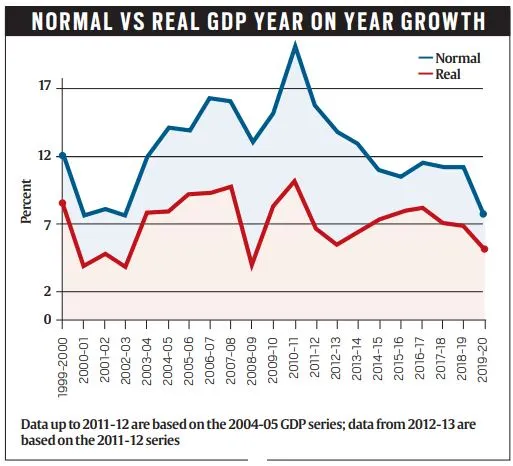
    Real vs. Nominal GDP

    • GDP is the total market value of all goods and services produced in the economy during a particular year, inclusive of all taxes and subsidies on products.
    • The market value taken at current prices is the nominal GDP.
    • The value taken at constant prices — that is prices for all products taken at an unchanged base year (2011) — is the real GDP.
    • In simple terms, real GDP is nominal GDP stripped of inflation.
    • Real GDP growth thus measures how much the production of goods and services in the economy has increased in actual physical terms during a year.
    • Nominal GDP growth, on the other hand, is a measure of the increase in incomes resulting from rise in both production and prices.
  • Government Owned Contractor Operated (GOCO) Model 

    Indian Army has initiated the process of identifying potential industry partners to implement the Government Owned Contractor Operated (GOCO) model for its base workshops and ordnance depots intended to improve operational efficiency.

    GOCO model

    • The GOCO model was one of the recommendations of the Lt. Gen. DB Shekatkar (Retd.) committee to enhance combat capability and re-balancing defence expenditure.
    • In GOCO model, the assets owned by government will be operated by the private industries.
    • Under the GOCO model, the private companies need not make investments on land, machinery and other support systems.
    • The missions are set by government and the private sectors are given full independence in implementing the missions using their best practices.
    • The main advantage of the model is that the targets are achieved in lesser time frame. Also, it will boost competitiveness among the private entities paving way to newer technologies.

    Who will be eligible under the mode?

    • The service provider should be an Indian registered company with at least 10 years of working experience in related domains and have an average annual turnover of ₹50 crore for each of the last three financial years.
  • Operation Twist

    Reserve Bank of India Governor has informed that the market’s reaction to Operation Twist was on expected lines.

    Operation Twist

    • The simultaneous buy-sell of government bonds, known as Operation Twist, was conducted to bring down long-term interest rate while allowing short term rates to inch up.
    • The move was aimed at addressing liquidity, which is assymetric — abundant at the shorter end but not on the longer end. The move will help in monetary transmission.
    • The central bank has so far carried out three rounds of simultaneous bond buy-and-sell via open market operations.

    For more reading, navigate to the page:

    https://www.civilsdaily.com/news/operation-twist/

  • [pib] New Energy Performance Standards for Air Conditioners

    The Central Government in consultation with the Bureau of Energy Efficiency (BEE) has notified new energy performance standards for Room Air Conditioner (RACs).

    240C default setting

    • The 240C default setting has been made mandatory from Jan 1, 2020 for all room air conditioners covered under the ambit of BEE star-labelling program vide this notification.
    • Additionally, the Indian Seasonal Energy Efficiency Ratio (ISEER) as per the new standards will range from (3.30 – 5.00) for split and (2.70 – 3.50) for window air conditioners, which will be applicable from 1st January 2021 onwards.
    • ISEER is the energy performance index used for Room Air Conditioners (RACs) and its assessment is based on the bin hours defined in ISO 16358.

    Voluntary star labelling program

    • BEE launched the voluntary star labelling program for fixed-speed room air conditioners (RACs) in 2006, and this program became mandatory on 12th January 2009.
    • Thereafter, in 2015, voluntary star labelling program for inverter room air conditioners was launched and which was made mandatory with effect from 1st January 2018.
    • The BEE star labelling program for Room Air Conditioners now covers both fixed and inverter RAC up to a cooling capacity of 10,465 watts (2.97 TR).
    • Continual enhancement in performance levels has resulted in substantial energy efficiency improvement of about 43% in the minimum energy performance standards (MEPS) for split units, which are the most popular RACs sold in the market.

    About BEE

    • BEE is a statutory body under the Ministry of Power, Government of India.
    • It is assisted in developing policies and strategies with the primary objective of reducing the energy intensity of the Indian economy.
    • BEE coordinates with designated consumers, designated agencies, and other organization to identify and utilize the existing resources and infrastructure, in performing the functions assigned to it under the energy conservation act.
  • [pib] Network for Scientific Co-operation for Food Safety and Applied Nutrition (NetSCoFAN)

    Union Health Minister has launched NetSCoFAN, a network of research & academic institutions working in the area of food & nutrition.

    NetSCoFAN

    • The NetSCoFAN would comprise of eight groups of institutions working in different areas viz. biological, chemical, nutrition & labelling, food of animal origin, food of plant origin, water & beverages, food testing, and safer & sustainable packaging.
    • FSSAI has identified eight Nodal Institutions who would develop a ‘Ready Reckoner’ that will have inventory of all research work, experts and institutions and would carry out and facilitate research, survey and related activities.
    • It would identify research gaps in respective areas and collect, collate and develop database on food safety issues for risk assessment activities.
    • The need for identify research gaps in respective areas and collect, collate and develop database on food safety issues for risk assessment activities, will be addressed by NetSCoFAN.
    • The NetSCoFAN directory would be covering detailed information of various heads/Directors and lead scientists of lead and associated partnering institutions.
  • [op-ed snap]Lifting growth, containing inflation

    Context

    There is a large scope for  the improvement in the efficiency of grain management system under the National Food Security Act (NFSA).

    Declining Agri-sector growth rate

    • India’s growth rate plummeted to 4.5 per cent in the second quarter of this fiscal.
    • The quarterly growth in GDPA (agri-GDP) is hovering at around 2 percent, it is a cause for great concern.
    • Agriculture still engages about 44 per cent of India’s workforce, which has serious consequences for the overall economy of the country.

    The bleak picture of the economy

    • Recently inflation has started to surge after a long time.
    • Inflation is led by the different components of the food segment- cereals, pulses, and vegetables.
    • There is a challenge of containing inflation and increasing the demand at the same time.
    • At the same time, there is also the challenge of maintaining the fiscal deficit by 3.3 %.
    • Recently Finance minister has launched an investment package of 102 lakh crores.
    • So, there is a need to take a look at the inefficiencies in food grain management.

    Inefficiencies in NFSA

    • It supplies a certain quantity of wheat and rice to 67 percent population.
    • It gives wheat at Rs. 2/kg and rice at Rs. 3/kg.
    • While the cost of these grains to FCI is at Rs. 25/kg and Rs. 35/kg respectively.
    • This led to the provision of Rs 1.84 lakh crores for food subsidy.
    • The buffer stocks with the FCI is far more than double the buffer stock norms as on January 1 every year.
    • This excess stock is the result of an inefficient strategy for food management.
    • The strategy where the procurement of these grains is open-ended while the disbursement is restricted.
    • The money locked in these excess stock is about 1 lakh crores.
    • If the rabi season procurement is good FCI may run out of storage space to accommodate.

    Suggestions for improvement

    • The open market operation should be increased.
    • Even if the government liquidate half of the excess stock it would fetch Rs.50,000 crores.
    • The Shanta Kumar panel had submitted the blueprint for the improvement in the grain management system.
    • Only three reiterations are needed.
    • First-while the Antyodaya category should keep getting the maximum food subsidy, the issue price should be fixed at 50% of the procurement for the rest.
    • Second- restrict the percentage of population covered under the scheme to 40 % from the present 67%
    • Third-stop the procurement of rice in the north-western states of Punjab and Haryana where the water table is depleting.

    Conclusion

    • If the government implements these three points it can save the country another Rs. 50,000 crores annually. On top of this, it will help the government to reduce its fiscal deficit.