The National Green Tribunal (NGT) has directed the Punjab government to devise a comprehensive strategy for managing the estimated 19.52 million tonnes of paddy stubble in the state.
About National Green Tribunal (NGT)
Description
Establishment
Formed in 2010 under the National Green Tribunal Act as a statutory body.
Objective
To deal with cases related to environmental issues and ensure speedy implementation of decisions.
Responsible for making many prominent decisions aimed at environmental protection, including addressing air pollution in Delhi and cancelling coal block clearances.
Composition
Headquartered in Delhi, chaired by a retired Supreme Court judge
Included Judicial Members and Expert Panel.
Powers
Empowered to decide on questions related to various environmental laws and hear civil cases concerning environmental issues:
The Water (Prevention and Control of Pollution) Act, 1974;
The Water (Prevention and Control of Pollution) Cess Act, 1977;
The Forest (Conservation) Act, 1980;
The Air (Prevention and Control of Pollution) Act, 1981;
The Environment (Protection) Act, 1986;
The Public Liability Insurance Act, 1991;
The Biological Diversity Act, 2002.
Exceptions
Prohibited to hear any issues which are covered under:
The Indian Forest Act, 1927,
The Wildlife (Protection) Act, 1972, and
Any other laws made by States which are related to protection of trees, forests, etc.
Places
Principal bench in Delhi;
Additional benches in Bhopal, Pune, Kolkata, and Chennai.
Governing Principles
Governed by principles of natural justice, not bound by Indian Evidence Act.
Applies principles of sustainable development, precautionary, and polluter pays.
Review and Challenge
NGT orders can be reviewed as per Rule 22 of NGT Rules.
Can be challenged before the Supreme Court within ninety days.
NGT intervention in Punjab
The ban and action against people burning crop residue are regulated under the Air (Prevention and Control of Pollution) Act, 1981.
Punjab is required to provide details on the steps taken to utilize paddy straw in the previous year, including the mode and manner of removal, transportation, and utilization in various units.
Punjab estimated an increase in paddy straw generation to 52 million tonnes in 2024, with a projected utilization of 18.66 million tonnes.
Notably, the off-site utilization is expected to see a significant 60% increase, with 5.96 million tonnes being utilized in industrial and energy plants.
Alternatives used for Stubble Burning
In-Situ Treatment: This involves managing crop residue directly in the field. Examples include using zero-tiller machines and bio-decomposers to break down stubble.
Ex-Situ Treatment: This method involves treating crop residue outside the field. An example is using rice straw as cattle fodder.
Turbo Happy Seeder (THS) Technique: This can uproot stubble and sow seeds while clearing the field. The stubble can then be used as mulch.
Pusa-Biodecomposer
Pusa-Biodecomposer is a fungi-based liquid solution developed by the Indian Council of Agricultural Research (ICAR).
It softens hard stubble, making it easy to mix with soil as compost.
It produces enzymes to digest cellulose, lignin, and pectin in paddy straw, rapidly converting crop residues and other waste into organic manure.
PYQ:
[2019] Consider the following:
1. Carbon monoxide
2. Methane
3. Ozone
4. Sulphur dioxide
Which of the above are released into atmosphere due to the burning of crop/biomass residue?
The Andaman and Nicobar Islands administration sought assistance from the Wildlife Institute of India to manage the increasing population of chital (spotted deer) in Ross Island, officially known as the Netaji Subhash Chandra Bose Island.
Chital in Andaman Islands
The Chital, originally native to mainland India, were introduced to Ross Island (0.3 sq km) by the British in the early 20th century.
Lacking natural predators or competitors and possessing strong swimming abilities, the Chital rapidly proliferated across the Andamans.
About Chital(spotted deer)
The Spotted Deer, scientifically known as Axis axis, is a species of deer native to the Indian subcontinent.
It is characterized by its reddish-brown coat adorned with white spots, particularly prominent in juveniles.
Spotted Deer inhabit various types of forest habitats, including dry and moist deciduous forests, grasslands, and open woodlands.
The Spotted Deer is classified as a species of Least Concern (LC) on the IUCN Red List and Schedule II animal under Wildlife Protection Act, 1972.
Definition of Invasive Alien Species (IAS):
The Convention on Biological Diversity (CBD) defines invasive alien species (IAS) as species whose introduction and/orspread outside their natural past or present distribution poses a threat to biological diversity.
These species encompass animals, plants, fungi, and even microorganisms, and can affect various types of ecosystems.
According to the CBD, characteristics of IAS include their ability to “arrive, survive, and thrive” in new environments.
The Invasive Species Specialist Group (ISSG) is a global network of scientific and policy experts on invasive species, organized under the auspices of the Species Survival Commission (SSC) of the International Union for Conservation of Nature (IUCN)
It refers to species of animal or plant not native to India whose introduction or spread may threaten or adversely impact wildlife or its habitat.
Notably, this definition EXCLUDES species within India that may be invasive to specific regions, such as the chital in the Andamans.
Examples of Invasive Wildlife in India:
Fish Species:
Examples include the African catfish, Nile tilapia, red-bellied piranha, and alligator gar.
These species were introduced to fulfill the demand for maintaining aquariums.
Reports indicate their presence in various inland systems and lakes in India.
Turtle Species:
Notably, the red-eared slider, a favored exotic pet in India, is often abandoned in local water bodies.
Originating from North America, this species is known for outcompeting local freshwater species due to its rapid reproduction.
Impact of IAS on Native Flora and Fauna
Disruption of Ecosystem Balance:
Invasive species act as disruptors in the food chain, disturbing the balance of ecosystems.
In habitats lacking competition, invasive species can dominate the entire ecosystem.
Specific Examples:
In Keoladeo Park, Bharatpur, Rajasthan, a UNESCO World Heritage site, the African catfish has been observed preying on waterfowl and migratory birds.
Studies have shown that the proliferation of chital in the Andamans has negatively impacted the regeneration of native vegetation, as these deer are known to consume seeds and seedlings.
IAS’ Economic Impact:
Global Perspective:
A report by the UN-founded Intergovernmental Platform on Biodiversity and Ecosystem Services (IPBES) in September 2023 revealed that approximately 37,000 established alien species were introduced worldwide, with roughly 200 new alien species introduced annually.
The economic cost of IAS globally surpassed $423 billion annually in 2019, primarily due to the damage inflicted on natural ecosystems.
Local Implications:
In India, the National Biodiversity Action Plan of 2019, published by the National Biodiversity Authority, highlighted the economic impact of invasive species such as the cotton mealybug (Phenacoccus solenopsis).
This invasive species, native to North America, has significantly affected cotton crops in the Deccan region, leading to substantial yield losses.
PYQ:
[2023] Invasive Species Specialist Group’ (that develops Global Invasive Species Database) belongs to which one of the following organizations?
(a) The International Union for Conservation of Nature
(b) The United Nations Environment Programme
(c) The United Nations World Commission for Environment and Development
(d) The World Wide Fund for Nature
This newscard is an excerpt from an articles which delves into the historical and social context of the Jenu Kuruba community, including their displacement from their traditional lands in the Western Ghats due to conservation efforts.
About Jenu Kuruba
The Jenu Kuruba tribe, numbering around 37,000, resides primarily in the Nilgiris region, bordering Kerala and Karnataka.
Their traditional occupation involves collecting honey in the forest, reflected in their name where ‘Jenu’ means ‘honey’ in Kannada.
In the early 20th century, they lived in forest huts and engaged in cultivation.
Social organization of Jenu Kurubas’
They speak the Jenu Kurumba language, which is related to Kodava or considered a rural dialect of Kannada.
Historically, they engaged in activities like food gathering, collecting minor forest produce, and handling elephants.
They typically reside in small settlements known as Hadi and practice shifting cultivation.
Social organization within the community is semi-nomadic, with decentralized authority led by a head-man (yajamana) and a ritual head or shaman (gudda).
Their rehabilitation
The tribe has fought for their rights to live in reserved forests, most recently in 2020 under the Forest Rights Act.
In 2021, protests continued against the forest department for promoting eco-tourism and safaris, which are deemed illegal under Indian and international laws.
From the 1970s onwards, many Jenu Kurubas have been evicted from their homes due to conservation efforts in tiger reserves like Nagarhole and Bandipur.
Those relocated outside the forest often work as daily wagers, agricultural laborers, or on coffee estates in Kodagu.
PYQ:
[2013] Consider the following pairs :
Tribe: State
1. Limboo Limbu : Sikkim
2. Karbi : Himachal
3. Dongaria Kondh : Odisha
4. Bonda : Tamil Nadu
Which of the above pairs are correctly matched?
(a) 1 and 3 only
(b) 2 and 4 only
(c) 1, 3 and 4 only
(d) 1, 2, 3 and 4
[2014] With reference to ‘Changpa’ community of India, consider the following statement :
1. They live mainly in the State of Uttarakhand.
2. They rear the Pashmina goats that yield a fine wool.
3. They are kept in the category of Scheduled Tribes.
Which of the statements given above is/are correct?
Q) ‘Climate change’ is a global problem. How India will be affected by climate change? How Himalayan and coastal states of India will be affected by climate change? (UPSC CSE 2017)
Q)Describe the major outcomes of the 26th session of the Conference of the Parties (COP) to the United Nations Framework Convention on Climate Change (UNFCCC). What are the commitments made by India in this conference? (UPSC CSE 2021)
Note4Students:
Prelims: NA;
Mains: Social Issues; Women Issues;
Mentor comments: Women are very effective at mobilizing communities during disasters. They are at the frontline in moving forward with recovery. Women further hold key knowledge of most of the Natural Resources and their management. Hence, they can be the key actors in Climate Adaptation and Mitigation.
However, women and girls have less access to climate information, early warnings, agricultural advisory services, mobile phone technology, and financial credit. For example, more women than men died in the Indian Ocean Tsunami in 2004 because they were less likely to know how to swim, and long clothing hampered their movement. Now, we have no time to lose as we are standing at the intersection of inequality and climate change, and our strategies must reflect the urgency of the times.
Let’s learn.
—
Why in the News?
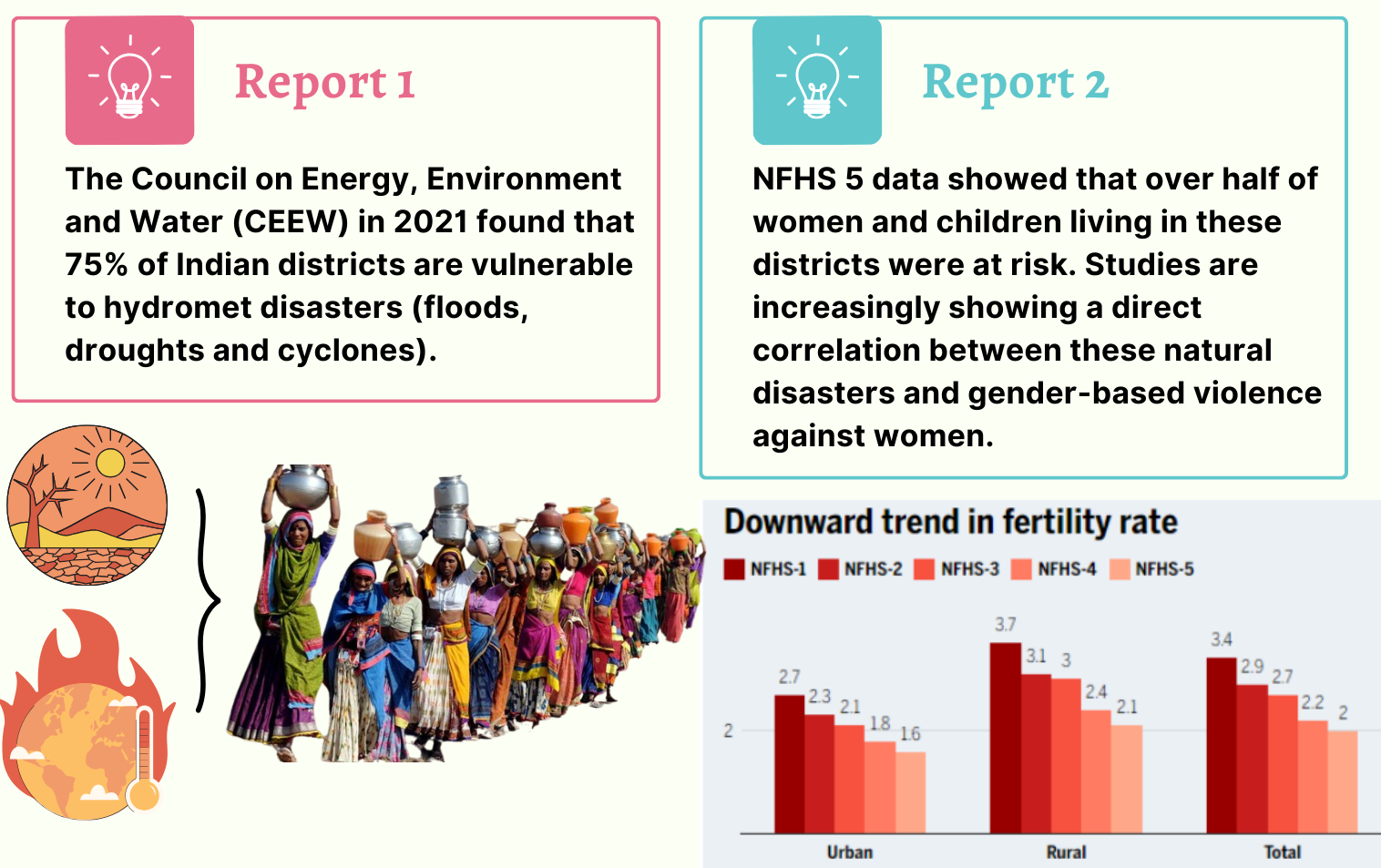
According to the United Nations Development Programme (UNDP), women and children are 14 times more likely than men to die in a disaster.
Tropical countries in the past decade are likely to face unprecedented heatwaves.
The SC has just recently ruled that people have a right to be free from the adverse effects of climate change, and the right to a clean environment is already recognized as a Fundamental Right within the ambit of the ‘Right to Life’.
Why Women are more vulnerable due to Climate Change Impacts?
High Sector-Specific Dependency: Agriculture is the most important livelihood source for women in India, particularly in rural India. Climate-driven crop yield reductions increase poverty.
Men Vs. Women Scenario: Within small and marginal landholding households, while men face social stigma due to unpaid loans (leading to migration, emotional distress, and sometimes even suicide), women experience higher domestic work burdens, worse health, and greater intimate partner violence.
The Scenario in Drought-prone Areas:National Family Health Survey 4 and 5 data showed that women living in drought-prone districts were more underweight, experienced more intimate partner violence, and had a higher prevalence of girl marriages.
Poverty and Insecurity: The increasing food and nutritional insecurity, work burdens and income uncertainties lead not only to poor physical health but also impact their mental health and emotional well-being.
How do the Extreme Climatic Events result in gender-based violence?
Reduced Self-Care: Subsequent changes in water cycle patterns severely impact access to safe drinking water, which increases the drudgery and reduces the time for productive work and self-health care of women and girls.
Maternal Issues: Prolonged heat is particularly dangerous for pregnant women (Chances of Preterm Birth/ Eclampsia), young children, and the elderly.
Cardiovascular disease: Air Pollution affects women’s health, causing respiratory and cardiovascular disease, and also the unborn child, impairing its physical and cognitive growth. One of the most worrying aspects is its impact on the growing brain.
Emerging data from cohort studies in India show that the risk of lung cancer increases by 9% due to PM2.5
Why does Climate Action need Women?
Improve Agri-Productivity: Women increased their agricultural yields by 20% to 30% when provided with the same access to resources as men.
Enhanced Conservation: Tribal and rural women have been at the forefront of environmental conservation.
Empowerment: Giving women and women collectives (Self-help Groups and Farmer Producer Organisations) the knowledge, tools, and access to resources would encourage local solutions to emerge.
Reducing CO2 emissions is crucial:
Creating Cooler Environments: Immediate action is needed to protect vulnerable groups from heatwaves, such as providing cooling spaces and adjusting work schedules.
Planting trees and vegetation can create a cooler and more sustainable environment.
Upgrading Infrastructure: Urban planning can help mitigate heatwave and drought impacts, such as increasing green spaces and using heat-resistant materials.
Improving early warning systems for heatwaves, creating more cooling shelters and green spaces, and promoting awareness campaigns about heatwave risks and safety measures are crucial for preparedness and mitigation.
Water Conservation: Traditional rainwater harvesting and storage systems in India can be revived using geographic information systems and local planning.
Improving water use efficiencies, and reusing treated wastewater can help reduce the strain on freshwater resources.
Technological Interventions: The M.S. Swaminathan Research Foundation in a few districts of Tamil Nadu showed that by using Geographic Information Systems (GIS), Panchayats could improve the groundwater crisis.
It identified vulnerabilities and climate hazards and developed a local plan to improve water access by directing government schemes and resources.
Titled “Geospatial modelling and mapping of soil erosion in India,” the report marks the first attempt to classify soil erosion on a pan-India basis.
The study categorizes soil erosion into six classifications, ranging from “minor” to “catastrophic,” based on the amount of soil eroded per hectare over a year.
Soil Erosion in India
Soil erosion is the process by which soil is removed or displaced from its original location, often due to the action of wind, water, or human activities.
It is a natural geological process accelerated by various factors such as deforestation, overgrazing, improper agricultural practices, urbanization, and climate change.
Key trends in India
Nearly 30% of the country’s landmass is experiencing “minor” soil erosion.
Critical 3% (approx. 1500 sq km) faces “catastrophic” topsoil loss.
The Brahmaputra Valley in Assam emerged as the most significant hotspot for soil erosion, with close to 300 square kilometers or 31% of its surface soil lost to “catastrophic” erosion.
The lower Himalayan region, extending from Kashmir to Uttarakhand and beyond, and Odisha also face severe erosion challenges, posing threats to biodiversity and environmental stability.
Causes of Soil Erosion
Anthropogenic Causes: Soil erosion in India is primarily caused by human activities including deforestation, overgrazing, improper land use practices, and construction activities.
Natural Causes: The monsoon season, characterized by heavy rainfall, exacerbates soil erosion, especially in regions with steep slopes and poor vegetation cover.
Impact of Soil Erosion
Topsoil, essential for agriculture due to its nutrient-rich composition, is crucial for sustaining crop growth.
Erosion diminishes soil fertility, leading to reduced crop yields and agricultural productivity.
Revised Universal Soil Loss Equation (RUSLE) Methodology
The Revised Universal Soil Loss Equation (RUSLE) is a widely used empirical model for estimating soil erosion rates.
It is used to predict the average annual soil loss caused by sheet and rill erosion from specific field areas.
The RUSLE methodology considers various factors that contribute to soil erosion, including rainfall, soil erodibility, slope length and steepness, vegetation cover, and conservation practices.
The equation for RUSLE is:
A = R * K * LS * C * P
Where:
A is the estimated average annual soil loss (in tons per acre per year).
R is the rainfall factor, representing the erosive power of rainfall.
K is the soil erodibility factor, representing the susceptibility of soil to erosion.
LS is the slope length and steepness factor, accounting for the effect of slope on erosion.
C is the cover management factor, indicating the impact of vegetation cover and land use practices on erosion.
P is the conservation practice factor, reflecting the effectiveness of erosion control practices implemented.
PYQ:
[2014] In India, the problem of soil erosion is associated with which of the following?
1. Terrace cultivation
2. Deforestation
3. Tropical climate’
Select the correct answer using the code given below:
The India Meteorological Department (IMD) recently said that India will have more than the ‘usual’ number of days with heat waves in this summer.
Increasing Temperature in India and its impact as per IMD:
Temperature Predictions: The Indian Meteorological Department (IMD) predicts “above-normal” temperatures for April-June 2024, with a probability of 55%-65% in one half of the country and over 65% in the other half. Few parts are expected to have normal or below-normal temperatures.
Effect of Heat on Agriculture: Higher heat negatively impacts crop yield, agricultural workers’ productivity, and water availability, varying in degree depending on the crop.
Consequences of Heat in Urban Area: Increased heat leads to higher power demand in urban and industrial centers, poses deadly risks for outdoor workers (such as at construction sites), overwhelms health service providers (especially affecting the very young and old), and highlights the importance of access to clean, cool water, indoor ventilation, and bathrooms.
Power Demand: The availability of power is crucial for addressing the effects of heat. A chart shows that in March 2024, the average evening peak-hour demand reached a new high of 190 GW.
Major challenges around the Energy Demand and Government Targets:
Government Targets: The government aims to achieve 500 GW of power generation capacity from renewable energy sources by 2030. Additionally, it has committed to producing 50% of its power from non-fossil fuel energy sources by the same year.
Heat increases power demand: Heat boosts power demand in cities and industries, heightens risks for outdoor labor, strains healthcare services for vulnerable groups, and underscores the necessity of clean water, ventilation, and bathrooms. Power availability is fundamental for addressing these challenges.
Focus on Solar Power: A substantial portion of the renewable energy addition will come from solar power. However, due to the intermittent nature of solar output and the ongoing establishment of power storage capacity, coal is still relied upon to meet peak demand.
Coal’s Dominance: Chart 3 (above) illustrates the gross electricity generated using coal in India and coal’s share in total electricity generation. The coal’s share has remained between 70-74% since at least FY16.
Commercially Viable Energy Storage: In India, the most commercially viable energy storage forms currently are battery-based and Pumped Hydro Storage (PHS).
Renewable Energy Generation: Chart 4 depicts the gross electricity generated using renewable sources in India and the share of renewable sources in total electricity generation. The share of renewables, including solar, hydro, wind, etc., has remained between 20-25% since at least FY16
Major Dilemma For India: Cannot ignore Coal immediately:
Coal is projected to continue as the backbone of the Indian energy system until the next two decades and its phase-down will require active policies on critical minerals, according to a report by the Indian Institute of Management (IIM)- Ahmedabad.
The report, titled ‘Synchronising energy transitions towards a possible Net Zero for India: Affordable and Clean Energy for All,’ asserted that net zero is not possible without substantial nuclear power and renewable energy generation by 2070.
To achieve net-zero energy systems by 2070, the report mentioned that the electricity sector will need to decarbonize well before that.
Way Forward:
NDC Goals: The remaining gaps in emissions will be offset through sequestration in forestry and tree cover as envisaged in our Nationally Determined Contributions (NDCs).
Need for Technological intervention: There is no silver bullet to achieve net zero. The transition needs multiple pathways to be adopted with the co-existence of myriad technologies in our energy basket.
Mains PYQ
Q Discuss the implications of heightened heat waves in India, as highlighted by recent statements from the India Meteorological Department (IMD).
This newscard is an excerpt from the original article published in TH.
What is Gape Limitation?
In ecology, the concept of ‘gape limitation’ sheds light on a simple yet crucial idea: predators can only eat prey that fit into their mouths.
It dictates the range of prey accessible to predators, influencing the dynamics of ecological communities.
Imagine a predator fish species with a relatively small mouth or gape size. This fish species primarily feeds on small aquatic invertebrates like zooplankton and small crustaceans. Due to its limited gape size, it cannot consume larger prey items such as larger fish or large insects.Now, let’s introduce a different predator fish species with a larger mouth or gape size. This predator has a broader diet and can consume a wider range of prey items, including smaller fish and larger invertebrates.In this scenario, the predator with the larger gape size has a competitive advantage over the predator with the smaller gape size. It can exploit a greater variety of prey resources, potentially leading to differences in foraging success, growth rates, and overall fitness between the two predator species.This example demonstrates how gape limitation can influence the feeding ecology and interactions between predator and prey species in an ecosystem.
A rare Total Solar Eclipse will be visible across North America on April 8.
What are Eclipses?
Eclipses are astronomical events that occur when the sun, moon, and Earth align in specific ways.
There are two primary types of eclipses: solar and lunar.
A solar eclipse happens when the moon comes between the sun and Earth during a new moon, blocking out the sun’s light.
Conversely, a lunar eclipse occurs when the Earth is positioned between the sun and the moon during a full moon, casting a shadow on the moon.
What is a Total Solar Eclipse?
During a total solar eclipse, the moon passes between the sun and Earth, entirely covering the face of the sun along a small path of our planet’s surface.
This is called the “path of totality.”
The daytime sky turns dark, similar to dusk or dawn, and nocturnal animals have been known to wake up, confused into believing night has arrived.
Stages of a Total Solar Eclipse
A total solar eclipse unfolds in several distinct stages.
It starts with a partial eclipsephase as the moon begins to pass between Earth and the sun, partially blocking it and leaving the sun looking like it has a crescent shape.
In the subsequent Baily’s Beads phase, points of light from the sun shine around the moon’s edges because of the irregular lunar topography, producing small beads of light.
In the diamond ring phase, a single bright spot appears along the lunar edge even as the sun’s atmosphere leaves a ring of light around the moon. This phenomenon precedes totality.
After totality, the other phases repeat as the moon keeps moving along its path until the eclipse ends.
Other types of solar eclipses:
Partial Solar Eclipse
This happens when the sun, moon and Earth are not exactly lined up.
The sun appears to have a dark shadow on only a small part of its surface.
Annular Solar Eclipse
An annular eclipse happens when the moon is farthest from Earth. Because the moon is farther away from Earth, it seems smaller. It does not block the entire view of the sun. The moon in front of the sun looks like a dark disk on top of a larger sun-coloured disk. This creates what looks like a ring around the moon.
During a solar eclipse, the moon casts two shadows on Earth. The first shadow is called the Umbra. This shadow gets smaller as it reaches Earth. It is the dark centre of the moon’s shadow.
The second shadow is called the Penumbra. The penumbra gets larger as it reaches Earth. People standing in the penumbra will see a partial eclipse. People standing in the umbra will see a total eclipse.
Why don’t solar eclipses happen at every New Moon?
The reason is that the Moon’s orbit tilts 5° to Earth’s orbit around the Sun.
Astronomers call the two intersections of these paths nodes.
Eclipses only occur when the Sun lies at one node and the Moon is at its New (for solar eclipses) or Full (for lunar eclipses) phase.
During most (lunar) months, the Sun lies either above or below one of the nodes, and no eclipse happens.
PYQ:
2013:
Consider the following phenomena
1. Size of the sun at dusk
2. Colure of the sun at dawn
3. Moon being visible at dawn
4. Twinkle of stars in the sky
5. Polestar being visible in the sky
Which of the above are optical illusions?
(a) 1, 2 and 3
(b) 3, 4 and 5
(c) 1, 2 and 4
(d) 2, 3 and 5
Practice MCQ:
Which of the following statements best characterizes a Total Solar Eclipse?
(a) A total solar eclipse occurs when the Moon partially blocks the Sun, leaving a visible ring of sunlight around the Moon’s silhouette.
(b) During a total solar eclipse, the Moon completely covers the Sun, casting a shadow on a narrow path on the Earth’s surface called the umbra.
(c) Total solar eclipses occur more frequently than partial solar eclipses due to the precise alignment of the Sun, Earth, and Moon.
(d) Total solar eclipses can only be observed from specific locations on Earth, making them rare and highly sought-after astronomical events.
The forest staff across the Kerala State are on alert with the onslaught of summer, with temperatures reaching as high as 40-41 degrees Centigrade, unusual for this time.
Forest Fires in Kerala
Kerala records relatively fewer forest fires compared to several other states in India, including Chhattisgarh, Odisha, Madhya Pradesh, Assam, and Maharashtra.
Kerala’s forest cover, occupying 29.65% of the land, is dominated by deciduous and semi-deciduous woods that are drying up, especially on the forest periphery because of it Forest staff in Kerala are on alert
Kerala reported 163 wildfire incidents since January, resulting in the burning of 230 hectares of forest, which is less compared to previous years.
Global Forest Watch data indicates 97 VIIRS(Visible Infrared Imaging Radiometer Suit) fire alerts in Kerala between March 15 and 22, with only 5.2% of them classified as high-confidence alerts.Fires were responsible for 0.33% forest cover loss in Kerala between 2001 and 2022 according to Global Forest Watch.
What is the frequency of forest fires in India?
Escalation Of forest Fire : Forest fire season in India typically spans from November to June, during which hundreds of thousands of small and large fires occur annually. The frequency of fires tends to escalate from February onwards as summer approaches.
forest Fires as per (ISFR) : In its 2021 report, the biennial India State of Forest Report (ISFR) released by the Forest Survey of India (FSI) indicates that 35.47% of the forest cover is classified as fire-prone areas.
Region more prone to forest Fire
Fires of severe magnitude occur frequently in dry deciduous forests, whereas evergreen, semi-evergreen, and montane temperate forests are relatively less susceptible to fires.
During the November to June period, the forests in Northeast India, Odisha, Maharashtra, Jharkhand, Chhattisgarh, and Uttarakhand face the highest risk of fires.For example in 2021, a string of forest fires occurred in Uttarakhand, Himachal Pradesh, the Nagaland-Manipur border, Odisha, Madhya Pradesh, and Gujarat, including within wildlife sanctuaries.
In 2024 forest Fires: According to data from the Forest Survey of India (FSI), Mizoram reported the highest number of forest fires (3,738), followed by Manipur (1,702), Assam (1,652), Meghalaya (1,252), and Maharashtra (1,215).
Reason behind the forest fires in India
The majority of forest fires in India are ignited by human activities, including:
Agricultural Burning: Farmers often use fire to clear land for cultivation or to manage crop residues, leading to accidental fires spreading into nearby forests.For example Jhum (slash and burn cultivation)
Intentional Arson: Deliberate setting of fires for various reasons, such as land grabbing, hunting, or retaliatory actions.
Carelessness: Unattended campfires, discarded cigarettes, or burning of waste materials can spark fires.
Climate Conditions: Dry and hot weather conditions during the summer months create favorable conditions for the rapid spread of fires. .For example forest fires has worsen due to climate change as per UNEP
Plan for Fighting forest Fires
Early Detection: Implement systems for early detection of forest fires, such as fire watchtowers, aerial surveillance, and remote sensing technologies like drones and satellites.
Rapid Response: Develop well-trained and equipped firefighting teams capable of swift response to contain fires in their early stages before they escalate.
Controlled Burns: Conduct controlled burns during cooler and wetter months to remove excess vegetation and reduce the risk of large-scale wildfires during dry seasons.
Firebreaks: Create and maintain firebreaks by clearing vegetation along strategic points to halt the spread of fires.
Community Involvement: Educate local communities about fire prevention and train them in firefighting techniques. Encourage community participation in fire management efforts.
Equipment and Infrastructure: Ensure availability and proper maintenance of firefighting equipment such as hoses, pumps, bulldozers, and firefighting aircraft.
Conclusion
Forest fires in India, exacerbated by climate conditions, pose significant threats. Kerala’s proactive measures and community involvement highlight effective strategies for prevention and control, crucial in mitigating the increasing frequency of fires nationwide.
An earthquake of magnitude 4.8 hit the New York City in a rare event.
The Ramapo Fault in Appalachian Mountains near New Jersey is a being considered as a reason behind this earthquake.
Appalachian Mountains
The Appalachian Mountains extend from the Canadian province of Newfoundland and Labrador in the north to central Alabama in the southern US.
The total length of the Appalachian Mountain range is approximately 2,200 miles (3,500 kilometers), making it one of the longest mountain chains in the world.
Geologically, it is one of the oldest mountain ranges on Earth, formed over 480 million years ago during the Ordovician Period. They are considered a Paleozoic mountain range.
They were formed through a series of tectonic collisions and uplift events, including the assembly of the supercontinent Pangaea.
The highest peak in the range is Mount Mitchell in North Carolina, standing at an elevation of 6,684 feet (2,037 meters) above sea level.
The Appalachian Mountains hold cultural significance for various indigenous tribes, including the Cherokee, as well as early European settlers who established communities in the region.
About Ramapo Fault
Fault lines are fractures in the Earth’s crust that facilitate movement of tectonic plates, triggering earthquakes.
The Ramapo Fault is resulted from tectonic activity associated with the breakup of the supercontinent Pangaea during the Mesozoic Era.
It is primarily a right-lateral strike-slip fault, formed by horizontal movement along the fault line due to the ongoing motion between the North American and Eurasian plates.
While the Ramapo Fault is not as seismically active as faults in other regions, it has experienced earthquakes in the past and remains a potential source of seismic hazards.
Geographical Distribution:
The fault extends across three states in the northeastern United States: Pennsylvania, New Jersey, and New York.
The fault crosses various topographic features, including riftvalleys, hills, and ridges, reflecting the diverse geological history of the region.
It intersects with the Appalachian Mountains, influencing the overall topography of the surrounding areas.
PYQ:
[2012] When you travel in Himalayas, you will see the following:
1. Deep gorges
2. U-turn river courses
3. Parallel mountain ranges
4. Steep gradients causing land-sliding
Which of the above can be said to be the evidences for Himalayas being young fold mountains?

![[10 April 2024] The Hindu Op-ed: The climate crisis is not gender neutral](https://d18x2uyjeekruj.cloudfront.net/wp-content/uploads/2024/04/10-april-1568x882.jpg)